
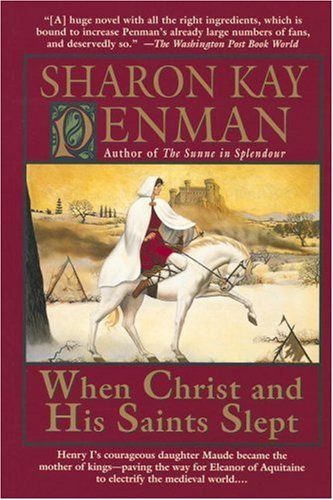
While there are plenty of writers out there who have tackled the Middle Ages and indeed my favourite period of the Angevin kings of England, not one has done it as well as Sharon Kay Penman. I was first given one of her books when I was 16, and while it was seriously weighty – more than 750 pages – I was immediately hooked by the thrilling tale of the Empress Maude and her efforts to take the English throne from her cousin Stephen. The opening pages include a devastatingly emotional account of the White Ship disaster of 1120, and I was utterly fascinated by her ability to make you sympathise with both sides of a battle.
It didn’t hurt that Maude’s war with Stephen also happened to be the ‘prequel’ so to speak to the Angevin era, and towards the end of the book you meet a young Henry Plantagenet, cheeky and confident and full of energy. One can understand why Eleanor, widely acclaimed as one of the most beautiful women in Christendom, would fall in love with his charisma.
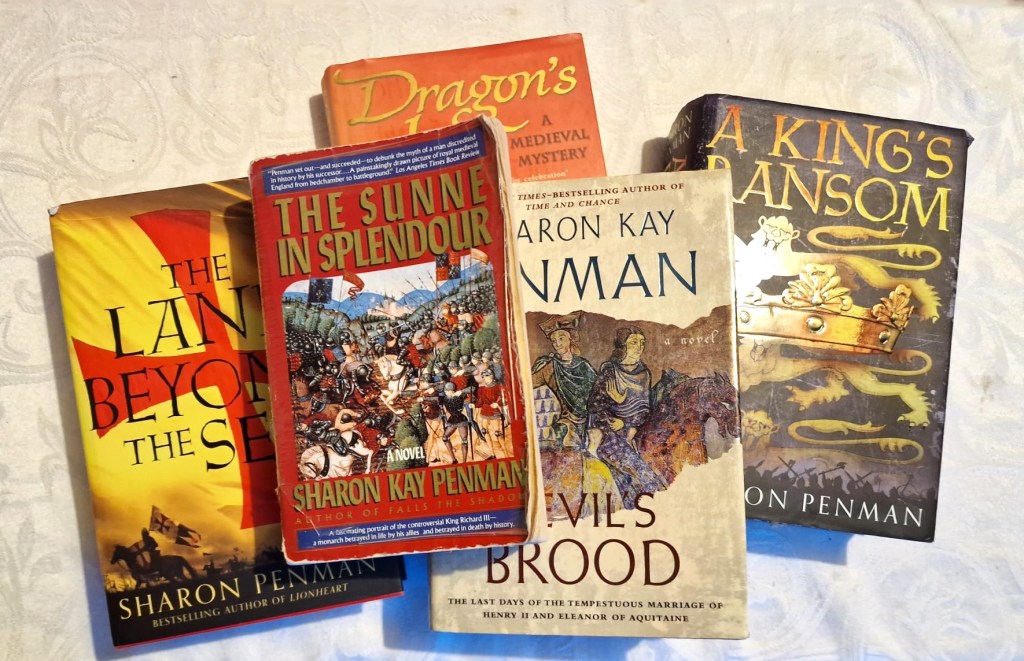
I can fully appreciate that not everyone might find her writing as comfortable as I do – the nuances of medieval politics, characters, and the family trees can be intimidating. Her final book, The Land Beyond the Sea, covering the life of Balian of Ibelin and the relatively short period of the Christian Kingdom of Jerusalem, was inspired I imagine by the research she did for her book on Richard the Lionheart on Crusade. While this era isn’t my specialty, I was able to follow the story, understanding many of the names and families. I did provide the book as a gift to another Penman-lover who did not know the history as well, and that reader struggled I think to keep all the history straight. Here are some of my many reasons why Penman remains one of my favourite writers:
- Character development. I find her writing of people to be powerful, particularly her ability to show both sides of an argument or even a war. Villains are never outright villains, and even the most unlikeable characters are sympathetic at points, and often she makes an effort to explain the reasoning behind unpopular decisions or actions, even if the action is still not justified. Likewise, even the favourite characters, the heroes and heroines, are flawed – much as people are in real life.
- Historical authenticity. Note I do not say accuracy – these are fiction books not textbooks and of course there is creative licence taken. Nonetheless, the in-depth research behind each book is evident in the care taken to have the right people at the right place at the right time, as much as possible. Furthermore, Penman will go into detail in the writer’s note at the end of each book, detailing where her chosen changes were, why she made them, and what the background of the history was. She also admits mistakes in some later re-publications of earlier works. I suppose the only criticism here could be that at times the story is so complex, with many historical characters sharing the same first name, that it can be difficult to follow for someone unfamiliar with the history.
- Historical characters. I happen to agree with Penman’s ‘take’ on many of the historical characters she deals with. She has real sympathy for John, even through his most heinous acts, and her portrayal of Henry and Eleanor is spot-on. I confess that for me, Henry will always be Peter O’Toole in The Lion in Winter (which I am sure I will write about at another point). Penman is perhaps a bit kinder to Richard I than I would have been, but I have very strong opinions on the Lionheart…
- Emotion. I have never managed to finish one of her books without, at least once, being reduced to tears. Her writing can be incredibly poignant, whether it is the defeat of an enemy, true love overcoming all odds, or the end of an independent Wales in the late thirteenth century, the death of Simon de Montfort and the heartbreak of his family, or the chilling helplessness of a woman struggling in childbirth, knowing her battle is for her own life and that of her baby. Her death scenes overall tend to be moving and often heartbreaking, her accounts of famous battles enthralling.
Despite their length, I have read and re-read most of Penman’s books multiple times, and it is incredibly difficult for me to rank them in terms of most or least favourite, though oddly it may be easiest to choose my least. Here is a quick run-down:
While enjoyable, I was less of a fan of her Justin de Quincy mysteries – but really only because I have such a devotion to two of her others series. I found Time and Chance, which focusses largely on the relationship between Henry II and Thomas Beckett, to be hard to follow due to the in-depth sections on the religious controversies, and my general distaste for Becket as a historical character.

The Welsh Princes series is phenomenal and covers most of the thirteenth century, but is also so phenomenally sad in places that I have to prepare myself for what I know is coming.
I’ve already mentioned her final book, The Land Beyond the Sea, which both stands on its own but also serves as a prequel in a way to Lionheart.
The Sunne in Splendour was her first book and covers the life of King Richard III, painting him in a much more sympathetic light than most historians would agree with. It includes, as most of her books do, wonderfully written depictions of medieval battles and a touching love story, a few solid villains and plenty of misunderstood relatives, and as usual, powerful women.
But finally, there is her Plantagenet series, which begins with When Christ and His Saints Slept, above, and ends with A King’s Ransom, the story of Richard I’s imprisonment and the end of his life. This series dovetails nicely into the Welsh Princes story, ending with the start John’s reign. It is also, essentially, my PhD thesis in fictional form, covering the ins and outs of the dramatic Plantagenets with aplomb. All of the people I spent years researching came to life in her pages and for that reason, this series of books are my favourite.
If I had to recommend an introduction to Sharon Kay Penman’s work, I think I would have to start where I did, with When Christ and His Saints Slept. If that does not draw you in, then nothing will!
 The Wandering Medievalist
2 responses to “My thoughts on – the great Sharon Kay Penman”
I think I read most of her books and I am thinking of re-reading When Christ and His Saints Slept….Love, Mum
LikeLike
[…] introduced me to Sharon Penman, an author who would quickly become one of my favourites – as I have written. I also consider this book to be the pinnacle of her writing style: well researched, enthralling, […]
LikeLike