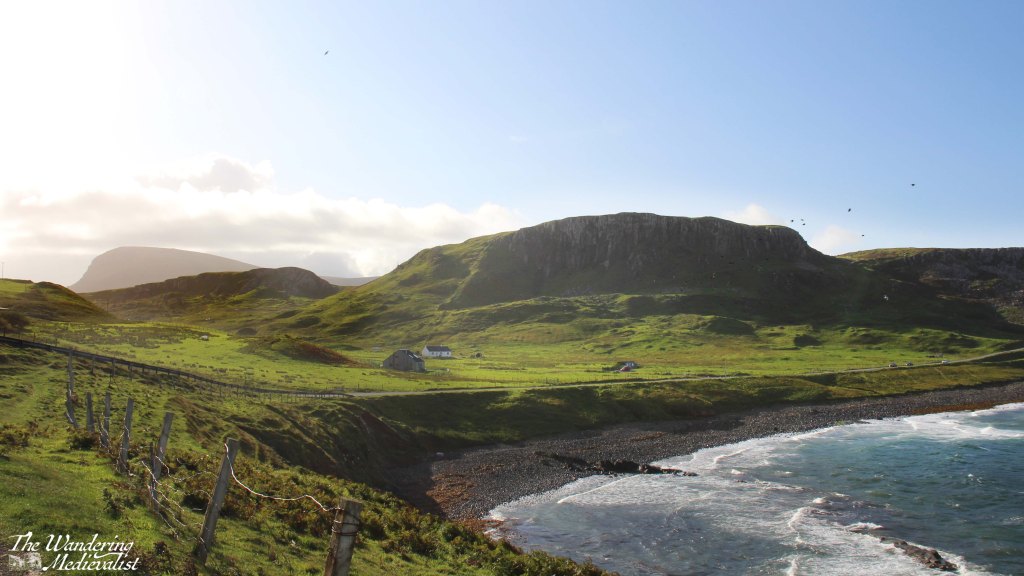
Hunglader is one of those place names that erases any question that the Norse settled in Skye. It was our home for most of the week, and our final morning dawned bright and blue as we packed up and tidied up the Homer. Before finally leaving the north, we ventured down to the local beach, passing on the way some picturesque old Skye-style houses with white walls and thatched roofs.
The beach area offered a decent-sized parking area where two couples in a camper van were just finishing their morning fire. The cliffs towered over the beach and sheltered it somewhat, though the wind was not nearly as strong as we had experienced the day before.
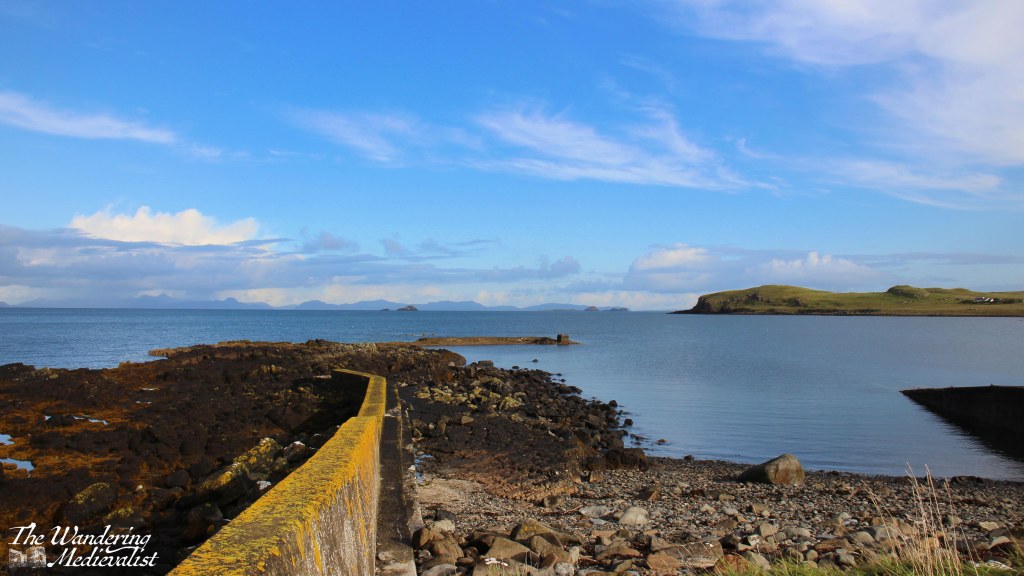
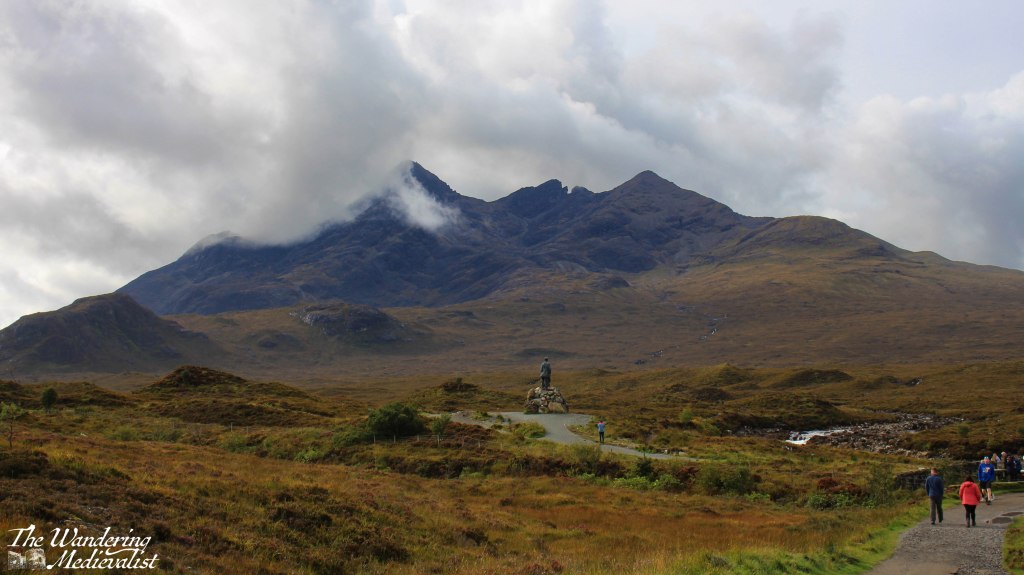
On the way out of town we had one more stop at a ruined church, then we headed south. I was quite keen to make sure we filled up on petrol before leaving Skye, and recalled a number of long queues, so we ended up stopping in Portree and topping up before our final Skye-specific stop, the Sligachan Old Bridge. It was one of several stopping points I had noted on the way north, and it is a gorgeous spot with stunning views up the glen. But it was also midge-infested, so we walked quickly and not as far as I might have hoped.
It is definitely a place to return, with paths heading up towards the Cuillin Mountains. The statue, I should mention, is not some distant historical figure like Bonnie Prince Charlie, but is perhaps more poignantly dedicated to two men who pioneered mountain-climbing on Skye, Norman Collie and John MacKenzie.
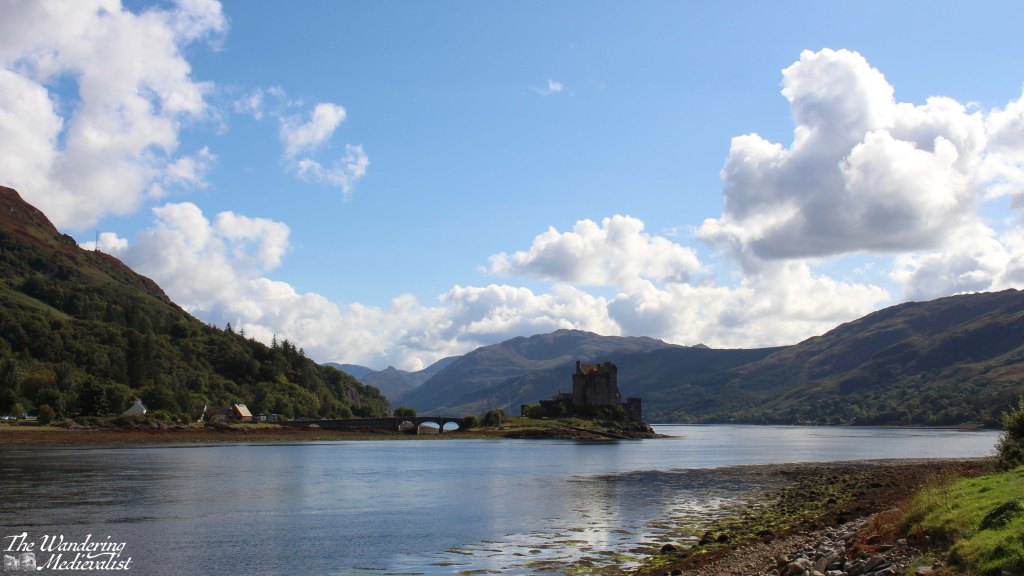
Sligachan was our last stop in Skye, and it was a relief to find the wind had stayed calm as we continued over the bridge and back to the mainland. By this view of Loch Duich it was so still that the waters were almost literally glass-like.
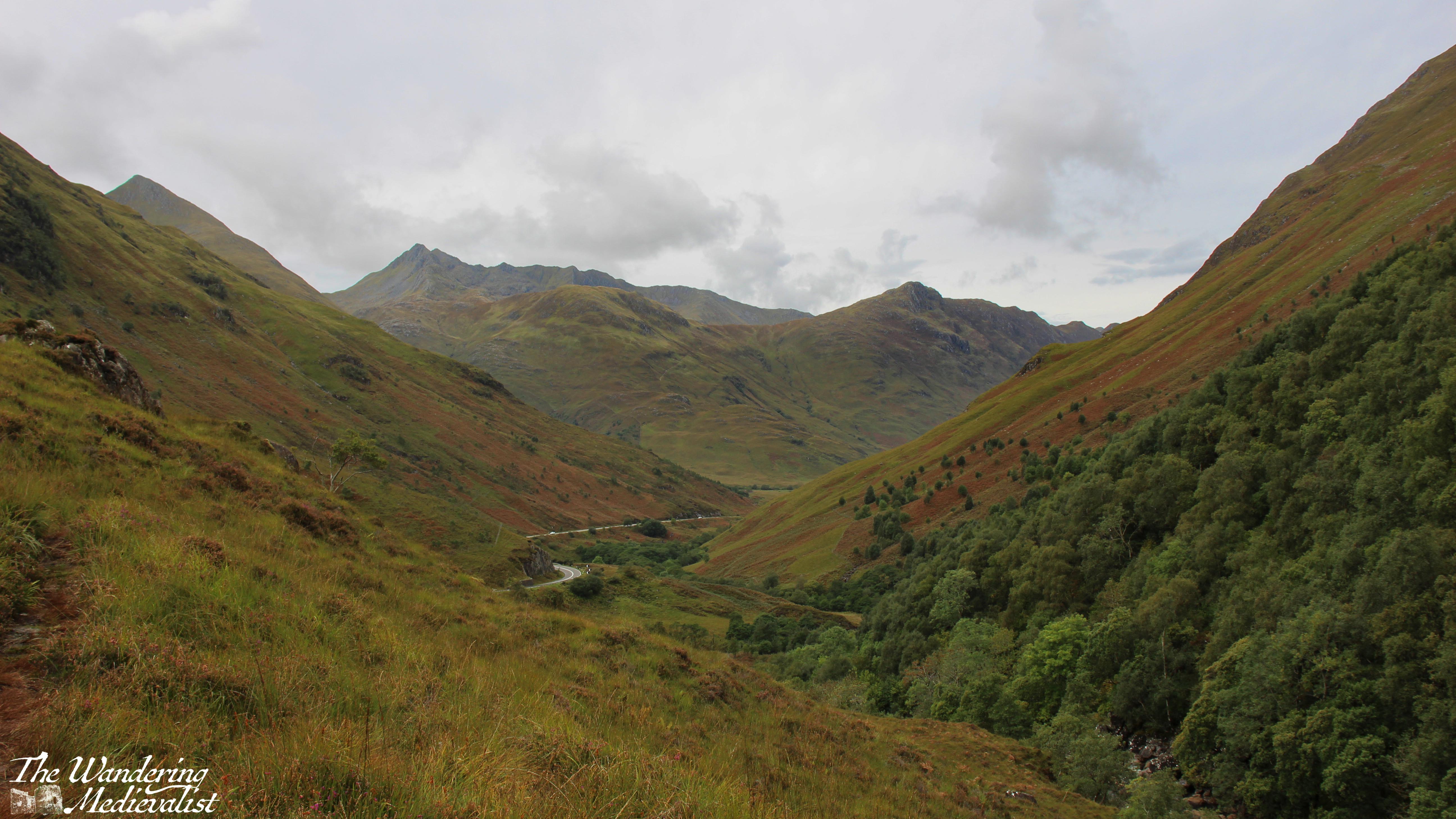
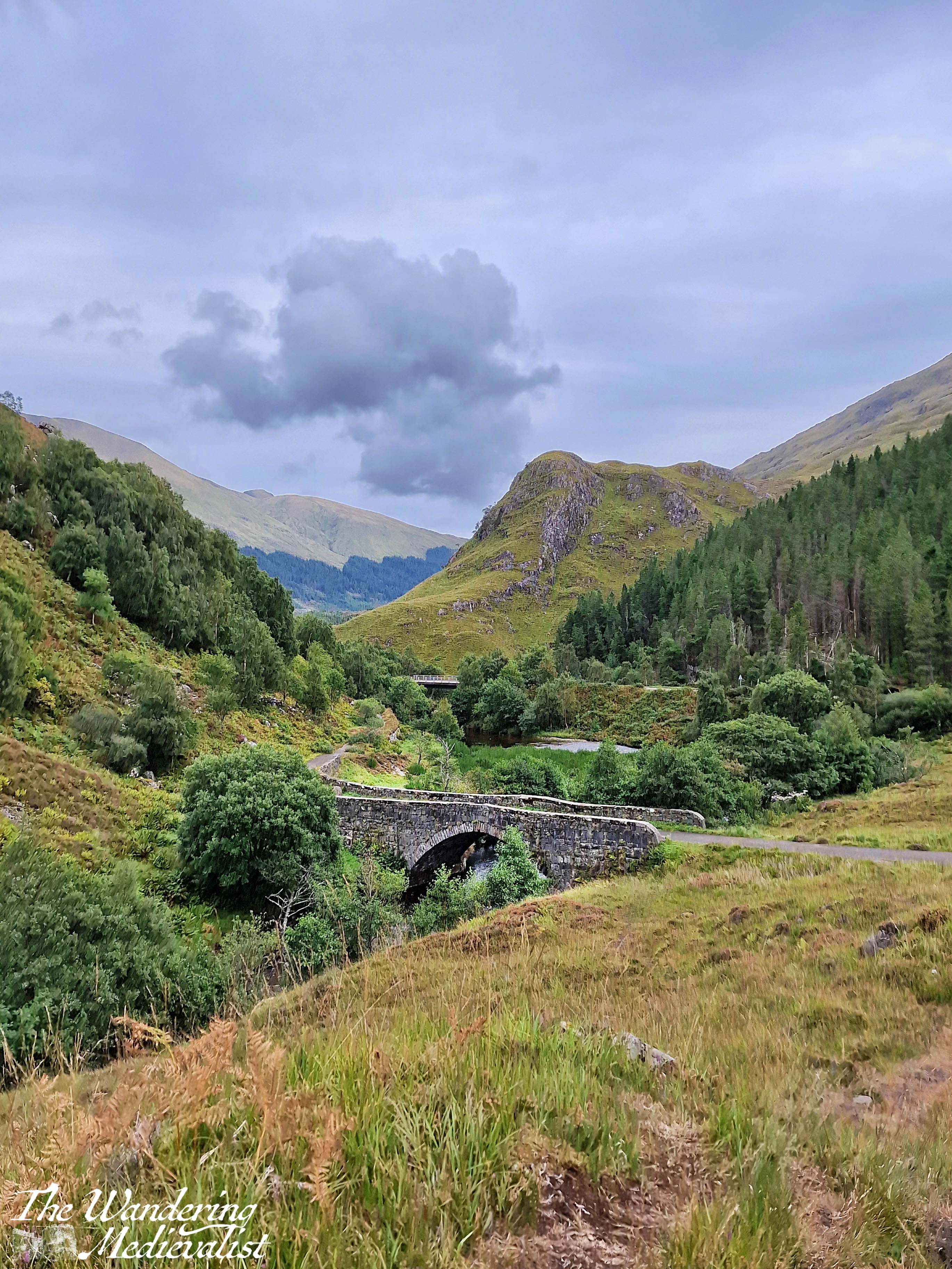
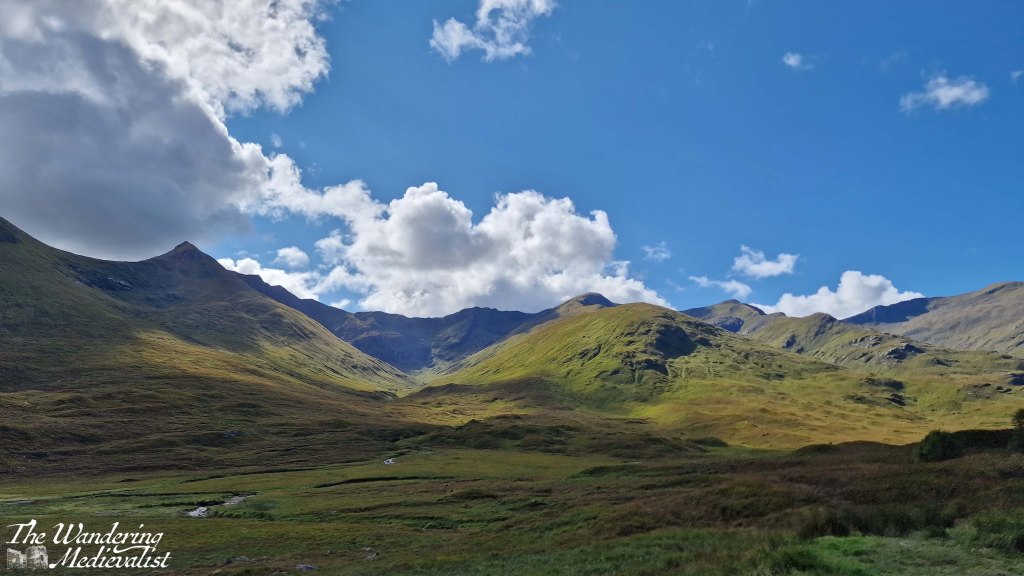
The clouds were drifting in as we pushed south into the mountains, following the road between Loch Duich and Loch Cluanie. I had made a careful note to explore Glen Shiel, where a stone bridge marks the point of a battle in 1719 between the Jacobites and Spanish on one side, and the English and Dutch on the other, evidence of religious and political divides across Europe in the early 18th century. Standing on the modern road, it was possible to track the historic route that armies would have needed to take, and the sharp angle of the hills makes it clear why this might be a treacherous battle spot. While most of the Jacobite commanders escaped, the battle is considered an English victory.
With our many pauses, the day was ticking on, and I think we all had enough of views and pictures and were ready to get to Fort William, still a fair distance away. We considered stopping at the Commando Memorial but there was little appetite amongst the passengers, while I was getting tired of winding roads.
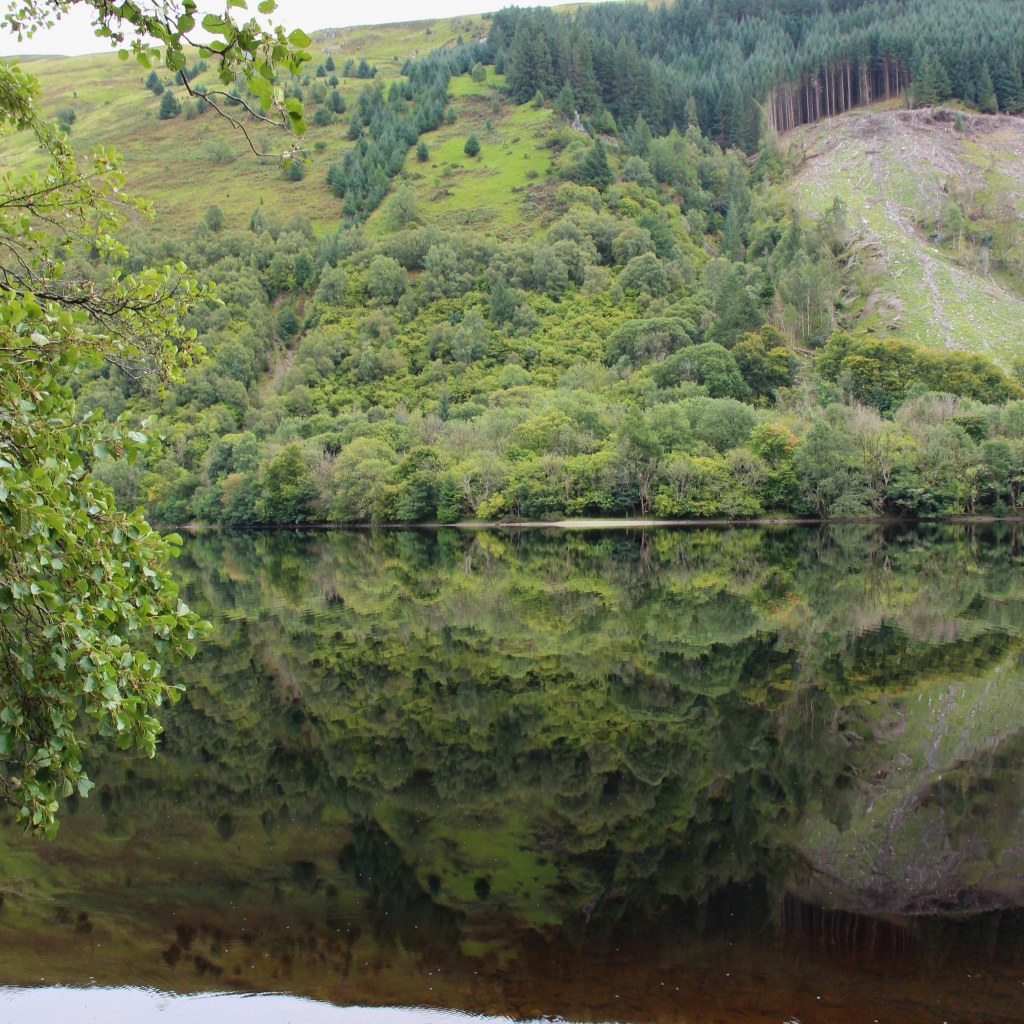
This was taken on the banks of Loch Oich, right before the locks of the Caledonian Canal, and I love how perfect the reflection is. It was our final break to stretch before making the last push.
The hotel we stayed at in Fort William, while clearly designed for coach parties, offered surprisingly good food and local beer – have determined that we must stop at the Glen Spean Brewing Company the next time we are up. We all headed to bed early, contemplative of the end of our time on Skye and what the following day would bring as we drove across Rannoch Moor and home.
I’ve skipped ahead in my story-telling to the third day we spent on Skye – the second was standard Highlands rainy, and we visited Dunvegan Castle before eventually retreating to our cottage for the afternoon. Thursday dawned clear and bright but increasingly windy as the day went on; the car was buffeted about and on one or two excursions it was difficult to walk. We think the gusts were well into hurricane-force, but even with whipping hair biting into my face like knives, I was so excited for our journey.
I had spent most of the afternoon before plotting out the route and places I knew we needed to stop, then entering it all into Google maps so I could know exactly where we were meant to go. There was a question as to whether we might go all the way to Portree and do a loop back, but in the end it was an out-and-back trip, allowing us the opportunity to stop at a few points we missed. Once again, I have chosen a few highlights for this page, but most of my pictures are in the video at the bottom.
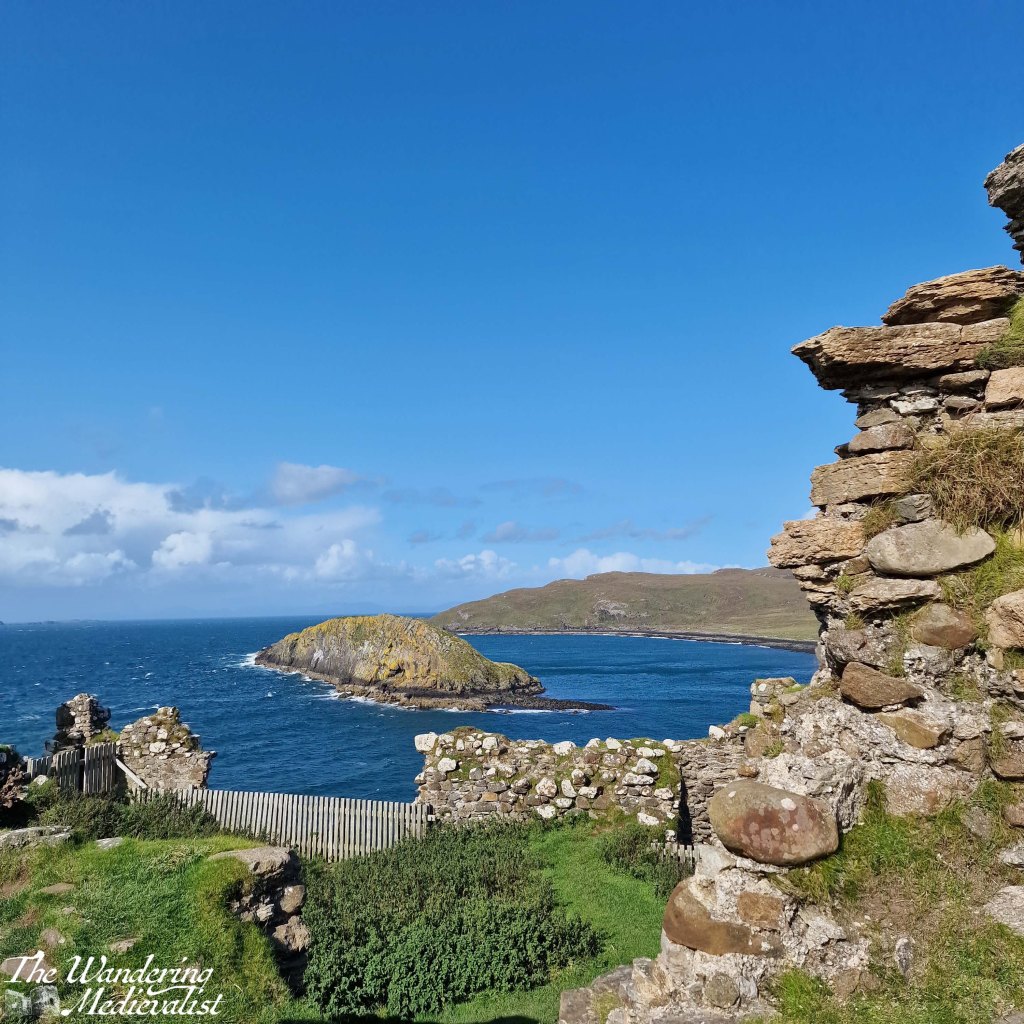
First stop was Duntulm, less than ten minutes north of where we stayed – it is an almost entirely ruined castle on a promontory with gorgeous views back over the hills and coastline.
I was the only one who hopped out of the car on this first stop so I made it quick, eager to see what the rest of the day would hold.
The A855, which is the main road that runs along the north edge of Skye, runs through some breath-taking landscape. Even when one cannot see the ocean, one can enjoy the distant mountains and vistas across green fields dotted with heather, sheep, and outcroppings of rock. Several times I stopped just to enjoy that view, and also to calm my nerves as driver.
Because, while it is the main route along this coast, the A855 is also a single-track road with relatively frequent passing places, but equally frequent blind corners and hills that cause the occasional near-miss with other more confident or less cautious drivers. I would certainly not recommend the route for tourists unused to Highland driving, beauty notwithstanding.
As the road cuts across the top of Skye it leaves the coastline to re-join a few miles later, opening up views across the glistening water to small islands and the distant mainland. We stopped a few times, though as the wind grew stronger, Dad started to doubt whether he wanted to go on much of a hike – one of the plans for the day. Knowing that one of our party would be confined to the car either way meant that cancelling a longer hike made good sense.
One location we knew we could not miss was the Quiraing, and so we turned inland along an even narrower road and made our way towards the line of cliff-like mountains ahead of us. Despite the size of the road it was quite busy, with cars and vans going to and fro. As we approached the parking area, the road started to climb sharply, weaving up the side of the mountain with hairpin turns that reminded me of scenes in To Catch a Thief – though I drove considerably slower than Grace Kelly or Cary Grant. I am not a great one for heights so kept my eyes firmly on the road as I negotiated the turns, breathing again I think only when we reached the top and found a large car park for hikers and visitors.
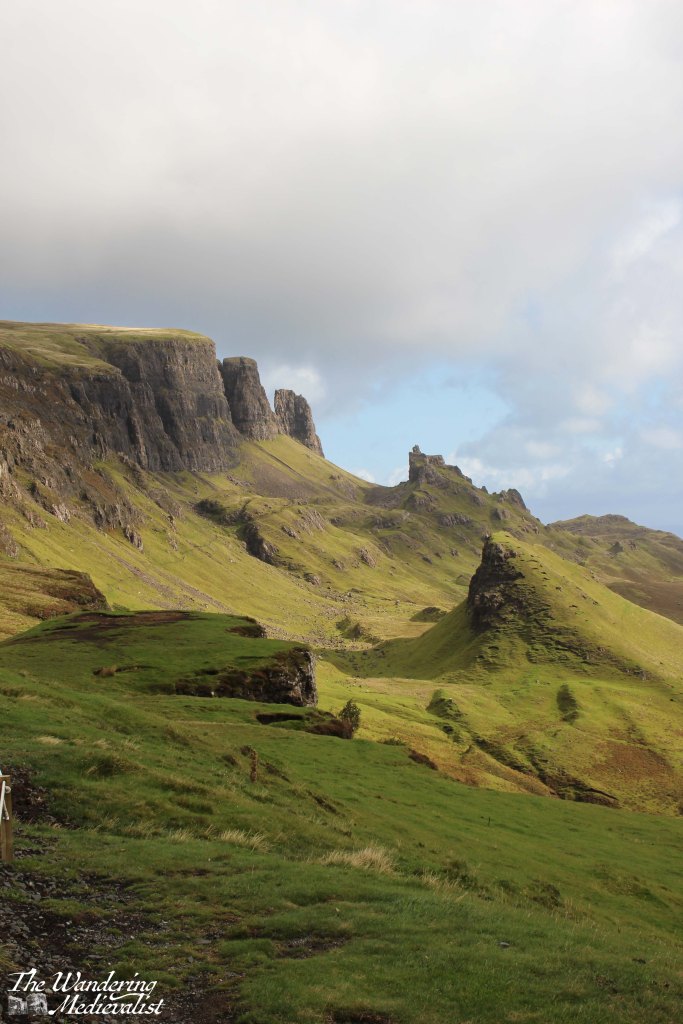
There are a number of path options at this point, including one that is wide and gentle enough that – I think – it is wheelchair accessible. It is certainly easy enough for most to try, and if you ever find yourself here with an elderly or less mobile companion, I would encourage you to encourage them to give it a go, even with wind as strong as it was when we visited – strong enough to take your feet from under you. This sight of the Quiraing, the view across towards the ocean, lochs and hills in between, is one of the most stunning I have ever seen. Top ten in my life, no question. The stunning scenery of the Quiraing is caused in part by a series of landslips, and the sunlight plays dramatically off sharp pinnacles, grassy slopes, and sheer rock faces.
As Dad and I made the short loop, we could see to the right a rain storm coming our way. I knew there was not enough time to reach the car so while Dad made a dash for it anyway, I continued on my way, hoping to reach the next knoll. I tucked my camera inside my sweatshirt and waited to get wet. I have absolutely no regrets.
Yes, I got soaked, and the much better-equipped hikers passing me looked at me questioning my sanity, but I stayed and filmed the storm.
The rain passed in minutes and the sun returned, allowing me to watch the storm as it moved towards the sea. There is no question I need to return here and take the time to do at least some of the hike. We saw quite a few spectacular sights on this day, and on the trip as a whole, but this was definitely the top of the list. Eventually I steeled myself to drive back down the winding road and was delighted to discover that the road south was back to two lanes.
The next stop was Kilt Rock, which was very busy so that everyone was vying for the best photo spot. My companions had been before, so we continued on quickly, to Lealt Falls.
This is where, as we parked the car, we realised just how powerful the wind had become. It must have topped 70 MPH, so strong that it was a challenge to walk and loose hair whipped my face like needles.
The colour of the hills and water were stunning so Dad and I braved a short walk to a viewpoint, though I recall passing two small dogs that I worried would be blown away. The falls themselves are visible from a sturdy viewing gallery that stretches out over the chasm, and in the distance one can see the range of mountains that includes the Old Man of Storr.
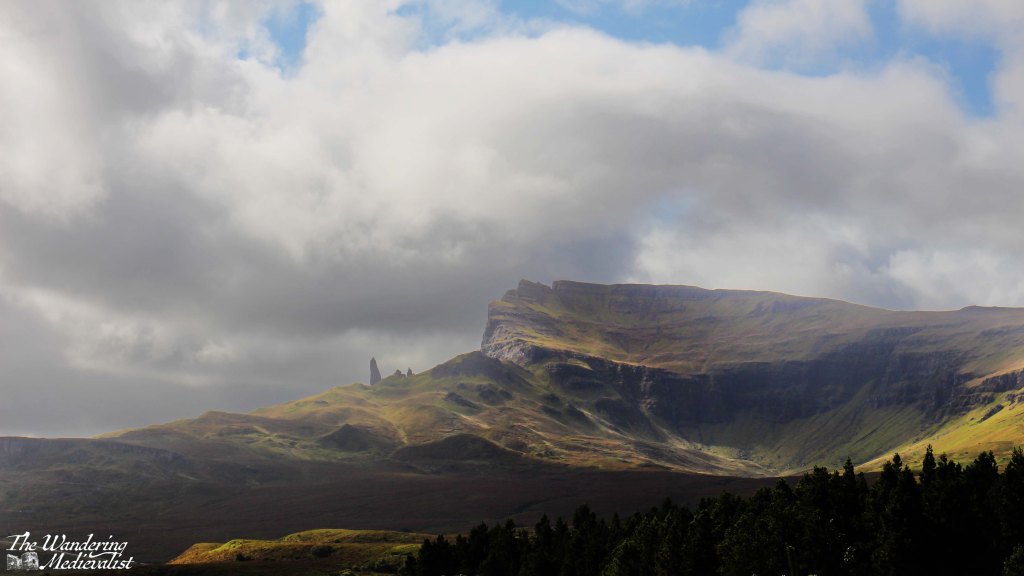
Another famous Skye destination, the Old Man of Storr should not be missed. The picture below is taken from a treacherous parking area called the Rigg Viewpoint – treacherous due to its narrow spots, large busses and larger potholes.
But the view is stunning. From here, we continued on to the actual parking lot for the Old Man, and while my companions waited in the car I scampered up the first half mile or so of the trail, to a point where I could see over Loch Leathan and up to the rock face. Again, this is clearly a spot that must be viewed on foot from the hiking trail, and next trip I will be certain to conserve the time and energy to do so.
The day was creeping by, however, and so after a brief discussion of our options, we decided to return on the route we had come rather than continuing on to Portree. We did not really need to go that far and the A855 was so beautiful it was worth another look.
We did not stop as often on the return but Duntulm required another look; I parked more securely – again dodging enormous potholes – and Dad and I took the short walk out to the ruins. Here once more the wind was battling us, and at times it was a struggle both to walk and to hold the camera steady.
The castle here had been built in the 14th and 15th centuries, the seat of the Clan MacDonald of Sleat – rivals of the MacLeods who held land further south. Despite its strong defensive position, the site was abandoned in the 1700s and the stone was taken to help build Monkstadt House, several miles south. Monkstadt, incidentally, is now a luxury inn and restaurant that we looked at very briefly before realising it was a bit too luxury for our needs at the time – we resorted to pesto pasta.
Once we had our fill of the castle ruins – or I did, more accurately – we returned to our cottage. It was mid-afternoon and the wind was battering the building and bushes outside, the perfect time to sit in the living room with a cuppa and enjoy the sunshine, a book, and the view. The Homer is so well-built that were it not for the noise, you would never know it was windy; not a single breath of air disturbed us. While we had not had a partiuclarly long day, it was an exhausting and even emotional one and we were all, I think, ready for a rest and time to process and review all we had seen. For me, it was a chance to start planning my return…
The Isle of Skye is a destination that everyone tells you is a must-see. First off, everyone is correct. But for any number of reasons – the distance, time, work – I have never managed to get there, even when most of my family have done so, usually as an add-on to a visit with me.
Finally, earlier this month, I was able to reach the almost mythic isle and was incredibly lucky to experience three out of four days of beautiful weather (one day included hurricane-force winds, but it was clear). Even if we had not had lovely sun for most of our visit, I feel I would be affirming that Skye is, indeed, a place that one really should see, particularly if one has any kind of affection for rugged dramatic mountains and scenery that is quite literally breath-taking.
In fact, I took so many pictures that I have had to turn them into videos, and split my posts into days, so as not to overwhelm – I’ll link it at the bottom of the post. There were a few views that I missed as I was the designated driver on this adventure, but they will remain imprinted on my brain and I did my best to channel what the other half reminds me, ‘Sometimes it’s ok to just enjoy the view and not take a picture.’
Even just the experience of driving over the Skye bridge and following traffic as the road gradually lifts over the mountains was enough to make me long for the time to do it again.
But I get ahead of myself. The first day – really only half on Skye – started with us leaving Fort William at around noon and heading north along the A82 past the Commando Memorial and Loch Lochy towards Inverness. Then at Invergarry, we took a dramatic turn west to follow the A87 towards Kyle of Lochalsh and Skye (and in fact, we would stay on the A87 all the way to Uig). I had scheduled in a number of viewpoints which I thought may be worth pausing to explore – I was acting as tour guide for visiting family – and the first was Loch Garry.
Unfortunately trees had grown up in front of the main viewpoint so high that it was difficult to even see the water, but a bit further along we were rewarded with this vista toward the end of the loch and the mountains beyond.
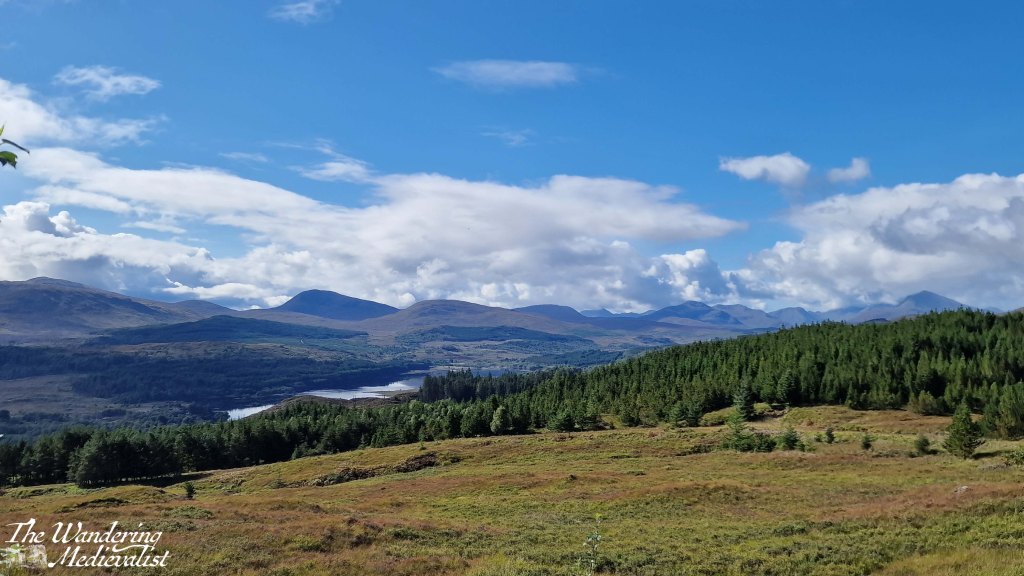
The road remained high above the lochs for the next few miles and we stopped long enough at the Loch Loyne viewpoint to take a video, then continued on to Loch Cluanie. For some reason this loch had stayed in my mind as I recalled a stop, many years before, at the Cluanie Inn. At the time it had been a much smaller place – it now boasts a bakehouse and fuel pump – but I recall a charming old spot with excellent soup. We did not stop on this trip despite this memory, and instead continued on away from the loch and into the gorgeous mountains.
This drive along the A87 is just stunning – the further north you get, the more rugged the mountains and flora get, verging on bleak but falling just short especially in the sun.
We could have stopped in many more places – some I made a note to try on the way back – but the day was passing and I knew we still had a significant amount of ground to cover. So, I pushed on until we reached Loch Duich and the most photographed castle in Scotland, Eilean Donan. We pulled into the massive busy car park and took a few distant pictures, but upon crossing the bridge into Dornie discovered an arguably even better view from the small town hall and public toilets.
Despite a continuation of stunning scenery, I kept my foot down after this stop and pushed on through Kyle of Lochalsh to the famous Skye bridge, an eye-catching steep arch of a bridge that was a touch unsettling at first, or is to one with a wariness of heights.
Once onto Skye the road is in good condition, quickly reaching Broadford, one of the larger towns on Skye were there are some good-sized grocery stores as well as plenty of places to stay – hotels, B&Bs, and self-catered.
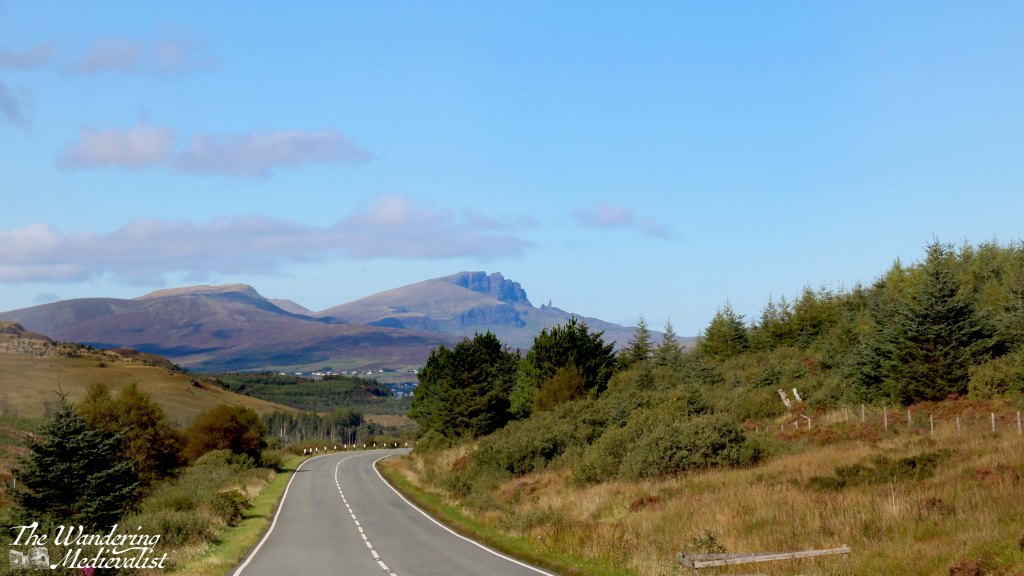
Continuing north, the road wove back and forth a few times and began to climb, with stunning mountains and valleys to the left and water to the right. We passed Sligachan with a note to stop on the return, and as the road topped a hill, before us was suddenly visible the distant shape of the Old Man of Storr, unmistakable against the blue.
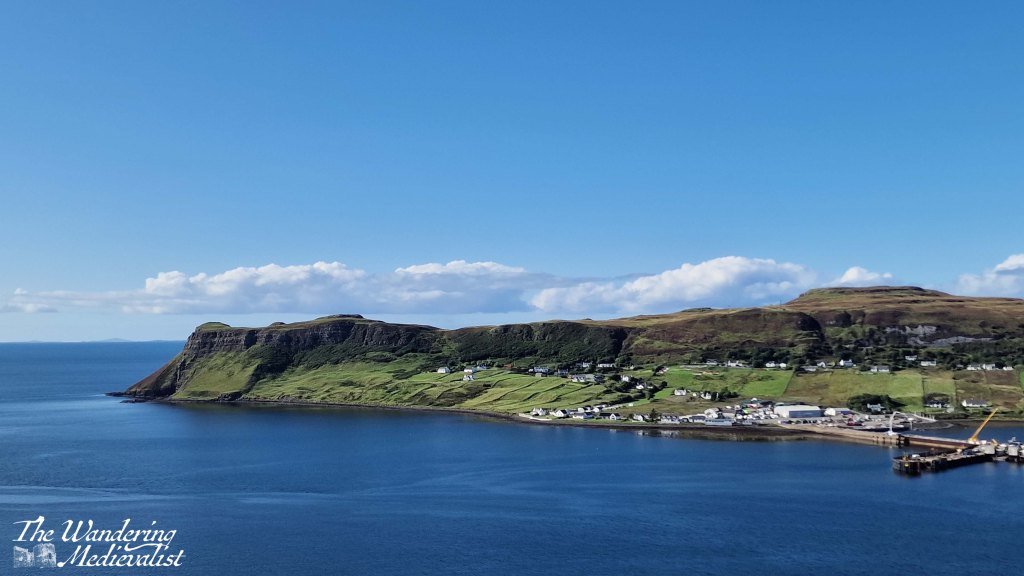
From here we touched the edge of Portree and continued pushing north, across another stretch of mountains and valleys populated mostly with sheep and a few distant farms. Our penultimate stop for the day came at a well-populated parking place perched on the hill above Uig harbour, dominated by a headland and ferry pier.
From here the road descended quickly into the village, passing several hotels and shops. Our route was further north and so we branched off to the A855 which I knew, from previous research, was also the start of the single-track roads with passing places. Indeed, while the distance from Uig to our cottage was relatively short, it was a solid 20 minutes in the car, requiring relatively regular stops to make room for passing cars and busses. Almost as if in an effort to test drivers, the A855 lifts out of town on a narrow cliff-side road that makes a hair-raising hairpin turn. This turn and the very visible drop off the road made me very happy not to be driving one of the many bulky motorhomes we passed.
After a long day of driving, I was quite ready to reach our destination, and the narrow road was not hugely helpful in alleviating my exhaustion, though the afternoon sun glinting off the water promised a lovely evening. Finally, more than four hours after leaving Fort William, we reached the cottage that was to be our home for the rest of the week. Dad had reserved the place and it was a fully-equipped cottage with two bedrooms, a lovely kitchen that I would happily have traded with my own, comfortable warm living room and perhaps most importantly, 360⁰ views of the sea, mountains, and countryside. After unpacking the car, we had a quick pasta dinner and sat outside with a glass of wine and my trusty camera tripod to watch the sun set. It was a perfect way to end the day.
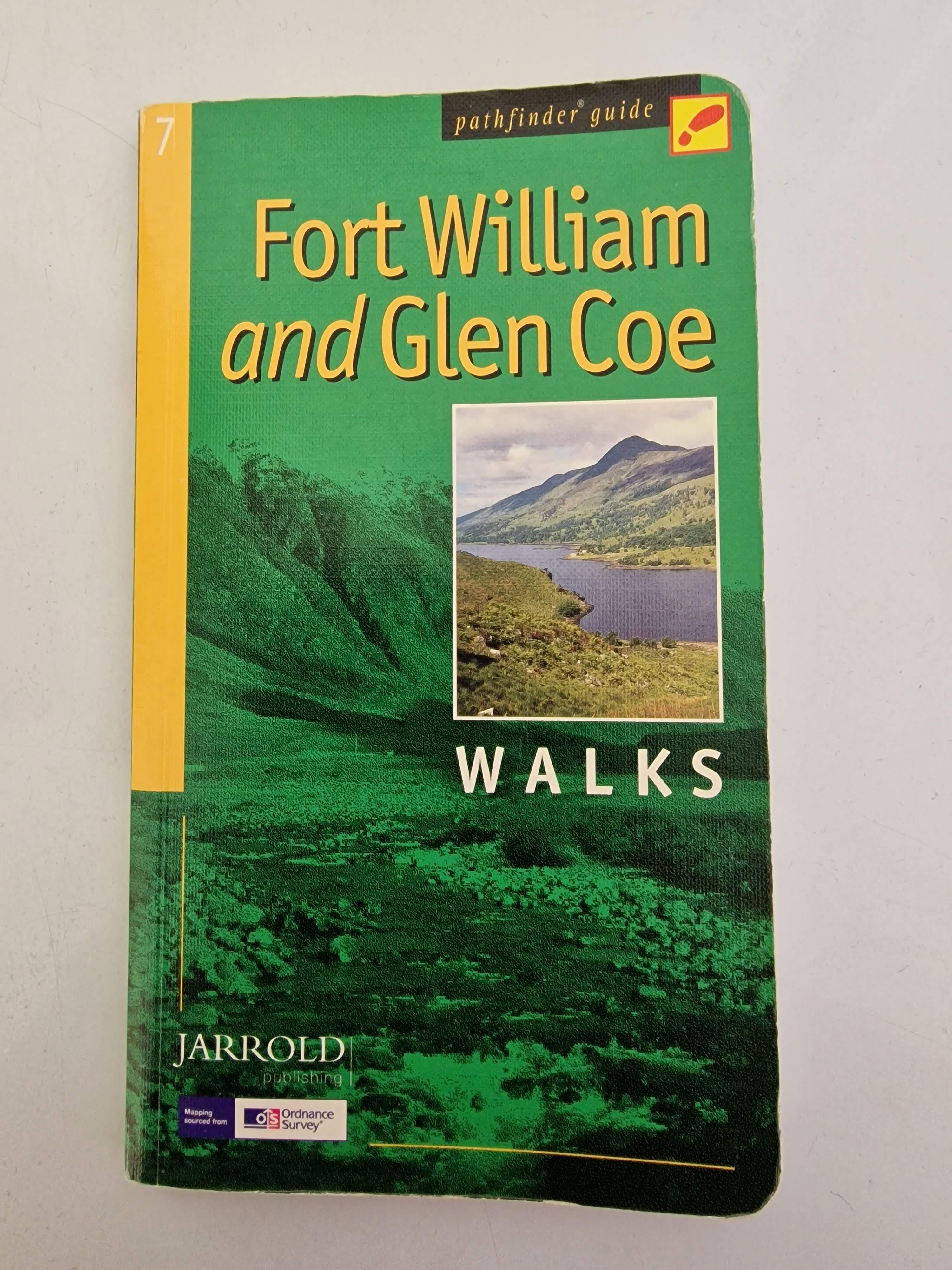
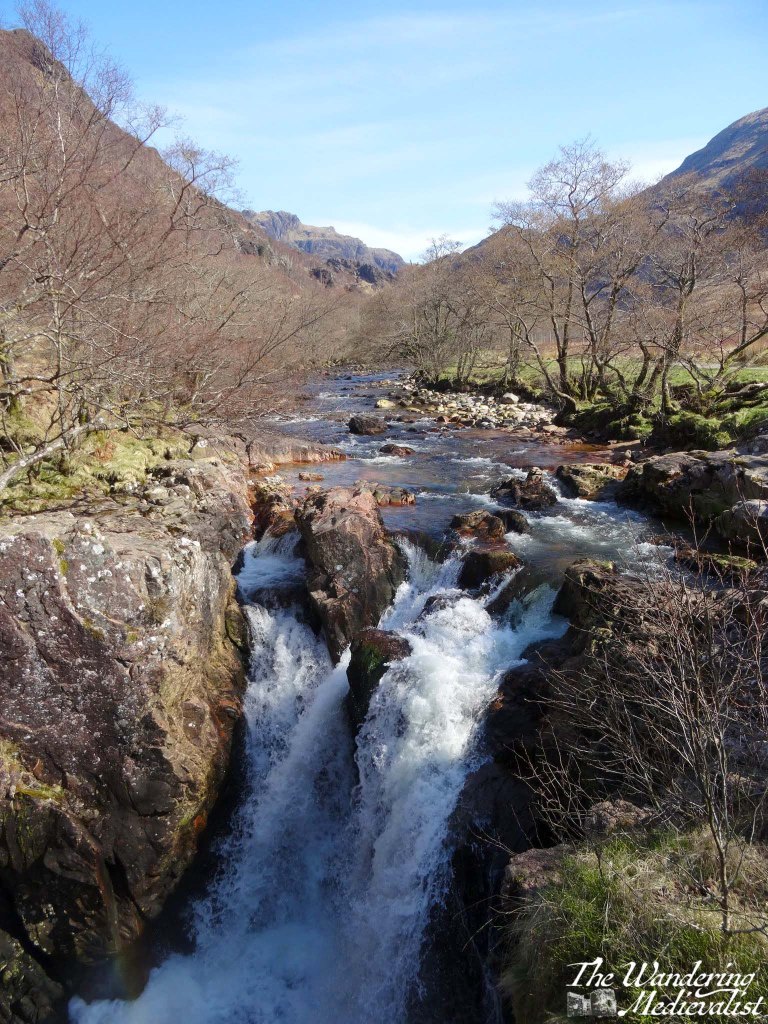
I first came upon this walk while perusing my well-used Pathfinder guide to Fort William and Glen Coe, and was immediately sold by the phrase, ‘one of the country’s most scenic waterfalls’. While the book also describes the path as ‘short and easy’, we soon discovered that while the waterfall description was accurate – and this walk remains one of the most stunning I have taken in the Highlands – the ‘easy’ part was less so.
While not particularly long in the first instance, the path does take one up and down some steep sections that are rocky and not suitable for anyone without a touch of fitness. Once through the gorge, the path is comparatively easy and comfortable. But, I am forever reminded of the August 2021 occasion on which I saw numerous walkers, drawn by the promise of a waterfall, attempting the hike in flipflops, some even with crutches and canes. Unfortunately, I imagine most of them were not able to continue to the best viewpoints.
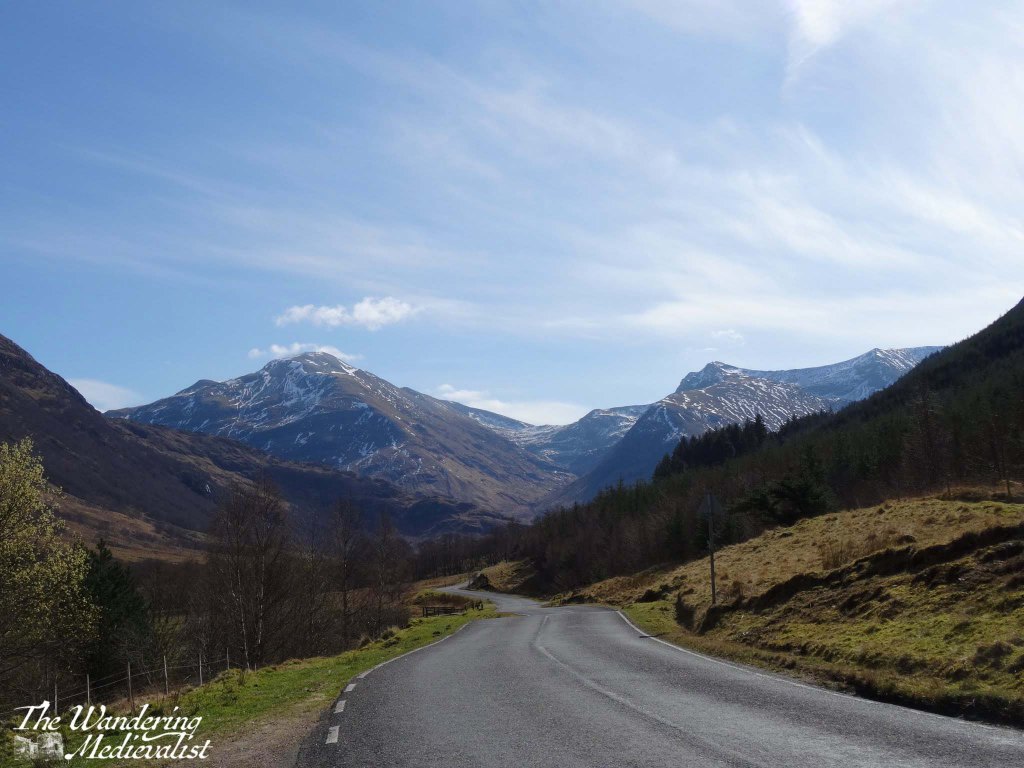
But I get ahead of myself. Our first challenge, as is often the case in more obscure walks, was to find the car park mentioned in the book. Starting in Fort William, one follows the signs for Glen Nevis and indeed for Ben Nevis itself, as the drive takes you past the most common starting point for hikers attempting the highest peak in the UK. Glen Nevis itself is stunning, and it is almost impossible not to stop a few times along the way.
Gradually the road narrows and passes a number of burns and wayerfalls, and on our first trip we thought we had found the car park when we reached the Lower Falls.
After a few more moments with the map though, we determined that we still had a way to go, and indeed the start of the Nevis Gorge walk, the Upper Glen Nevis Car Park, is another 1.6 miles along the single-track road. Once there, it is clear that it is the end of travel for vehicles. There is a good-sized car park, though when we visited in 2021 it had filled up completely by mid-morning. This may have been anomalous due to the higher than normal number of visitors that summer, but I have a feeling it is quite standard.
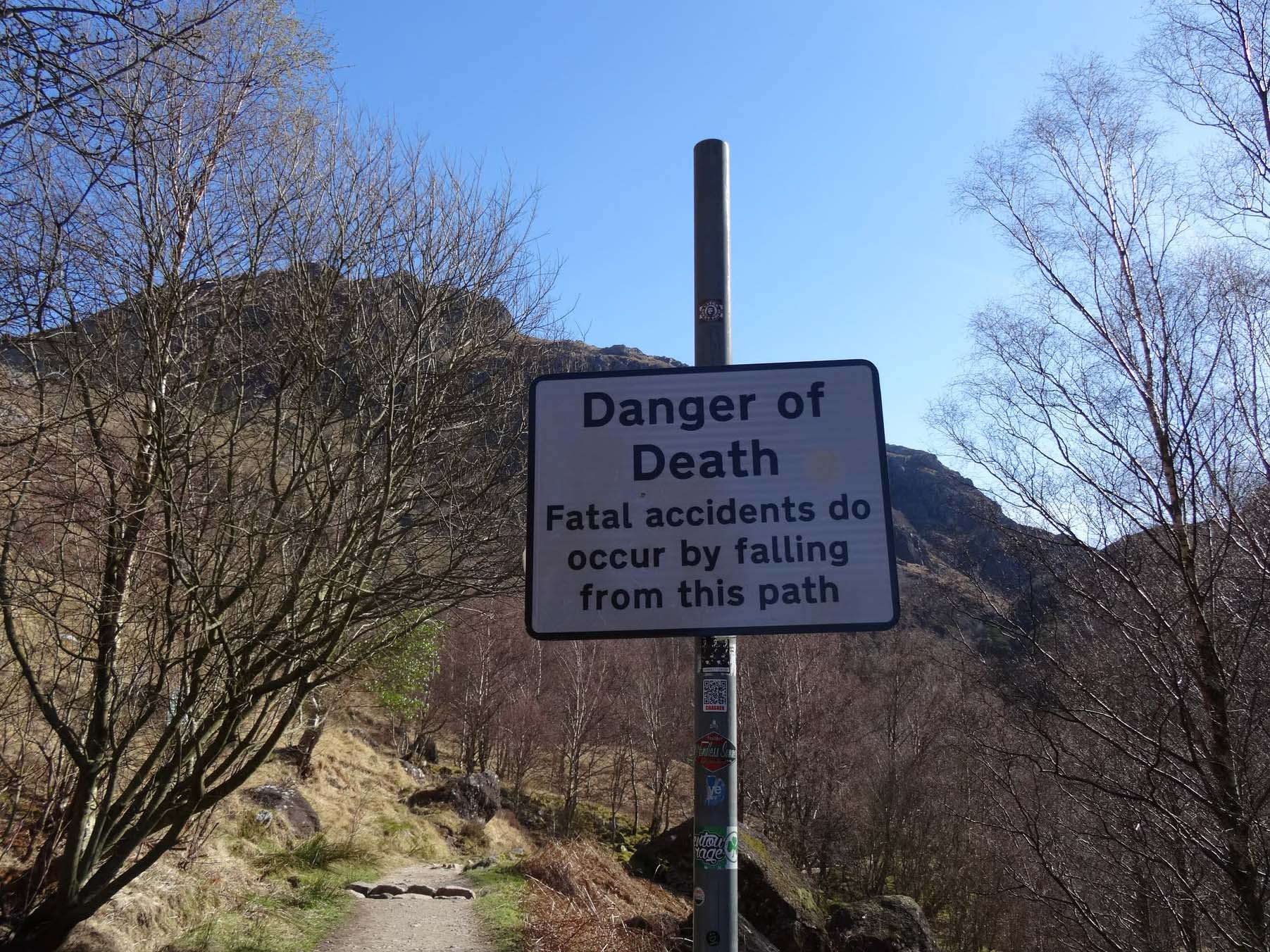
There are lovely views even from the car park, and I could not resist snapping a pic of the warning sign to send to the family – once we had returned safely of course.
While initially we paid less attention to the warning, by the time we had climbed a bit further and discovered the steeper areas of the trail, we realised how easy it would be to slip into the gorge – especially when mesmerised by the view.
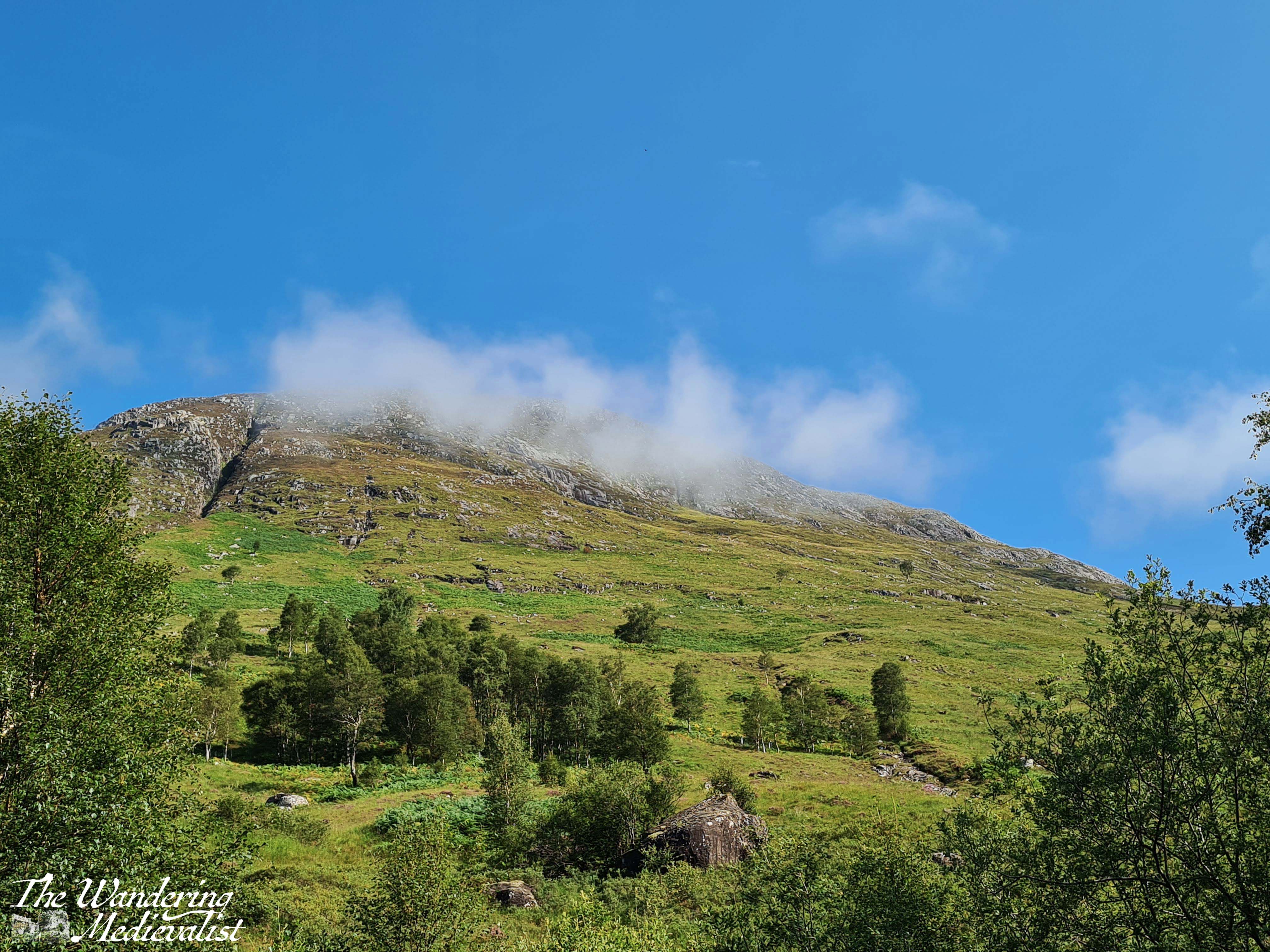
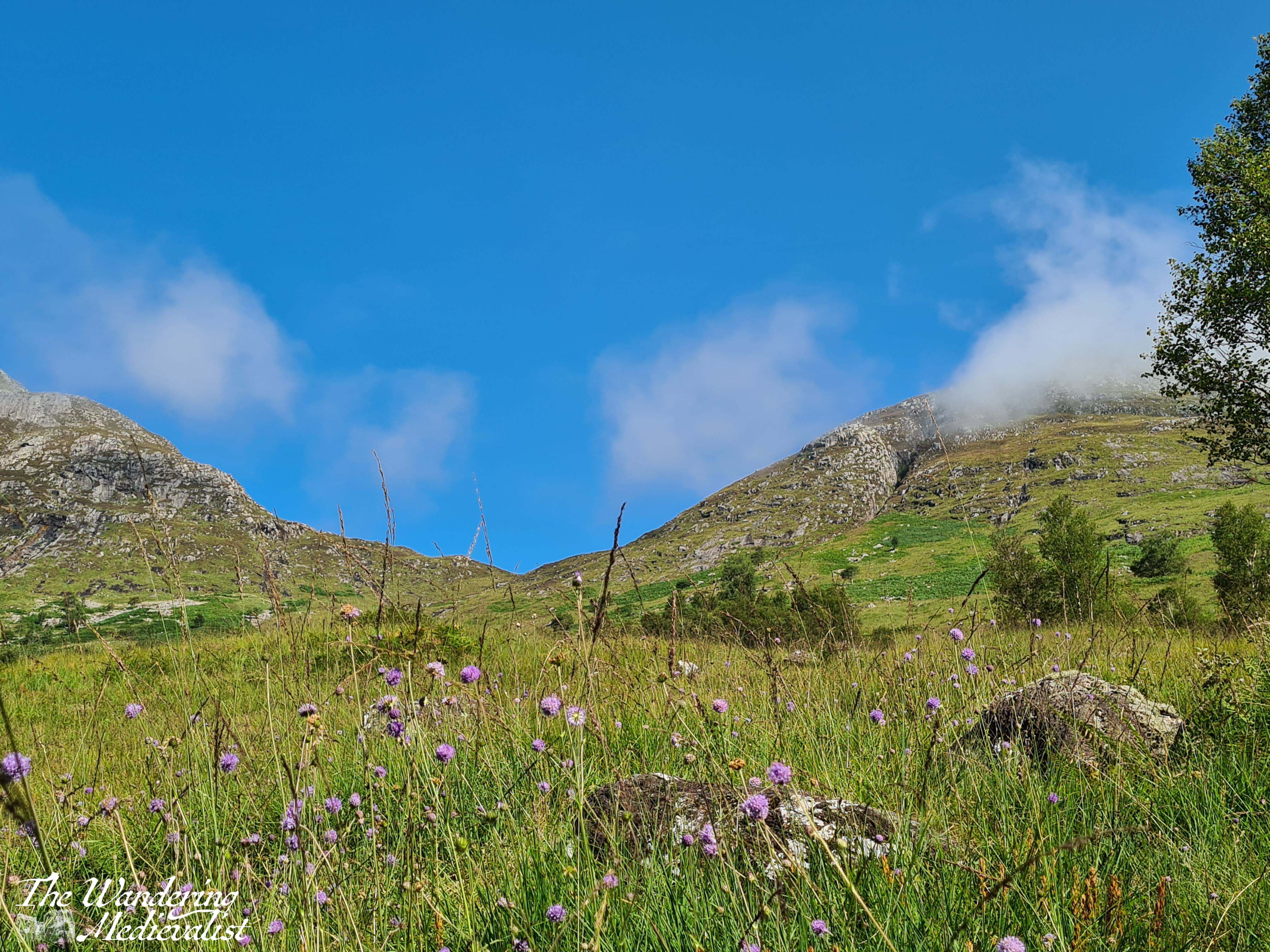
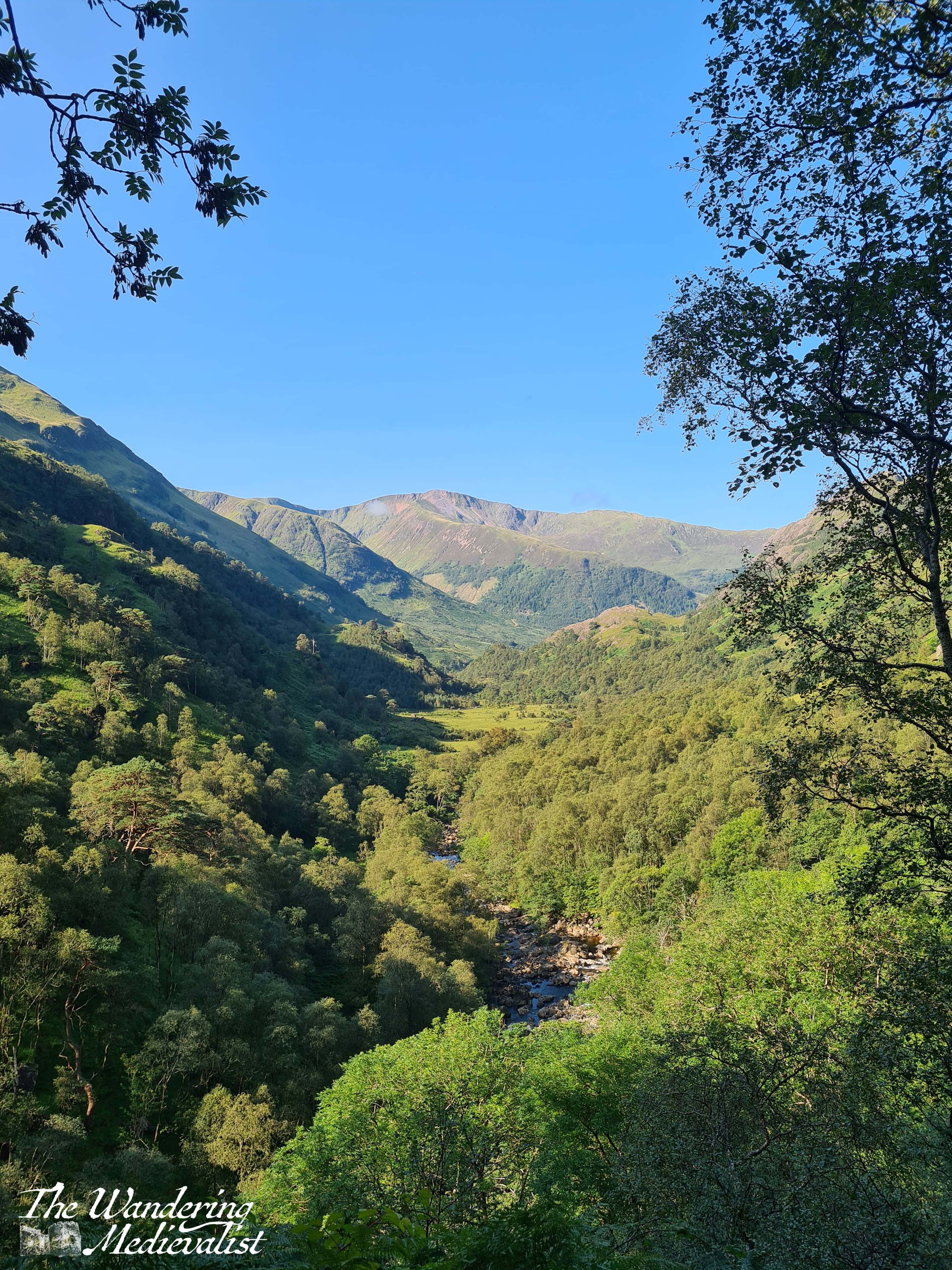
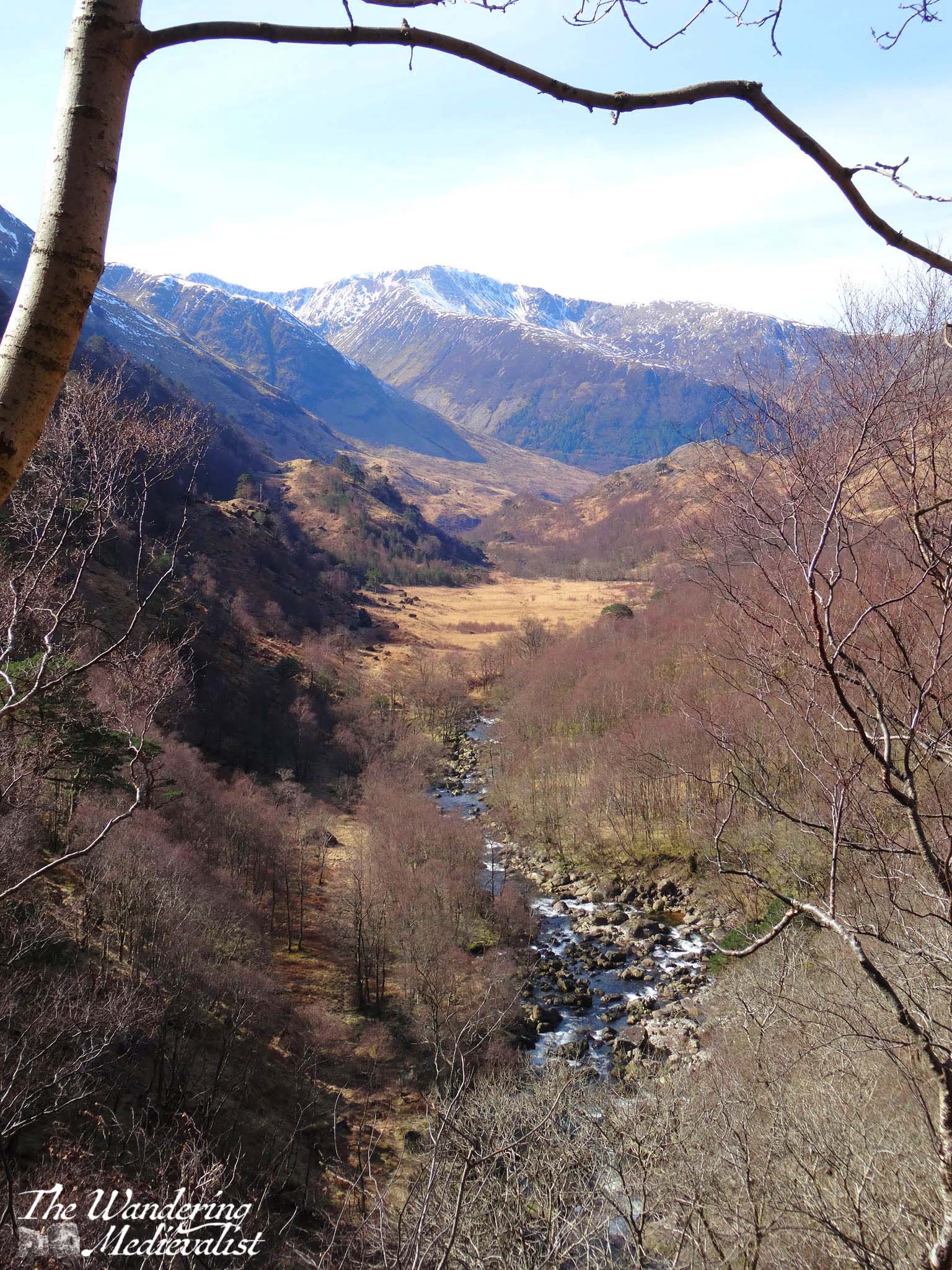
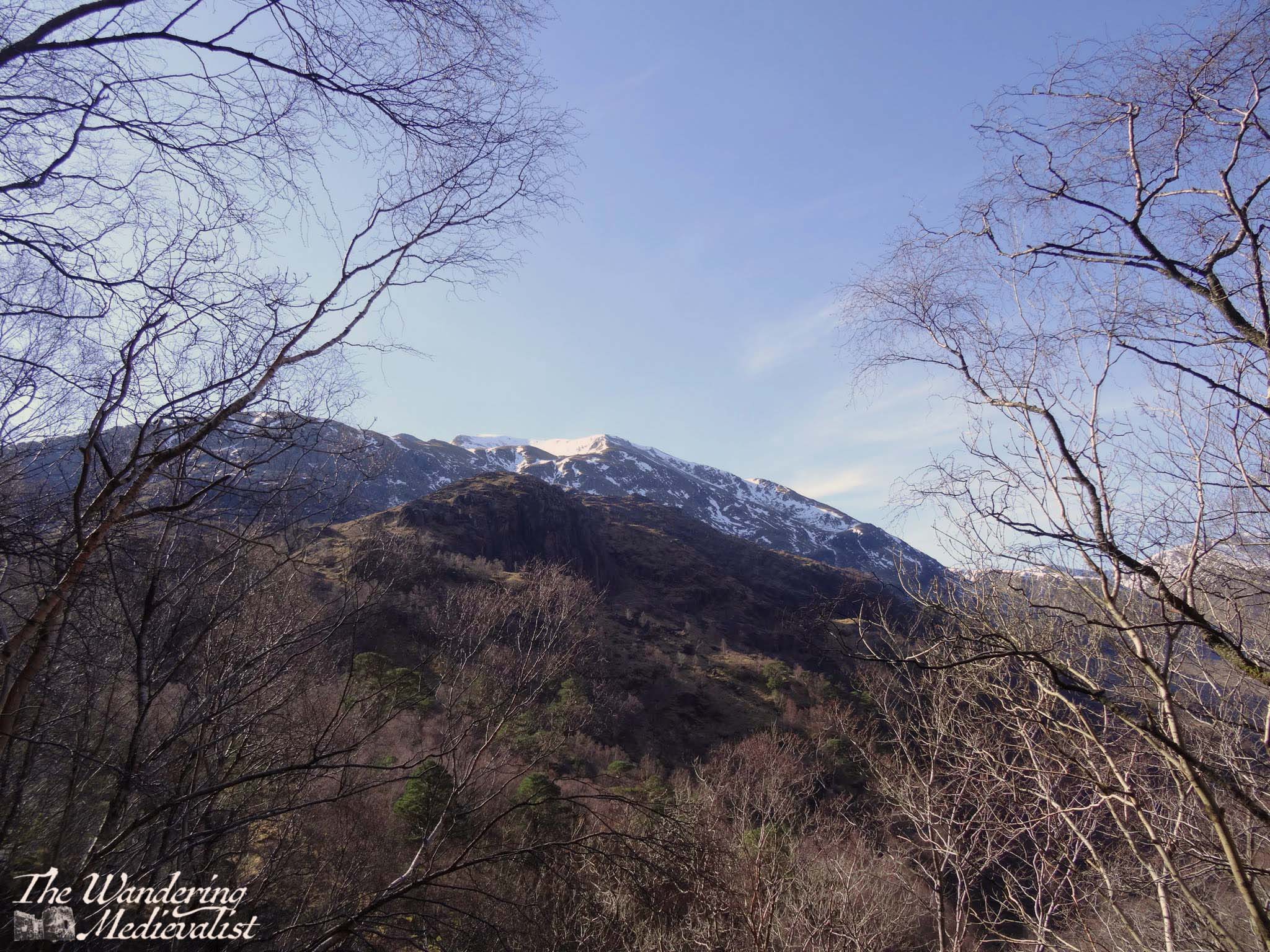
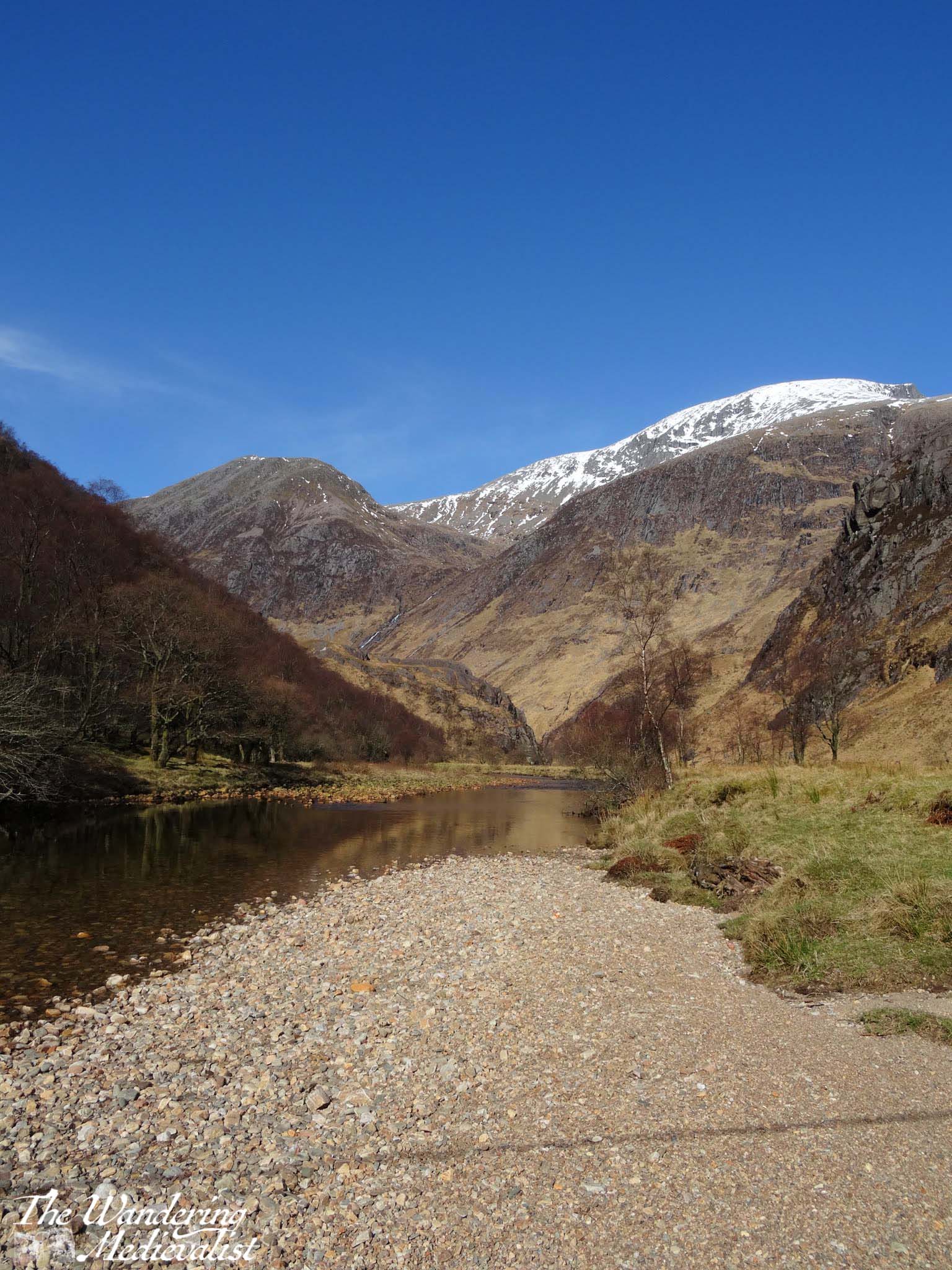
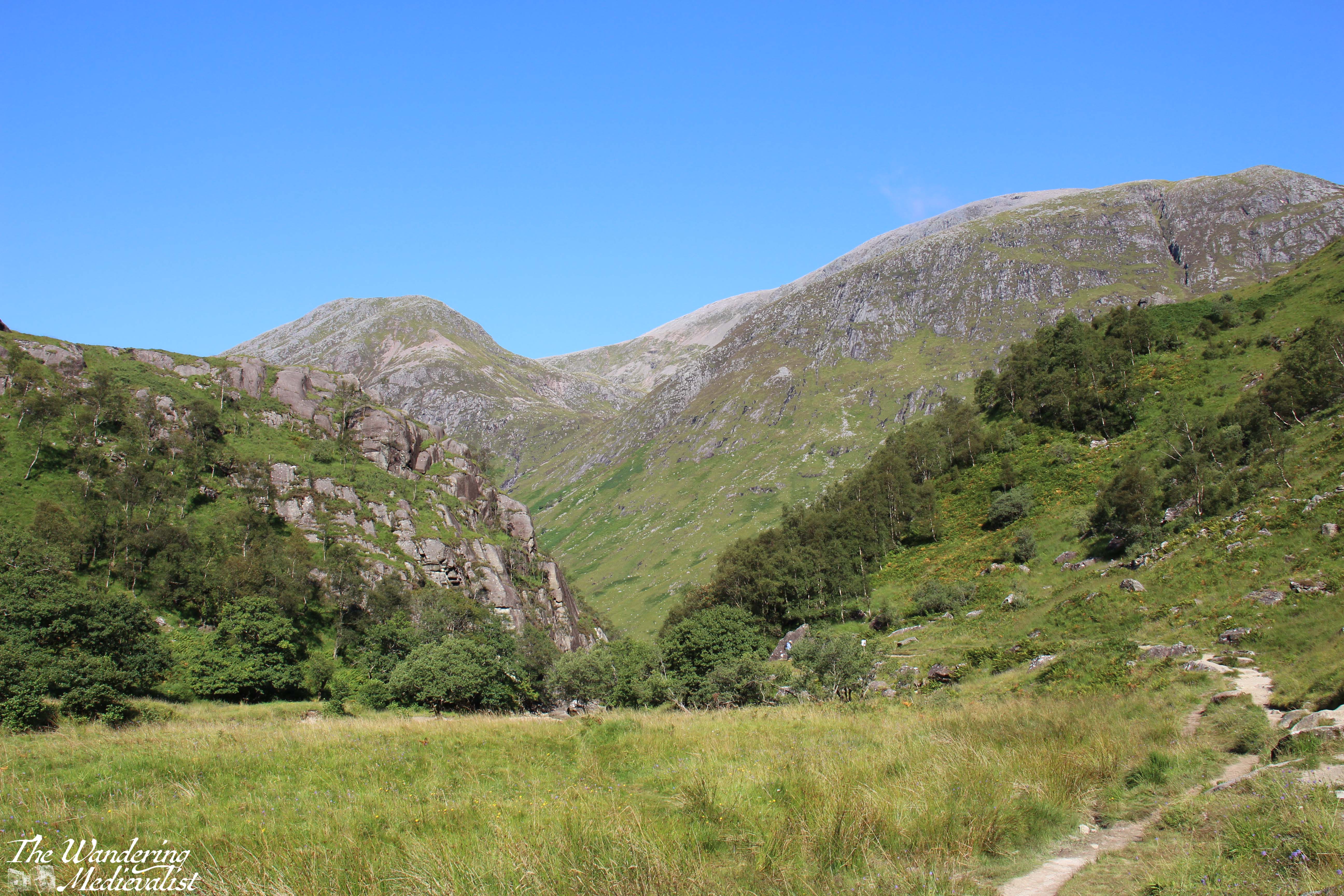
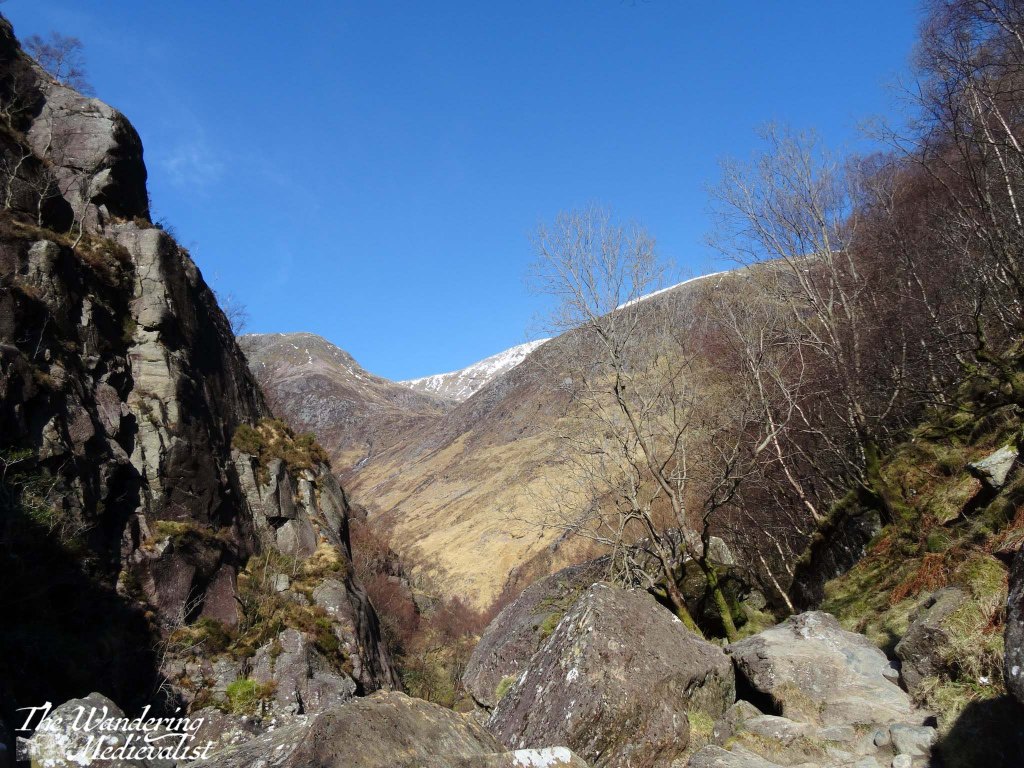
The path starts out quite innocuously through a lovely stand of birch, with some small streams and impressive glimpses through the trees up the hillside and down into the valley where you can hear – if not always see – the Water of Nevis. Before long, though, the trail runs into the side of the hill and begins to curve around to the right, at the same time that it starts to gain height. It narrows and becomes a bit more difficult to traverse, as it is clear that hikers are moving up and through the gorge. Warnings notwithstanding, it is impossible not to stop at a few points to enjoy the view over the glen – below you will see an early spring and late summer version of the view.
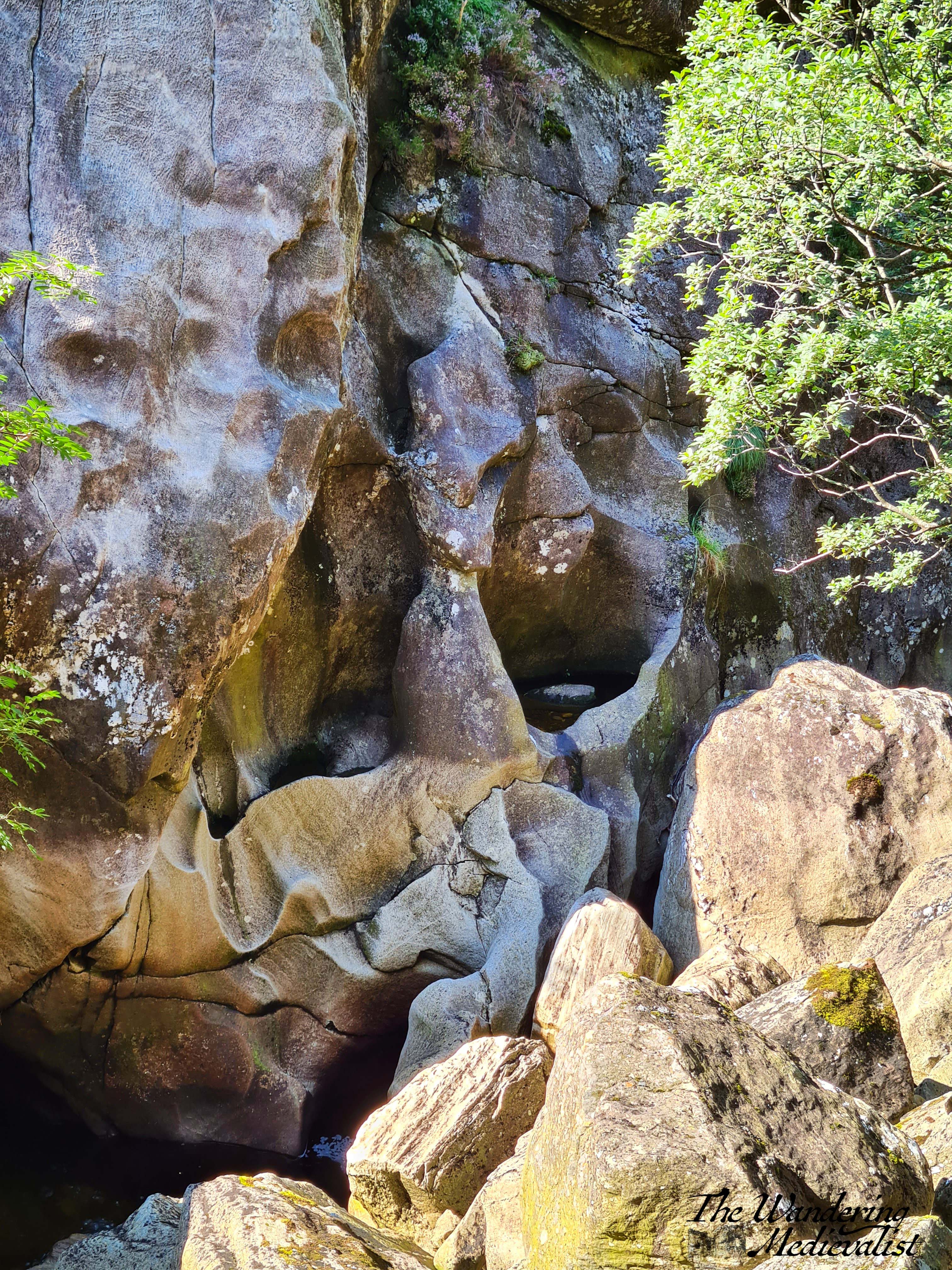
After a few sets of rocky stairs, the trail curves back around to the left and you know you are headed through the gorge. The rushing water below becomes more turbulent as it passes through the narrow gap, and while it is far enough below that you cannot often see it, the rock faces are sheer and carved by thousands of years of water.
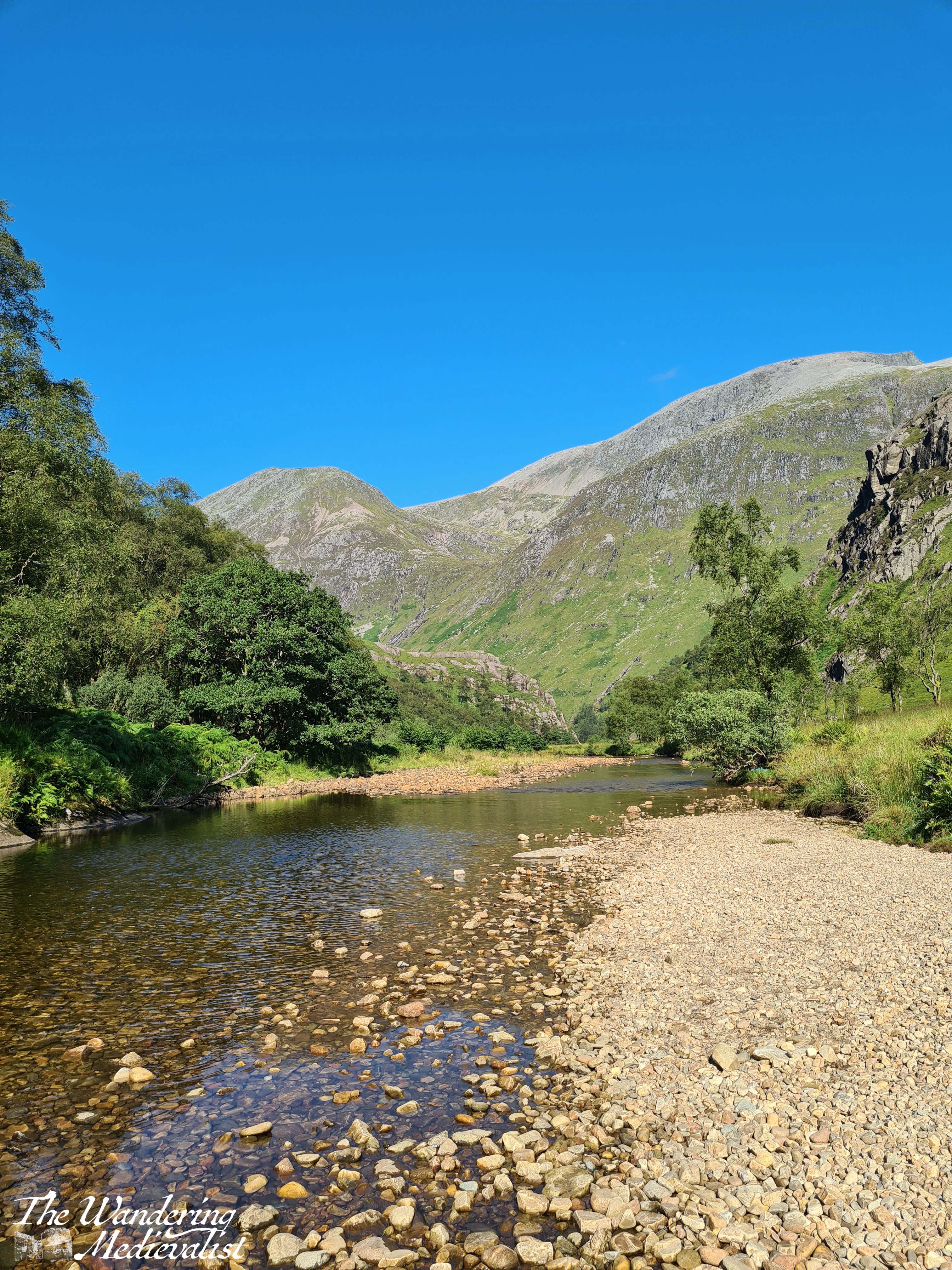
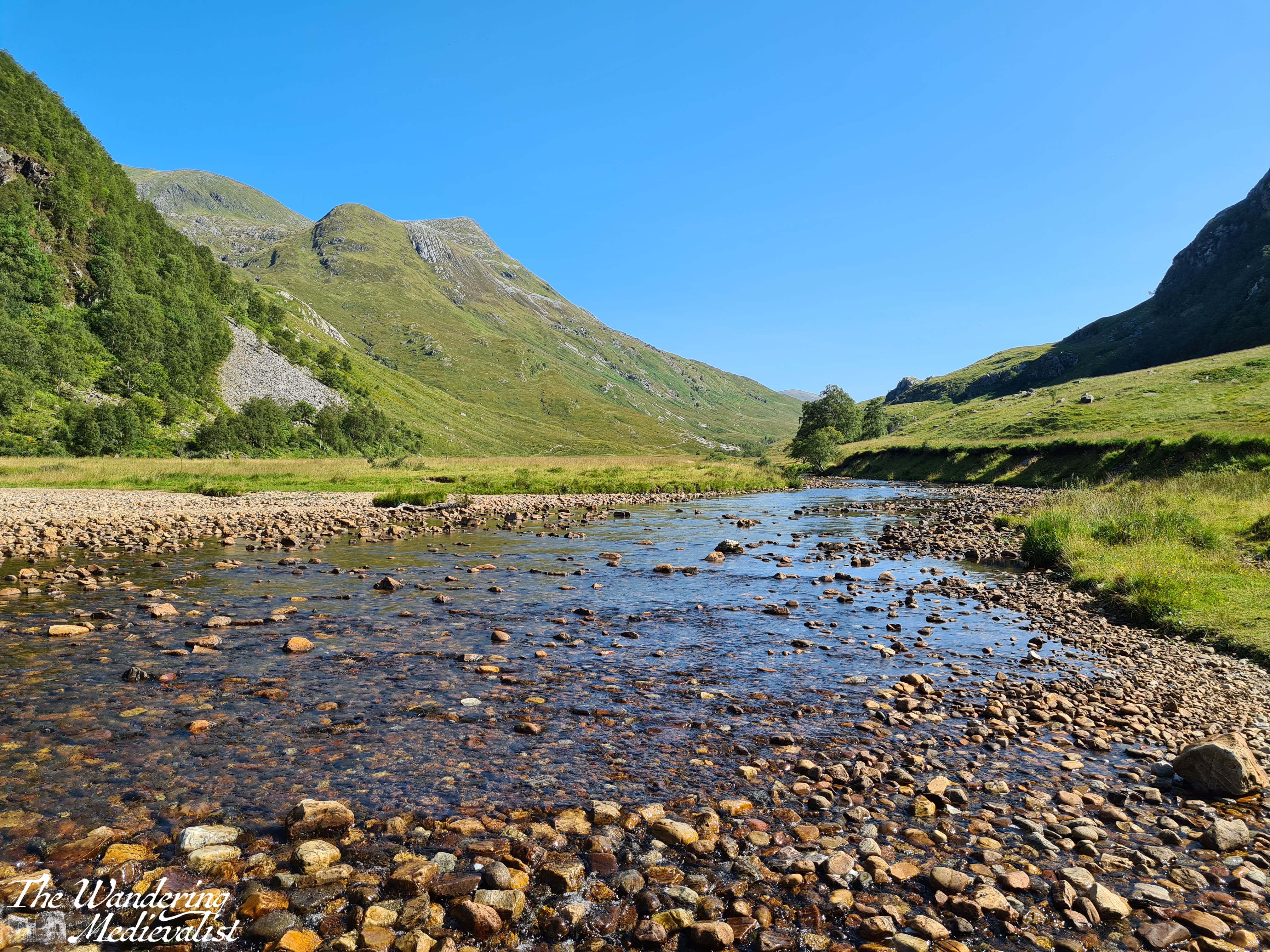
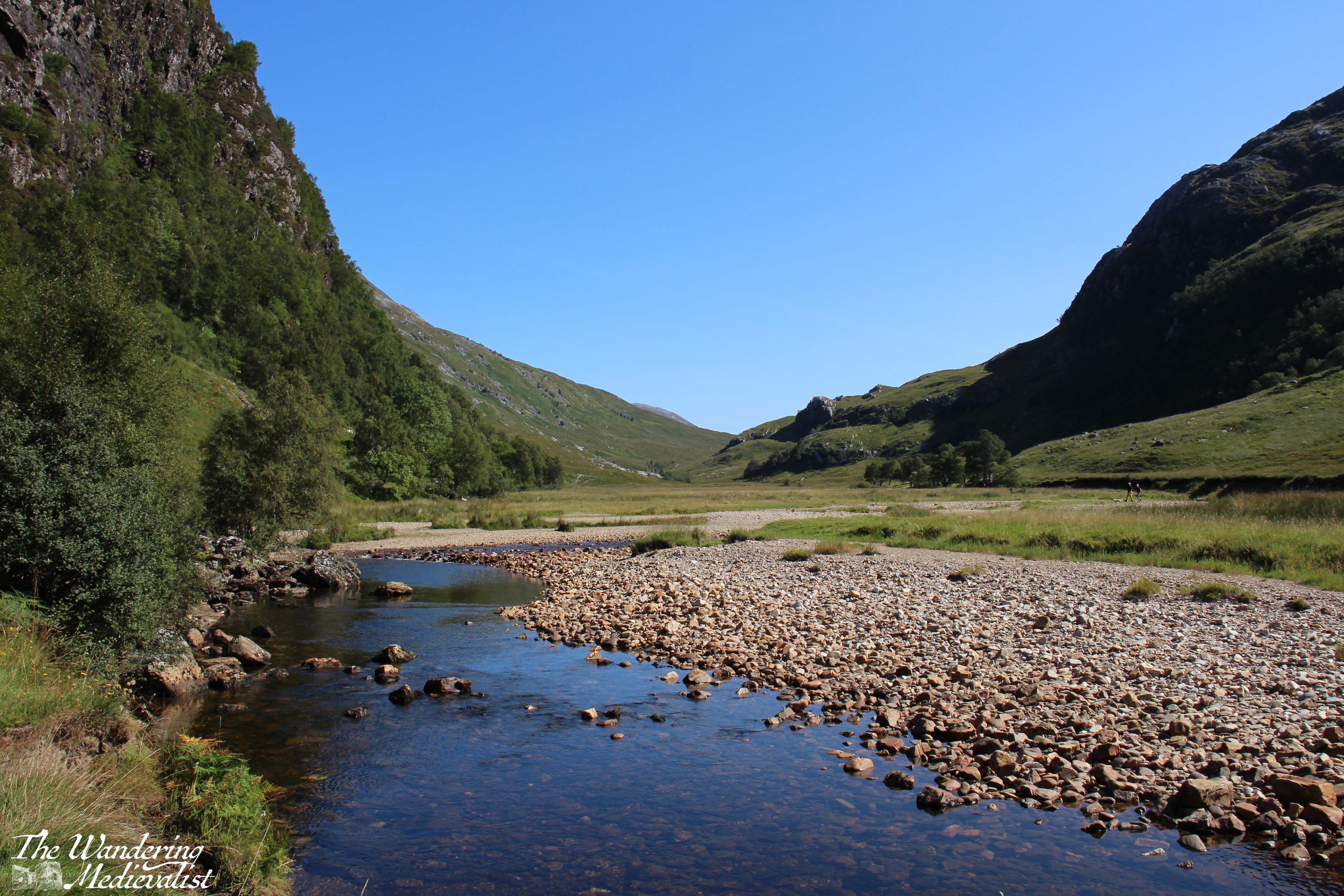
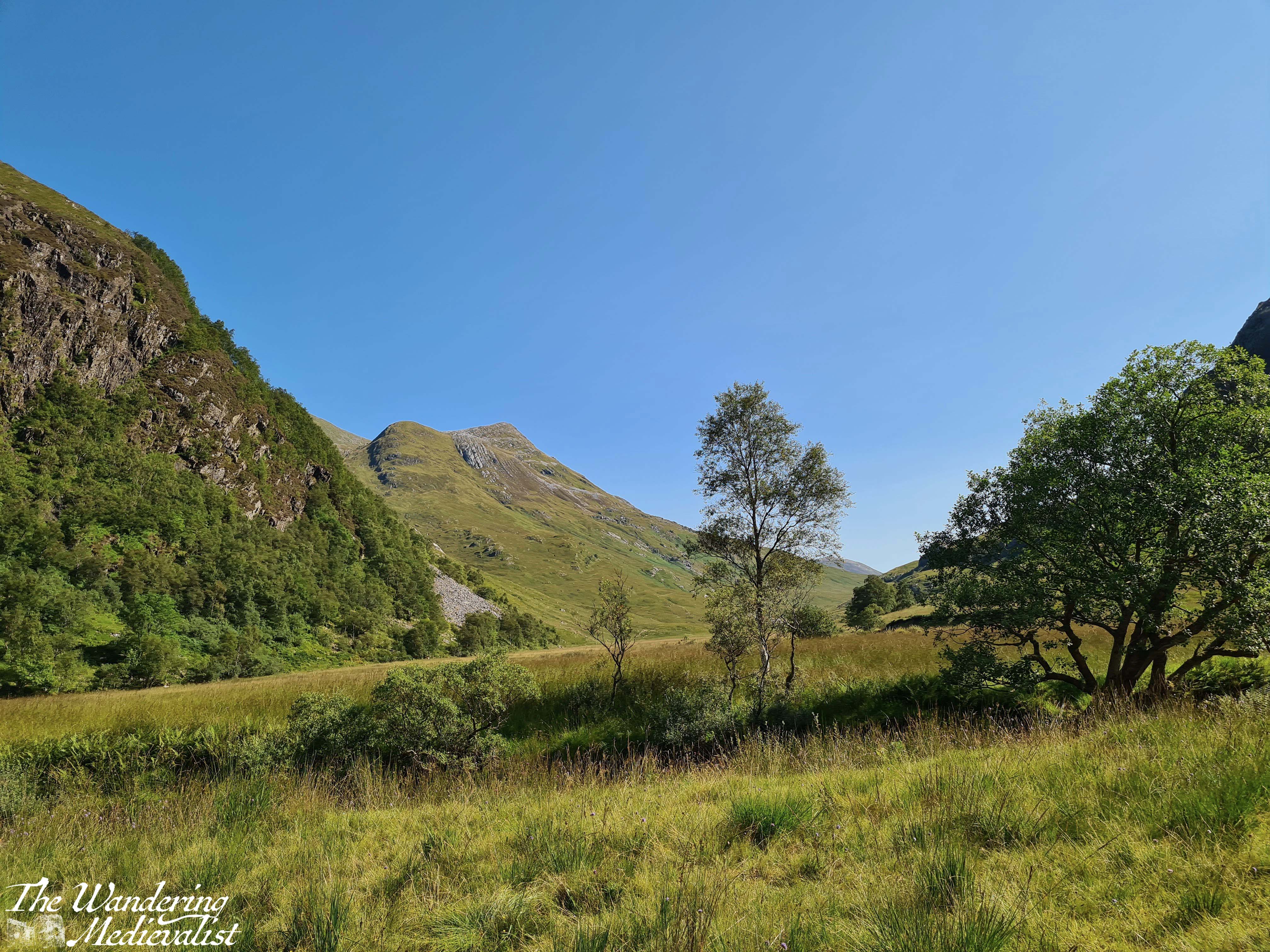
The trail eventually passes through to the other side of the gorge, and before you opens up a beautiful flat valley where the Water of Nevis cuts through the hills. Grassy flat land is dotted with stands of trees and rocks, and in the distance you can just see Steall Falls.
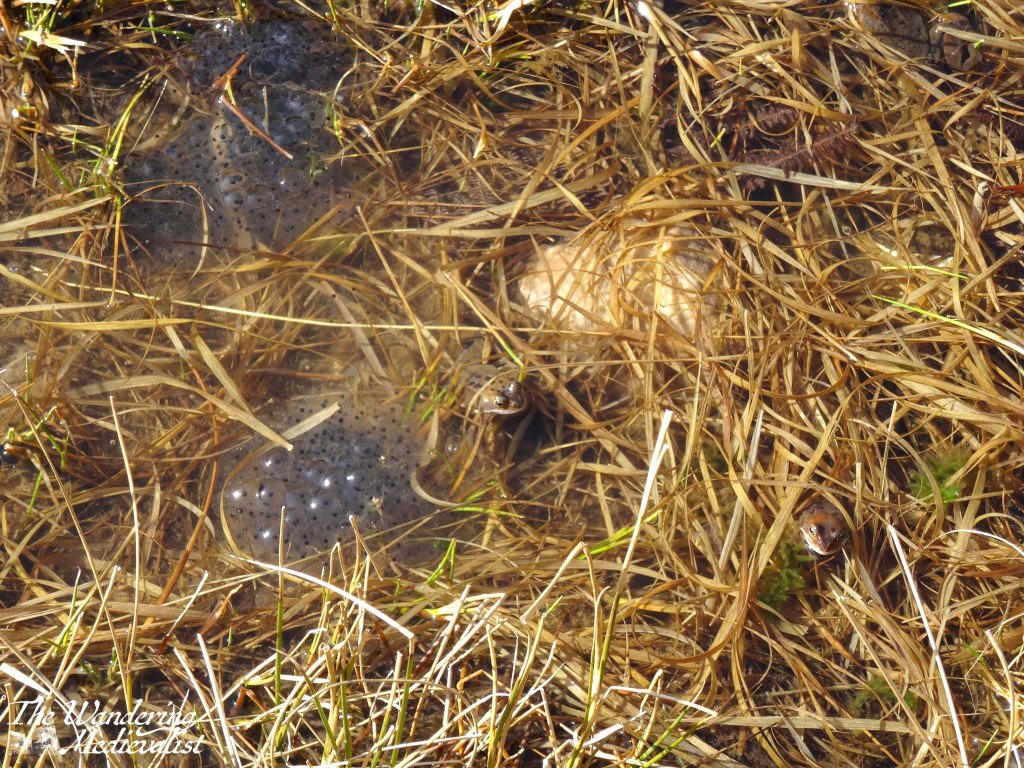
From here, the trail follows the curve of the valley, crossing some small streams and boggy ground; in March when we visited, it was absolutely full of frogs and frogspawn, glistening in the sun.
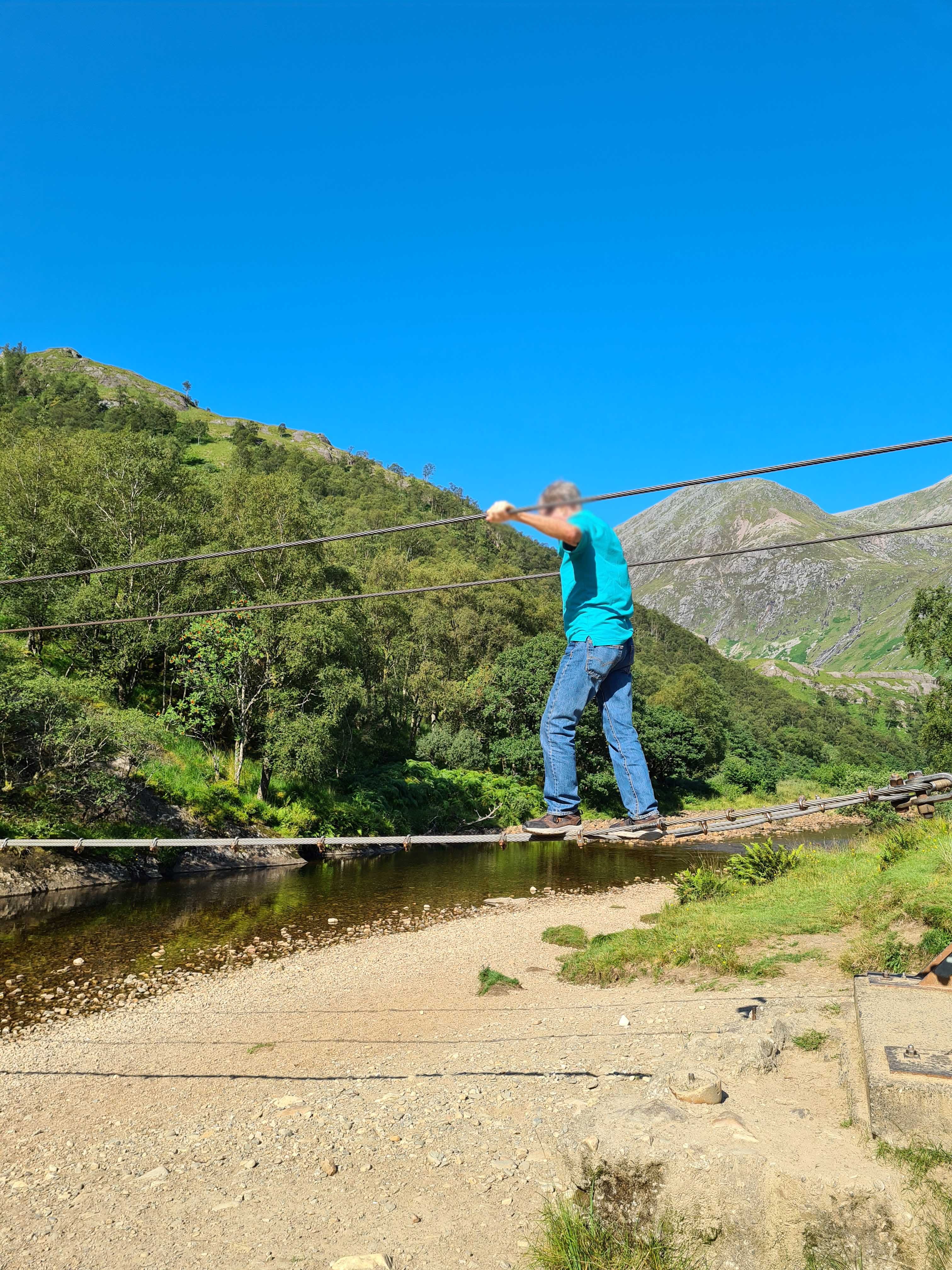
From this point you can continue along the valley up the back of Ben Nevis and eventually reach Spean Bridge or, if incredibly adventurous, the edges of Rannoch Moor. Or, if you are feeling adventurous in a different fashion, you can cross the river to approach the falls directly, though the trail is not as well-marked as one might hope (or wasn’t in the days just after the pandemic). On our first visit, the other half and I chose to just walk up the valley and find a spot on the riverbank for lunch. Dad on the other hand chose to cross the river. Not, as I did, on the rocks just poking above the surface that I crossed dry – unlike the hikers ahead of me – but instead on the wire bridge that spans the river. By wire bridge, I mean literally three heavy wires, one for your feet and two for your arms, which requires both height and upper body strength I do not have – I could not even reach the starting point. While at first the bridge is not far off the ground, by the time it stretches out over the water, it is high enough that one can imagine a fall into the shallow river would not be without injury. After a few uncertain moments at the start, Dad managed it quite well, and then waited on the other side while I plotted my route.
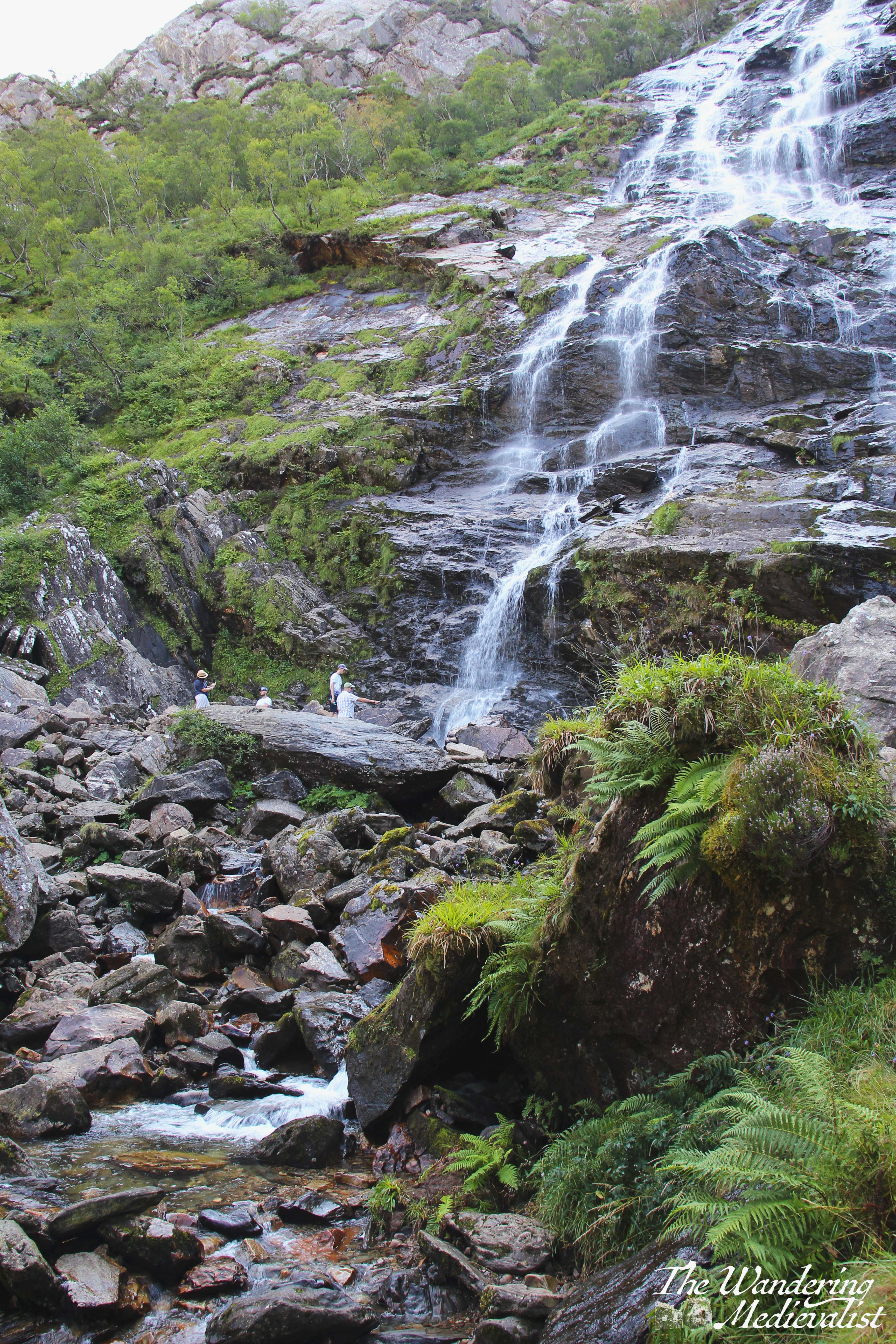
Once safely across, we hiked up towards the falls and I experienced the true viciousness of midges in the Highlands – fortunately I had spray, but the closer I got to the falls, the more swarmed around me, getting caught in my hair and the spray on my arms. While they did not bite through the spray, I ended up looking more freckly than normal and they went out of their way to aim for ears, nose and eyes. I managed to pause long enough for a few pictures of the falls and the view from the rocks, but the bugs were intense enough to encourage us to keep moving.
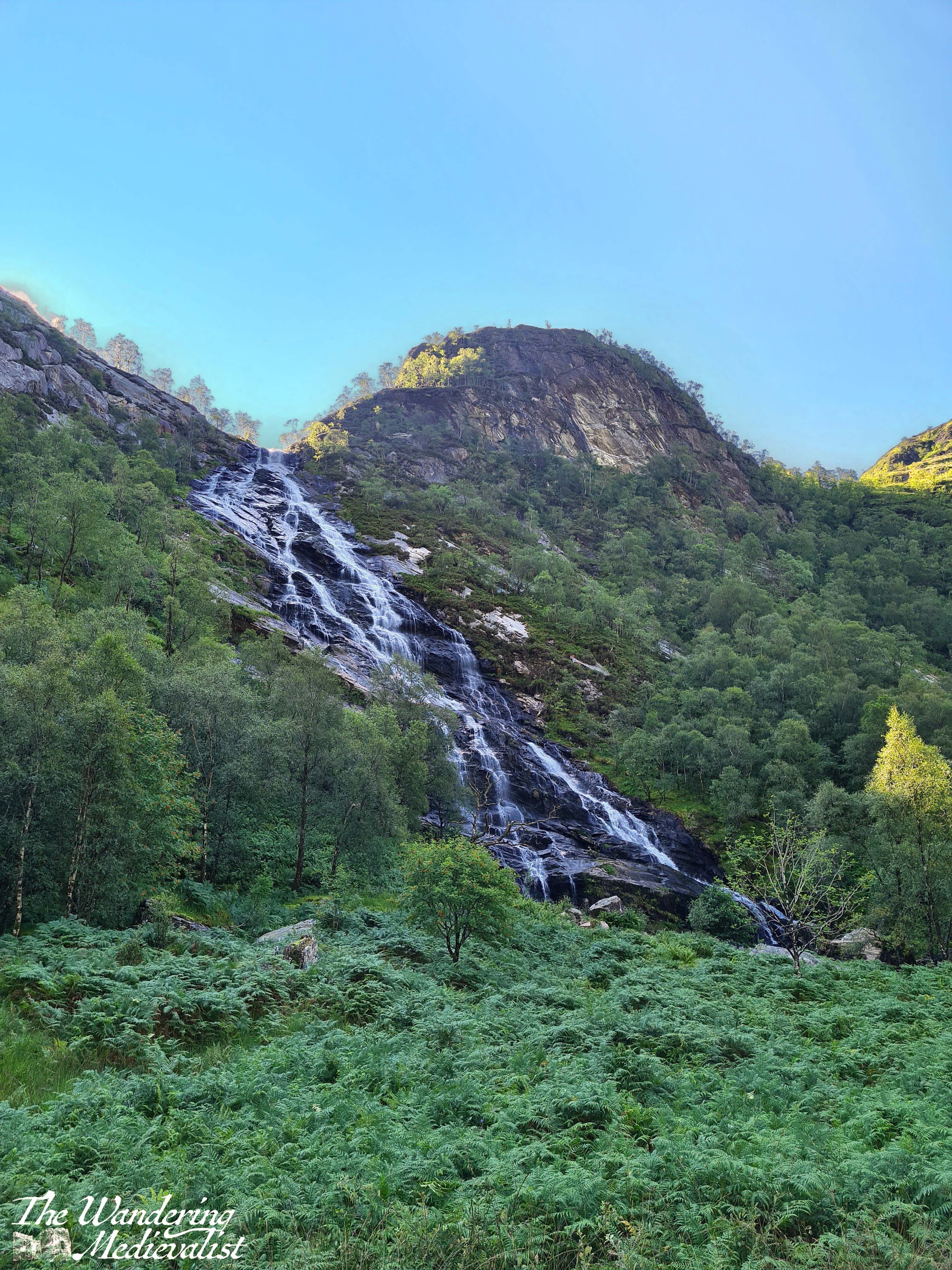
The falls are well worth the exploration – they are the second-highest falls in the UK, with a single drop of 120 metres (390 feet), and there are plenty of places for brave walkers to cross and climb up for a better view.
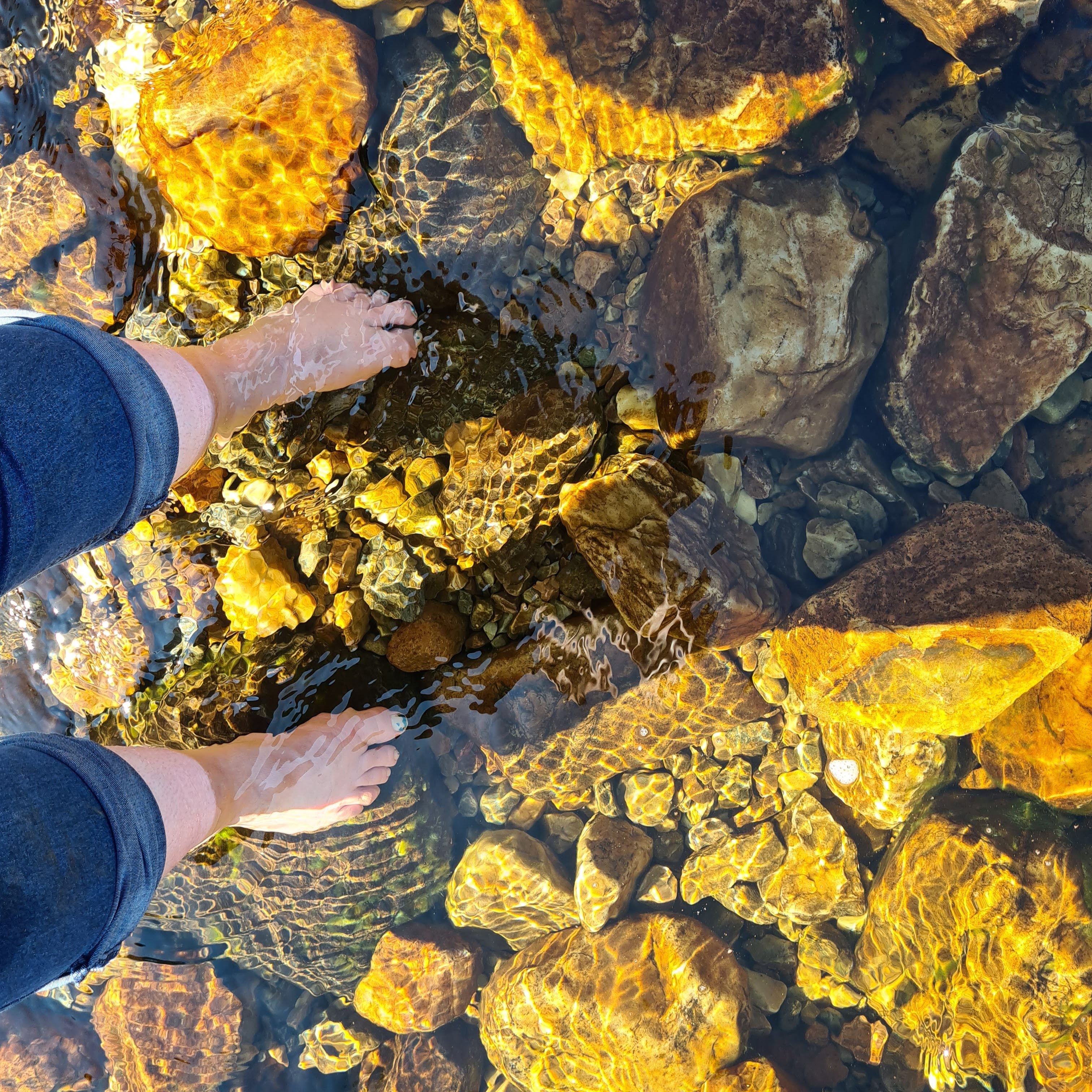
Dad and I tried to continue walking along the valley but found the path to essentially disappear into bog, so we headed back towards the wire bridge, looking for a place to cross. In the end, tired feet won out and I stripped off my boots to plunge into the icy water. It felt amazing and almost immediately numbed my toes to the rocks as I managed to just get across without falling. As we waited for our feet to dry, we sat on the riverbank and enjoyed the stunning view back towards the gorge.
The return trip is a touch less gruelling as it is more downhill than up, but the views are no less stunning and there is a great deal of truth in the fact that down becomes harder as one’s knees get older.
By the time we returned to the car I was very ready to take off my sturdy hiking boots and find some looser shoes to don for the drive back down the glen. I recall sitting in the car for a few moments just enjoying the car park view before finally heading back into town.
From here, Dad and I went on to the Commando Memorial, but even after our hikes on Ben Nevis and beyond, this remains one of the most stunning and magical trails I have found. The tranquillity of the valley around the Water of Nevis is breath-taking, and so quintessentially Scotland that it really should not be missed. That said, it is not a trek to take on lightly or unprepared; water, a snack, and sturdy shoes are an absolute must! And, if you are going in the summer, a strong midge repellent.
As anyone who has read my two posts on the Nevis Range may have guessed, Fort William – and the surrounding Lochaber – is one of my favourite places in Scotland. One of my favourite features of Lochaber is the way in which the mountains and hills sweep down right to the lochs and sea, creating spectacular vistas that are so typical of the Highlands. It is such a different feel from the east coast, where we have cliffs and beaches, and of course the east coast of the US which tends to be much flatter, except perhaps up in the far north of Maine.
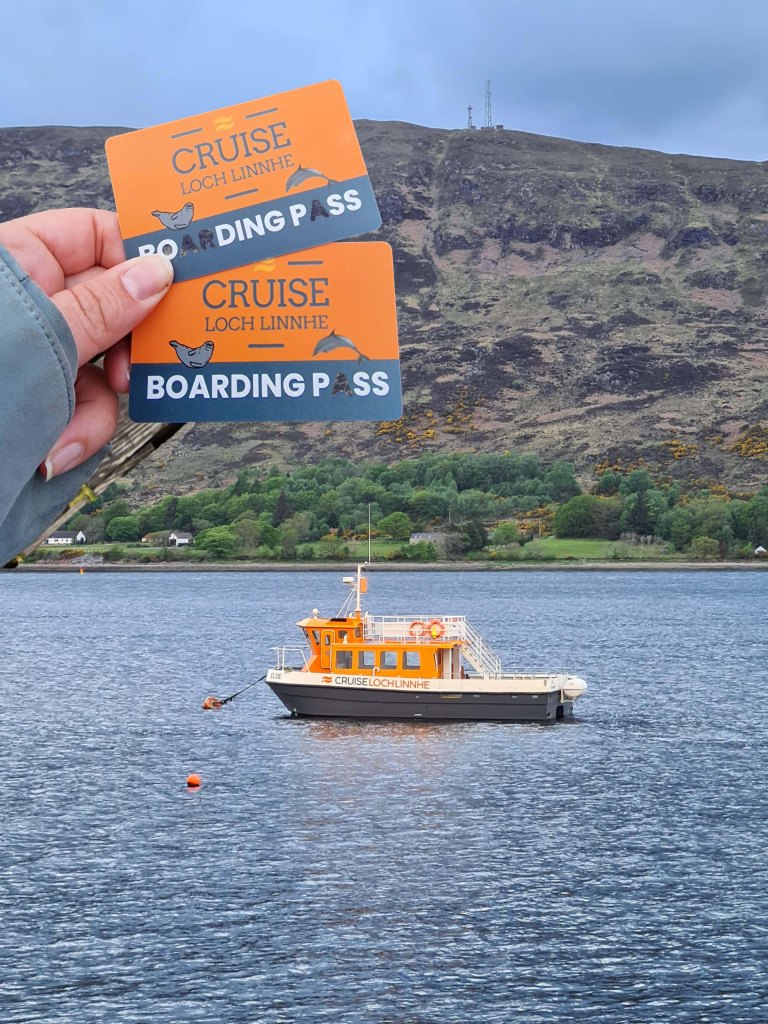
One of the best ways to truly appreciate and experience the views is, as we discovered, to explore the loch with Cruise Loch Linnhe, a tour company that runs a series of cruises from Fort William. They offer evening cruises and even private charters, but also the cruise I have now taken twice: the ‘seal’ cruise, which covers a good portion of the loch and allows one to see not just seals but heron, swans, dolphins, and many other kinds of wildlife.
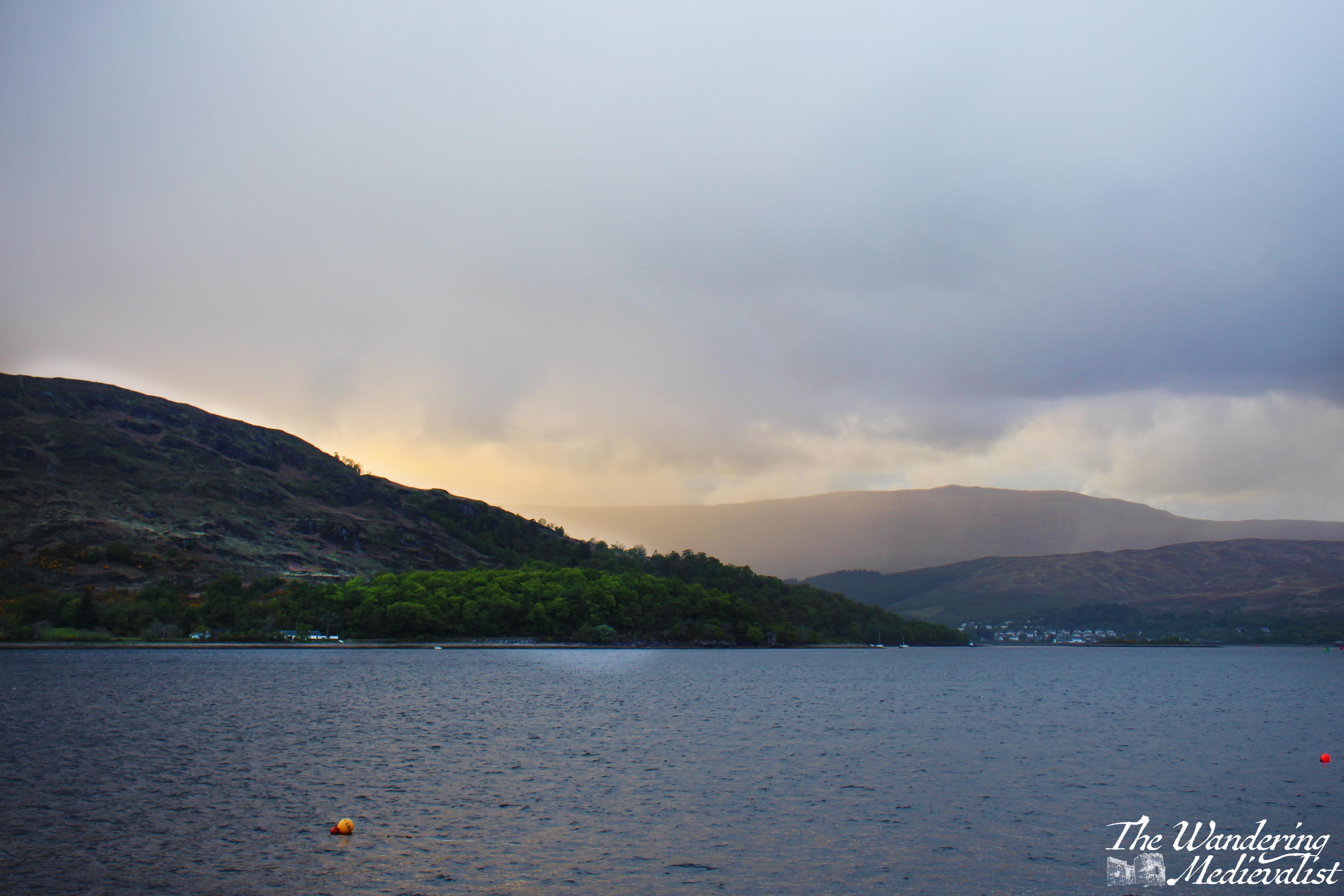
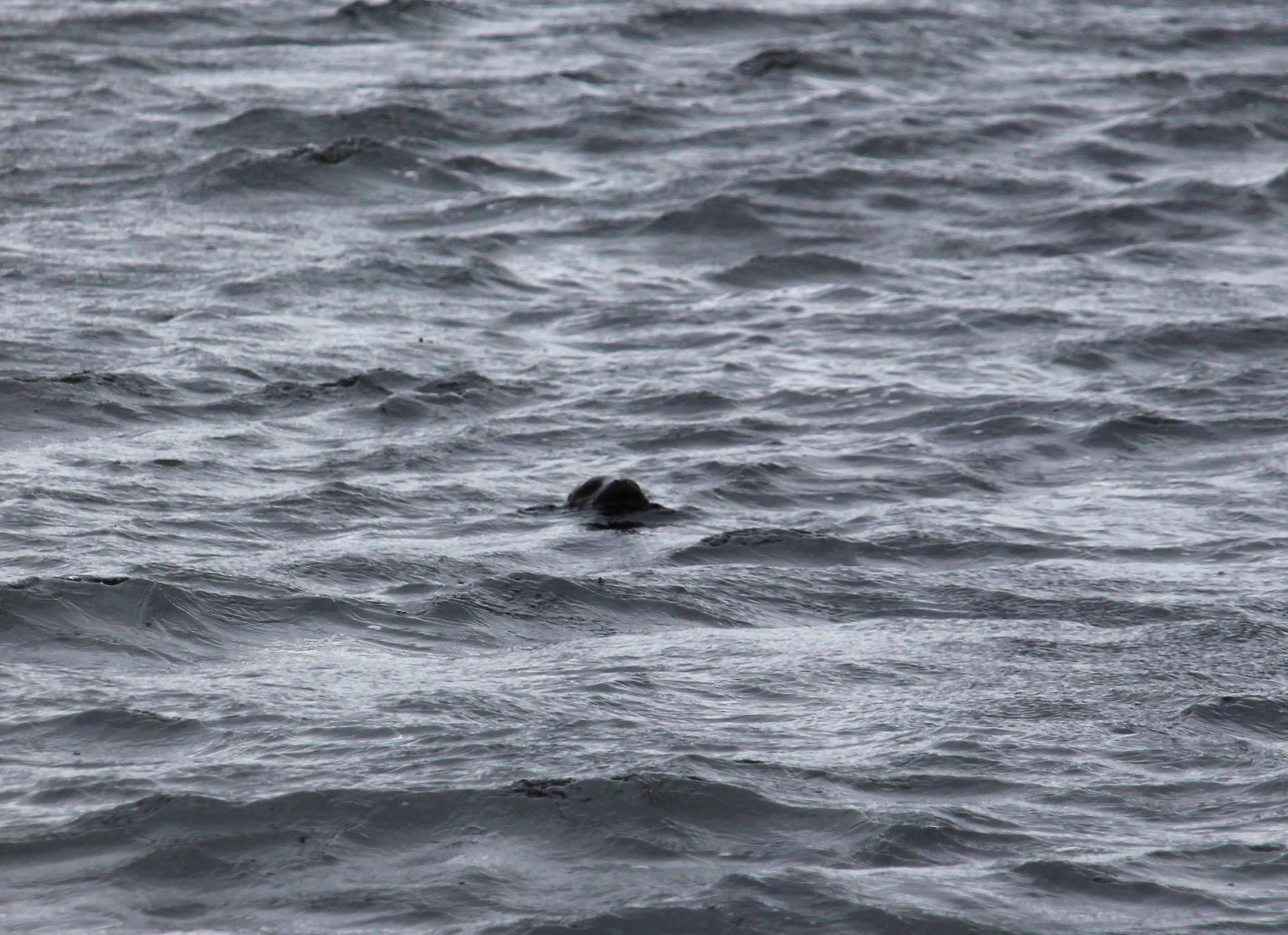
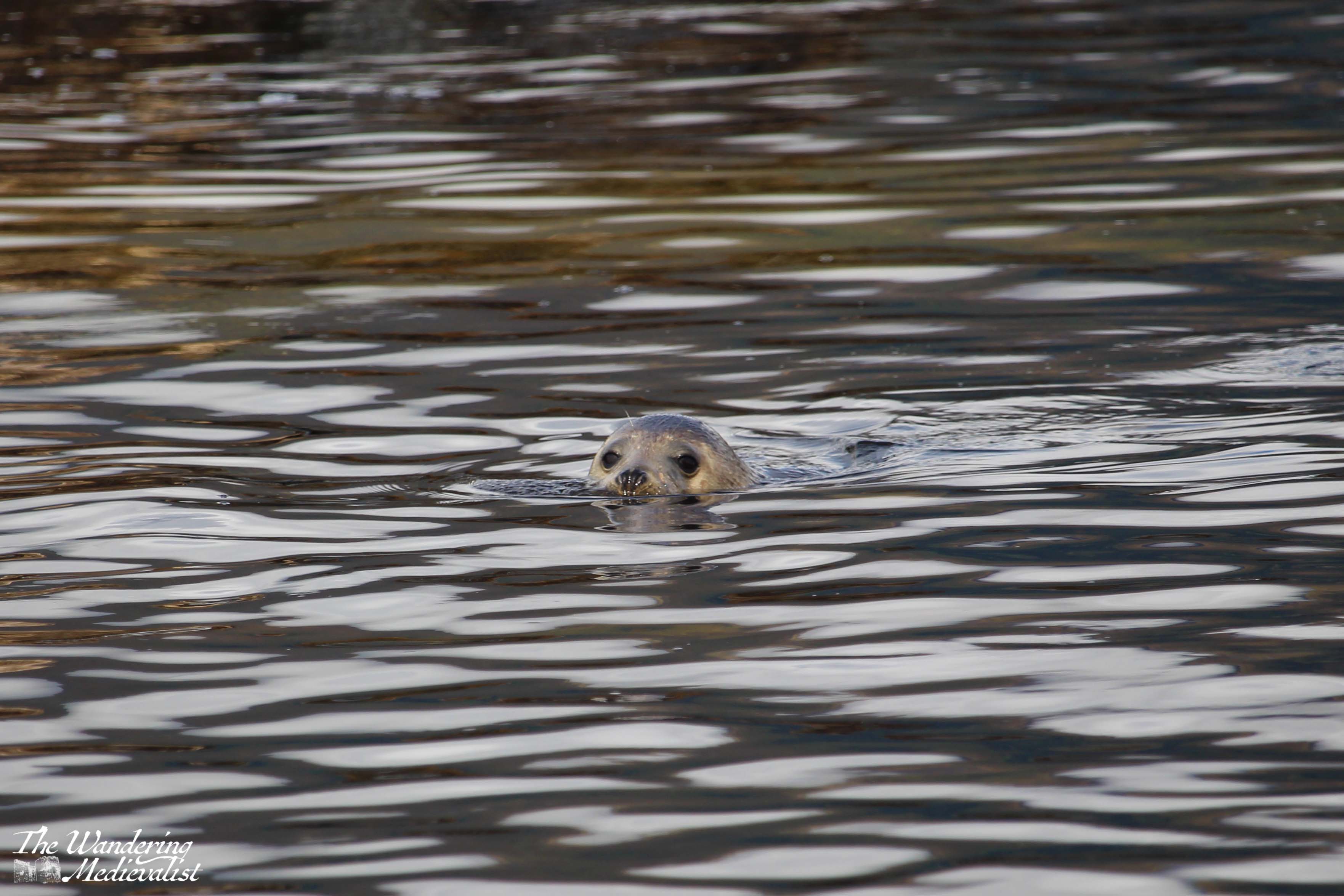
The first time I took the cruise was with Mum in May of last year, and we were not at all lucky when it came to the weather – it poured rain almost the entire time we were on the boat, and we saw only one seal, its head just poking out of the water. Below are the two pictures from May – the night before the cruise, with the rain clouds closing in, and the only seal we saw.
Rain notwithstanding, it was a very nice cruise; the boat is comfortable with plenty of amenities including hot tea and coffee, snacks, and even a whisky or two if you’re interested. I stood just outside the door for a while and tried to get some pictures of the view, but the ones later in the year were so much better I have not bothered to post them here. As I experienced later on, the skippers on these cruises are very experienced and offer a running commentary of information about the area surrounding the loch as well as the wildlife, so it is a good lesson in all things Scottish! My father has always had an interest in boats, and so I determinedly re-booked for later in the summer when he was visiting, and on the second attempt I was rewarded with a much clearer trip.
The boat leaves from just next to the Crannog Restaurant, not far from the large car park in Fort William. I insisted upon being first in the queue – or almost first – to board so that I could get the seat I wanted, right at the back of the boat where no one could block my view.
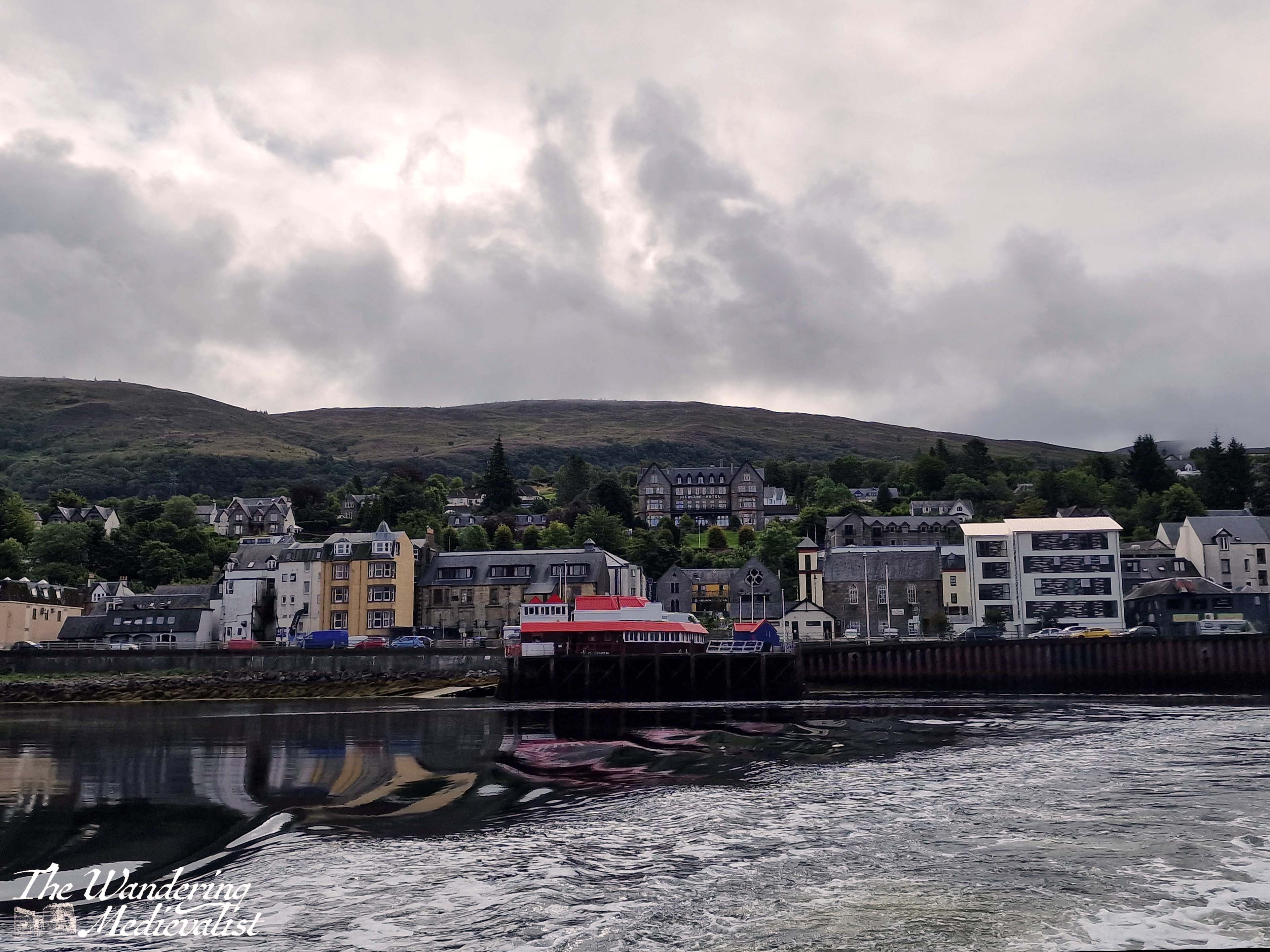
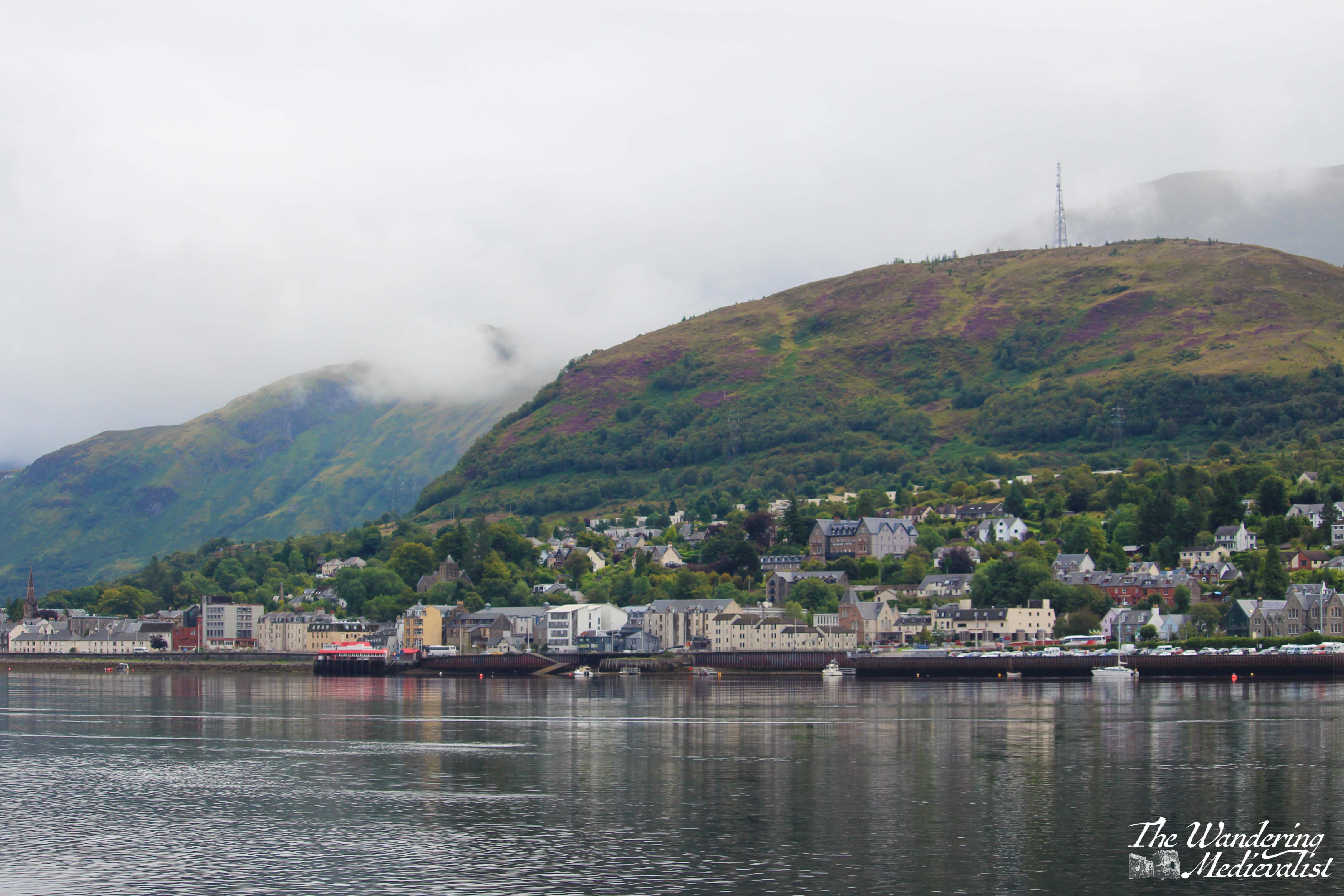
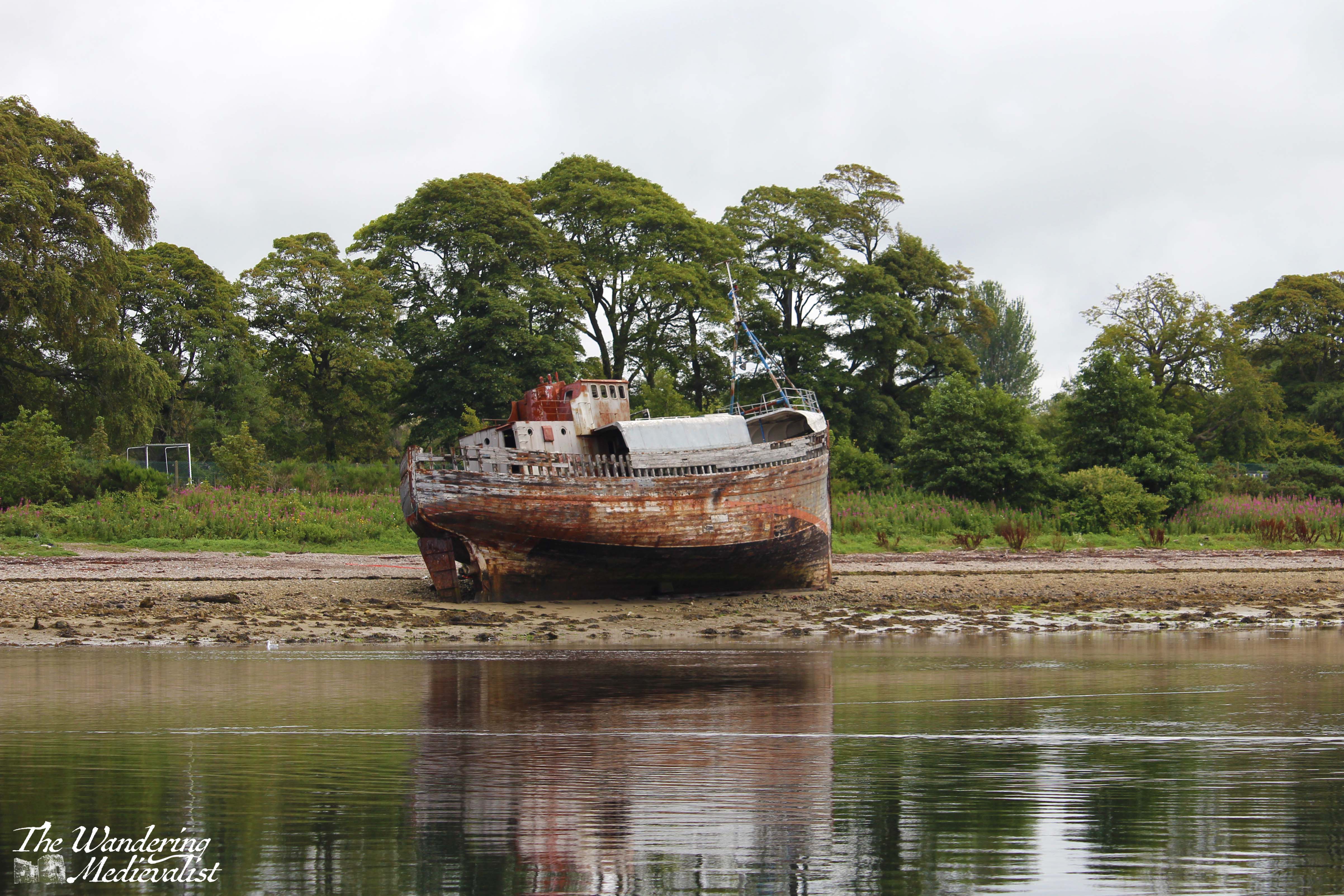
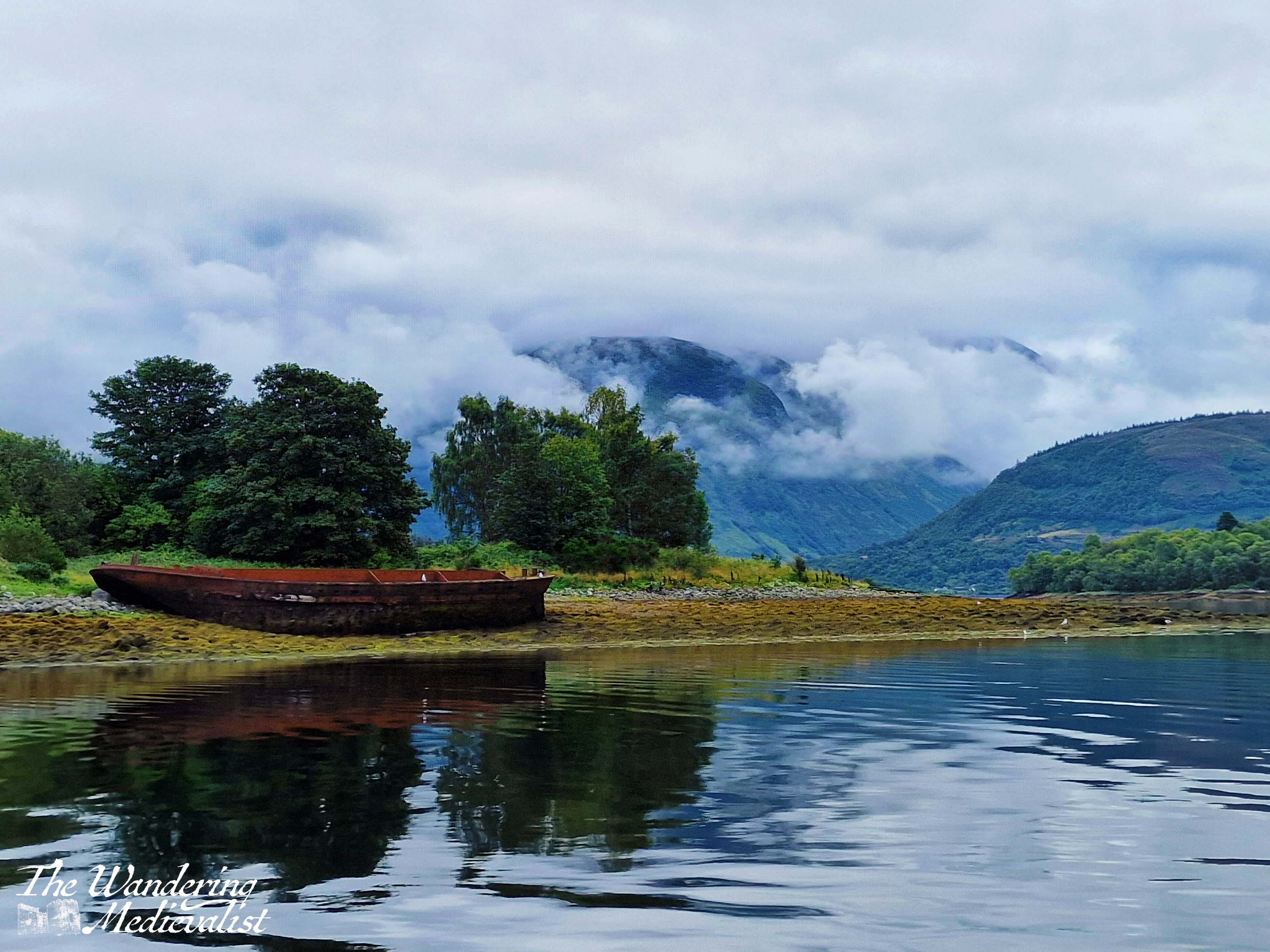
At first, the route of the cruise takes you right away from the quay, roughly north towards Caol, a village almost immediately outside Fort William. Right away you are rewarded with views back towards the town and Ben Nevis, if it is clear; from there the cruise passes Caol and the locks at the start of the Caledonian Canal, as well as the Old Boat of Caol, a shipwrecked fishing boat.
The cruise goes north and west a bit to pass the timber yards which I learned are some of the largest in Europe; it was also on this cruise that I learned that most of the timber grown in Scotland is not high enough quality to use for building, because it grows too fast. So, it is turned into biomass pellets, while the good building timber is shipped in from Scandinavia, where the cold forces the trees to grow more slowly.
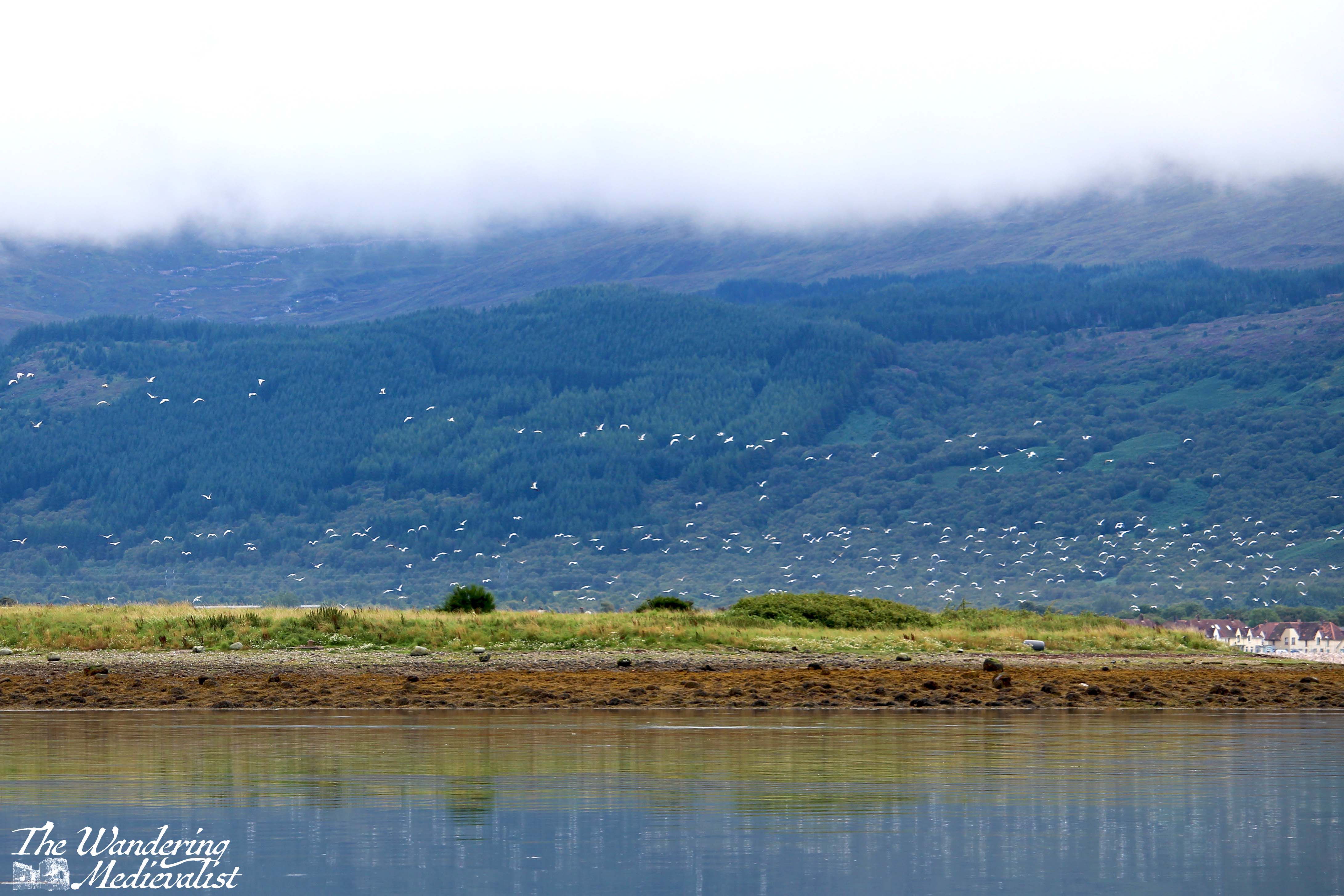
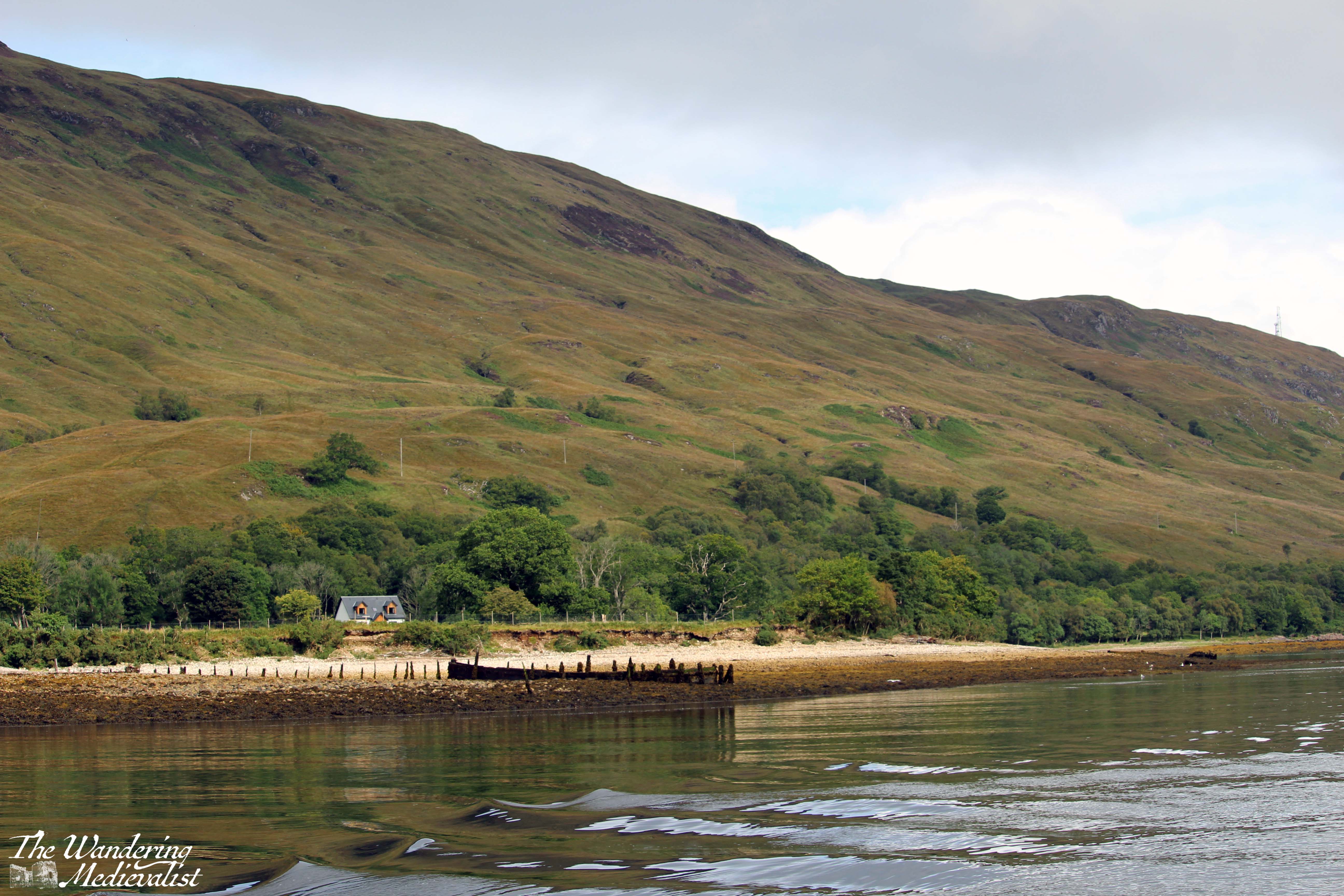
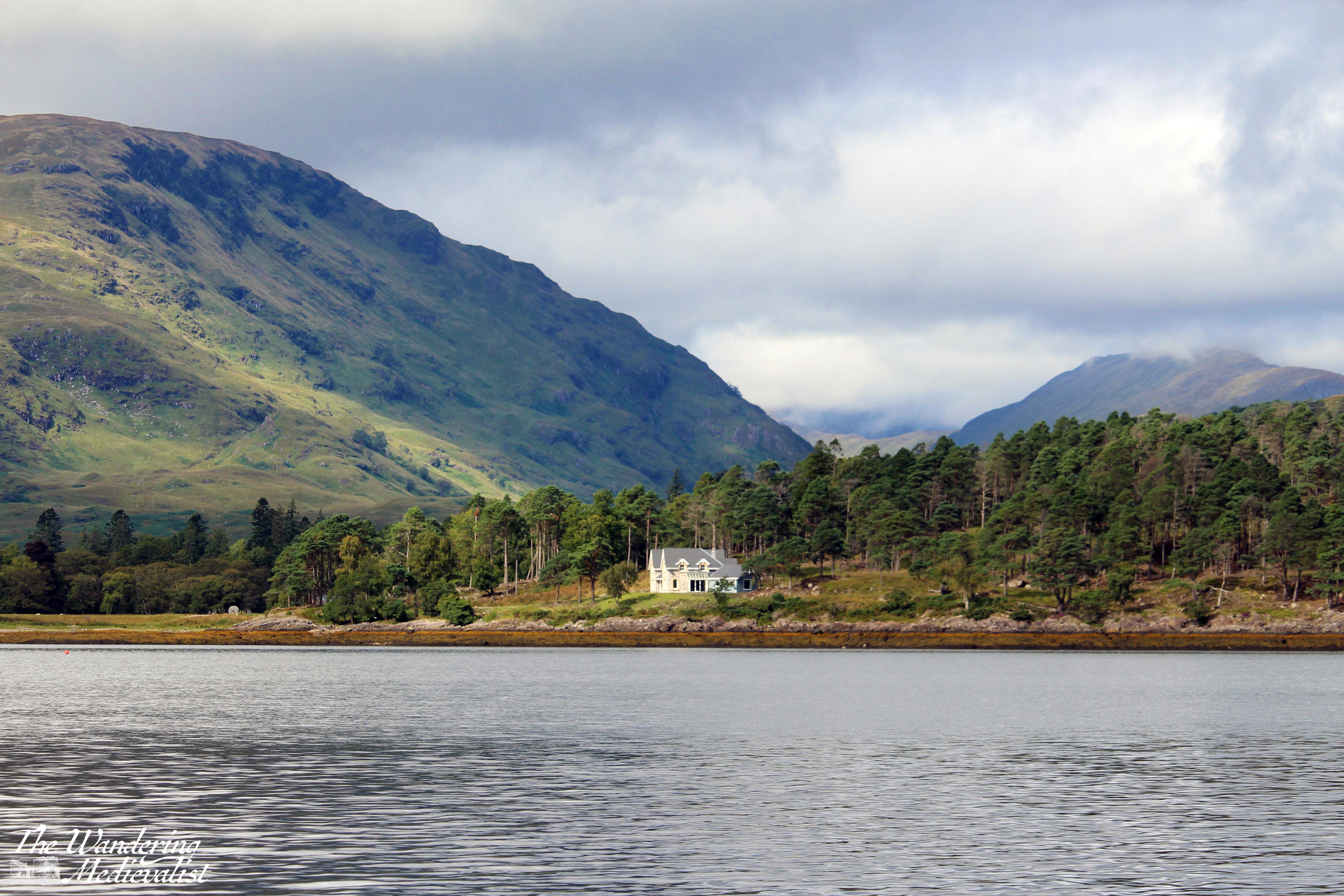
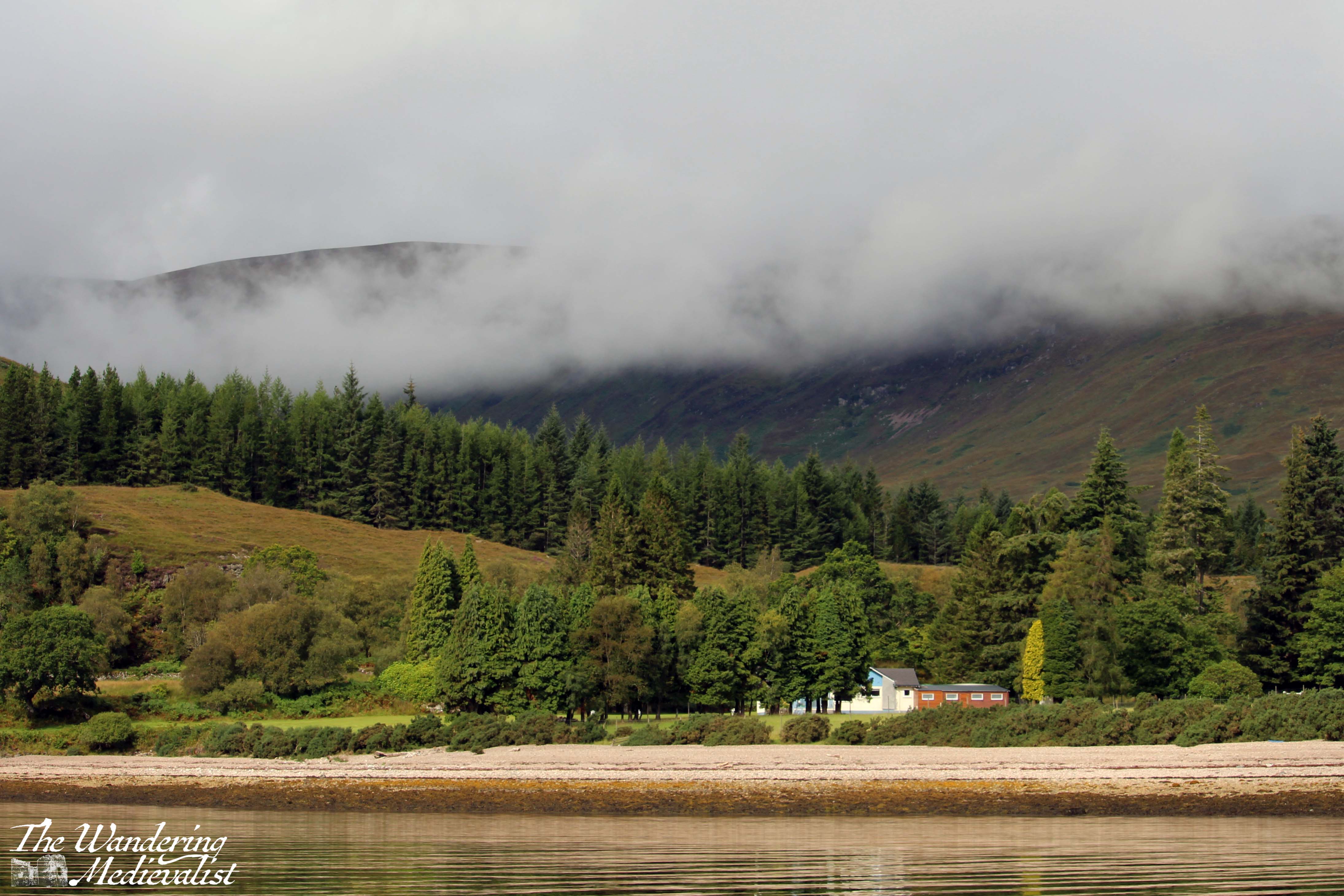
Gradually the boat circles back towards the wider loch, passing some lovely homes on one side, and bird-covered small islands on the other – the clouds started to clear slightly so I was able to see the start of Glen Nevis.
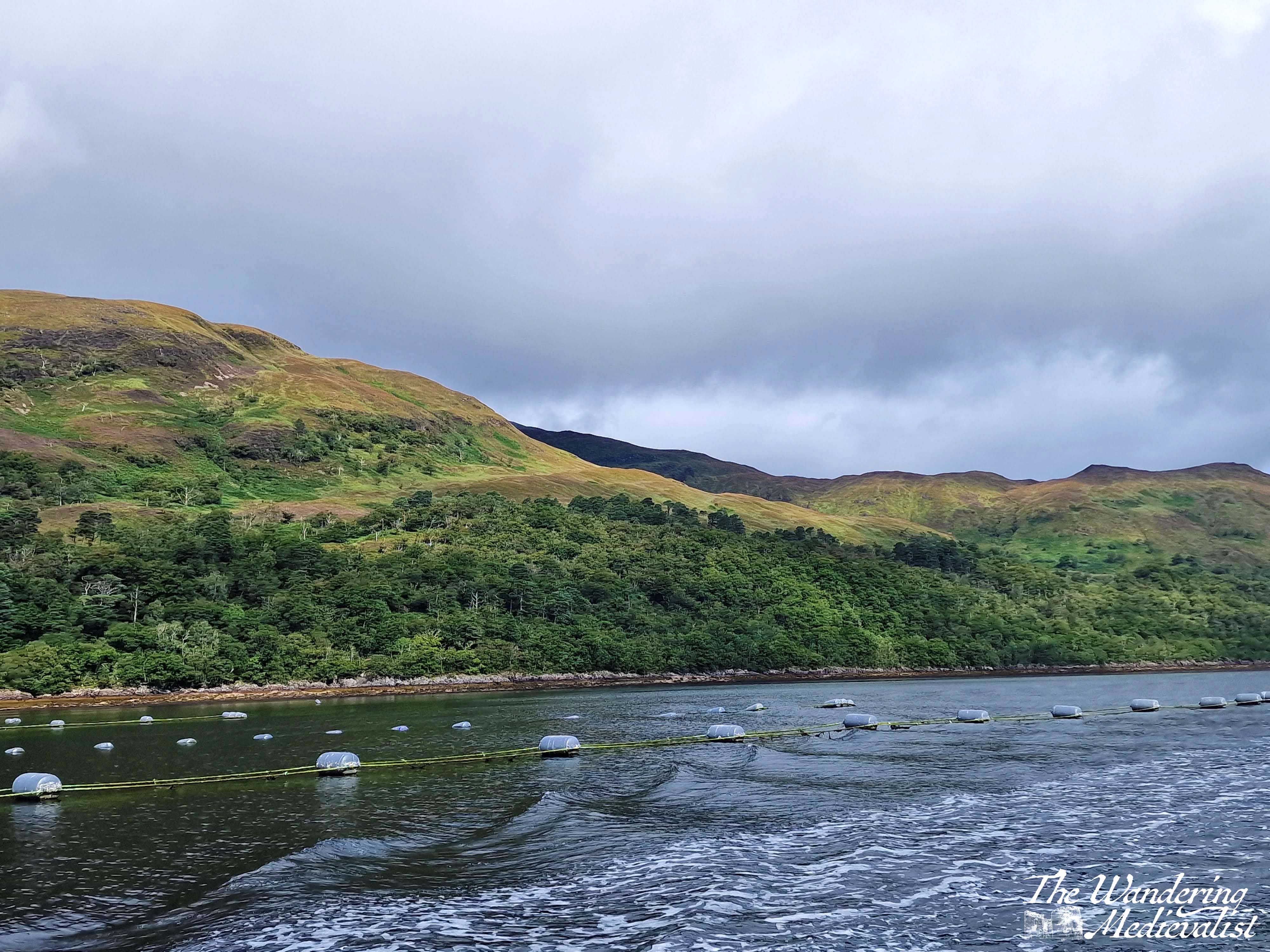
From here, the cruise hugs the west side of the loch across from Fort William, where there is a series of small farms – including one with alpaca – as well as salmon and mussel fisheries. Side note, it was during a trip to Fort William that I had some of the best mussels of my life, and this is from a New England girl!
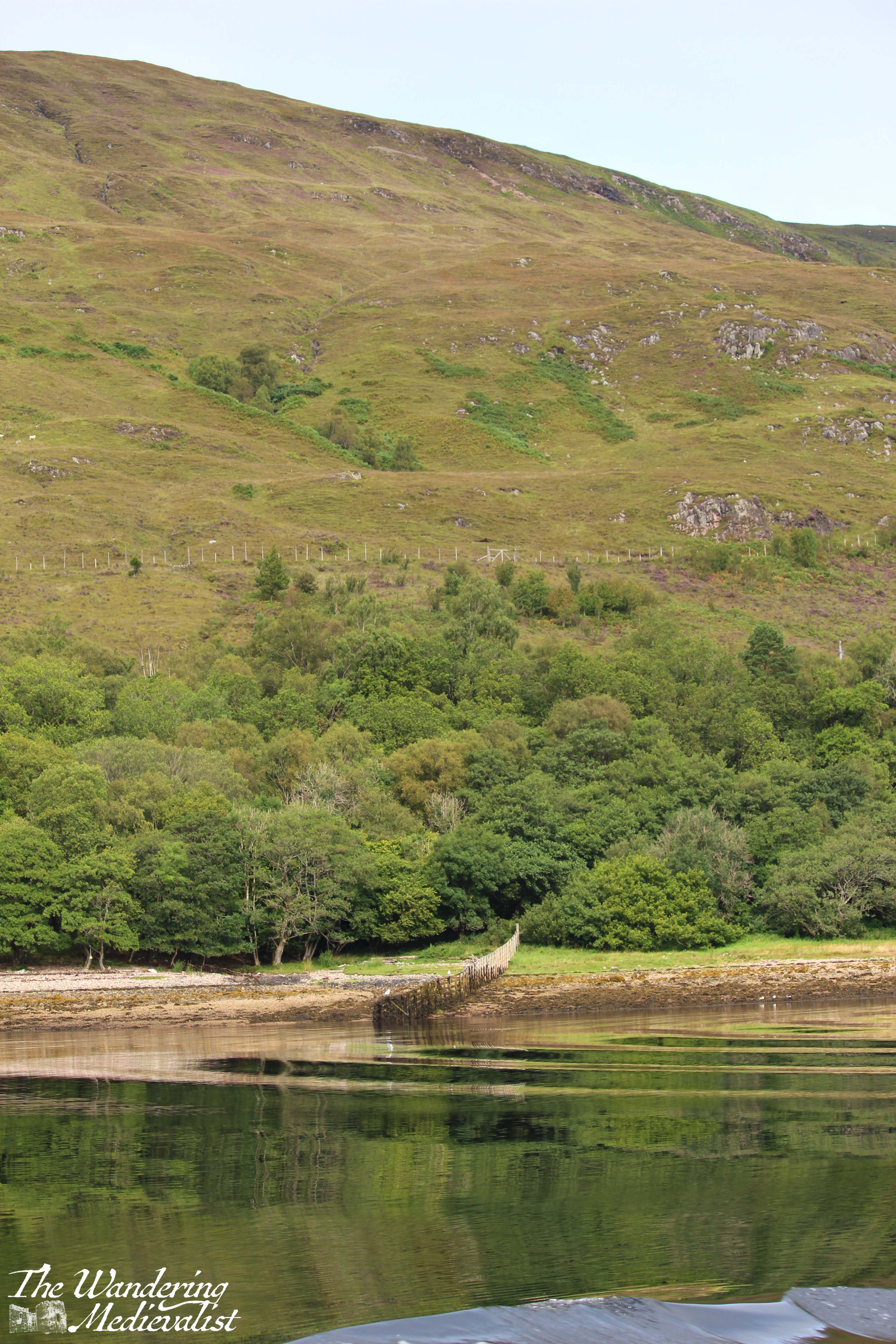
I became fascinated by the way the hills are split by crevices in which streams must flow downhill, and eventually meet the loch – very dramatic. We also learned a great deal about the ecological problems with salmon farming, and the impact it was having on the loch (this article linked here is very staunchly anti-farms, but then after hearing the skipper talk, so was I).
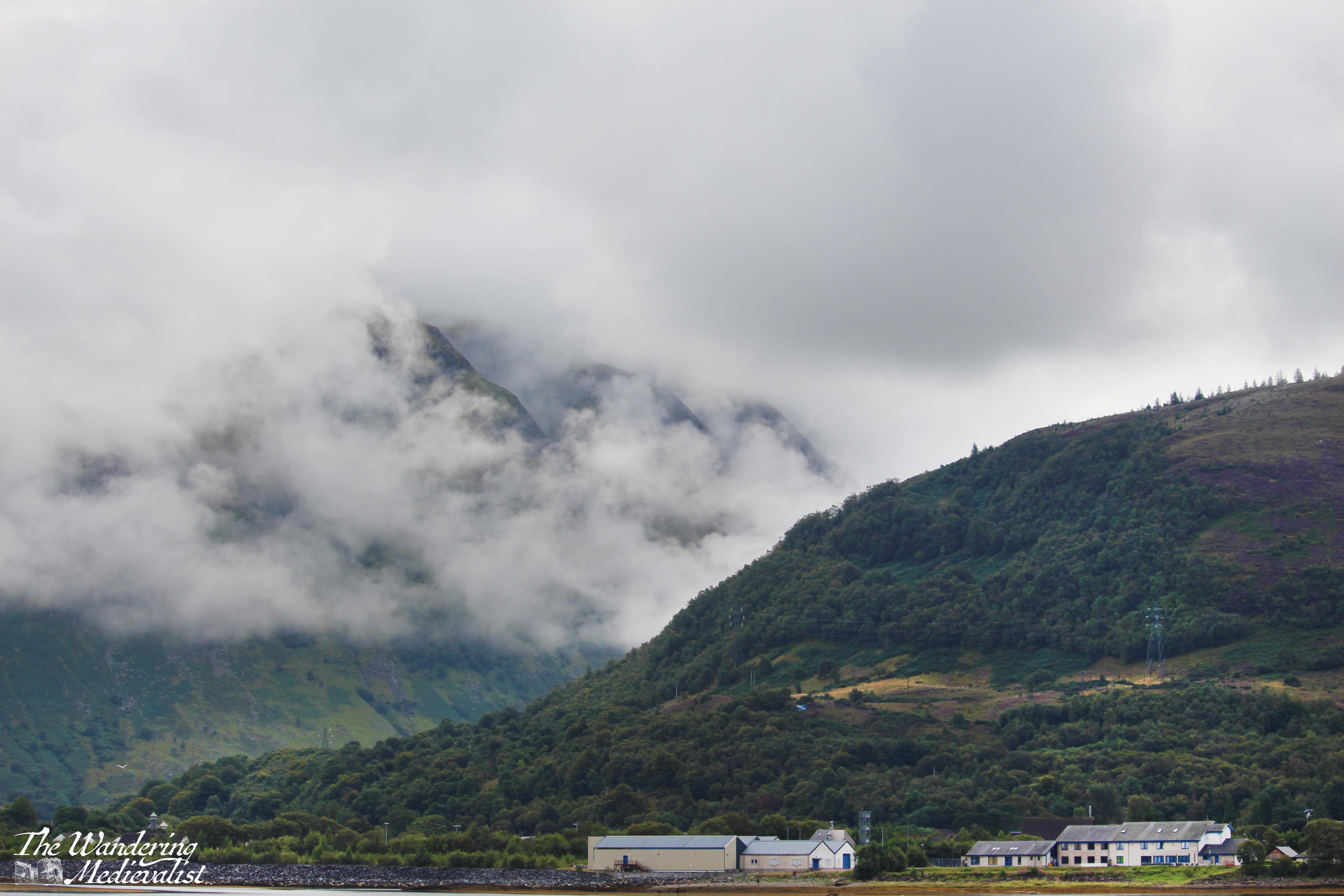
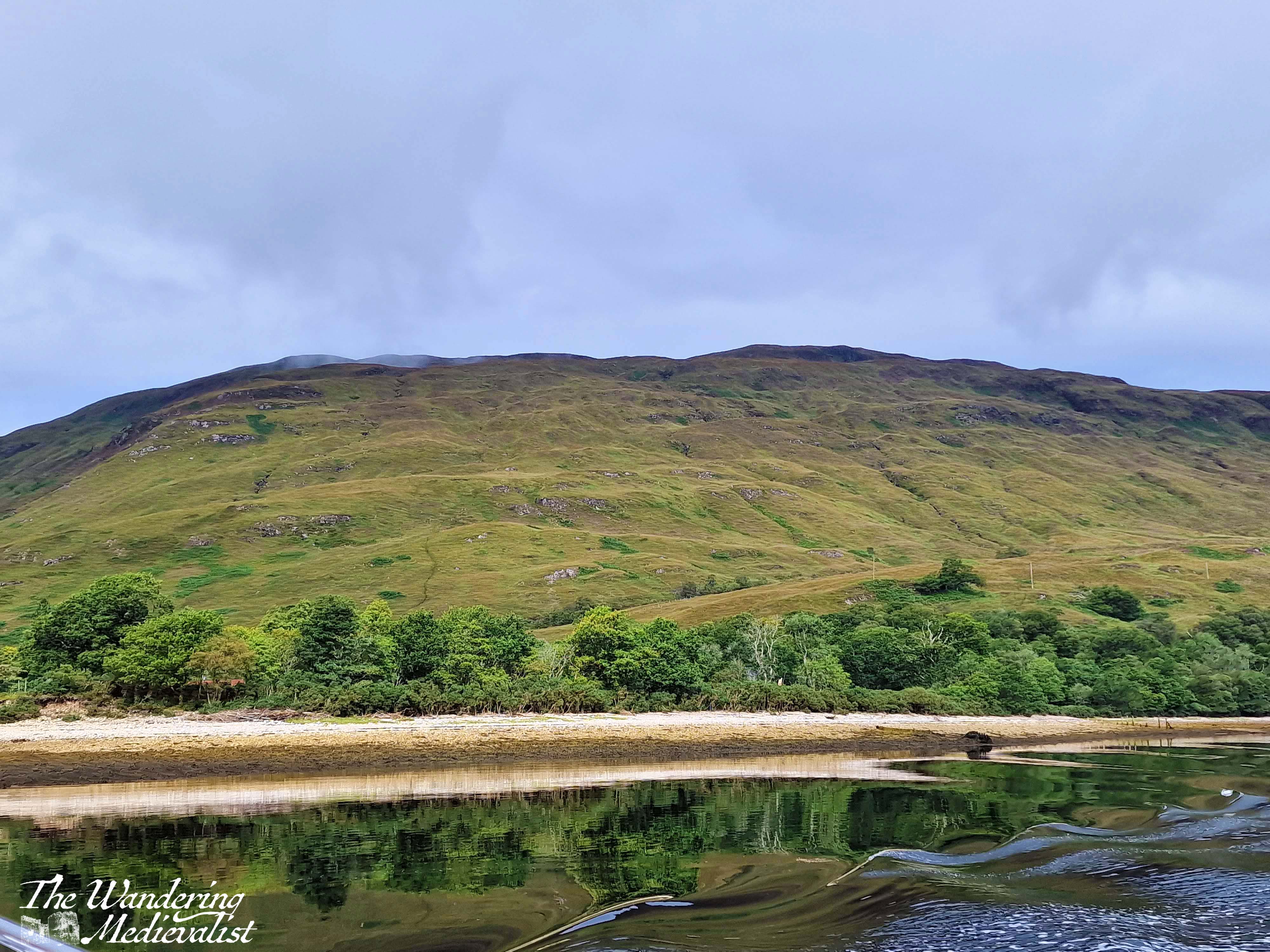
As we headed south, the boat moved more into the middle of the loch, allowing for stunning views westward along the glens and mountains that are sparsely-populated and quite difficult to access without the use of the Corran ferry.
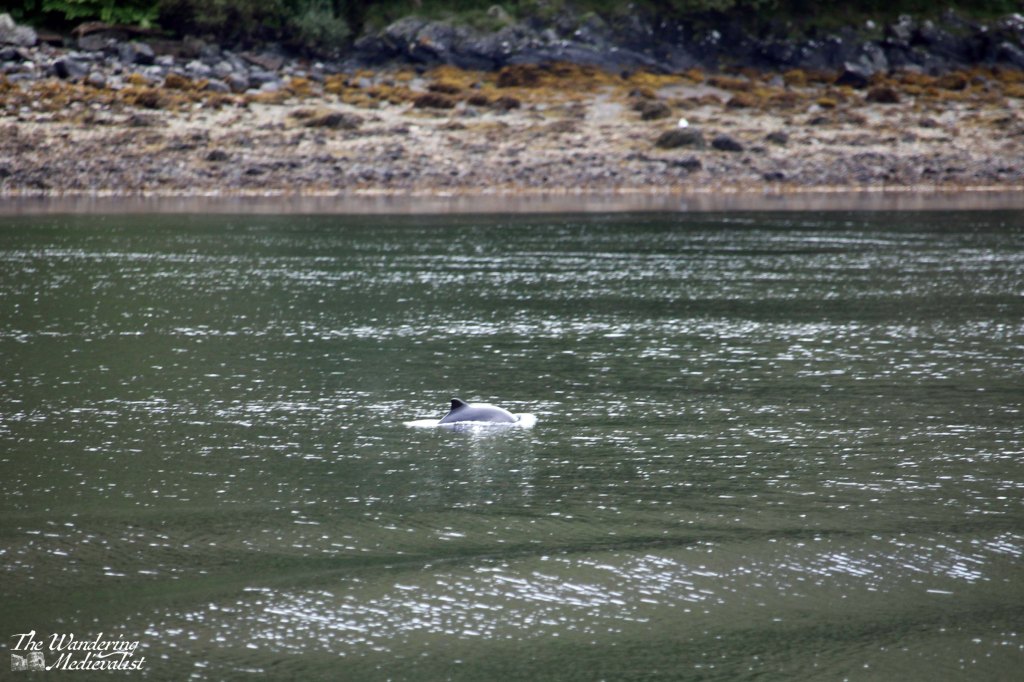
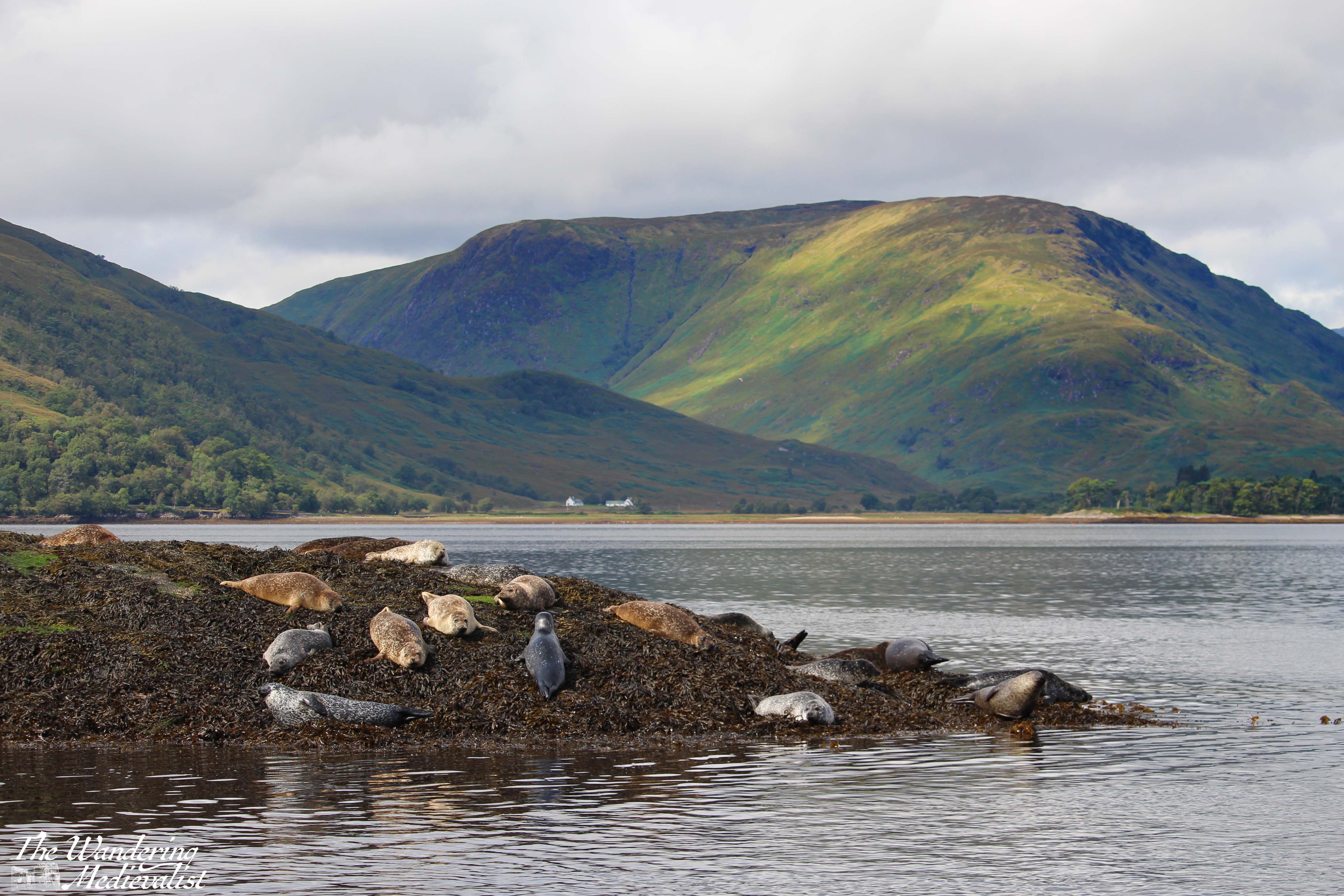
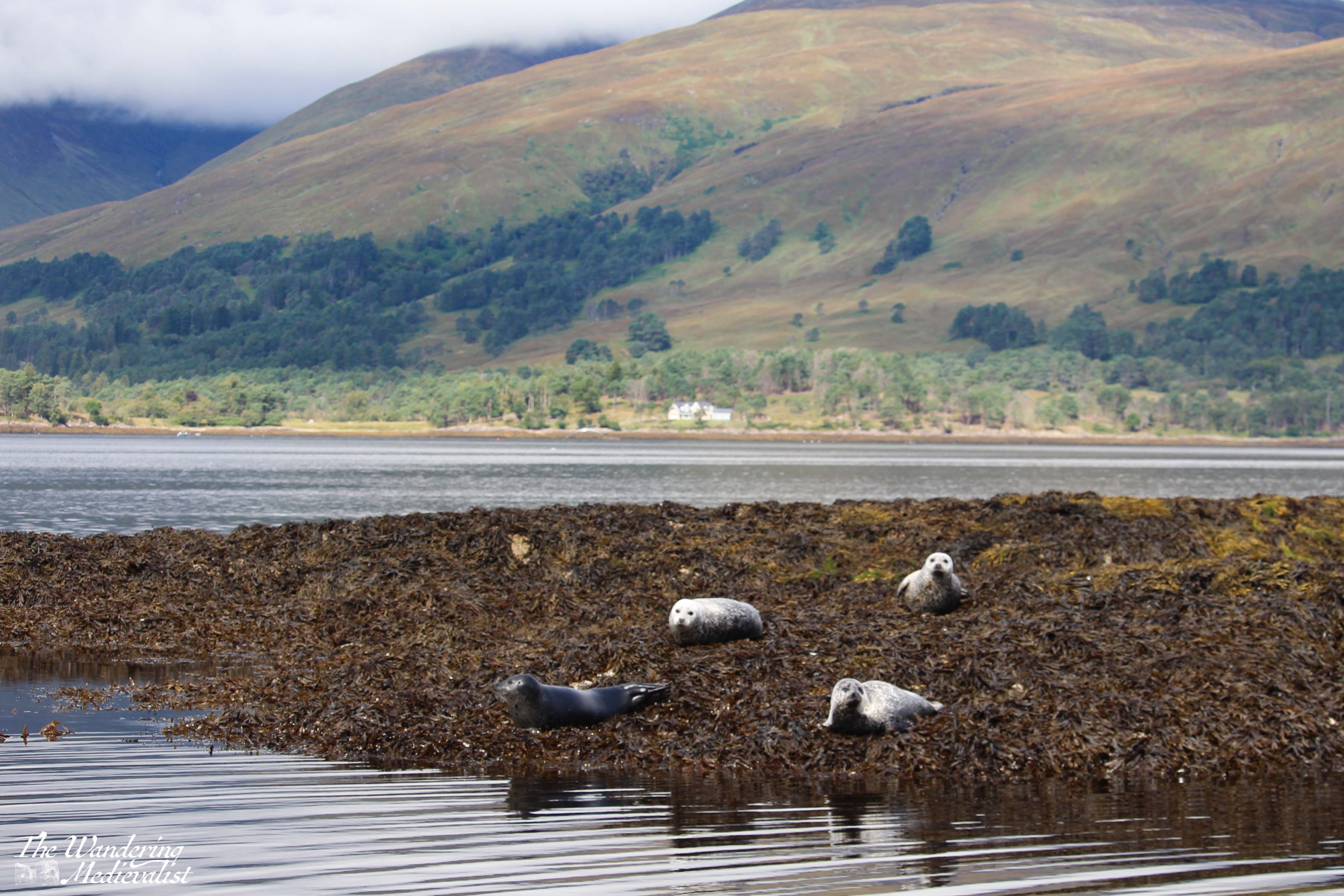
Then we circled around towards the other side of the loch, passing a small pod of dolphins – this was the only clear picture I got – and heading towards the tidal rock where the seals rest – the pièce de résistance.
We were given very strict and serious instruction about how to behave. Clearly incredibly experienced, the skipper lectured us on remaining quiet and still, as if we scared a young seal pup it might get lost and end up separated from its mother permanently. With the horror of potentially causing young seals to suffer fresh in our minds, the whole boat full of people prepared with cameras at the ready and children sufficiently chastised. The skipper turned the motor down and allowed the current to push us closer and closer, circling the seal rock.
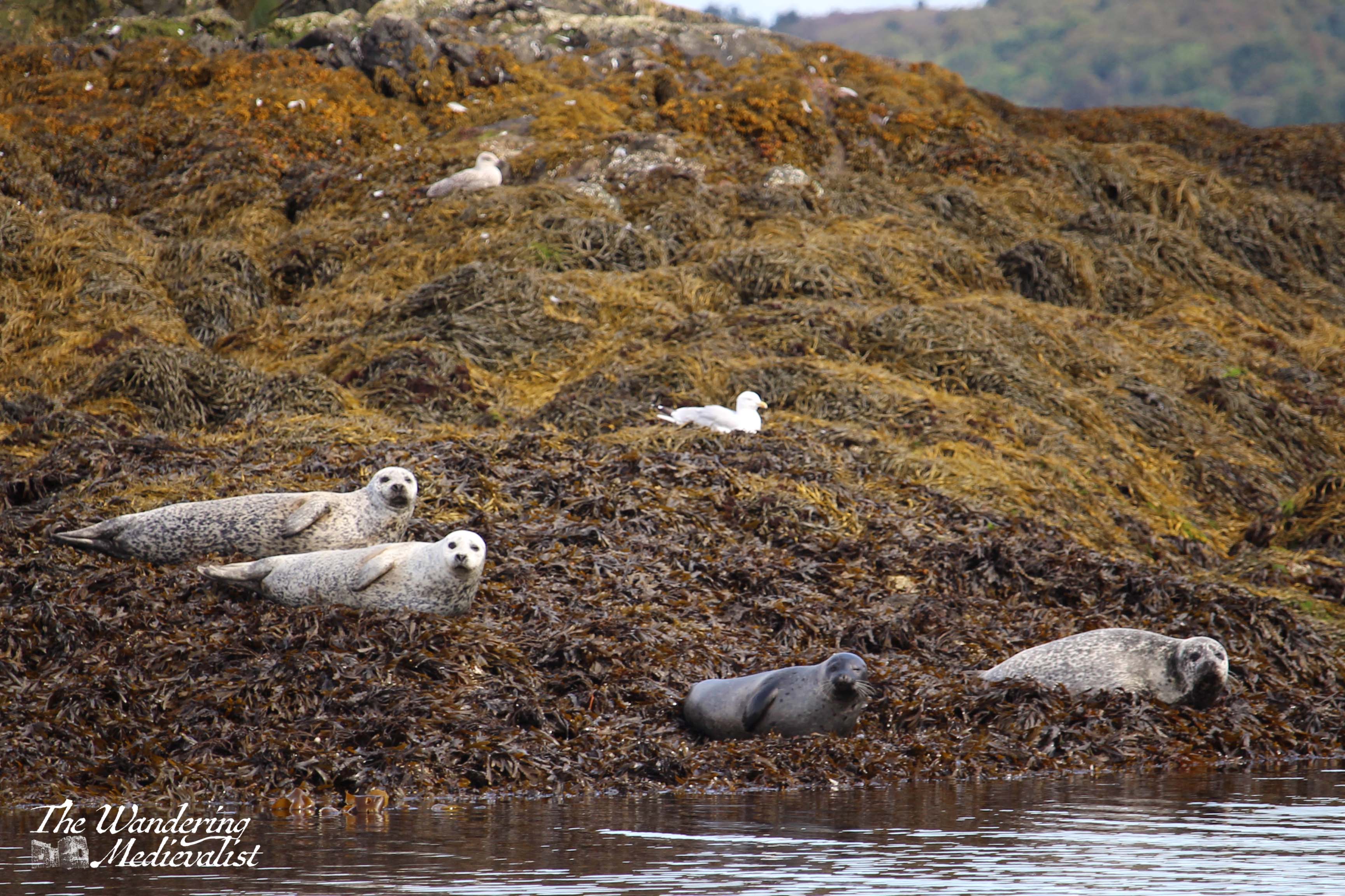
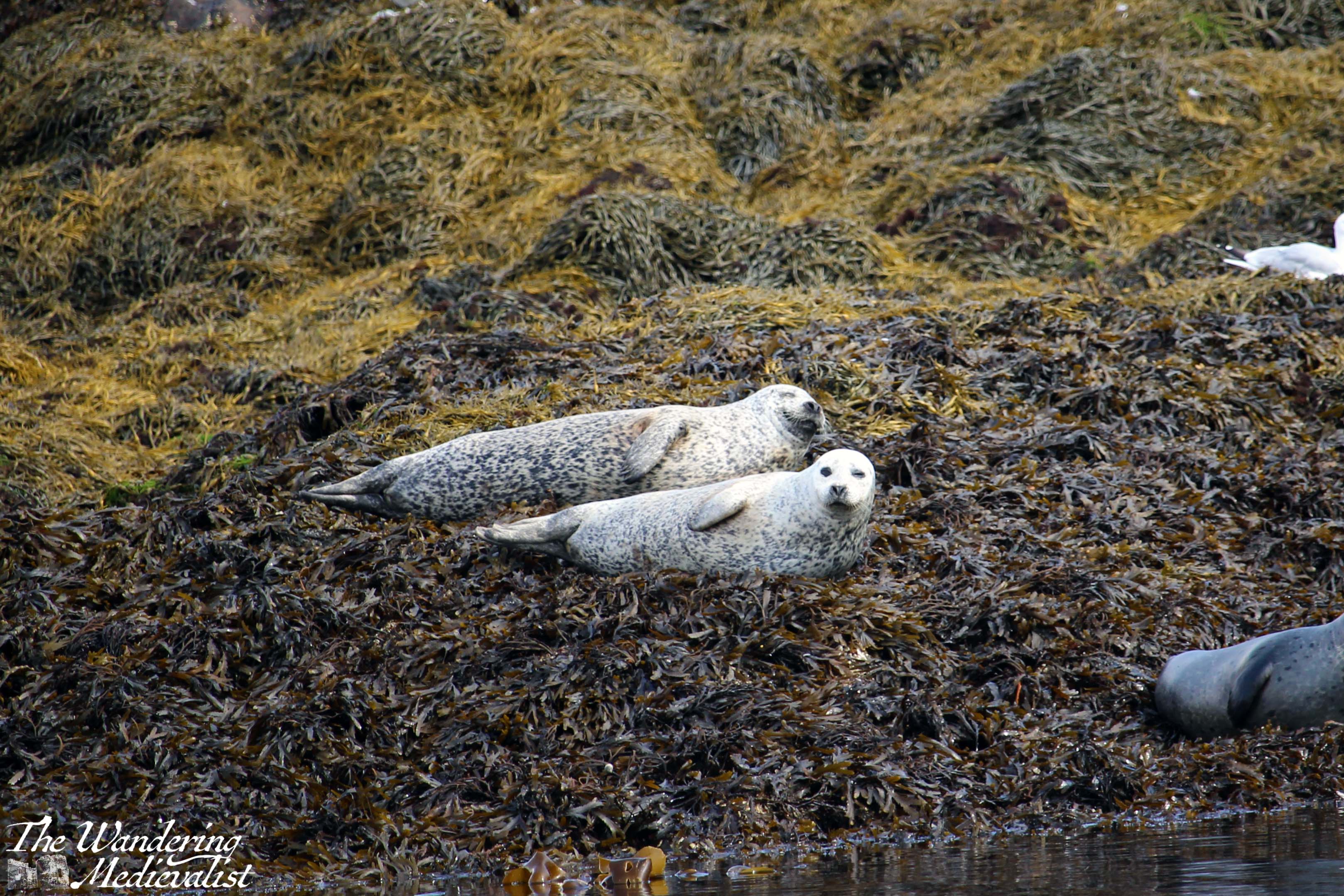
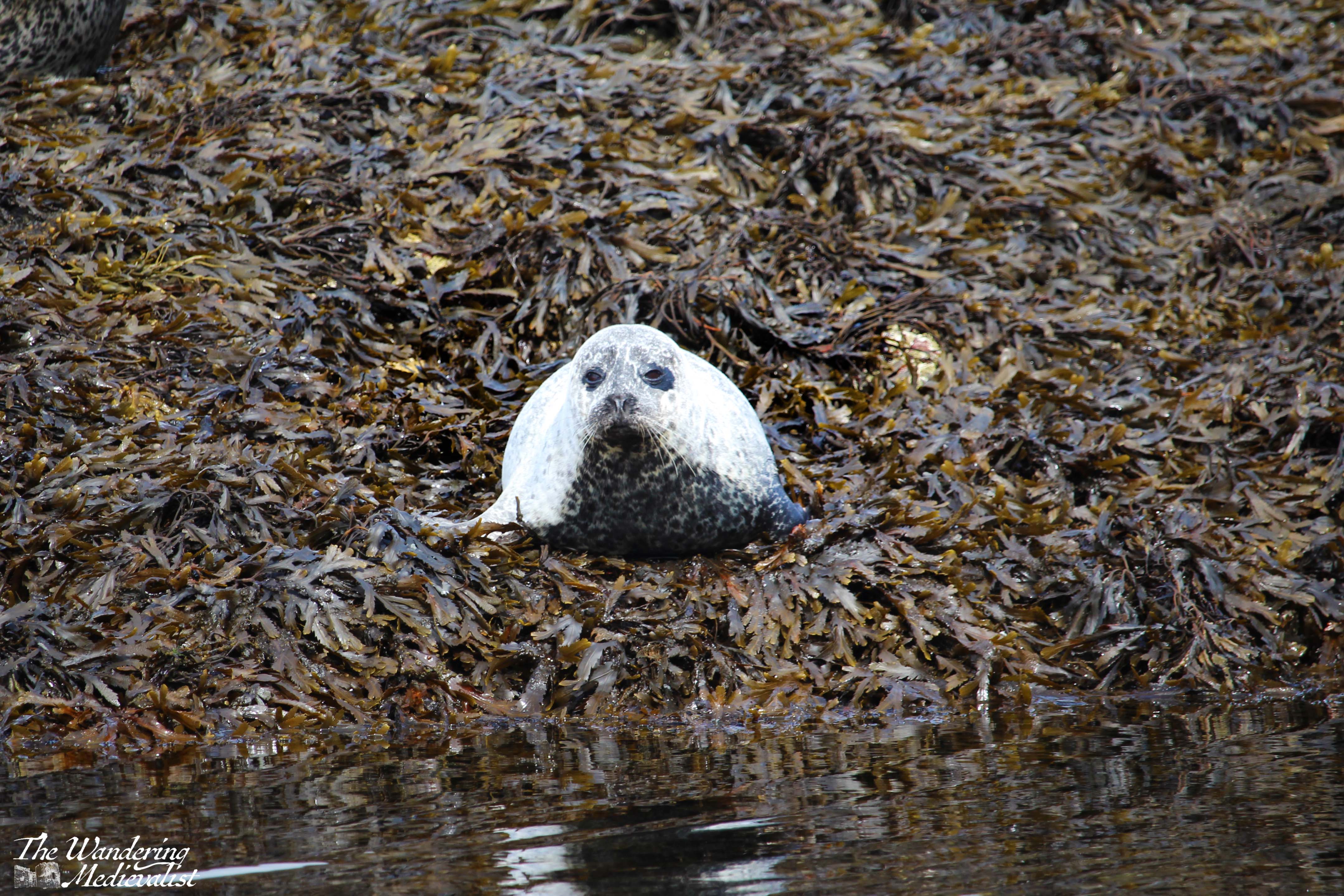
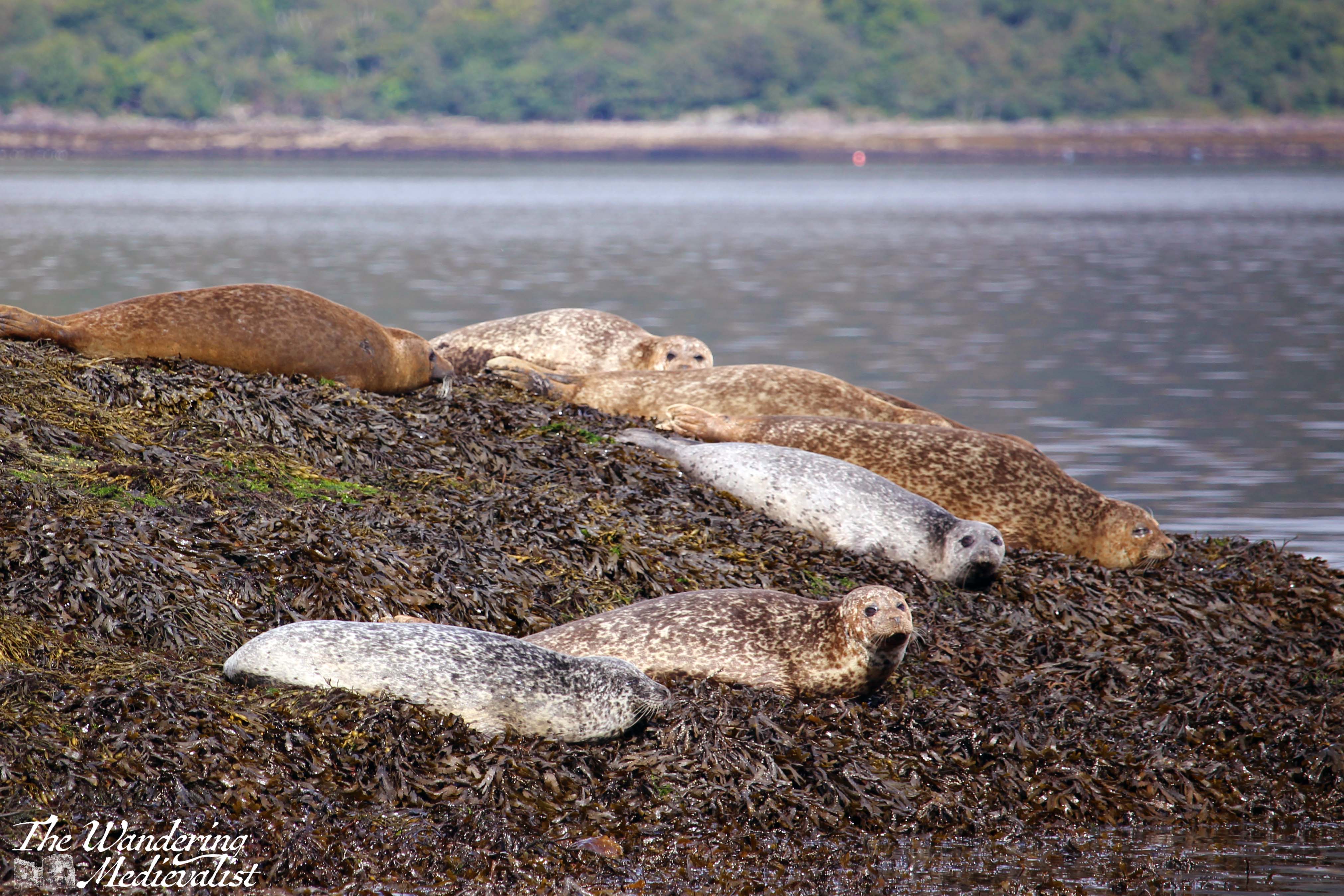
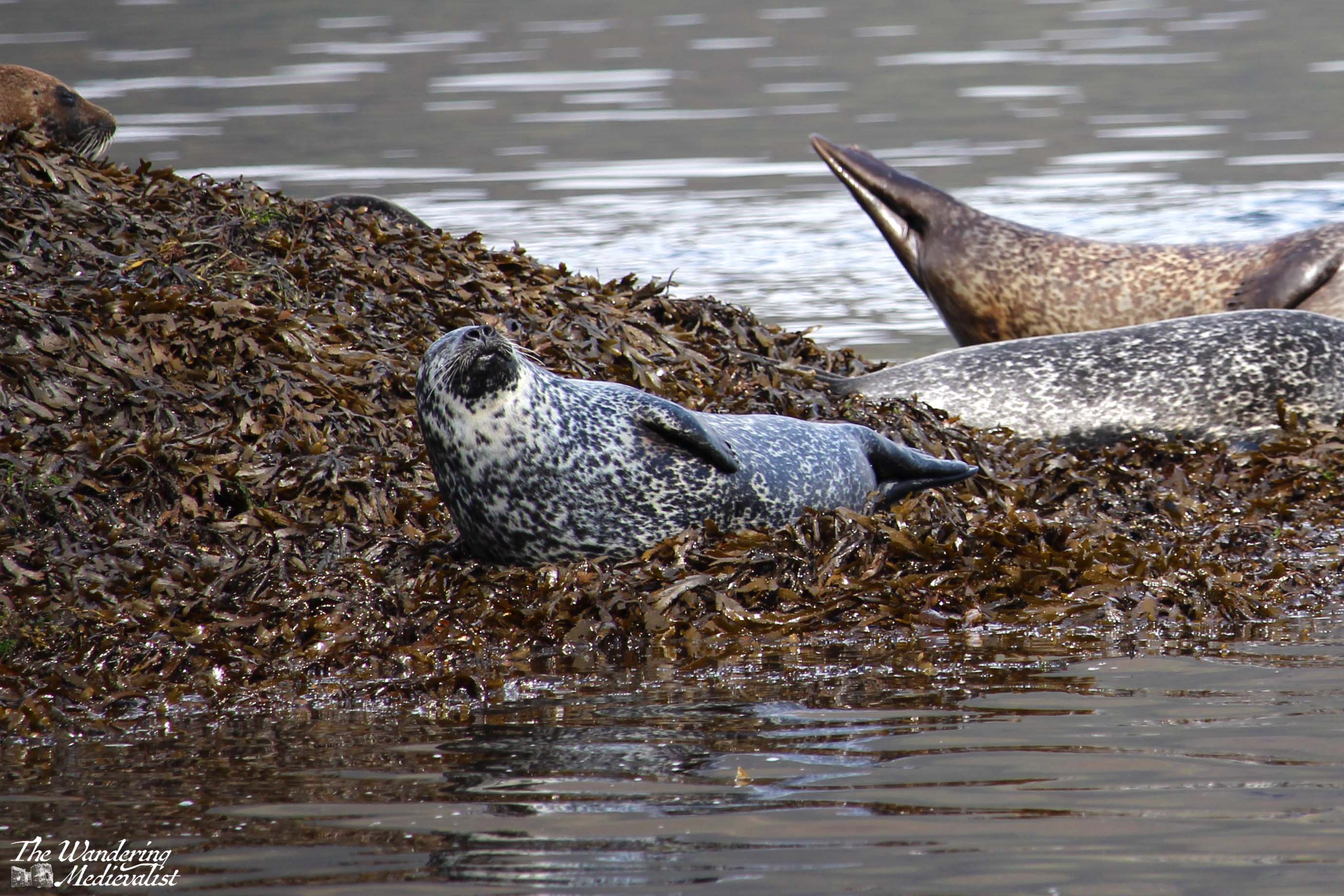
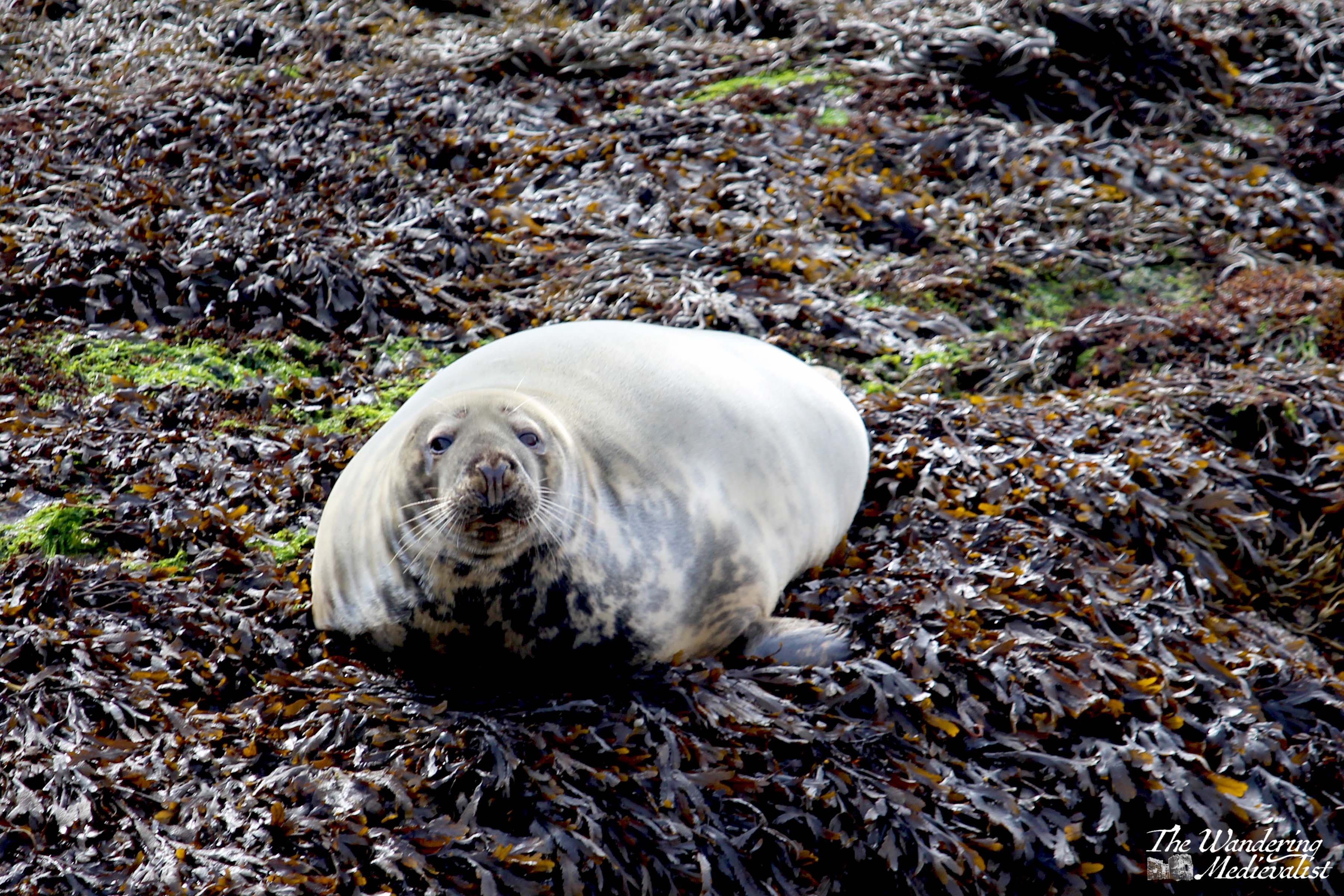
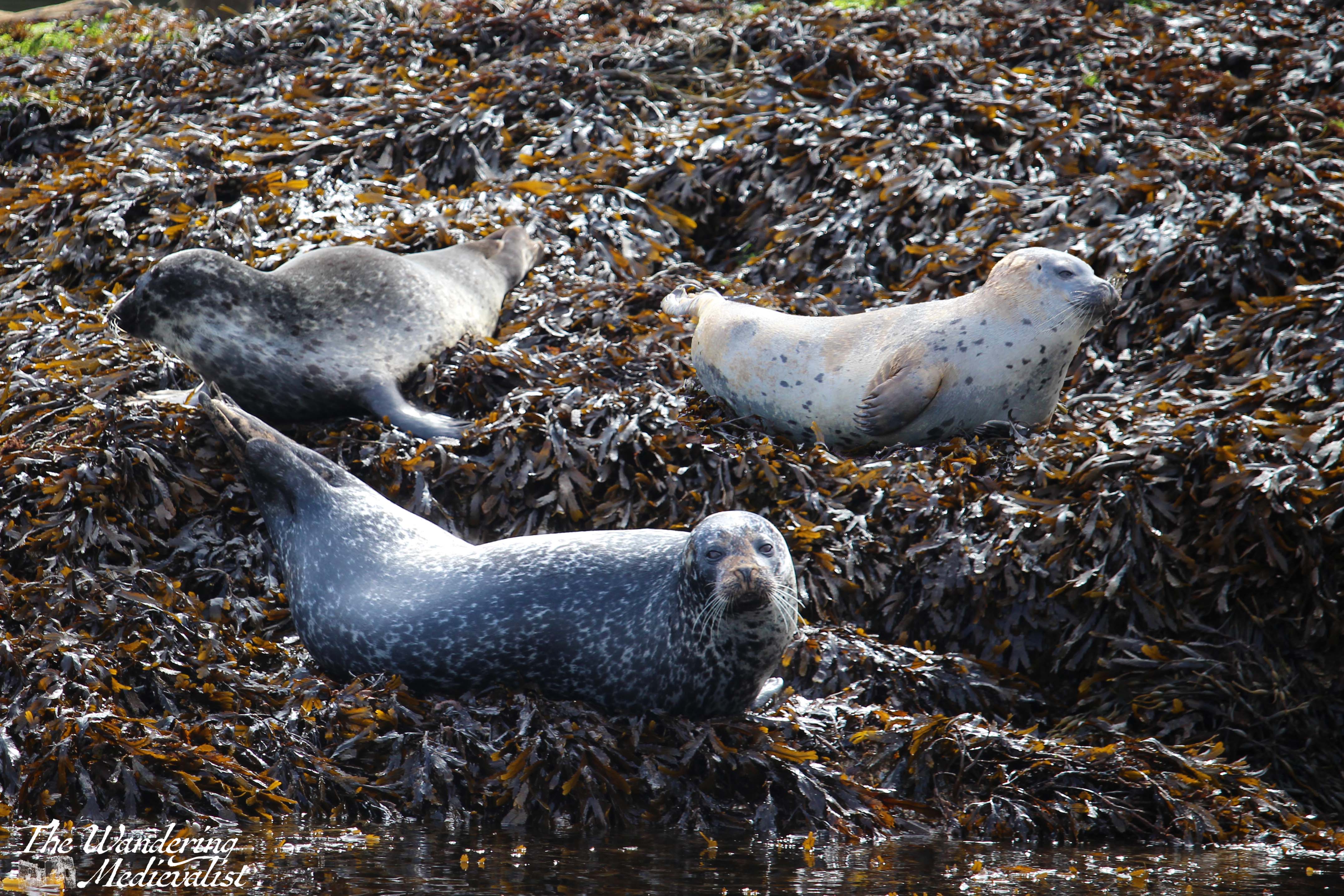
Even if I had been allowed to speak I do not think I could have – it was positively breath-taking to be so close and see the faces of the animals as they watched us pass by. I took more than 200 photos but here are the best – there were smiles, frowns, and general showing off by the amazing array of common and Atlantic grey seals.
The hush that had fallen over the boat remained as the skipper slowly moved us away, back north towards Fort William, and I managed few more spectacular views of the seal rock and the loch behind it.
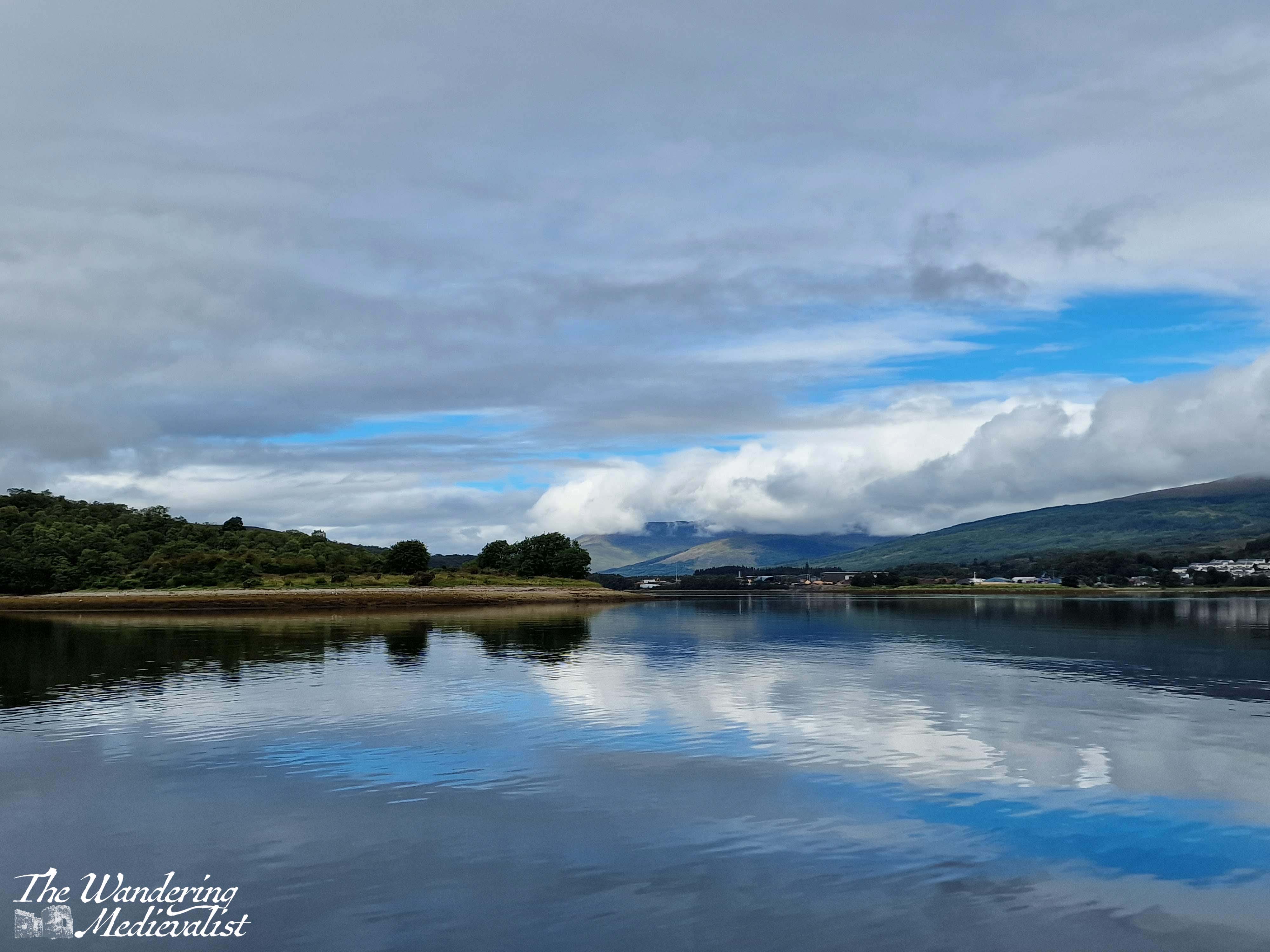
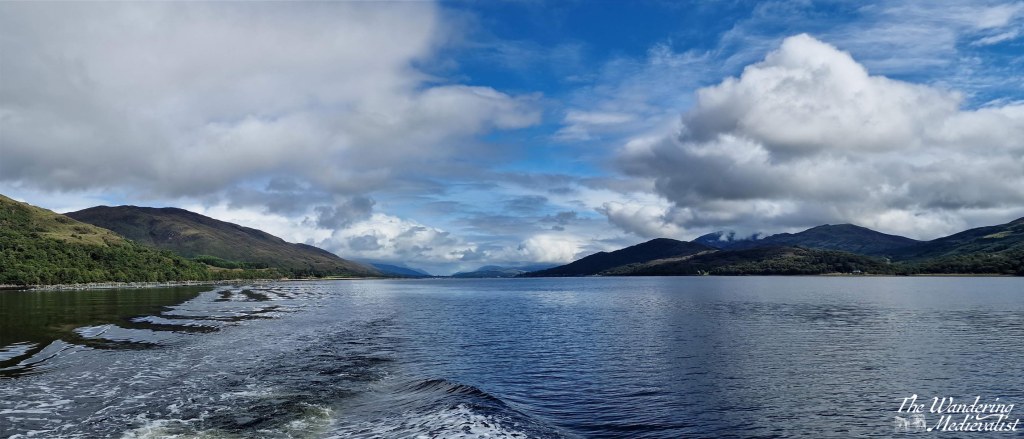
After this kind of experience, it was a bit of a let-down to return to dry land. But, it made me that much more determined to try the cruise again with Mum the next time she is here, and to go with the other half some time as it really is a spectacular way to see the loch. There are currently plans to go again in a few weeks, and I am looking forward to another exciting trip. Finally, here is the view from the back of the boat as we headed south – Ben Nevis is just topped with cloud on the right:
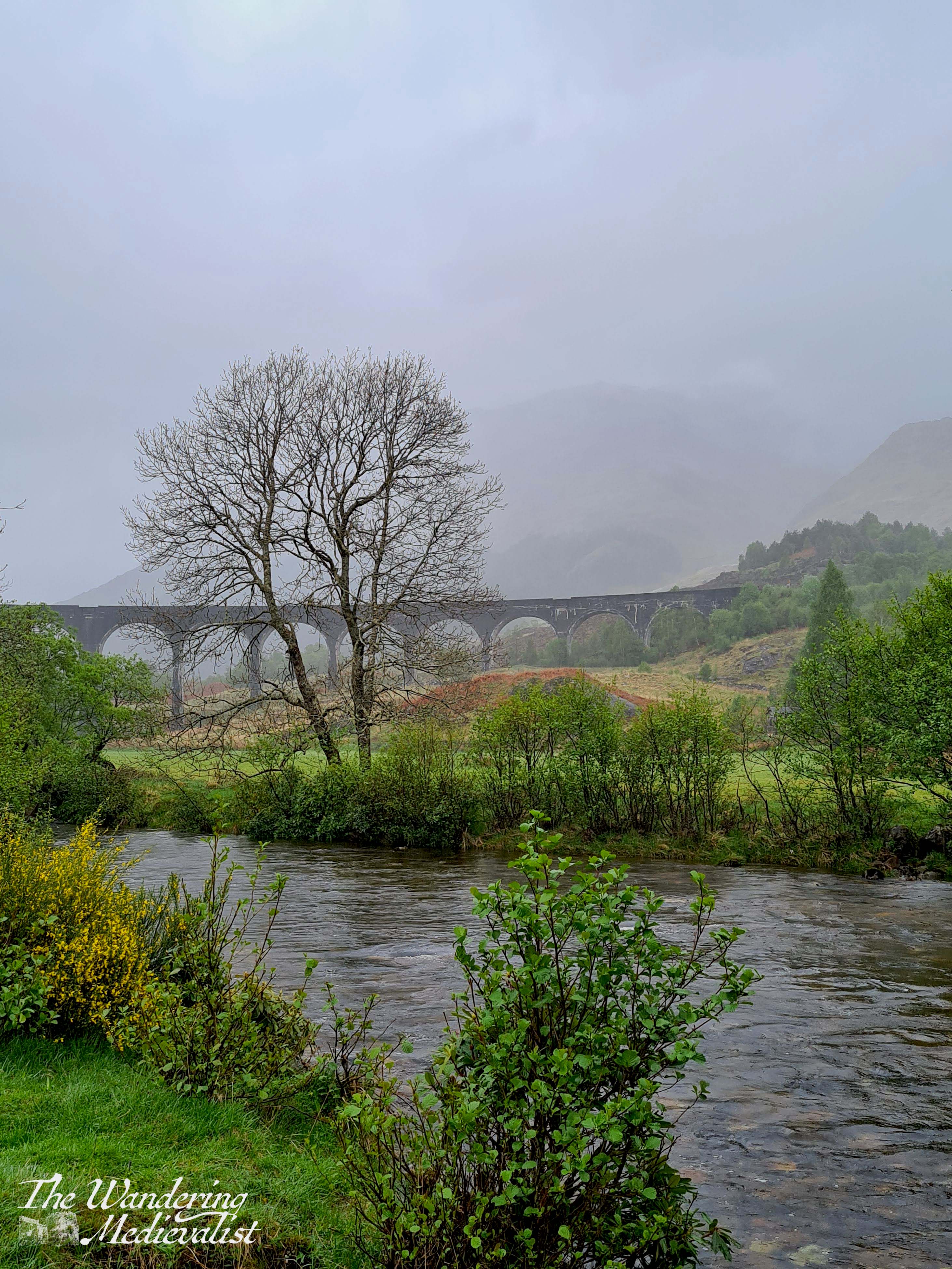
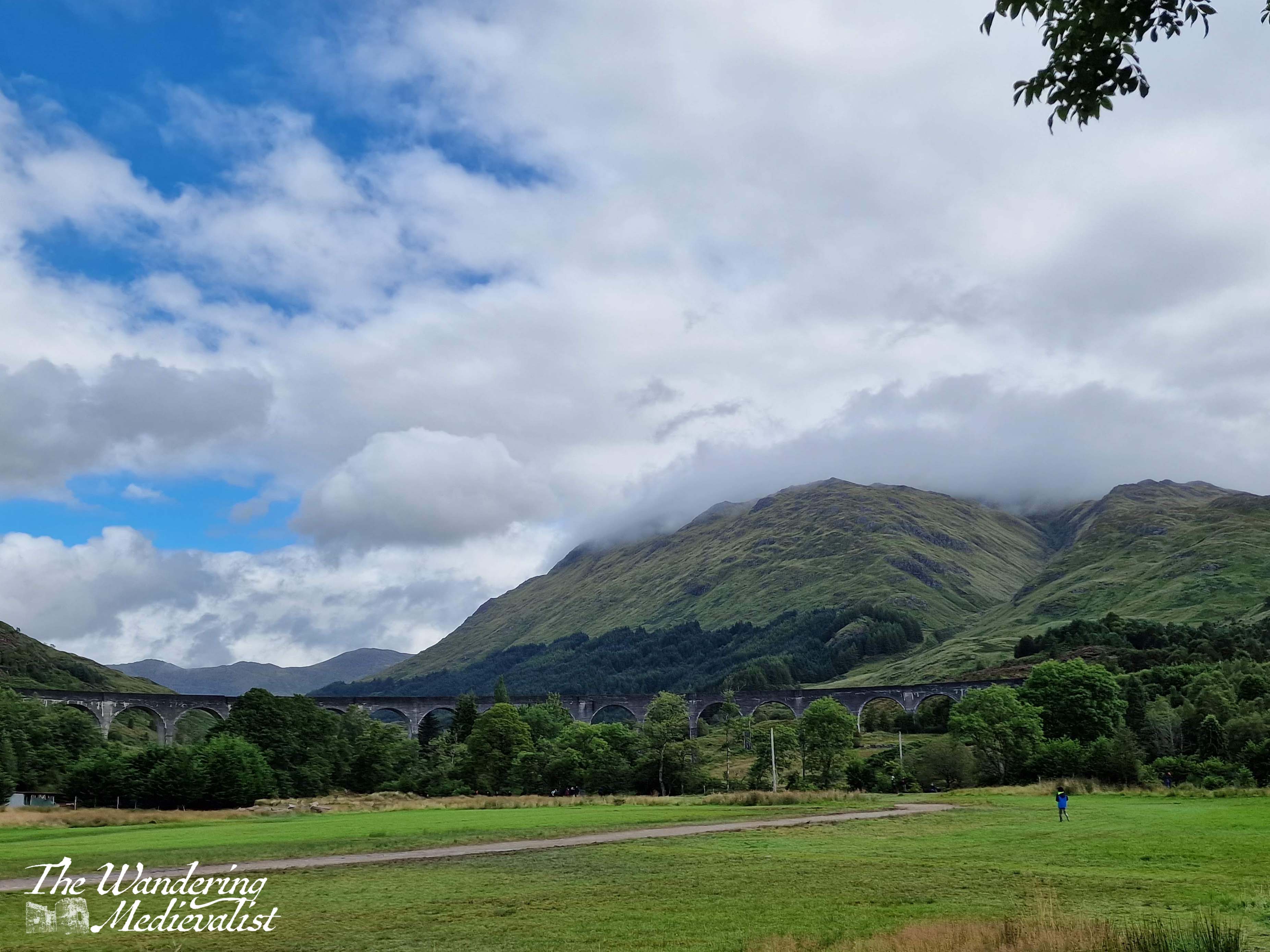
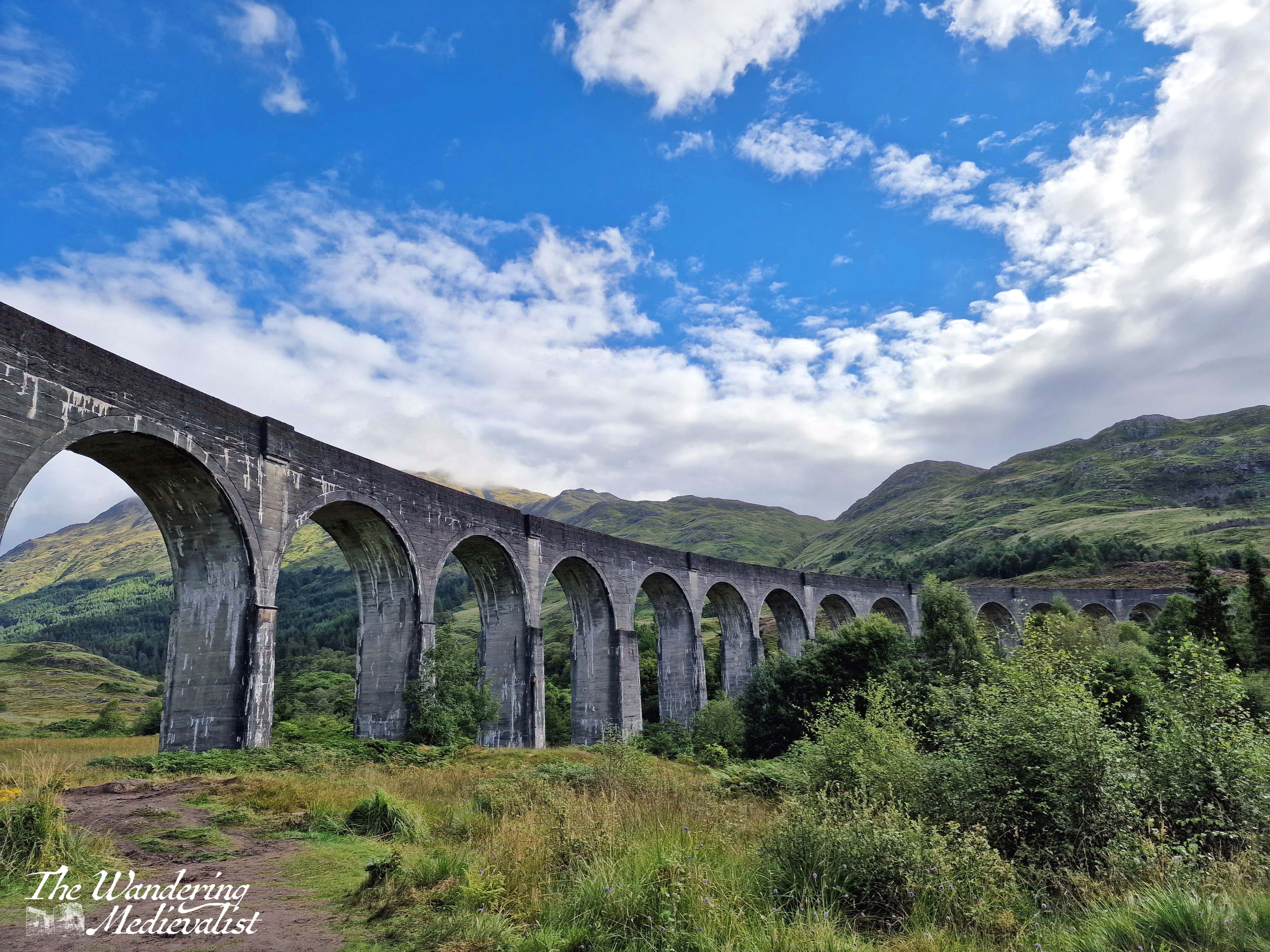
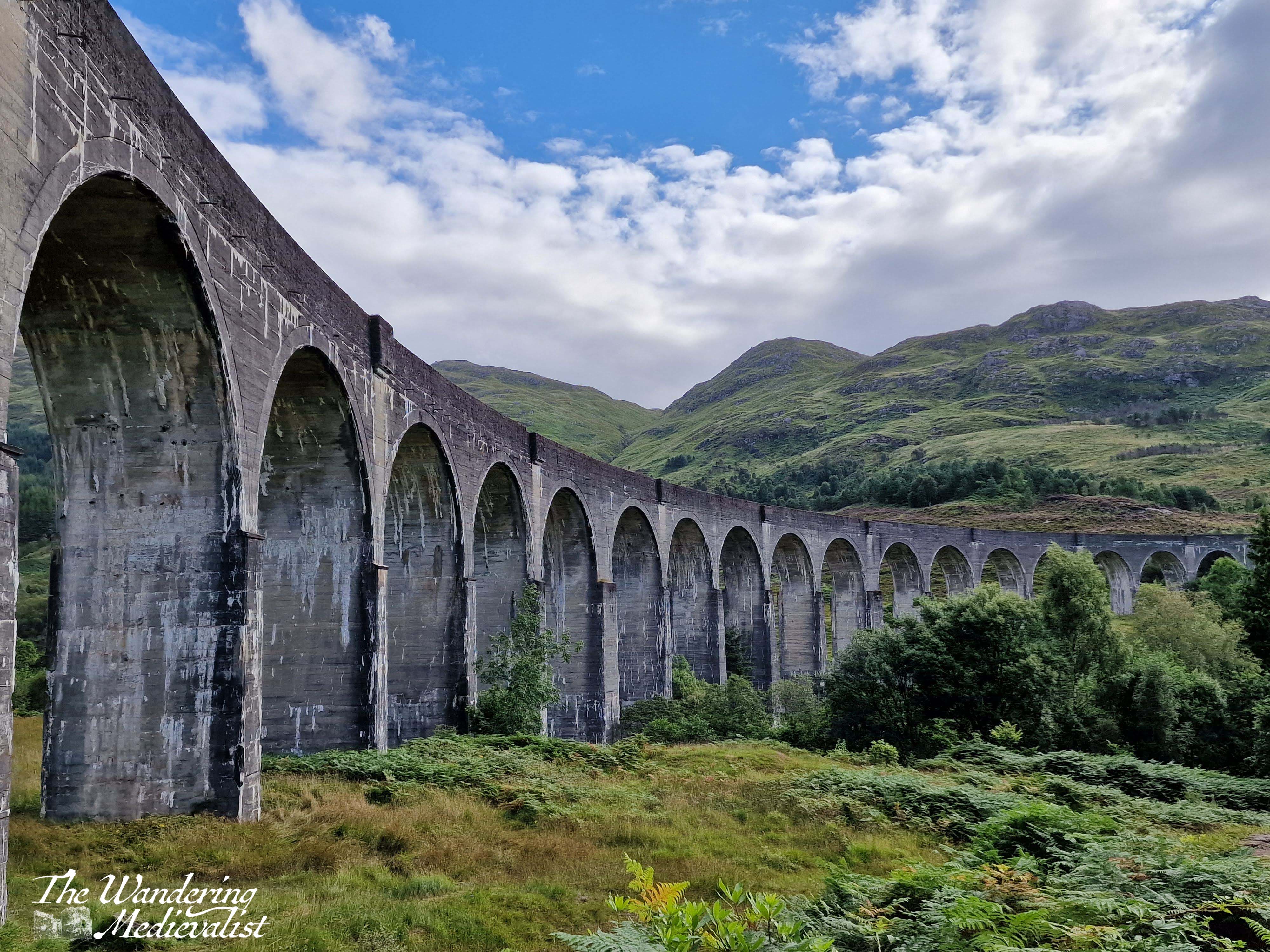
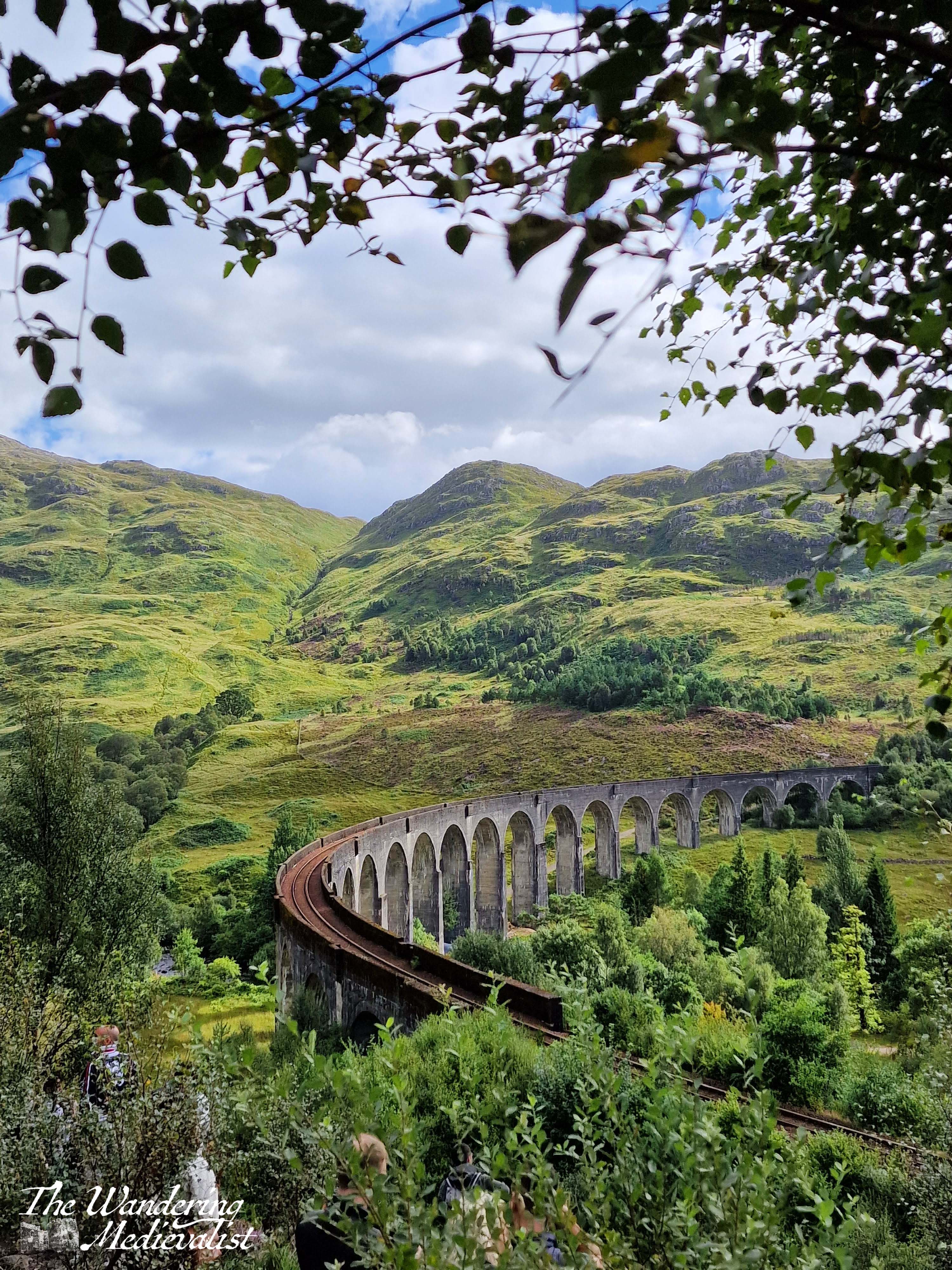
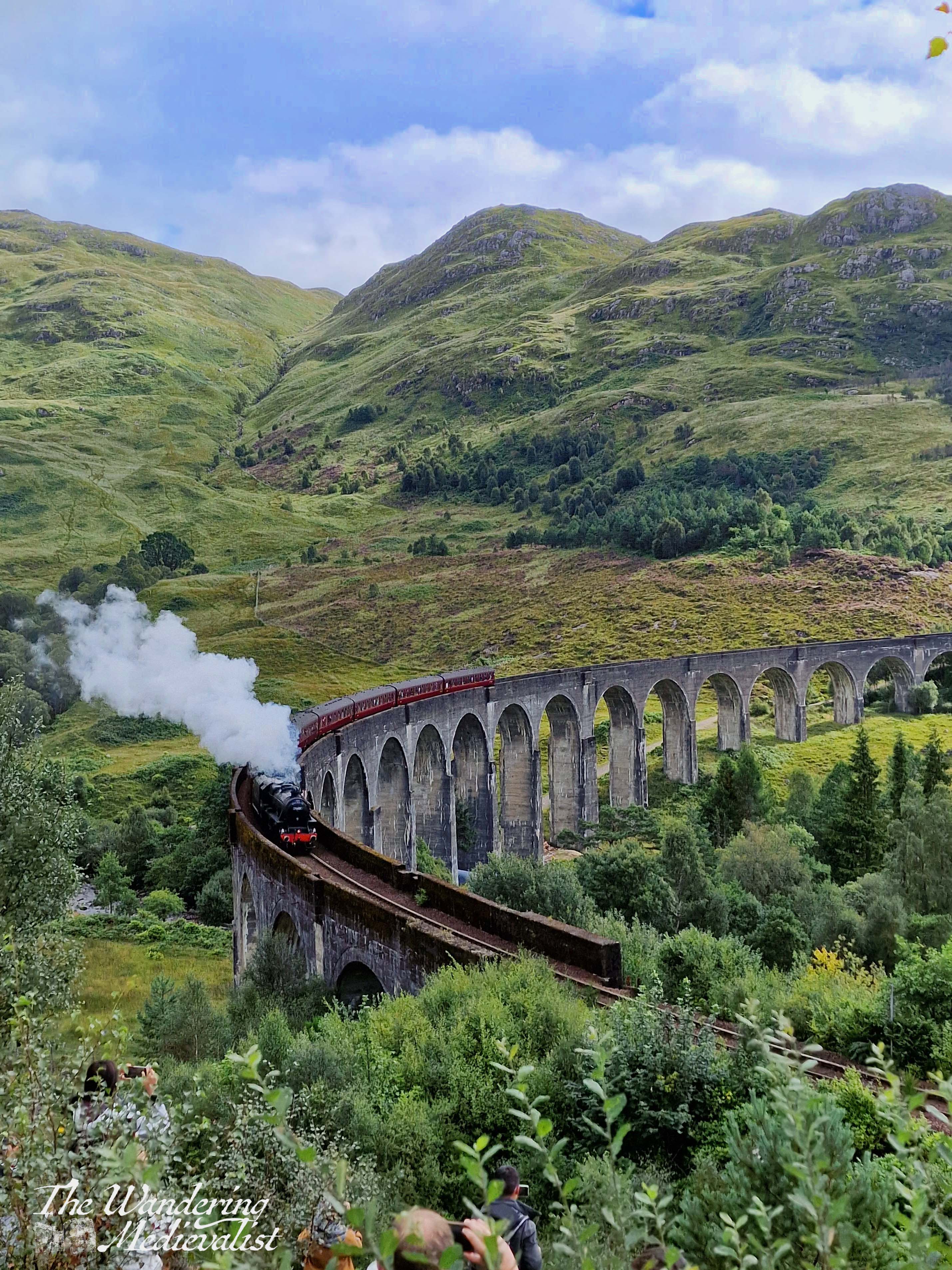
Whether you are a lover of Harry Potter, Jacobite history, or Scottish hills and lochs, this trail that starts off under the famous Glenfinnan viaduct and skirts the edge of the hills to come down alongside Loch Shiel is not to be missed. Even on a dreary rainy day, the stunning viaduct cutting across the valley is atmospheric and impressive, while in the sun and awaiting the famous Jacobite Steam Train, it is breath-taking.
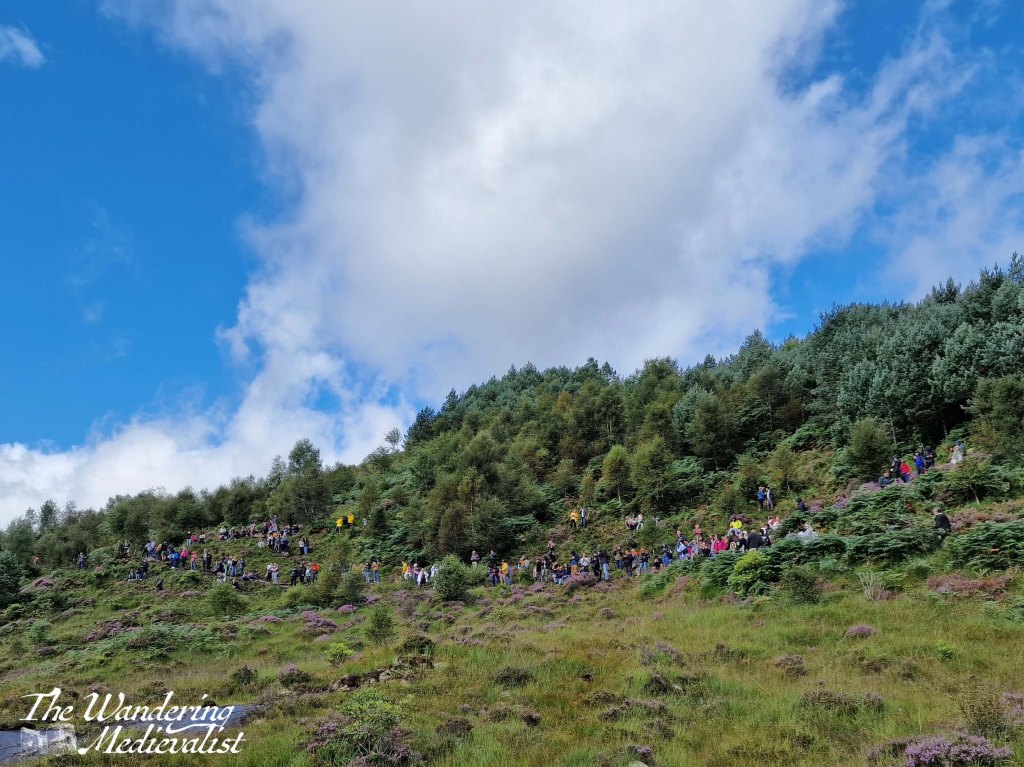
My most memorable visit to Glenfinnan came last summer, when my father and I were spending a few nights in Fort William and I managed to convince him that this walk would have good views. We honestly did not even check the train schedule before leaving, but managed to arrive at the parking lot about twenty minutes before a train was due. We joined in the masses of people excitedly scurrying up the hillside – many very unprepared for such a climb – to get a good view of the famous train.
But I get ahead of myself – firstly, I should point out that the size of the car park here has expanded significantly since my first visit in 2017 and now is no longer free (£3.50 as of writing except for National Trust members). There is a substantial gift shop and café, catering to the bus-loads of tourists who stop here on their way to Mallaig. There are also two viewpoints; one, which we took in the pouring rain in 2017, is much shorter but provides a good view both over the viaduct and the Glenfinnan Monument and Loch Shiel. This is a good option if you are in a hurry.
The period of the Jacobite Rebellion is a touch too modern for my tastes – it is all relative – but one can hardly study Scottish History and live in this country without picking up pieces of the story. It has echoes of the American Revolutionary War tales you hear everywhere in the Boston area – hearty, brave rebels fighting against the evil English. The truth of the history is, as always, much less black and white, but that is not the purpose of this post.
The Monument itself – a viewpoint and tourist attraction long before the viaduct appeared in Harry Potter – marks the location where Prince Charles Edward Stuart (Bonnie Prince Charlie) first raised his standard in 1745. It was the start of the doomed eight-month campaign that would come to a catastrophic end on Culloden Moor in April 1746, so one can understand why this area would hold a special place in Scottish history. The scenery is certainly evocative, with deep valleys cutting through rugged mountains that plummet straight down into the loch.
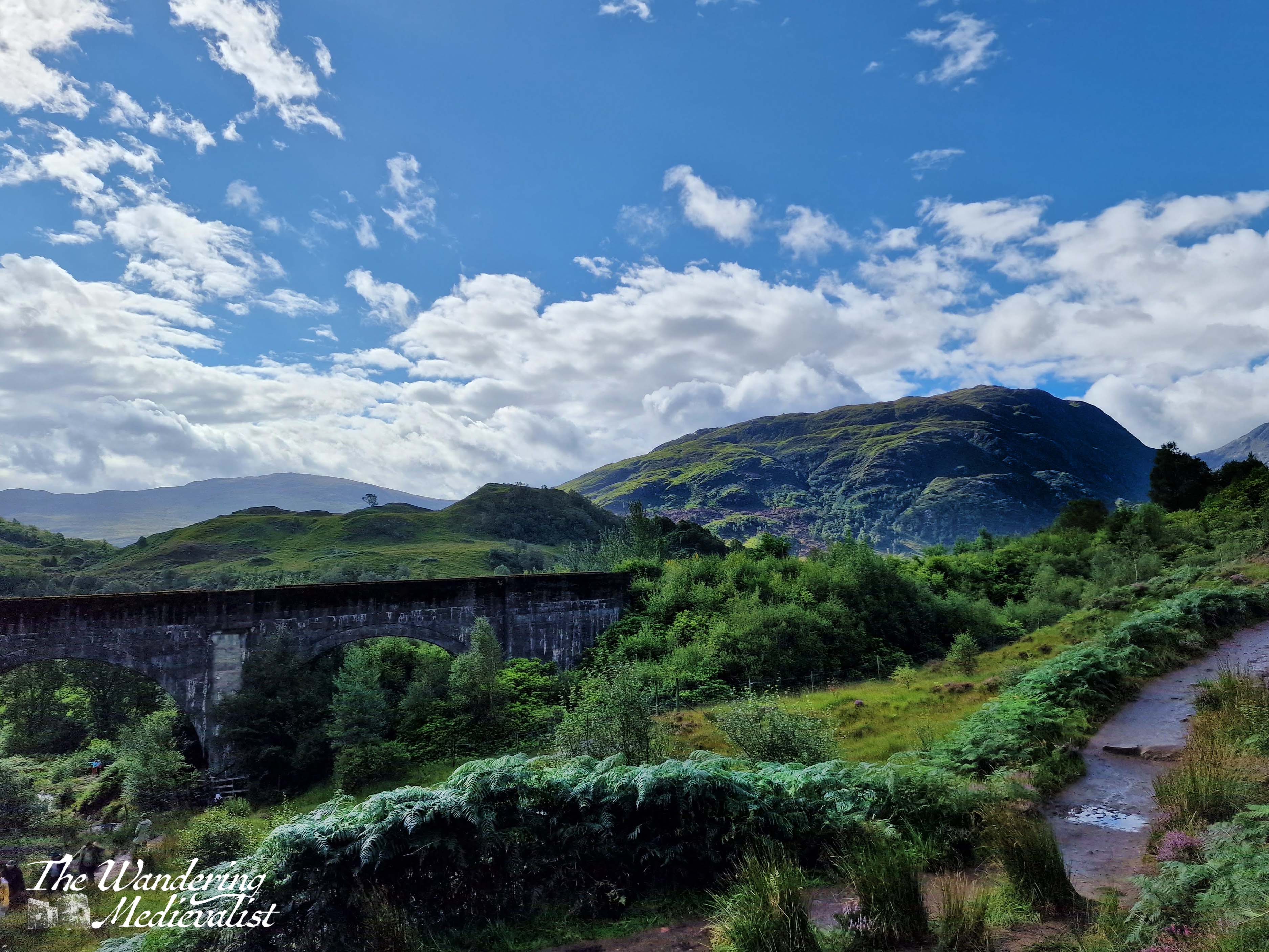
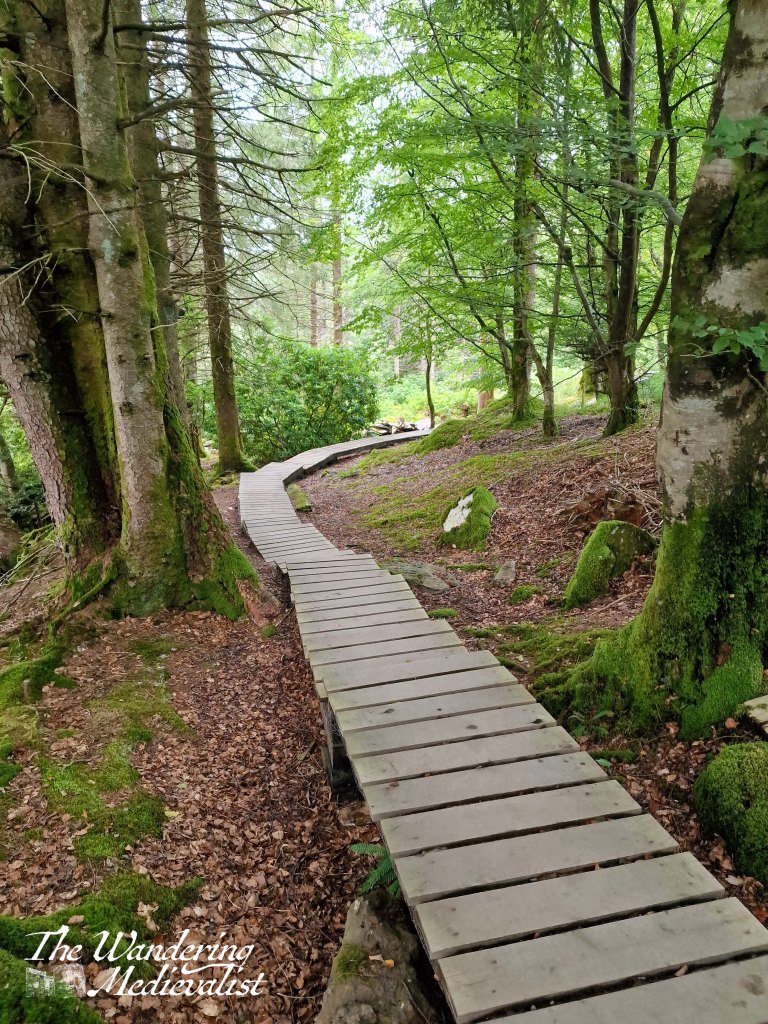
The second viewpoint is harder to access but also falls along the viaduct trail. Once parked, visitors can follow a well-kept path, skirting the edge of a burn, and moving slowly closer to and eventually under the massive viaduct. It was built between 1897 and 1901, to complete the extension of the West Highland Railway from Fort William to Mallaig. Side note, Mum and I rode this train some years back, but crossing the viaduct on the train is nowhere near as fun as walking beneath.
On the day Dad and I climbed, I quickly realised a train must be due, as I had never seen so many people crowded on the side of a hill in the Highlands before. The path is quite steep in places as it climbs the side of the hill, and I was impressed by the number of determined tourists in sandals, dragging young children behind them.
I convinced Dad to stop and wait, and sure enough, about ten minutes later, we could hear the distant train whistle, while the excitement in the crowd became palpable – and noisy. The first sign of the train was the steam, then it came creeping around the corner, blowing its whistle. The view was second to none, really, and I managed both still pictures and a bit of video, which I will post at the end. Frustratingly I missed the small child sitting on his father’s shoulders shouting out, “Avada Kedavra!” at the train. Not sure if the excitement got the better of him and he mixed up his spells, or if he is just a very dark child…
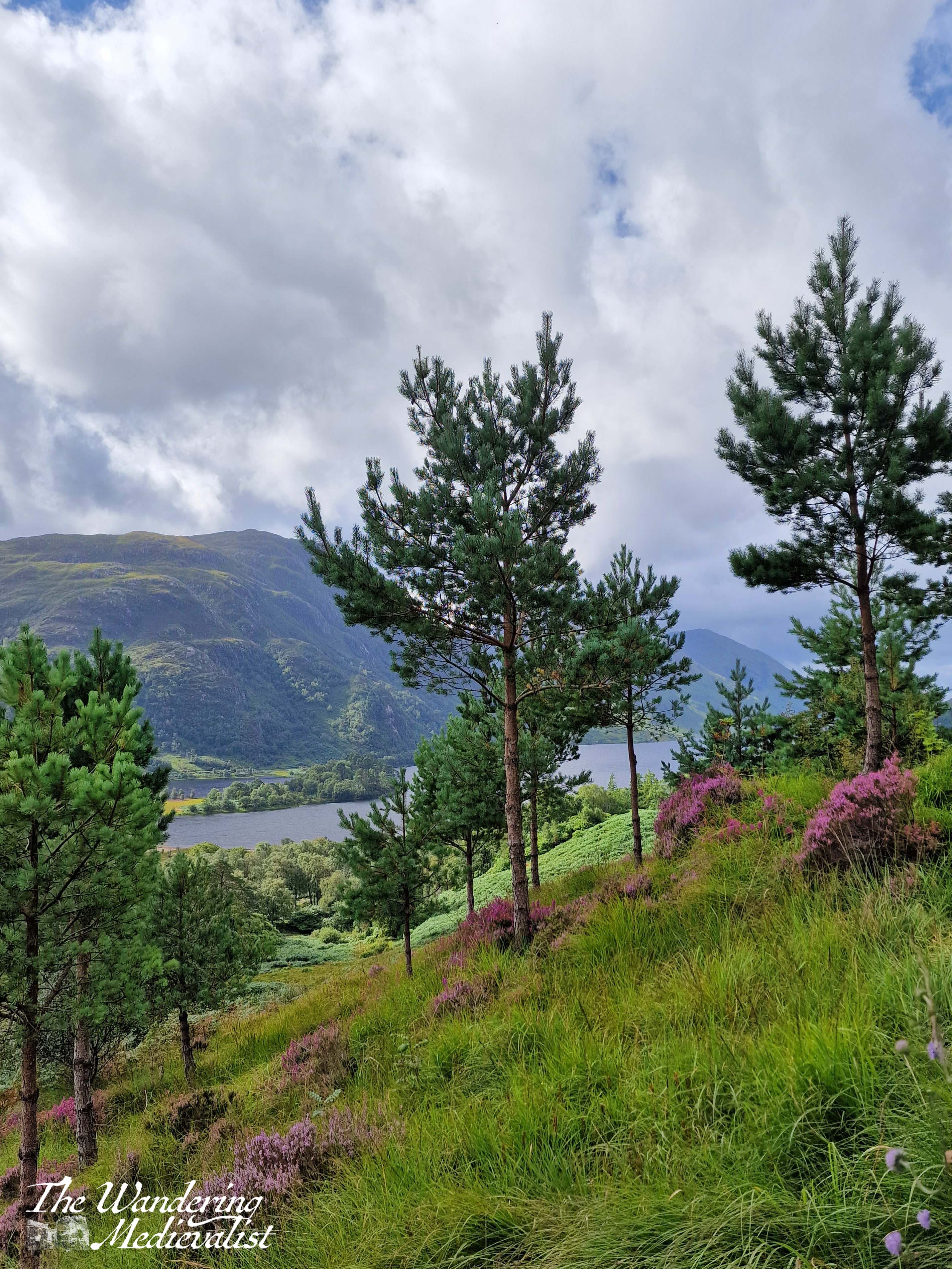
In any case, as the train moved on we moved against the foot traffic, further up the hill and following the path around the corner. For the most part the trail continues along the hillside with a few ups and downs, but with excellent views back to the viaduct, down to the Monument, and along Loch Shiel. It was a relatively busy path and narrow in places, forcing us to move to the side into the heather and ferns at the side of the path; I found myself grumbling slightly about proper hiking etiquette – or even just general courtesy – but only after being poked by some thistles as I allowed a large group of foreign tourists to pass.
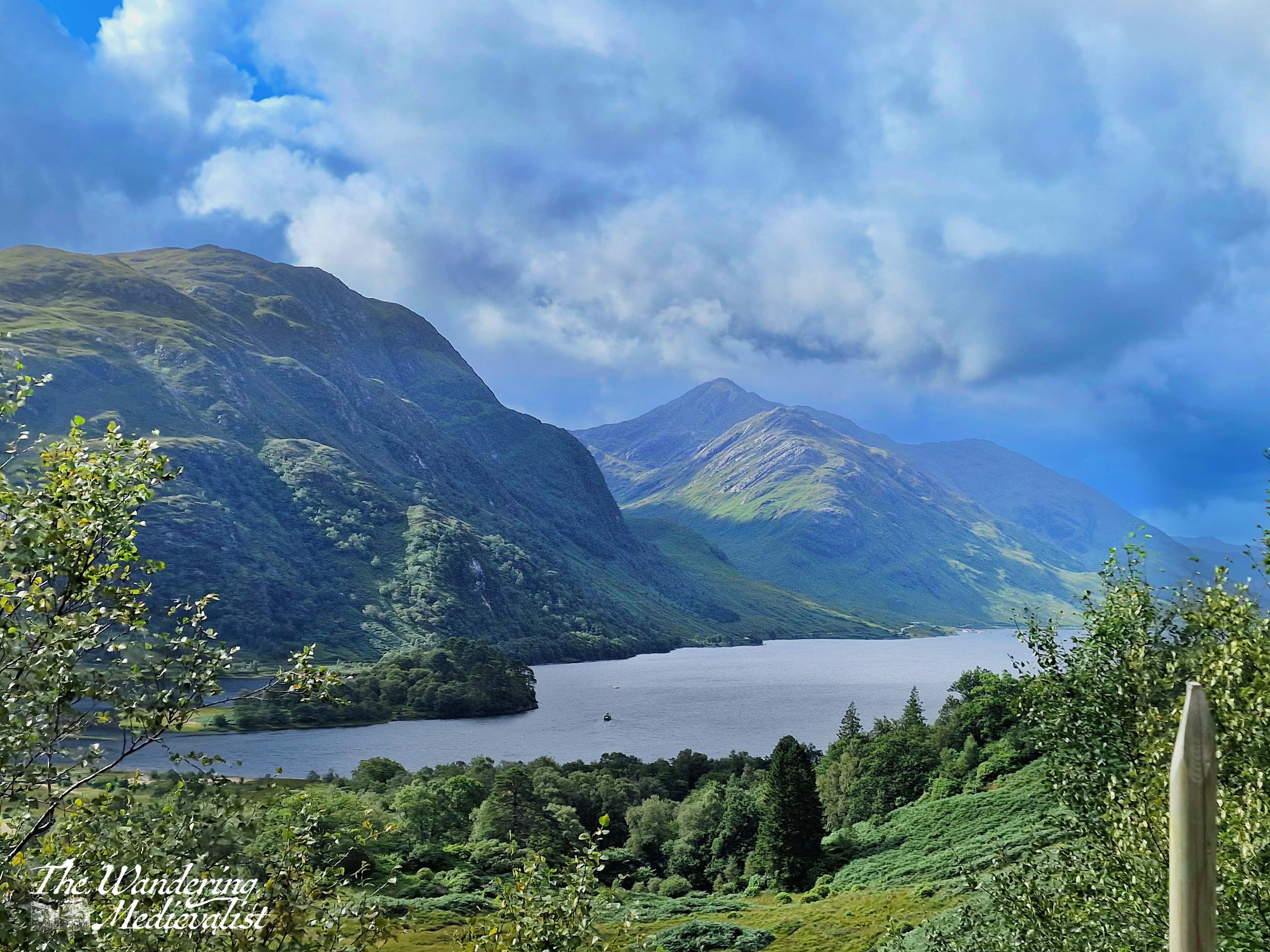
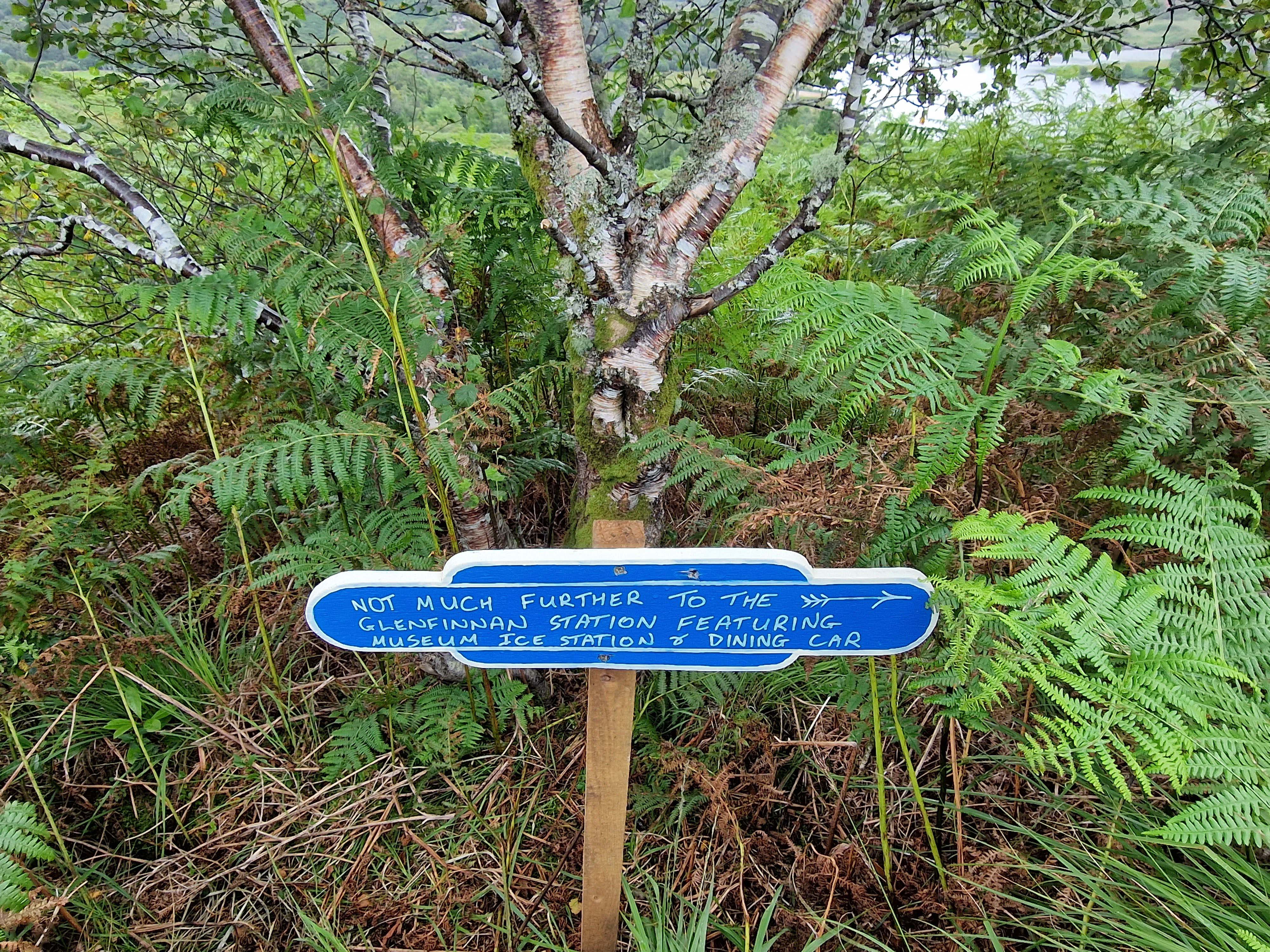
There are several more truly impressive viewpoints before the trail turns left and starts descending into the trees and back towards the loch shore. After a relatively short time, the path reaches Glenfinnan Station where there is a Museum and, as we learned, an option to purchase ice cream, at least in the summer. We took a short rest on the benches, enjoying the atmosphere of the station, before continuing on our way.
From here, most of the walk is on quiet roads, but there are a few excellent points to view the loch before one finally returns to the Monument and gift shop. I recall stopping in for a coffee and a truly excellent piece of millionaire’s shortbread before getting back into the car. It is worth observing that the times of the trains crossing the viaduct are posted both in the car park and online, so if this is the goal for your trip, it is well worth checking and positioning yourself in a good spot. I was lucky to visit on a spectacular sunny day as well as in the rain, and even without a particular affinity for Harry Potter or Jacobites, I found it a rewarding and even moving place to visit. If at all possible, though, avoid the height of summer unless you enjoy fighting your way through crowds of tourists woefully unprepared for a climb.
During our recent Sunday walk (definitely another post soon to come), we climbed a hill from which we could see the edge of the Highlands. As we caught our breath and tried to work out which jagged distant hill was which, I felt this visceral need to go there again, to see the mountains up close.
Ever since my first trip north of Perth, I have found the Highlands to be calming, comforting, peaceful – perhaps because they remind me of the White Mountains, or perhaps just because they do have a power over some people – me included. The Meall Beag viewpoint is one of those places in the Highlands where I can find my equilibrium.
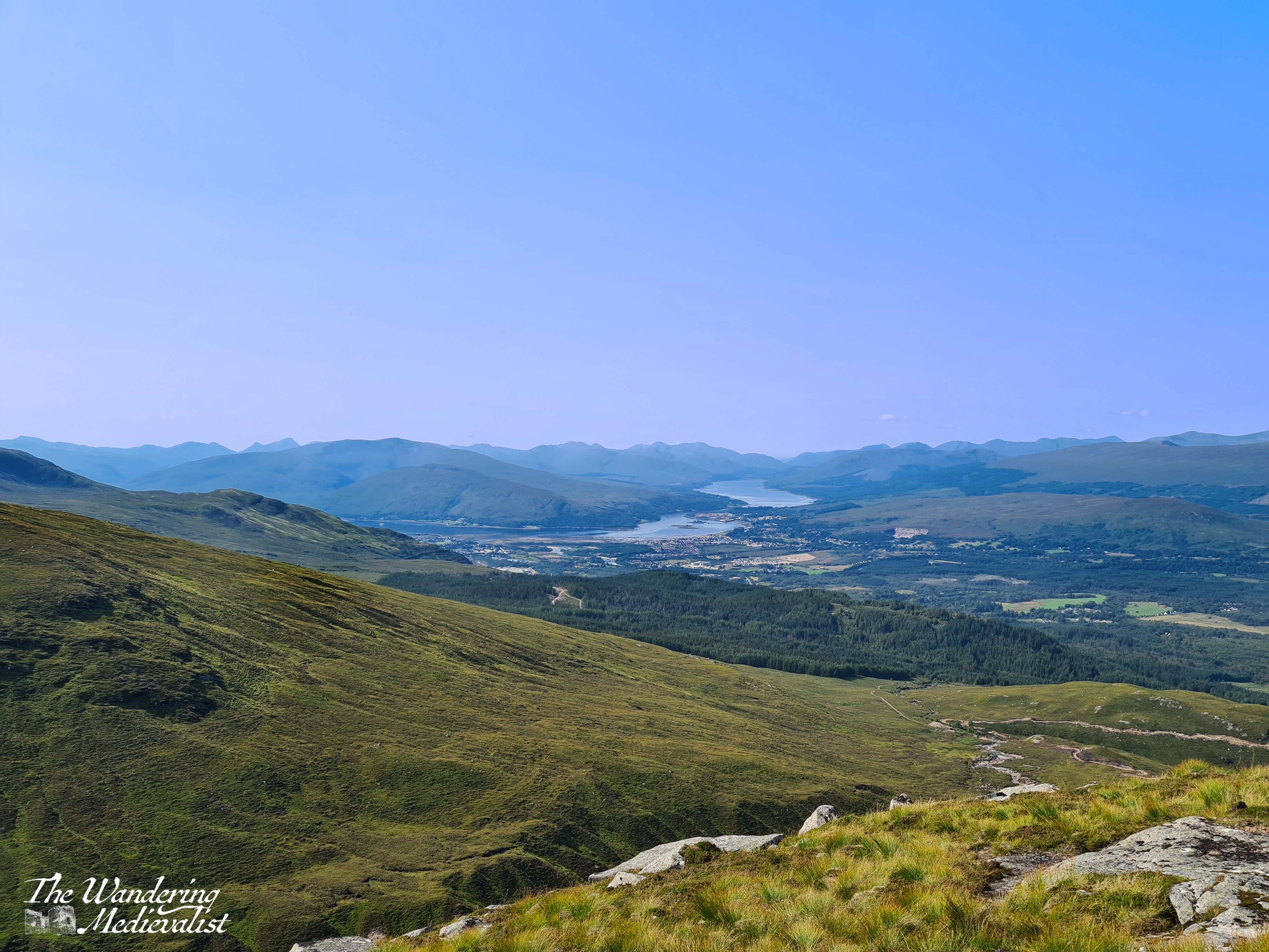
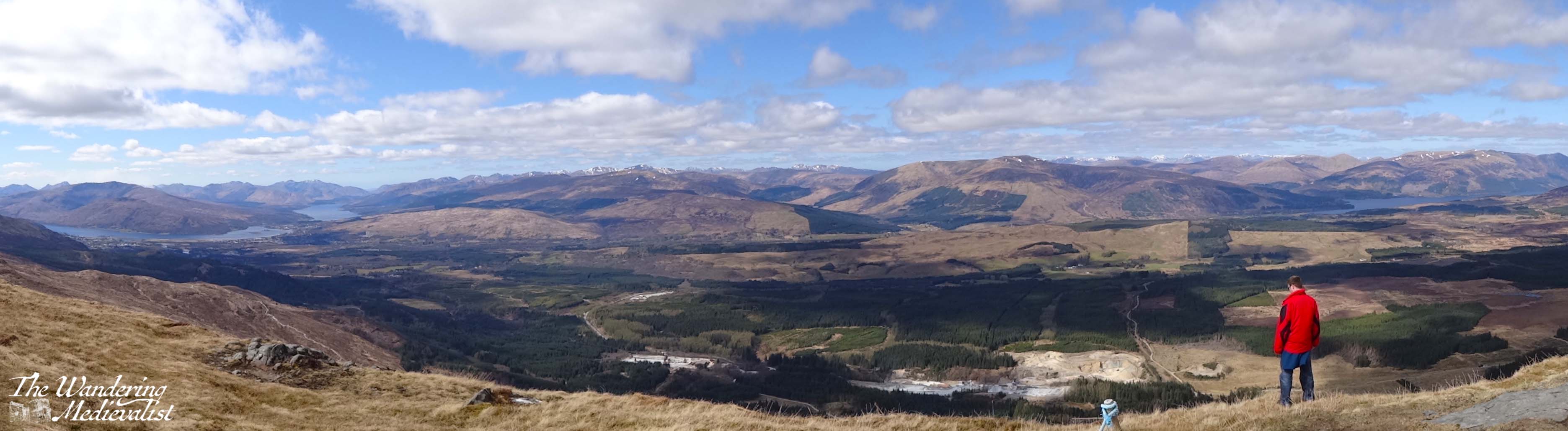
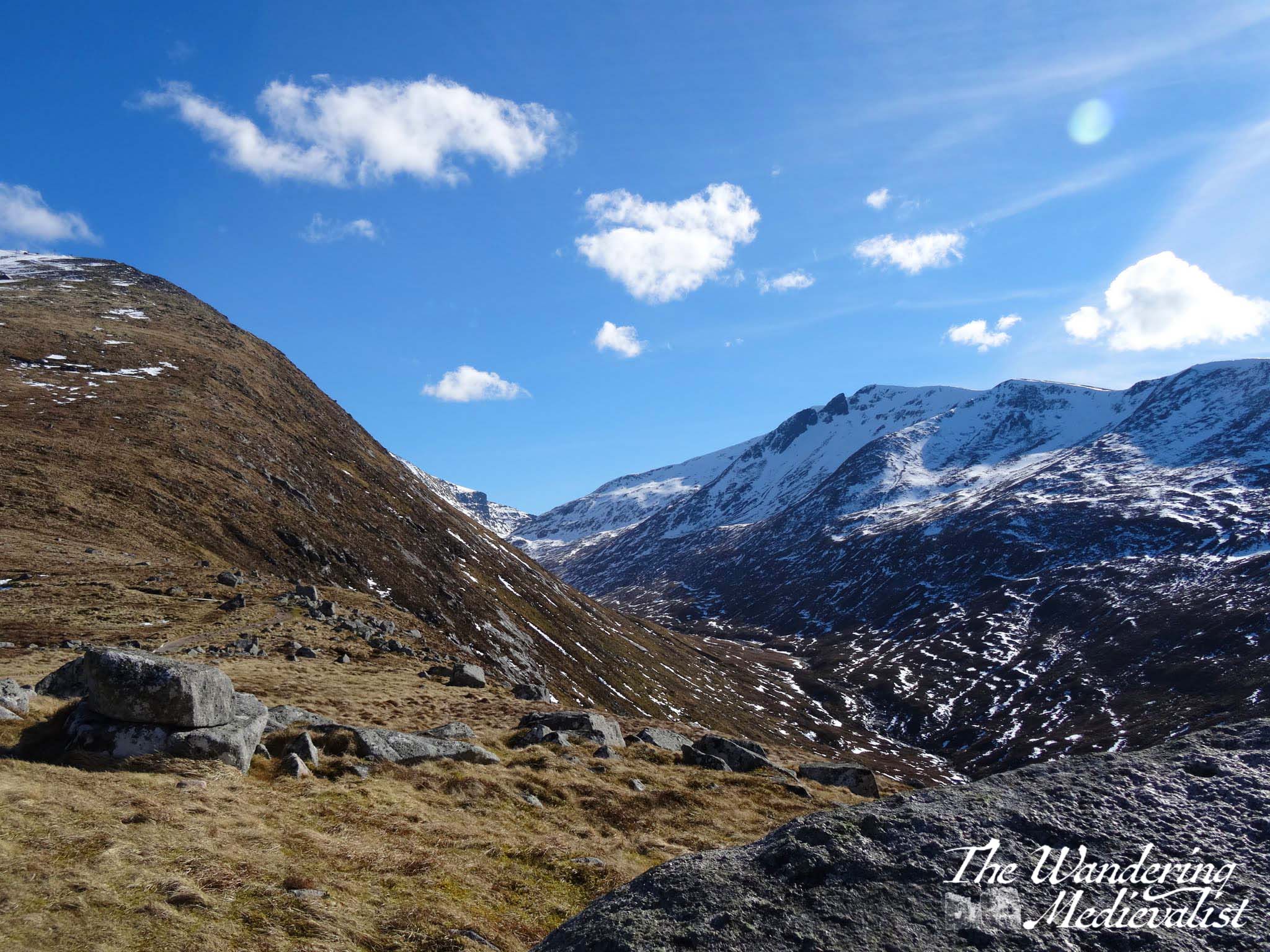
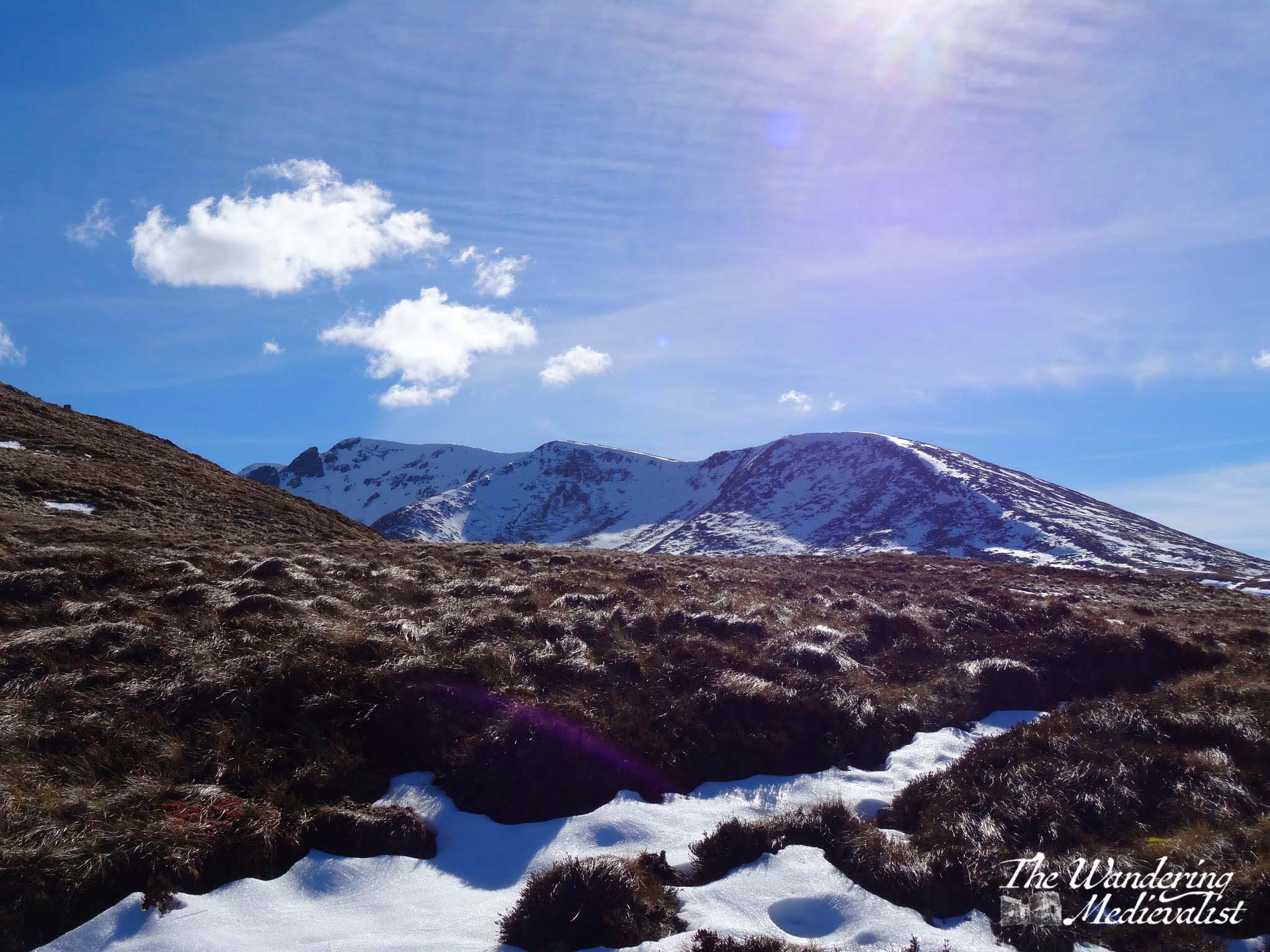
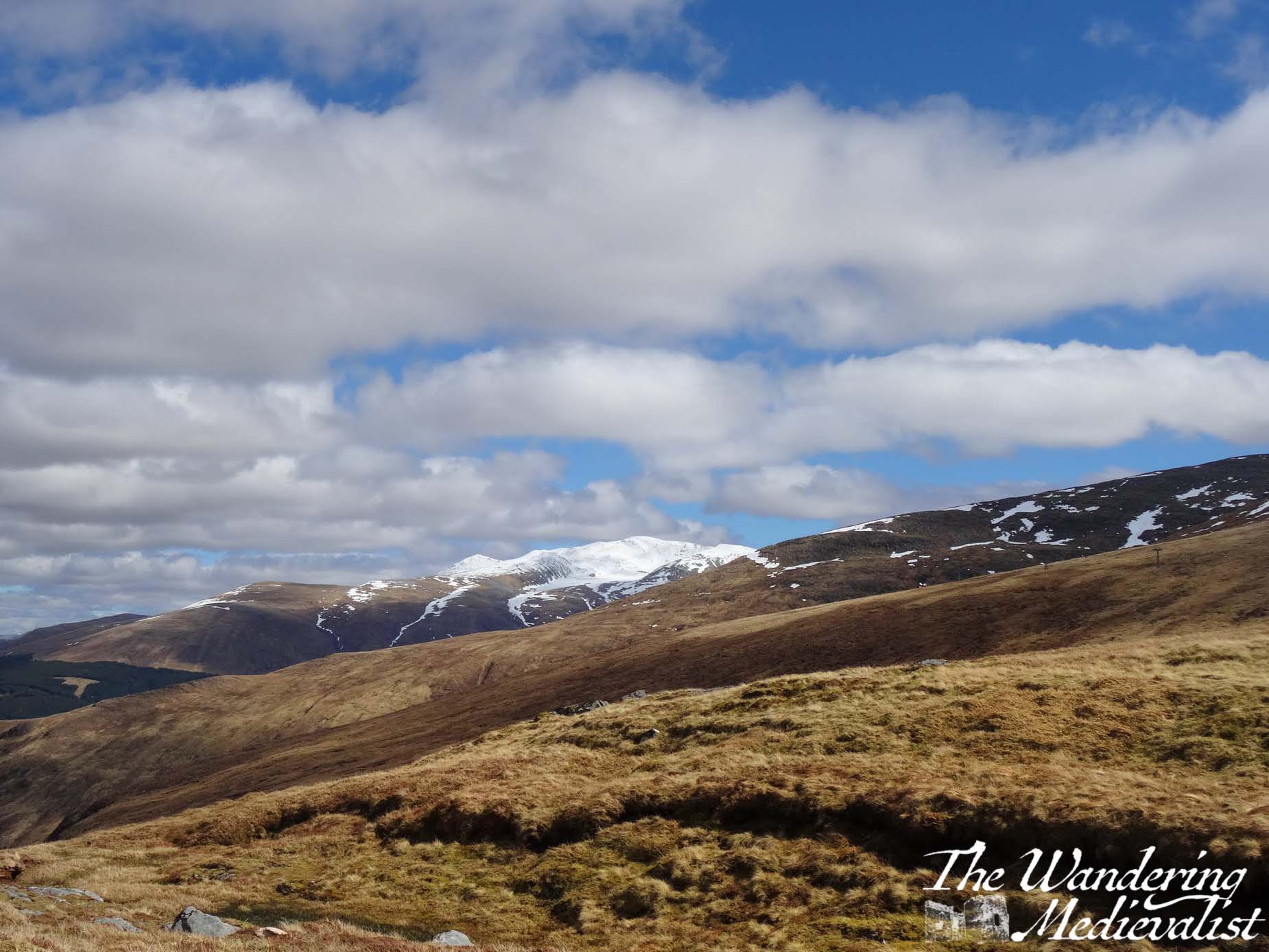
For some reason it took us until our second trip up the gondola to try the second, longer hike to the second viewpoint. I feel that referring to it in any way as ‘long’ is a bit misleading – the whole walk, out and back, is an hour at most and I think Dad and I did it faster. There are a few hilly bits but nothing overly strenuous, and the views are even better than from Sgurr Finnisg-aig. In fact, I realised on my second visit, that this viewpoint qualifies as one of my favourite places in Scotland, if not the world. From the benches or rocks, you can see west and a bit south to Fort William and Lochs Linnhe and Eil, east towards Spean Bridge, but you have a spectacular view of the back of Ben Nevis, all swept rocks and snow.
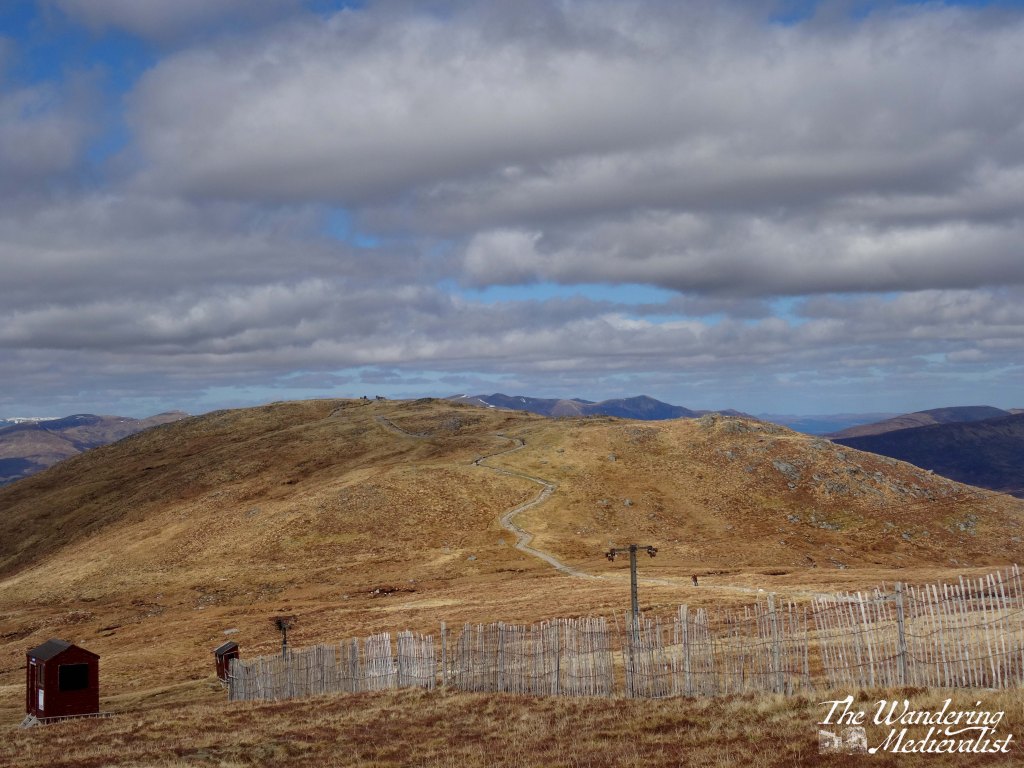
The trail begins as you leave the Snowgoose Café at the top of the gondola and turn right along a wide path, heading towards the chair lift that takes skiers to the top of the mountain.
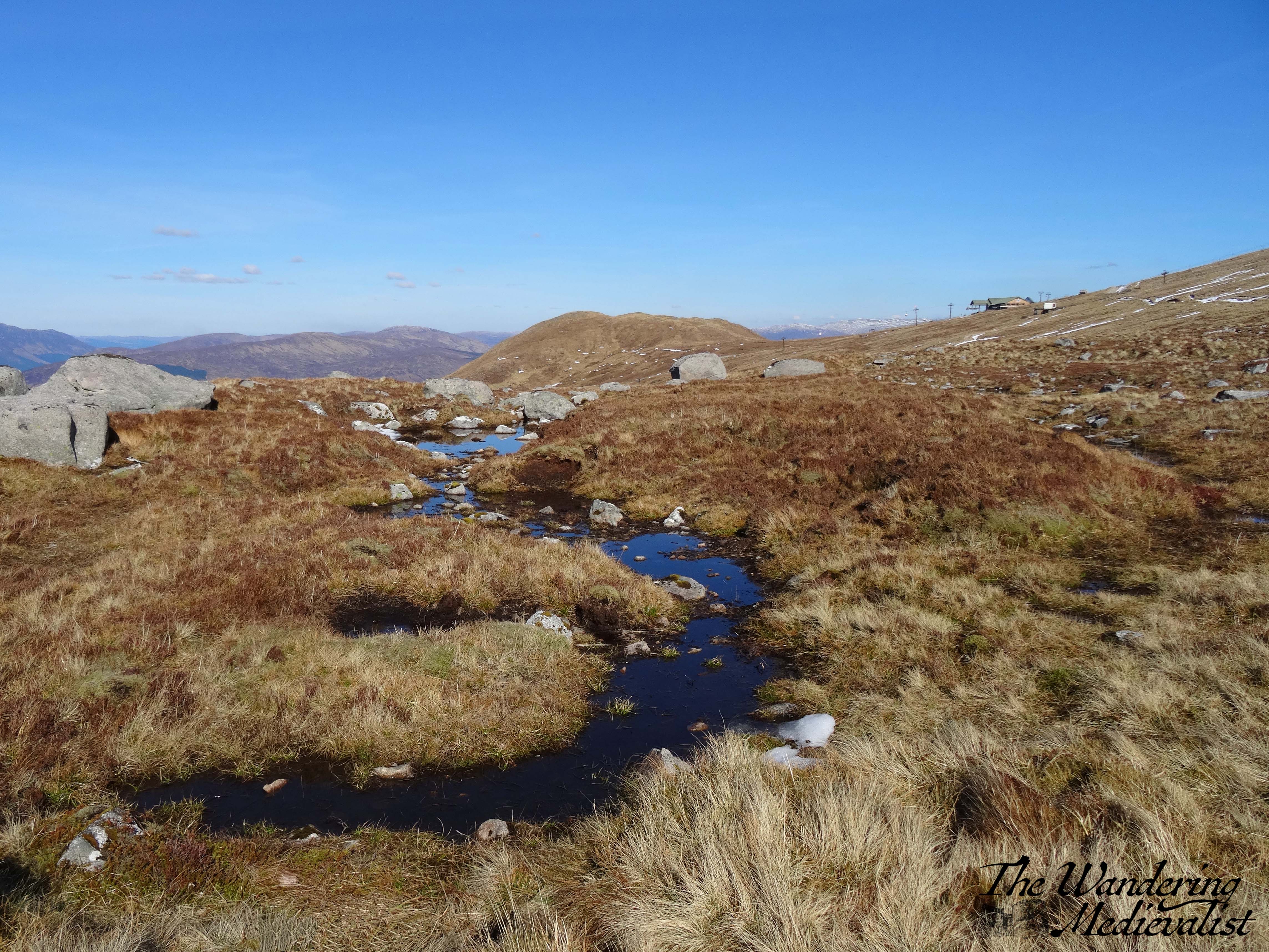
Eventually, it passes under the lift and continues along the side of hill, rising and falling and crossing over a number of small burns. Eventually, you can turn and look back at the café and gondola in the distance.
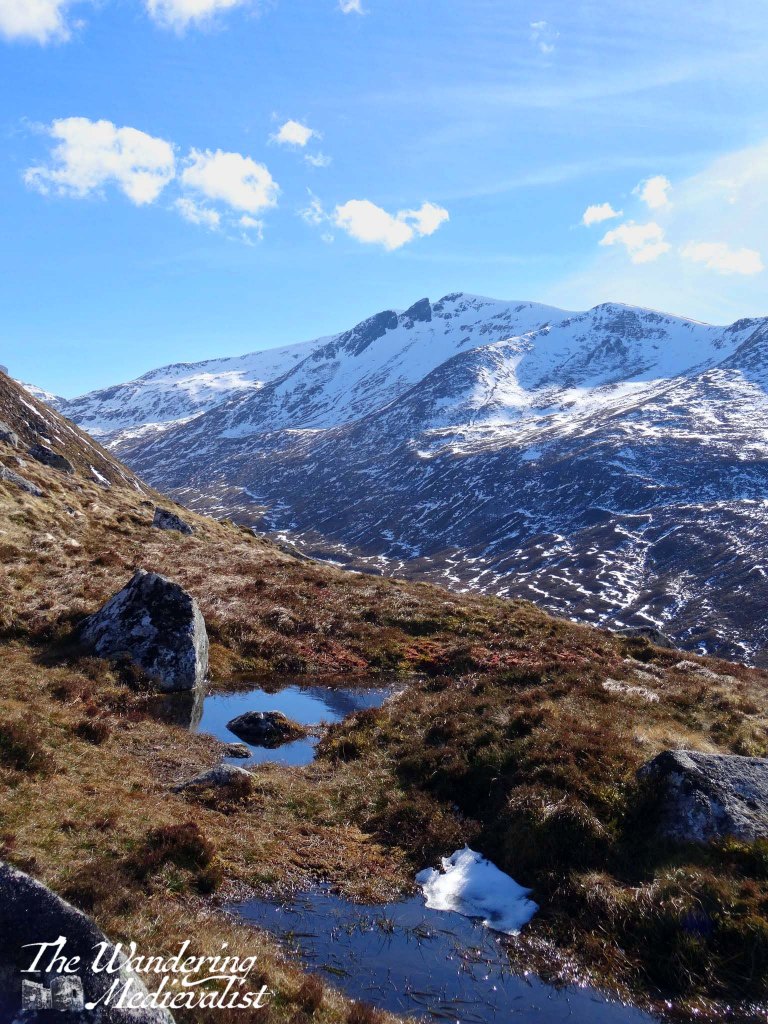
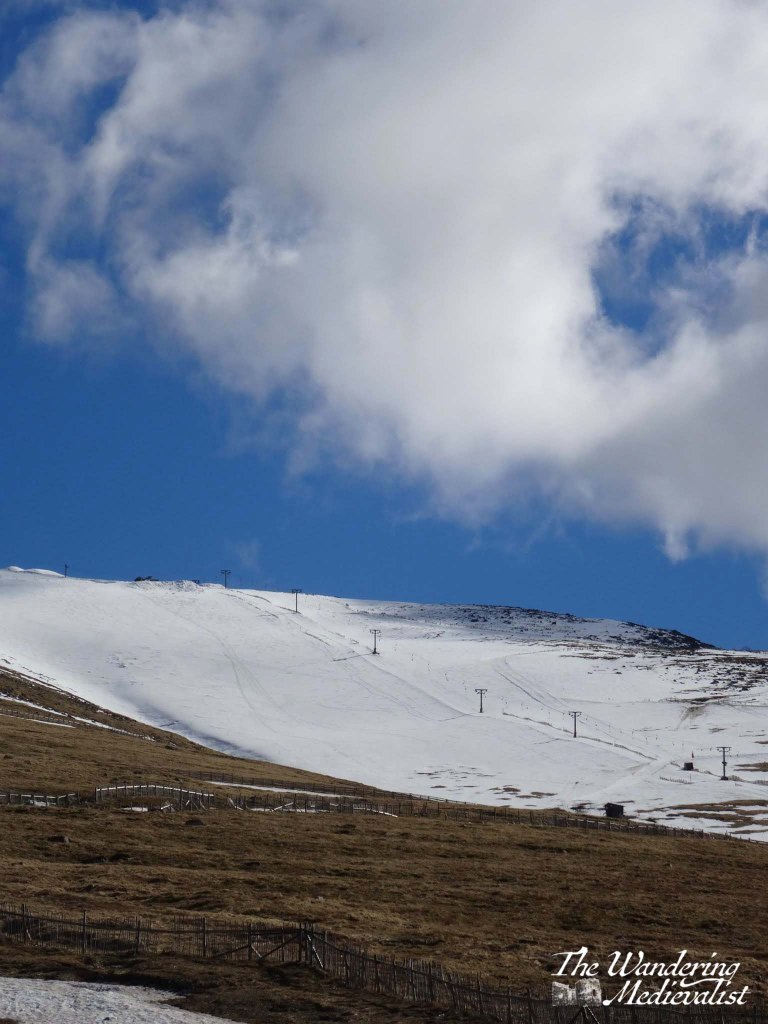
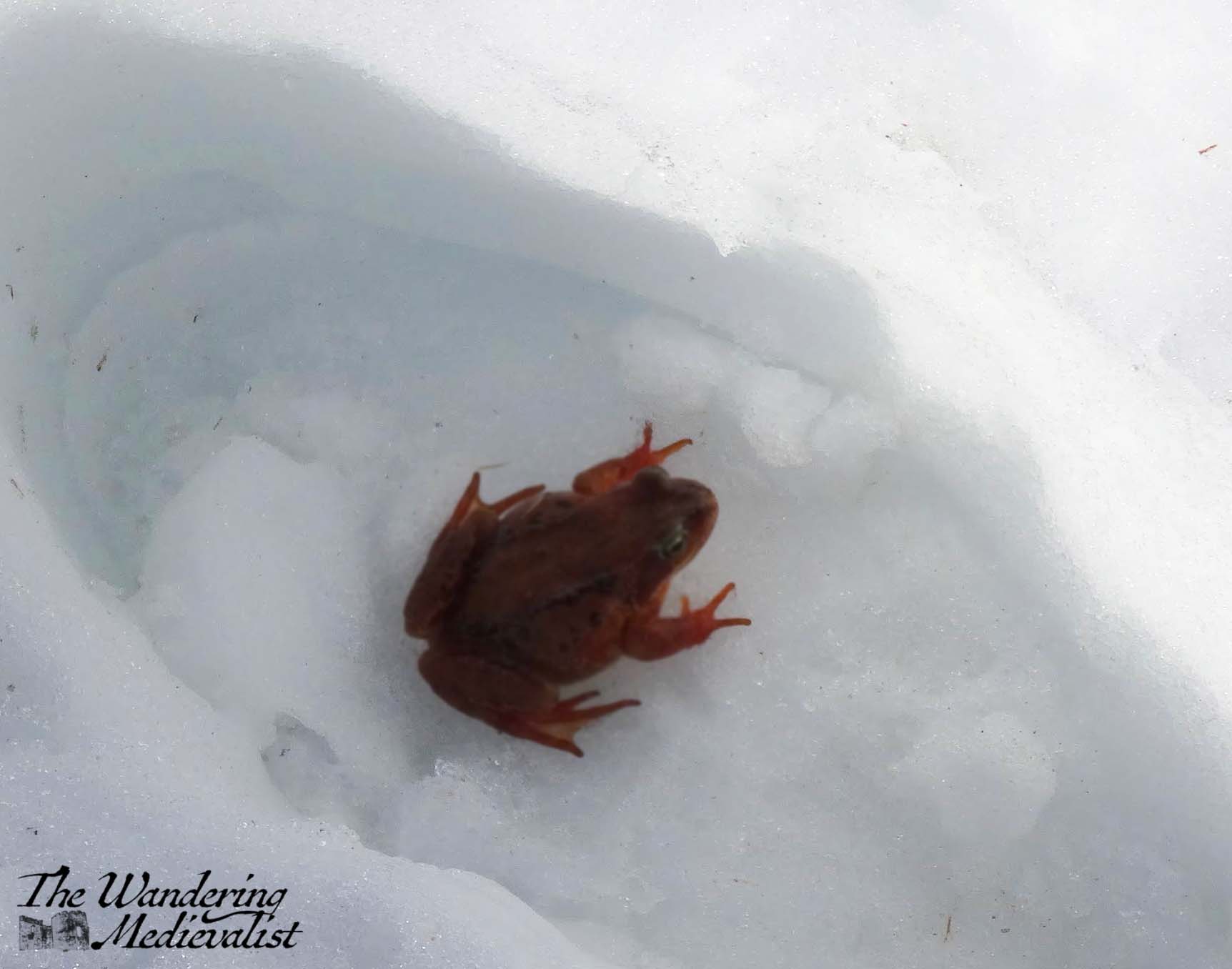
Here is the view back to the Sgurr Finnisg-aig viewpoint, as well as a little friend we found in the snow. As you move further around the hill, you get a better view down into the valley, and start to see the lochs and Fort William more clearly.
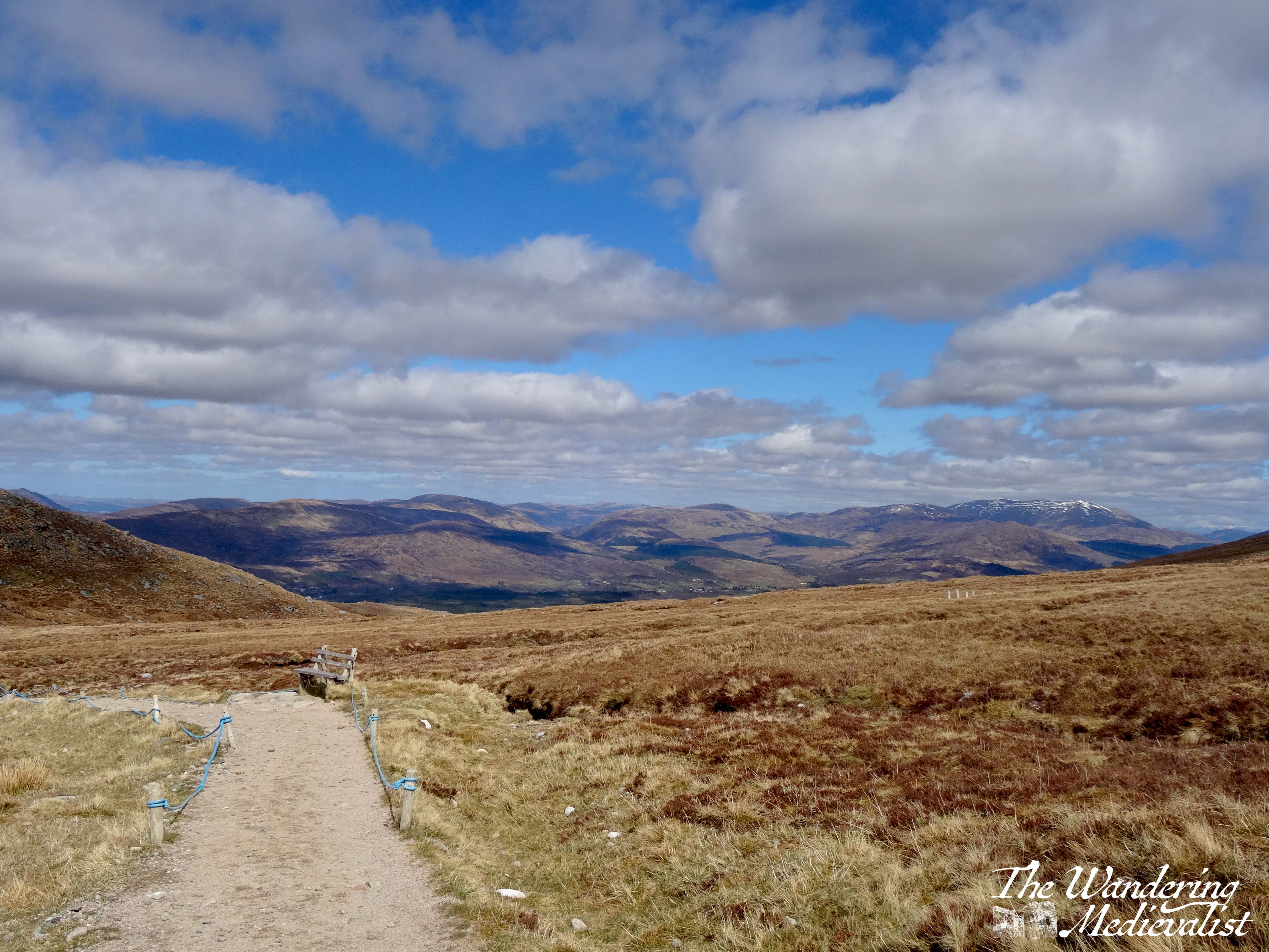
I find the peaty water tumbling through the heather and boggy land to be fascinating and beautiful, but nothing is as impressive as the view from the end of the walk. Like at the other viewpoint, there is a guide showing you what you are looking at, and there are series of both benches and rocks to perch on as you enjoy the vista. I could quite happily sit for hours, I think, watching the clouds (if there are any) and taking in the awesome sights of the view down and also back up the valley and to the sweeping height of Ben Nevis.
In both height of summer and snowy seasons, the view is just breath-taking, and I always have to force myself to turn around and start making my way back. Much like the let-down I always feel as the A9 passes Perth and Fife opens up in front of me – meaning I know I have really left the Highlands behind – I find the trek back to the café to be less enjoyable than the way out. But, once back at the Snowgoose, the best option I find is to get a coffee and maybe a snack, and if you are lucky, a table outside to take advantage of being high up the mountain for just that much longer.
There are so many beautiful views in the world, many I have seen and many I have on my list of wishes. This list, then, is of a few that I love more than others – some of these please I have visited and photographed over and over in different seasons and lights. Some of them I have visited only once, but remain in my memory as special, unique. These are views that make me smile, take a deep breath, and feel at peace.
Unsurprisingly, quite a few of these now grace the walls of our house, as canvas prints or collages.
I hope that they bring you the same smile and peace of mind.
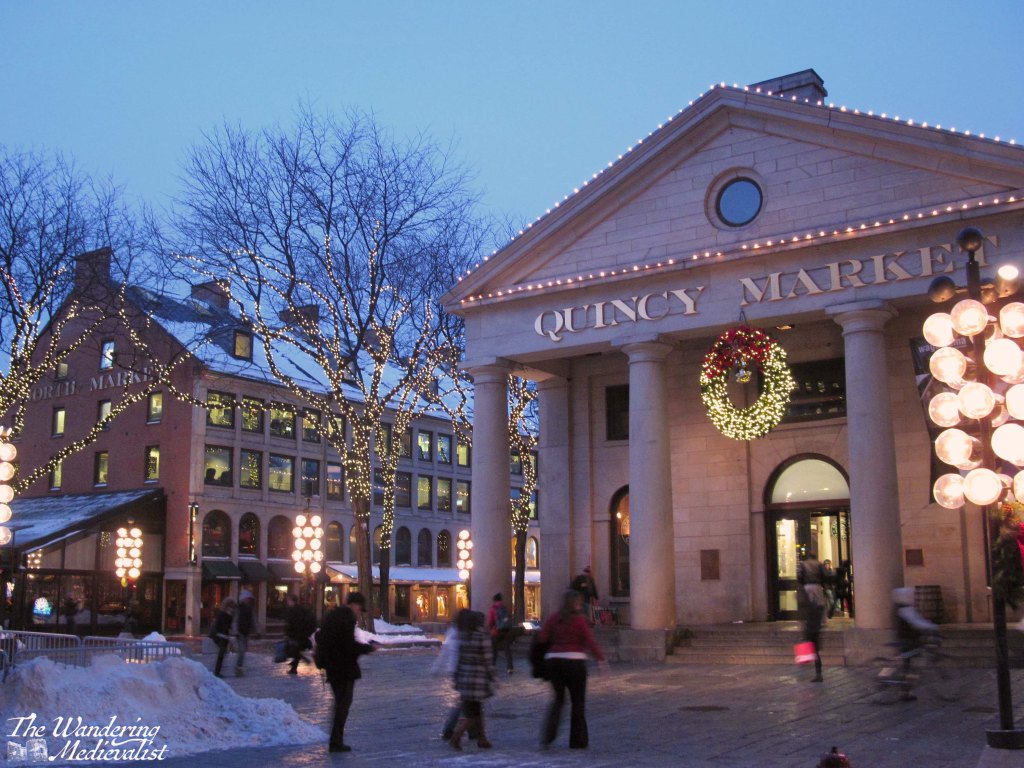
Boston, Massachusetts – Quincy Market
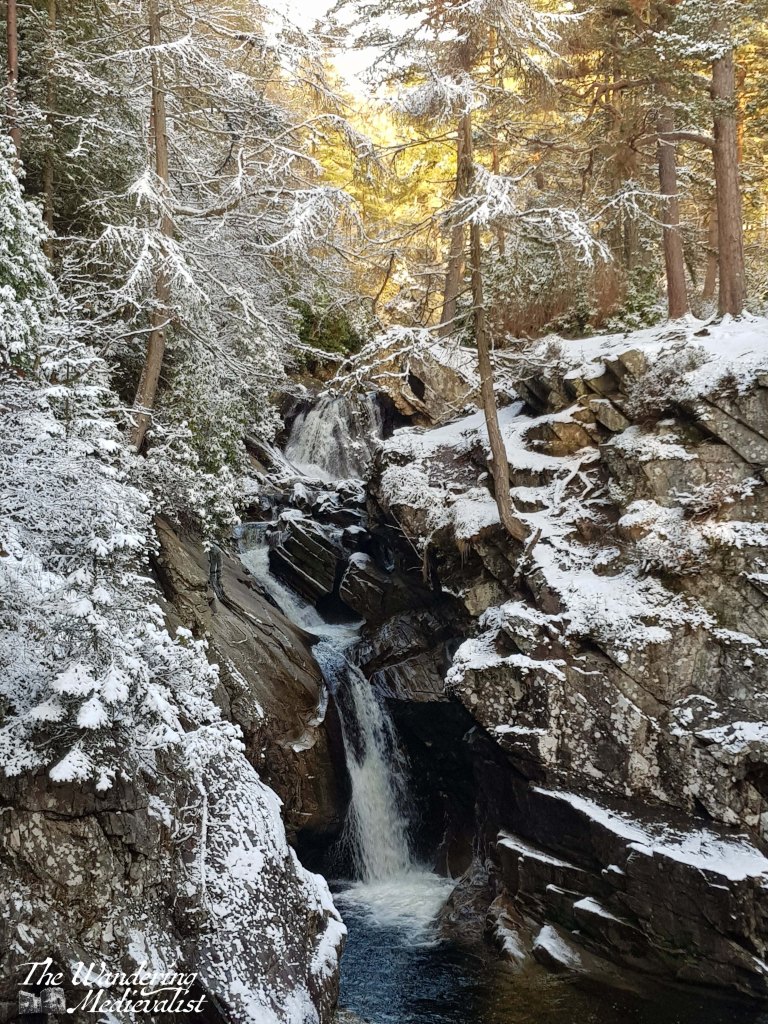
Bruar, Scotland – lower Falls of Bruar
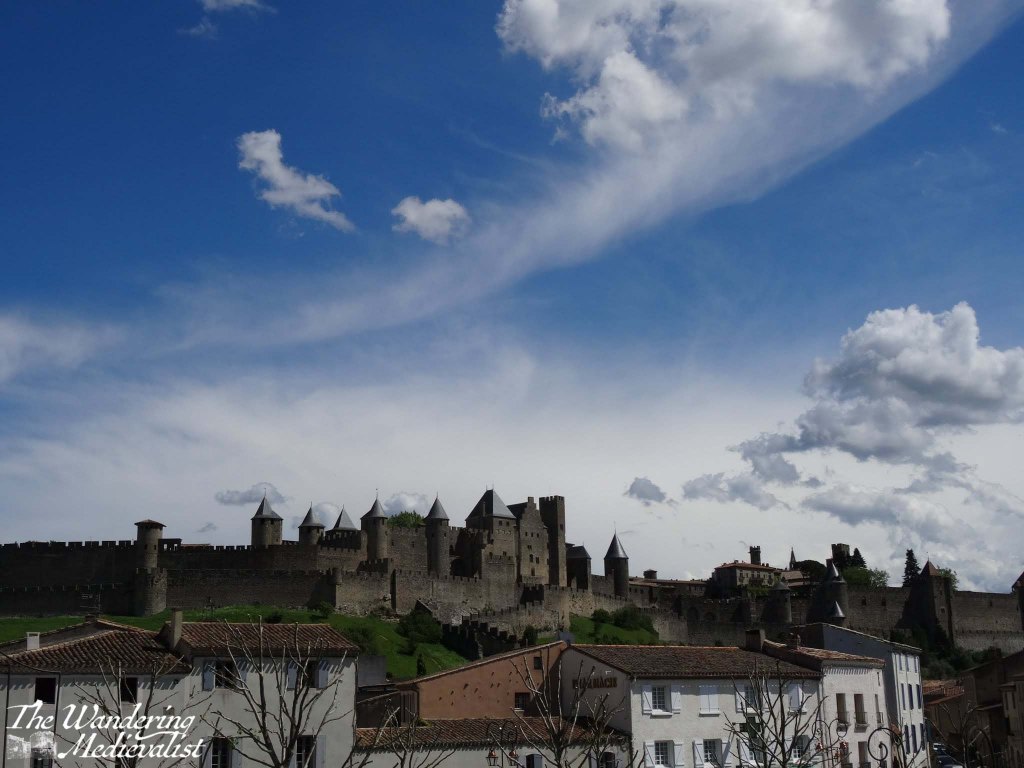
Carcassonne, France – the medieval city of Carcassonne from the Pont Vieux
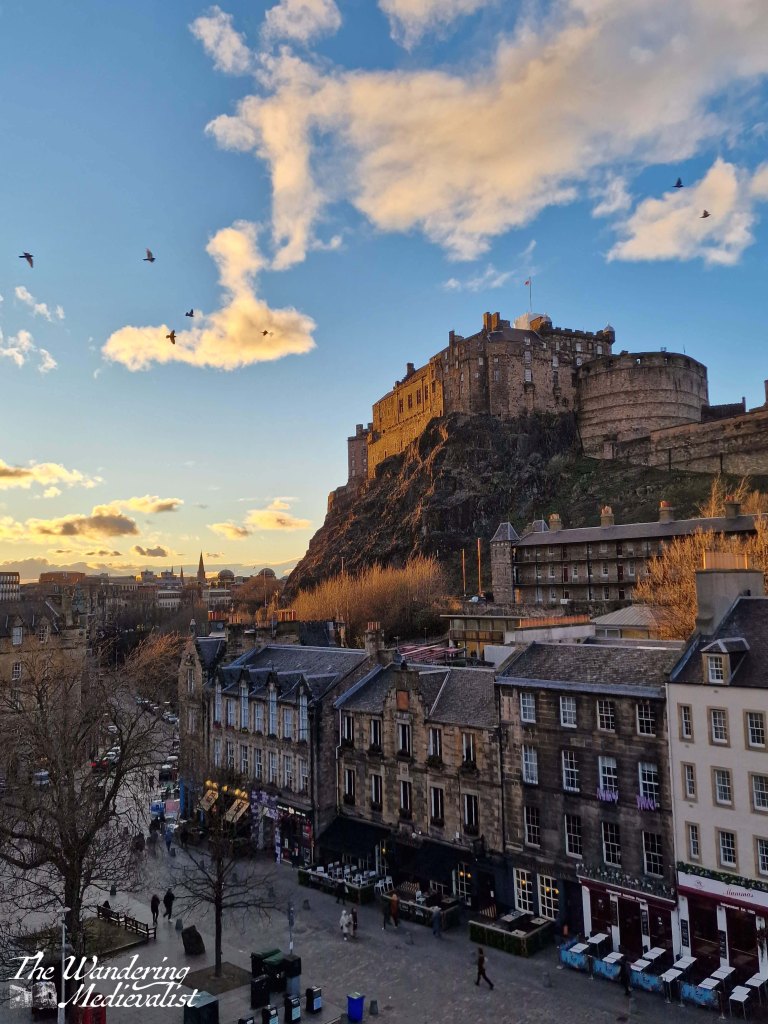
Edinburgh, Scotland – the castle from the Grassmarket
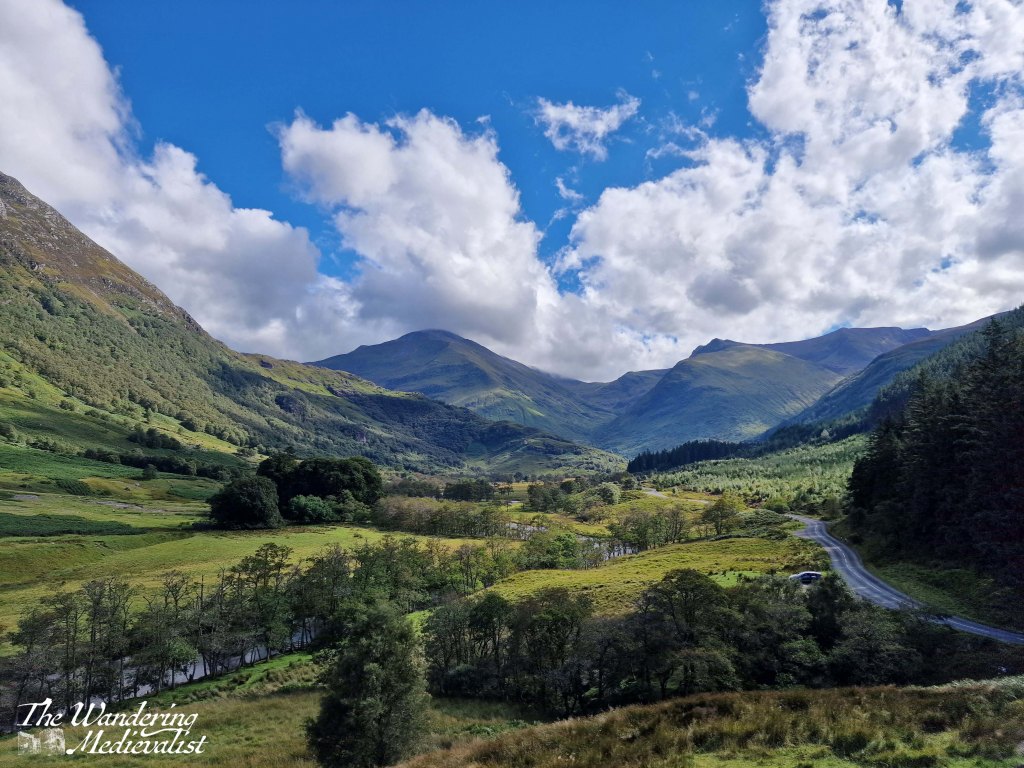
Fort William, Scotland – Glen Nevis
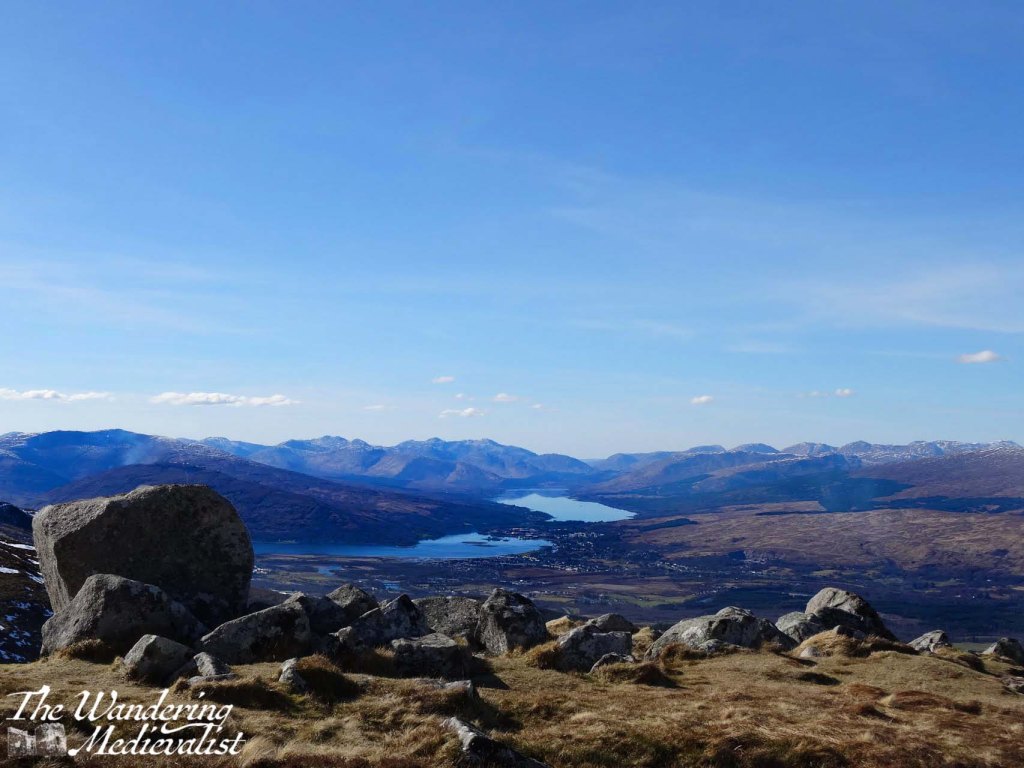
Fort William, Scotland – view of Loch Linnhe and Loch Eil from Meall Beag viewpoint
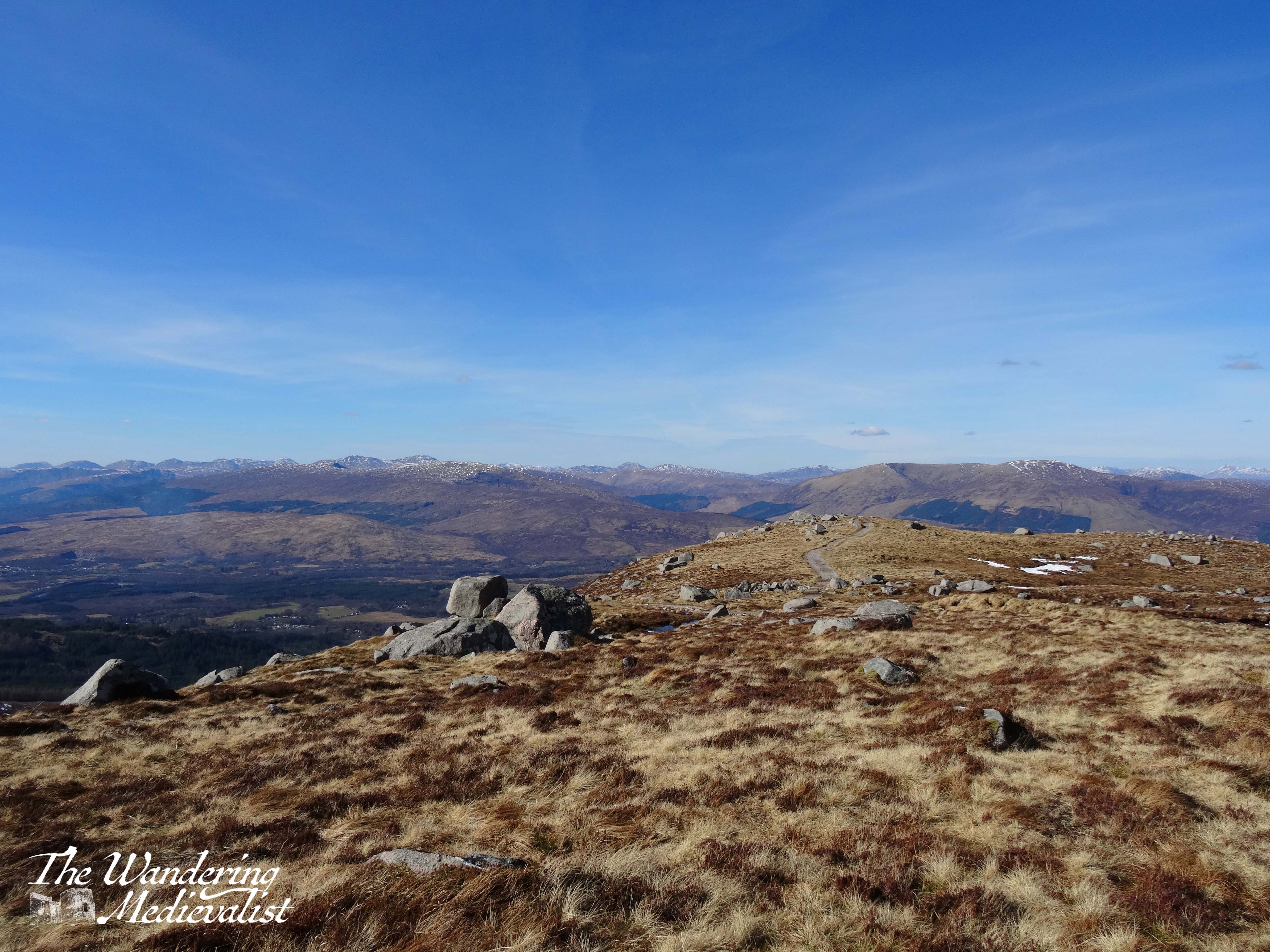
Glenrothes, Scotland – view from East Lomond looking west
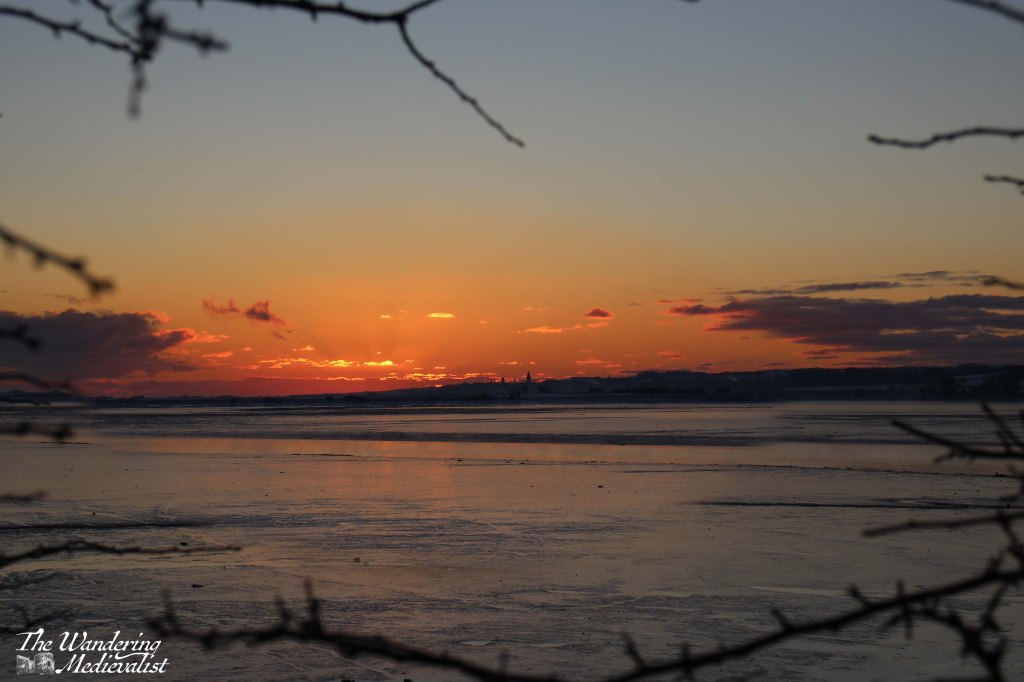
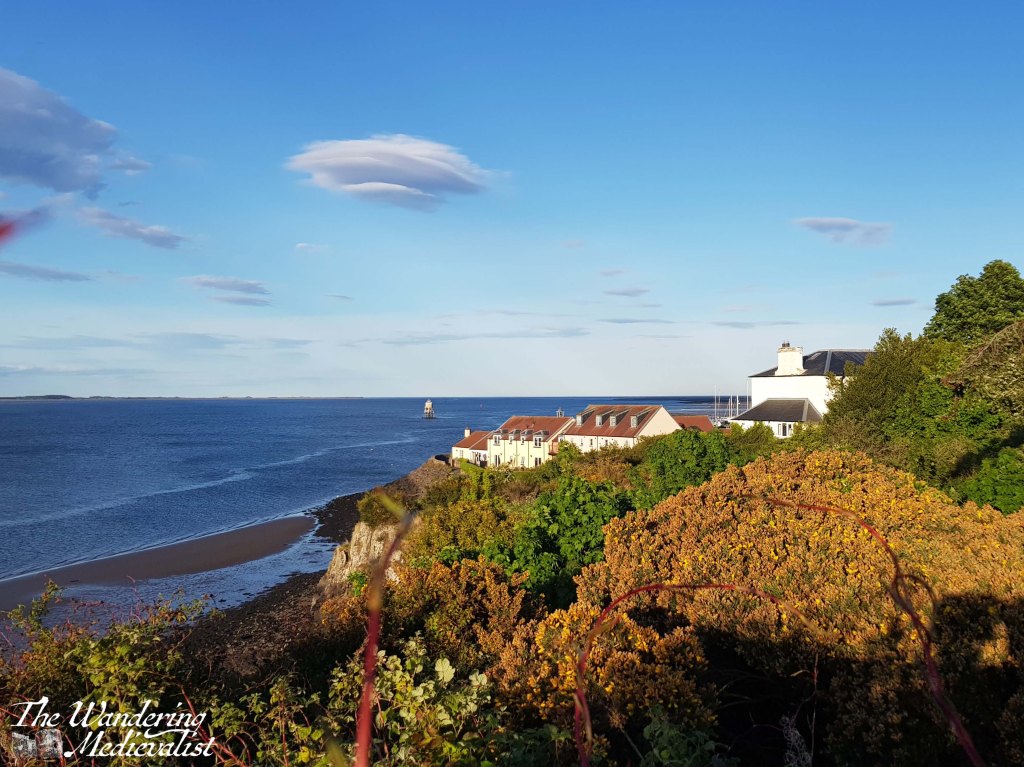
Guardbridge, Scotland – looking across the Eden Estuary to St Andrews
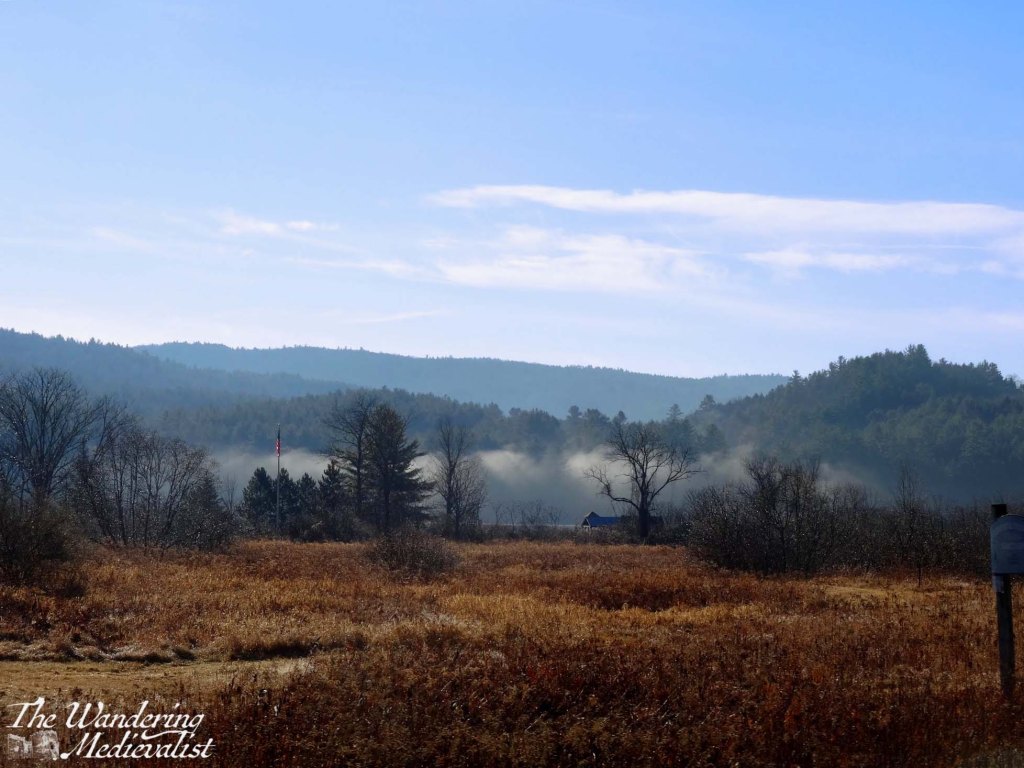
Lyme, New Hampshire – Post Pond
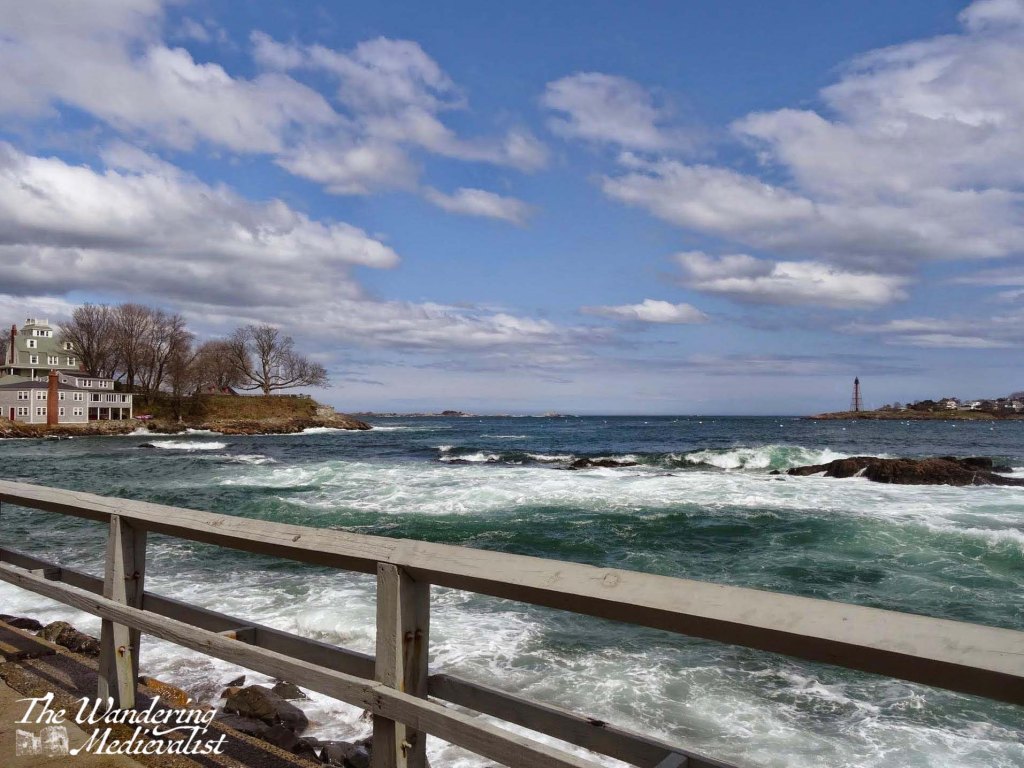
Marblehead, Massachusetts – Fort Sewall and the harbor from Fort Sewall beach
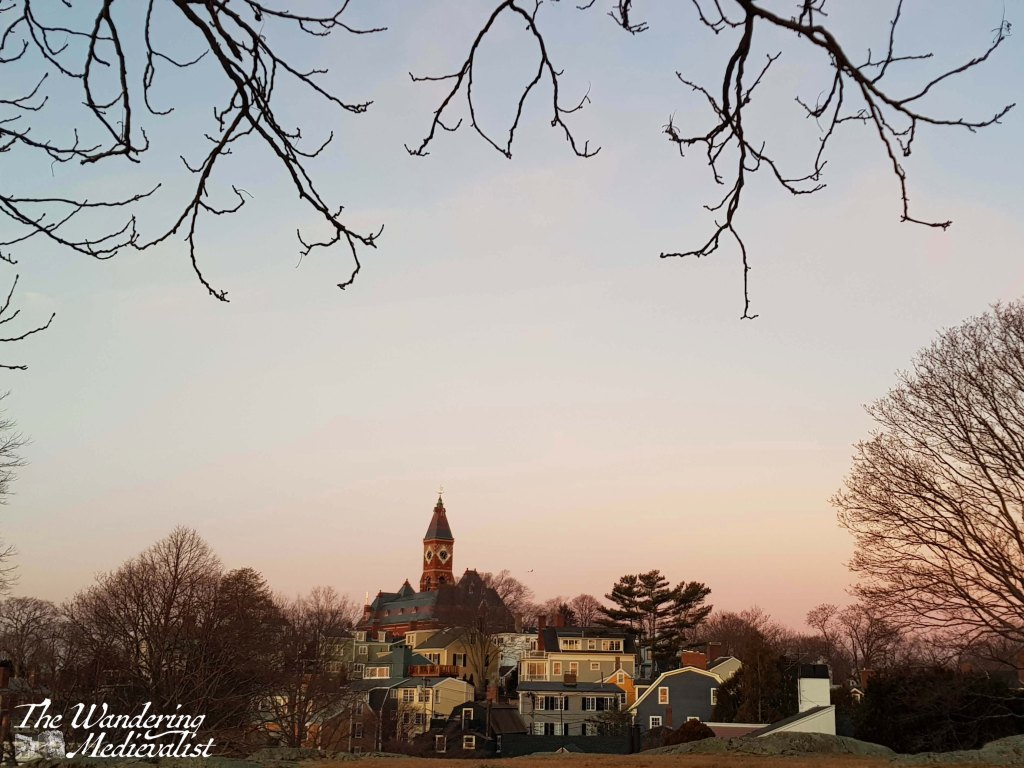
Marblehead, Massachusetts – view of Abbot Hall and Old Town from Crocker Park
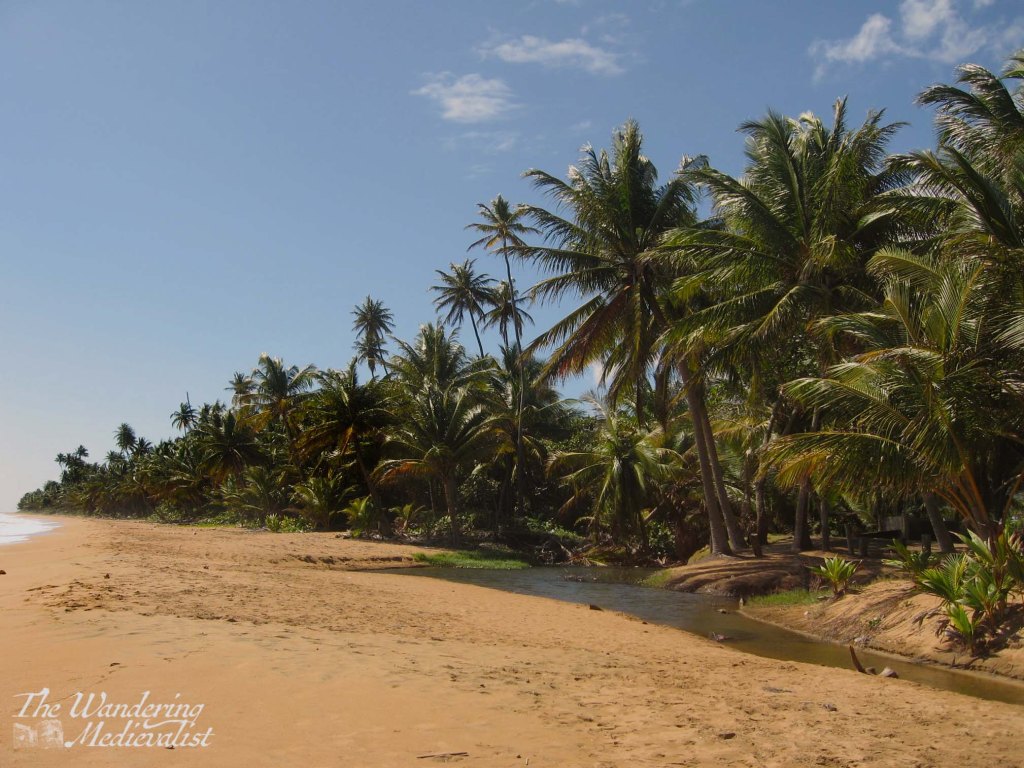
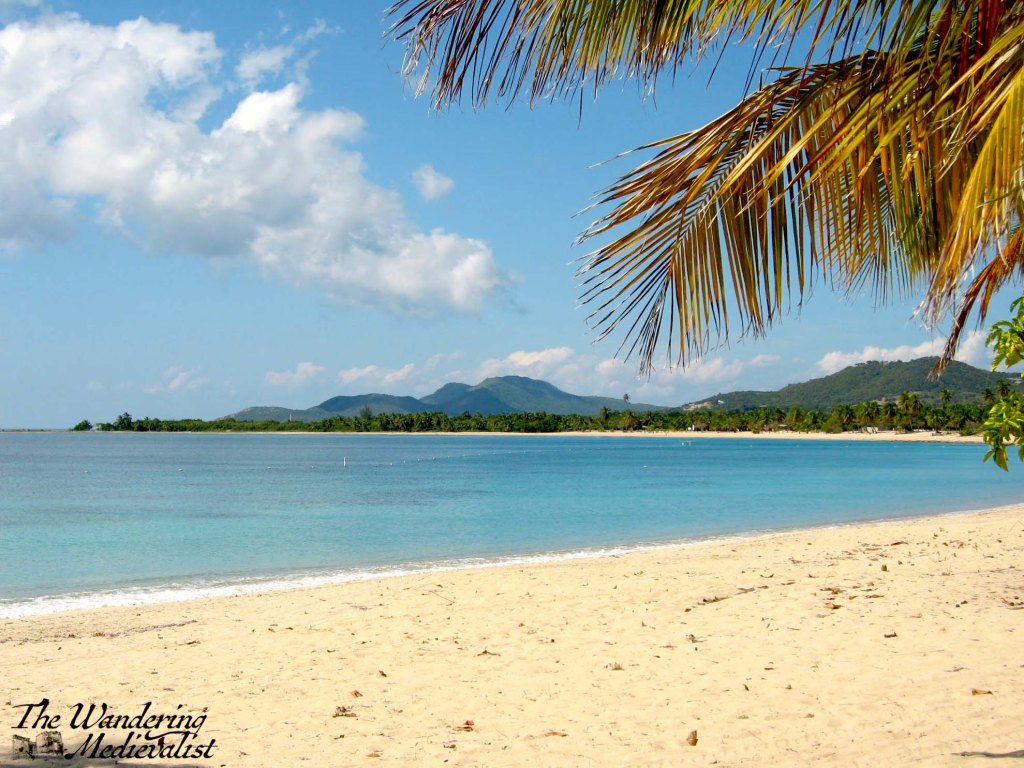
Maunabo, Puerto Rico – Punta Tuna Beach
St Andrews, Scotland – view of the castle from the Scores
On a list of my favourite places in the world, the views from the lodge and surrounding areas on Nevis Range are pretty close to, if not, the top. Whether in the depths of summer or the end of winter, in sun or rainy weather, the gondola trip itself is worth the cost and the walks at the top offer simply stunning views. It is worth clarifying at this point that the gondola does not actually climb Ben Nevis, but instead Aonach Mòr, one of several mountains in the Nevis Range that is popular with skiers.
We discovered the Nevis Range on our first adventure to the Highlands in 2016, when we arrived at our hotel too early to check in and decided to take advantage of the spectacular weather to explore a bit. I was a bit nervous about the gondola – I am not a fan of heights – but it is entirely closed in and very seldom so high off the ground that you imagine desperate scenarios reminiscent of James Bond films.
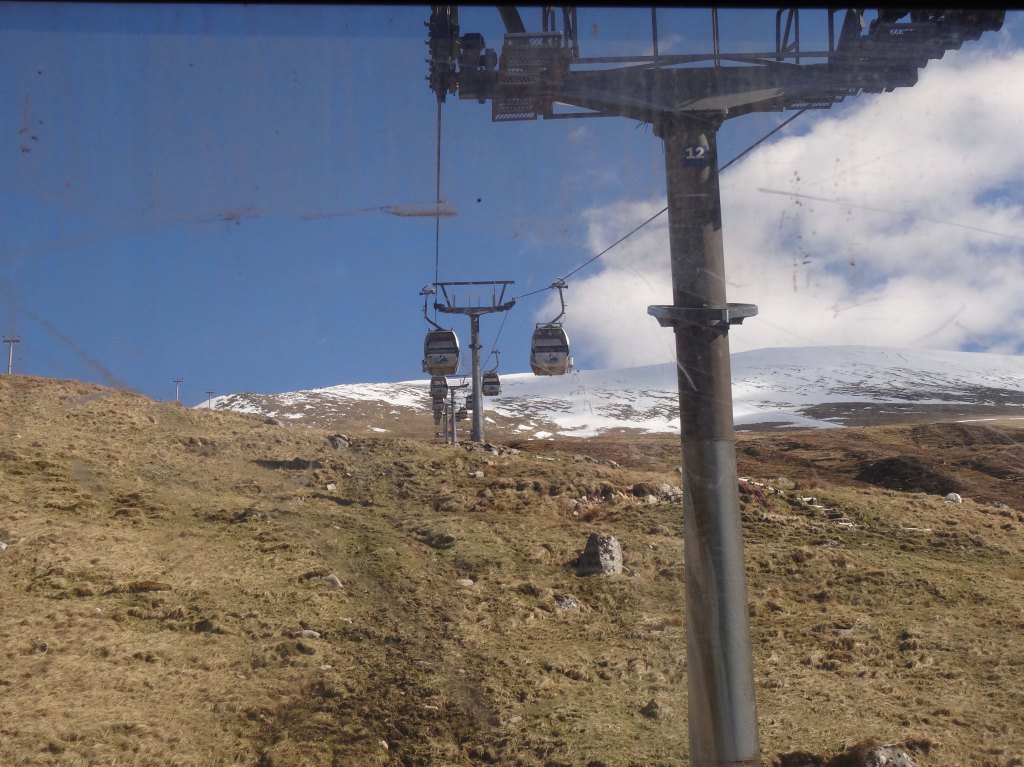
The windows of the gondola don’t allow for particularly clear pictures, but here is the view up, not far from the café at the top.
Both ends of the journey offer a place to stop for a snack or lunch, clean restrooms, and easy access to the cars – I believe that wheelchair access possible, though not 100% certain.
While at some times of year, the view is enjoyed primarily by skiers, by mid-March when we visited, most of the snow was gone but the mountain bikers had not yet taken over, so we had plenty of space to ourselves. A word briefly about the lodge at the top of the gondola, and the Snowgoose Restaurant within – I have been repeatedly impressed by its comfort and good food. The snacks and coffee are great, and there is ice cream or bottles of water aplenty, depending on your need. Best of all, the view is just out of this world.
From the lodge, there are two available walks, each to a different viewpoint. The Meall Beag viewpoint is a bit further away, so on our first trip we opted for the Sgurr Finnisg-aig trail, which is reached by turning left out of the lodge. It is a short walk, about fifteen to twenty minutes to the viewpoint, and the trail is well-kept.
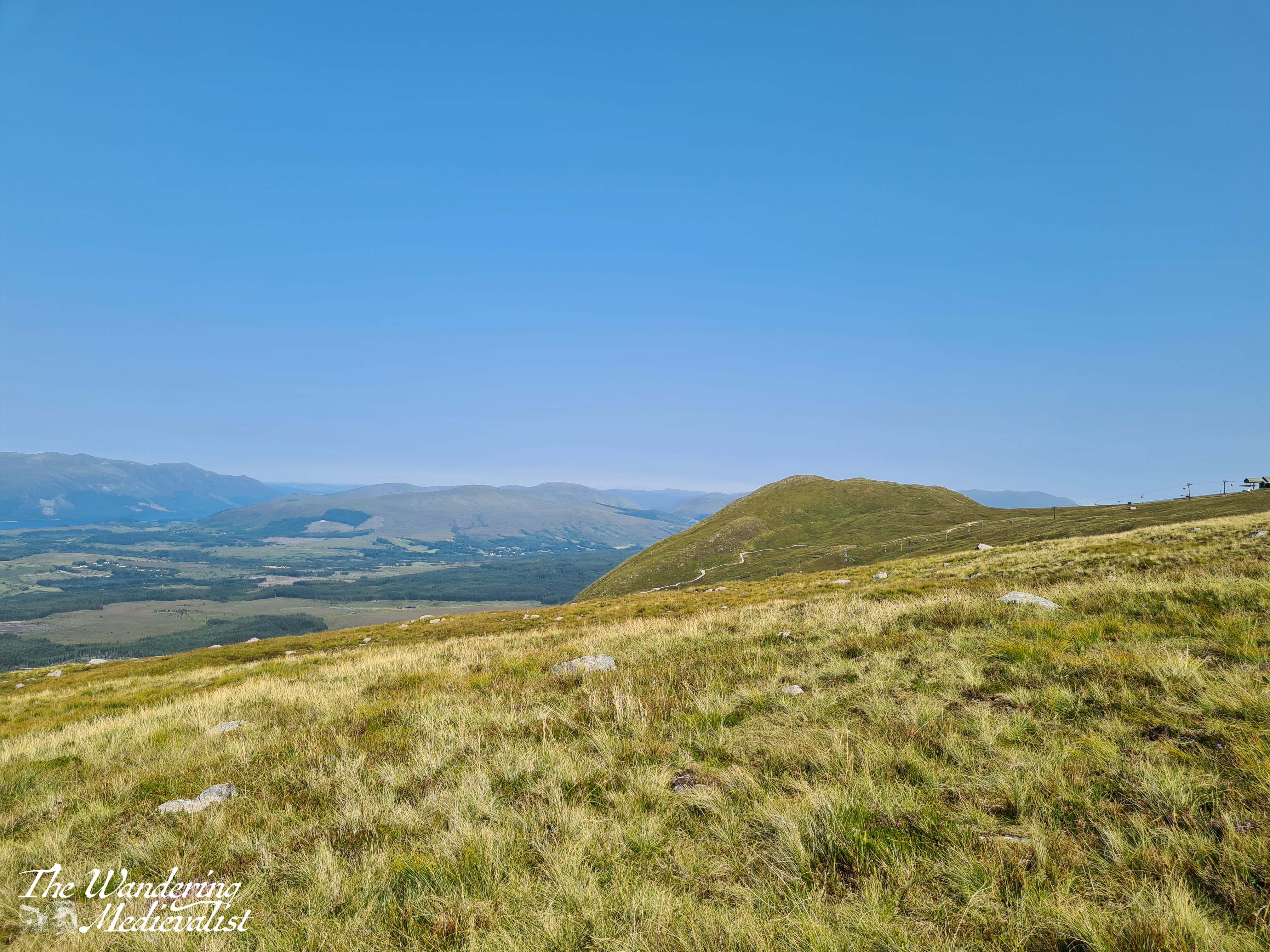
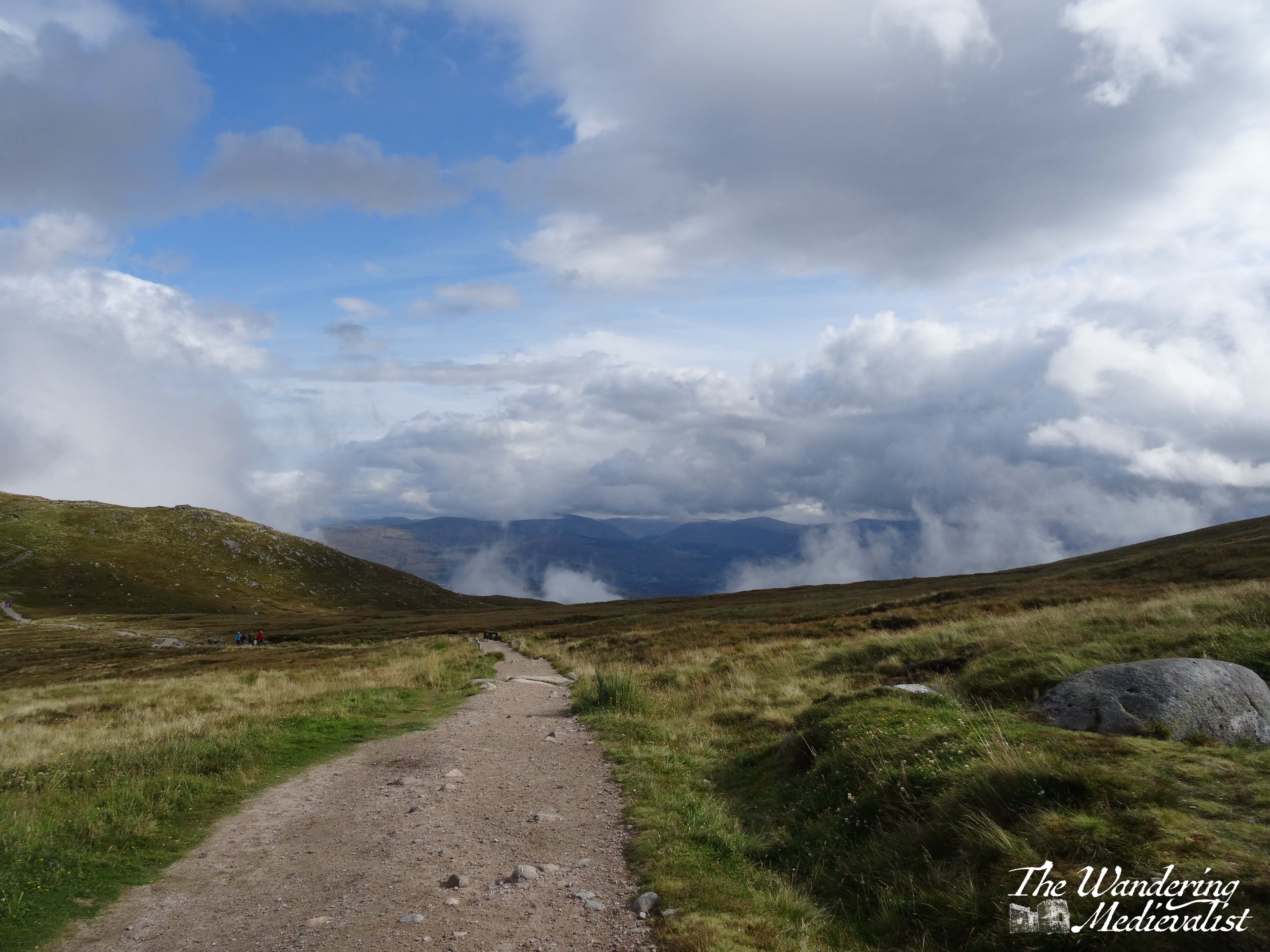
The start of the walk boasts views out to the east, and as you will see below, on the second time I took this walk with my father, you could see clouds rising in the distance. Our first visit was in mid-March, so snow was still evident on some peaks, but the cloudy visit was in late August – much greener and definitely no snow.
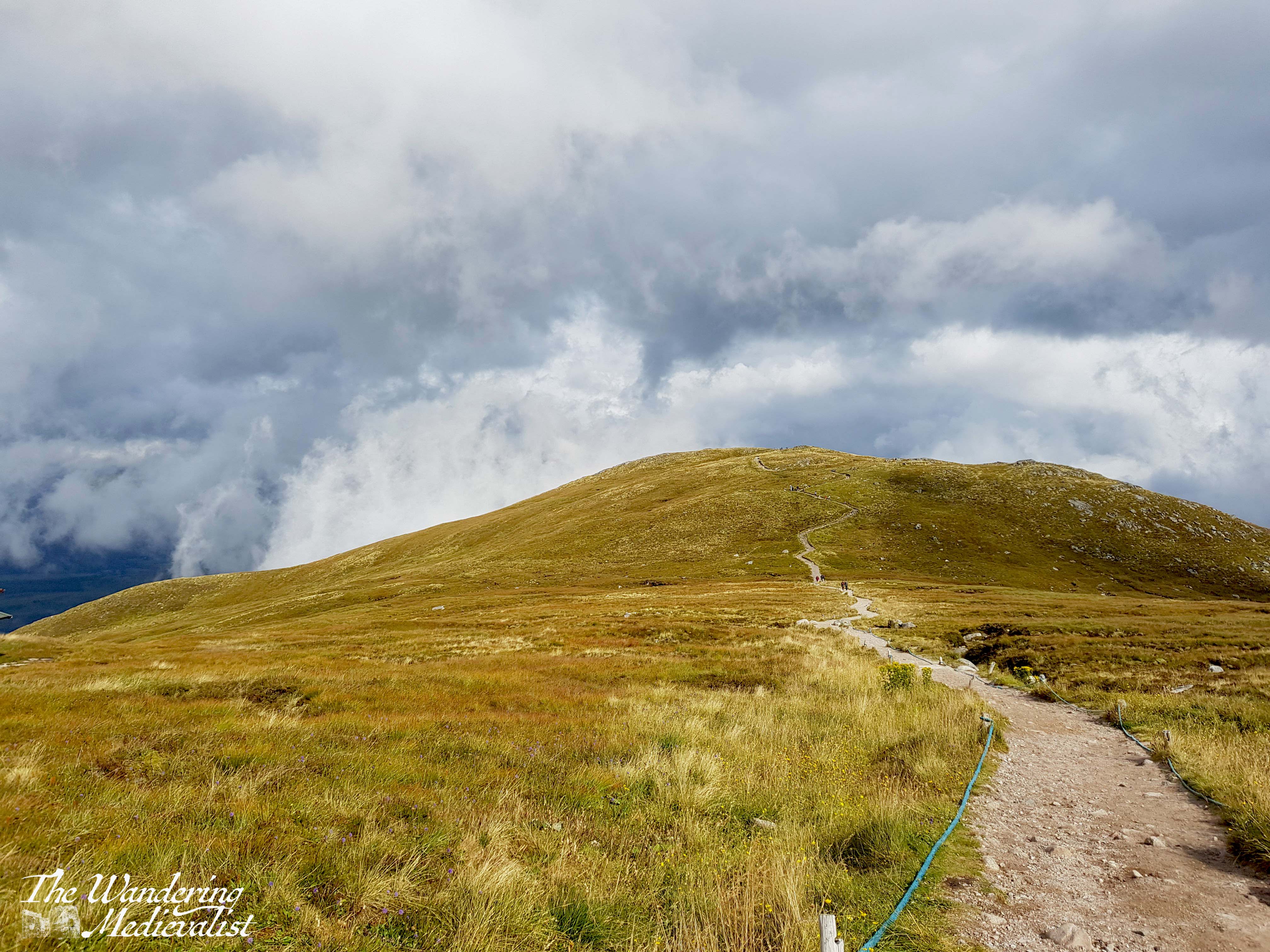
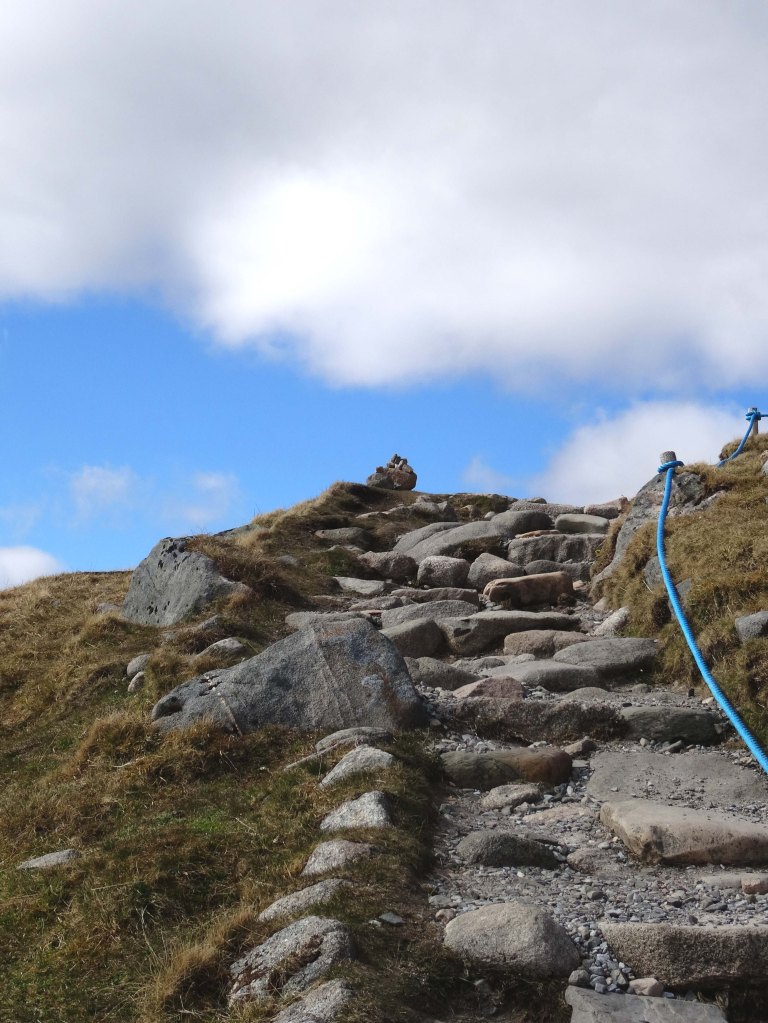
The trail is relatively even and easy-going until you get closer to the hill itself, and then you are faced with stairs. These wind and climb, at times a touch narrow, but there are plenty of places to pause and catch your breath or allow people to pass.
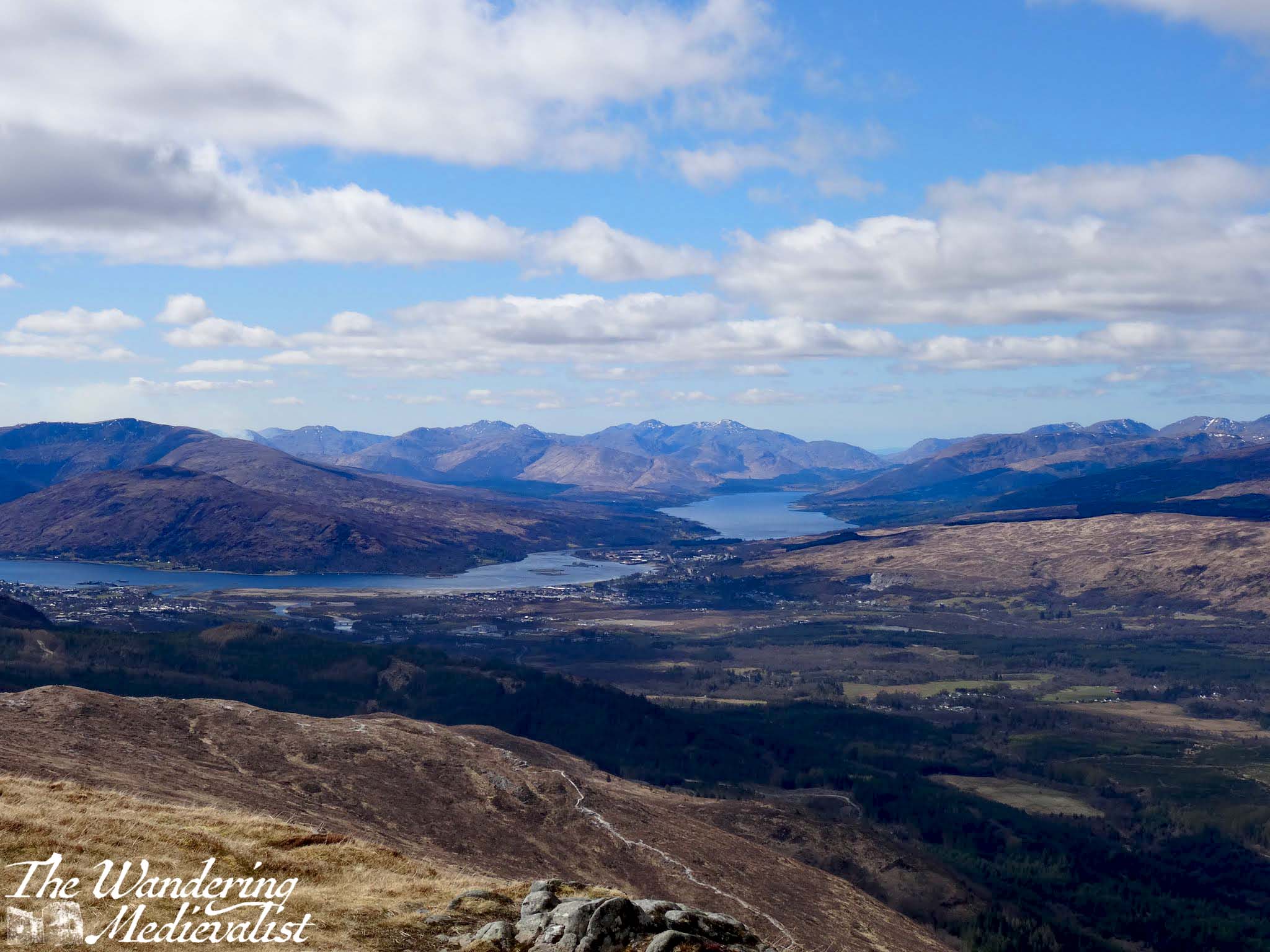
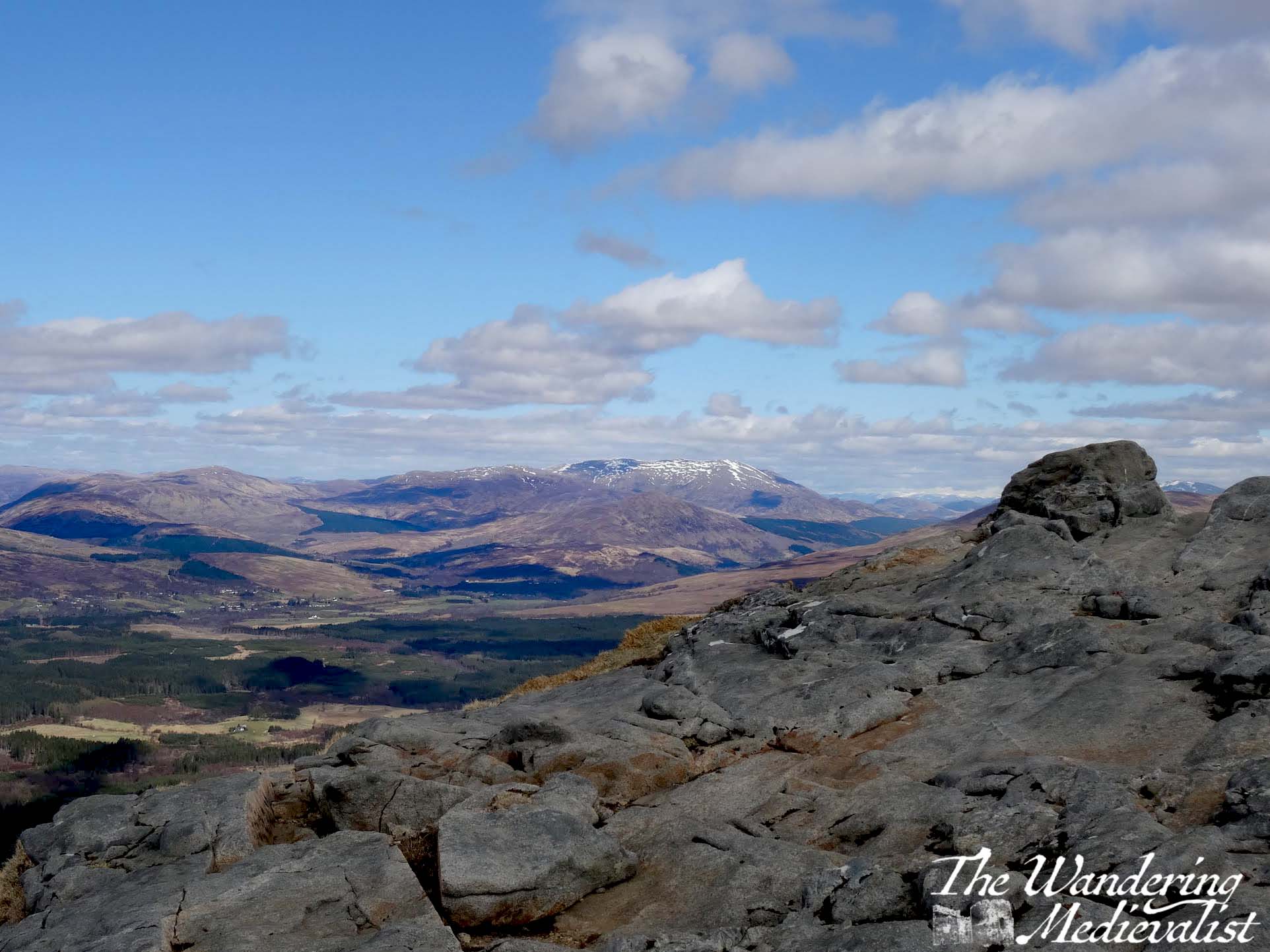
And there is no question, the climb is worth it. At the top is a rocky plateau of sorts, where there is a map to show you what you are looking at, as well as numerous spots to take advantage of the view. Standing at the map provided, one can see to the west and the edge of Fort William, Loch Linnhe and Loch Eil, to the east towards Roybridge, and north to the start of the Great Glen that leads up to Inverness. As noted above, these photos were taken on two separate trips, as is evident. In March, we were blessed with incredibly clear weather, while in August, clouds were closing in around us as we walked and by the time we returned to the café, rain had arrived.
On both occasions I followed this trail, I found myself equally distracted on the walk back by the spots of heather, the small burns, and the rock shapes poking through the grass. It is iconic Scottish mountaintop, and the gondola has made it accessible for many people who may not normally be able to enjoy it. My most recent trip up the mountain was actually in summer 2021, when masks were required in the gondola and travel restrictions meant that the tourists around us were all British rather that foreign. The outdoor nature of the trip made it ideal for Covid times, and the relative freedom after more than a year of various lockdowns was palpable.
One of the most pleasant parts of any visit to Nevis Range is once you have completed your walk, when you find yourself a table in the café with a coffee, a cake, or some lunch, and just enjoy the view. On the cloudier trip, I found myself fascinated with the way the clouds were swirling around the gondolas as they disappeared in the mist – though the ride down was without a view, as the video below shows. So whether a perfectly clear day or one where rain is imminent, I would most definitely recommend this trip and short walk. One caveat is that when there is high wind forecast, the gondola may not run for obvious safety reasons – on one trip we missed out and enjoyed the walks at the foot of the mountain instead.
I have done the Meall Beag viewpoint walk as well, but there are too many pictures for one post!
Both my other half and I agree that our first weekend away together to Glencoe many years ago remains one of our best trips ever – we went in April and were lucky enough to experience two glorious sunny spring days, warm and completely dry. We stayed at a hotel in Ballachulish on Loch Leven, close to the village of Glencoe (note, there is also a Loch Leven in Fife, which boasts a lovely castle I will write about in the future). For weeks ahead of time, I excitedly read through my Pathfinder Guide to Fort William and Glencoe, marking the walks I thought we could do to really experience the mountains and surrounding area.
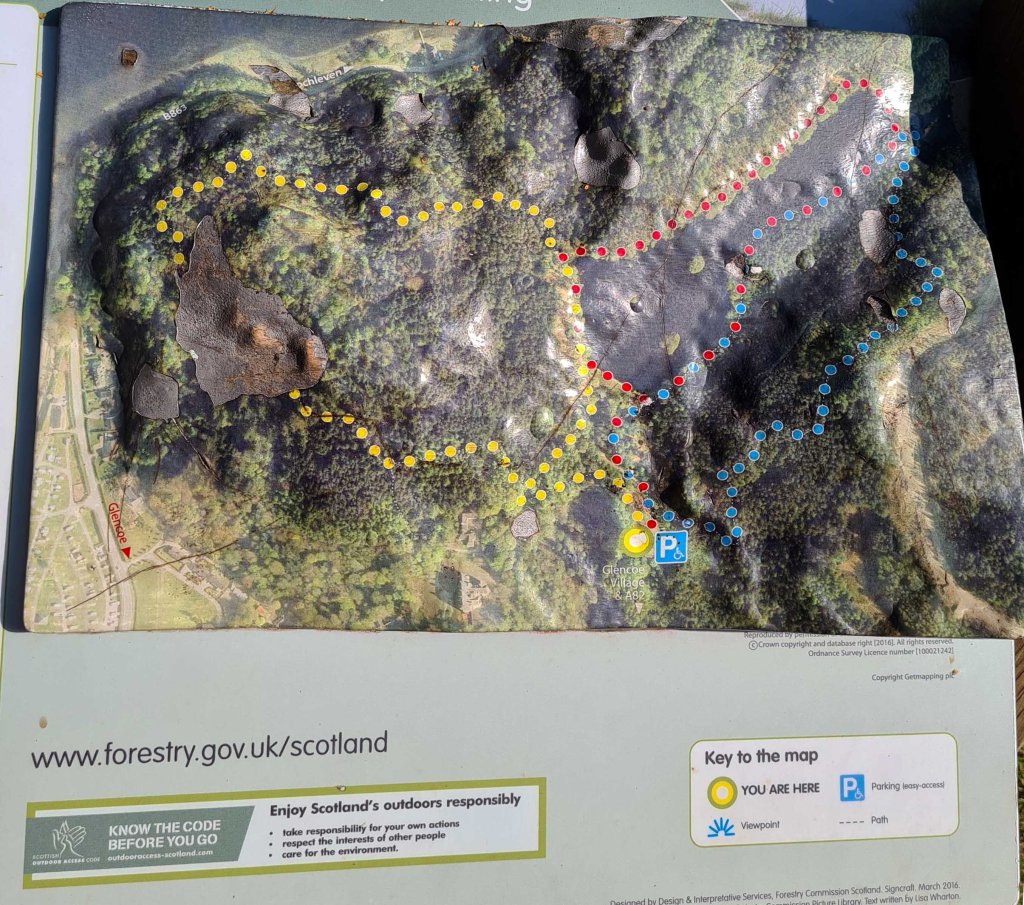
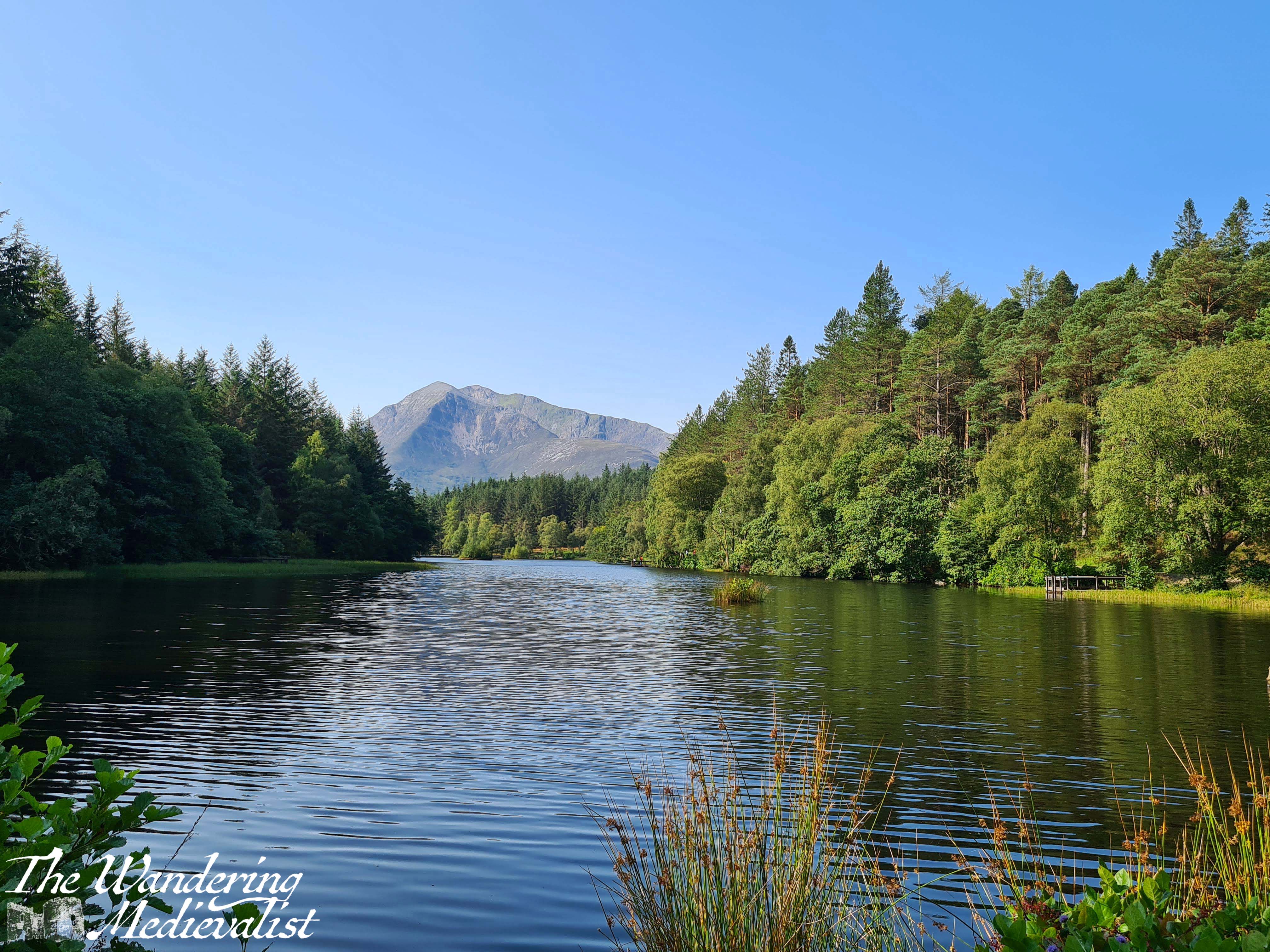
This series of walks around Glencoe Lochan was one of the last we did, but also one of our favourites. The trails start in what is now a well-marked car park, and there are three options. The shortest, and the one that is advertised as being wheelchair and pram accessible, is the red trail.
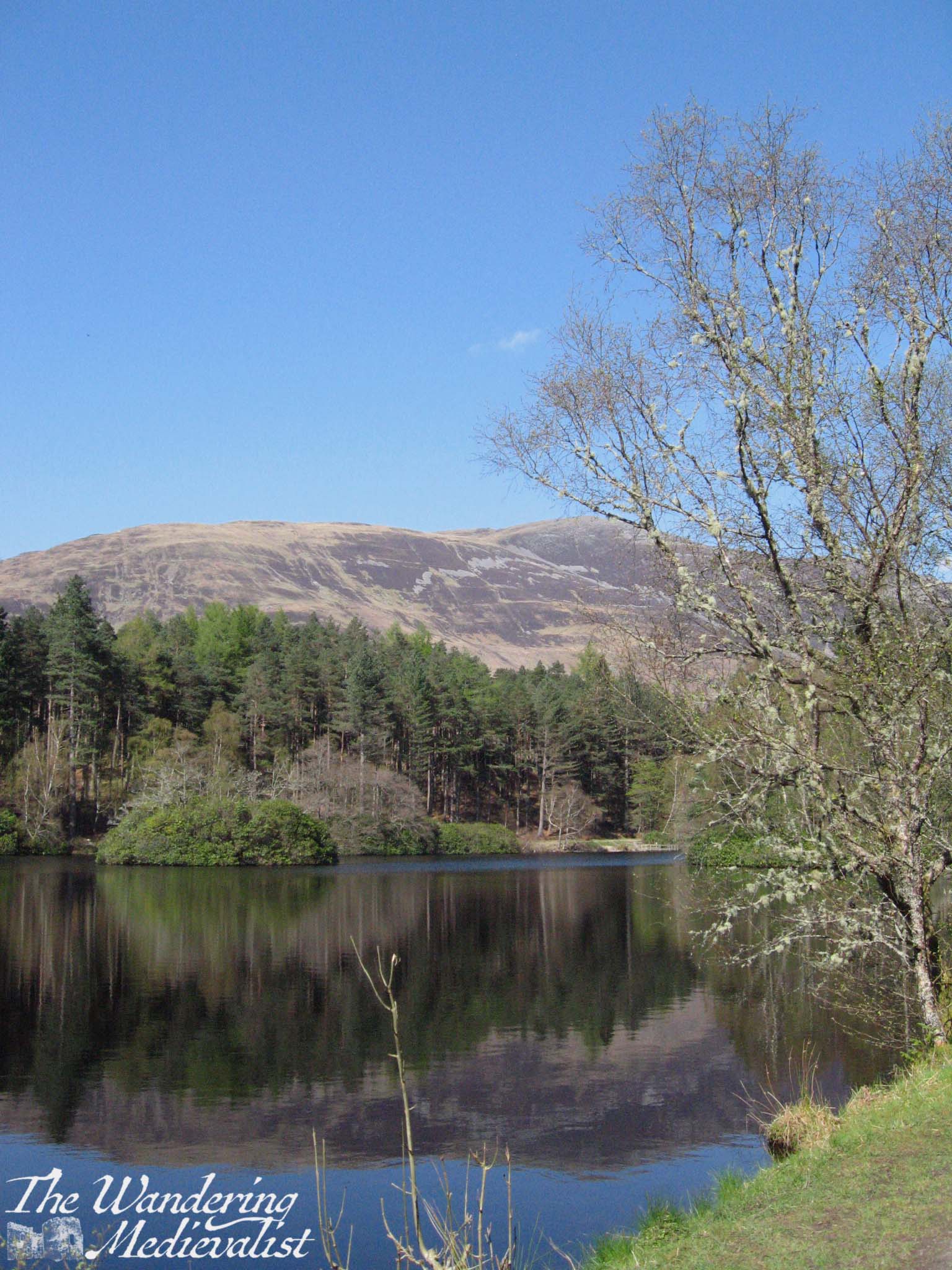
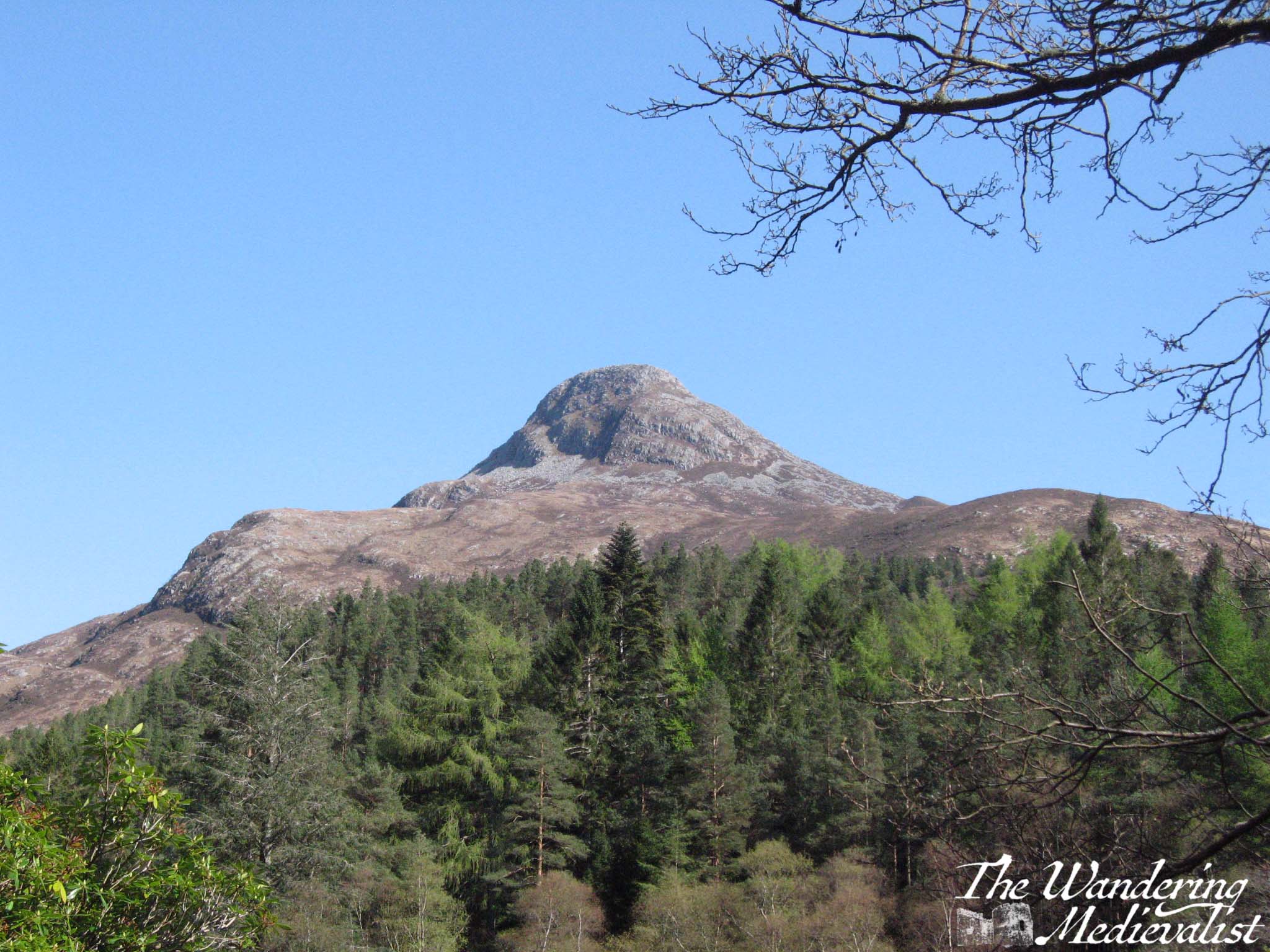
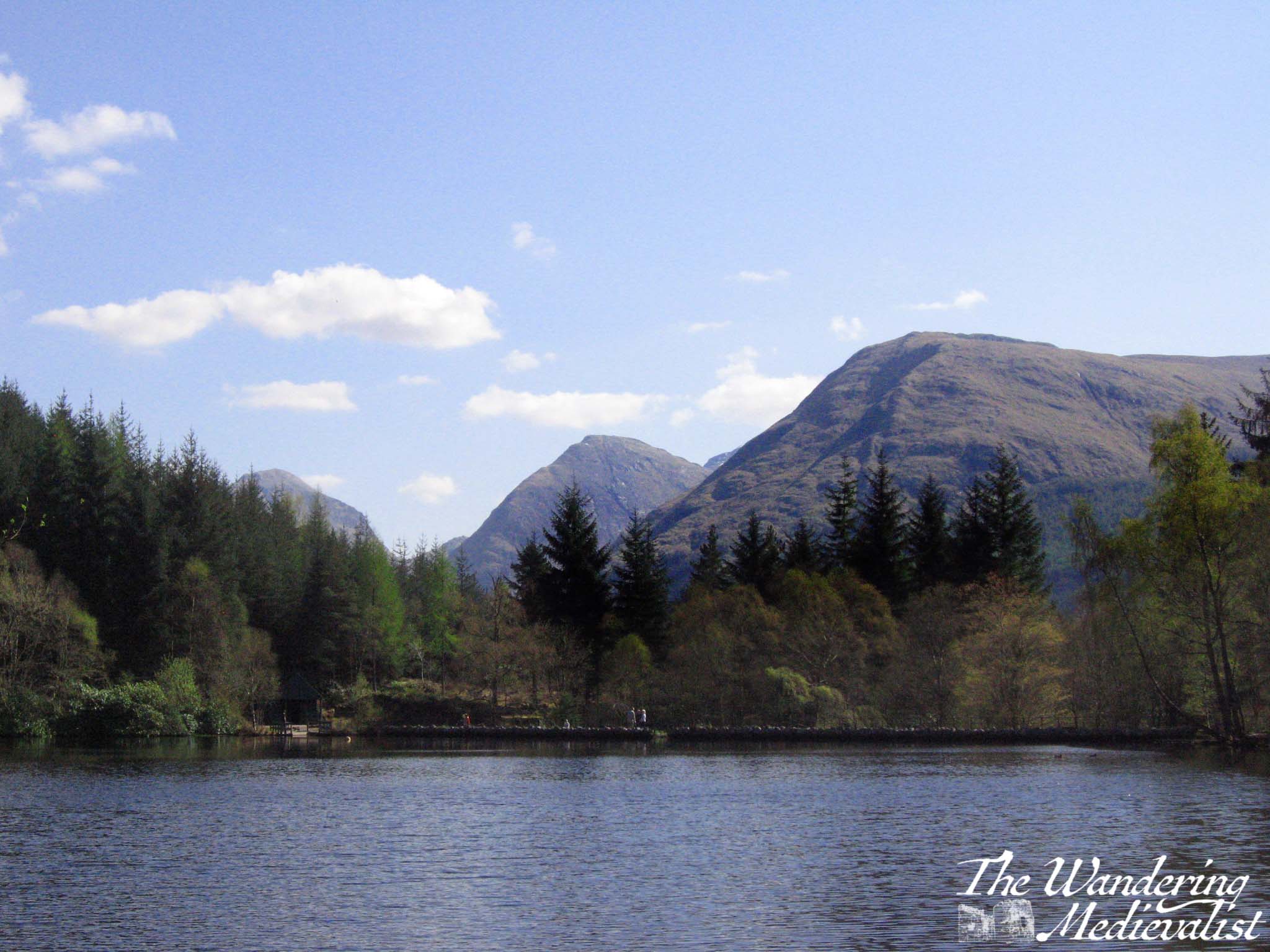
Though the shortest, the red trail is by no means hampered by lack of a view – in fact, as it circles the lochan (small loch), it boasts some of the most spectacular views of the nearby mountains including the Pap of Glencoe (the pointiest hill you see below).
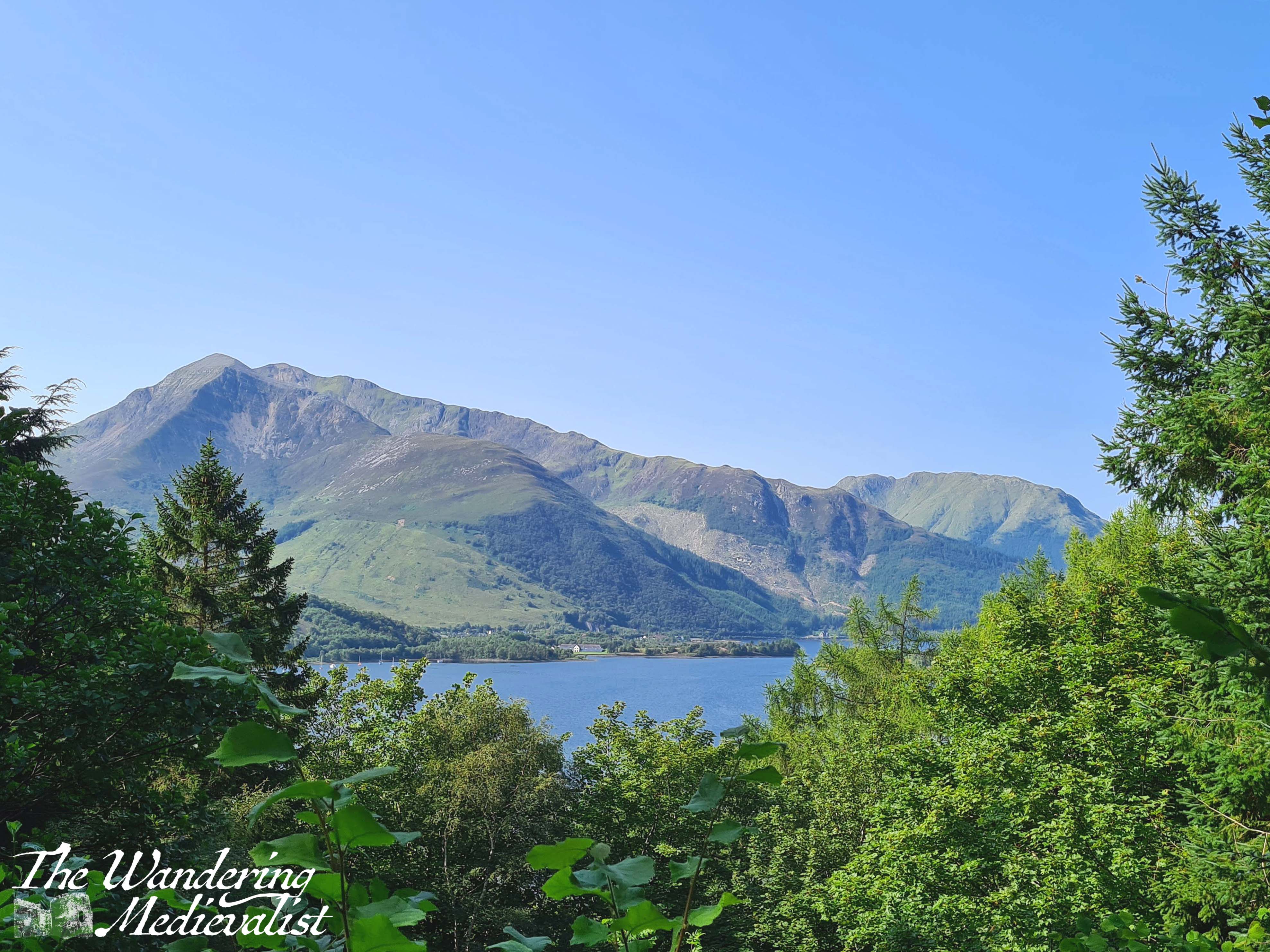
The blue trail is arguably the most challenging as, while not particularly long, it does boast a few very steep bits, both up and down. It also, however, offers a gorgeous path through trees and heather with the mountains just visible in the distance. There are also a few good stopping points with picnic tables and cleared brush so that you can enjoy the view.
The blue trail eventually cuts downhill back towards the lochan, and joins up with the other two; even after the steep climb we were still ready for a bit more exercise so left the red trail to follow the yellow, which is also mostly wooded but includes a few stunning viewpoints out towards Loch Leven and the mountains to the north.
The whole outermost circuit taking in all the trails was just over an hour but could probably be extended if you did the red loop as well. It’s also a great option if you have a member of your party who isn’t particularly mobile, as the red loop is gentle and has plenty of benches to stop for a rest, but still enables one to see the view. Perhaps one of the nicest aspects of this area is how close it is to the village. After the walk, we drove down into the town and were able to stop into the shop for fresh water and a snack, as well as use the very clean public loos – they were not free, but I’m always happy to pay if it means the facilities are clean!
All in all, an absolute must for anyone staying in the Glencoe area!























 The Wandering Medievalist