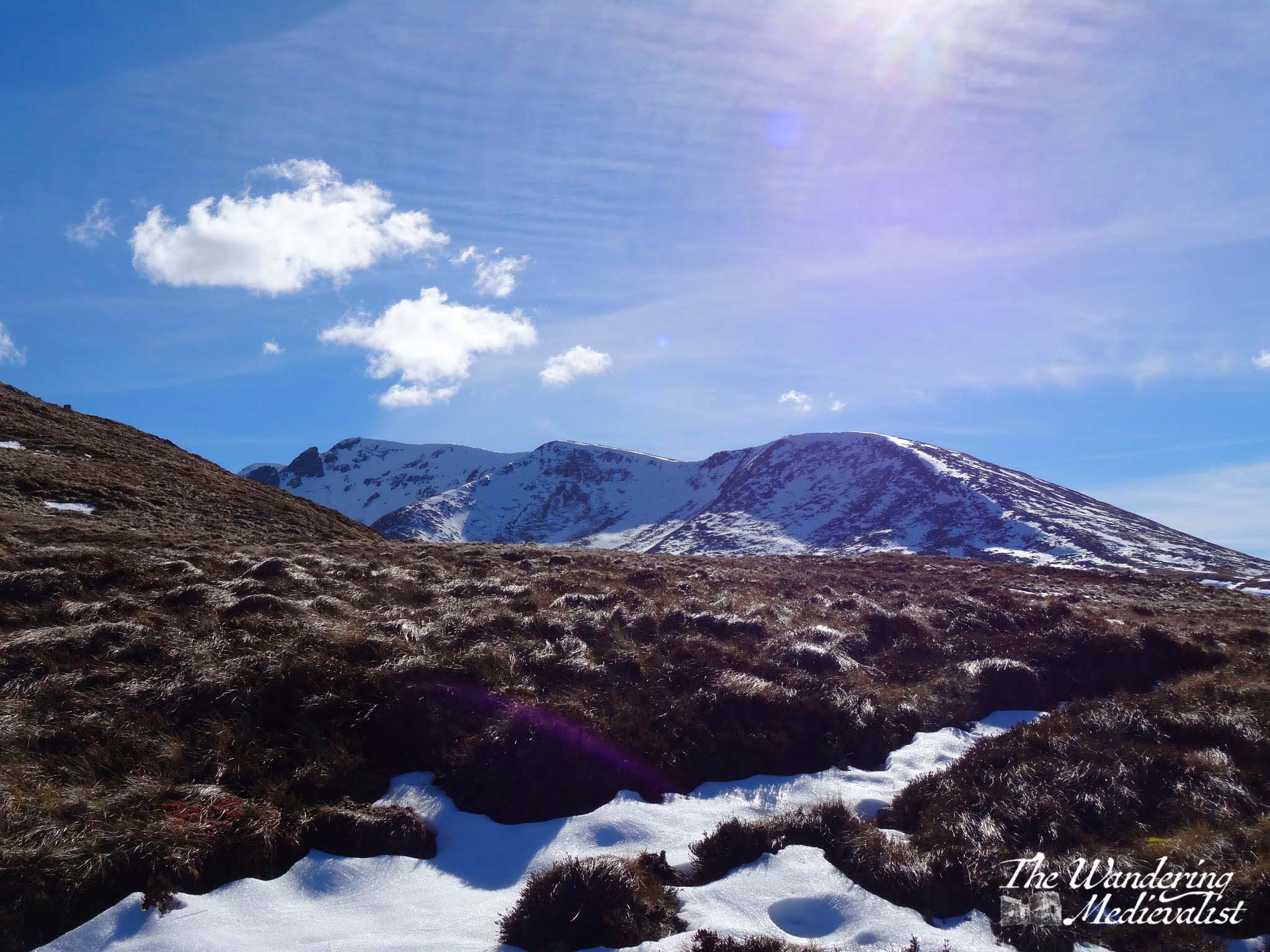
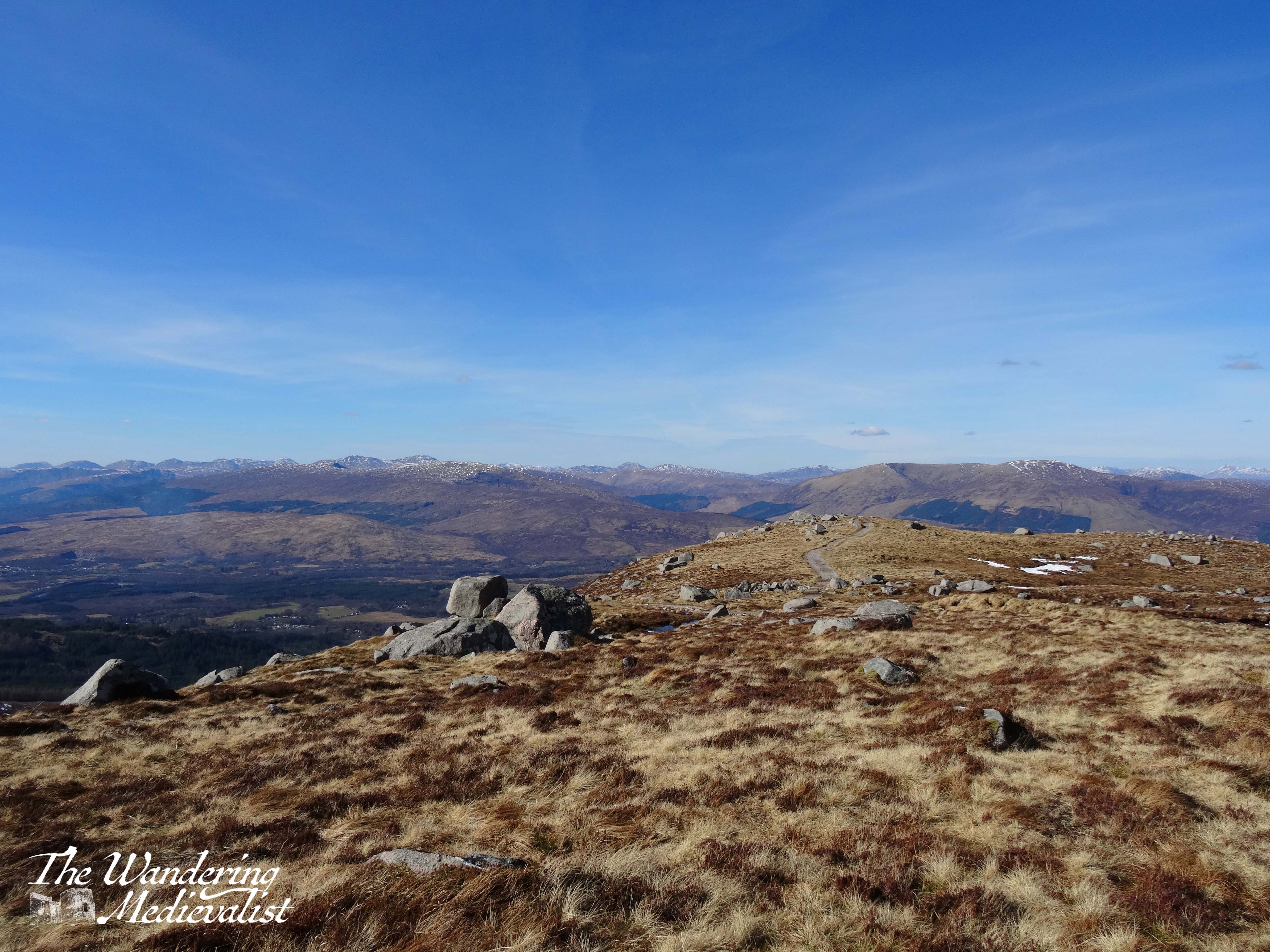
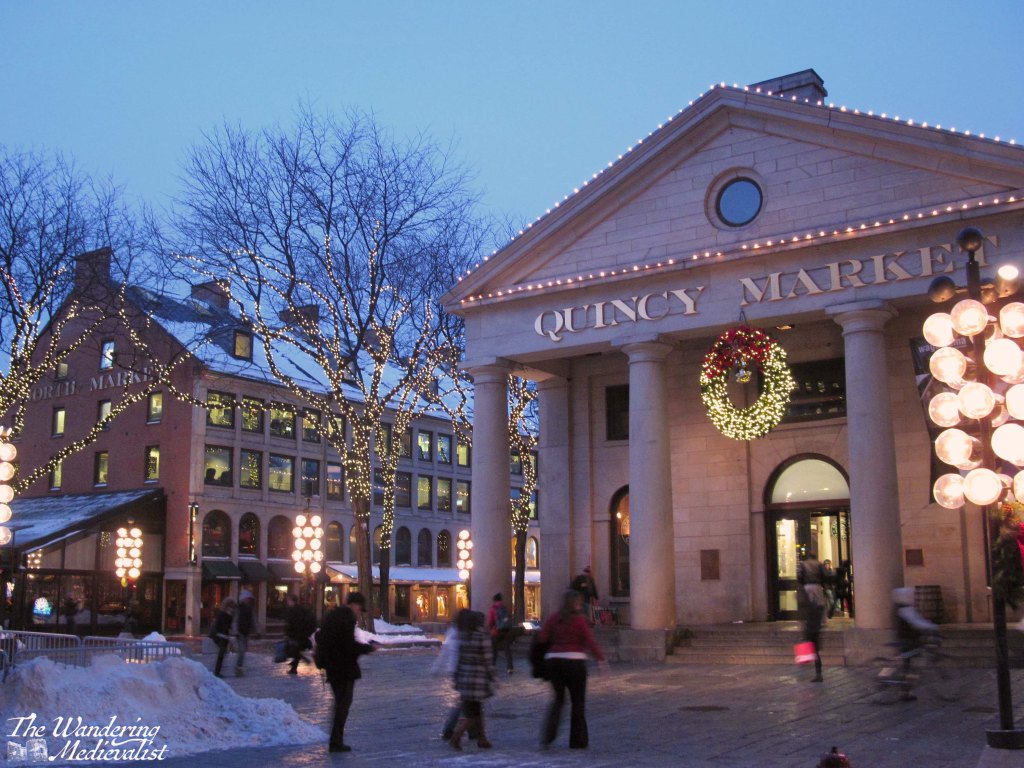
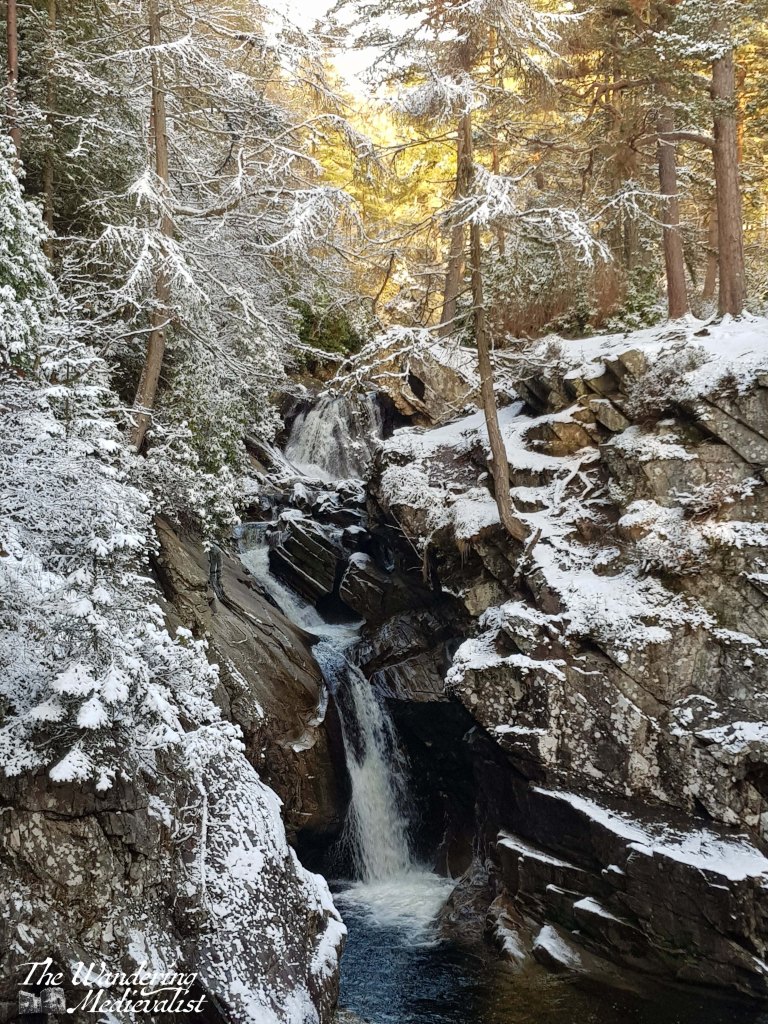
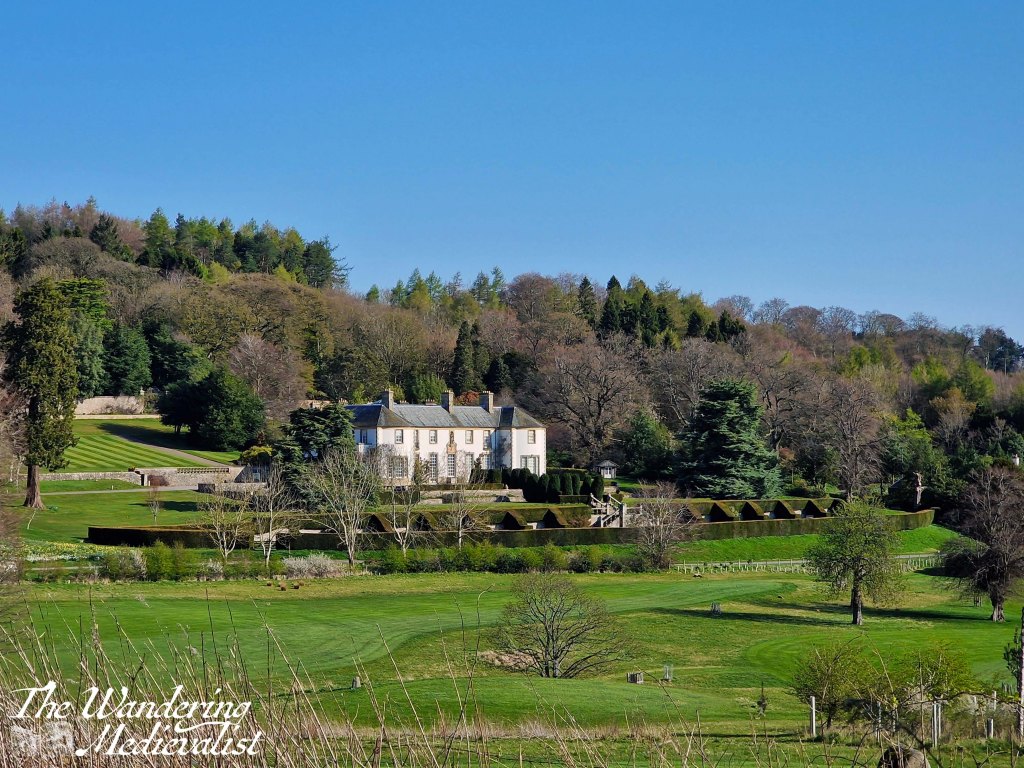
There are so many beautiful views in the world, many I have seen and many I have on my list of wishes. This list, then, is of a few that I love more than others – some of these please I have visited and photographed over and over in different seasons and lights. Some of them I have visited only once, but remain in my memory as special, unique. These are views that make me smile, take a deep breath, and feel at peace.
Unsurprisingly, quite a few of these now grace the walls of our house, as canvas prints or collages.
I hope that they bring you the same smile and peace of mind.
Boston, Massachusetts – Quincy Market
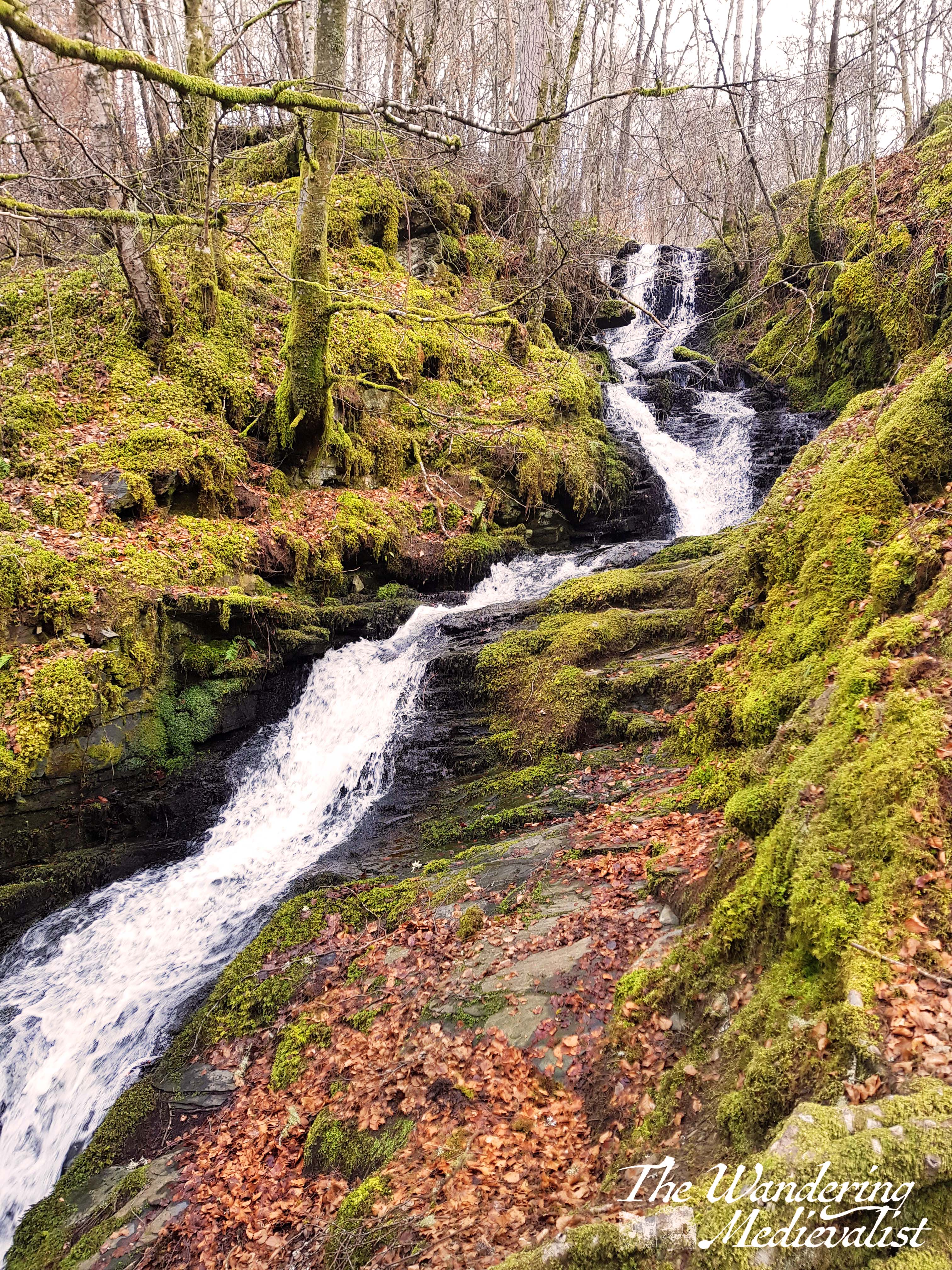
Bruar, Scotland – lower Falls of Bruar
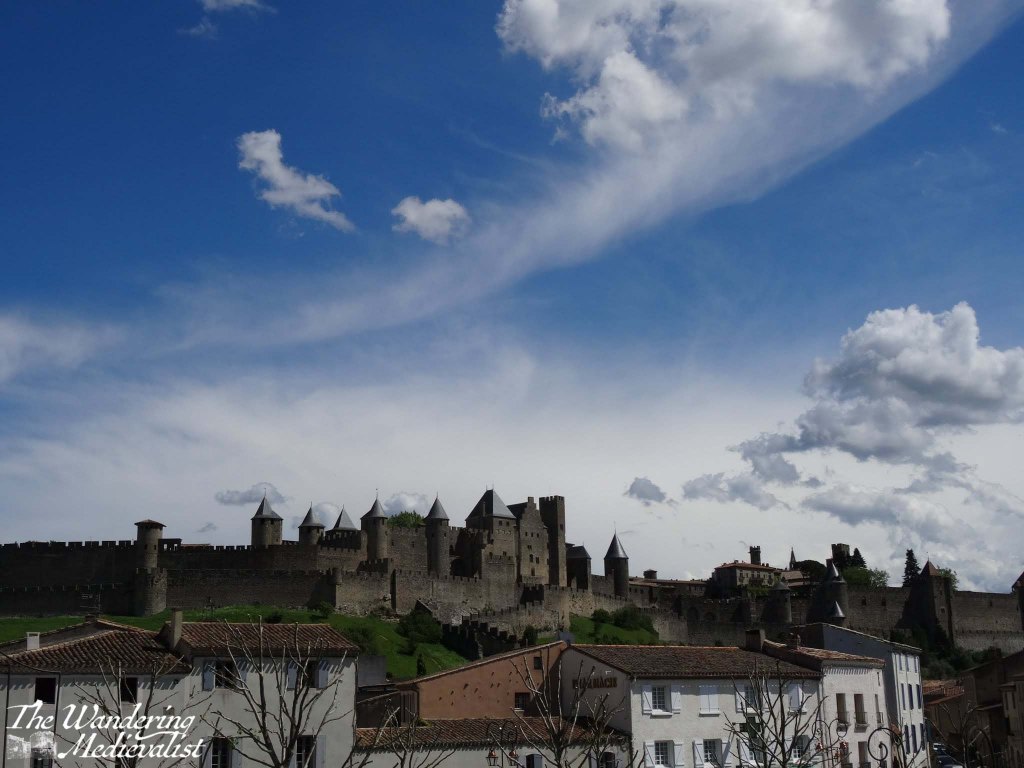
Carcassonne, France – the medieval city of Carcassonne from the Pont Vieux
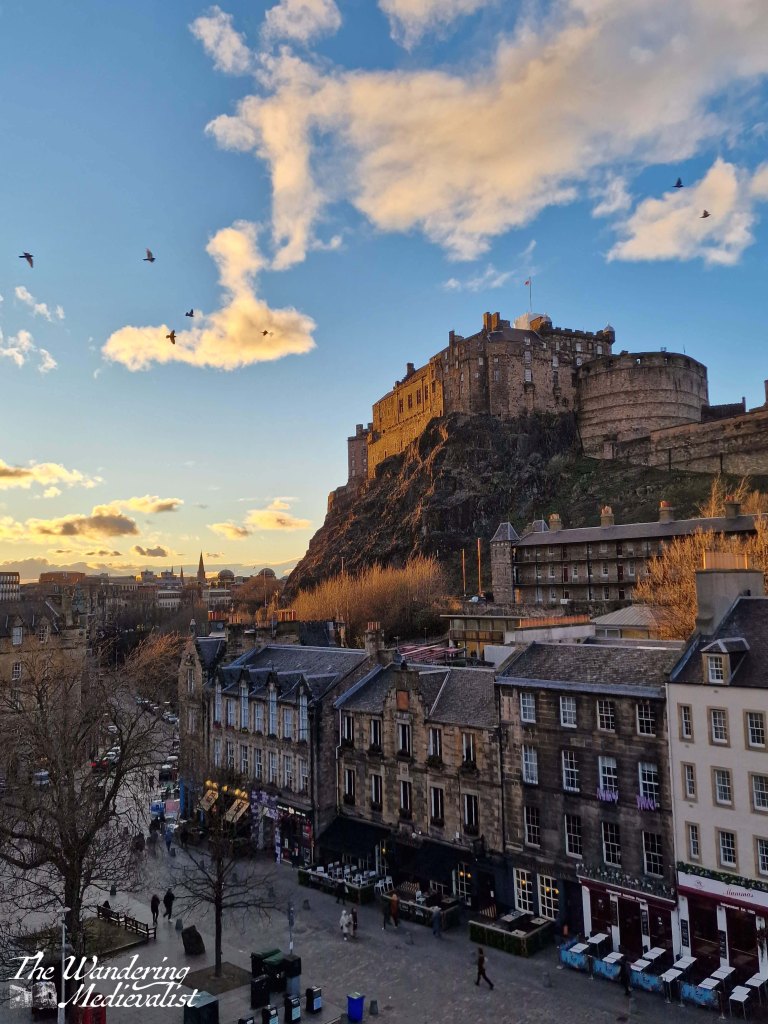
Edinburgh, Scotland – the castle from the Grassmarket
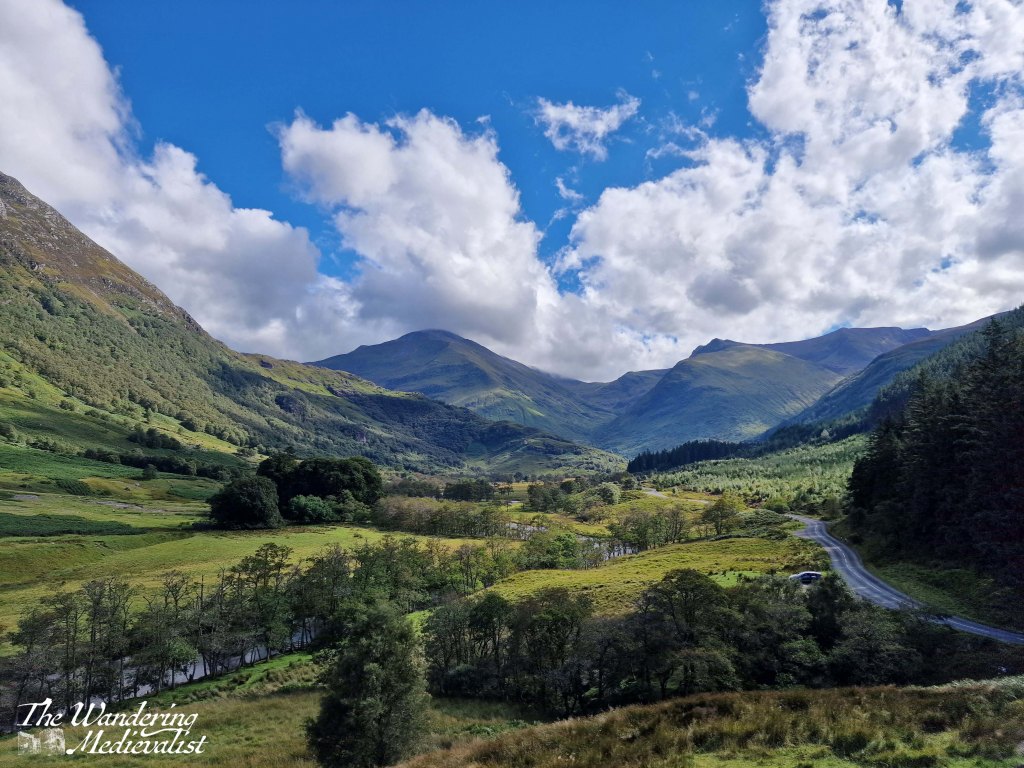
Fort William, Scotland – Glen Nevis
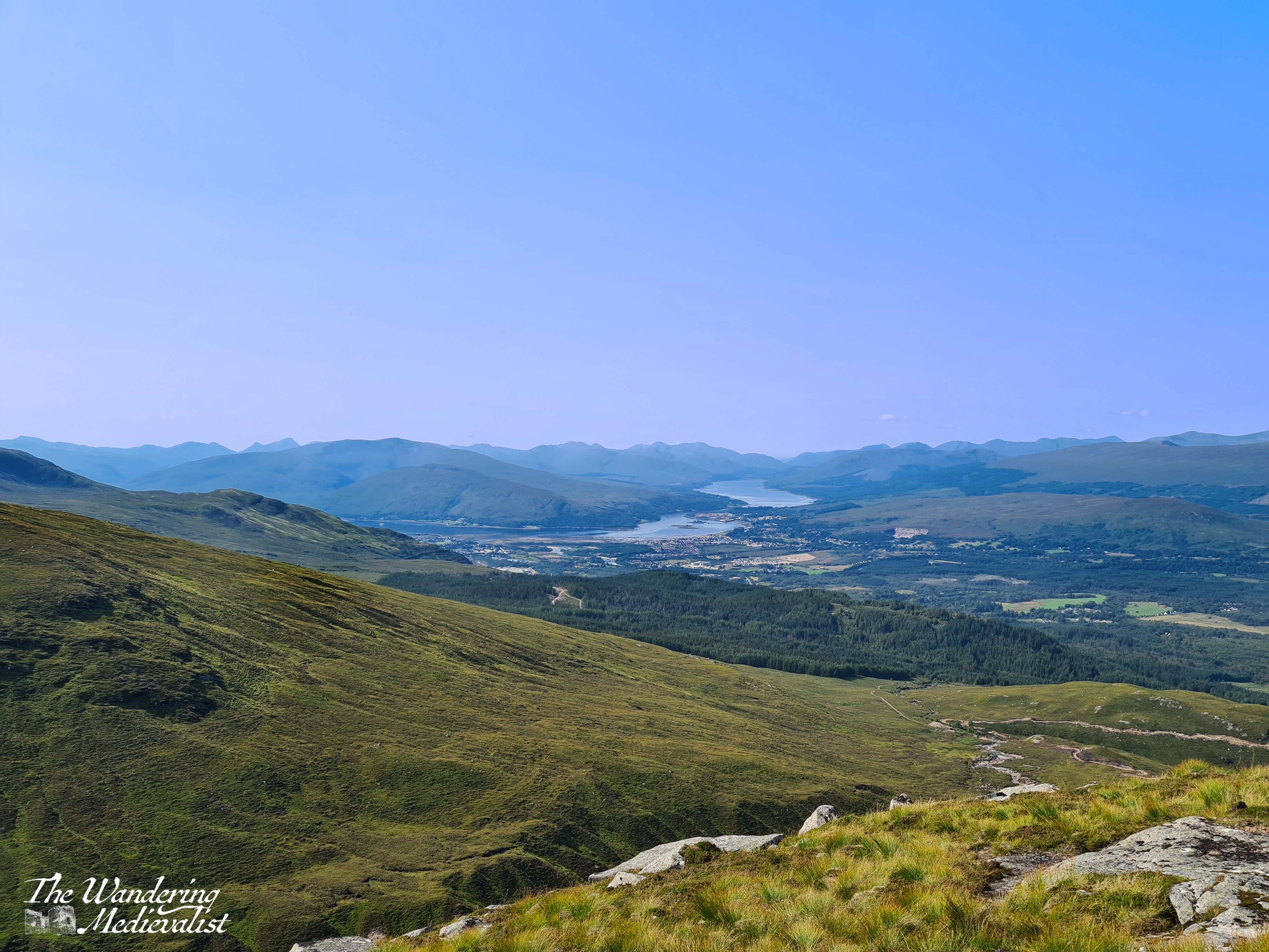
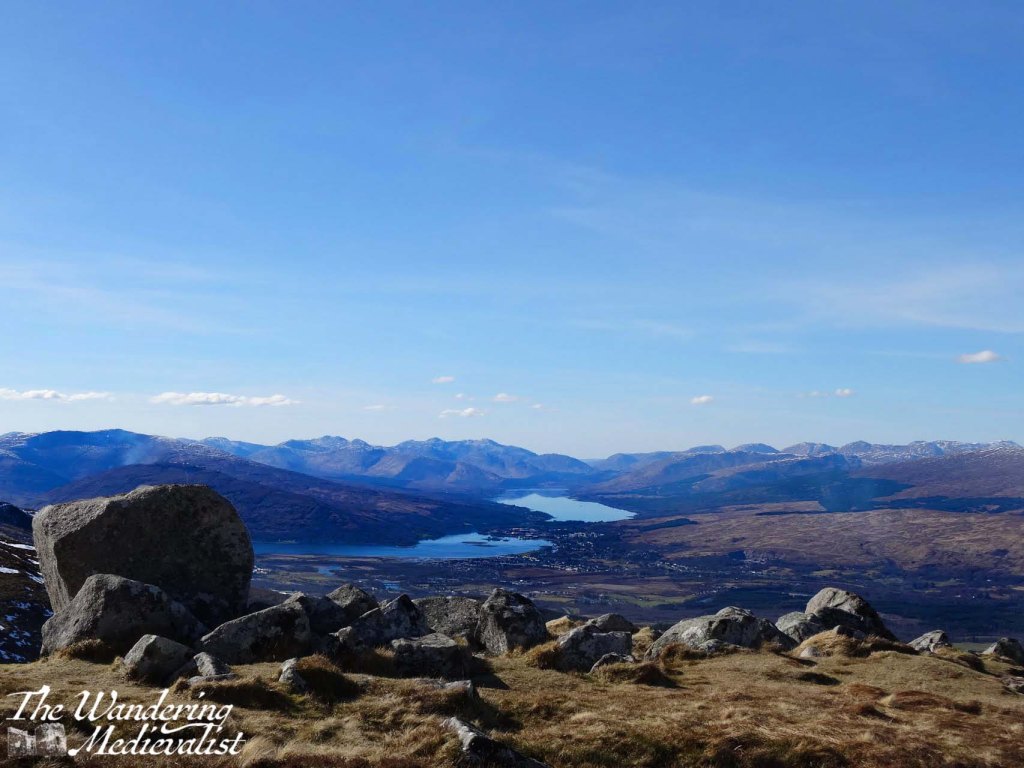
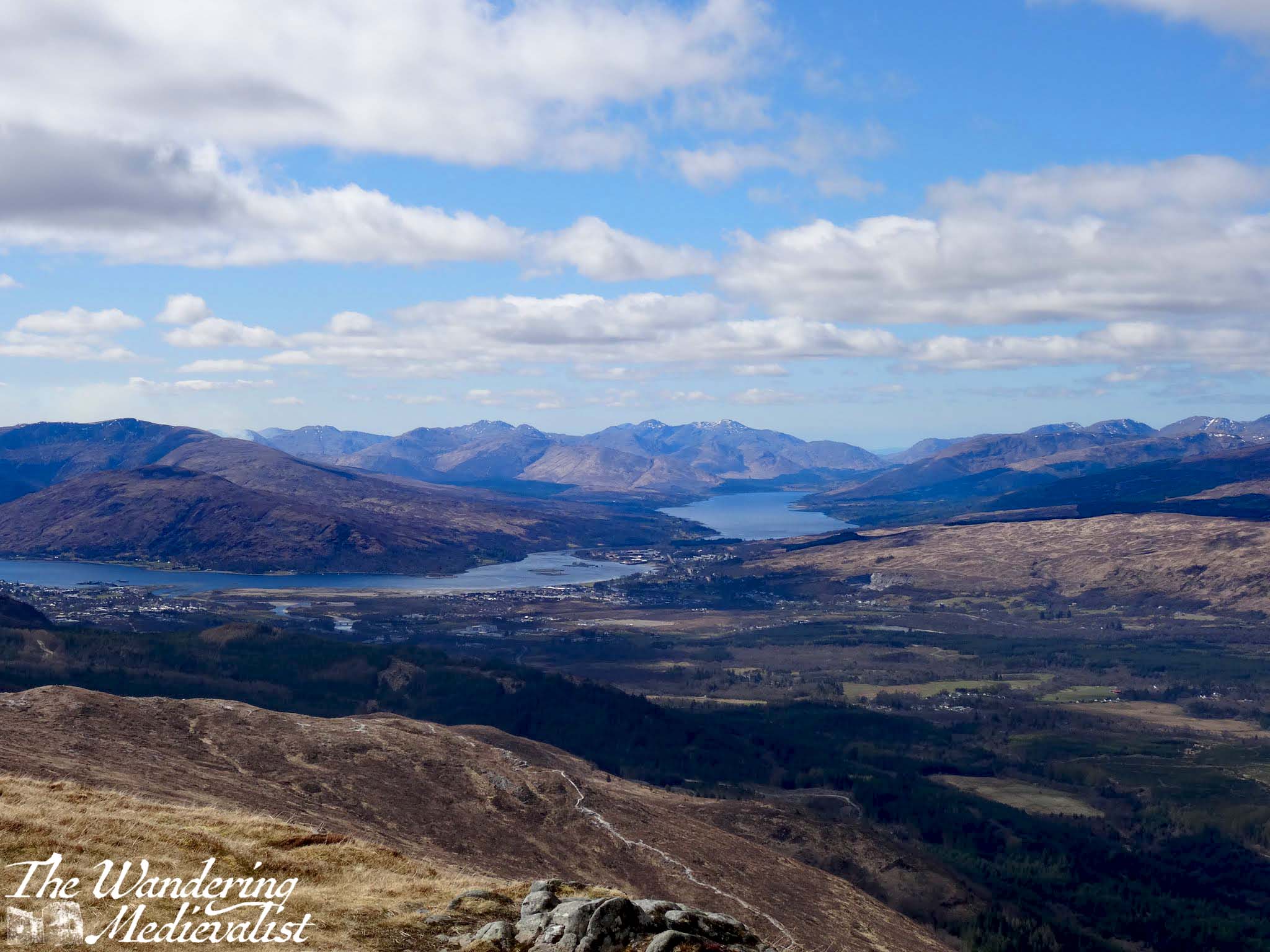
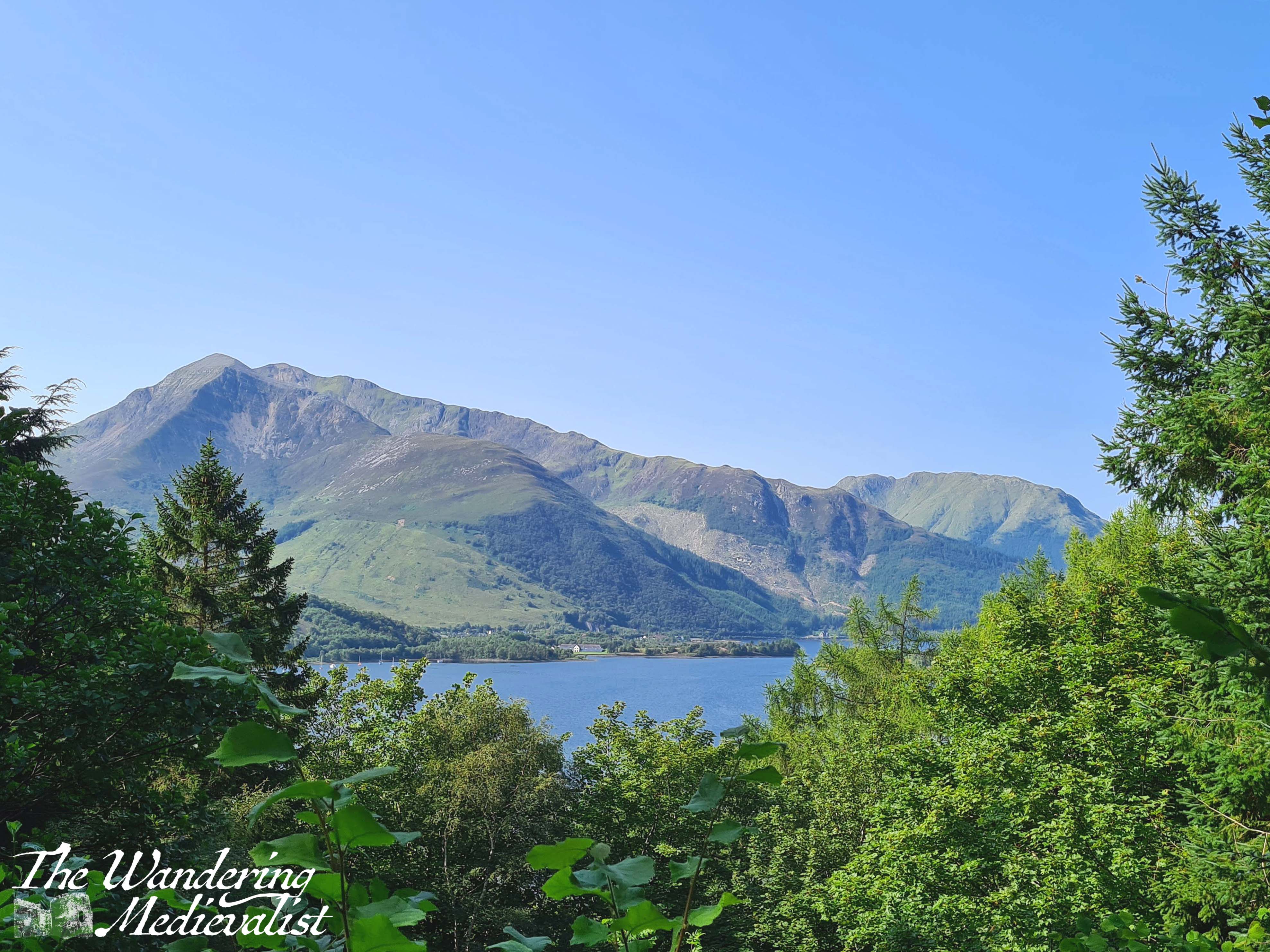
Fort William, Scotland – view of Loch Linnhe and Loch Eil from Meall Beag viewpoint
Glenrothes, Scotland – view from East Lomond looking west
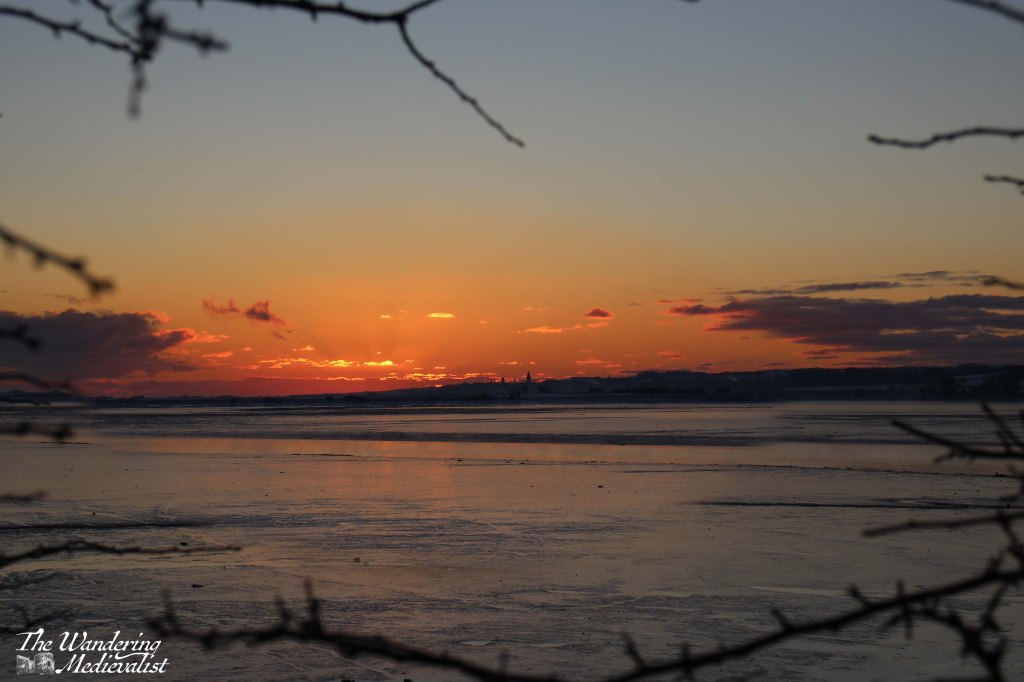
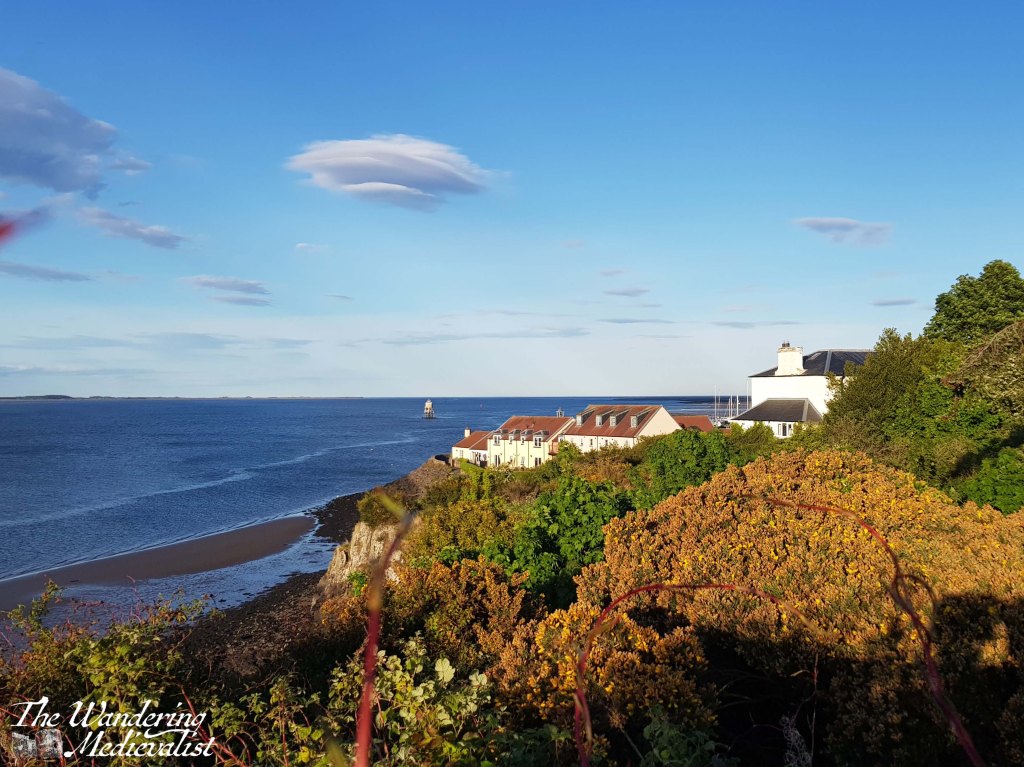
Guardbridge, Scotland – looking across the Eden Estuary to St Andrews
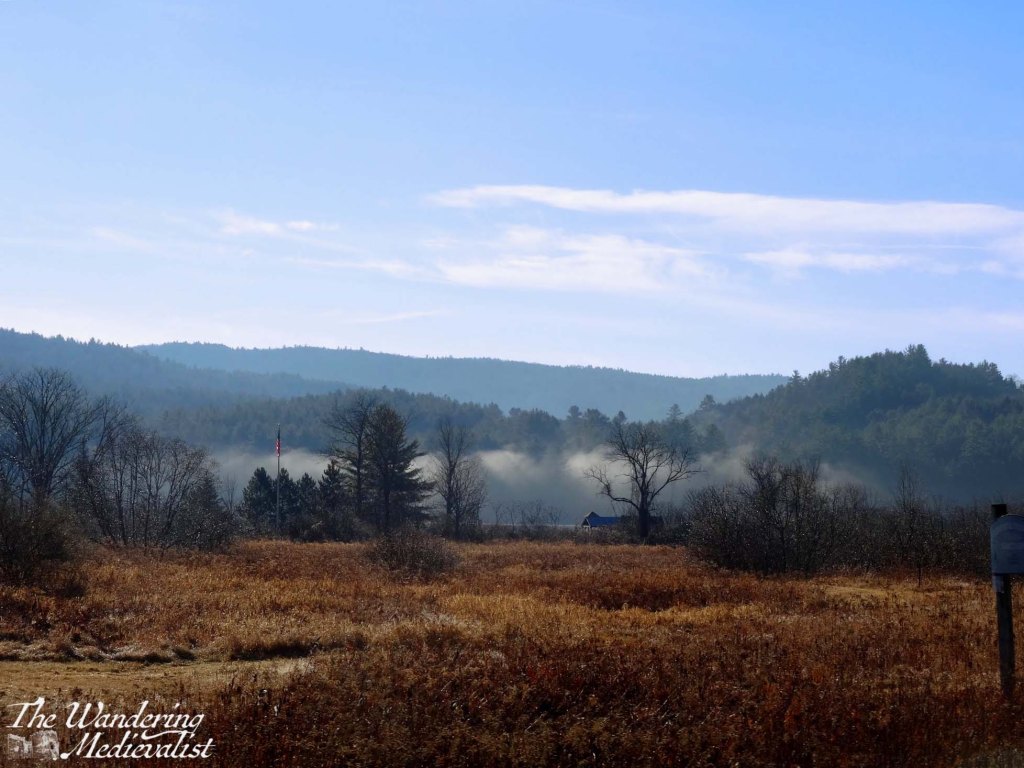
Lyme, New Hampshire – Post Pond
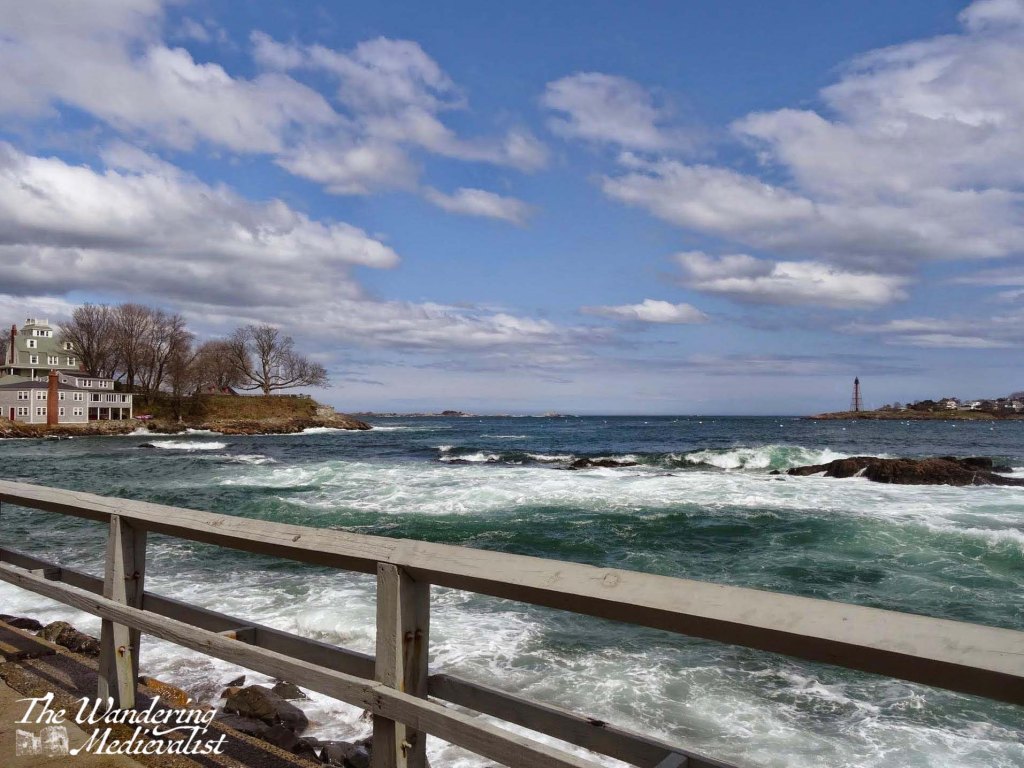
Marblehead, Massachusetts – Fort Sewall and the harbor from Fort Sewall beach
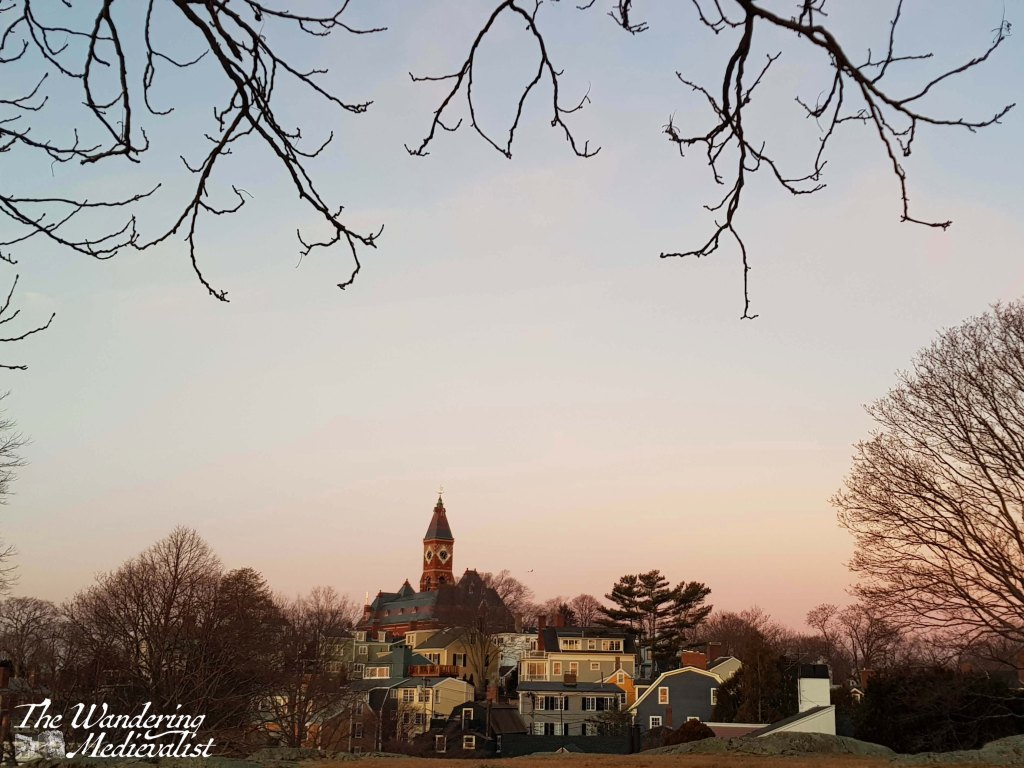
Marblehead, Massachusetts – view of Abbot Hall and Old Town from Crocker Park
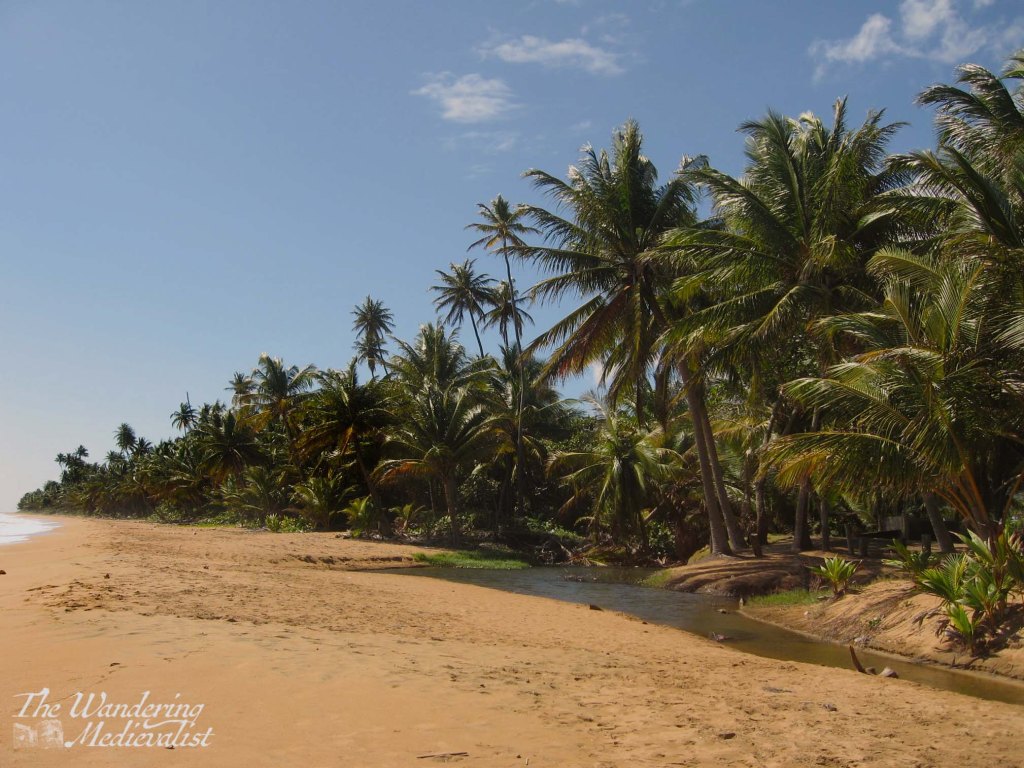
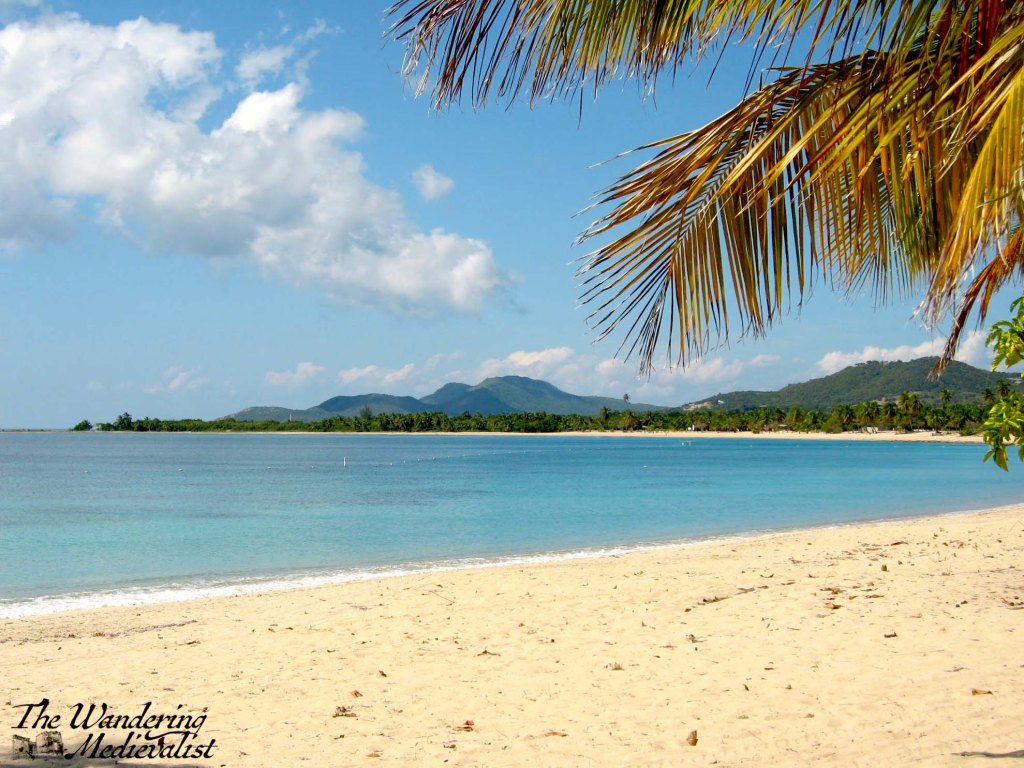
Maunabo, Puerto Rico – Punta Tuna Beach
St Andrews, Scotland – view of the castle from the Scores
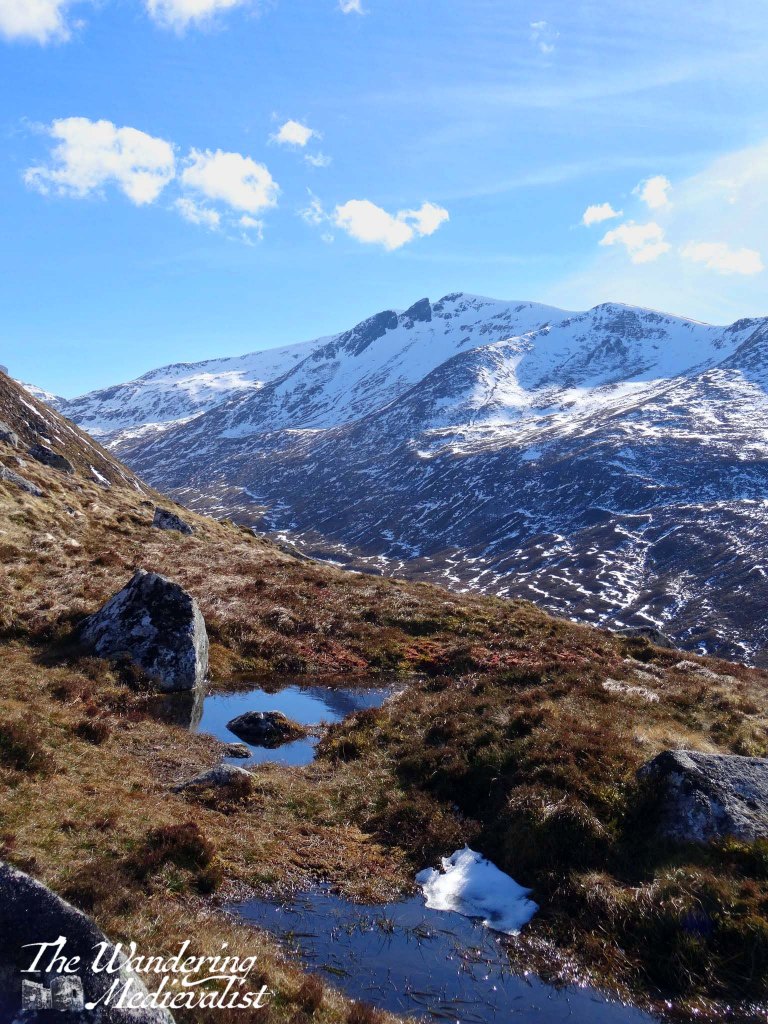
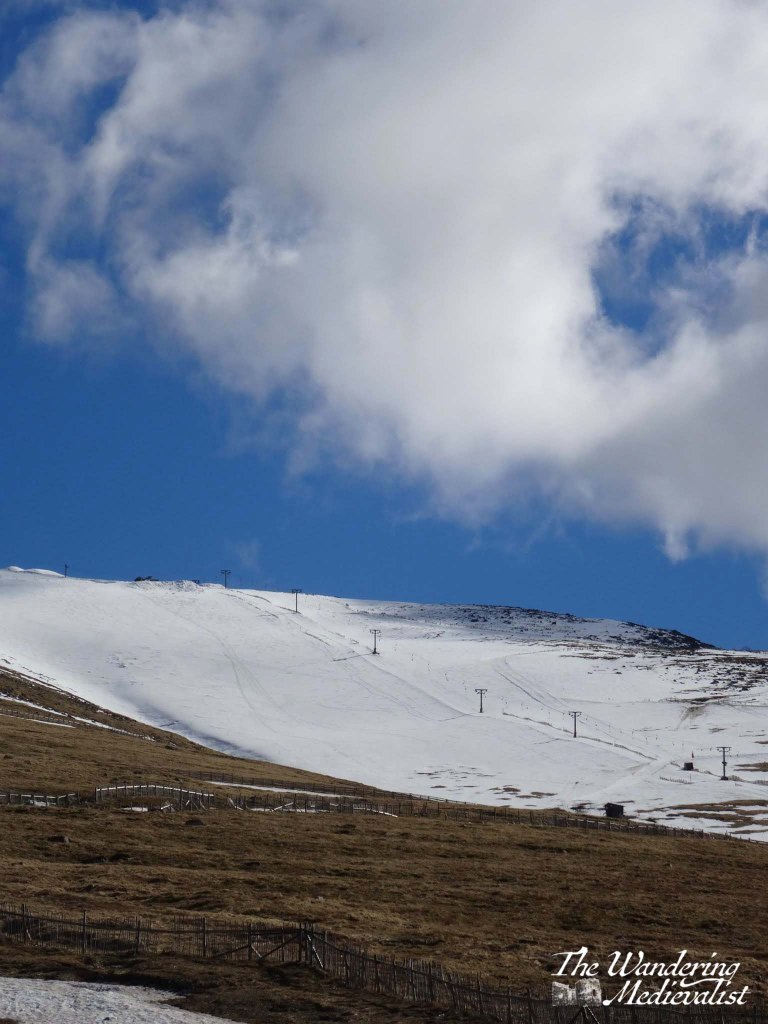
On a list of my favourite places in the world, the views from the lodge and surrounding areas on Nevis Range are pretty close to, if not, the top. Whether in the depths of summer or the end of winter, in sun or rainy weather, the gondola trip itself is worth the cost and the walks at the top offer simply stunning views. It is worth clarifying at this point that the gondola does not actually climb Ben Nevis, but instead Aonach Mòr, one of several mountains in the Nevis Range that is popular with skiers.
We discovered the Nevis Range on our first adventure to the Highlands in 2016, when we arrived at our hotel too early to check in and decided to take advantage of the spectacular weather to explore a bit. I was a bit nervous about the gondola – I am not a fan of heights – but it is entirely closed in and very seldom so high off the ground that you imagine desperate scenarios reminiscent of James Bond films.
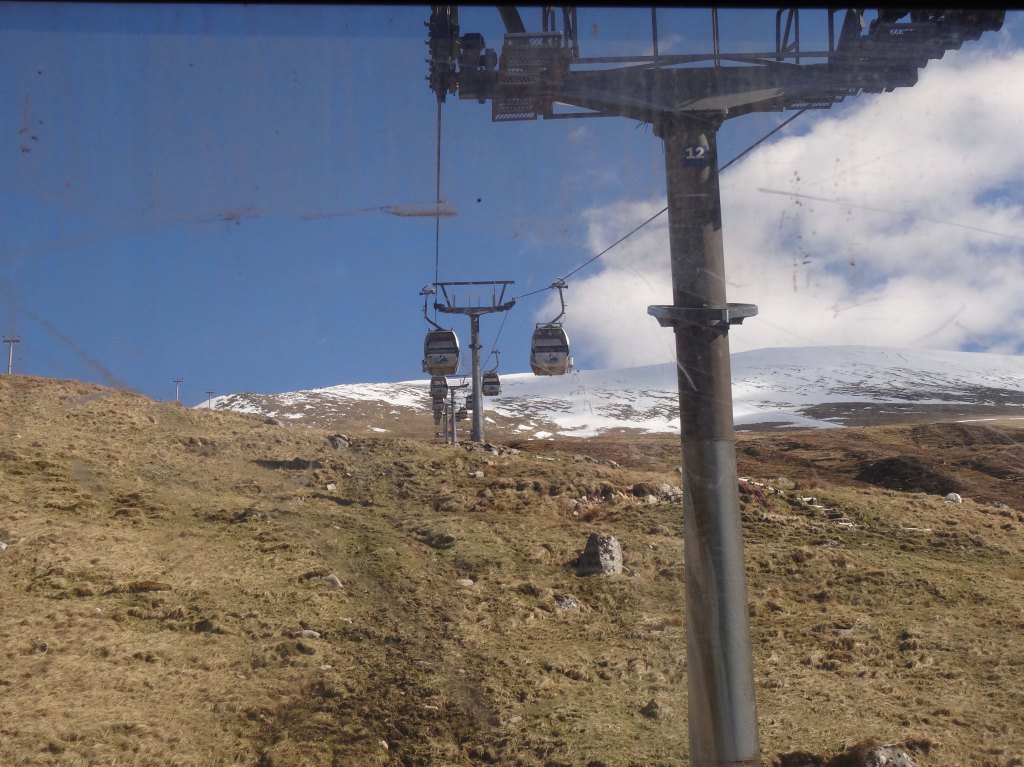
The windows of the gondola don’t allow for particularly clear pictures, but here is the view up, not far from the café at the top.
Both ends of the journey offer a place to stop for a snack or lunch, clean restrooms, and easy access to the cars – I believe that wheelchair access possible, though not 100% certain.
While at some times of year, the view is enjoyed primarily by skiers, by mid-March when we visited, most of the snow was gone but the mountain bikers had not yet taken over, so we had plenty of space to ourselves. A word briefly about the lodge at the top of the gondola, and the Snowgoose Restaurant within – I have been repeatedly impressed by its comfort and good food. The snacks and coffee are great, and there is ice cream or bottles of water aplenty, depending on your need. Best of all, the view is just out of this world.
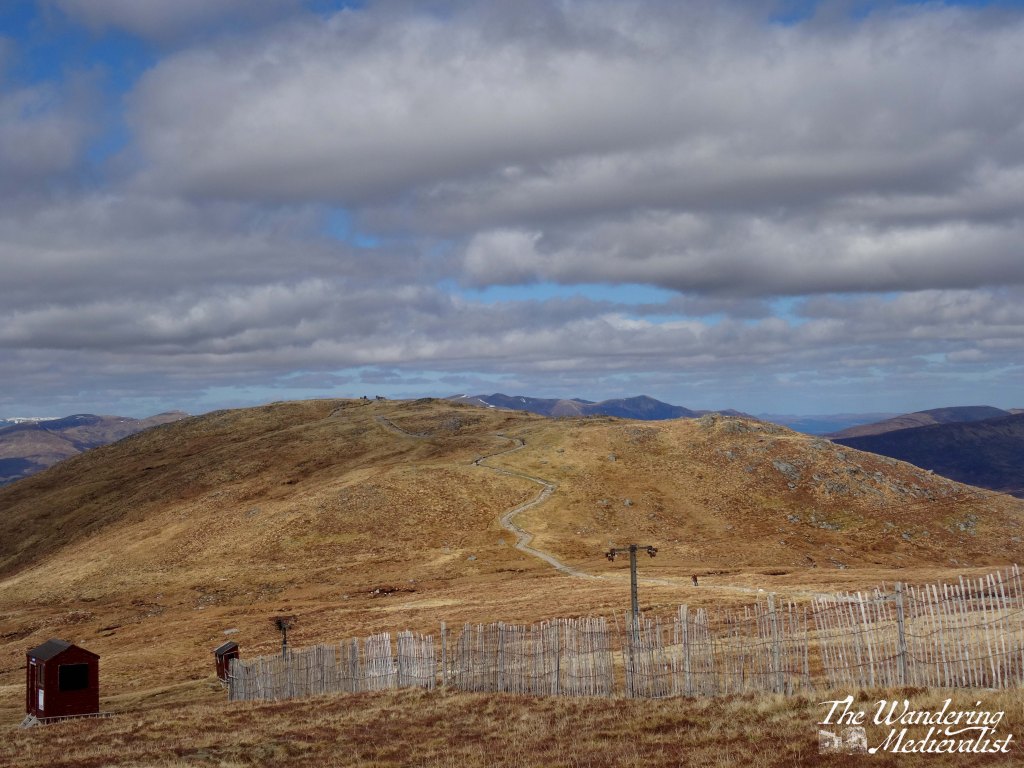
From the lodge, there are two available walks, each to a different viewpoint. The Meall Beag viewpoint is a bit further away, so on our first trip we opted for the Sgurr Finnisg-aig trail, which is reached by turning left out of the lodge. It is a short walk, about fifteen to twenty minutes to the viewpoint, and the trail is well-kept.
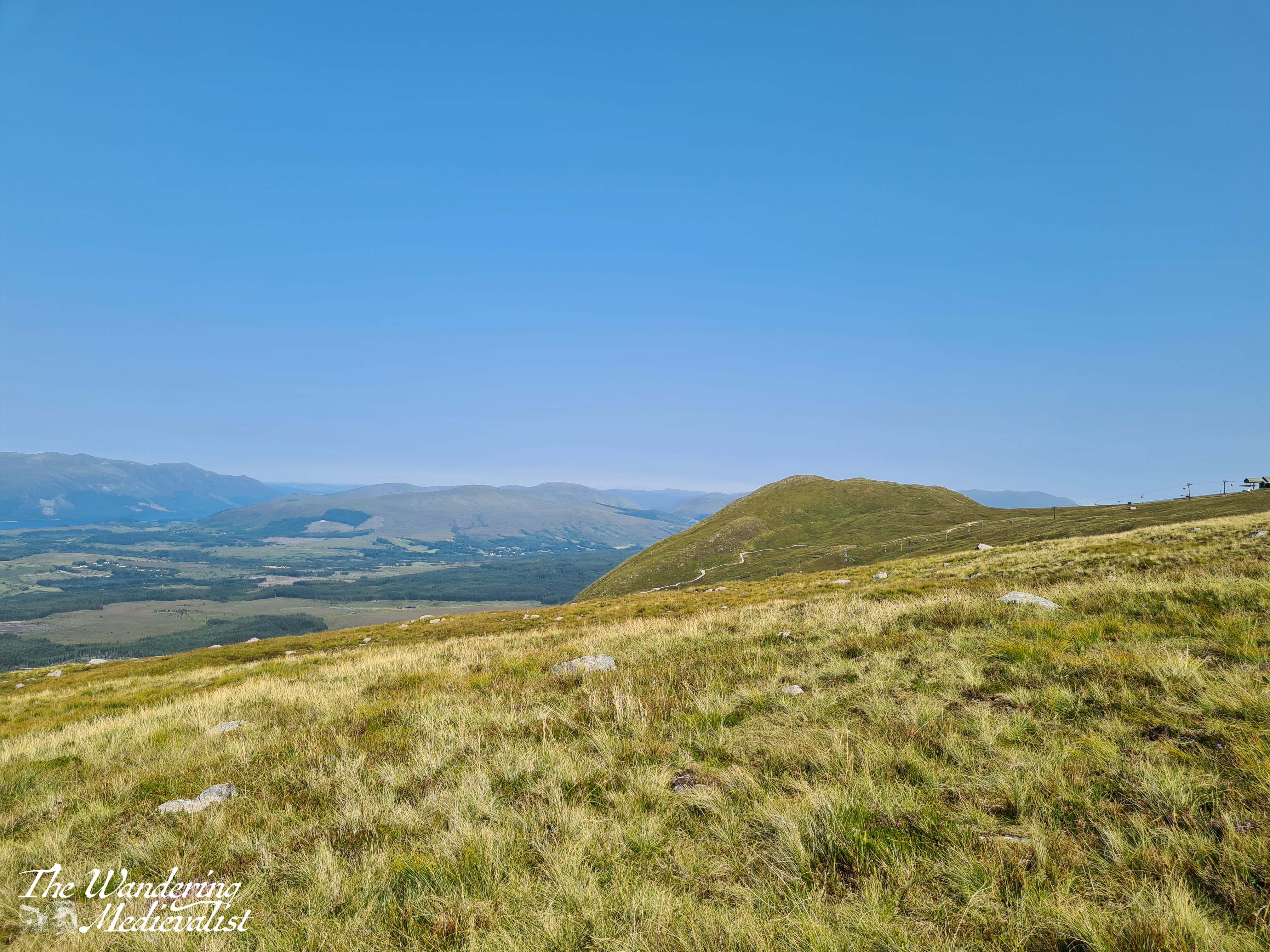
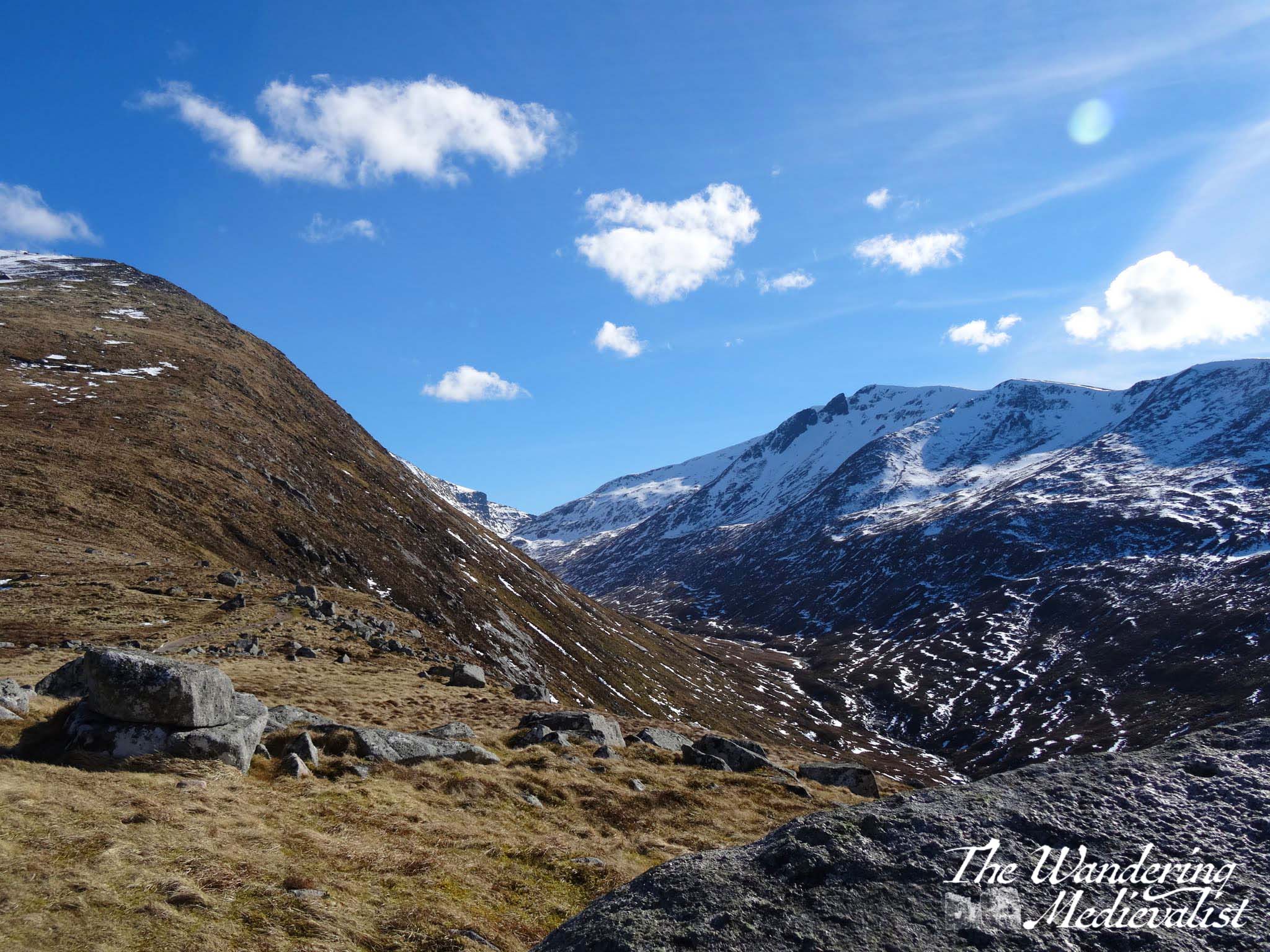
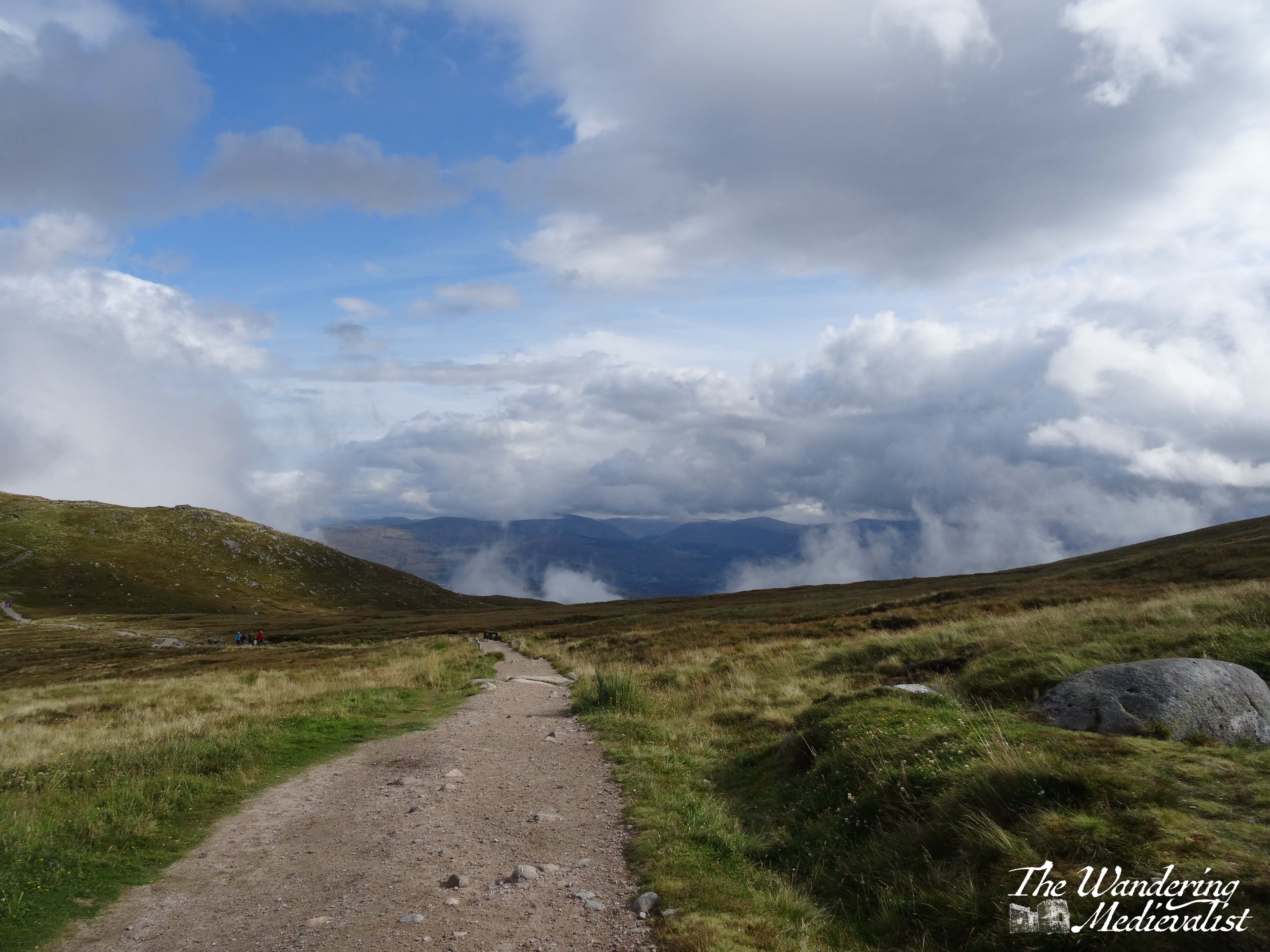
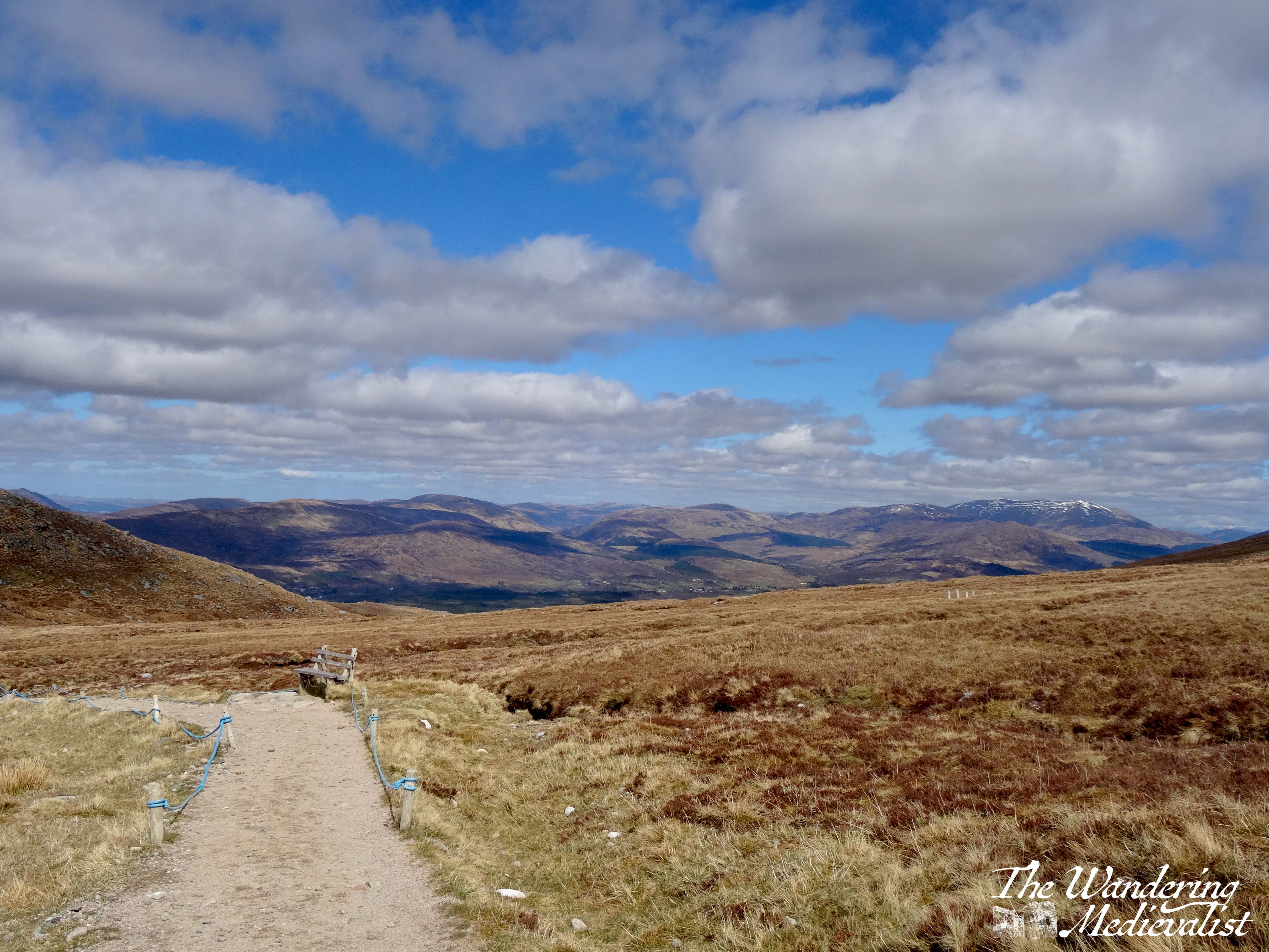
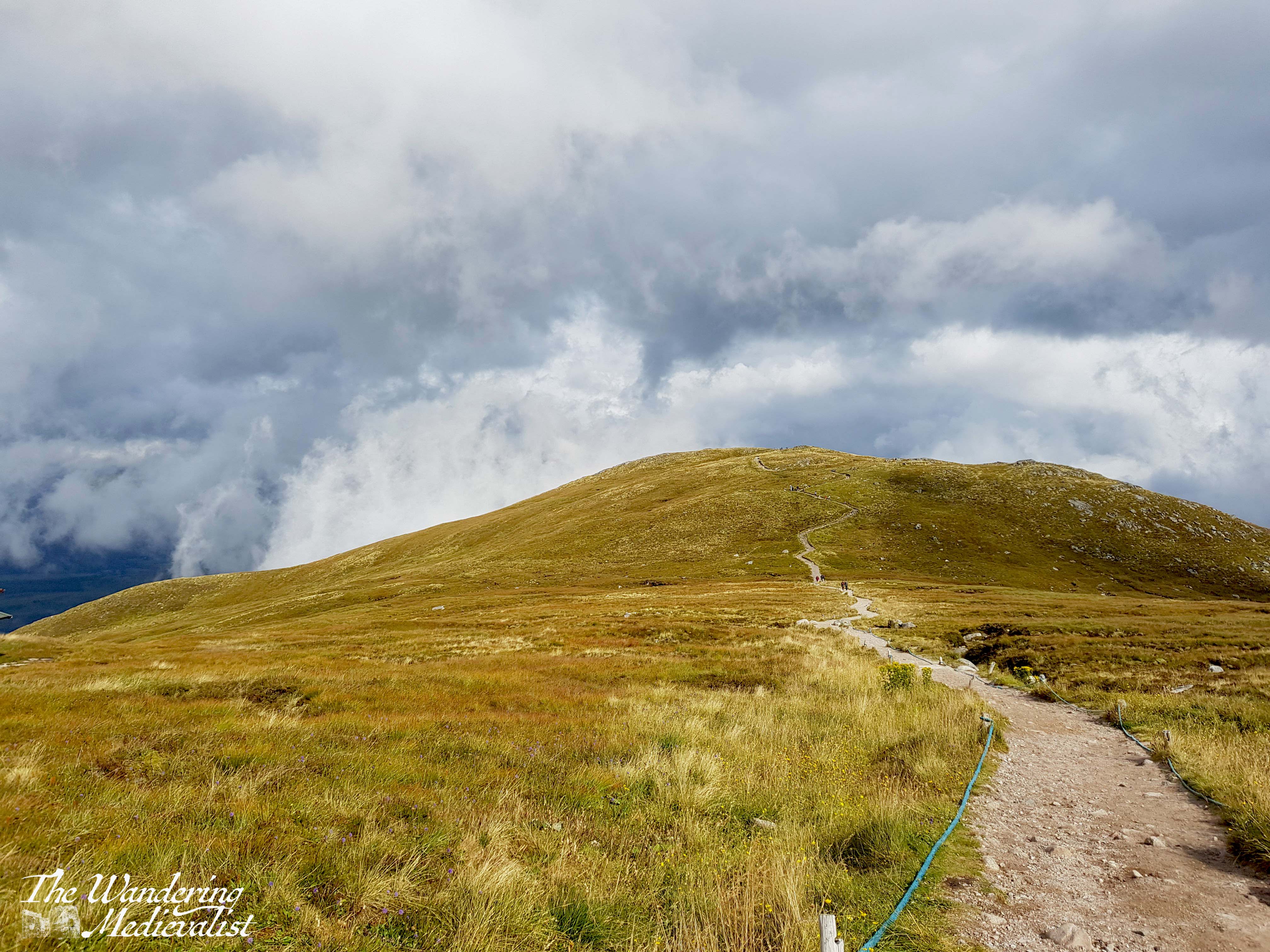
The start of the walk boasts views out to the east, and as you will see below, on the second time I took this walk with my father, you could see clouds rising in the distance. Our first visit was in mid-March, so snow was still evident on some peaks, but the cloudy visit was in late August – much greener and definitely no snow.
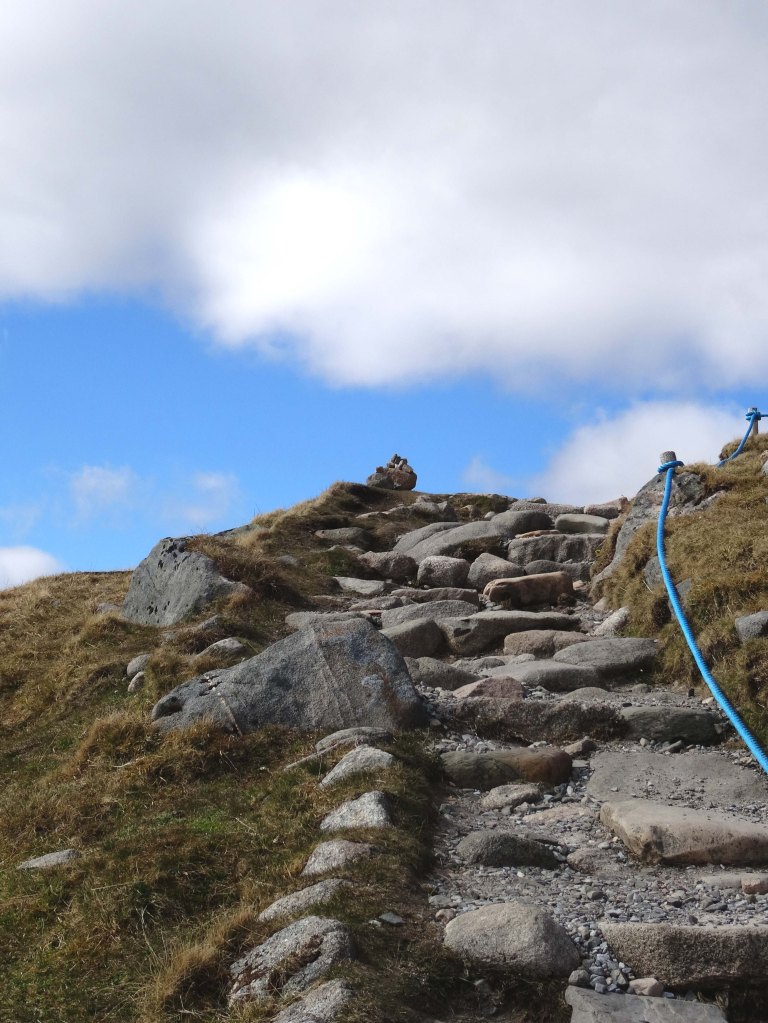
The trail is relatively even and easy-going until you get closer to the hill itself, and then you are faced with stairs. These wind and climb, at times a touch narrow, but there are plenty of places to pause and catch your breath or allow people to pass.
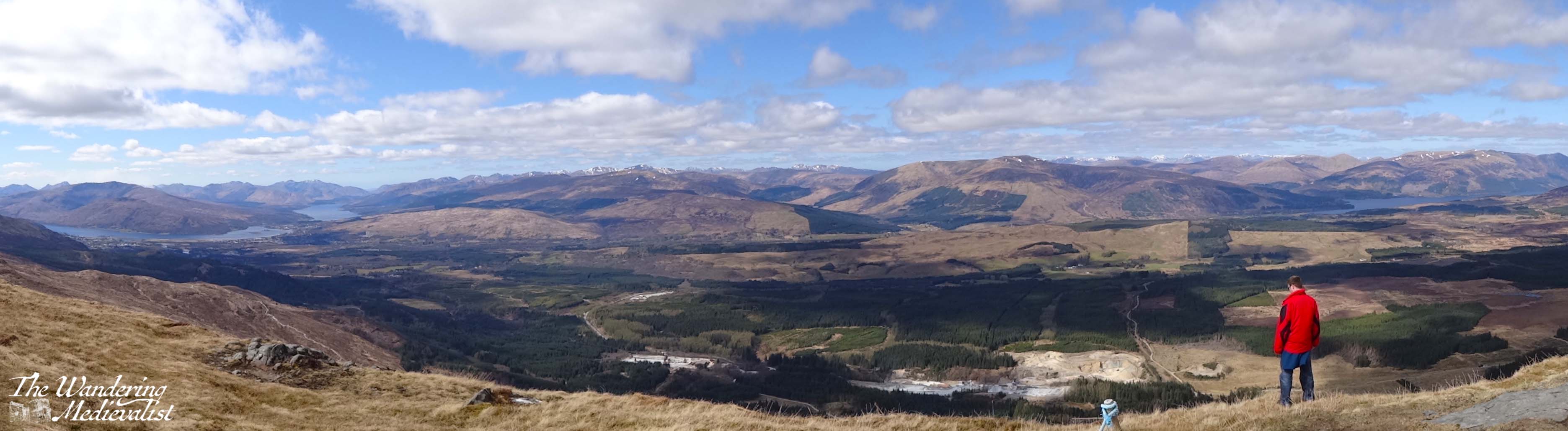
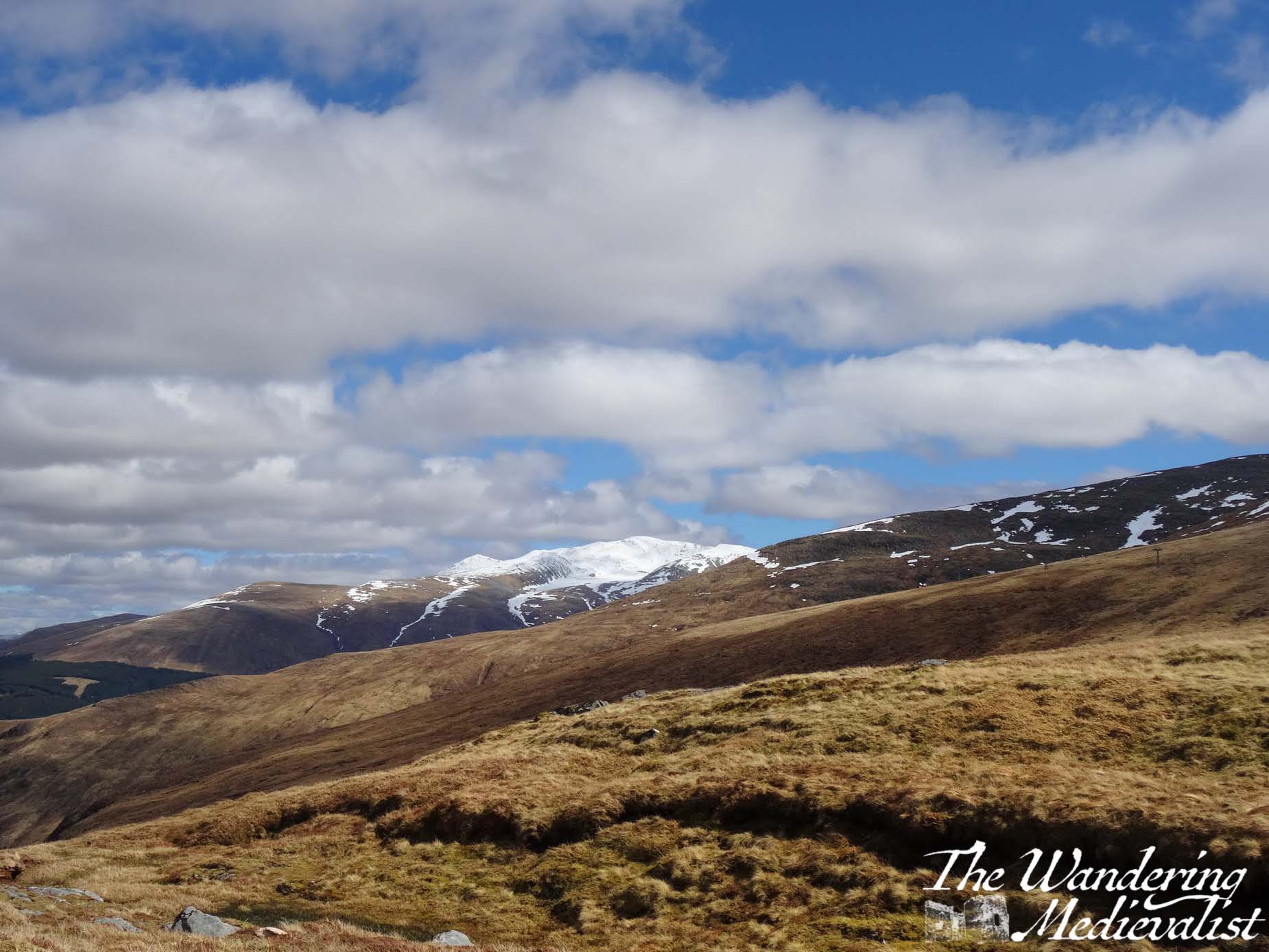
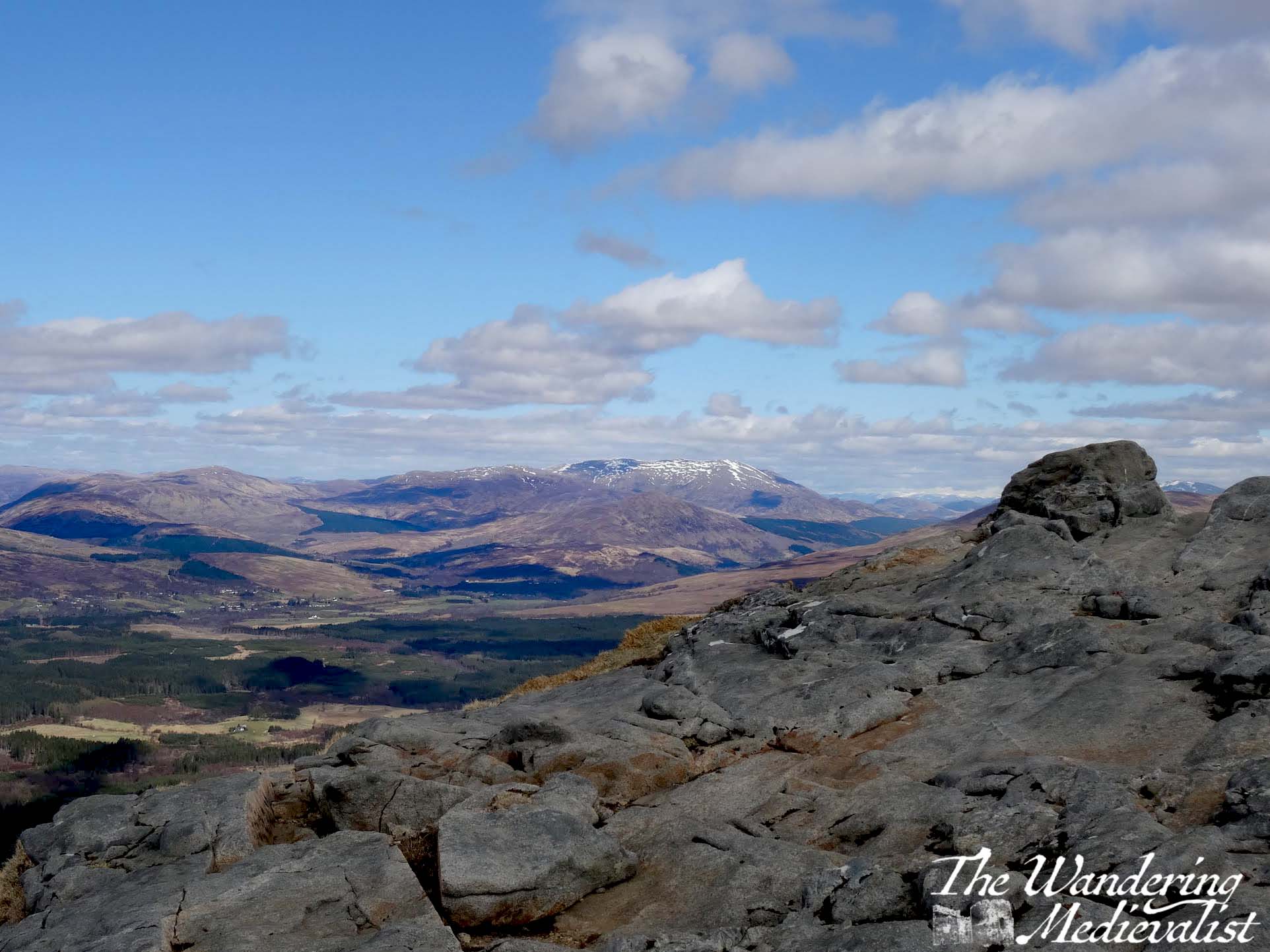
And there is no question, the climb is worth it. At the top is a rocky plateau of sorts, where there is a map to show you what you are looking at, as well as numerous spots to take advantage of the view. Standing at the map provided, one can see to the west and the edge of Fort William, Loch Linnhe and Loch Eil, to the east towards Roybridge, and north to the start of the Great Glen that leads up to Inverness. As noted above, these photos were taken on two separate trips, as is evident. In March, we were blessed with incredibly clear weather, while in August, clouds were closing in around us as we walked and by the time we returned to the café, rain had arrived.
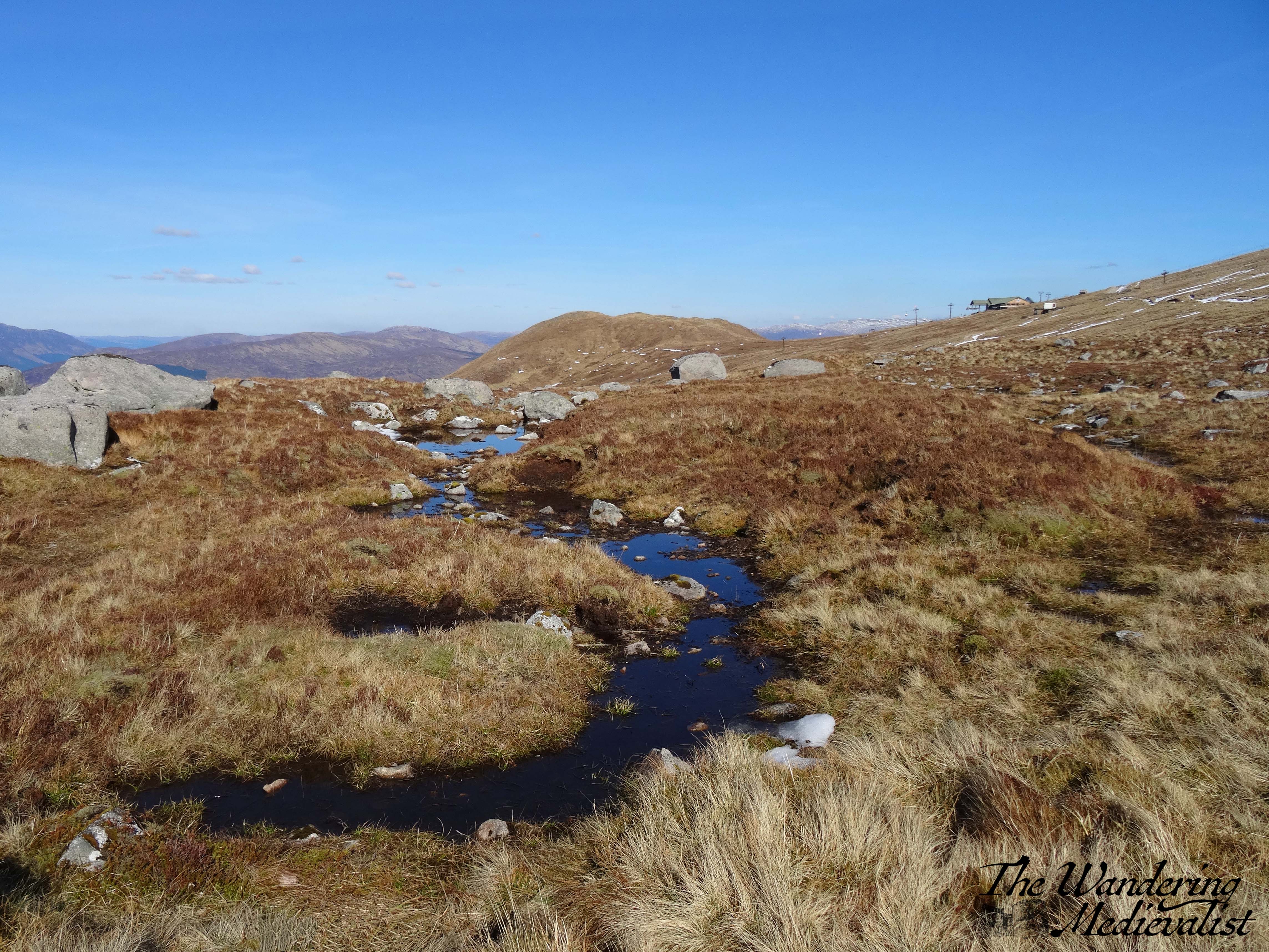
On both occasions I followed this trail, I found myself equally distracted on the walk back by the spots of heather, the small burns, and the rock shapes poking through the grass. It is iconic Scottish mountaintop, and the gondola has made it accessible for many people who may not normally be able to enjoy it. My most recent trip up the mountain was actually in summer 2021, when masks were required in the gondola and travel restrictions meant that the tourists around us were all British rather that foreign. The outdoor nature of the trip made it ideal for Covid times, and the relative freedom after more than a year of various lockdowns was palpable.
One of the most pleasant parts of any visit to Nevis Range is once you have completed your walk, when you find yourself a table in the café with a coffee, a cake, or some lunch, and just enjoy the view. On the cloudier trip, I found myself fascinated with the way the clouds were swirling around the gondolas as they disappeared in the mist – though the ride down was without a view, as the video below shows. So whether a perfectly clear day or one where rain is imminent, I would most definitely recommend this trip and short walk. One caveat is that when there is high wind forecast, the gondola may not run for obvious safety reasons – on one trip we missed out and enjoyed the walks at the foot of the mountain instead.
I have done the Meall Beag viewpoint walk as well, but there are too many pictures for one post!
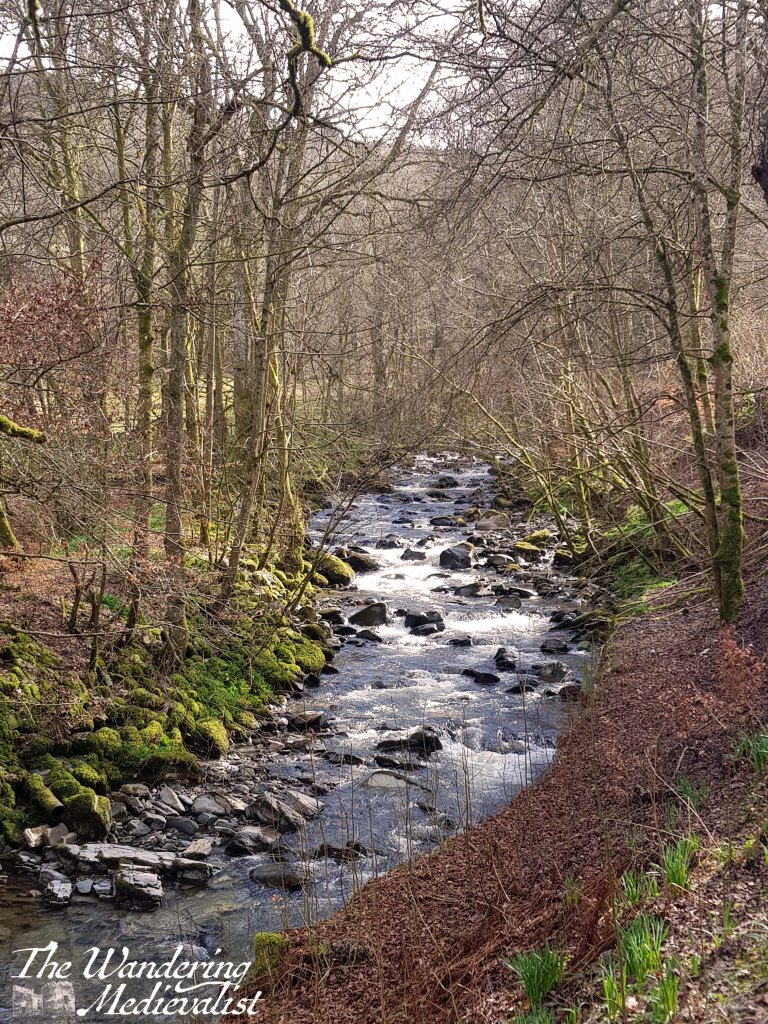
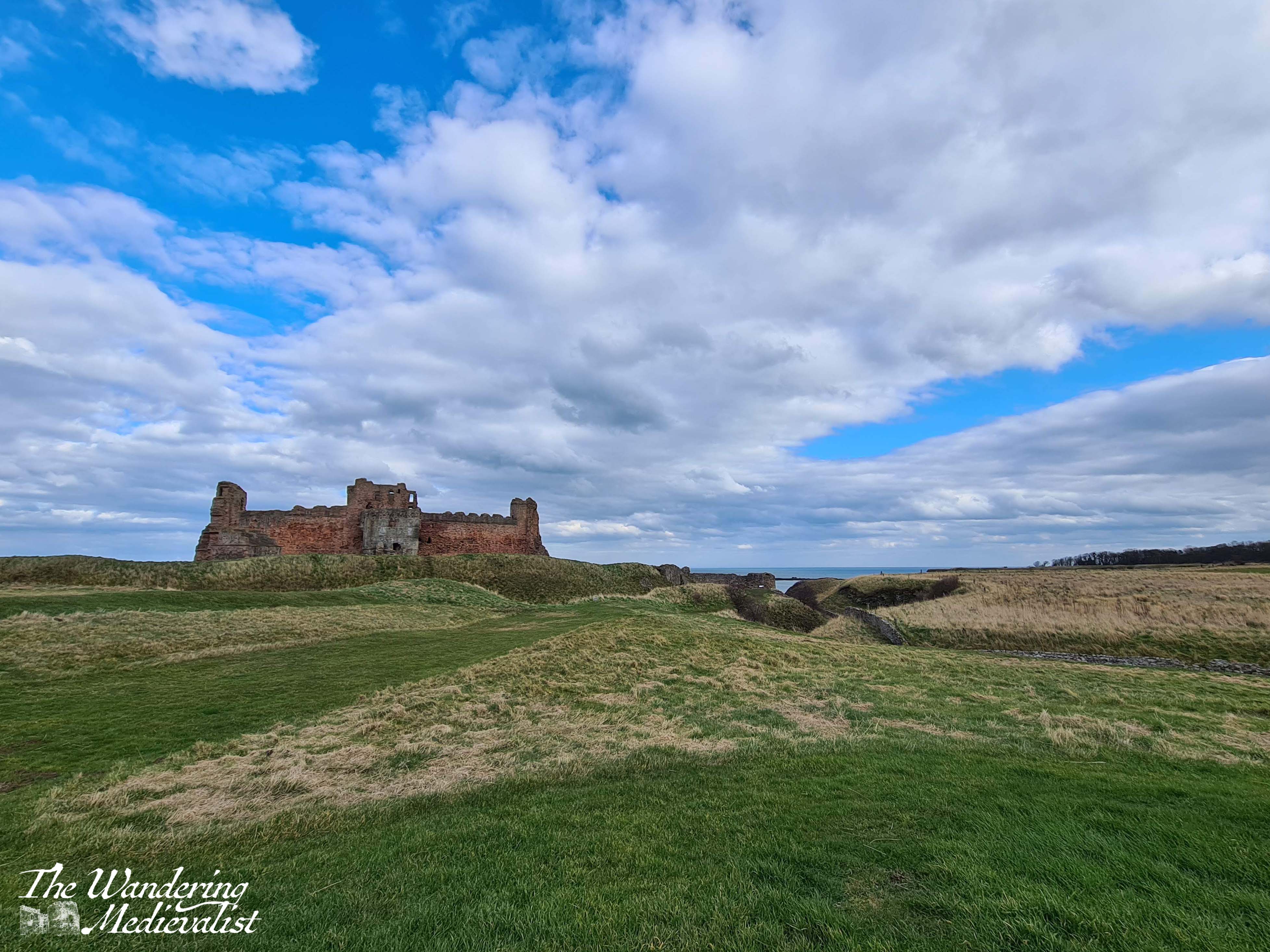
A few years back, I managed to secure some time off that the other half could not, and so I took myself away on a castle-finding adventure to North Berwick. My efforts were hampered slightly by two factors:
Time of year – many castles and monuments are open only seasonally in Scotland, or their winter opening hours are limited.
Restoration works – during the pandemic when everything was shut down, many castles in Scotland were discovered to have some dangerously unstable masonry. At the time I travelled, many sites were still closed, or partly closed, for renovation and restoration. As of writing, this is still the case for many castles, and for St Andrews Cathedral.
I had hoped to make it a two-castle day and see Dirleton, but it was completely closed, so instead I booked ahead – as one still had to do due to Covid restrictions – and being me, arrived about 20 minutes early. The empty car park was a short walk from the actual ticket office/gift shop. I was eager to get a bit of exercise though, so while I could probably have driven closer, I chose to walk the quarter mile and hoped for some good views as I did so.
Upon arriving at the shop, I was greeted by name – I was one of two people booked in all day! So I chatted with the shop assistants, who apologised that I could not get into the castle itself (which I was prepared for) and it was during this chat that I learned about the state of so many of the monuments in Scotland. Then, they allowed me access to the castle early, ‘You have it all to yourself just now,’ I was told. Music to my ears.
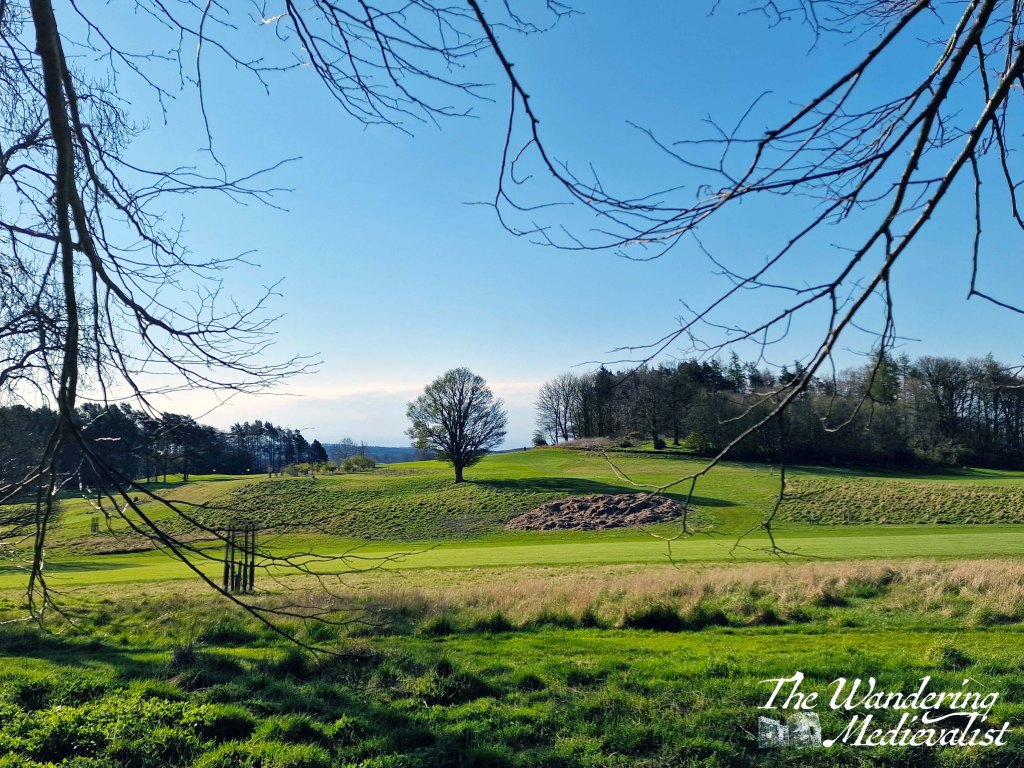
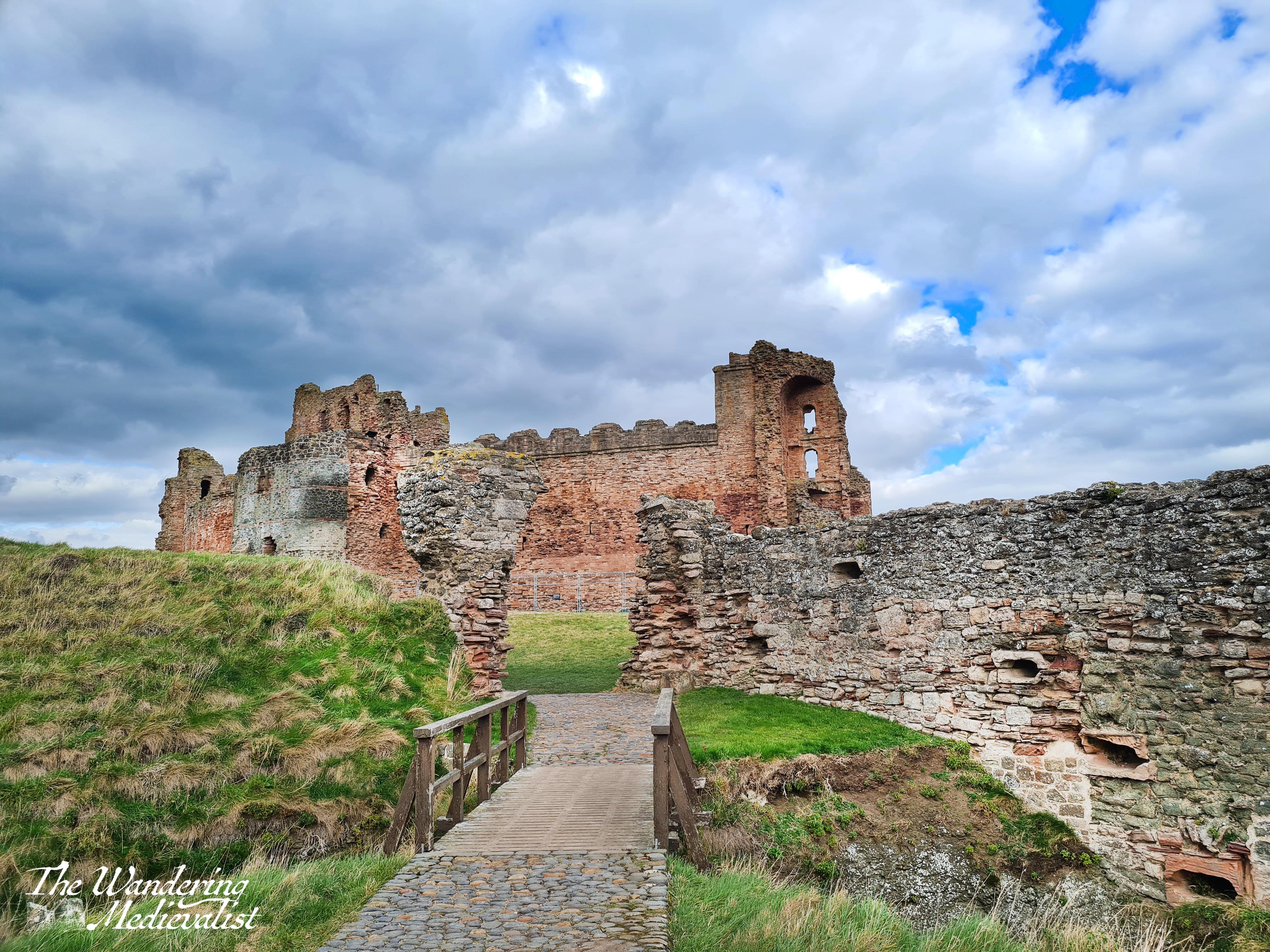
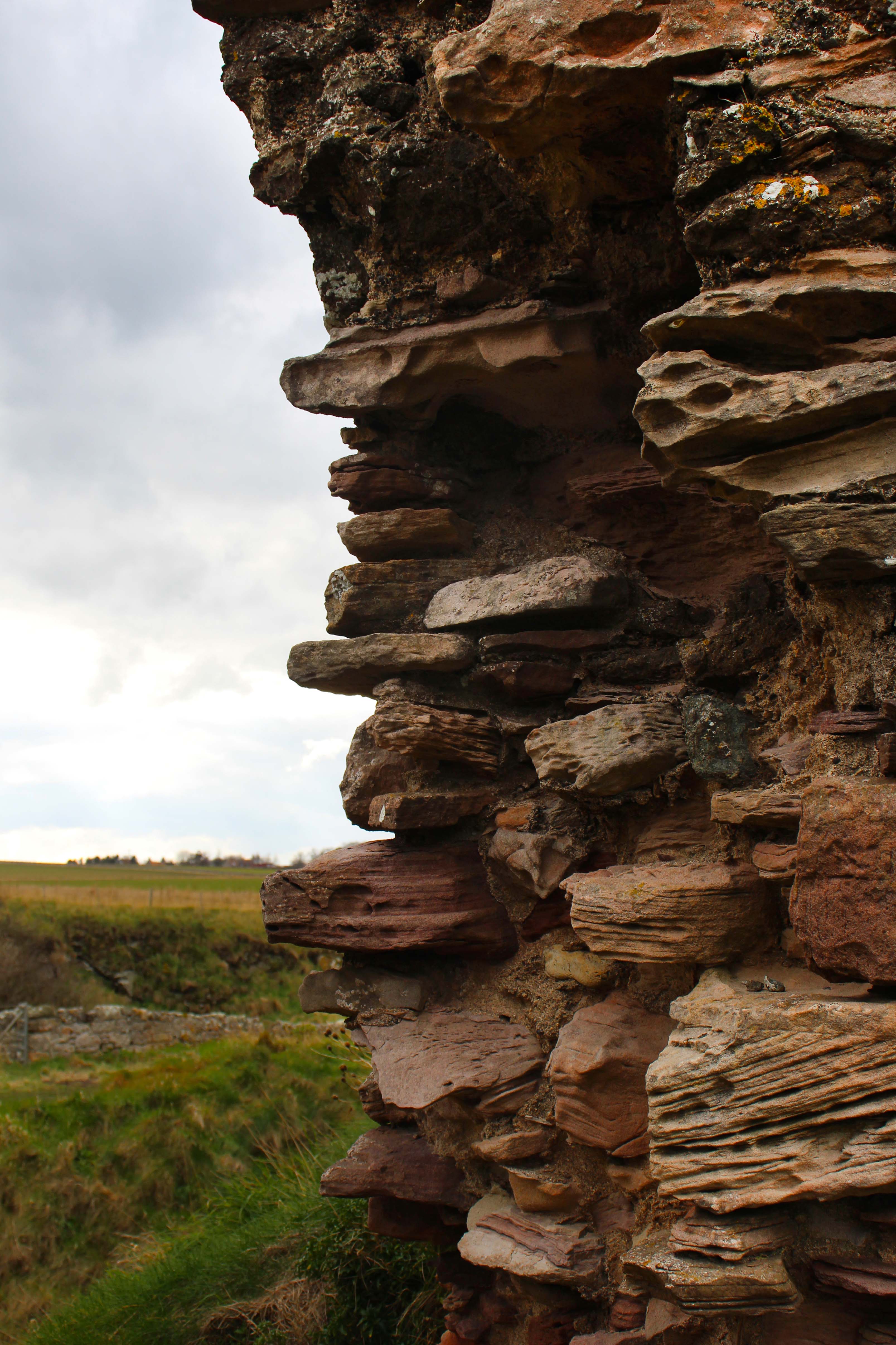
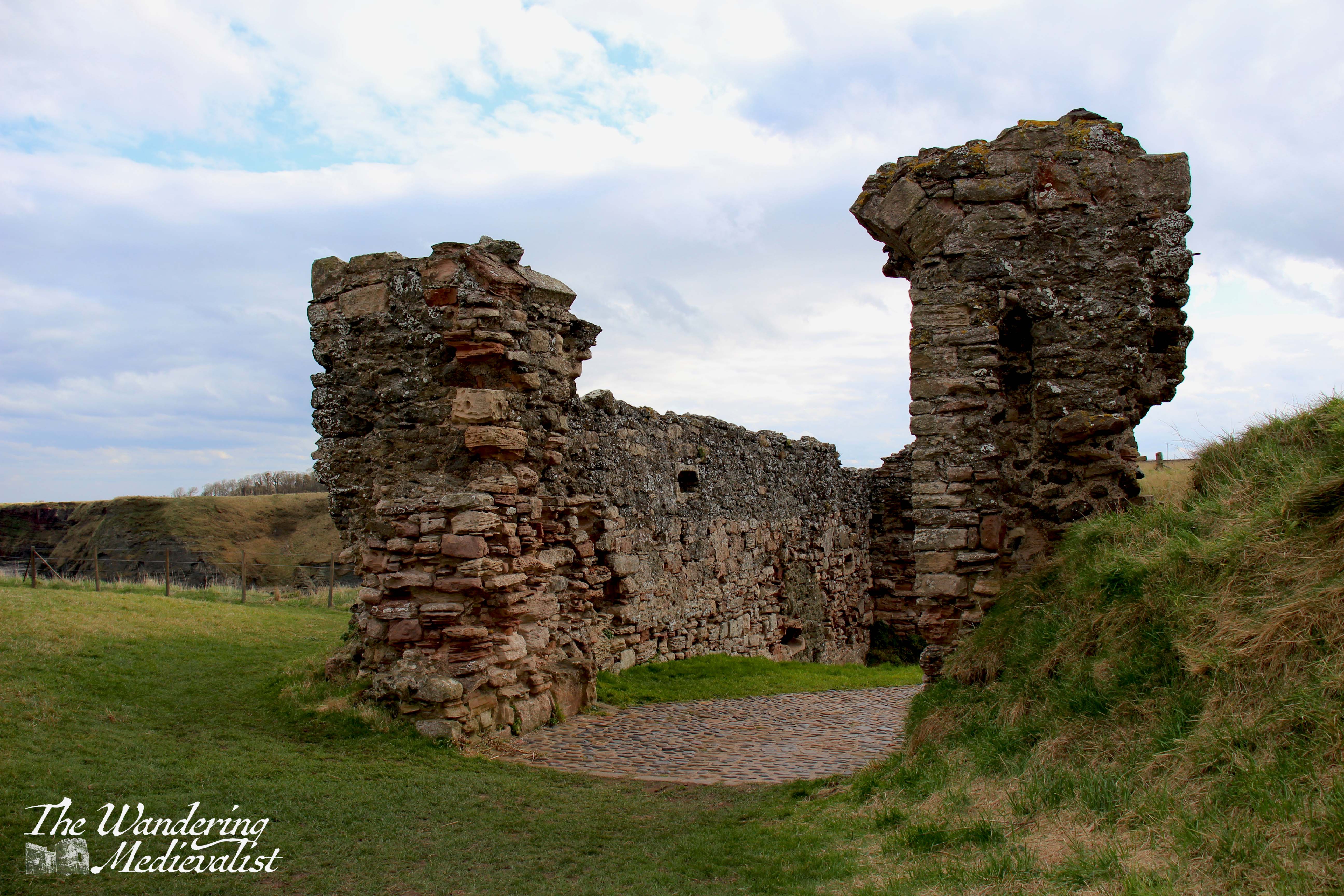
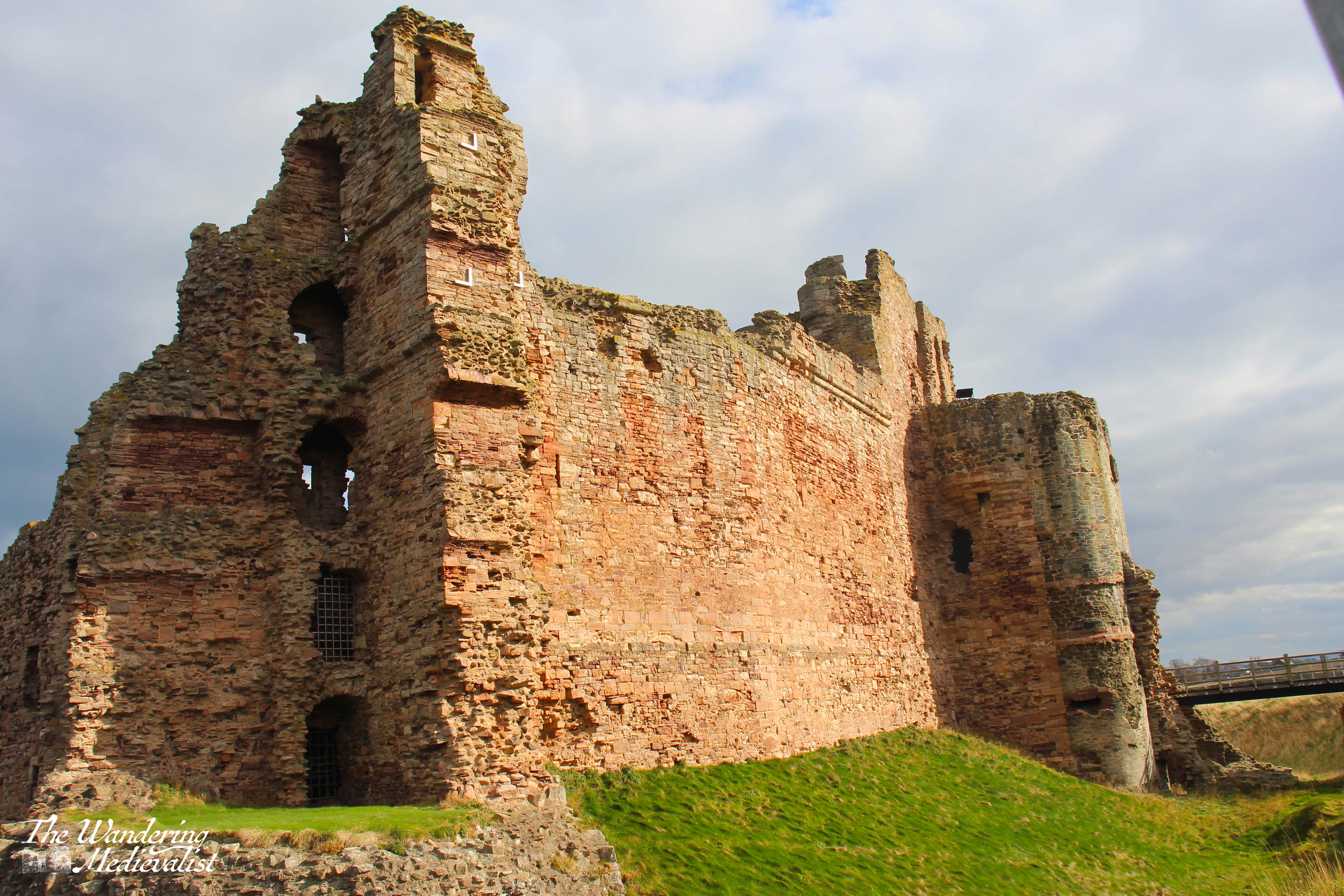
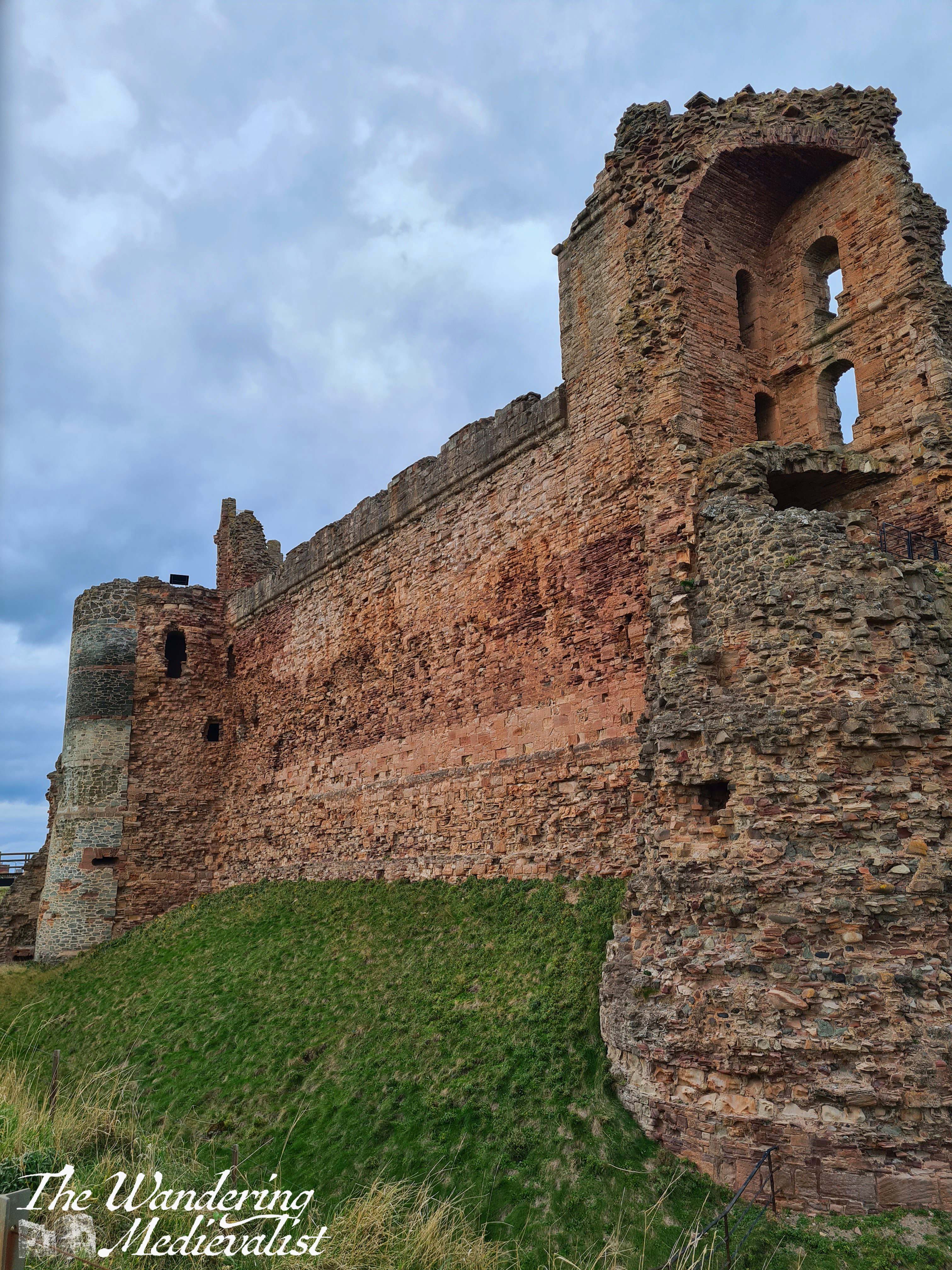
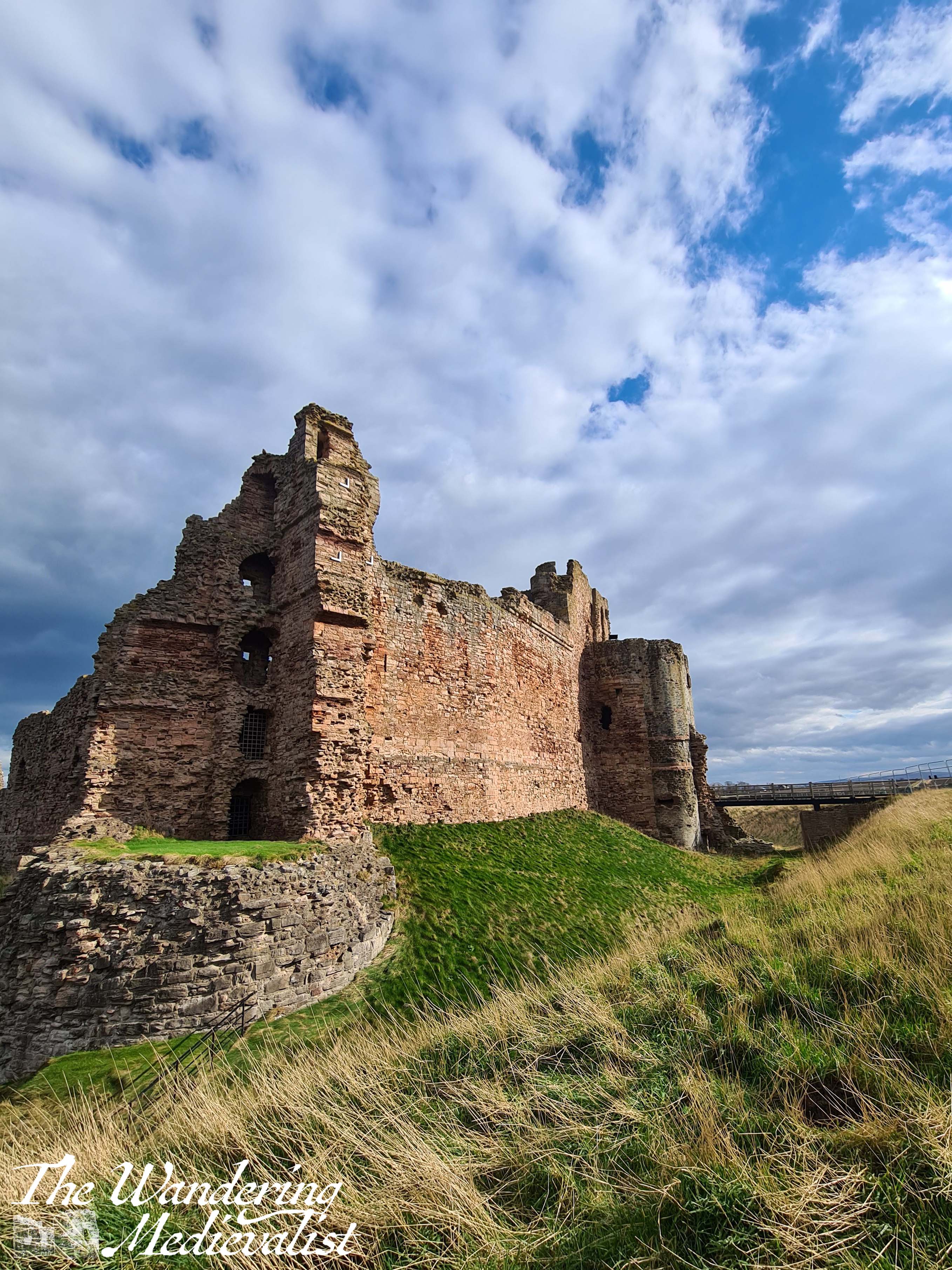
The approach to the castle is along the route one can imagine was used when it was whole, and there are lovely views of the main curtain wall. As I passed through the outer defences, two things stood out to me: one, the gorgeous orange-red of the sandstone; and two, the rather stunning way in which rain and wind had shaped and eroded the soft stone.
The day I visited boasted rather typical Scottish weather, in that it changed almost by the minute – sky was dark and stormy then bright blue and sunny, so I had a lot of fun playing with some of the changes in light.
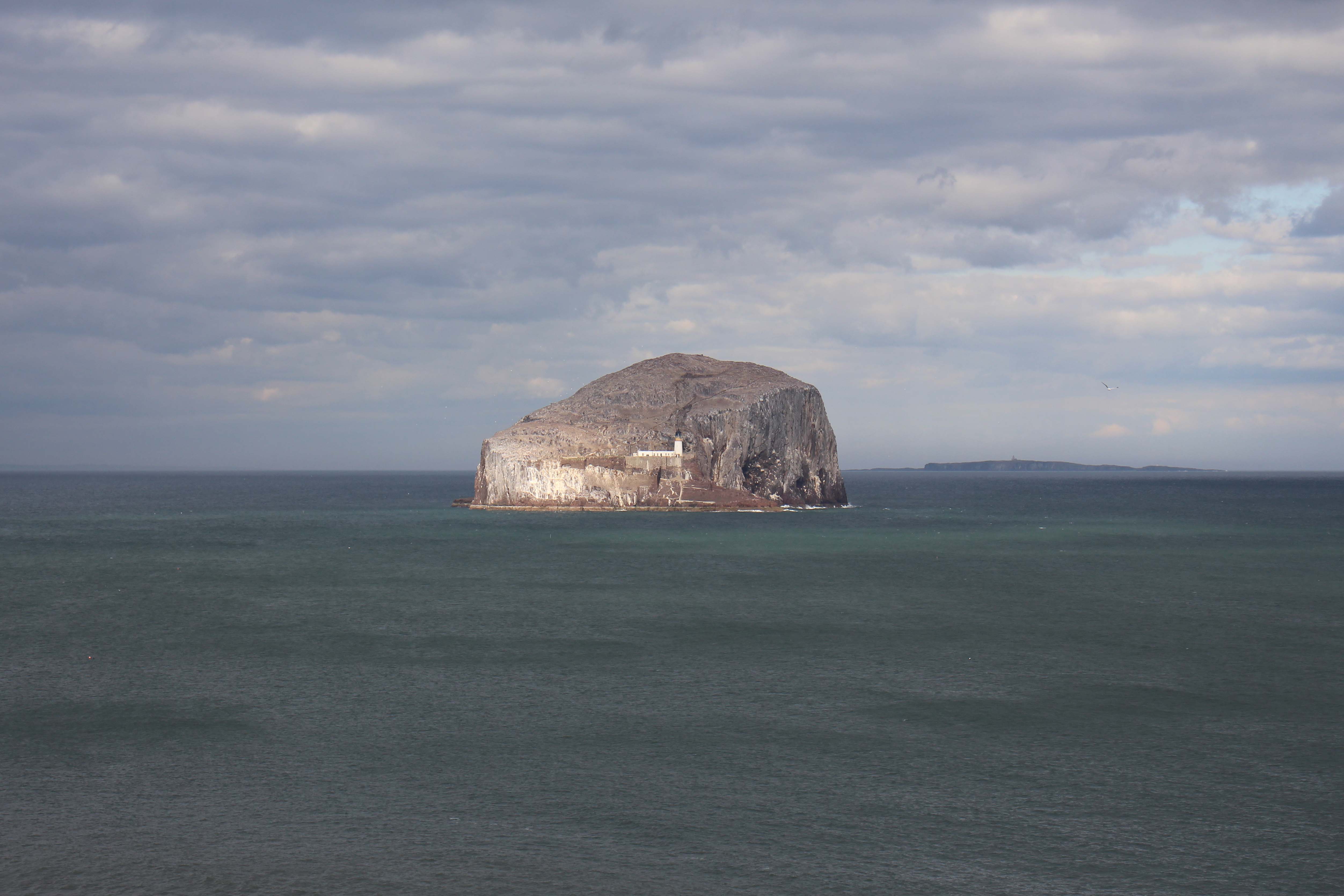
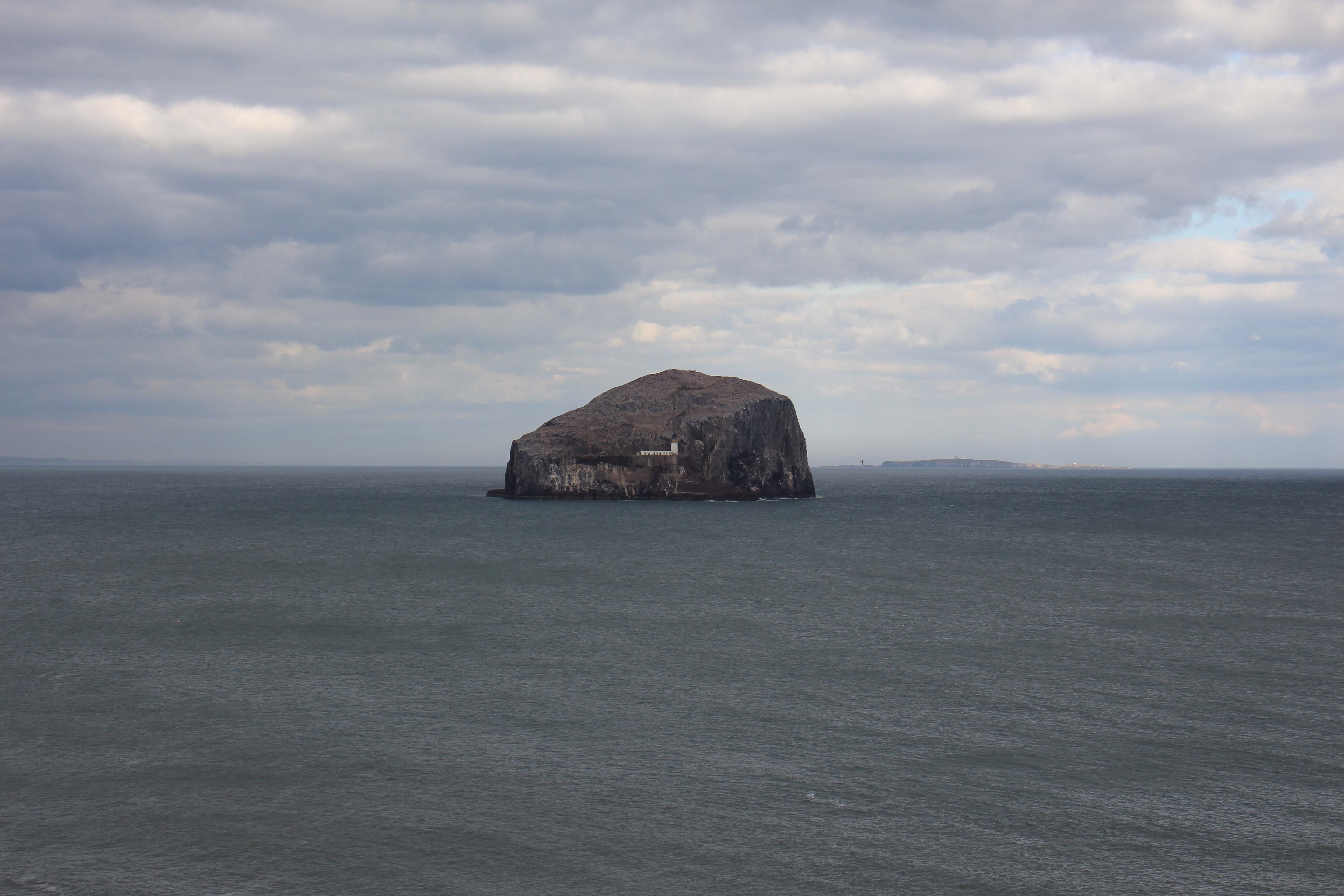
One of the most spectacular aspects of Tantallon is its view – not only along the coastline, but out to sea and the Bass Rock, a spectacular lump of stone in the Firth of Forth that housed a fortress in the Middle Ages and later a prison. At times it has hosted colonies of sheep. Today you can see a lighthouse, and the rock is the world’s largest colongy of northern gannets. Here it is in both sun and shadow:
view of the Bass Rock from Tantallon
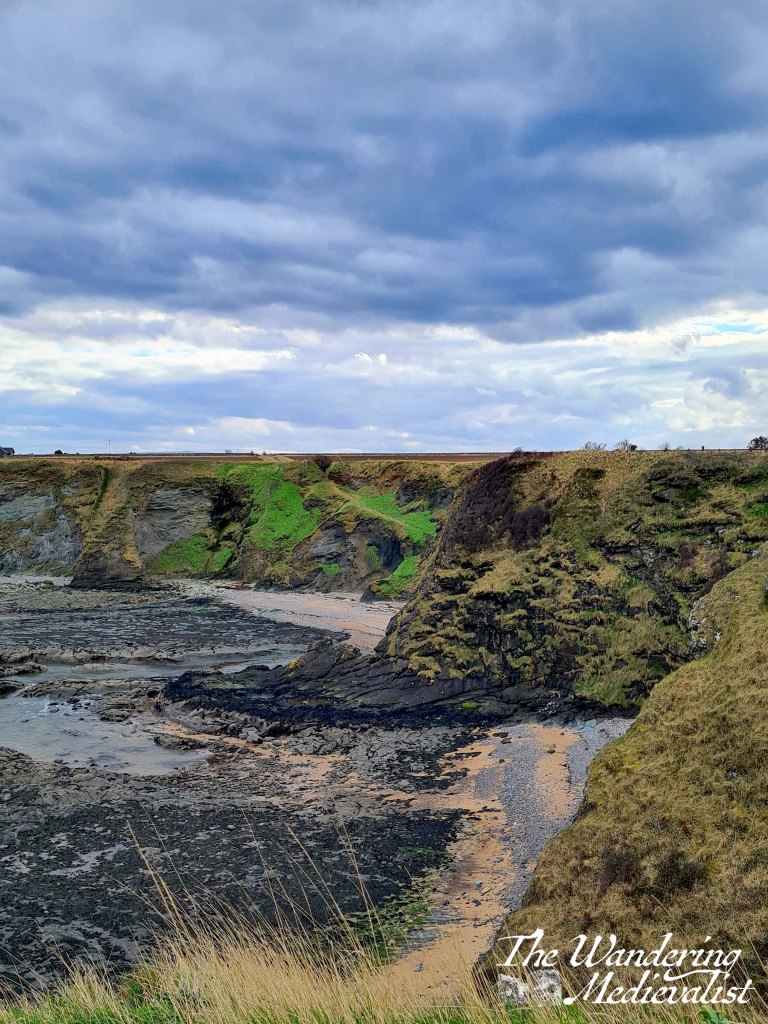
The other view from the castle is of course along the coastline – cliffs and rocky beaches galore, one could understand why landing an army here would be a formiddable undertaking.
I was eventually joined by a few other adventurous souls on this day, but in the meantime I sat down and enjoyed my picnic lunch in the lee of the castle.
It would be remiss of me, as a historian, not to tell a bit about the castle’s background. It was built in the 1350s by William Douglas, who would be the progenitor of the Red Douglas line, descended through his illegitimate son George, later Earl of Angus. Douglas was quite clever in this design, as the castle defences are comprised essentially of one long wall, securing a headland that pokes out in to the Firth.
It was known in the Middle Ages to be nearly impenetrable, but unfortunately this was proven false through a siege conducted by Oliver Cromwell’s Parliamentarian forces in 1651. Twelve days of cannon fire were too much for even this curtain wall, and it was left as it is now.
The trip I spent visiting Tantallon introduced me to a part of Scotland I had never really seen before, and I found the North Berwick area to be both beautiful and well worth exploring in more depth. There is not a big town, but the roads were in decent shape and the edge of Edinburgh is very close, so one could probably be based in the city and do day trips. I will definitely be going back to visit Tantallon, hopefully with the opportunity to go inside and explore some of the ruined towers and rooms I could only glimpse from around the edge. I was struck, as I stood looking across towards Fife, that while the drive was around two hours, a boat could probably get me home faster, as the distance between Tantallon and Fife is less than 10 miles as the crow flies, more than 80 by road. When standing in St Monans several days ago I could look across to the Bass Rock and know this castle was hiding just behind it – just out of sight.
The braes ascend like lofty wa’s, The foaming stream deep-roaring fa’s, O’er hung wi’ fragrant spreading shaws, The birks of Aberfeldy.
The hoary cliffs are crown’d wi’ flowers, White o’er the linns the burnie pours, And rising, weets wi’ misty showers The birks of Aberfeldy.
– Robert Burns, ‘The Birks of Aberfeldy’
Work completely took over my life last week, but thank goodness for Facebook memories, reminding me of the trip we took last year at this time to Aberfeldy and inspiring me to look back even further to our March 2020 trip. It was a strange time – we knew that the world was starting to change, that restrictions were coming into place, and in fact it was while in a pub in Aberfeldy that we heard the pubs were closing – it was a sombre and disconcerting time, full of the unknown.
But, we had rented a self-catered cottage at Moness Resort, and were determined to make the most of it. Perhaps foolishly, we chose the Birks of Aberfeldy as our first walk of the weekend – the start of the walk is just across from the entrance to the resort, and so easily accessible from both Moness and Aberfeldy itself (officially, in fact, one can start the walk from Aberfeldy high street). And I should clarify – the foolishness was not in choosing to go for this walk, but instead to choose it as the first walk of the weekend, before we had time to warm up a little. The other half was struggling with his knee, and the description of the walk I read in one of my books indicated that it was not overly long. It is, however, incredibly steep – in many cases, the path is in fact a set of stairs, leading up the side of the gorge. Stunning views, and definitely good for the quads – if not, necessarily, sore knees.
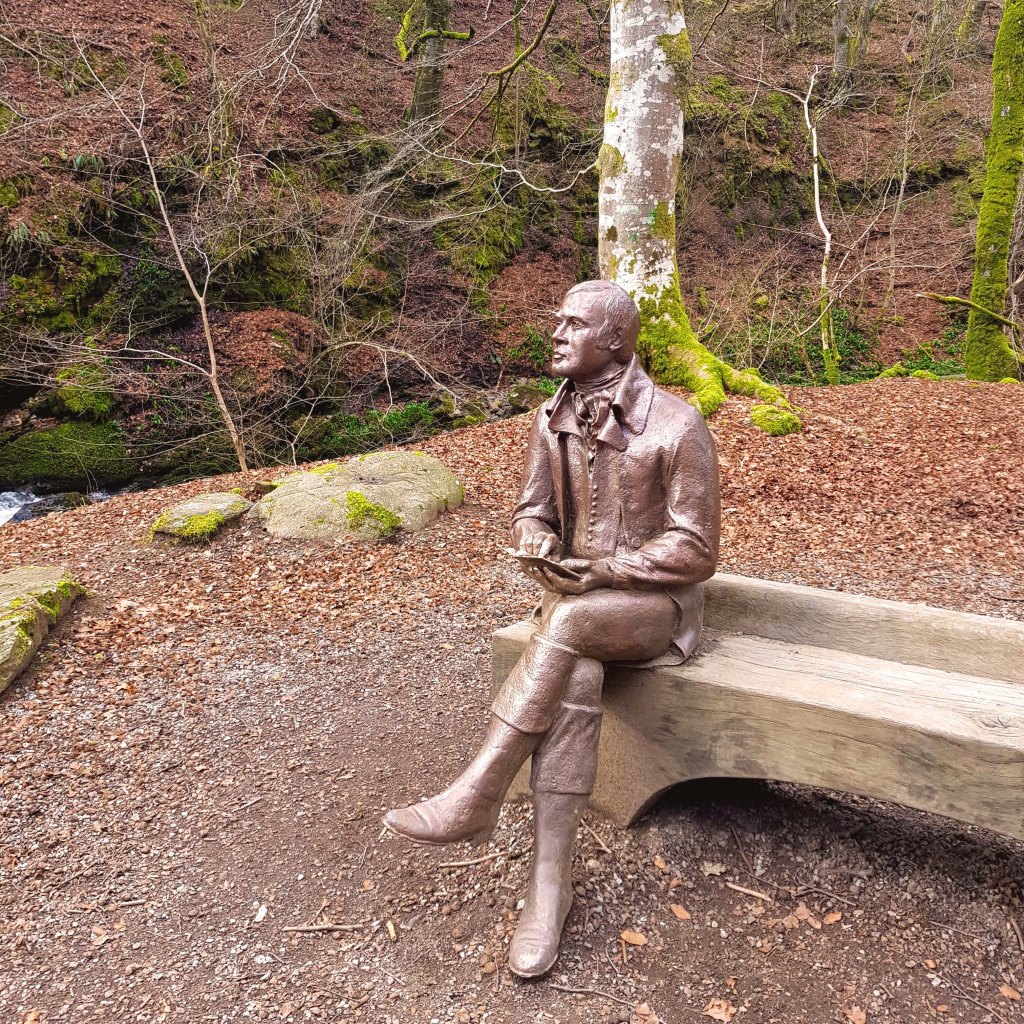
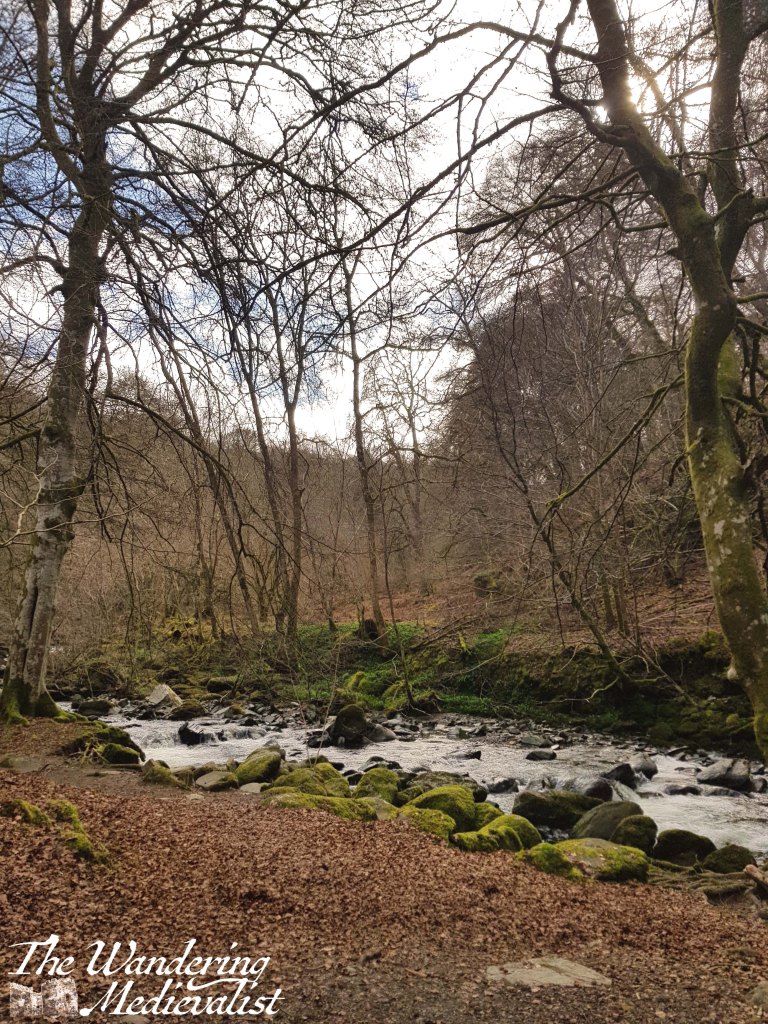
The start of the trail is relatively gentle, following the Moness Burn as it rushes over rocks and smaller falls. The statue portrayed at the top of this post is in a lovely wide clearing, indicating where Robert Burns may have first been inspired to write; one can understand this inspiration!
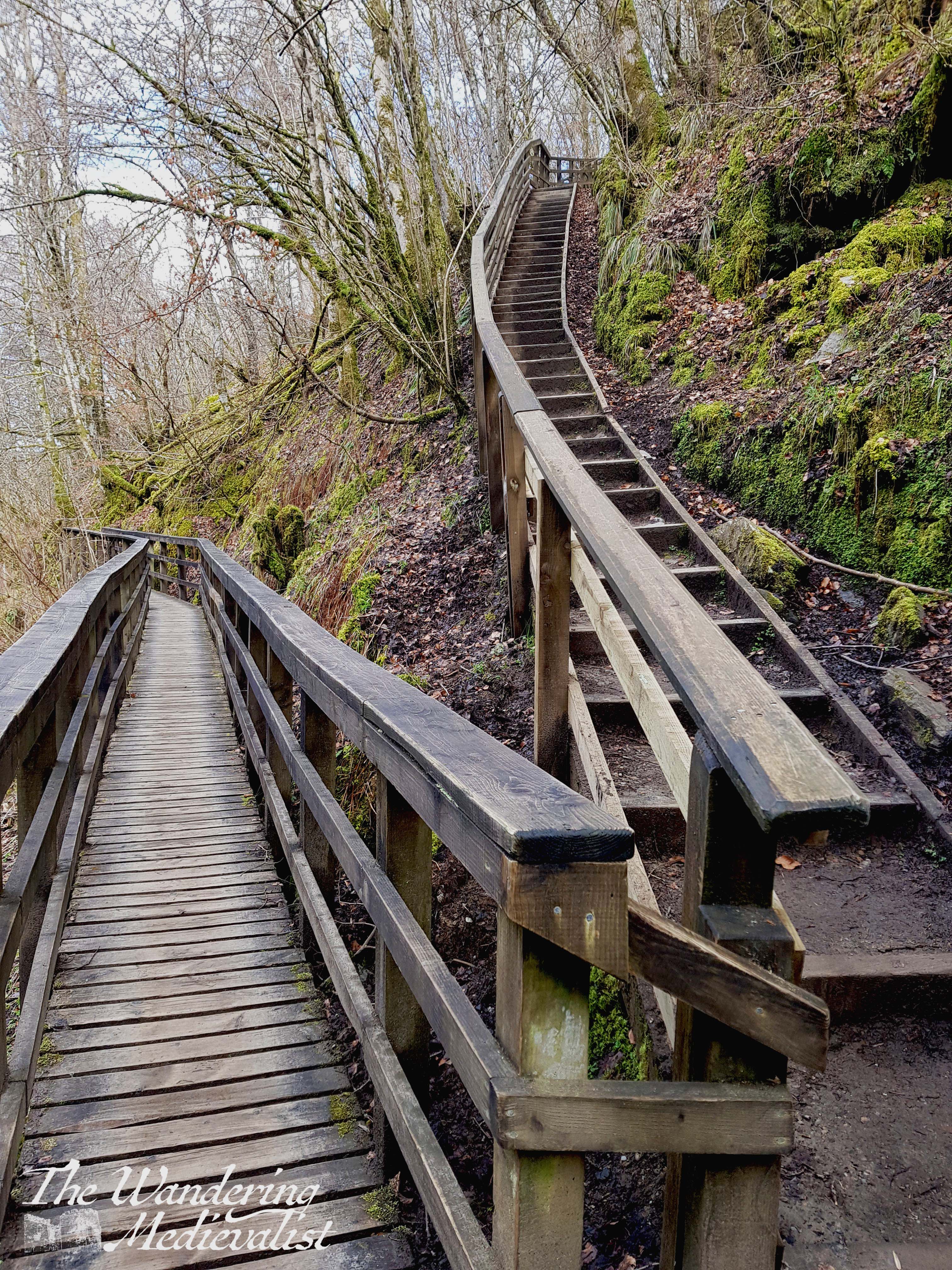
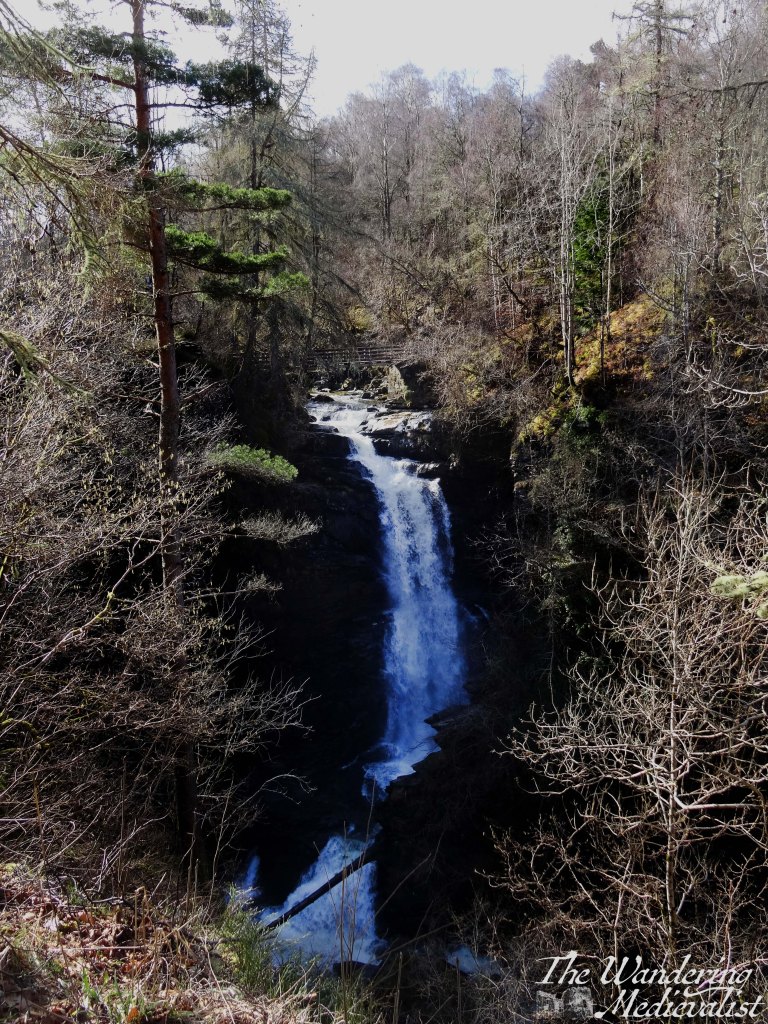
The path continues on eventually into a narrowing gorge, and this is where the walk becomes both more beautiful and a touch more challenging. Well-build wooden walkways and steps make it possible to truly experience the beauty of the lower falls.
I am a total sucker for waterfalls of course, and wish only that I had had my fancier new camera to properly capture them. Instead, I allowed both the other half and I to take periodic breaks as we climbed, and took plenty of pictures on my phone. It really is a stunning walk, with bridges and gorgeous colours of copper and green, even in the early spring when we were there.
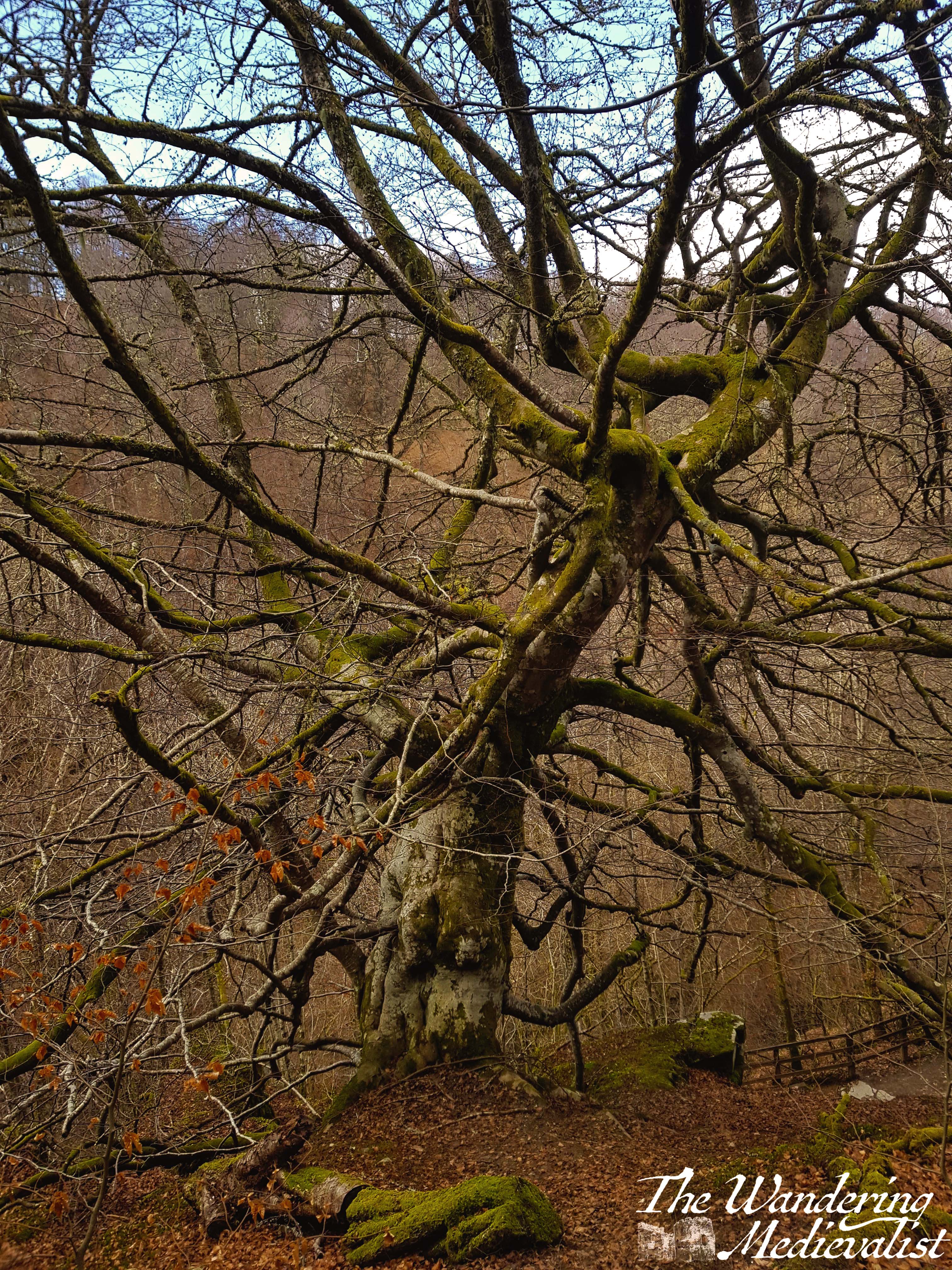
Staircases like the one above wind up the gorge and away from the burn, and at the top of one I was delighted to see the tree on the right, which reminded me of something out of Sleepy Hollow – I half expected it to come alive.
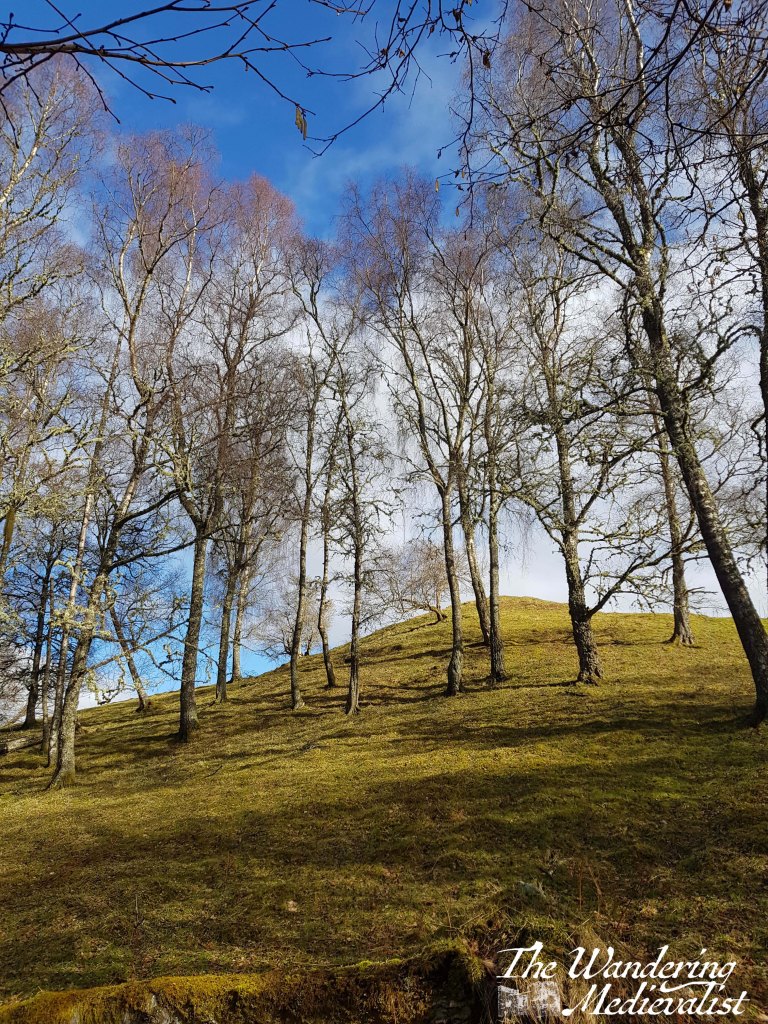
Equally magical was this view up what almost seemed a fairy hill – though the other half told me I was getting a touch fantastical when I spoke the thought aloud.
The apex of this loop is Upper Moness Falls, impressive at any time of year but perhaps particularly when snows are still melting. You cross directly over the falls on a bridge, but the best view is a bit earlier in the walk, where lines from Burns’ poem are carved onto the railing.
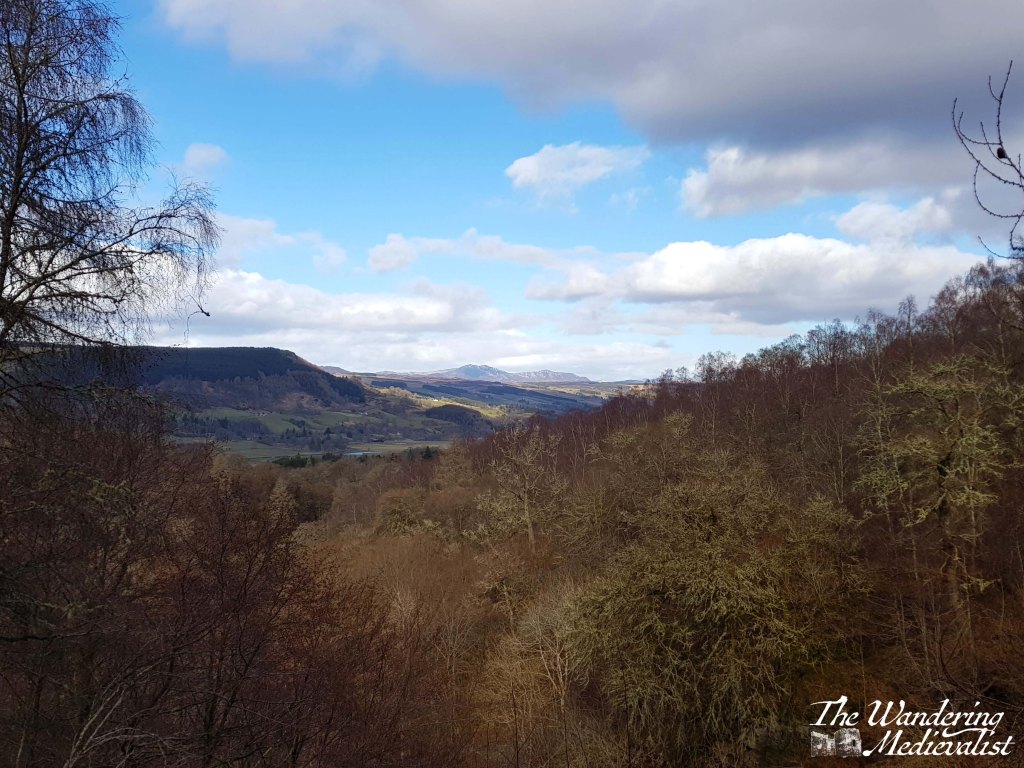
The return loop is higher up above the gorge and involves far fewer stairs, instead just a meandering descent. I quite enjoyed having both options available – near the water on the way up, but also views down into the gorge and across the treetops and hills towards Ben Vrackie in the distance.
All in all, a stunning walk and one I would most definitely do again – but with my knee brace and quads prepared!
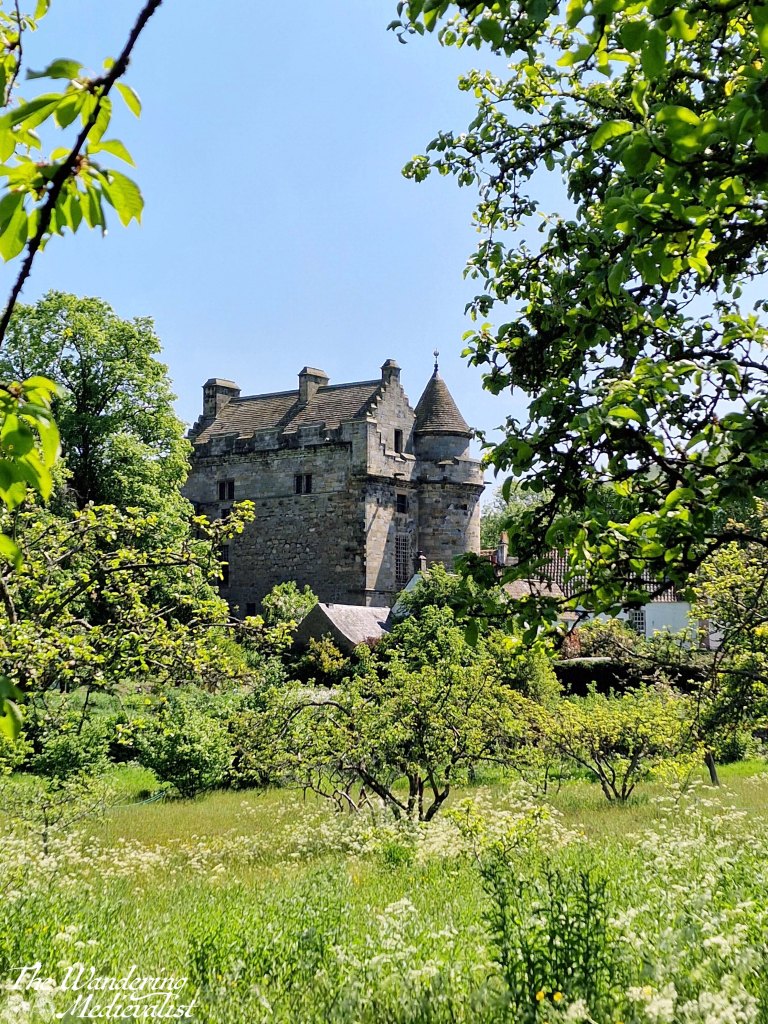
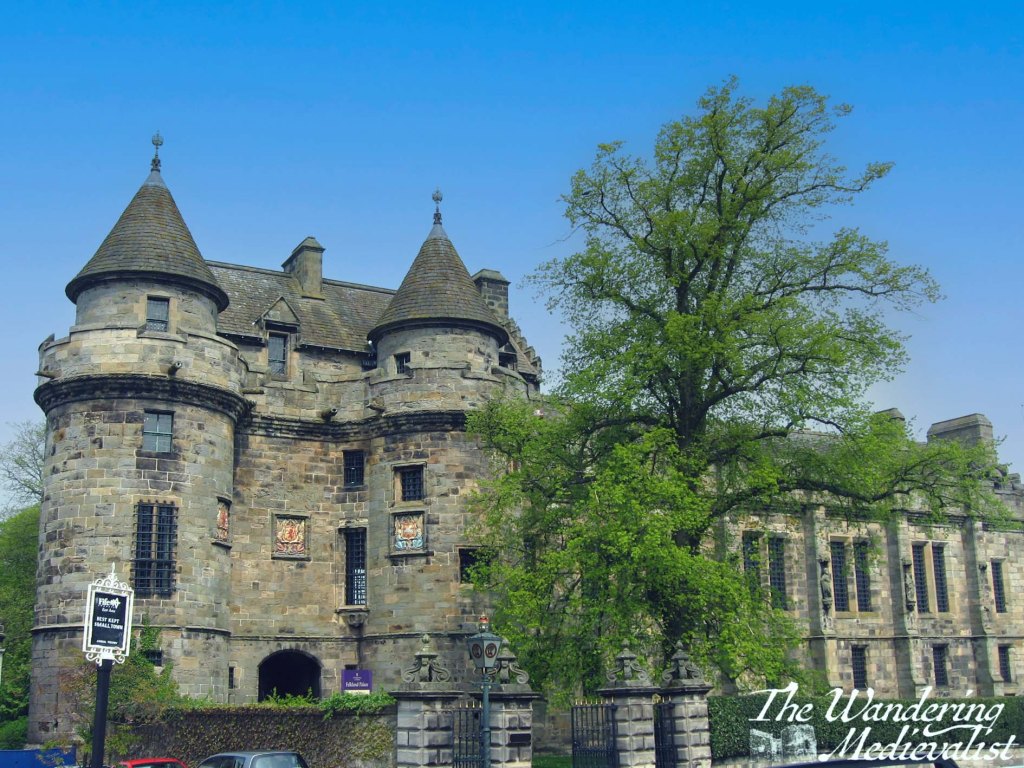
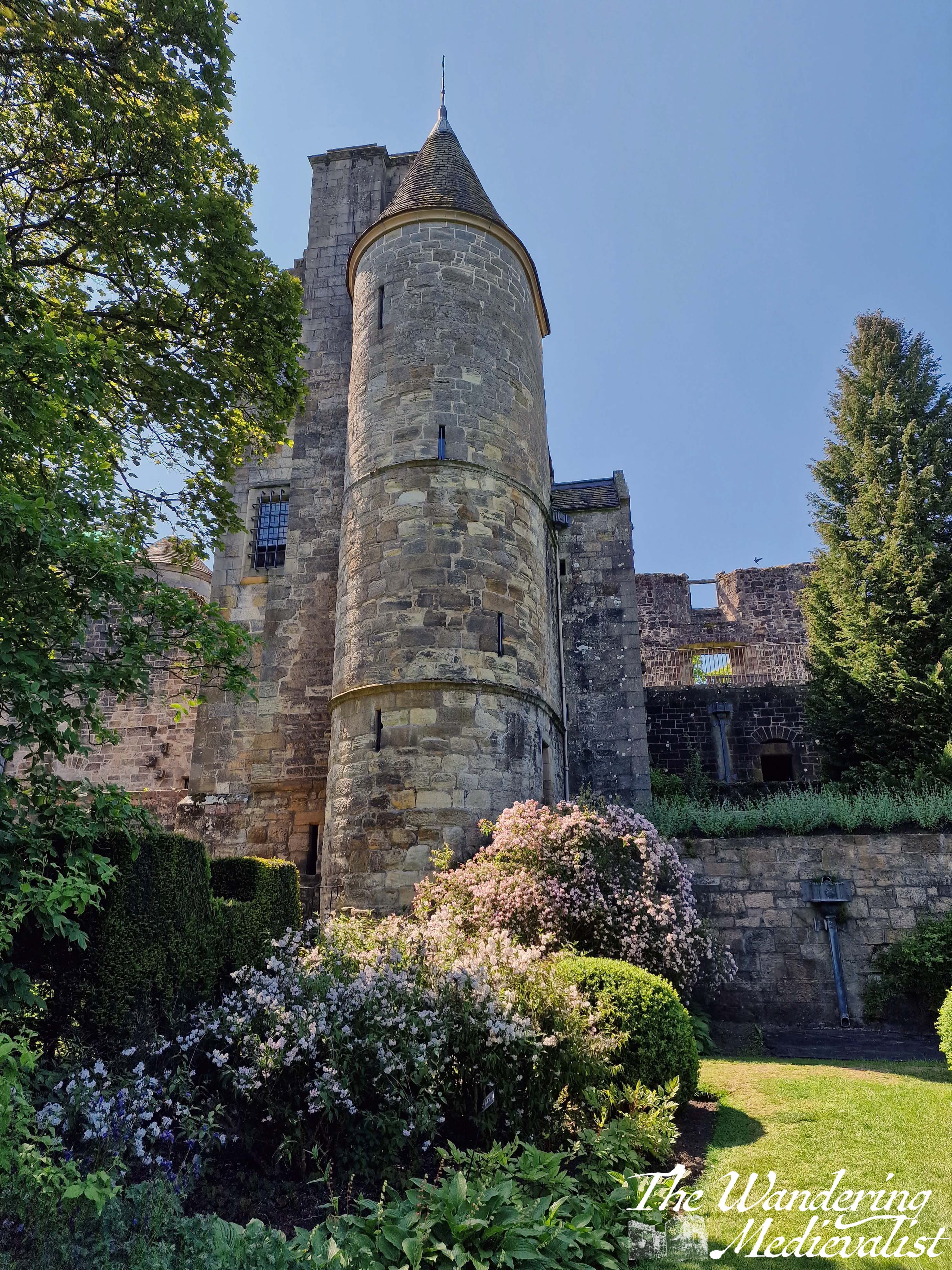
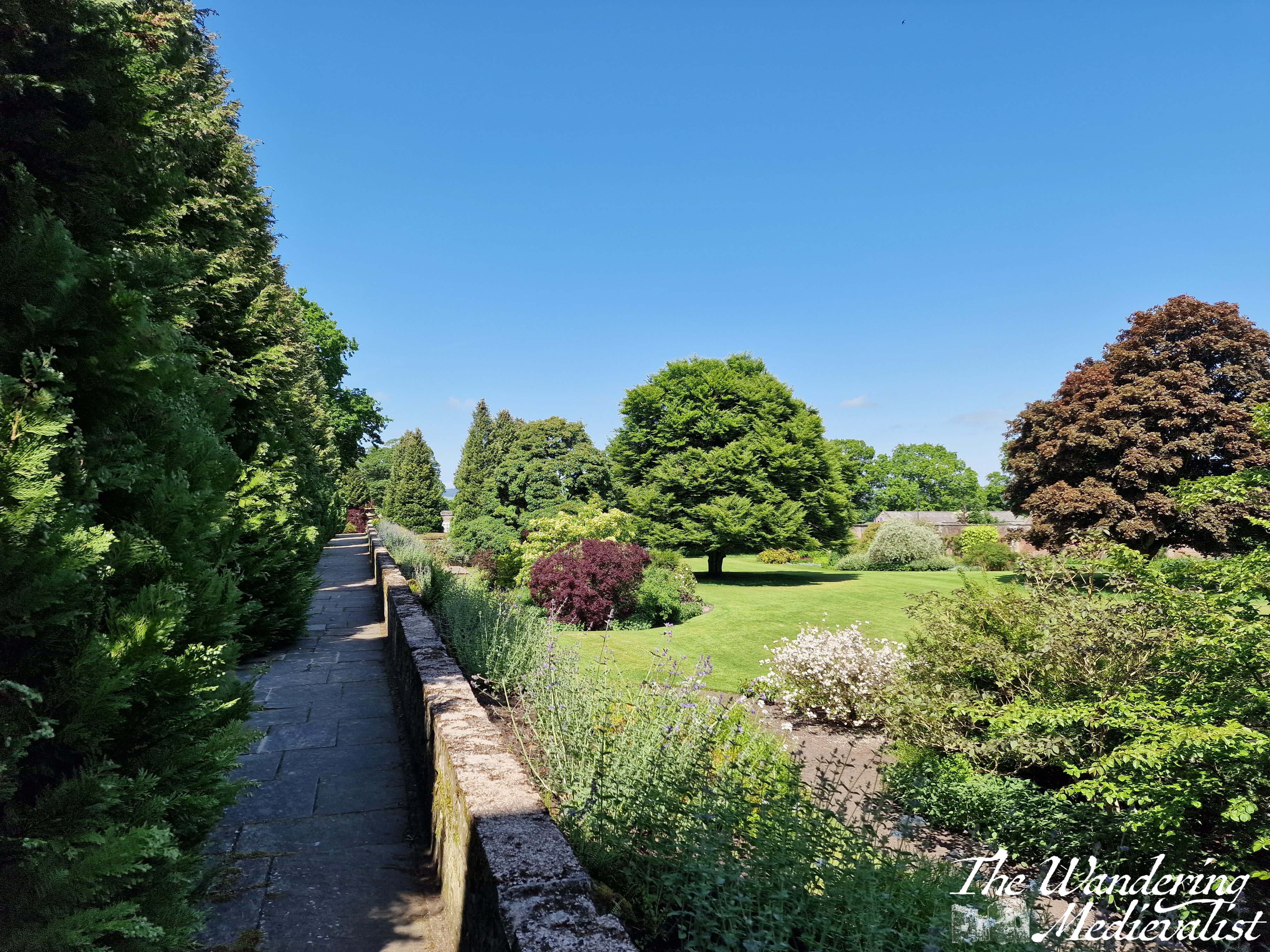
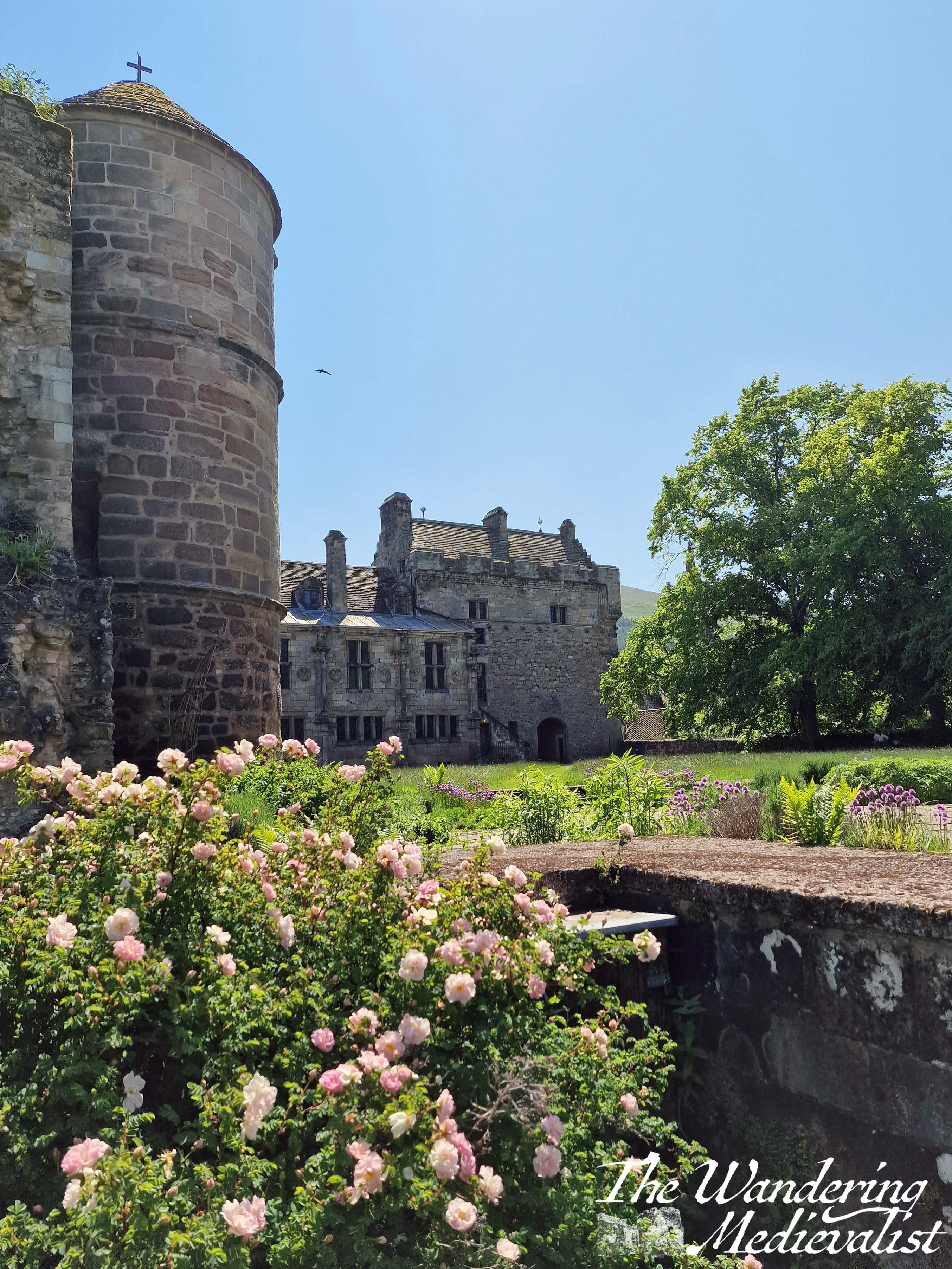
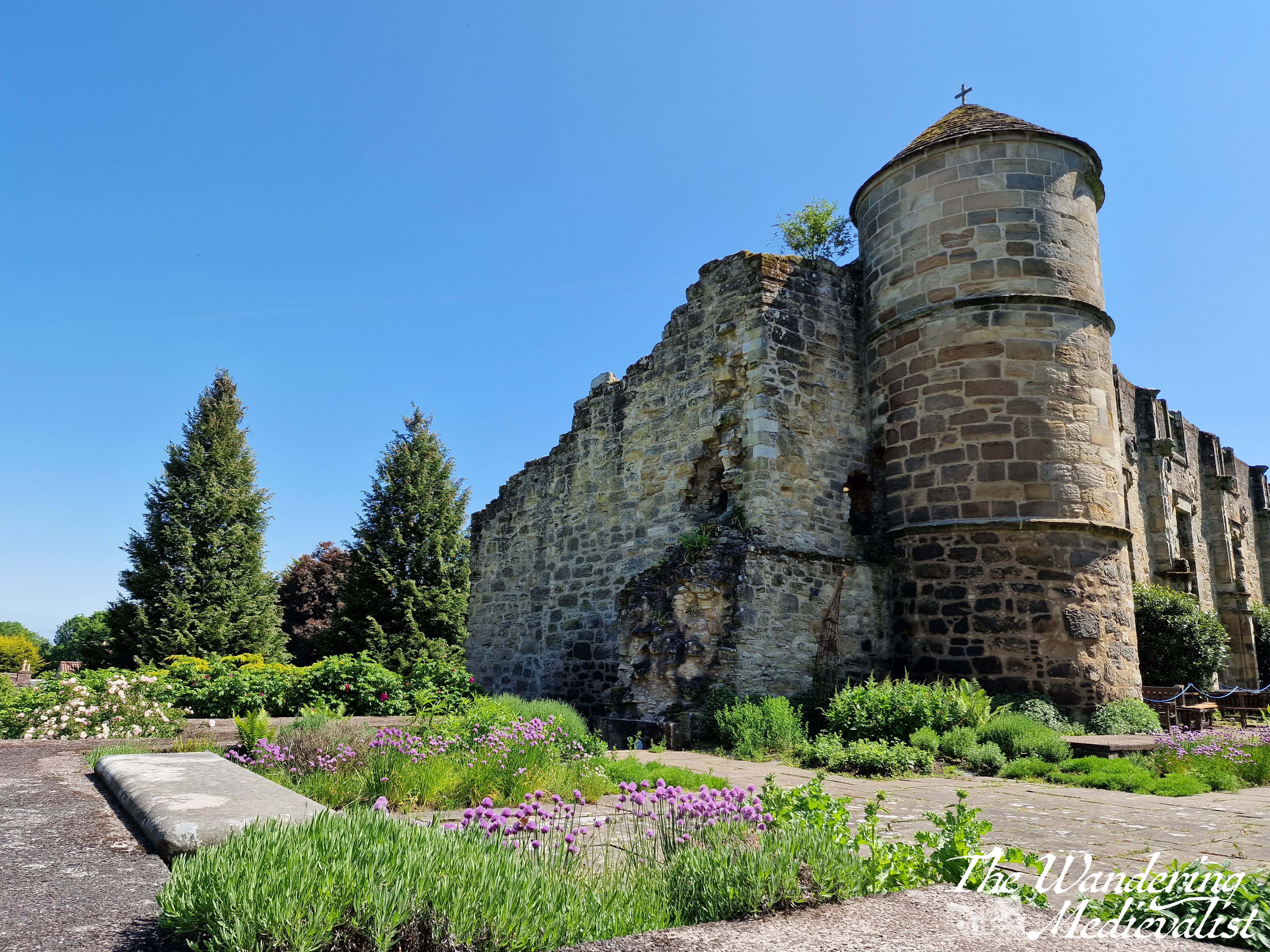
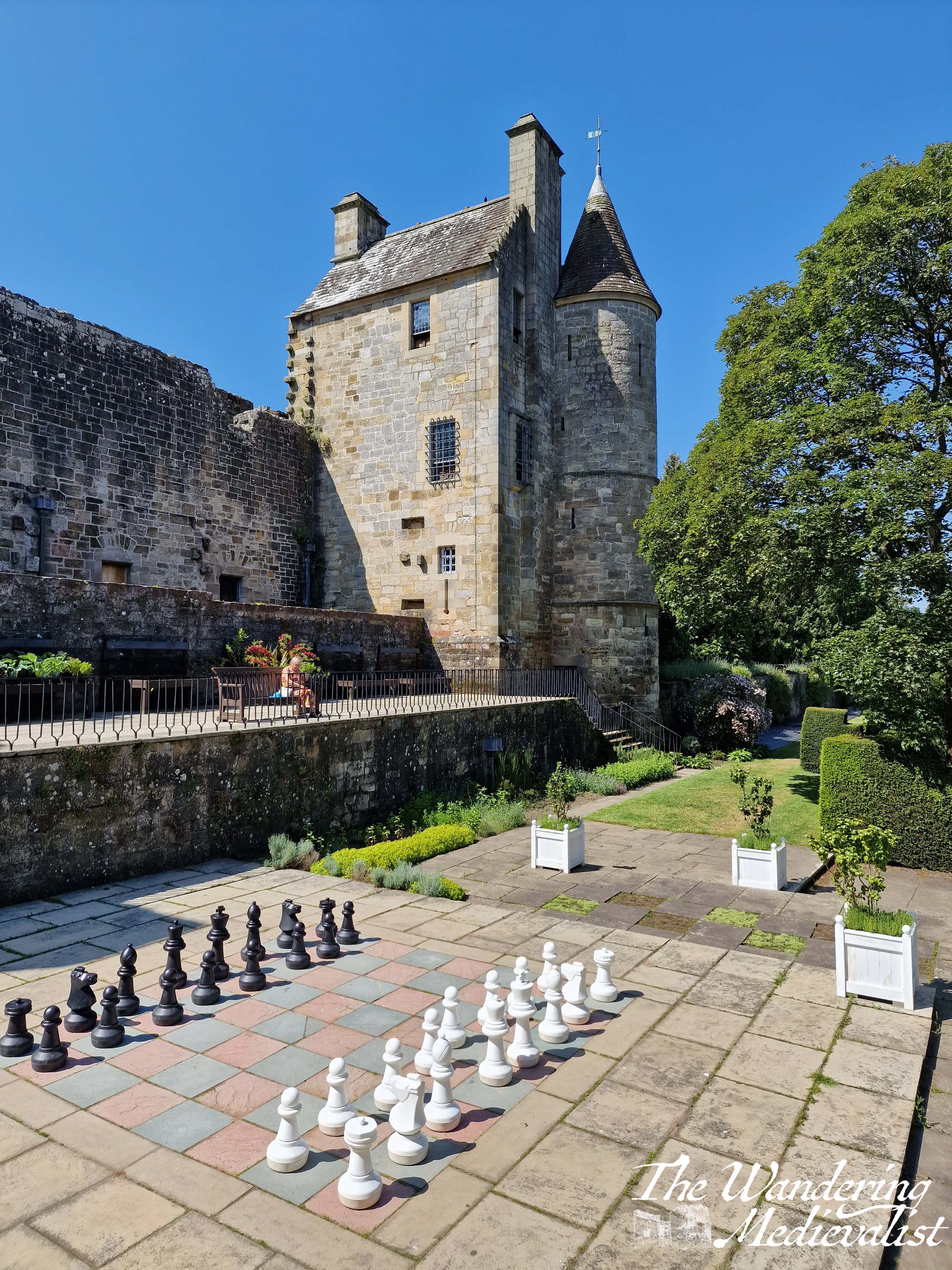
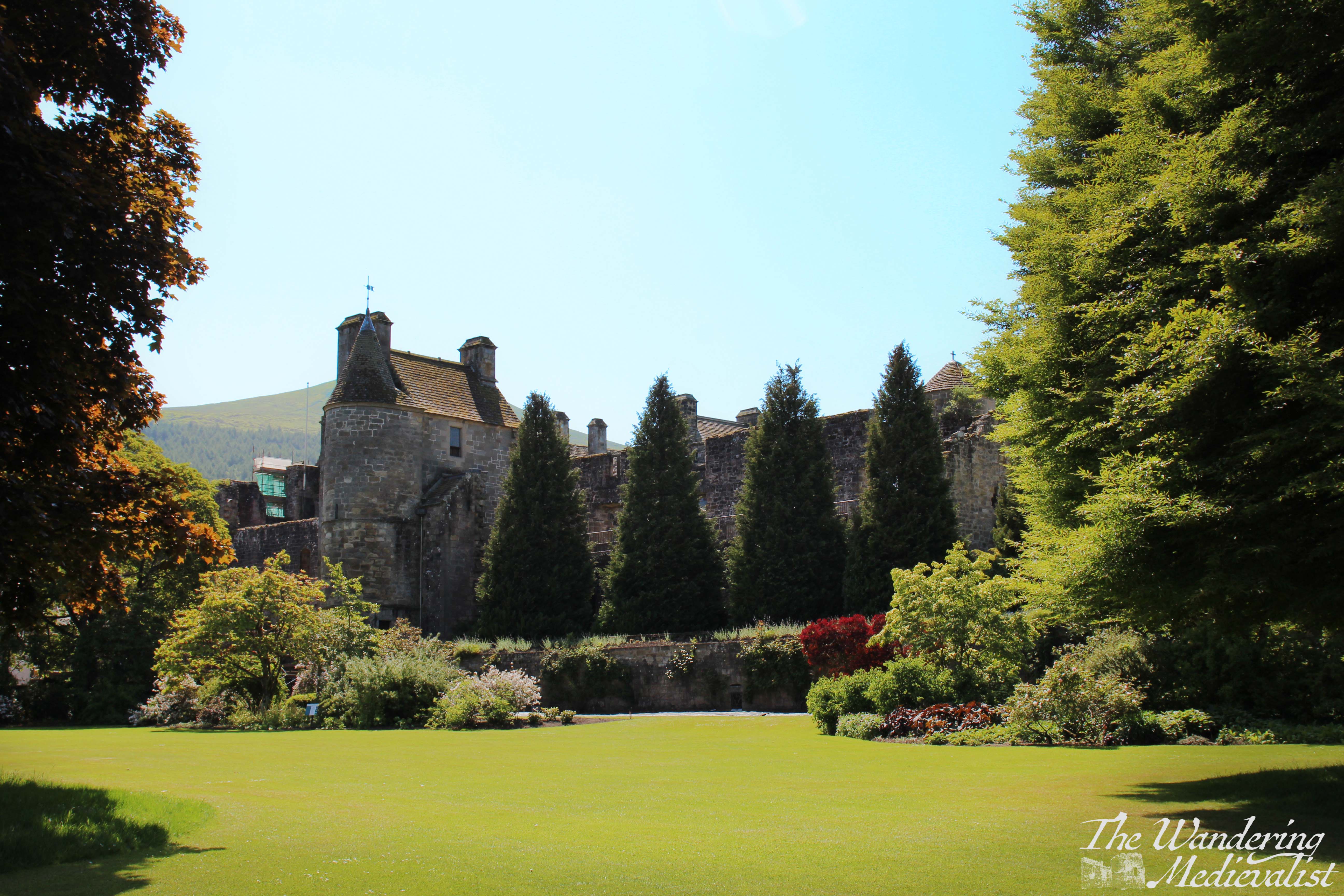
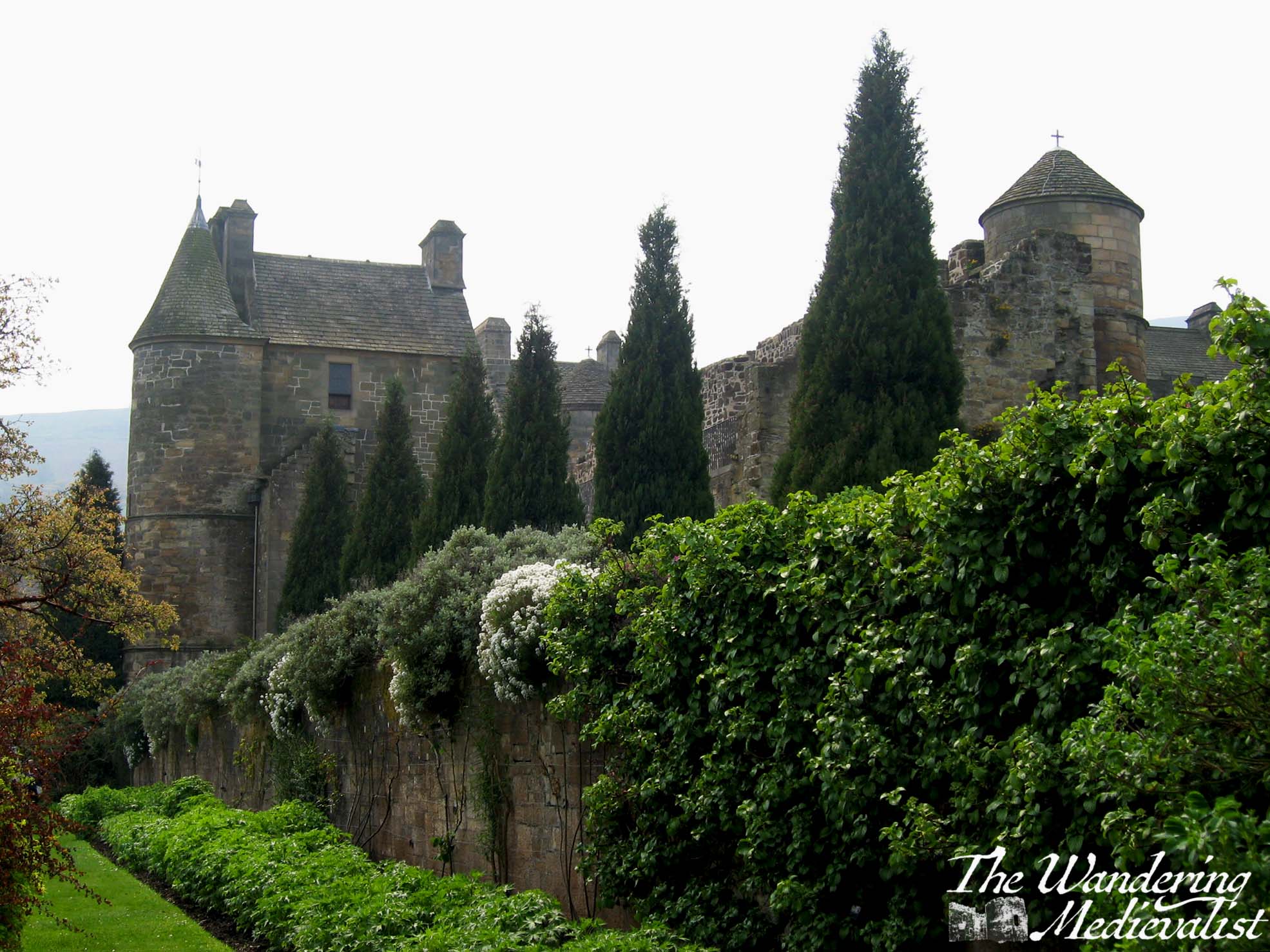
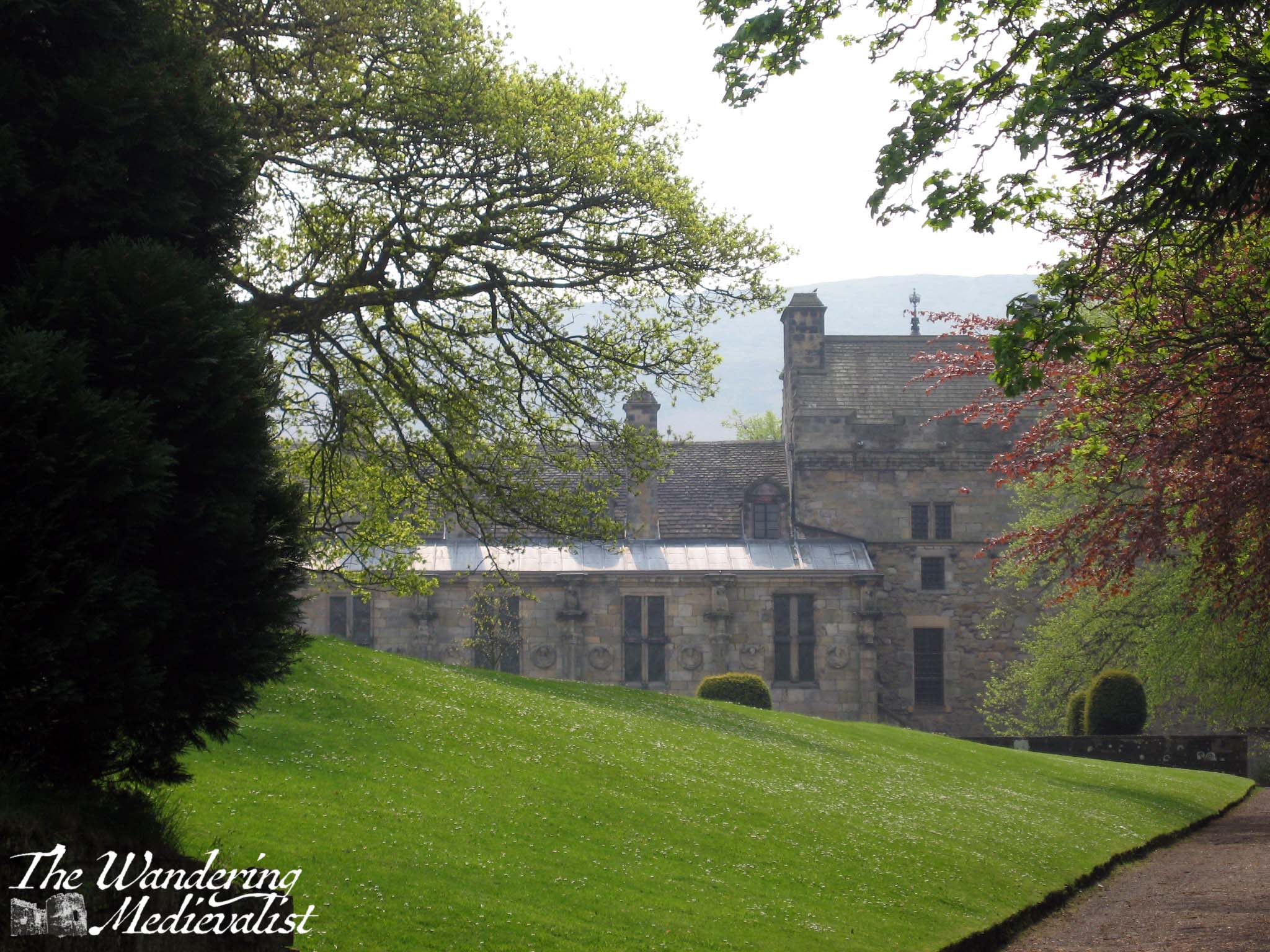
Today is overcast with patches of rain (not complaining, we desperately need it), a total contrast from last Sunday when I spent a hot and sunny afternoon exploring the gardens around Falkland Palace. The town of Falkland is a former royal burgh, and has recently risen to fame by standing in as 1940s Inverness during the filming of Outlander. It is a stunningly well-kept village blessed with charming old houses, beautiful gardens, and sweeping views over Fife towards St Andrews – all nestled in the lee of the Lomond Hills, specifically East Lomond.
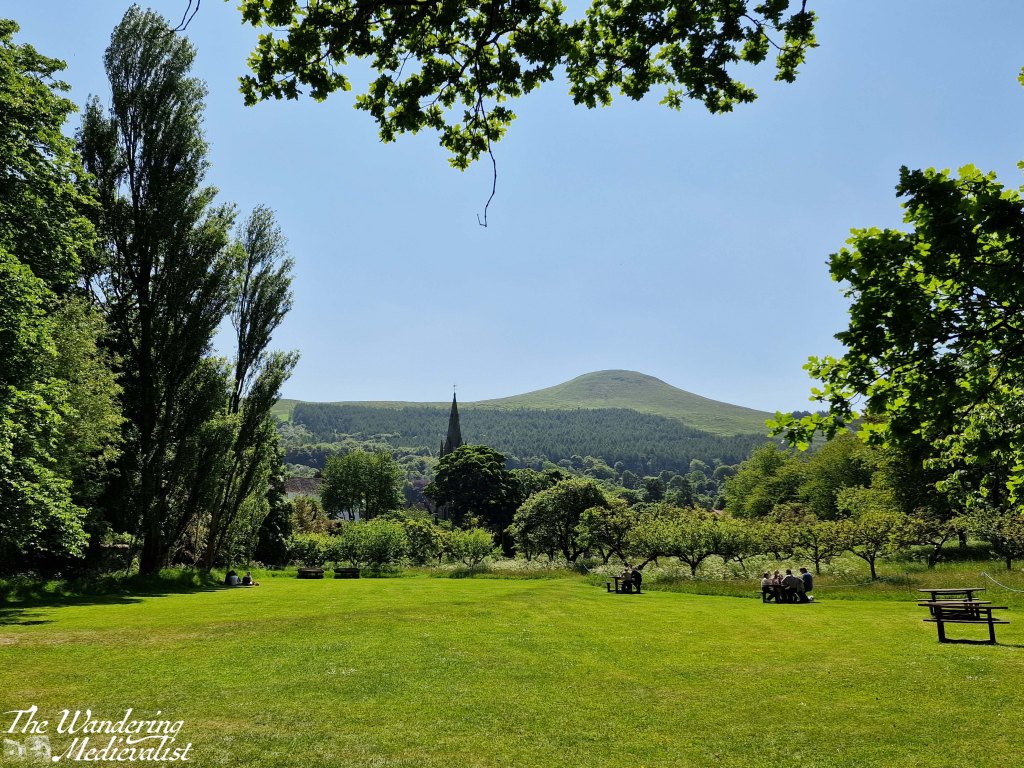
East Lomond from the palace orchard
The palace itself was a favourite retreat of the Stewart monarchs of Scotland from James I onwards, with the forests nearby used for hunting. Most of the Jameses and Mary, Queen of Scots all visited regularly, at least partly I am sure due to Falkland’s proximity to Perth, Stirling, Linlithgow and Edinburgh. While there is evidence of a garden here since the mid-1400s, the present garden was re-designed in the 1940s by famous horticulturalist Percy Cane.
The National Trust for Scotland took charge in 1952, and in recent years, there has been an increased effort to bring back meadow land, to encourage growth of wild flowers and the bee population which is always in danger.
I had been thinking for some time of a visit to the palace gardens, and managed to coincide with the Falkland Open Garden weekend, meaning there were plenty of like-minded people around, and that the town itself was far busier than I think I have ever seen it. Nonetheless, I managed to find a parking spot on the edge of the Falkland Estate, and walked back through town to the palace, which does offer garden-only entry. The palace itself is of course worth a visit, but I had been in before and on this occasion did not have the time for a full exploration.
To enter the garden, you go through the impressive main palace gate, and from there, it was up to me and my camera to wander around and enjoy.
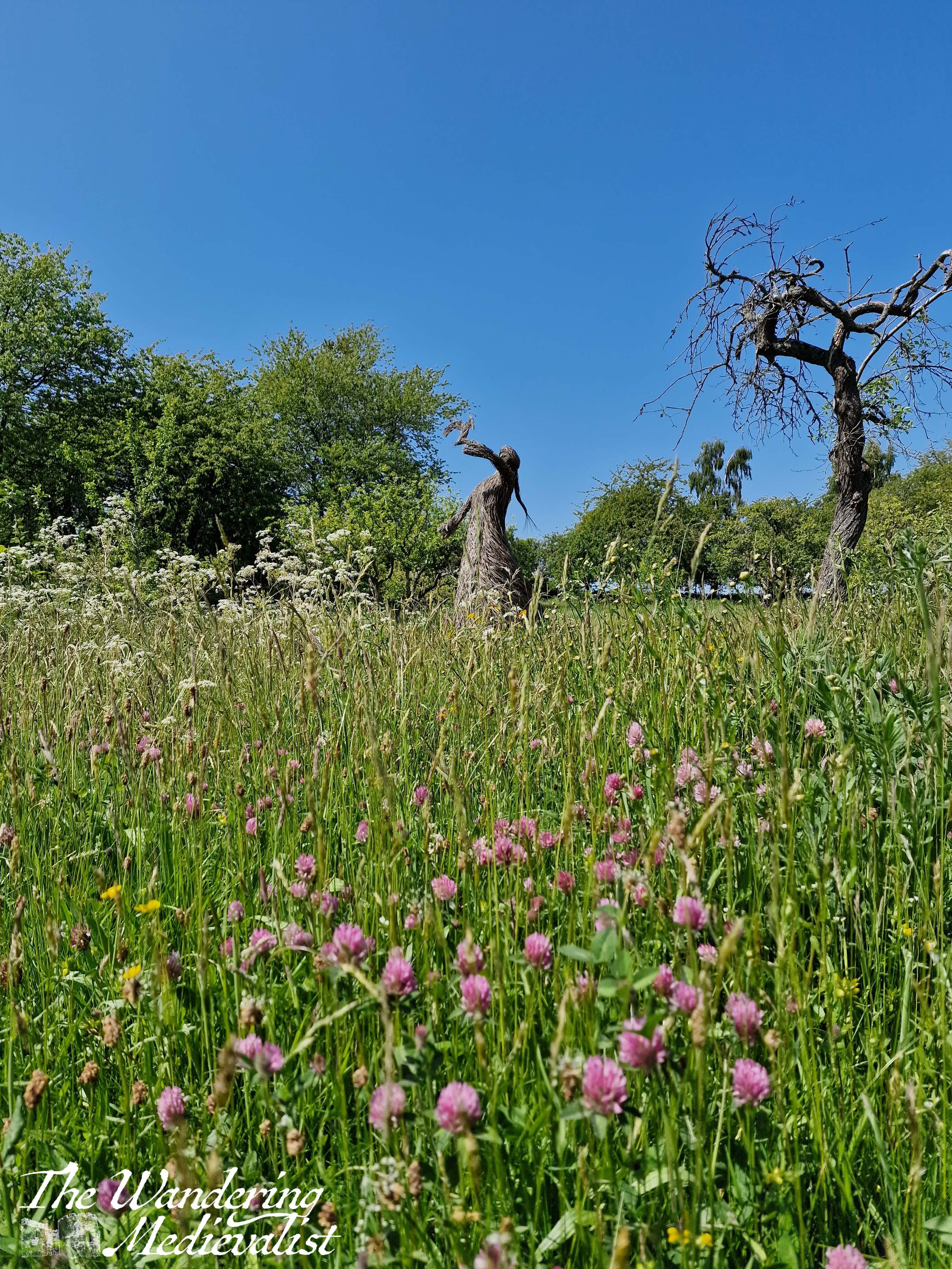
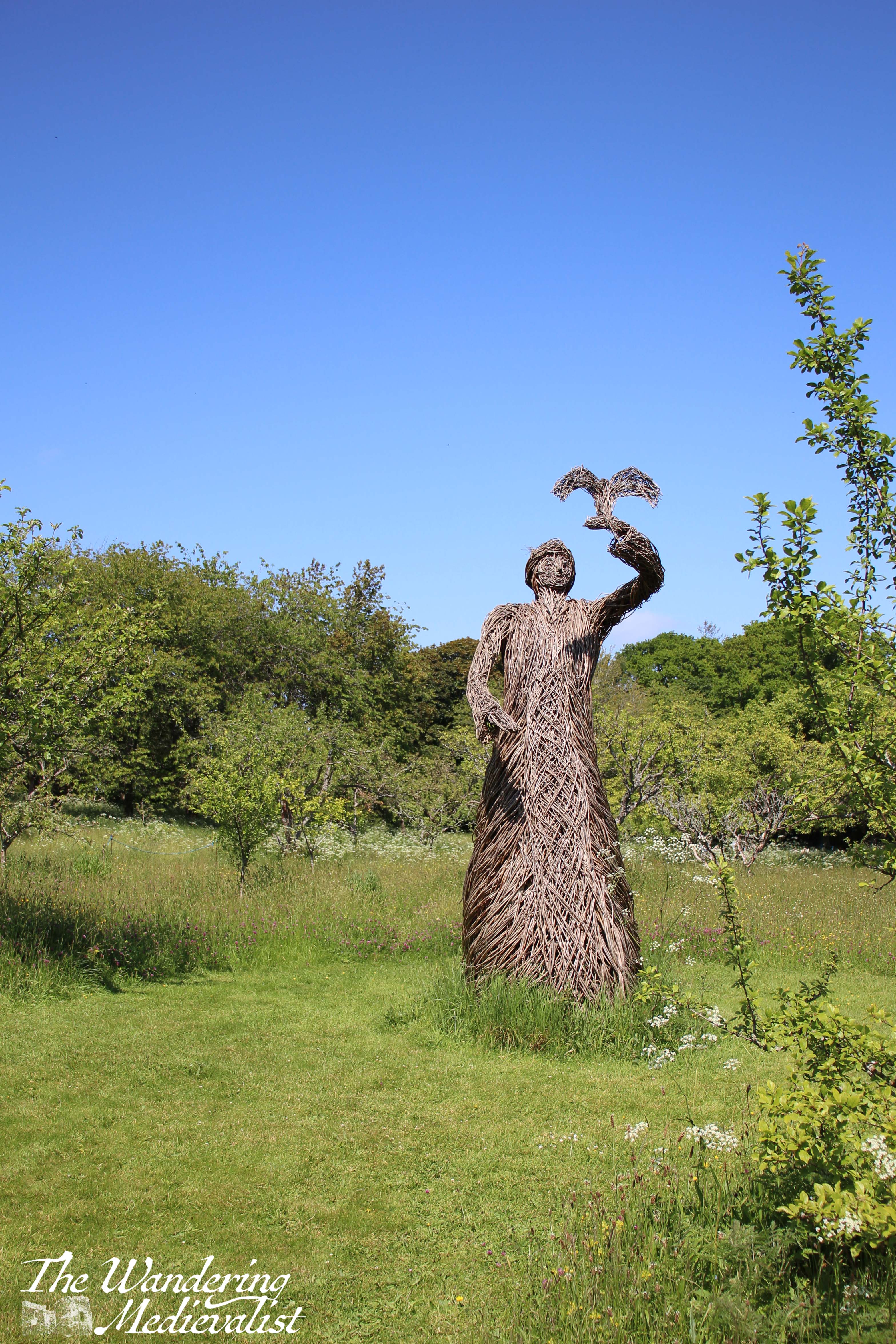
I started off in the orchard, which offered lovely views of the hill and town, as well as the Willow Queen, who stands on her own amidst the wildflowers and apparently represents Mary, Queen of Scots.
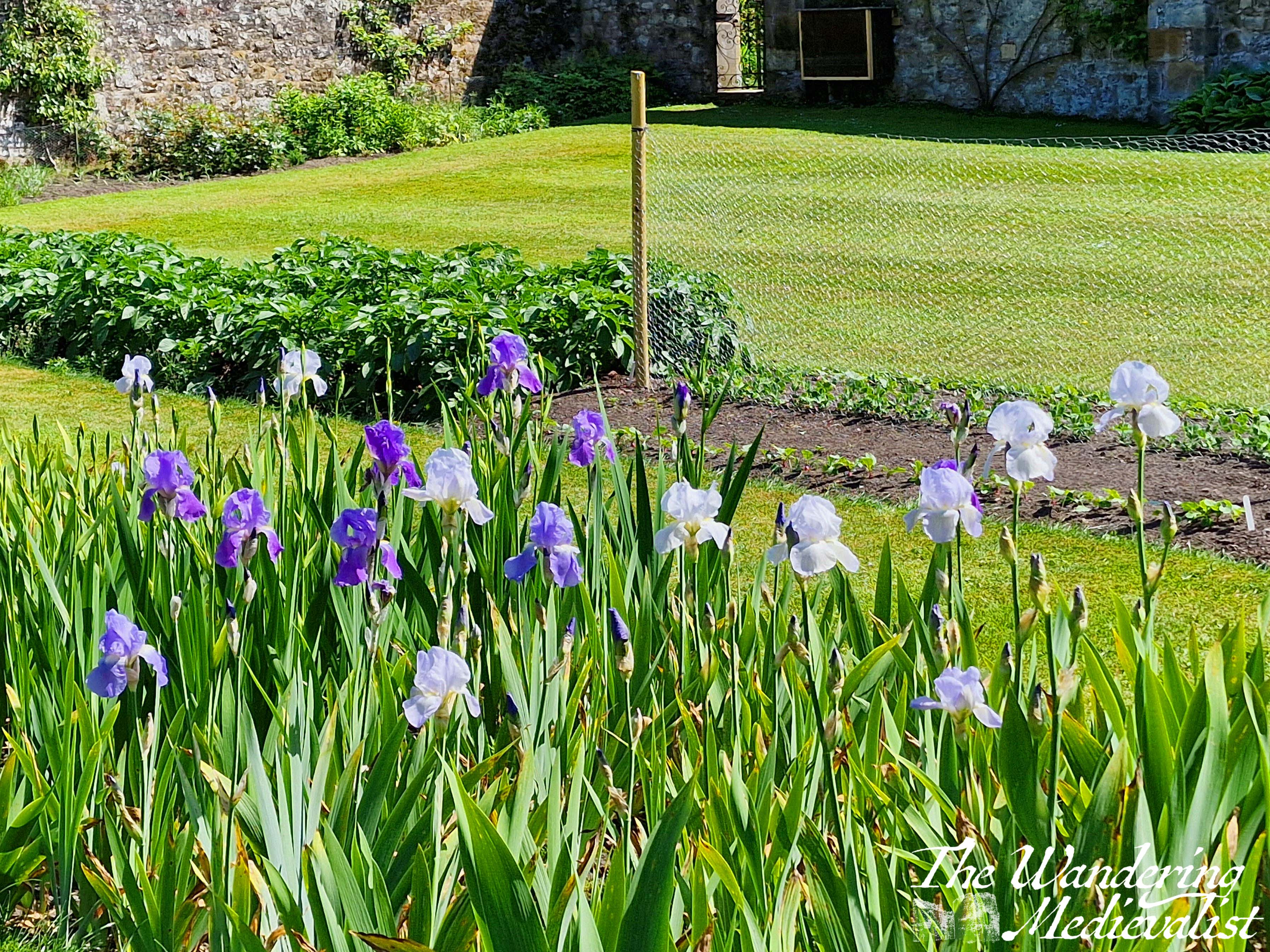
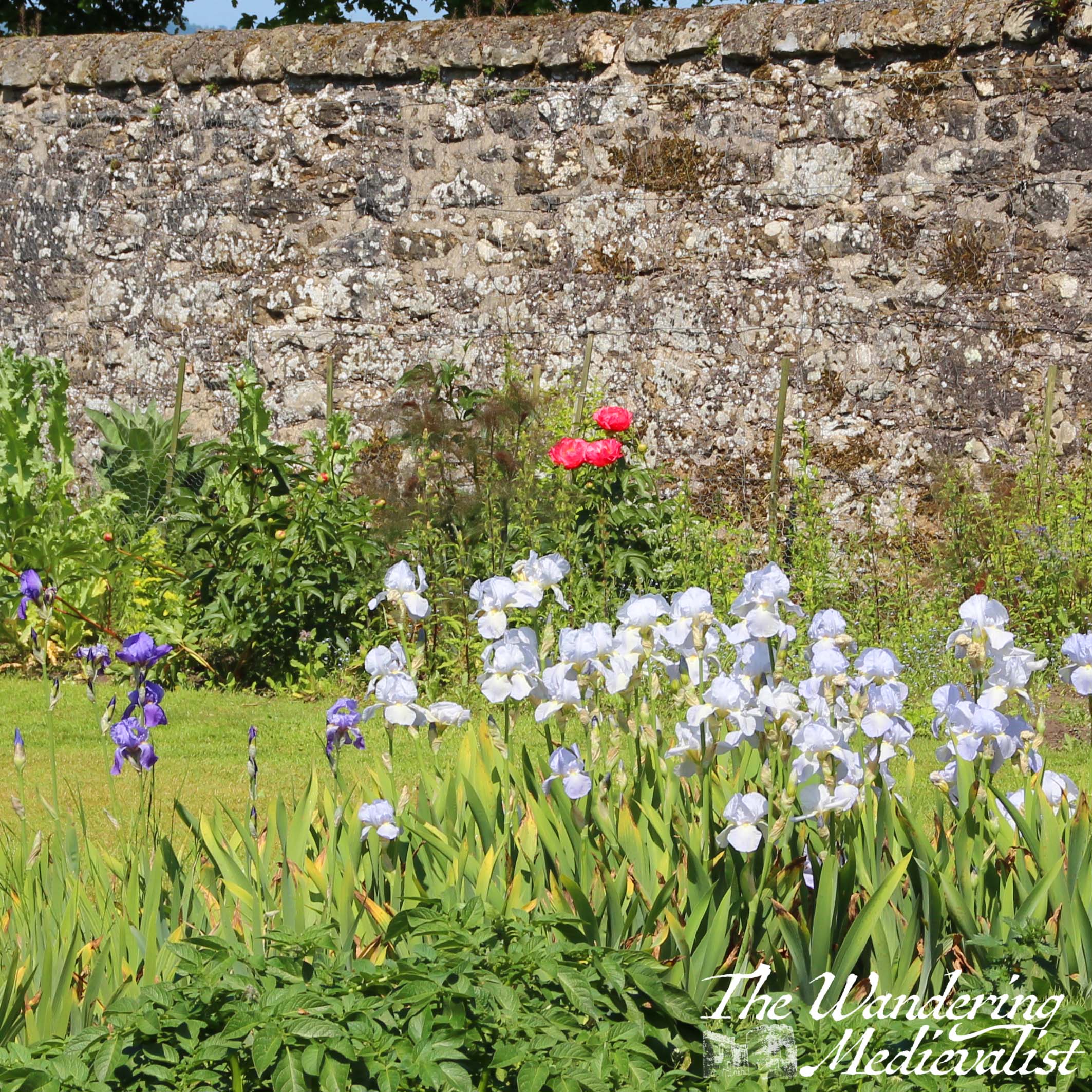
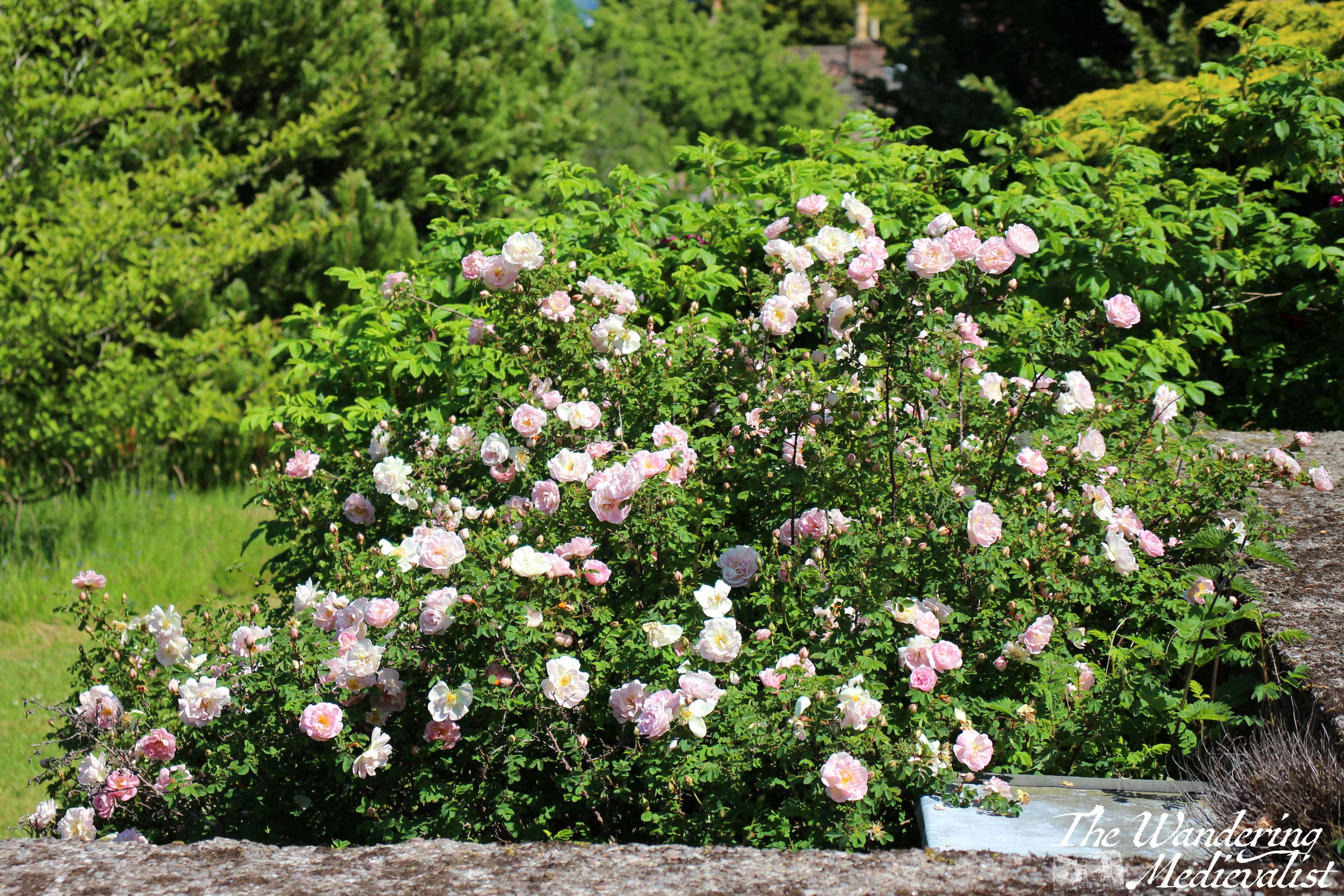
From the orchard and meadow I returned to the gardens proper and explored the walled garden, where there were rows and rows of iris – my grandmother’s favourite – and peonies just a few days off blooming.
I realised as I walked up towards the palace again that I was probably a few weeks too late for some of the best spring flowers – lilacs, wisteria, and flowering trees were all a bit past – and a touch too early for summer roses, but that really only means I have to return before too many more weeks have passed.
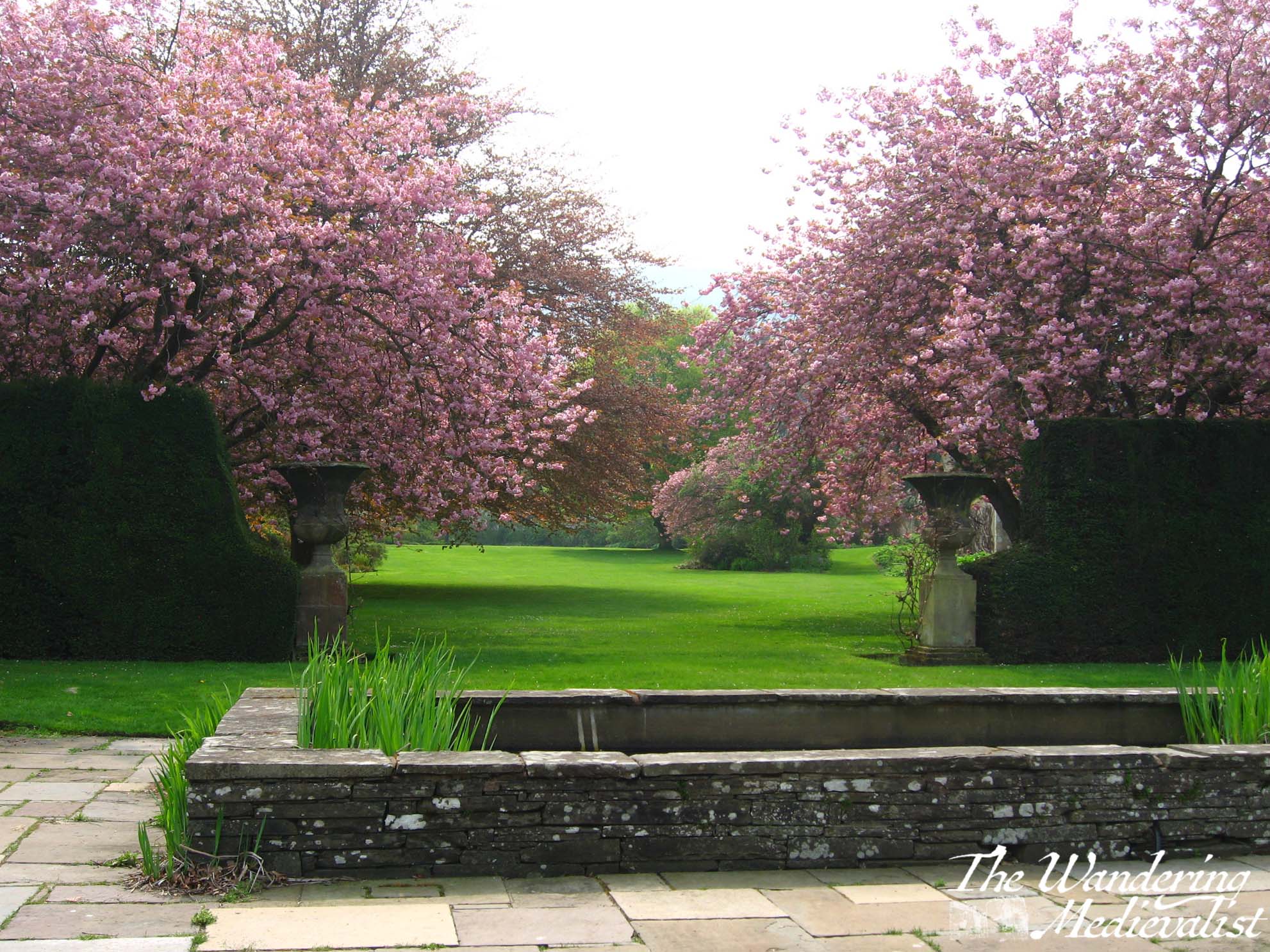
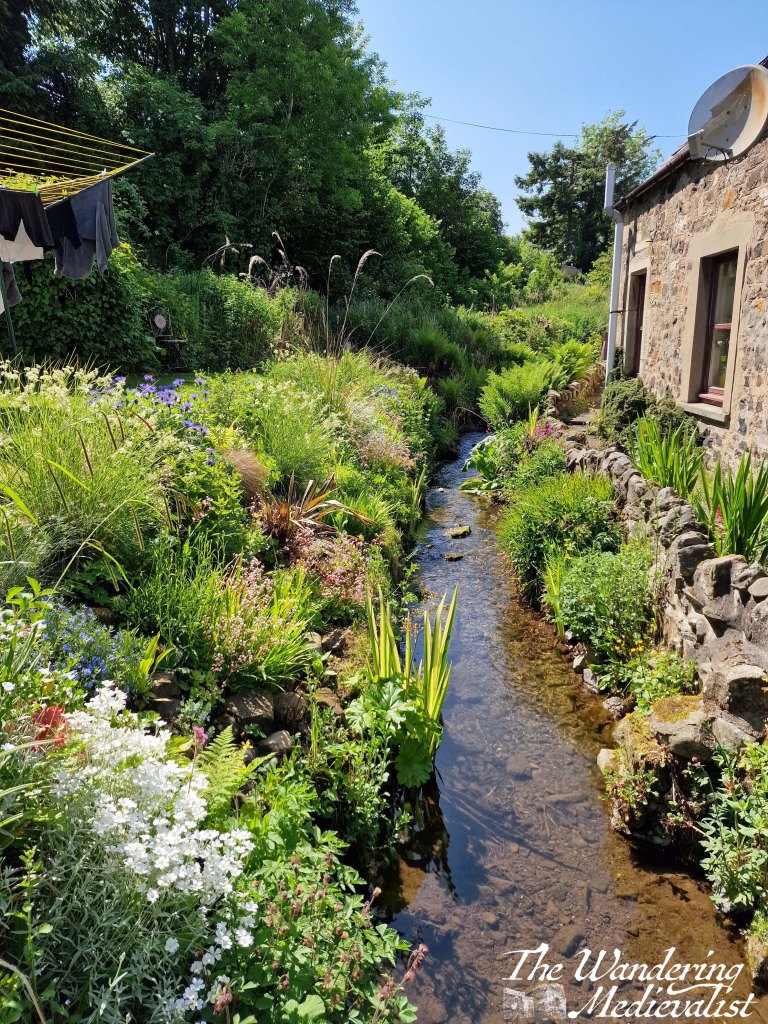
I should clarify, the bottom two images above including the pink trees were taken several years ago, earlier in the year. After taking my fill of garden and palace pictures, I made my way through the gift shop and, resisting the ice cream on sale in several locations, made my way back through town. I had time to spare, so detoured down along the Maspie Burn as it run alongside houses and an old mill, before finally taking me to a play park
From there I cut back up the hill to the main road, and back to Falkland Estate car park. It was just too hot and buggy to explore the estate itself, though I have done before and will certainly write about it soon!
Even with regular stops for pictures I managed a good walk and a few extra freckles from the sun, though as I stood on the palace wall I could see clouds gathering along the distant coastline. Fortunately they stayed off-shore until later in the evening. I am looking forward to my return to Falkland in the season of rhododendron (just out now as I write) and of course, roses.
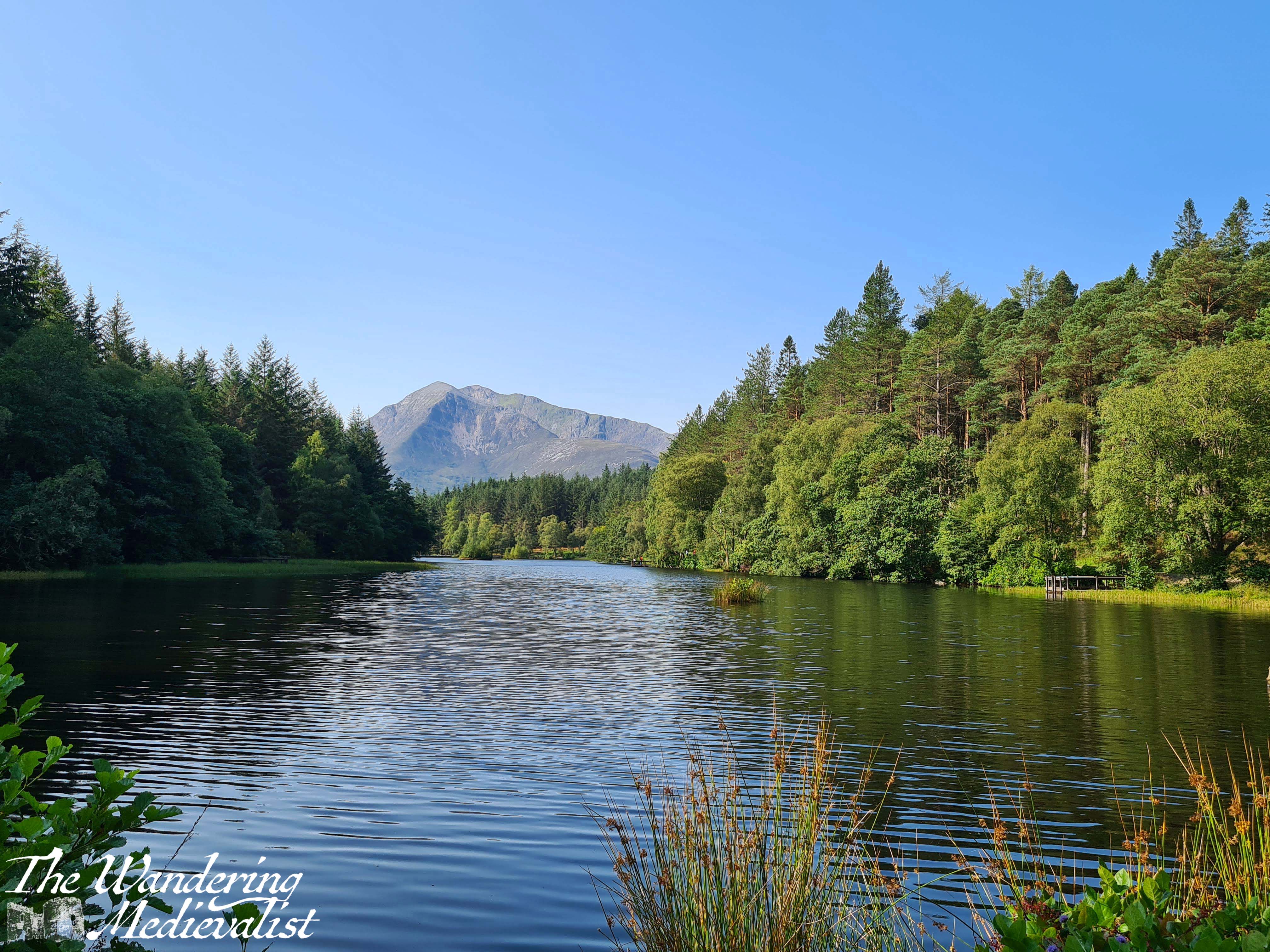
Both my other half and I agree that our first weekend away together to Glencoe many years ago remains one of our best trips ever – we went in April and were lucky enough to experience two glorious sunny spring days, warm and completely dry. We stayed at a hotel in Ballachulish on Loch Leven, close to the village of Glencoe (note, there is also a Loch Leven in Fife, which boasts a lovely castle I will write about in the future). For weeks ahead of time, I excitedly read through my Pathfinder Guide to Fort William and Glencoe, marking the walks I thought we could do to really experience the mountains and surrounding area.
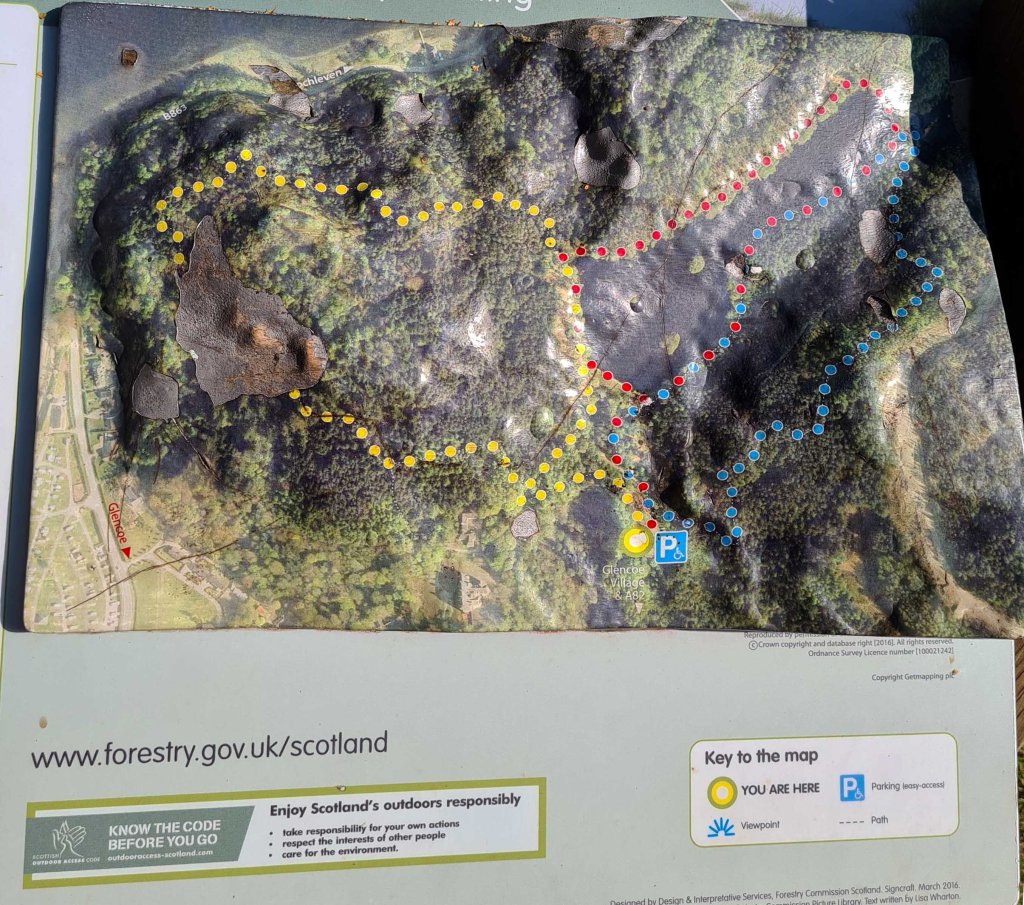
This series of walks around Glencoe Lochan was one of the last we did, but also one of our favourites. The trails start in what is now a well-marked car park, and there are three options. The shortest, and the one that is advertised as being wheelchair and pram accessible, is the red trail.
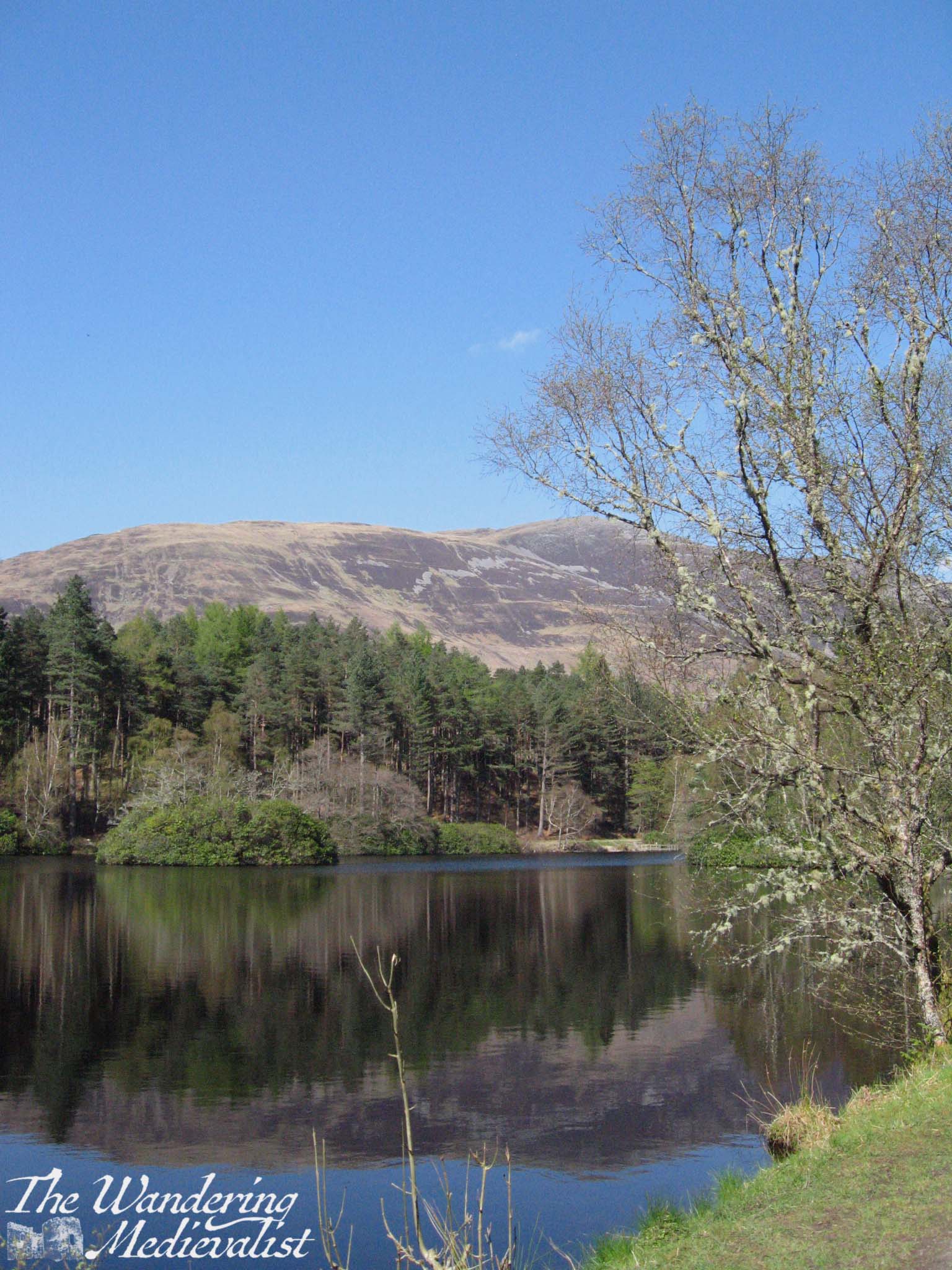
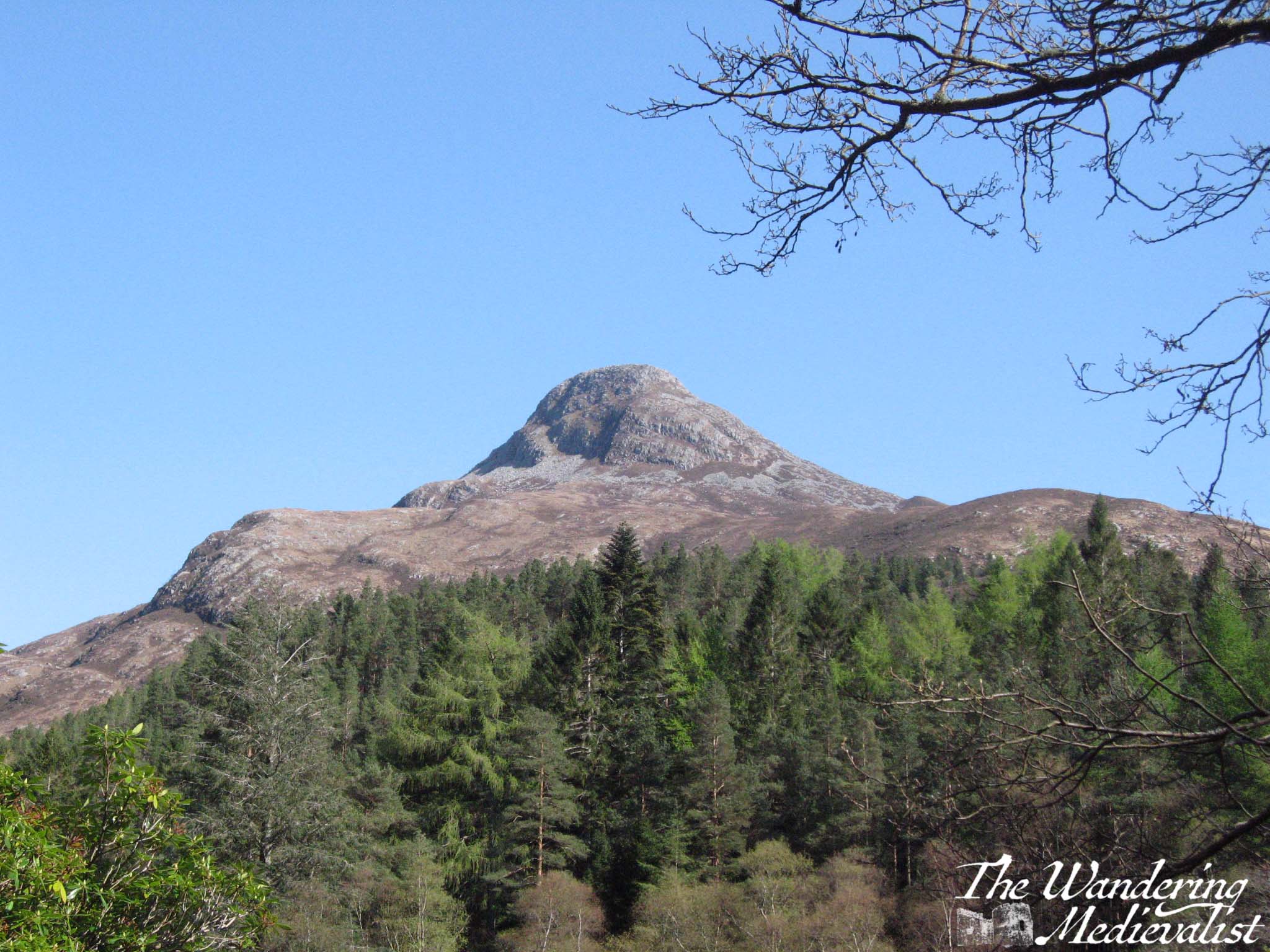
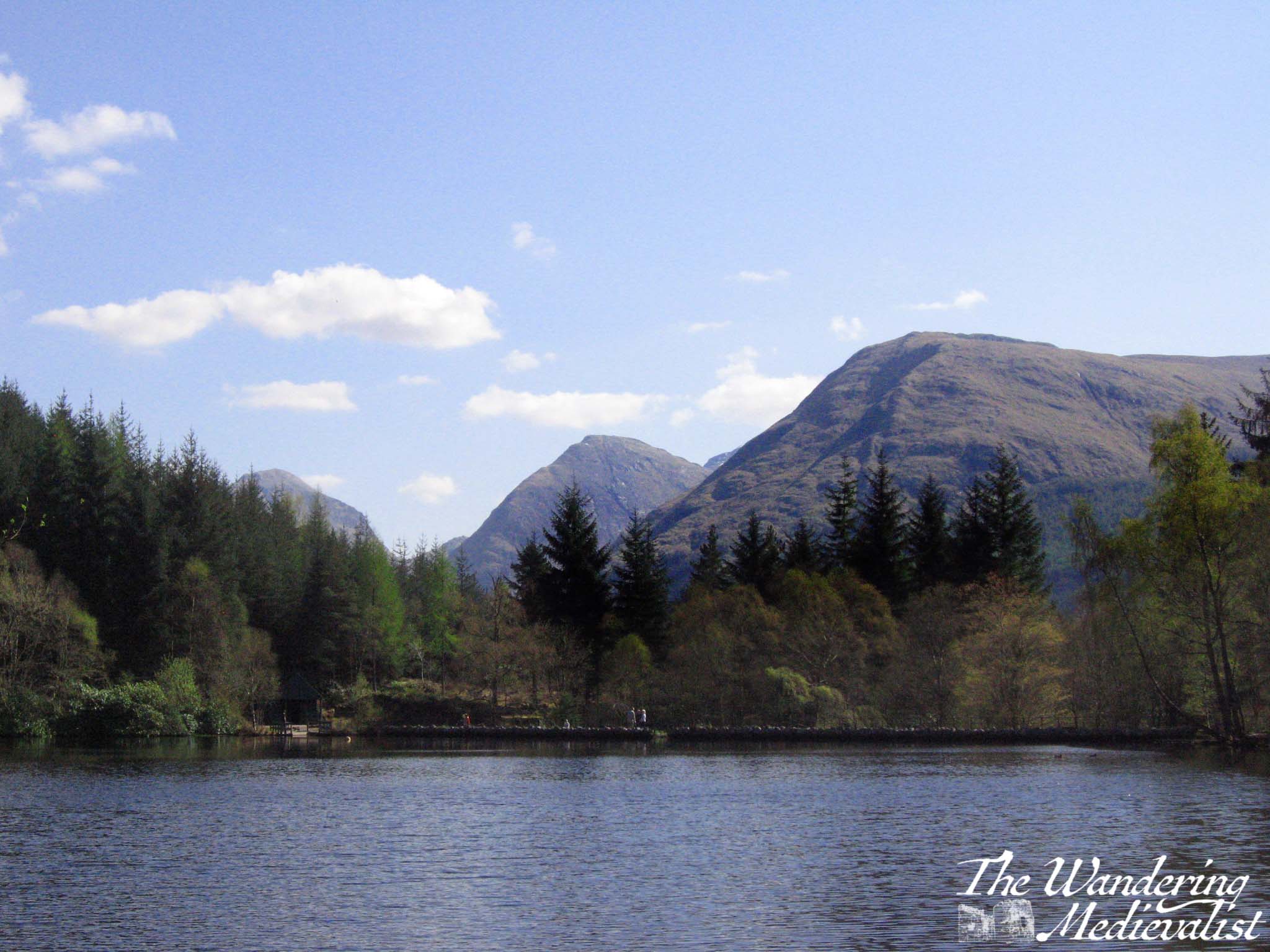
Though the shortest, the red trail is by no means hampered by lack of a view – in fact, as it circles the lochan (small loch), it boasts some of the most spectacular views of the nearby mountains including the Pap of Glencoe (the pointiest hill you see below).
The blue trail is arguably the most challenging as, while not particularly long, it does boast a few very steep bits, both up and down. It also, however, offers a gorgeous path through trees and heather with the mountains just visible in the distance. There are also a few good stopping points with picnic tables and cleared brush so that you can enjoy the view.
The blue trail eventually cuts downhill back towards the lochan, and joins up with the other two; even after the steep climb we were still ready for a bit more exercise so left the red trail to follow the yellow, which is also mostly wooded but includes a few stunning viewpoints out towards Loch Leven and the mountains to the north.
The whole outermost circuit taking in all the trails was just over an hour but could probably be extended if you did the red loop as well. It’s also a great option if you have a member of your party who isn’t particularly mobile, as the red loop is gentle and has plenty of benches to stop for a rest, but still enables one to see the view. Perhaps one of the nicest aspects of this area is how close it is to the village. After the walk, we drove down into the town and were able to stop into the shop for fresh water and a snack, as well as use the very clean public loos – they were not free, but I’m always happy to pay if it means the facilities are clean!
All in all, an absolute must for anyone staying in the Glencoe area!
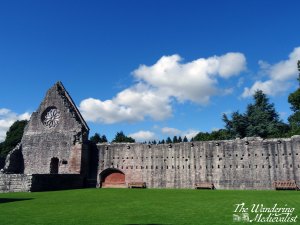
When it comes to border abbeys, Scotland is spoiled for choice. Many of the names echo in my head from years studying history but also reading excerpts of my roommate’s PhD thesis, but until a few years back I had never visited any of them, usually preferring castles. Then in 2017 we were looking for a new place to go for a short weekend away, and eventually settled on Jedburgh, a small but comfortable border town within easy driving distance of most of the major abbey ruins. It was a glorious sunny weekend, and I chose for our daily outing to visit Dryburgh Abbey, for no particular reason other than it was a bit closer than Melrose. I am so pleased I did!
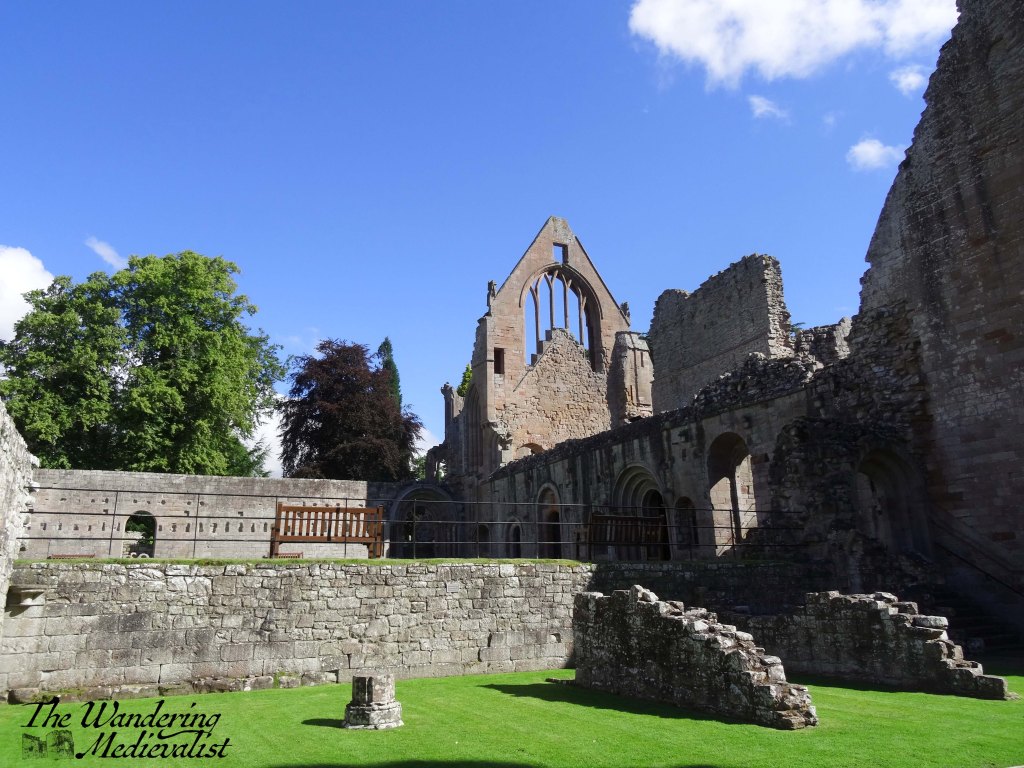
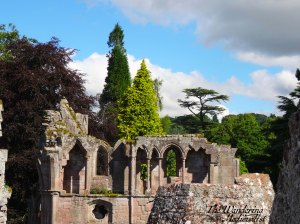
Less well-known and probably less photographed than Melrose, and certainly less complete than nearby Jedburgh, Dryburgh Abbey is situated in a woodland, in a loop of the River Tweed. The trees provide a tranquil surrounding that allows visitors to appreciate the solitude of a monastic life.
Dryburgh was founded in 1150, with the first abbot arriving in 1152, and suffered several attacks over the years, particularly in 1322 by the retreating English army under King Edward II and again by the armies of Richard II in 1385. Several times it rallied, supported by various nobles and bishops of Glasgow and St Andrews, but was finally destroyed in the 1540s.
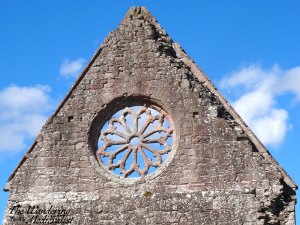
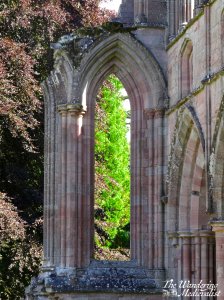
What is left allows for a good sense of the scale of the abbey. The pinkish-red stones are stunning in the sunlight, the shapes of the windows and arches still eye-catching.
There is plenty to be explored and learned, and there is something about the ruins of the perfectly geometrical architecture that is quite moving. If you are making a tour of border abbeys, definitely make sure this one is not forgotten!
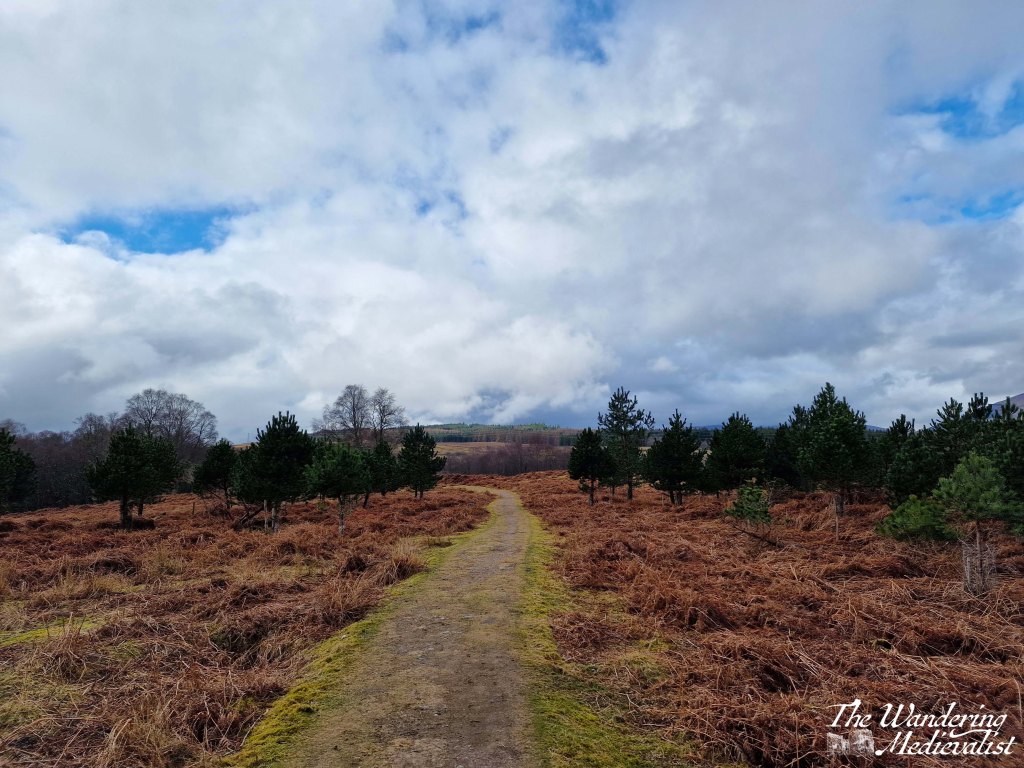
I came across this walk while exploring hikes near Spean Bridge and Fort William, particularly hoping for one that would be scenic but not overly strenuous. As it turns out, this trail was both – around 2 hours in total and with a few inclines but nothing as serious as climbing one of the many nearby Munros. For the record, the website I have found to be most helpful in exploring walking routes is Walkhighlands, which despite its name details walks all over Scotland. In any given location there is usually a range of walks offered, with accurate ratings on difficulty, distance and time, as well as usually quite detailed descriptions of the paths themselves. There are a few occasions on which vague directions have caused uncertainty, but many of the trails on the website are included on signs at the actual location, and are well way-marked.
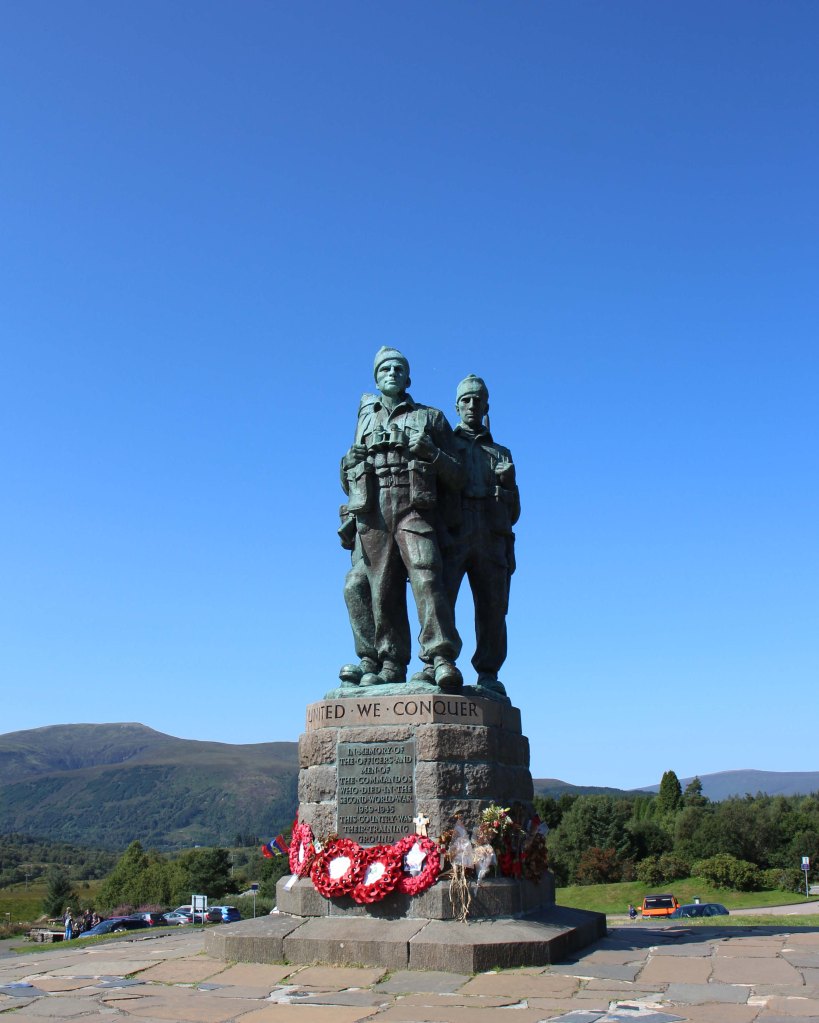
Firstly, the Memorial – it was unveiled in 1952 and is dedicated to the men of the British Commando Forces who trained in nearby Lochaber during World War II.
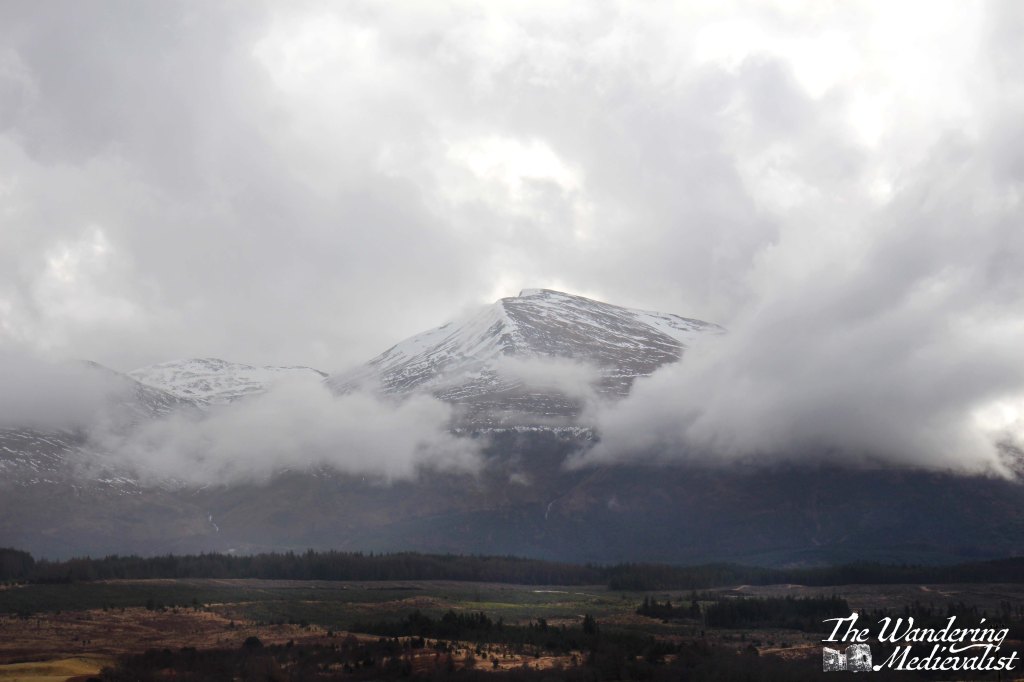
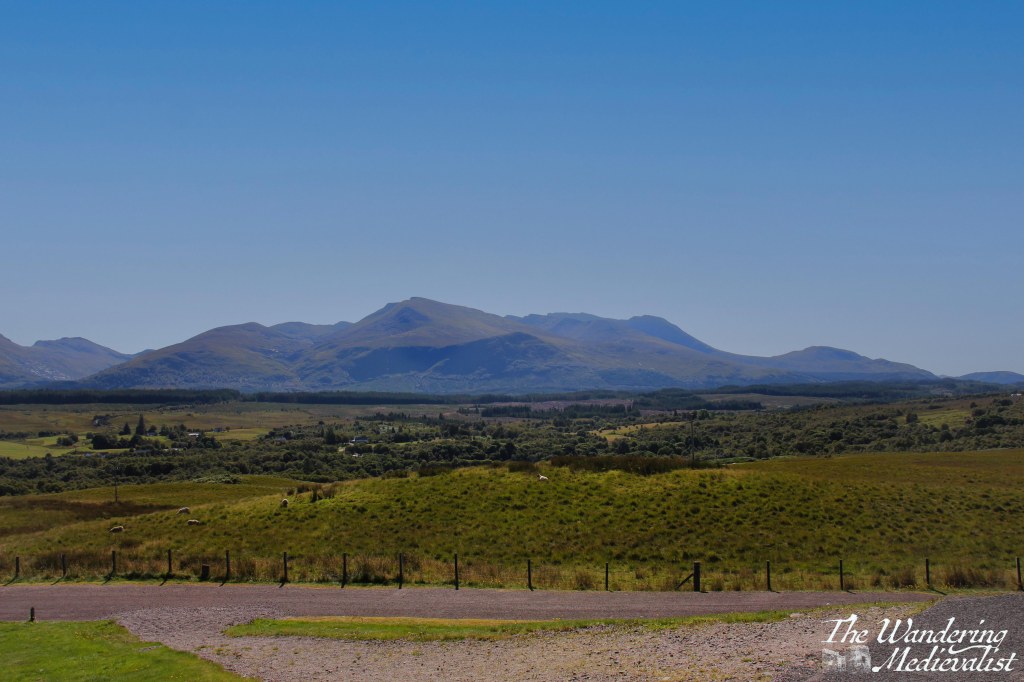
The Memorial stands in one of the most stunning locations in Scotland, with 360-degree views of the mountains – Aonach Mòr, Ben Nevis, and others. I have visited both on a clear day and a cloudy one, and still do not know which view I prefer. It would be a moving spot even without the Memorial, and despite the regular busloads of tourists getting their 2 minutes to take pictures, there is a palpable sense of respect.
The High Bridge walk starts just below the Memorial, down to the right if you are standing looking out at Ben Nevis. One note is that the path described by the Walkhighlands page indicates that walkers should make a loop, with the final stretch of the path following the road that climbs up to the Monument from Spean Bridge. We were not convinced that there was definitely a path alongside the road that would be safe, and so we went back the way we came out, adding probably 30 mins to the walk. As it turns out, there is indeed a path along the road and some hikers may find it more pleasant to hike down the road first, doing the walk in reverse. I think if I did it again, that is the option I would choose.
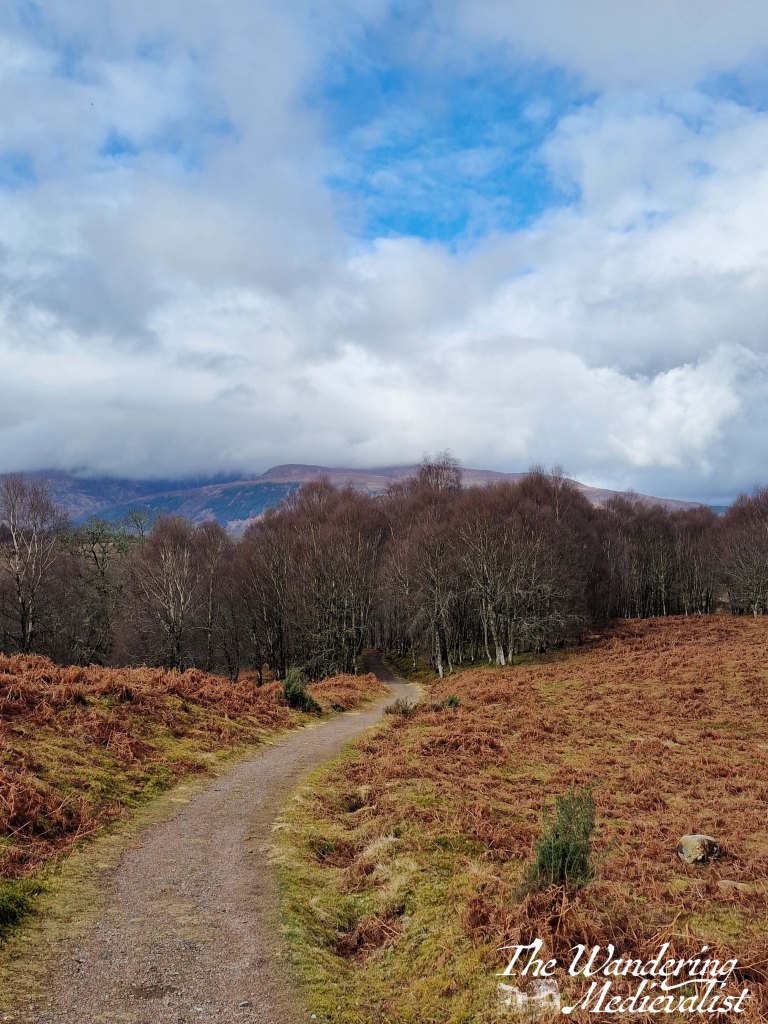
On the day we did this hike, we started at the Monument and followed the clear path along the grassy open plain, avoiding sheep droppings and boggy areas as best we could. At first the path follows the B8004, towards Gairlochy, but eventually swings left and leads gently down the hill towards a stand of birch trees.
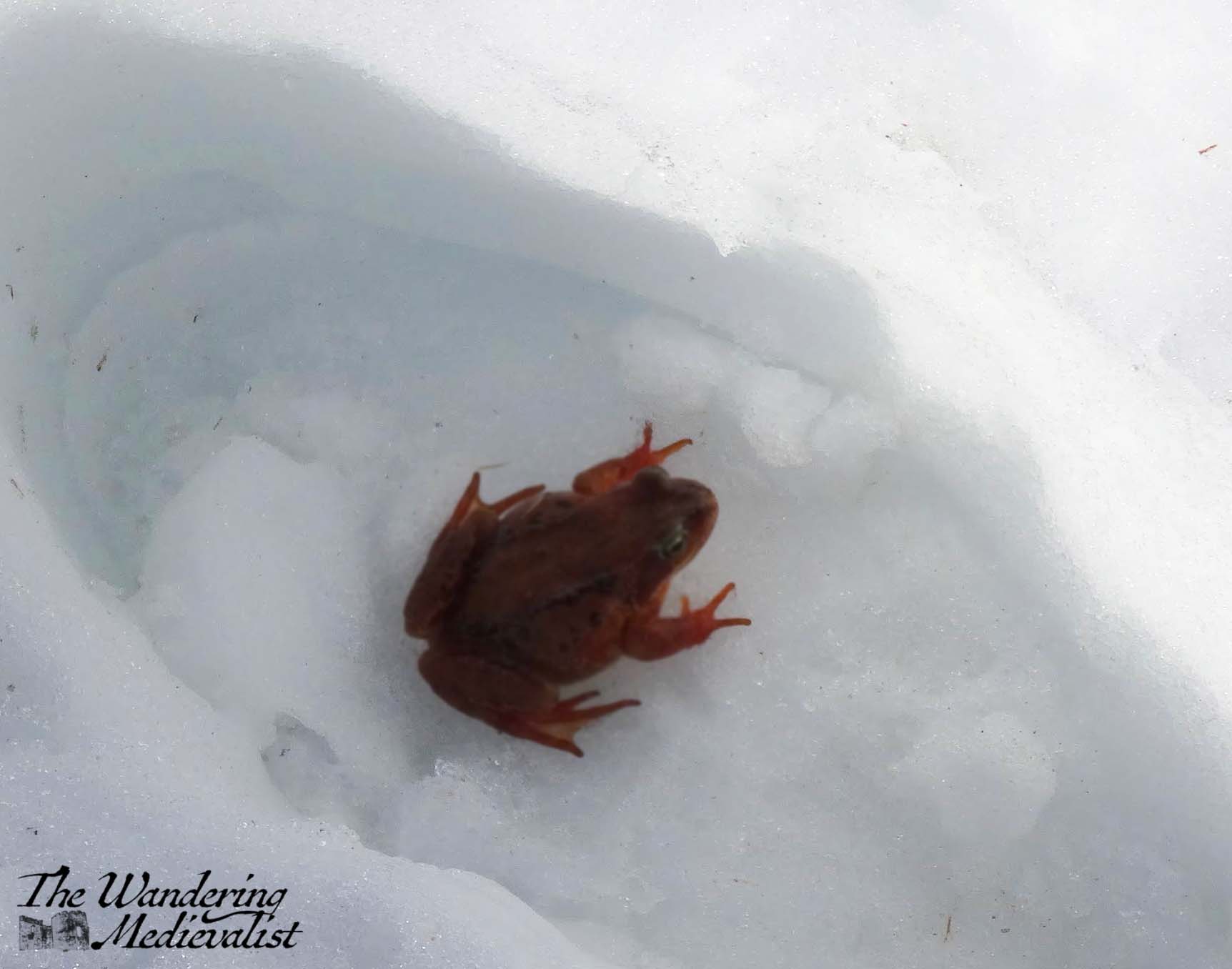
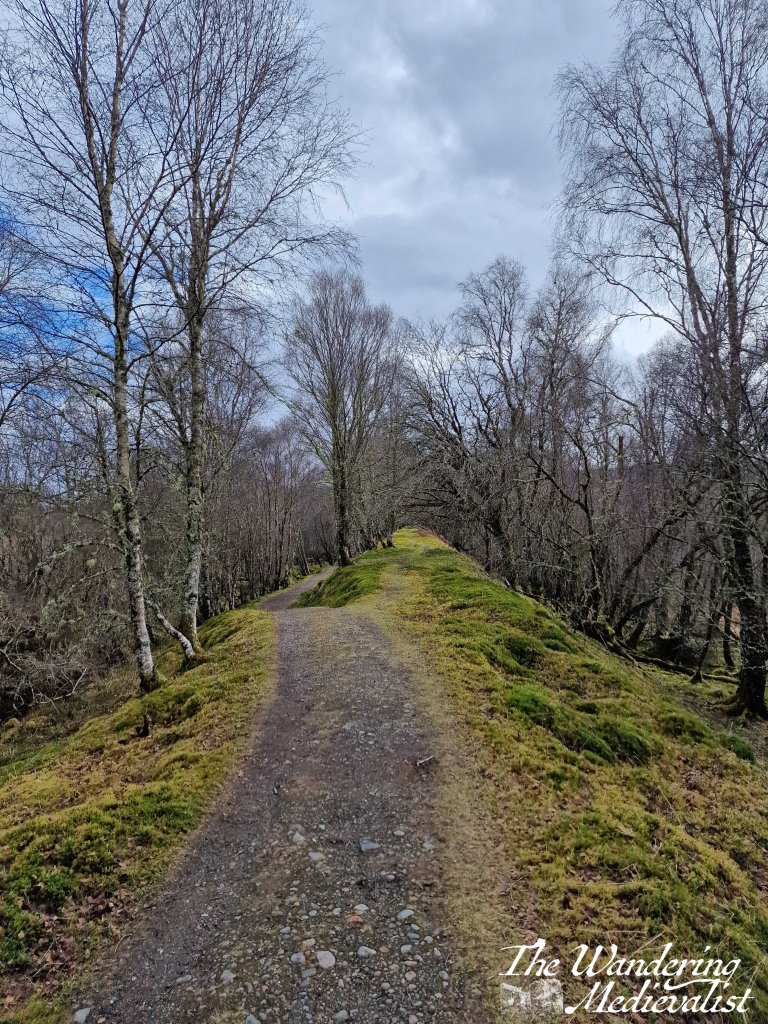
The trail is relatively level as it makes its way through the woods, in some places very straight, and down to the right the river is just visible and audible as it rushes through the ravine. Along the edge of the trail is a ditch where water alternately runs and gathers in pools, and we quickly discovered this water to be absolutely full of frogs and frogspawn – so many frogs that we almost stepped on a few who refused to get off the path. A number of small waterfalls tumble down the hill on either side of the walk.
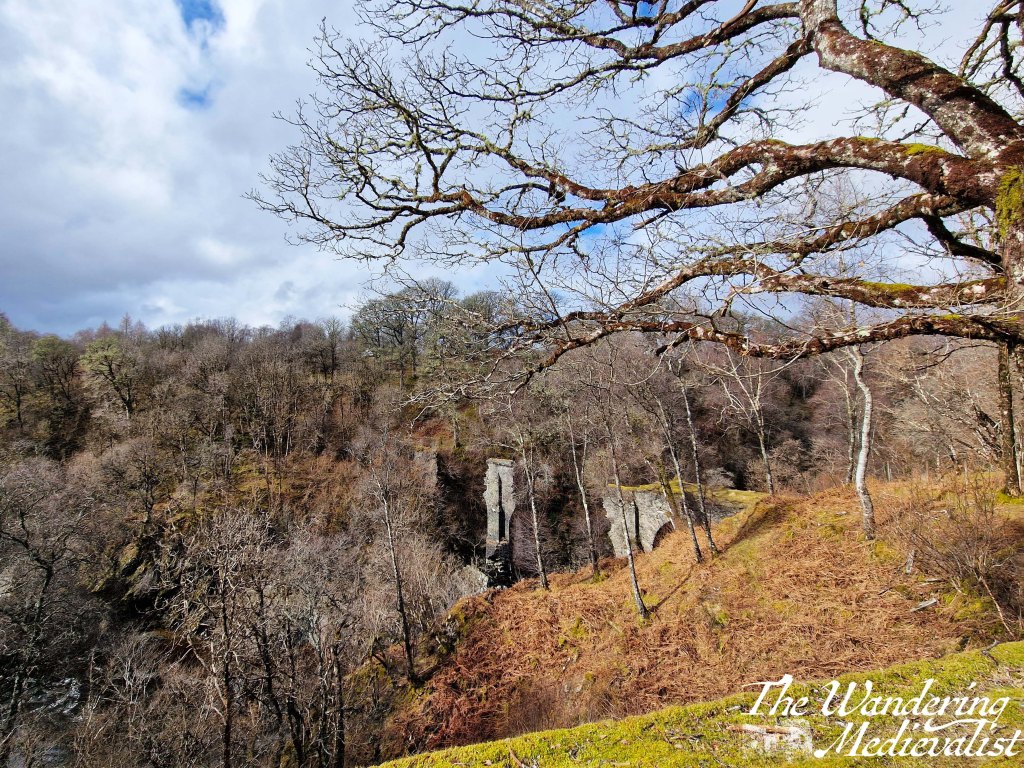
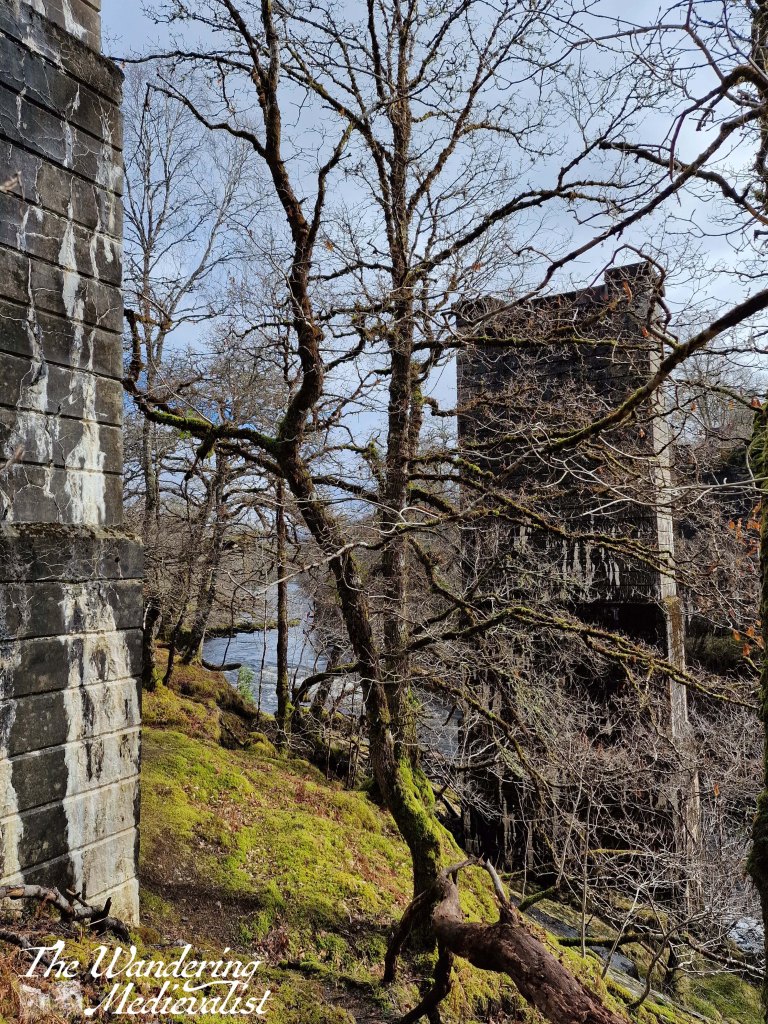
After perhaps 20 minutes, we reached the ruins of the High Bridge, originally built by General Wade in 1736. The bridge was the primary crossing of the River Spean on the military road between Inverness and Fort William, and in August 1745 it was the location of the first shots fired in the Jacobite uprising that would end at the Battle of Culloden the following year.
It is probably difficult to see at certain times of year due to leaf cover, but it was still early enough when we visited to be visible – I think it has an almost Tolkien-like quality about it.
The bridge is by no means the end of the trail, however – instead it continues along the river’s edge – though quite a ways above it – gradually turning towards the left. The trail appears, I believe, to follow an old train line, and eventually you reach a split where you can follow the path slightly higher or down to the left. Whichever option you choose, the trail merges again around the piers of another former bridge.
Veering off to the left, the path continues to follow the river, which is a lovely peaty brown in colour; there are rhododendron bushes along the edge and I imagine we were just a bit early in the year to enjoy their colour.
After crossing several wooden footbridges, the path starts to edge away from the water and heads up towards the road, where it joins after a bit of a climb. Though we did not go up that high, we did find a nice bench to rest on for a bit that would have boasted excellent views back towards Ben Nevis on a clearer day.
Which ever direction of loop one chooses, this is a really lovely woodland walk, not overly strenuous but with enough hill to get the blood moving a bit. I imagine it could be a bit buggy during the summer months, but even in early spring it showed potential for lovely views and colour, particularly the multitude of rhododendron.
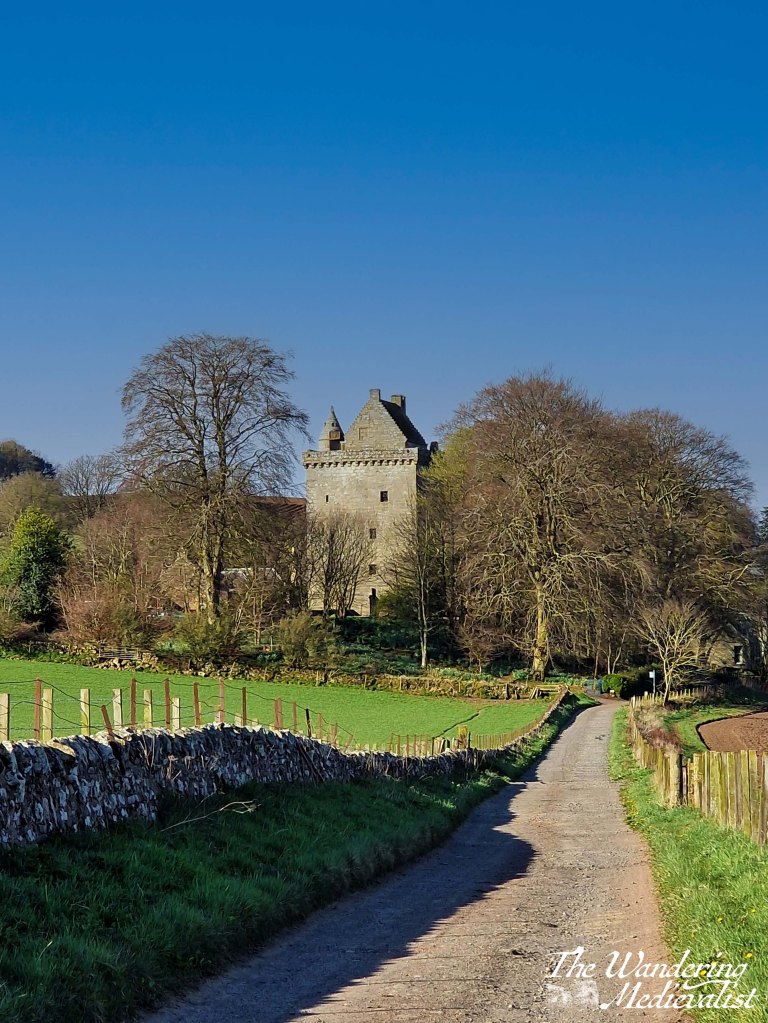
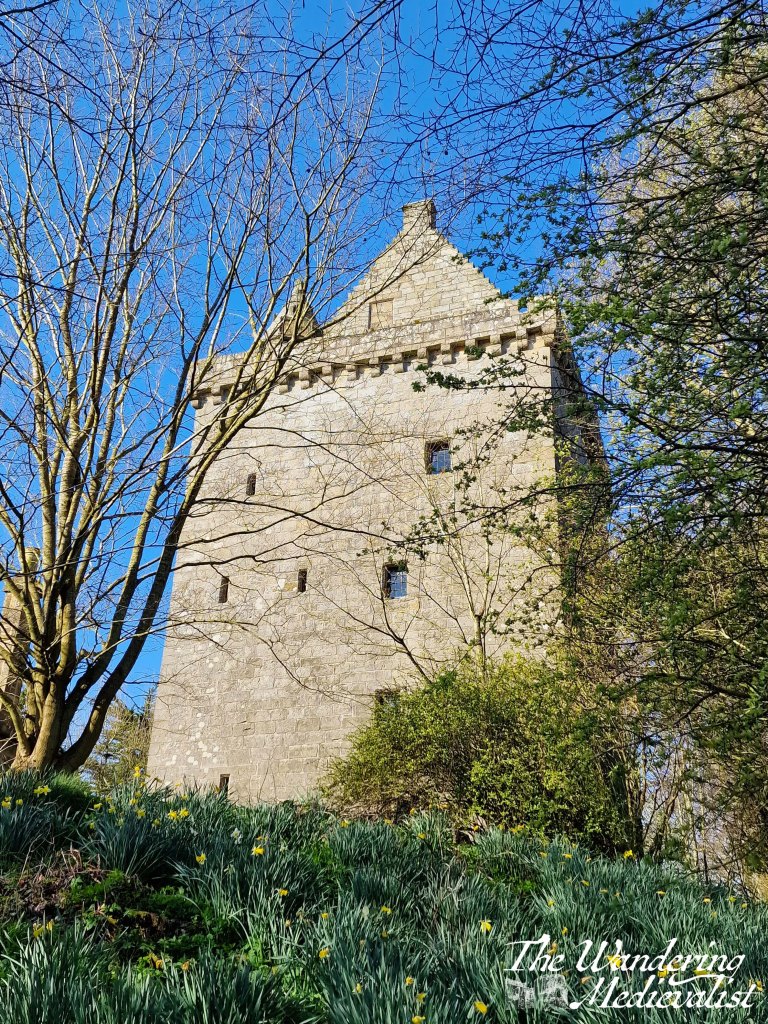
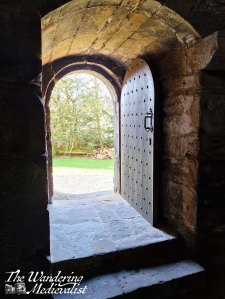
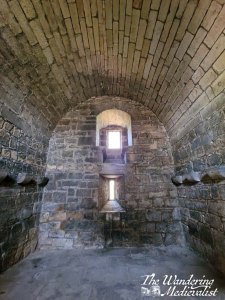
Yesterday was a positively gorgeous sunny day – in the morning anyway – and so I got myself going early to finally explore this tower, which we drove by on our daily commute for years. I had been led to believe that you could not go inside, but was excited to discover that fact had changed. Scotstarvit Tower was likely built in the late 1480s or 90s, by the Inglis family, and was renovated in the early 17th century to the form seen today. A true tower, it has one large room on each floor, connected by a spiral staircase, though there are small ‘closet’-type rooms built into the wall in places.
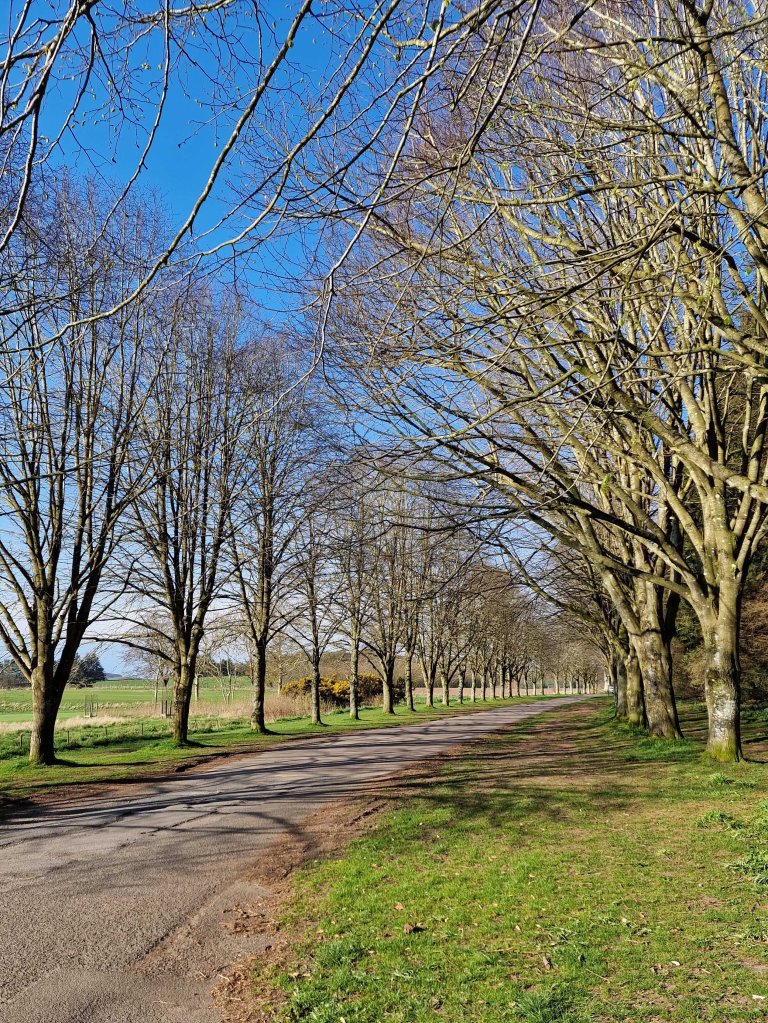
Scotstarvit Tower sits about half a mile off the road linking Craigrothie to Cupar. You cannot drive to it, but instead can find easy parking at the nearby National Trust property, the Hill of Tarvit mansion house. Parking is £3, and from the parking lot, I walked back towards the main road along a lovely tree tunnel.
Along the left of the path there are views through the trees up to the Hill of Tarvit monument, and to the right is the lovely green rolling expanse of the historic Kingarrock Hickory Golf course.
Eventually I reached the main entrance to the property, and the A916. Cars come incredibly fast along this road in both directions, but I was able to scamper across and to the safety of the farm track which is only accessible via vehicle to residents. Along the track, there are lovely views out to the right towards the Lomond Hills, and eventually back towards Cupar.
farm trackview towards the Lomonds
After a short walk, there is a path up to the left, lined with daffodils, and a small sign indicates that is the way to go. I found myself a bit hesitant at first as the path to the tower takes you quite close to a private home, but it was well worth the exploration.
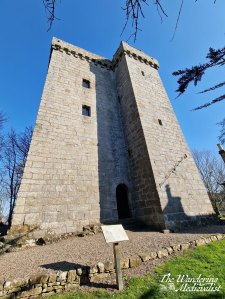
I was delighted to find, as I approached, that the front door to the tower was open, and the interior was quiet but light and well-maintained. I climbed to the staircase, which comes to an end in the little funnel-shaped room on top of tower. Perhaps understandably, the public is not currently able to wander the rooftop. It is also likely that there were outbuildings at some point, and there is evidence of an extension at ground level.
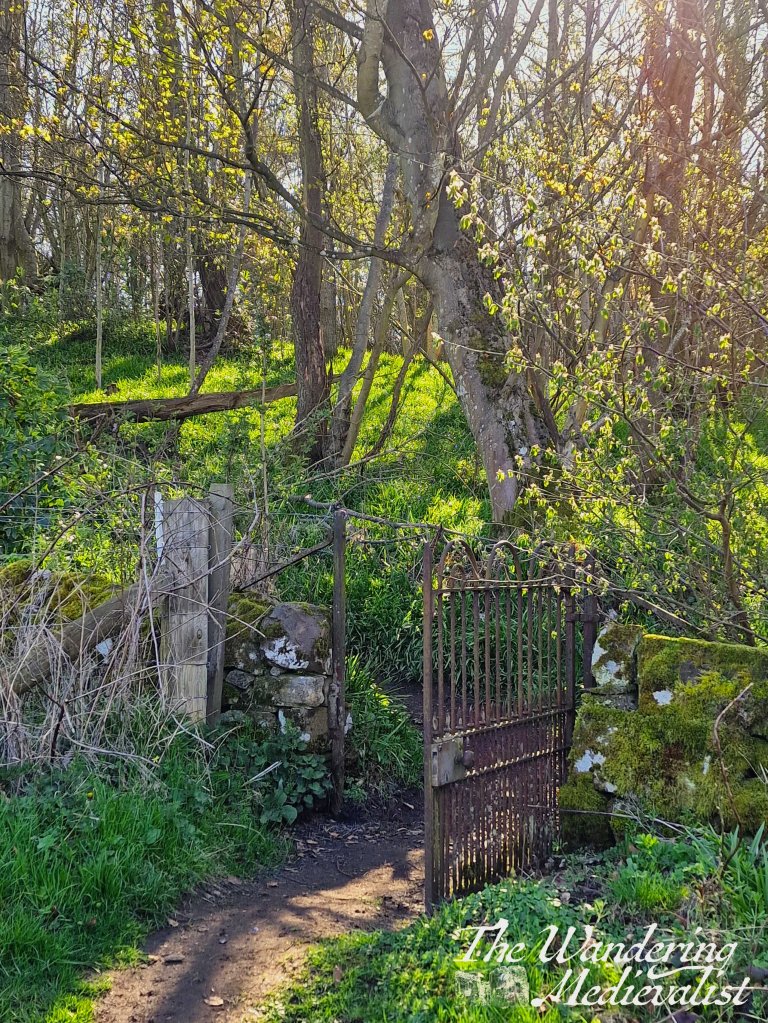
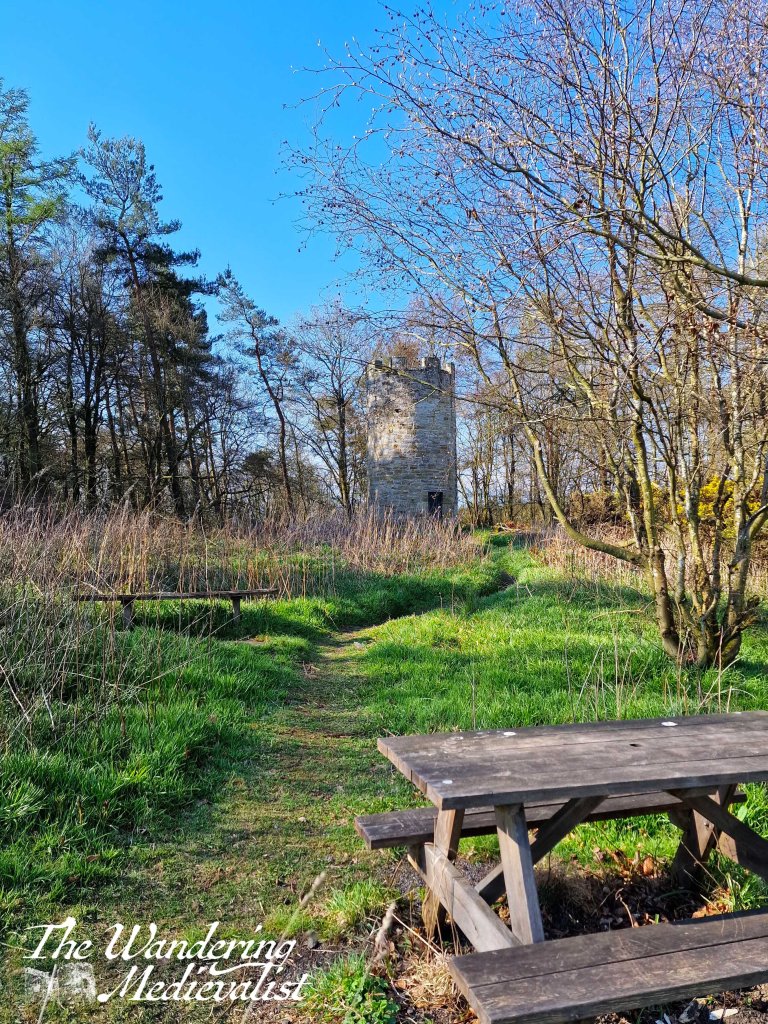
Once I had my fill of the tower, I made my way back towards the car, but I found myself distracted by another path off to the right, running along the edge of the golf course. It seemed to lead in the Craigrothie direction, and I decided I needed a few more steps so made my way through a gate and towards a nearby hill. There is a lovely old iron gate leading to a smaller path that eventually climbs up to an impressive doocot, designed to look like a medieval tower. A picnic table and slightly deteriorated wooden bench are situated perfectly to allow one to enjoy the view back towards the Hill of Tarvit mansion house. While the extra short walk is by no means required as part of the visit to the tower, it was definitely worth the effort.
West Sands in St Andrews is a destination beach for many reasons, and it never disappoints. A close friend of mine walks the beach almost every day, and he agrees that it never looks exactly the same. The beach is well-known as the location for the opening scene in Chariots of Fire (check it out here, starting about 2 mins in to really see the beach), and for running alongside the world-famous Old and New Courses.
It is also a stunningly preserved (with much work done by the Joint Nature Conservation Committee and Fife Coast and Countryside Trust) example of coastal dunes, which are immensely important defences against erosion and are a protected area. For locals, the beach is a popular walk location for families with children, dogs, horses and everyone else – particularly University students looking to de-stress with a pick-up game, jog, or mind-clearing walk. It is about two miles in one direction, and can seem quite quick when you are walking with the wind – just be aware that walking into the wind is a much harder option. And yes, it is almost always windy.
For most, the walk will start only steps away from the Royal Golf Museum and the Bruce Embankment Car Park (not free). There is a recently refurbished toilet block available, and a bit further on a dog-friendly café, Dook, open 9-5 currently (‘dook’ being a Scottish word for a quick dip or bathe).
There are two options available for walkers: you can start off following the road behind the dunes, and choose one of the many paths that branch off to the right leading to the beach. It is possible to follow the road the whole way out to the end, where there is a small car park, but walkers beware that the pedestrian path ends probably less than a mile along. Alternatively, you can just stick to the beach. At low tide you can walk quite a way out, but at high tide you are quite constricted to a small section of beach – there is about a 5m difference between high and low tide, or 16 ft.
Whichever option you choose, prepare for wind! And bring your camera – West Sands really is one of the more stunning beaches I have ever seen, and it is almost impossible not to take another picture, even if one already has 100s.
It would be remiss of me not to also point out the potential dangers in getting carried away with your walk. The end of the beach eventually curves around the corner, as the North Sea meets the Eden Estuary, and here the tides can move incredibly fast. It is very easy to get caught out, and so it is recommended that walkers be very cautious around this point. You can in fact cut back up to the car park here and walk along a small access road which takes you another 15 minutes or so out to a viewing platform. This platform offers birdwatching guidance as well as stunning views back across the golf courses towards town, or in the other direction across the water to Leuchars base and Tentsmuir Forest. This end of the beach is quite popular for bird-watchers as well as walkers.
While the beach is no doubt stunning in the middle of a sunny day, the evening hours are what I love the most, as you can see below!