It’s been a while since I posted about something purely medieval, and so today seemed a good opportunity to do so, talking about one of my favourite English towns.
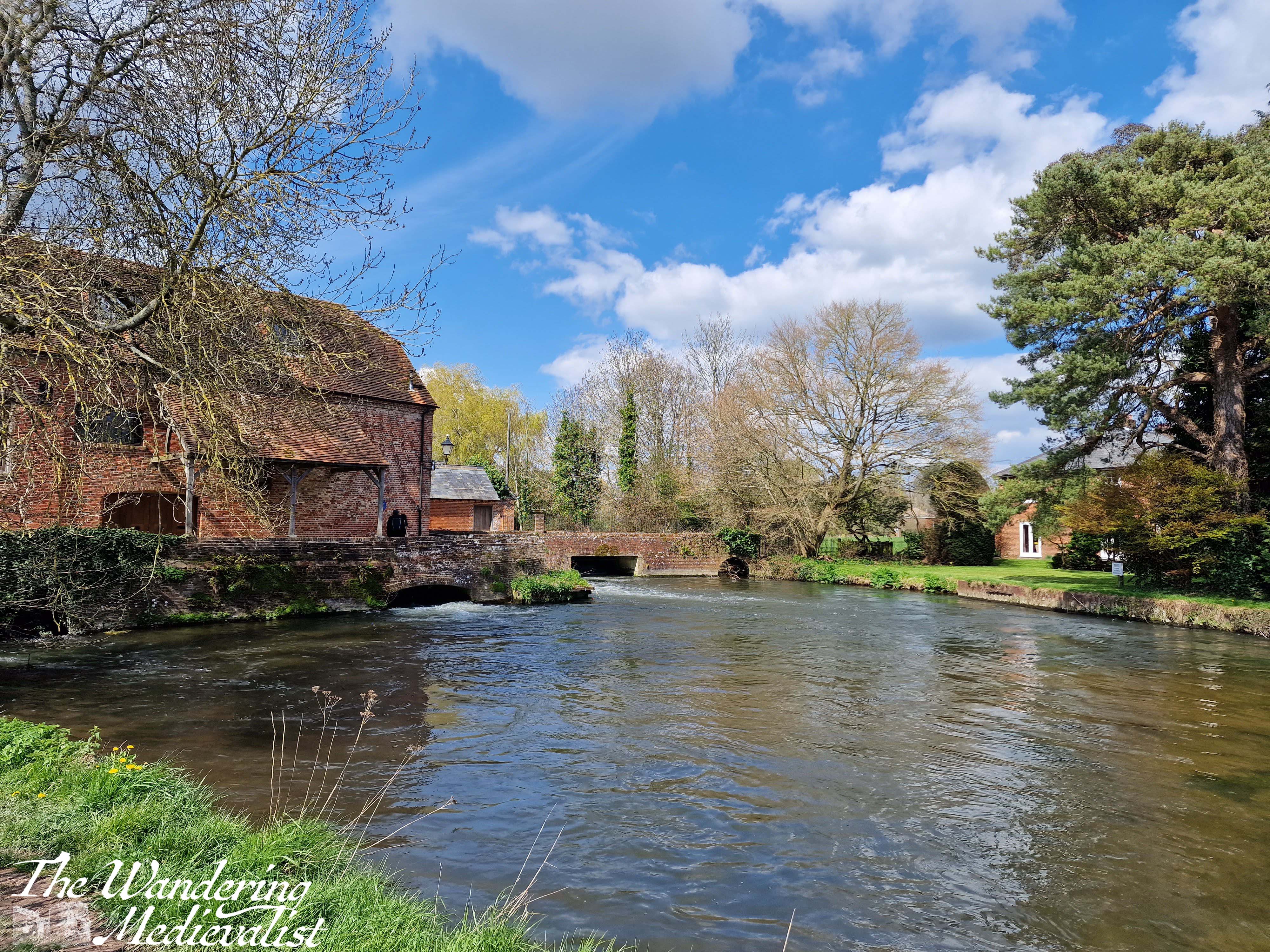
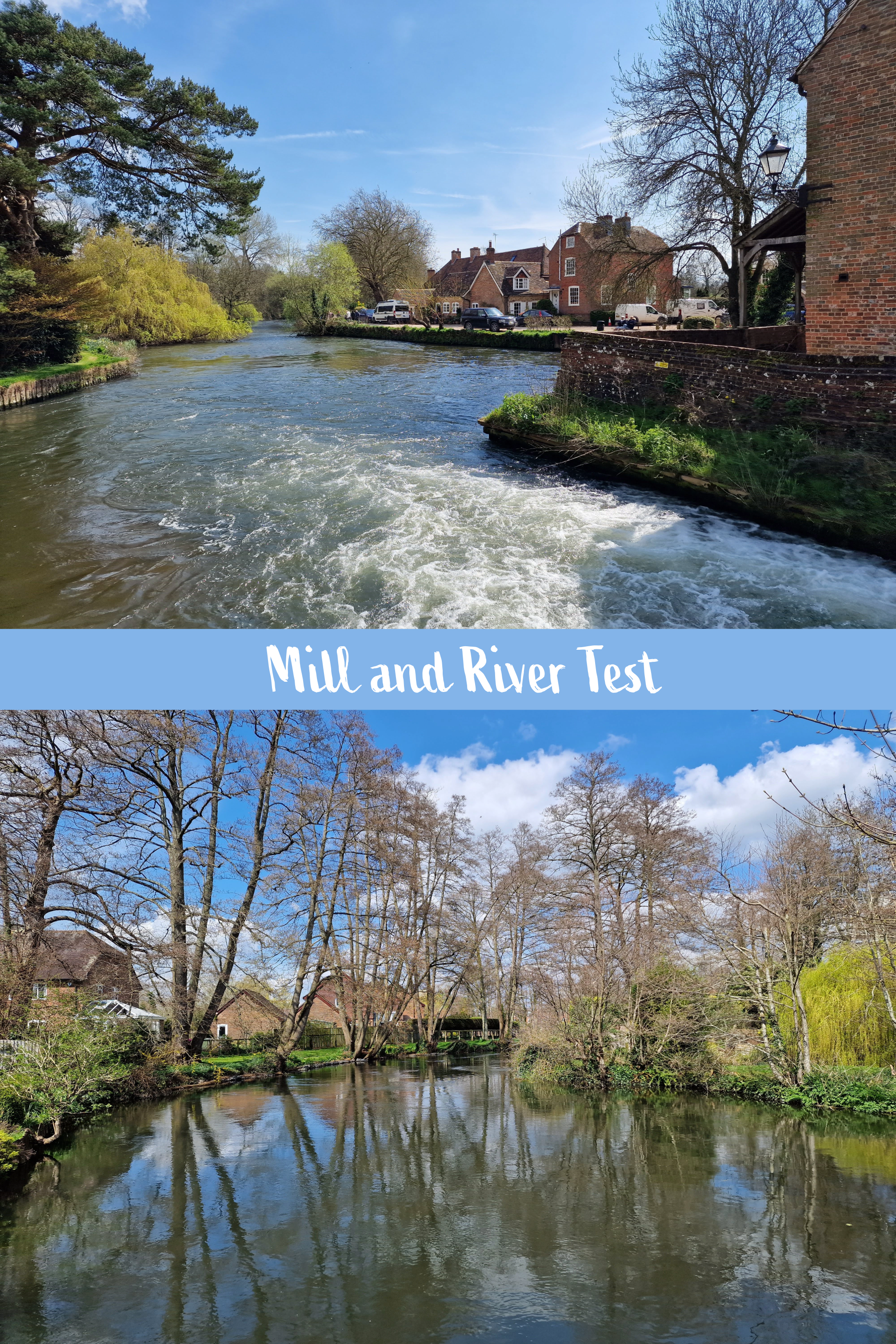
Romsey is a charming, well-to-do town about 7 miles from Southampton Airport, in the south of England. The town centre offers a mix of lovely shops, restaurants and pubs on winding streets and lined with Tudor-style frontages. The River Test flows through the community and some stunning parks, and past a picturesque old mill. The history in the town is more than evident; founded as far back as the 8th century, Romsey was a medieval market town that grew around the founding of the first church by King Edward the Elder in 907 CE.
Our connection to Romsey comes through some close friends who settled there some time ago, and who we try to visit at least once a year. The abbey is a required detour on our walks through the town, and I recall one relaxing morning in particular sitting under the trees with a cinnamon bun and coffee, enjoying the view.
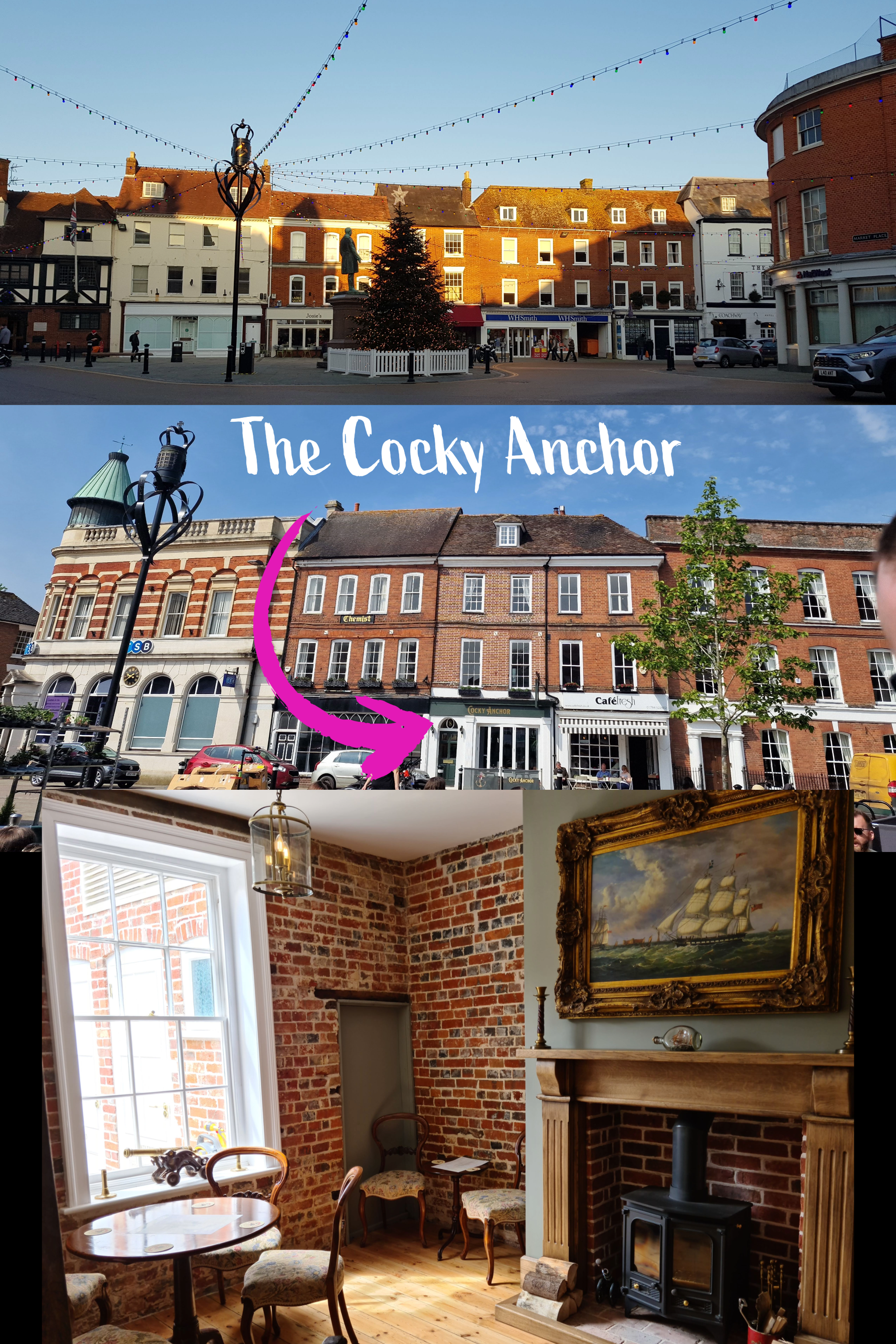
I also have fond memories of visiting the nearby pub the Cocky Anchor in summer 2021 – my first holiday after the end of lockdown – where the back beer garden offered great views of the abbey church.
The pub is just off the nearby market square, from which you have easy access to the abbey, along Church Street and down Church place.
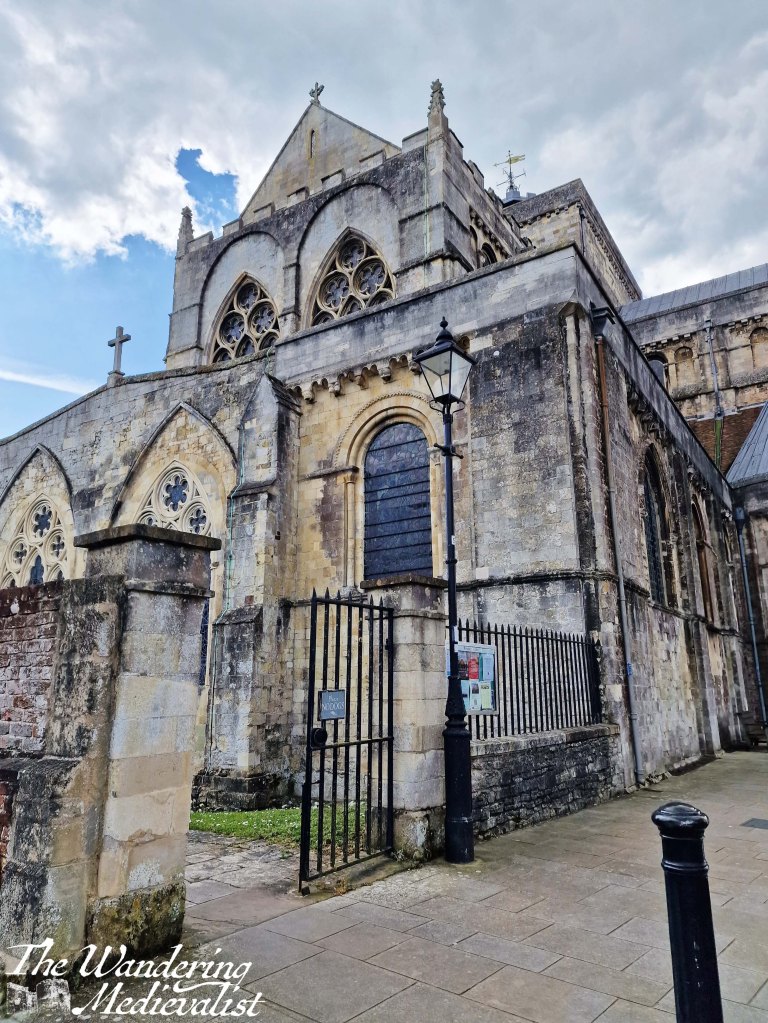
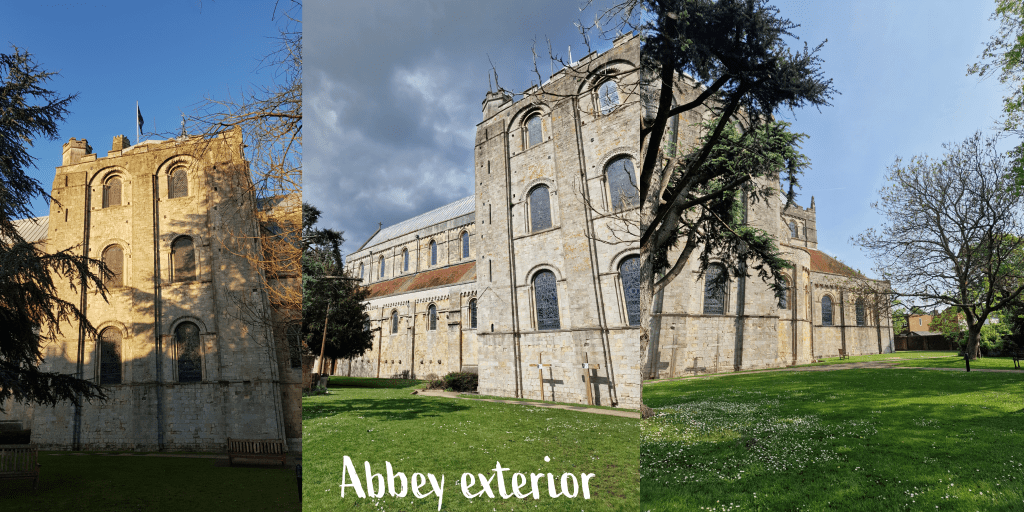
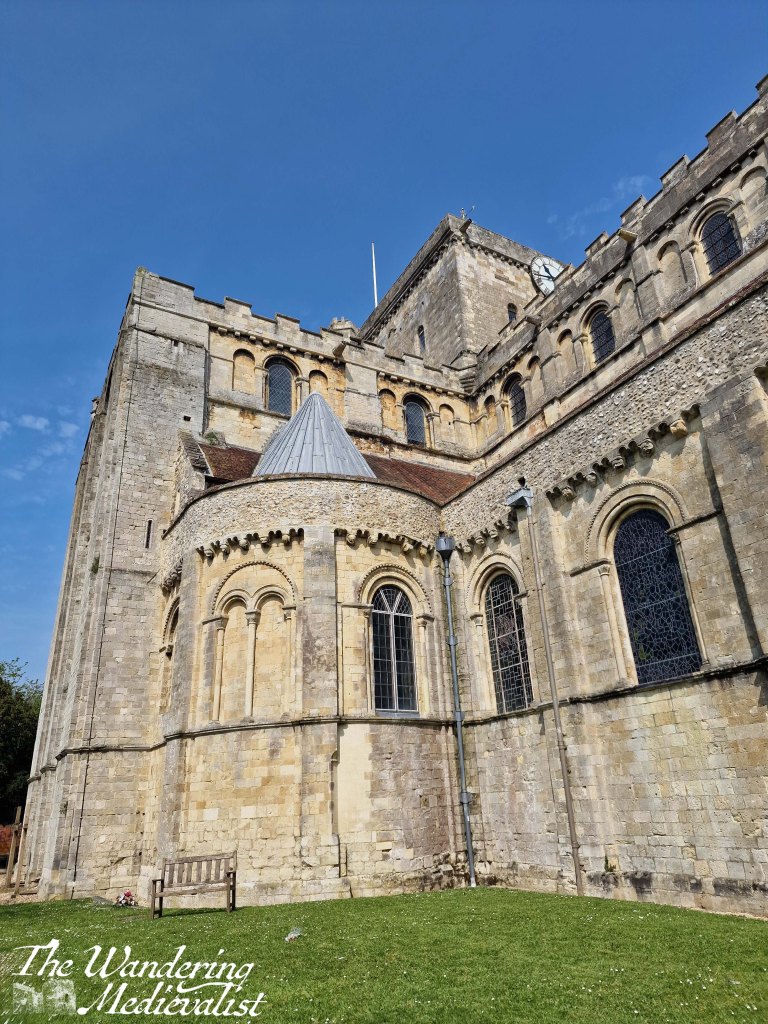
A visit to the abbey does not take particularly long, as you can walk around the outside in less than 5 minutes, unless like me you enjoy a much slower wander to take in the view. We always start off heading down Church Place, where the first view you see is this one, the east end of the church.
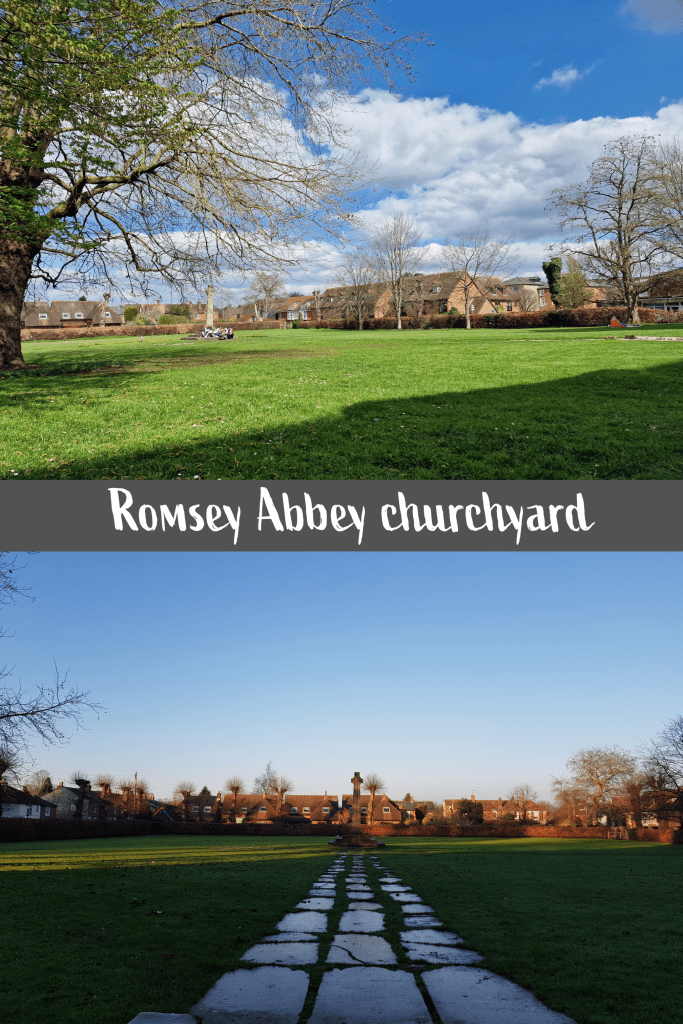
To the right of the path is the churchyard, which was the burial ground attached to the abbey. There are several memorials including a large cross and a Waterloo memorial, though the majority of the monuments were removed when the yard was cleared and levelled in the 1940s. The reasons for this appears to be safety-related, as the area had become very uneven and dangerous to traverse, and many of the stones were re-purposed to create a path.
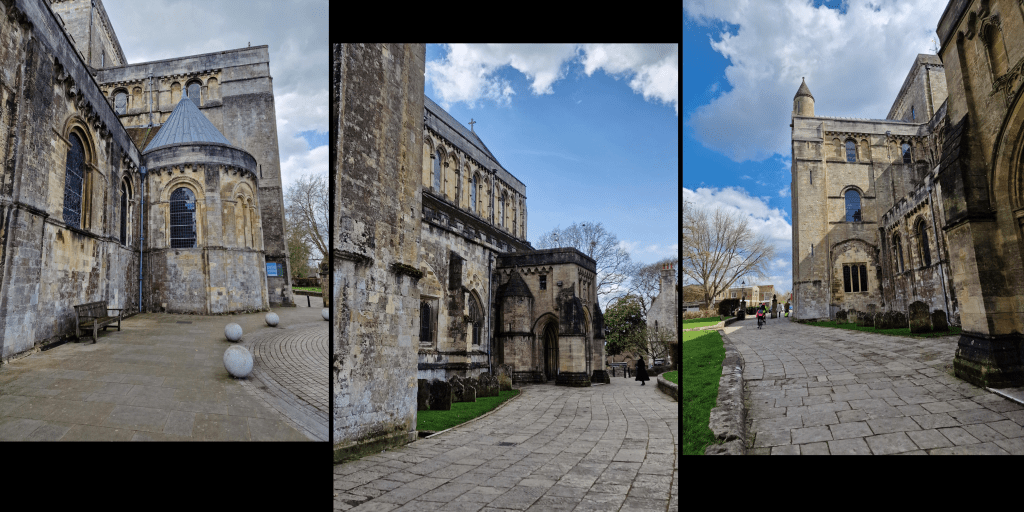
North side of the abbey church
Ahead at the edge of the churchyard is Folly House, the former vicarage, now a beautiful residence. From here you could go in either direction down Church Lane or a street creatively called ‘the Abbey’ to enjoy more of the stunning houses and gardens of Romsey’s town centre.
Folly House, former vicarage
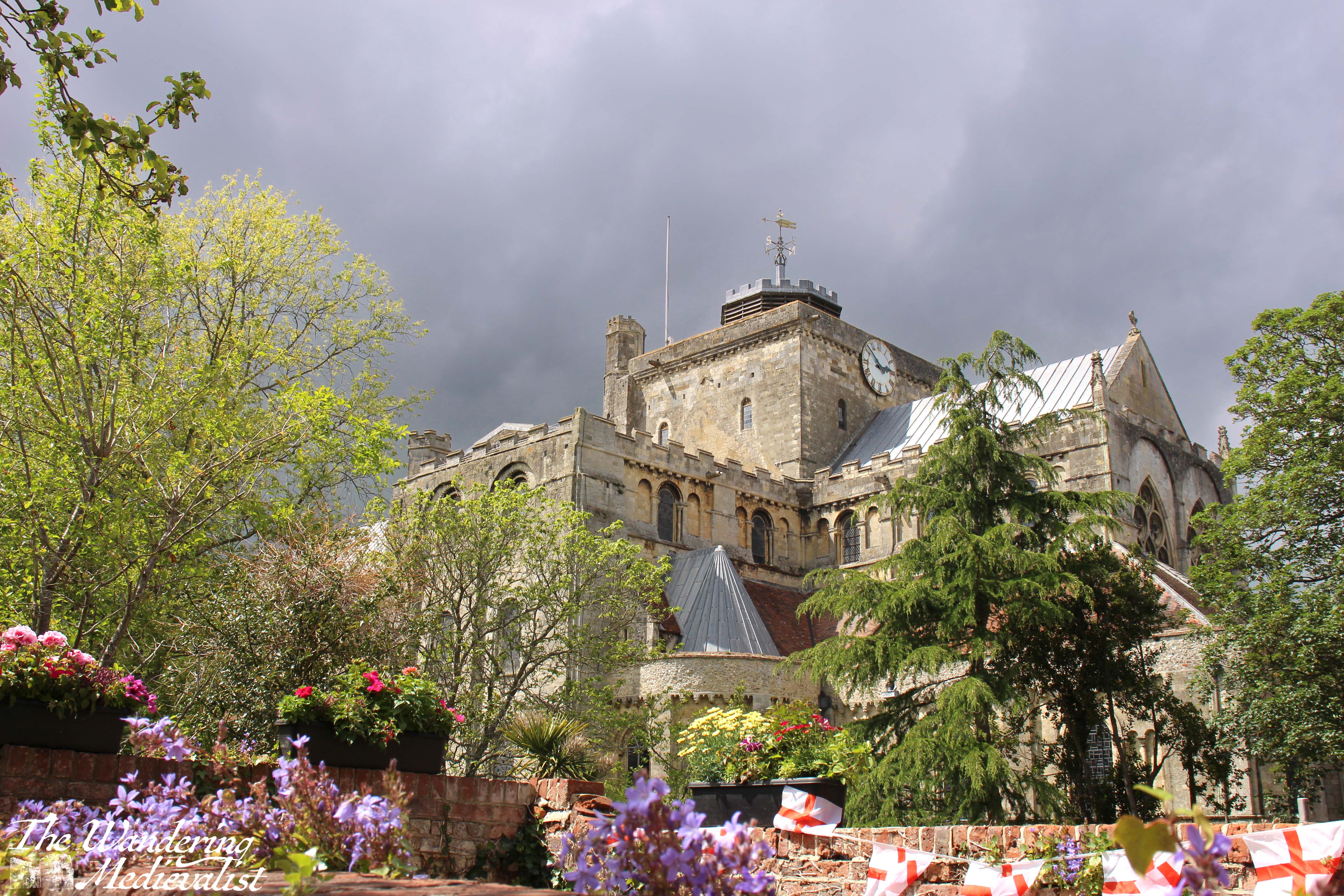
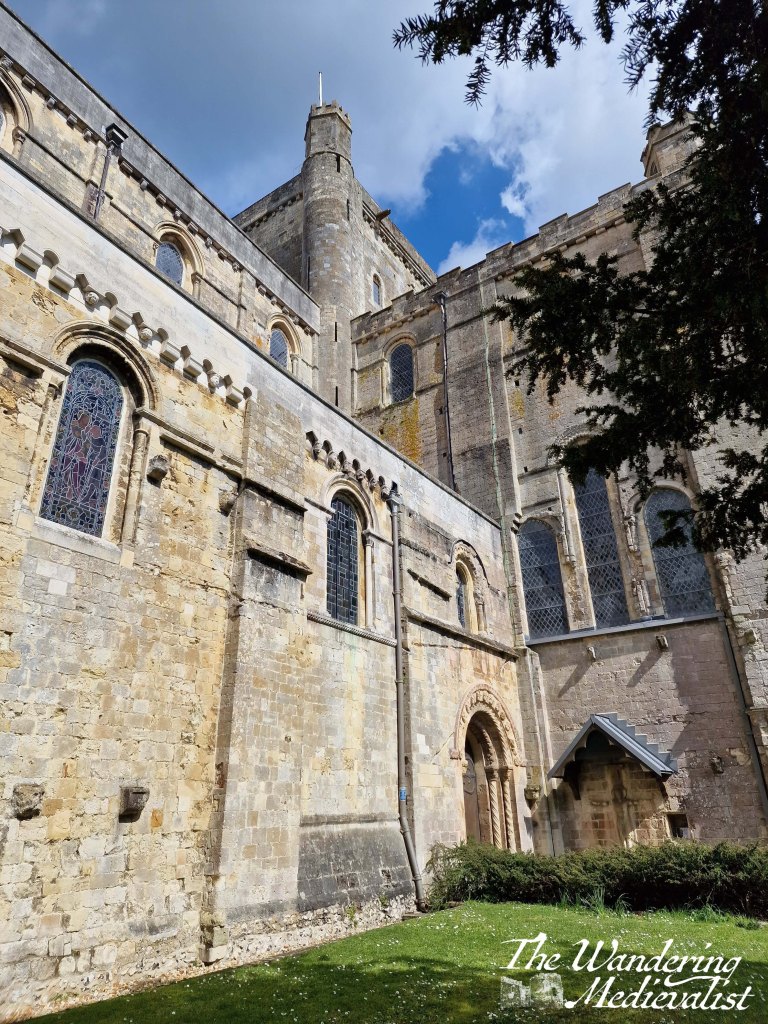
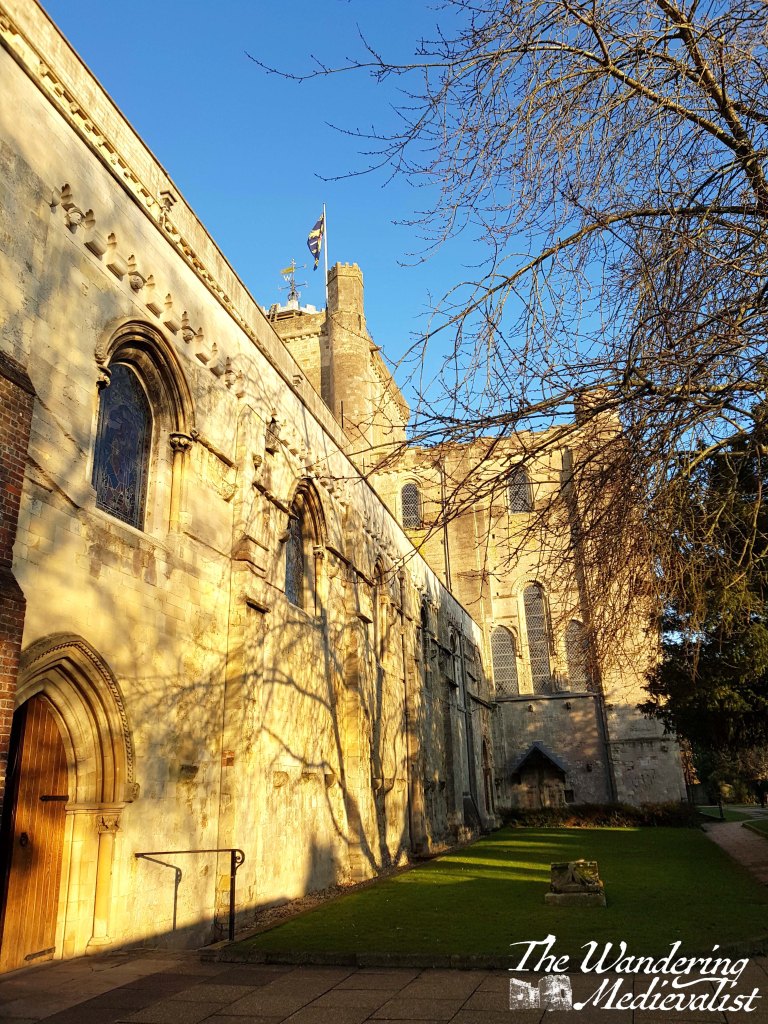
Continuing counter-clockwise around the church takes you to one of my favourite views, looking along the outside wall and up to the central tower – in all fairness, this diagonal view looking from the base of a church up to the tower is my favourite view of any ecclesiastical building. We come this way almost every time we visit Romsey, yet I find it impossible not to get another version, in different light of course…
On this south side of the church is a small park with shady trees, where we enjoyed the breakfast mentioned above.
This seems a good time to go into a bit more detail about the history of the abbey. As mentioned above, it was founded in 907 and Elflaeda, the daughter of the king, was put in charge of the community, beginning a long line of royal abbesses and nuns. In 967, the abbey was re-founded in the Benedictine order by King Edgar, also known as Edgar the Peacemaker or Peaceable. The first stone nunnery and church were built around the turn of the millennium, and the abbey flourished as a place of education and safety particularly for noble and royal daughters.
The abbey was sacked in 1003 by the Danes, likely in retaliation for the St Brice’s Day Massacre. This massacre had taken place on 13 November 1002, when King Æthelred (often referred to as the Unready) had ordered the killing of all the Danes living in England at the time. The chronicles of the time indicate that it was retaliation for an assassination attempt, though it may also have been retaliation for the years of raids by Danish forces.
Following the sacking of the abbey, in the 1120s work began on the current building. This was during the reign of King Henry I and work continued under the supervision of Henry of Blois. Blois was the brother of Henry I’s successor, Stephen, whose daughter Marie was elected abbess in 1155.
Marie’s story is one of those tragic female tales of the Middle Ages that make one realise that royal women had it just as hard – if not sometimes harder – than others.
Her father King Stephen died in 1154 and then her last living brother, William, passed in 1159. On his death, she became suo jure Countess of Boulogne (essentially, countess in her own right, meaning the title was hers by birth and not marriage). Despite her position as abbess, Marie was abducted by the son of the Count of Flanders and forced into marriage. Eventually, after giving birth to several daughters, she found her marriage annulled and was permitted to return to the cloister for the last years of her life – though not to Romsey. I wish this was an unusual tale to find in the Middle Ages, but it goes without saying that it was a difficult time to be a woman, at any level of society.
Back to the abbey. The last three arches of the church, designed in an early English style, were added in the 1230s, by which time over 100 nuns were part of the community. The abbey would continue to prosper until the decimation of the population by the Black Death in the late 1340s; 80% of the nuns are reported to have died, including the Abbess, and from this point on the number of nuns remained much smaller – less than 30. Nevertheless, the abbey remained an important part of local life, functioning as a center of prayer and charity.
Unlike some less fortunate establishments, the abbey survived the dissolution of the monasteries under Henry VIII due to the petition of four Guardians, who purchased the abbey for £100. The nuns were dispersed, but the community continued to worship in the surviving buildings.
It is still a working church to this day, with Sunday services.
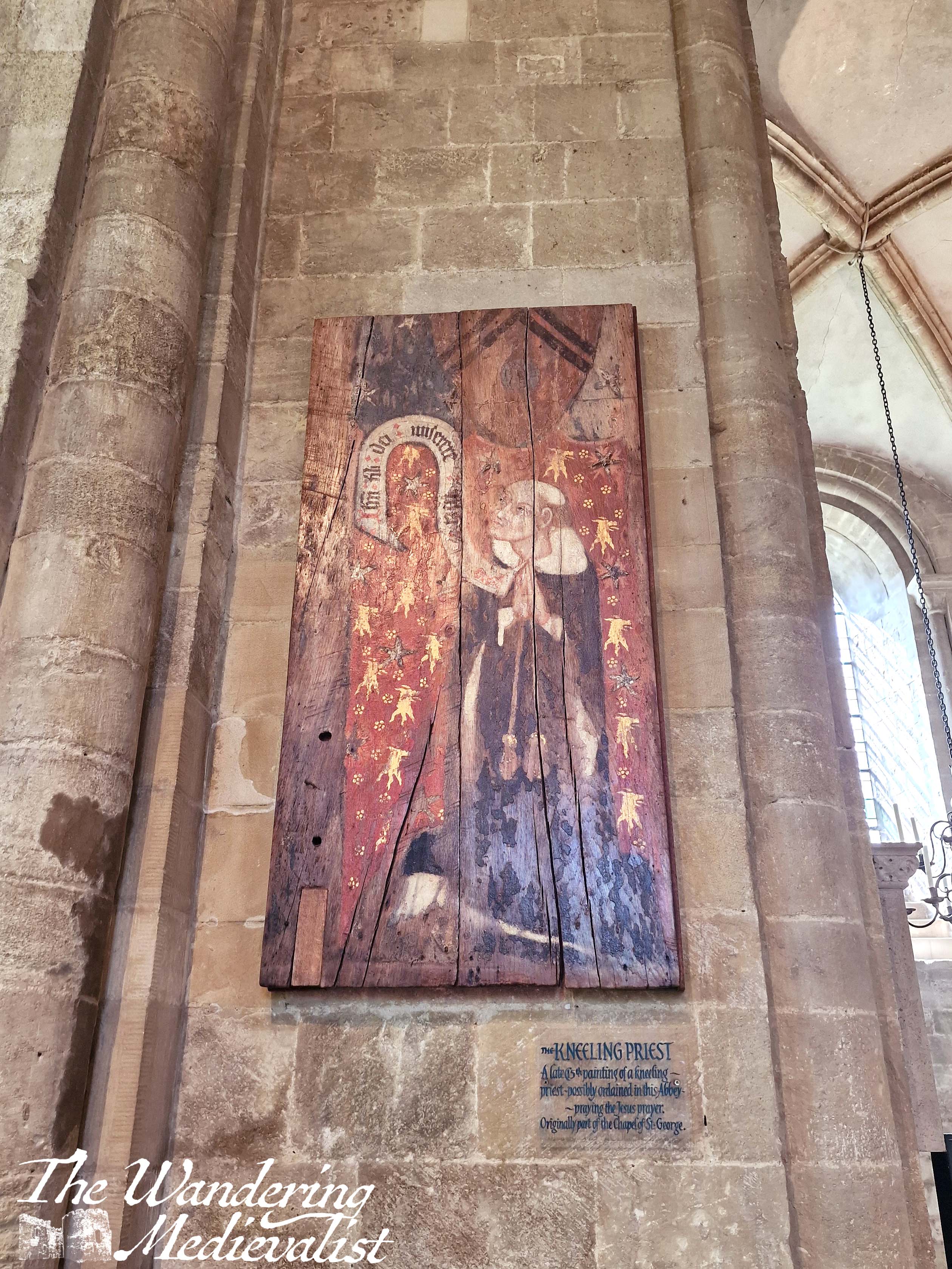
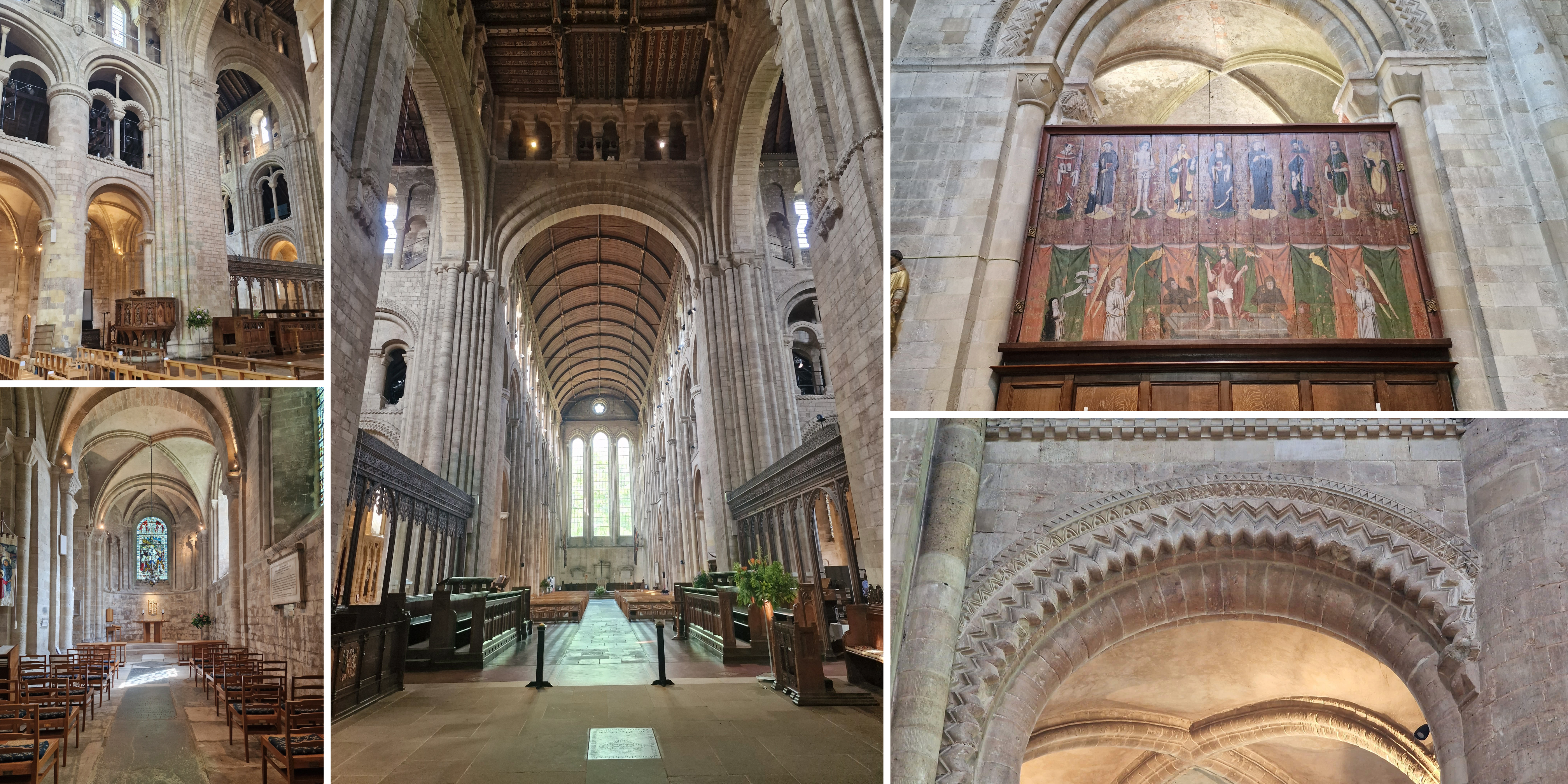
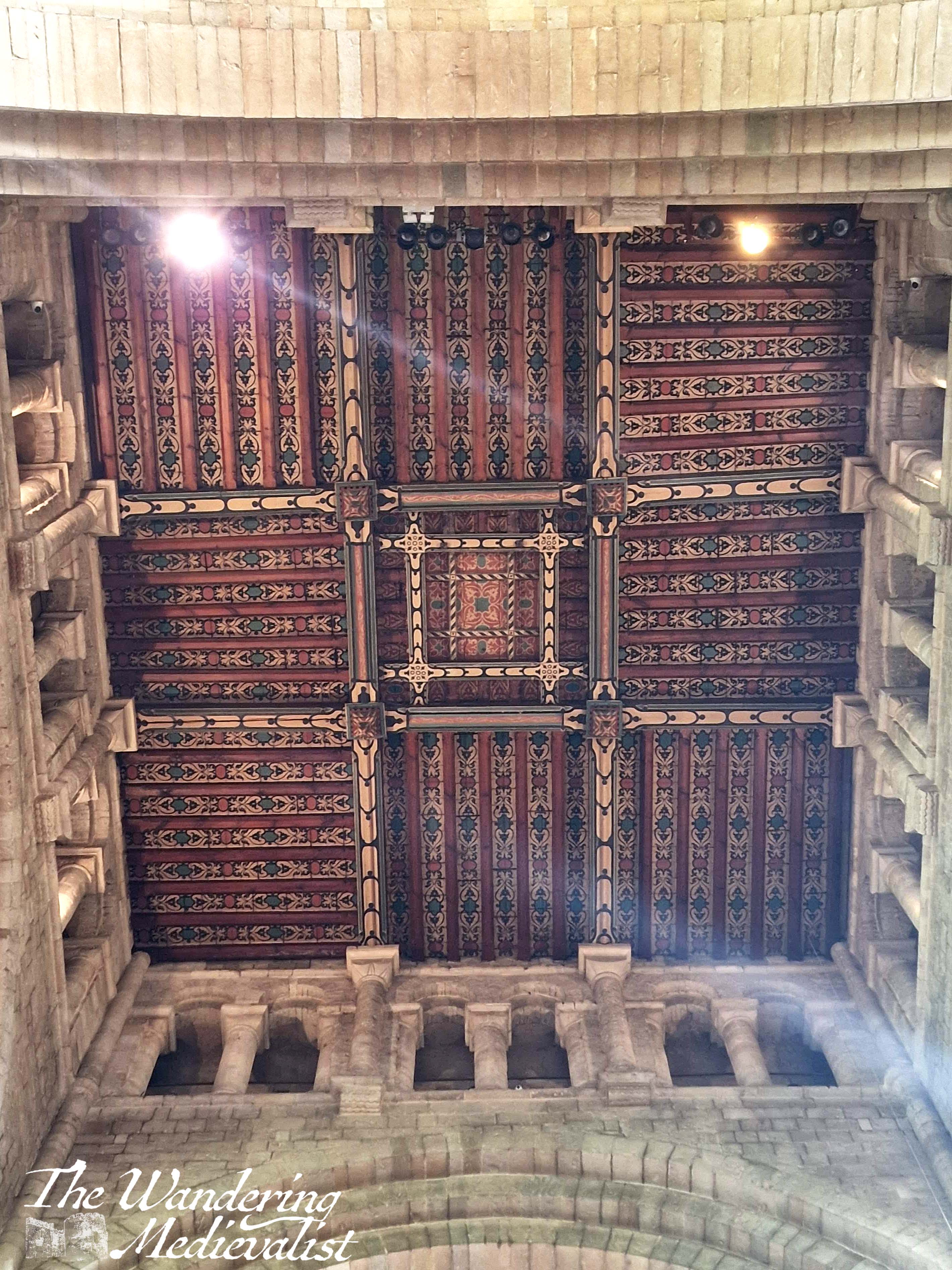
On our last visit, we were finally able to get inside of the church, which has several fine examples of medieval art as well as Norman carving that echoes that seen in Durham Cathedral.
Visiting an abbey like that at Romsey is a unique opportunity to experience an ecclesiastic community that has existed for hundreds of years, both changing and evolving with the times as well as maintaining its medieval roots. The protection Romsey enjoyed after the creation of the Church of England means that it allows the full immersive experience that you cannot get at ruined abbeys like those at Jedburgh, Dryburgh, and so many more that did not survive the dissolution of monasteries in the sixteenth century. It’s also just a beautiful building, set in a lovely English town that provides the best of what the countryside has to offer. I highly recommend a journey!
I have been thinking for some time that it would be nice to share here some of the research I have done over my years as a medievalist. While I have not formally studied for some time, I am always fascinated by how new views can be found on events that took place hundreds of years ago. So in this post, I will share with you a version of a piece of work which I put together for the International Medieval Congress in 2019.
I’ve tried to make it accessible, and I hope you will find it as interesting a topic as I did. It touches on some of my favourite characters in history, and the subject upon which I focussed for so long: medieval marriage.
But really, it’s a story – a story of the people involved in the negotiations, of their personalities, their strengths and weaknesses, and their priorities.
The title of the paper was, ‘An Unexpected Proposal: the suggestion of a marriage between Joanna of Sicily and al-Adil during the Third Crusade’.
Setting the scene…
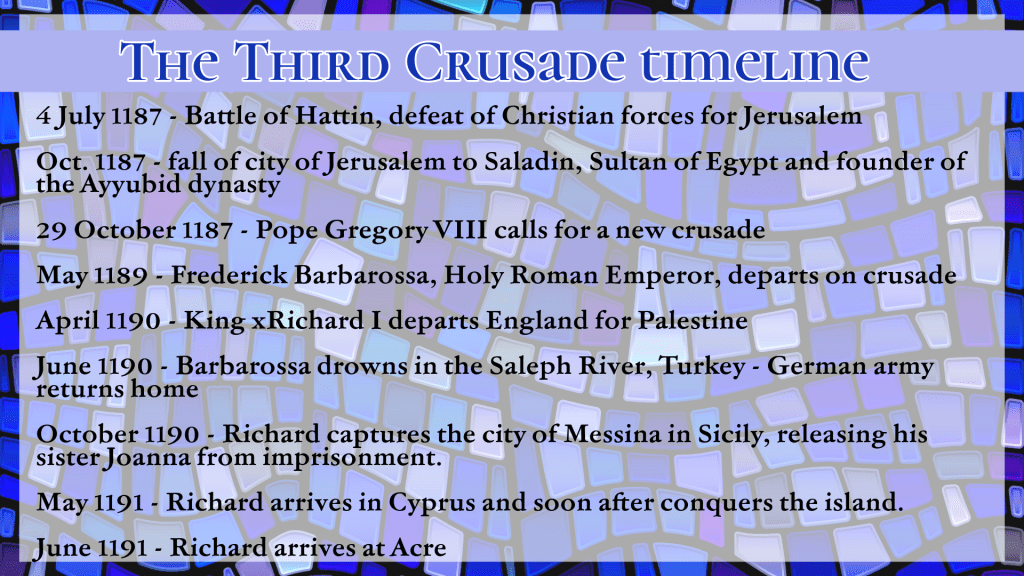
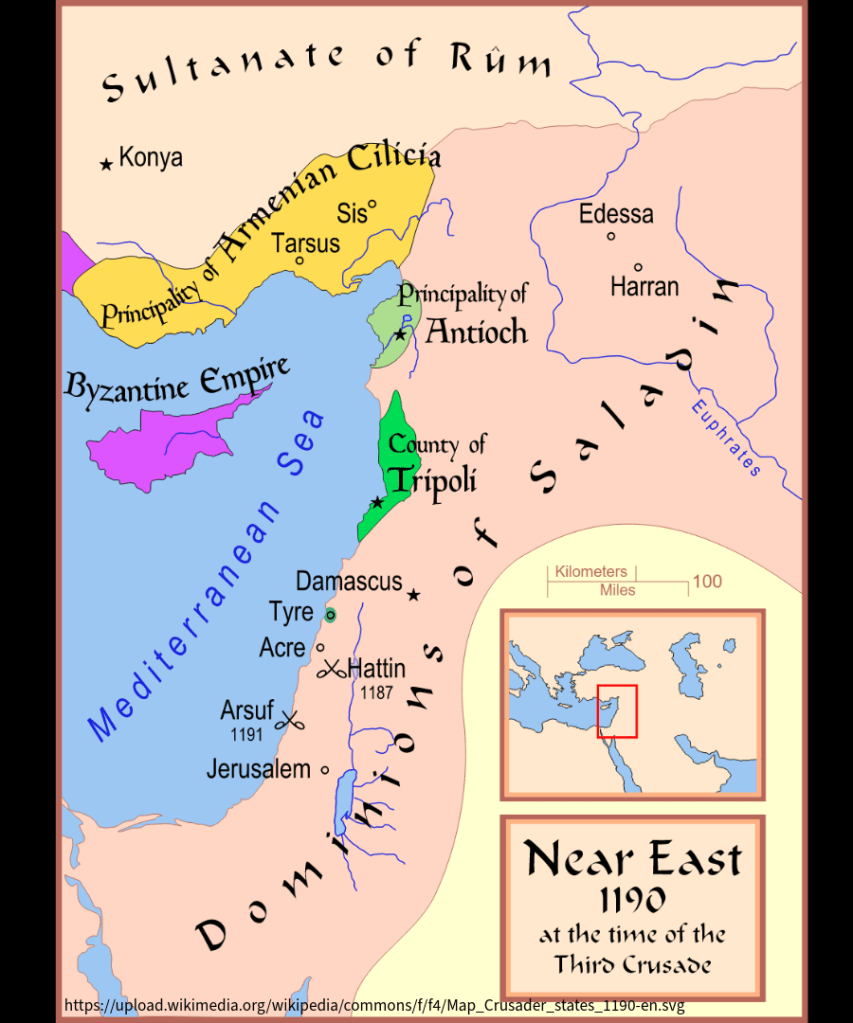
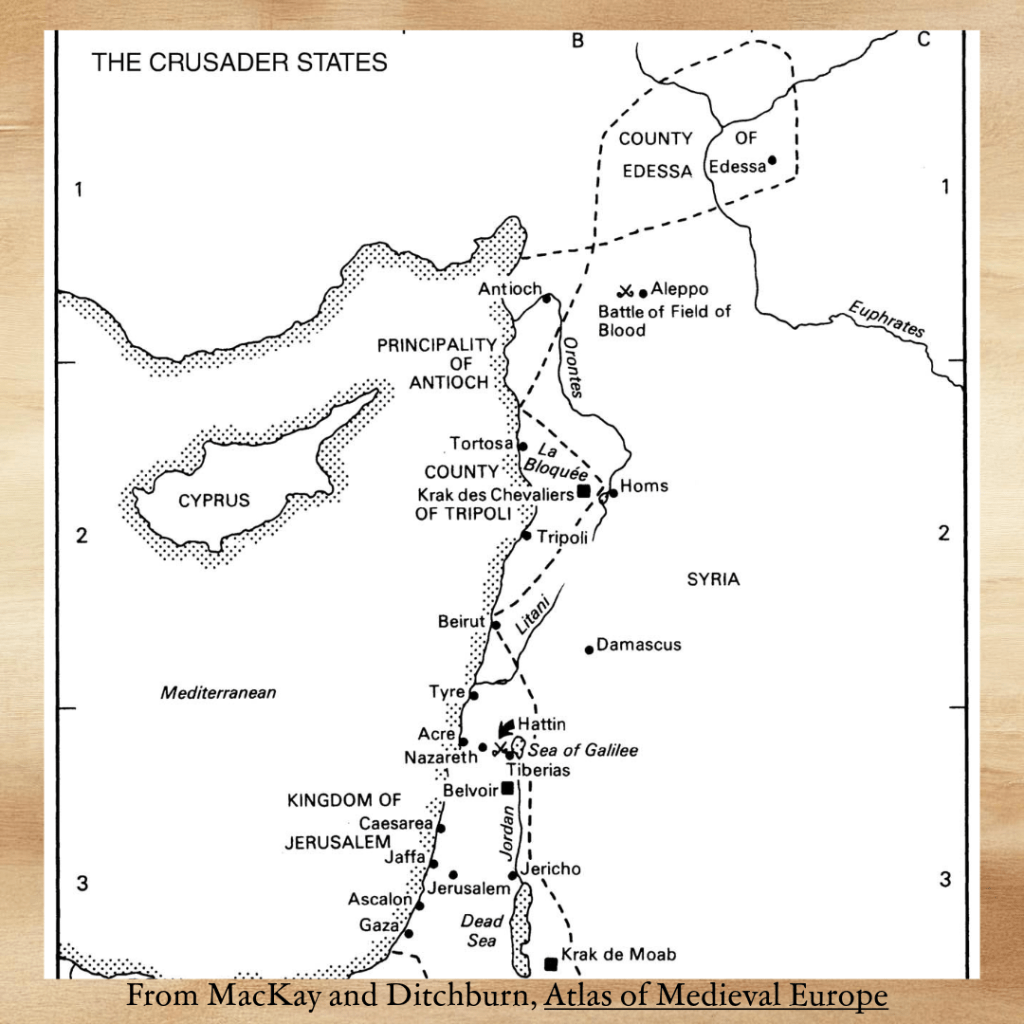
The tale begins in the midst of the Third Crusade, which was called in 1187 by Pope Gregory VIII after the fall of Jerusalem to the Muslim forces led by Salah al-Din, the sultan of Egypt (for the purposes of this paper, I will refer to him as Saladin, as do most western historians). Jerusalem had been captured by the Christian armies of the First Crusade in 1099, establishing the Frankish Kingdom of Jerusalem, so the loss of the city less than a century later caused most of the leaders of Europe to take notice. The Holy Roman Emperor Frederick Barbarossa was the first to set off, but he drowned while crossing a river in Turkey, and his troops disbanded. This left the kings of England and France to lead the second wave of the crusade, and both Richard I of England and Philip II of France departed Europe in 1190.
Arrival in the Holy Land
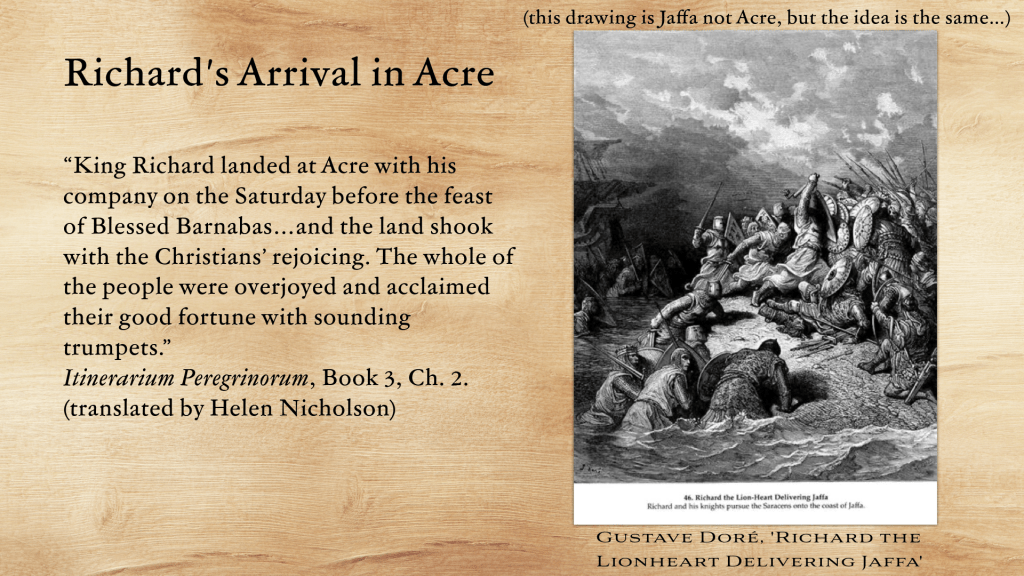
In June 1191, Richard I, king of England – known in later years as the Lionheart – arrived in the Holy Land after a number of delays, to take his role as leader of the Third Crusade. He had left England some months previously but was held up first in Sicily – where his sister Joanna was the dowager queen – and then in Cyprus – where he was ‘forced’ to intervene when the Byzantine ruler, Isaac Komnenos, seized his supplies and belongings after a shipwreck. (it’s an interesting story, but not the point of this paper…)
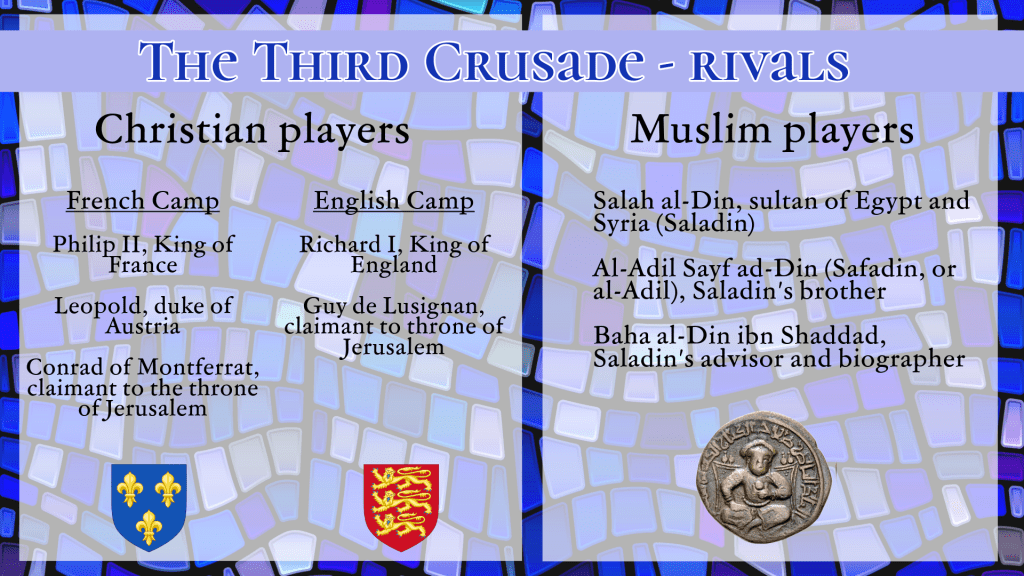
There were plenty of other high-level nobles and kings present upon his arrival, including his now arch-enemy King Philip II of France, (they had fallen out in Sicily) and two candidates for the throne of Jerusalem: Guy de Lusignan and Conrad of Montferrat. But, almost from his arrival to dramatically lift the siege of Acre, Richard’s secured his position as the foremost warrior and hero.
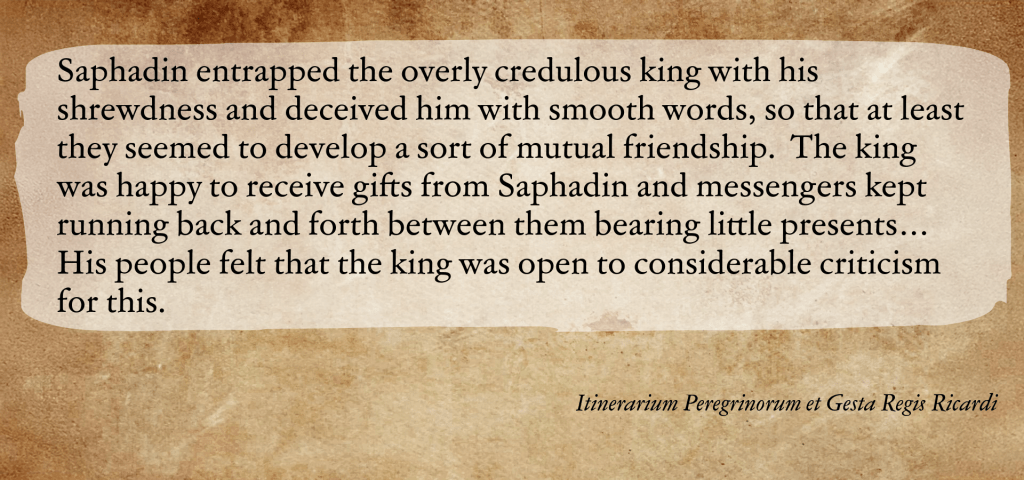
The Itinerarium Peregrinorum (long title Itinerarium Peregrinorum et Gesta Regis Ricardi), a Latin prose account of the Third Crusade that is likely to have been written from first-hand experience, tells us:
Even the enemy had a view on his arrival with one chronicler stating,
“He was wise and experienced in warfare, and his coming had a dread and frightening effect on the hearts of the Muslims.”1
Richard’s first few months were very successful; Acre, the maritime foothold of the Kingdom of Jerusalem, was captured, though the surrender was marred by the controversial decision to execute the Muslim garrison, probably more than 2,600 men. The motives for this action have been debated at great length, and you can read more in Gillingham and Spencer.2
However, the incident does give us insight as to Richard’s negotiating strategy. The treaty he had made with the enemy forces upon the fall of Acre were for Saladin to hand over a fragment of the True Cross and to release 1,500 Christian prisoners in exchange for the lives of the garrison and their families.3 When the terms were not upheld by Saladin, Richard followed through on his threat, without compunction.
Negotiations
The military aspects of the crusade have been the stuff of numerous articles and discussion, and the diplomatic negotiations were also an integral part of the relationship between the Christian and Muslim armies, as well as between Richard and Saladin. These negotiations have been examined thoroughly by Thomas Asbridge,4 but this paper looks in more depth at one particular part of these negotiations: a series of exchanges that took place in Autumn 1192, during which Richard suggested that the battle for Jerusalem could be ended by a marriage between his sister Joanna, the widowed queen of Sicily, and Saladin’s brother, al-Adil, often called Saphadin by European sources of the time.
Curiously, eastern sources discuss this proposal in some depth and are our primary evidence for it, while western sources are completely silent. This silence has always intrigued me. Many historians have focussed on the likelihood that the whole thing was just a joke, if it took place at all, but I believe it to be quite clear from reliable sources close to Saladin that the proposal was indeed made and considered in seriousness, at least at first.
Here I will make an effort to come to terms with why western sources leave the incident out, and I hope to answer some of the questions surrounding the event, which has been called ‘implausible’5, ‘extraordinary’,6 ‘remarkable’7 and ‘curious’.8
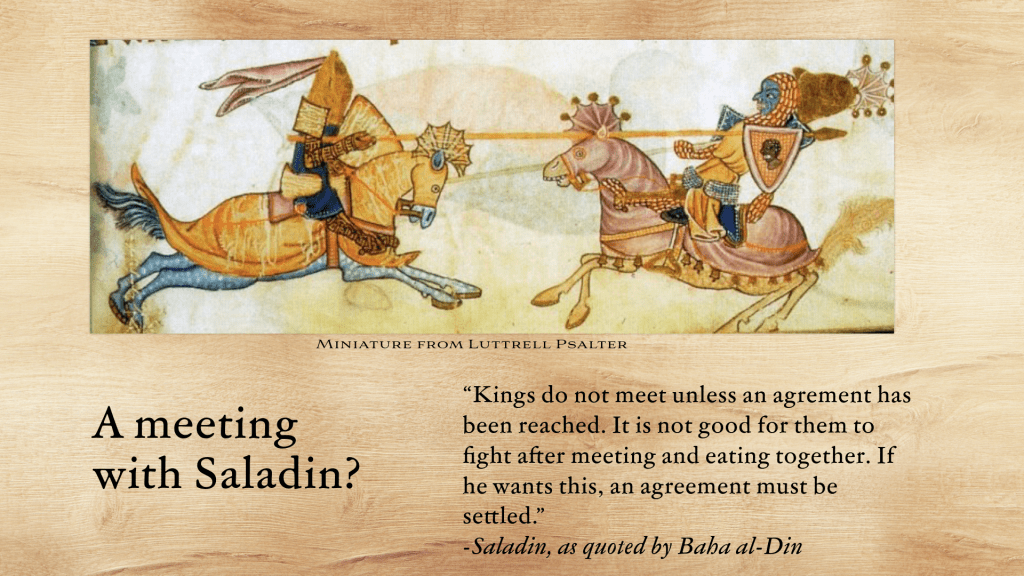
The proposal was not the first step in this round of negotiations. Rather, Richard had requested personal meetings with Saladin from the time of his arrival at Acre, but Saladin always refused.
For that reason, Saladin’s trusted general and brother, al-Adil, was his stand-in, and he met Richard in person on several occasions. They developed a rapport and traded regularly both food and gifts, and shared many meals.
In autumn 1192, Richard’s first offer, an opening gambit if you will, was one Saladin could never possibly accept. Baha al-Din, one of Saladin’s most trusted personal secretaries – and the writer from whom we get the most detailed account of these events – recorded Richard’s letter.
Saladin’s response, unsurprisingly, was a much wordier version of ‘no’.
He also reminded Richard that Jerusalem was as holy for Muslims as it was for Christians, and that the land had of course been theirs originally, before the First Crusade of the 1090s.
There was another player in these negotiations who was influencing Richard’s position. This was Conrad of Montferrat, one of two rivals to the crown of Jerusalem. Conrad was attempting to make his own agreement with Saladin, wherein the Muslim leader would confirm his possession of lands in Sidon and Tyre in exchange for Conrad’s attack on Acre, now garrisoned by Richard’s men.
Fortunately for Richard, the majority of Saladin’s advisors favoured a deal with the English king over one with Conrad. So, with his opening offer refused, Richard moved on to the second. There are three accounts of this incident, and I will look at each in turn.
Three Accounts
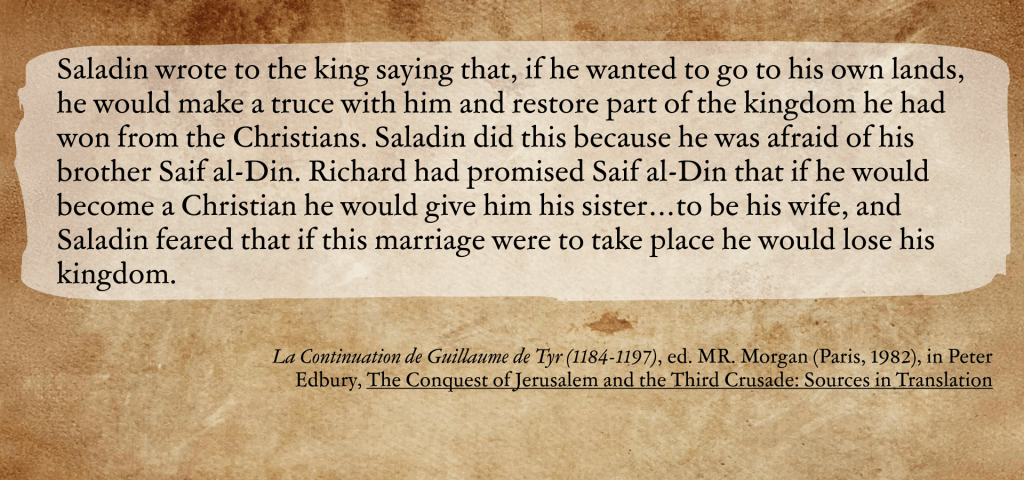
1. Old French Continuation of William of Tyre
This is the only surviving Christian source to mention the incident, and the source is often hostile to Richard. The writer states that Saladin was the initiator – the only source to suggest this, almost certainly in error. Further, the passage supports the belief held by some historians that Saladin was afraid of his brother. Certainly strife between two brothers is a common trope, but there is no real evidence of it, rather the sultan appears to have trusted and depended upon his brother. The overall accuracy of this version is therefore questionable.
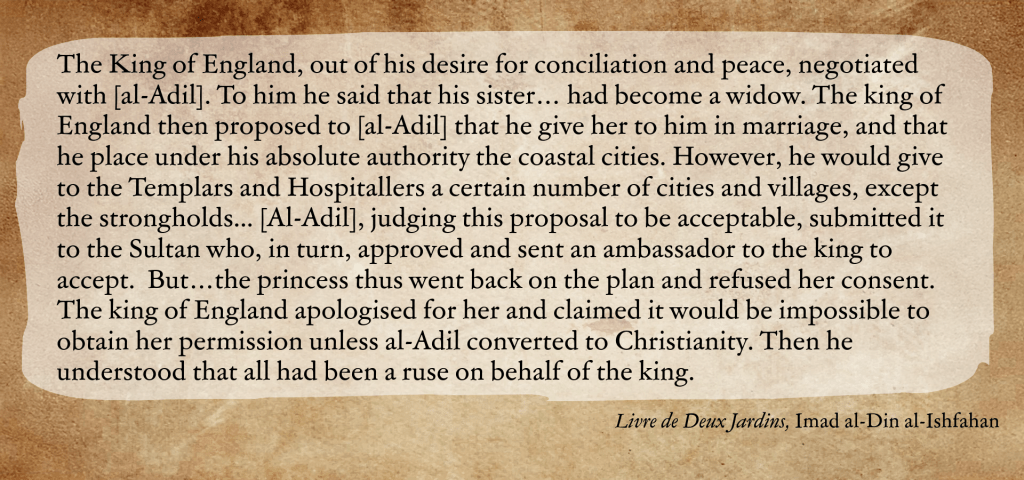
2.Les Livres de Deux Jardins, an account heavily based upon the writings of Imad al-Din al-Ishfahan, a Persian scholar who worked as a secretary to Saladin and was personally involved in many of the political machinations at court.
Clearly, this account is far more in-depth and indicates the more likely scenario that Richard initiated the proposal, directly to al-Adil, who passed the terms to Saladin. It was not a secret.
Furthermore, this account brings in a fact left out by the Continuation, that it was Joanna herself who was the spanner in the works, refusing to marry a man not of her religion. I’ll come back to this.
3. Baha al-Din, The Rare and Excellent History of Saladin. As mentioned, Baha al-Din was one of Saladin’s personal secretaries and a writer who is considered one of the most reliable for this period due to his first-hand knowledge of Saladin’s inner circle. His account is most comprehensive, covering Richard’s opening gambit, Saladin’s subsequent refusal, and Richard’s regroup to approach a second time. The delicate nature of the terms is made clear in that al-Adil required both Saladin’s trusted emissary, Baha al-Din himself, and a number of emirs to be present when they were announced.
Al-Din asserts that he himself was given the task of bringing the message to Saladin and bore witness to the reply. There were to be no secret negotiations between Richard and al-Adil, rather al-Adil was cautious, acting in self-preservation – Saladin may have not reacted well to hearing about the offer second-hand.
Echoing Imad al-Din’s account but with more detail, the story goes on. Saladin immediately approved the terms, ‘believing that the king of England would not agree to them at all and that it was intended to mock and deceive.’9
Baha al-Din also confirms Joanna’s involvement, stating that she was very displeased, ‘How could she possibly allow a Muslim to have carnal knowledge of her!’ instead asking al-Adil to convert. (remember of course that she was Catholic and this was the Middle Ages – it was entirely unheard of to marry a non-Christian). With regard to this refusal of Joanna’s, I do have my doubts about whether Richard would have allowed the prospect of peace in the Middle East to be ruined by his sister’s temper tantrum. The fact that the story is repeated by both Muslim writers makes it more likely that Richard used her as an excuse to get out of a proposal with which he never intended to follow through.
What does it all mean?
What the sources indicate, then, is a diplomatic suggestion that, joke or not, was also quite daring. Al-Adil considered it so noteworthy that, rather than continue his personal tête-à-tête with Richard, he wrote immediately to his brother. If the brothers were aware, as Baha al-Din relates, that the proposal was a joke, they certainly reacted in a serious fashion. They may also have wished to call Richard’s bluff.
So one has to ask of Richard – why? Was the proposal merely a distraction? Did he do it just to see what Saladin and al-Adil would do? It could have been a test of al-Adil, a way of assessing his loyalty to his brother – certainly Richard himself had no reason to believe in brotherly bonds and knew how precarious the relationship could be, so perhaps he hoped that al-Adil would leap on the suggestion to gain power over his brother.
Seal of Richard I
Or perhaps he hoped that Saladin would grow to view his brother as a threat. Either way, Richard would be causing dissension in the ranks, which could only be to his advantage.
One can understand the Muslim writers’ assertions that Richard never intended for the proposal to be taken seriously when one looks at the rest of the tale. When Saladin accepted the offer, Richard was forced to scramble for a reason why Joanna could not, in fact, be married: he would have to ask the pope (dowager queens in Europe could not remarry without his permission), and that could take months. Richard suggested the al-Adil could have his niece instead, of course she was in Europe so again another delay…this is not the sign of a well-constructed plan. Richard may even have fibbed, saying that his Christian colleagues objected to the idea – but if the Christians had been asked, surely one chronicle somewhere would have mentioned it?
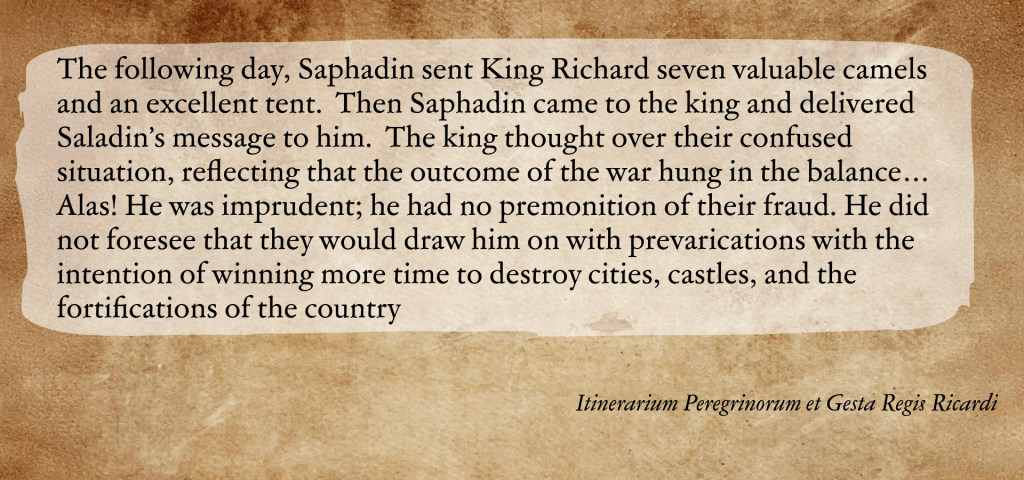
Finally, if this was a real proposal, part of a long-term strategy to end the warfare and allow Richard to return to Europe where the king of France was chipping away at his empire with the help of his brother John, why is it not in the Itinerarium Peregrinorum?
Because this period of negotiation IS there:
I feel this section to be a bit harsh on Richard. He was more than experienced at the art of war and negotiation, and would never have allowed himself to be distracted. Rather he would have been perfectly aware that a period of negotiation did not mean cessation of hostilities – frequently the opposite. Instead this indicates that the writer, whoever he was, had no knowledge of the more delicate negotiations taking place in the background, or if he did, he left them out. Which was it?
We cannot know for certain, but the only reasonable answer for either the writer leaving the story out or for Richard keeping the proposal a secret lies in Richard’s reputation. A little later, the writer of the Itinerarium alludes to the problem:
One has to remember that just because Richard was leading the crusaders did not mean that he was supported by all of them. In fact there were French factions – and others – who were seriously adverse to Richard’s strategies, particularly what they saw as his reticence to march directly upon Jerusalem- a true strategist, Richard was hoping to establish a solid base from which to attack the city, rather than attack directly.
A French source tells us that Richard had been overruled in his wish to approach Ascalon, a strategically vital city: whoever controlled Ascalon also controlled access to Egypt, Saladin’s home base. Its significance is evident in that Saladin himself had made it a priority to re-capture Ascalon in 1187 prior to his march on Jerusalem – this tactic was one Richard hoped to emulate, but could not convince the other Christians. They remained focused, inexorably, on relieving the Holy City.
Richard would have been considered even more suspect and likely found himself in danger had the majority of the crusading host discovered that he was offering his sister to a Muslim, rather than fight the infidels courageously for Jerusalem.
And it is here, I believe, that an answer may be found.
I have no doubt that Richard made the proposal, as suggested by two reliable Muslim sources, both very close to Saladin. It is possible that Richard’s closest advisors knew of the proposal and objected, but he mostly ignored them. However, the lack of inclusion in Christian sources such as the Itinerarium, which was unlikely to have been written by someone with the level of access to Richard that Baha al-Din had to Saladin, indicates a lack of widespread knowledge of the proposal. It is quite reasonable that there would have been a lot of detailed negotiation taking place which a member of the general crusading force would not know about, but which Saladin’s personal secretary would. An every-day crusader would also be more aware of the threats to Richard’s reputation that his close relationship with al-Adil caused.
The Muslim sources go into more depth about the gifts and offer a more detailed timeline than the Christian sources, and are generally better informed about the relationship between Richard and al-Adil. Richard was a bold strategist, and his life shows numerous examples of the willingness to make extreme choices in order to get what he wanted – he took part in several rebellions against his own father, beginning in his teenage years; he alienated the king of France by refusing to marry his sister and choosing another wife; he regularly led his armies into battle even when his life was in serious danger.
So, I do not see it as uncharacteristic for him to have made a proposal, almost off-the-cuff, just to see what kind of reaction he would get. But he would have been aware of the danger involved: his strategies were often questioned, he was frequently ill while in the East, and his kingdom was in serious peril during his absence. His reputation was not so strong that it could have suffered the kind of serious outrage which would have arisen had a French crusader heard of the proposal.
Muslim sources tell us what happened, but the details in the Christian sources actually hint more clearly at why the incident was omitted, or kept secret – it had to be.
As for the incident being implausible, I personally am not surprised by anything Richard did – he was bold, intelligent, witty, arrogant, and not above extreme negotiation. This time, he was up against an equally skilled strategist who called his bluff.
But Richard had some good luck. The proposal was refused by his own sister, and the counter-proposals that al-Adil convert or wed Richard’s niece, were passed over.
So, Richard never had to face a council of European and French nobles to explain that the Crusade was over because his sister was going to marry a Muslim prince. But it is intriguing to wonder what might have happened if he had…
Thomas Asbridge, ‘Talking to the enemy: the role and purpose of negotiations between Saladin and Richard the Lionheart during the Third Crusade,’ in Journal of Medieval History. ↩︎
One of the most significant royal marriages of the Middle Ages took place at Poitiers, in May 1152. We know this because the chronicler Robert of Torigni – sometimes known as Robert de Monte due to his position as abbot of Mont-Saint-Michel in Normandy – tells us in his Chronicle that, ‘Henry Duke of Normandy, either suddenly or by premeditated council, married Eleanor, countess of Poitou, who had only recently been divorced from King Louis [of France].’
It is a relatively short passage and quite matter of fact, but we can be confident as to its veracity as Robert had a close personal connection to Henry’s family: his abbacy was within the duchy of Normandy, and he would be made godfather of Henry’s second daughter. For such a significant alliance, Torigni is quite tight-lipped, though he makes an allusion to one of the more controversial aspects of the match: the bride’s very recent separation from her first husband. If you continue to read Torigni’s account, you discover that her first husband, King Louis, was furious but could do very little about it – I’m getting ahead of myself.
Firstly, who were Henry and Eleanor?
Henry
Henry, duke of Normandy, was known by several other monikers including ‘Henry Fitz Empress’, ‘Henry Curtmantle’ and ‘Henry of Anjou’.
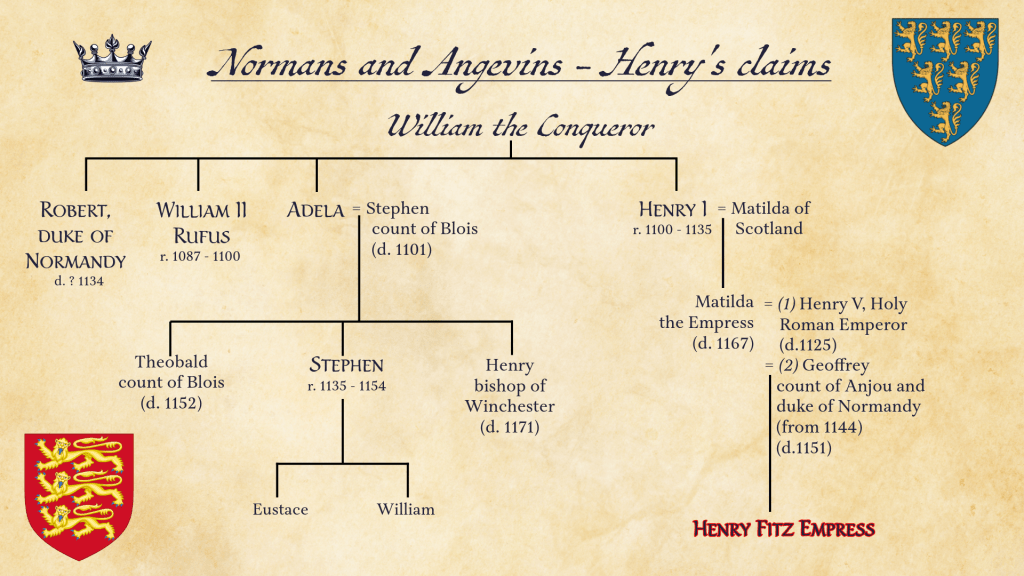
At the time of his marriage, he was 19 years old, and quickly becoming one of the most powerful men in Europe. His father, Geoffrey, had been regarded as one of the most handsome men in France, often called ‘Geoffrey le Bel’, and in his lifetime he was count of Anjou, Maine, and Touraine: a wealthy gathering of French lordships. Geoffrey was married in 1128 to Matilda, the only surviving legitimate heir of King Henry I of England. Though their marriage was notoriously unhappy – they in fact hated one another and separated at least once before being forced to reconcile – Geoffrey took up her cause when her throne was usurped by her cousin, Stephen of Blois.
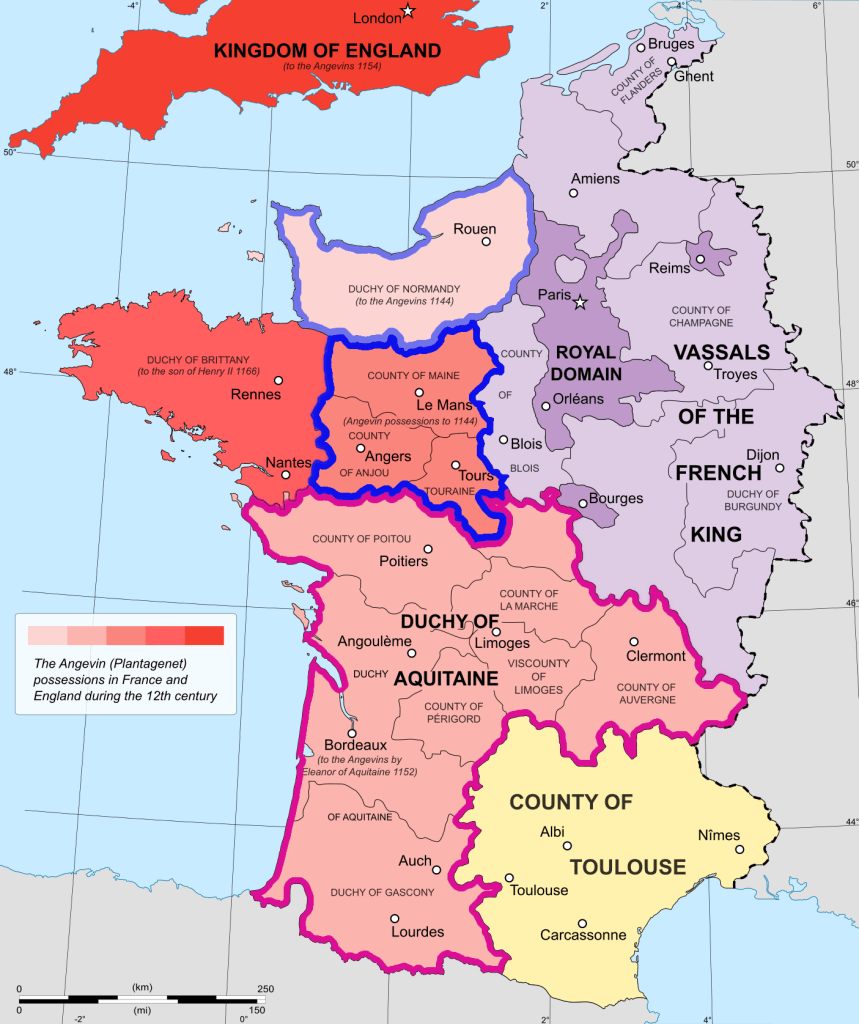
As part of that war, Geoffrey conquered Normandy and was granted the title of duke by the King of France. Normandy was one of the richest lordships in France, and this is how Henry, in 1152, was referred to as Duke of Normandy. His patrimony – the land he inherited from his father – was therefore immense, consisting of all the land outlined in dark and light blue, to the right. From his mother, he inherited a direct claim to the throne of England, and by the time of his marriage it was becoming increasingly likely that this claim would be fulfilled.
Eleanor was no less impressive than her new husband. She was heiress to the vast duchy of Aquitaine, outlined in pink above, and she had been Queen of France for fifteen years. During that time she bore two daughters and accompanied her husband on Crusade, stirring up gossip about her relationship with her uncle, Raymond of Antioch. She was referred to as one of the most beautiful women in Europe with enough regularity that it seems likely to have been true, and she was also educated and erudite, providing patronage to the arts through her court of love in Poitiers.
Her first husband, Louis VII, had loved her well but after fifteen years of marriage with only female heirs, he chose to set her aside on the grounds that they were too closely related under papal law. While seemingly absurd to modern eyes, this was a common ruse in the Middle Ages, when so many of the nobility and royalty were related within the prohibited degree set by the papacy.
The end of her marriage to Louis meant that she was suddenly ‘up for grabs’ in the European marriage market, and while Louis doubtless expected that he would be allowed to choose her second husband, there were more than a few lords who hoped to wed the richest heiress in France, with her permission or without.
A story is told that when Eleanor was travelling from Paris back to her capital after her divorce, she was forced to ride astride a horse to escape a bevy of men set on kidnapping and forcing her to marry. She managed to escape and reach the walls of Poitiers, where Henry would soon meet her.
The Marriage 💍👑
Even if one considers only the combination of lands, this was a significant alliance. In one day, Henry – by the right of his marriage – gained control of more of France than the king of France himself personally held. Quite a bit more, in fact – the royal domain is outlined in purple above. This infuriated King Louis on several counts: first, the obvious threat; second, the couple had not asked his permission to wed, which they were required to do as his vassals; third, Henry was as closely related to Eleanor as Louis had been; and finally somewhat related to the second point, Louis was now prevented from controlling Eleanor’s vast lands by marrying her to his own ally. Rubbing salt in the wound, Eleanor would go on to bear Henry five sons and three daughters – the first son just a year later.
At first, Louis attempted to exact punishment, but like most of Louis’ military endeavours it did not go very far, and Henry would spend most of the next thirty years outsmarting Louis both at war and at negotiation. This repeated humiliation was not a small part of the reason that Louis’ son, Philip, was so vehement in demanding respect from Henry and his heirs – he had no intention of repeating his father’s weakness, and he would gradually but progressively chip away at the English-controlled lands in France.
Within two years of the marriage, Henry was crowned King Henry II of England, forming an empire that reached from the border of Scotland all the way to the Mediterranean. The lands he inherited combined with those he gained through marriage to Eleanor made him the greatest landholder in Europe, even though a large portion was held as a vassal of the King of France. Henry therefore owed fealty to Louis for his French lands, a situation which would cause tension between two monarchs as to who would be superior. During Henry’s reign, his strength determined that he would be victorious; his heirs were less successful, while Louis’ were more so.
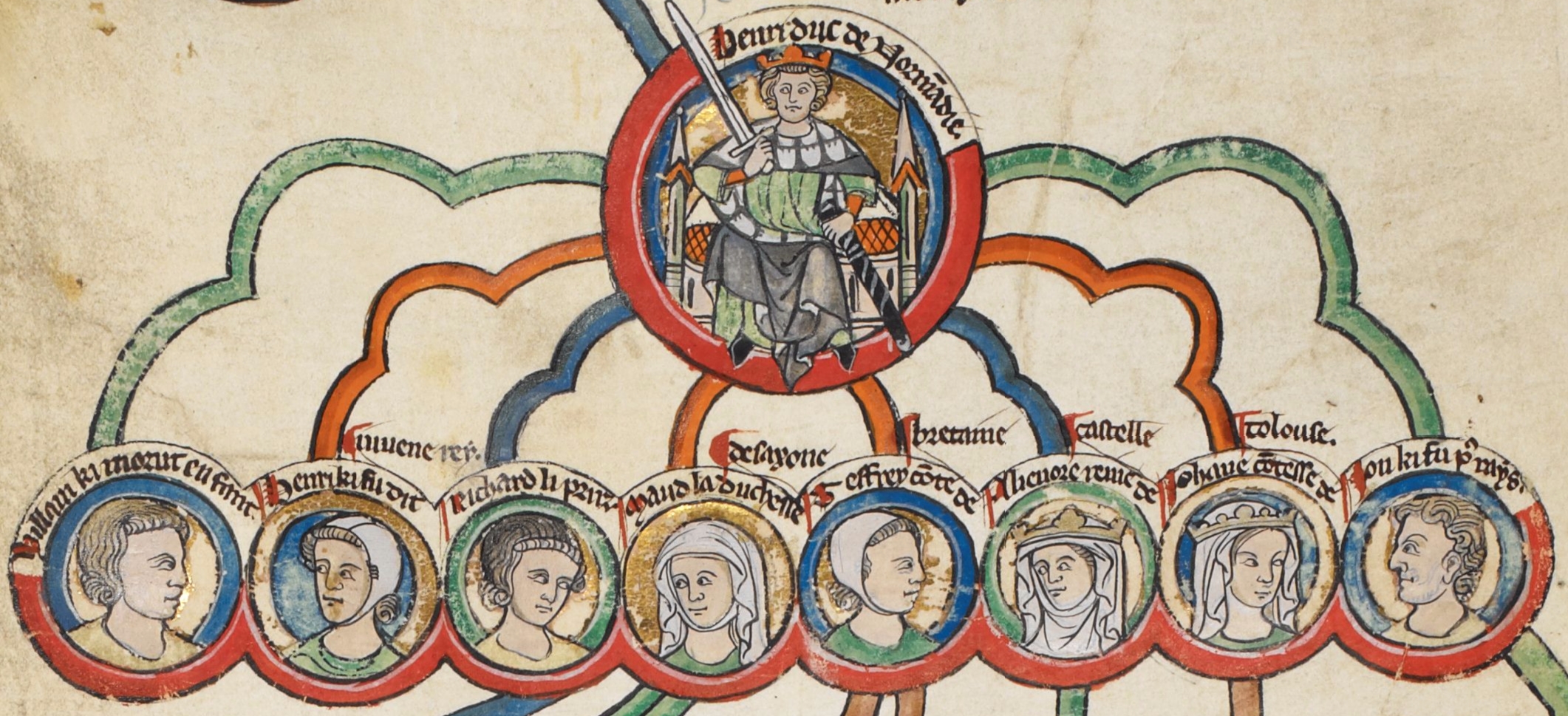
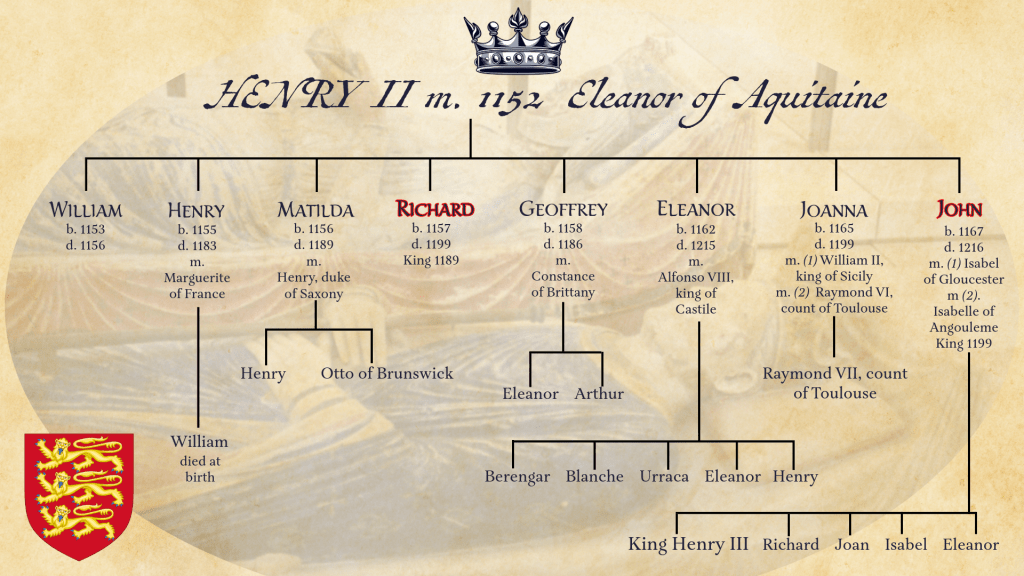
Henry and Eleanor’s children
But that’s not all…
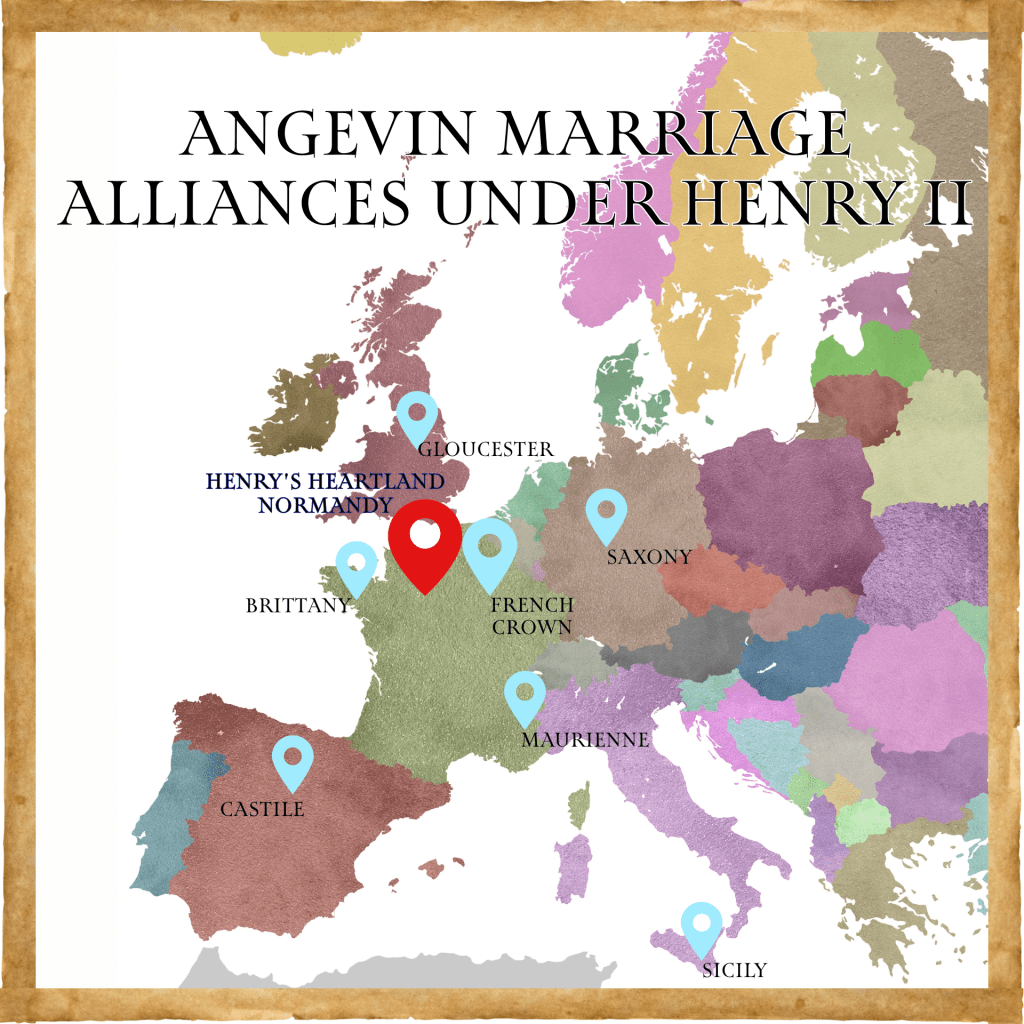
The marriage did more than just make Henry an incredibly powerful king. Due to his interests on the continent and his extensive holdings, Henry would make a series of marriage alliances with kings and lords throughout Europe, dictated by the borders of his new realm and by his many children.
Whereas in his grandfather’s day, the royal family of England tended to marry close by – French or Scottish royal, or even noble English spouses were common – under Henry, royal marital alliances included Castile, Sicily, the Holy Roman Empire and the royal house of France.
In the next generations these webs extended to Eastern Europe, the Byzantine Empire and re-secured alliances in France and the Spanish kingdoms The throne of England was now a prominent European player.
The marriages of Henry II and his children
Through their children and grandchildren, Henry and Eleanor were progenitors of the royal houses of England, Scotland, France, Portugal, Aragon, Sicily and Castile, the Holy Roman Emperor, the counts of Toulouse and many more. The name by which Geoffrey le Bel was occasionally known, ‘Plantagenet’, would become the family name of the royal house of England for 400 years.
But it wasn’t all fun and games…
On the flip side, the crown of England would spend considerably more time and money on the continent than before; efforts to re-claim lost lands in Normandy and Aquitaine would drain coffers for generations, especially after Normandy was lost early in the thirteenth century. One might even argue that the marriage set the stage for the Hundred Years’ War of the fourteenth century; indeed France and England were at war as often as not in this period.
There is also the point to be made that Henry’s efforts to make a strong alliance for his last son, John, caused more dynastic damage than benefit. John, named ‘Lackland’ by his father, was almost ten years younger than his brothers, born when Eleanor was in her early 40s, and around the time Henry first met and fell in love with his famous mistress Rosamund Clifford. While Henry had arranged for each of his sons to have a generous parcel of land – his heir the Young King would inherit Normandy and the throne of England; Richard would inherit his mother’s lands of Aquitaine; Geoffrey was wed to the heiress of Brittany – there was simply nothing left for John. Henry would spend a great deal of time and effort searching for a solution, and in doing so betrothed John to the daughter of the count of Maurienne, in south-east France. The count insisted that John be granted something from his father, and so Henry named three castles that in fact belonged to the Young King, his heir. The frustration of having his father give away three of his most lucrative and strategically important castles drove the Young King into further disgruntlement, and spurred his eventual rebellion.
Furthermore, despite the clear success of Henry and Eleanor in creating heirs, their marriage was not a happy one – at least, not for long. Their sons grew to adulthood under the strong ruling hand of their father, and they were increasingly impatient for some power and influence of their own. Richard, who was raised mainly in his mother’s lands of Poitou and Aquitaine, was the most independent while Henry’s direct heir, the Young King, was perhaps the least – or at least believed himself to be. Henry was a master at controlling and manipulating those about him, but his sons proved to be his biggest challenge.
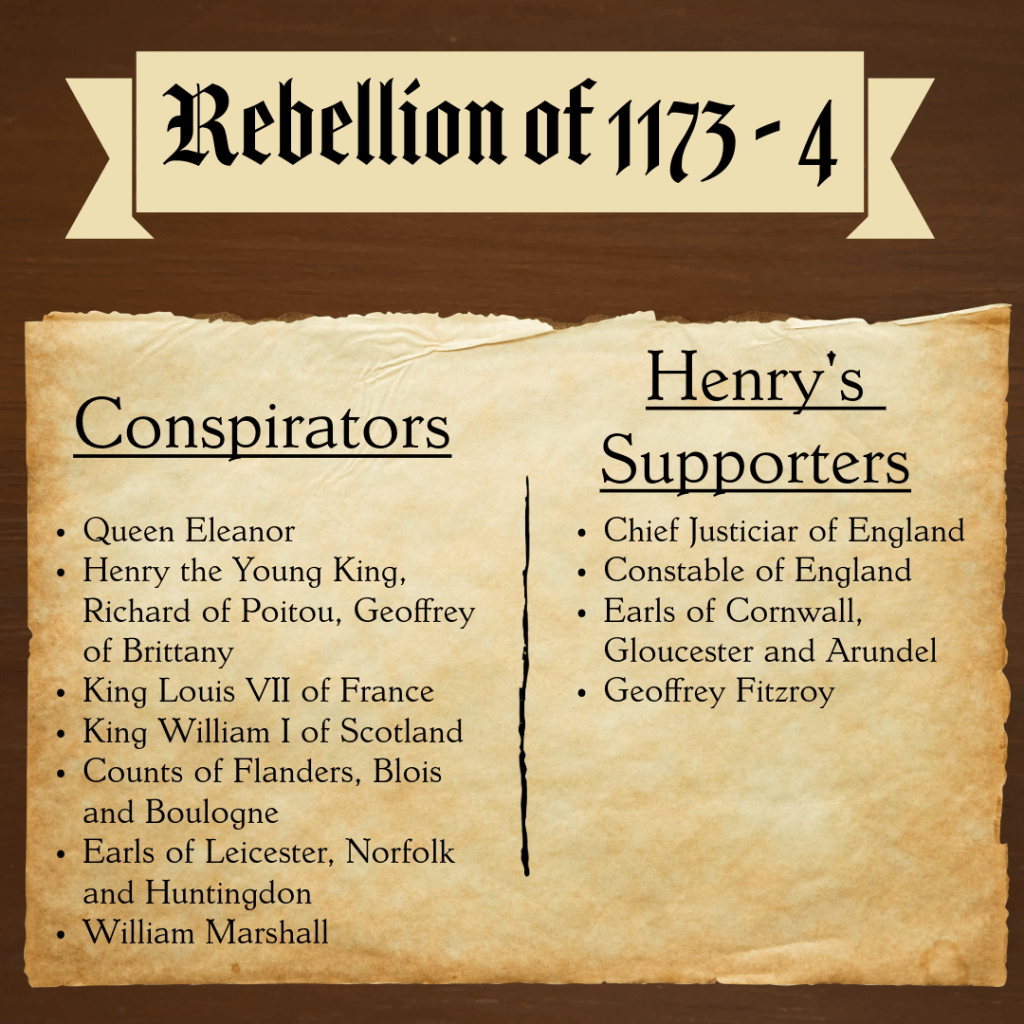
In 1173, goaded by Henry’s granting of castles to John and by the King of France, Henry’s sons agreed to a rebellion against him. They were to be supported by the King of Scots and a good potion of the French and English nobility.
Also in on the plot was Queen Eleanor, who by the early 1170s had been increasingly frustrated by her husband’s lack of action in Toulouse and too much time with his mistresses. (Eleanor claimed a right to the county of Toulouse through her grandmother, and both of her husbands had endeavoured to enforce that right, unsuccessfully. The Dukes of Aquitaine and Counts of Toulouse had been at odds for generations, and it was only with Eleanor’s daughter Joanna’s marriage to Count Raymond VI in 1196 that peace was established.)
The fact that Eleanor’s betrayal was one of the most painful to Henry was evident in the fact that after the defeat of the rebellion, he cast her into prison for 18 years, while his sons, he forgave. Side note, this story is one of my favourites about Henry – his entire family, the kings of France and Scotland, and half of his nobles all rebelled against him, but so ineffectively that he remained on the throne for another 15 years.
Henry and Eleanor were both unique in their time, as well as in history – powerful, charismatic, energetic and intelligent, they were both the perfect partners for one another and the perfect enemies. Though Henry’s Angevin Empire, with its heartland in Anjou and Normandy, would not survive long after his death, the significance of the English royal foothold in France beyond Normandy would echo for centuries, even if its extent was never what it reached under Henry and Eleanor.











 The Wandering Medievalist
