Last year in December, struggling to think of a post, I decided to pull together and share some of my favourite pictures from the past year; many o them I have not shared before, or have only done briefly in an Instagram story. It struck me that this might be a nice tradition to start.
Throughout the year, wherever I am and no matter how tired I am, taking pictures of the beauty around me keeps me inspired. And so in this post, I would like to share with you MY favourite pictures that I have taken this year, and a bit of why they are special to me. They are, for the most part, entirely unedited except for some cropping.
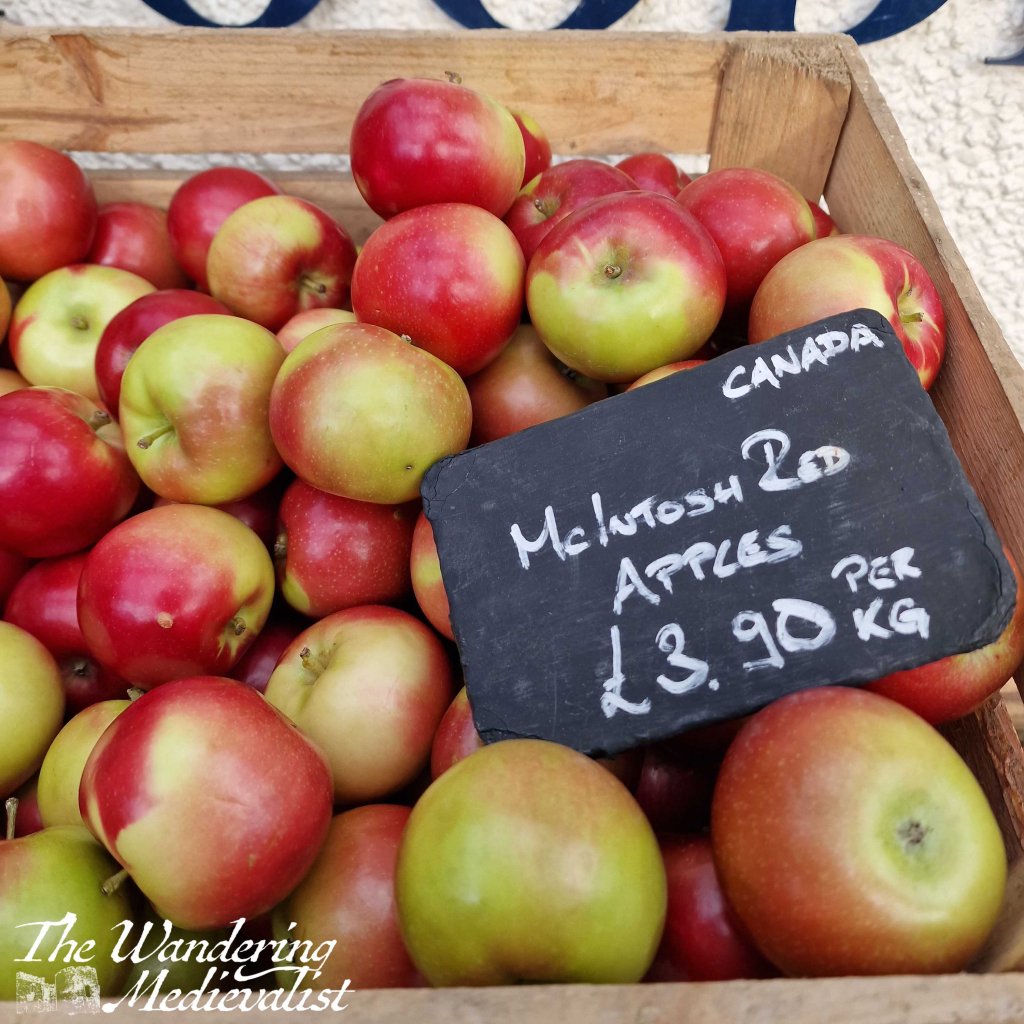
When I was young and growing up in Massachusetts, every autumn we would go apple picking, and the apple of choice was McIntosh. So, I grew up eating them in pies, applesauce, and of course straight off the tree. They are seldom found in Scotland though, and so when I found these at House of Bruar, I was overjoyed.
We visited House of Bruar on a cold January afternoon, and we left in time to drive home mostly in daylight, with the hilltops frosty. I love winter and this picture reminds me of that lovely day in Perthshire.
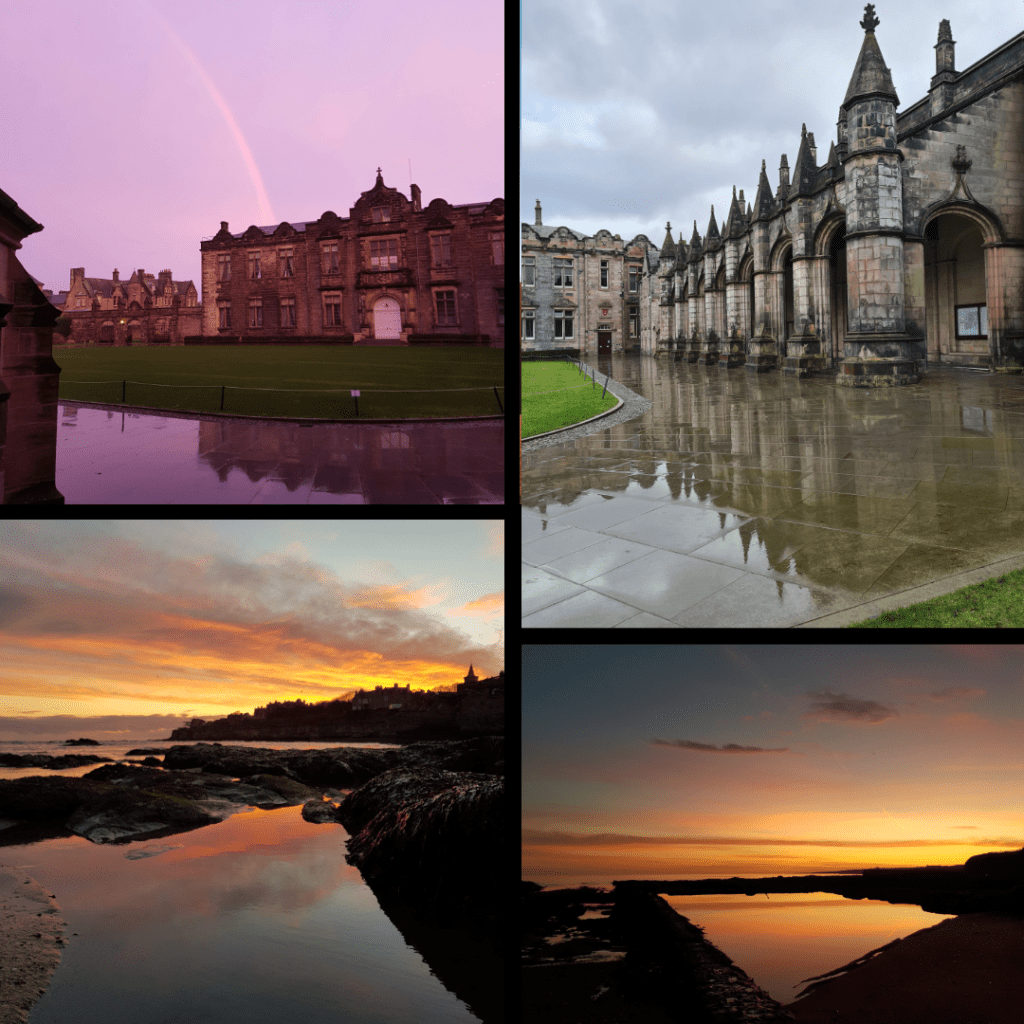
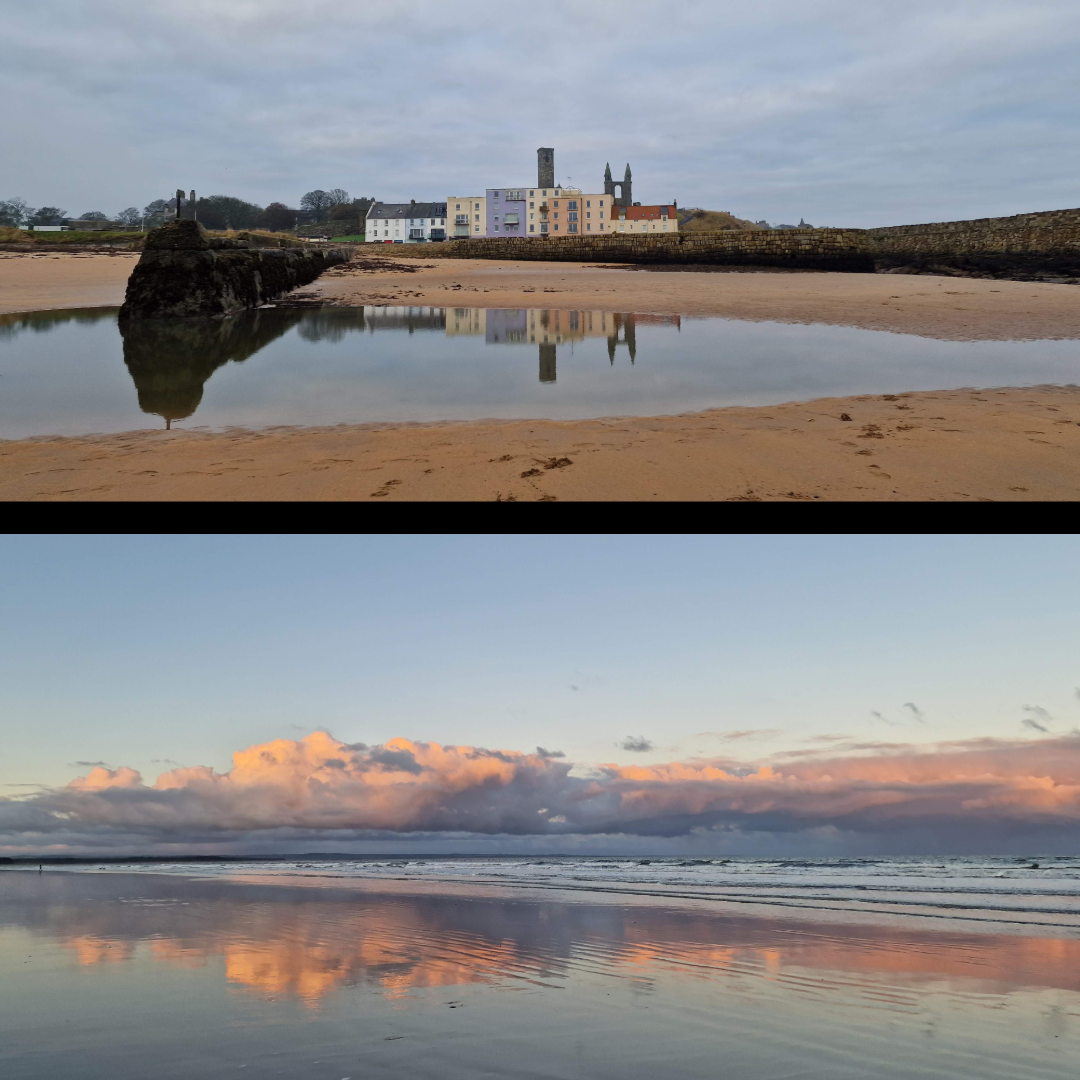
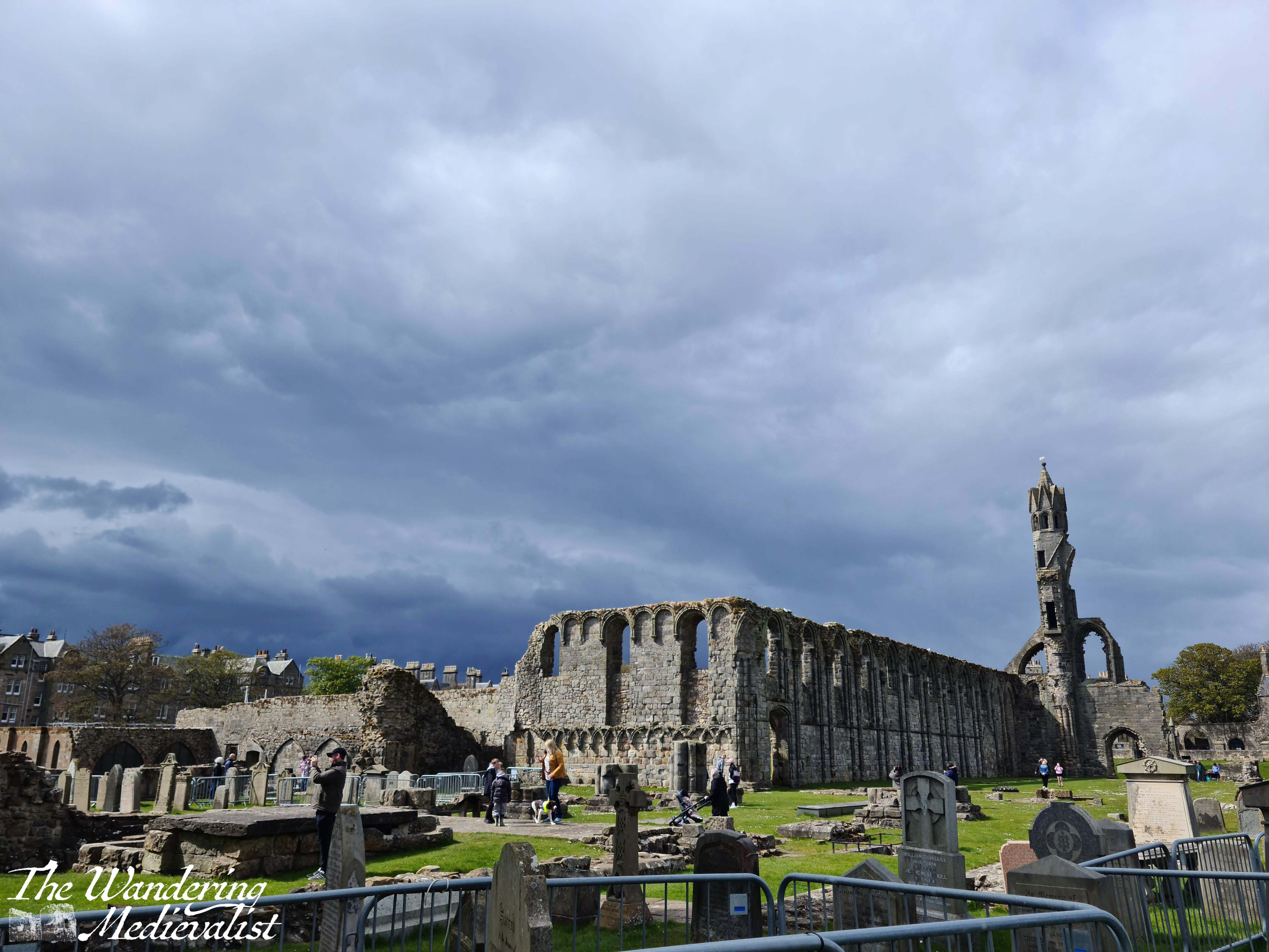
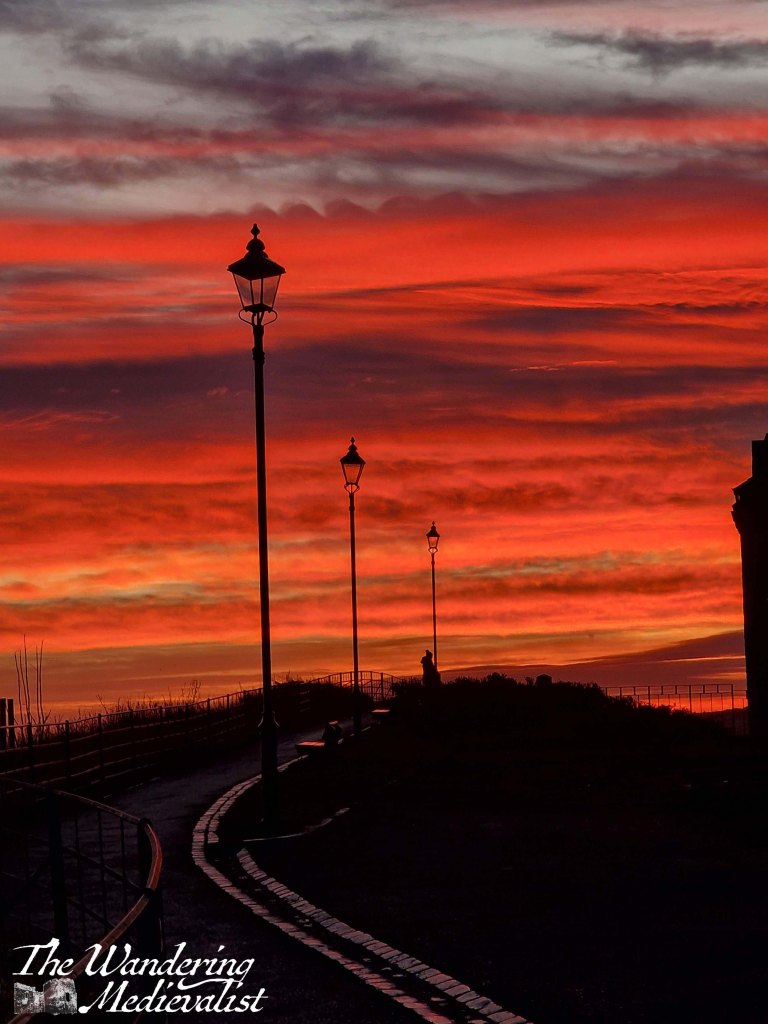
St Andrews is one of the most photogenic places on earth, and I used to get up early just to catch the sunrise here. Fortunately, in January, the early part is not required.
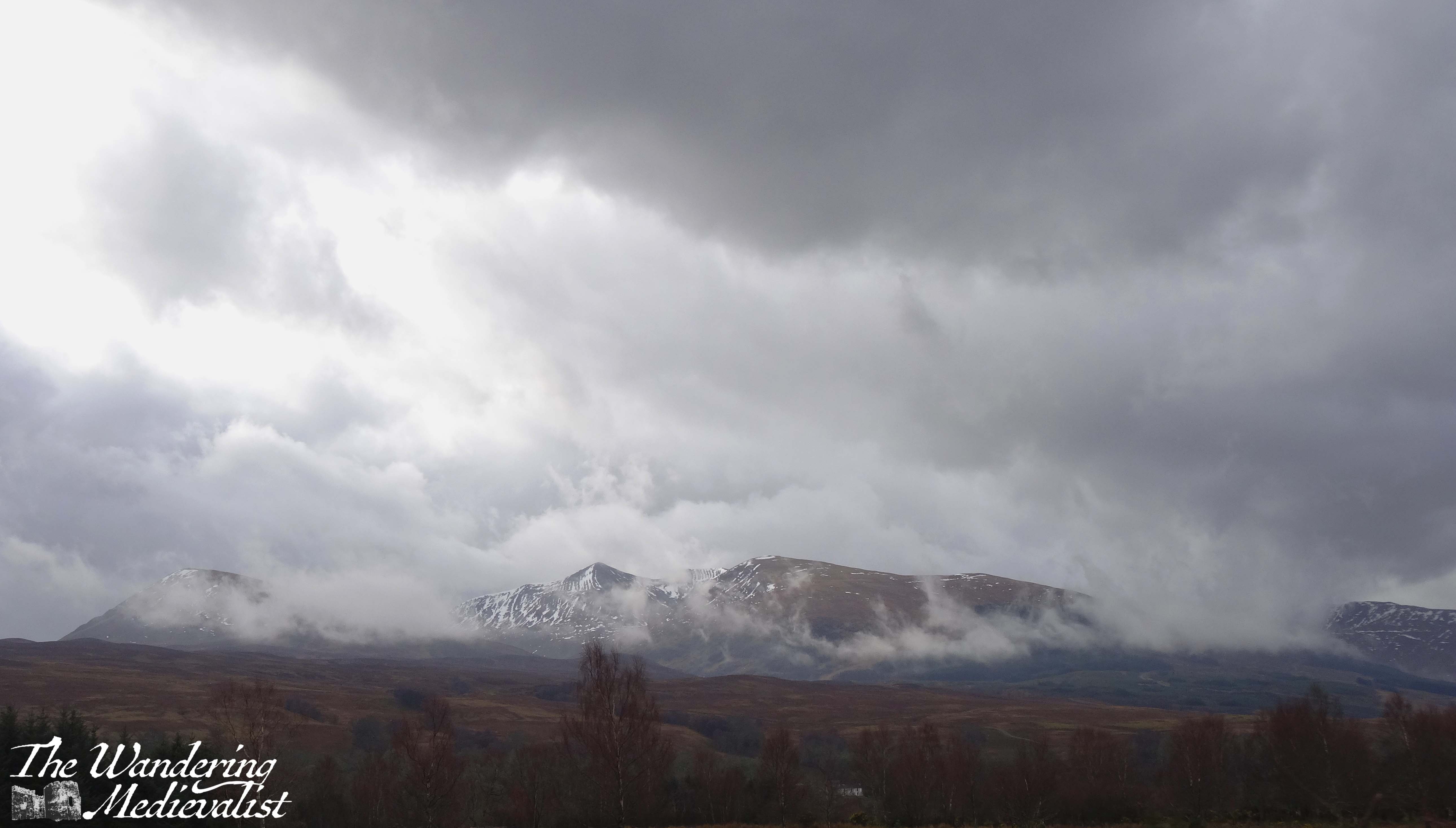
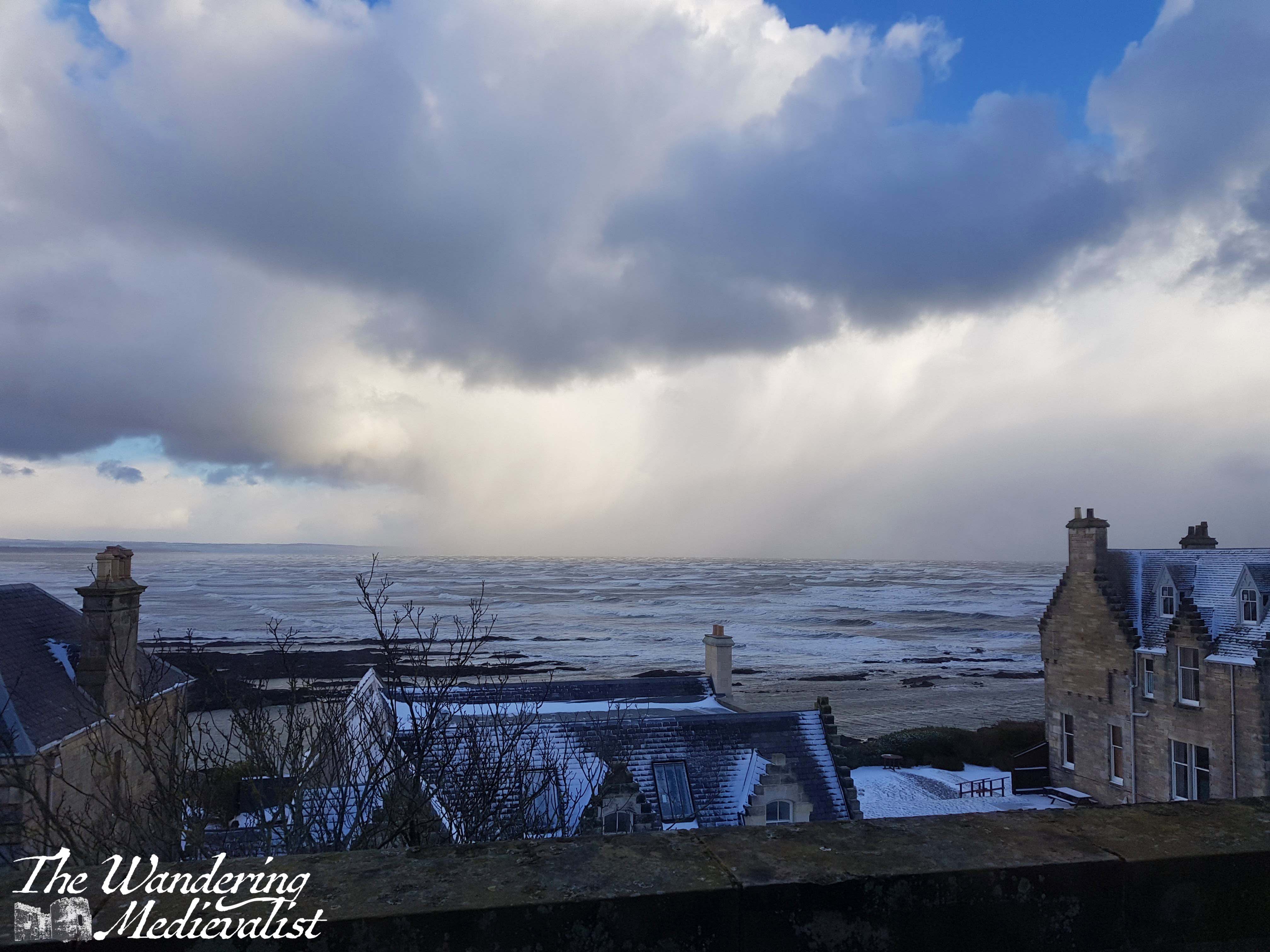
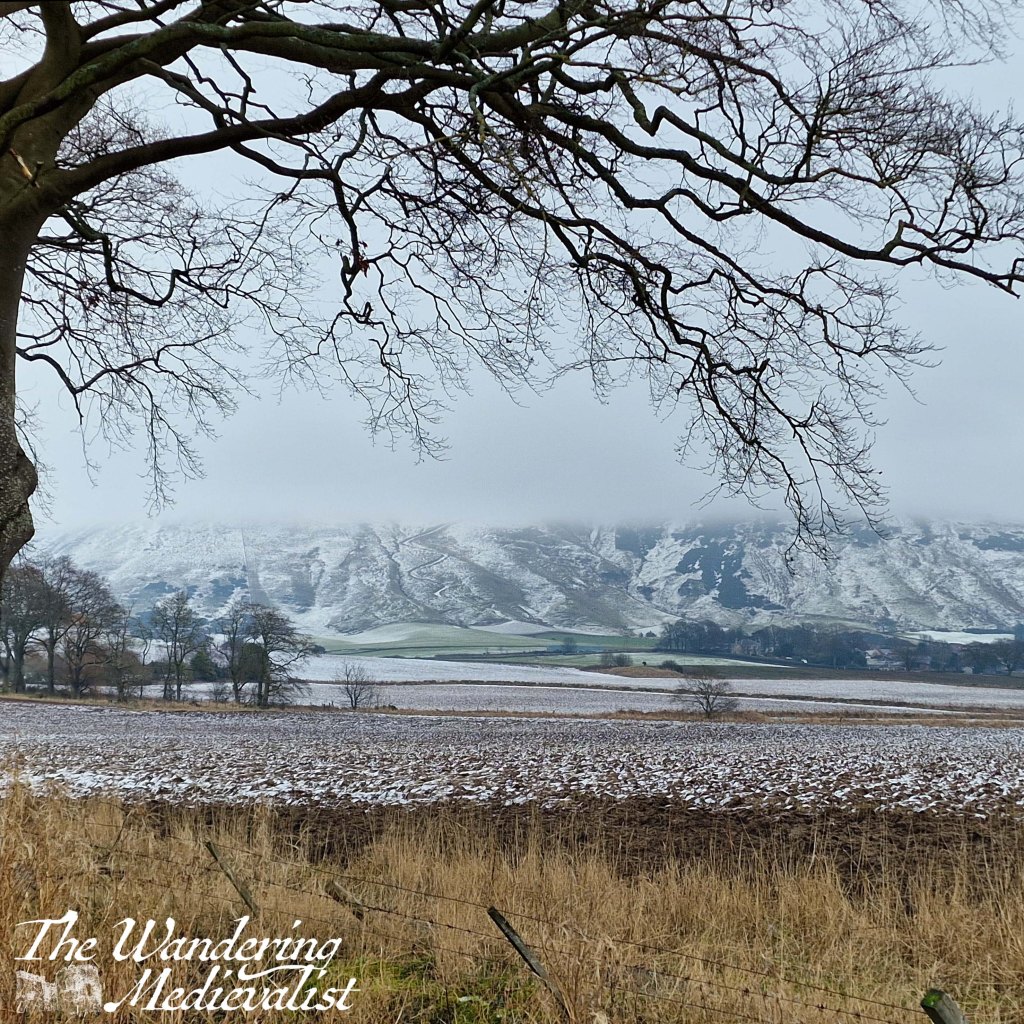
We had very little snow this past winter, but on visiting Loch Leven we discovered a dusting had made it inland. I loved this hill half-hidden by cloud.
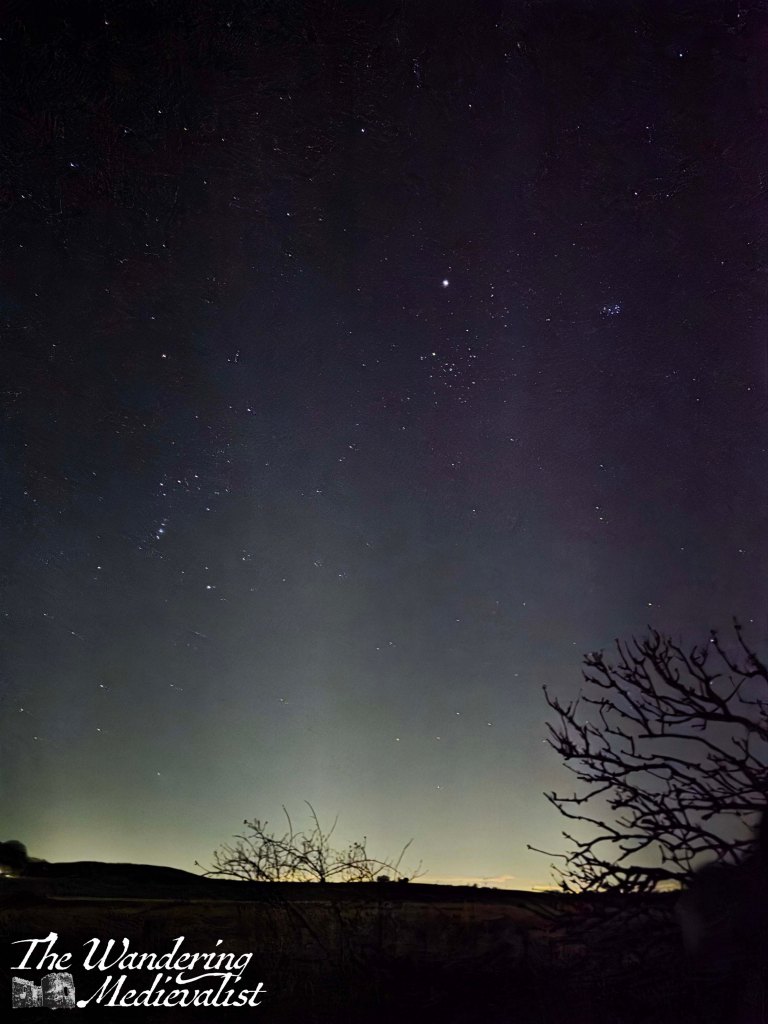
The winter months are by far the best for night sky, if only because it gets so very dark. Nonetheless, this picture was taken in the middle of an unlit field and shows the rather extreme light pollution here in Fife.
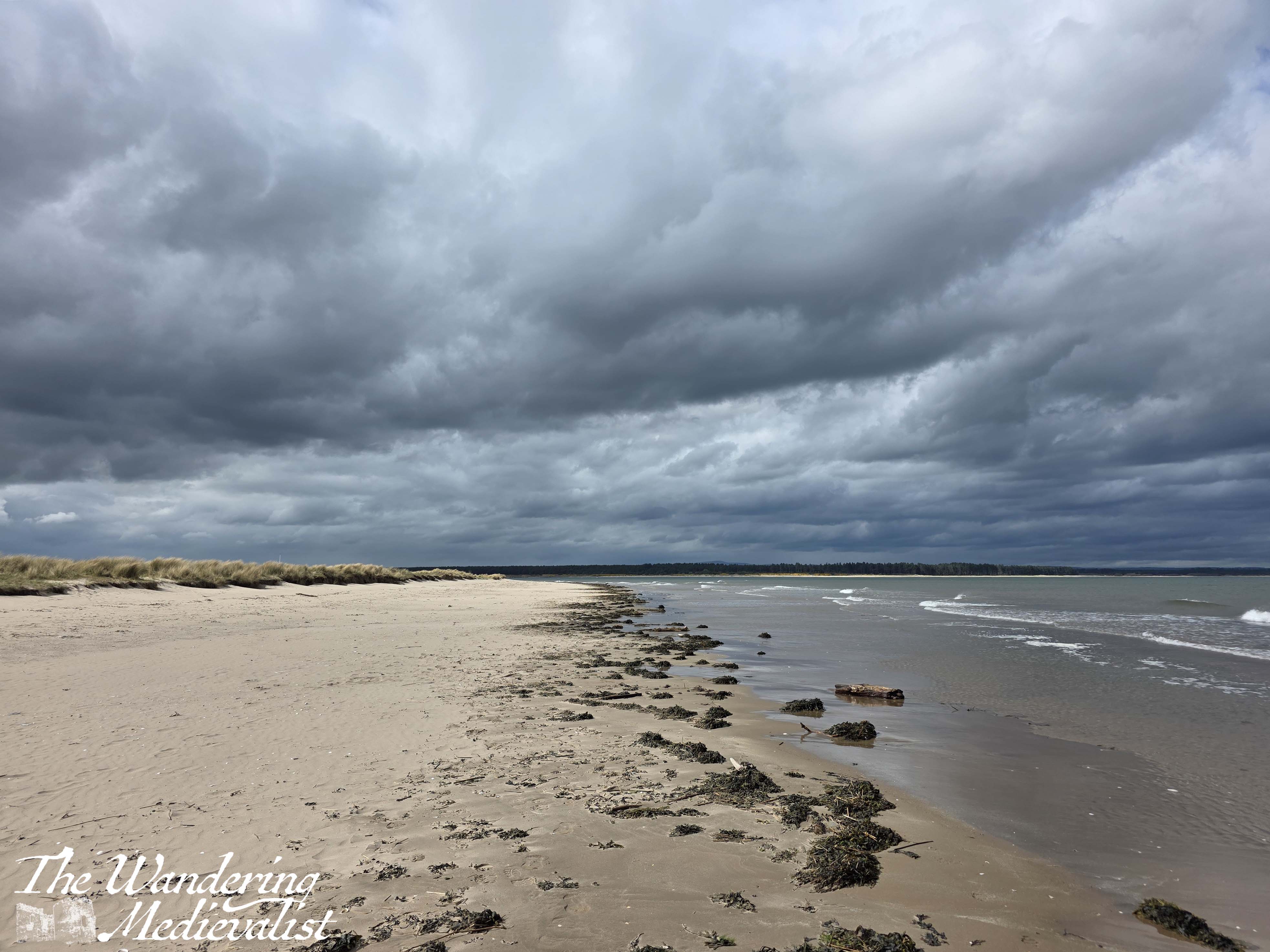
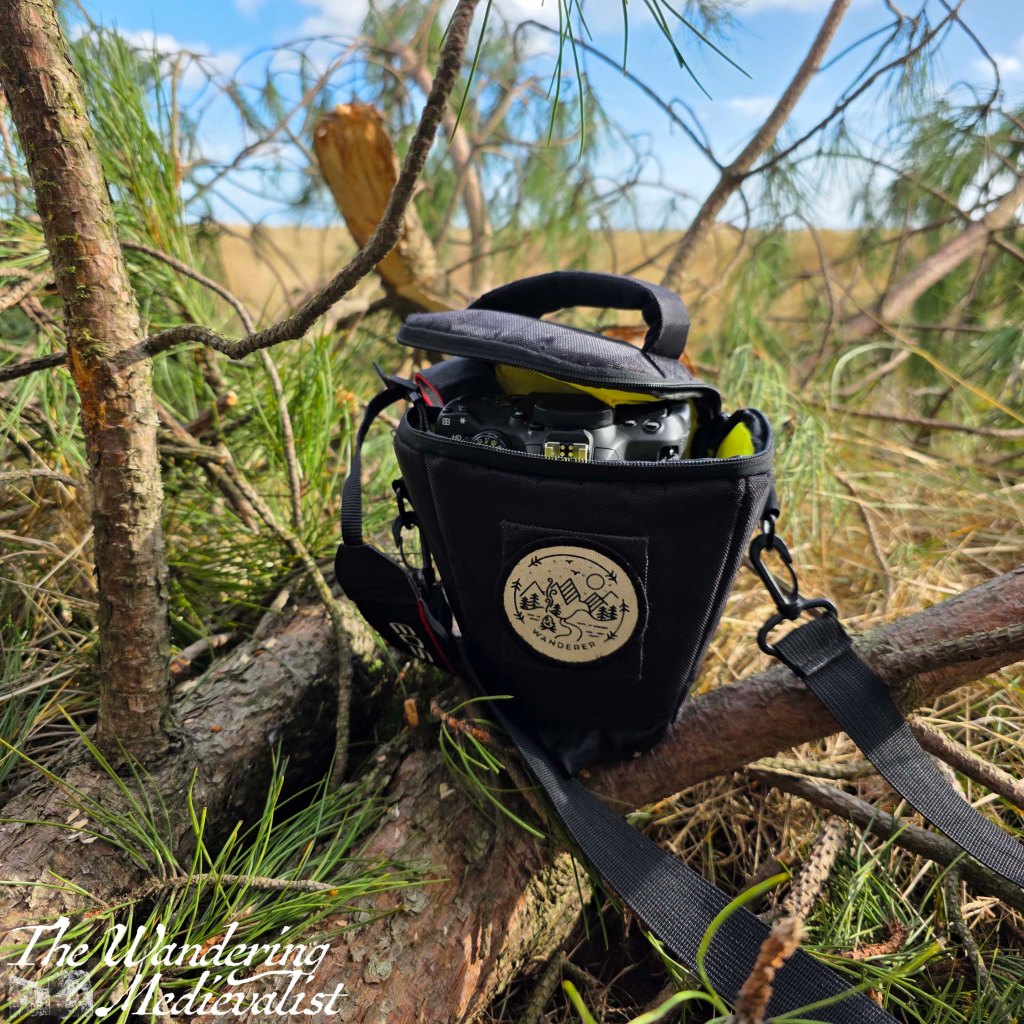
I decided to show off my new camera case patch with this posed picture on my walk along Tentsmuir. Love how it turned out.
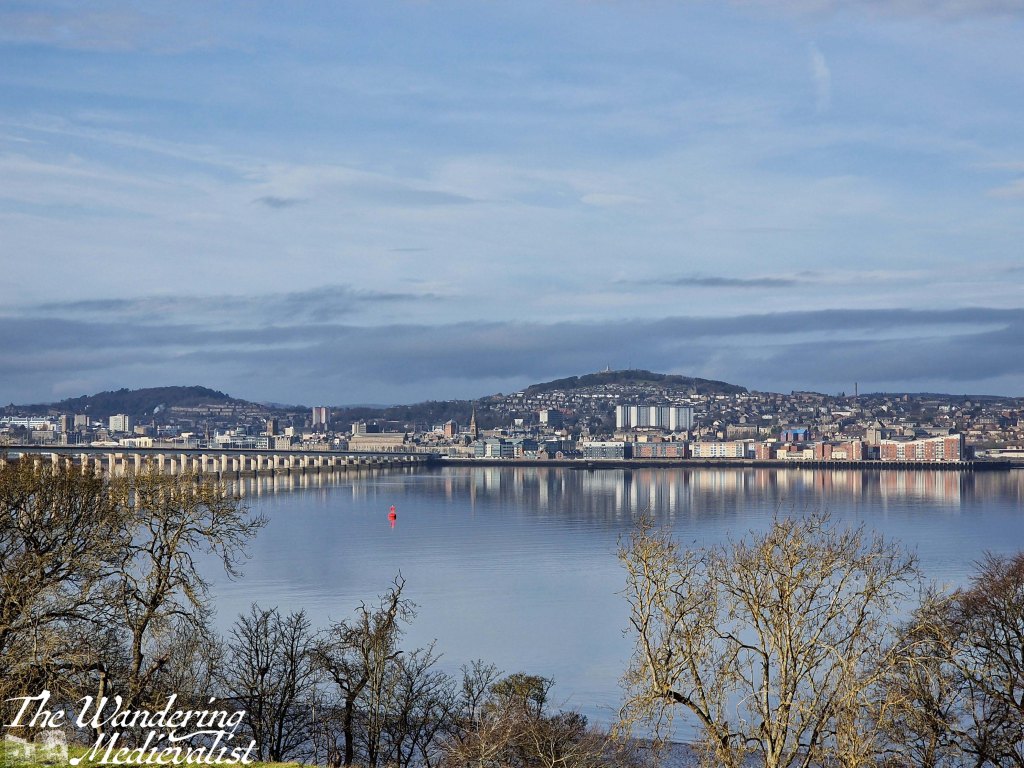
Dundee is not always thought of as the prettiest city, but on this day walking from Tayport to the bridge, we caught the river in stillness as the tide turned. I love the reflections.
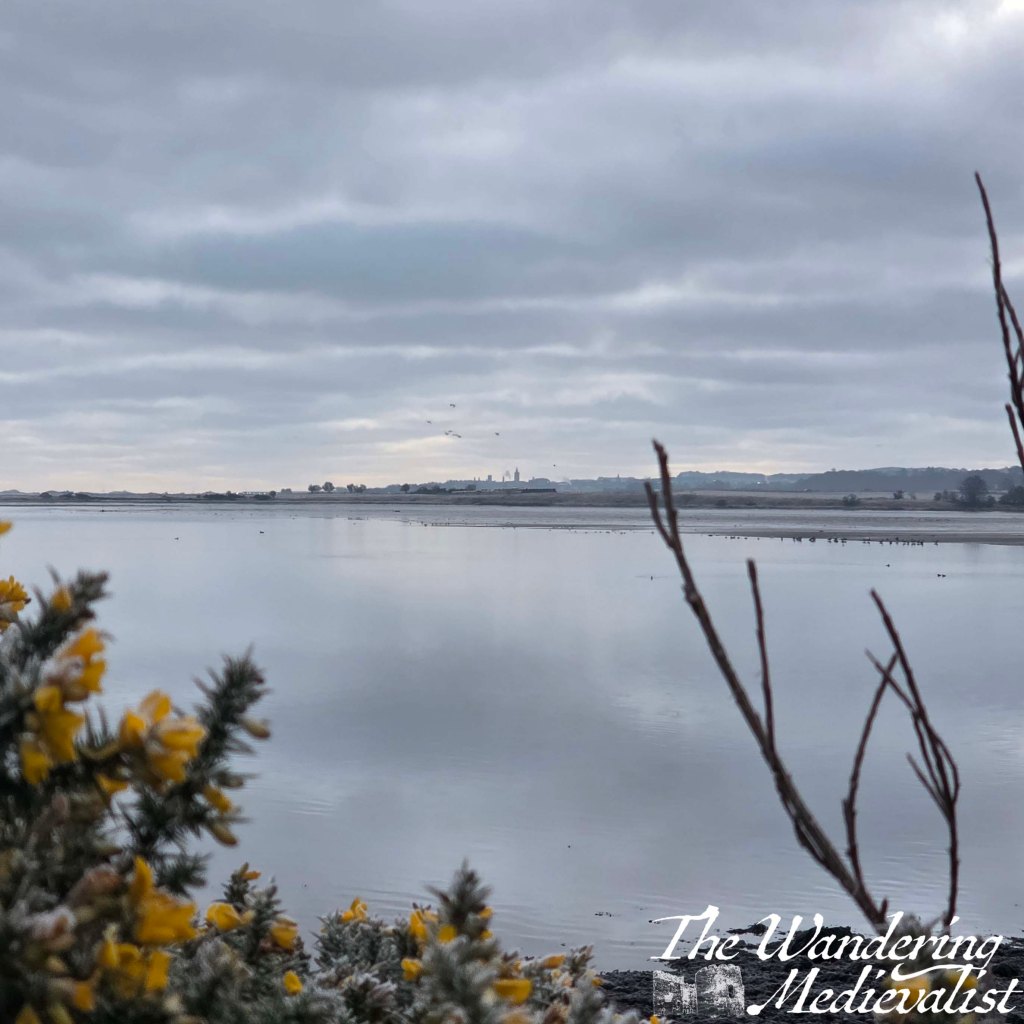
I have 100s of versions of this view, but this is one of my favourites, with frost just touching the flowering gorse on a grey and silver morning.
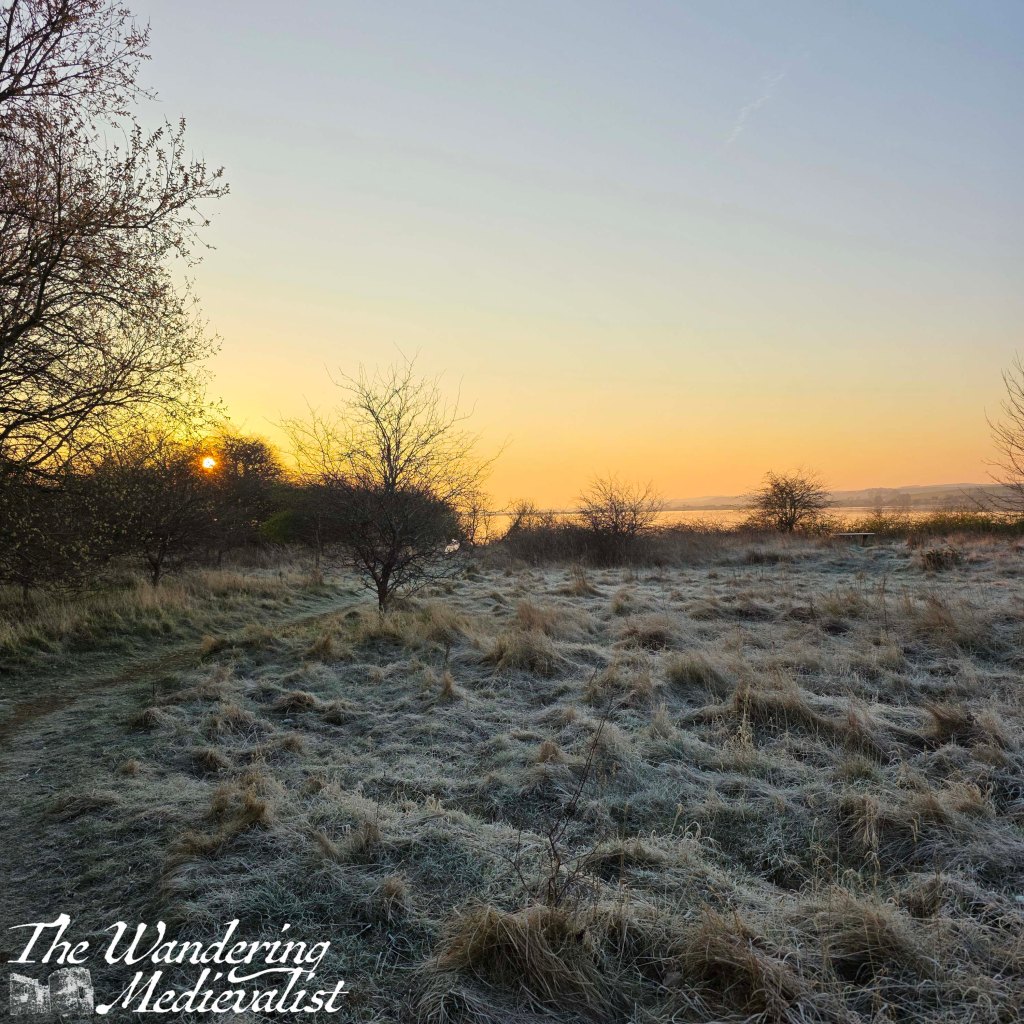
Sunrise over a frosty field. Does it get better?
I did this walk every day in lockdown, and it is still the best way to start off any day.
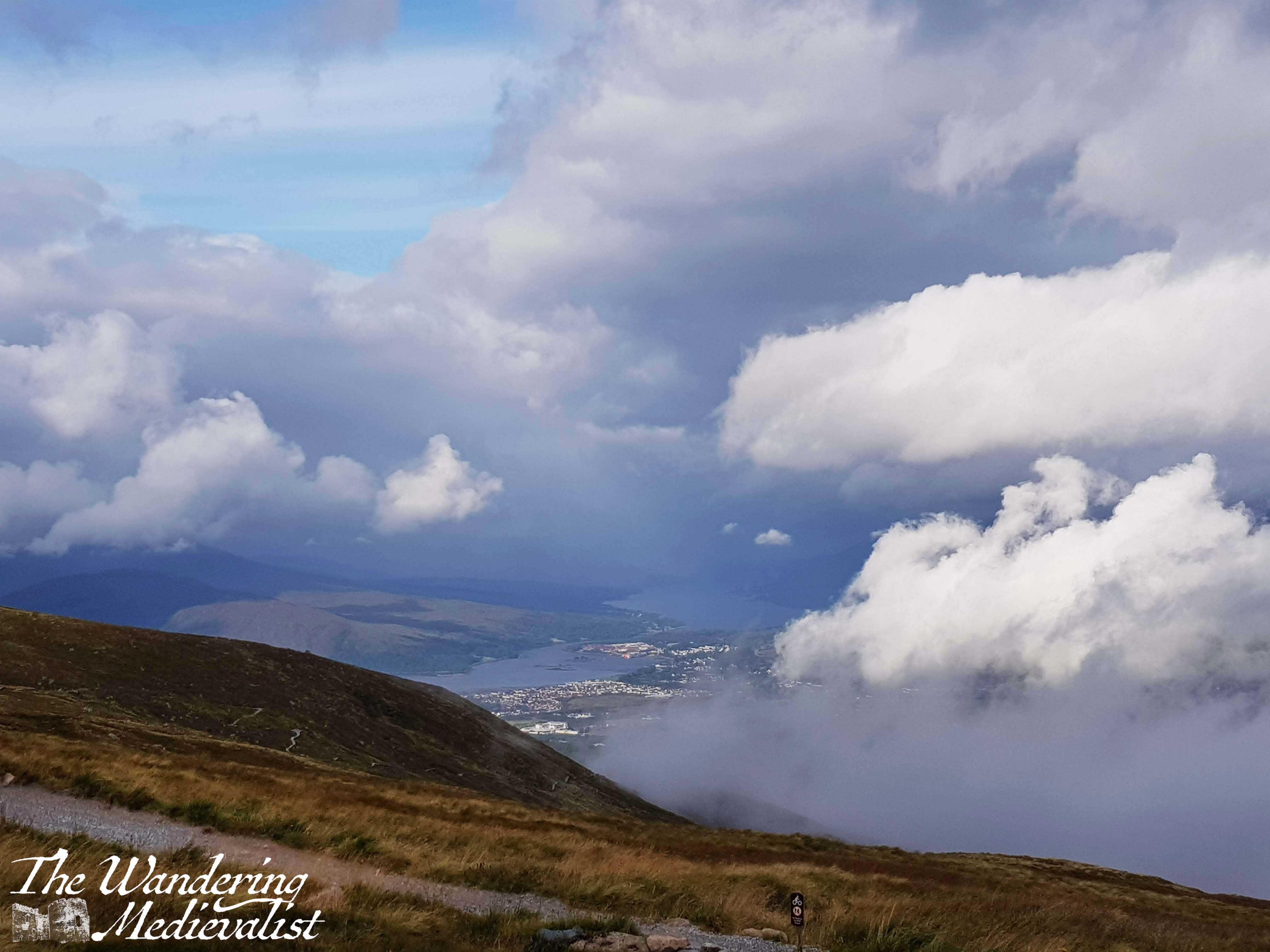
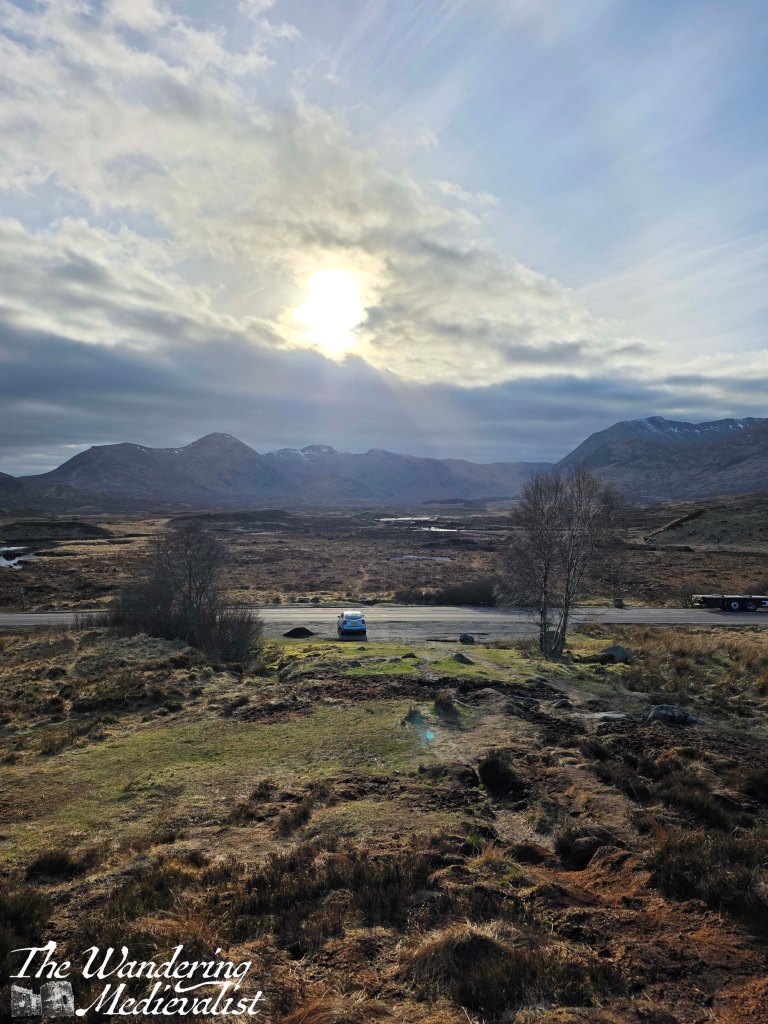
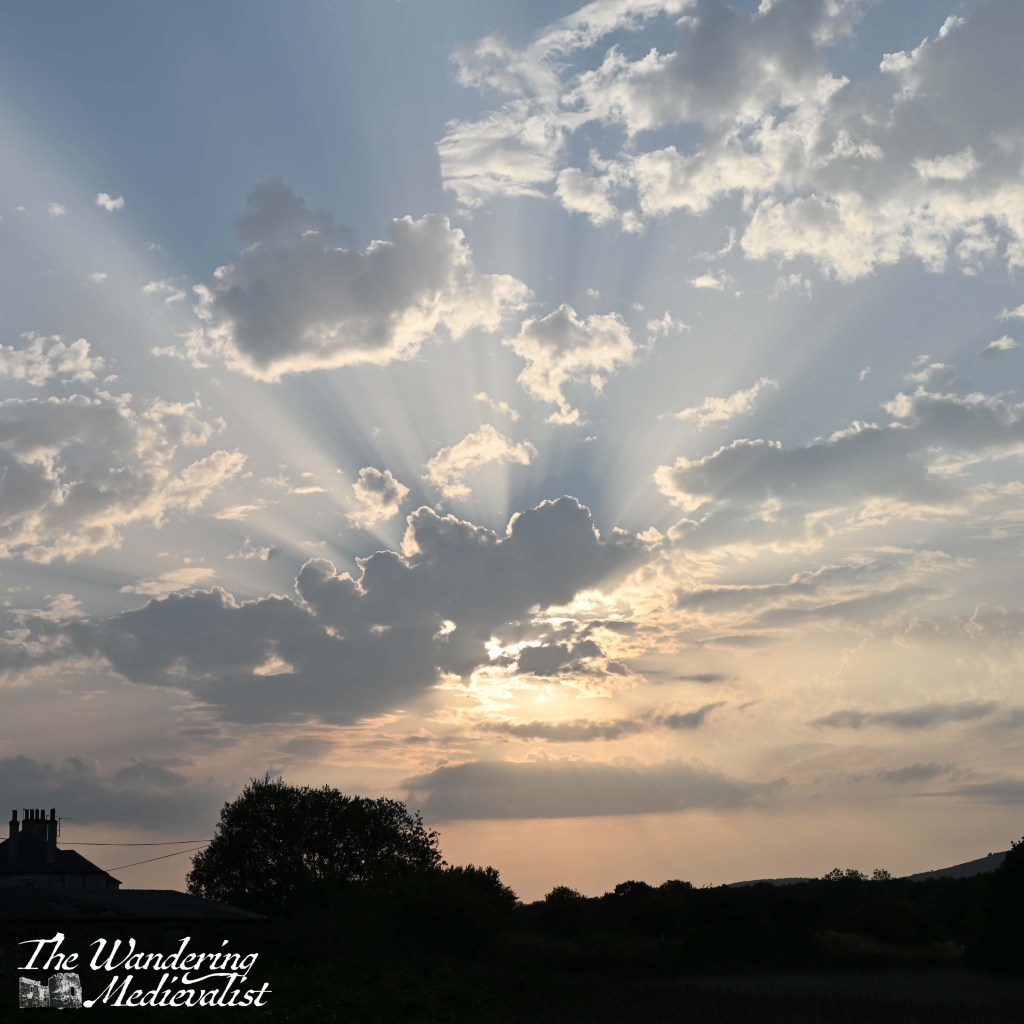
In March we drove up to Ballachulish for a long weekend, and stopped at the Loch Ba viewpoint. The loch is behind me, but this view of the sun fighting through the clouds was just as impressive.
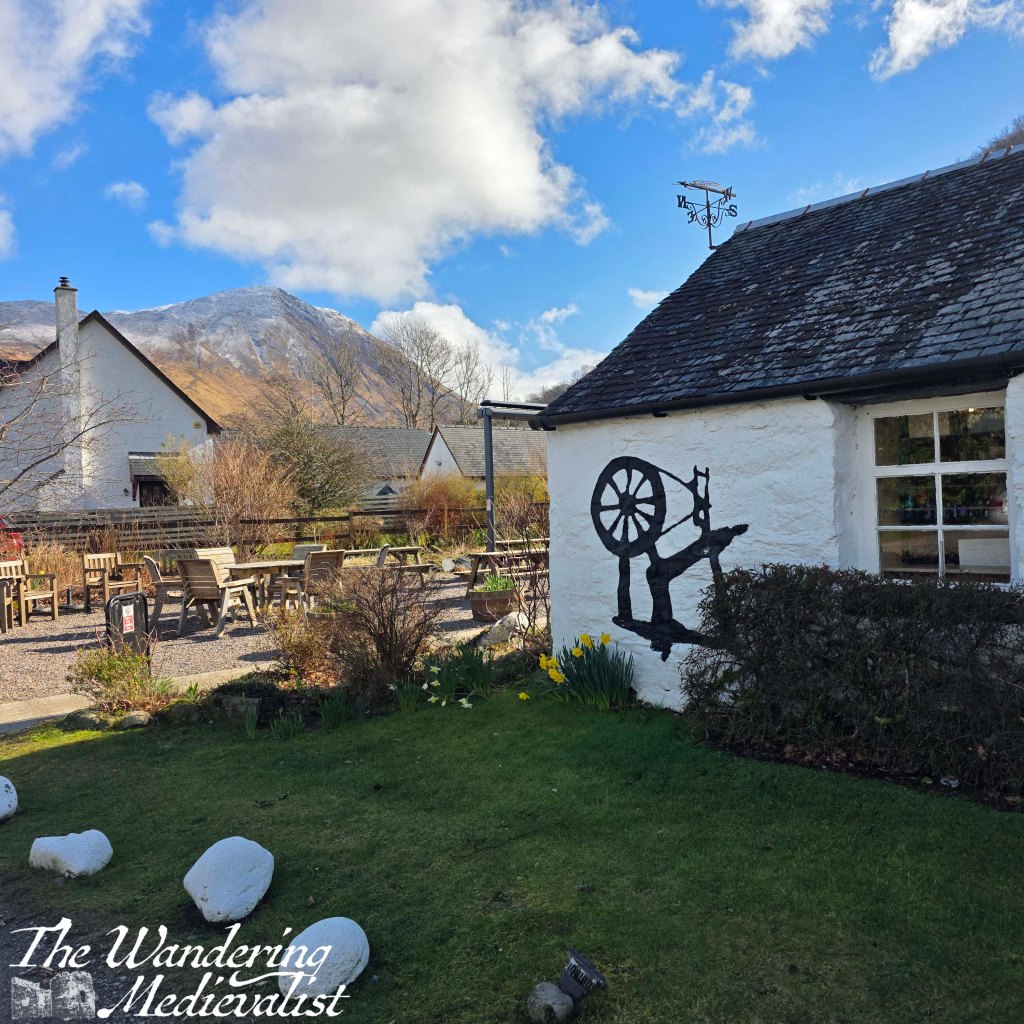
Our favourite snack spot in Glencoe since our first weekend away in 2009. Great coffee and an even better view.
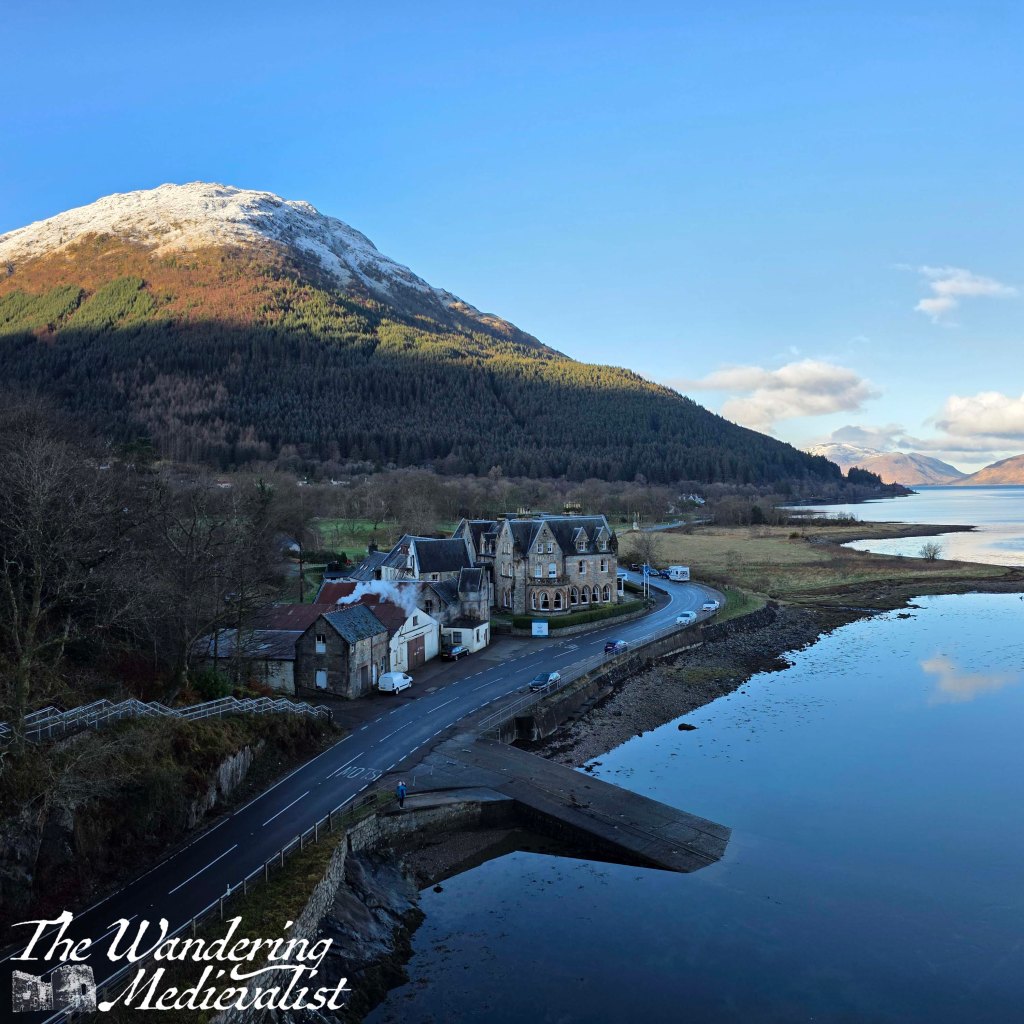
On our first morning, the cold night had left a heavy frost over everything, and there is nothing I love more than white mountains against a crystal blue sky. Also shows our hotel’s excellent location.
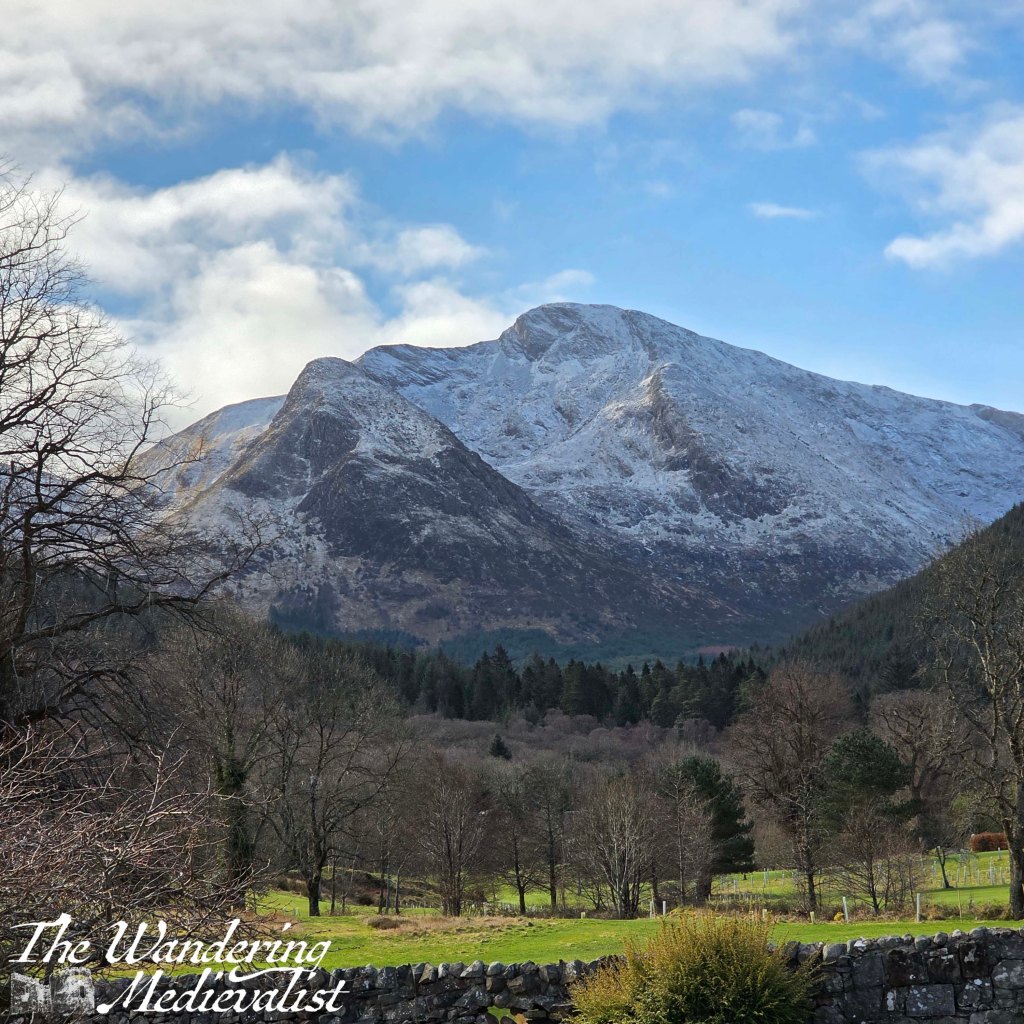
Frosty mountains are definitely one of my things…I can’t not take a picture. Just as my other half.
On a clear night, we drove to Loch Achtriochtan in Glencoe to try to get some excellent star pictures. A full moon rising and the busy road made for far too much light pollution, but I like this picture anyway, especially as that isn’t the sun setting behind the hills – that light is just from the moon.
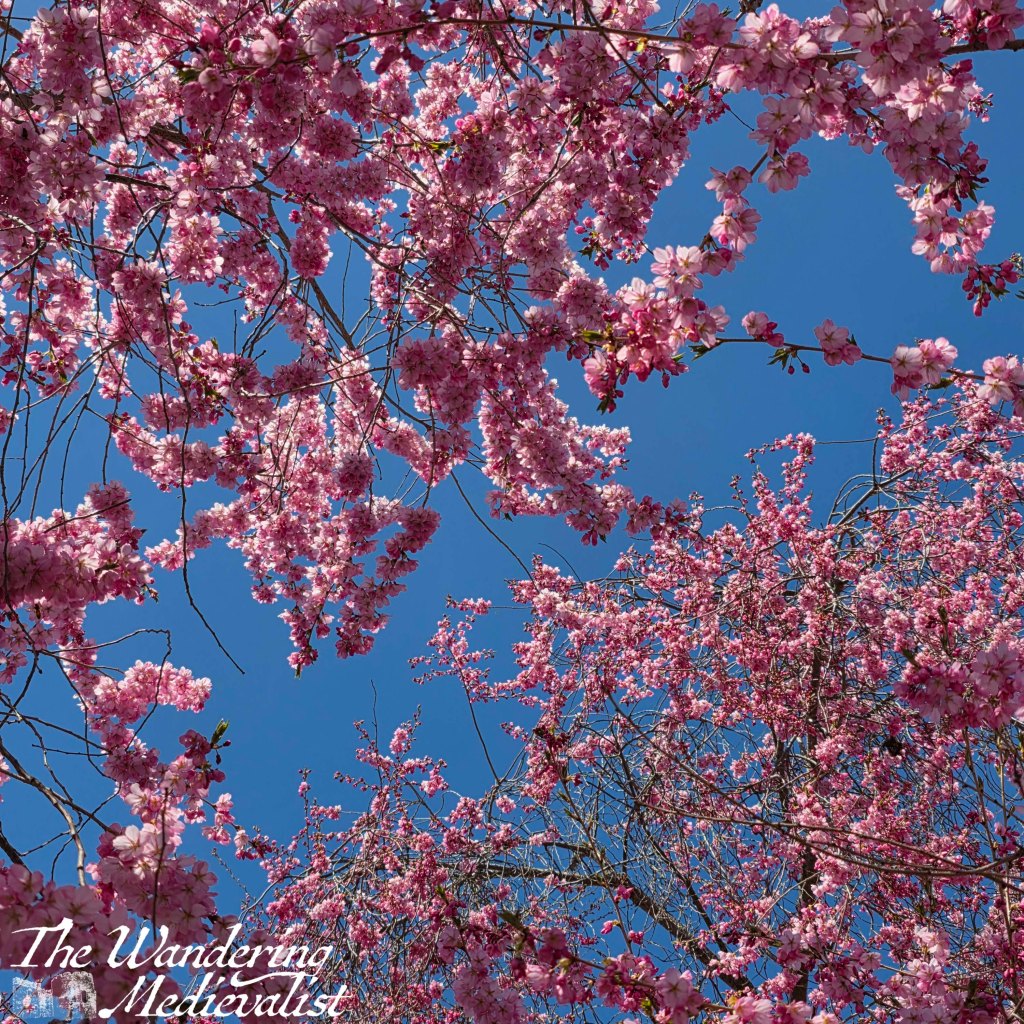
April blossoms, stunning colour contrast.
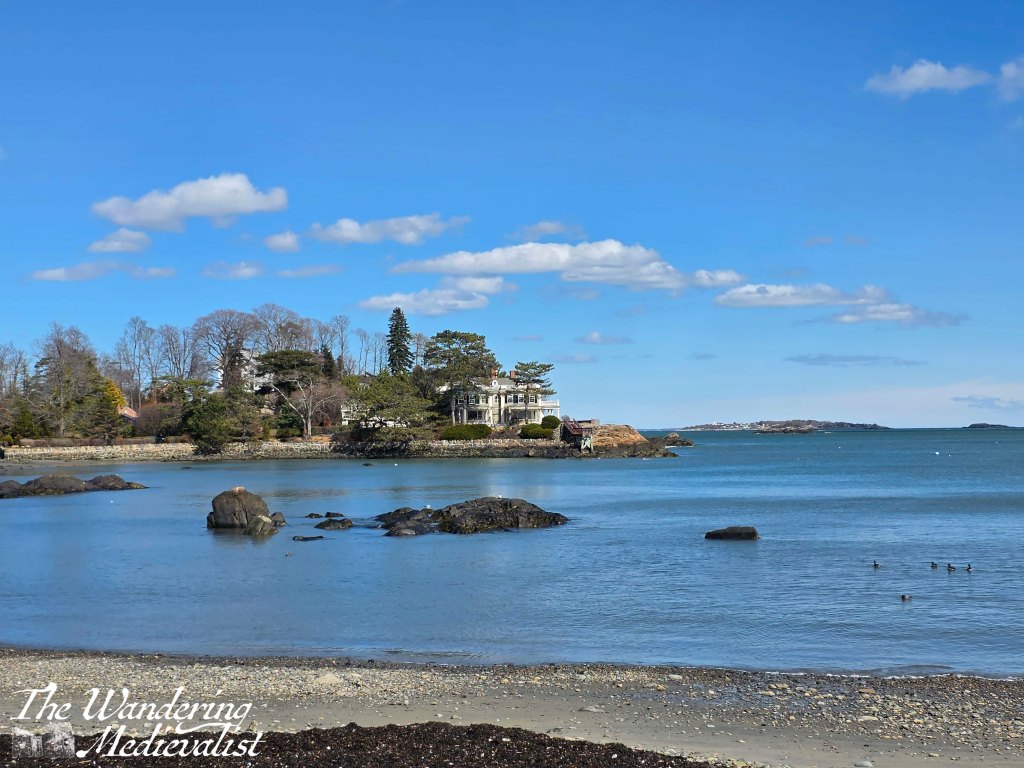
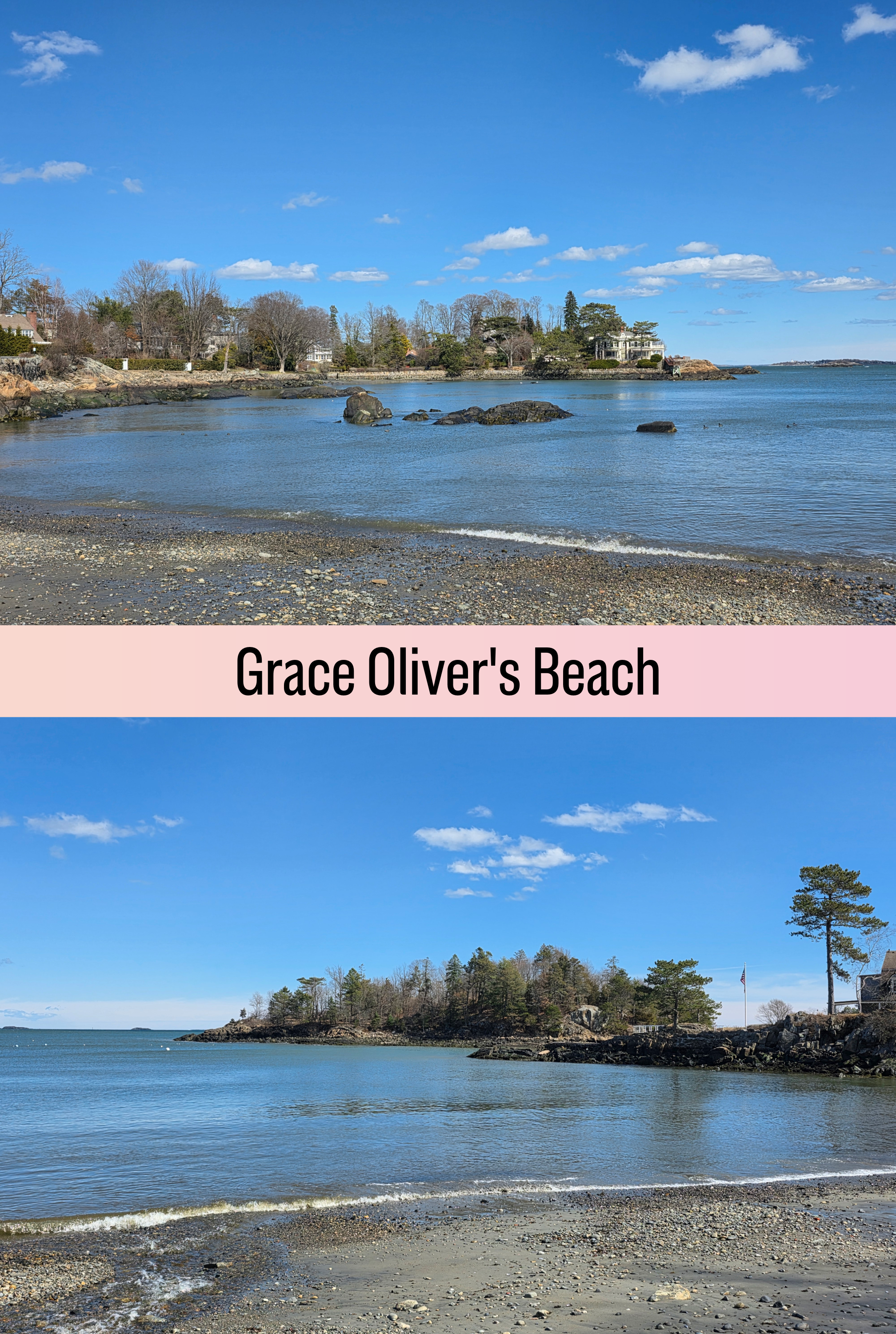
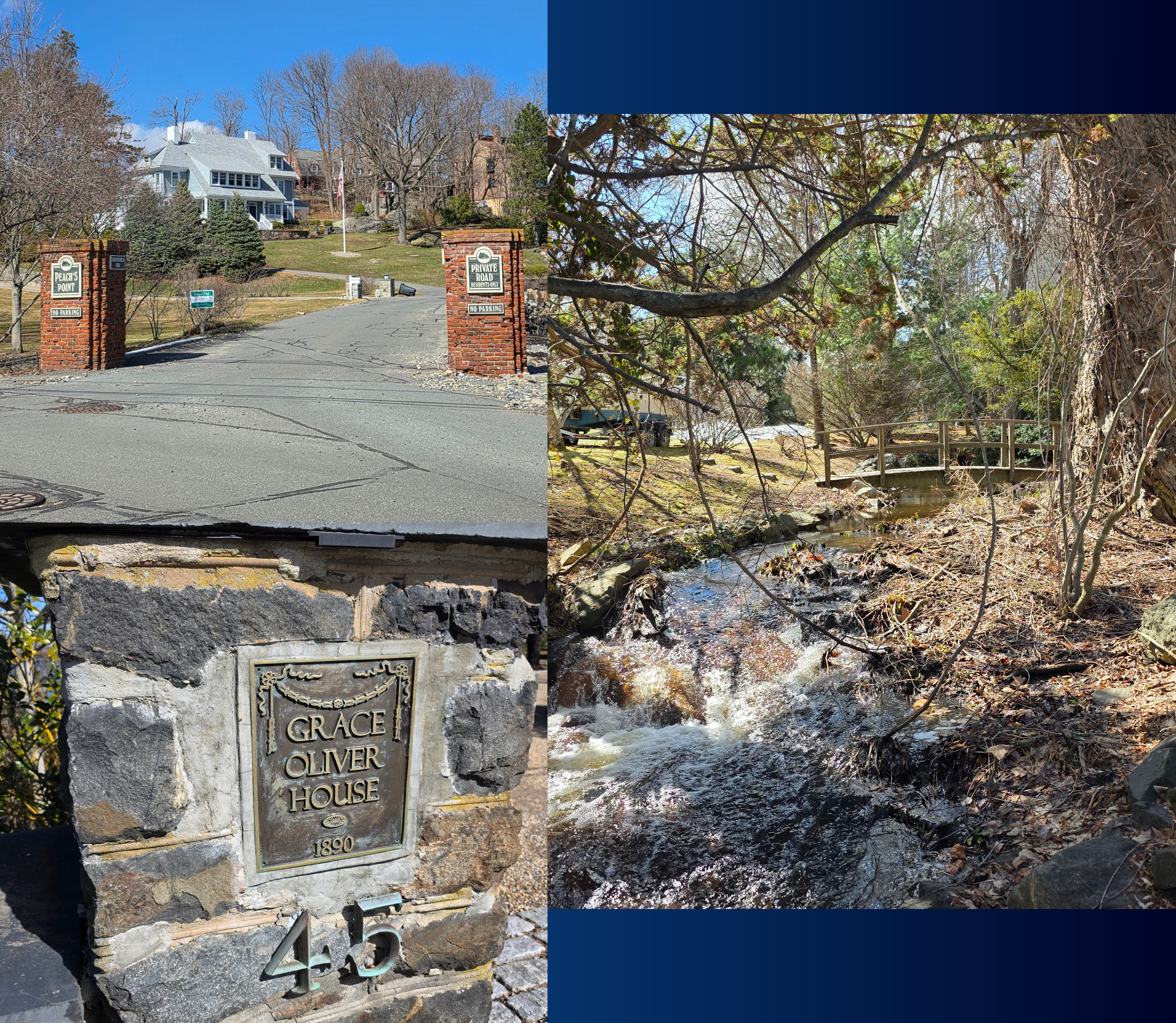
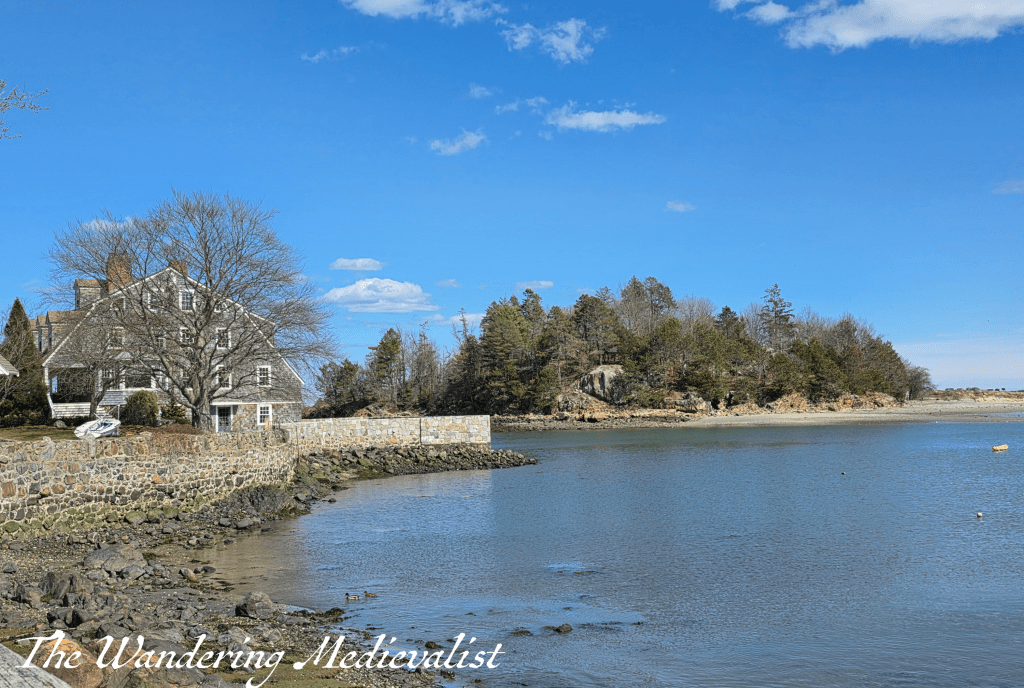
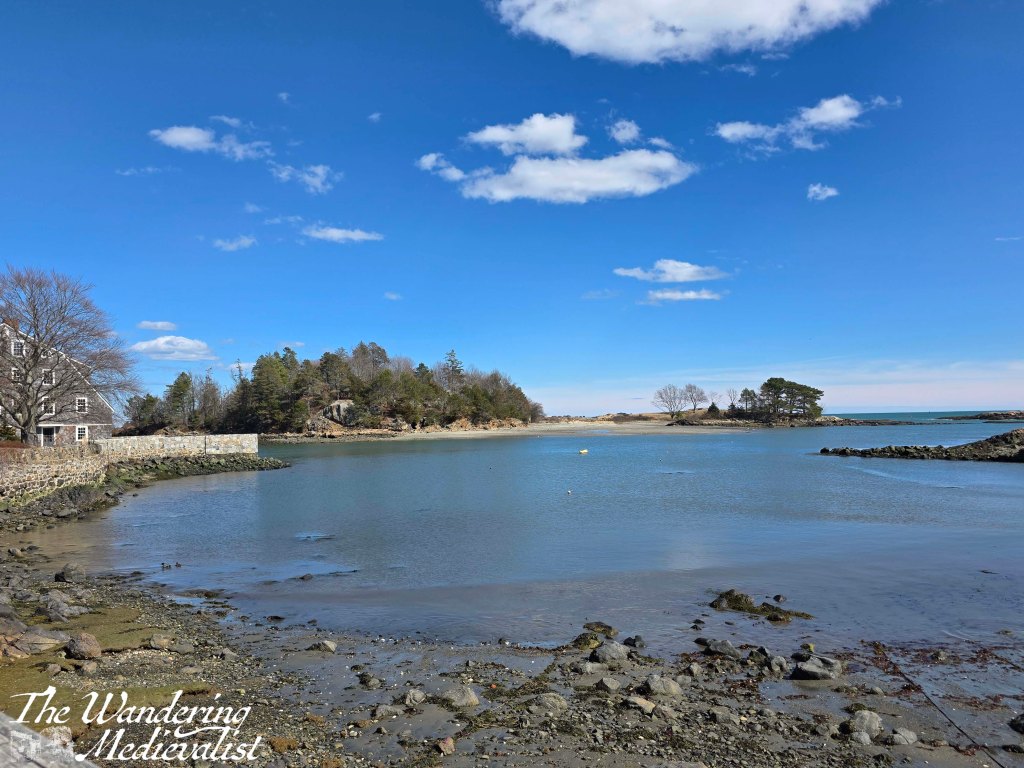
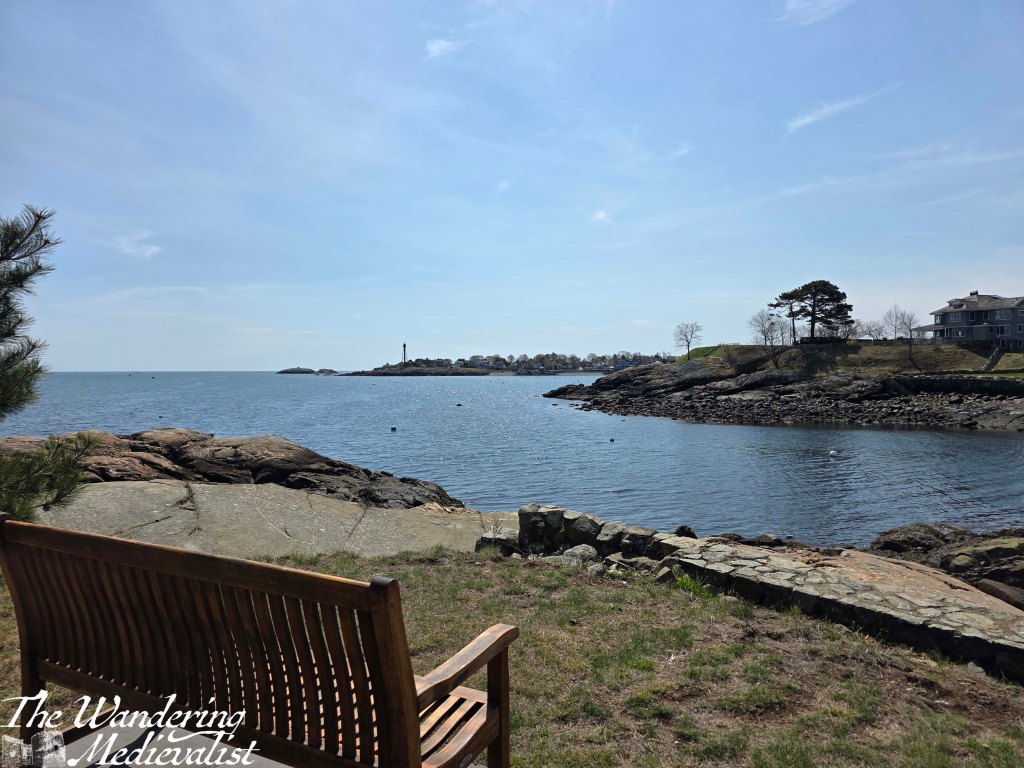
I spent my childhood playing on this island in Marblehead, long before it was cleared or with a bench to enjoy the view. Still, it brings back so many fond memories to see it.
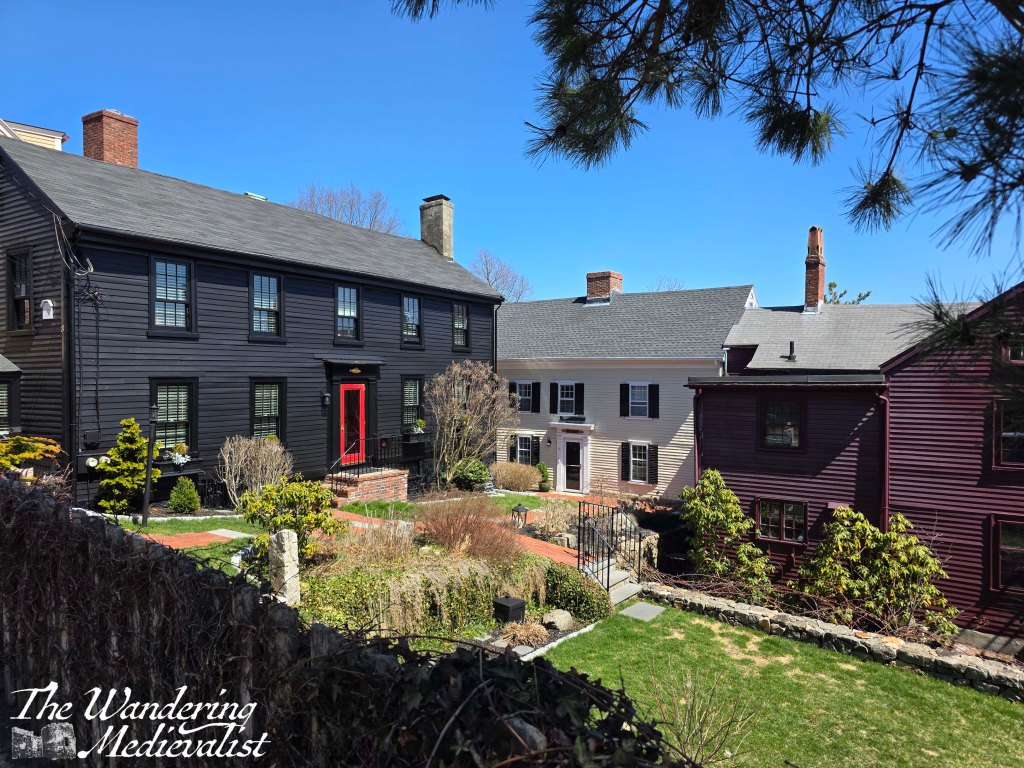
One of my favourite views in Marblehead, overlapping Colonial houses and rocky gardens. The old town in a nutshell.
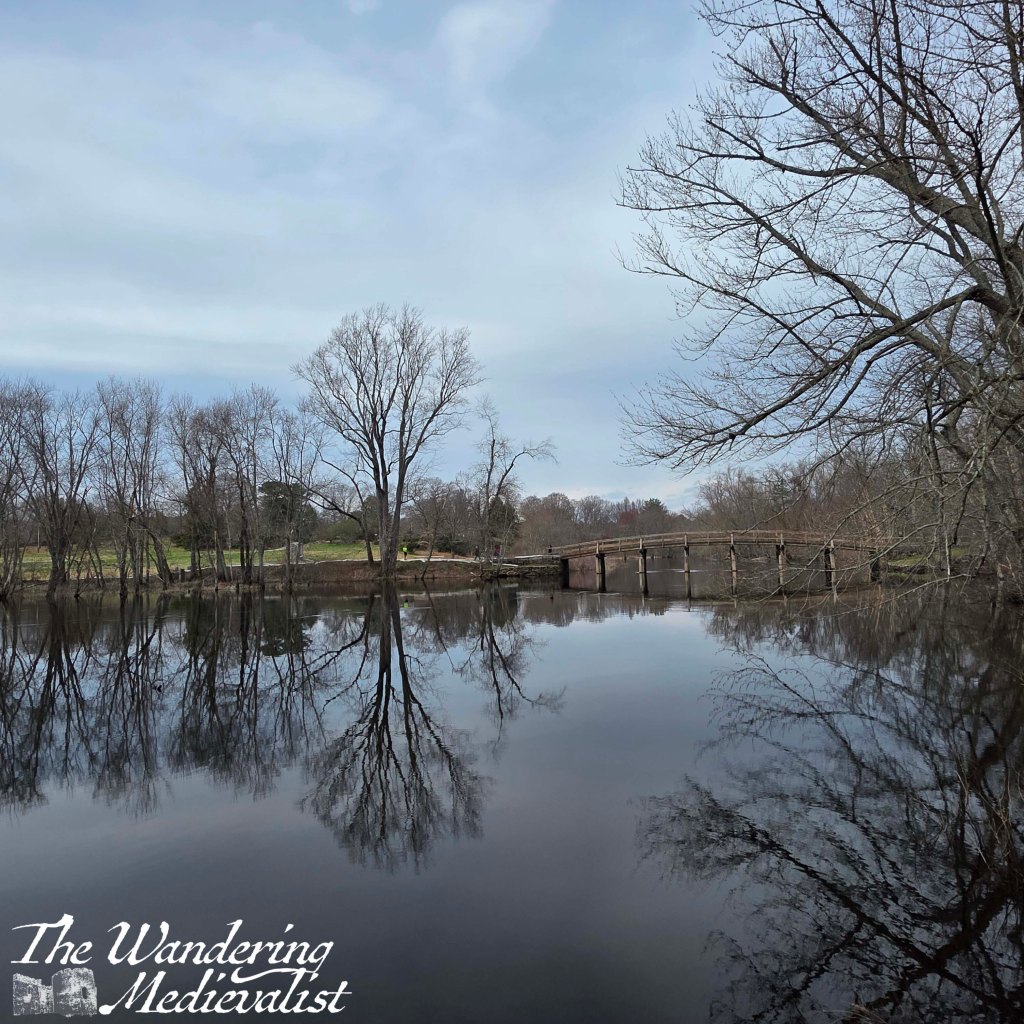
Old North Bridge in Concord MA, the location of the shot heard round the world.
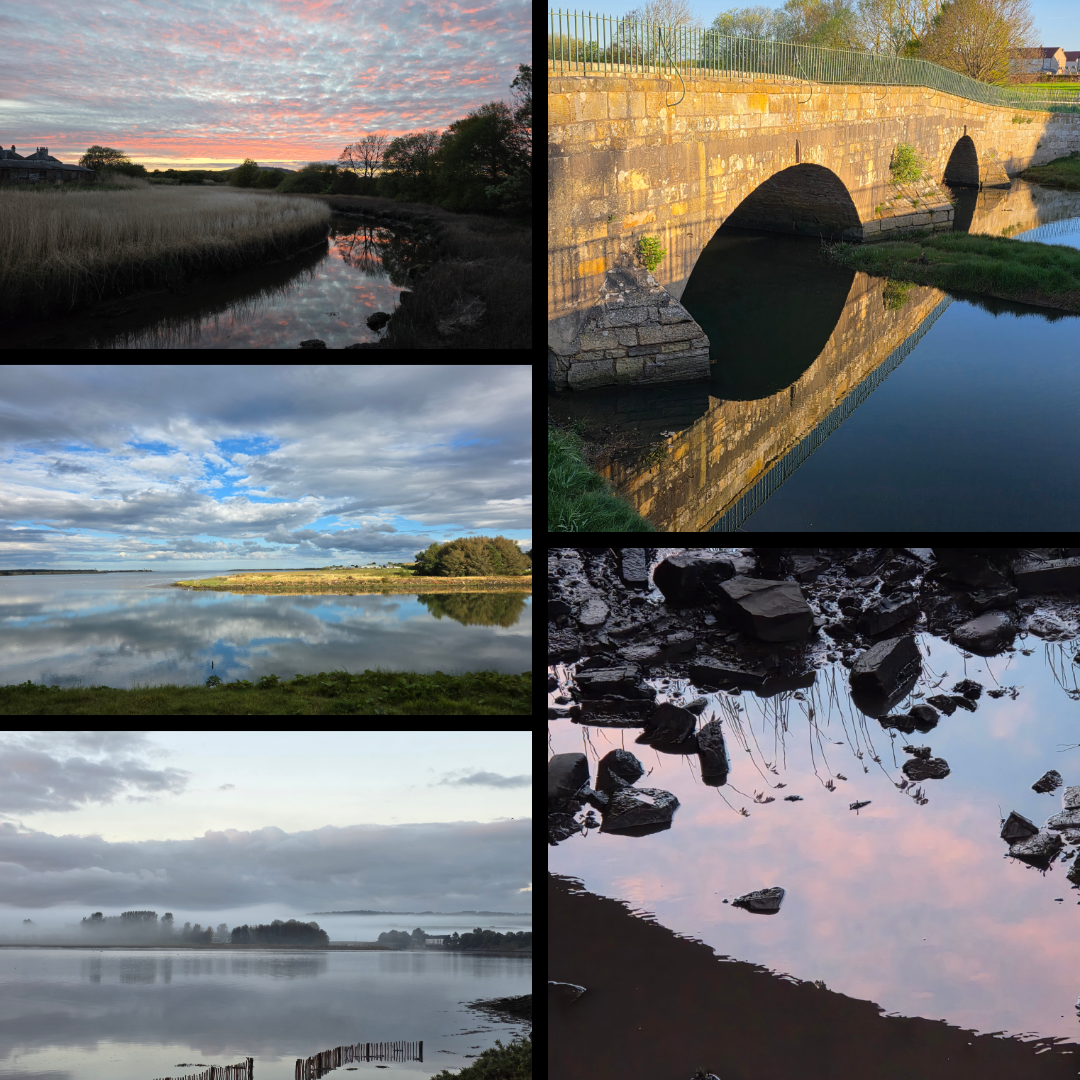
Mostly I just love reflections.
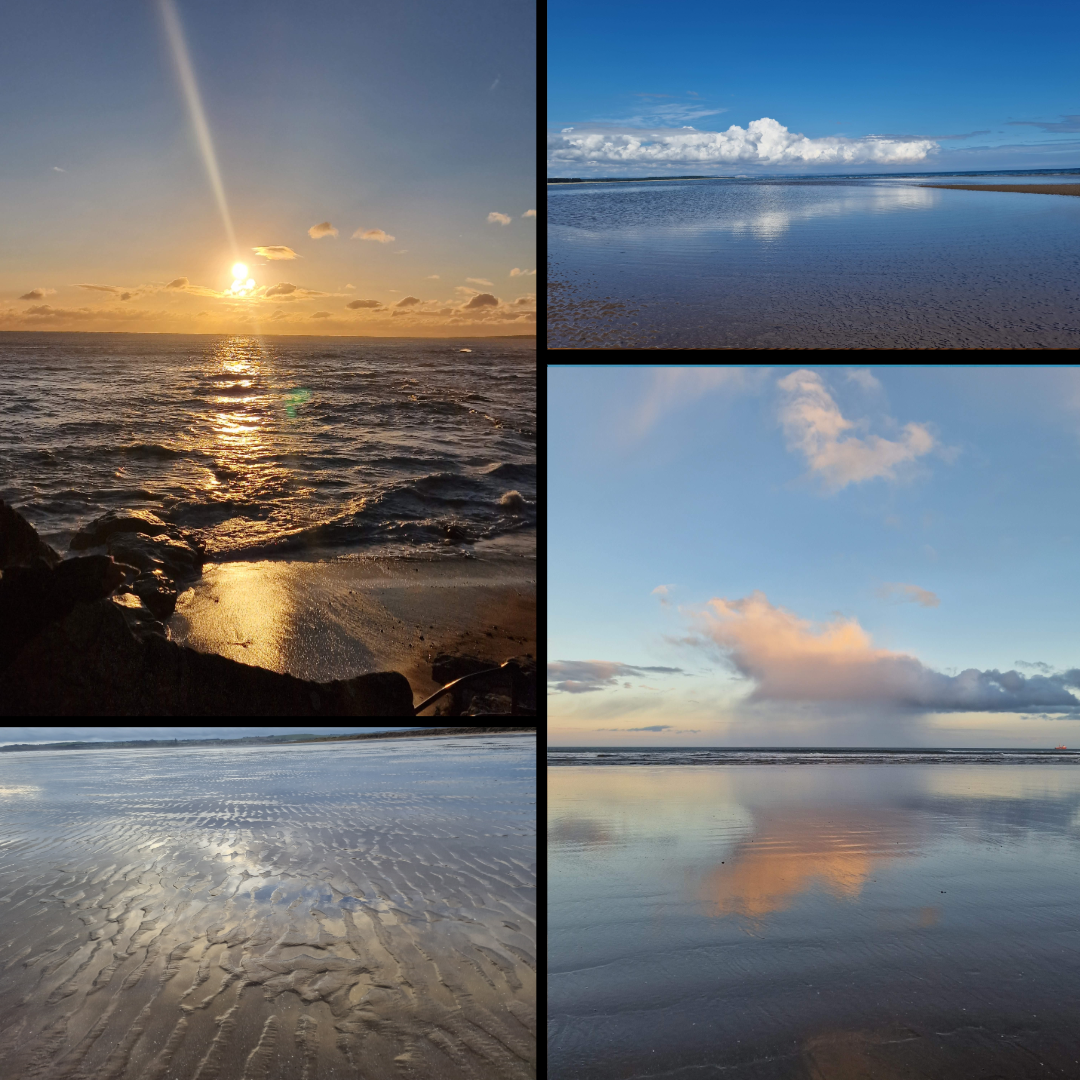
May was the month in which I really focussed on my fitness and in making a dent in my Coastal Path plans. The weather cooperated most of the time, but not always, like this rainy day when I walked from Newport to Balmerino. It is Scotland after all. No one would believe me if it was always sunny.
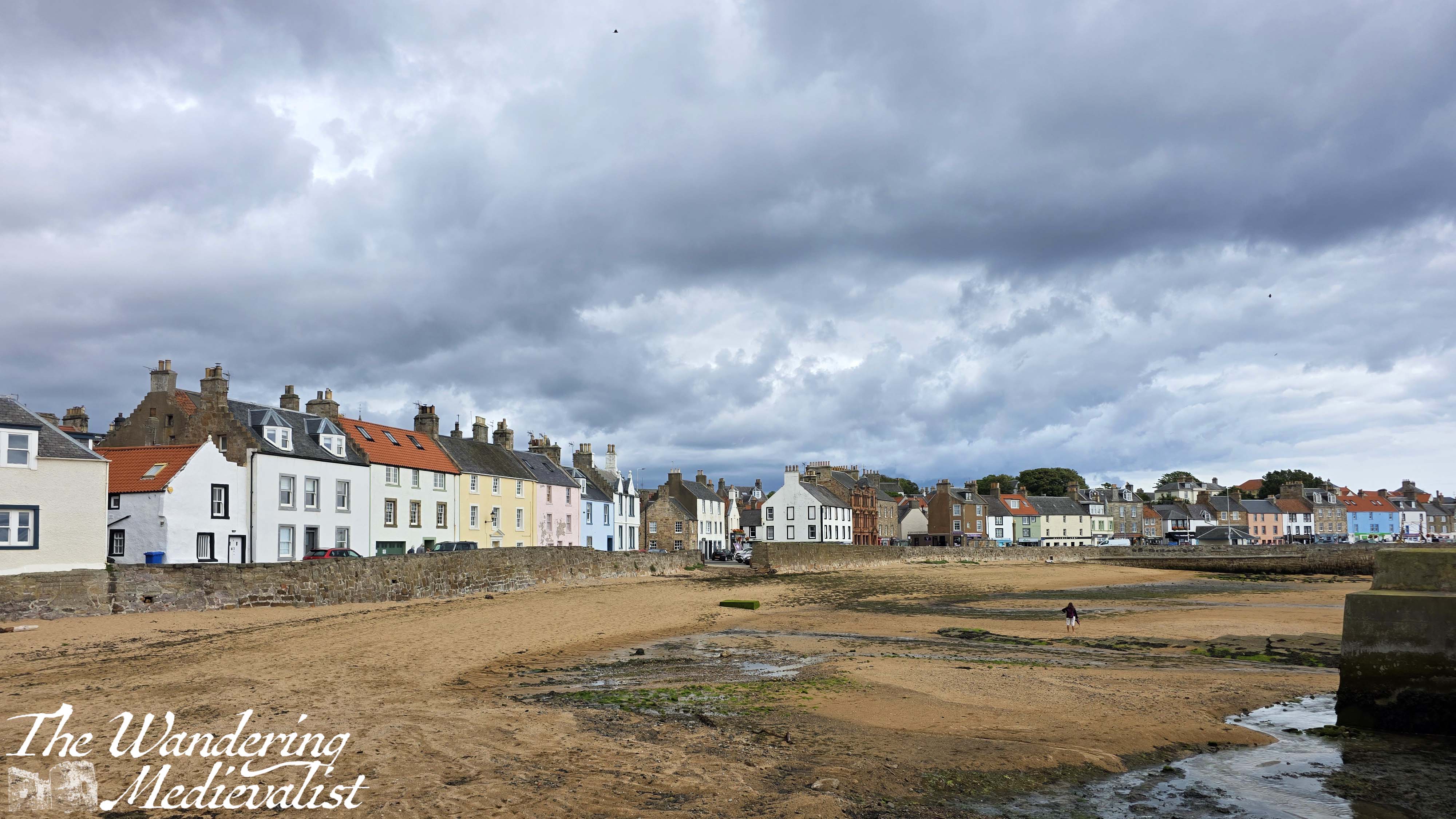
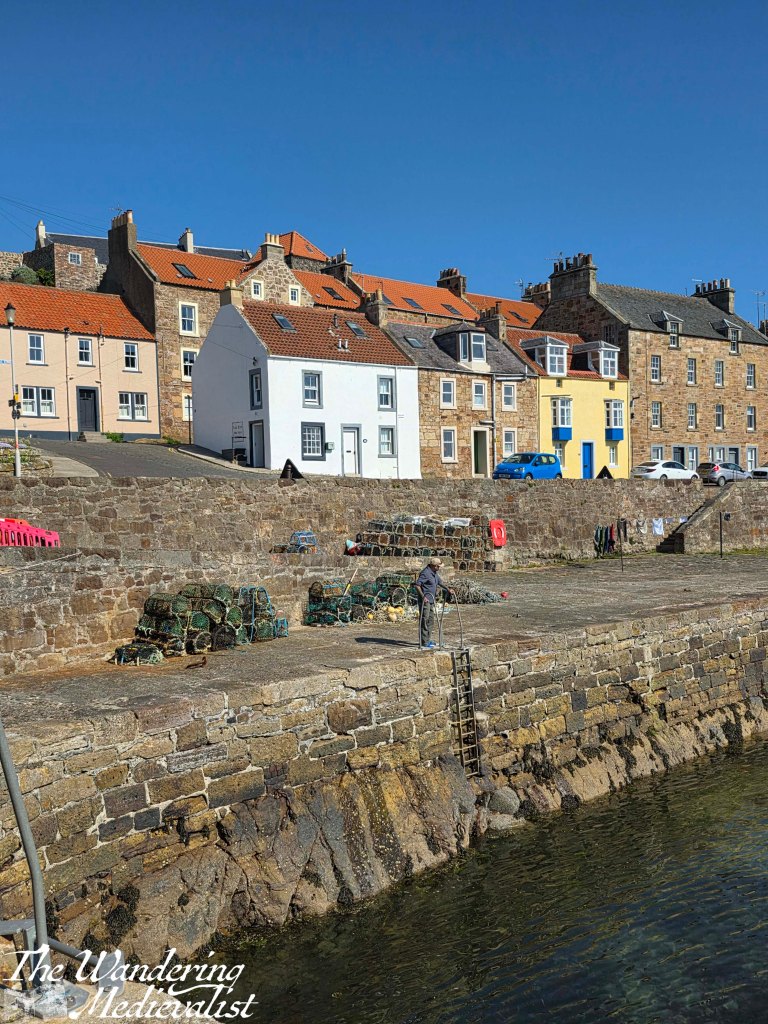
That said, most of my walk WAS sunny. Cellardyke harbour on this Saturday morning was calm and quiet, and just the epitome of the East Neuk.
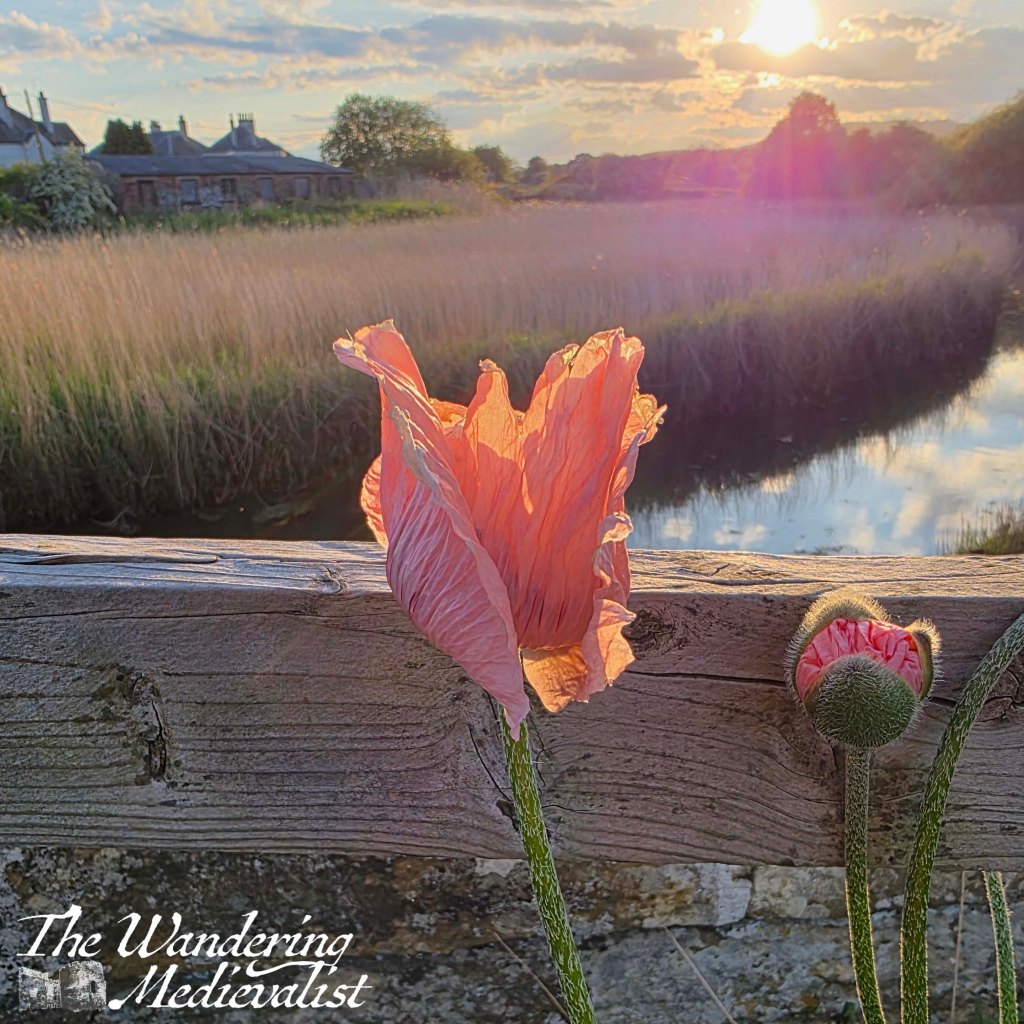
I love a good flower against the sun picture. Had you noticed?
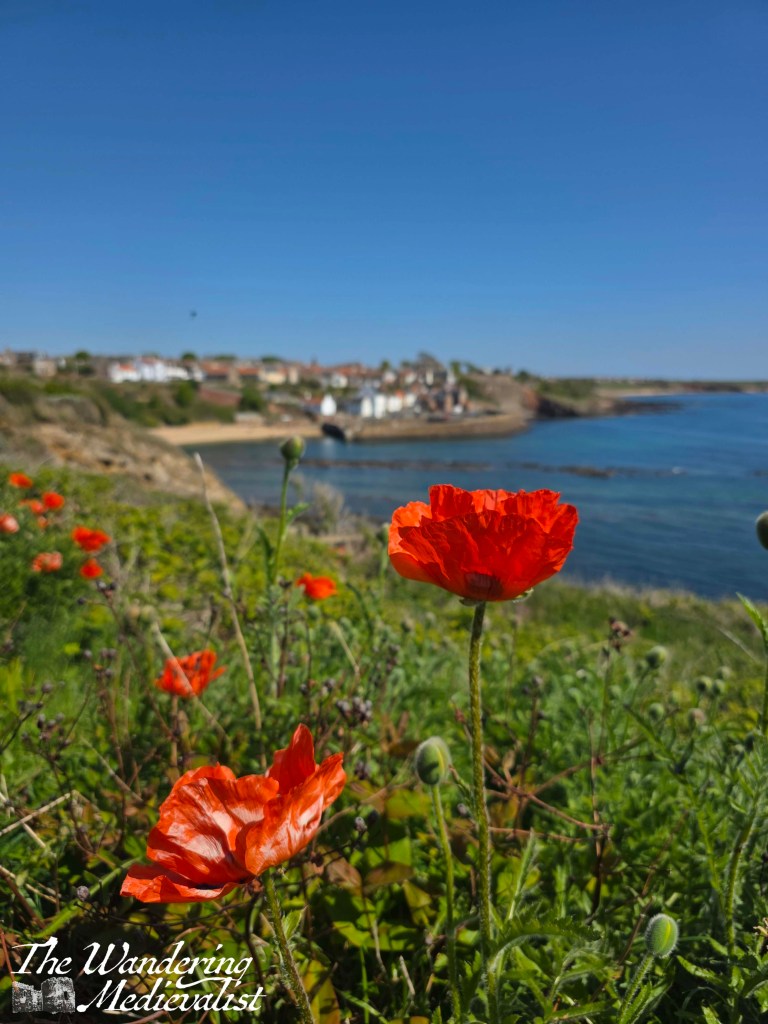
The walk into Crail is simply stunning, and when I completed this section the poppies were just blooming. The town is in the background, but the stunning red was the subject for this picture.
San Antonio in June. Whose idea was that?
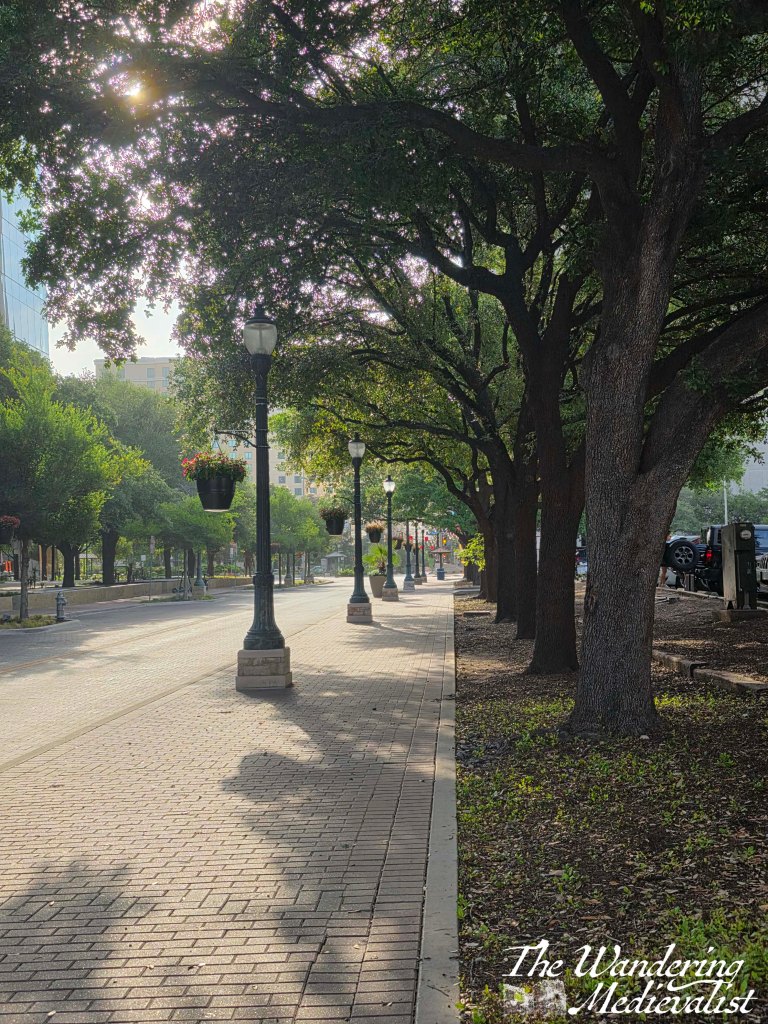
Taken relatively early in the day, this picture shows the heat that would come.
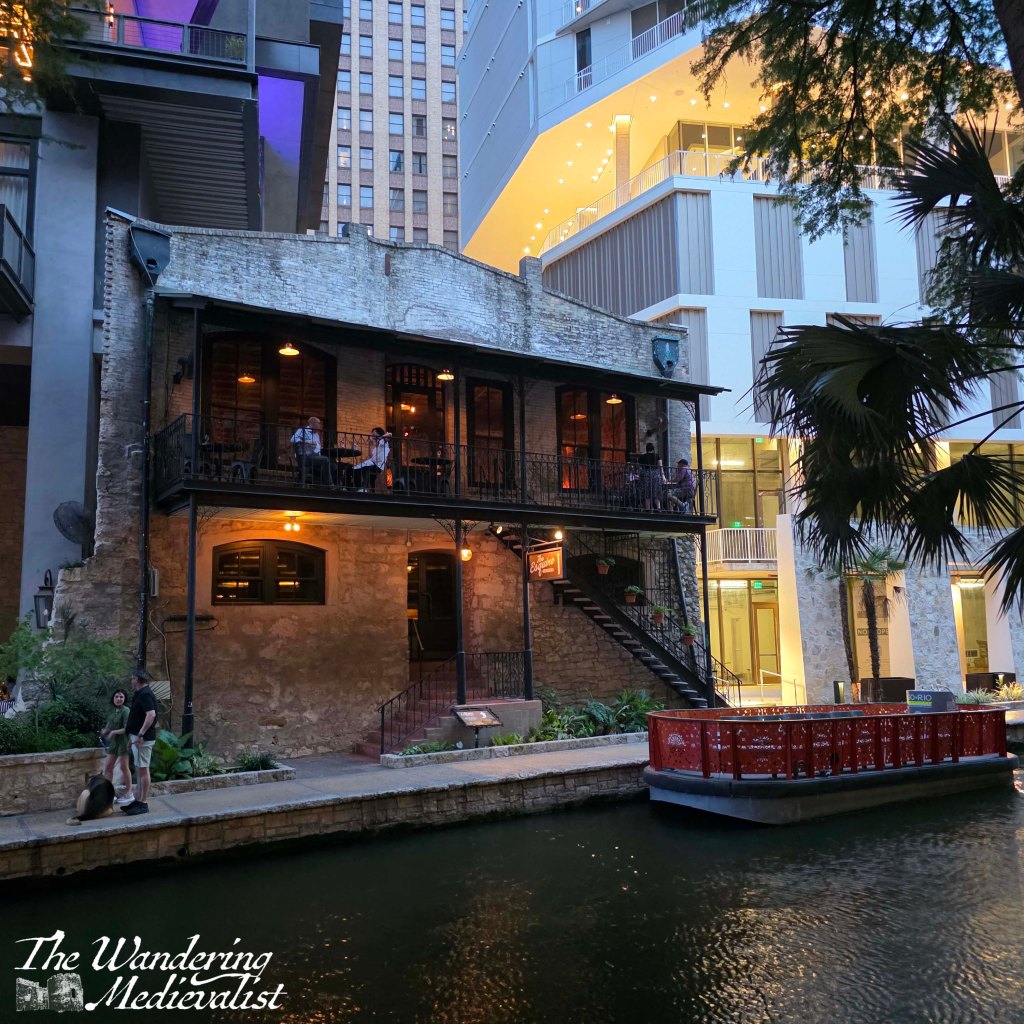
I fell in love with the Riverwalk in, and I have plenty of daytime pictures. But this one shows what is clearly an old building, just as the evening begins. So much promise of the night’s entertainment to be had!
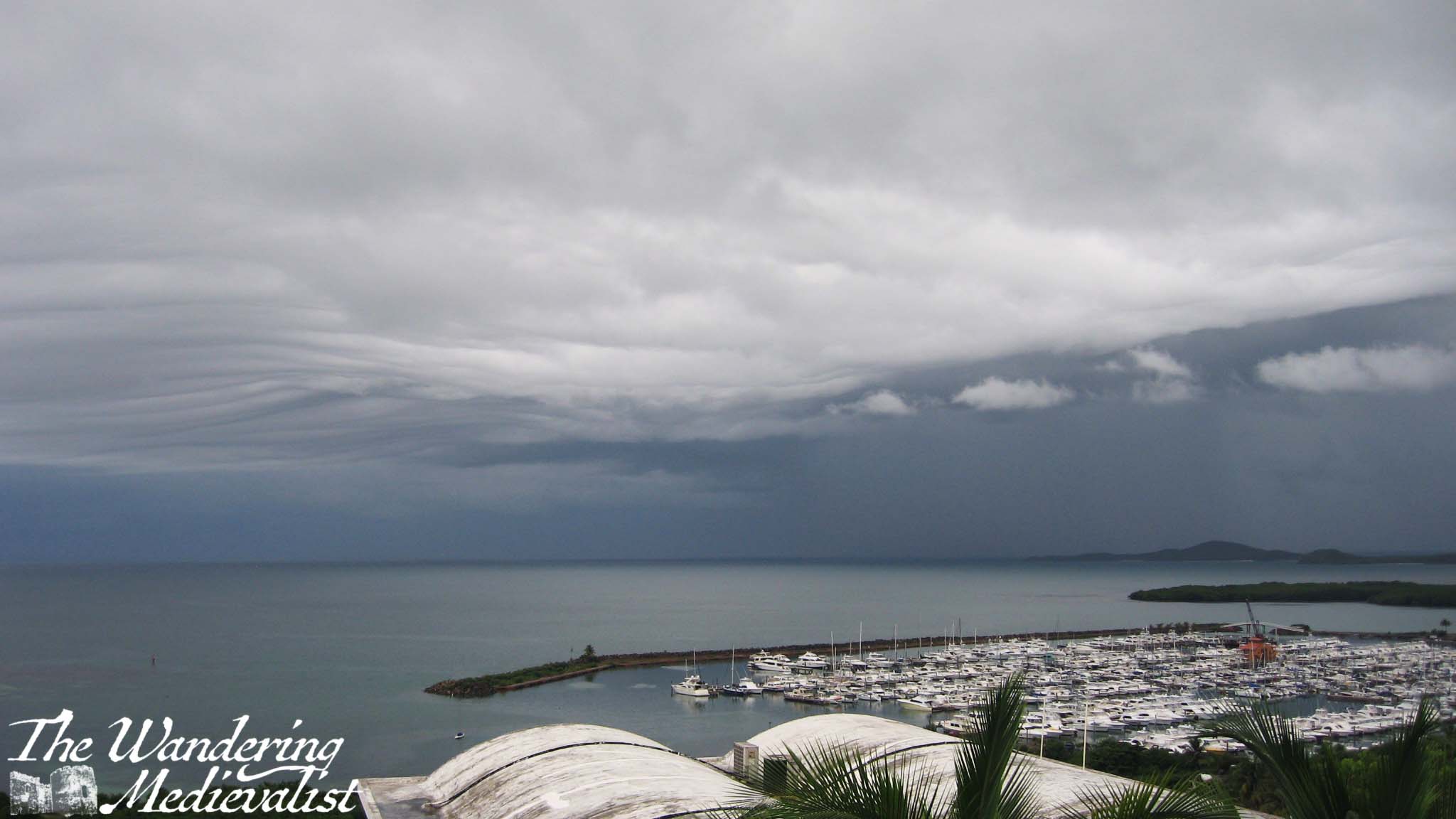
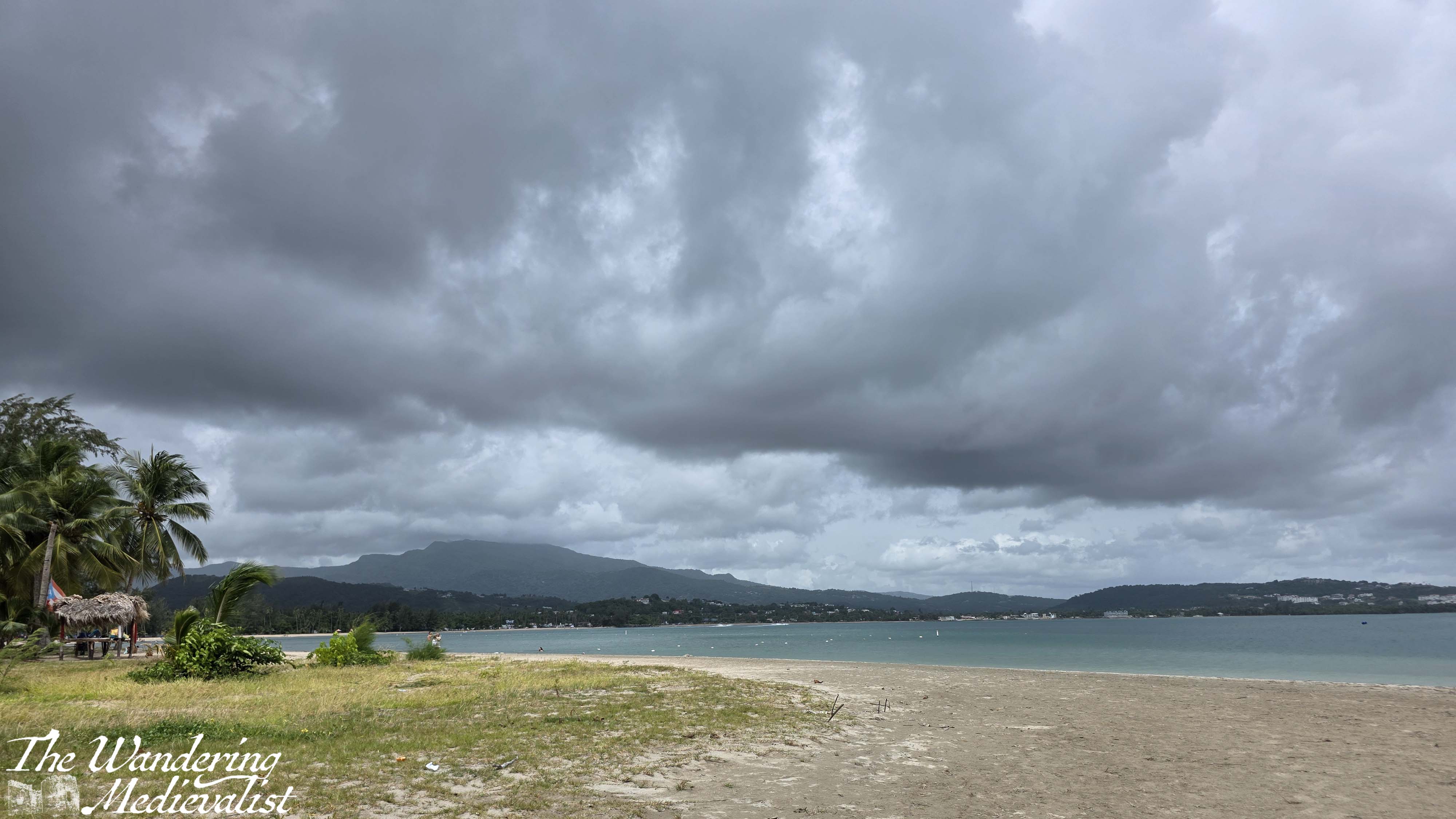
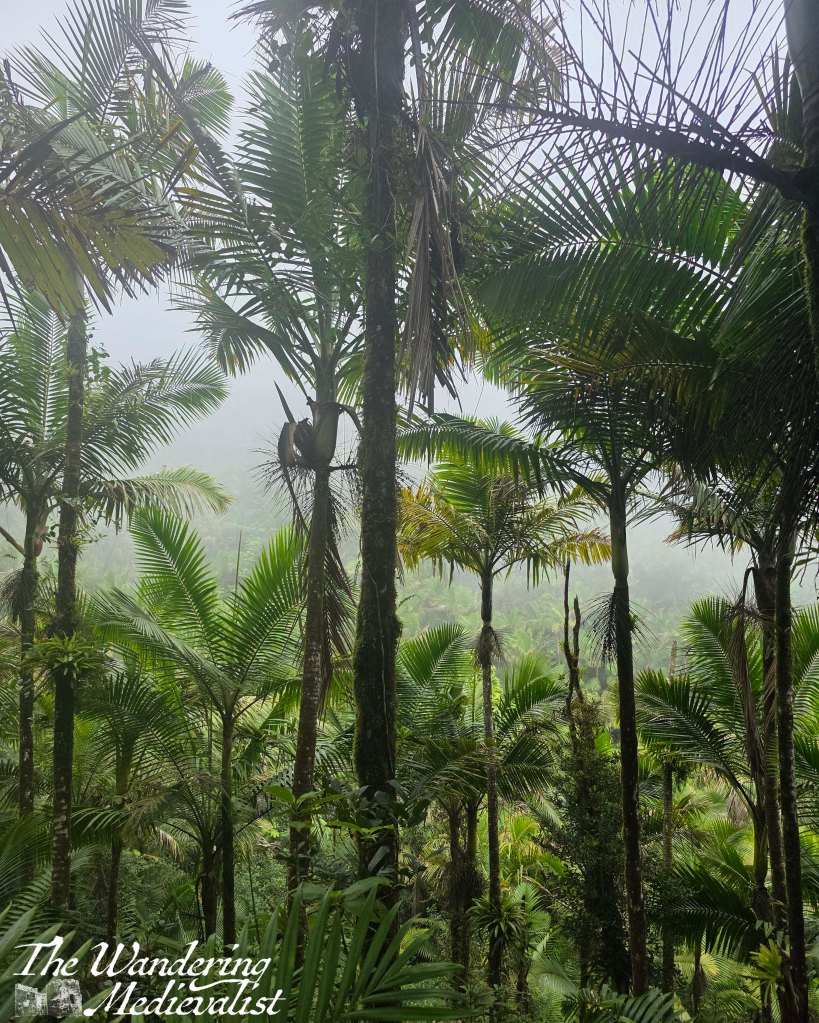
While I was visiting my father in Puerto Rico, we climbed a mountain. We hiked up through the cloudy mist, and never quite came out above it. It doesn’t matter if you get rained on here, and I like the mysterious feel.
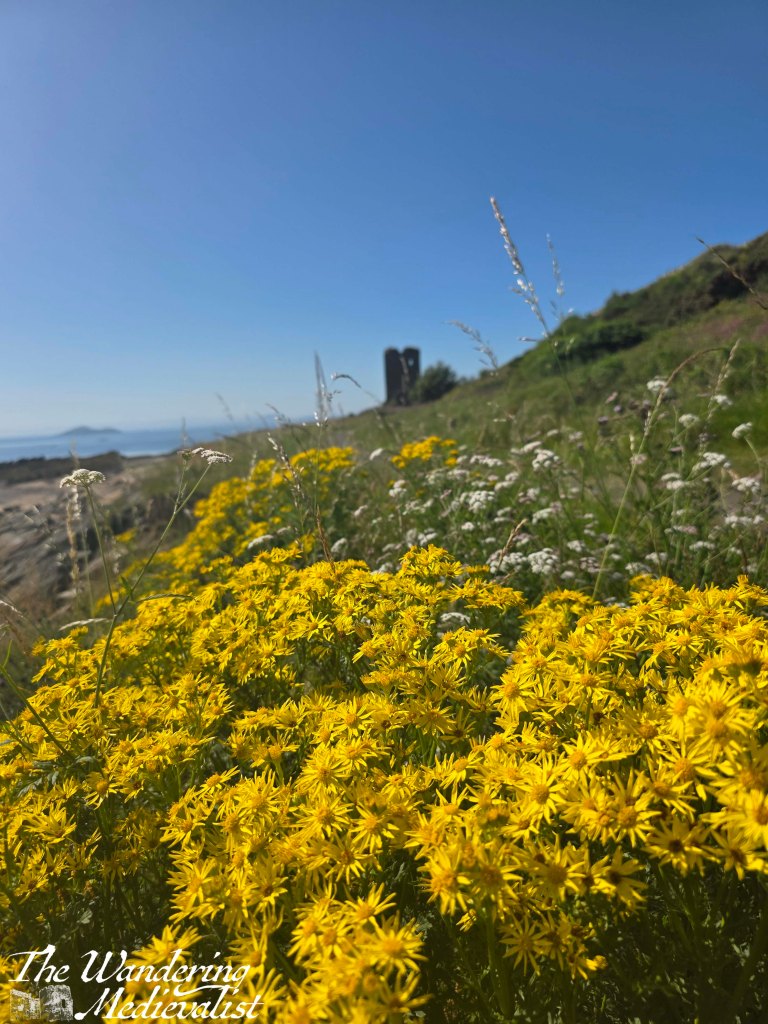
Flowers and castle ruins.
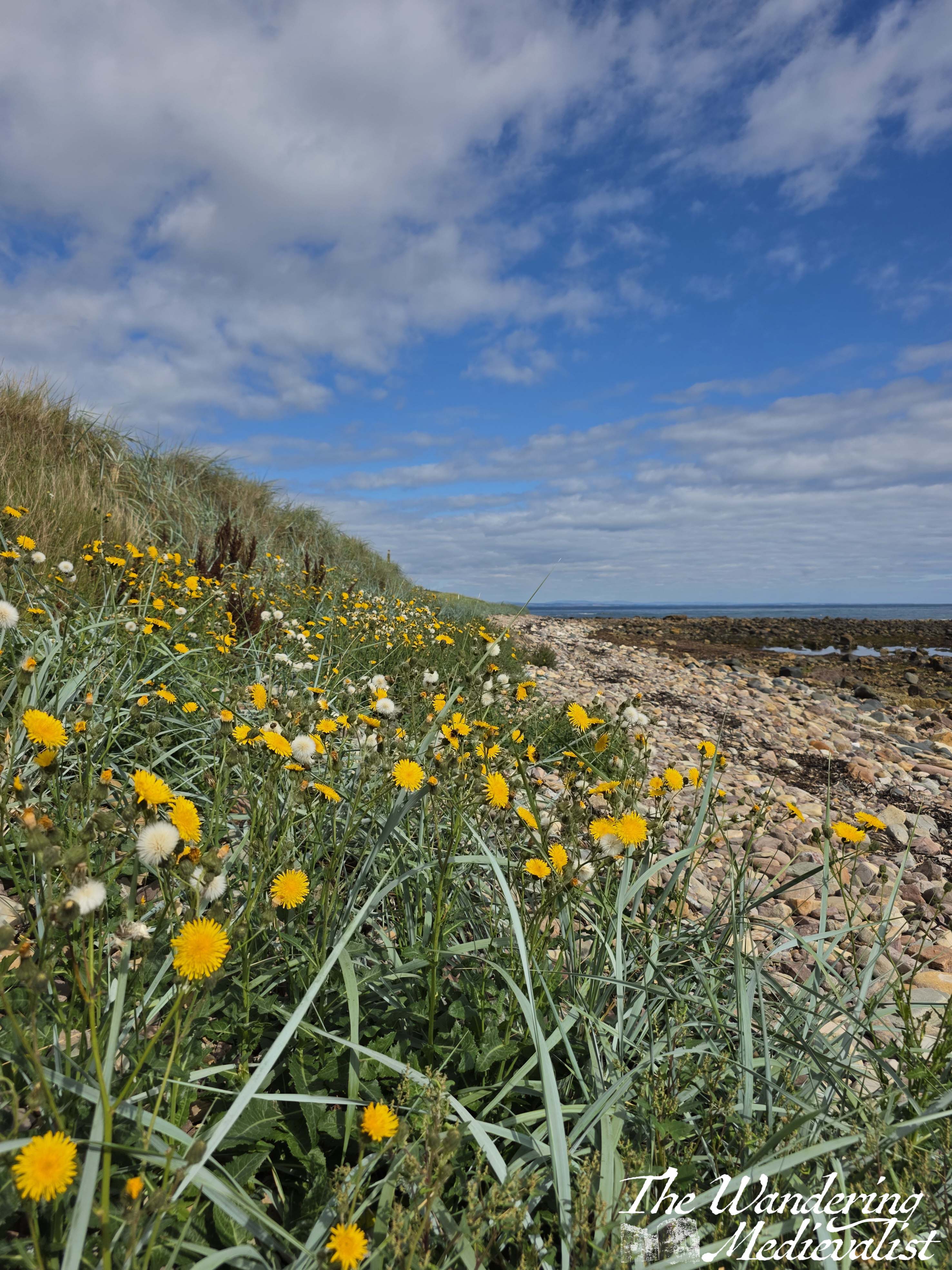
I did several more chunks of the Coastal Path in July, and there was no shortage of these small yellow beauties.
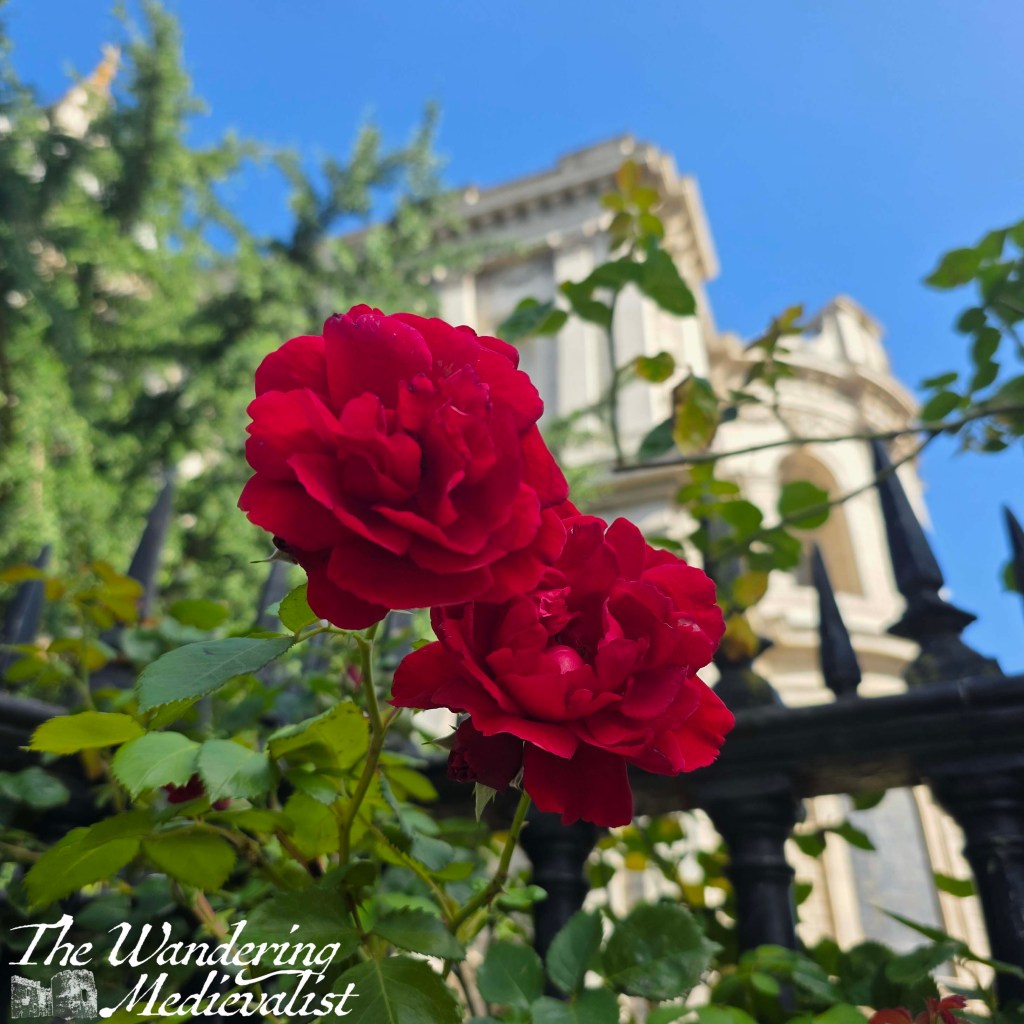
I also visited London, where the roses were in full bloom around St Paul’s Cathedral. I can’t miss a rose.
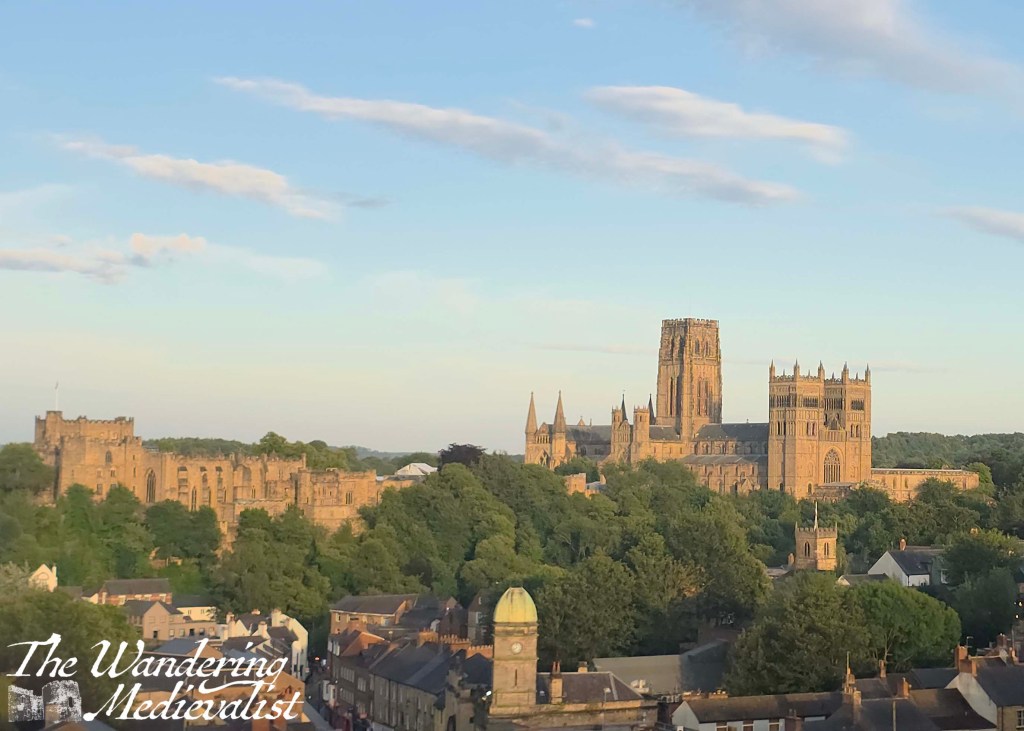
Durham Cathedral and Castle from the train. The sun was setting and the medieval stones glowed orange and yellow. Breath-taking.
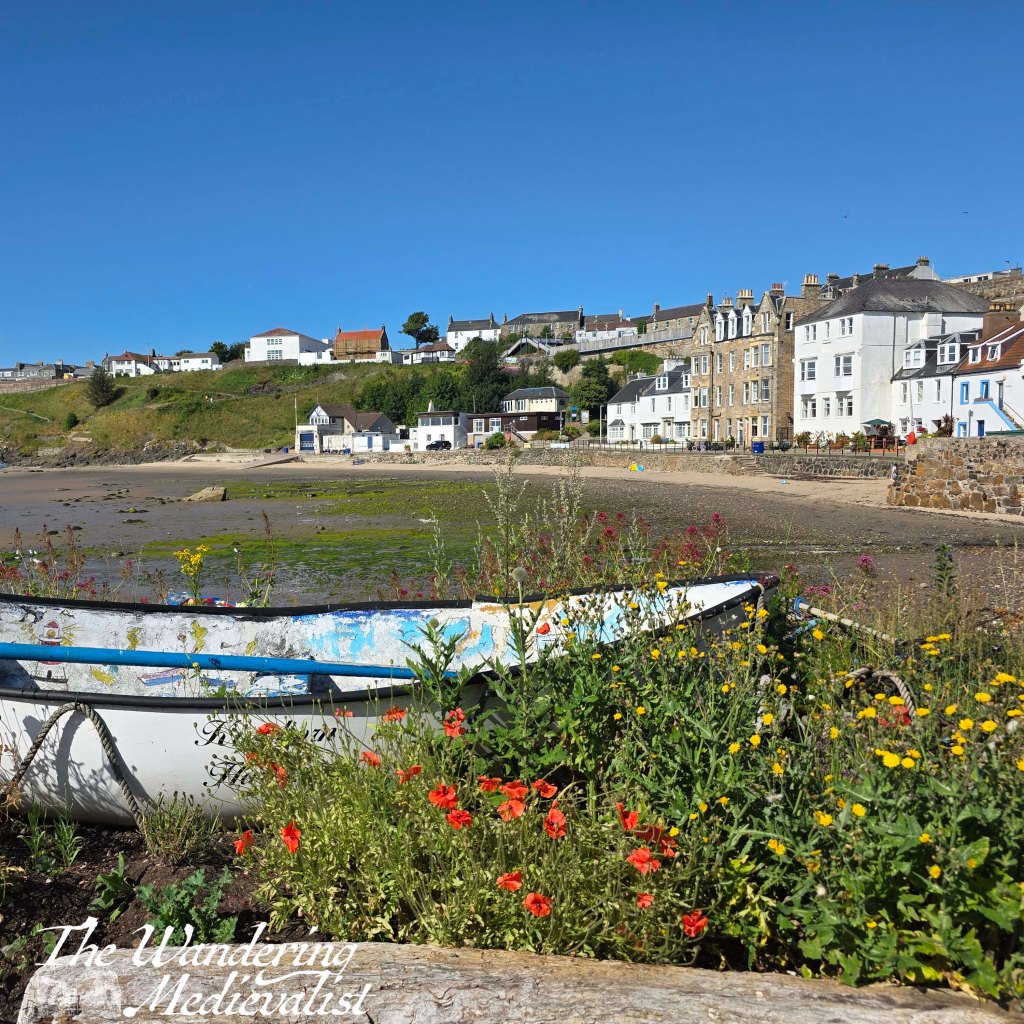
Most towns in the East Neuk have small gardens planted in or around a fishing dinghy, like this one. One of the many echoes in this area of New England.
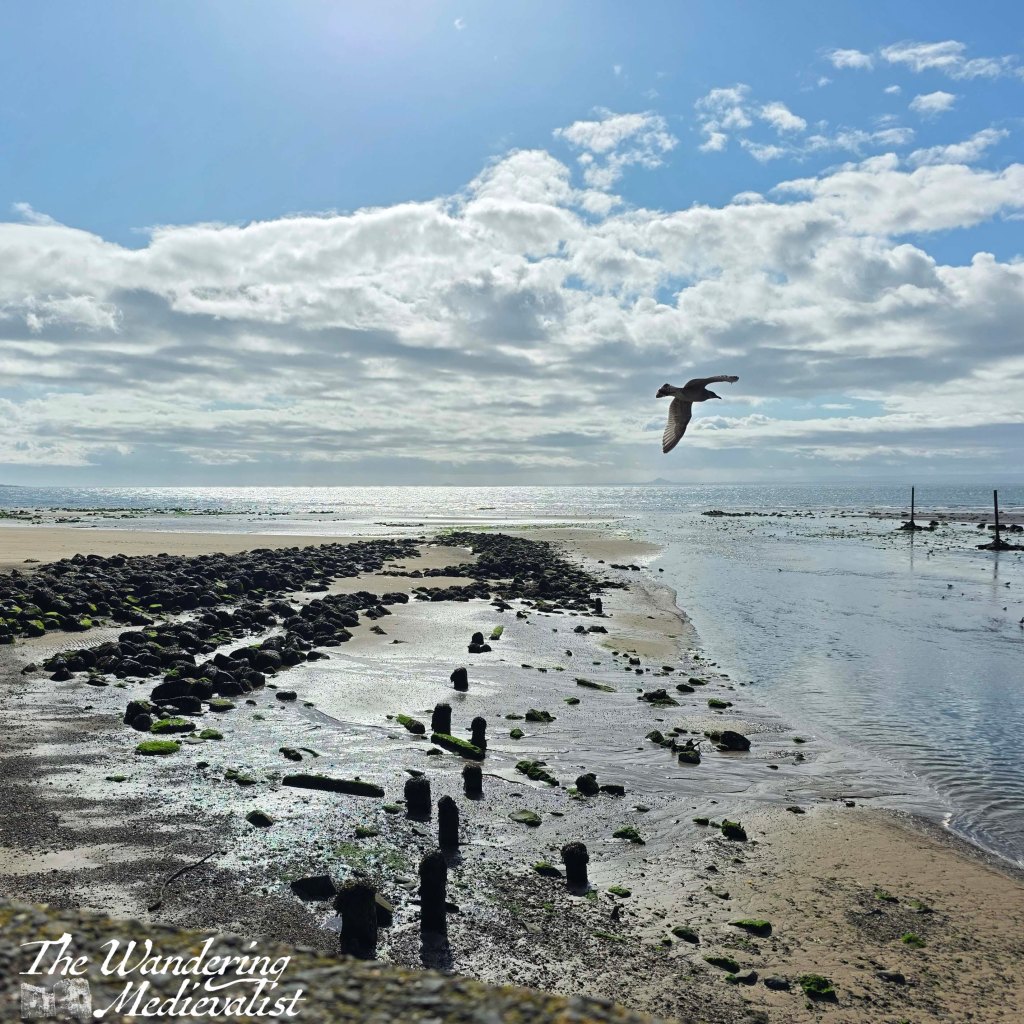
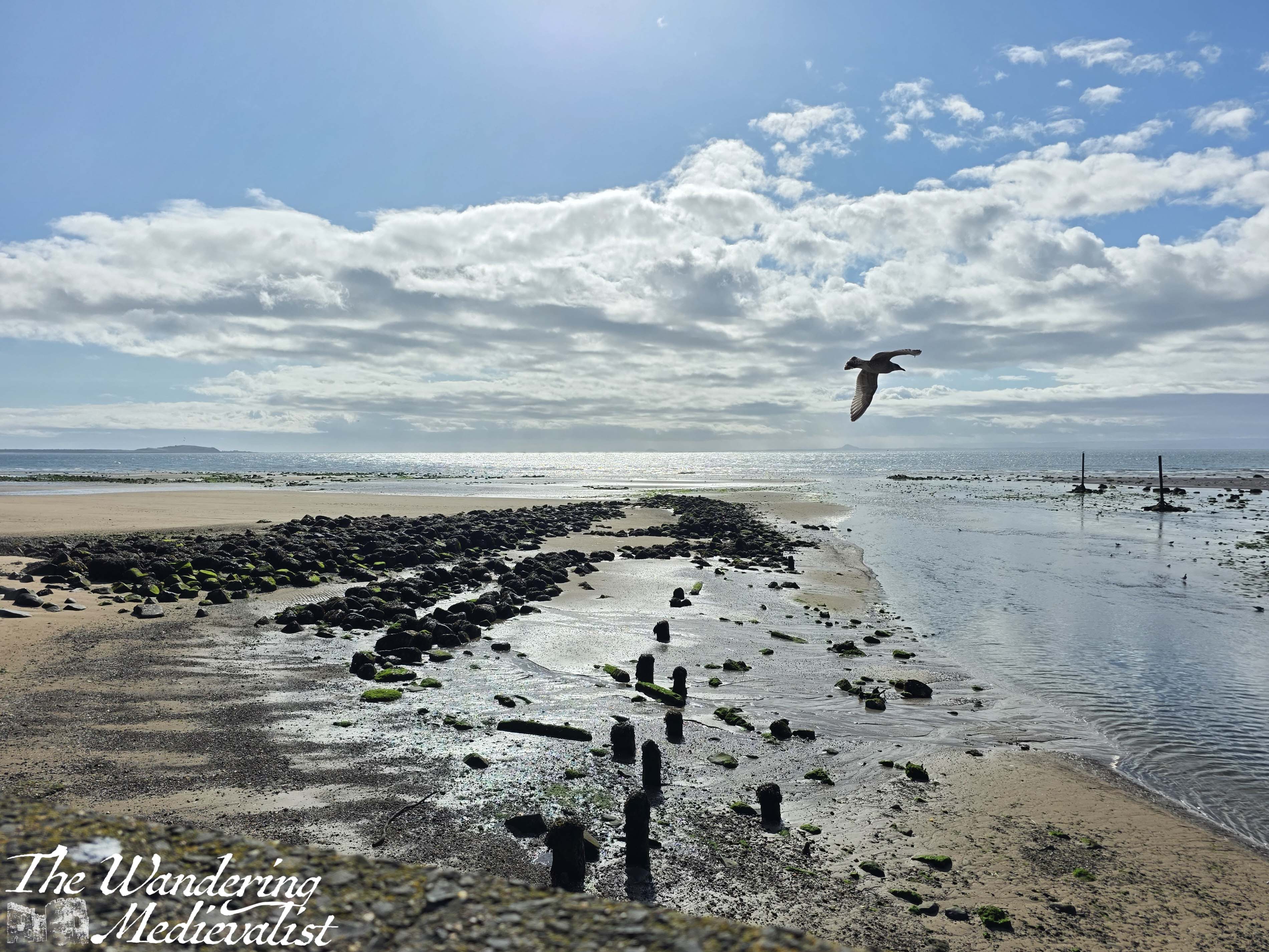
Who doesn’t enjoy a photobomb by a seagull? Well, I sure do.
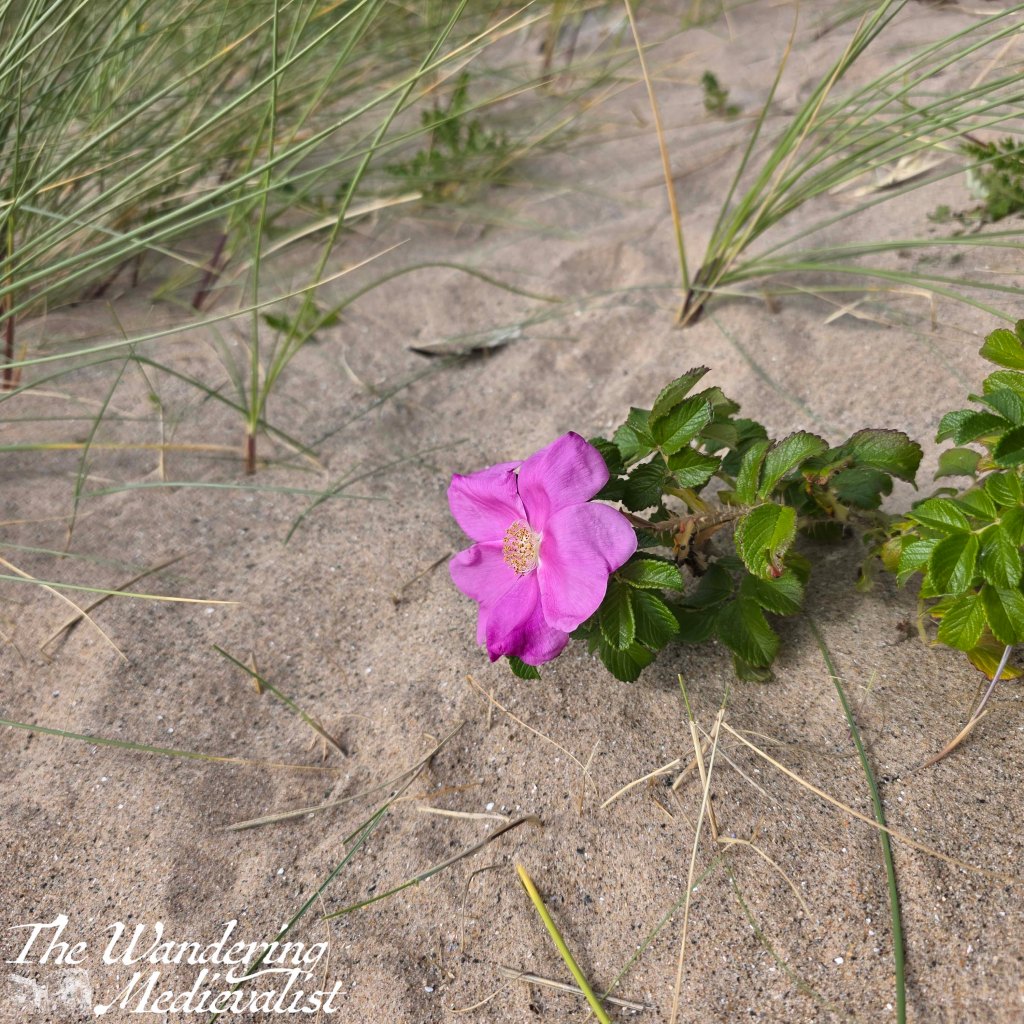
Sea roses are a special kind of delicate, and remind me of summers on Cape Cod. This picture could be taken on either side of the Atlantic (though it was of course in Fife, near Kinghorn)
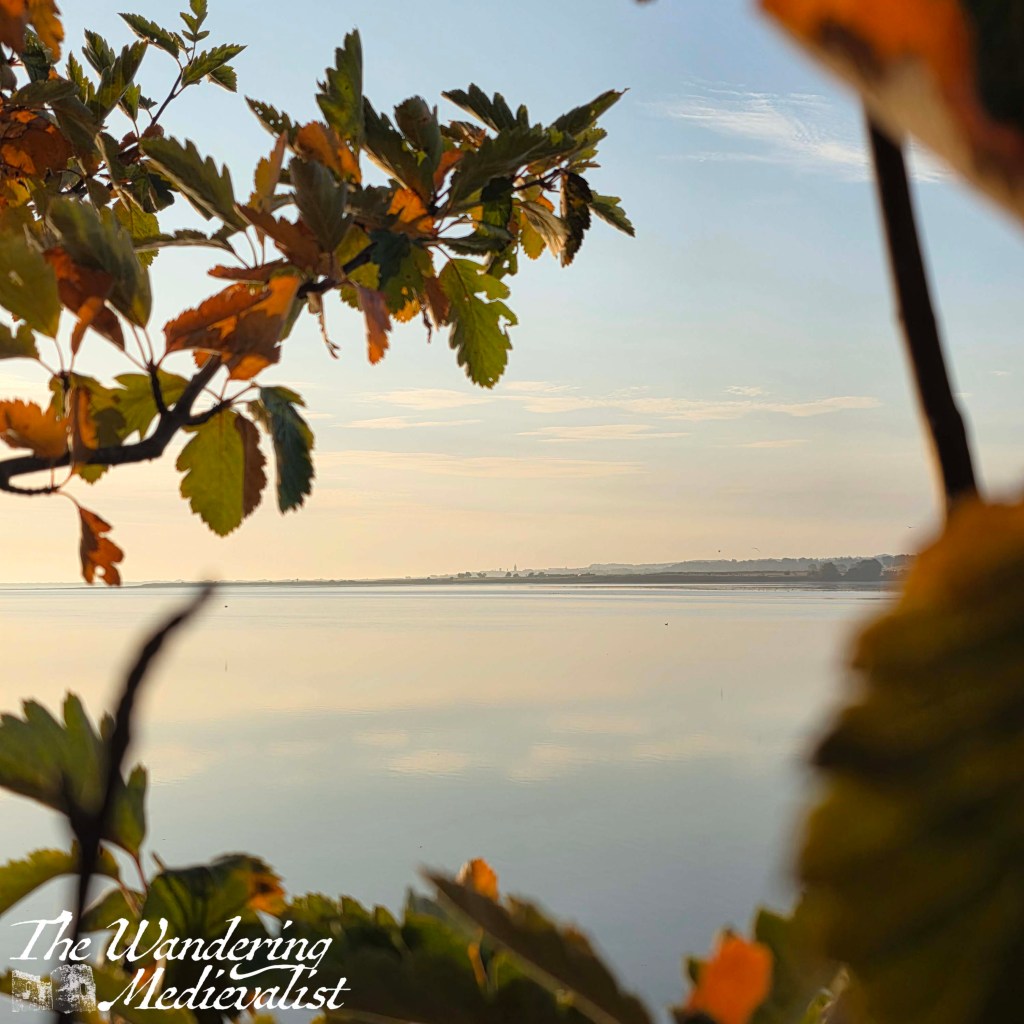
It was such a dry summer in Scotland that the leaves started to turn an orange-brown even in late August. Super calm water, and you can just see St Andrews in the distance.
Summer late light. I cannot resist.
One cool evening in early September, four of us trooped out to West Sands to see if we could catch the Aurora. We did.
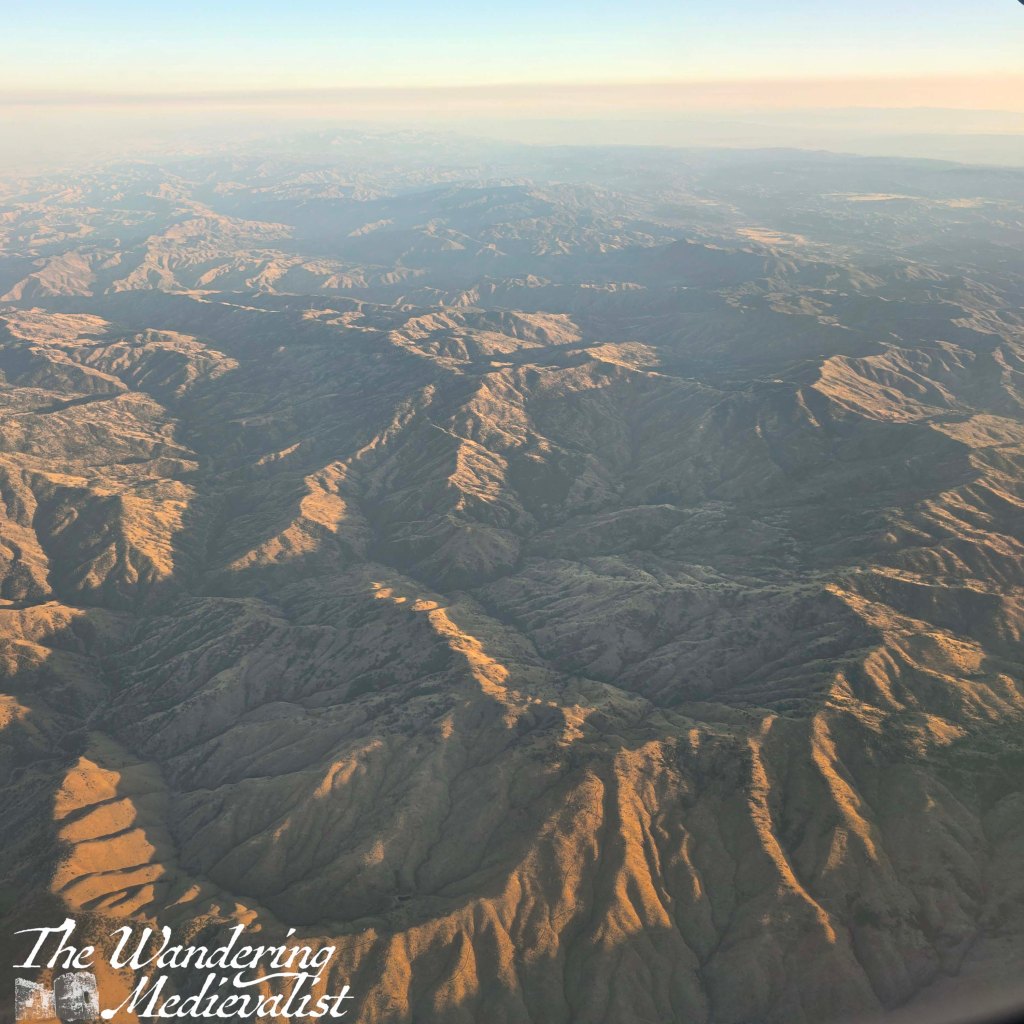
Plane views are a big thing with the amount of travel I do now. The flight into San Francisco included these fantastic vistas of the mountains of eastern California and western Nevada.
Pure Americana, in the perfectly mid-west town of Columbus, Ohio.
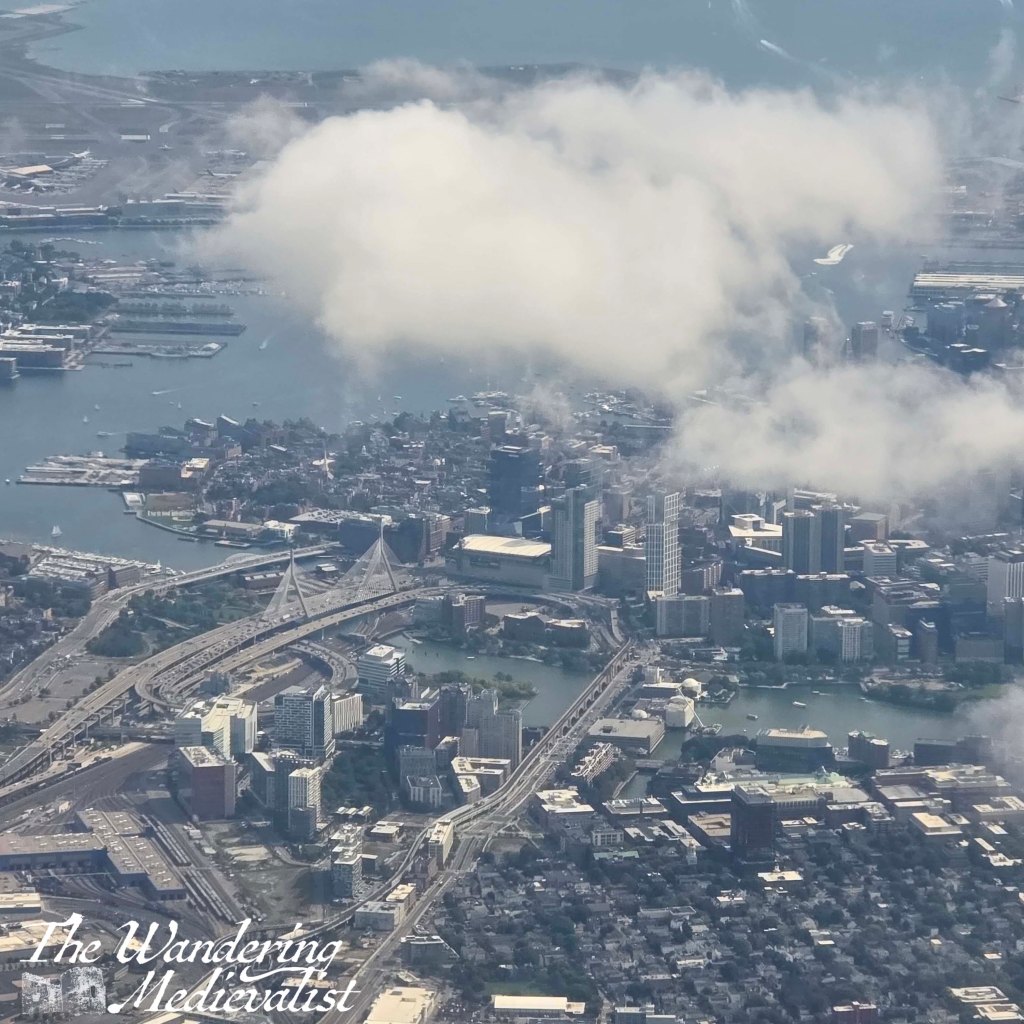
Another plane view!
I have visited and enjoyed many cities, and would happily live in many of them. But none will ever surpass Boston (even with a cloud obscuring downtown).
A misty late September morning – five minutes later this had cleared. Silver and grey again, just beautiful.
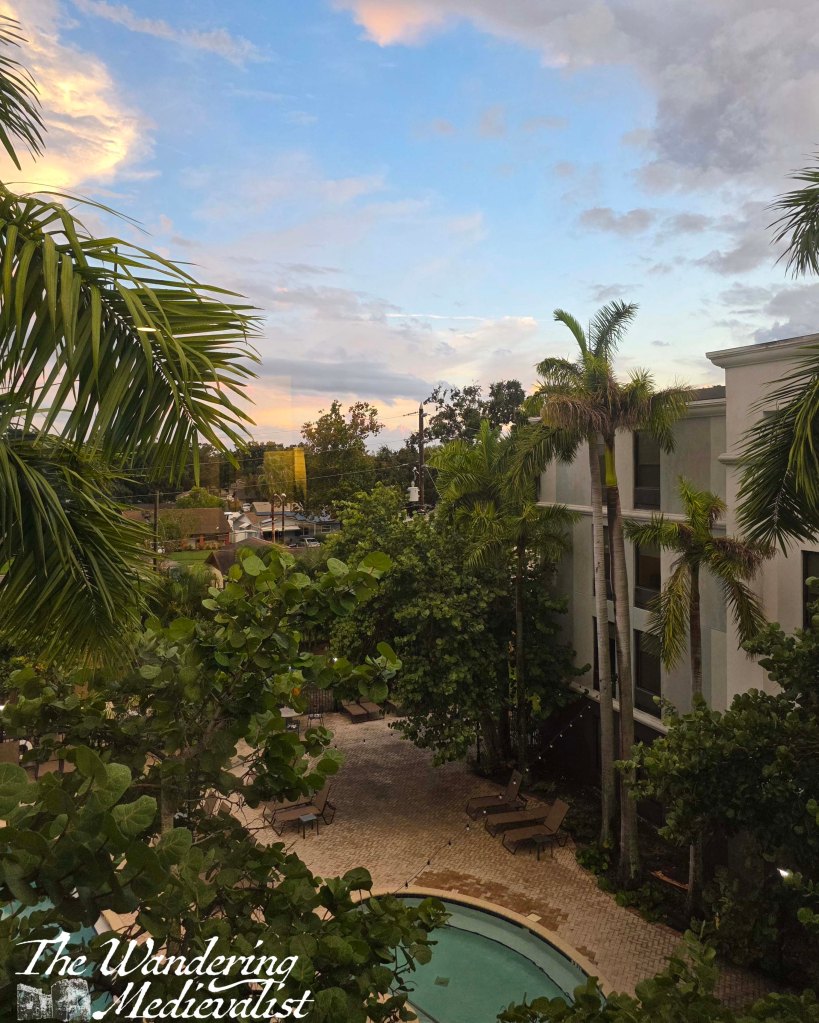
To me, this picture is the epitome of Florida: palms, beach grapes, a pool and a hotel. I loved even this small hotel view.
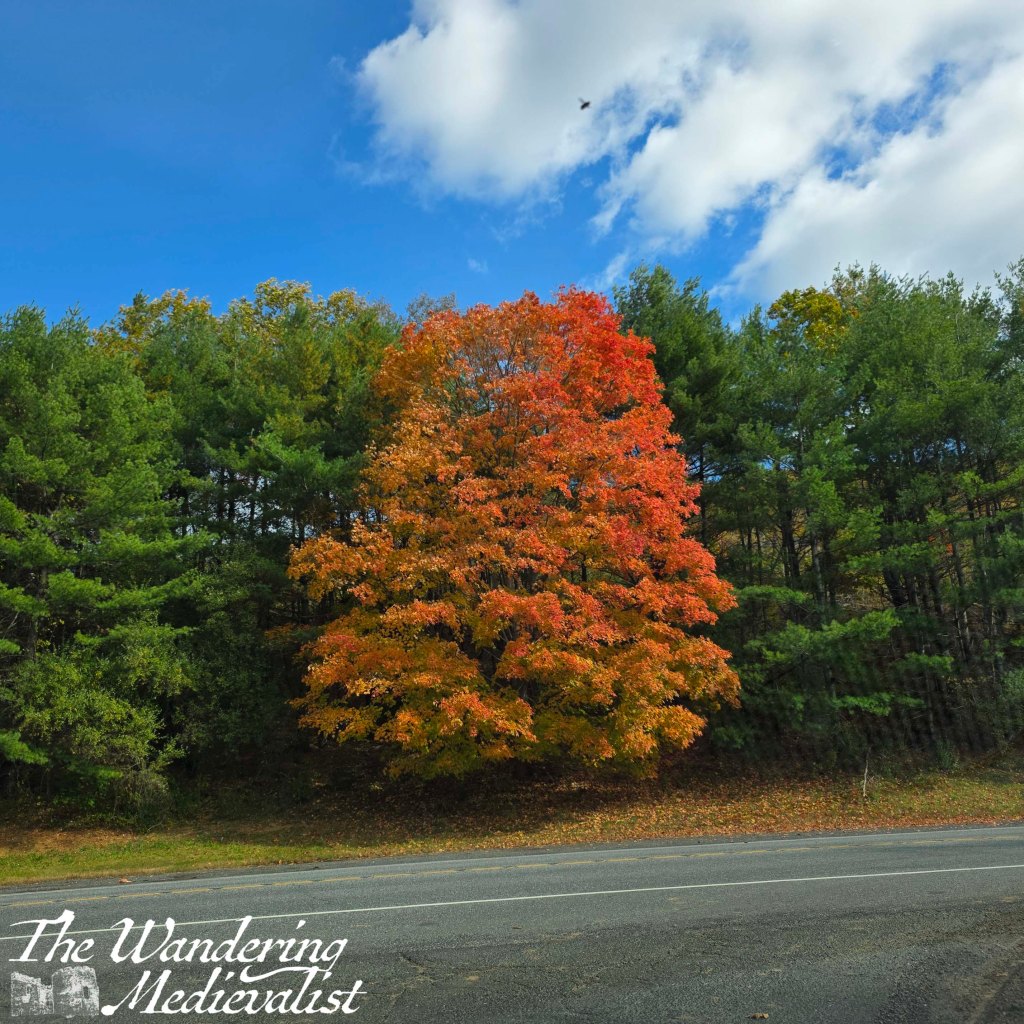
Travelling in Connecticut in October reminded me why New England is famed for its autumn. I’ve even written a post about it. I stopped the car briefly coming out of a parking lot to take this – gorgeous.
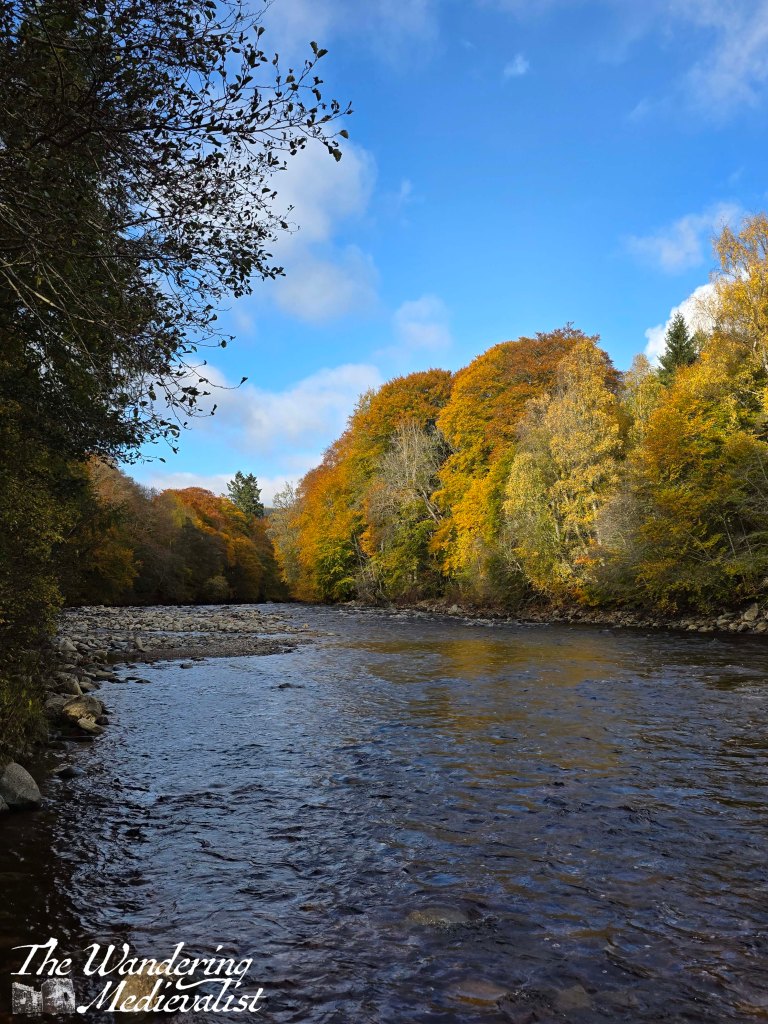
Autumn colour in Perthshire. Always gold and orange, even in a dry year like this one.
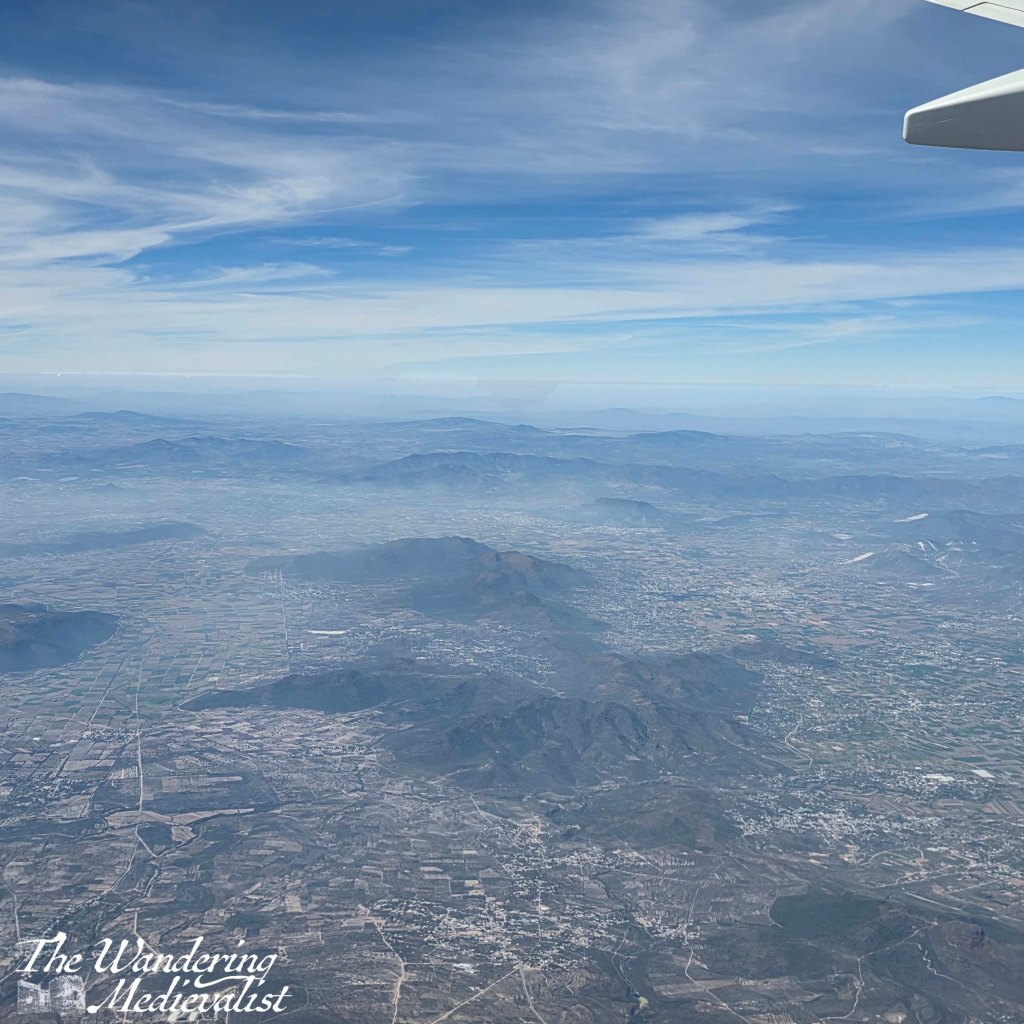
I absolutely fell in love with this view of the sun rising over Mexico City’s distant mountain barrier. They were never as clear as before the sun rose, and an hour later were obscured by haze.
I was fascinated by these mountains, peeking out of the otherwise civilised centre of Mexico.
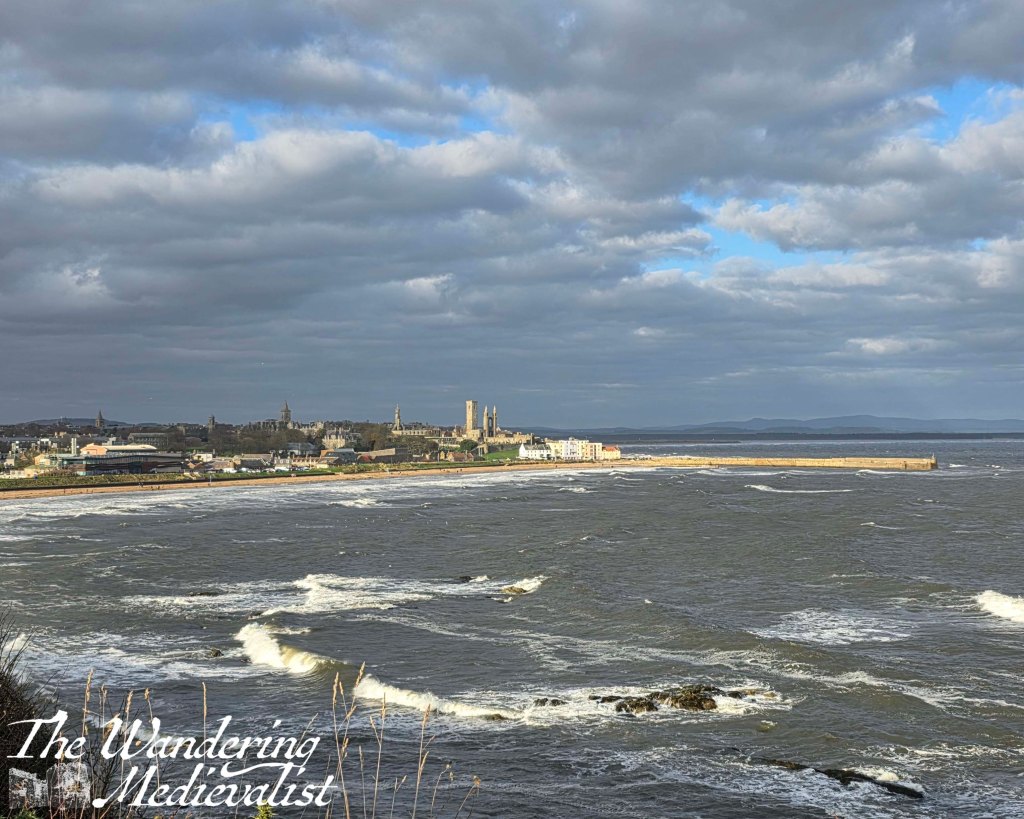
My one coastal path walk in November was on a cloudy windy day, with the sun fighting through. I loved this view with crashing grey waves and some blue sky.
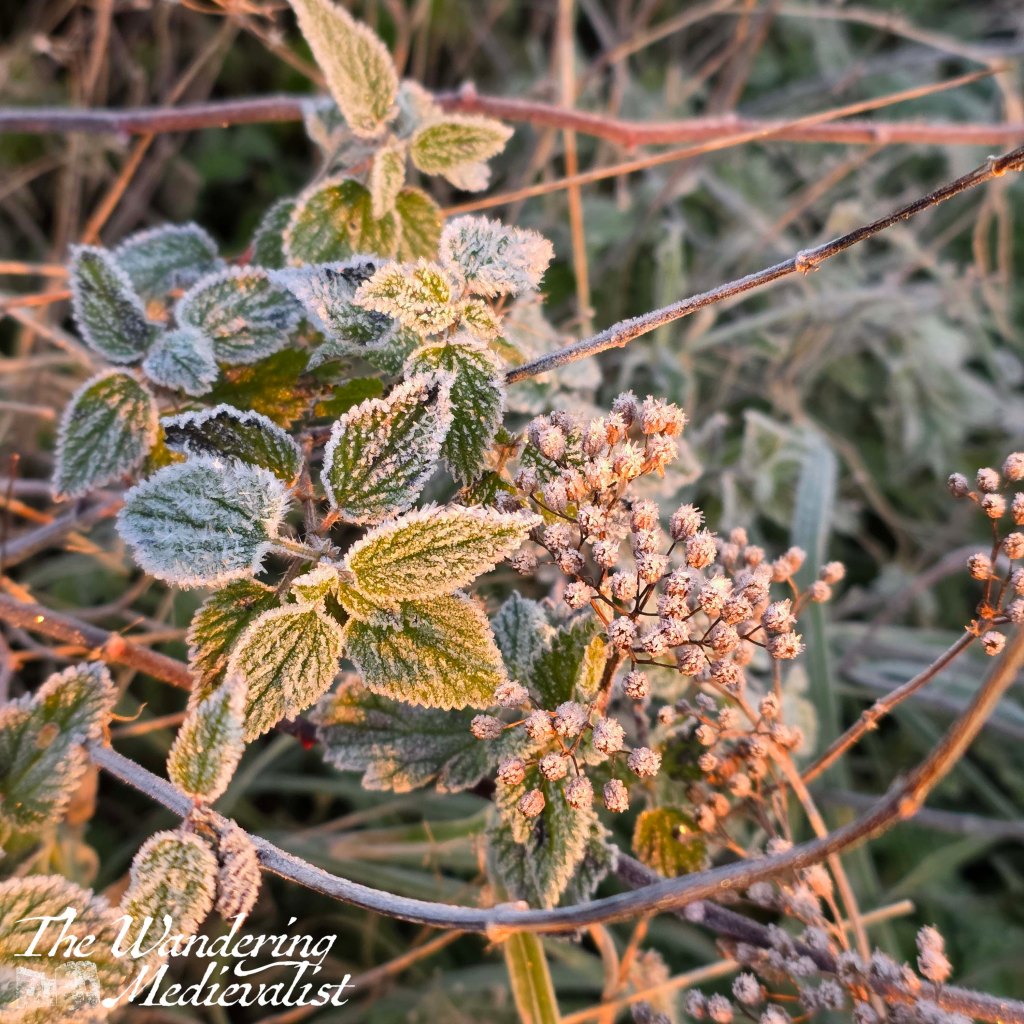
A heavy frost on my morning walk. I took so many plant pictures this morning…
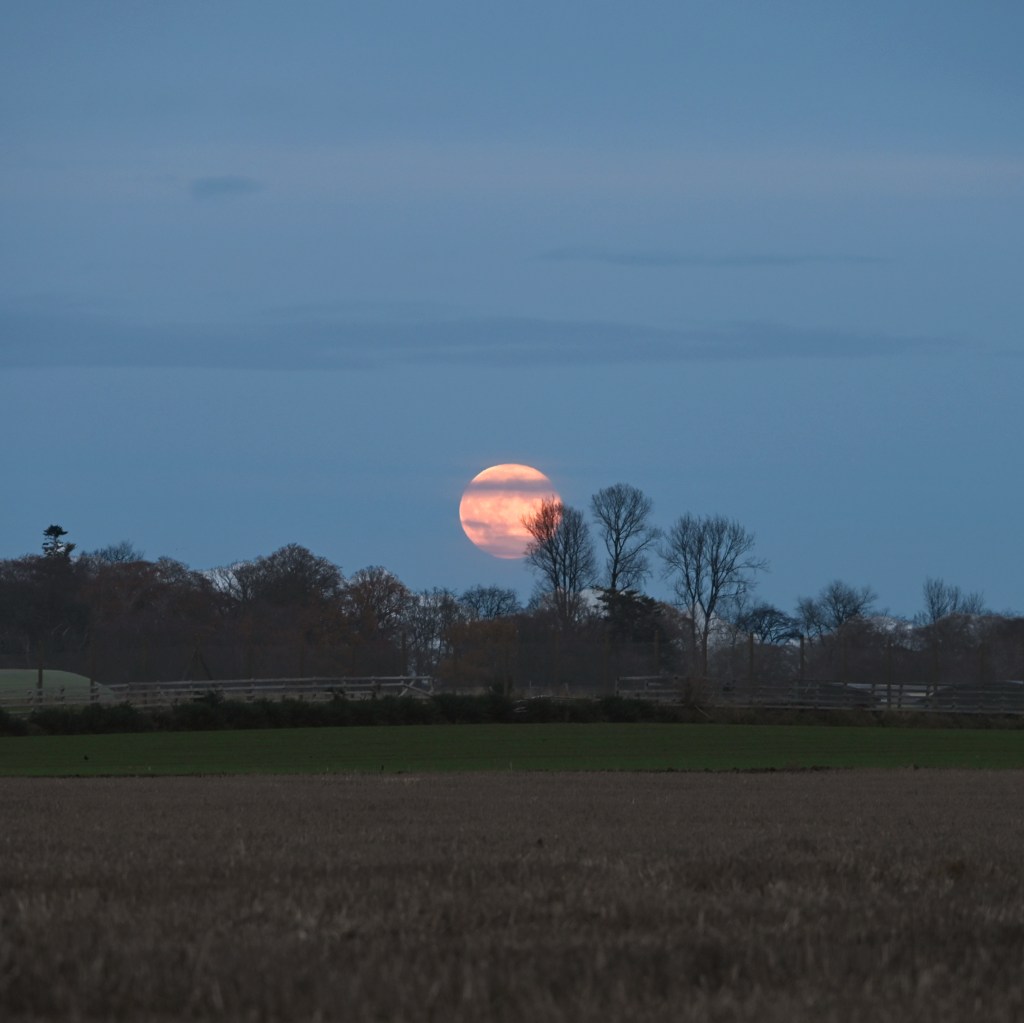
Full moon rising – just managed to catch it before it disappeared into the clouds again.
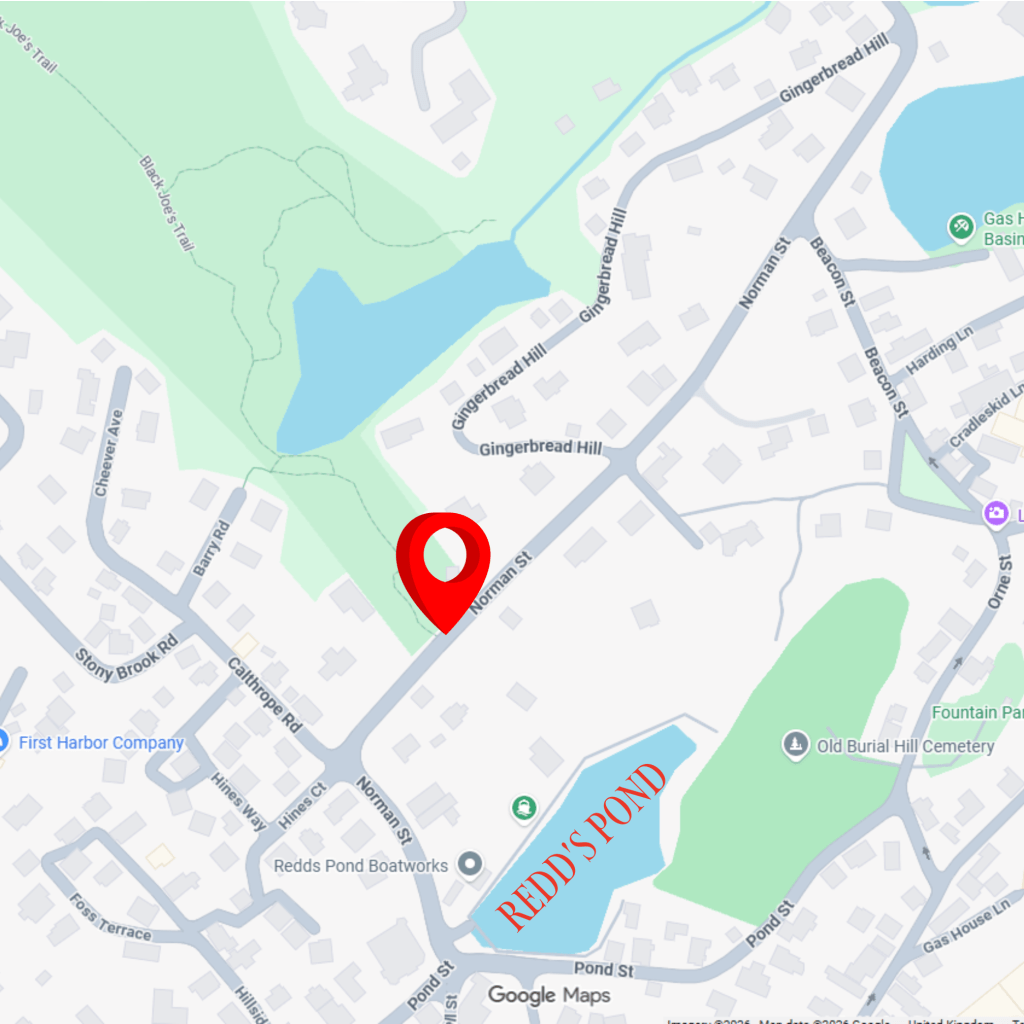
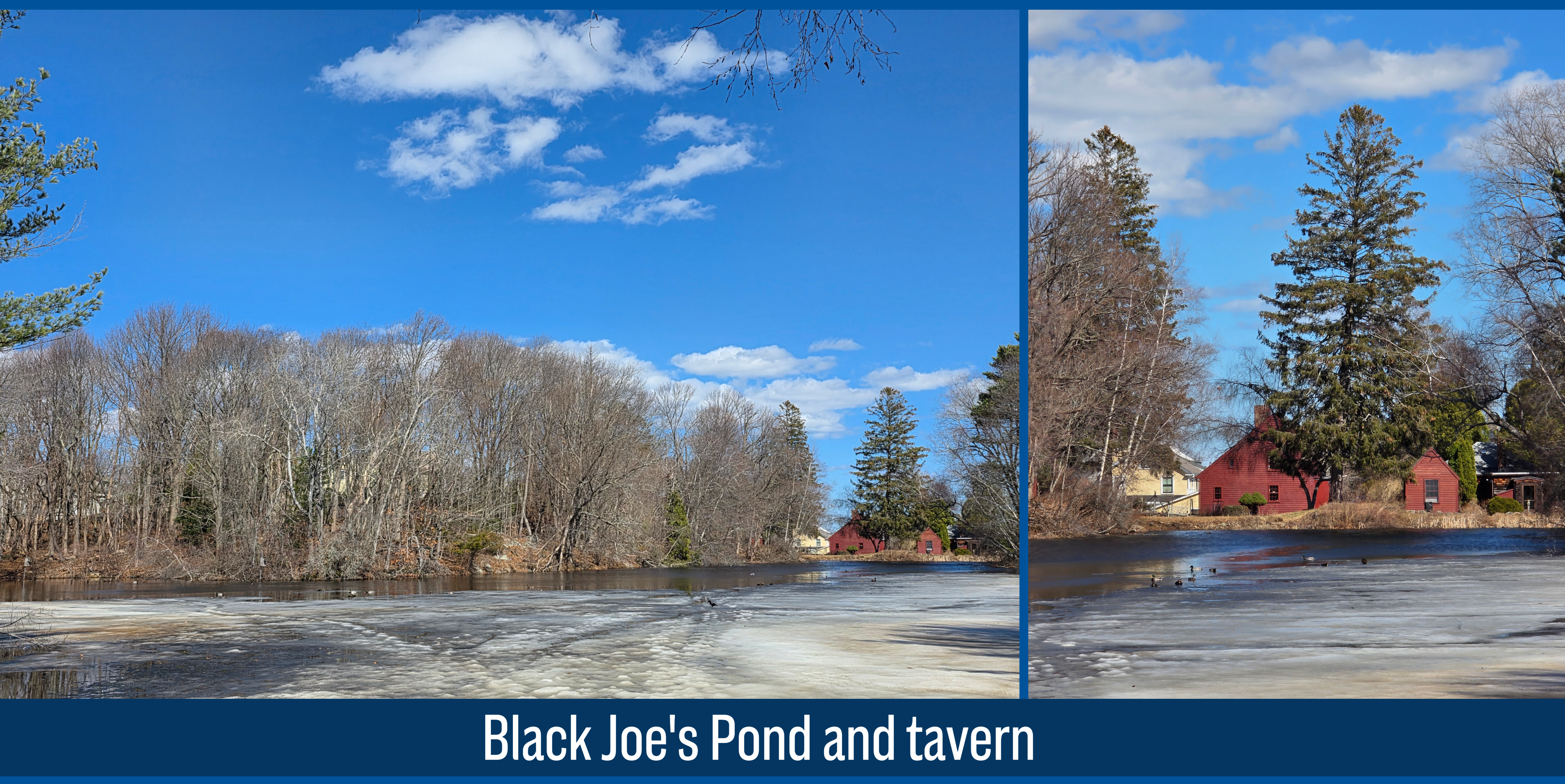
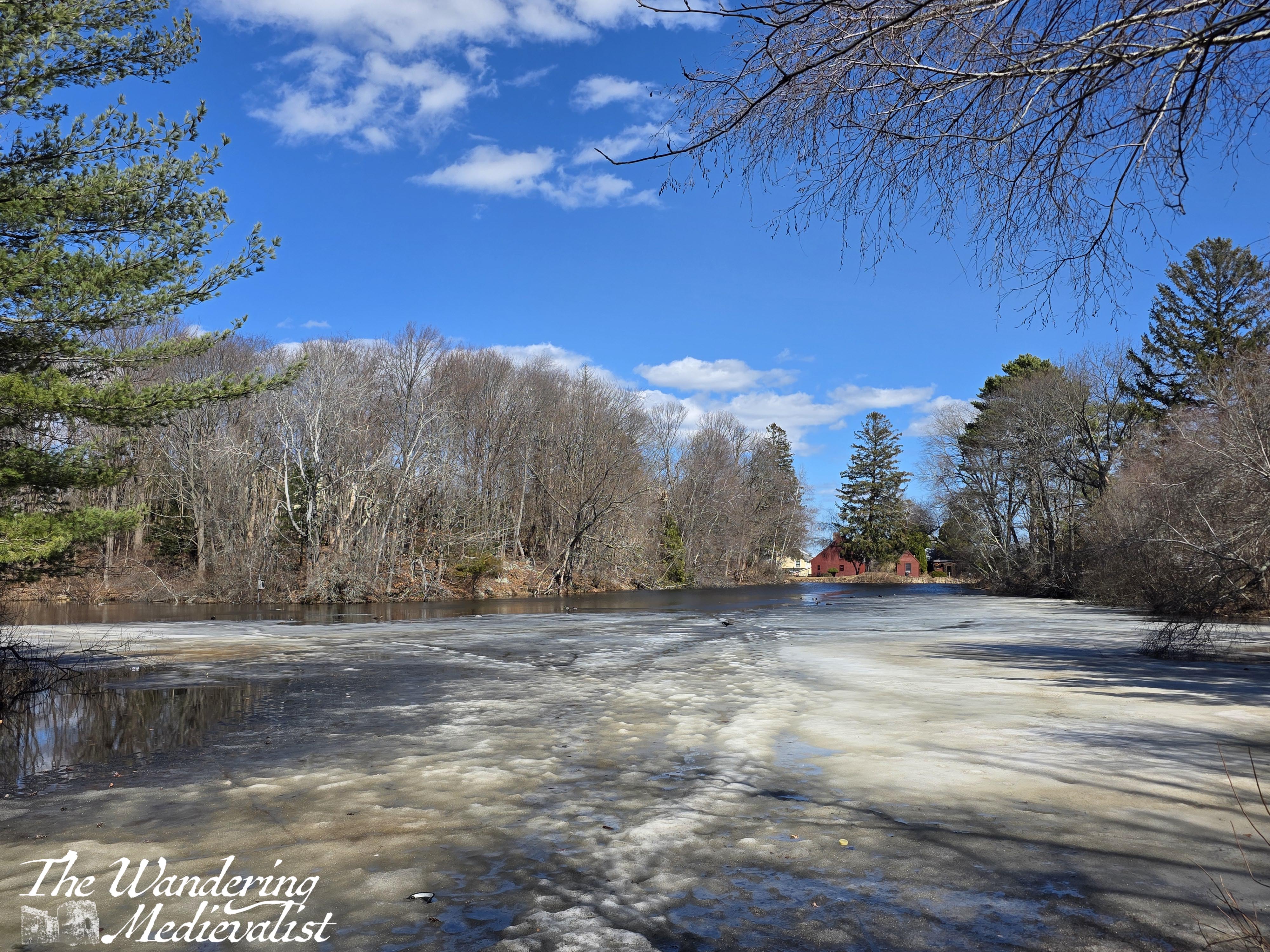
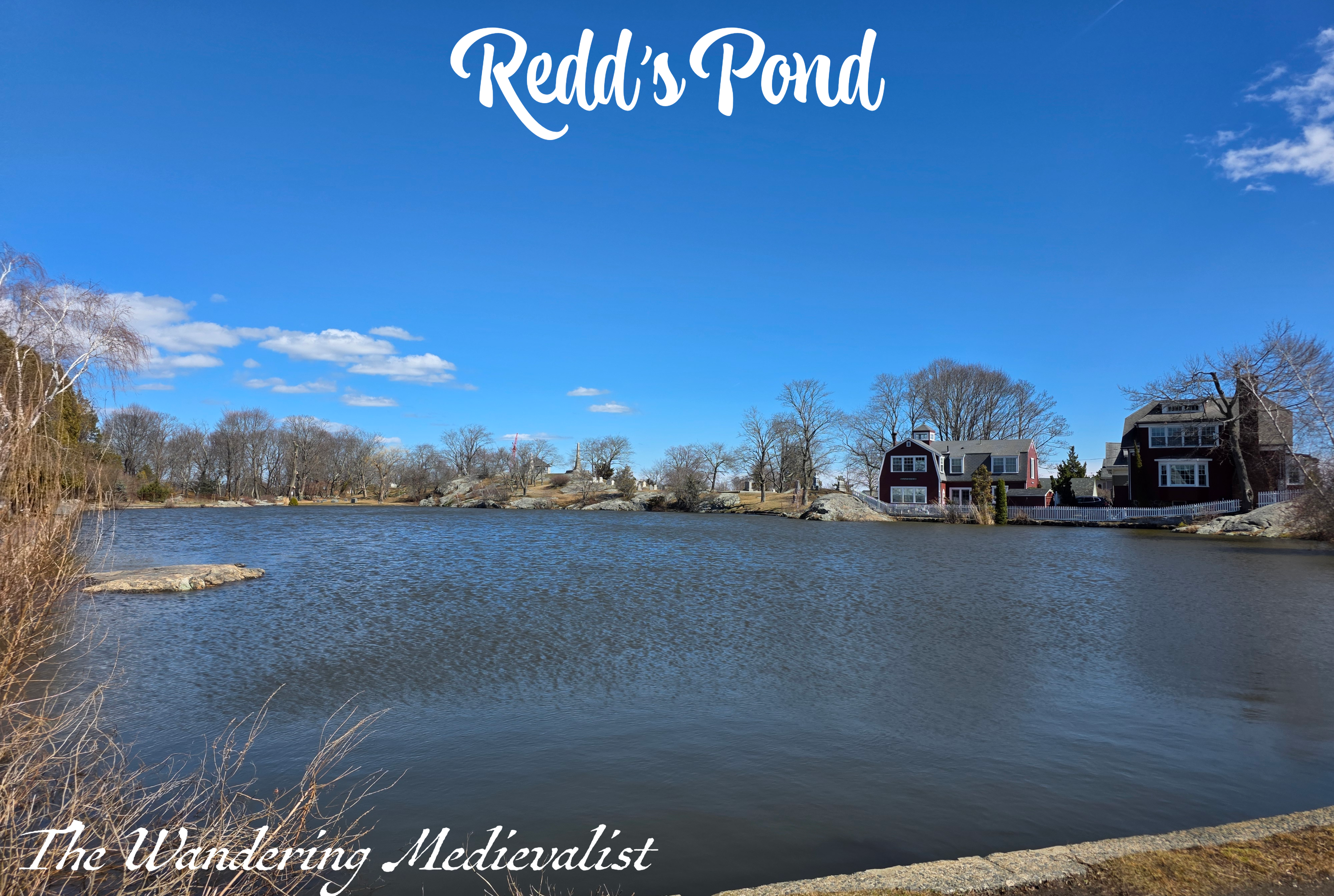
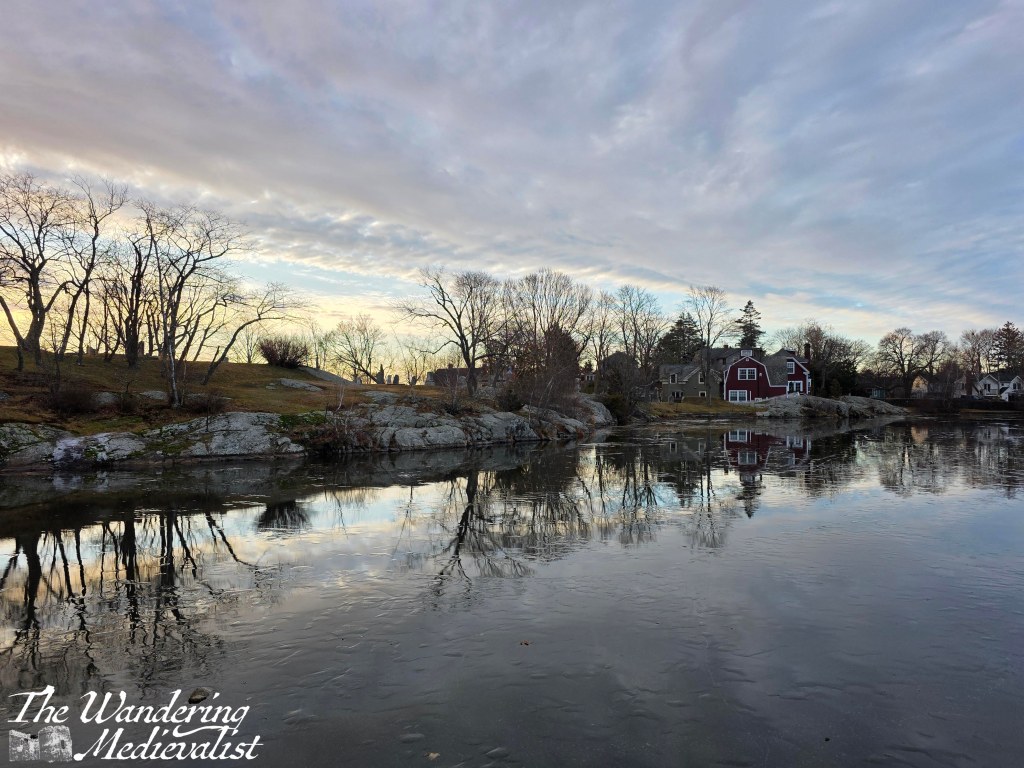
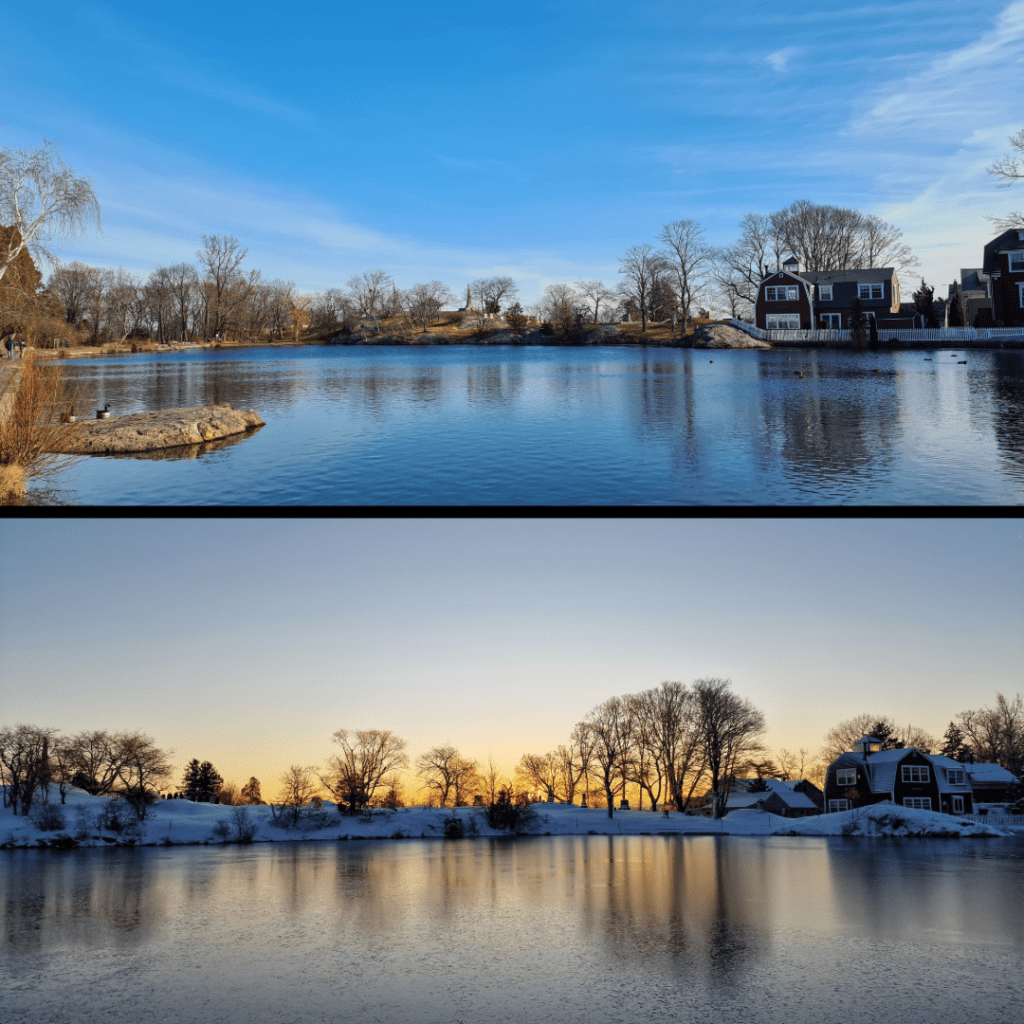
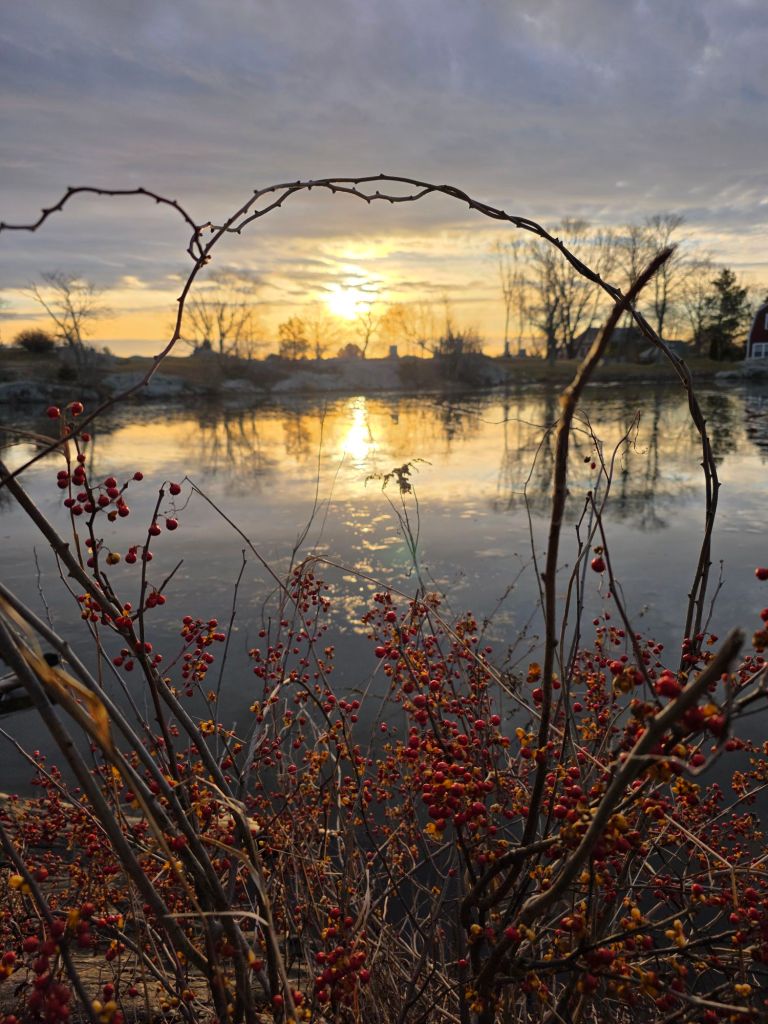
Rising sun in Marblehead on the shortest day of the year, taken across a partially frozen Redd’s Pond. Gorgeous morning to be out and about.
And finally, to wrap up…
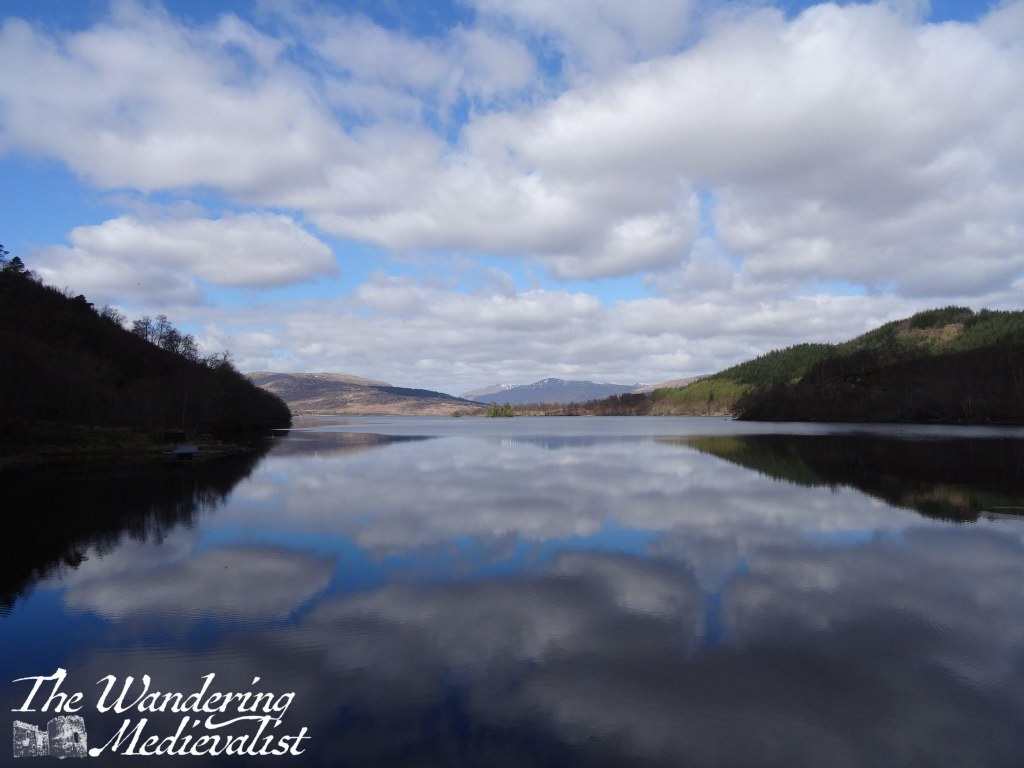
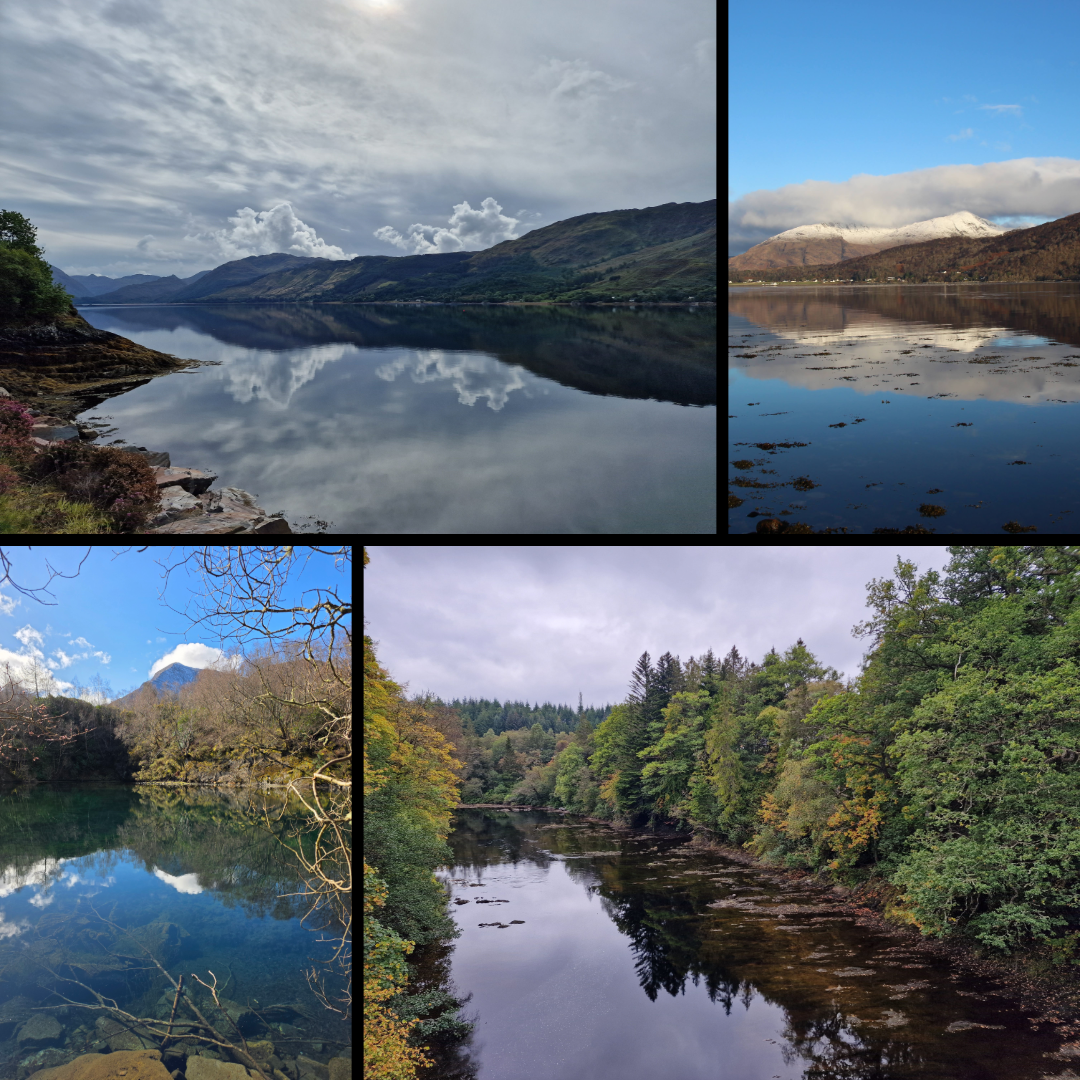
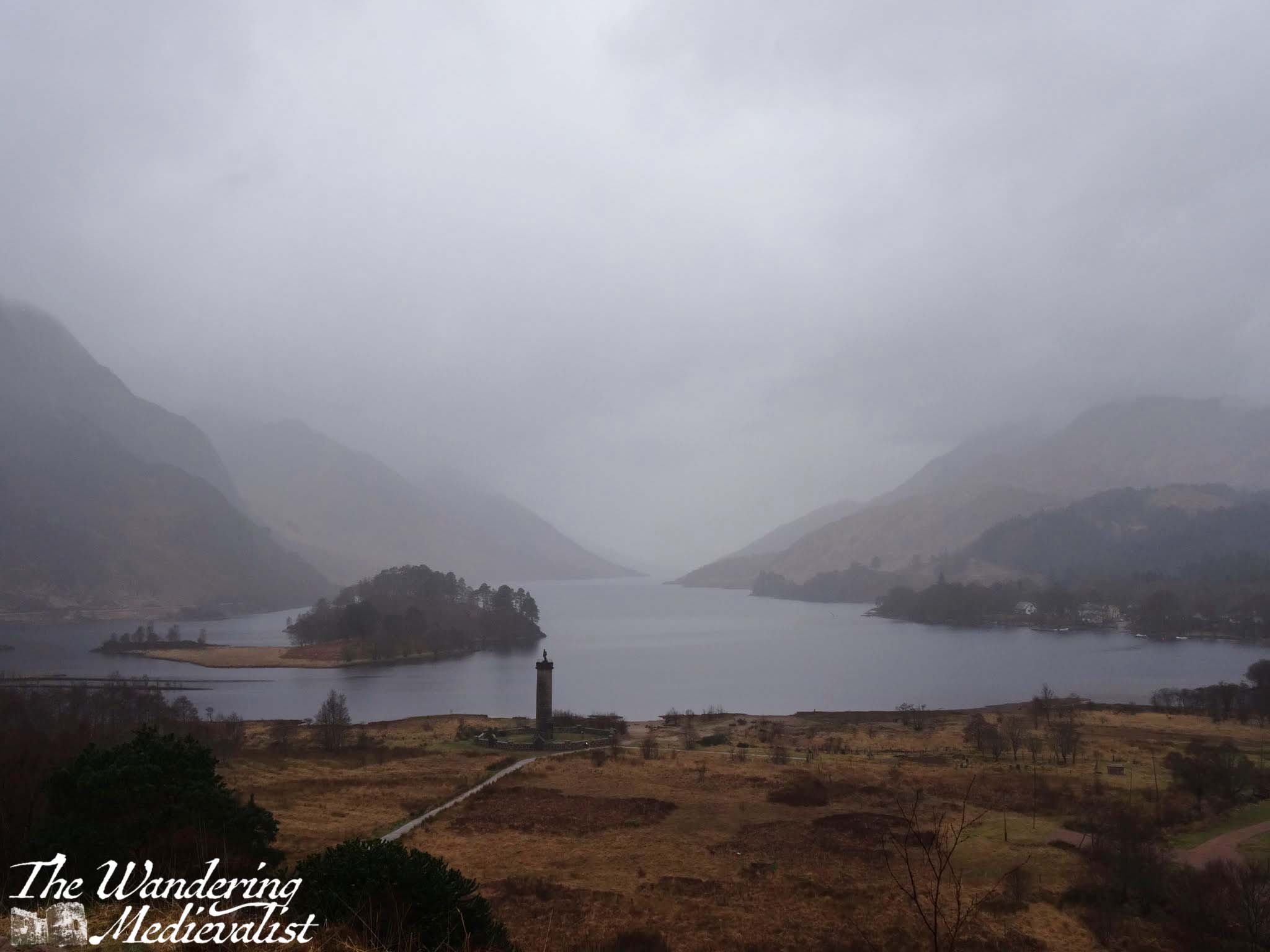
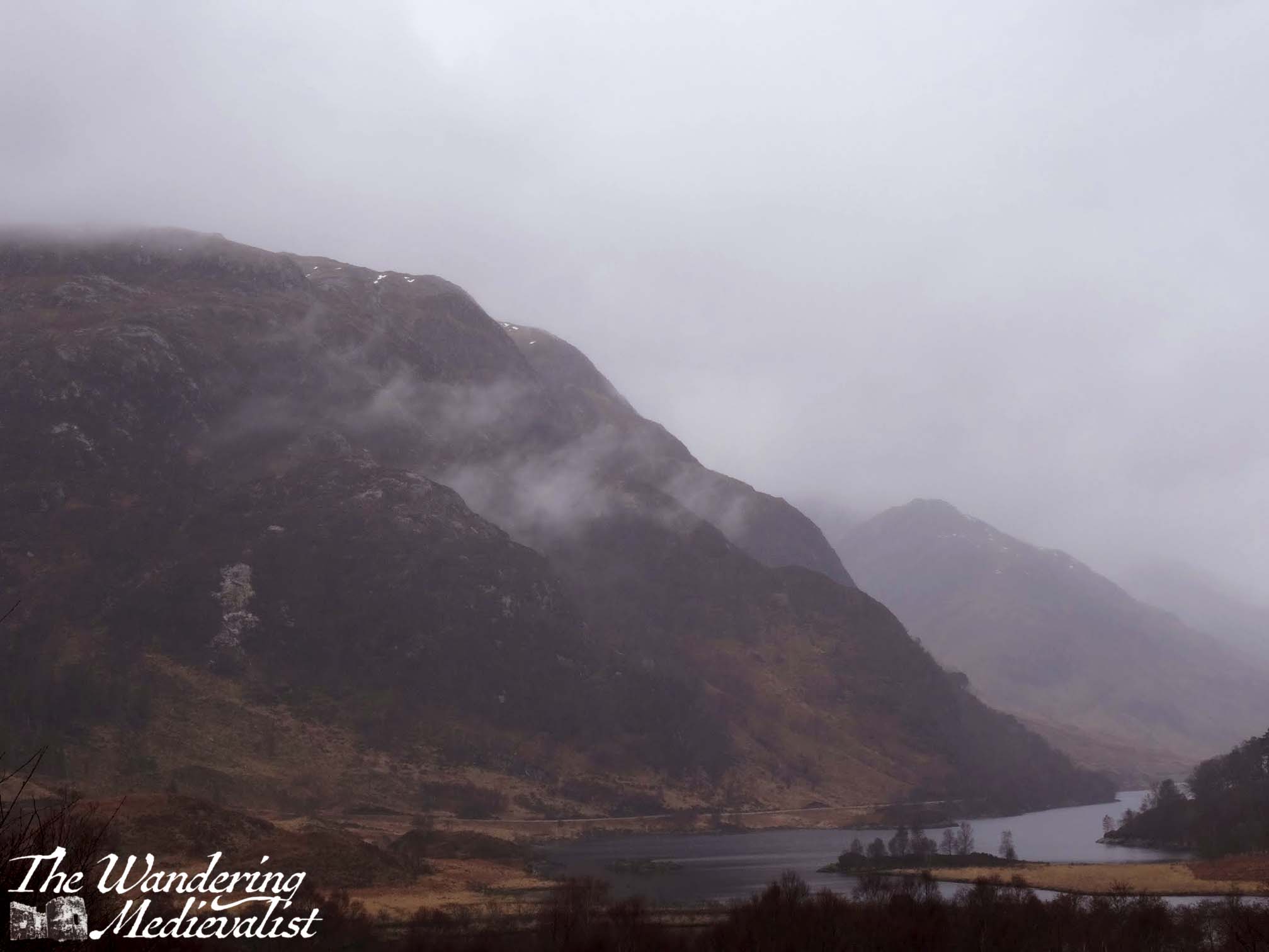
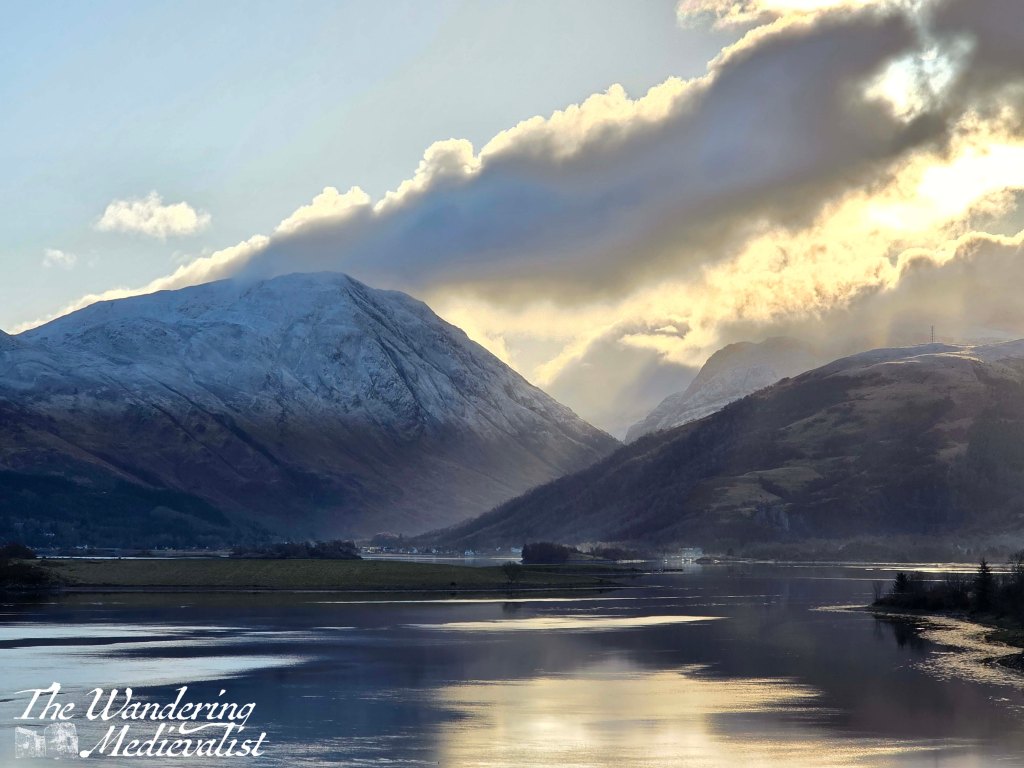
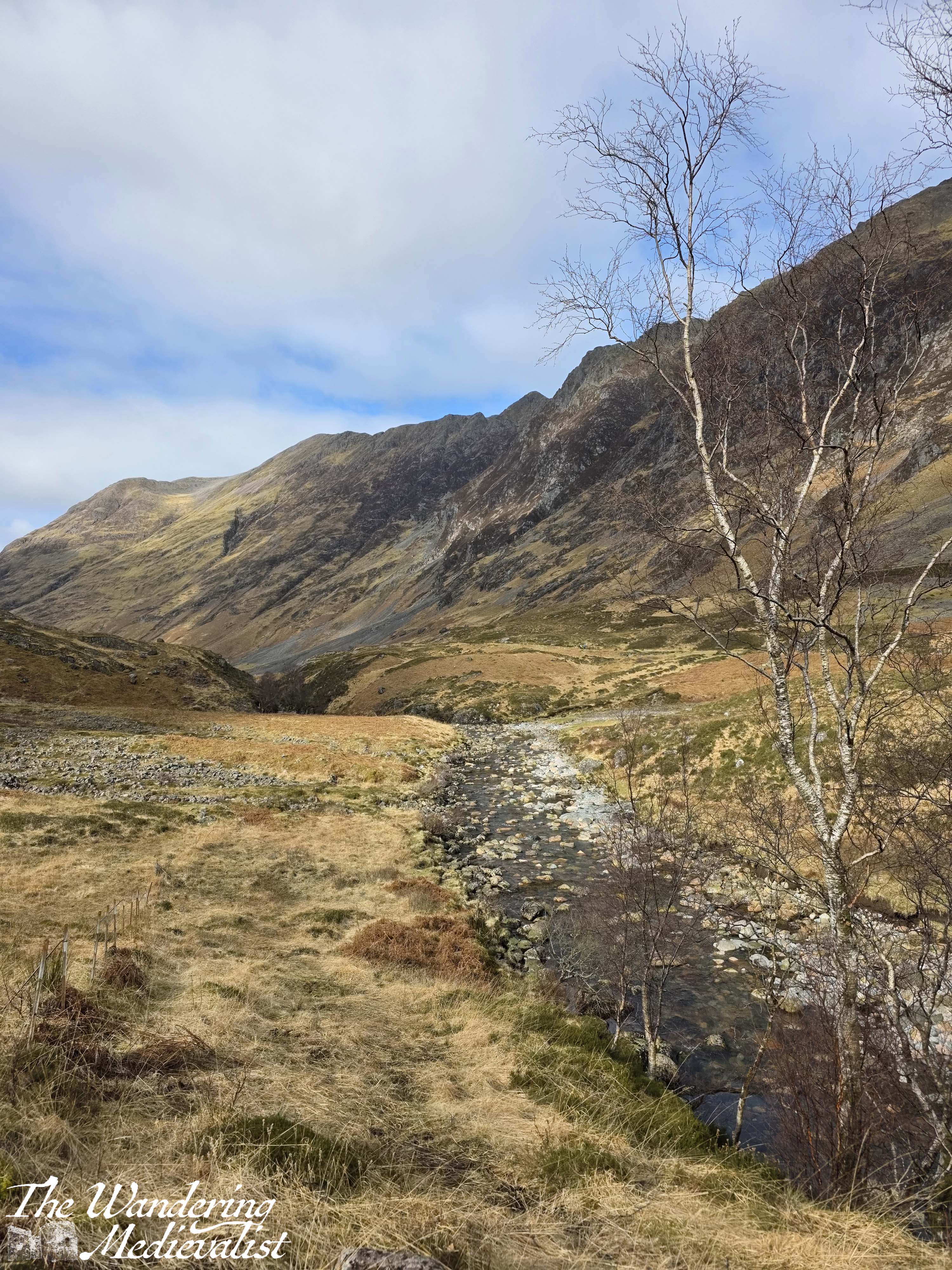
This is my absolute favourite picture I took all year; I’ve shared it before, but I want to share it again – the snow, the light through the clouds, the still loch. And the memories it evokes, of a lovely weekend away hiking and enjoying late winter in the Highlands.
Loch Leven and Glencoe, Scottish Highlands
I hope you have enjoyed this photographic trip through my year! Have you checked out my online shop yet?
Completing a circuit of the Coastal Path by January may no longer be a feasible goal but that doesn’t stop me from doing my best to try. So, last Saturday I planned another stretch, on the shorter side as I had family commitments to get back to in the afternoon. So, Leven to Lower Largo seemed a good option, and relatively easy to manage by bus.
The day started windy and with patches of rain, with water still in the breeze but sun promising a change in the distance. The storm earlier in the week cleared out the air a bit, and it was less stuffy and a few degrees cooler – perfect day for a walk. (Though, side note, the other half was devastated that the storm was mostly wind, as he was looking forward to a wet grey day. Instead we experienced fast-moving white fluffy clouds and wind, very little rain).
The bus I chose was the x58, which is a faster route south from St Andrews towards Upper and Lower Largo, bypassing most of the East Neuk. It was a nice ride, quick and interesting to see different villages for a change.
I reached Leven Bus Station in good time, and despite there being no visible signs for the Coastal Path, it was easy to see where to go.
The bus station is very centrally located and only a road away from the coastline, just next to where the River Leven empties out across the beach into the ocean. There is a big car park here, and a promenade that is smaller than the one in Kirkcaldy but just as pleasant, with a wide sandy beach. While the Coastal Path proper runs along the road, I took a quick jaunt down to the sand to on several occasions.
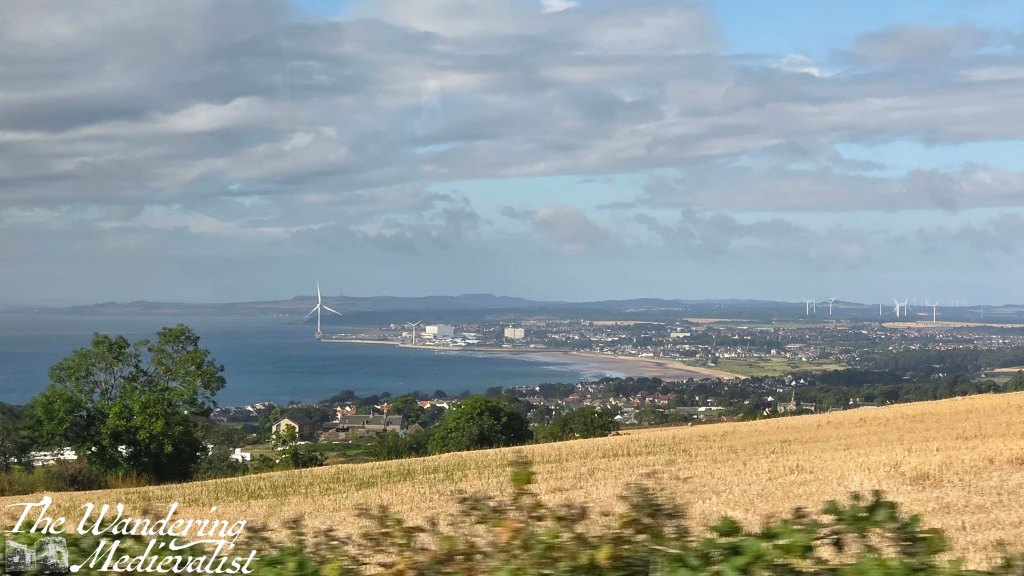
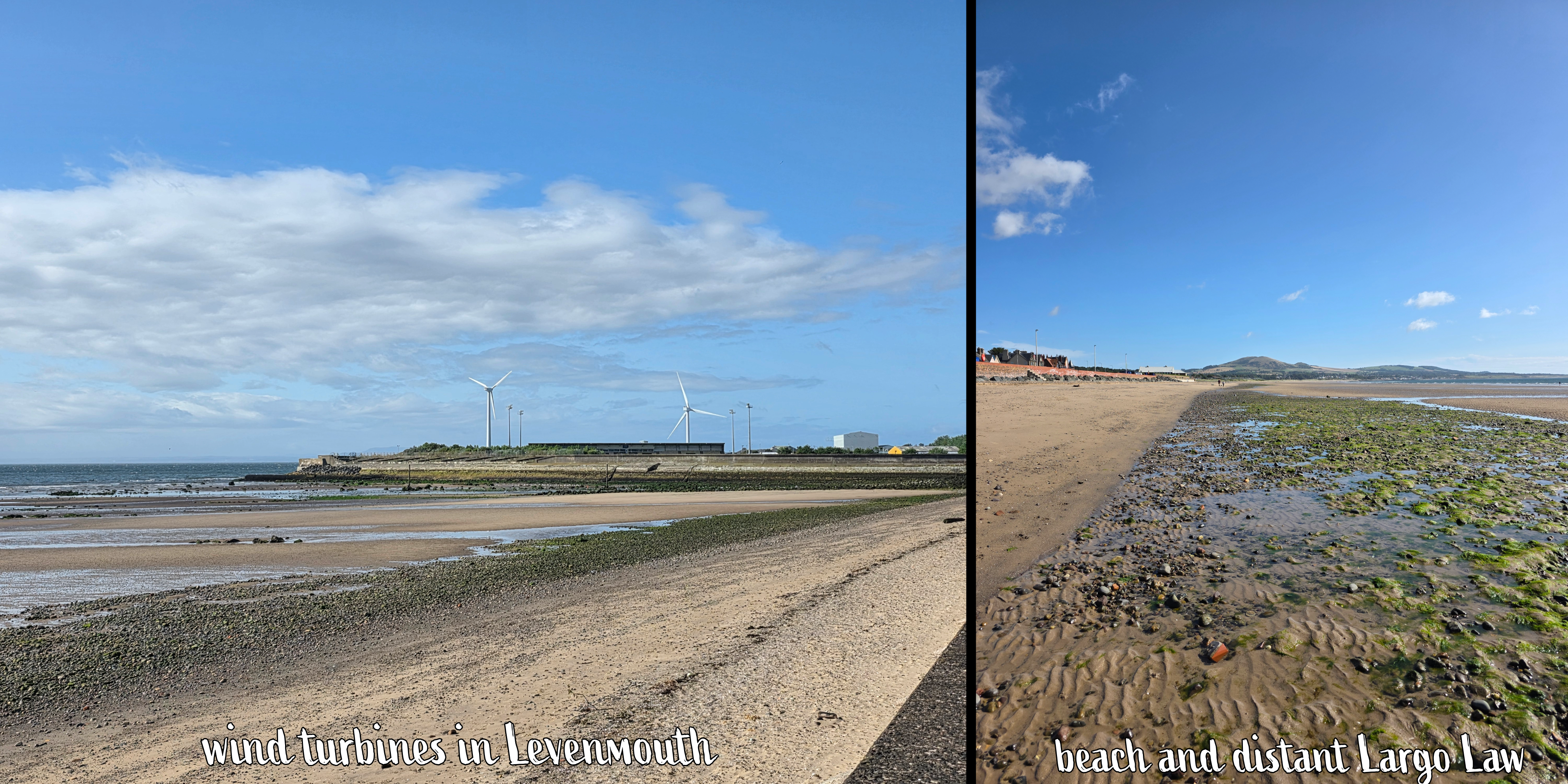
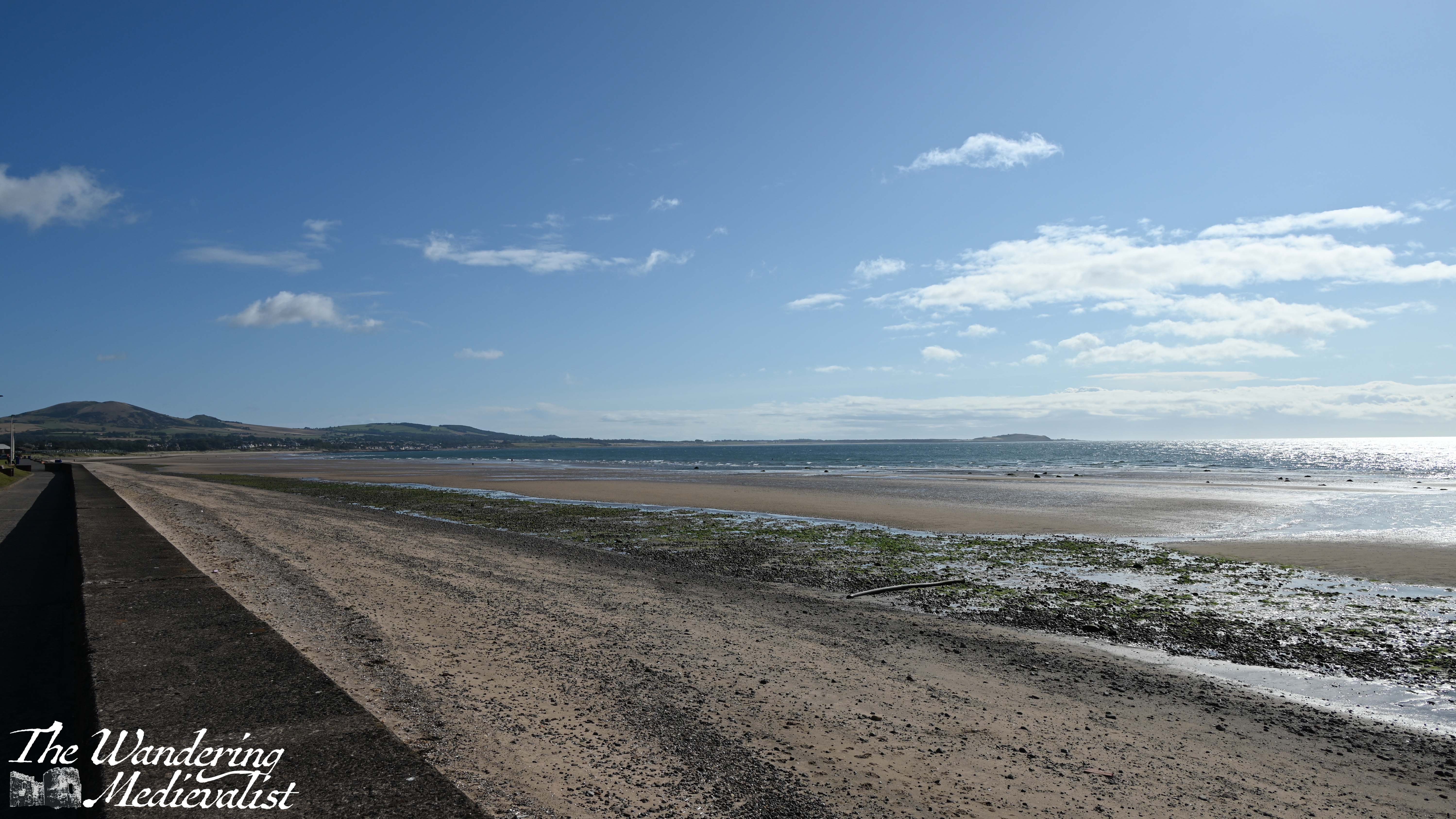
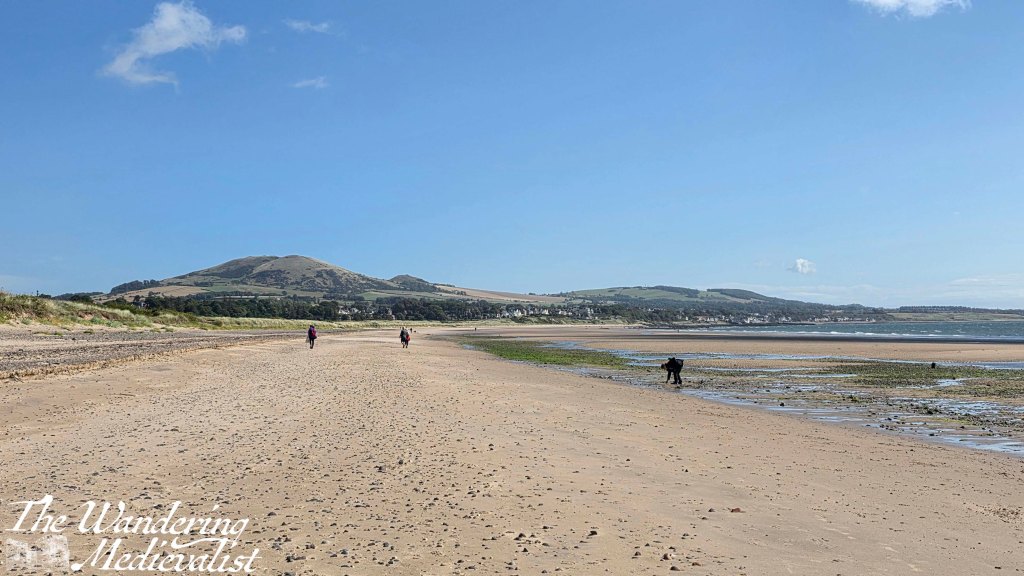
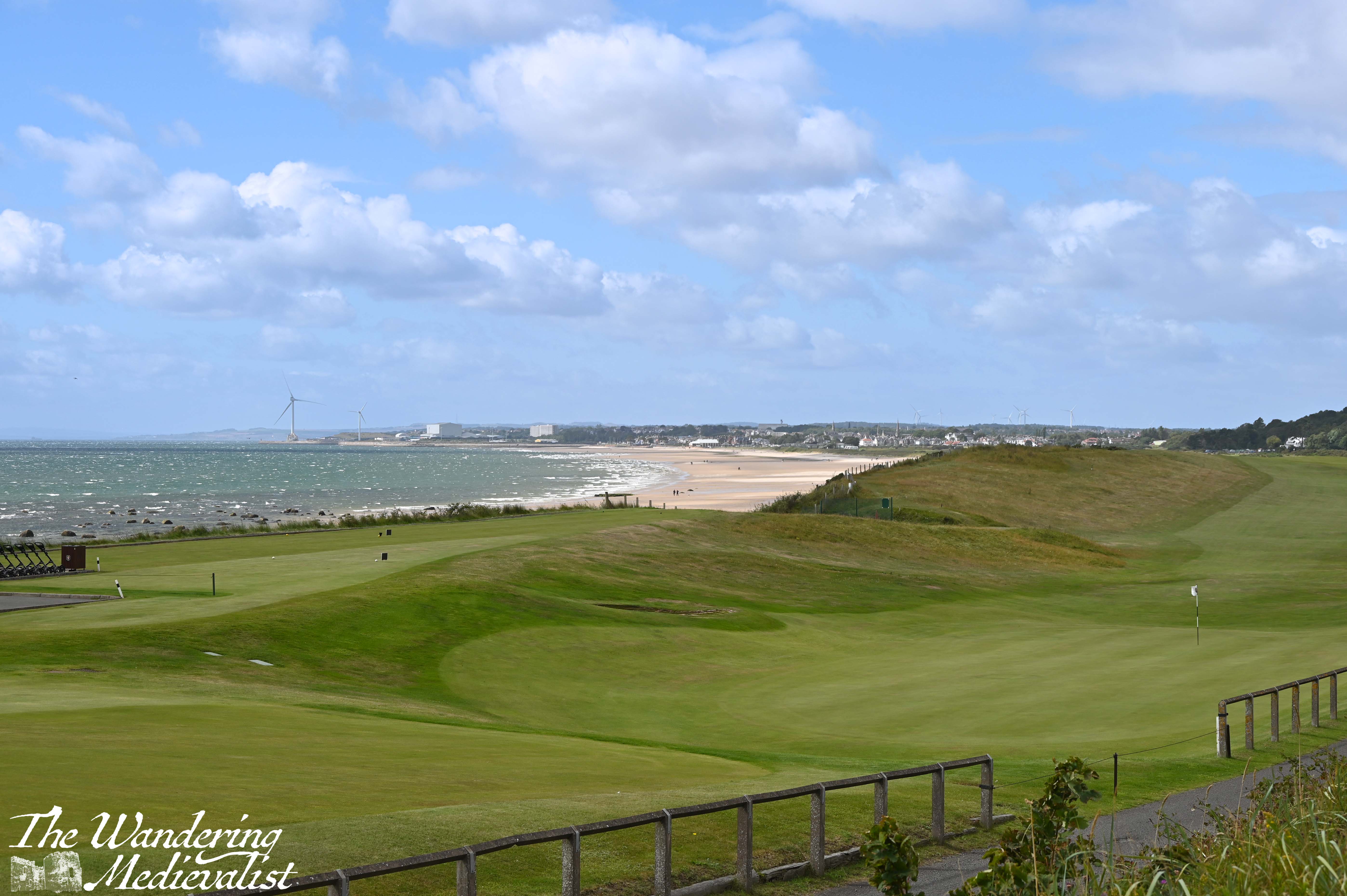
Also similar to Kirkcaldy, this promenade provides a view of the whole bay, with coast stretching out for miles ahead up to the point where you would turn to go to Elie, and Largo Law – Largo hill – towering over the distant towns. It was a touch hazy, but became clearer as the day went on and the clouds were chased away by sunshine.
As I walked along the beach, I became aware of the excited screams and laughter of many children, who were playing in a large blow-up arcade with a massive slide and other amusements. This theme continued, as further down the coast was an older arcade-style building, a new skateboard park, playground equipment, a putting green and more.
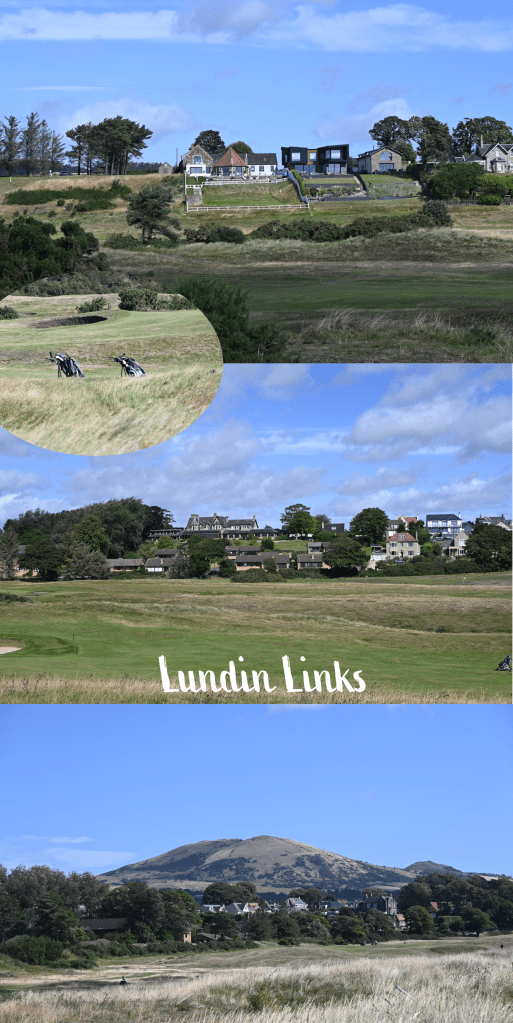
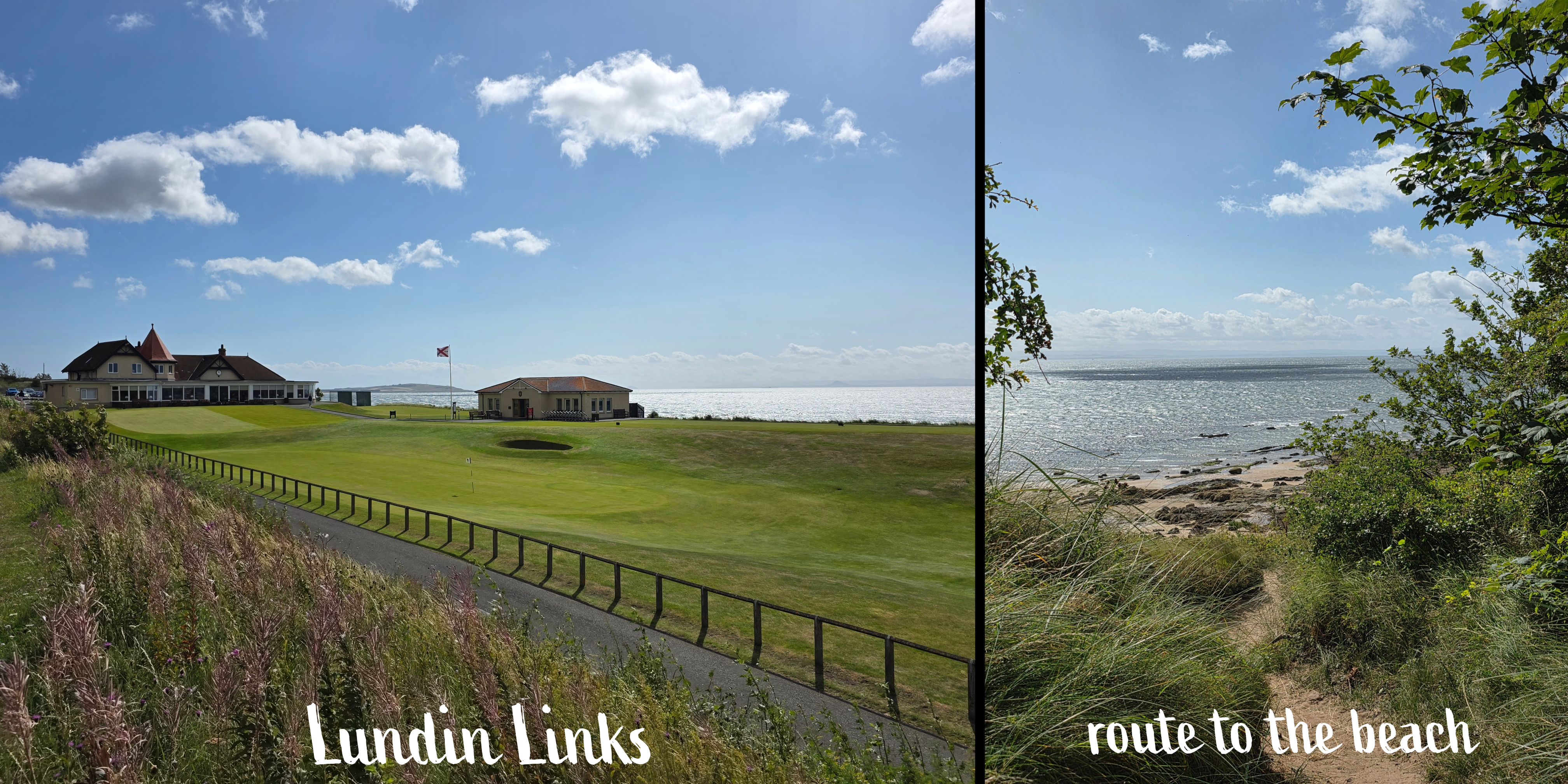
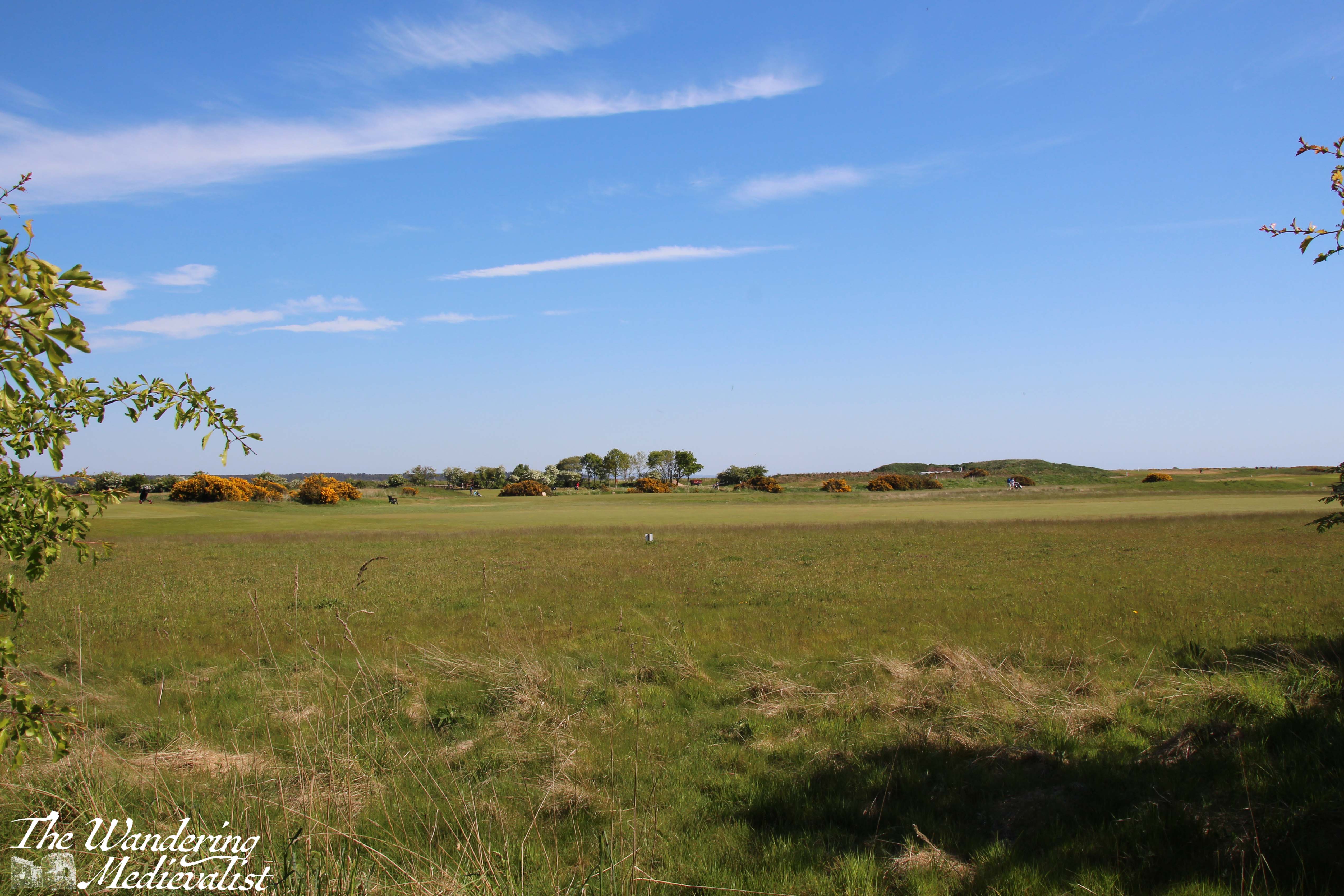
At this point the Coastal Path signage is scarce, but there really isn’t any other option but to follow the road. On the side away from the beach, I eventually passed the Leven Golfing Society – a large red brick building – and enjoyed a nice vista across the golf course to the Victorian-era cottages beyond.
Unlike in other towns, the Coastal Path avoids going through Leven Beach Holiday Park, and there are two routes – a high tide route up behind the park, and a low tide route on the beach.
The sign that indicated these two routes was so faded from the sun that I could not capture it, but I figured that I would work it out when it was time to leave the beach.
I was also delighted to walk past a small group of pet owners taking part in a dog training class on the grassy area beside the beach. I passed more than a few dogs on the beach and this section of the trail – clearly it is a popular spot! Including one small white dog that continued to chew on its squeaky toy for a solid 10 minutes – at first I thought it might be a very odd bird, but soon realised my mistake.
beach looking towards Largo Law
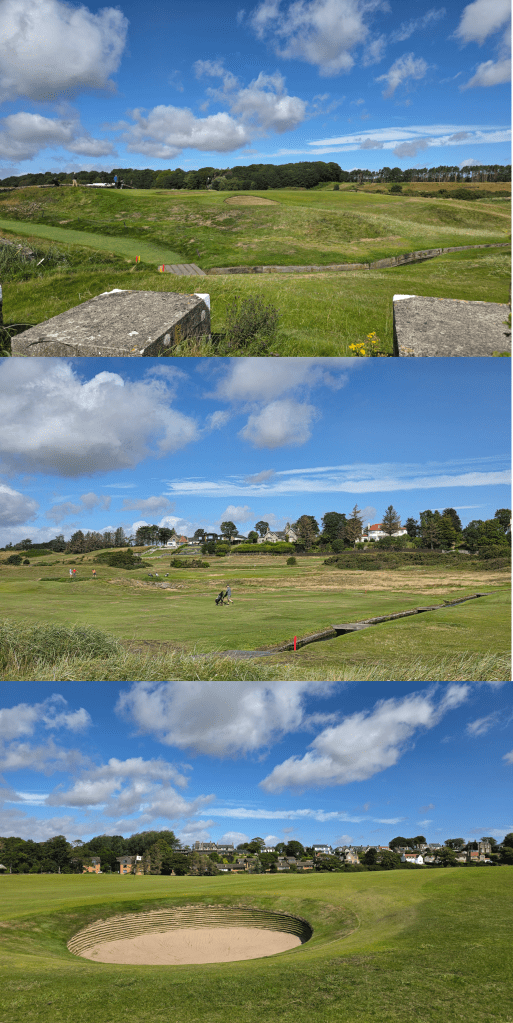
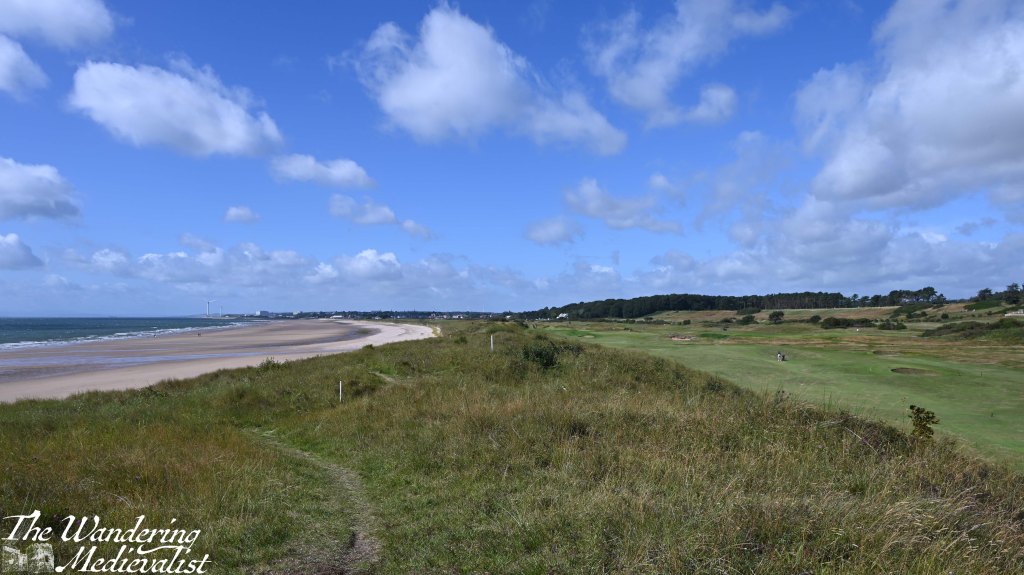
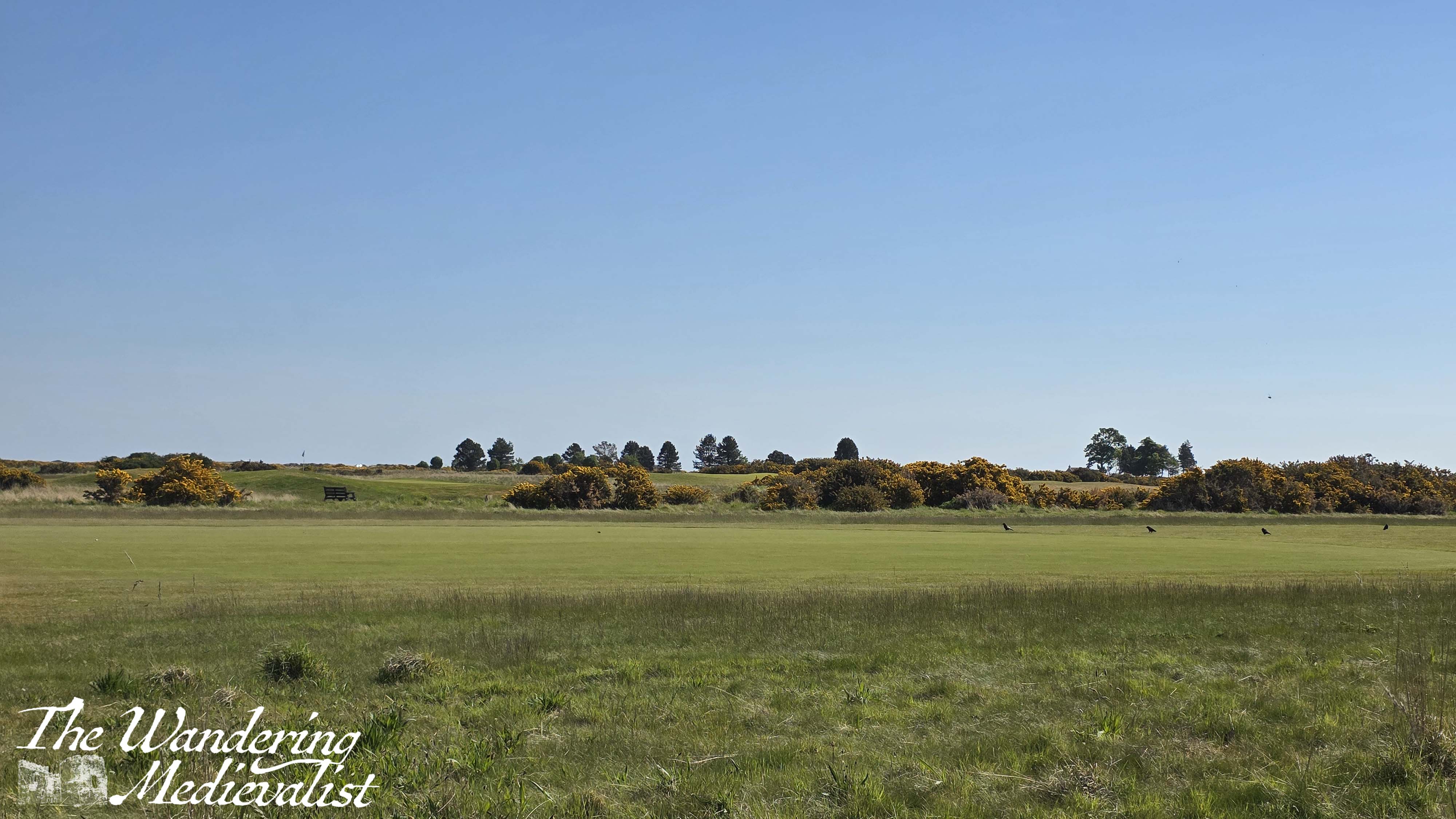
The sign indicating the spot to re-join the high tide route is easily visible from the beach, and so I climbed back up onto the verge between the golf course and the sand. Like so many large patches of the Coastal Path, this was the pattern for the next mile or so – beach and golf course, both providing good camera fodder. (I have an idea to do a calendar of Scottish golf courses, so this walk will be a great help)
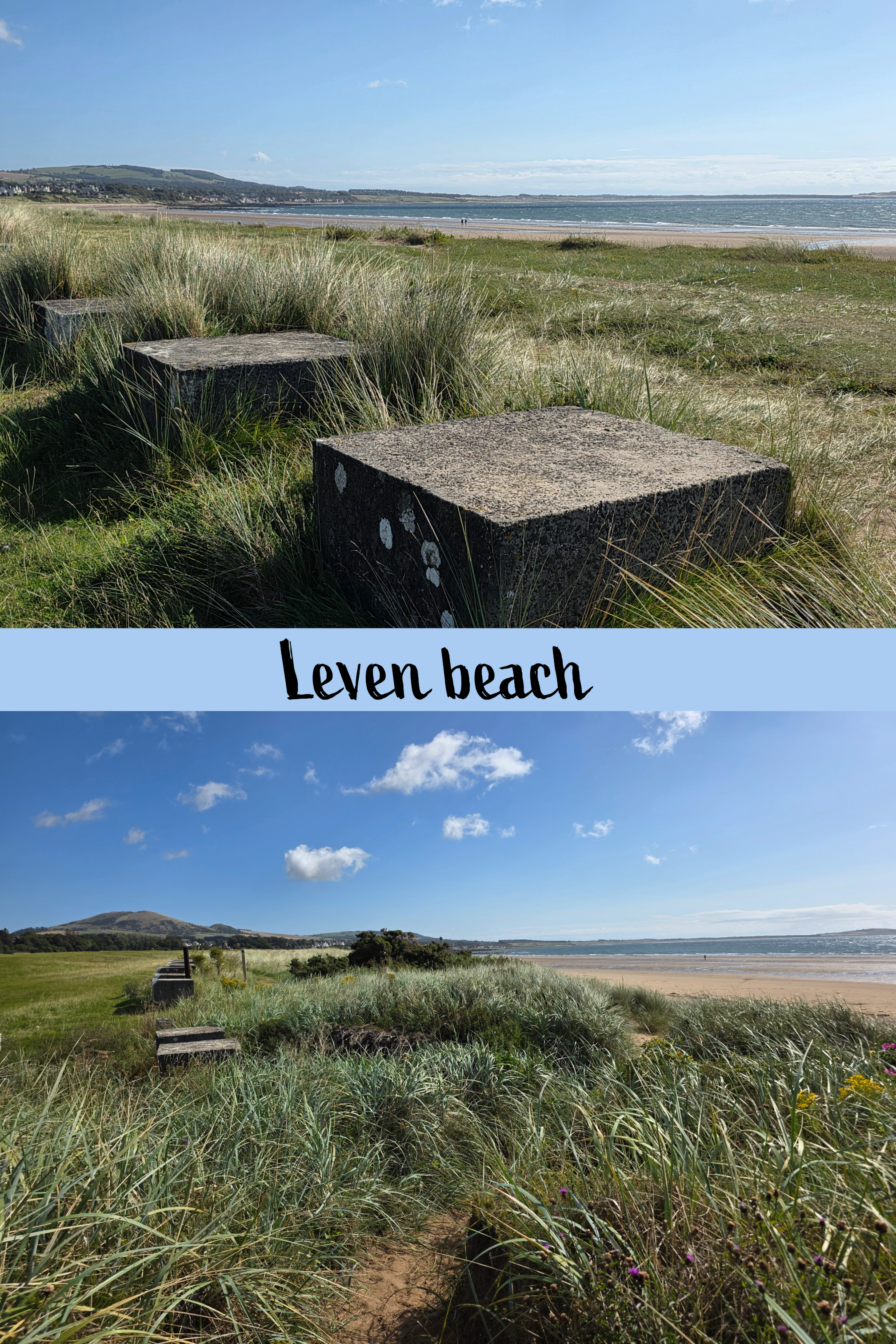
In very little time, the comment I made last week about not noticing WWII defenses this far down on the coast was entirely disregarded when a long line of concrete blocks appeared, essentially marking the border between golf and walking. The Coastal Path sign helpfully points right down the middle, so to some extent it is walker’s choice which side of the blocks you choose.
The track here is quite a bit softer, with deep sandy patches interspersed with grasses, making the going a little harder. I finally became warm enough to shed my cardigan (the wind was no laughing matter), and paused briefly at a bridge across a small burn. The burn cut through the dunes and was lined with sea roses and other wildflowers – really beautiful spot.
Some golf views…
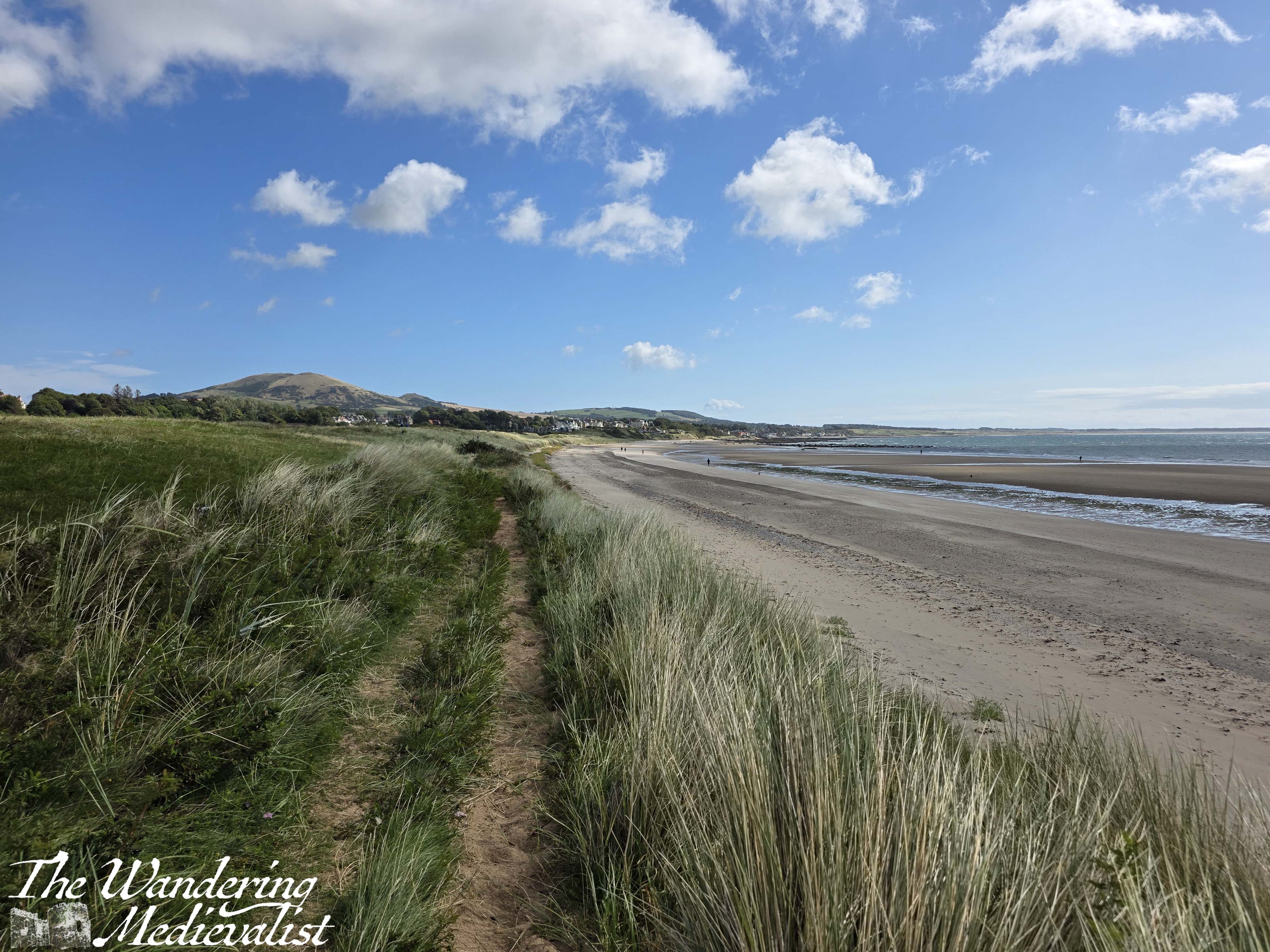
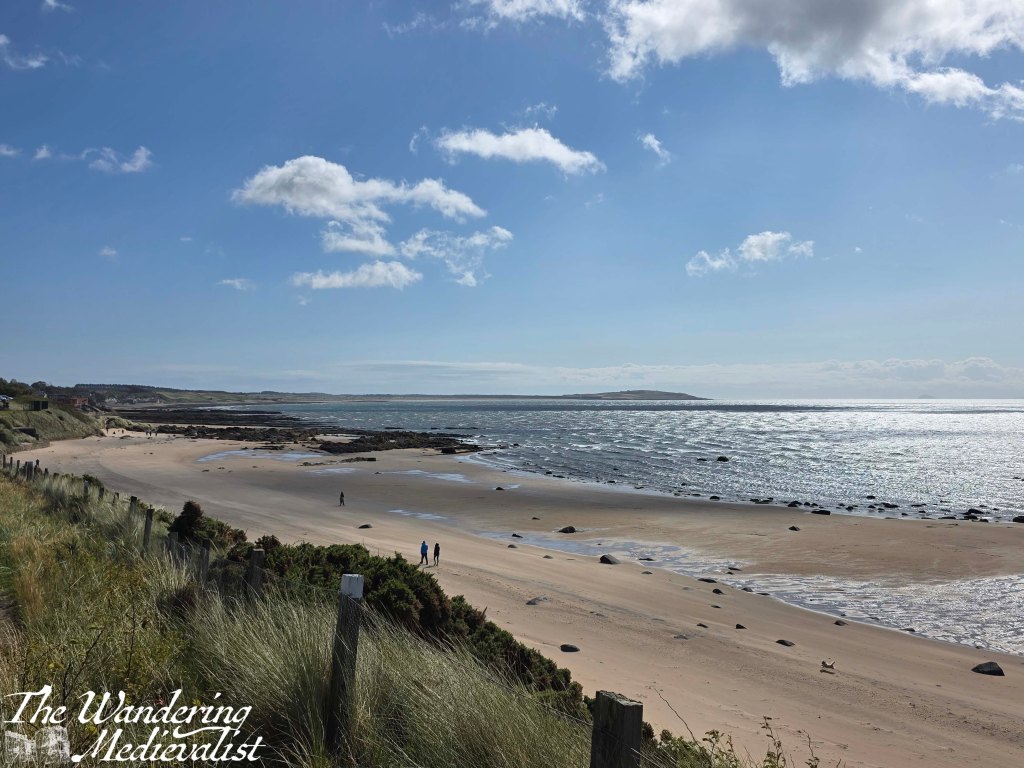
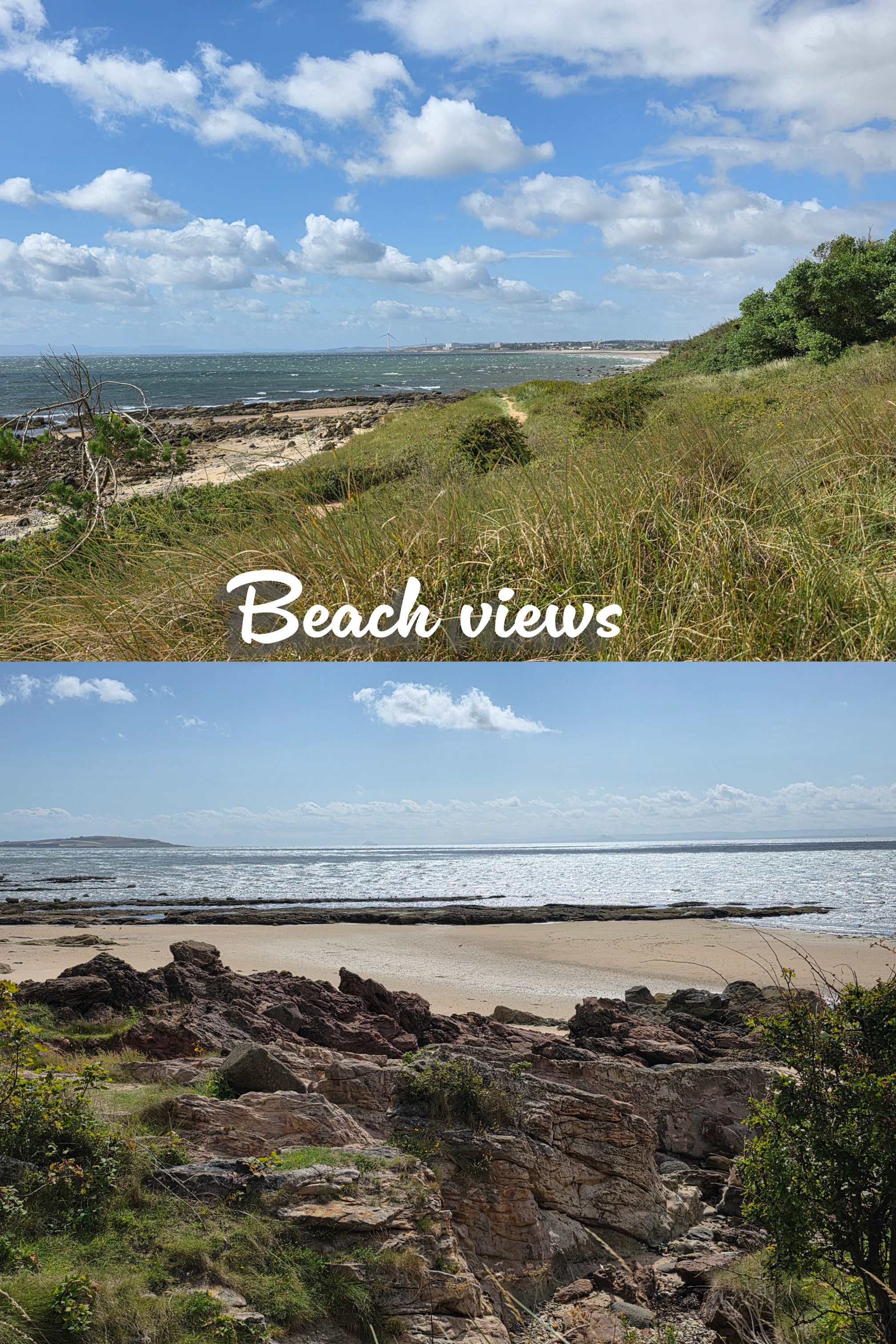
As the path moves around the bay, Largo Law shifts further to the left, and the well-kept houses of Lundin Links appear along the distant edge of the golf course. At some point this becomes Lundin Links rather than Leven, though I’m not sure where – probably at the stone wall that seems to cut a relatively even division down the grassy slopes. On the beach, the pristine sand slowly becomes rockier, first by the waterline and then gradually moving inland, with sand replaced by the rock shelves so common in Fife. With the dunes and long grass edging the beach, it is just a really beautiful few miles, and could probably mostly be done on the sand itself, should a walker prefer the beach.
half beach, half golf- epitome of the Coastal Path
While on the dunes there are several little trails breaking off, the Coastal Path itself is always well-marked and relatively easy to follow, or so I thought as I was walking.
About a third of a mile after the first burn, there is a second, beyond which the trail climbs slightly up a hill with excellent viewpoints in all directions. I walked for another third of a mile or so only to reach a fence and some rather threatening warning signs, indicating that walkers could cross the golf course at this point, at their own risk. The only other choice was to go down to the beach.
After a quick check of my new map and the internet – which was working for a change – I determined that I had made an error, and that the actual route of the Fife Coastal Path led off to the left back at the most recent burn. As the course was busy, I determined it wisest to go back, unfortunately meaning that I was now about 15 minutes behind my schedule which was again depending upon busses.
great view for a detour…
Sure enough, the sign for the Coastal Path clearly directed walkers across the course at the burn – I missed it entirely, probably too busy with the burn itself – which is considerably further from the fairway and so safer. Annoyed at myself, I crossed the green and joined a dirt track which soon led into the residential area. The homes here are lovely with abundant gardens, and there are stern signs warning that dog walking must not take place on the golf course.
In about five minutes, there is a right turn to keep following the edge of the course, and then a quick left along the road leading towards the golf club. There is also a dirt track that climbs up a hill beside the road, removing walkers from the traffic, which is ideal.
Some Lundin Links views
Passing through the golf club parking lot, I spotted the signs for the path ahead as well as a large gate, leading beyond. There is an almost immediate right turn (though a path also leads straight ahead), and suddenly I found myself emerging from the tree line to a stunning view over the coast. It reminded me ever so slightly of certain parts of Cape Cod, with beach-adjacent trees, long grass and rambling sea roses. The path wound down the hill, with sand and rock beyond; do be careful if you get too immersed in the view, though, as there are several deep steps that you might miss or – ahem – slip down if you are too busy looking up.
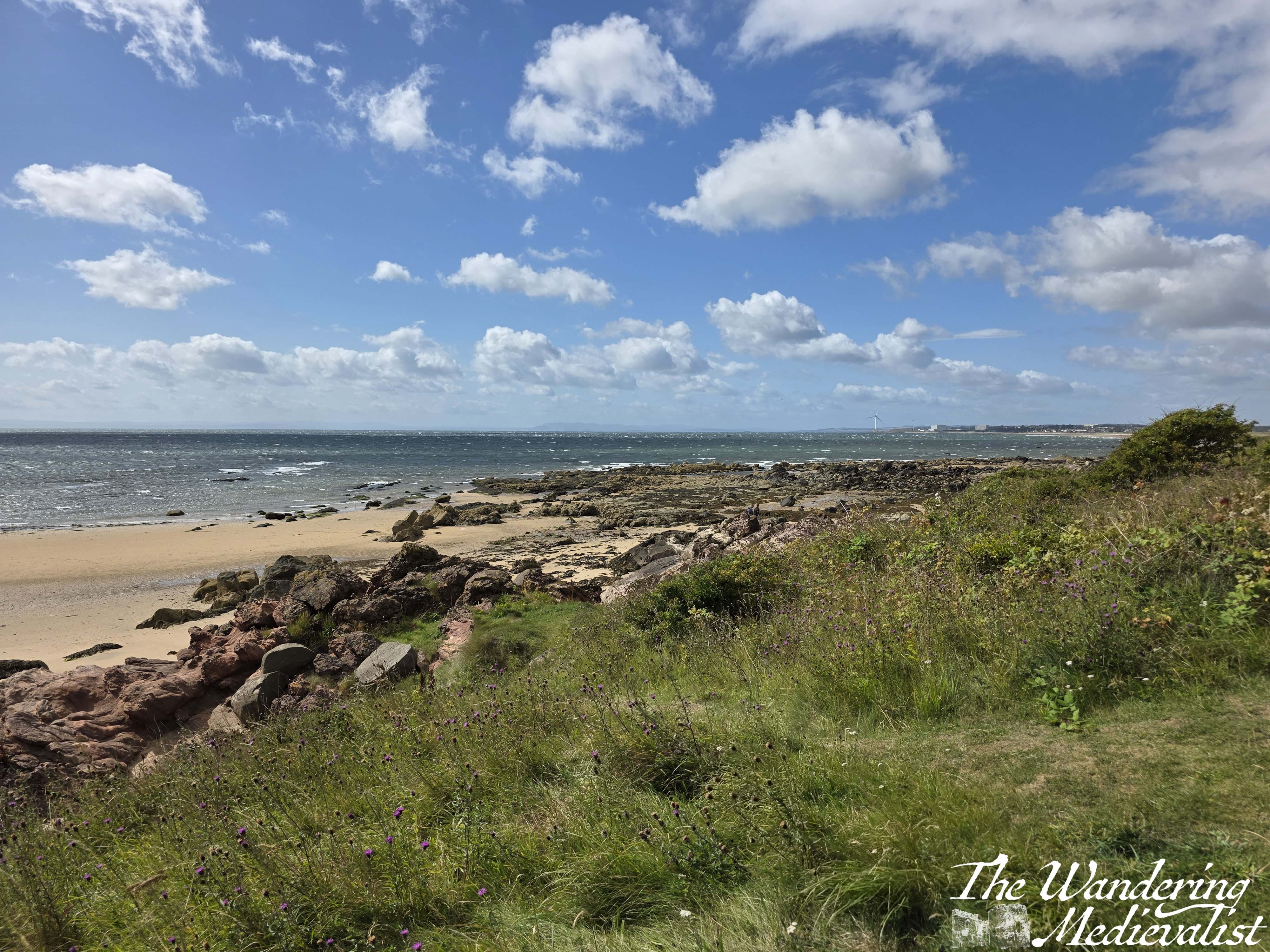
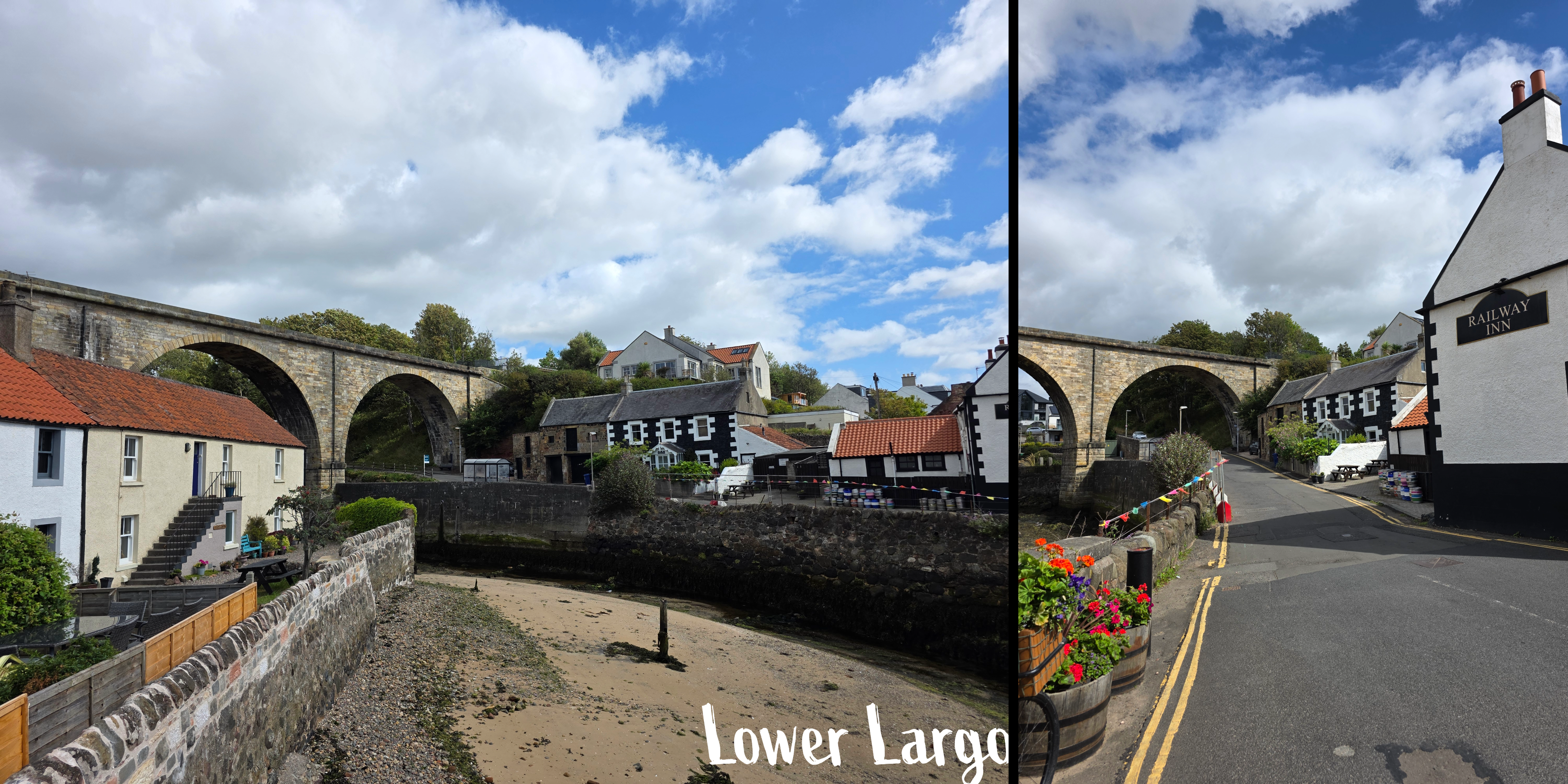
This was by far my favourite part of the walk, and the ocean colours were extraordinary, almost Caribbean in their blue-green quality. There are a few side-paths but keep going straight and you will be fine, eventually reaching a stand of trees and a gate, beyond which the trail enters the edge of Lower Largo. There is a large orange house between the path and the coast, and you are walking behind identical coastal cottages for a short while. The homes are mostly old fisherman’s houses that have been restored, and ahead is the viaduct that used to carry the train.
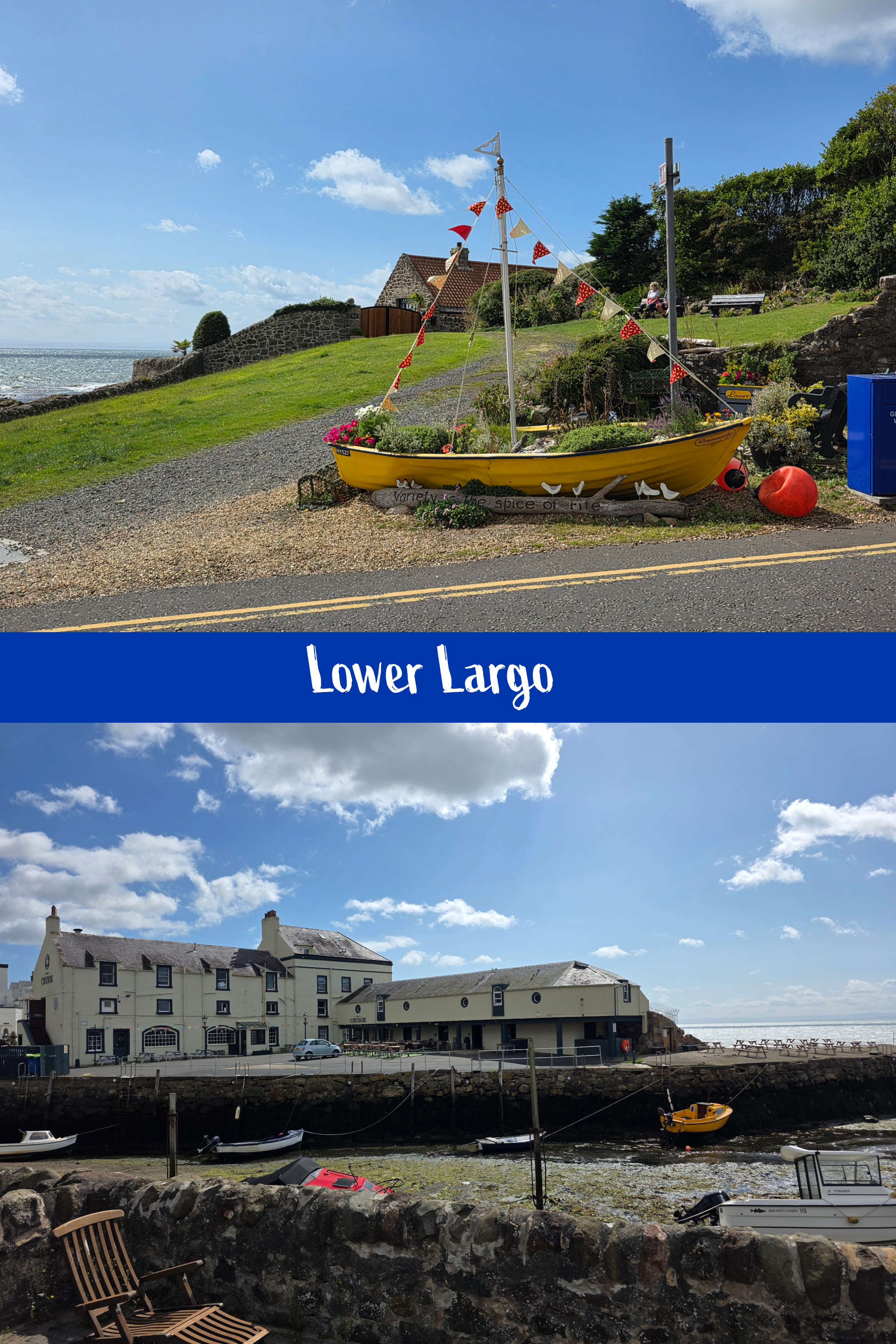
As the road winds down into the town, be careful as there is not always an obvious sidewalk; this feels much more like the towns of Anstruther and Crail, and shortly the road crosses a narrow bridge over the harbour. Ahead is the Crusoe, a popular local restaurant, and to the left a beautiful old mid-eighteenth century inn, the Railway Inn, offers bar snacks and a beer garden.
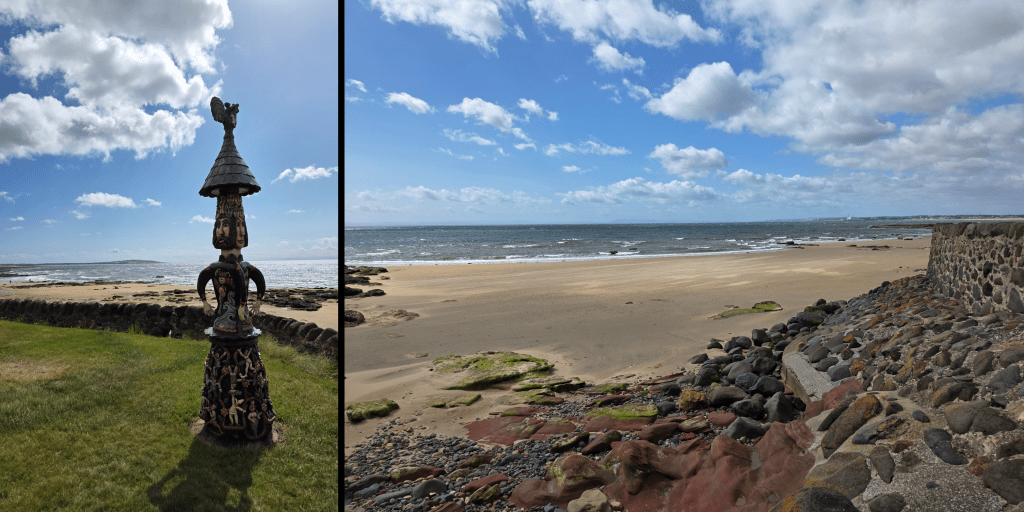
The Coastal Path continues with a brief jog to the left, then straight along Main Street. You will pass a small grassy area with a stone fence, and in the middle a sculpture by a local artists, Alan Faulds. There is more of his art further on – very unique stuff.
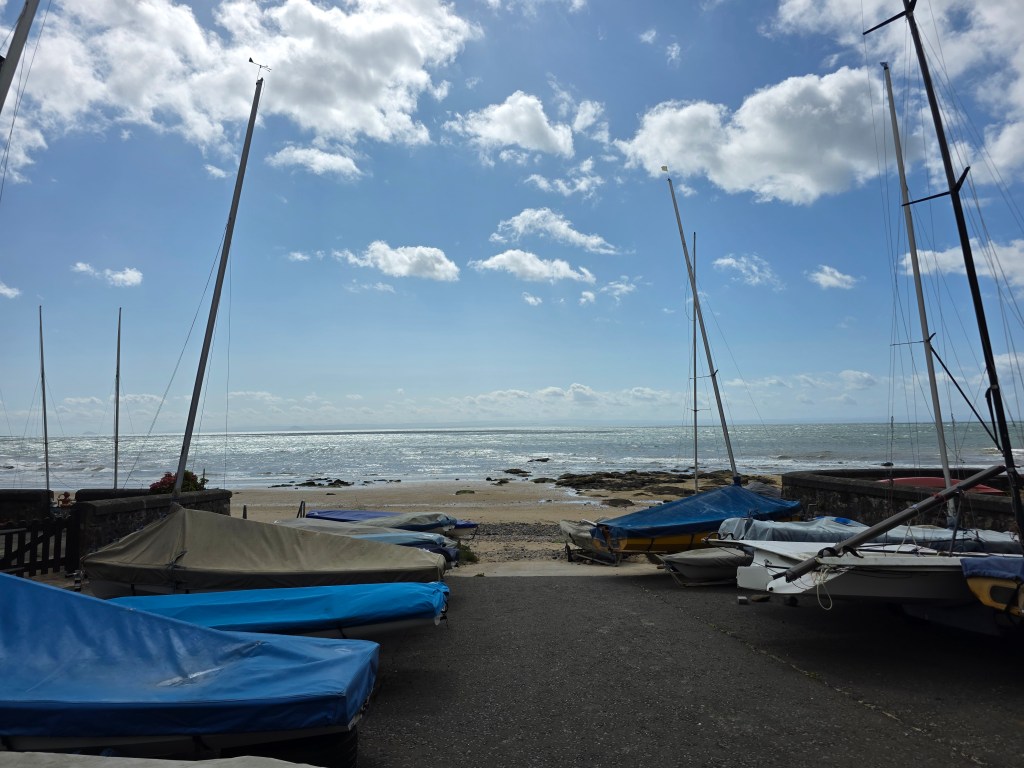
By this point, my walk was quickly coming to an end, so I decided to mark the close at the Aurrie, just next to a car park which should really have been called a boat yard. I took a quick moment to enjoy the view over the beach, then turned inland.
If you are also planning to finish a walk here, be warned that the street leading up the hill – Durham Wynd – is steep and without a pedestrian path for the first section at least.
Beyond that it was an easy five-minute trip to the bus stop and I caught the bus with a few minutes to spare, in the meantime keeping the company of a field of cows. One note about the bus trip back – I always forget about the great view of St Andrews as you come over the hill past Cairnsmill Caravan park. I just managed one today, though the bus was jerking about and bumpy.
Another note – one of the aspects of the Fife Coastal Path about which I am continually impressed is how you can turn a relatively unexciting-looking corner and suddenly be faced with a jaw-dropping vista. It has happened so many times now that I can’t even count, but I am always amazed. It really makes the heat, sweat, bugs, and bouncing around on public transport worth the effort. Large portions of the path are quiet, so I am often on my own, astounded by the peace and beauty, and counting myself lucky that I have the opportunity to pursue this goal.
My next walk is likely to be the last one I can manage before autumn travel, and I have planned a good one – 6 miles, at least one castle, and as usual phenomenal coastline. I hope the weather stays good, though wouldn’t mind if it cooled off a touch…
For whatever reason, this past Saturday morning sleep was not my friend and I woke early – the same time I do for work, which is early for a weekend – and got myself going to aim for a bus an hour earlier than I had intended. And good thing I did, as this stretch of the Coastal Path took me longer than expected, even with a few stops to test out my new camera. Yes, that is one exciting development this week: I finally managed to order and have delivered the fancy new camera that was a – cough – Christmas present from my father. Entirely my fault that it took me this long to get it sorted, as I was waffling about what to get. I settled on a switch of brand, moving from Canon to Nikon. I still need to spend some time working it out, but I’ll get there. And I digress. (still…new toy!)

Crail is a bit more limited than Anstruther in terms of public transport, but the 95 is always a good option and I got my favourite seat upstairs at the front. Also on the bus were a group of young caddies, probably about 21, who were on their way to Kingsbarns and discussing their job and how much they would make after a day of work. Blew my mind – I can definitely see the appeal! A lot of hard work to get there, I know, but still paid incredibly well especially for someone on a summer break from university.
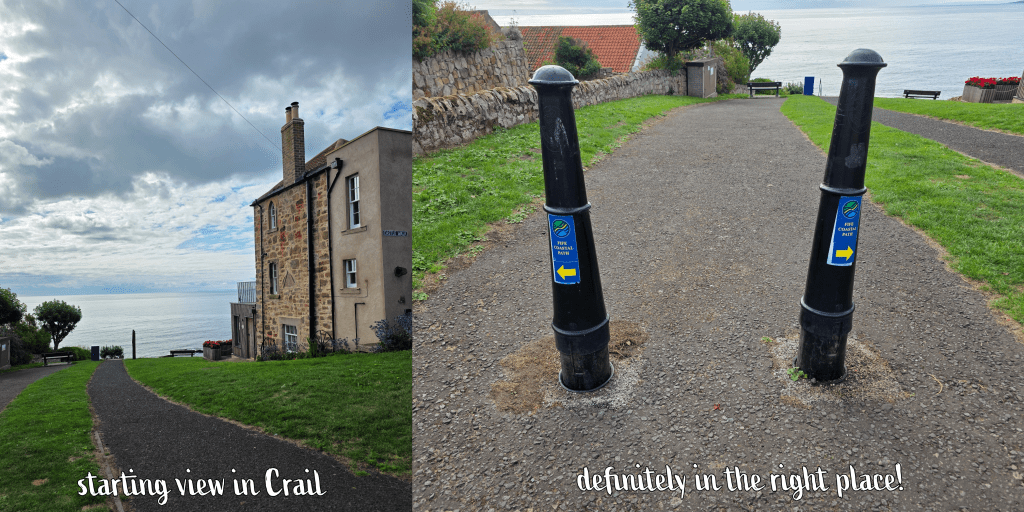
I arrived in Crail at 9am on the dot, alighting just before the roundabout where St Andrews Road turns into the High Street. It was a short walk of less than 5 minutes down Castle Street, then a slight veer to the left around the castle wall, to the spot where I had officially ended the walk to Crail from Anstruther a few weeks back.
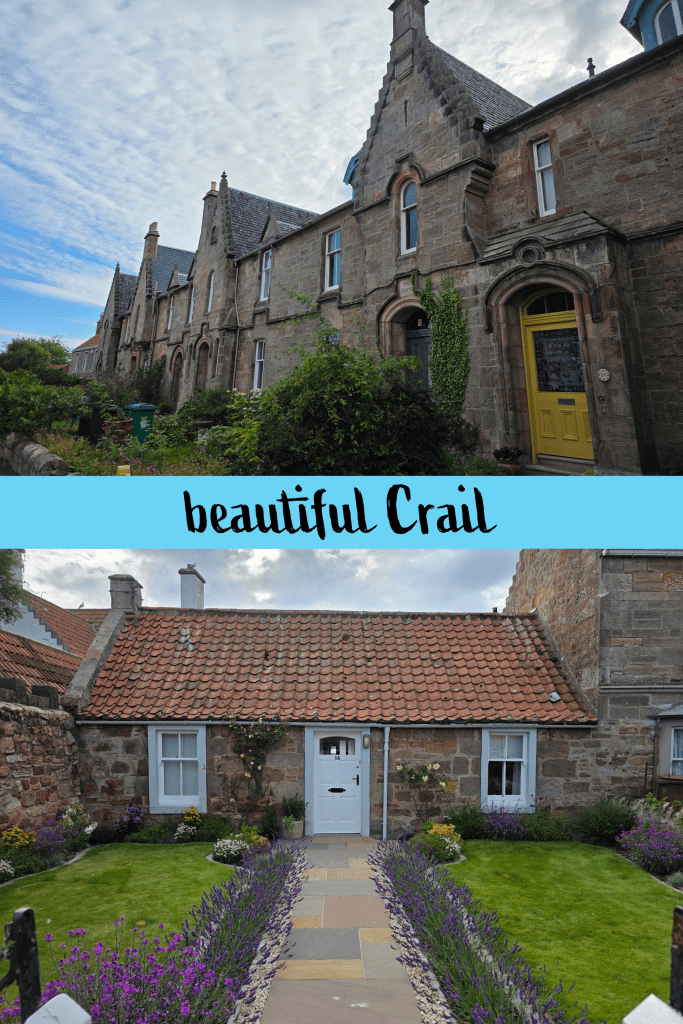
The oath is clearly marked here, along the Nethergate heading north-east. This street is just an endless line of beautiful houses and well-kept gardens, which are really all-pervasive in Crail. Even the edge of town where the houses are ‘newer’ is a lovely winding neighbourhood with beautiful gardens. That said, the constant shrieking of the gulls (expected, still annoying) made me wonder if I really coveted one of these cottages.
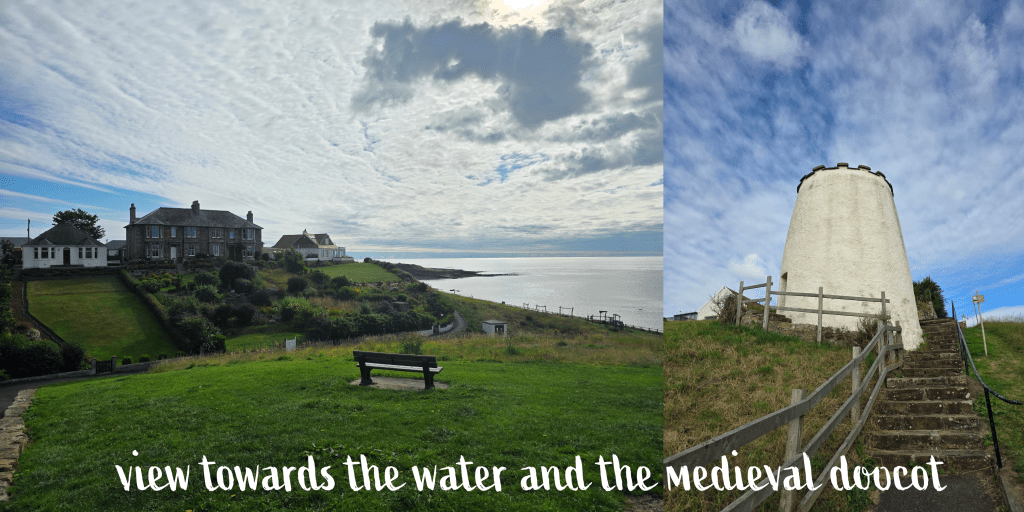
In about a third of a mile, the Nethergate ends at a stone wall and large grassy area, and the path takes a steep turn town towards the beach; ahead is a line of Victorian-era houses with beautiful gardens (notice a pattern?), and the open sea beyond.
There are two paths here, one a straight shot down a steep hill along a wall, and one off to the left which is a touch more gradual. This is the official path, I think, though I chose the other way. Going along the wall eventually takes you past this late medieval doocot, which is still open (though I did not go in) and which includes a detailed explanation of what a doocot is. This one, built around 1550, housed pigeons until the mid-19th century, and is of a quite traditional round ‘beehive’ design, though there are plenty – for example one at Tantallon Castle – that are rectangular.
Beyond the doocot, I turned left along the shore, where there is a playpark next to the sea. The weather was mild but breezy, with a mix of sun and clouds that was the perfect opportunity to test my camera. The beach is rocky with small patches of sand, reminding me very much of the beaches at home. I was relieved to discover that there was also a toilet block, though it was far from clean or well-kept. Those in Crail had been at the other end of town, so this seemed a good opportunity, and potentially the last one on this walk. (Though if you ask very nicely, it may be possible to use the ones at the caravan park, I’m really not sure)
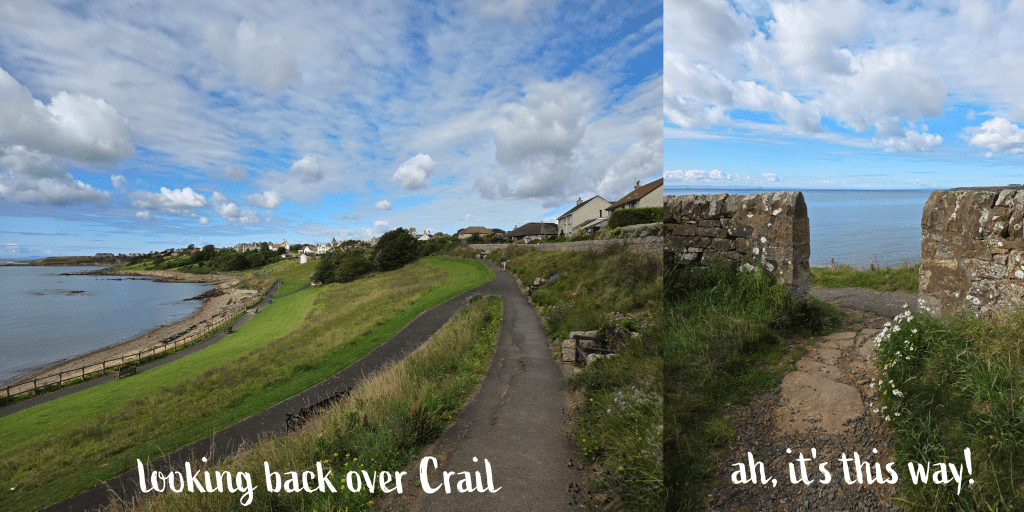
At the end of the bay, there is a flight of steps leading up to what I realised was the actual Coastal Path – oops – which had run along the top of the park. Either way is fine, I’m sure! This is of course a good spot to get a few pictures back over the beach towards the town. From here it was along the path for a short while, and a relatively fast right turn through a grassy field. There are several routes here, some leading off to the left that are clearly made by walkers, and the Coastal Path is not well-marked, but stick to the main trail heading straight for the water’s edge, and you will reach a gap in the stone wall. It may not seem the right way, but it is!
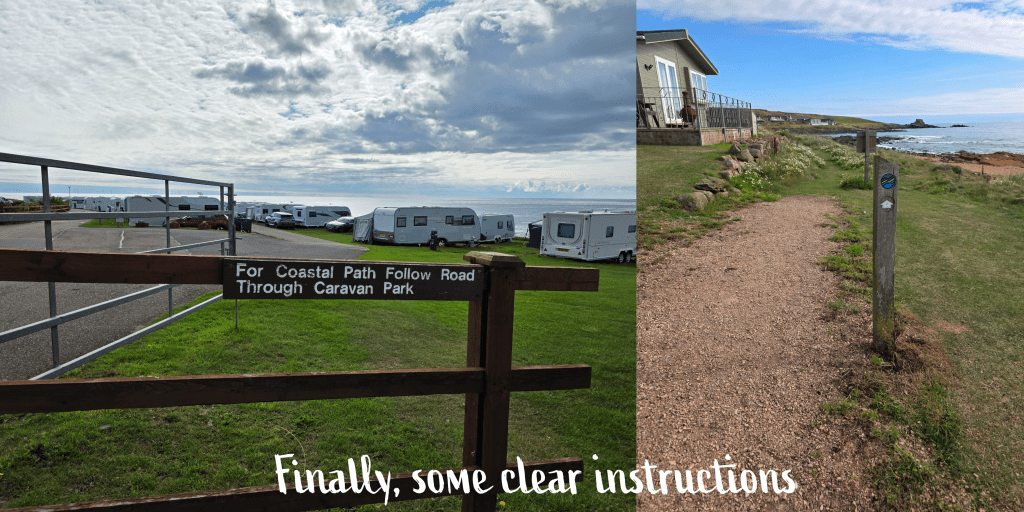
Once through the stone wall, you will see signs again and the entrance to the Sauchope Links Holiday Lodge and Caravan park. There is a clear direction here, sending walkers through the caravans on the main road. While it was early morning and the park was just waking up – some lucky souls sitting on their porch drinking coffee with a splendid view over the ocean – there were some vehicles too, keeping me on my toes.
I was really impressed with the holiday park which had a small but clean-looking pool and a good number of well-kept caravans. In time the caravan park merged into the holiday lodges, including a few glamping pods (I think) and then eventually some really lovely-looking lodges. The views were excellent, but I did have some doubt as to whether I’d want to be quite that close to the water here on the outermost edge of Fife – especially with Storm Floris expected in a few days. Eventually I discovered the style of house I liked best, up on the side of the hill a bit further back, with big patios and I am sure, a great view.
After about ten minutes or so of walking – it’s a big park! – I found a sign for the Coastal Peth taking me off the main road and down a sandy track towards the beach. The path runs between the lodges and the beach, alternately sandy, grassy, and occasionally rocky. It was an odd day where I couldn’t decide if I needed sunglasses or not, and it meant that the views were alternately bright and clear or a bit murky.
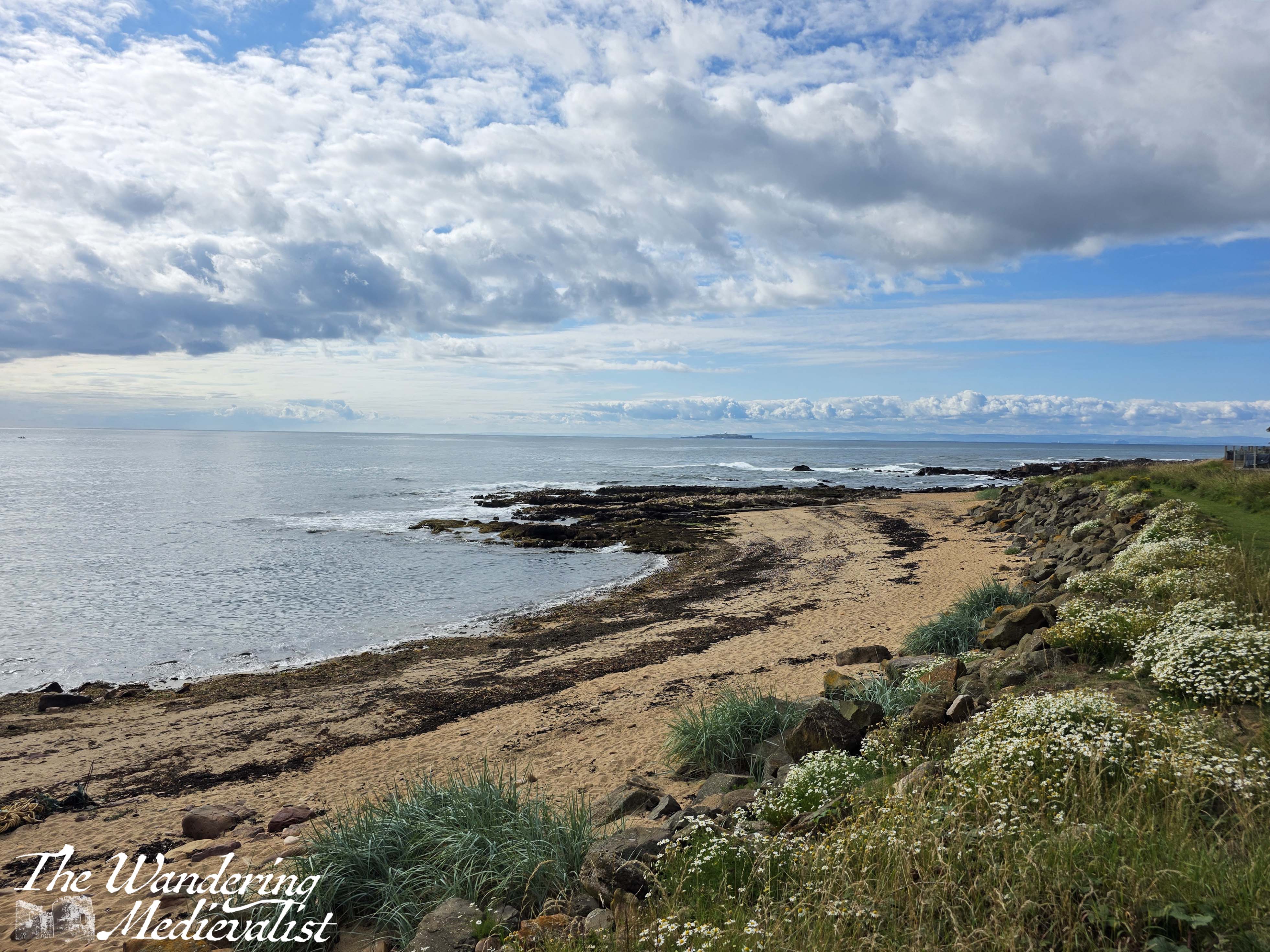
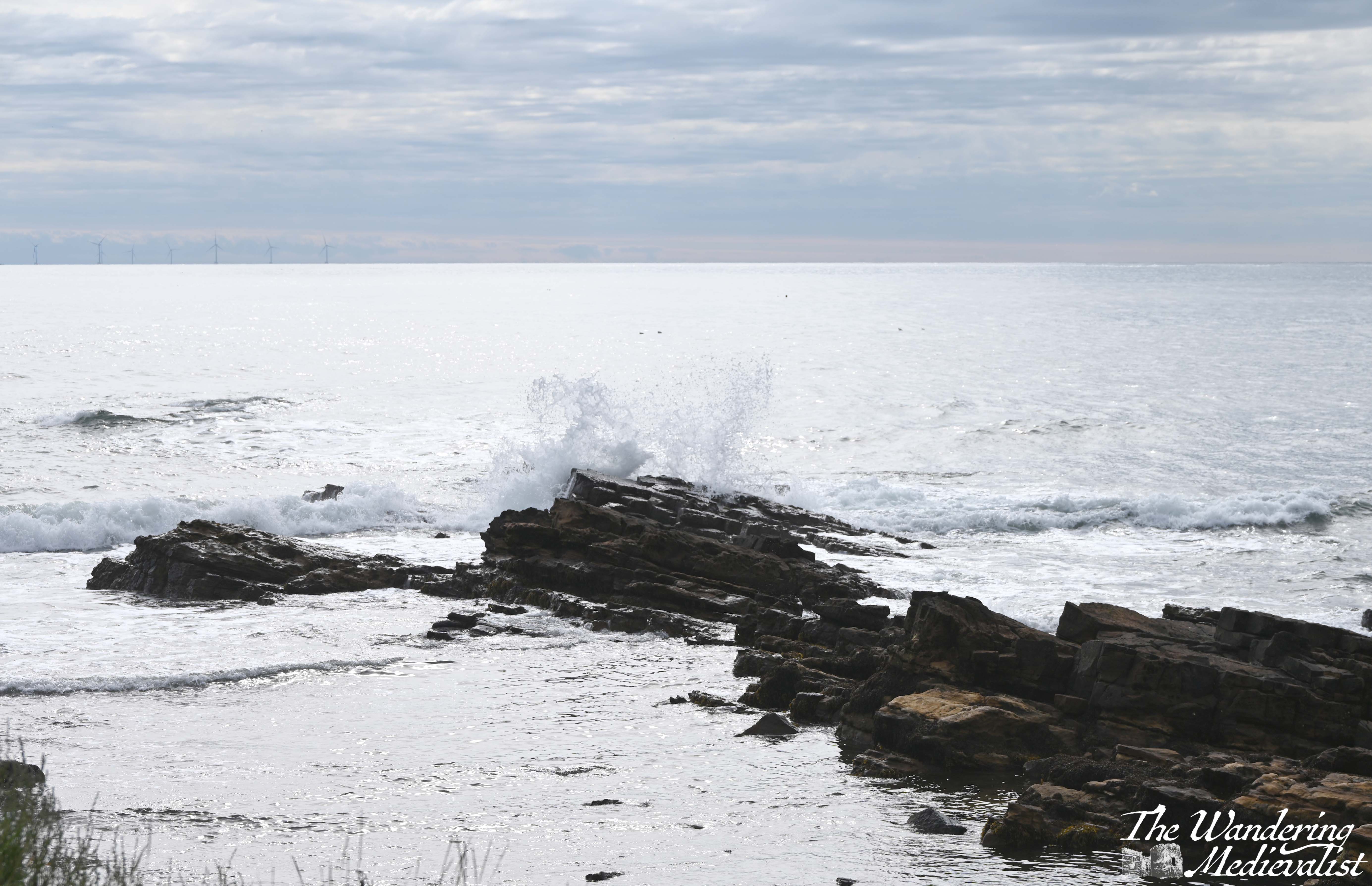
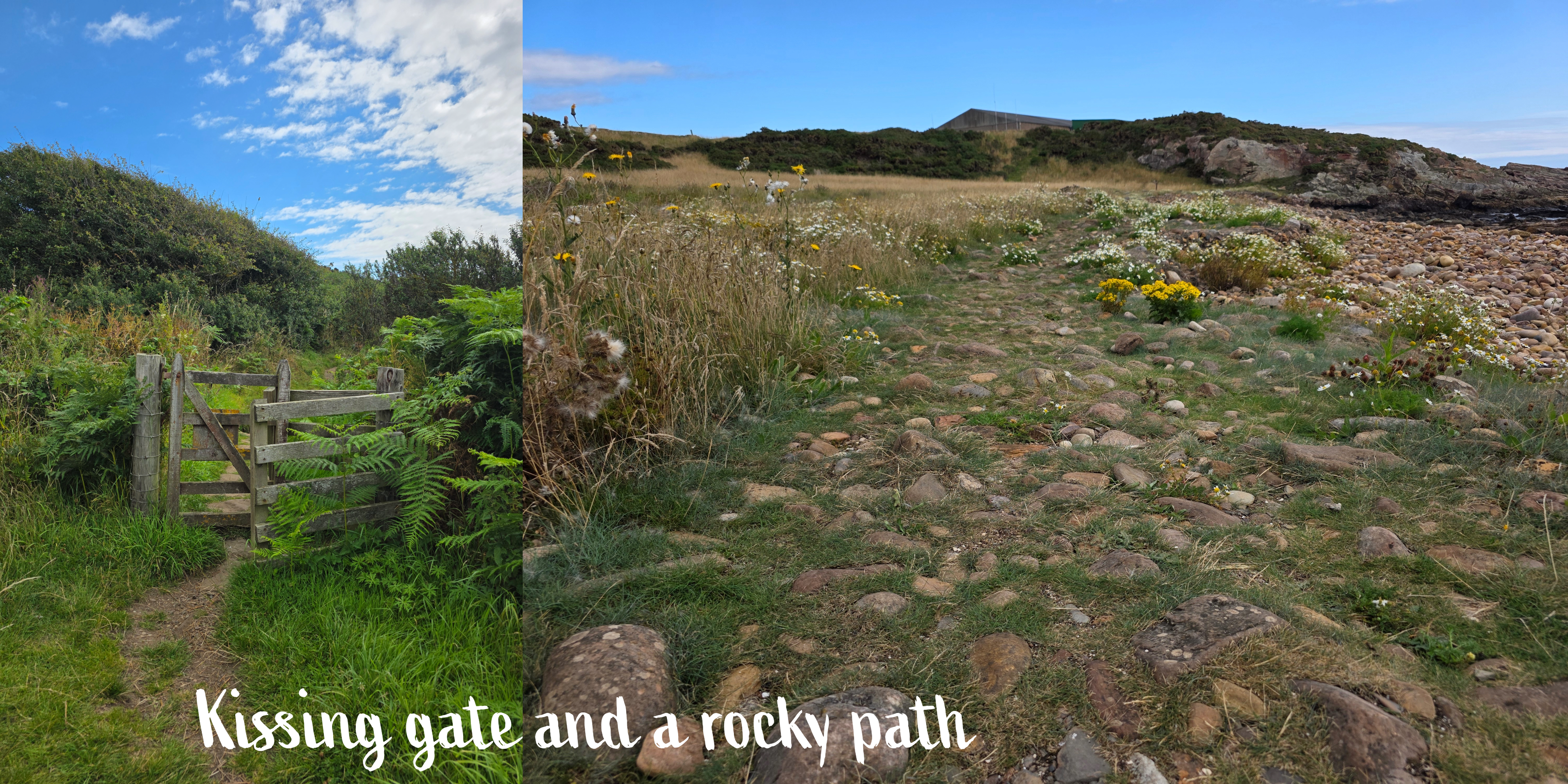
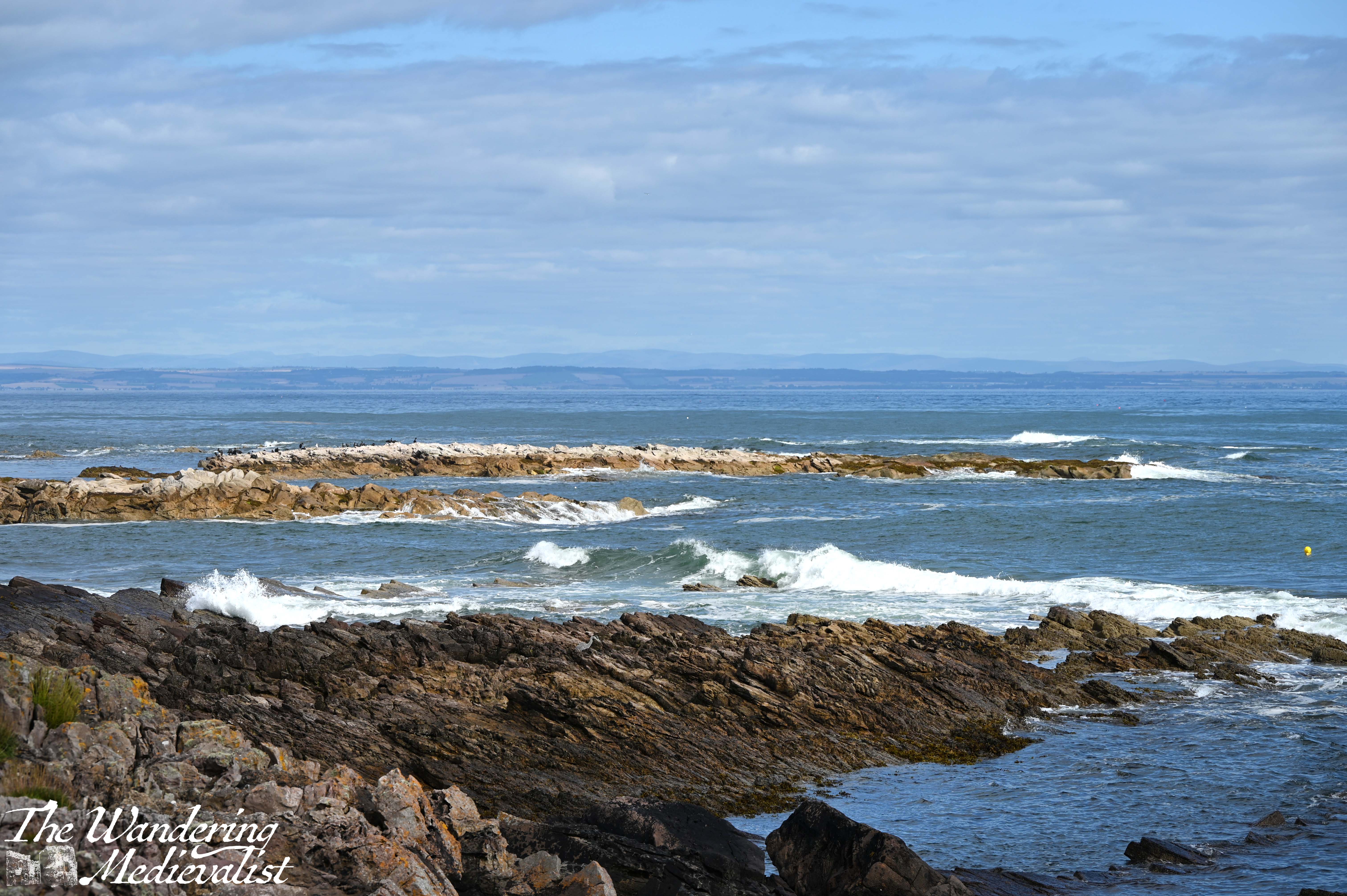
In time – longer than I expected – I reached the end of the park and went through a wooden kissing gate onto a more wild path, with high grass on both sides. There is a beautiful rock structure up ahead on the right, and a sign indicating that walkers are now entering the Kilminning Nature Reserve. Here are some great views looking back, particularly if there are waves crashing on the rocky promontories between beaches.
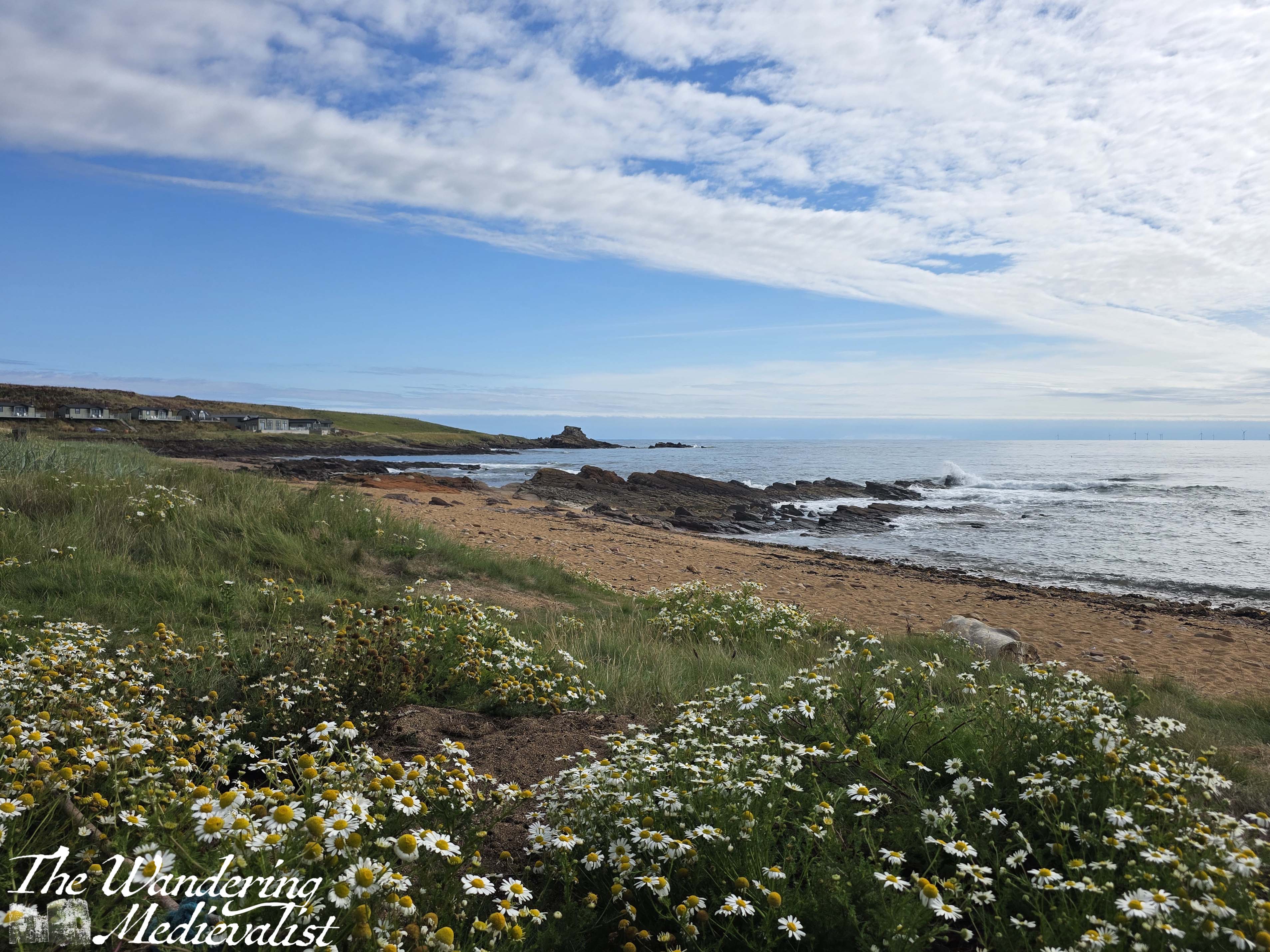
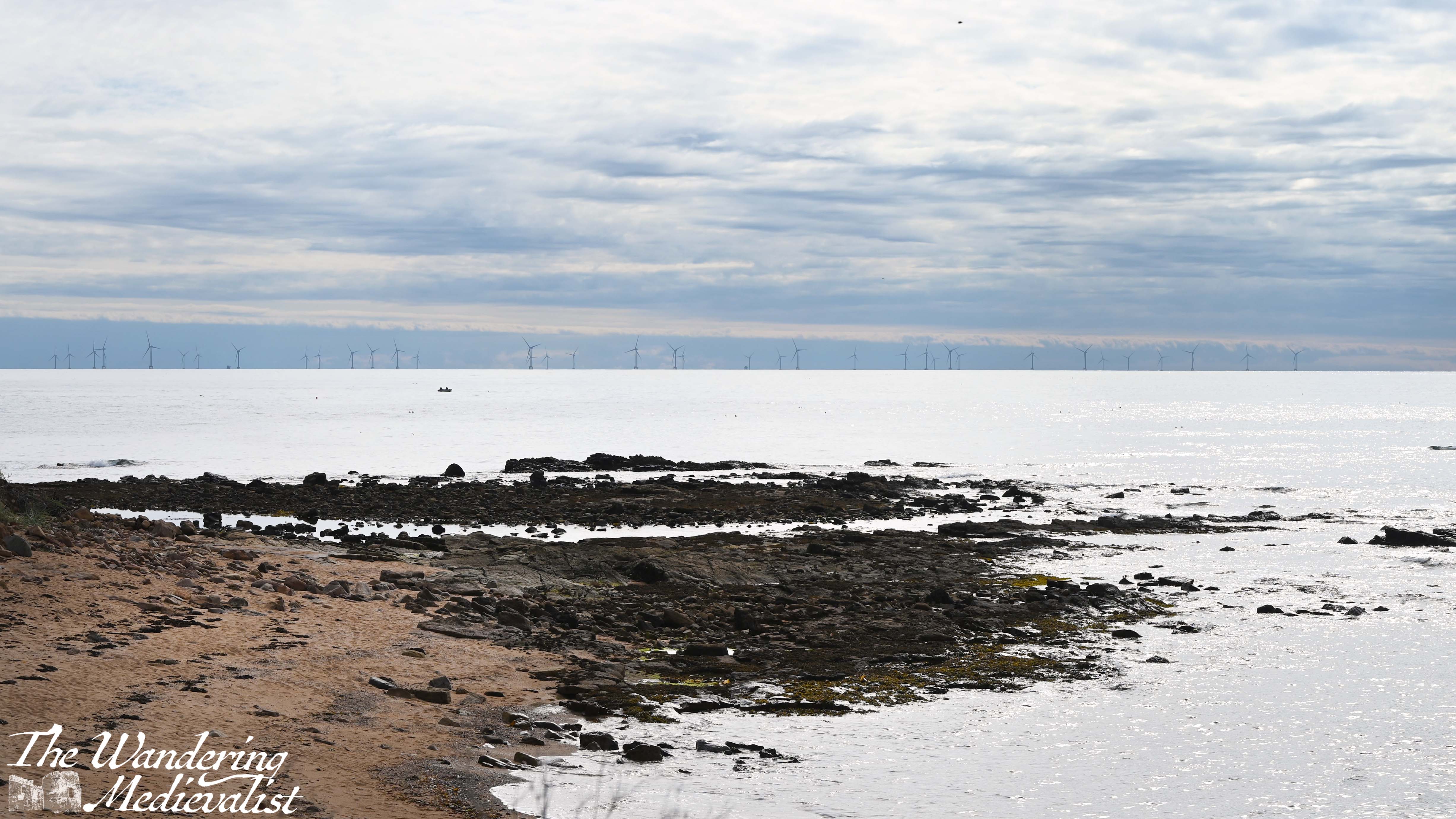
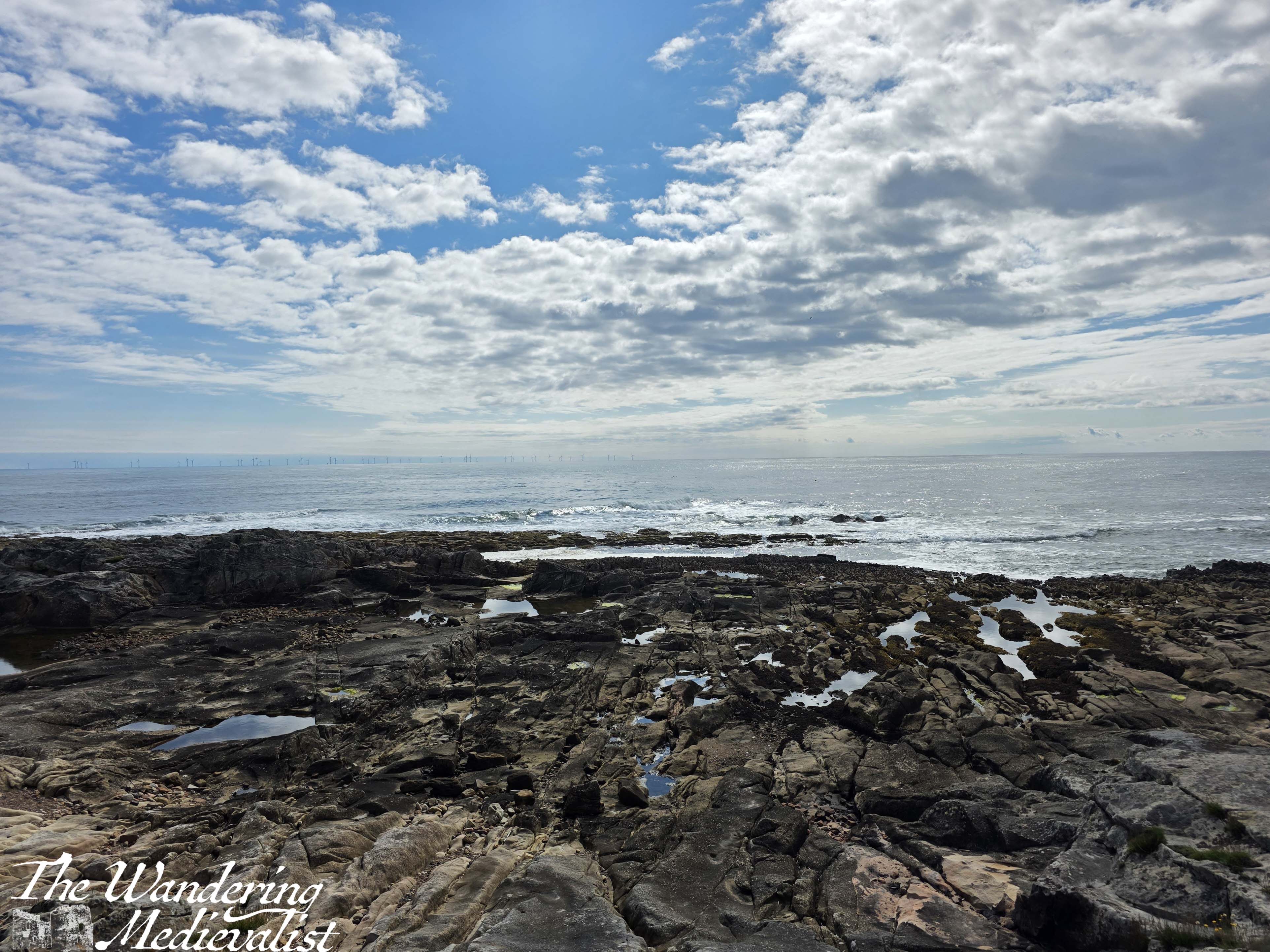
You will note in these pictures an enormous wind farm, with turbines all along the edge of the horizon. There is a lot of controversy over this wind farm, and the recent approval for what will be Europe’s largest wind farm; some object to the visual of them, but there are also environmental concerns. Personally I don’t think the optics are really an issue, and I don’t have knowledge to comment on the impact on sea birds.
From this point, the path rounds a corner into a relatively wide flat area, with long grass on either side and a rocky trail. There was one spot that was really muddy and required negotiation on stones, but overall it is pleasant, a touch flatter than much of the East Neuk trail. In a few places, you will notice entrances to bunkers along the coast; it was of course a perfect lookout spot during World War II.
This part of the trail is quiet and it might be tempting to look up at the view, but it is also quite uneven and I have in the past rolled an ankle pretty hard here. As you go past a viewing platform and through another kissing gate, the path becomes a bit more rolling, with some ups and downs on rocky stairs that can be steep.
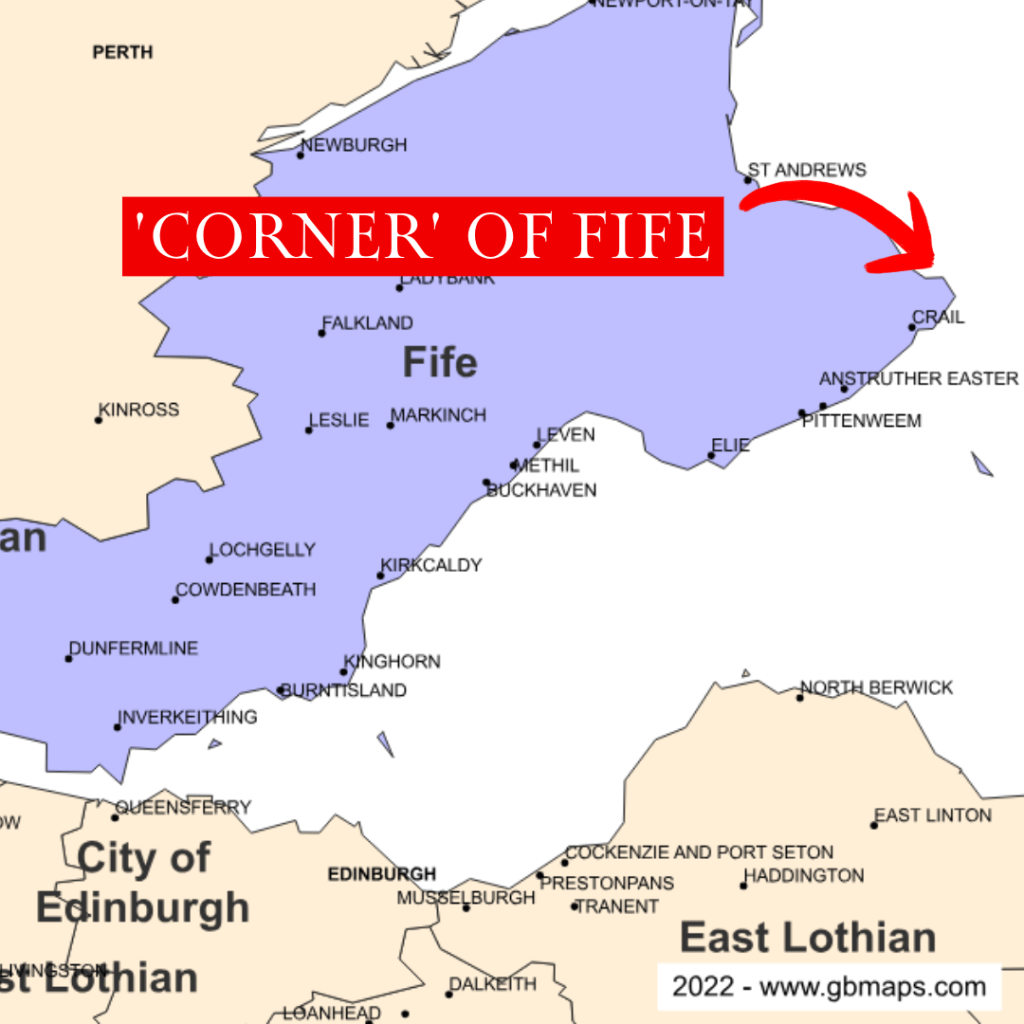
There are some great viewpoints, and eventually at the end of the bay you go up and down one more rise and discover a golf course on your left – this is Fife after all – and the ‘corner’ of Fife ahead. By corner, I mean the point of land that sticks out furthest in to the North Sea.
I found myself stopping here for several minutes, looking out over the crashing waves – it was a challenge really not to stay for hours, as I find them quite mesmerizing. Repetitive, yet always different.
I had a goal however and so pushed on. Right at the corner, the trail narrows slightly to pass between the Fife Ness Lighthouse above, and a bird blind and WWII pillbox, constructed in 1941 as part of the Crail airfield. Whereas you often see other evidence of WWII defenses further up the coast along West Sands and Tentsmuir, I had not noticed many or any in the East Neuk.
Once you turn the corner, you approach another small caravan park and the remains of Fife Ness harbour, first mentioned in the 1530s.
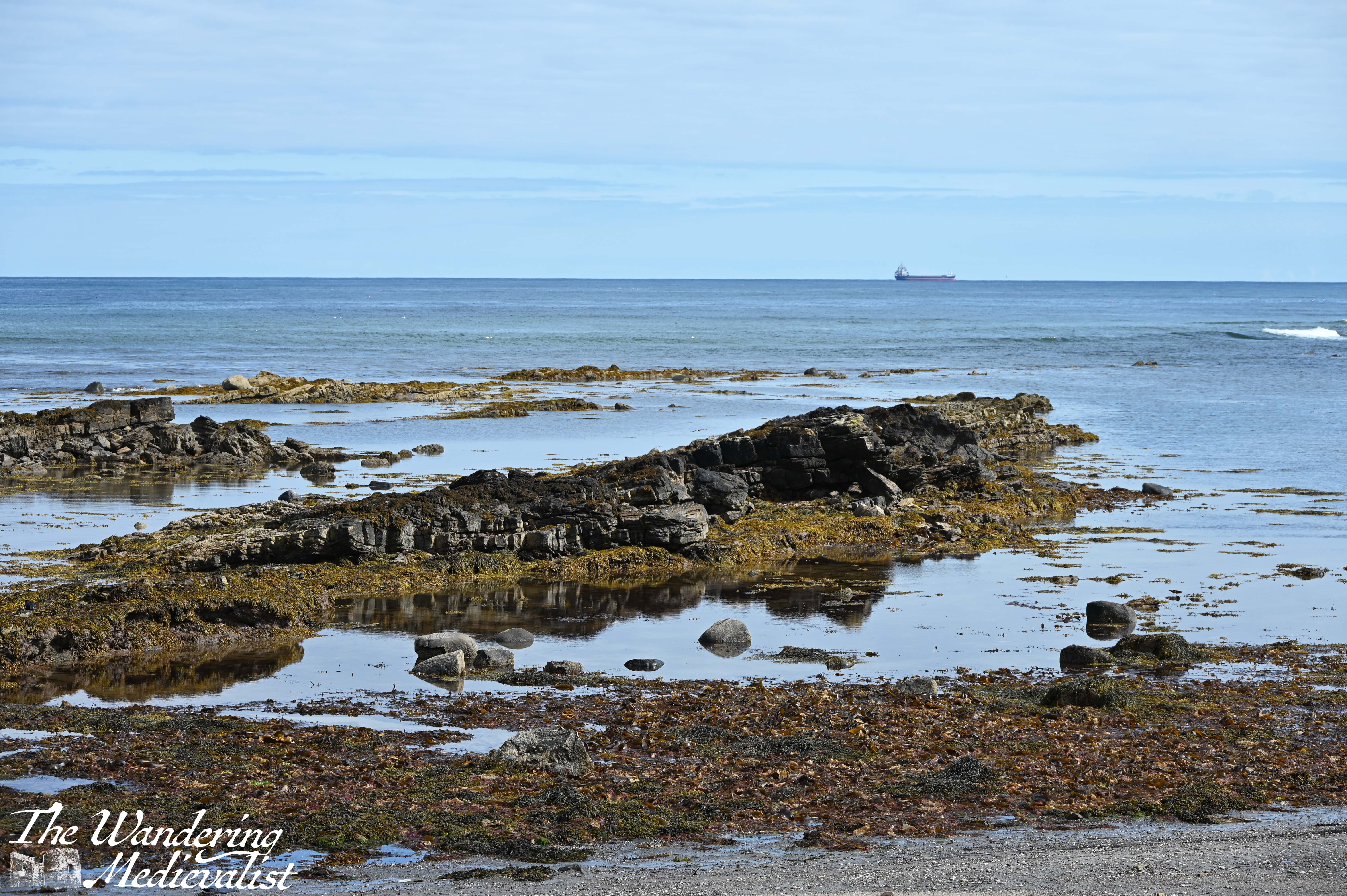
The harbour was used for fishing, as well as for shipping stone from nearby Craighead quarry – some of this fine stone was used to repair St Andrews Cathedral in the 1450s. The long lines of sharp rocks stretching into the waves make it clear why this point of Fife could be treacherous for boats; I was walking at about mid-tide, but the rocks clearly went much further under the waves.
There is also a great example of a Scottish seaside cottage, well-kept of course with a small garden. I wasn’t really sure that I was going the right way here, but there was really no other obvious route, so as before I just kept walking.
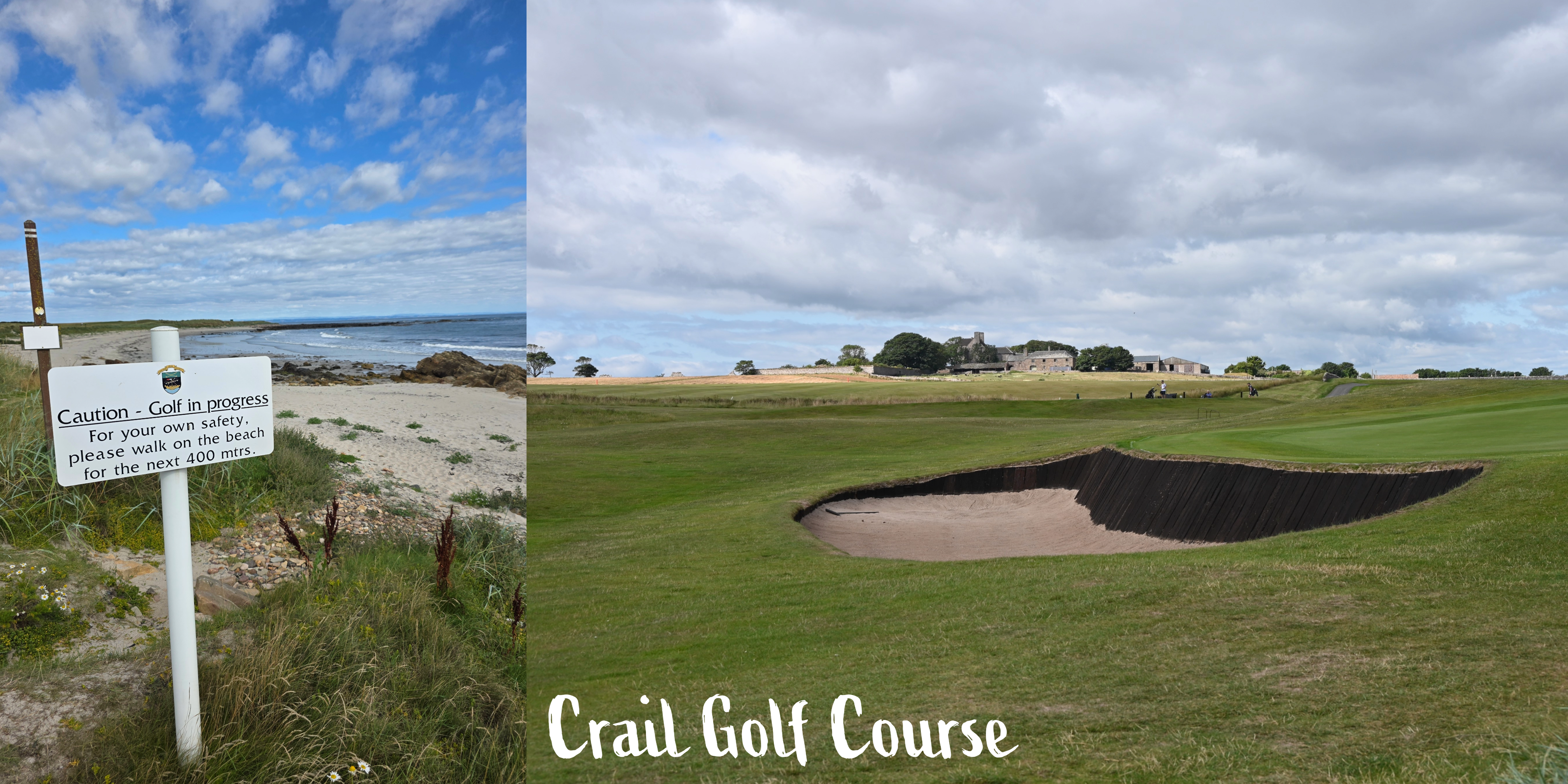
The paved road soon looked as though it would be heading directly for Crail Golf Club, but sure enough as I reached the edge of the green, the Coastal Path signs returned and I headed off to the right on a path that ran along the edge of the green.
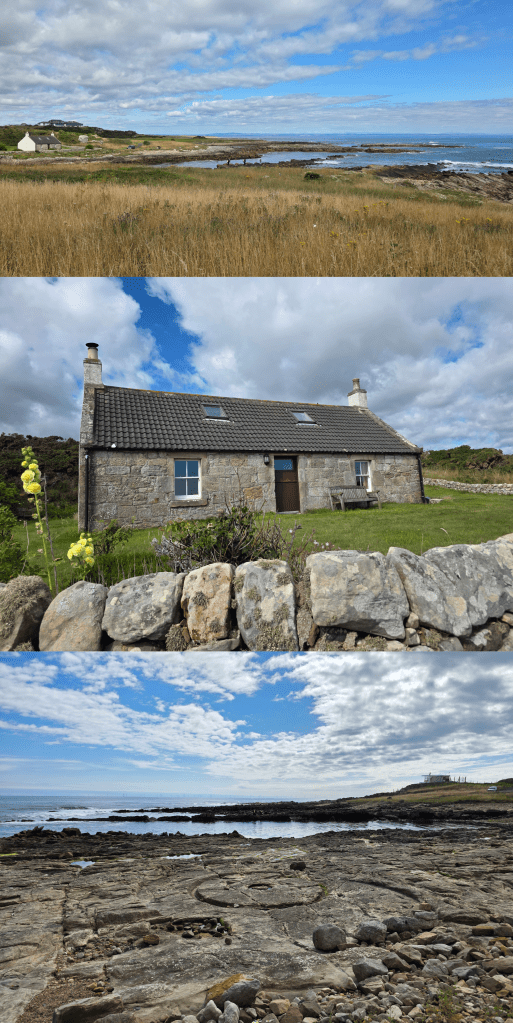
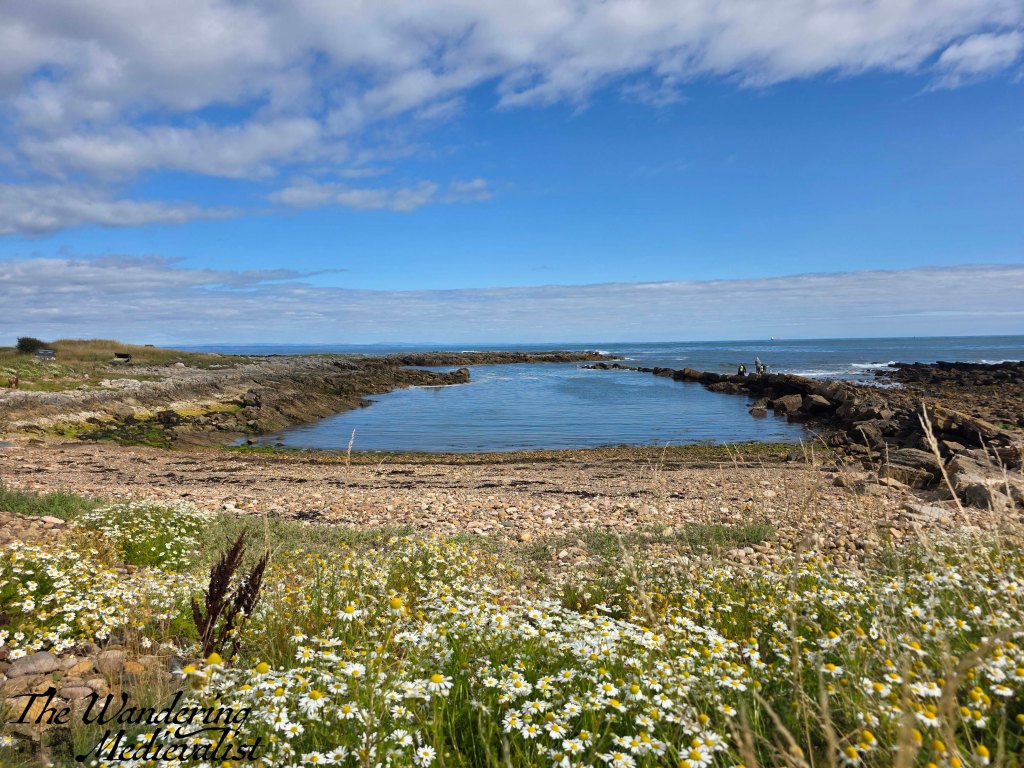
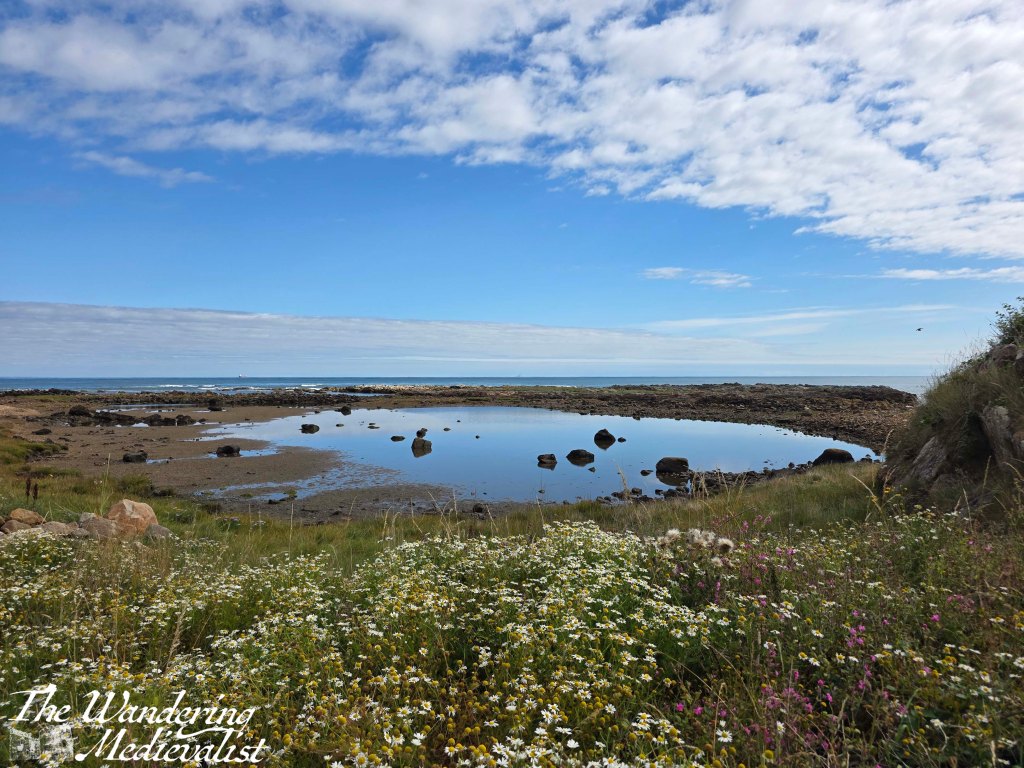
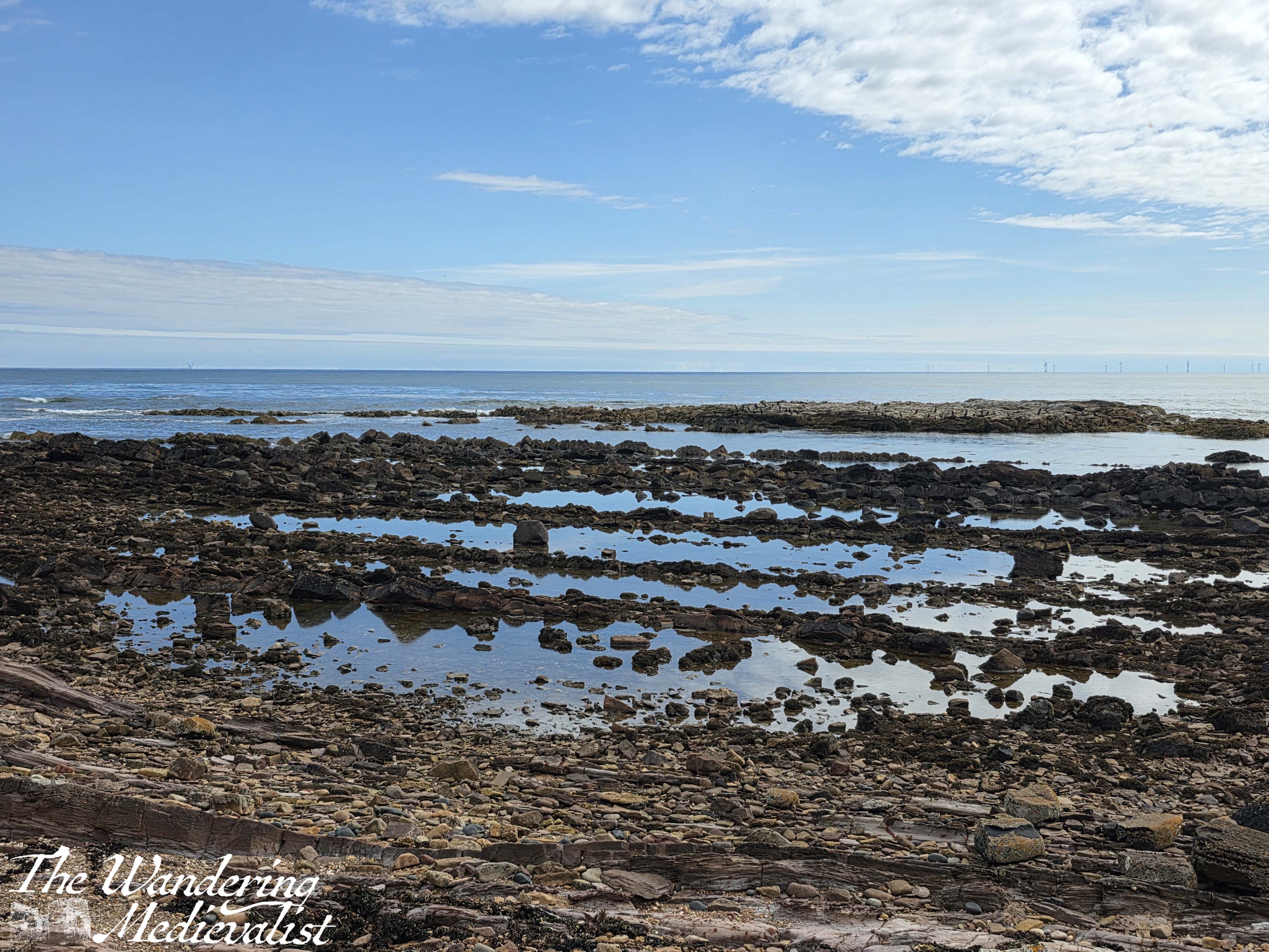
This is a really beautiful stretch, particularly in the sun as it was when I walked, with the ocean and multitude of wild flowers. It is hard not to be fascinated by the layers of stone and the pools of water between them, glistening in the sun. There are a few signs on poster boards for adult geology classes, and it is easy to see why this would be a good spot. The layers of stone and water erosion are very evident.
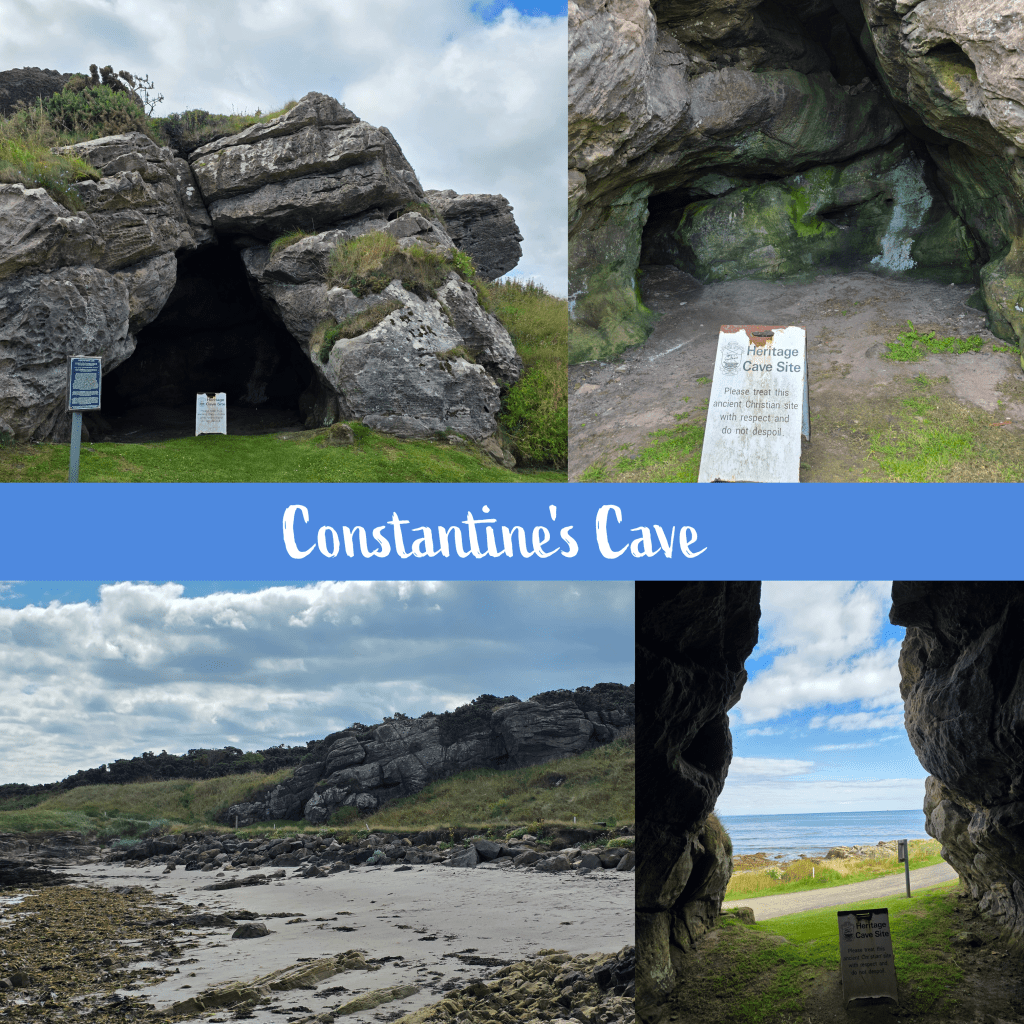
From here the path hugs the edge of the golf course, at times moving up to the walkways designed for golfers, but only for a short while. I stumbled across Constantine’s Cave quite by surprise, absolutely not expecting it to be in the middle of the golf course. Interestingly, the other half and I had planned to walk to the cave some years ago, joining the trail near the airfield, but gave up due to my rolling my ankle (see above). I’m quite pleased in the end that we didn’t go the whole way, as compared to the Caiplie Caves this one is a bit less dramatic.
While visually not as impressive, the cave does have an interesting history; excavation work has shown evidence of a stone wall across the entrance, protecting the interior space, and the earliest occupation layer was pre-Roman. The cave’s name comes from the local tradition that King Constantine III of Alba (903-943) was killed in a battle near the cave.
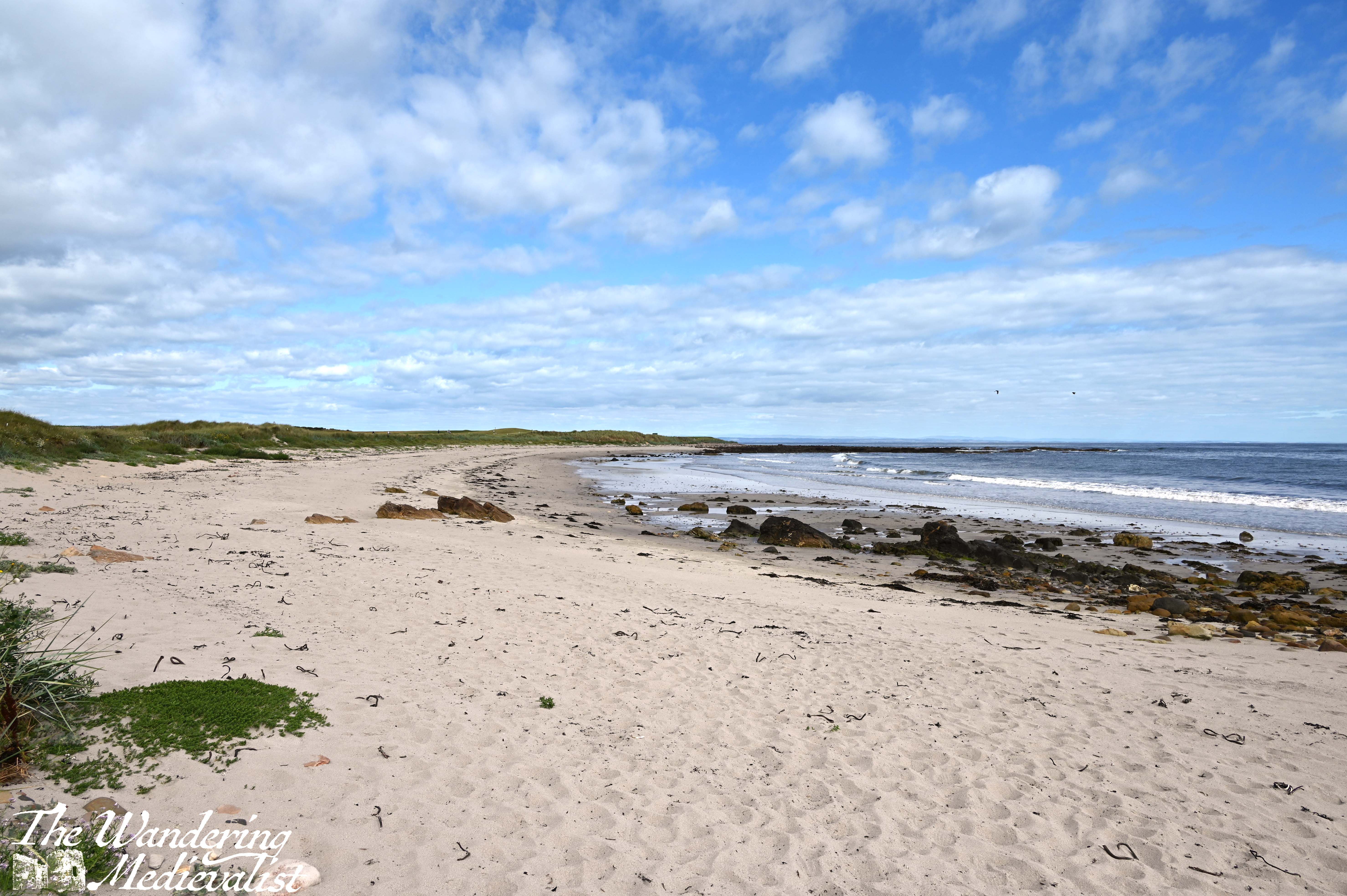
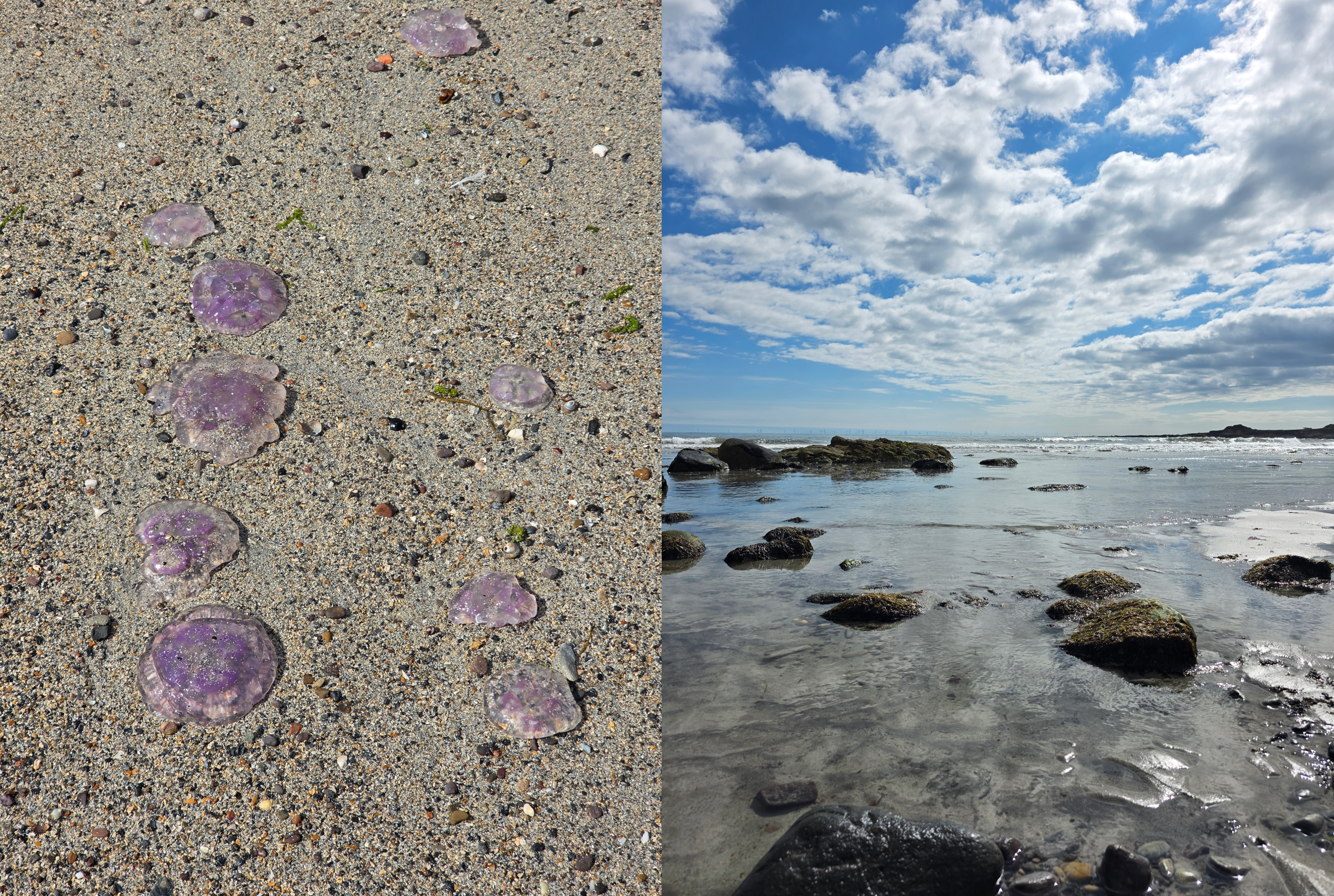
Not far beyond, walkers are directed to move down to the beautiful sandy beach below, to avoid interfering with the golf play. I was very happy to do so, enjoying my ramble in the sand, though it was somewhat hindered by what must have been hundreds of beached Moon jellyfish along the high waterline. Eventually I chose to move closer to the waves, where I could avoid stepping on them.
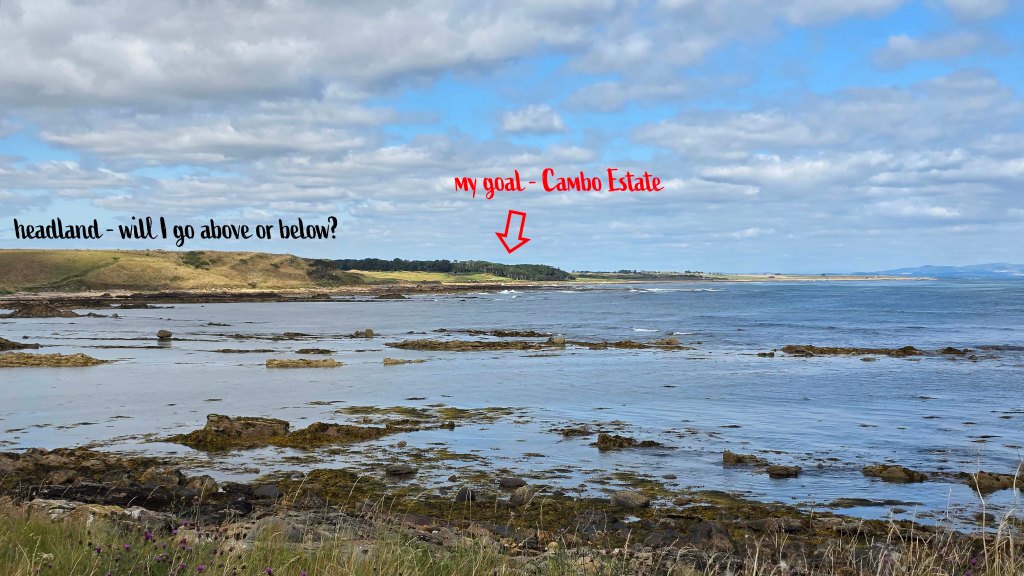
The sandy beach slowly becomes rocky, and the last few metres require some scrambling to return to the upper path, along the golf course. Soon after re-joining the grassy trail, another corner is turned and all at once I could see the tree line of Cambo Estate ahead, though still a distance away. It was a touch intimidating to see the coastline between there and where I stood, including a headland that I was not sure if I would pass over or under.
I should note that the official map of the Fife Coastal Path warns walkers that this section of the trail, between Crail and St Andrews, can be challenging and may not be passable at high tide. While I had neglected to check the tide – not a mistake I will make again – I was lucky to discover it was going out rather than in, so I had plenty of time. Absolutely be more sensible than I if you try this walk, and check well in advance – there are plenty of websites and apps available.
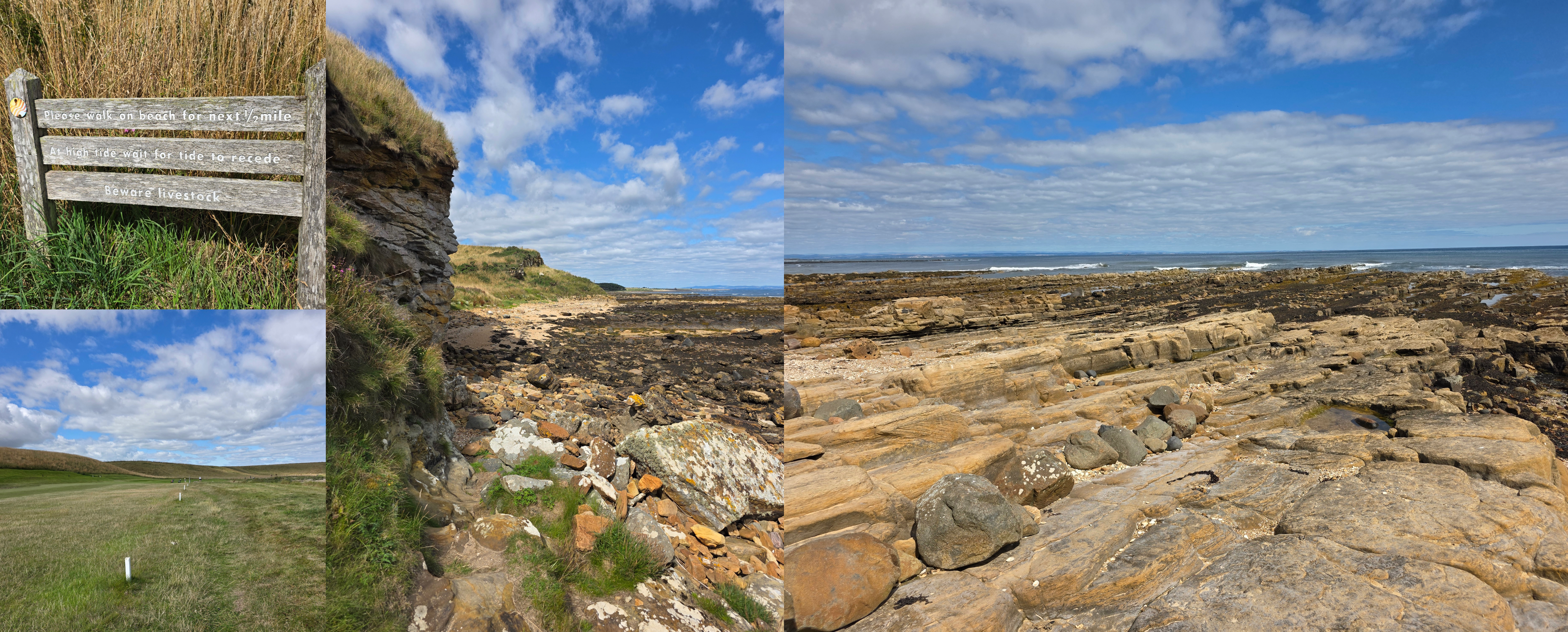
From here to the edge of Crail Golf Course, it can be on occasion difficult to tell if you should be on the beach or not. At least once I opted for the beach route, seeing a faint trail from other hikers, as it was nice to have a bit of variety. I was so fortunate to be walking on such a gorgeous day, and at a time of year when daisies and other wild flowers are everywhere. (I do not know names – must educate myself on wild flowers). There is a series of small white posts in the grass that seems to separate the well-manicured golf course from the trail, but those are not always clear.
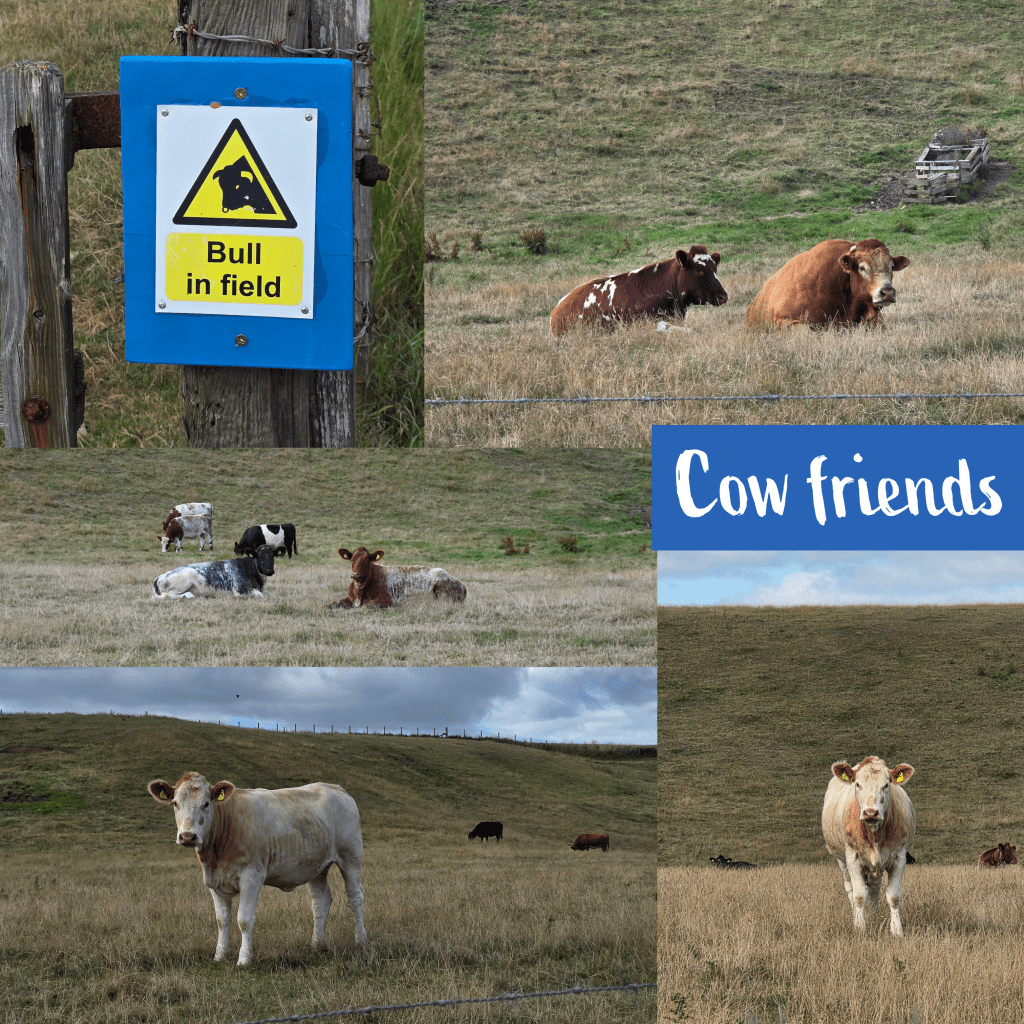
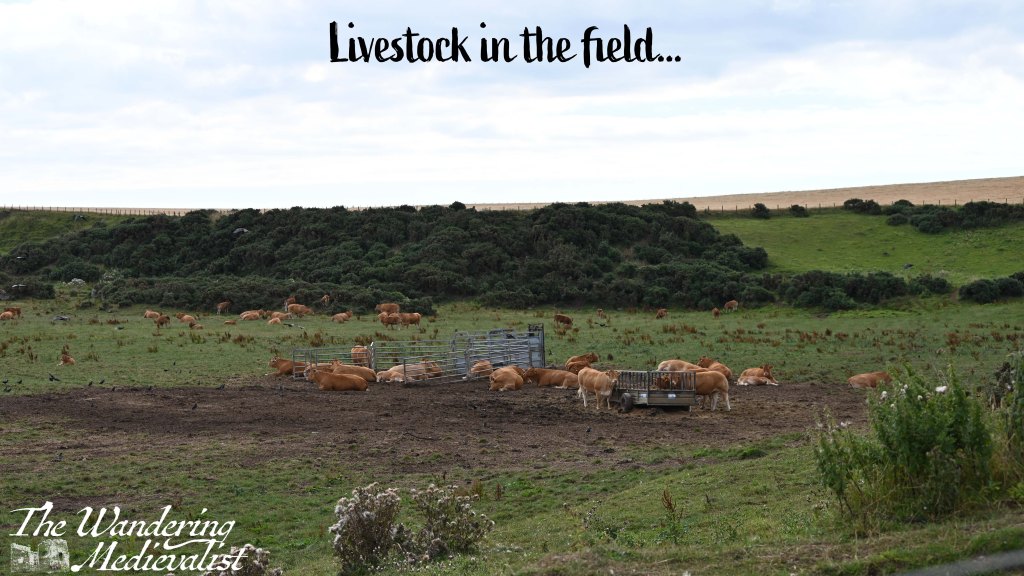
Eventually, after about 1.3 miles of edging along the golf course – with frequent reminders that golf is being played and you should be aware, and listen out for ‘fore’! – the course ends and there is a different kind of hazard, albeit short-term. The field of livestock was relatively calm, with one or two getting up as I passed. The white cow did keep a close eye on me, but never actually moved, just watched carefully that I would not be a problem.
At the far edge of the livestock pasture, the path leads steeply up hill – the headland I could see from a distance – then almost immediately back down again. There may have been an option to scramble along the beach here, rather than going up and down, but there was a great view at the top so worth the extra push. This may also be the only option at high tide.
Once down at beach level, the path cuts in front of a large cliff, onto the beach. There is a warning sign here to stay on the beach to avoid the fields of livestock, which are clearly open to the beach.
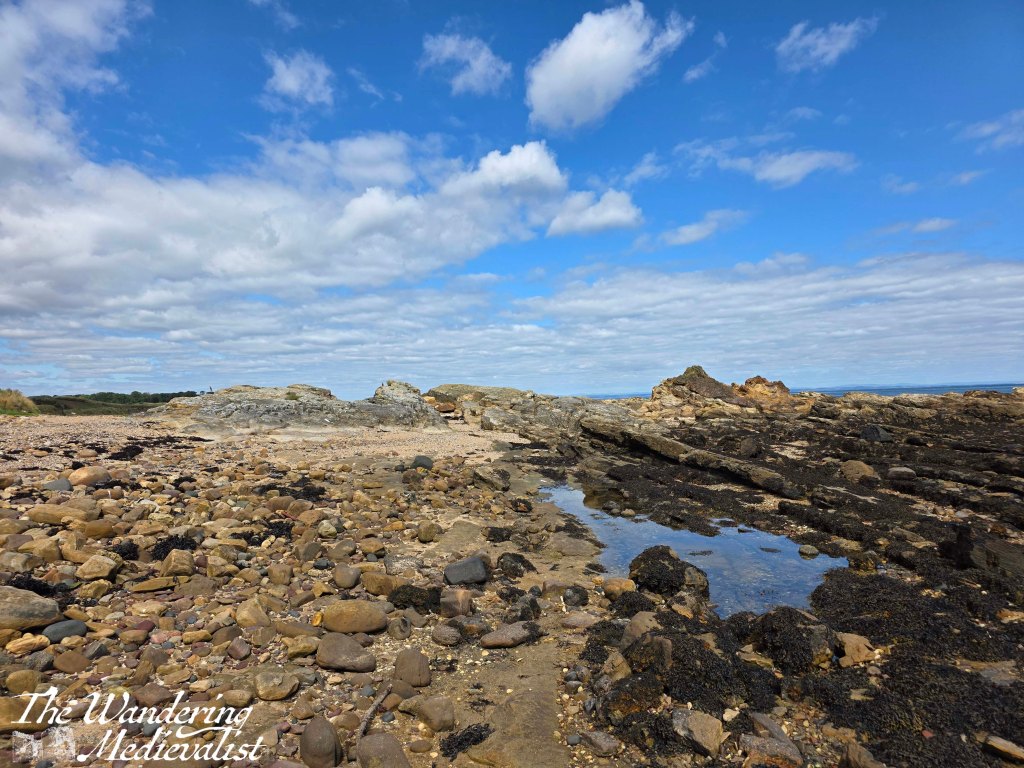
At first, the beach is not too difficult to manage, a combination of sandy and rocky but mostly rocky. I could see it as definitely being slippery if wet or if the tide had recently receded. As someone who grew up playing on beaches like this, I really enjoyed this section, especially with the view off to the right. The most challenging parts were soft sand and dodging the cow pats that were evidence of the open boundary between beach and meadow.
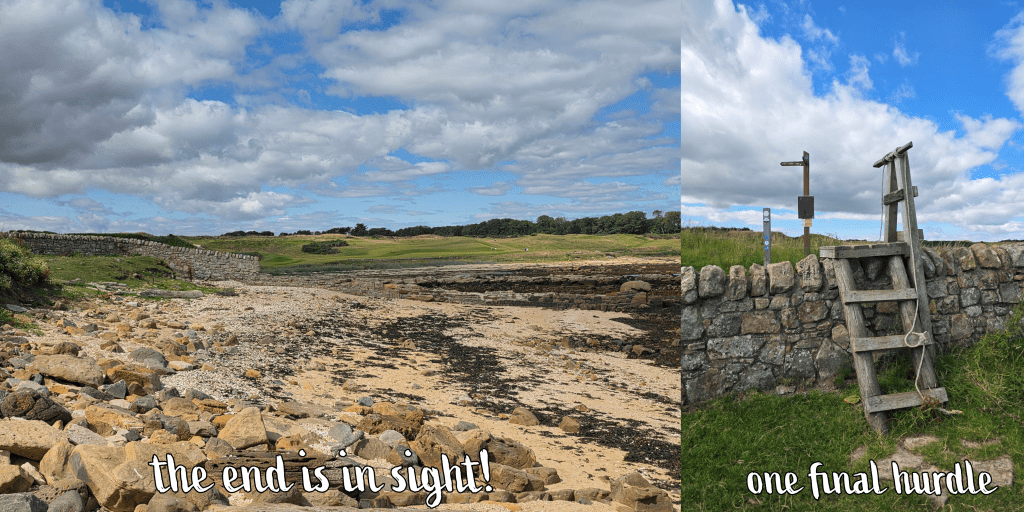
As I plodded along the beach, though, I realised that I was starting to run a bit short on time. It’s always a touch frustrating on a trip like this when your public travel options are limited, and you find yourself racing the clock. The farther I went, the rougher the terrain became, with rocks that were too small to completely stand on, but too large to step between, requiring a lot of attention and energy, slip sliding along. Progress slowed, and I was running low on energy. Finally, I caught sight of a stone wall – this was the end of the beach walk, though I was challenged in the end by a final obstacle – using a rope to haul myself up a wooden ladder to cross the wall.
It was at this point that I realised I needed to add two things to my hiking arsenal: one, a portable power bank, as my phone was beginning to run low (using it for pictures and voice notes) and I needed it for my return bus ticket. Two, an updated map of the coastal path; mine was from 2017, and it has become increasingly evident with each walk that changes have been made since then. While there is an online version, you are often out of range of data on these walks so it quickly becomes obsolete.
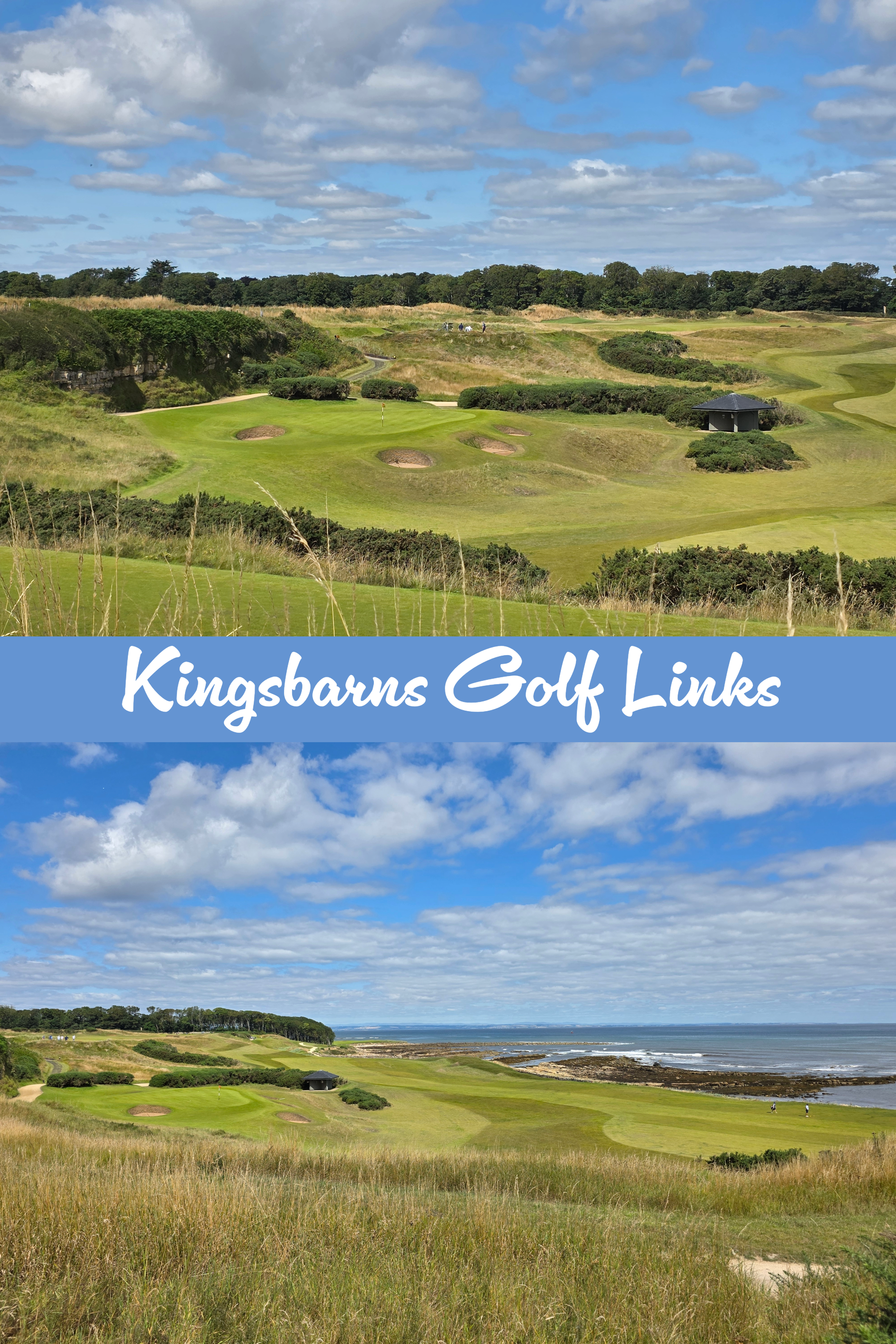
Carrying on past the wall, the path heads up a small hill, offering views of the livestock field on one side, and Kingsbarns Golf Course on the other. It was a busy day for golf with several large groups out, and to my amusement I identified more than a few American accents among them.
I thought that the path stayed by the coast at this point but instead it loops up above the golf course, which caused me a bit of confusion. My last efforts along the beach had driven me beyond the point of questioning, though, so I pushed on, enjoying the view over the course. It was also helpful to see the treeline of the Cambo Estate clearly ahead of me, knowing that was my goal.
The path is a touch unclear here, but I used my instinct and habit at this point to keep to the edge of the golf course – a brief turn left then almost immediately right again, between a few greens. The sun was bright and hot by this time, and up to the left I could see a few old estates including the roof of Kingsbarns Distillery.
The Coastal Path approaches the estate wall and is briefly forced around to the left, curving towards the water, before a small gap in the stone appears. There is a wooden gate and sign for the path – I was quite relieved, as I knew the end was near and I did not want to go all the way back down to the beach.
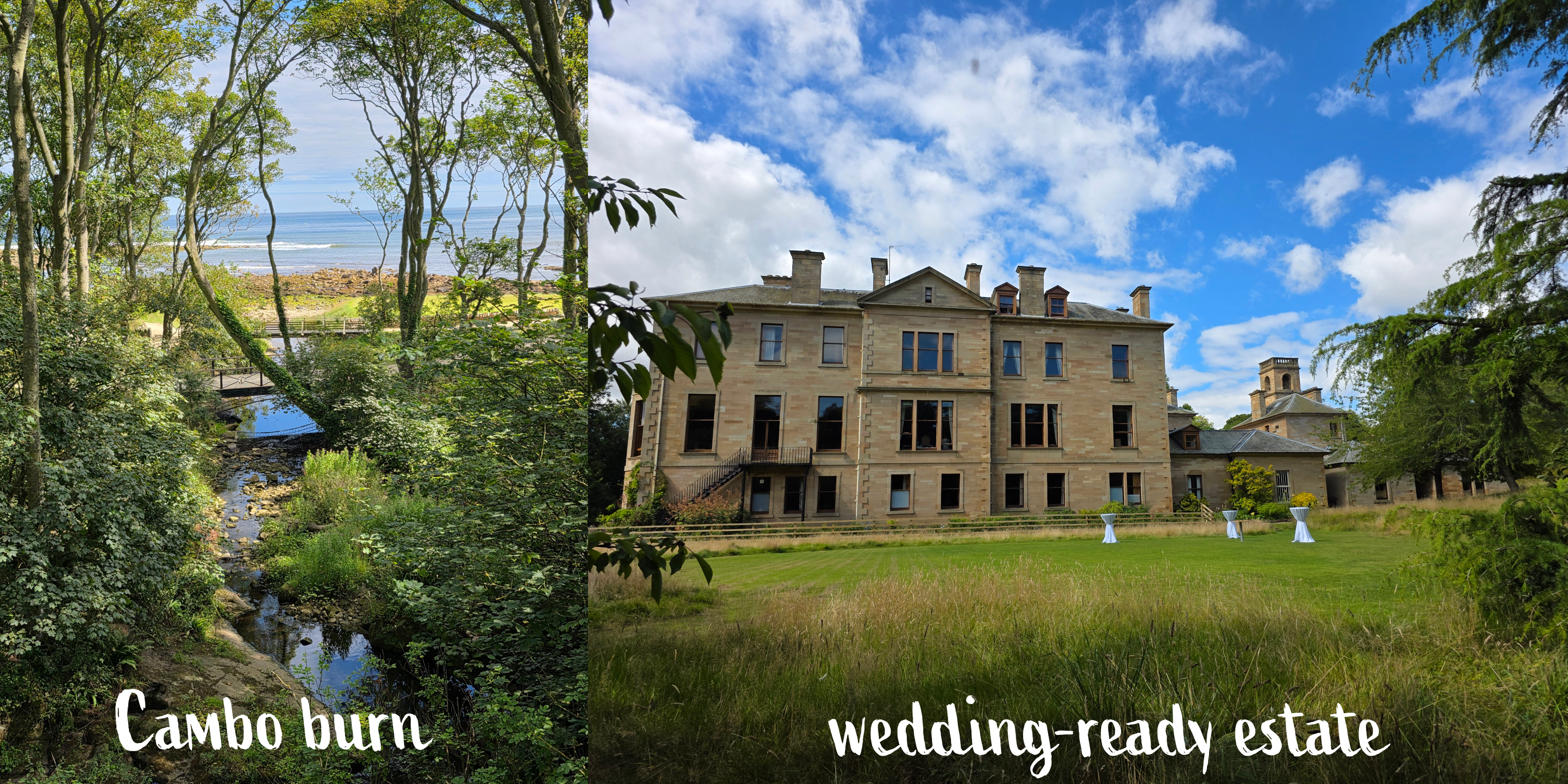
Through the gate, there is an immediate right-hand turn down some wooden stairs, and a view through the trees towards the beach, looking over the Cambo burn.
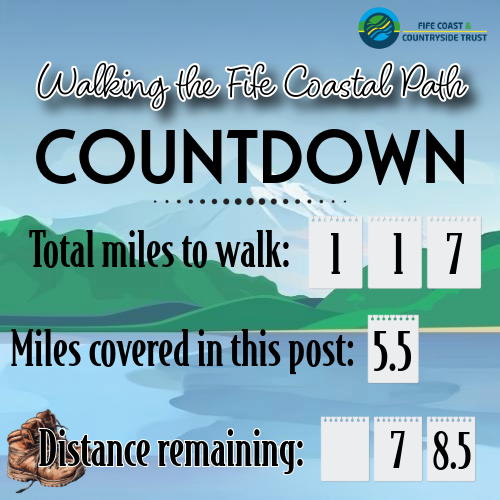
Once you go down the steps, the path sweeps towards the river, and on the other side splits into several directions. One leads down to the coast, one further along towards Kingsbarns, and one up towards the estate house and gardens. This was where I marked the end of my walk – 5.5 miles from where I started in Crail. But, I still had a way to go, walking up through the estate grounds.
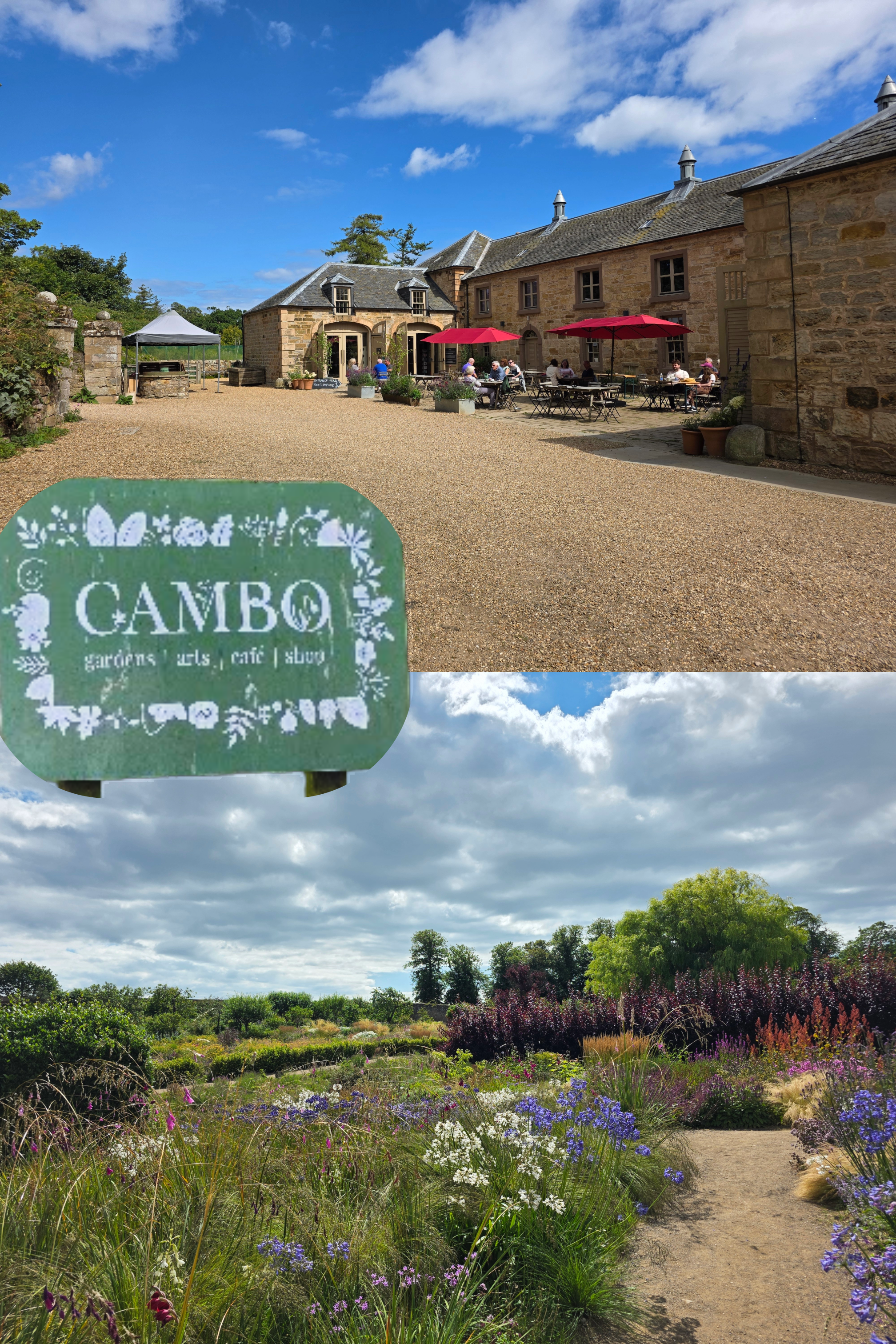
Cambo is a beautiful spot to visit, with a walled garden, excellent café, and plant shop. It is possible to walk up past the walled garden, through the car park, and along a path all the way to the road – for those hoping to make a bus, this is a solid mile. I tried, I really did, but I missed by about 10 minutes, having forgotten just how far it was. Fortunately, the other half took pity upon me and collected me from the bus stop where the only alternative was a 45-minute wait.
I did consider joining the groups of families and couples enjoying their lunch in the sun, but I was hot, sweaty, and a touch bedraggled. Home was the better option. Overall I found this a really pleasant walk, and not as difficult physically as I thought, meaning that my stamina is definitely improving.
I might try it the other way were I to do it again, with the rocky beach the first thing I tackled rather than the last. But I do seem to have developed a pattern of walking counter-clockwise around the edge of Fife, and I am now reluctant to change that. Public transport is possible for this route but a bit tricky, so worth just being aware of the limited options (one bus an hour to Cambo), and of course, check the tides!
Autumn travel approaches, but I hope I will manage at least one more section of the trail before I disappear overseas.
I have to admit to rather dreading this section of the Coastal Path. I have walked it before, and compared to some of the East Neuk stretches, it is busy, noisy, and not as stunning. However, it is required and so I chose to walk it before it got too late into the summer and harvest season. The last time I walked this route, it was August and there were 1 million harvest flies, several tractors stirring up dust, and enough pollen to defeat any anti-histamine.
There are plenty of good points about this section, though: it is fully accessible by public transport, relatively flat, paved, and moderately busy (can be a plus or a minus depending on how you see it).
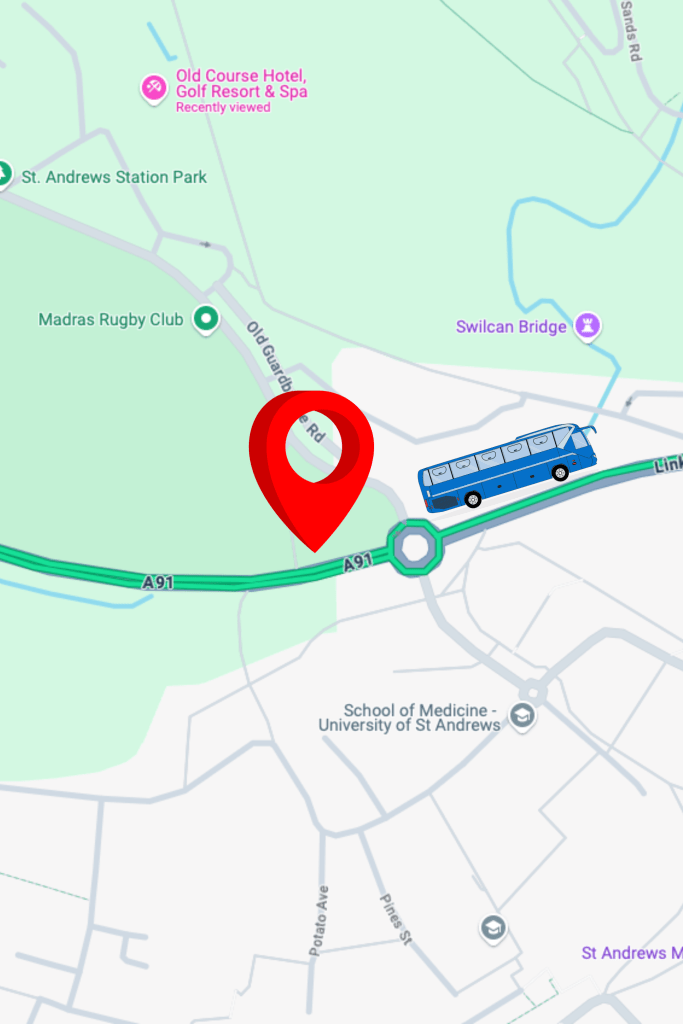
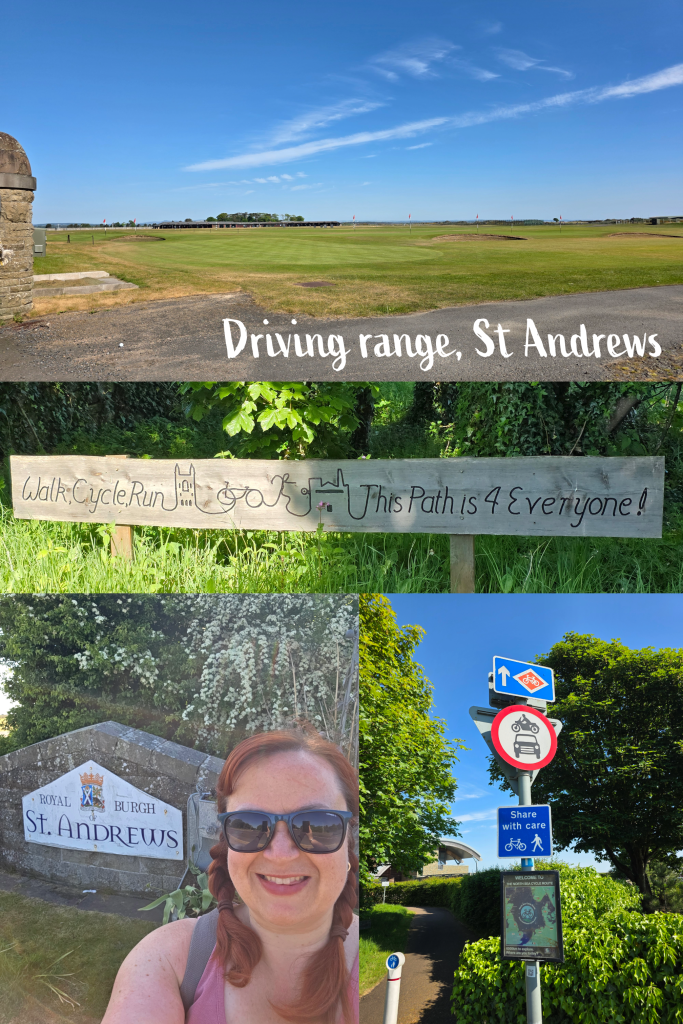
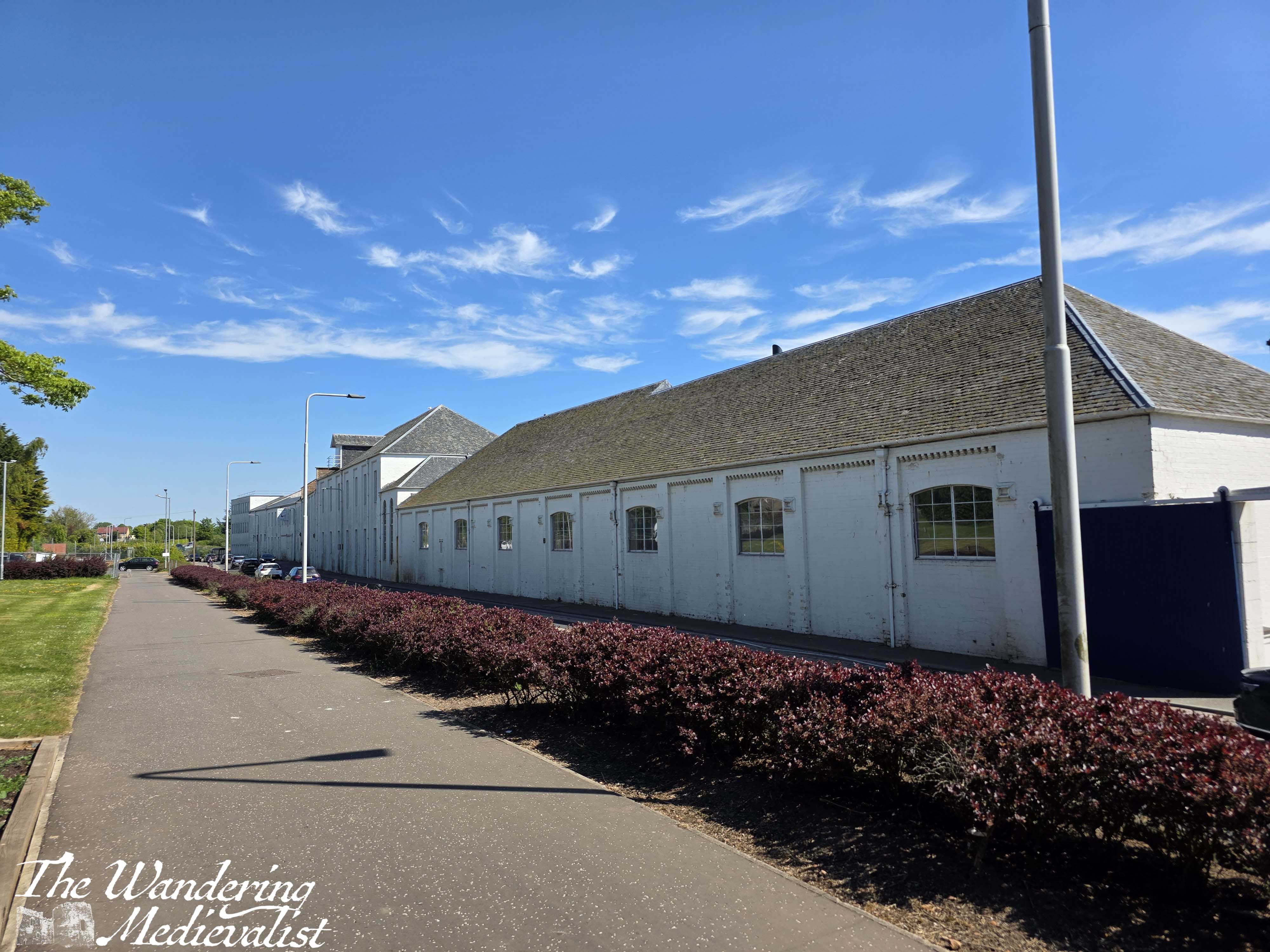
I started this part of my journey by getting off the bus at the Old Course Hotel bus stop, just opposite the Gateway Building. From here you follow the path directly behind the bus stop and very quickly come upon a car park, and your first signs for the Coastal Path.
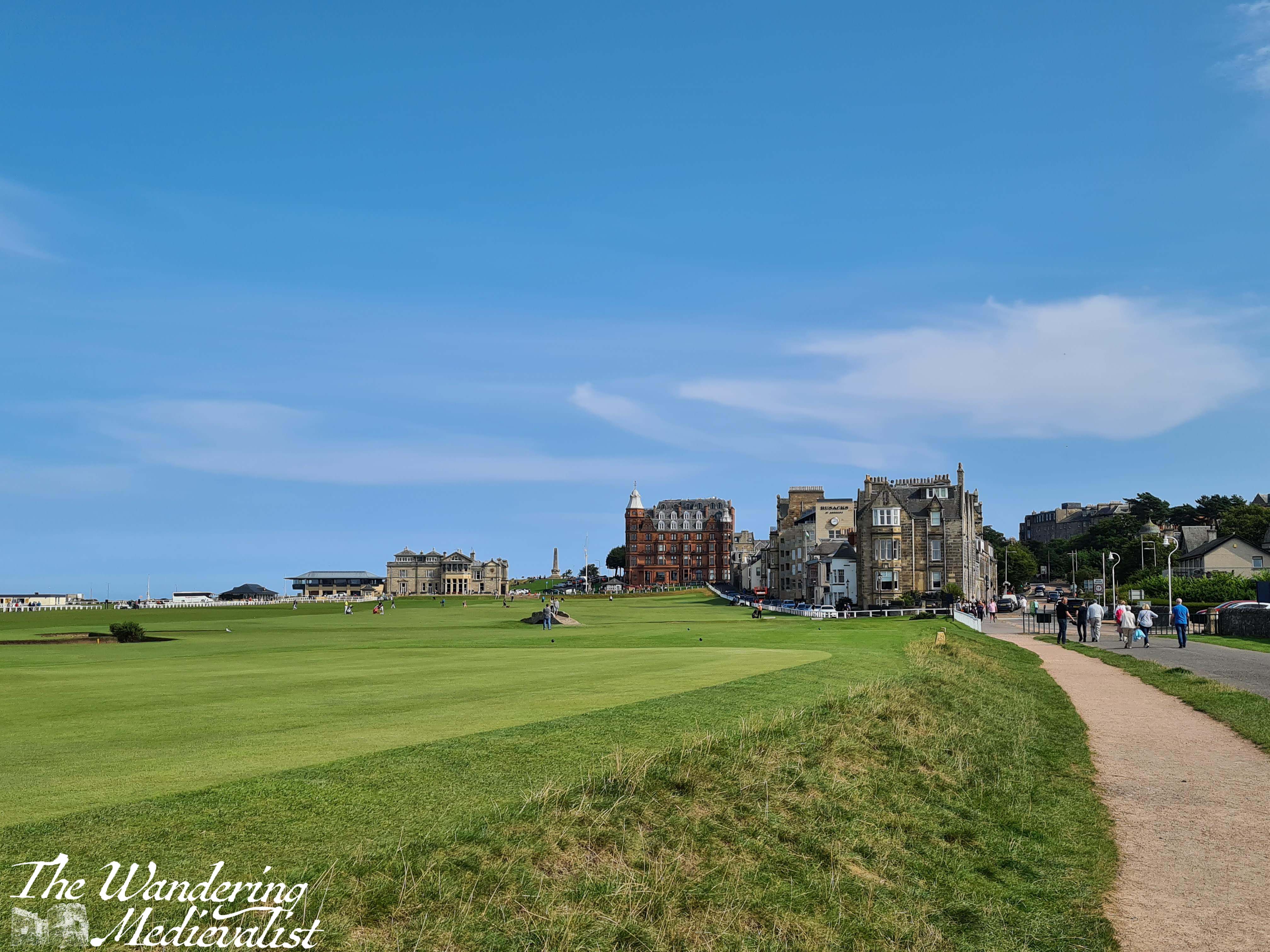
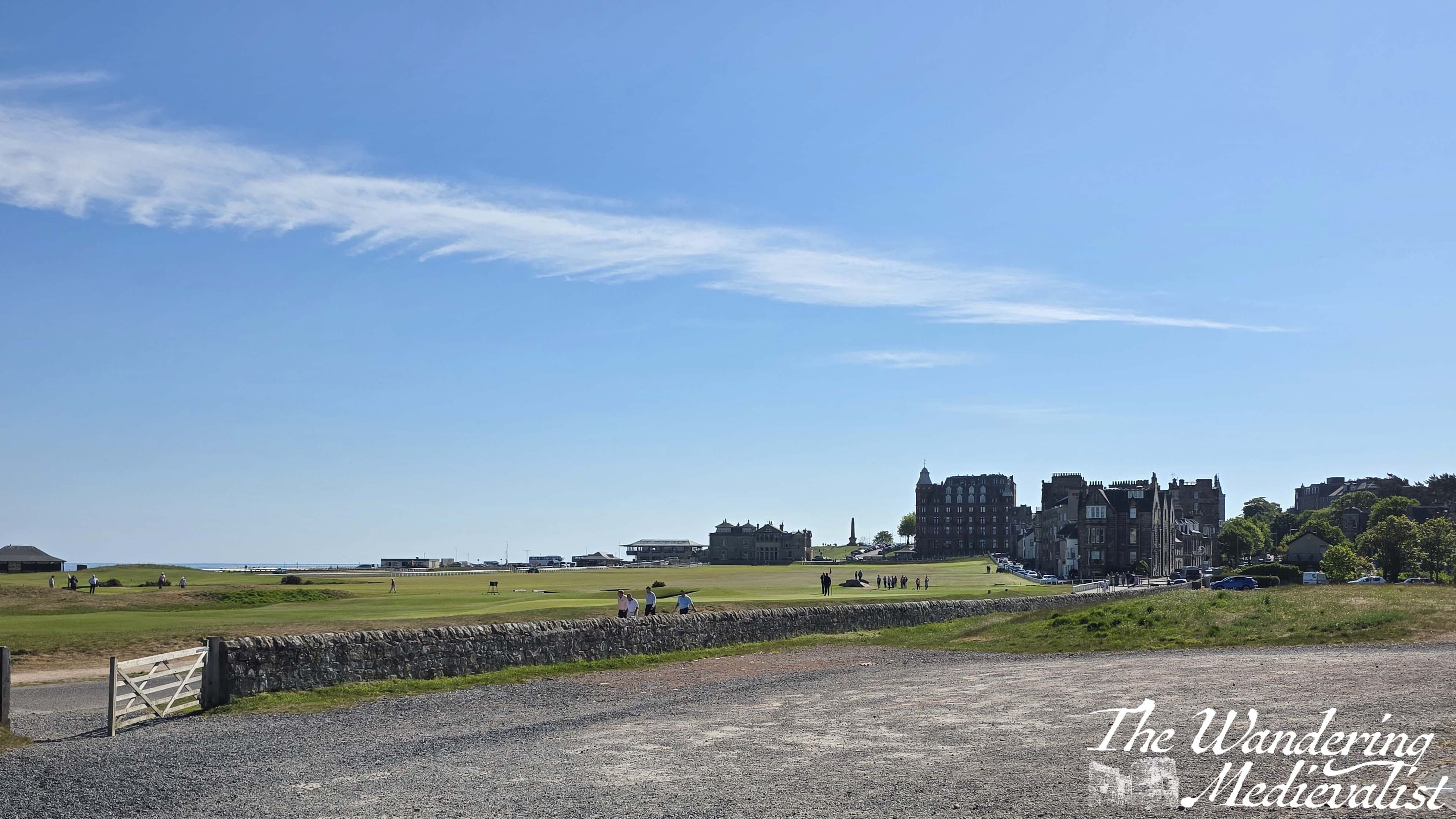
Golf enthusiasts will want to take a short detour here to go closer to the course, which here is the 17th Green of the famous St Andrews Old Course. Views looking back to the Royal and Ancient Golf Club, the 18th Green and the Hamilton Grand are stunning. You can tell that one of these pictures was taken several years ago when we had more rain than we have had this spring….
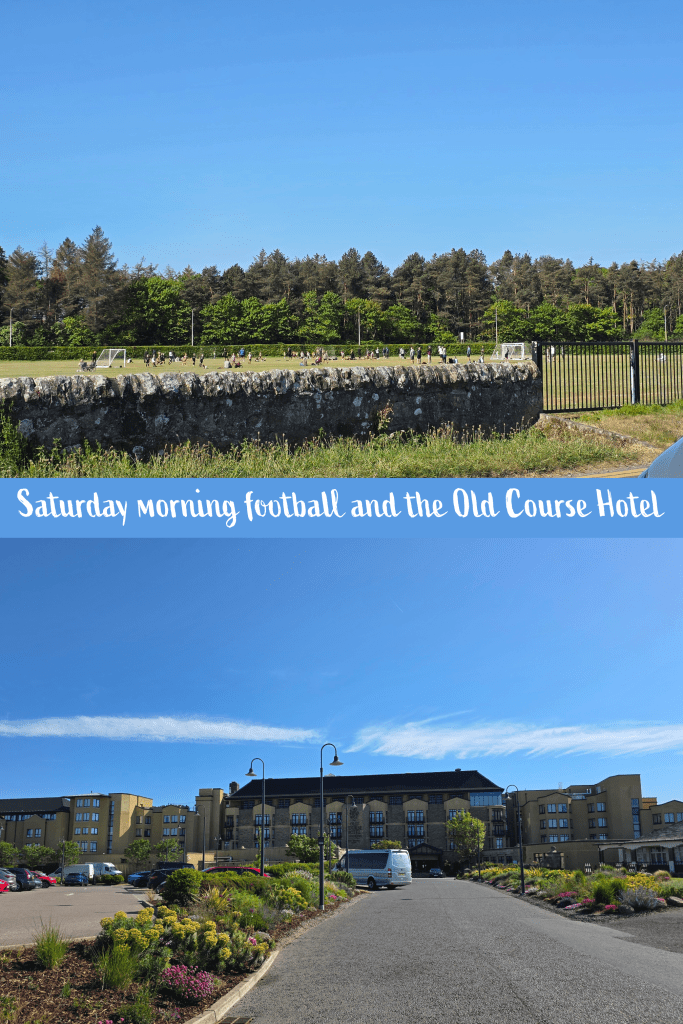
The official route of the coastal path leads here along Station Road to the left. The first buildings passed are the spa and the impressive Old Course Hotel, where most celebrities and famous golfers stay when they visit St Andrews (unless they rent a house of course). The menus are impressive and restaurants are beautiful, and they offer high tea with some of the best views in town, looking over the golf courses and beach.
Beyond the hotel is the driving range, and across the road are a series of sports fields, which on the morning I walked were busy with Saturday football (soccer) games. This stretch of road is always lined with parked vehicles, both parents going to games and the luxury coaches of the golf tour operators. At the far end, the path crosses the road to the driving range, and continues off along to the right.
I took a quick detour to get a picture by the town sign before heading back to the path. The signs here are evidence of just how busy this stretch of path is – cyclists, often in groups, take advantage of the pavement while walkers and runners are regular users. I deviated from my normal no-earphones walking pattern, but I was careful to always look around before moving from one side of the path to the other.
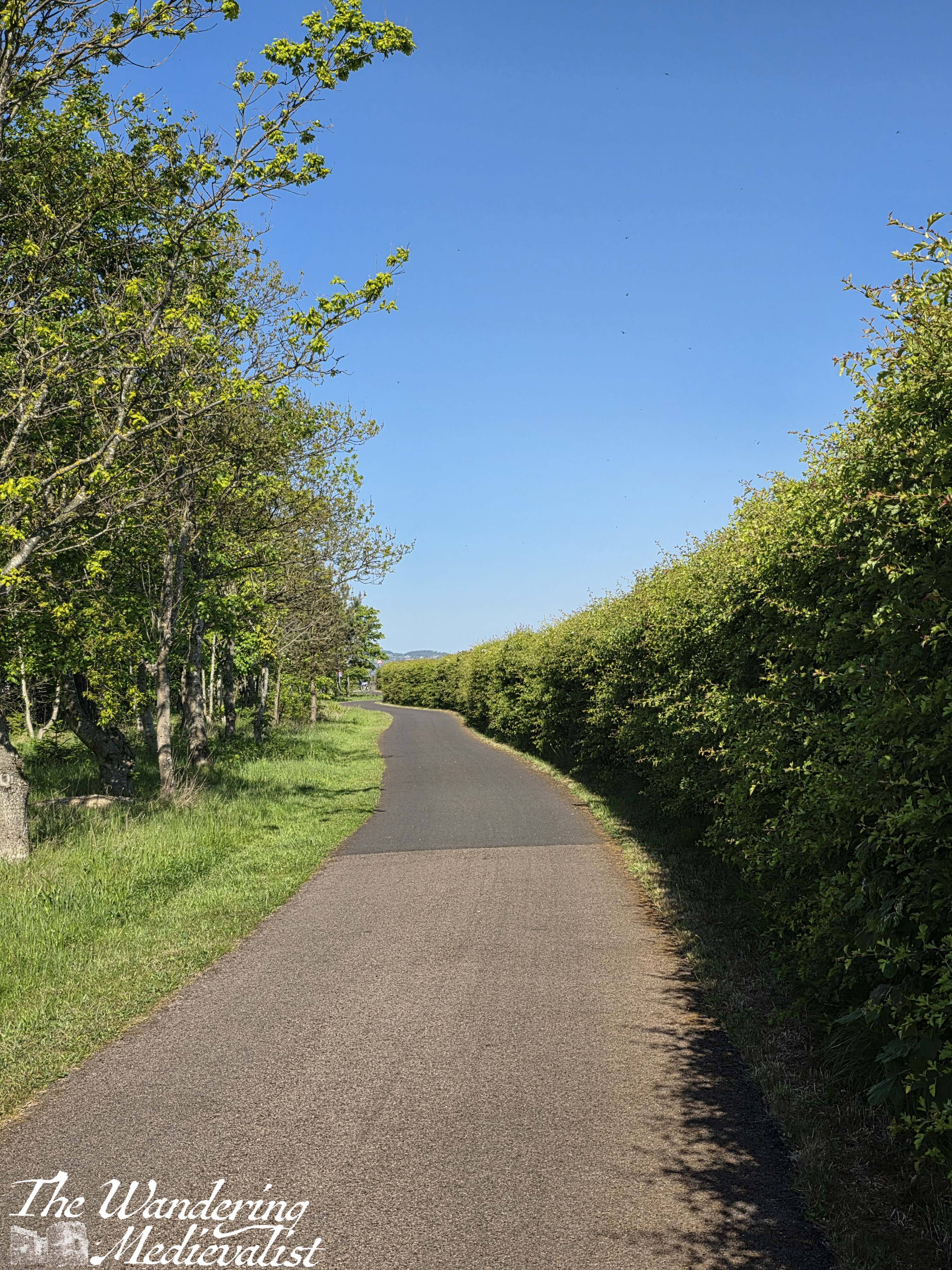
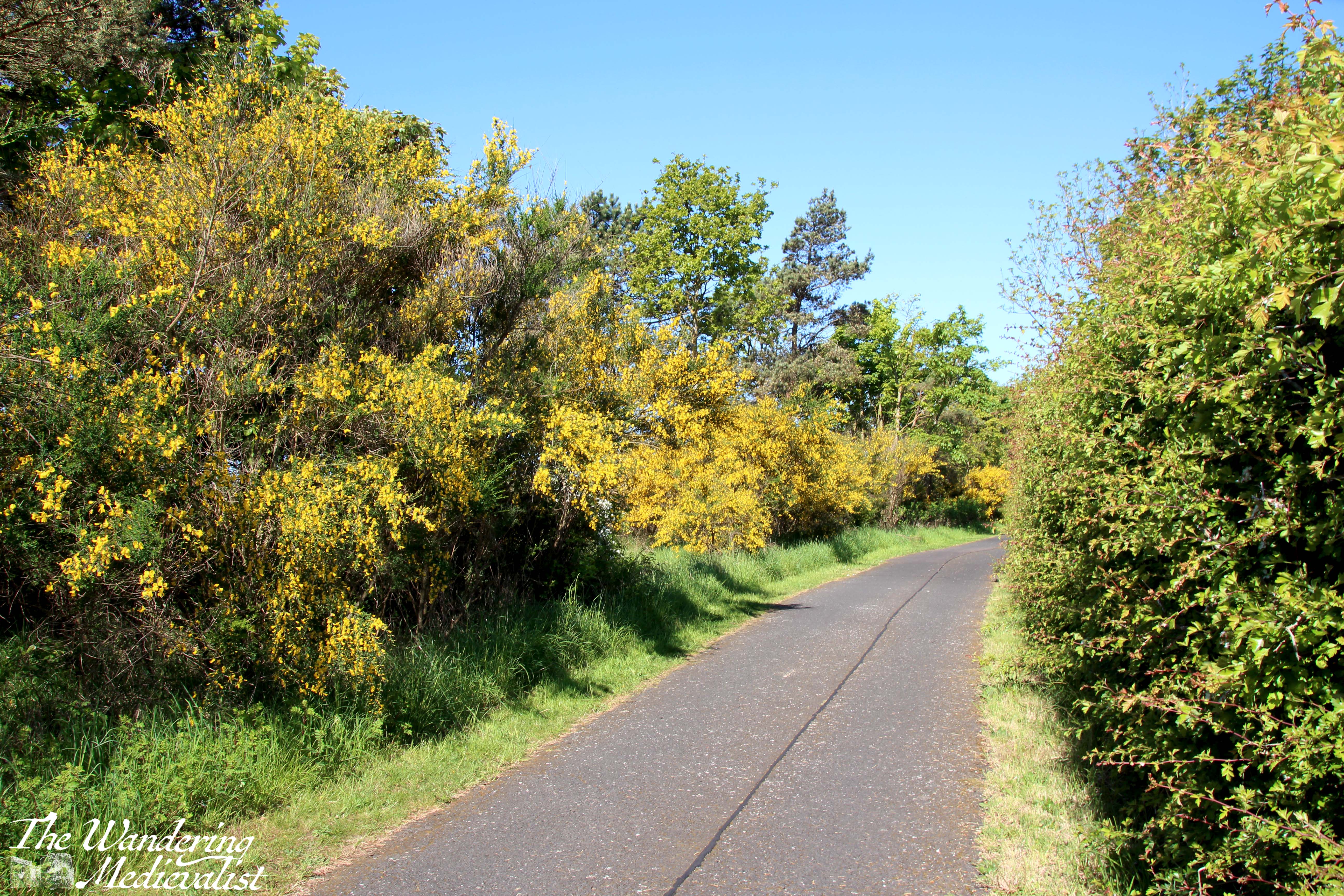
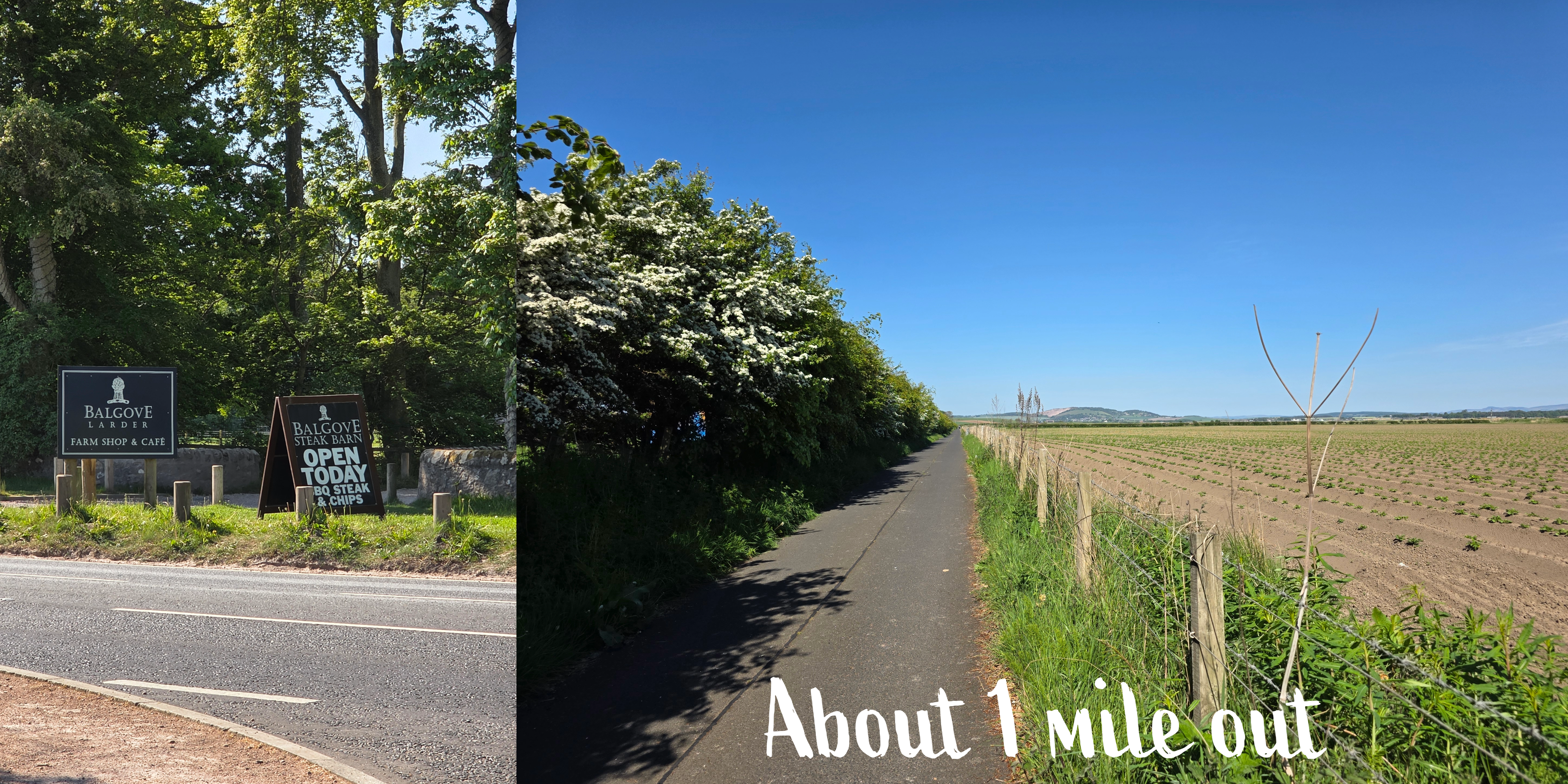
The first mile of this walk is quite pleasant, with trees for shade dotted along and the potential for lovely flowers – some roses, lots of yellow gorse and white flowering bushes. There are several breaks in the foliage for vehicle access, and the first one is very close to Balgove Larder, an upmarket farm shop that sells local produce, bread, cheese, meat, beer and liquor, and much more. It has a great café and a steak barn that is hugely popular.
Along the right-hand side of the path is a large hedgerow, separating the coastal path from the Balgove and Strathtyrum Golf Courses. Periodic breaks in the hedgerow offer good glimpses of the fairways.
Then, about a mile and a quarter outside of town, the golf course abruptly stops, and the right-hand side of the path opens up to wide fields, those I am so eager to avoid later in the year. A hedge on the left continues to separate the coastal path from the busy A91. A short while longer – I confess I forgot to mark how much further, but probably 5-10 minutes walking – and the hedgerow disappears, replaced by only a stone wall separating walkers from the road.
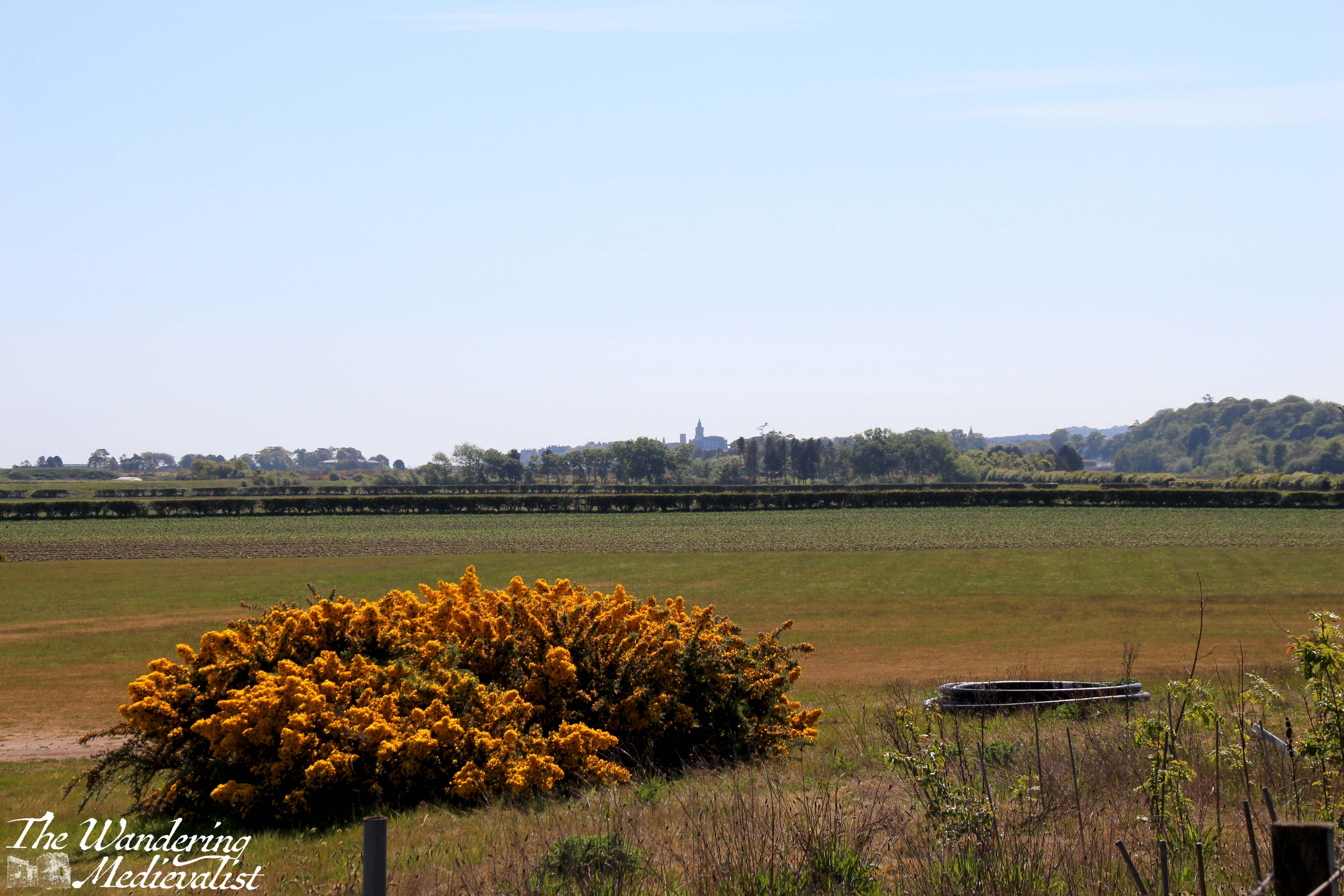
While you can turn to look back at the town at several points along this path, I confess this is the part I like the least. It is very noisy with constant traffic, and there is not a huge amount to see. At the point where you can feel the path rising slightly and curving around to the right, it is a good time to look back at the steeples of St Andrews, just visible over the tree line. When driving, this is an iconic view of town, and one that even now makes me feel, just a touch, as though I am coming home.
Then, about three miles from St Andrews, the stone wall separating the pavement from the road ends, and the Coastal Path becomes essentially what in the US we would refer to as a sidewalk, running along the road. The traffic on this road should be explained briefly in that this is the primary route into St Andrews from the north (Dundee), as well as traffic coming from further west in Fife, Edinburgh, Glasgow, etc. Busses run along this road to Leuchars station every ten minutes, plus large coaches going to the bigger cities, tourist coaches, and plenty of commuter traffic. When something stops traffic on this road, it takes very little time to build up for miles in all directions, bringing movement even in St Andrews town centre to a halt.
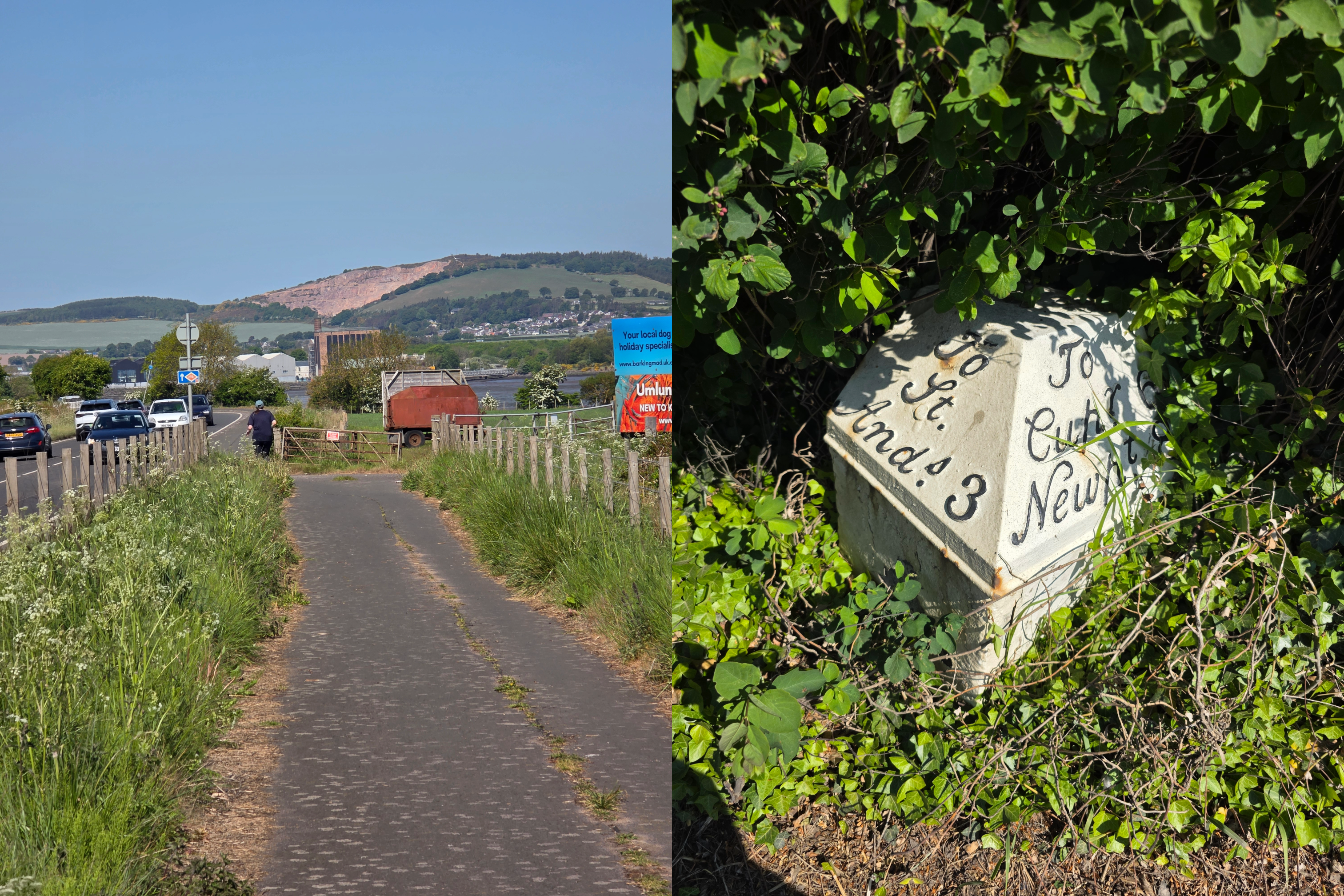
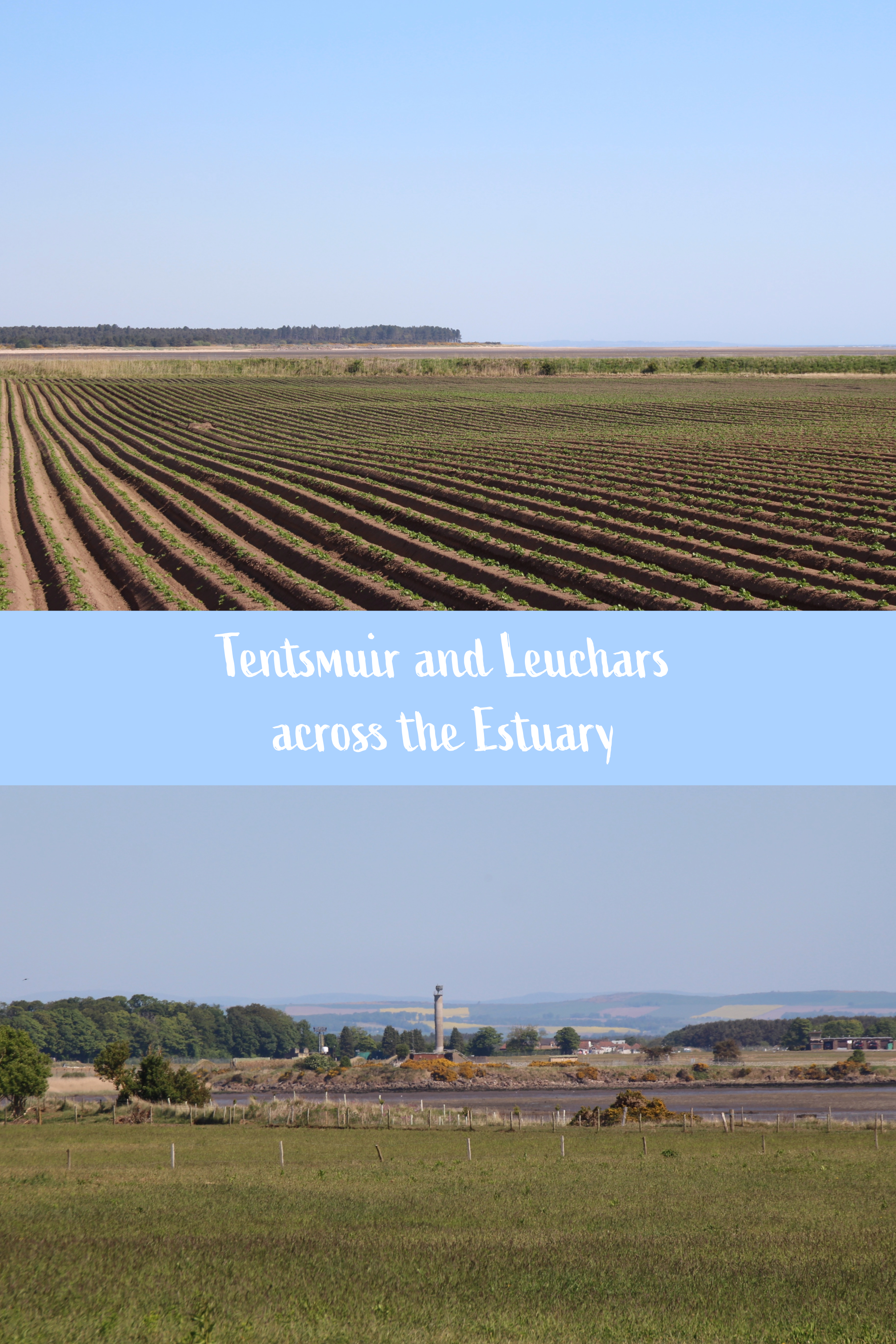
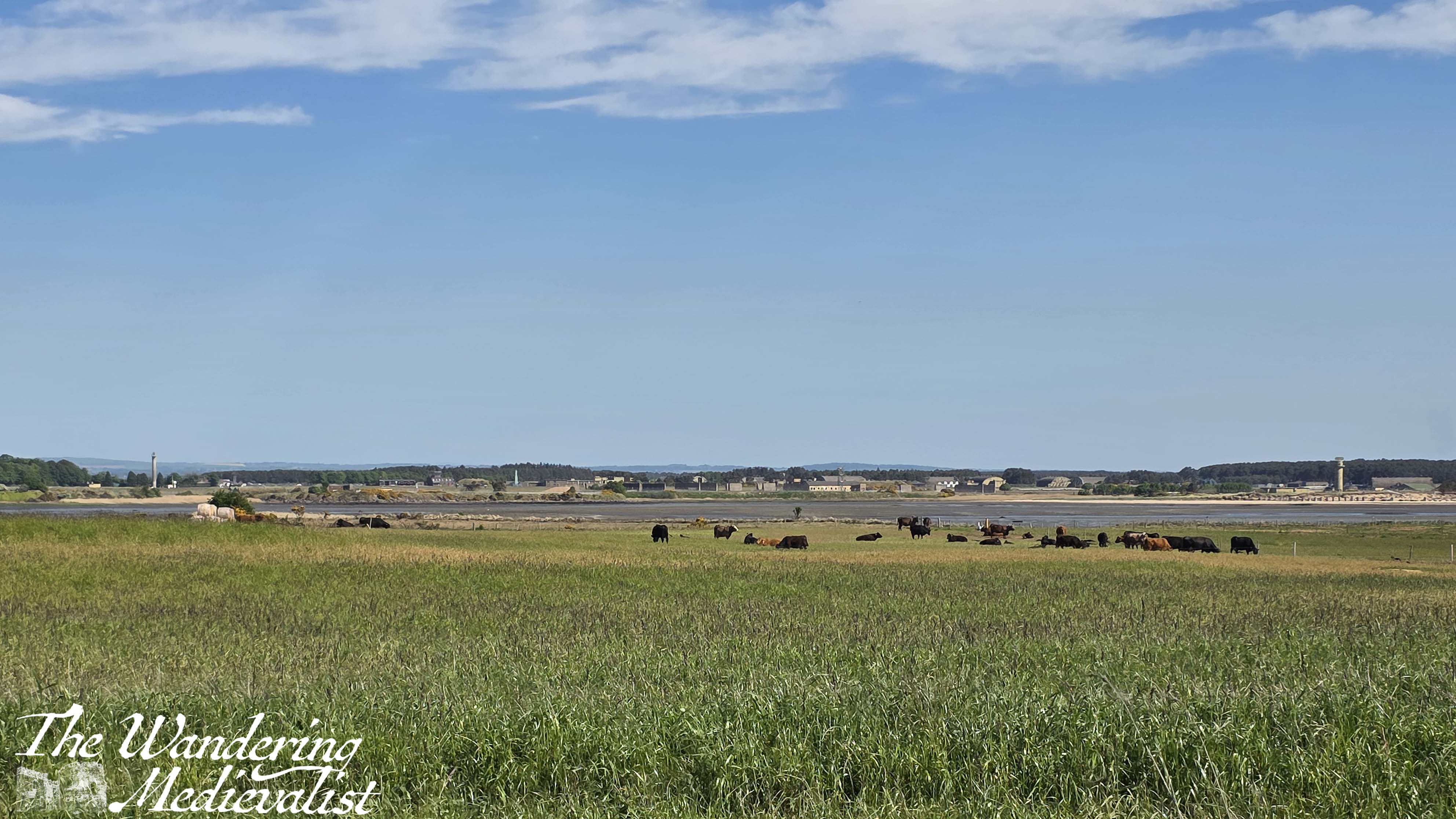
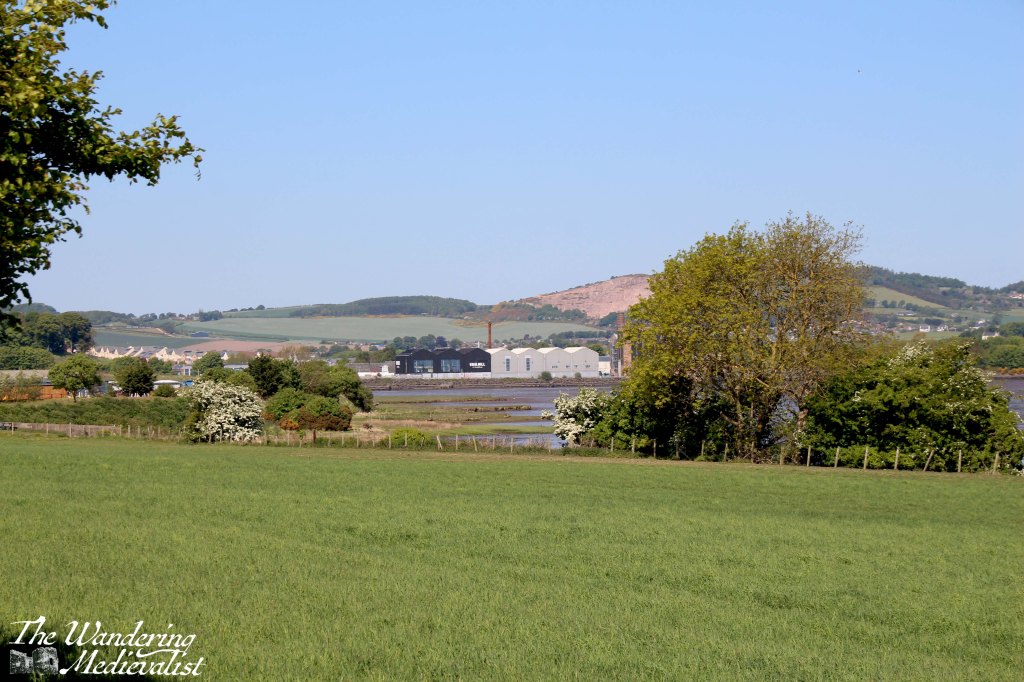
This is also where the view across the fields becomes a bit more interesting, as you can see to Tentsmuir forest and get a good feel for just how big Leuchars Air Base is. Just past the turn-off for Kincaple, you can also start to get a good view straight ahead, with the distant Guardbridge mill buildings just visible, and the lump of Balmullo Law against the horizon. The Law stands out from any other hill by the obvious scar of the Balmullo quarry, a stark brown against the sky.
The path is quite narrow at a few points here, and you have to hope you don’t meet any cyclists, but as the road curves again towards Guardbridge, fields open up to the right along the estuary, along with a few groupings of houses. The hedgerow to the right has a few gaps to allow views across to the mill buildings, now run by Eden Mill, a local distillery.
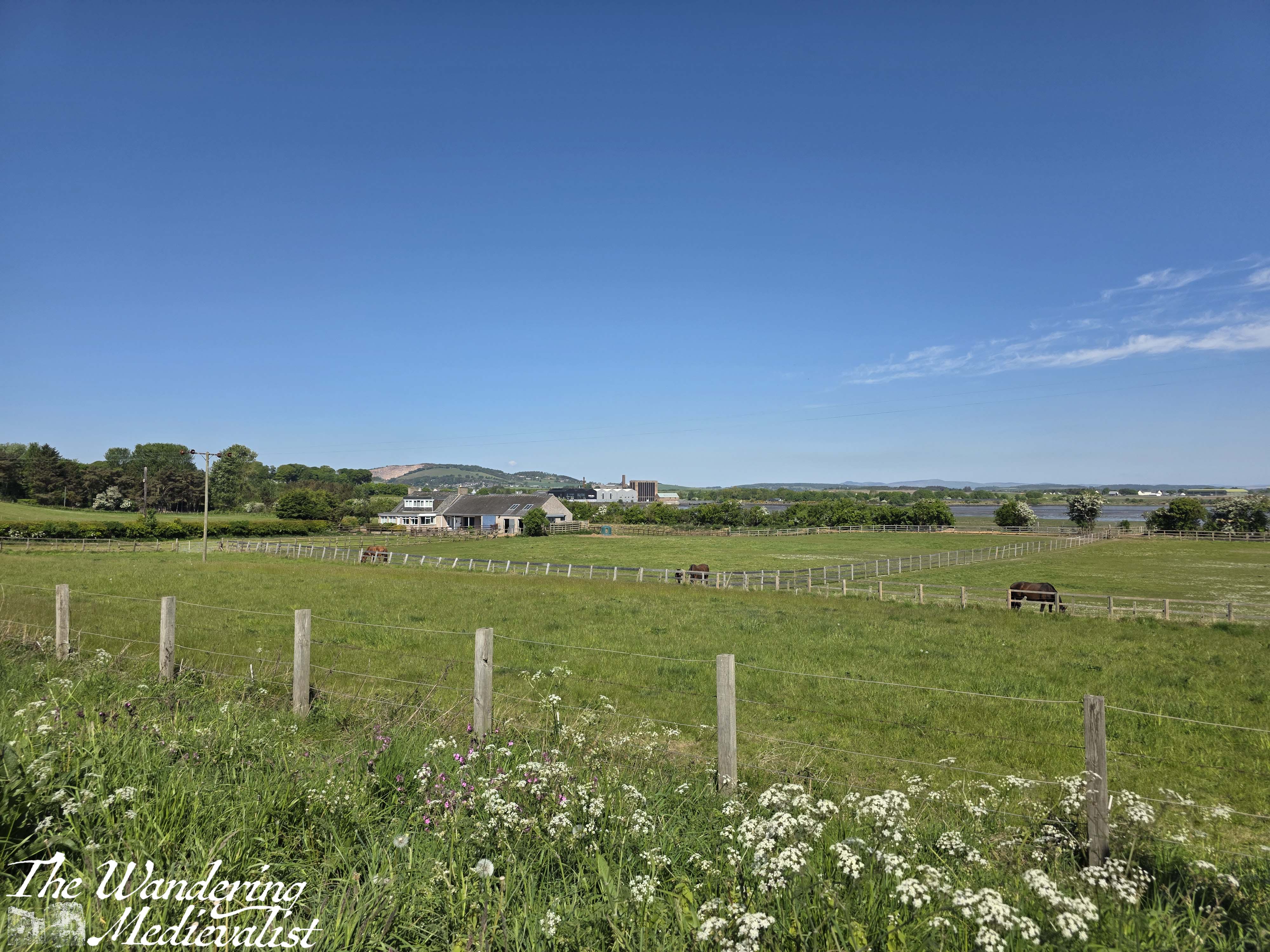
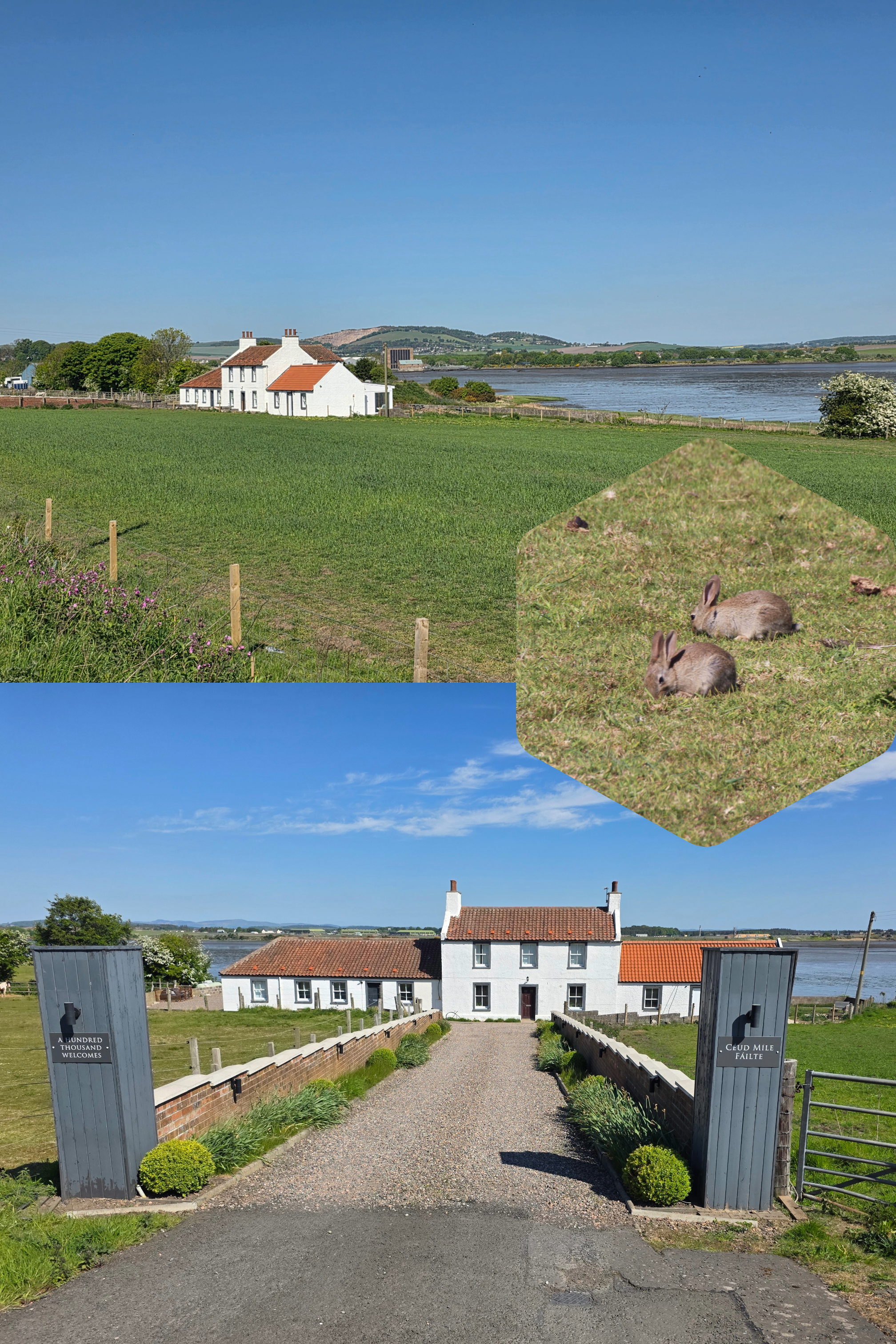
As you approach the village limits, the hedge also vanishes and the path to widens a bit. You will note a beautifully-kept white guest house surrounded by fields in which horses frolic away (and also the occasional bold rabbit).
You know you are getting close when you pass Fast’n’Fresh across the road, a sandwich and refreshment spot that would be a good place for a break should you need one. A caveat though in that there is no pedestrian crossing, so you do have to make a bit of a run for it. You’ll also see the road up to Strathkinness here, and shortly after, the Guardbridge town marker.
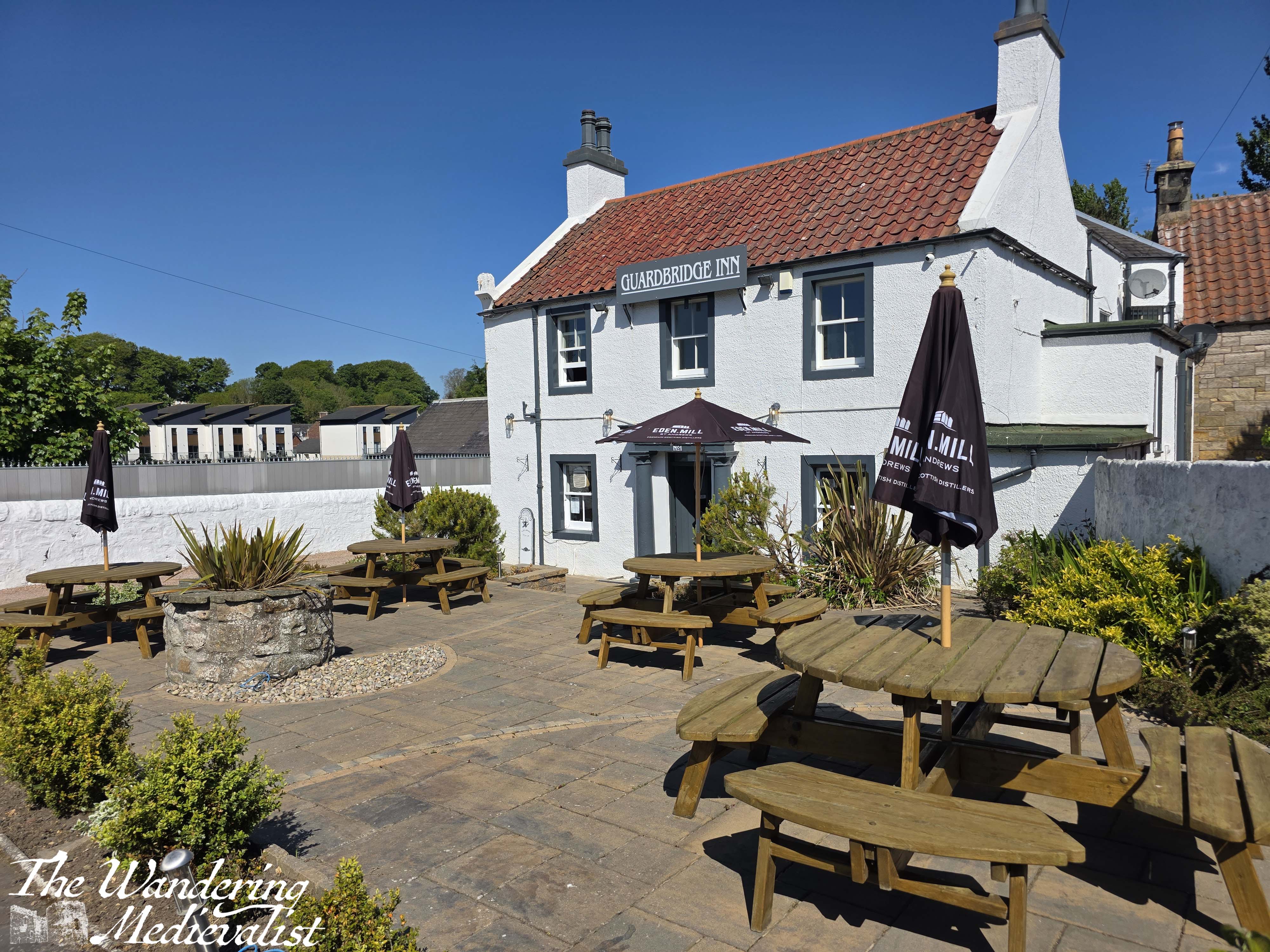
At the crest of the hill at the edge of town, the Coastal Path breaks off from the main pavement and branches right, onto Old St Andrews road. There are some large rubbish and recycling skips here, a few tables, and signs for the Guardbridge Inn.
This is the edge of the residential part of Guardbridge, with houses appearing on both sides both quite new and clearly of an older era. At one point, you can look directly down the road, across the bridge, and up Cupar Road on the other side of town. It is worth observing at this point that this route follows what was once a train line into St Andrews. There is a small local element looking to reinstate the line – which closed in 1969 – but much of the route is now golf course and fields, also residential.
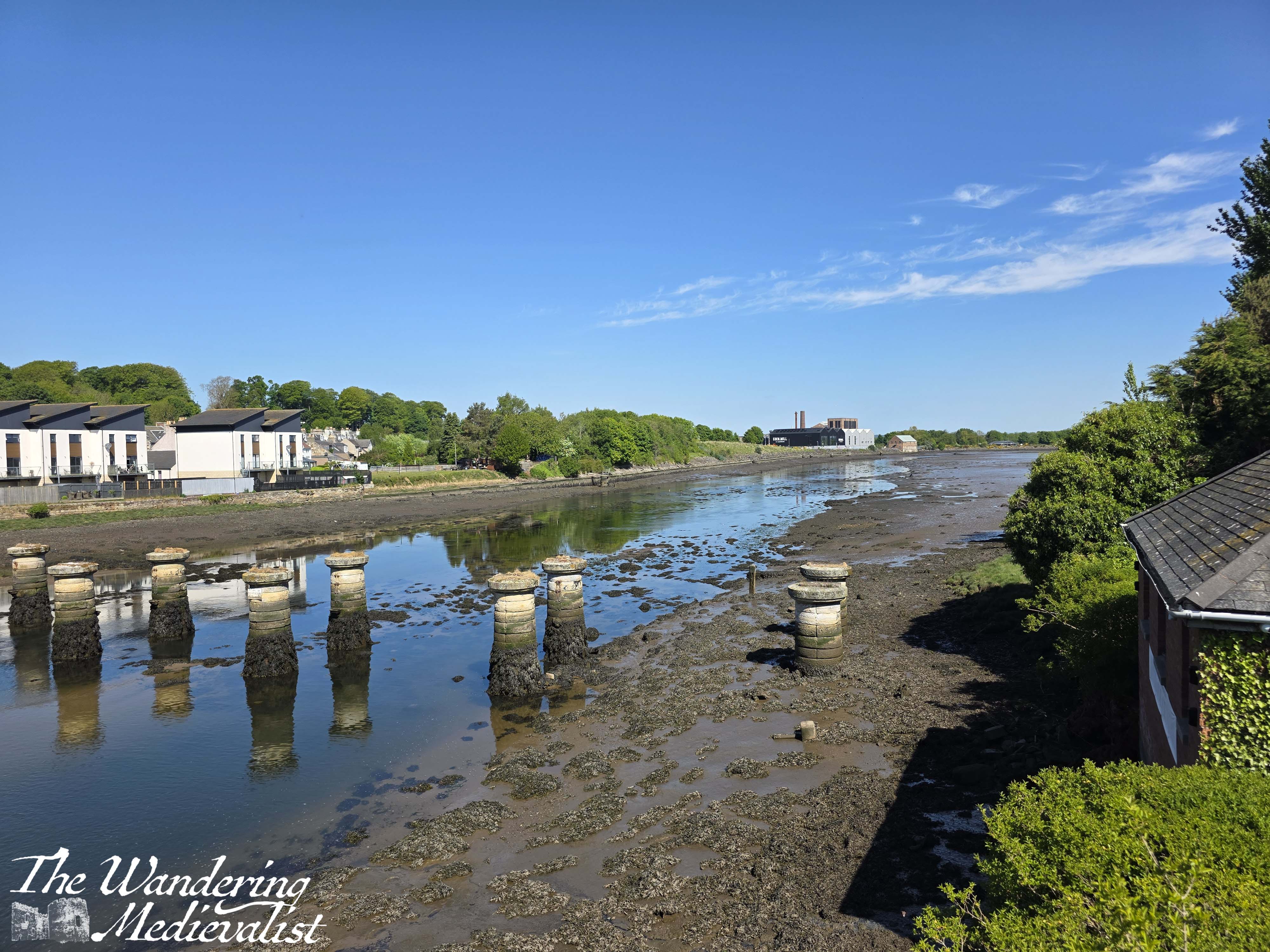
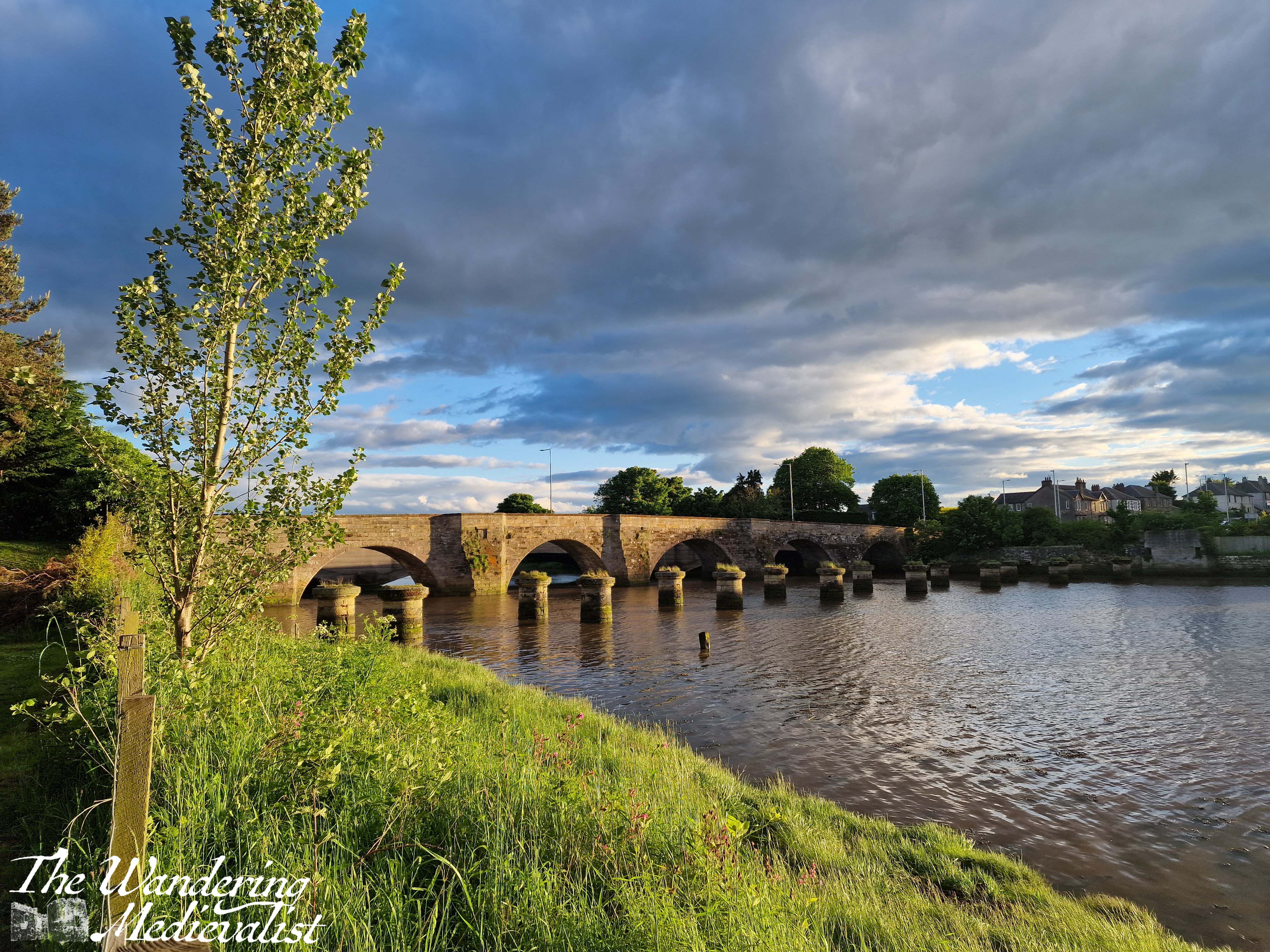
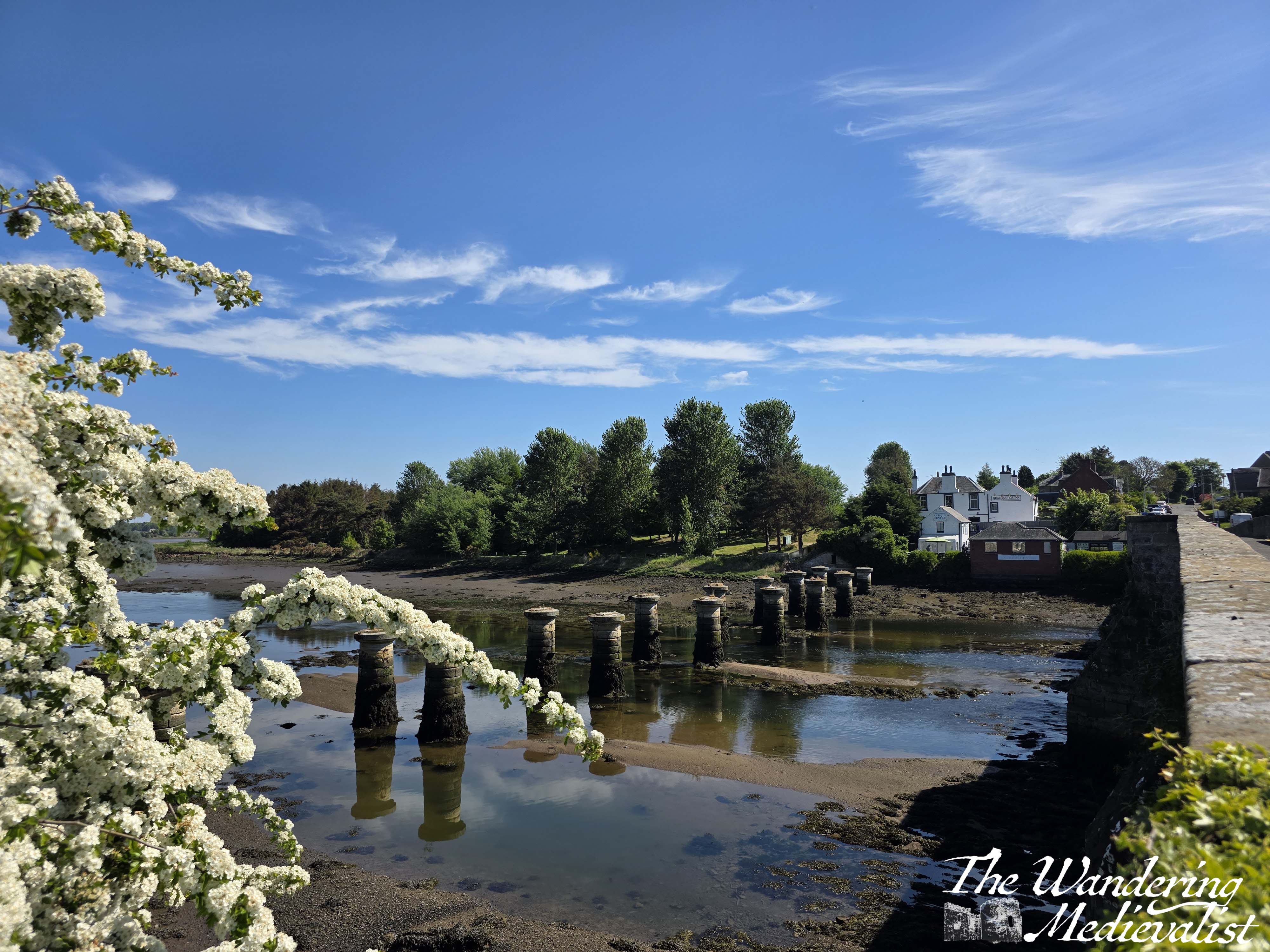
Both this bridge, the pylons in the Estuary, and the north bridge at the end of this walk are evidence of the former train line, and the required alternative bridges for road traffic. The bridge that pedestrians now cross on the Coastal Path is either or was once where there was a medieval bridge, build in the 1400s by Bishop Wardlaw of St Andrews.
At the bottom of the hill, just before the bridge, is the Guardbridge Inn, a fantastic place for dinner or just a few pints with friends. They offer tables out front as well as in a grassy area along the estuary at the back; this was one of the first places we enjoyed a drink after the pandemic lockdown, when we could all sit outside and enjoy the sun and social distancing. The chef is excellent and the building itself is lovely, though I am not sure of its age.
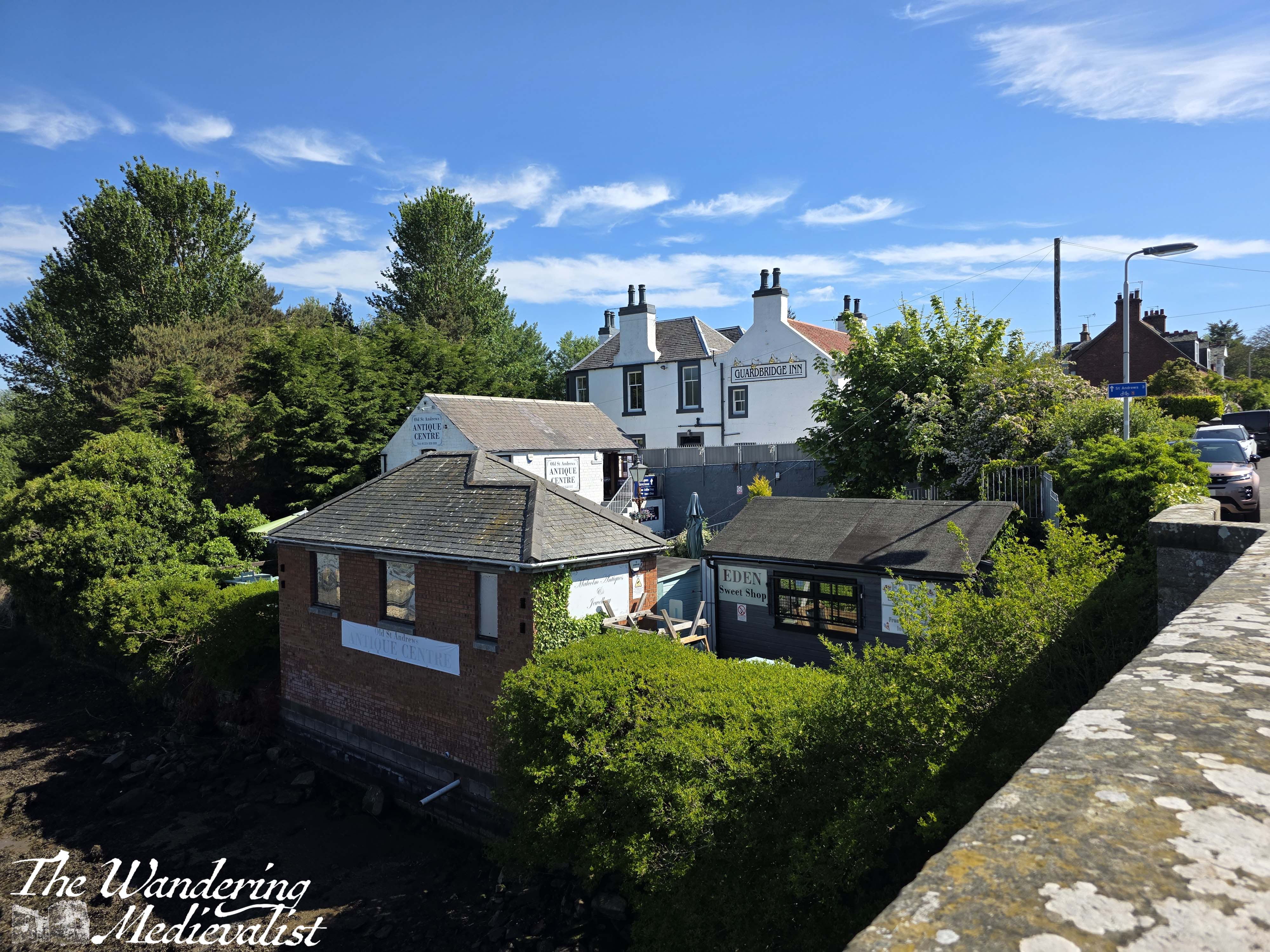
By all means, schedule a stop here if you can! Or, at the small coffee shop and antique store below, which I admit I have never frequented but about which I have heard good things.
Continuing on from the Inn, the coastal path crosses the old bridge, which I have always preferred at high tide, and which you can get an excellent feel of from the Inn, and from the far side of the bridge.
The bridges both end at the main Guardbridge roundabout – another popular spot to hold up traffic – which unfortunately you must cross at this point, heading for a break in houses on the far side of the road.
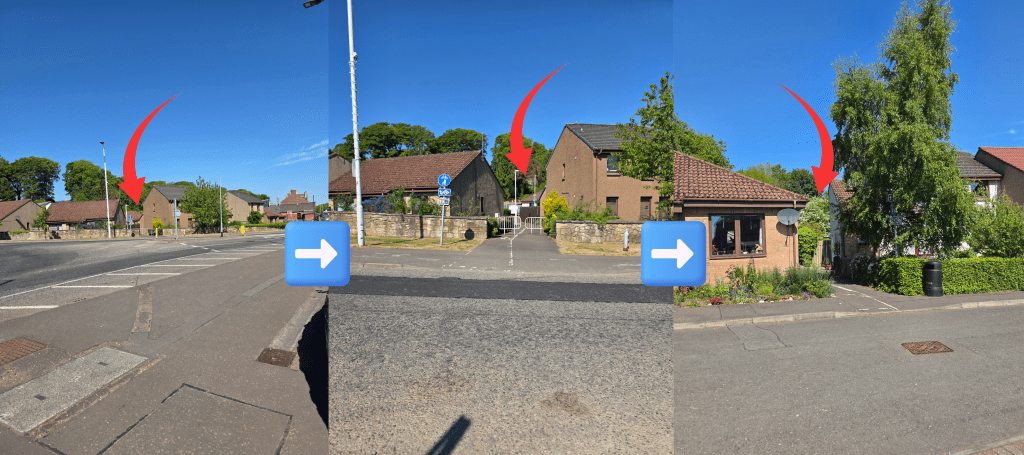
In theory at this point there are two paths through Guardbridge, one along the main road which allows you to get refreshment at Dan’s Goods (a small convenience store), detour through the park and even the University’s Eden Campus. But, the official Coastal Path takes a route behind the main residential section, with back gardens to the right and a hill leading up to the left. Once you cross at the roundabout, follow the signs between the houses, and then cross the small parking area to another gap between gardens. Here the path is again beneath the trees – a relief after a sunny stretch – following the former rail line; it is quite well-marked. On that hill stretching up to the left is the Seggie estate, which was a farm but is now a large housing estate that has been built over the past few years, adding several hundred homes to the village. For a longer walk, you could go up Cupar Road and walk through the estate, where there is a walking path through some tall trees allowing a view over the university campus and the estuary beyond.
About five minutes along the path, the houses disappear and there is a wide open space where a condemned rail storage building was torn down. It has been vacant for some time, and there is great supposition as to what might be constructed there.
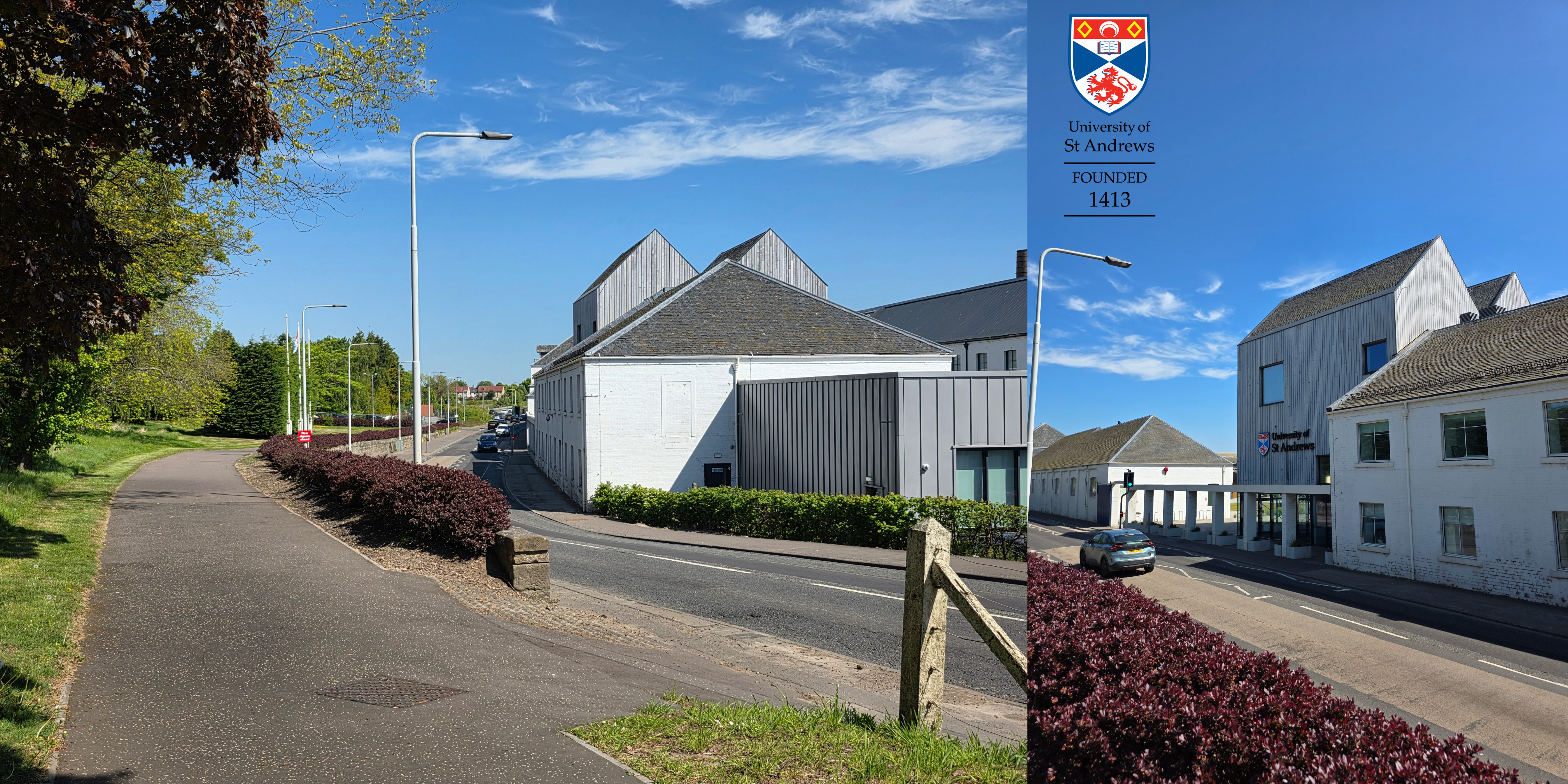
On the other side of the road from here until the end of this stretch is the Eden Campus, which was built by the University of St Andrews in the late 2010s and opened for staff use at the end of the pandemic. When I first arrived in St Andrews many years ago, the buildings still housed Curtis Fine Paper. They were originally built in the 1870s as the Guardbridge Paper Company. The town grew up around the mill, which employed more than 600 people in the 1950s. Many of the original elements of the mill remain today including what were wide doors for horse-drawn wagons to enter, and the Guardbridge clock that overhangs – almost – the road. The University was careful to maintain as much of the original feel of the mill as they could when they built Eden Campus, which is a wide open-plan area with an industrial feel to it. They have won several awards for their success.
Seggie Drive joins the main road just across from the University, and from here on the path is raised slightly away from the road, which is considerably safer. Again, though the speed limit is 30 MPH here, traffic is often moving quickly around an almost blind corner.
The end of this section of the walk is where I started a few months ago, at the north bridge in Guardbridge, the far end of town. As you can see there are some lovely spots that you pass on this walk, though it is also far less rustic than further south. It was the first walk where I really noticed a difference in my stamina, which I hope can continue! But I’m off on travels again soon, so we shall see.
First, a disclaimer: this is not an ‘official’ walk, but rather a trek that we stumbled onto ourselves. It isn’t really a loop, and not really an out-and-back, instead two out and back paths, and it is a record of the walk we took most recently when visiting Glencoe. It combines parts of a few others into two miles of lovely scenery, a bit of climbing, and two bridges. As you know, I cannot resist a bridge.
One of the hikes on my bucket list – right behind climbing Ben Nevis – is the Lost Valley trail that leads up a ravine next to the Three Sisters of Glencoe. It is not particularly long (about 5 miles out and back), but as we learned on this hike, it is quite steep, and neither of us were feeling quite rested and ready enough to really give it a go. So, we…adjusted.
The day started off in the parking lot at the Three Sisters Viewpoint, which since the pandemic has undergone an excellent redevelopment, allowing for safer entrance and exit on to the busy A82, and designated parking spots. The parking is still a bit of a free-for-all, with visitors ‘creating’ their own spots when they are all full and blocking people in, but at least tour busses now have their own viewpoint, a few hundred yards along.
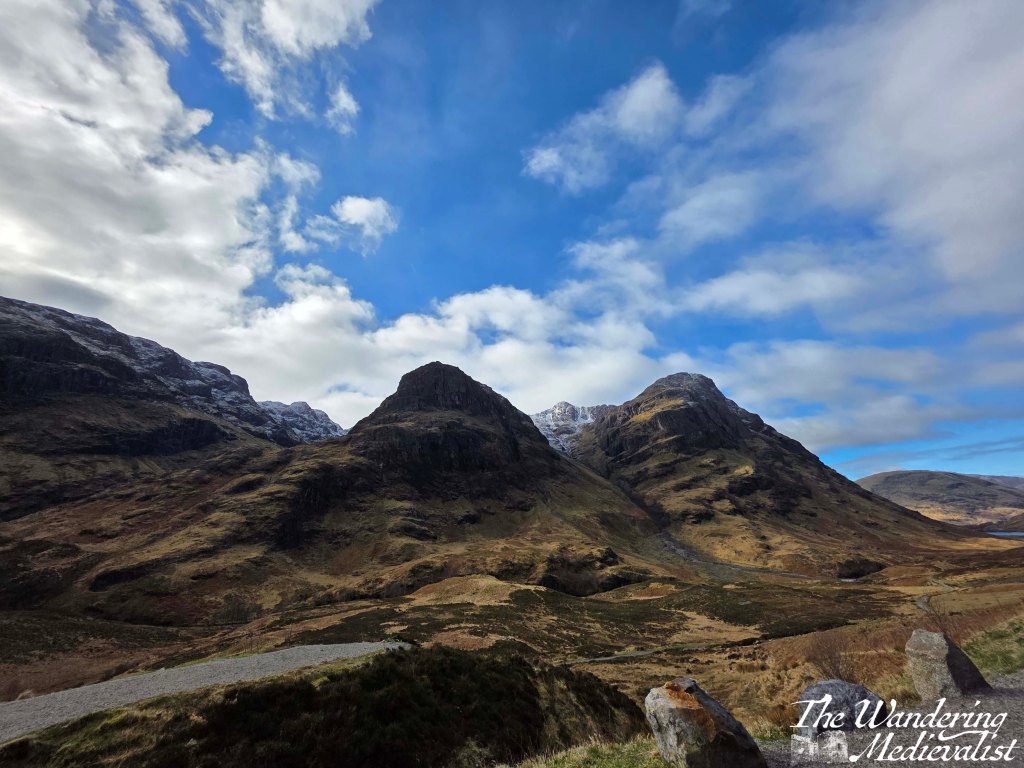
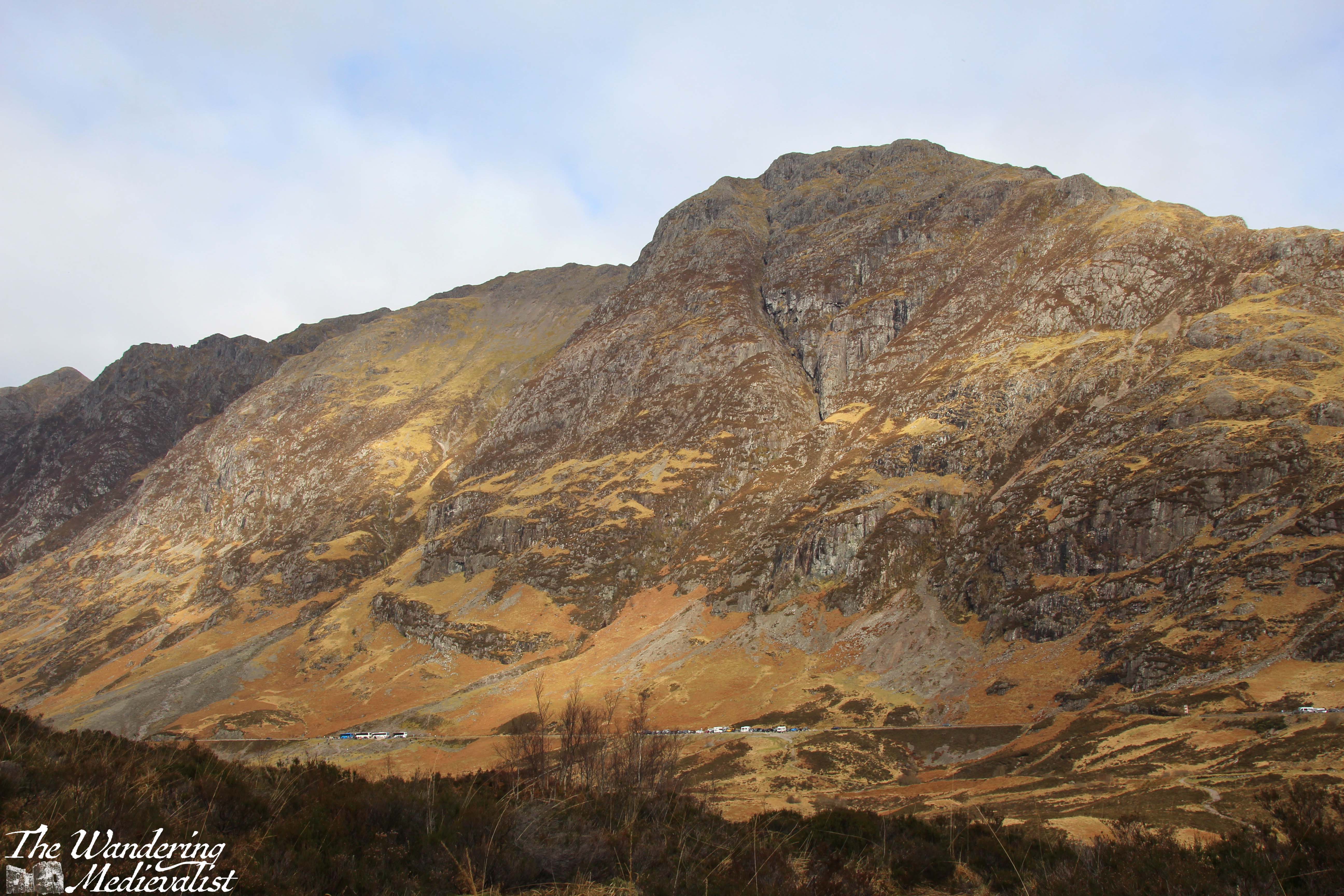
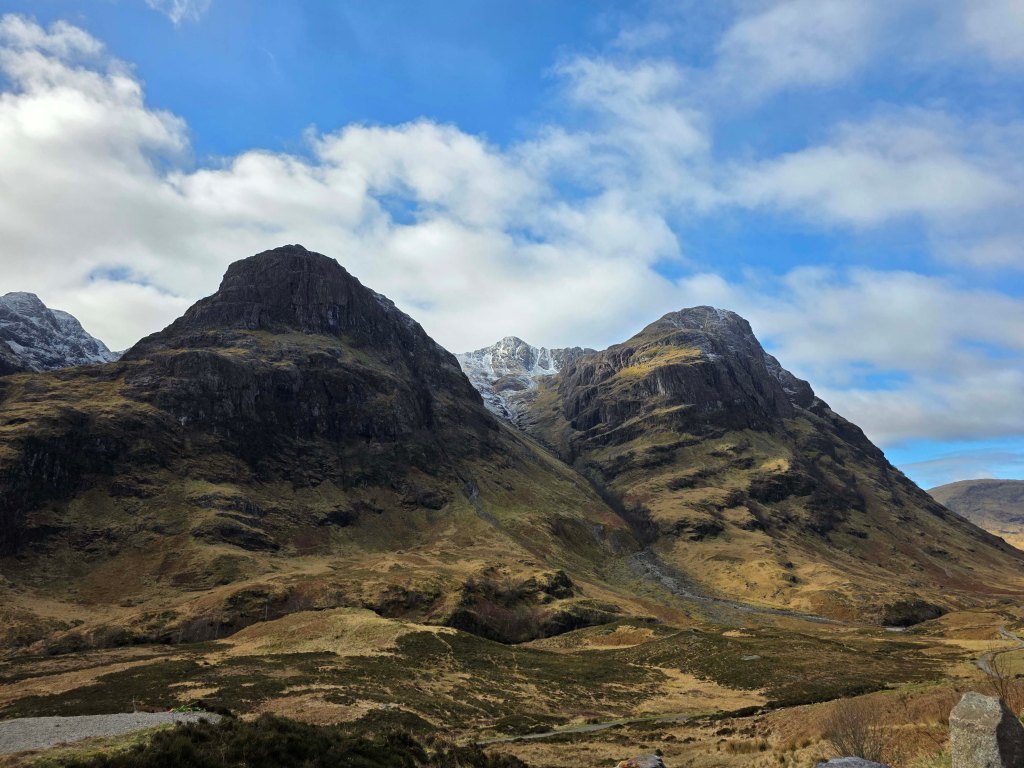
The spot is busy because it offers access to one of the more famous views in Scotland: the Three Sisters of Glencoe. I have more than a few versions of this view, taken in many different types of weather, but here is the one I took when we visited most recently:
I can never really decide if I like this view better, or the one that looks down towards Loch Achtriochtan:
What do you think? Leave me your comments below 😊👍
While you no longer have to take your life into your hands stopping at this car park, you do need to stay alert and be prepared to be hemmed in, at least for a short while. If only there were a nice view to distract you…this, like St Andrews castle, is another view of which I cannot avoid snapping another version. The light may be different, after all, and the mountains are always a different colour.
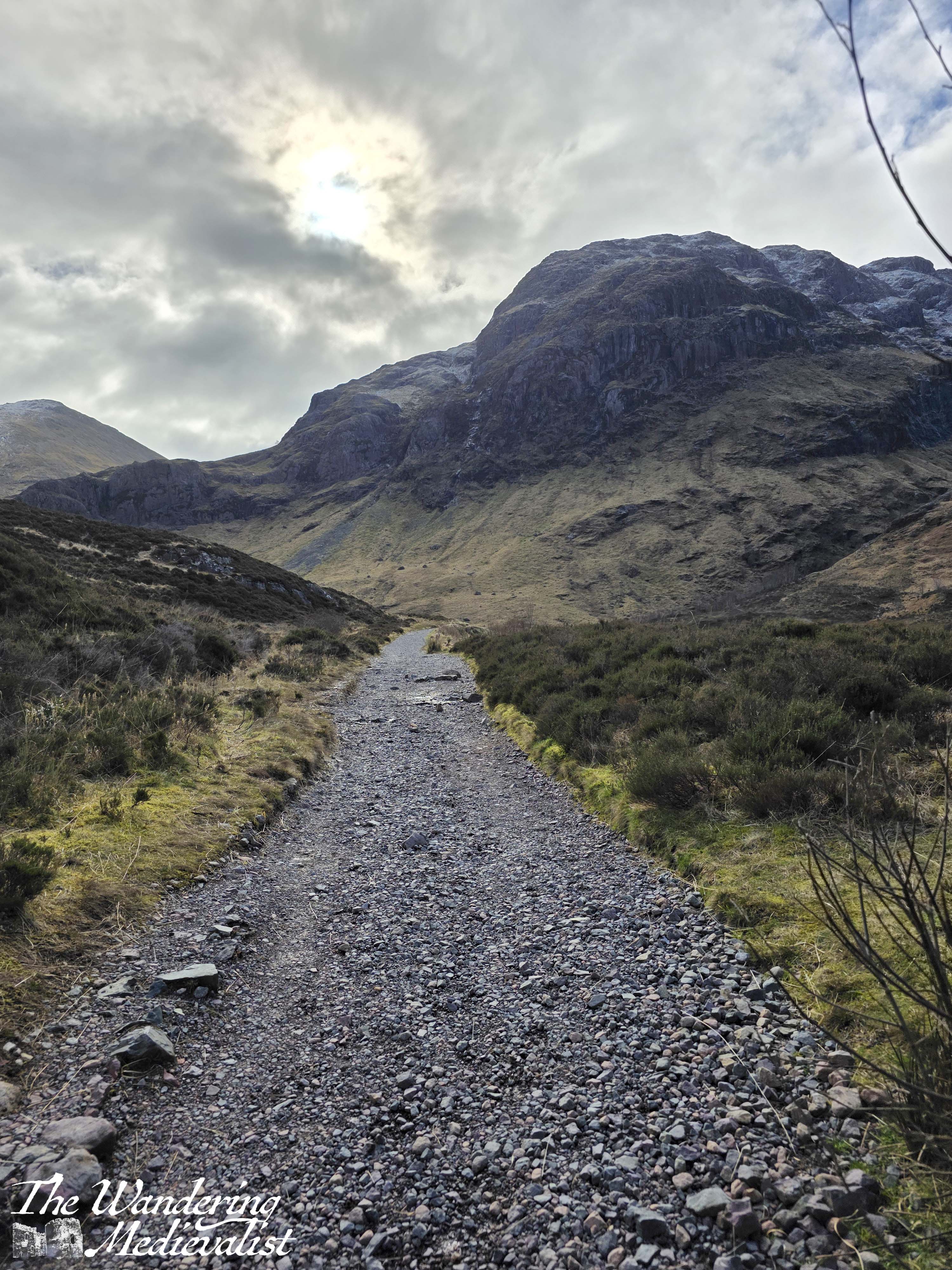
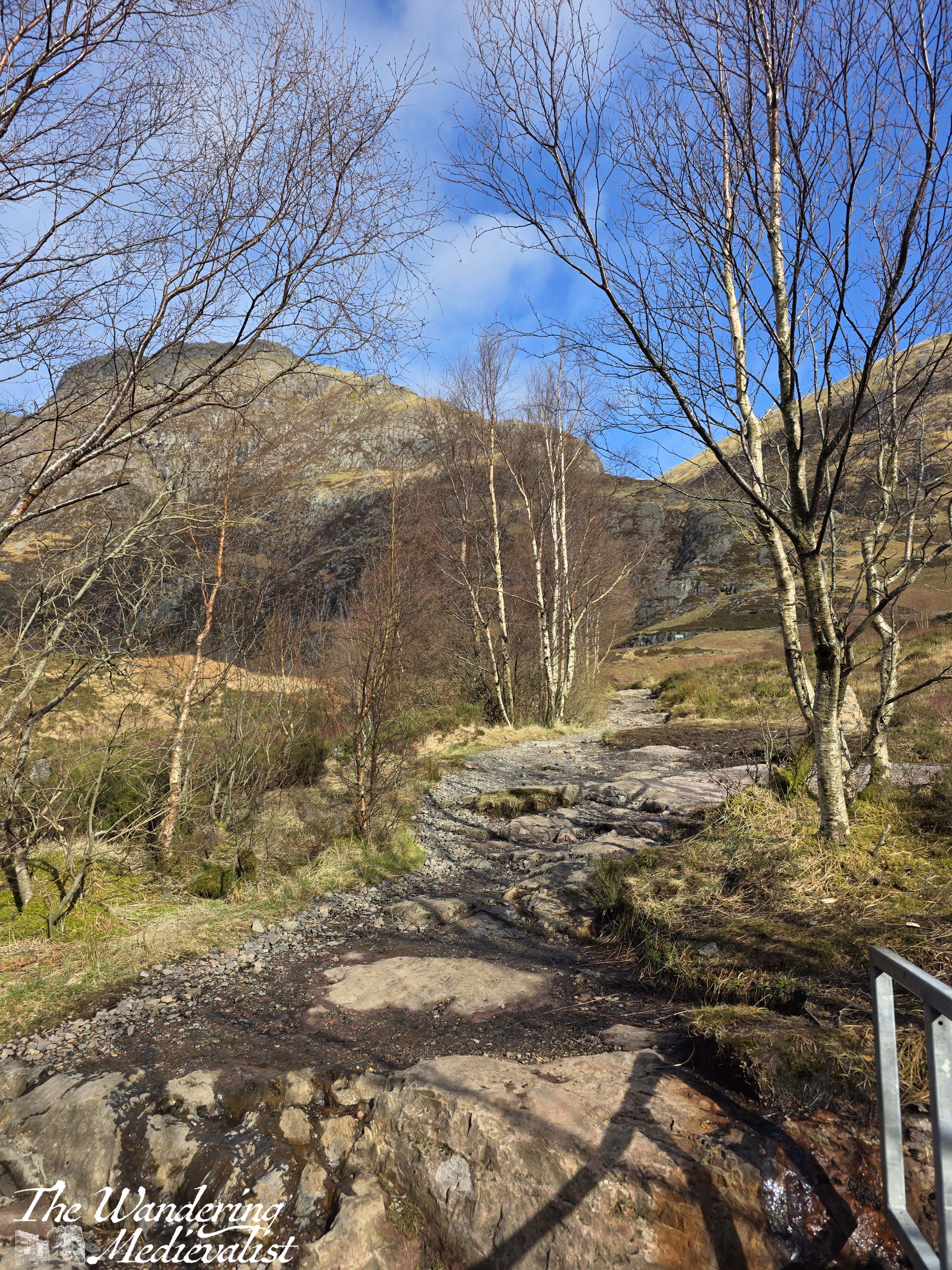
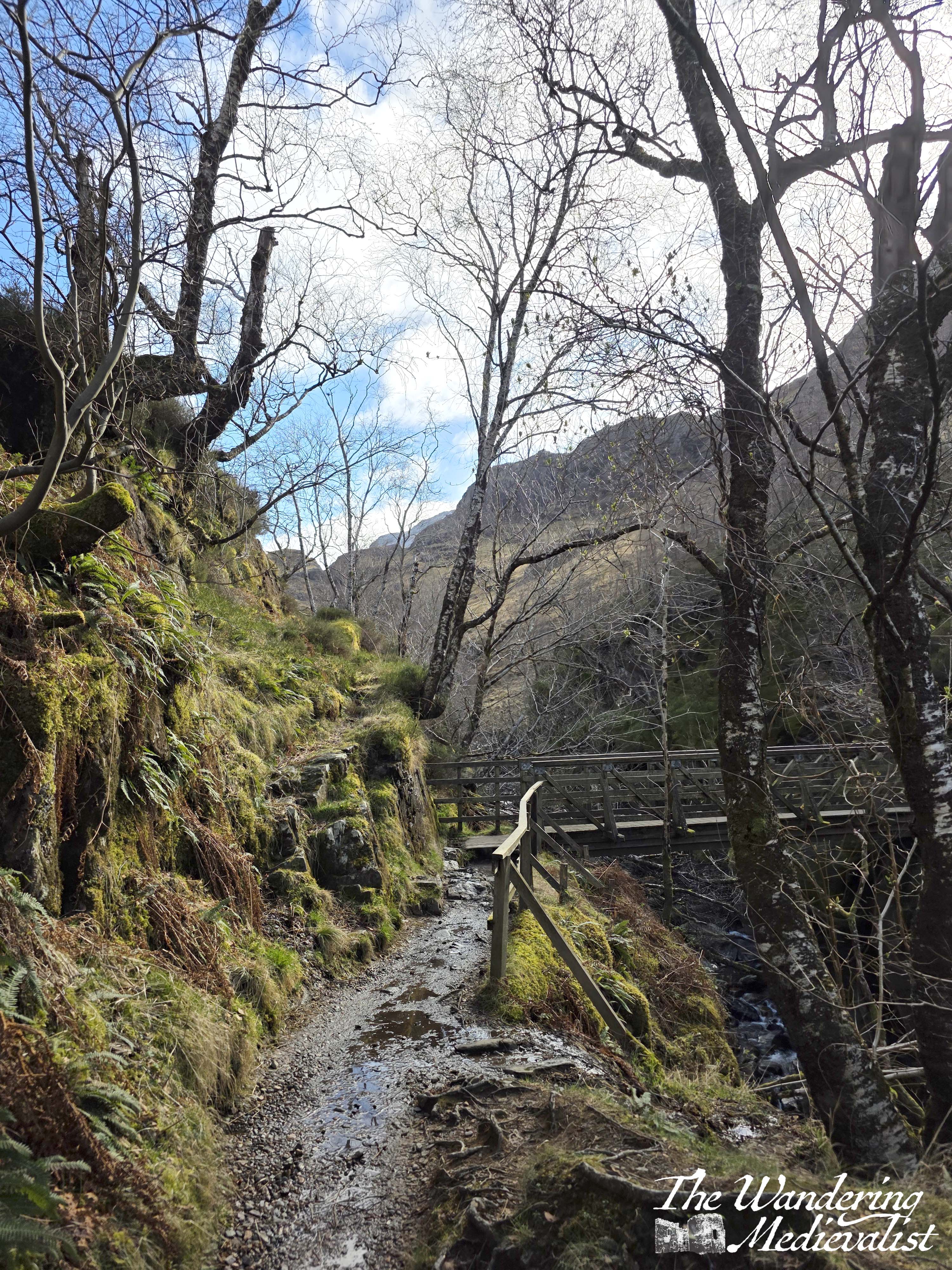
But I’m getting distracted. We managed to find a good – legitimate – parking spot, changed into our hiking boots, and started off down the steep path that leads from the car park into the valley below. Here, the trail is wide and quite well-kept, dirt with small rocks that can turn your boot if you’re not paying too close attention. On either side of the trail is grass, heather, and low bushes, with small rivulets making their way down to the river below.
The well-used trail is just about in shape for cyclists, and once level leads either to the west towards Loch Achtrioctan or to the east, towards the Lost Valley trail. We took this route, and found that as we got further from the car park, the trail became rockier and a bit wetter, as the small burns broke over the path. In a few places you have to either jump across water or make your way on rocks, so if attempting this walk ensure that you are wearing sturdy shoes or boots. Not, as I saw several tourists wearing, flip-flops (as we call them in the US) or sandals. The path is relatively level, though to your right you will notice that the river, which is relatively open below the car park, is quickly being hidden by the rising banks.
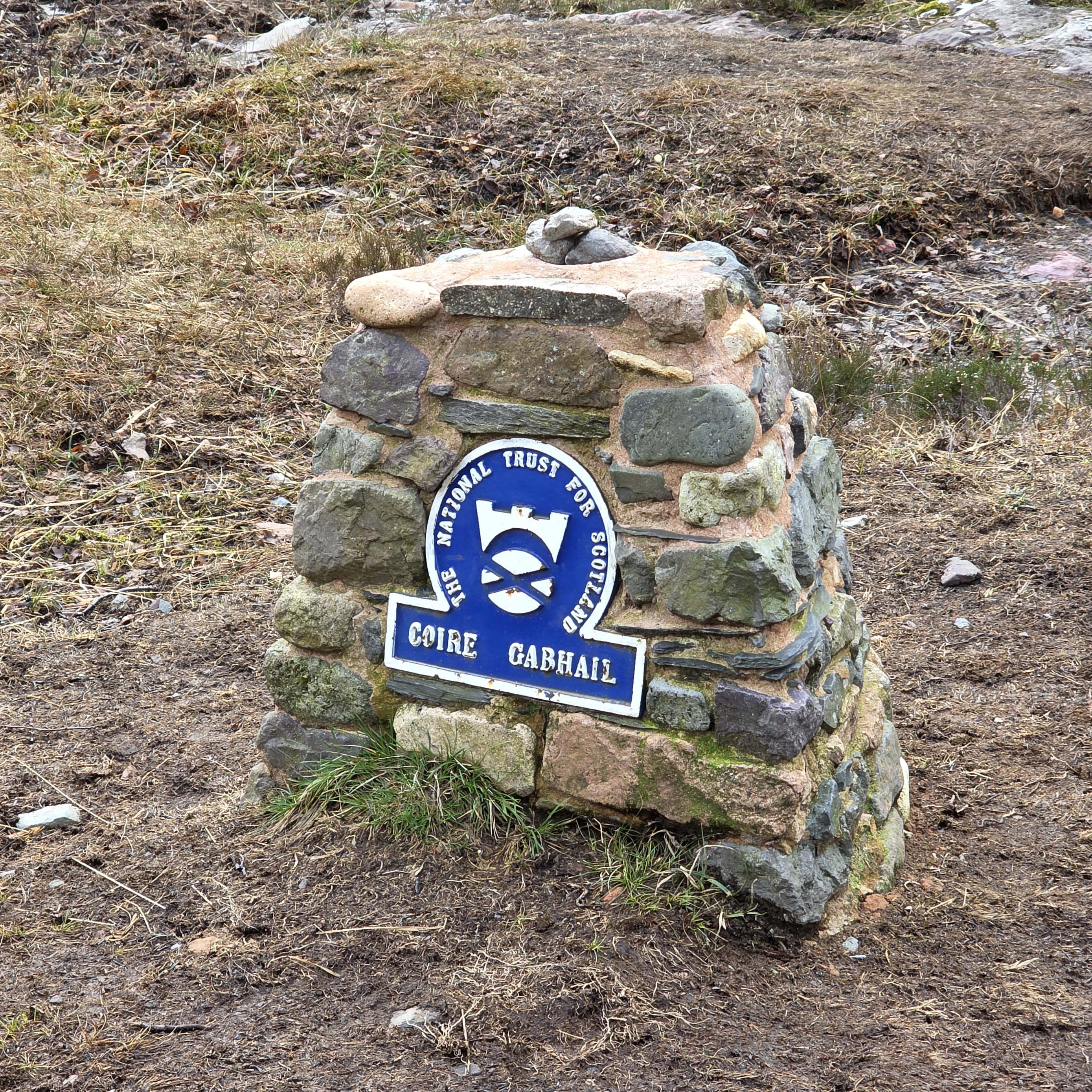
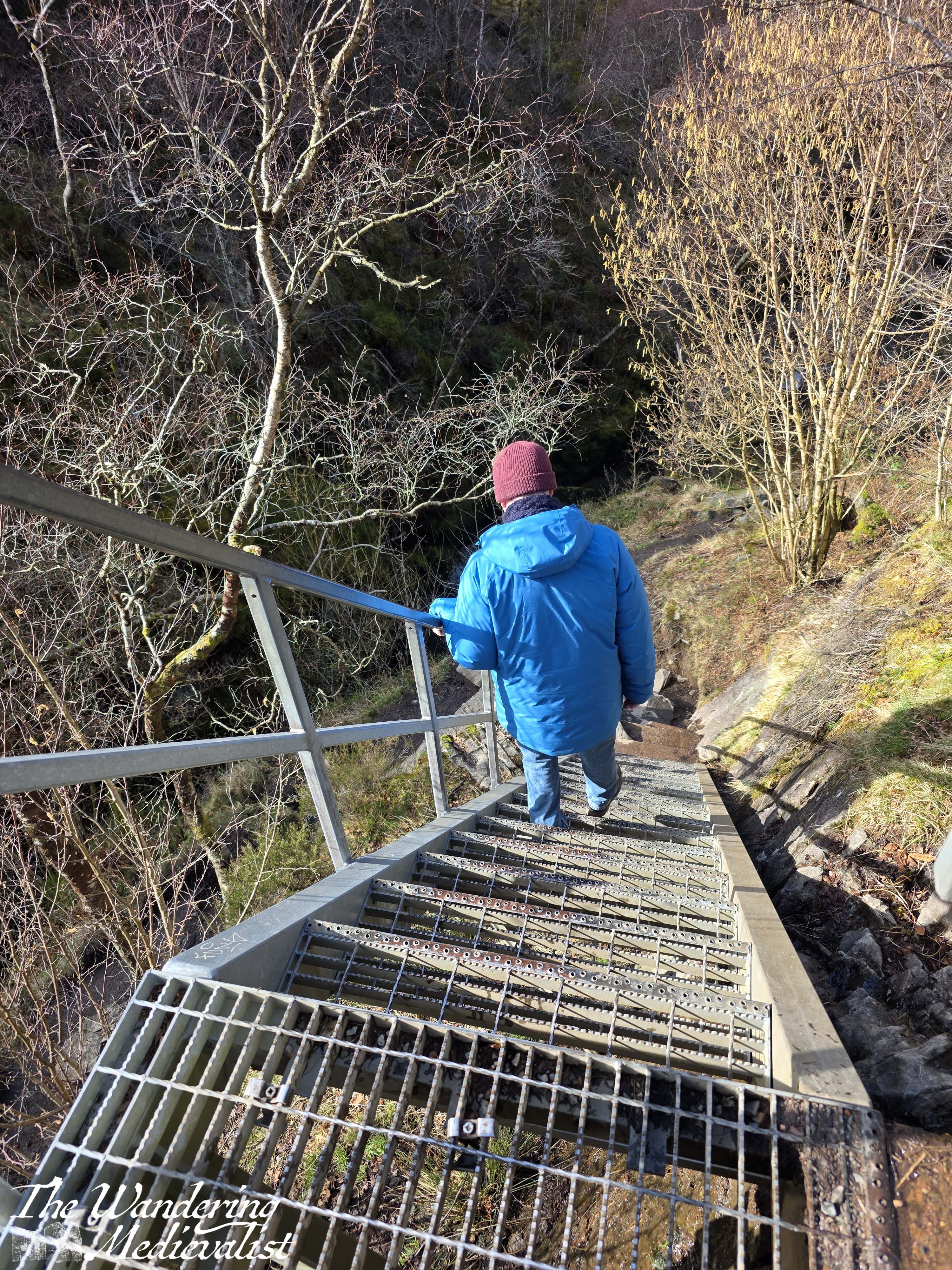
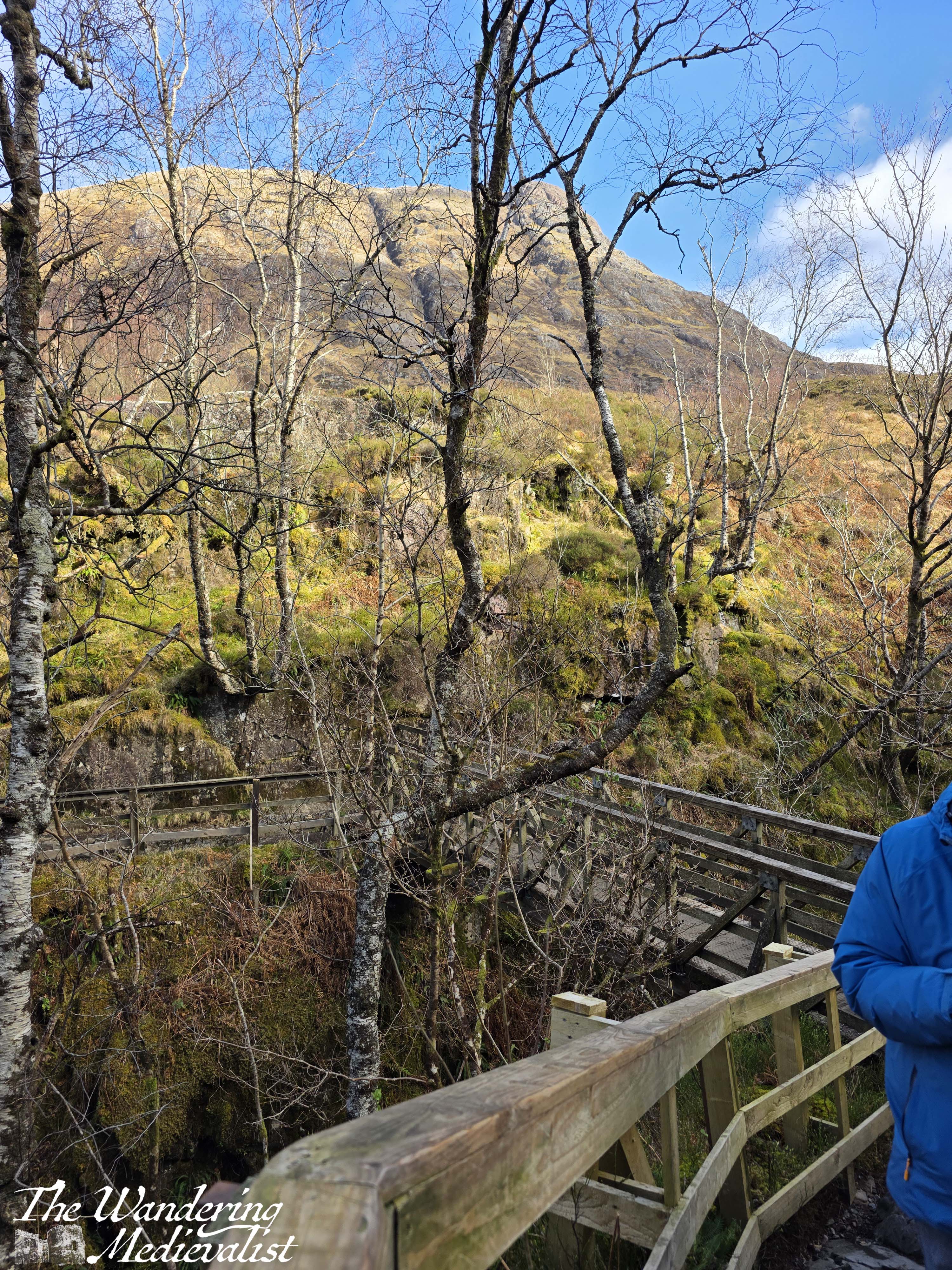
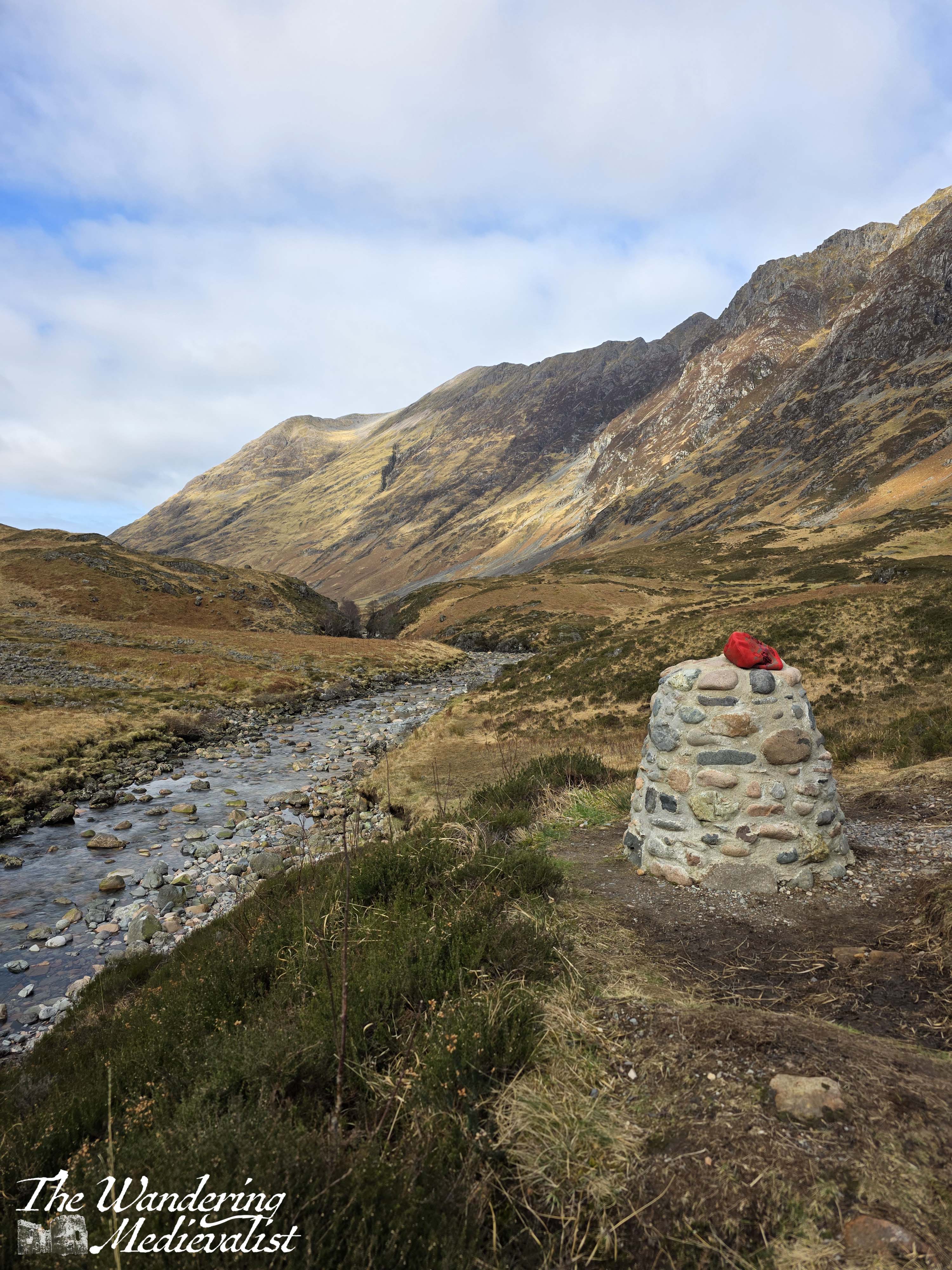
In about 0.3 miles, you reach a small cairn which marks the entrance to the Coire Gabhail (Lost Valley), and sits at the top of a set of steep metal stairs that descend to the first bridge. The River Coe is deep below in a gorge, just visible as you cross.
The bridge is well-maintained, and almost immediately upon crossing you are faced with your first real hurdle (not counting the steep metal stairs, which are probably only a real issue for the vertically challenged among us). This hurdle is a steep wall of rock which really does require all four limbs to get up – there are plenty of hand-holds, but the rocks are slippery and there is a very sturdy wire rail which can be used to help climb. It is an absolute necessity on the way back down again.
This picture does not really capture the climb, as I was already part-way up so the angle is not steep enough. Suffice it to say, by the time you have reached the top, you will have gotten your blood pumping a bit.
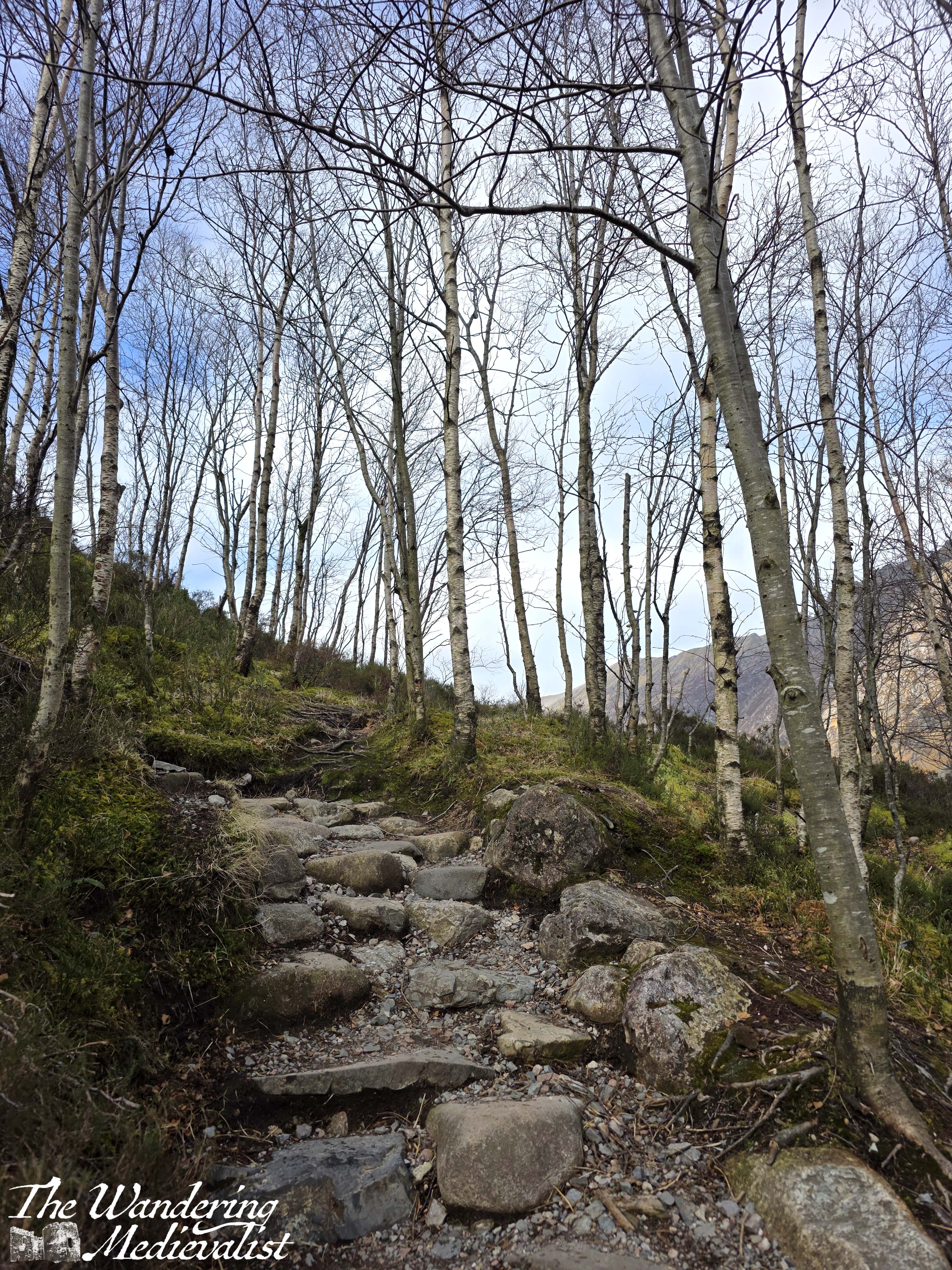
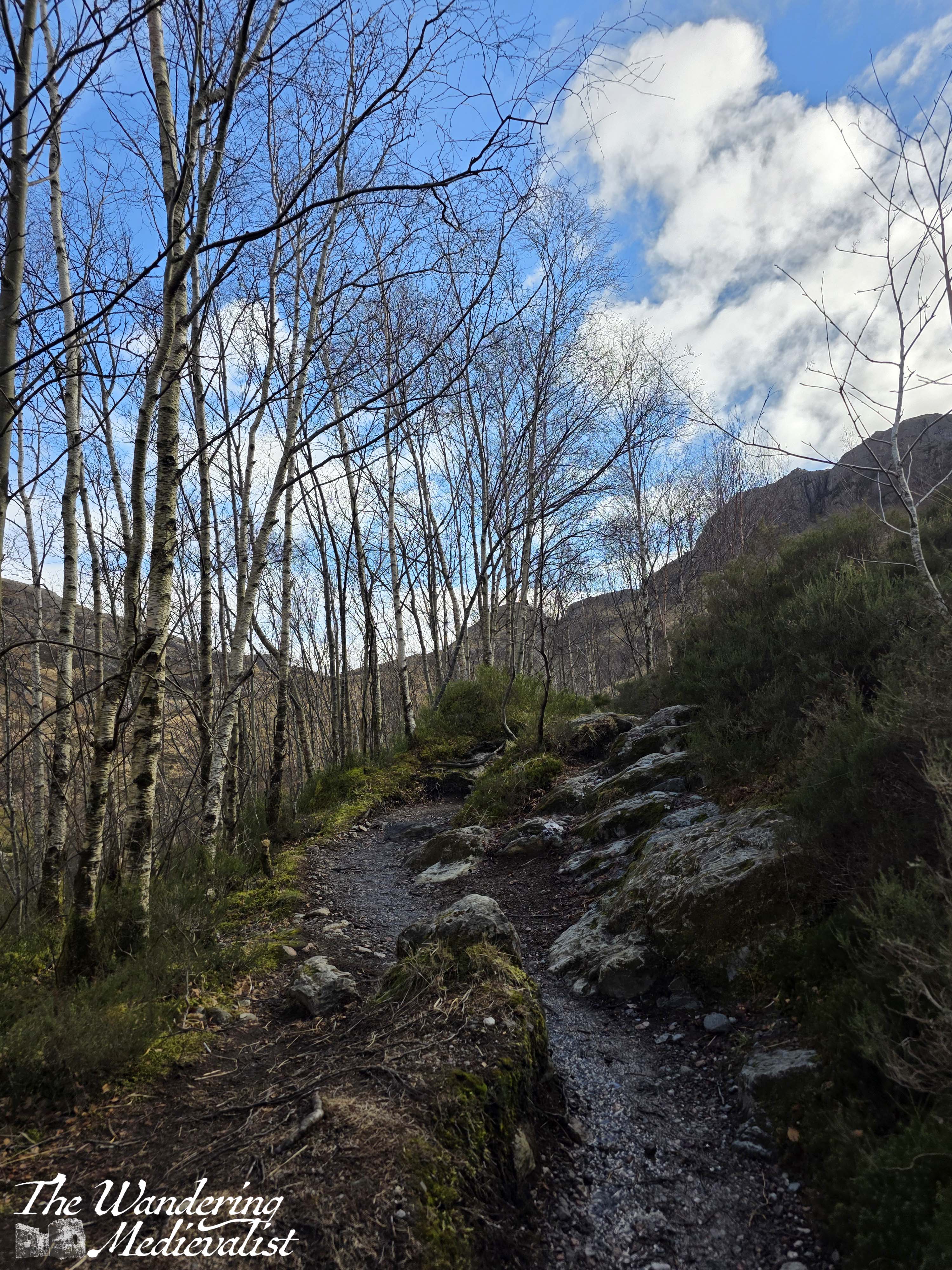
From here, it really is just a steady climb, varying from gentle to quite steep, climbing up small boulders and stone steps, sometimes open but more often surrounded by lovely stands of birch, gorse, and heather.
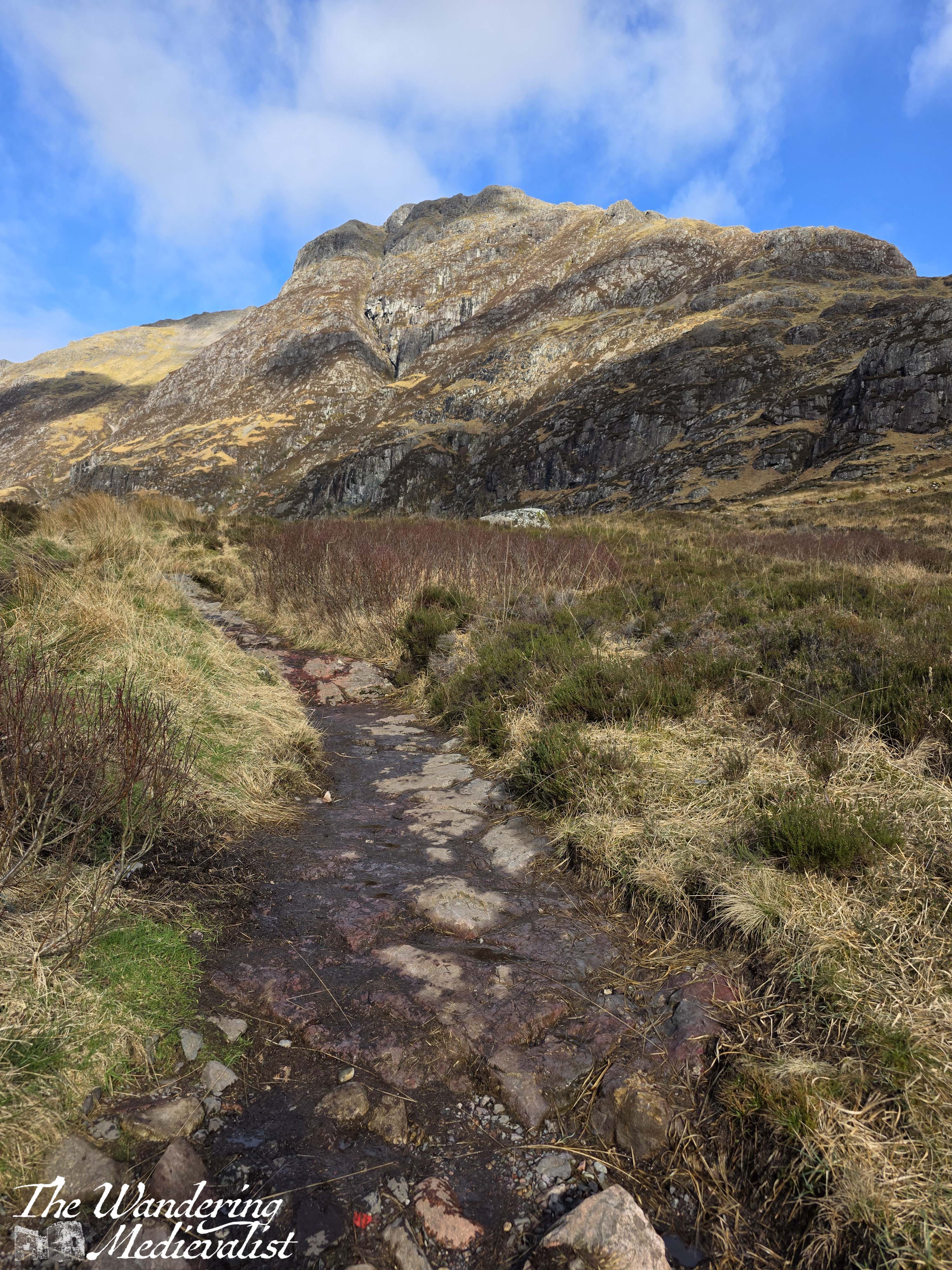
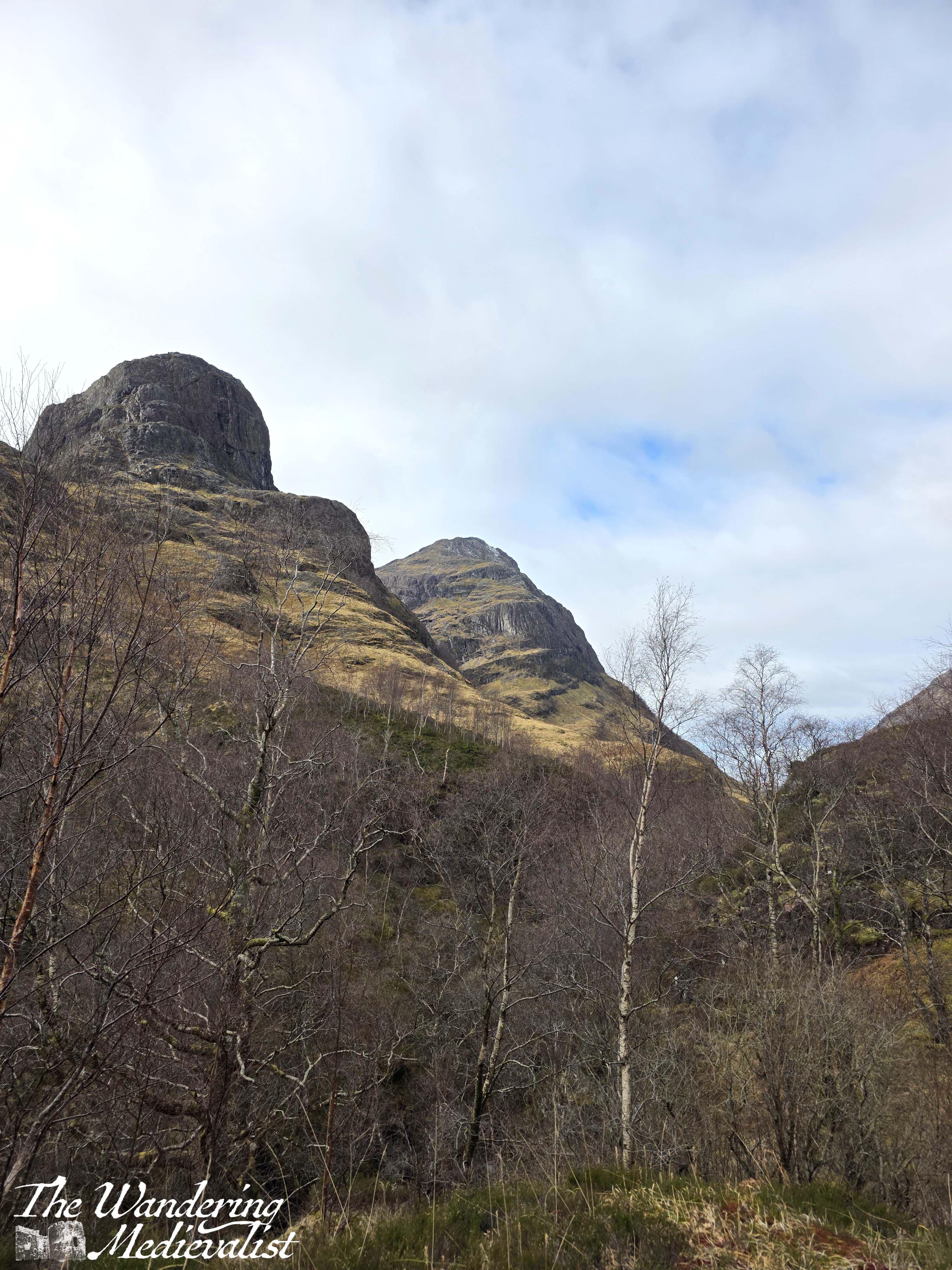
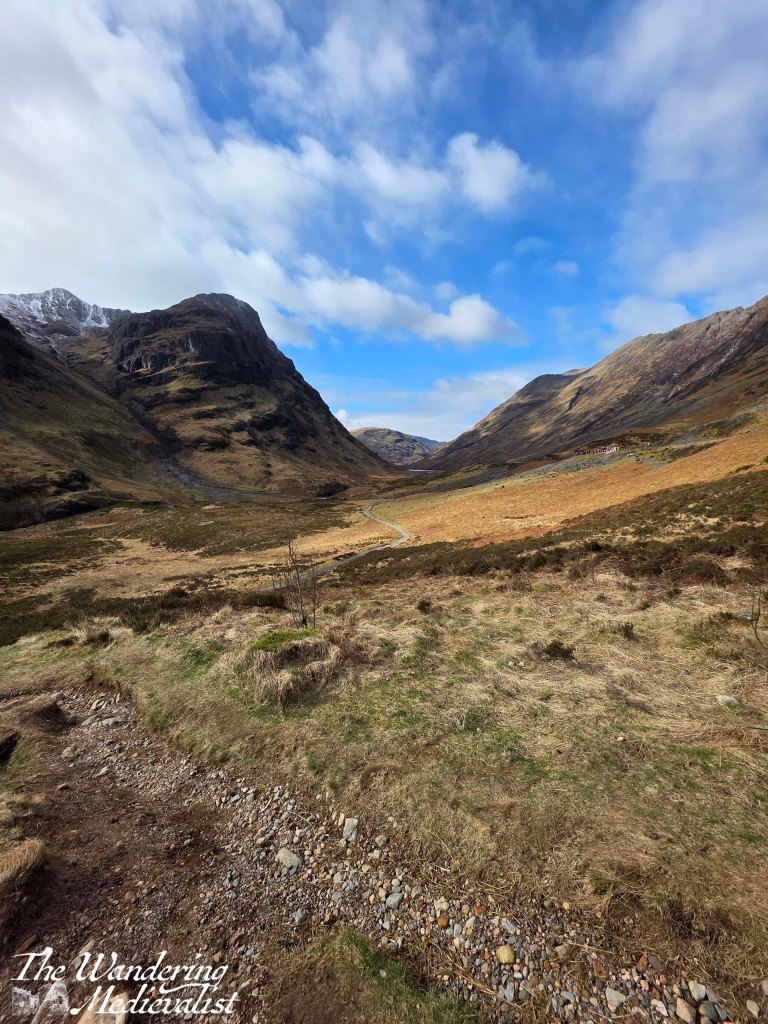
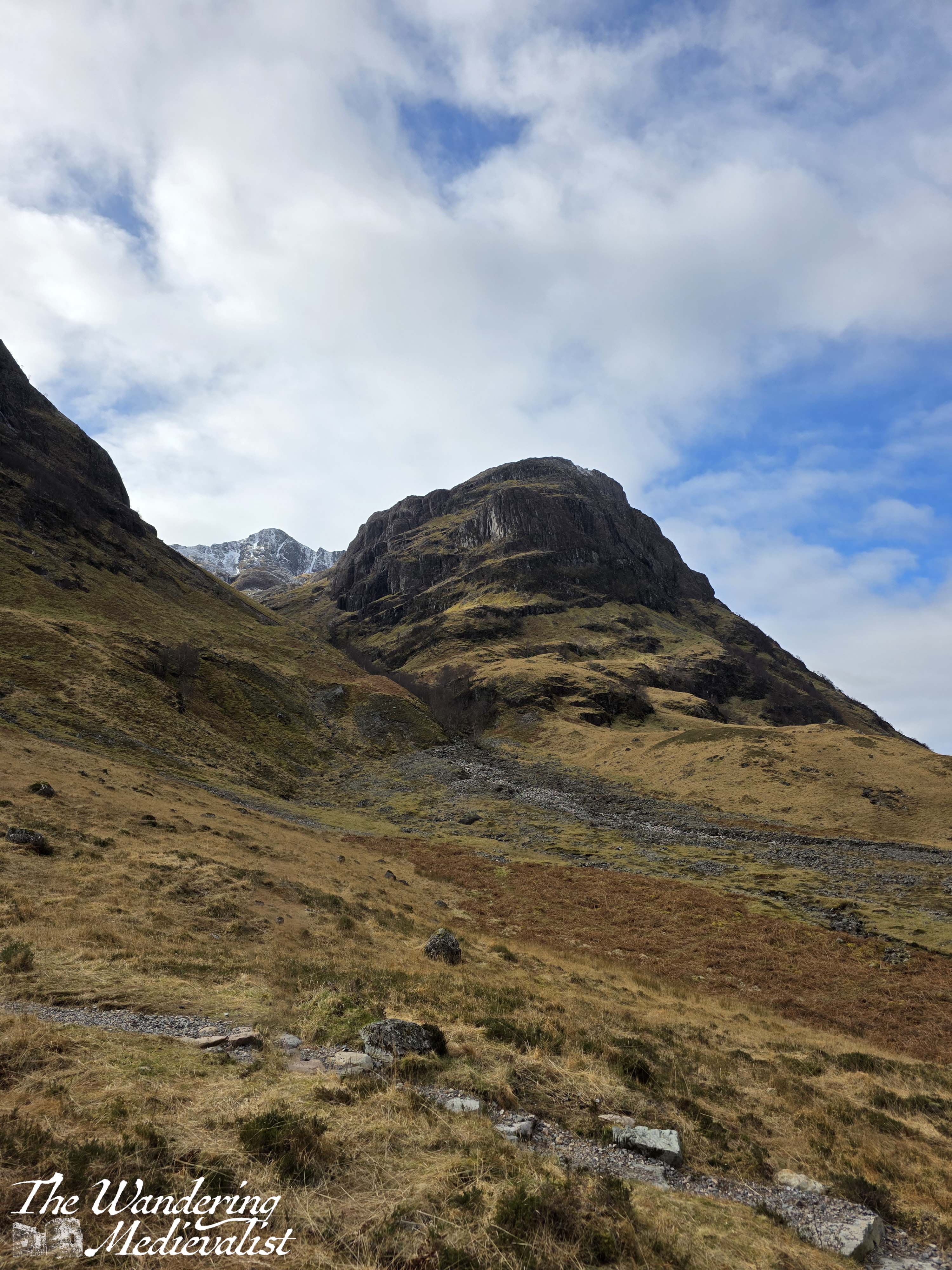
As you climb, the open areas begin to offer really excellent views towards the car park and over the valley, as well as a different angle of the mountain than you see from the road.
We hiked up this path for about half a mile before deciding that we weren’t quite up for the whole trail. As anyone over 35 reading this will appreciate, down has become more of an issue than up, and neither of us were interested in injuring already testy knees. The trail continued to wind up relatively steeply from this point on, so we took a short break to enjoy the view before heading back down towards the bridge. The very steep section required a backwards approach, clinging to the rail, but we both made it without too much stress.
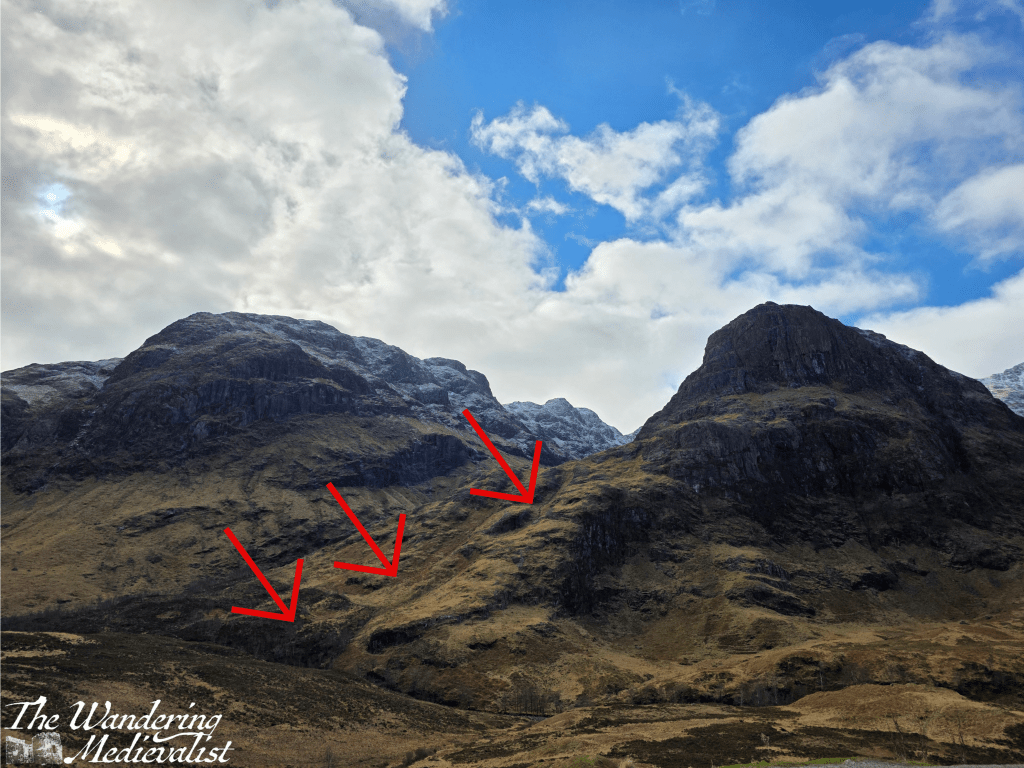
This photo shows the tree line and, roughly, the route of the trail we took.
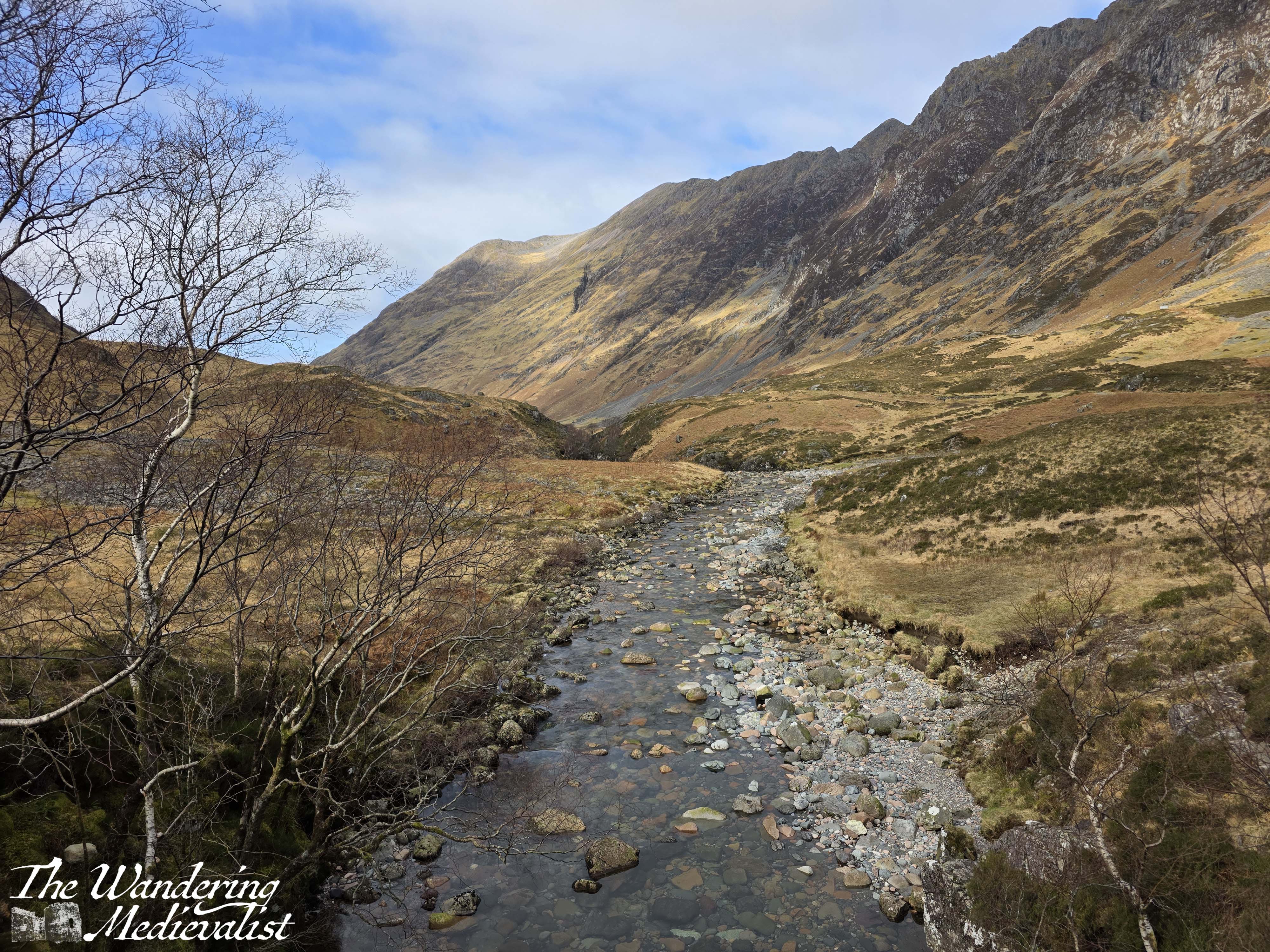
In time we re-crossed the bridge and made our way back to the main path, where we decided to turn west and wander along the flatter path for a bit. It meanders up and down gently, crossing a few burns. The views of the mountains are stunning, and the river is relatively flat with a stony bank.
Perhaps five to ten minutes along this trail is a left-hand turn, and a trail that eventually takes hikers up between the two mountains.
We of course had no such ambition, but took the path anyway as I figured – correctly – that it would lead us to another scenic bridge. Sure enough, about a quarter mile in, we reached a viewpoint up the glen, complete with a cairn marking the Coire nan Lochan trail and wooden bridge. I appear to have neglected to photograph the bridge itself, as the view was a bit distracting.
I could not resist climbing a bit further so that we could take in the view from a few hundred feet above, looking over the glen in both directions.
It was tempting to want to keep going either up or along the valley, but the steep uphill climb of the first part of our walk had taken more out of us than we would have liked, and so we meandered back towards the car. The final push up the steep bit of scrabbly hill to the car park was a bit more challenging with several cyclists and tourists coming the other way; in total the whole walk was just over two miles, and after a short drive back into Ballachulish we topped up our step count with another short walk along the loch. (Note, sure enough, our car had been blocked in when we reached it but the gent with an enormous truck was happy to move long enough for us to get out – and for him to nab our spot.)
The early section of this walk starting the Lost Valley route was steep and reasonably challenging, but the second half of the loop was very pleasant and easy walking. I have a wish at some point also to walk to Loch Achtriochtan, though the latter part of that trail appears to be close to the highway, so perhaps of less interest. This part of the A82 is nearly always busy – even at night, as we learned – and with large coaches, motor homes, and trucks added to the normal car traffic, so walking close to the road does not appeal to me.
What I refer to as our Two Bridges trail definitely offers some lovely views, a bit of exercise, and an option to lengthen in almost all directions, even if you do not attempt the longer trails. I hope you enjoy it!
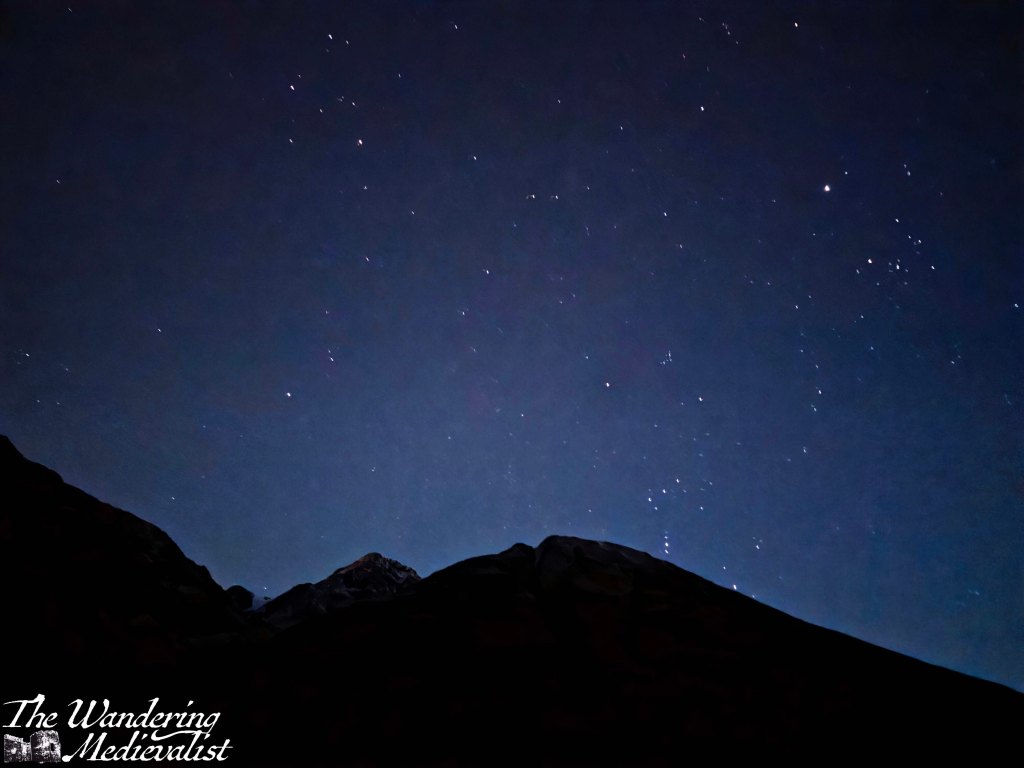
As a bonus, here is a night sky picture of Glencoe I took that evening, with the full moon behind me.
I have been wracking my brain for days on what next to write about, but my creative juices are running a touch low after weeks – months – of work travel. Finally I thought of this post – throughout the year, wherever I am and no matter how tired I am, taking pictures of the beauty around me has kept me centred. And so in this post, I would like to share with you MY favourite pictures that I have taken this year, and a bit of why they are special to me.
This picture was taken on one of my favourite days all year, when I got up early after a snowstorm to wander Marblehead as the sun rose. I wrote a whole post about this day – so serene and stunning, it remains one of the best days of the year.
Boston coffee at its best. Most people are Dunkin’ people or Starbucks people. Whether they are next to each other or across the street, they almost always offer you the chance to choose between them, in Boston anyway.
Me? Cold brew Dunkin’, even in the depths of winter.
Next Stop Wonderland was a movie, and when I started riding the subways regularly in the 90s, was still announced by the driver. So, usually was, ‘Nexxop, Wondaland’
I love this picture of the light glistening off ice starting to drip from the tree branches as the sun began to warm the world after a day and night of snow. I sat under this tree watching for some time, until I was dripped on.
February started as a month of new beginnings, with a new job for me. This picture was taken at the end of a day in week three, as the sun set down Perth Road. Hard to beat a good winter sunset.
Speaking of sunsets, here’s another, one of my favourite nearby views including the old rail bridge and the River Eden.
And to counter the previous two, a sunrise – specifically the sun rising over St Andrews, a view I have captured 100s of times but never tire of, especially on a golden morning like this one. February was a rough month for us, but mornings like this one helped.
One Saturday in March I took a late morning walk on East Sands, and it was a gorgeous sunny day at low tide. It is hard not to love this view of St Andrews.
My morning walks in spring are often joined by the local small family of deer. I like to think that they get used to me and are less afraid of the woman in a purple coat who is always taking pictures.
The deer on this morning were so completely un-bothered by me.
Most of April was consumed with work, but I did my best to get out for an evening stroll whenever I could. I loved this one daffodil standing up against the setting sun.
Early in May, I took myself on a solo adventure to Castle Campbell. This stunning blue sky against the Ochils just filled me with joy.
Out of work for the month of May, I found myself free to have the occasional Friday evening pint at our local haunt. What a spectacular evening view. Though I do have a thing for bridges.
A hiking trip in support of the Step Count Challenge took some friends and I to the Hermitage, in Perthshire. It does not get much more fairytale-perfect.
Another day trip found me in Kenmore; I just cannot take enough pictures of this bridge, but this one with the distant loch and mountains peeking through is one of my favourites.
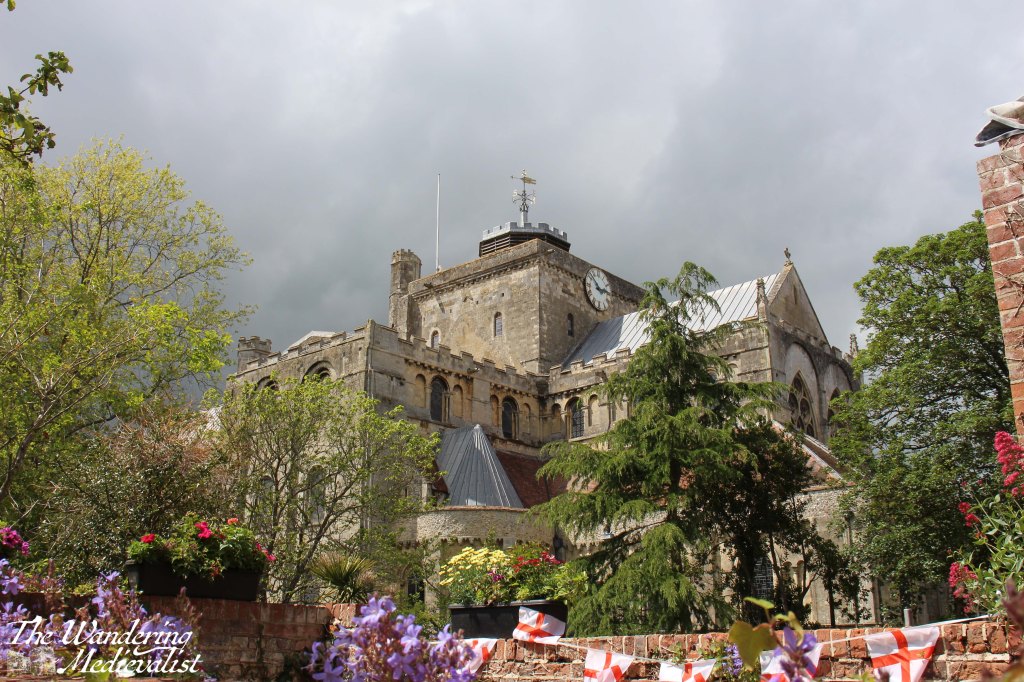
We also travelled south to visit friends for Eurovision weekend. As always when we visit Romsey, we went on a long walk through the medieval parts of the town, where the gardens are always stunning. Many happy memories.
Driving back from Oban, we enjoyed a day of almost perfect weather. We stopped at the Stalker View café and this perfect view awaited us. I love the hint of rhododendron in the corner.
While I have hundreds of pictures of this view, this one reminds me of a very special day – the end of final exams celebration for a student I worked with for years. She fought long and hard to get to this day, and I was so proud to see her soaking wet and grinning. (a St Andrews tradition)
We had a near perfect day in Oban when we first arrived – stunning blue sky and bright sun. This picture seems to cover it all – the monument on the hill, the harbour and the distillery and high street.
I positively fell in love with the rock-lined sandy beaches of Mull. How could you not?
This was our lunch view, looking over clear water with bobbing sailboats reminiscent of the Caribbean. But on Iona. Reminds me of a peaceful and moving day on the ancient isle.
June in Scotland is all about flowers. These lightly pink blossoms line the streets and woodland paths, and I love them.
One day in June, I sat in my in-laws’ garden and took pictures of the birds. Their garden is always full of feeders and birds of every kind, and this photo in particular is in memory of my father-in-law.
July was the first month of travel with my new job, and I found that I really loved the city of Toronto. This picture seemed to encompass both the old and new feels of the city.
The V&A Museum in Dundee held a fascinating exhibit on kimono, both old styles and new. It was beautifully presented, and I loved this mirrored display.
The pinnacle of summer in St Andrews is the Lammas Market. Held on the last weekend before kids return to school, a fun fair fills the streets of the town in an event that is somehow both very modern and incredibly ancient in feel. I have always been fascinated by the juxtaposition of old stone buildings and bright garish rides.
I travelled a lot in September, starting off with a trip home – I had not been home in September in many years and I almost forgot how beautiful late summer in New England can be. Almost. And of course this view is one of the best in Marblehead.
This was also my first 9/11 in the US since 2001. It was incredibly moving for me to be in a school on that day and learn how the teachers were ensuring the next generation remembered the day with the same poignancy as those who lived through it.
One evening, I drove from Houston to Dallas. It was a great drive and I loved this totally deserted rest area where I stopped for a short break. No question I was in Texas.
In the otherwise rather standard hotel I stayed in, they offered Texas-shaped waffles on a Sunday morning. The epitome of Texas and the US. Made me so very happy.
I love a good churchyard, and this one in Dunvegan on Skye was both old and beautifully kept.
Sunset on Skye. Seldom gets better, and this will always remind me of the little cottage in which we stayed, overlooking the fields and water.
On this stunning clear night, I stood outside with my camera for almost an hour playing with settings until I managed to get them just right. Sheep in the nearby field were baaing their impatience with me, but otherwise it was totally silent and peaceful. Heaven.
It is always nice when the sky is blue, but the Highlands lend themselves just as well to clouds and partial sun. I loved this view of rocks, loch, hills and ocean beyond.
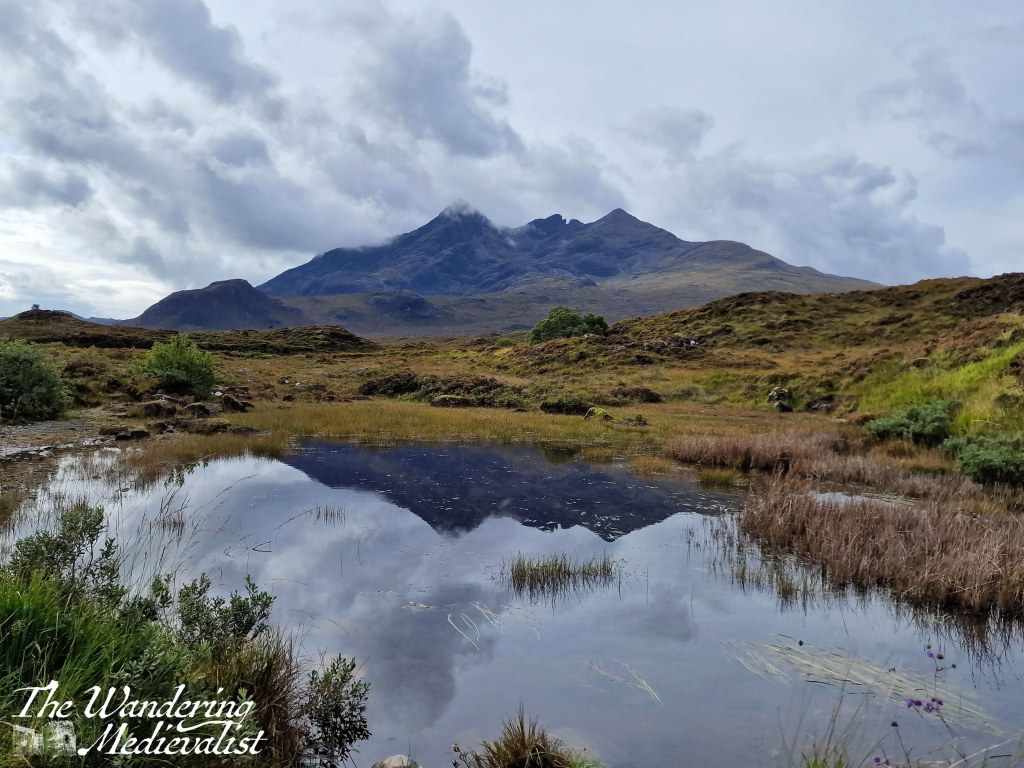
That said, the day we started our drive home was sunny and gorgeous, so I could not resist a stop at Sligachan Bridge, which had been overcast on our last visit. I pride myself on staying dry while managing this under-the-bridge picture of the distant Cuillins.
October was an another busy month of travel, including my first ever visit to Southern California. This picture, taken out of my hotel window on my first night in CA, was a precursor to a really great – if busy – trip.
I found myself drawn to the Californian mountains. They were rugged like the Highlands but dry in their starkness. And stunning in the evening light.
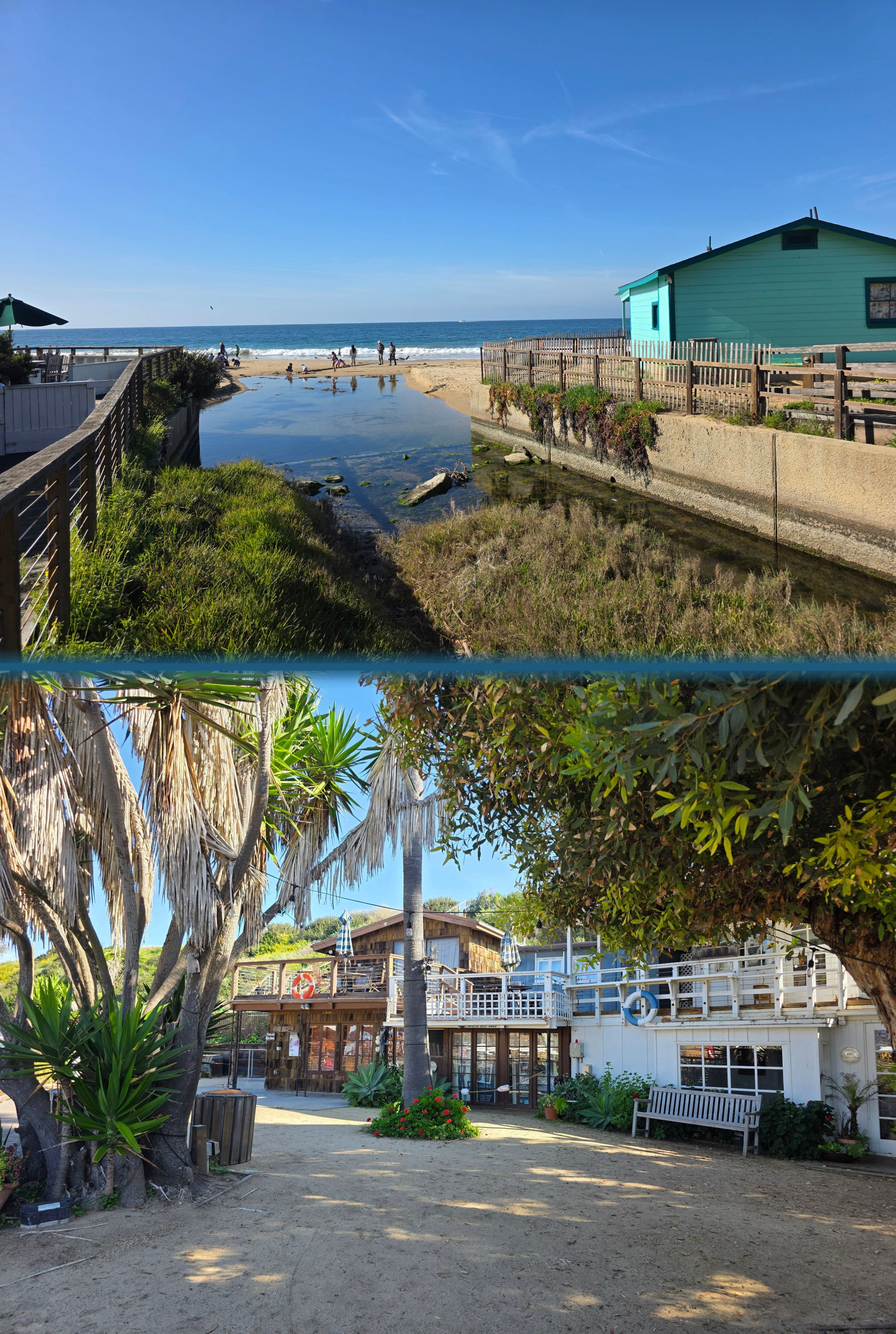
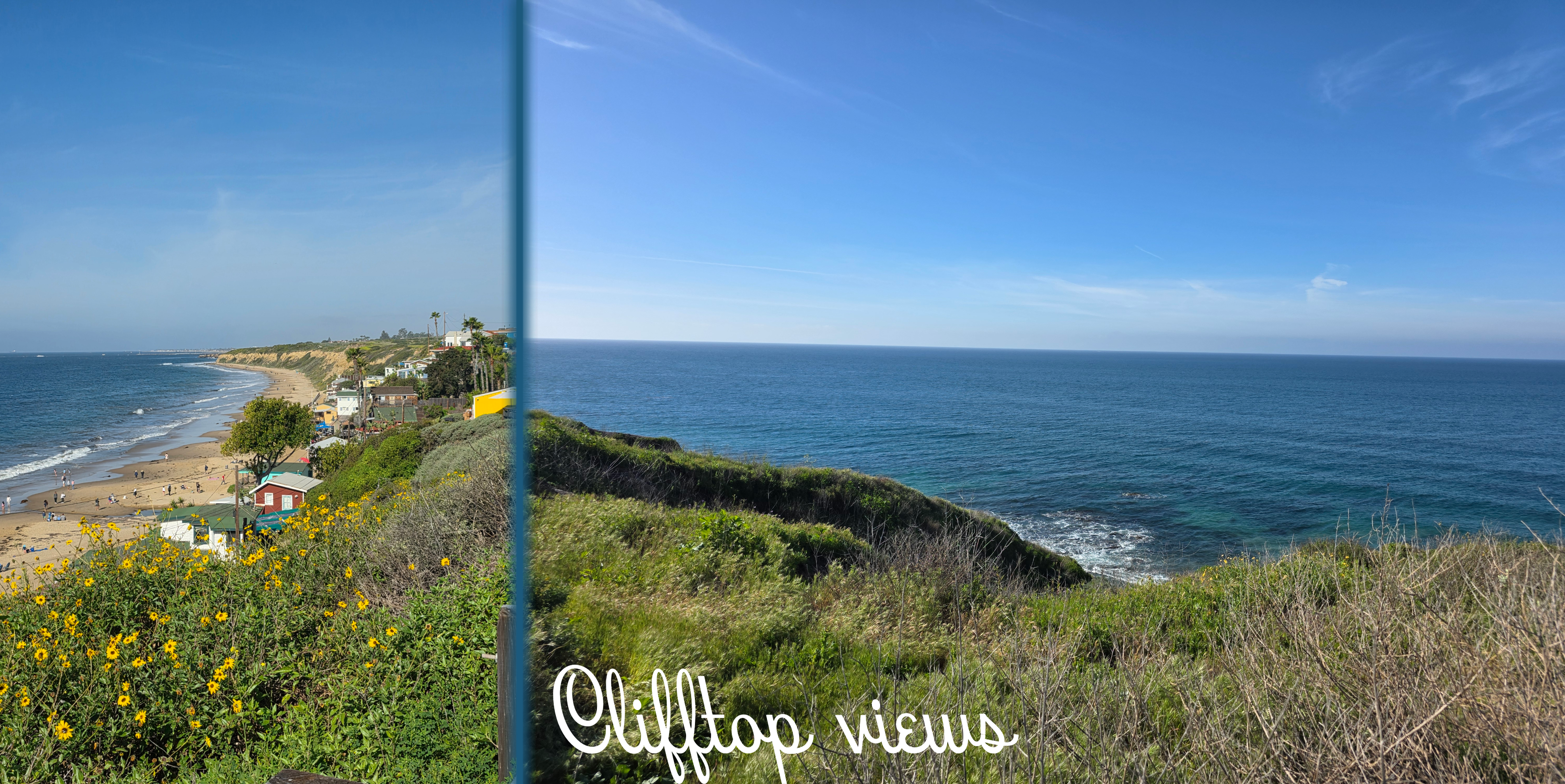
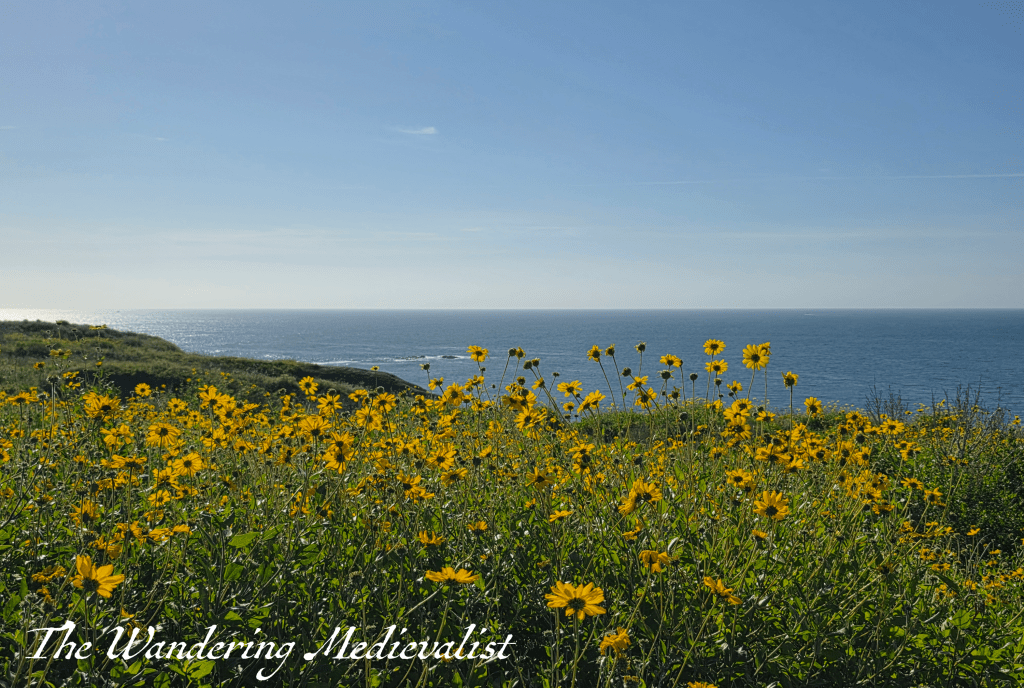
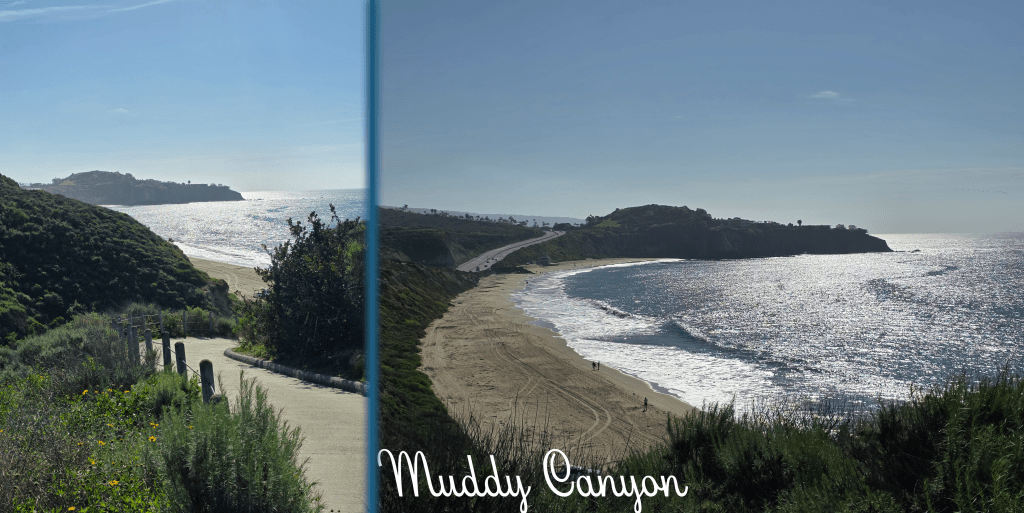
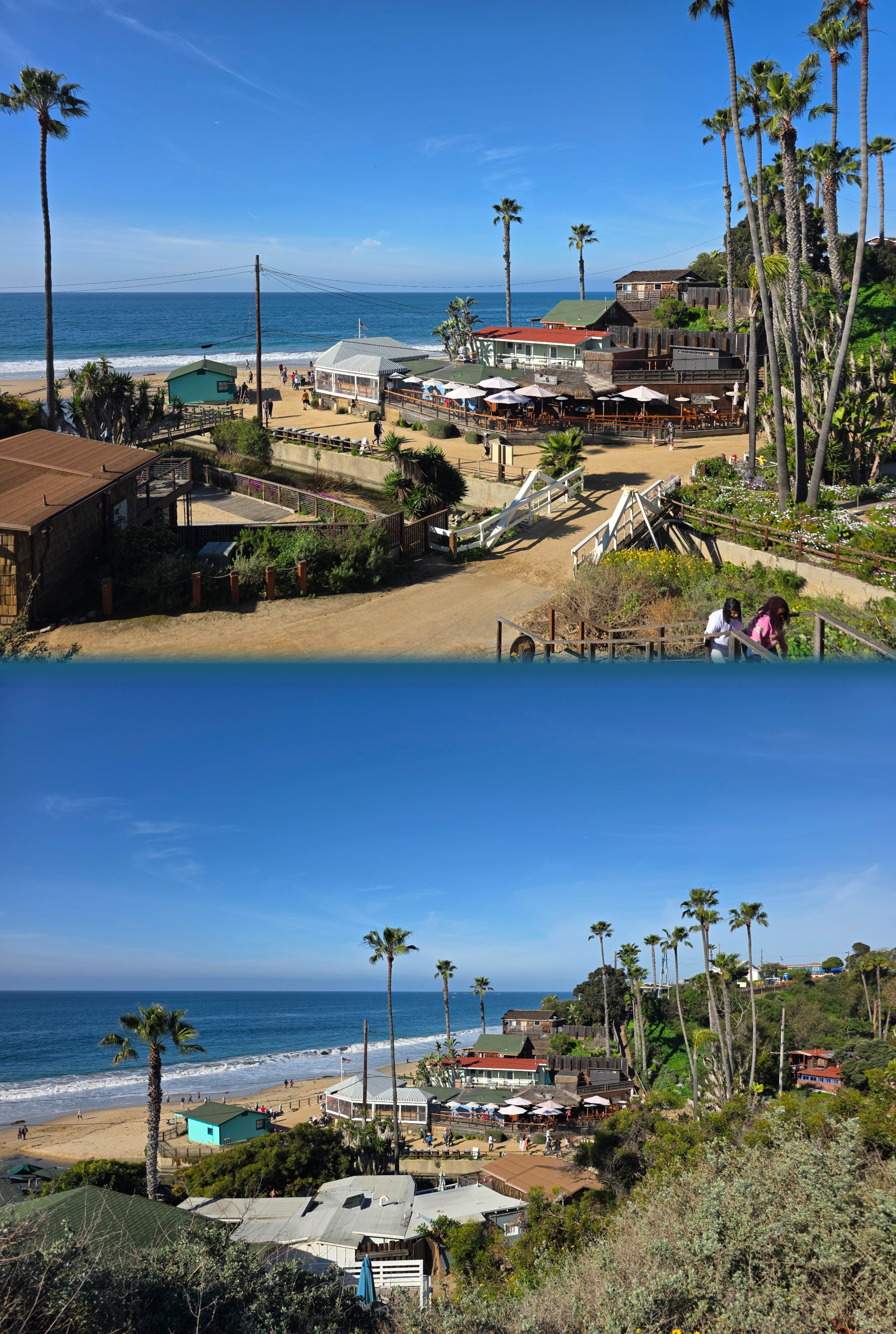
As I recently wrote about, one morning I took myself on an adventure to Laguna Beach. I was entirely on my own and knew nothing about where I was going, but had a wonderful morning in the sun. There were so many gorgeous pictures to be had, but this of the palms and sea and sand was my favourite.
Bangkok was a city about which I knew very little. I found myself fascinated by the architecture, the greenery, the heat, and even the BTS sky train. Always crowded, always hot, and often beautiful in the way only a city can be, Bangkok surprised me.
In one of the more surreal nights of this year, colleagues and I were taken on a river boat cruise in Bangkok. The night skyline was even more beautiful, and it was a magical night.
This is one of my favourite picutres of the whole year, encapsulating the elegance of the ancient temple and the bustle of modern Thailand. I completely fell in love with the city of Chiang Mai and hope I can return!
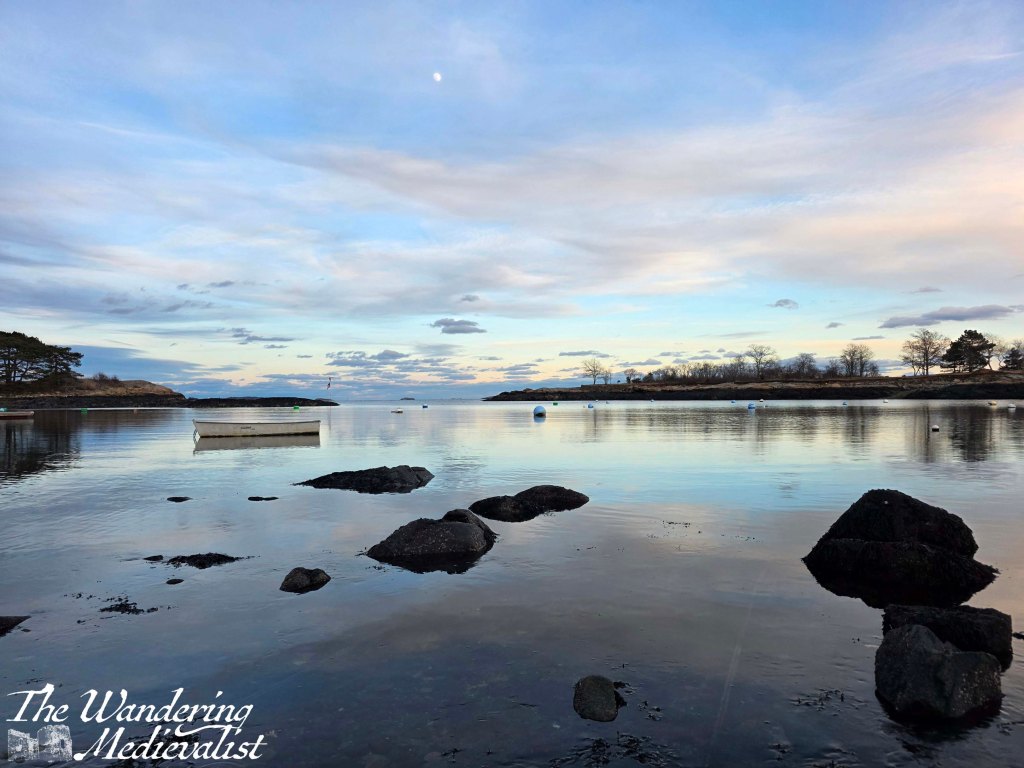
Finally, in November, I returned to New England to finally see the autumn colours (or tail end of them) and do my job in my home town of Boston. The weather was gorgeous, as the area was in drought, and I was there for the full moon. It was a fitting end to a year of lots of travel to new places, and plenty of opportunities for pictures.
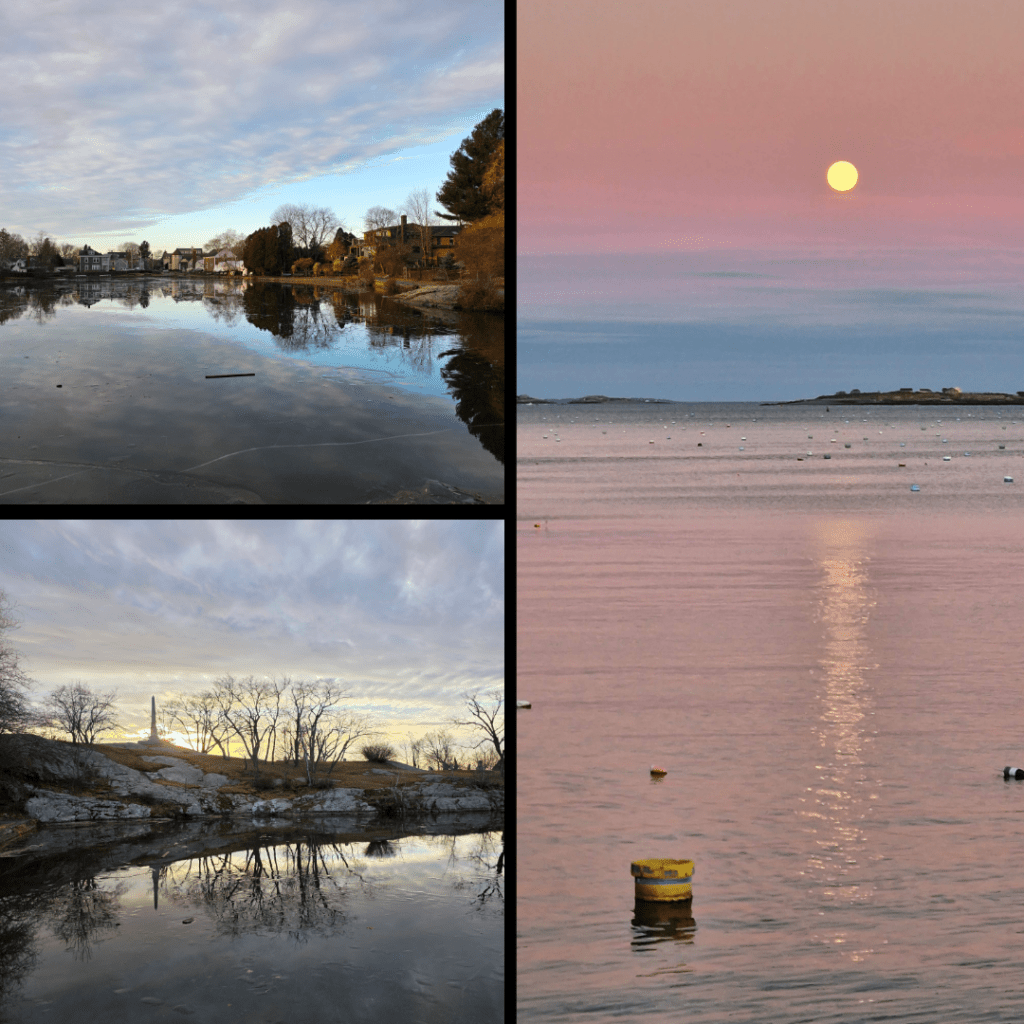
Clockwise from top left: Full moon rising over Marblehead harbour, a stunning tree at Worcester Academy, the statue of George Washington looking over the Boston Public Garden, a stunning red Japanese maple in Mt Auburn Cemetery, and Marblehead harbour at night.
I hope you have enjoyed this photographic trip through my year! Have you checked out my online shop yet?
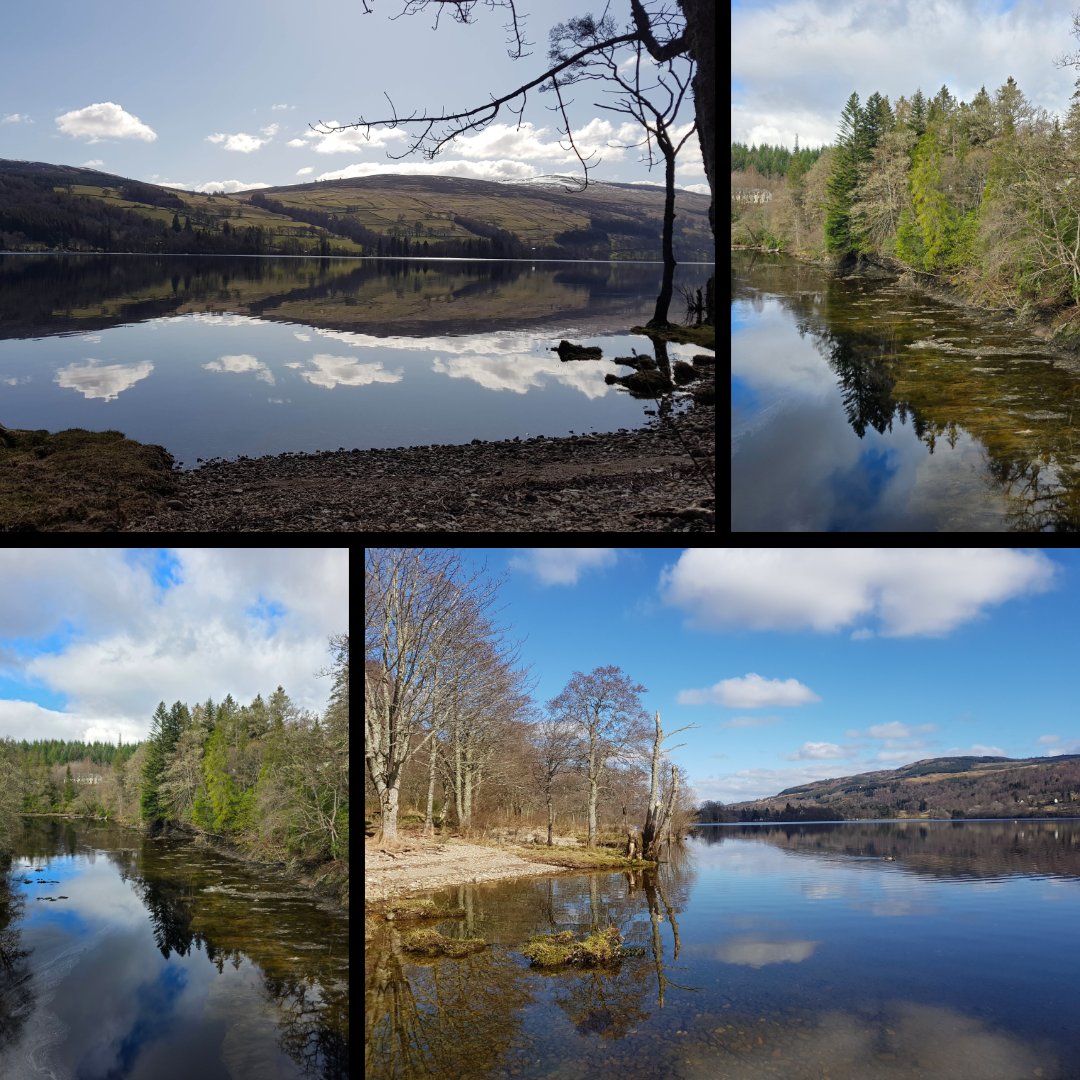
The Queen’s View over Loch Tummel in Perthshire is one of the most famous views in Scotland, and one of the most photographed. It is not hard, when visiting, to see why, though actually getting to the viewpoint can be a bit of a challenge.
Not, I should point out, because it is physically difficult to reach – on the contrary, there is a large car park (not free!) and well-maintained path that leads to the main viewpoint (though occasionally you must fight to the front for the best view). The visitor centre is closed, and have been since the pandemic, but the area roundabout is kept up.
Rather, it is the road to the viewpoint that offers a challenge.
The advantage of Perthshire is that so much of it is just stunning, and easily reachable from Dundee, Edinburgh and Fife. Pitlochry, the nearest town to the Queen’s View, is less that two hours’ drive from Edinburgh or Stirling, and offers oodles of options for accommodation: guesthouses, B&Bs, lower cost hotels, luxury hotels, and a camping and caravan park. Pitlochry is a regularly-used base for exploring the area and only 14 minutes from the Queen’s View.
What is the problem then, you ask?
Simply that the short stretch of road between the A9 and the view is one of the windiest and narrowest that you will find on a two-lane road. Further, you are competing for space not just with other cars, but with large camper vans and coaches that offer tours throughout Scotland.
I have now been on the road twice, once as a passenger and once as a driver, and both times I found myself clinging to the door handle and searching for an alternate route back. (Note, there are alternate routes via the other end of Loch Tummel, but they are also quite narrow and add considerable time to a journey). I feel I should point out that I am making this observation after having explored the Highlands, Skye and Mull, so not without some experience on narrow and winding roads.
Once you reach the car park, there is a short walk and then the view really is spectacular. When Queen Victoria visited the spot in 1866, she assumed that it was named in honour of her – a view to match her greatness. What no one likely told her at the time was that it was almost certainly named well in advance of her arrival, and for Queen Isabella, wife of Robert the Bruce.
Standing at the viewpoint, you are looking down Loch Tummel, almost due west, with the peak of Schiehallion, one of the more popular hiking mountains in Scotland, in the distance. Even further, one can just make out – on a clear day – the mountains of Glencoe.
As you can see, the view is phenomenal in the sun but just as atmospheric in the cloud and rain; visiting earlier in the year may also mean less foliage growth between you and the water.
If the view has only whetted your appetite for Loch Tummel and the surrounding hills, I highly recommend continuing only minutes along the road to the Allean Forest, where there are two hiking loops you can follow up into the trees.
The car park is sizeable, and there is even a toilet block – warning though that it is a latrine that was far from well kept when I last visited. It was a ‘medieval’-style experience that I could well have done without. My hope is that in the years since the end of the pandemic, the facility has been improved.
Of the two available loops, one is shorter – about an hour – while the other is more like 1.5 to 2 hours in total. Both start off in the same way, climbing away from the car park through the trees and leading to several viewpoints over the mountains and down the loch.
We did this hike in August, so the greenery was lush and at its height, though many of the spring and summer flowers had passed. It was not a hugely challenging hike but did have a decent amount of gradient, and my father decided he wanted to opt for the longer route. This turned out to be an excellent decision, as it took us past the ‘Family Circle’, ruins of an Iron-Age stone wall that enclosed a timber roundhouse.
The appeal of this area of Perthshire clearly runs back at least 2000 years, as the plaque by the circle told us that this area of Scotland features more settlements of this type than almost anywhere else in the country. Excavated in the 1970s, the site shows evidence of being used in more recent times as well, for ironworking and drying corn or grain.
This particularly intrigued me, as family research I have done indicates that at least one branch of Scottish ancestry (don’t all Americans have at least one?) came from the area around Loch Tummel. It is a romantic thought that the area appeals to me because of that family connection – I have always loved the Loch Tummel and Pitlochry area – though it is also stunningly beautiful, as these pictures show. Perhaps it is a bit of both.
Loch Tummel from a bit further down,
While the Queen’s View is a natural tourist draw and invites visitors from all over the world, the hills and forests around Loch Tummel are a recommended addition for walkers and hikers. They are not as challenging as many others, and the views are not as dramatic as further north, but the proximity to Pitlochry makes Loch Tummel a good place to explore. A few recommendations if you are attempting this journey are to ensure your driver is confident and comfortable on narrow roads, and to bring your own snacks and refreshments – the closest place I could find when visiting was Pitlochry, though new locations may have opened up since then.
When living in a country where dark is so prevalent in the winter, one must be willing to accept and even embrace the night sky and the often stunning light that comes after sunset.
In St Andrews, the streets and buildings are illuminated not just by street lights but by displays specifically designed to accentuate the stunning nature of the architecture. In fact, in most towns and cities now there is always light after dark, ensuring that visitors – and photographers – can continue to enjoy the sights and get from A to B.
In recent years I have become increasingly fascinated by the moon and stars. For more than a year now I have been trying to really capture especially the stars, a feat much tricker than it may appear, and one that has left me with hundreds of shots of a mostly black sky. But I am learning with each attempt, and each night I stand in the cold and try to get it right.
Night can be a fascinating time to capture your favourite daytime spots – I hope you enjoy some of my efforts to do so!
Boston, Massachusetts, USA 🇺🇸
There is a lot to love about Boston at night, though I particularly love the winter lights. When I was young we used to drive into the city every December to see the Nutcracker ballet, and I recall with utter clarity the wonder of driving past the Common to see the trees festooned with lights and every lamppost adorned with a Christmas decorations. The ‘Christmas’ nature has widened to encompass all holidays, and the lights are still stunning.
City view from Christopher Columbus Waterfront Park.
Carcassonne, France 🇫🇷
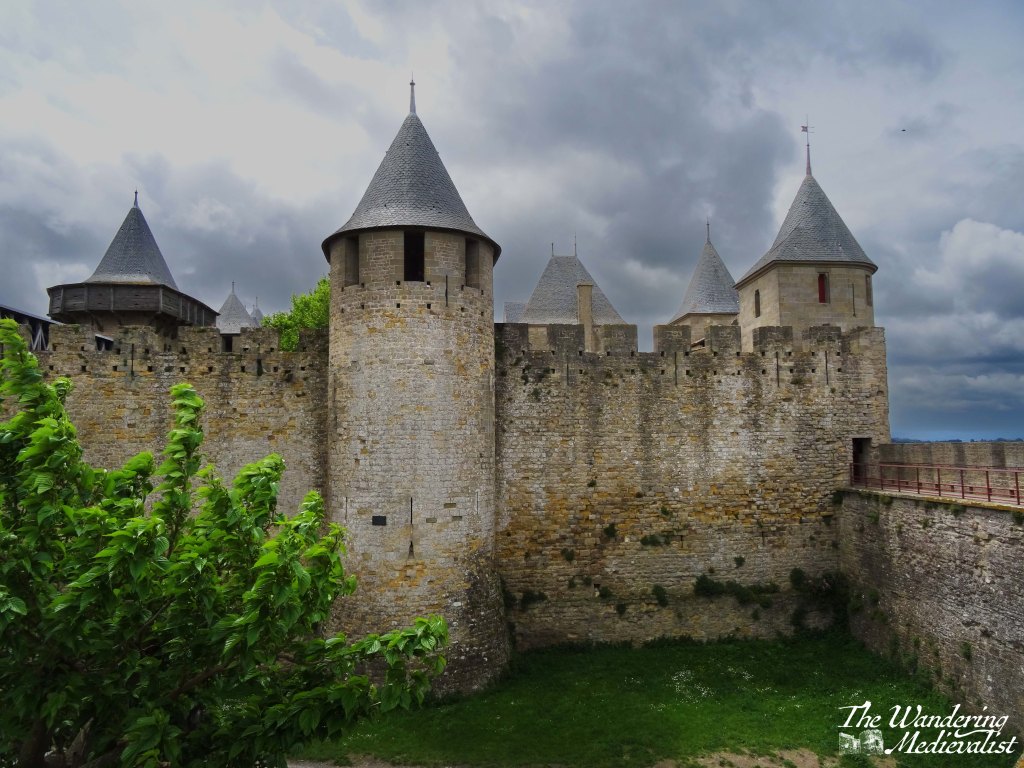
I consider myself so lucky to have been able to visit Carcassonne and to have found a hotel in the newer part of the city with a spectacular view of the medieval town. At night, it was almost more magical than during the day.
Edinburgh, Scotland 🏴
As anyone who has routinely read my blog is aware, Edinburgh is one of my favourite cities, second only to Boston. It is almost absurdly picturesque, both old town and new, and boasts some incredible Christmas decorations, particularly around the German Christmas market.
Panorama of Princes Street from the castle
Marblehead, Massachusetts, USA 🇺🇸
Whenever I visit home, I make an effort to walk around the town at least two or three times each trip, and an evening wander home from dinner or a drink with a friend is a great opportunity to capture the town at night. I am also inevitably either welcomed back or given a send-off by the Logan Airport flight path, which passes almost directly over Marblehead, allowing for some great sky shots – who needs a drone when you have Aer Lingus?
Little Harbor
Marblehead from an Aer Lingus flight
State Street
Puerto Rico 🇵🇷
Night in the Caribbean can be a very different place than anywhere else; it is seldom quiet, and I find very seldom as dark as anywhere else. Perhaps because there are often many people about, perhaps due to reflection of the moon and stars off of the water, or perhaps something to do with the warmth.
Ponce, Puerto Rico
Fajardo, Puerto Rico
St Andrews, Fife, Scotland 🏴
I have spent a great deal of time in St Andrews, after dark as well as before, and so I have hundreds of pictures of the town at night. These are just a few of my favourites.
The Moon at night 🌚
I defy anyone to take a walk at night during the full moon and not stop, just once, to wonder at it. I have become so obsessed with capturing the full moon that I even have it marked in my calendar. At this time of the year, near the equinox, the moon is often in the sky during the day and offers a perfect opportunity to capture it; but that is not the point of this post. Mankind has been fascinated with the moon for generations, even more so since we actually went there…I personally am continually surprised by how clear it can look even just to the naked eye.
And the stars… 🌌
Taking clear, atmospheric photos of the stars requires a spot with as little light pollution as possible, a tripod, plenty of time to try different settings, and some knowledge about how to edit the products of your time. I’m getting there, though I’ve got a way to go to equal some of the spectacular professional shots one sees online.
This one was taken on my phone with a night setting, so feels a bit like cheating.
If you open this one up, you should just be able to make our the Orion.
The night sky in Skye – so little light pollution up north!
Finally, I’ll wrap up with a sequence of pictures I took one evening as the moon rose; I’ve mashed them all together, and I hope they provide even a touch of the awesome nature of the full moon.
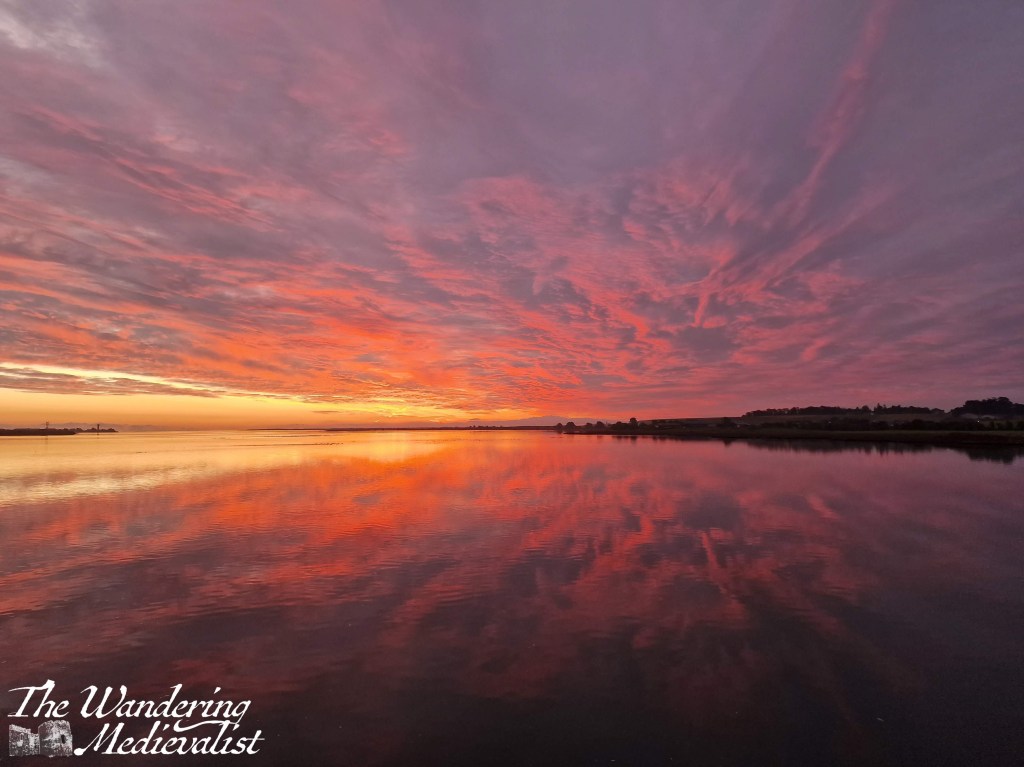
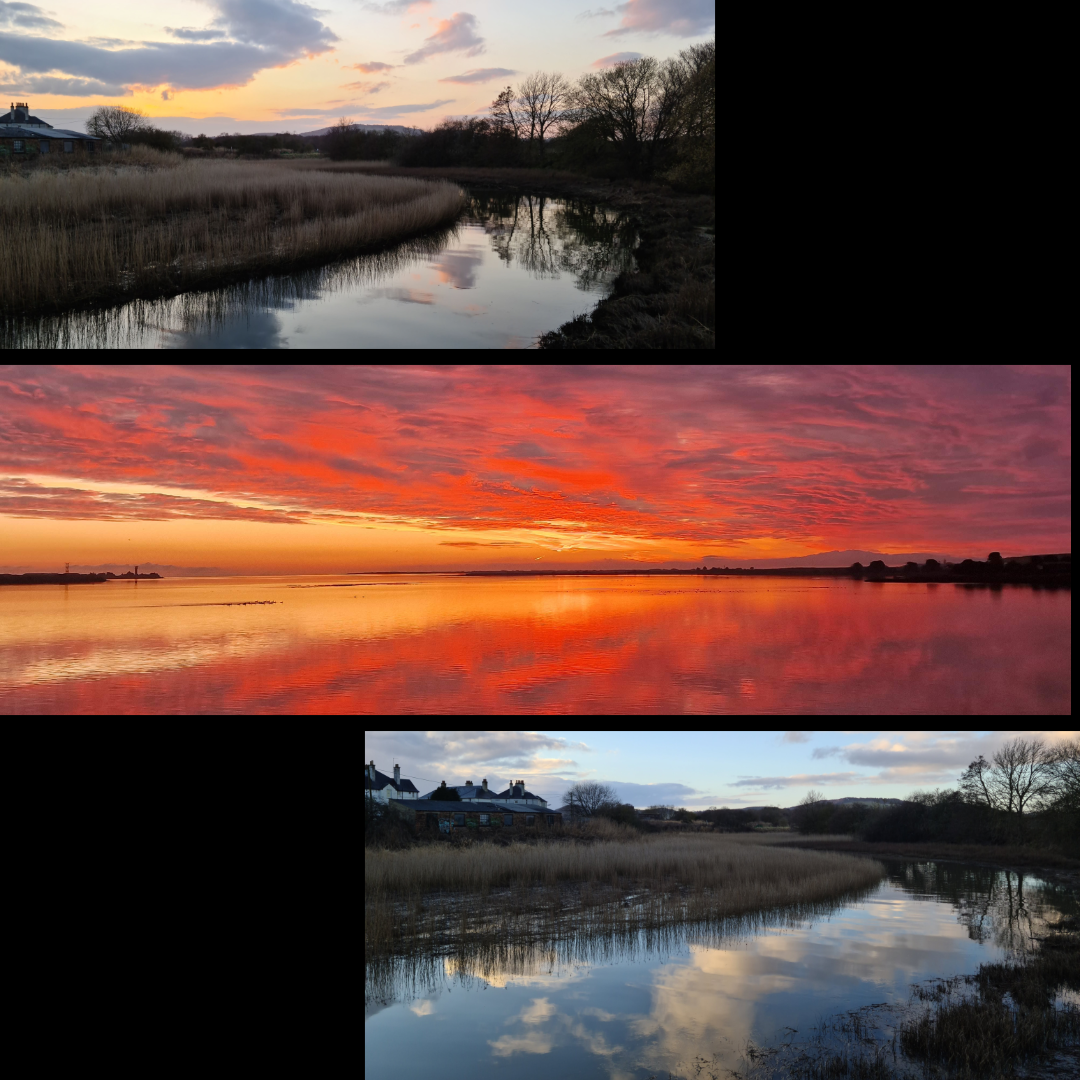
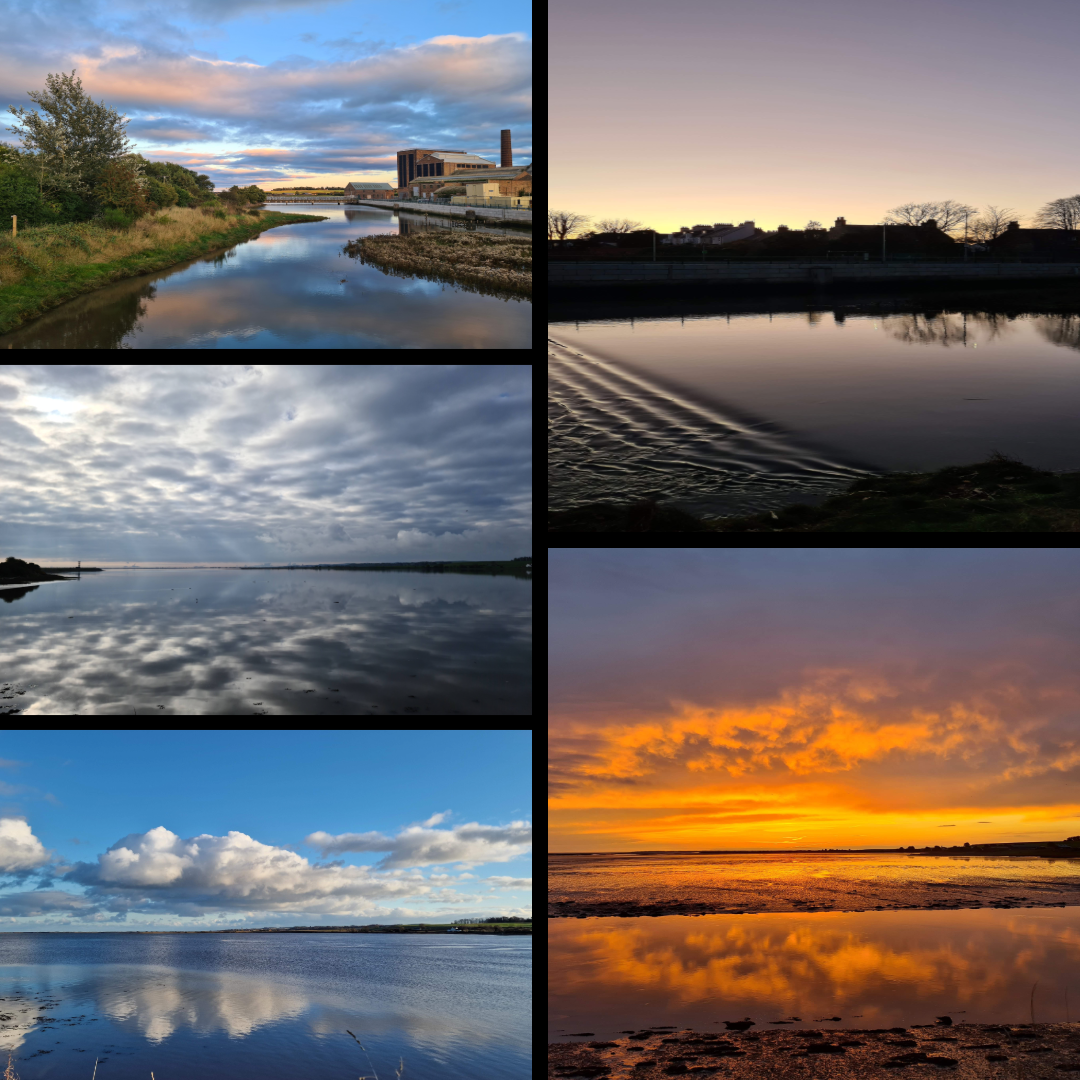
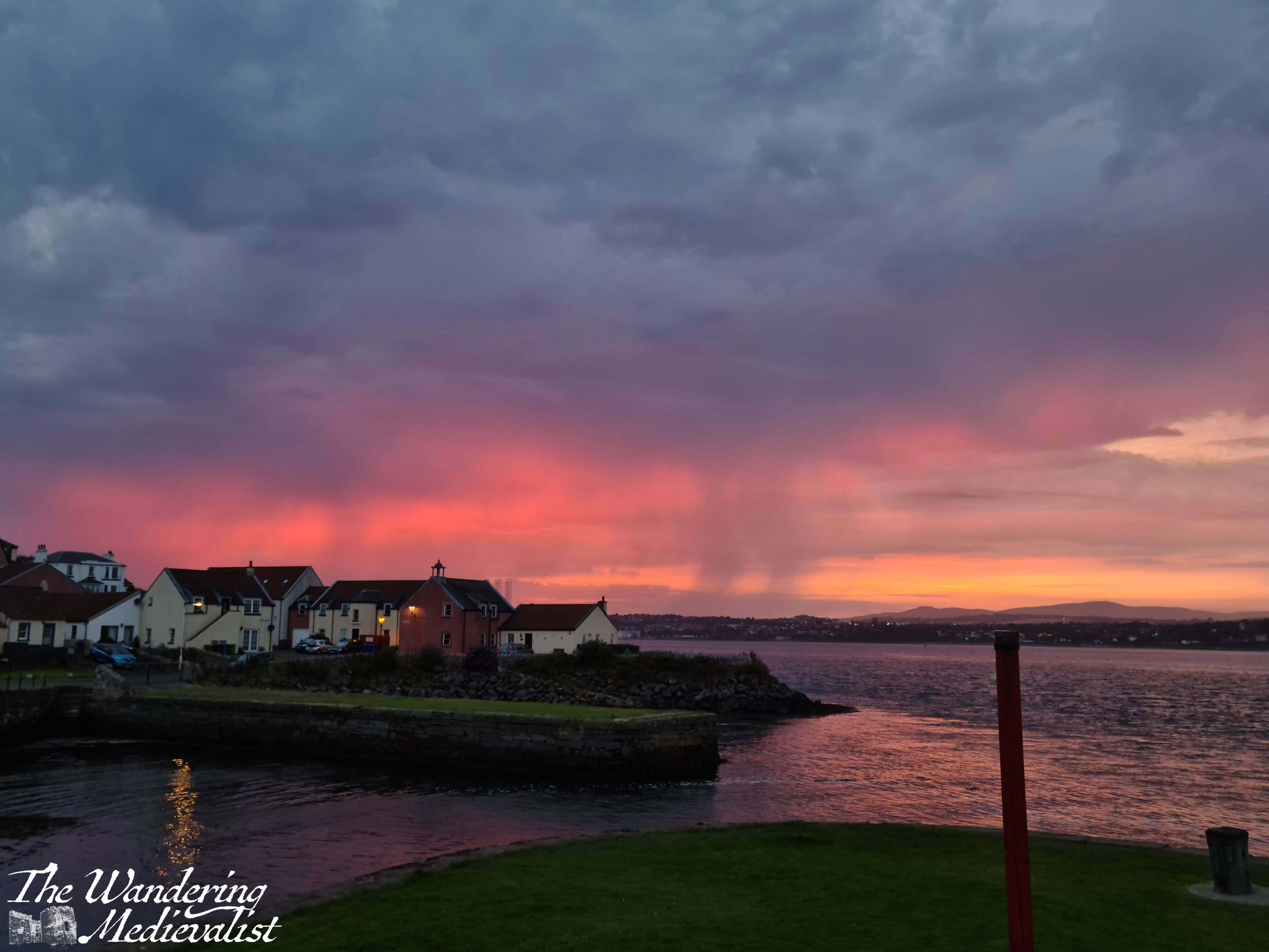
Throughout the many depressing months of lockdown, a morning or evening walk was often the time to which I clung to relax and refresh my mind. Few things helped more than stopping before a beautiful yellow-orange-red sky, catching a glimpse of some distant pink, or watching the sky fade into purples and dark blue. I have always loved getting up early to catch the start of the day.
The thing about sunrises and sunsets is that you can never really be sure when you’re going to get a good one. Some mornings or evenings you’ll be out there with your camera ready and the colours just won’t appear, and everything fizzles away. Then other days you’re walking or driving home from work or on the bus and suddenly colour appears in the sky that is just so spectacular it should have its own symphony. To a great extent it’s all about being lucky, being in the right place at the right time and then of course being ready to capture the colours if you can. Though there is also, of course, an element of persistence, going out whenever you can, and even trying to read the clouds. I by no means claim to be an expert at this. Some days the colour is earlier than you think, or later, or even in a part of the sky you did not expect. You can never predict it perfectly.
But once you do, and you get the pictures you want, it is always worth taking a few moments to just enjoy the peace, and the drama.
Fajardo and Vieques, Puerto Rico 🇵🇷
Caribbean sunsets and sunrises tend to be surprising – they are either spectacular and dramatic or sometimes a touch underwhelming. Dawn and dusk come with less speed than in other parts of the world, moving slow in the heat that never really fades even at night. I have been lucky enough to experience quite a few of both over the years, and I have developed a bit of a fascination with pictures of sunlight through palm leaves.
Glencoe, Scotland 🏴
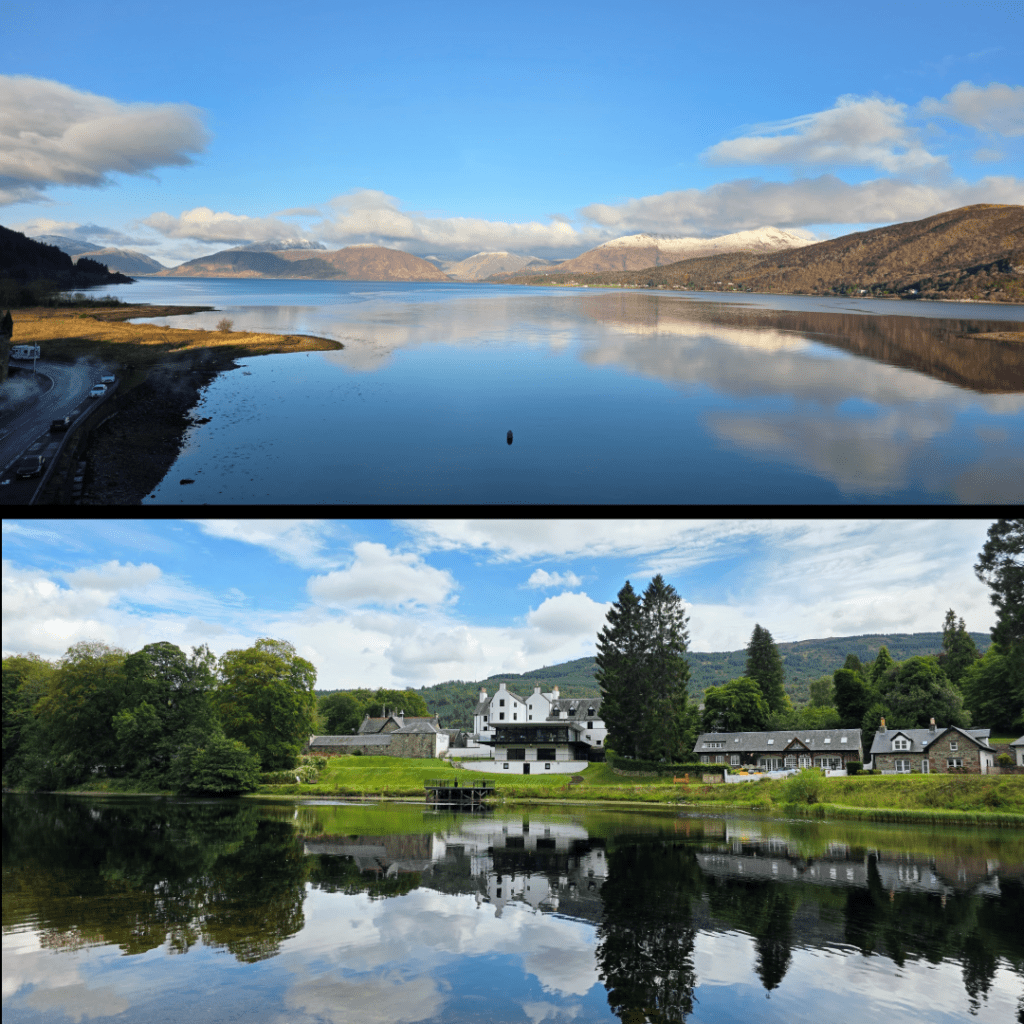
My favourite place in the Highlands, Fort William, is not overly well-situated for sunsets, as mountains block the sun well before it hits the horizon. A bit further south in Glencoe, however, Loch Leven runs almost due west and allowed for these stunning pictures one April evening.
Guardbridge, Fife, Scotland 🏴
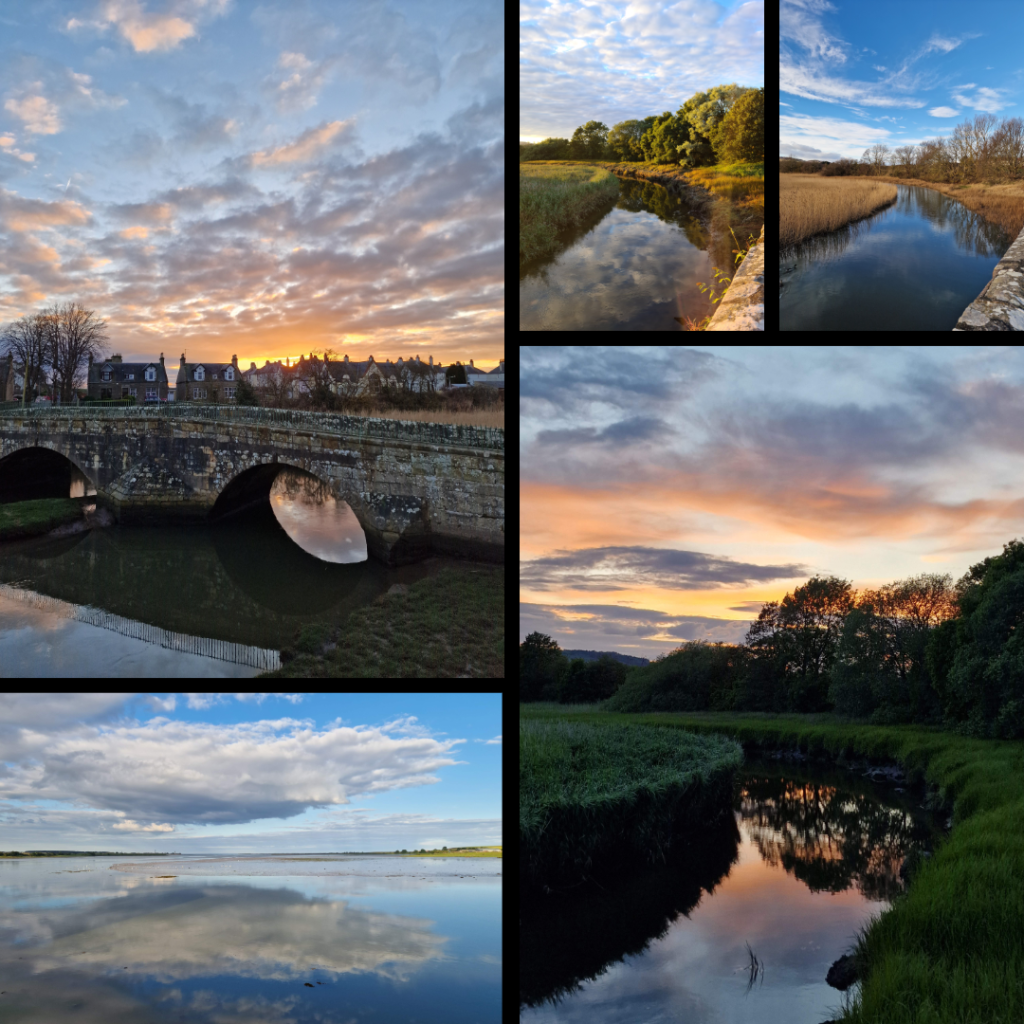
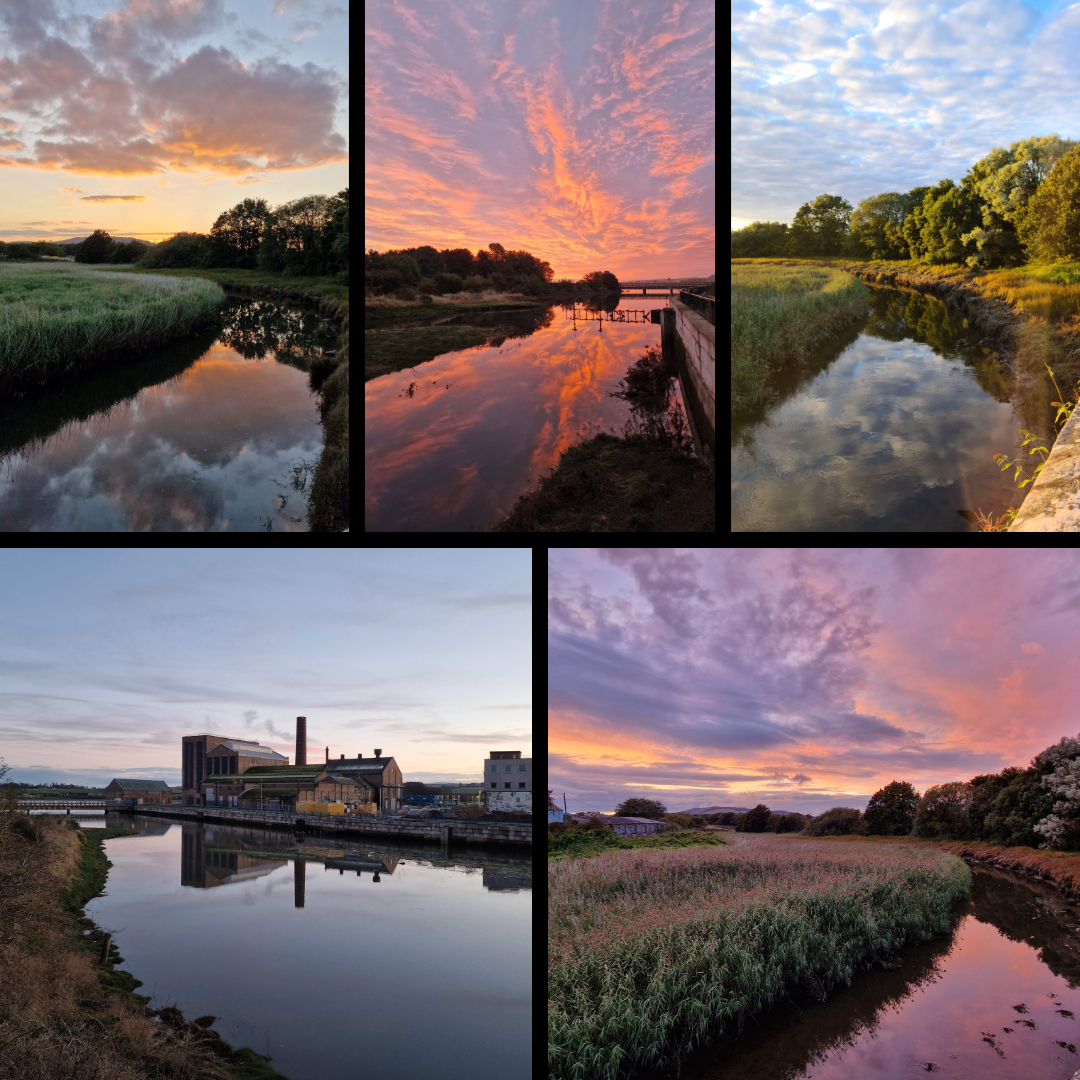
In 2021 as lockdown really took hold, I made it a point to go out for a walk every weekday morning before work, even in the rain and snow. My route included a breathtaking vista across the Eden Estuary towards St Andrews, where the church towers and cathedral ruins punctuate the skyline. Often flocks of birds and even local deer made cameos in these pictures, as well,
Marblehead, Massachusetts, USA 🇺🇸
Marblehead is a perfect spot for colour at both ends of the day, with sun rising over the Neck or mouth of the harbour, and setting over the causeway and old town. In recent years, jet lag has allowed me to capture some gorgeous sunrises particularly in winter.
St Andrews, Fife, Scotland 🏴
Top of the list of beautiful settings with castle and cathedral ruins, University buildings, wide beaches and dramatic coastline that sheds in layers into the sea, is St Andrews. I have no shortage of pictures of sunrise and sunset; here are a few of the best.
Tayport, Fife, Scotland 🏴
We did not live in Tayport for very long, and a good portion of the time we were in Covid lockdown, but we were fortunate enough to have a fantastic view from our kitchen. I was known on more than one occasion to throw a coat or sweatshirt on over my pyjamas to rush down to the harbour, to get these pictures across the Firth of Tay.
And a few more…
This sunrise lives in my mind as one of the last before lockdown started…taken from the Tay Rail Bridge in March 2020 as a colleague and I travelled to Edinburgh. Sunrise from the train to Edinburgh – I always sit on the left side of the train to enjoy the views across the Firth of Forth, particularly in the morning.Glenrothes sunset.
Sunset on the Isle of Skye.Sunset over the Charles River, Boston.Sunset on the Lomond Hills.
Finally, I’ll wrap up with one of my favourite views at one of my favourite times of day and year – icy sunrise over St Andrews.