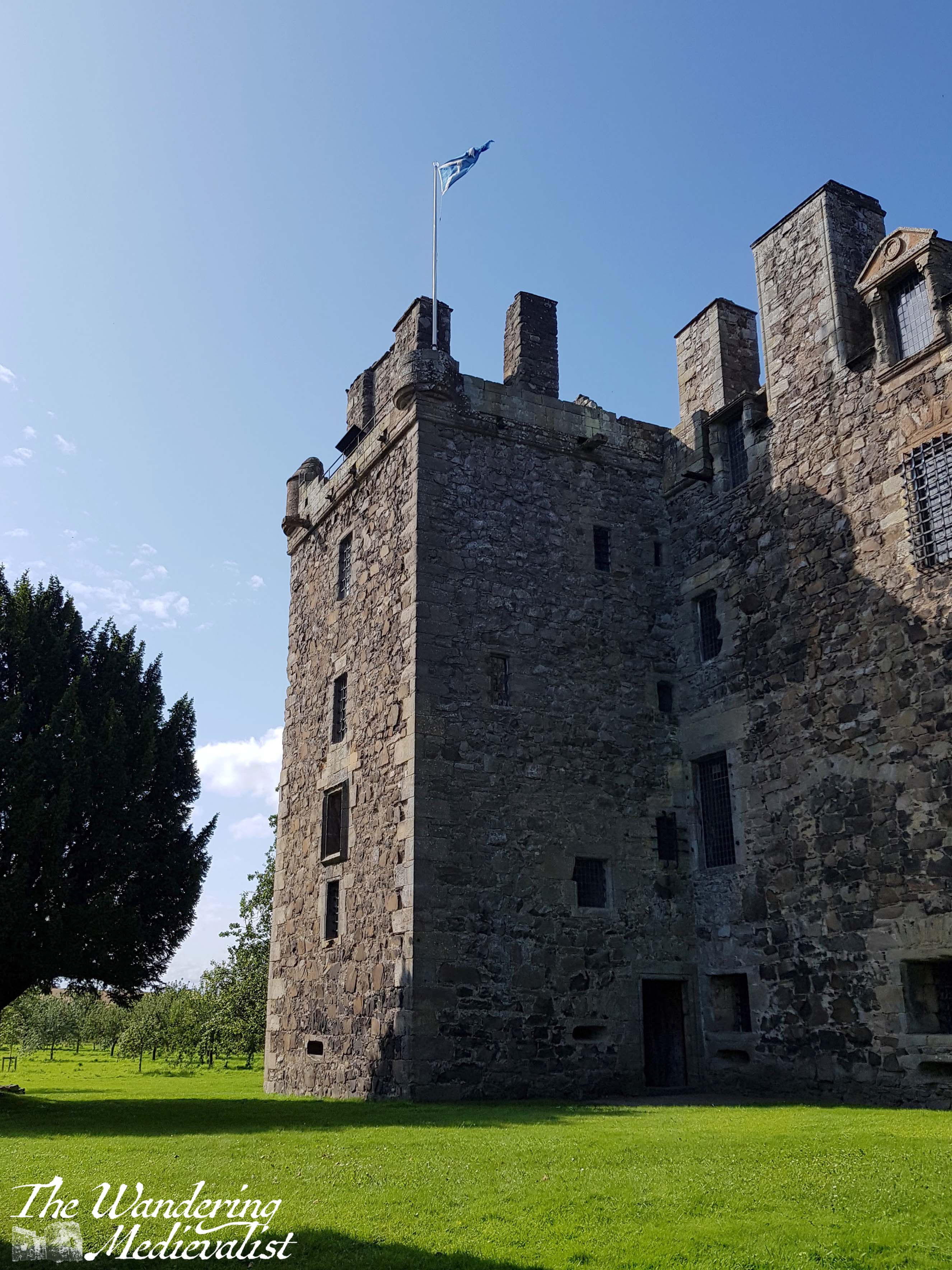
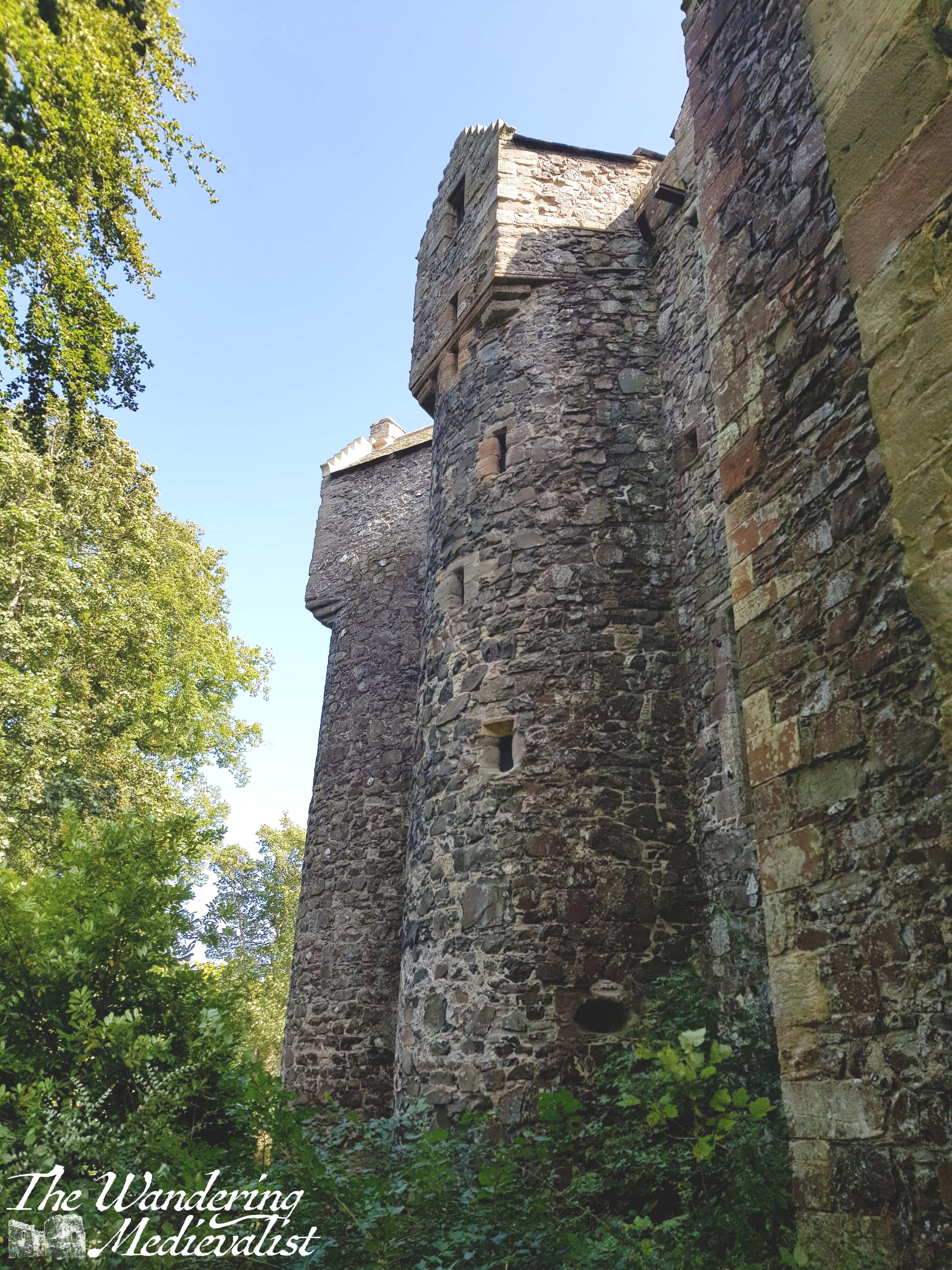
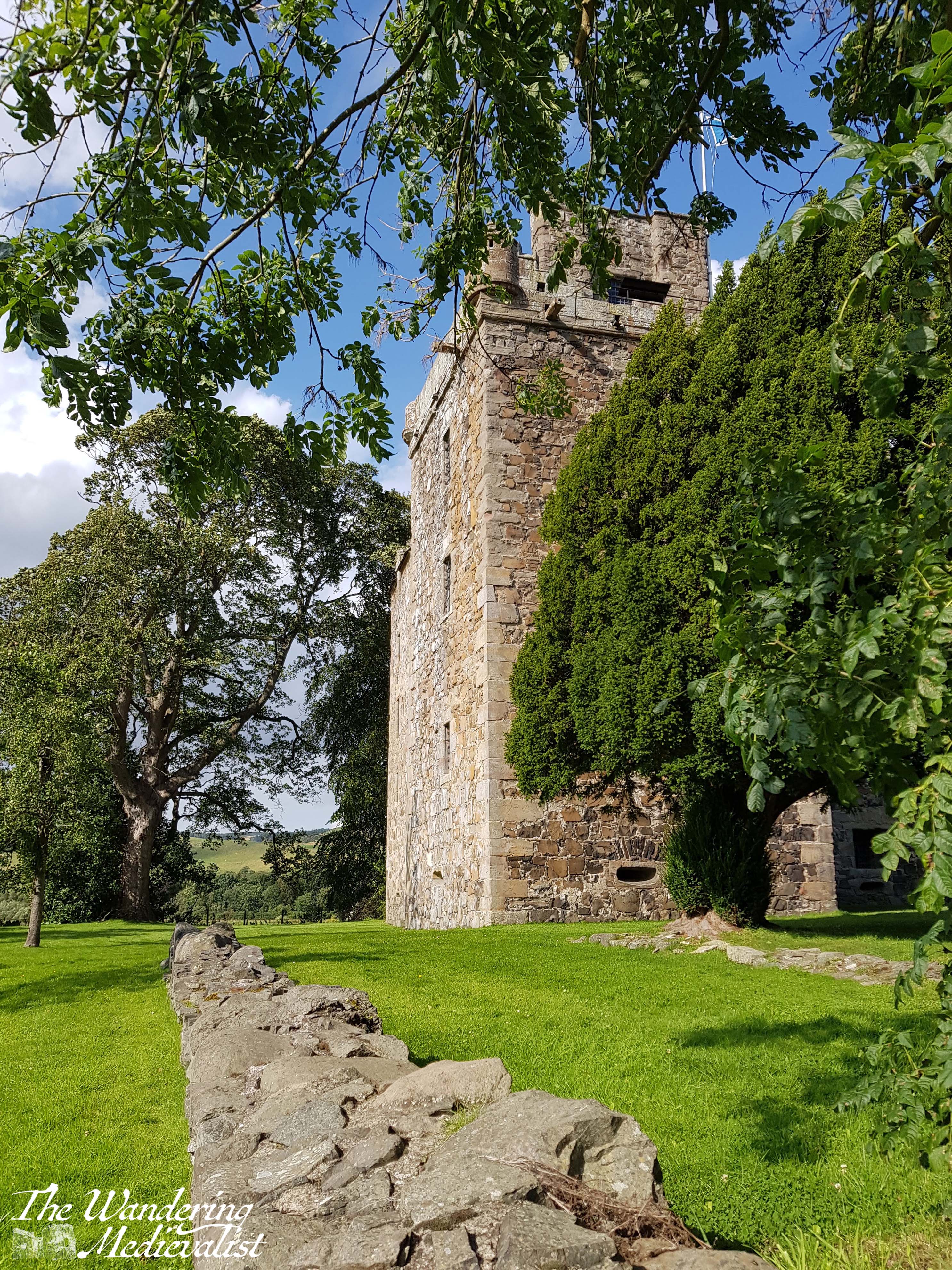
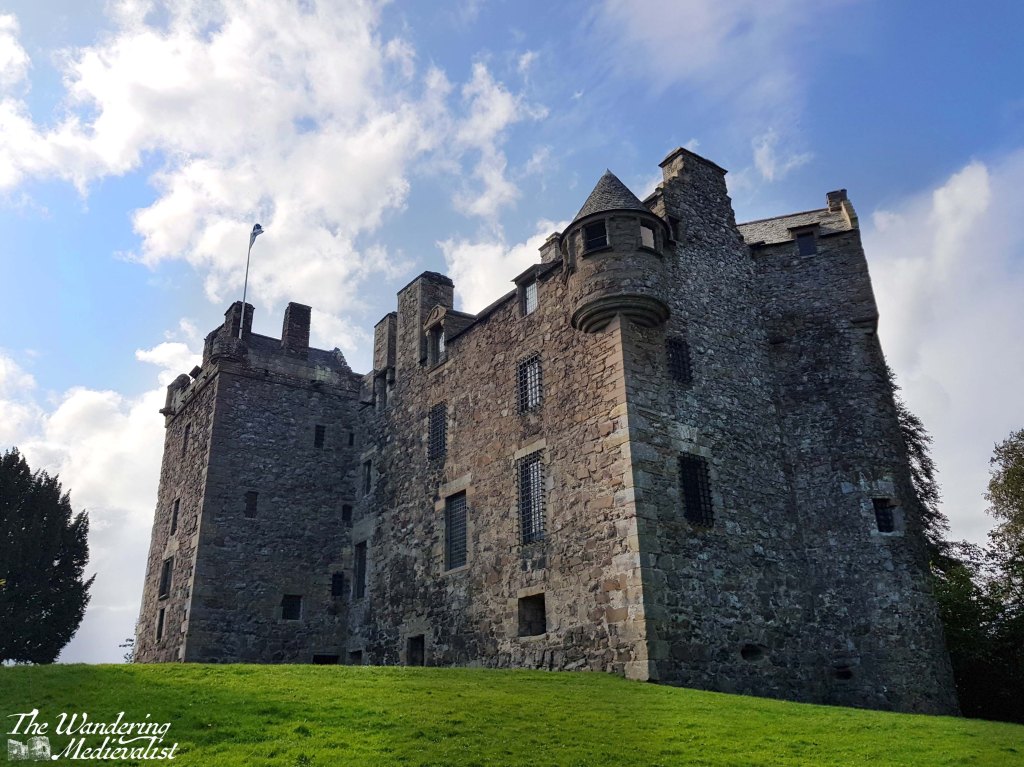
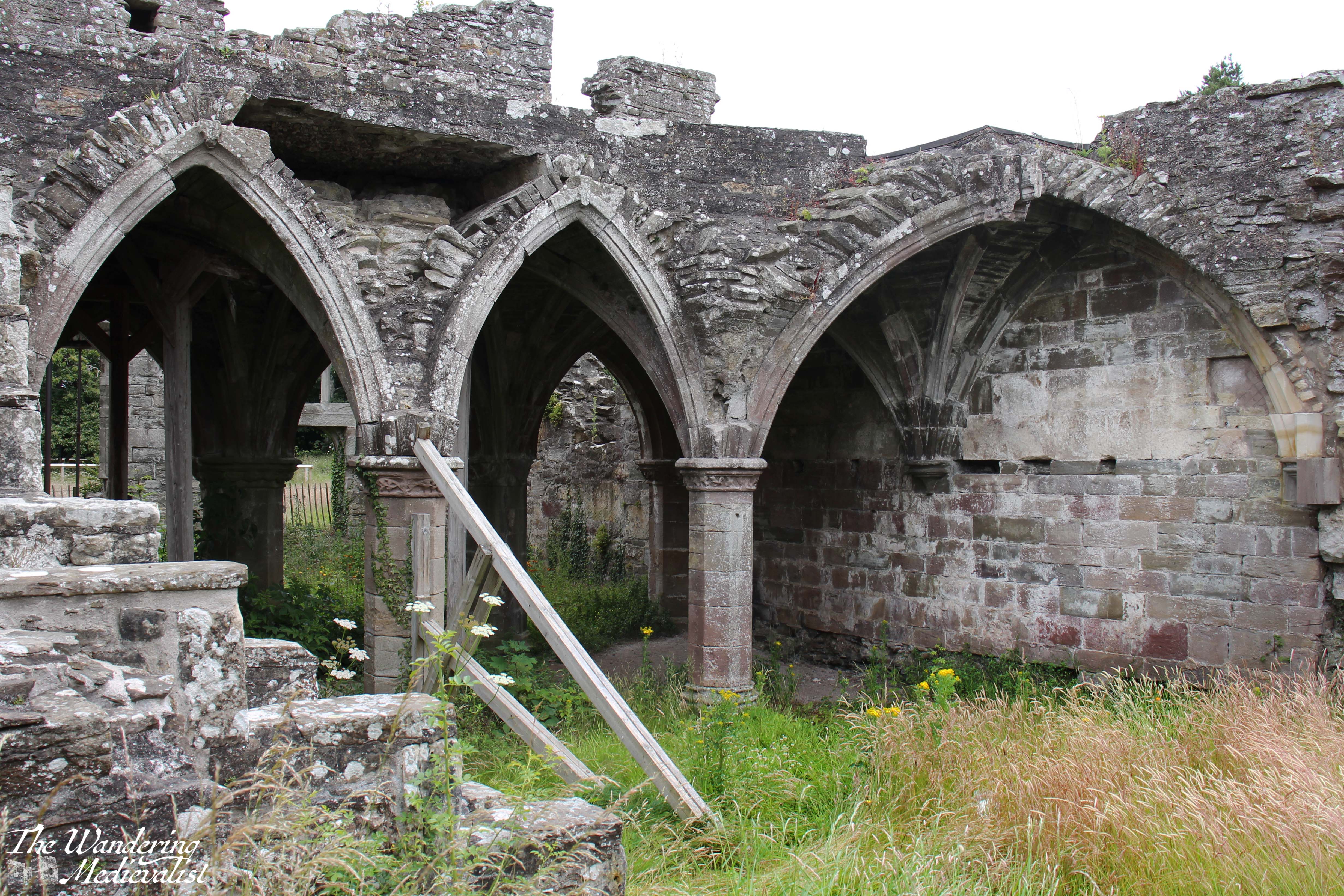
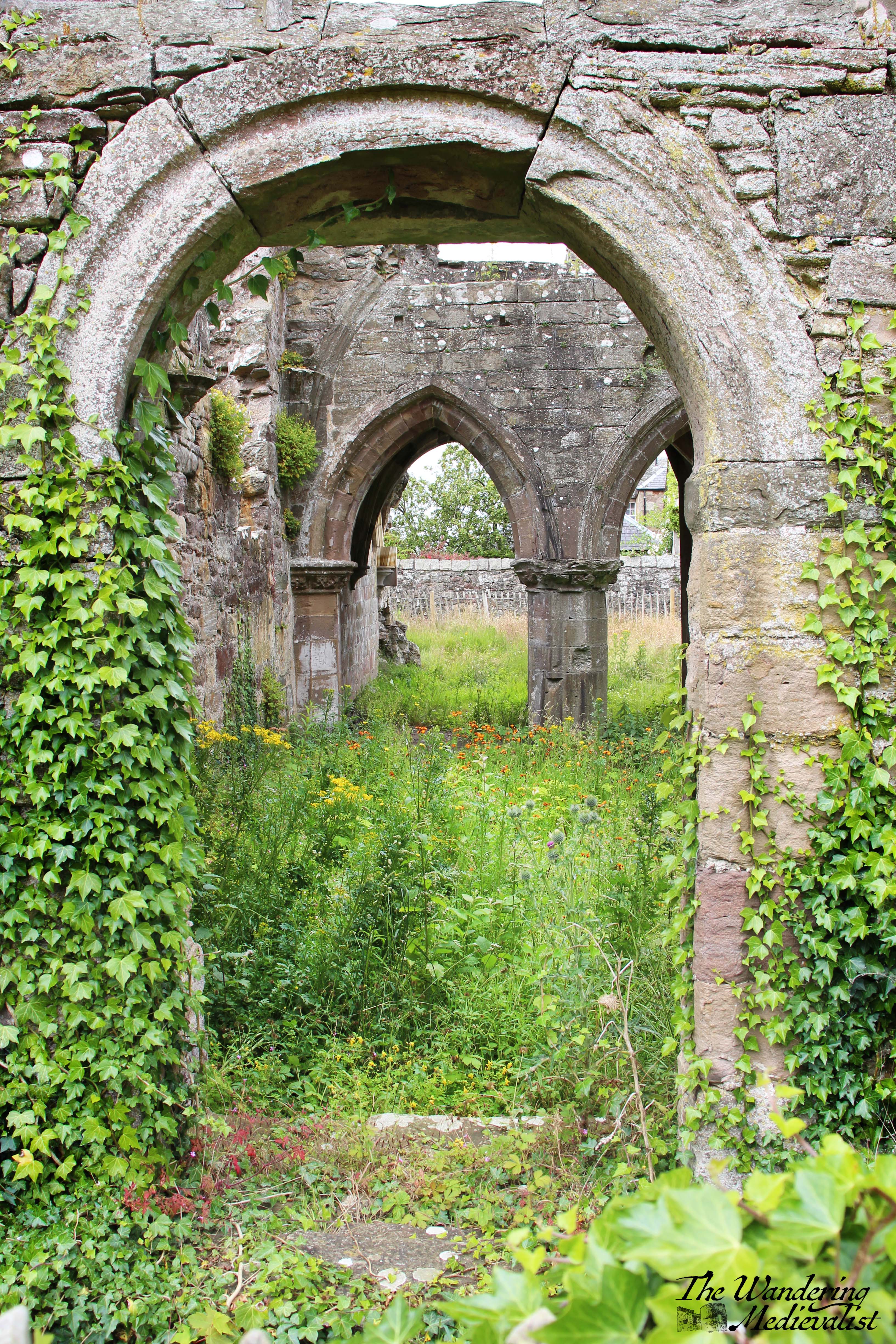
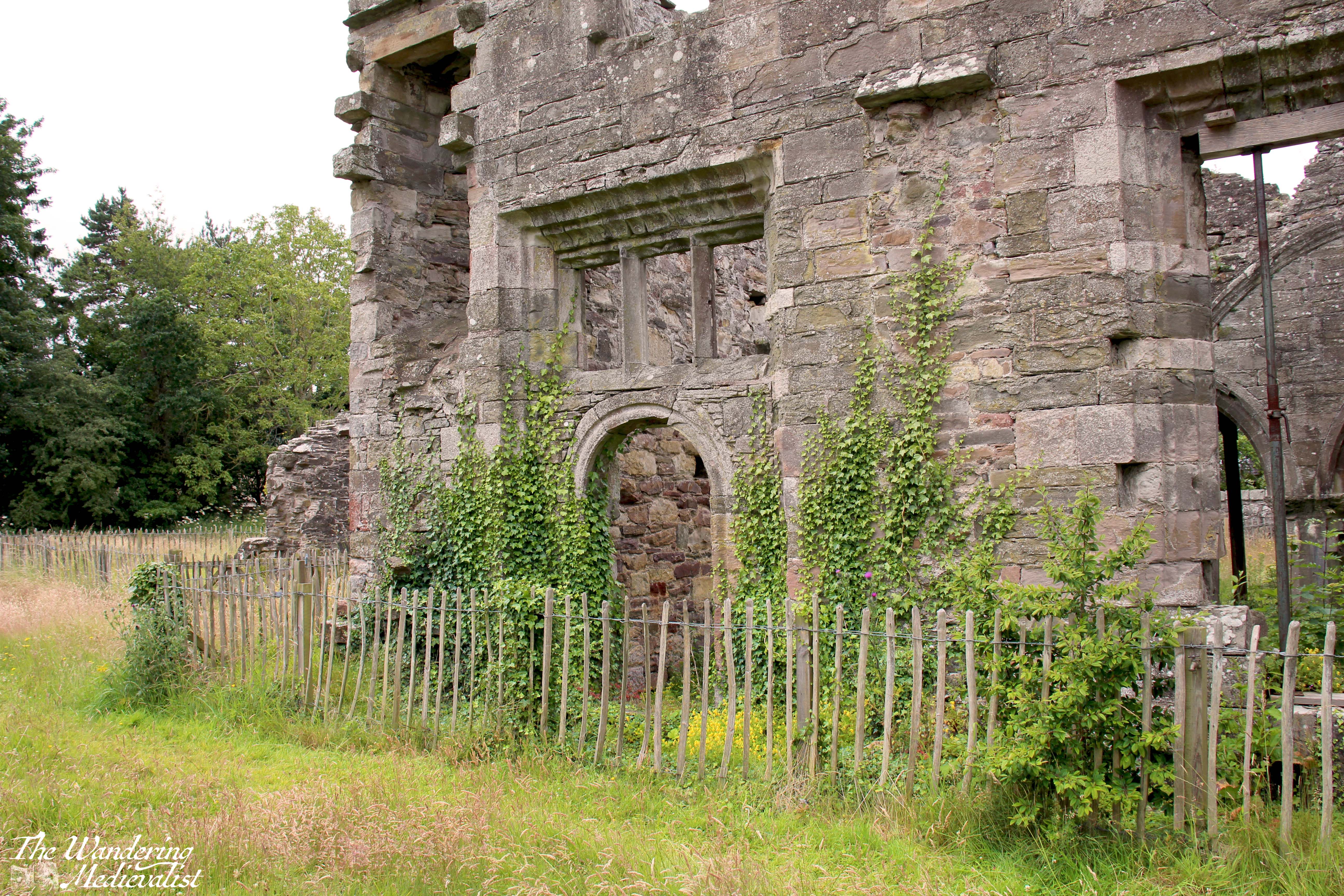
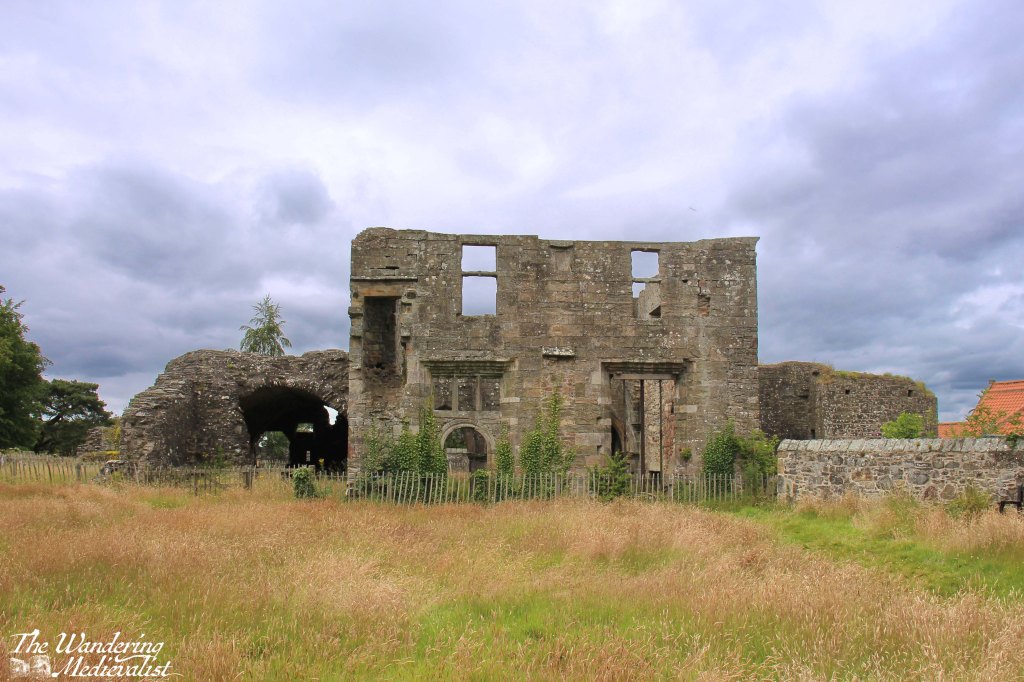
Our excursion to Elcho Castle was part of a late summer weekend during which we met a friend – and fellow medievalist – in Perth for lunch and decided to explore this heretofore unknown castle. I had identified it on one of my many castle maps of Scotland, and the Historic Scotland website confirmed it to be a well-preserved example of a late medieval Scottish tower-house. I note that as of writing, the castle is one of the many currently closed while masonry inspections are undertaken.
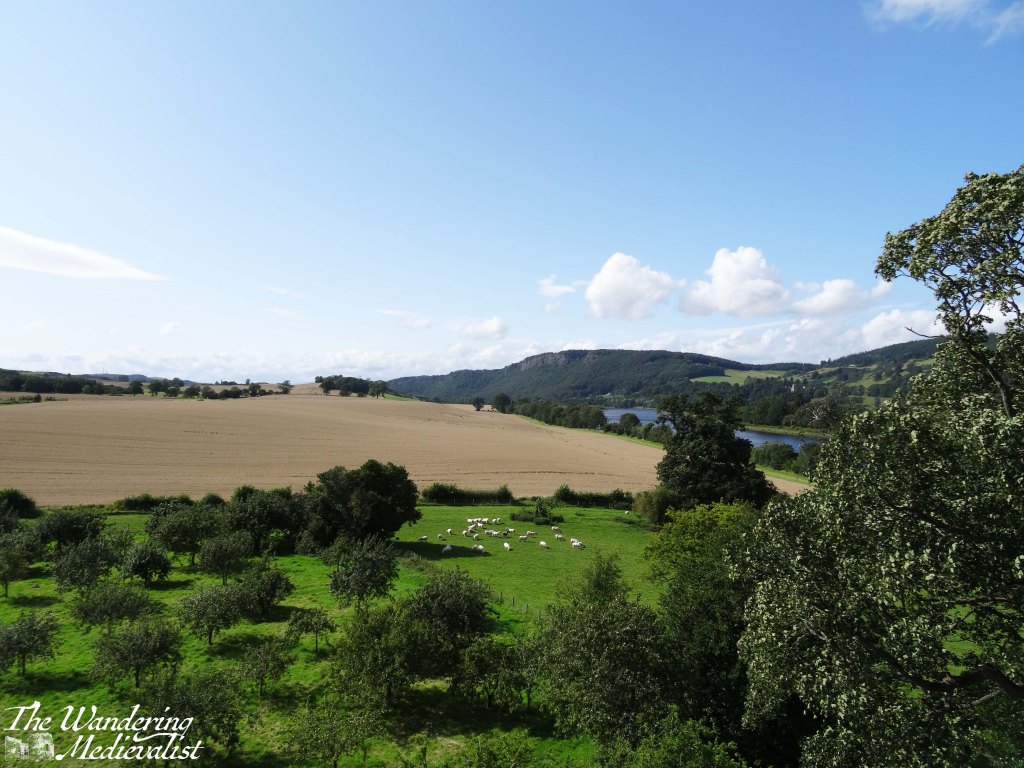
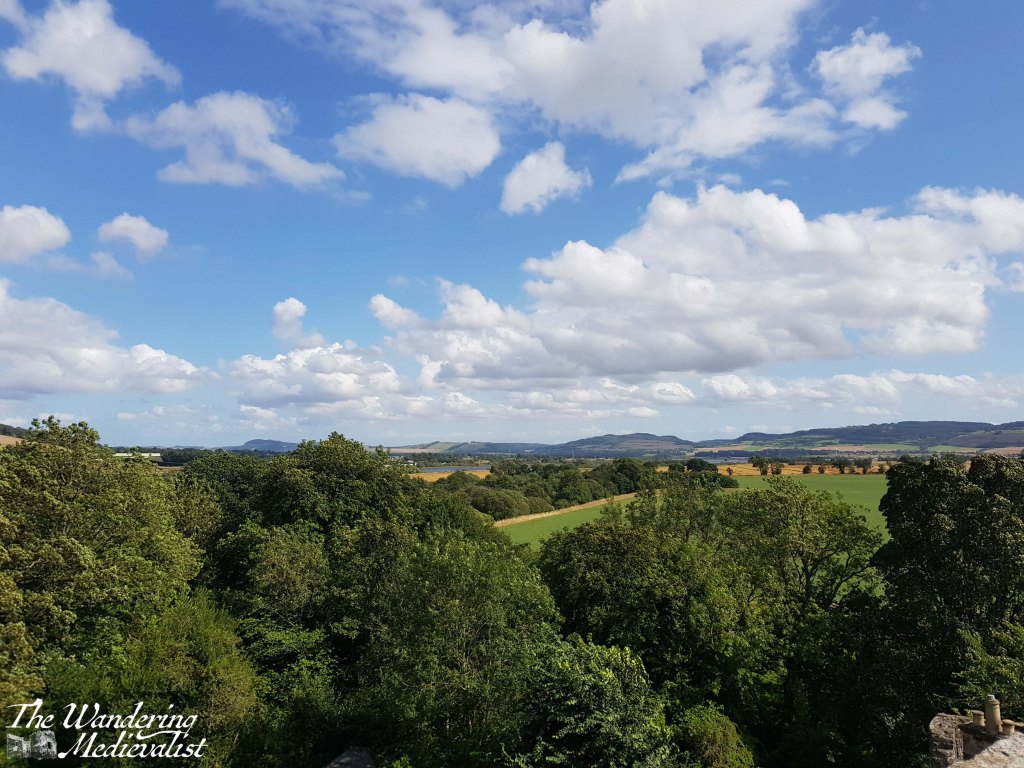
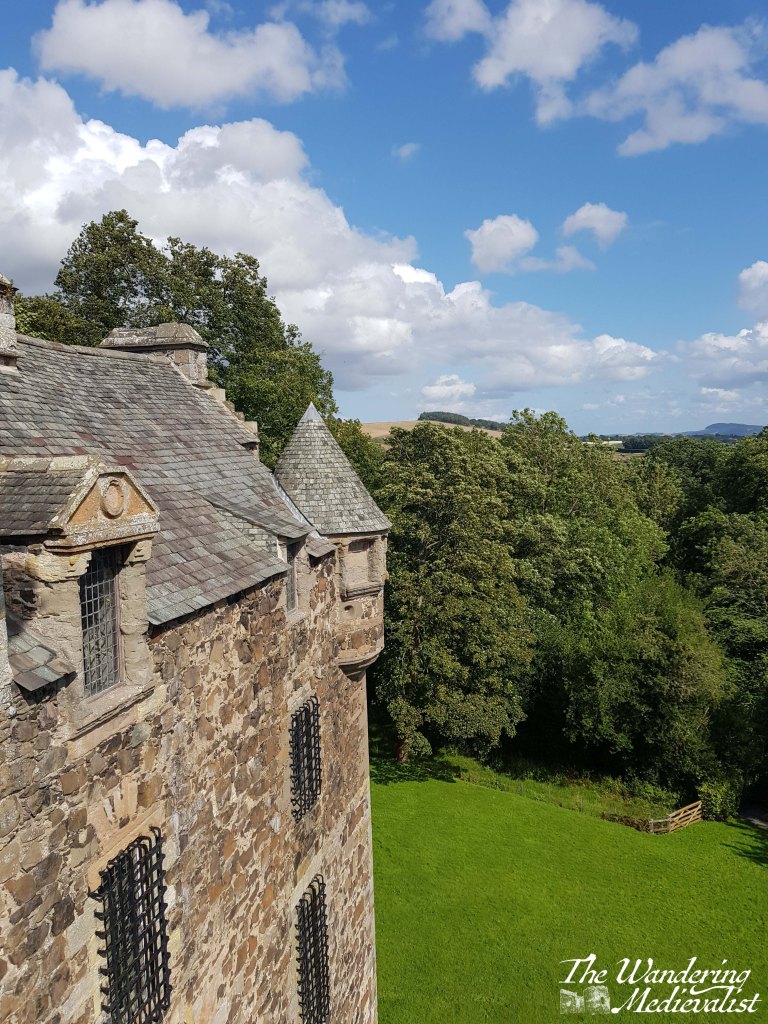
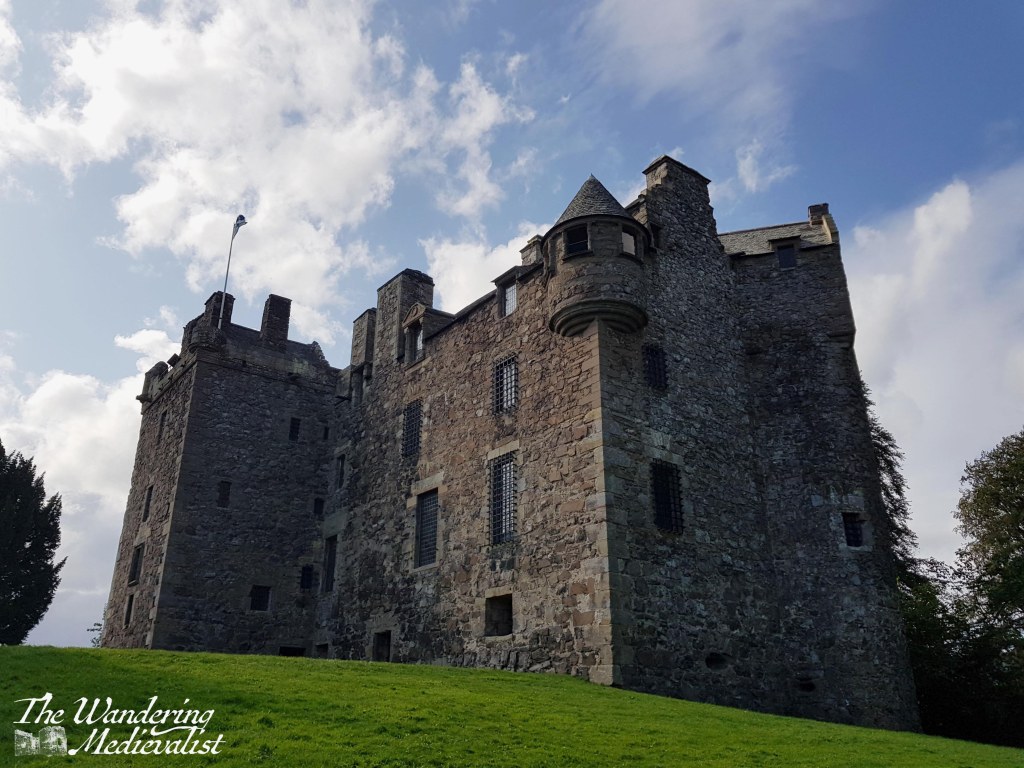
Only four miles from Perth, Elcho is accessed by narrow back roads that eventually lead to a small car park, the castle, and the nearby listed cottage. It was built by the family of Wemyss of that Ilk, around 1560, and is an interesting example of a comfortable country manor residence that was also defensive. It has both guest rooms and gun ports. As one can see from the view from the castle walls, it was happily situated beside the River Tay, amidst fields for crops and sheep, as well as an orchard. In the distance one can just make out the cliffs of Kinnoull Hill.
The view to the west is towards Perth, just out of sight beyond the rise, and to the east along the river in the direction of Dundee and Fife.
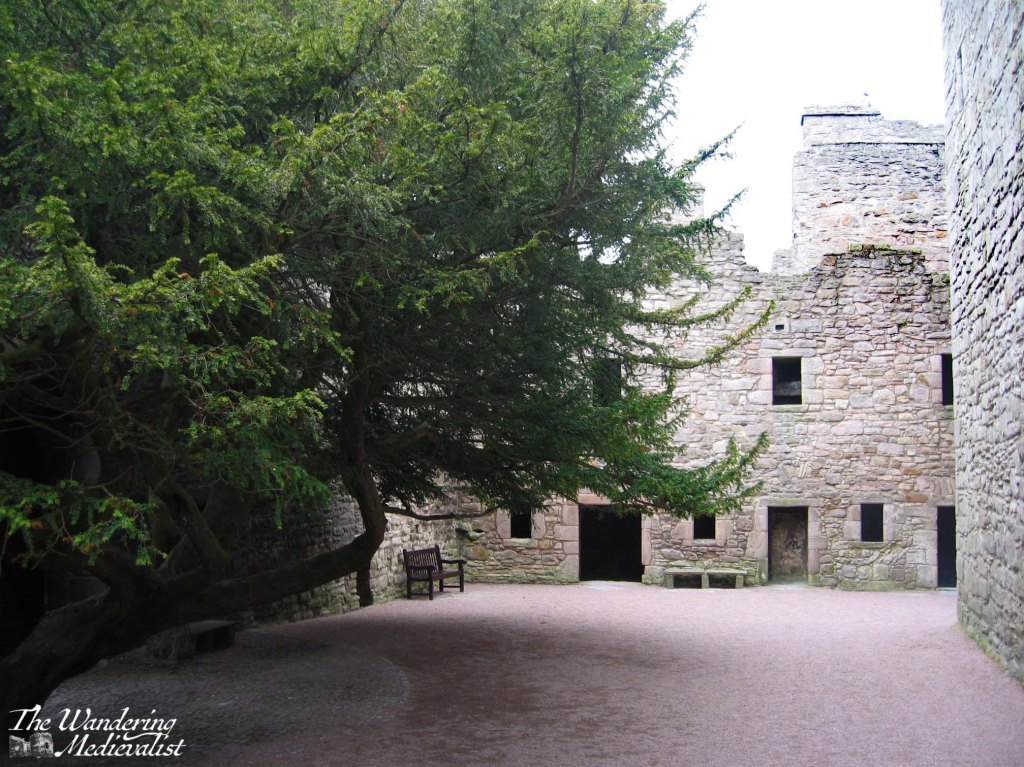
It is just about possible to walk around the outside of the castle, though the river side is well-treed and the view of the walls is obscured somewhat. There is evidence of a formerly walled courtyard and at the edge of the orchard are some well-placed picnic tables.
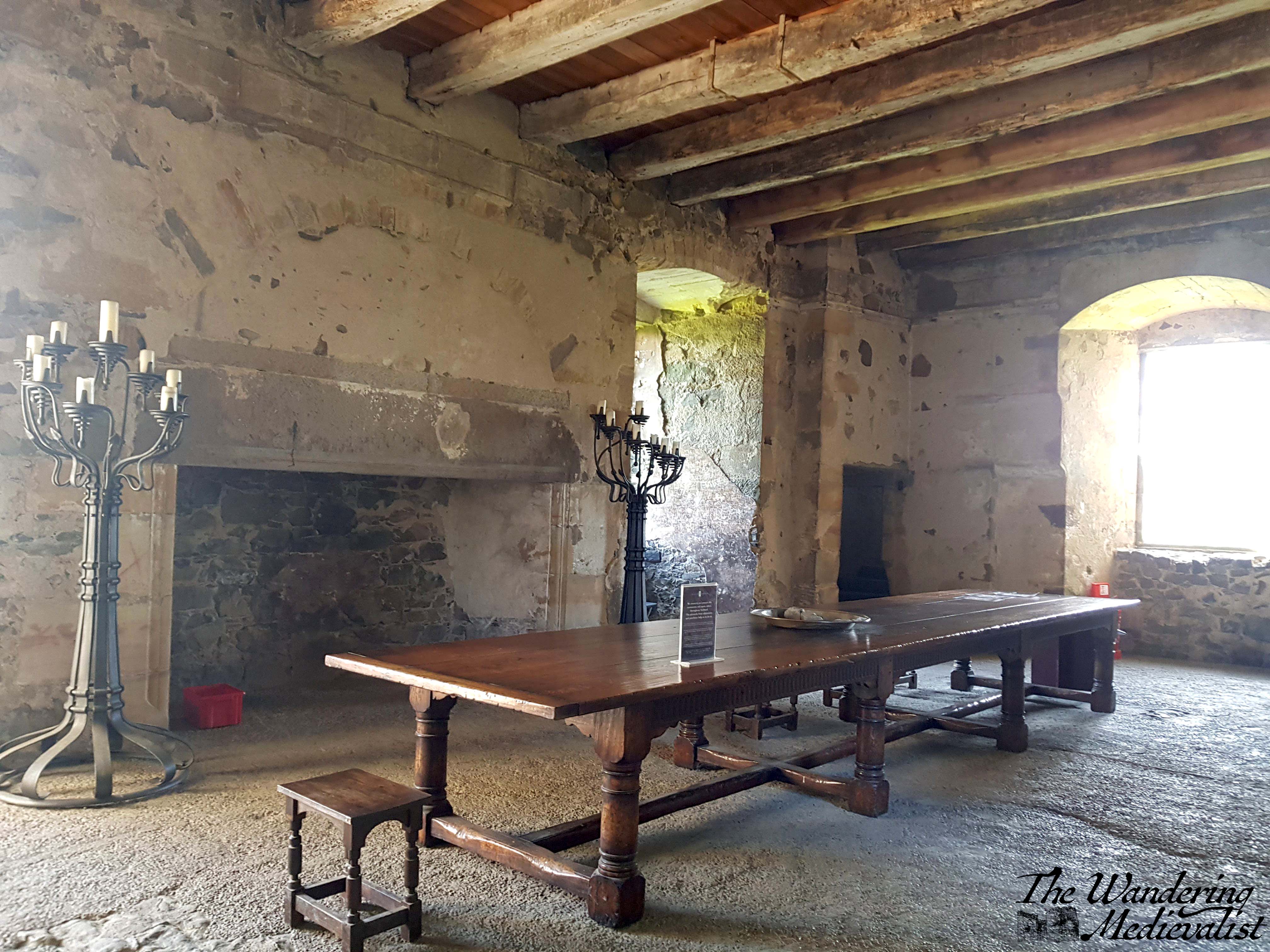
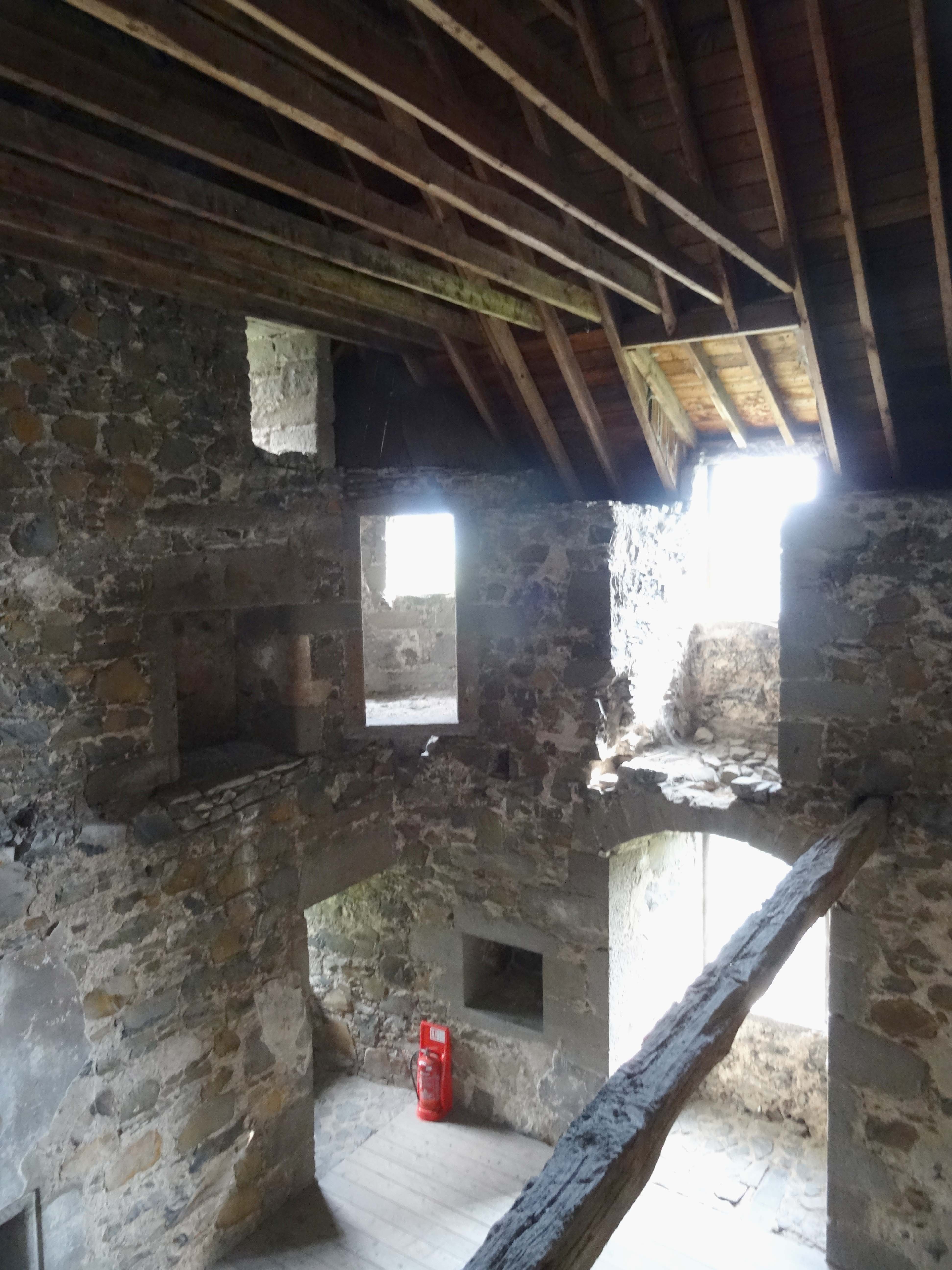
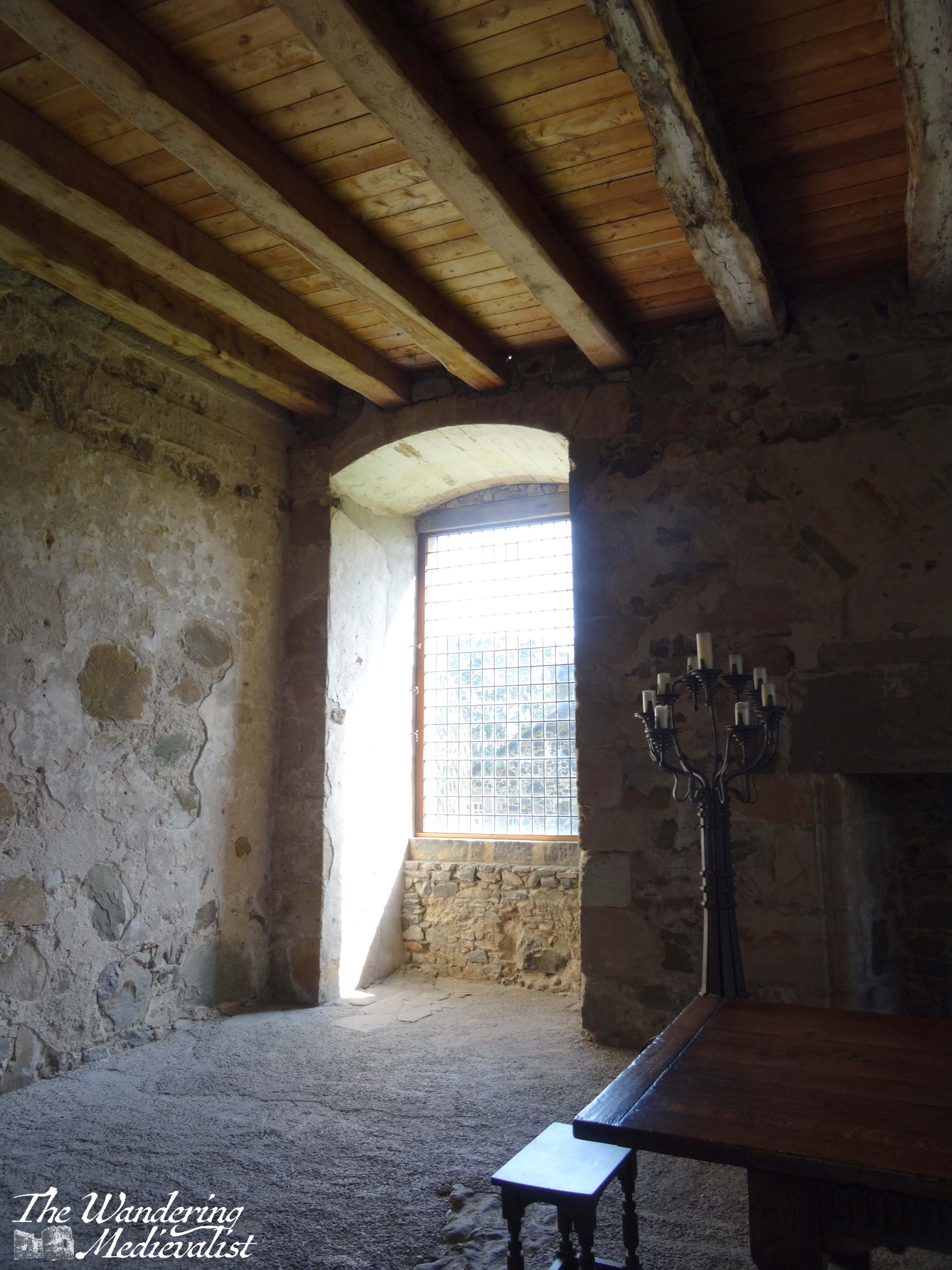
The true joy for a castle lover, though, comes inside, where the main hall, vaulted pantry and cellars, and numerous floors are all visible. Deep kitchen hearths and ovens can be explored, and there is a combination of restored rooms, but also open space where you can look up the walls to see where additional floors and fireplaces would have been.
And of course, one can climb to the top of the castle walls to see the views above, and examine the turrets and roof that was replaced in the 19th century.
It is quite easy to see, while wandering through these rooms and the nearby land, how this could be a comfortable spot to live. The surrounding fields are plentiful, the river is close by for fish and transport, and while the orchard is clearly young, one can imagine there may also have been one in the 16th century.
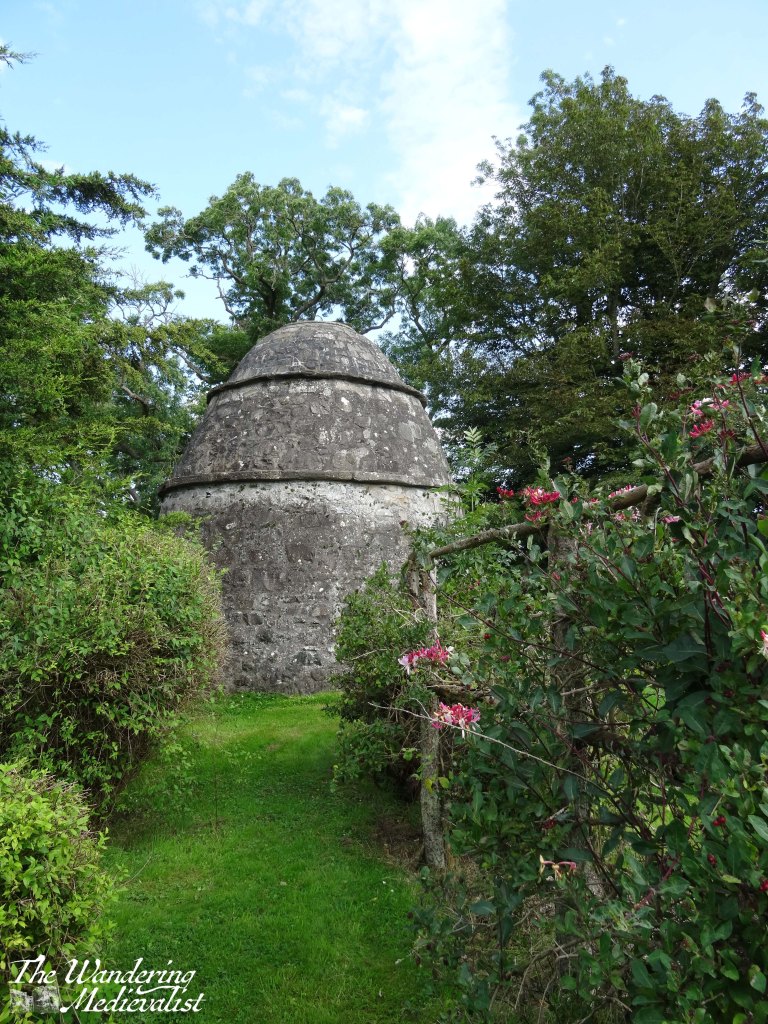
Also on the grounds is a well-preserved doocot (Scots for dovecote), surrounded by a small garden. This doocot would have provided valuable food for the castle through the winter months, both from the birds living within and their eggs.
We did not spend a great deal of time at Elcho but it was the perfect castle for an afternoon jaunt; photogenic and well cared-for, it also boasts a small gift shop which, to our delight, sold ice cream. We happily enjoyed our treat, which also kept the other half patient while I scurried around taking pictures of the castle exterior. Though it does not necessarily hold a dramatic place in history, Elcho is an excellent window into the past, demonstrating how comfortable life might be for a lord living in the late 1500s. It is also an excellent castle to explore, and once it has opened again I could see it as a good spot for children, with lots of rooms to get lost in. Furthermore, it is an easy day trip from Perth, Dundee or anywhere in Fife, the perfect spot for a picnic!
I have had every intention of publishing this post almost every day for the past two weeks, but a combination of leaving work and a bout of Covid continued to set me back.
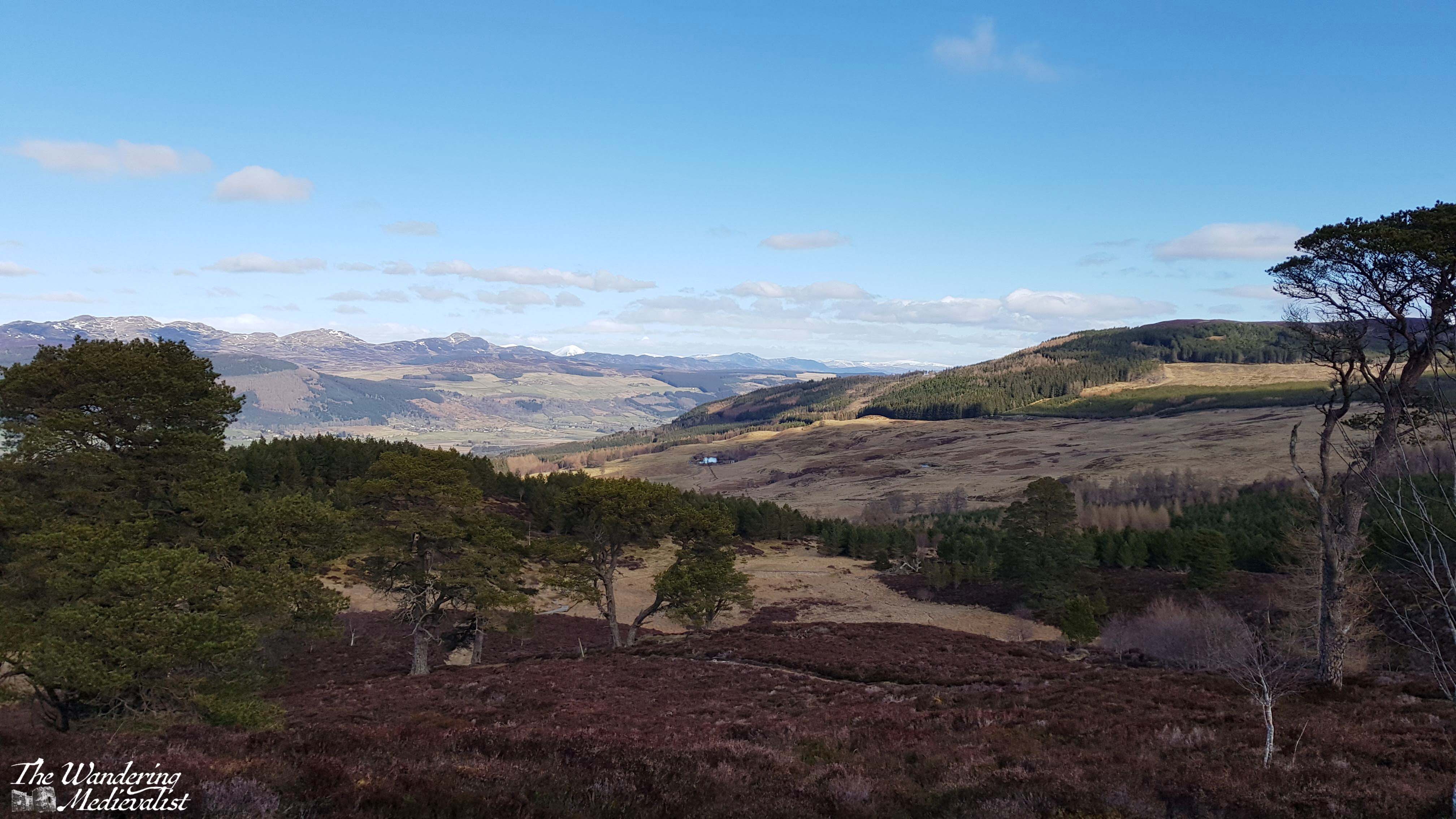
The Scottish Highlands are legendary for their stunning hills, lochs, and the hikes and paths that allow you to view them in a way you can only do by foot. Not long before the start of lockdown, we spent a weekend at a self-catered cottage in Aberfeldy, allowing us plenty of time to explore the surrounding hills. This walk, on Kenmore Hill above Loch Tay, was both stunning and a touch disastrous.
Why was the walk a touch disastrous? It started with the car park which, at the time we visited, was inaccessible without a 4×4 (I do have hopes that it has been re-done since then!). We ended up having to stow our car just off the road and the end of the drive up to the car park, but fortunately our car at the time was tiny and we managed relatively well.
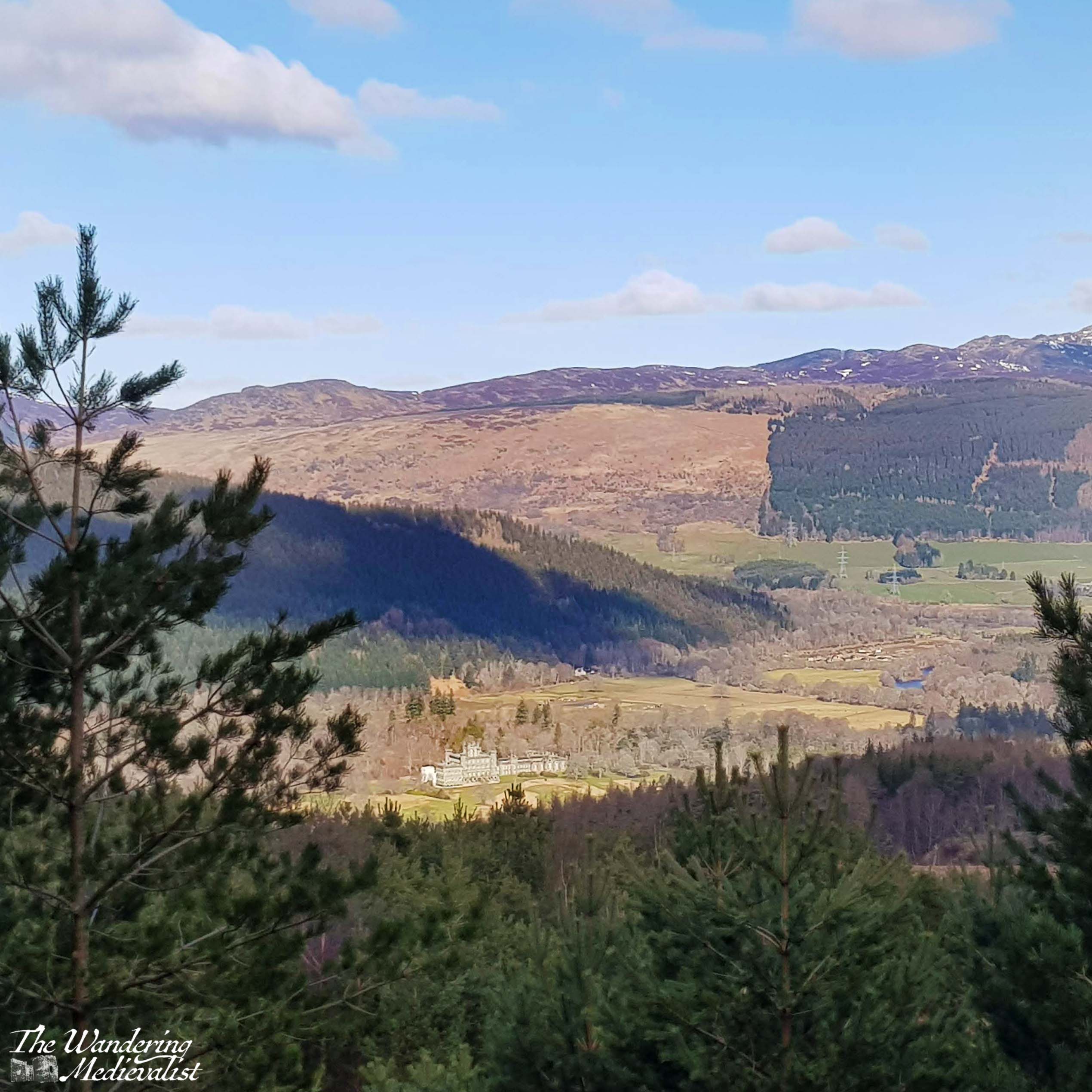
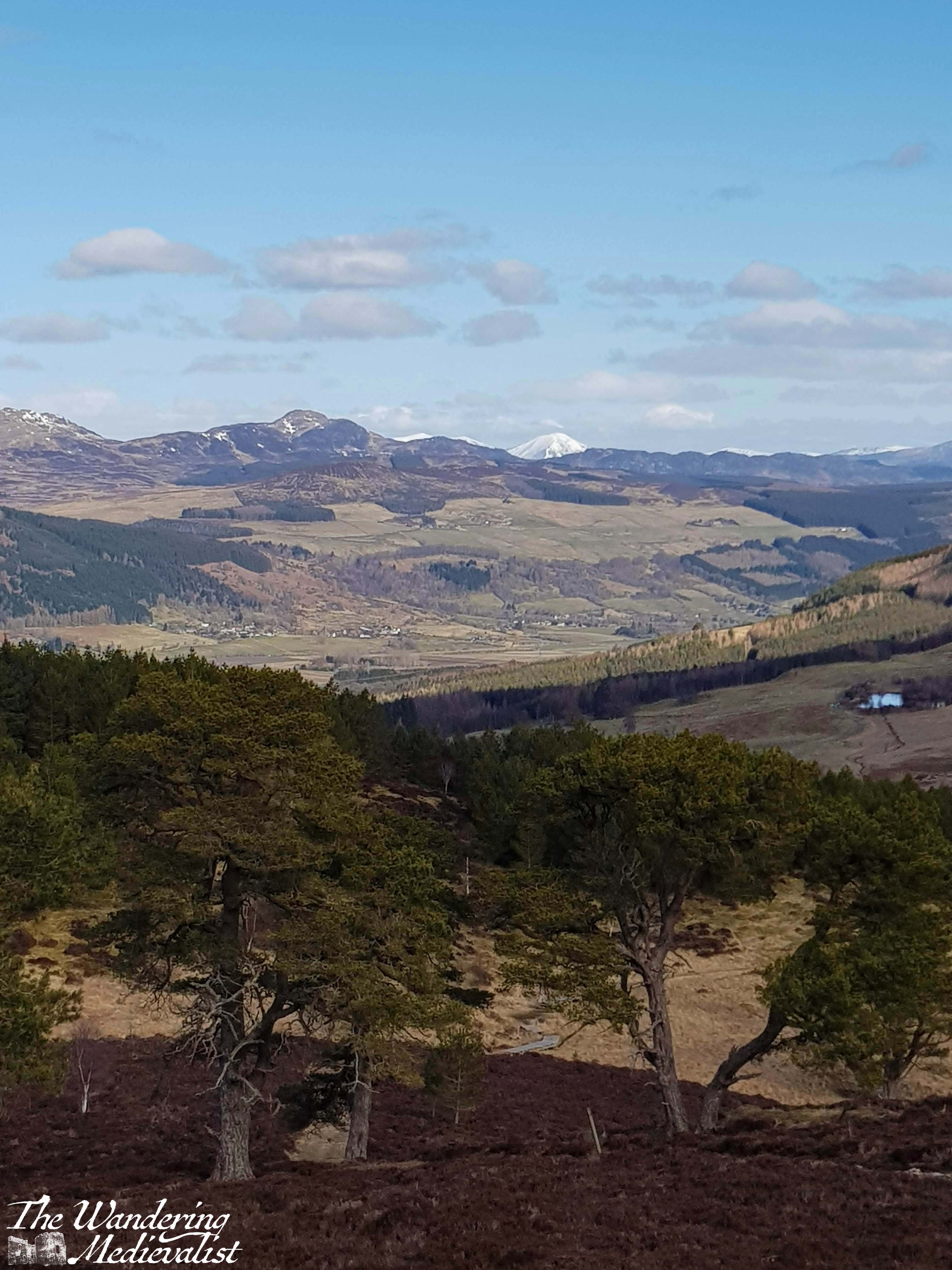
From the edge of the road we walked up through the car park and almost immediately enjoyed splendid views back over the valley, particularly down towards Taymouth Castle and estate.
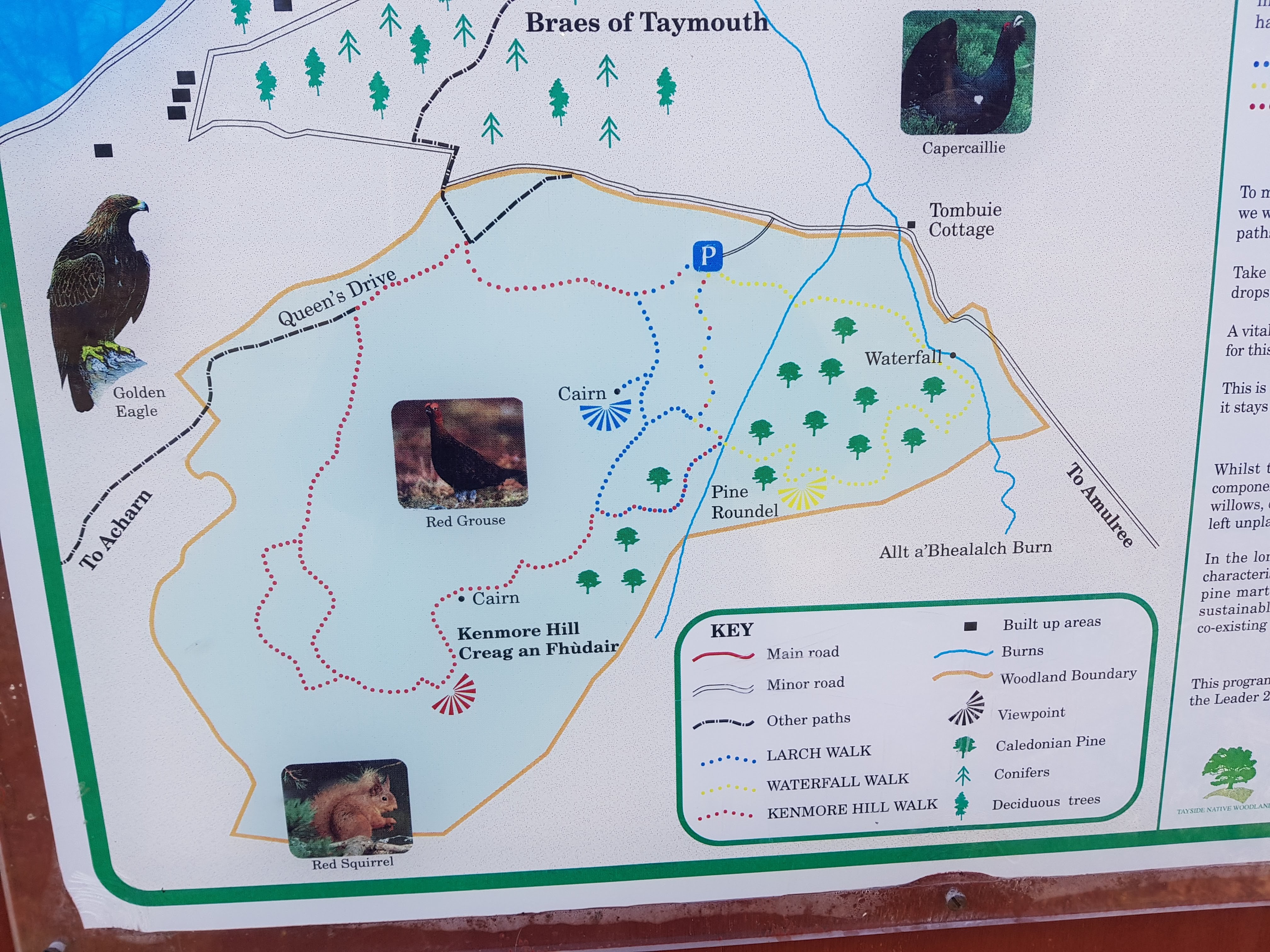
The sign in the car park offered three routes, and the one most clearly described by Walkhighlands was the red route; all three started in roughly the same place so we headed upwards, beginning a steady climb up the hill on a path that reminded me of a ski path without snow – rocky and lined with trees.
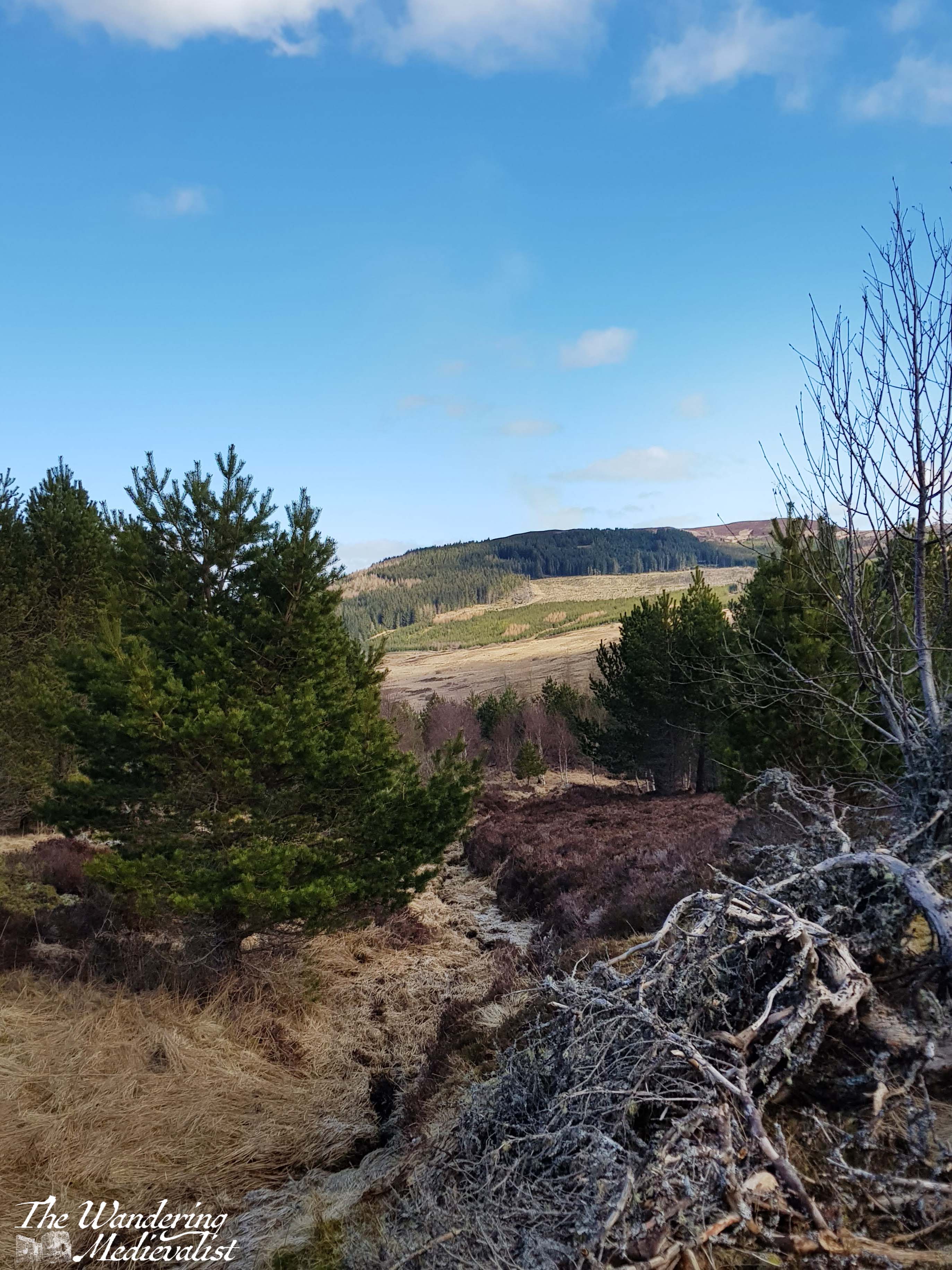
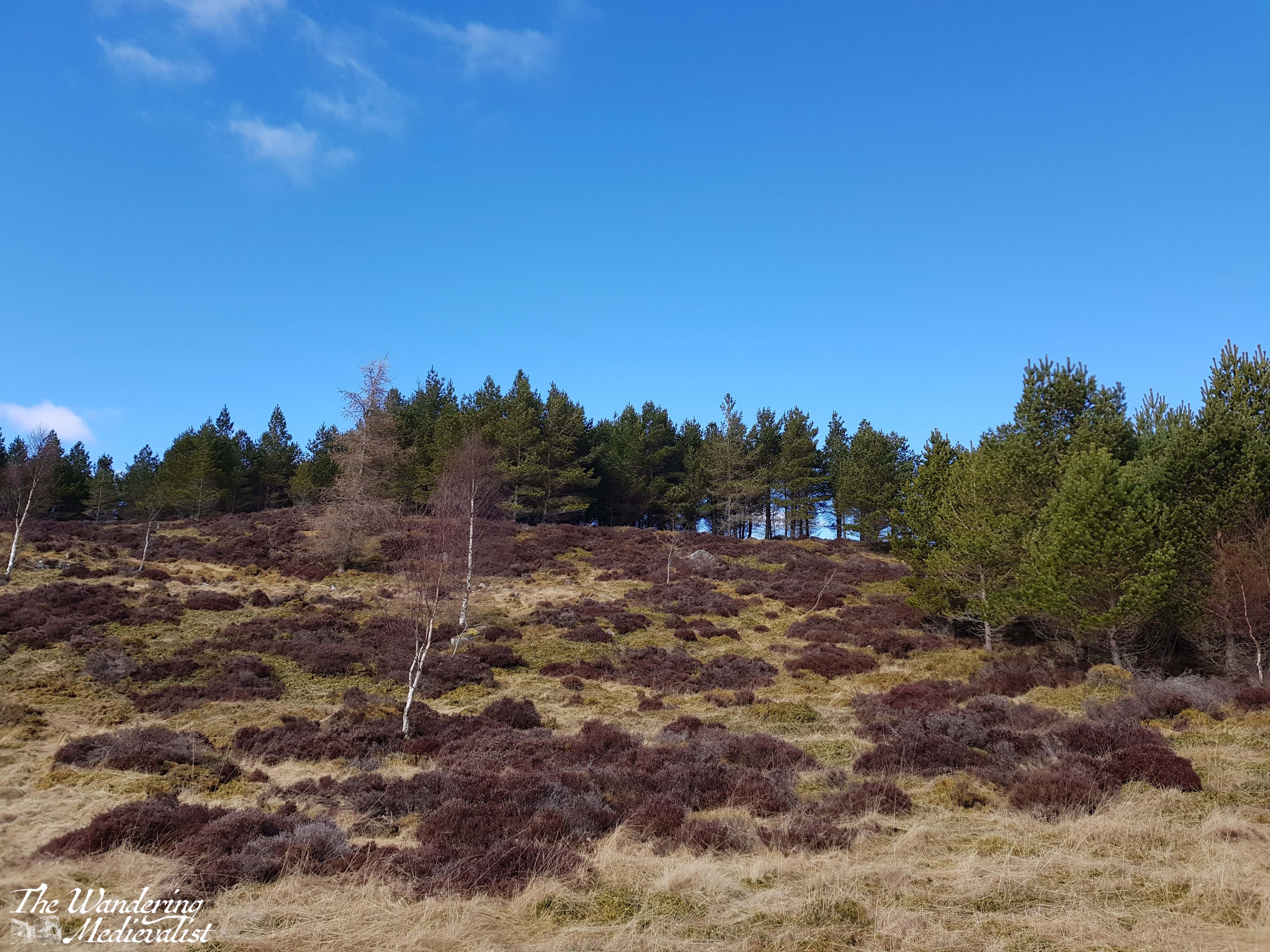
Eventually signs for the red path turned us right and we emerged from the trees, finding ourselves on a grassy area with a treeline on the ridge above and promises of views over the valley.
We were hampered a bit at this point by the fact that we had, the day before, done the Birks of Aberfeldy walk, which had been steeper and with more stairs than expected. The other half was suffering a bit with his knee from an old injury, and as we climbed up the hill towards the ridge – a relatively steep walk – he found it becoming more and more difficult.
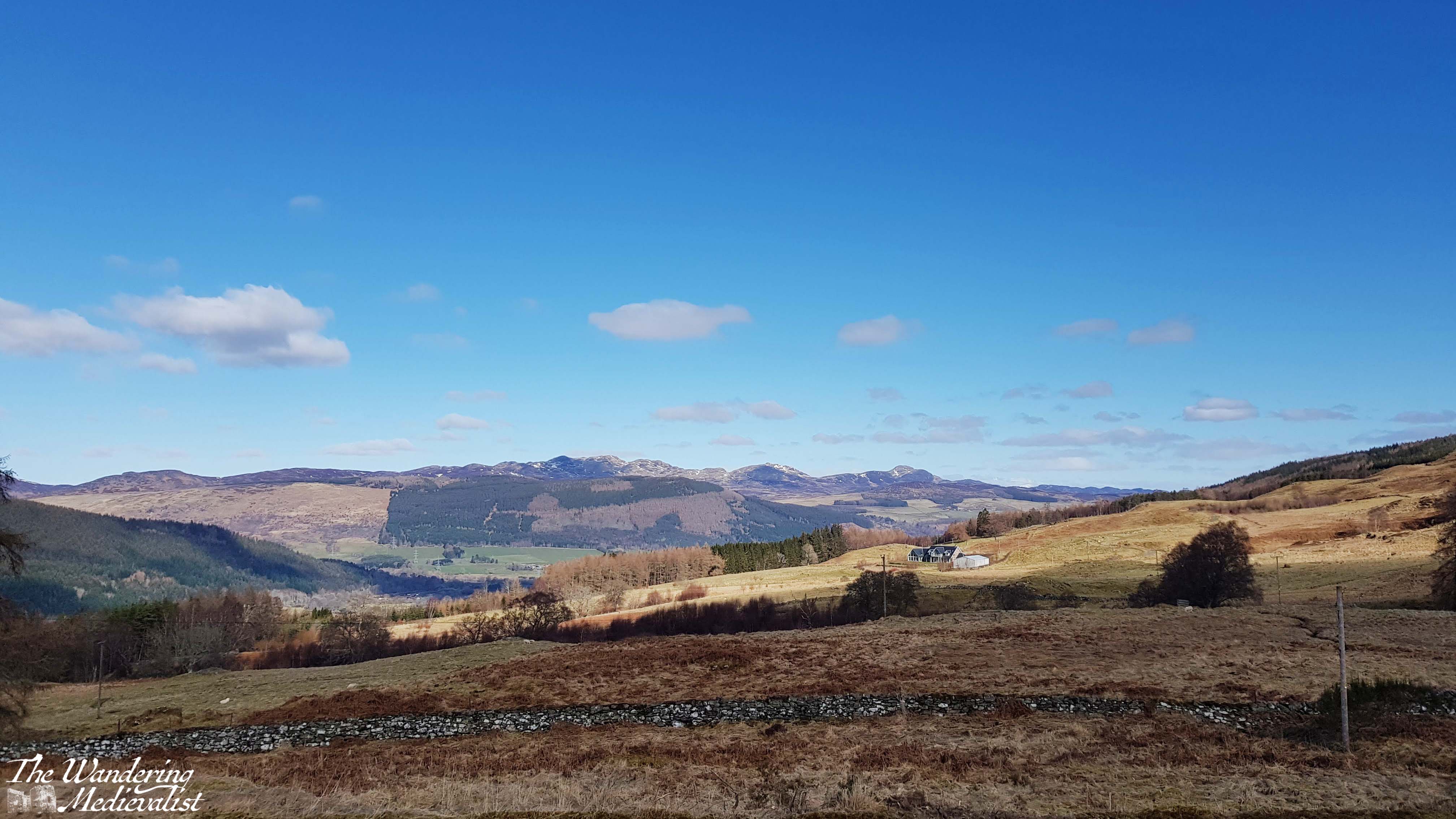
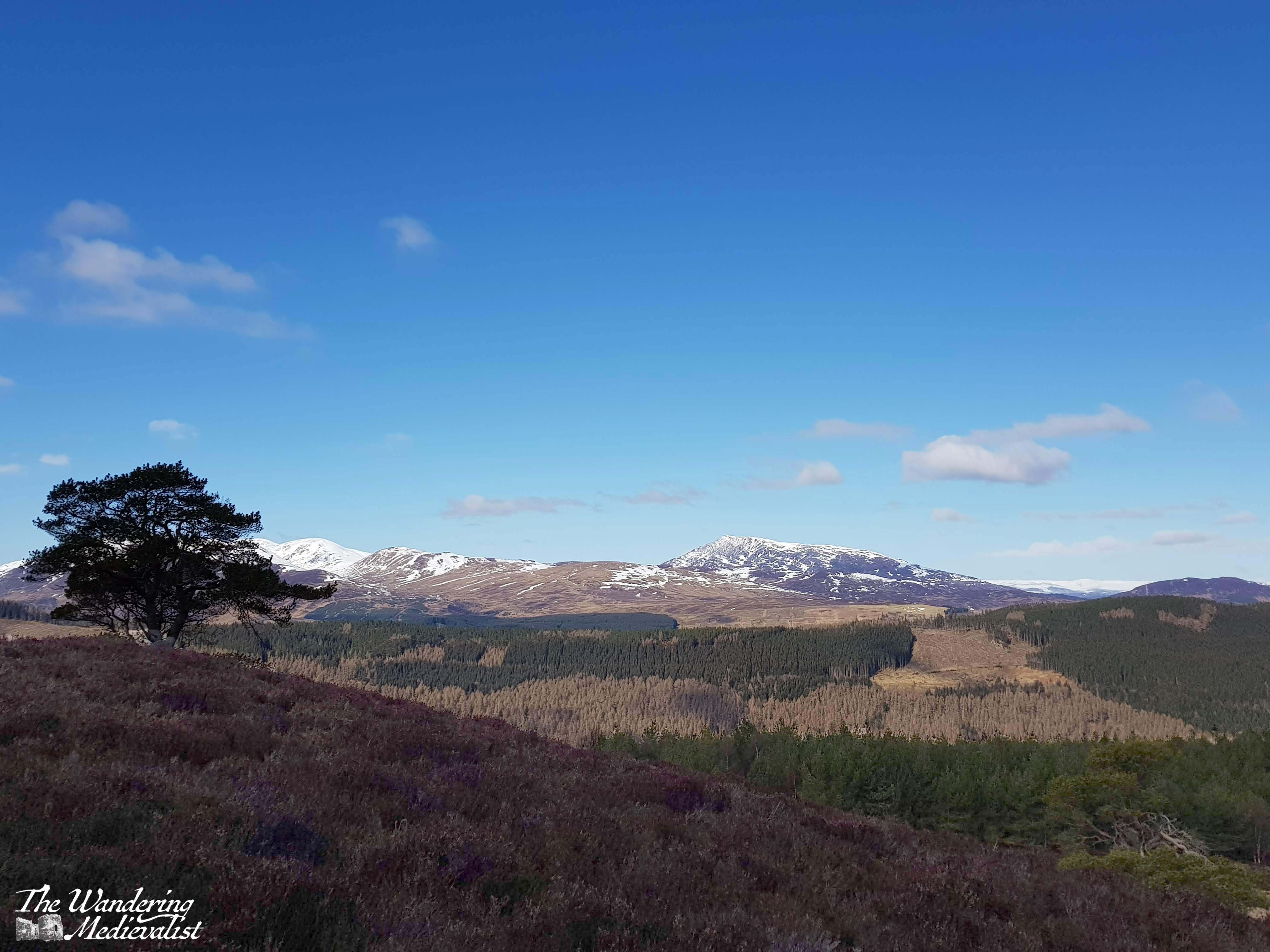
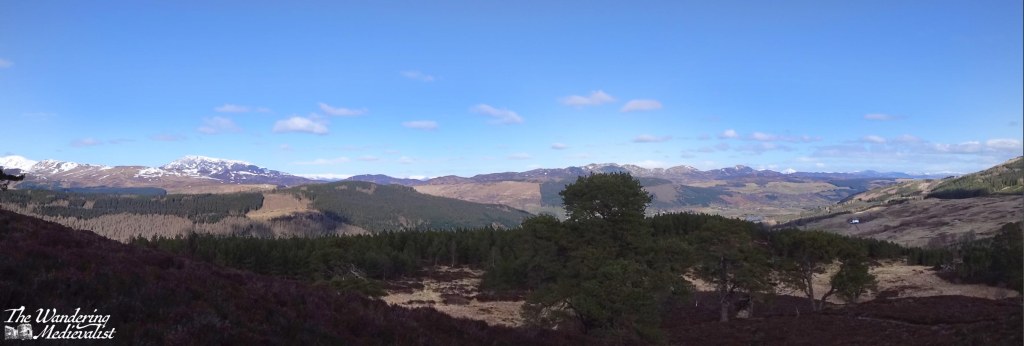
We reached the top of the ridge in time and the views were indeed spectacular – the snow-topped peaks in the distance stood out beautifully against the blue sky, and we planned to continue the red loop towards the final cairn, where I know you can see down towards the other end of Loch Tay.
The discovery that we had forgotten a knee brace meant that we really could not continue to potentially cause even more damage, and so we agreed to return to the blue loop, and follow it back to the car.
Here, of course, is where slight disaster struck. We did as planned, found the blue path and intended to allow a quick run up to the marked viewpoint. Instead, as we followed the blue markers and the gap in the trees, we gradually realised that we had not seen a marker in a while, and that any sign of a trail had vanished. Both of us are relatively experienced hill walkers who had been paying attention, and yet could not determine a place where we could have deviated from the trail; we had two versions of a map and the picture of the trail, but found ourselves completely lost. We back-tracked a bit, and still could not confidently identify a marker. Standing at one of the last clear points, we established where the path should be, and where the road was, and decided that as long as we headed down and towards the road, we would reach it eventually, as it loops around the hill.
What followed was a rather steep and haphazard descent through brush, heather, and the occasional small trickle of water. I would not normally condone leaving a trail like this as it can cause damage to the wildlife, but we really did not have much of an option. We decided the trail lost us as much as the other way around. It was similar to a hike I had once done with my father, when we realised a touch too late that the trail we were following was in fact a dry creek bed – on that day, like on Kenmore Hill, eventually common sense and perseverance (perhaps even stubbornness) won out and we found our way to a clearly marked path.
On Kenmore Hill, this ended up being the last loop of the red trail, though we still cannot work out we managed to get there. Relieved, we found our way back to the car park and our car, the beacon we had just made out from higher up. While it was certainly not the most comfortable climb, I have every intention of making my way back and completing the red loop at some point, as I have seen from other hikers that the views from the other side of the hill are spectacular. It also seems to be the perfect length of hike – about two hours, with enough climb to get some proper views and the heartrate up a touch. I also have hope that in the years since the pandemic, the path has been kept up and perhaps improved, though a peek at Google Maps indicates that the road to the car park may still be in questionable shape.
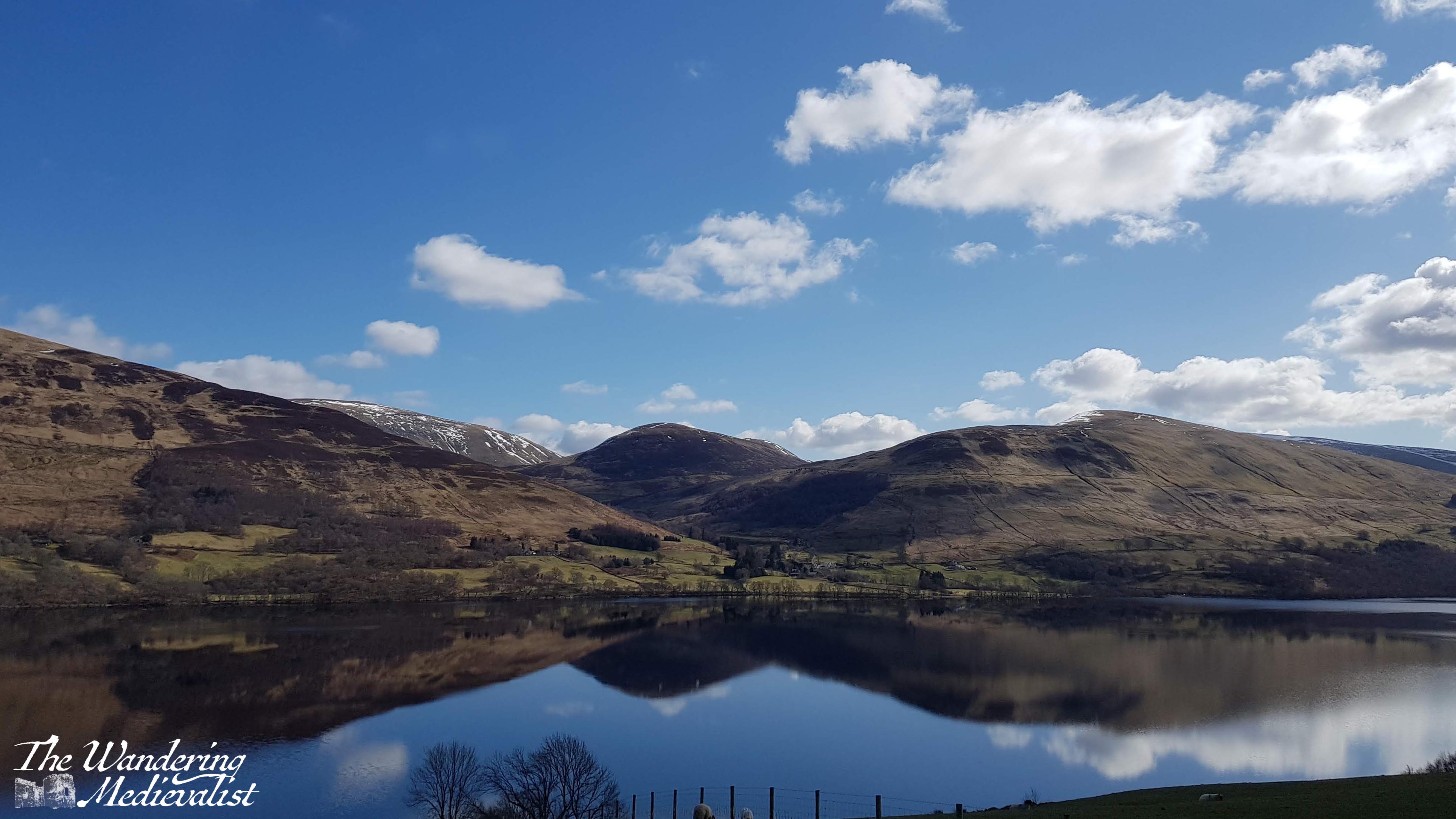
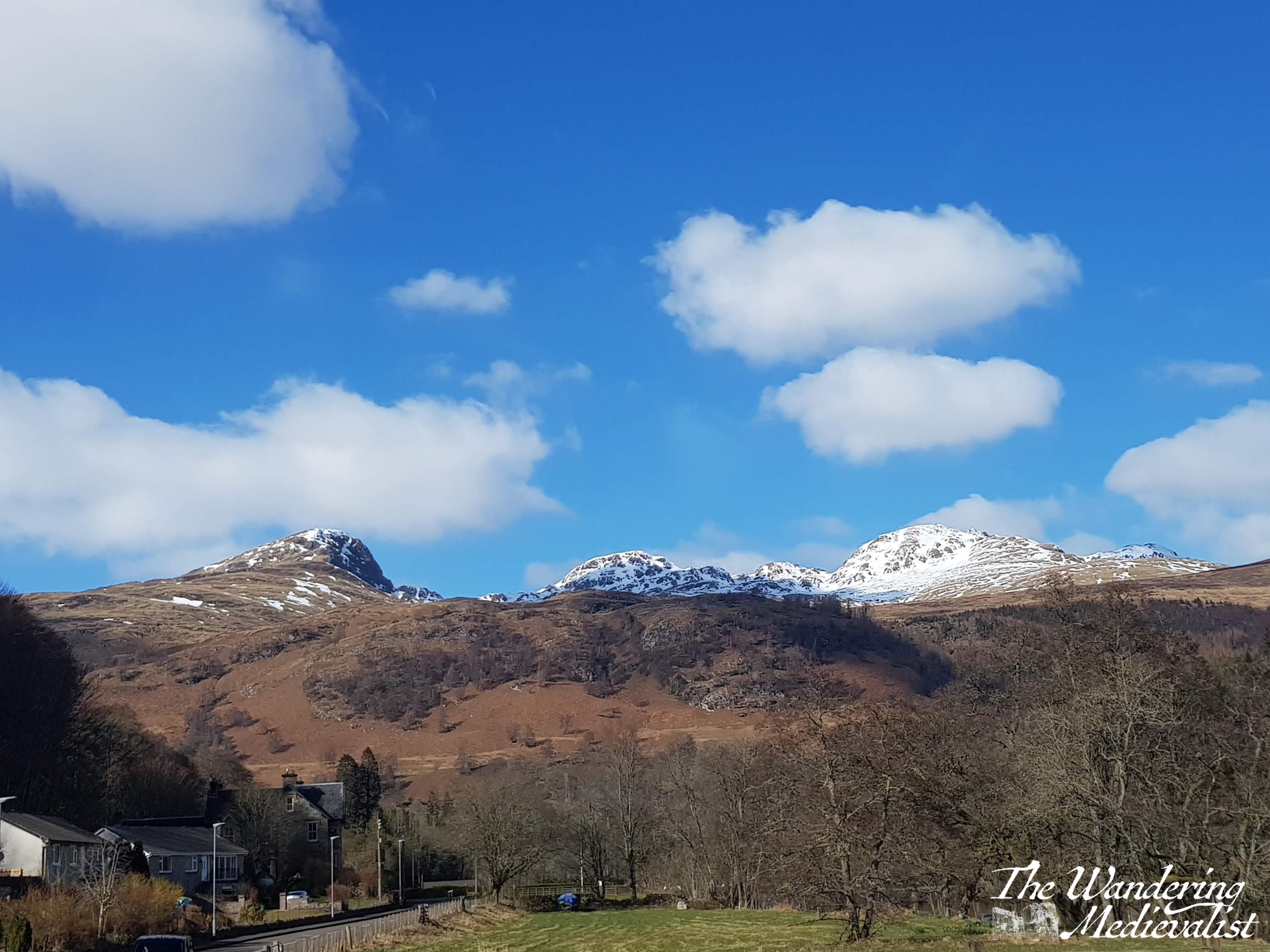
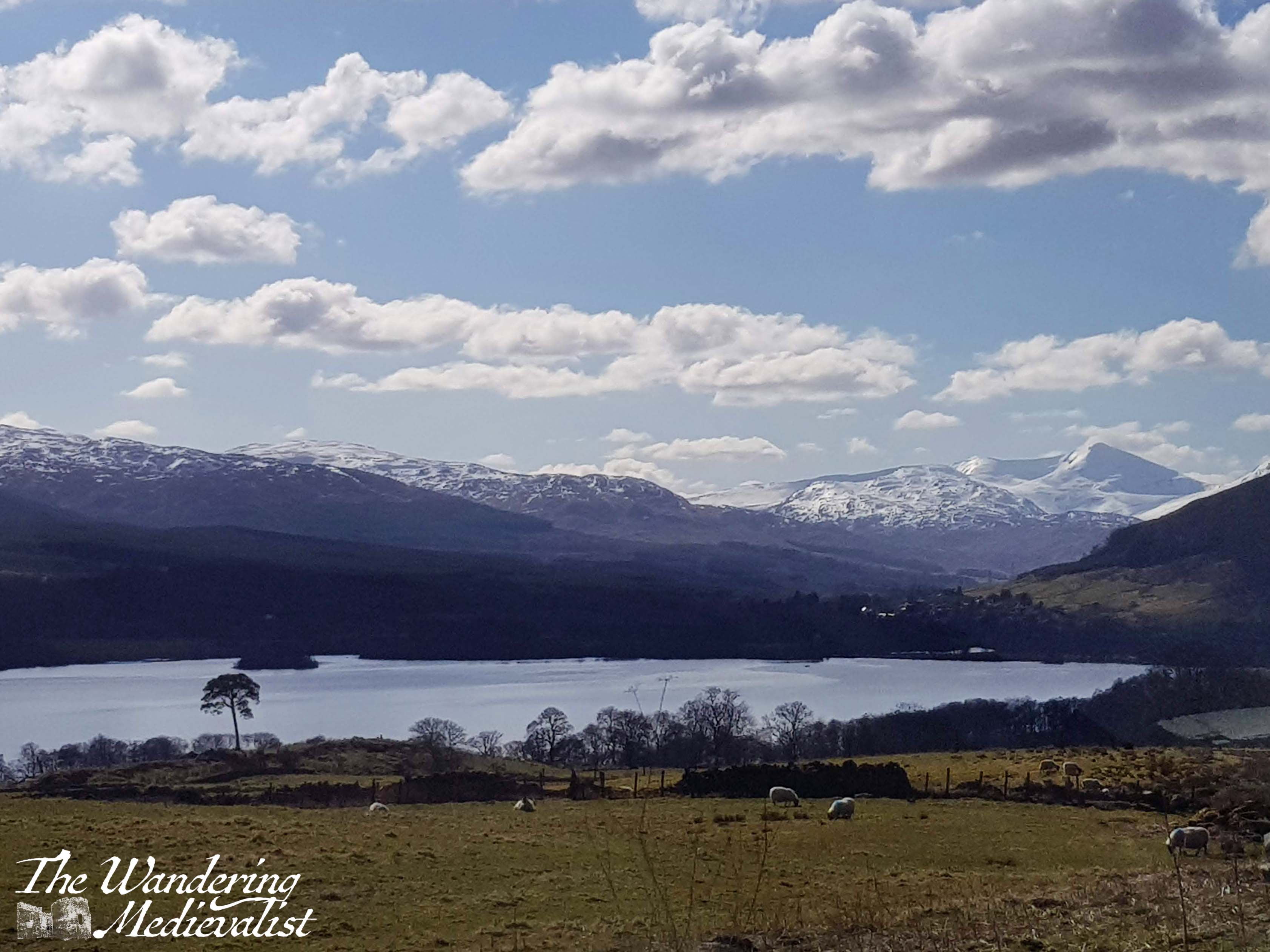
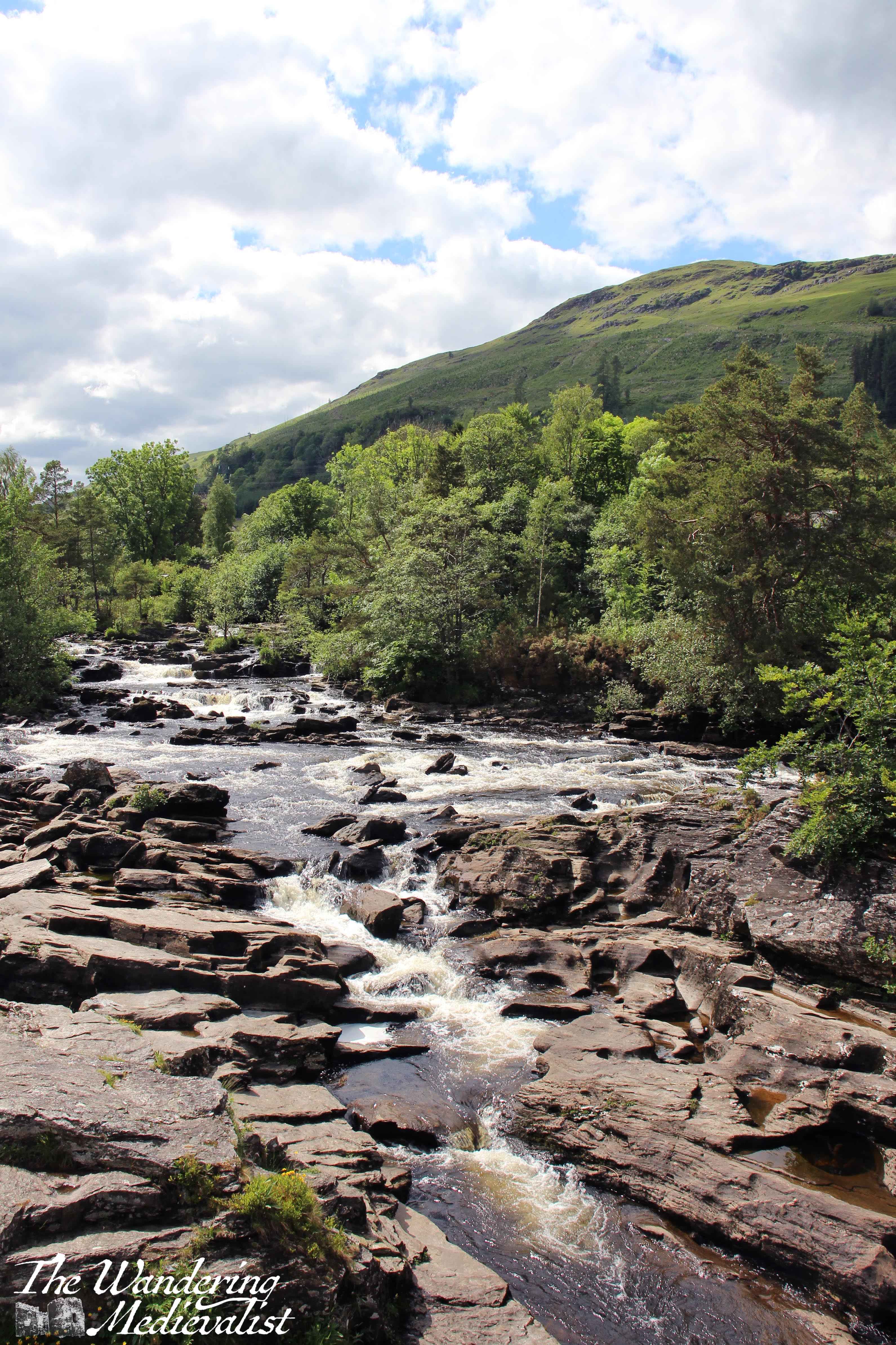
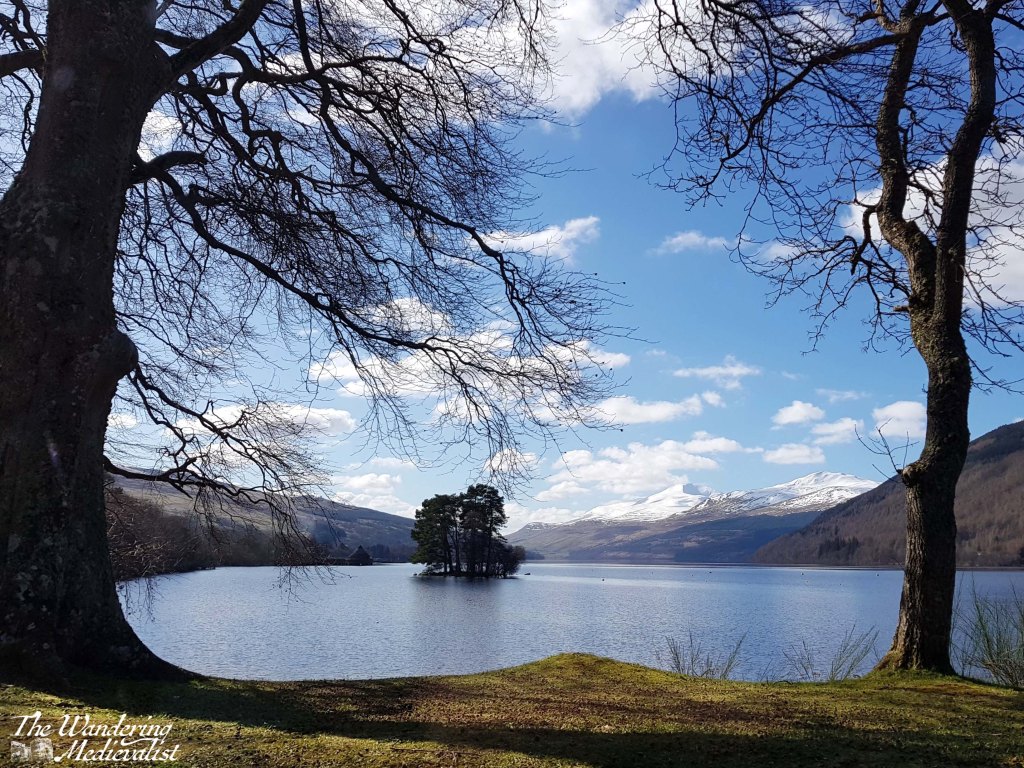
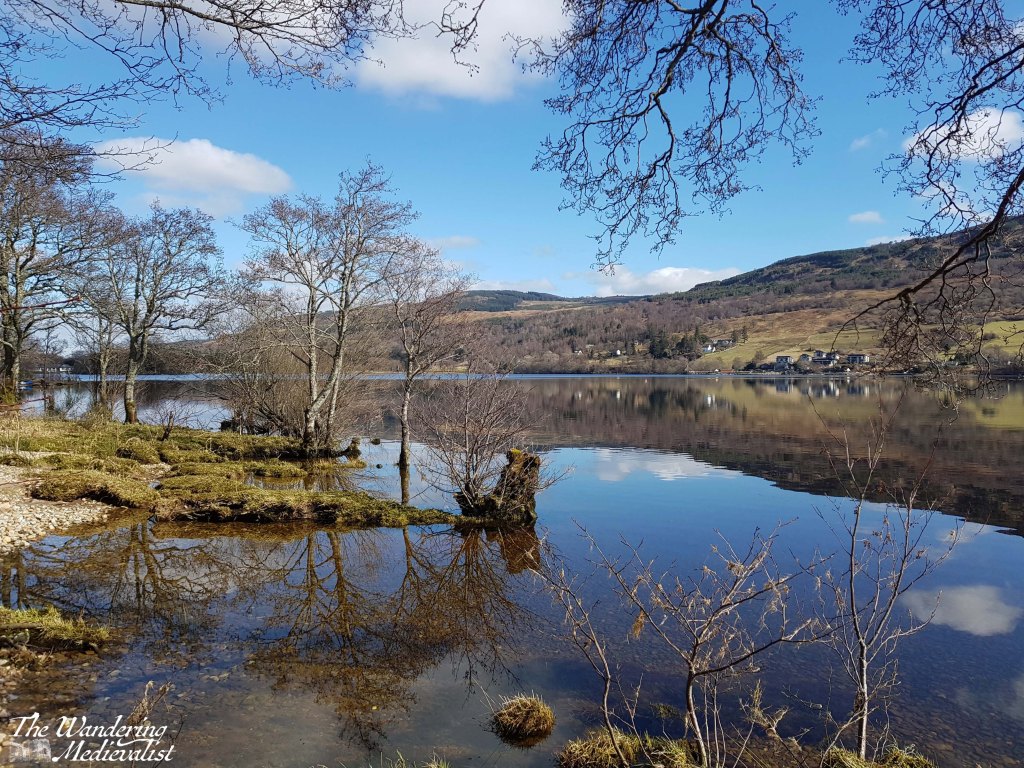
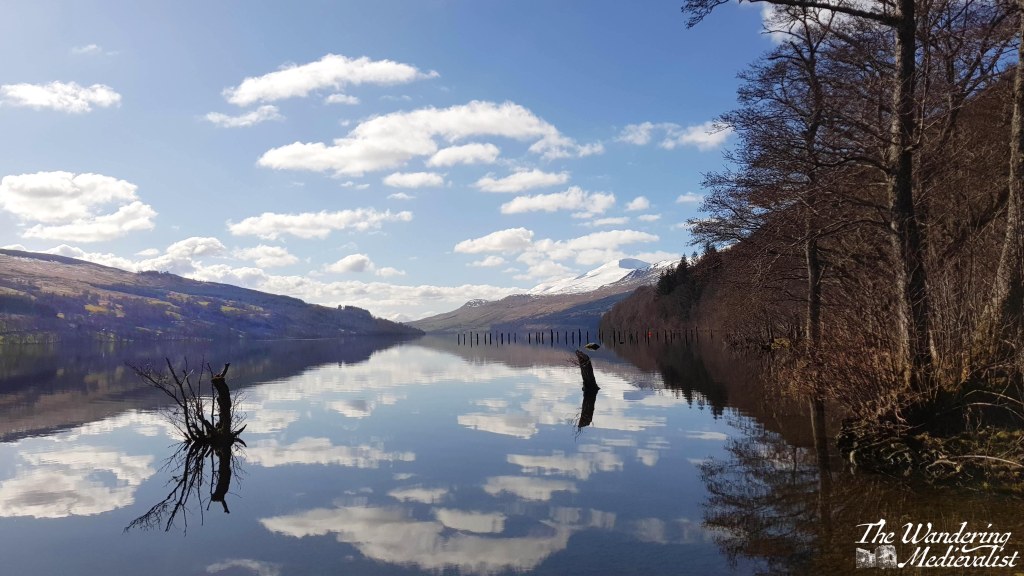
After our slightly chaotic hike, we decided to take a drive down the loch as it was a beautiful day, and below are a few of the pictures I took along the way; Loch Tay really is a beautiful spot and while the mountains are less dramatic than further north, they are no less impressive. We in fact drove all the way to Killin and stopped at an Inn by the Falls of Dochart – a post for another time.
I look forward to an opportunity to try to this hike again!
It is clear to everyone by now, I am sure, that I love castles. I have opinions on which types are best, of course, but really, I love them all. I love the aesthetics: the ruined ones, the restored ones, the mostly complete ones, and everything in between. Several years ago I decided it was prudent to set up a Google My Map of every castle I have seen, and all those I would like to see – I have barely scratched the surface of English castles, while Wales and most of mainland Europe are on the list of dreams. Needless to say, the list is…lengthy.
In this post are some of those I have visited – many of them multiple times – and found to be even more spectacular than others, or having historical significance that sticks in my mind. Some of these pictures are scans of those taken before digital technology (gasp!) so please bear with the quality. I hope you enjoy!
England
There are so incredibly many castles in England, and some of the most famous I have seen at a distance (Warwick for example). I have visited the Tower of London several times and – despite being chastised by a Beefeater for being overly excited – I experienced less emotional attachment than to some of these below.
Carisbrooke Castle
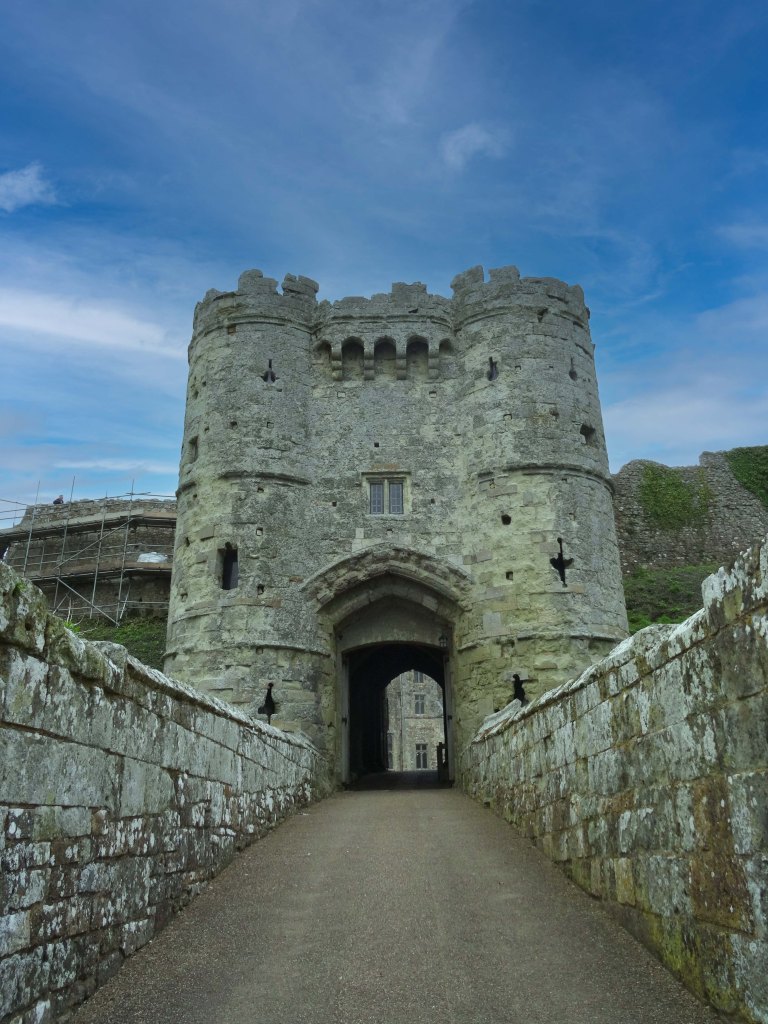
Located on the Isle of Wight, Carisbrooke is a fantastic example of a castle constructed across many generations and styles. Complete with an early motte-and-bailey that you can still climb, this gatehouse, and a perfect view across the countryside, the castle is an excellent spot for a day out and encompasses so many different ages of castle.
Ludlow Castle
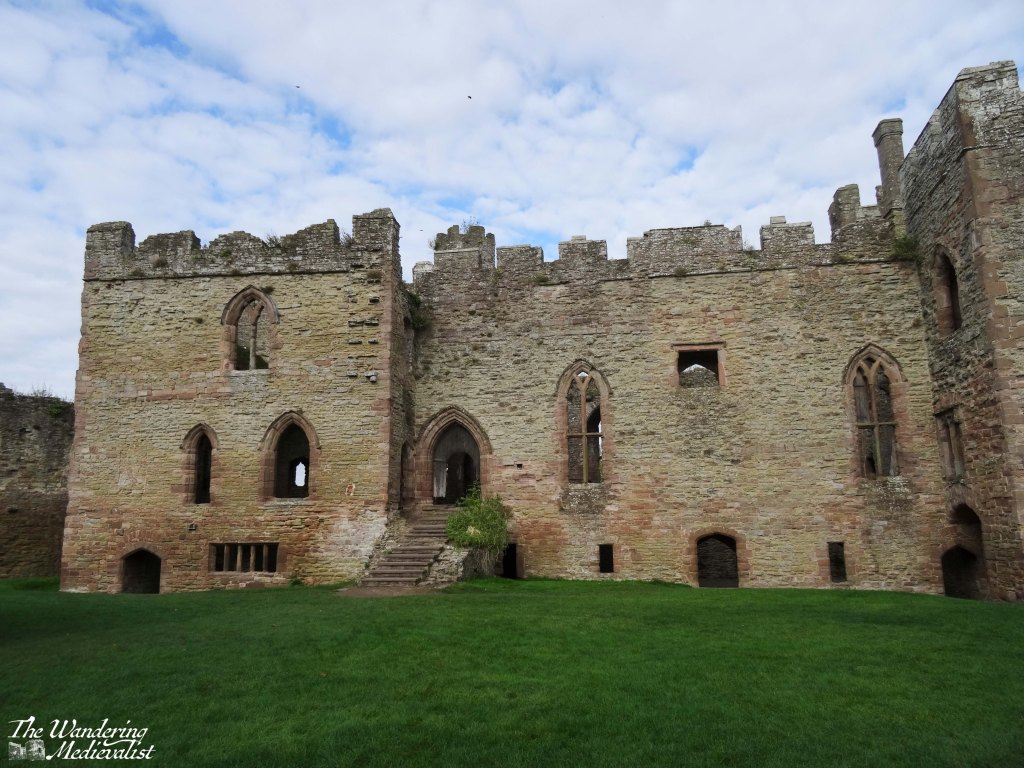
Arguably one of the most stunningly ‘typical’ castles I have ever visited, Ludlow gained significance as a border castle, on the Welsh marches. It has been managed through the ages by some of the ‘biggest’ names in English medieval history including the Mortimers, de Lacys, and the Duke of York.
Scarborough Castle
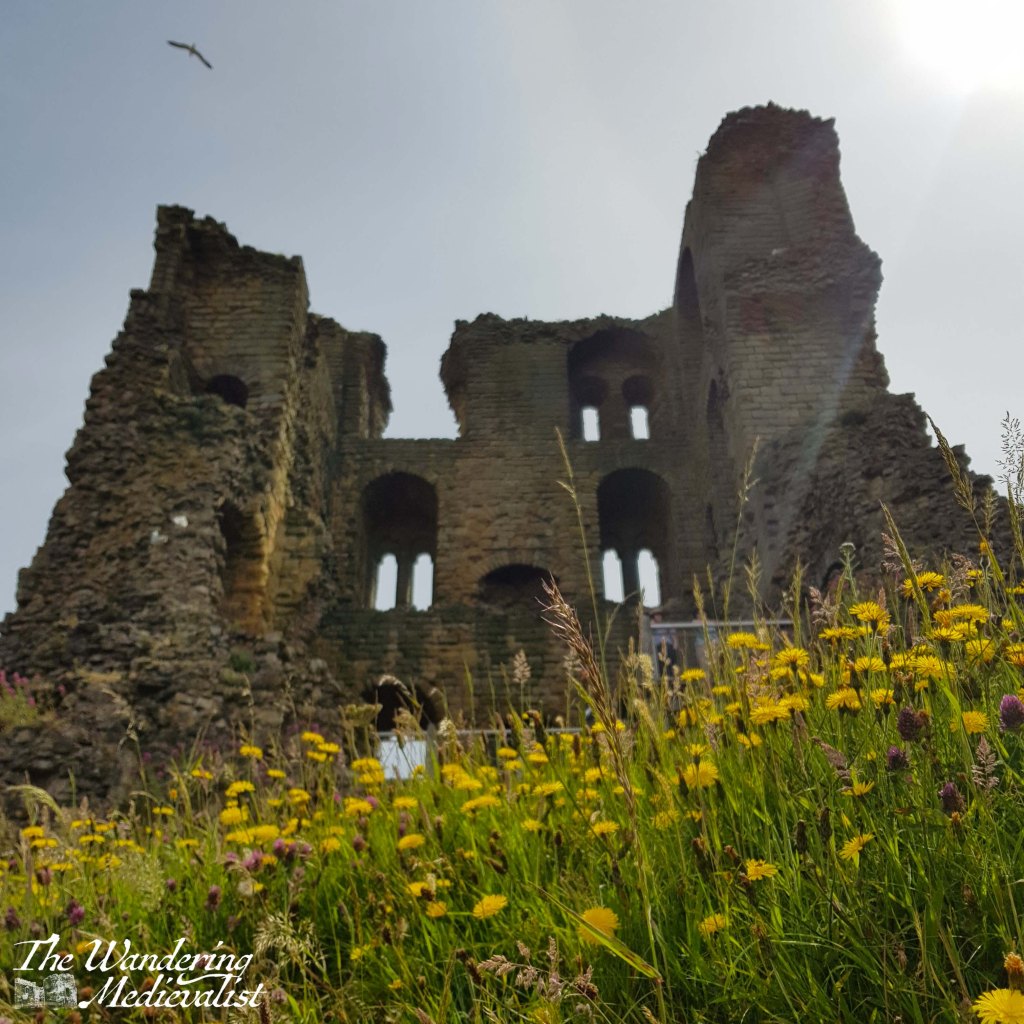
Another link to King Henry II, Scarborough is mostly ruined but the views and remaining curtain wall are a ghostly example of what a high medieval castle could be.
France
The sheer variety of châteaux in France is world-famous – the Loire valley in particular boasts some of the most stunning in the world. As one who has spent a great deal of time studying French history, many of the locations inspire memories of a particular moment of battle or conflict, with castles at the crux of many arguments. There are so many I have yet to see, but Mum and I have managed a few.
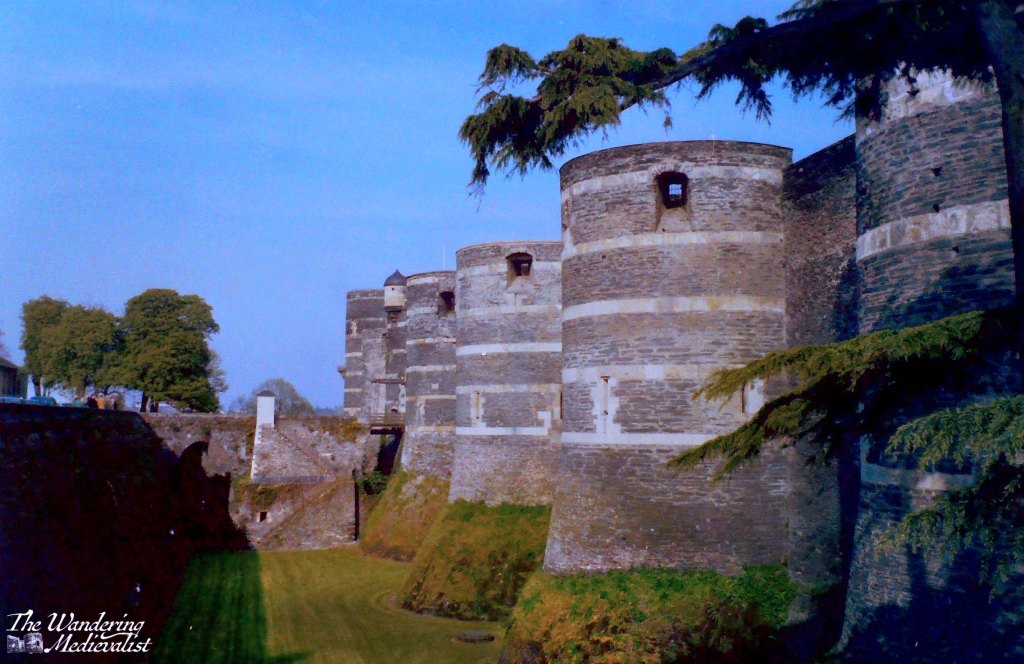
Château d’Angers
Easily recognised by its stunning striped stonework, the Chateau d’Angers – or a version of it – has stood since the ninth century. The castle lent its name to the Angevin Kings of England, starting with Henry II.
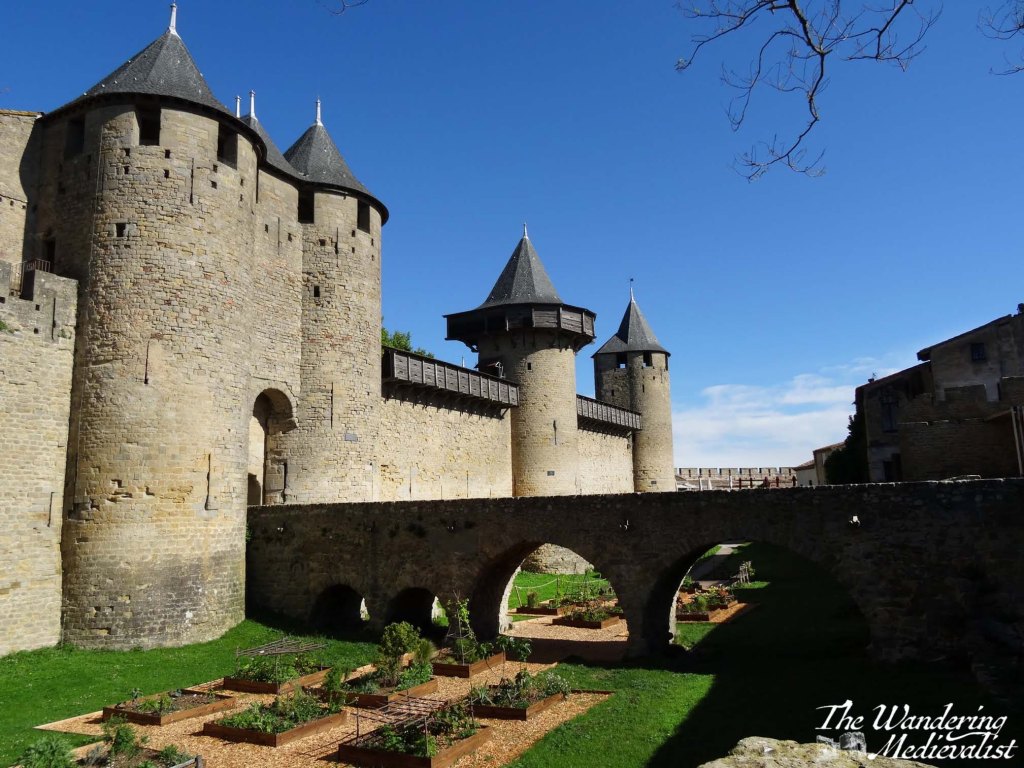
Château de Carcassonne
I’ve written plenty about Carcassonne, one of the better examples of a modern restoration of a castle, complete with battlements.
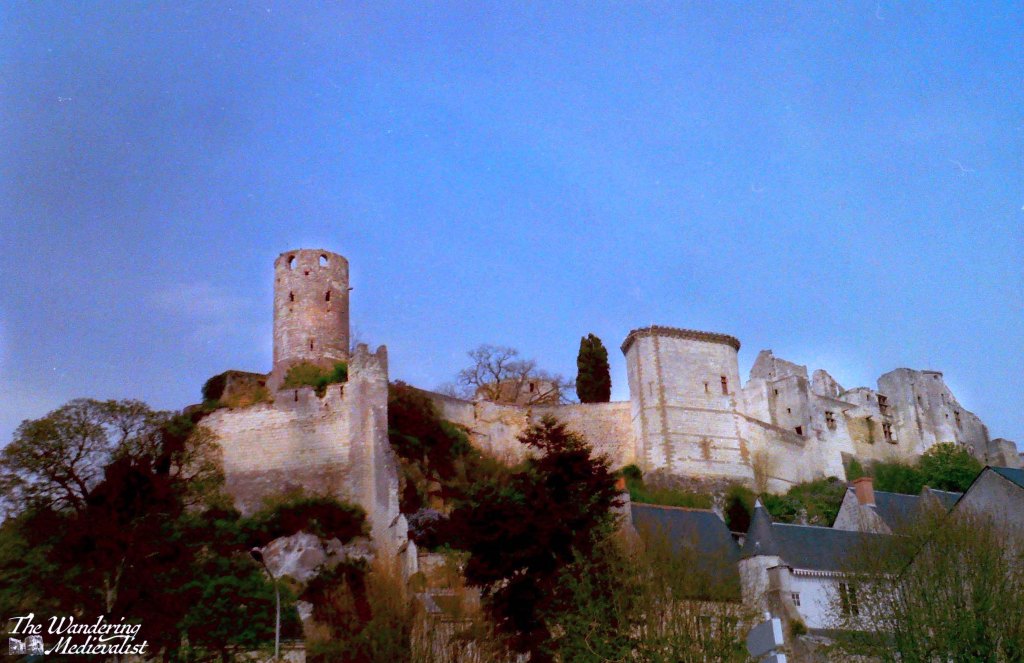
Château de Chinon
Chinon is the setting of one of my favourite films, The Lion in Winter, and was a vital strategic fortress for Henry II. It is also where he passed away, betrayed by his last son. We visited in 2002.
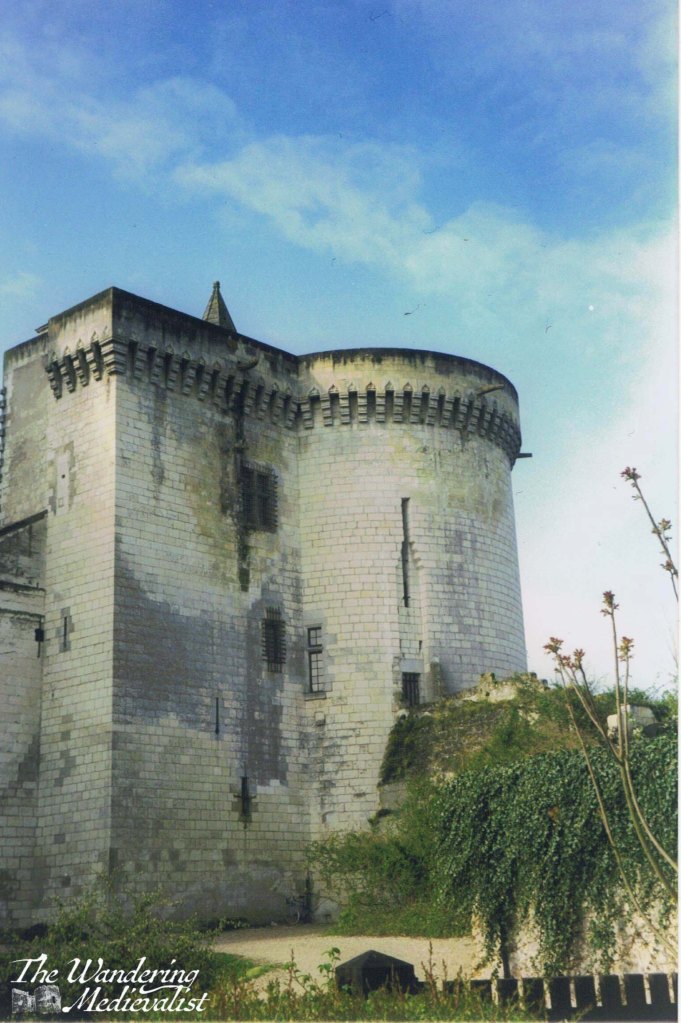
Château de Loches
Though I did not know it in 2002, Loches is in fact twinned with St Andrews. The town itself is renowned for its medieval feel, but my recollection is mostly of the impressive square Norman keep that has remained in place despite all the construction around it. Another castle occupied by Henry II and Richard in their day.
Scotland
Needless to say, Scotland is rich with castles and I have done what I can to visit as many as possible – there are still many to go! A few stand out as favourites; many are of a similar style, with a central keep and walled courtyard of various sizes, known as a tower house. Most offer spectacular views over the ocean, shoreline, or countryside.
Caerlaverock Castle
Uniquely triangular in shape, Caerlaverock is another castle that has been partly destroyed and rebuilt over the years. Pieces of the walls are clearly medieval while the interior buildings are of a slightly newer style.
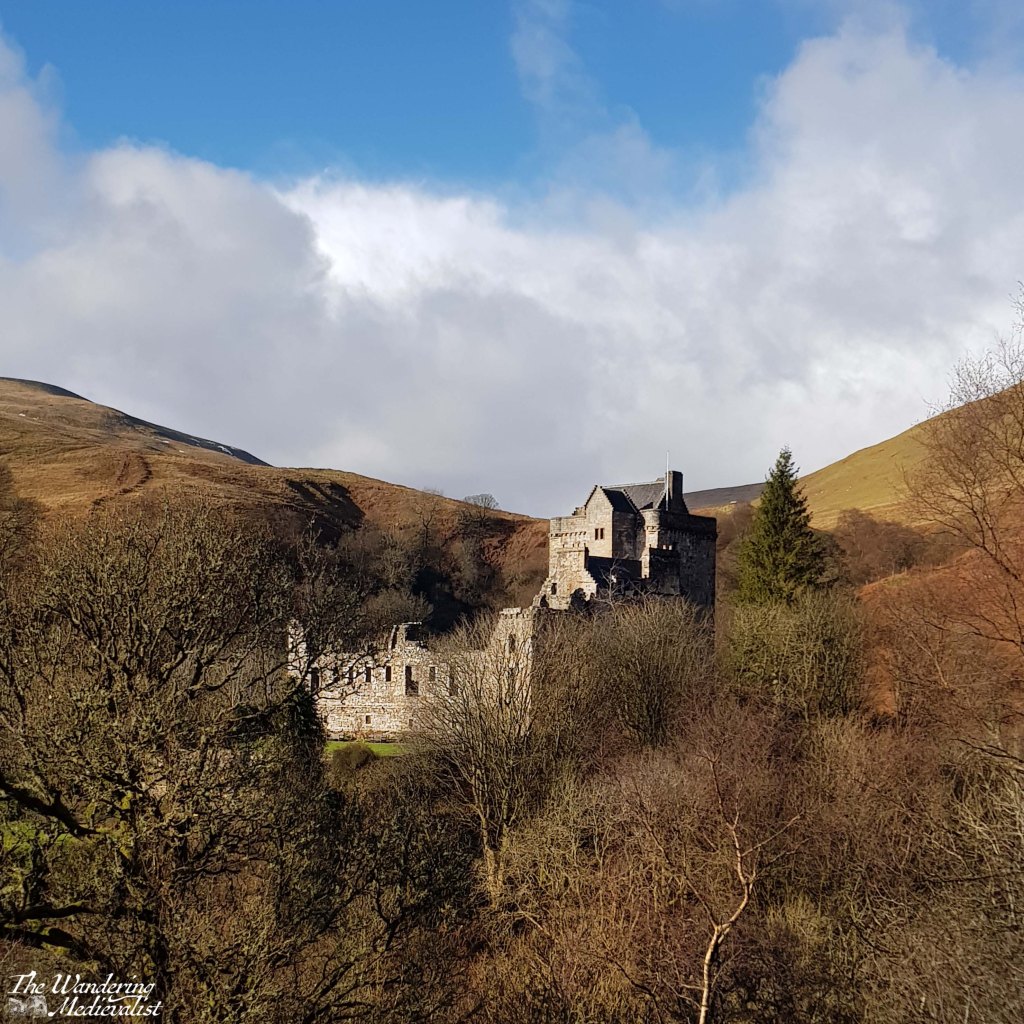
Castle Campbell
The location of Castle Campbell is half of its draw – nestled in Dollar Glen with walks on every side, every time I have visited has provided a different view. The tower itself is still relatively intact, and the views from the surrounding hills are breath-taking.
Craigmillar Castle
One of many castles most recently used for filming Outlander and other Scottish productions, Craigmillar is located on the outskirts of Edinburgh. The castle itself offers a great place to explore, and the views back towards the city are excellent.
Doune Castle
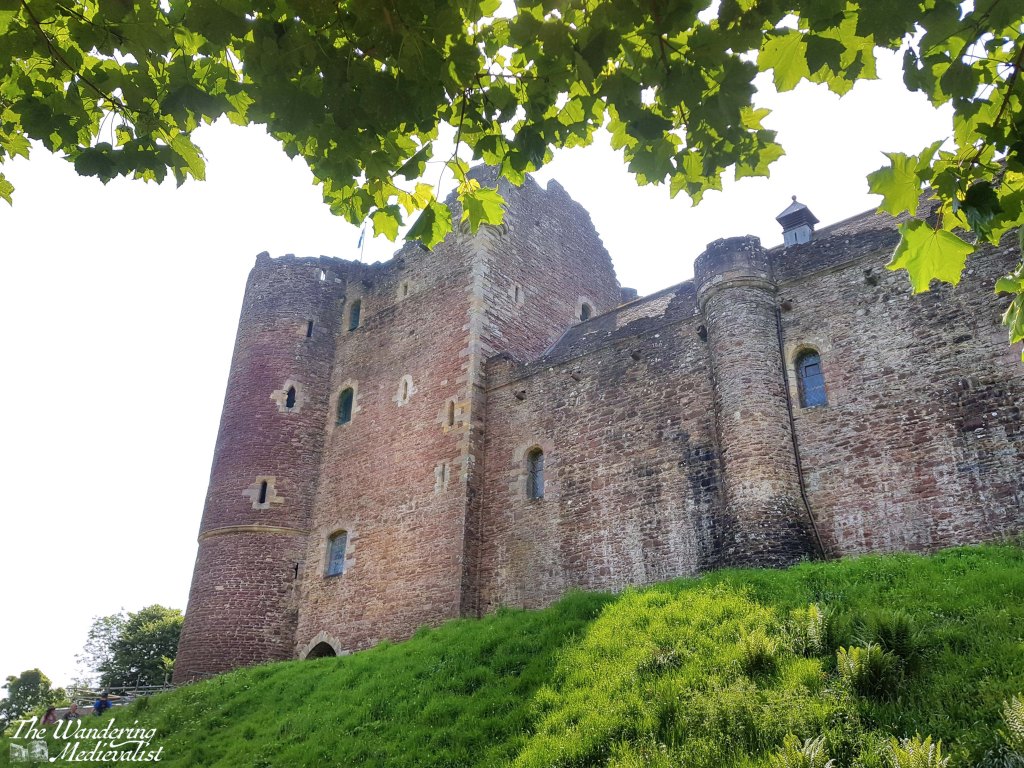
Another movie star castle, Doune is mostly intact with a central keep that offers plenty of staircases and rooms to explore. It tends to be busy year-round but is one of my favourites since my solo visit in January many years ago.
Dunnottar Castle
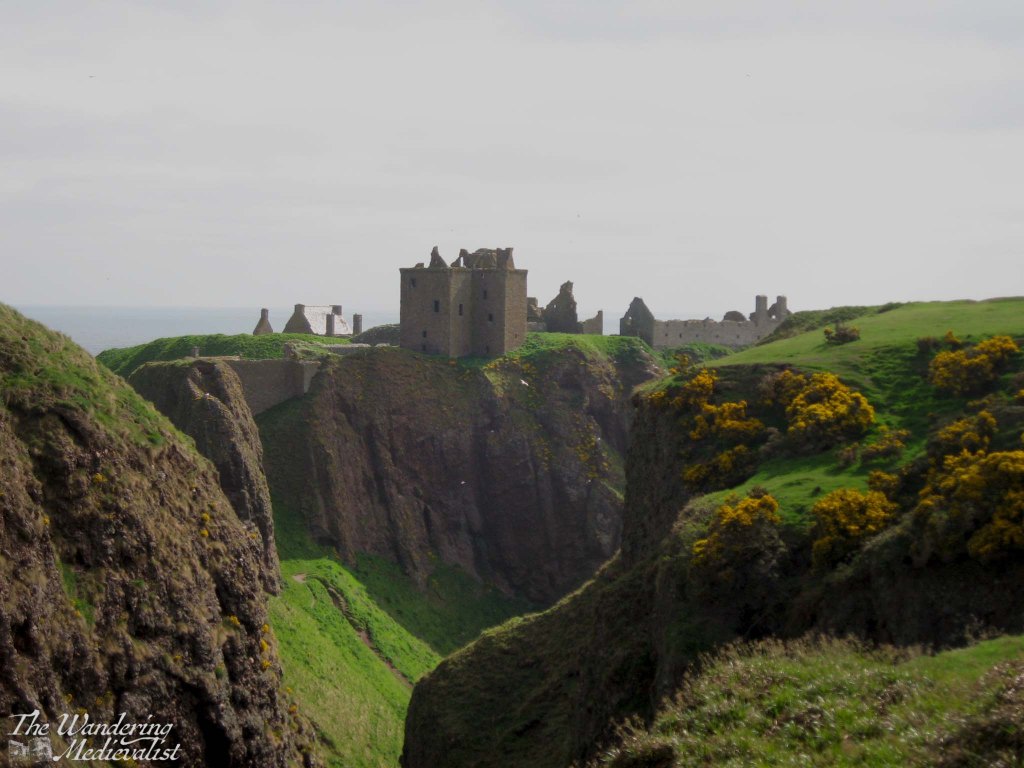
Constructed on a rocky headland, Dunnottar is the epitome of a defensive castle; even now, it requires a good bit of climbing to reach its main gate. Once inside, one finds plenty of buildings to explore and views of the Aberdeenshire cliffs.
Elcho Castle
Self-contained and still in quite good shape, Elcho was a castle we visited on a spur-of-the-moment trip and I really enjoyed. It is ‘new’ for a castle, but the rooms inside have a solidly medieval feel. Lovely views over the countryside and the nearby River Tay.
Lochleven Castle
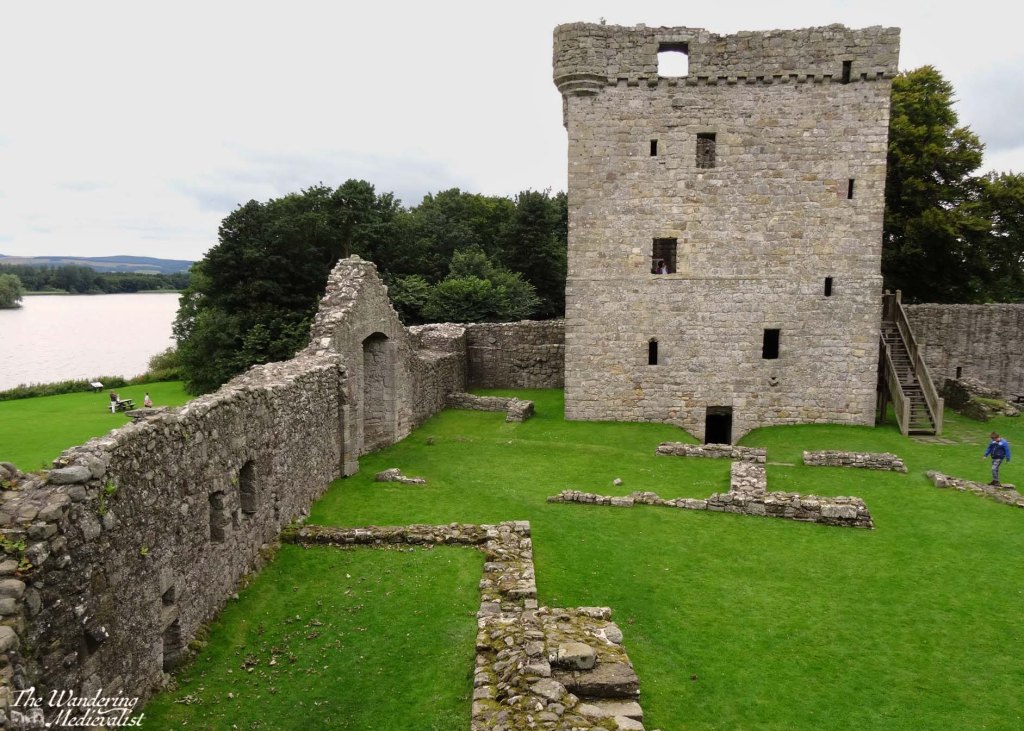
Once upon a time, the other half planned a daily outing for us, ‘Castle Day’, which included a picnic and boat trip to Lochleven Castle. Perfect for defence, the castle takes up most of the small island on which it was built. It was also one of several places where Mary Queen of Scots was imprisoned.
Stirling Castle
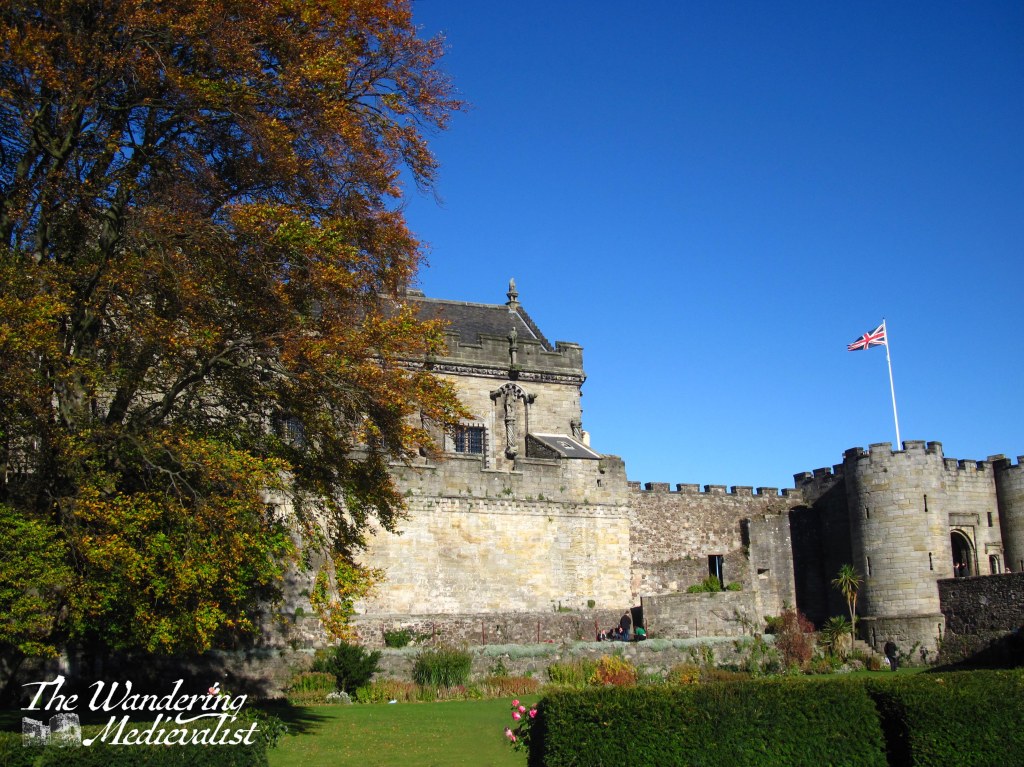
Last but not least, Stirling has always been one of my favourite castles. Similar to Edinburgh in some ways, it is still more medieval in feel, and it offers some of the best views in Scotland.
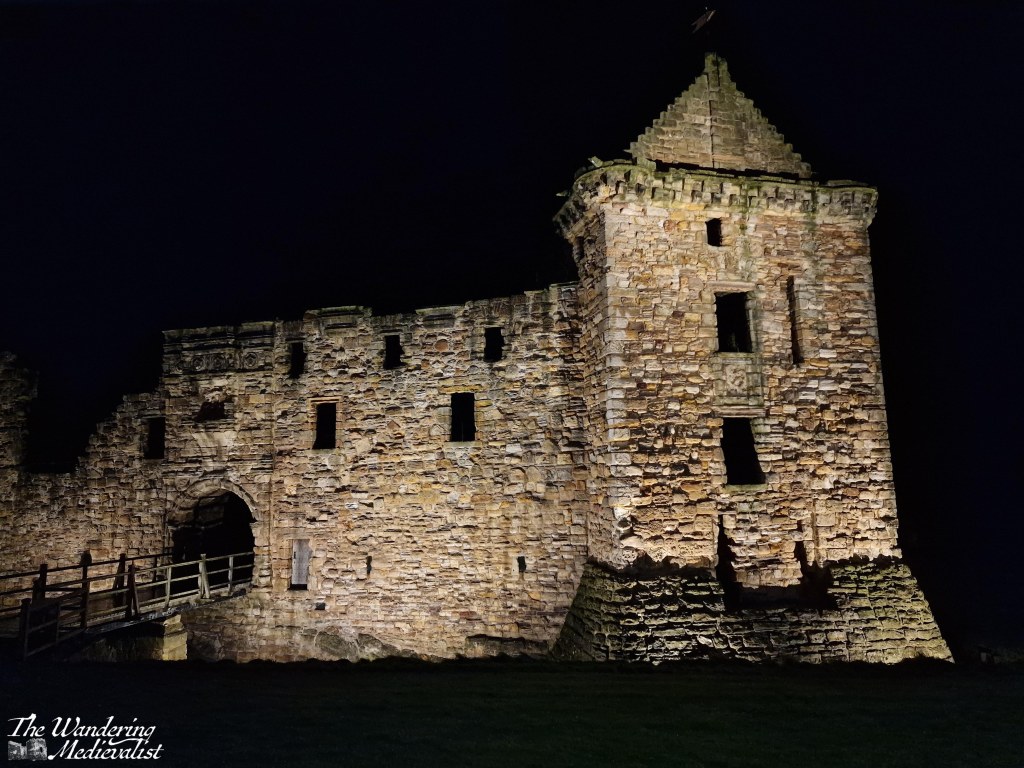
Finally, honourable mention must go to the castle of which I have more photos than any other and which I walk past almost every day: St Andrews. A bishop’s castle, it boasts a bottle dungeon, some lovely carvings, and perhaps most unique, a preserved mine and counter-mine dug during a siege. I will never grow tired of the view walking up the Scores past the castle, enjoying the magnificent gatehouse and the often pounding waves of the North Sea. It is almost impossible to pass by without taking yet another picture. The one below is from Christmas Eve 2022, in the pouring rain; but still a picture that needed to be taken.
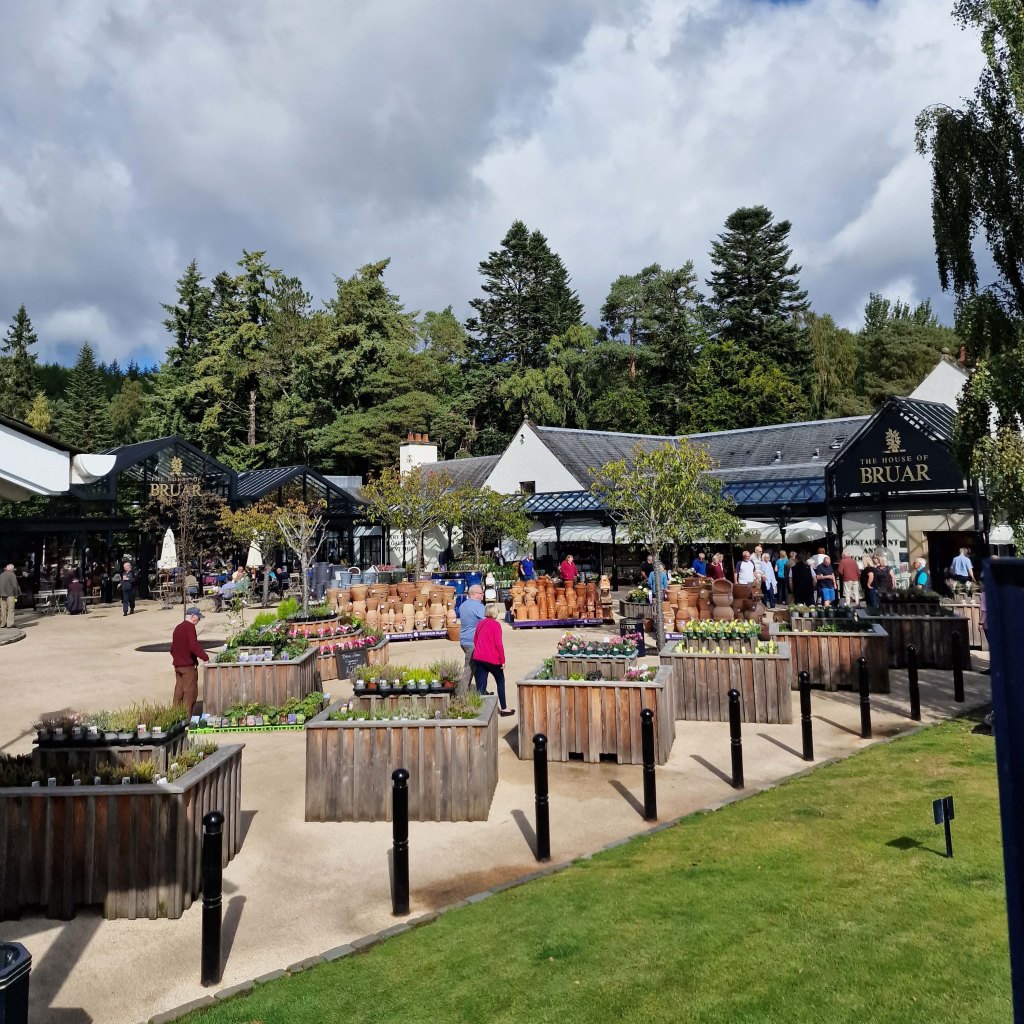
A weekend visit or mid-road trip stop at the House of Bruar is an absolute guilty pleasure, and on a wet and rainy day like today, I often find myself thinking about the next time I can manage to escape north.
The House of Bruar is a bit difficult to explain – it is a luxury goods store that sells everything from fishing tackle to fine cashmere, country styles and deer stalking outfits, fresh produce and plants, and also fine kitchen supplies, Scottish gifts, and much more. There is an extensive fine food hall with Scottish goodies like shortbread, oat cakes, Dundee cake, fine chocolates, sweets and pastries of all kinds, preserves, honey, crackers, cheeses, bread, and a fresh deli with an excellent butcher.
The sausages obtained from this butcher are often reserved for a special occasion and are offered in a great range of flavours. There is also a generous liquor section selling local gin, whisky, beer, liqueurs and soft drinks.
Not pictured: enormous scone
If this was not enough to draw you north of Perth, there is a large café selling fresh-made soups, sandwiches, cakes and indeed whole Sunday roasts; essential to any stop is a coffee and a scone in the covered canteen, where often you can find birds hopping around between the tables.
In short, it is the perfect place for a day out, as long as you set yourself a budget ahead of time. To help with this, there is a sale hall where you can find older styles of clothing and discounted wool and cashmere sweaters and scarves – a must around Christmas time.
Shopping is not the only goal of a trip to Bruar though, for if you bring your sturdy shoes, you can follow the path around to the back of the complex and up into the forest towards the two falls – falls that were immortalized in words by none other than Robbie Burns.
The Lower Falls is a short walk up a relatively easy trail that still enables you to experience the beauty of the woods. It is probably just short of wheelchair accessible, but I have seen plenty of prams and casually-shod walkers attempt it – with varying levels of success.
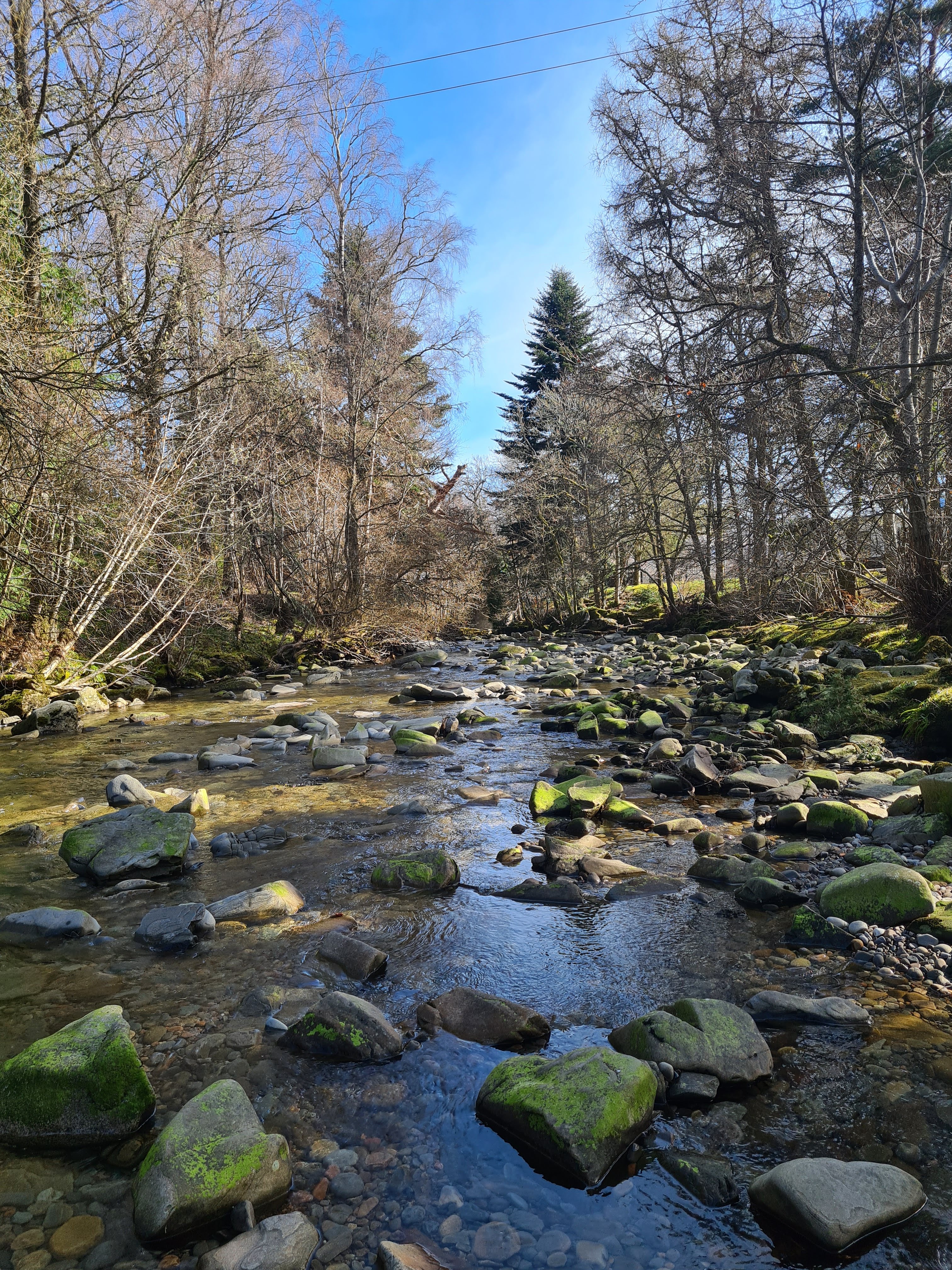
The path starts along the edge of the river then passes under the train track through a short dark tunnel.
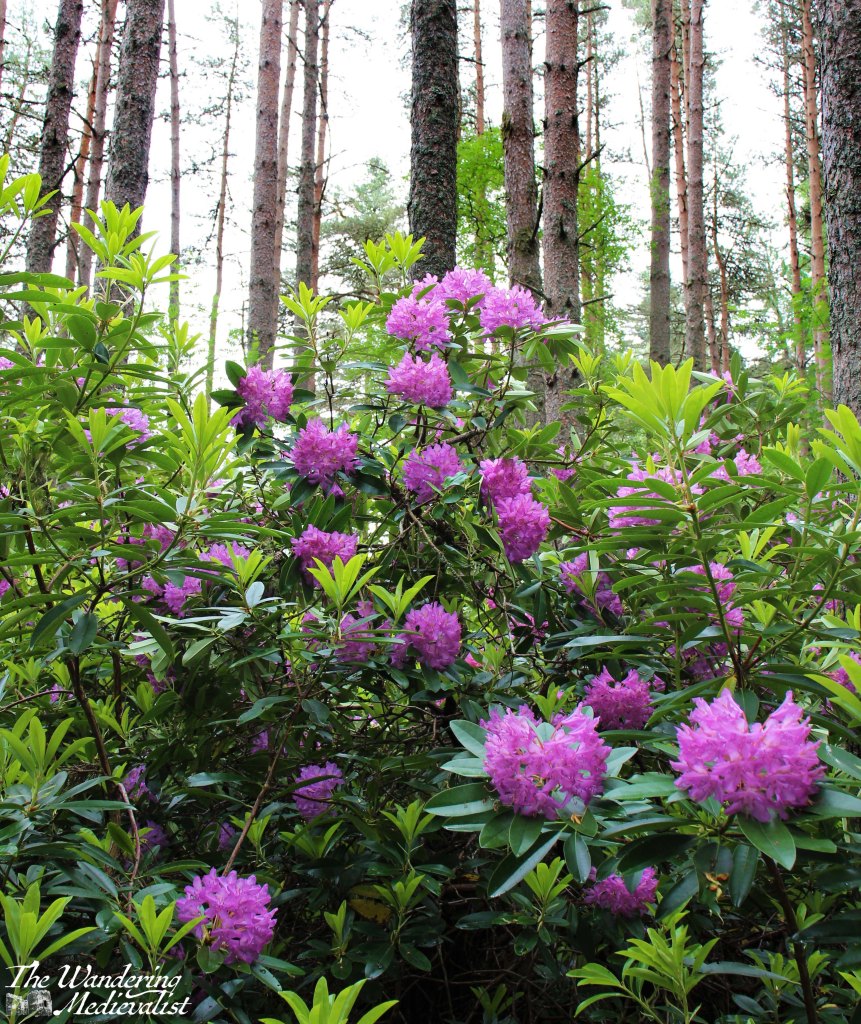
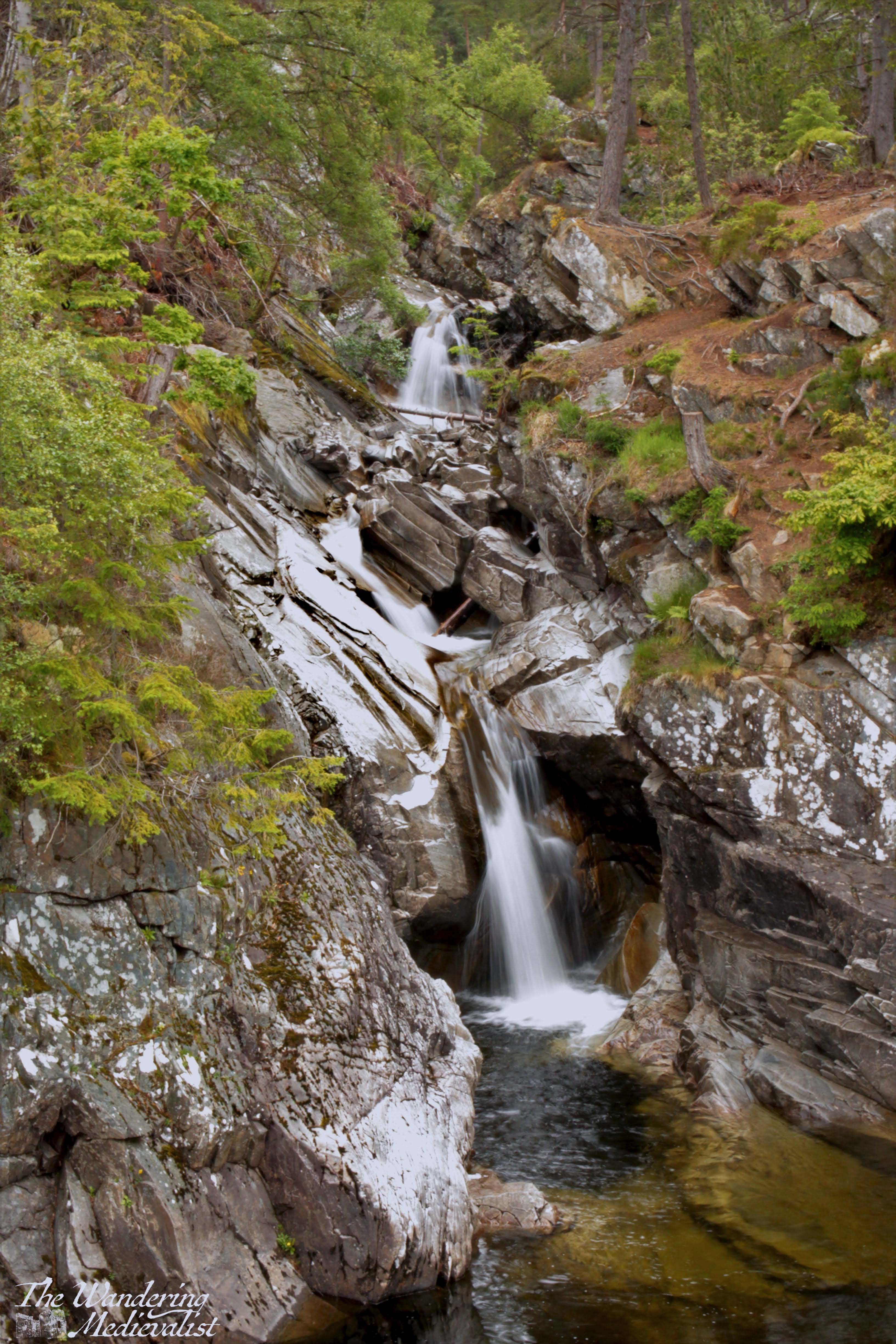
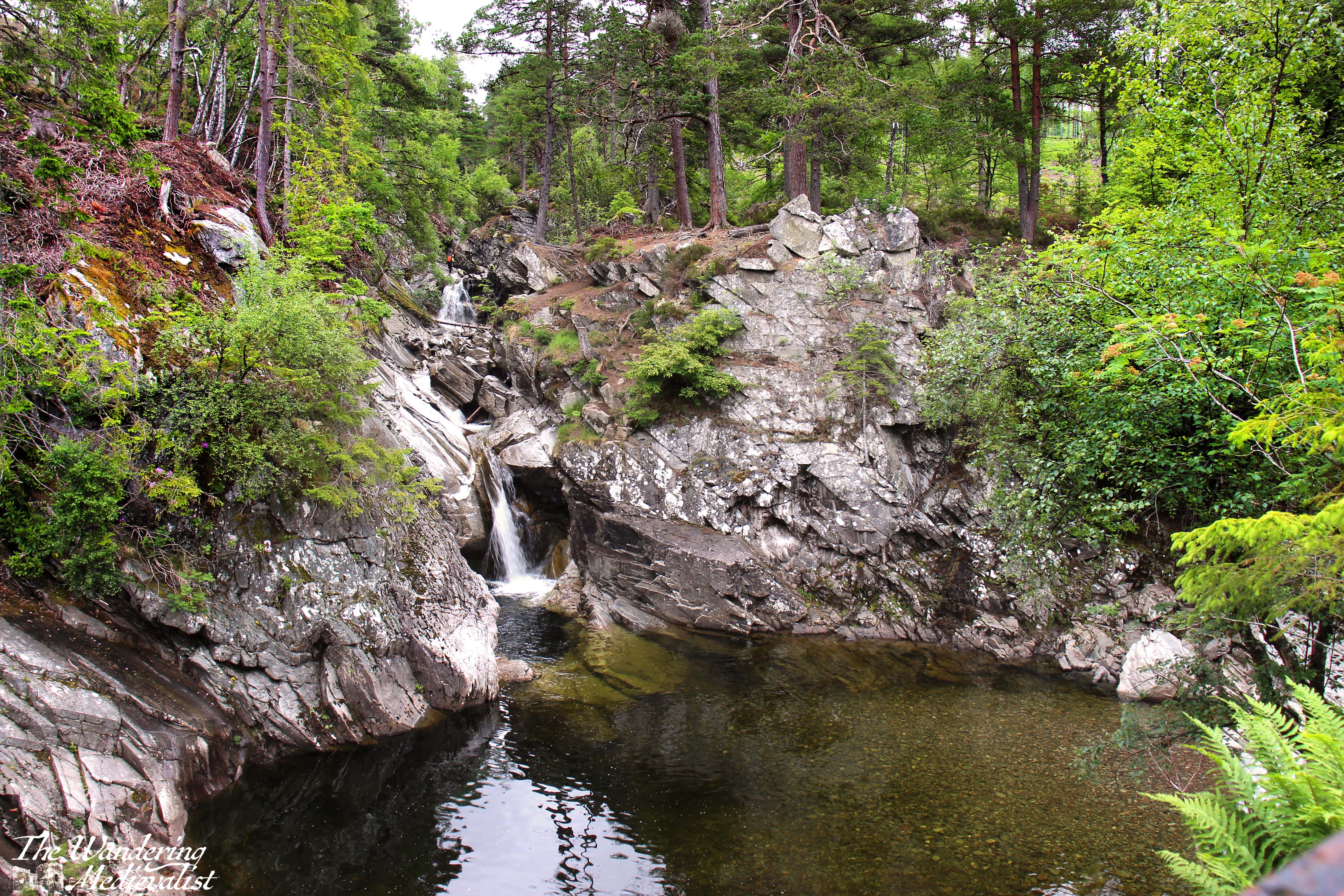
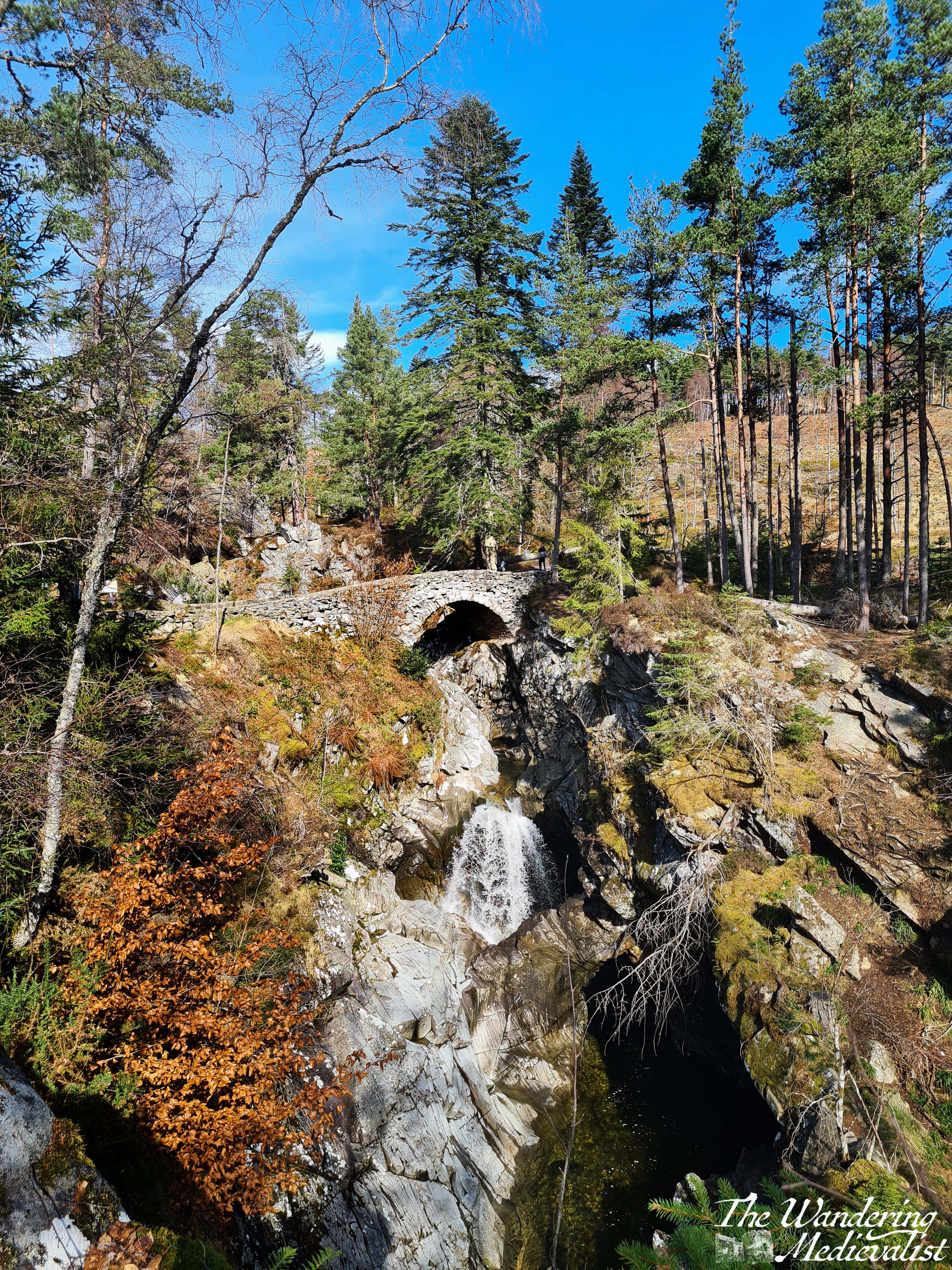
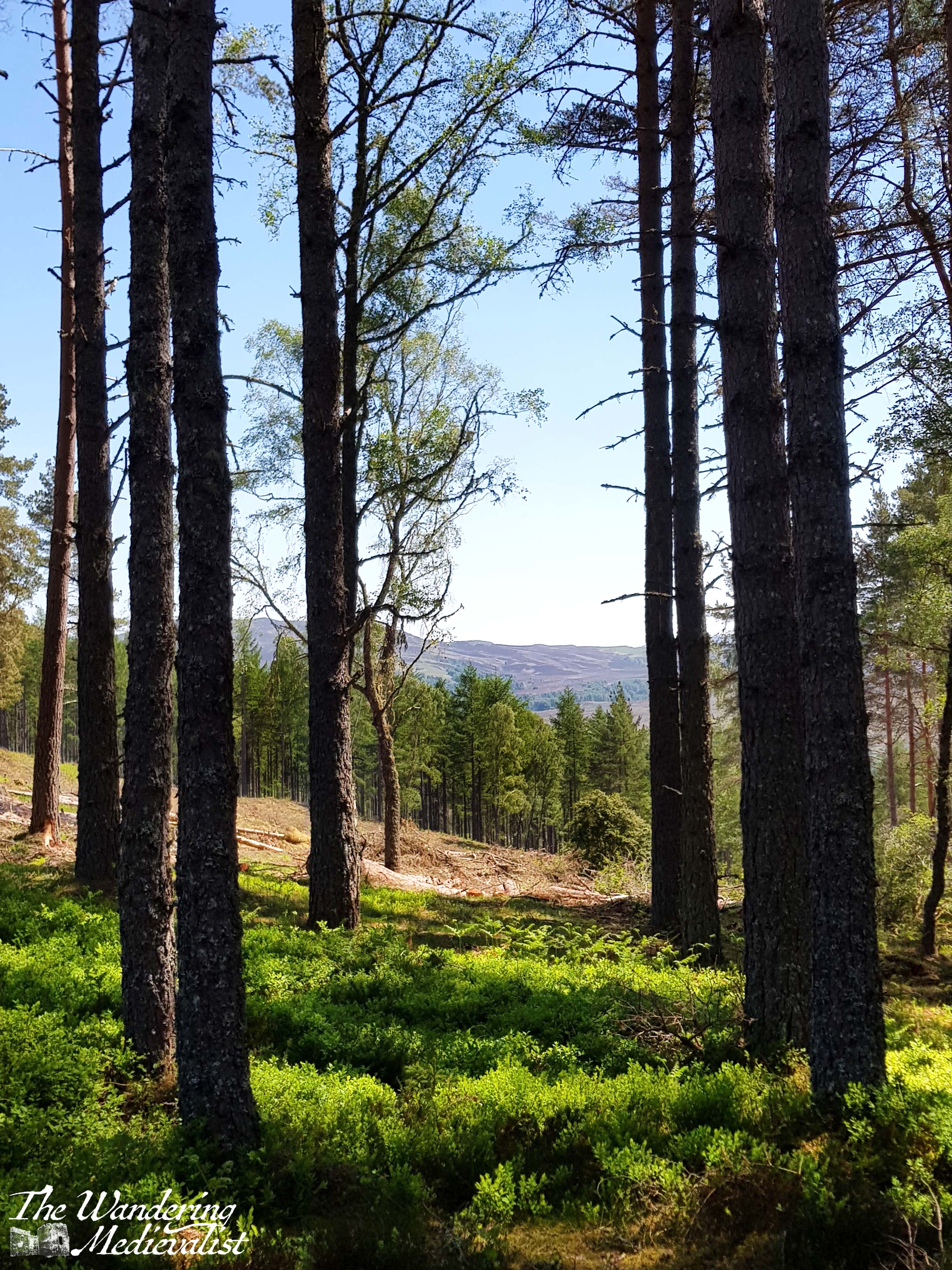
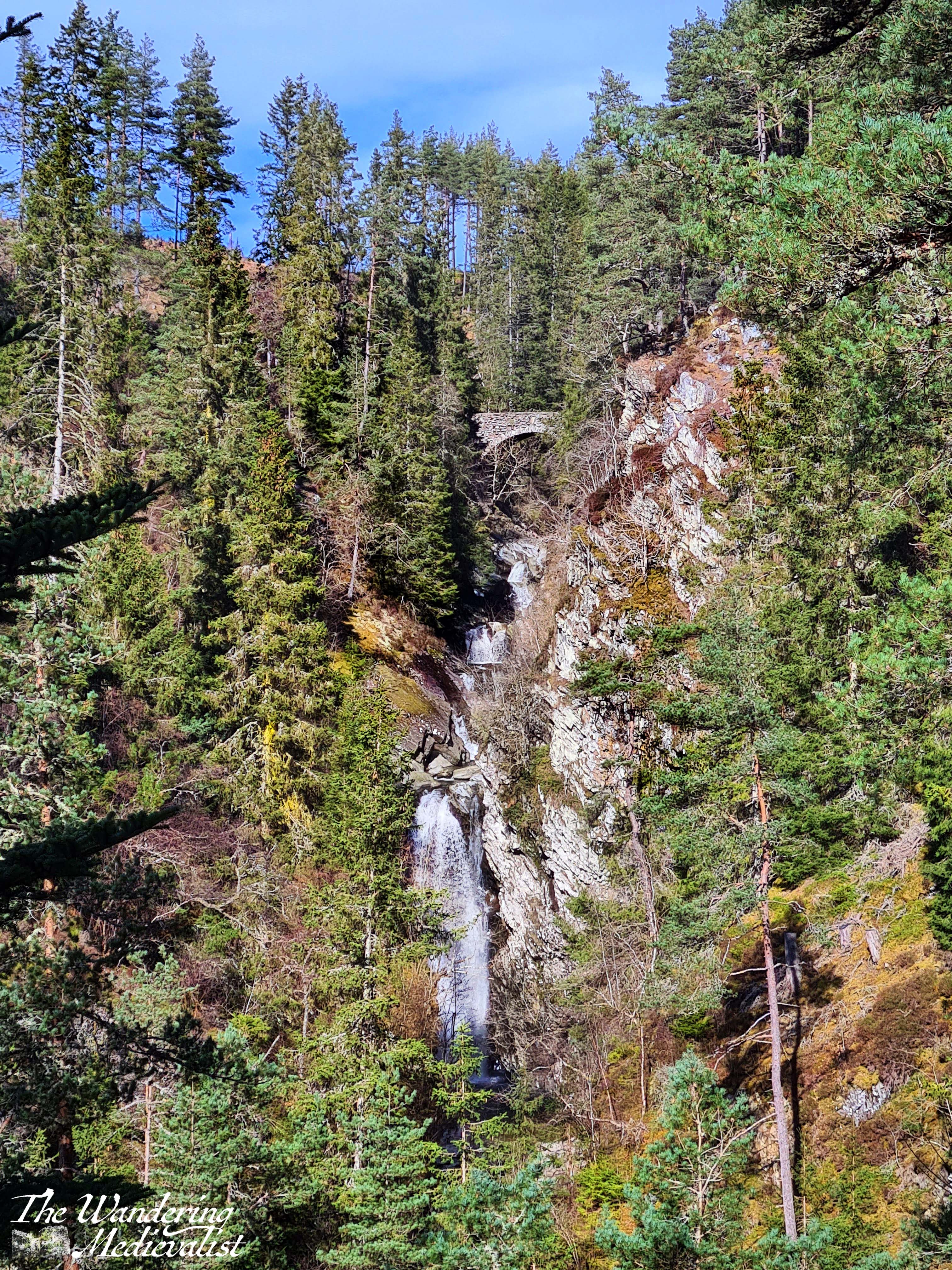
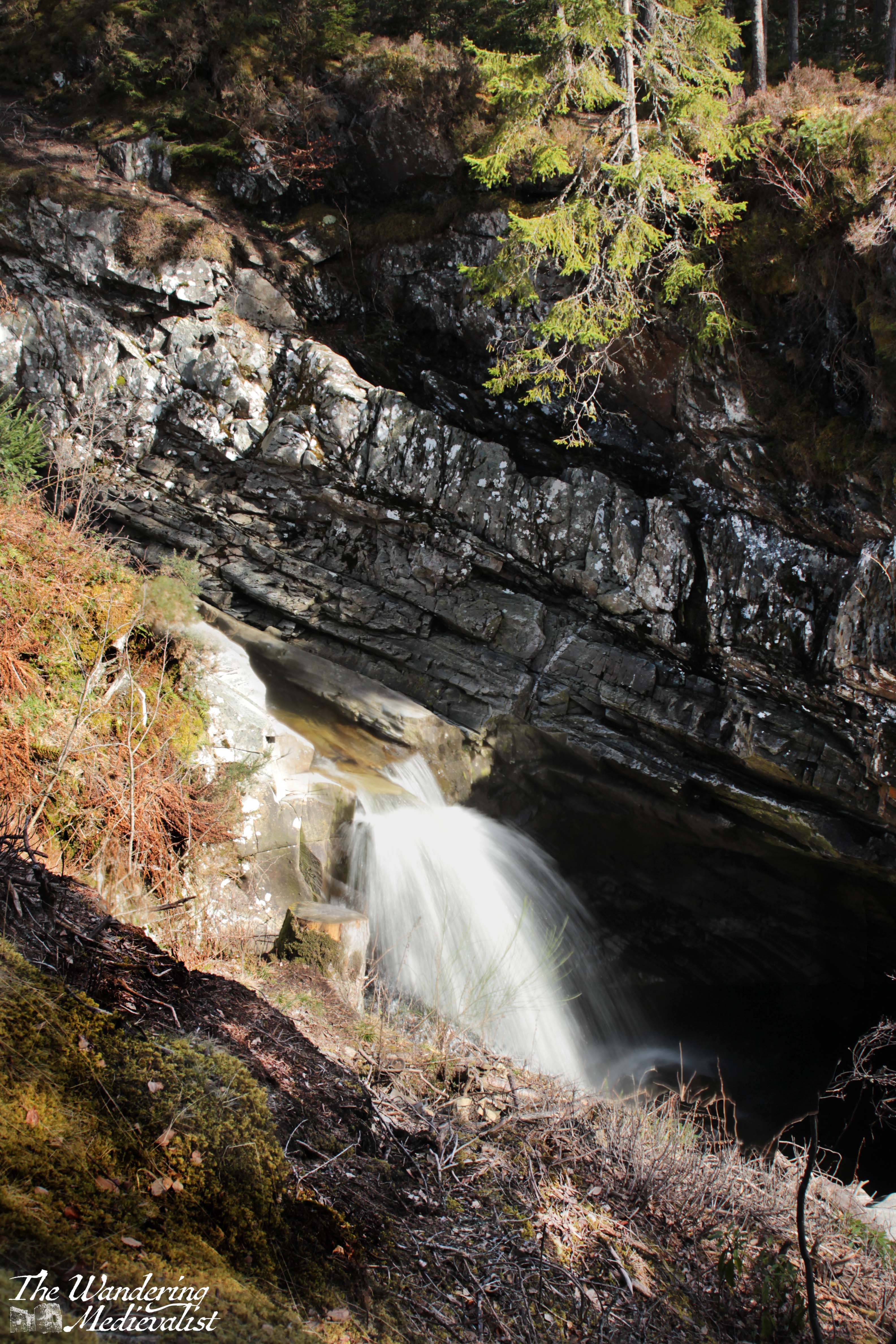
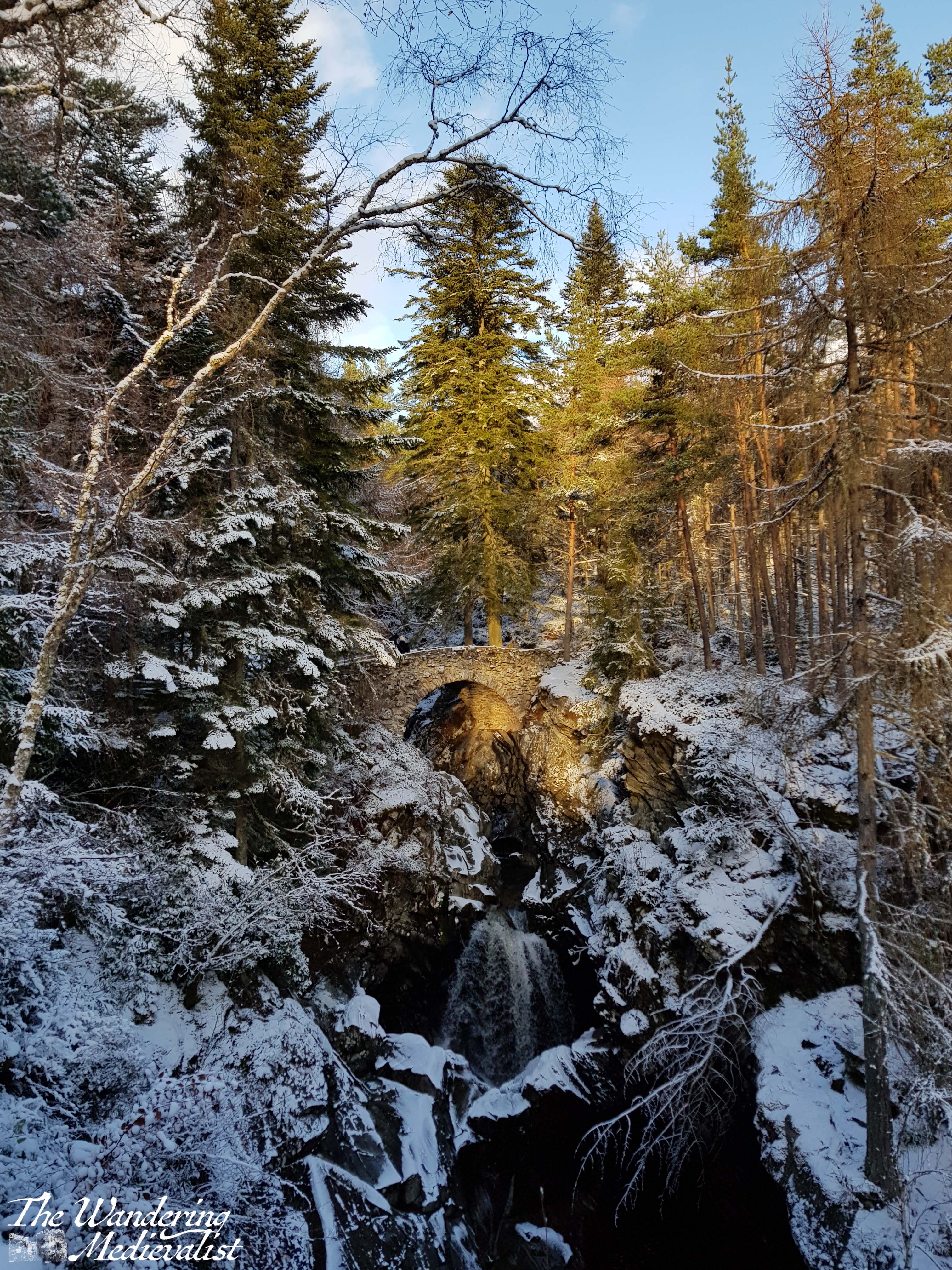
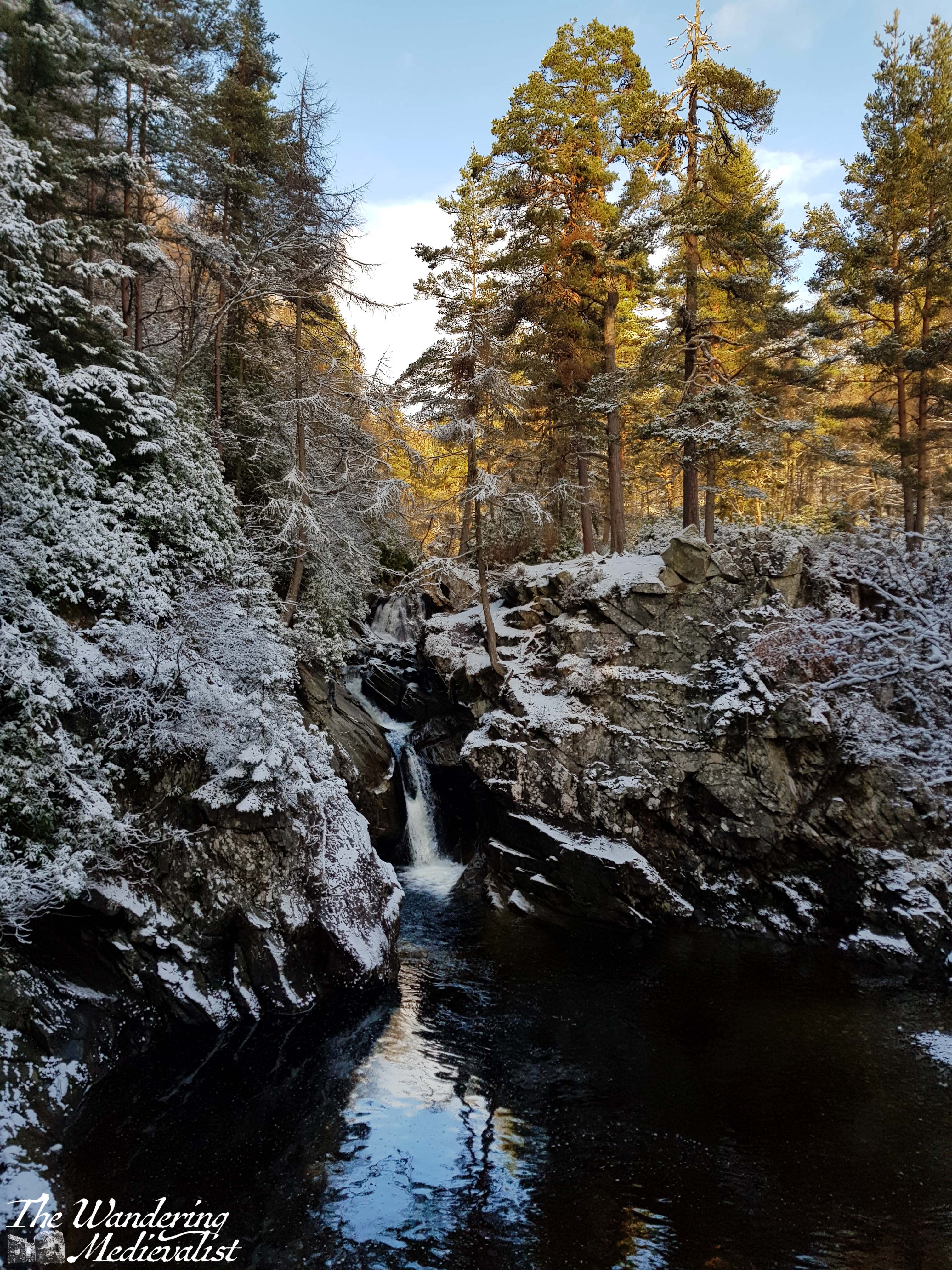
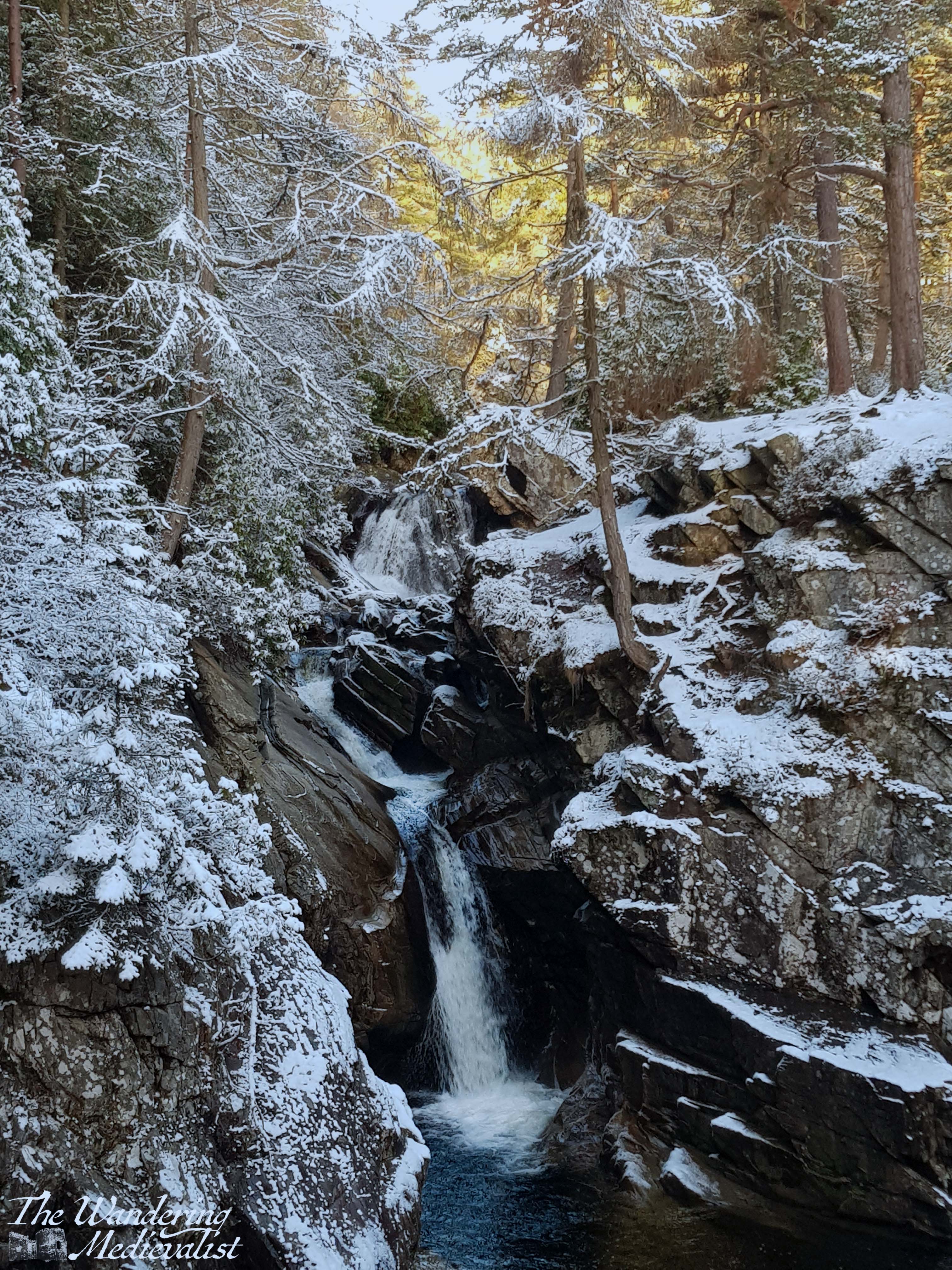
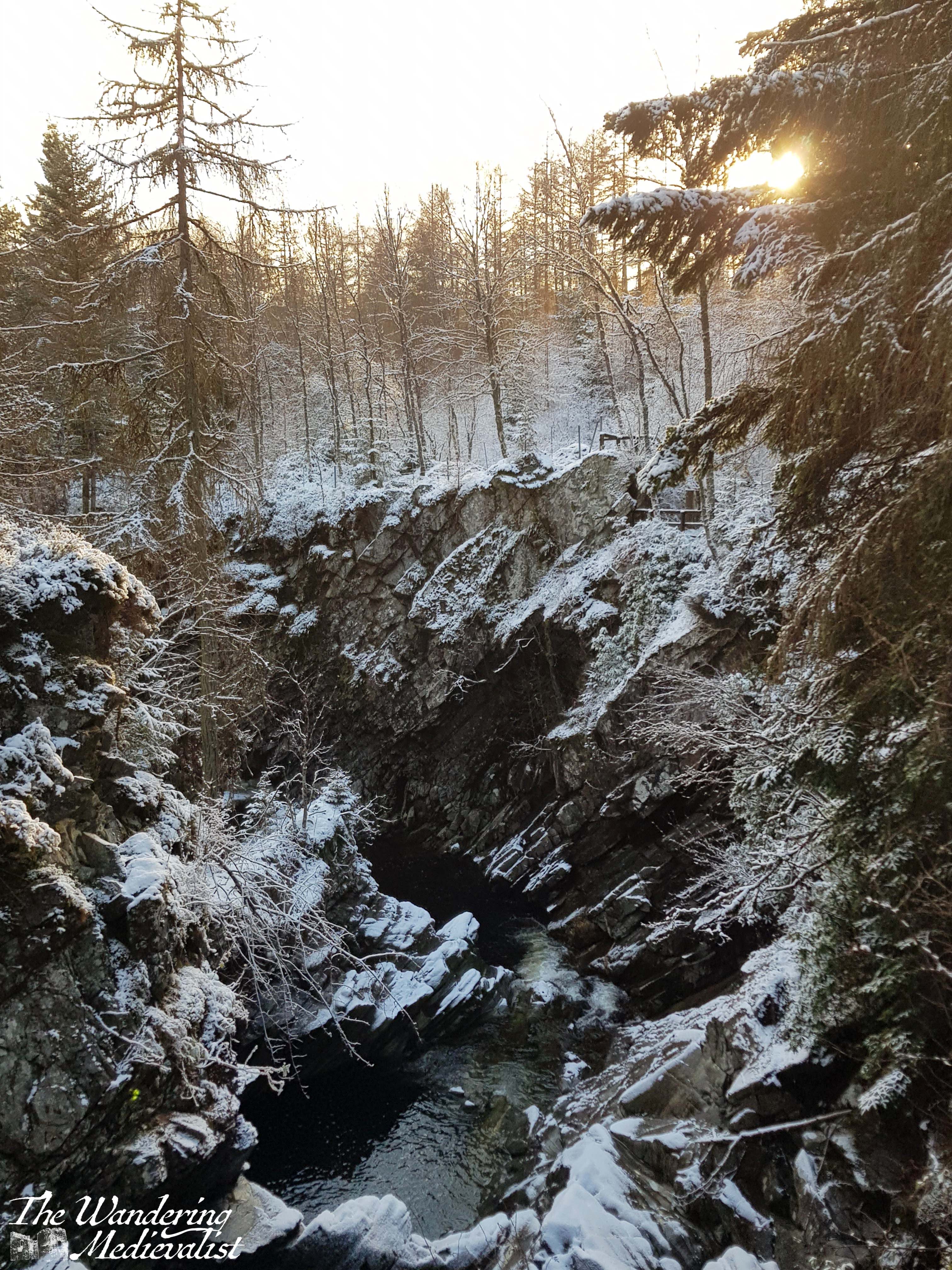
Beyond the tunnel, the trees are tall and straight, the ground gently mossy or covered in pine needles, with stands of rhododendron scattered about, stunningly purple in the summer. Walkers weave gently uphill with the river audible to the right, deep in a gorge that has been carved through the rock. The first viewpoint is just before the bridge and allows for the picture below of the water pouring through the gorge under the stone arch. Just a bit further up one finds the remains of a Victorian view house, which is best spot for the lower falls themselves. Here one often finds children and dogs scrambling around the rocks, and there is a wide, rocky pool, though swimming is not advised. From the bridge you can see the falls or down the river to a spectacular gorge – pictures in the snowy bit below.
For those wishing a bit more of a hike, the path continues up the hill towards the upper falls. It’s a longer walk – around 45 minutes – and quite steep in places, but there are a few benches where one can pause and enjoy the view back over the valley.
I remember very clearly the first time we took this walk, more than fifteen years ago, and many of the trees that graced the hillside have since been cut down due to disease, creating patches of bald earth, particularly on what is the left-hand side of the river, facing uphill – the western side. The story is that it was Robert Burns himself who requested that the Duke of Atholl plant the forest around the Bruar Water, and so while it was required that diseased trees be removed, new ones have been planted to replace them.
A few strong wind storms damaged the path through the pandemic years, bringing down some enormous trees that must have been hundreds of years old. On our first post-pandemic visit we were not able to go as far as we had planned, as the path was completely blocked.
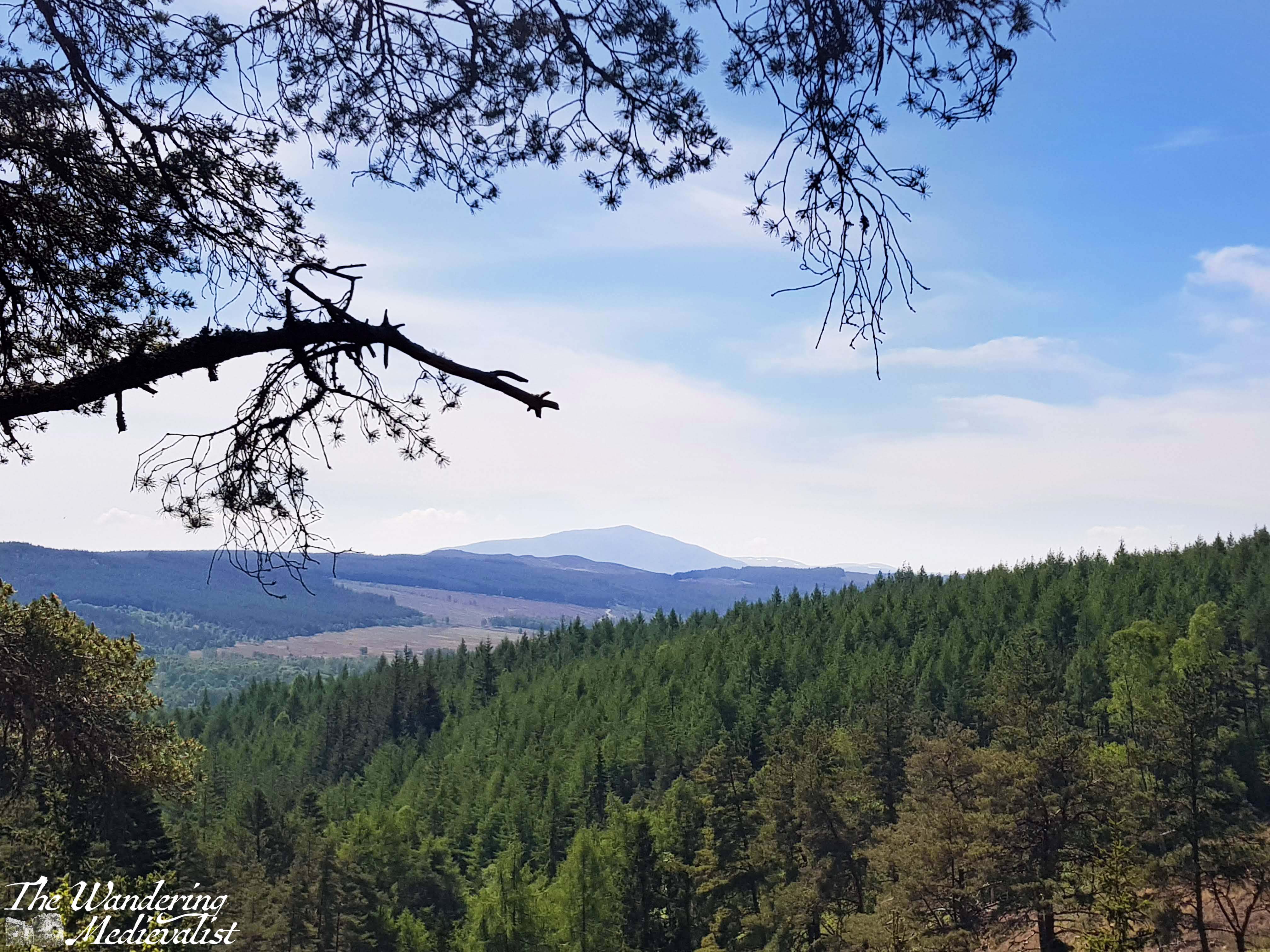
Continuing up the hill is well worth it when safe. As one climbs, glimpses of the upper bridge are visible through the trees, while the gorge cuts away sharply below. Eventually, the path circles down again towards the river and reaches the bridge, where the views are, again, lovely across the forest and valley beyond.
From this point, the path either continues along the far side of the river and eventually completes the loop at the lower bridge, or you can choose to return on the eastern path which is a bit more picturesque as the western slopes were those most dramatically cleared of trees.
In the autumn the few deciduous trees tend to turn orange-yellow to match the golden larch. In warm months, the greenery is lush and often colourful, but by far the most beautiful visit we ever had to the Falls of Bruar was in December. It was a completely unplanned trip that came into our heads one Saturday morning when we realised we wanted to get a new Christmas ornament for our tree, and quite fancied some nice sausages from the butcher. While Fife did not have any snow, we discovered as we drove up the A9 that the area north of Perth had experienced a dusting. We had planned to at least walk up to the Lower Falls – we almost always do – but thought we might run out of light before we could go further.
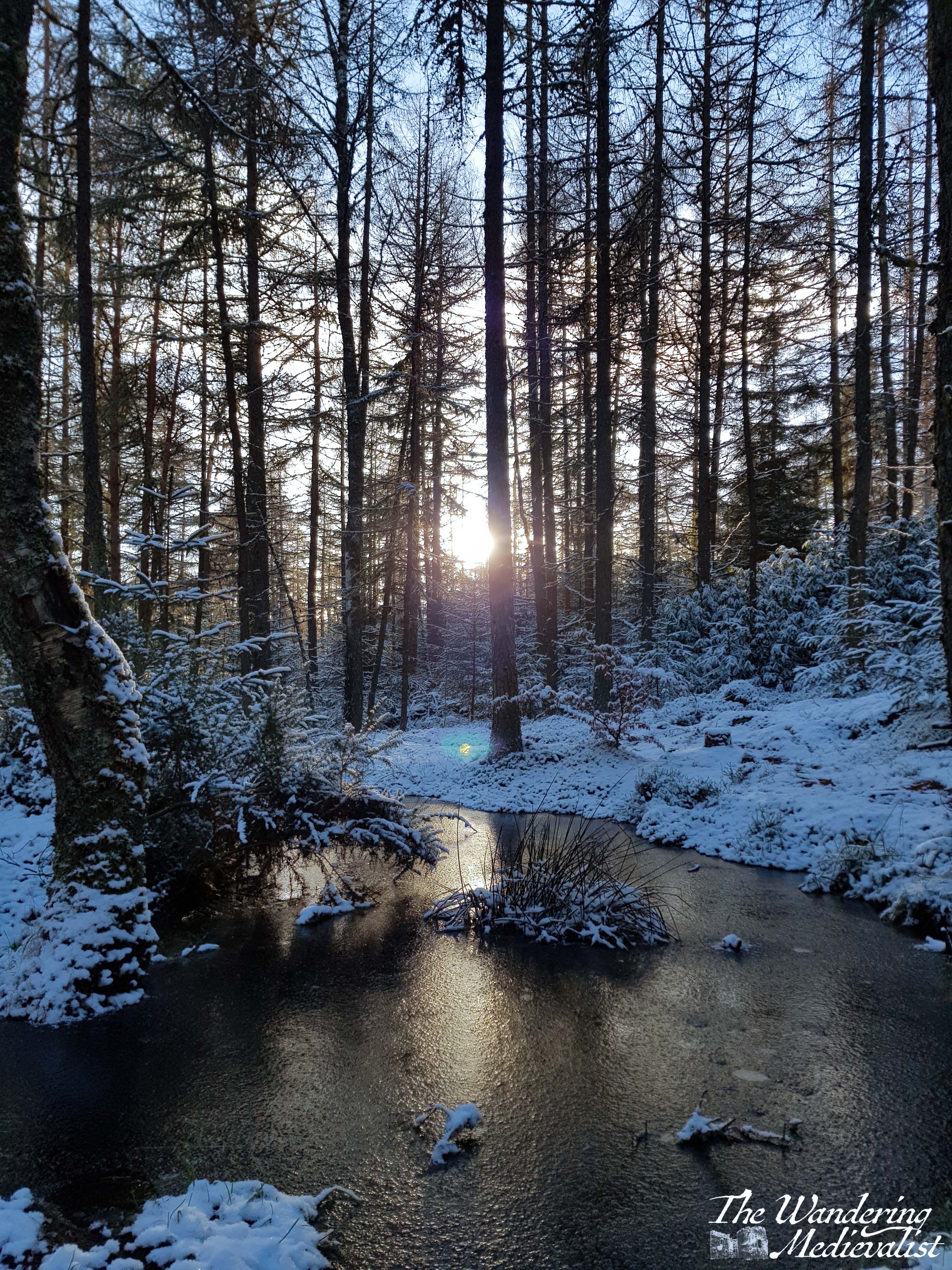
After a short tour through the food hall, we stowed our purchases in the car and headed up the path into a winter wonderland. The snow and afternoon sunlight – in December the sun sets not long after 3.30pm – made for an absolutely breath-taking walk, with so many stunning views that I can never decide which I like best.
It was with real regret that I eventually agreed to return to the food hall for a coffee and scone, delicious though both were. I have always desperately hoped that I might have a repeat of this snowy visit, but even in December 2022, when snow blanketed the whole country, I missed it here by about 12 hours.
There are a few caveats to visiting the House of Bruar: firstly, you may well run into coach trips full of tourists, or large groups of well-off visitors with very little consideration of those around them. Secondly, it is frequently very busy, meaning that even a mid-trip stop to use the facilities and pick up a snack can eat up 20 minutes. And thirdly, it is expensive – one has to be realistic about what one intends to spend, and realise that even a bottle of water is likely to cost double what it might elsewhere (though the quality of what you buy here often equals the cost).
Like so many places in Scotland, Bruar holds a connection for me that is both one of beauty and one of memory; the other half and I visited the House of Bruar on our first ever weekend away together to Pitlochry and I stop here at almost every chance I get, certainly on any trip along the A9. Even if I do not have the time to manage the full climb to the upper falls, a trip to Bruar is the highlight of any weekend or week. I am already planning a return visit closer to Christmas!
I recall summer 2020 as being a time of hope and a touch of freedom after a spring of uncertainty, lockdown, and fear. While work was still very much from home, people were taking advantage of the fine weather to be outdoors, even if socialising was still touch-and-go. I took advantage of having not long passed my driving test to plan short day trips for myself including to Balmerino Abbey, a twenty-minute drive along the coast from where we lived in Tayport. I’ve never been particularly into abbeys or ecclesiastical history, but one has to appreciate their architecture.
So, I packed myself up and planned the route on Google, trusty camera in tow. It was one of my first solo driving adventures and so I was both excited and a touch nervous as I made my way into the small town and managed to find a place along the road to park.
The abbey, as I discovered, is in ruins, but with much less left than I had expected. It was founded in 1229, when a group of Cistercian monks arrived from Melrose Abbey, about 85 miles south. King Alexander II and his wife Queen Ermengarde were patrons – the queen visited many times and was buried there. It was even said that Ermengarde planted the ancient Spanish chestnut tree upon the abbey’s foundation.
Analysis of the tree performed by the National Trust however indicated that it is ‘only’ around 420 years old, so more likely to have been planted closer to the time of the abbey’s dissolution than foundation.
Throughout the Catholic Middle Ages, the abbey maintained a small population of monks, reaching 20 in the beginning of the sixteenth century, but it suffered in the wars with England, damaged both in 1547 and then again in 1559 by the Reformation.
Compared to the border abbeys, Balmerino was quite small, and there is considerably less to draw on one’s imagination, however the outline of the church is still visible, marked out in the grass. The ruins that are left are still markedly ecclesiastic in their feel, with beautifully shaped pillars and arches, hints of vaulted rooms, and the remains of a carved entrance way.
Moving past the remaining stones and towards the ancient tree, one can look back and get a feel for the scale of what once stood here.
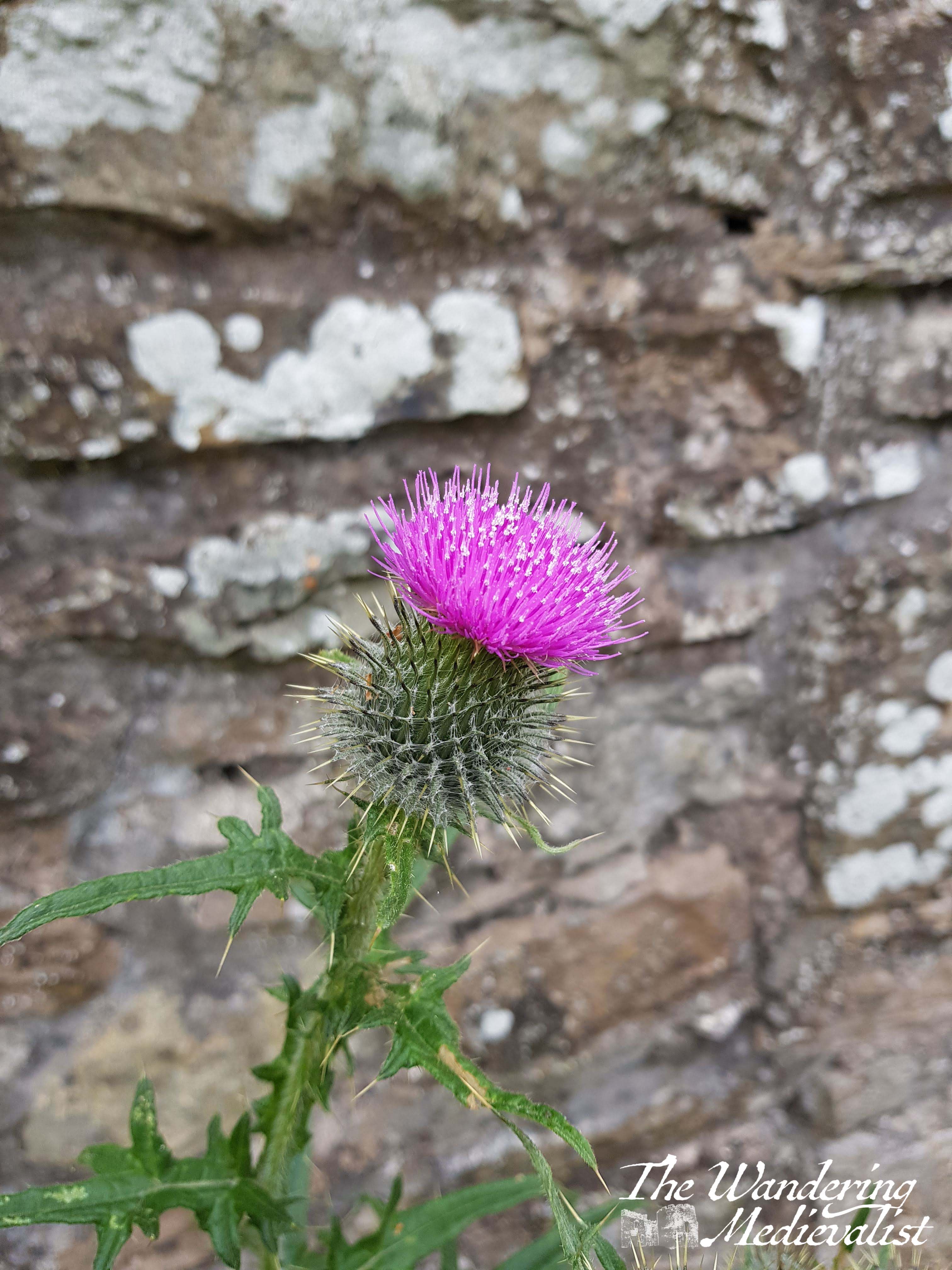
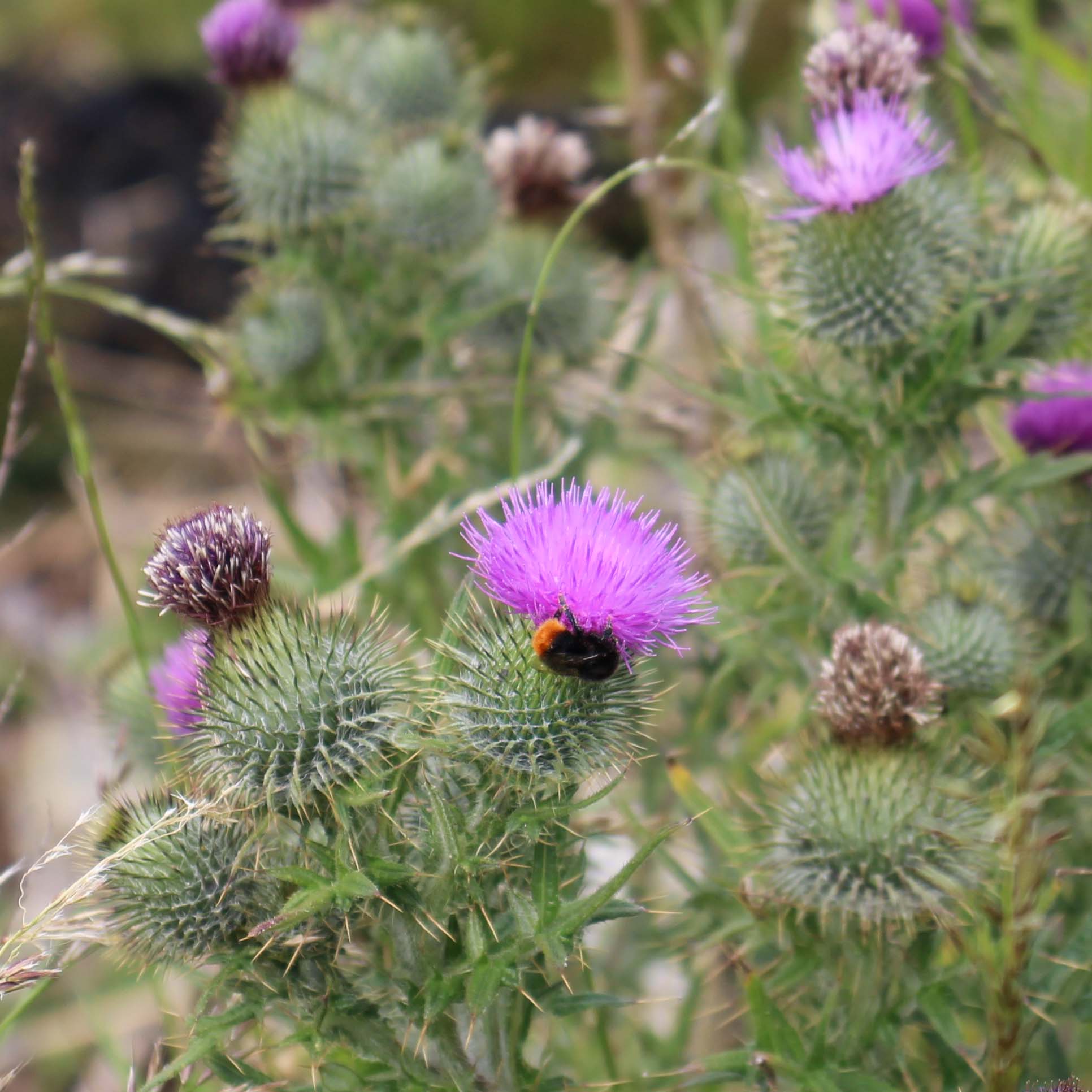
One could wax philosophical about how the years since the Reformation have chipped away at the remaining stones – or outright stolen them – much in the way that the Catholic or indeed any faith has been allowed to decay since the Middle Ages. I always find these locations to be haunting and yet still holding on to a spiritual vibe; even if one is not religious, one can hold appreciation for the devotion those who lived here would have felt. In 2020, there was an aura of loneliness and abandonment caused by months of lockdown, with the grass longer than it should have been and distinctly Scottish thistles and purple flowers sprouting everywhere.
After wandering the abbey grounds for a while, I decided to extend my outing by following the signs for the Fife Coastal Path, which stretches from Newburgh around the edge of Fife to Kincardine. It is generally well-kept and some stretches are positively stunning, so offers a good option for someone looking for a short – or long – ramble on a mostly sunny day. The stretch near Balmerino kept quite close to the beach to the left/west, and to the right/est followed the wall above the beaches, skirting in front of some lovely houses and cottages while the Tay Rail Bridge came into view.
While I cannot say that go out of my way to return to Balmerino Abbey quickly, I could certainly see the value in a trip here for any student of medieval abbeys, monks, or monastic life. And for anyone who enjoys a good wander along the coast.
Like this post? Explore some of the other abbeys I have visited:
In Scotland, a den is a narrow, often wooded valley, usually following a small burn or rivulet. Craighall Den, the subject of this post, is hidden on the outskirts of the town of Ceres in Fife, and it offers a gentle walk through some woodland, ending at the ruins of an old limekiln. It is quite popular, and very seldom have I visited without running into at least a few other walkers and, often, horseback riders.
I discovered the walk through the den in the midst of lockdown in March 2021, when we were desperate for outdoor adventures but could not leave Fife, and so I consulted my favourite walking site, Walkhighlands, which despite its name details walks throughout Scotland. The route suggested involved parking in the town centre and walking up what turned out to be an abominably muddy farm track, to join the den almost at its furthest point.
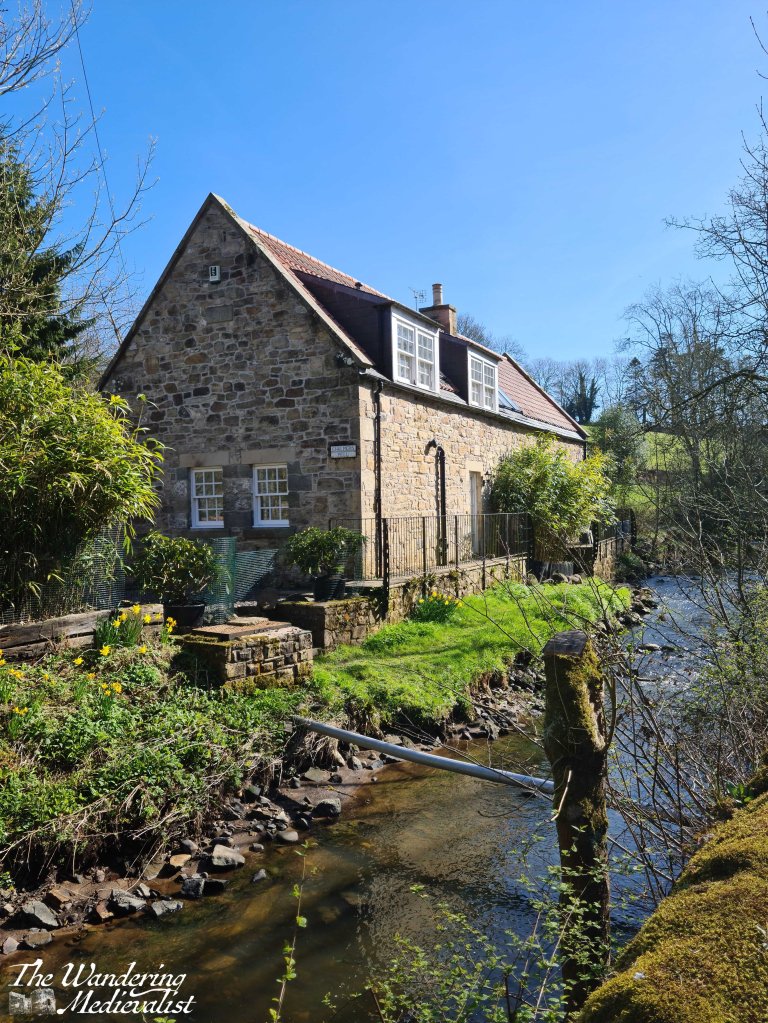
I have never tried this circular again, instead have several times parked in Ceres and walked an extra few hundred yards up the road to join the path. This adds a few steps that pass some lovely farm houses and an old mill that I secretly covet (or not so secretly to anyone with whom I have walked this route).
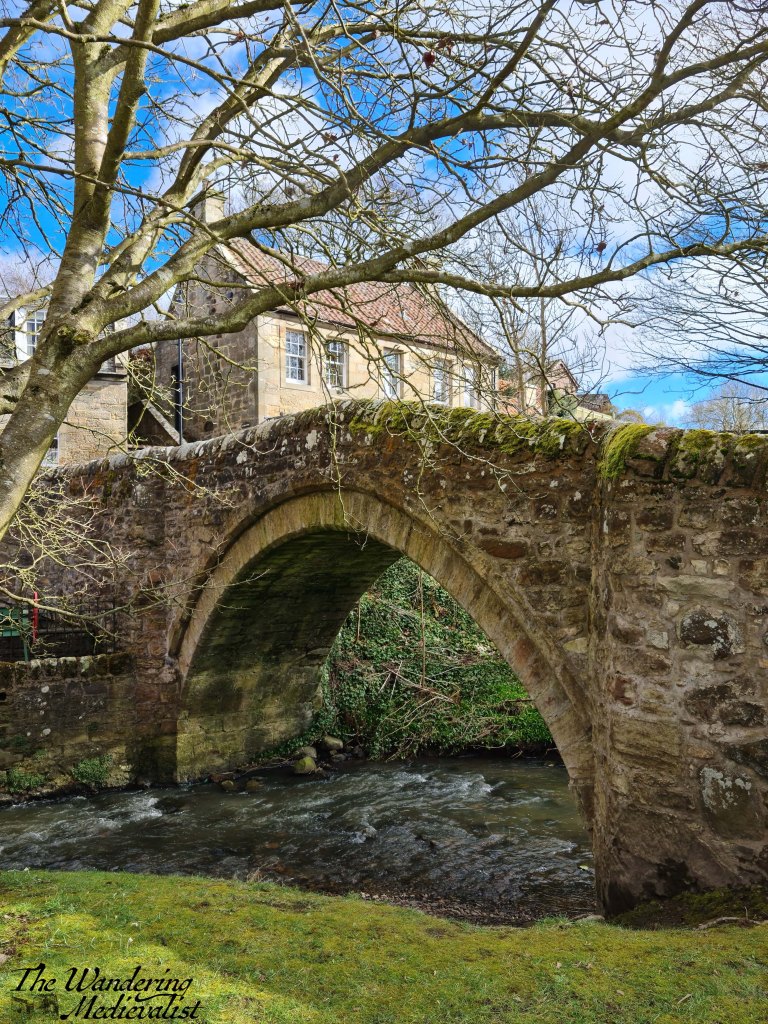
Ceres itself is a picturesque village full of historic stone houses and bridges, complete with an old tavern and a town green – the Bow Butts, where archery would have been practiced. It will likely earn itself a post of its own, but for now, here is the bridge next to the central car park, where one starts the route up the hill.
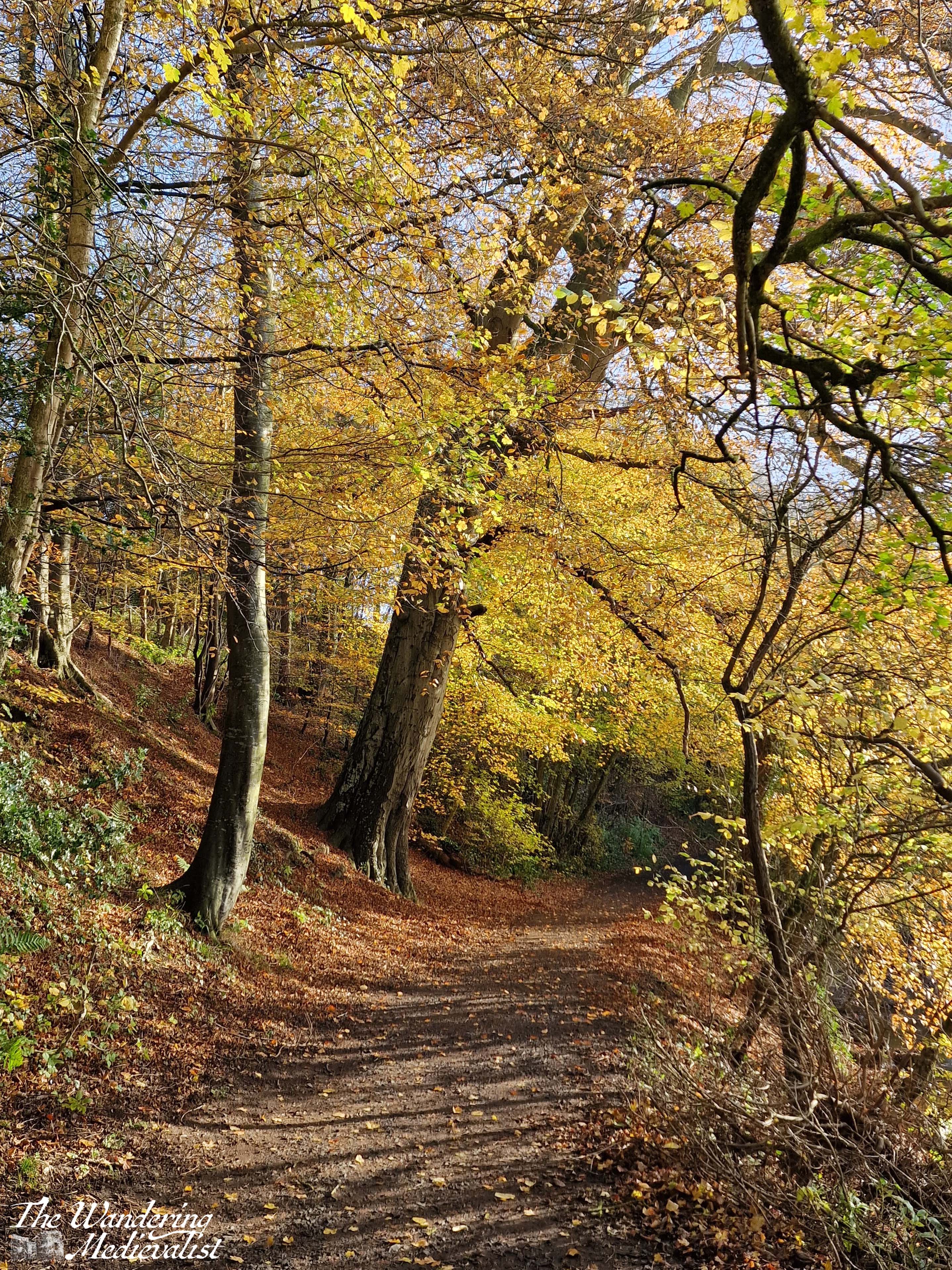
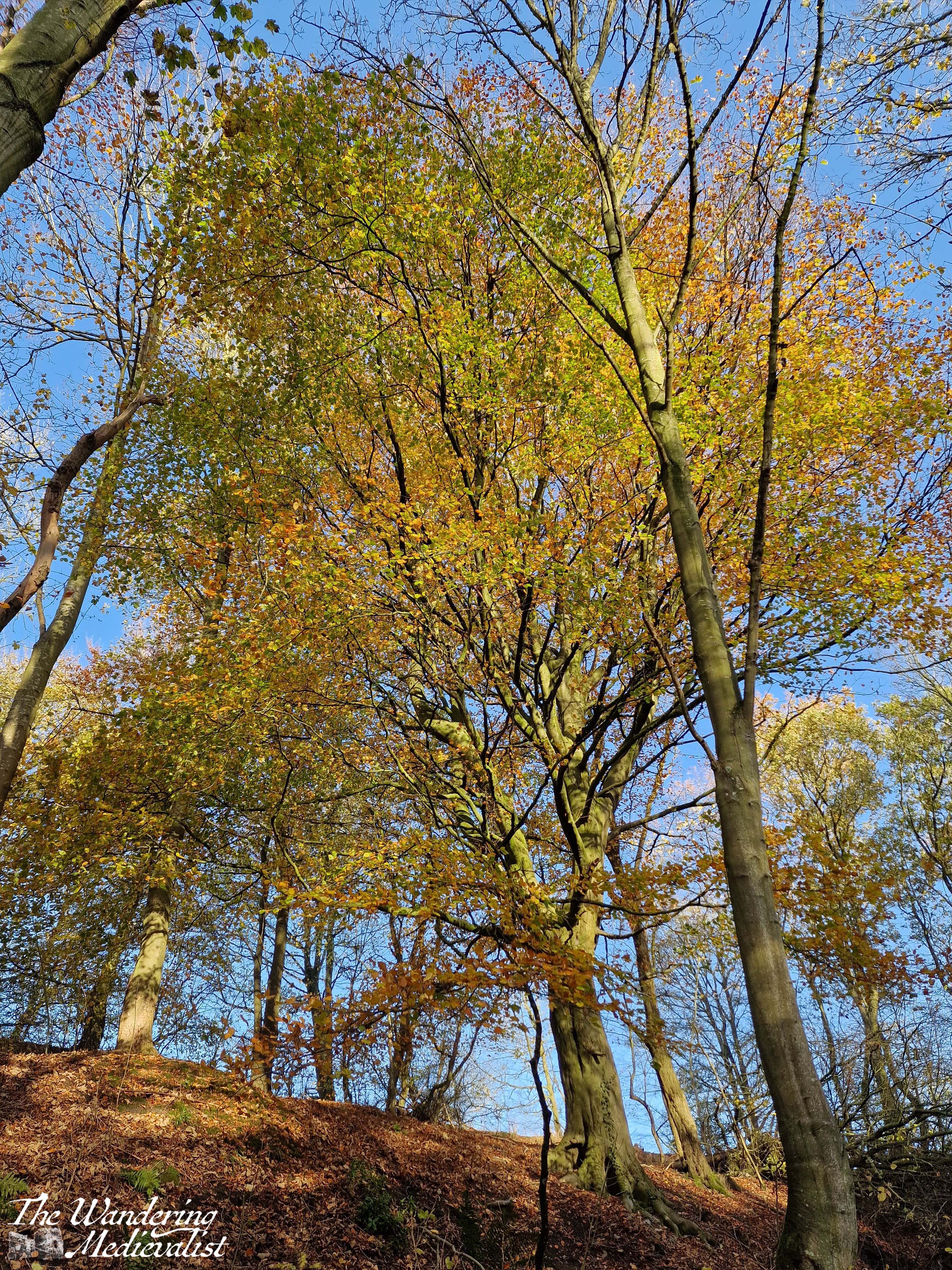
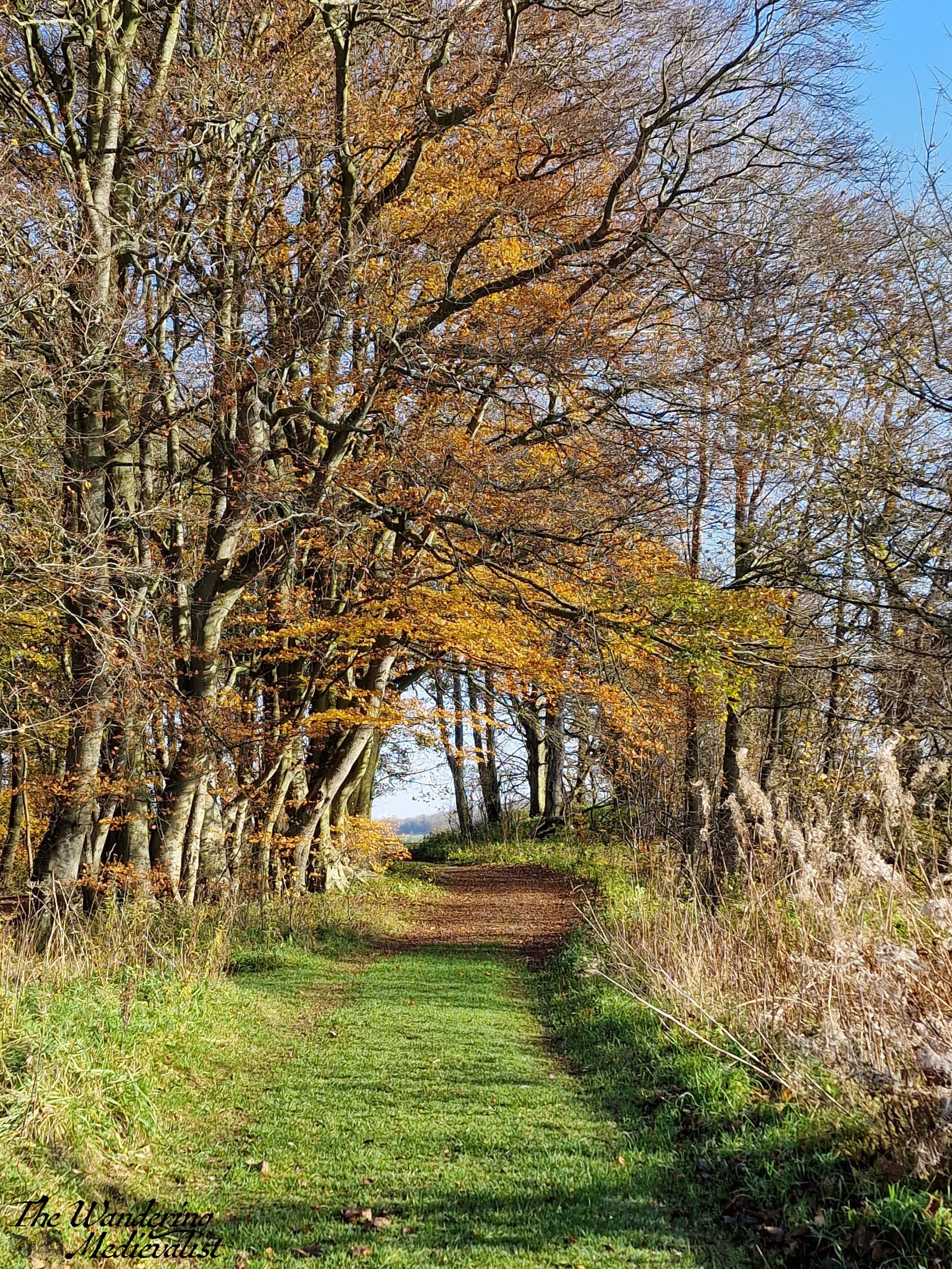
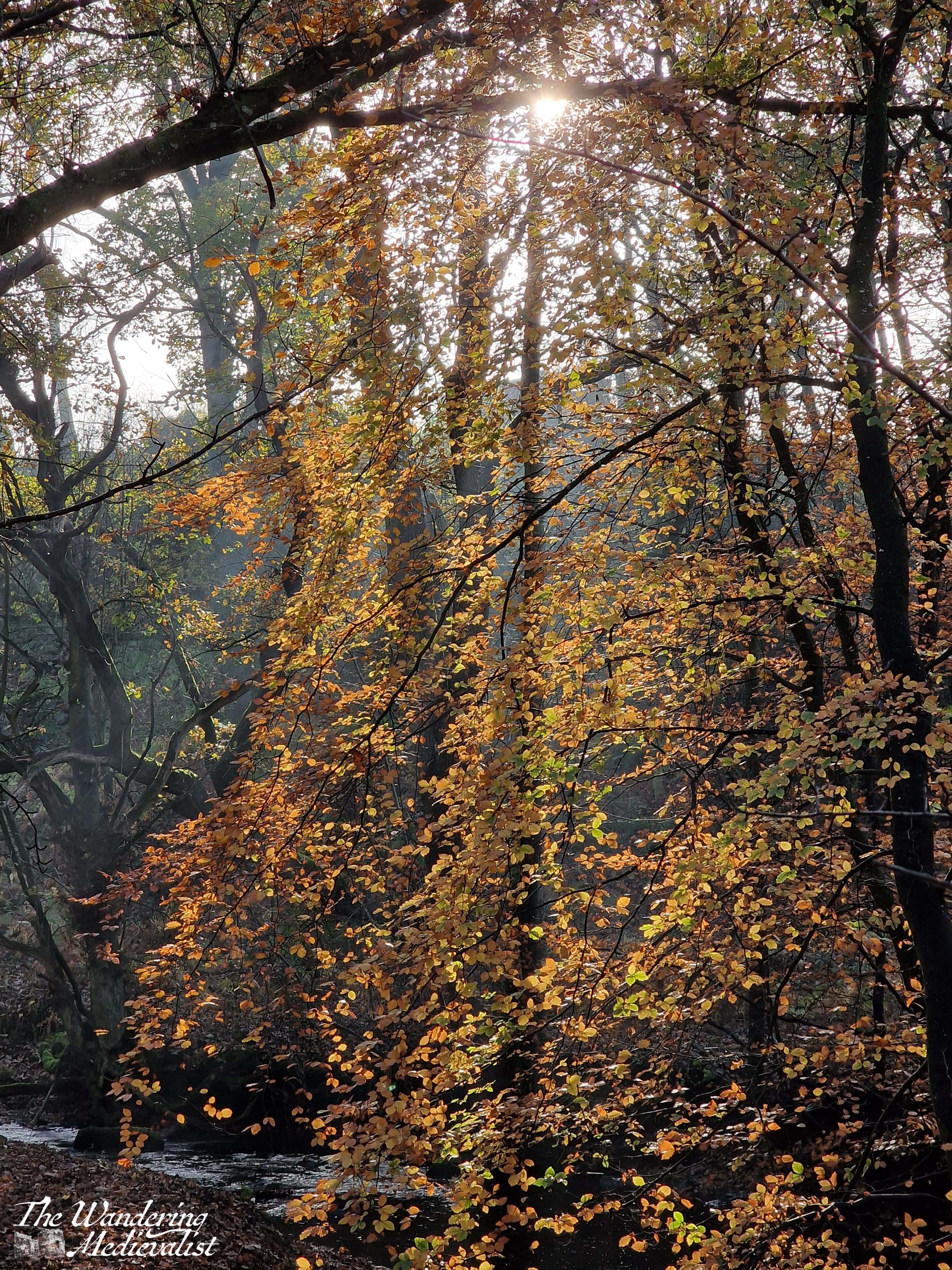
The day that inspires this post however was one that came about entirely by chance – I had been to Cupar shopping and there were major roadworks that encouraged me to take the long way home. It was an atmospheric autumnal day with heavy fog everywhere except Ceres, where sun broke through as I entered the town limits. Almost without thinking, I turned right and up towards the den, deciding a short walk might be nice. As I parked in the small lot at the road end of the walk, I quickly discovered what a good choice I had made. November colours of yellow, gold and amber were perfectly highlighted against the sun and peeking blue sky, and I found myself in a perfect autumn paradise.
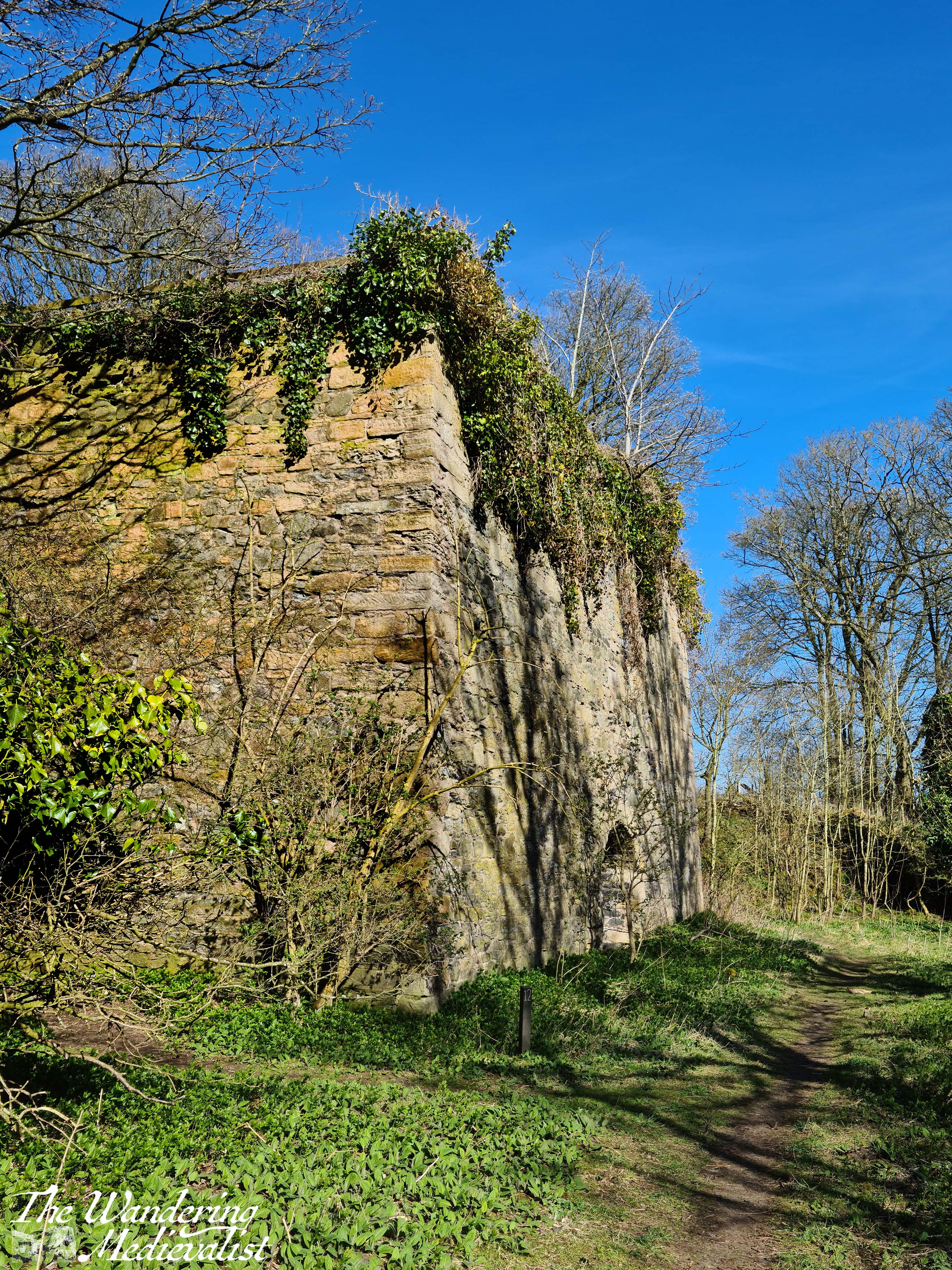
Despite wearing shoes entirely inappropriate for walking, I was encouraged by the colours to do the whole walk – about 30 mins in total so not hugely challenging. The path stays close to the burn before eventually climbing up to the ridge above as the valley sides grow steeper; on the left is a steading and farm with an old stone farmhouse. Eventually one reaches the endpoint of the walk, which as mentioned above is an old lime kiln. Below you see the grassy path leading up to it, as well as a picture I took one summer as we took this walk.
At this point, there is a rock face to the left through the trees and on the right one can either walk out on top of the kiln or follow the path down the hill and around it. There has been occasional evidence here of local teens using it as a place to hang out, and once remnants of a fire, but there are active farms on all sides so I cannot imagine there is much secrecy.
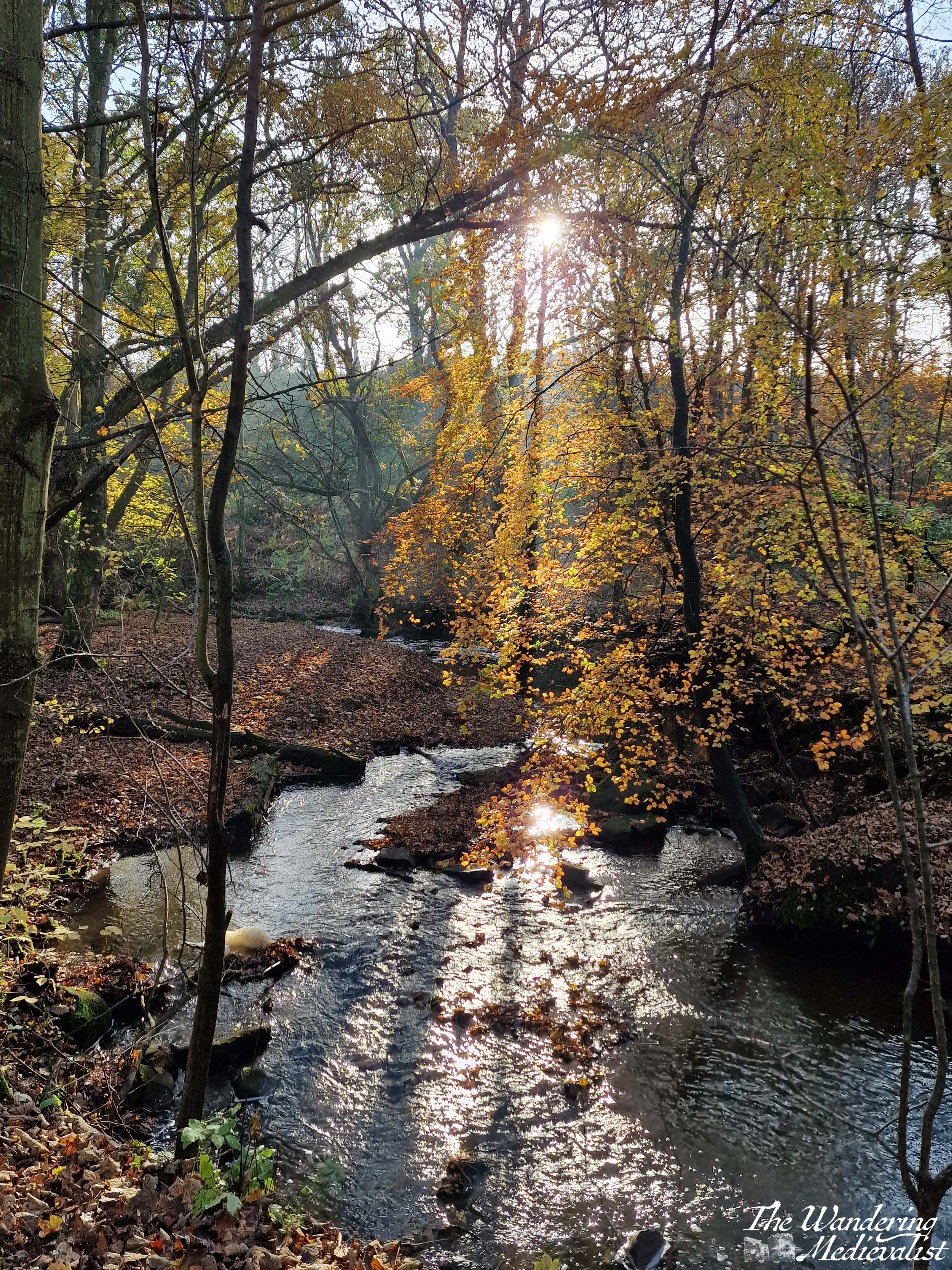
It seemed a shame to head back to the car, but I had shopping to get home and my other half to collect from work, so I enjoyed the sun glinting through the trees onto the burn on my return walk.
For reference, here is how the burn normally looks…I’ve tried to catch it many times but have never been particularly happy with it. As anyone who has read this blog is aware I have an affection for burns and rivers, but this one has often eluded me in that the light is often more grey than blue or, as on this autumn day, yellow.
There is no shortage of charming dens in Scotland and even in Fife, but this one holds a particular place in my mind, not least because of the stunning autumn walk. In the spring it is graced by carpets of crocus and snowdrops, and I am constantly struck by how peaceful and quiet the path always is, even when comparatively busy with walkers. I look forward to a return visit in the near future.
We knew that the second day of our time on Syke was going to be wet – it was predicted to start raining at about noon, so we got on our way relatively quickly in the morning for the hour-long journey to Dunvegan Castle. It was the one and only castle I insisted upon visiting, and I hoped we could get a bit of a visit before the rain closed in.
I’ve written an account of our visit to the castle, during which the rain started at least two hours earlier than it was meant to – but that is standard in the Highlands. So, we headed back towards Uig, passing through alternating heavy storms and light drizzle. I realised as I drove that by the time we reached our cottage we would not want to leave again, and so my mind was also on foraging for dinner. With luck, we found a café that included the word ‘deli’ and I pulled in for a coffee and exploration.
The Dunvegan was the perfect spot for what I needed – they had cakes, crackers, cheeses and some venison salami that I felt should be tried. I wish I could remember the name of the cheese I bought which the girl said was local, and was amazingly creamy and delicious, but no amount of googling seems to find it. In any case, I stocked up and ran back to the car where the family had decided to camp out.
As we pulled out of the Dunvegan town, we passed the view of the Two Churches, which is actually the start of what appears to be a circular walk – must try it next time.
From here we headed home to our cottage which, as I have mentioned in previous posts, was called the Homer. It was part of a set of 2 or 3 cottages rented by one family and the owners were very friendly and attentive, stopping by once a day to check that all was well. The house was incredibly well-equipped with top-of-the-range stove, fridge, washing machine and dishwasher. The kitchen had every utensil you might need, and previous tenants had left behind bits and pieces – tea, rice, salt, pepper. The beds were comfortable and rooms warm, and the instructions and advice provided were detailed and very helpful.
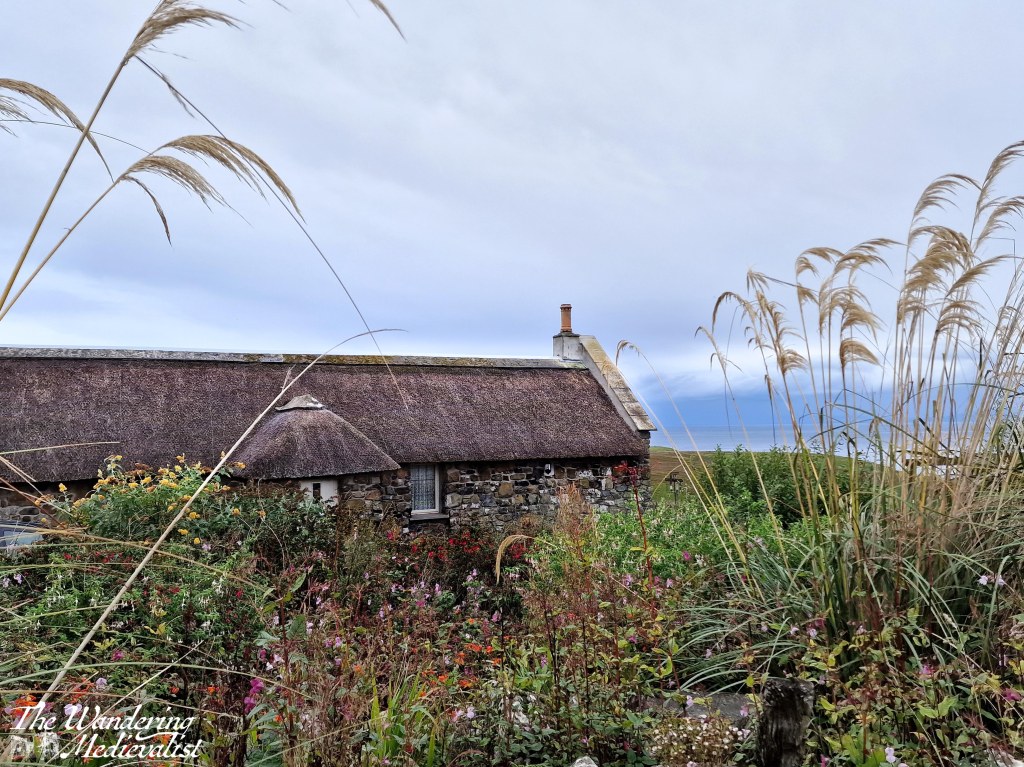
We spent the rest of the day hunkered down in the cottage, for the most part – the wind and rain were intense at times, but the living room remained toasty warm and tightly battened down against the weather. The TV had every channel we could possibly want – had we been able to agree on something to watch. At one point, Dad got restless and suggested we go for a short walk, which we did – to the entrance of the property and down a side road that led to a charming house built in the old island style of stone walls and thatched roof.
After this detour we headed home and all read and relaxed until it was time to break out our foraged dinner. Cheese, salami and crackers made a good accompaniment to some veggies and snacks I had from Marks and Spencer – not the fanciest of meals but tasty enough! It was a good night to head to bed early, and prepare for the next day of exploration.
I thought this might also be a good time to make a few recommendations based upon my one-time visit, and reflect on a few things I wish to explore in more depth upon inevitable return.
Recommendations
Accommodation: going self-catered is a great option, especially at super-busy times of year, and it’s an option the other half and I have preferred more and more wherever we go. It makes everything more flexible and often saves you money. On Skye in particular, there are cottages everywhere that will probably provide better views than a hotel. But plan ahead. Highly recommended to bring a cooler or ice box and prepare to buy your food in Broadford, Portree, or before you cross to Skye (we bought most of our supplies in Fort William).
If you opt for a hotel/B&B, ask them when you book if you need to make a dinner reservation. We tried a few days out and one place did not have any tables – for the rest of the month.
Weather – well duh, but make sure you have something to do on a rainy day.
Walking – bring a change of sneakers/hiking boots/whatever you like to wear. There are boggy paths and your feet will get wet almost inevitably.
Drivers – prepare yourself for the roads. They are windy, narrow, and you are often out-weighed by the massive busses that negotiate the twists and turns so easily. Needless to say, watch your petrol level and be aware of hidden pot-holes. Make sure someone in the car knows how to change a tire! (We came so close…)
Beer – check out the Isle of Skye Brewing Co for some excellent and really reasonably-priced beers. Particulary recommended is the Syke Red, if you like red ale. I may be disowned by certain friends for admitting I did not try the gin…
Food – we didn’t eat anywhere (see above recommendation on reservations) but we did stop for supplies at the The Dunvegan, an inn, restaurant, coffee shop and deli. Their cakes were spectacular and they had local cheese…well worth a visit!
On my list for next time
Over and above all, more time for hiking and walking!
Hike the Quiraing. Views can only get better.
Hike the Old Man of Storr trail.
Try the Two Churches walk – even in the pouring rain looked like something out of Wuthering Heights.
Check out the Skye Museum of Island Life – it was literally minutes from where we stayed, and looks like it has some fascinating examples of cottages and more.
Visit Monkstadt – looks gorgeous and would be tempted to try to stay here if I had the time and money.
Explore the other coasts – clearly to adequately cover any portion of Skye you need a lot longer than we had, and we missed the whole south/west.
The only thing stopping me from making plans to return is the distance. It is perfectly possible to get to Skye in one day but it is a bit of a trek, and neither of us are keen to do it in one go. This means inevitably breaking the drive somewhere – Fort William was perfect really – and making a long weekend less feasible. But I will be keeping an eye out for the opportunity.
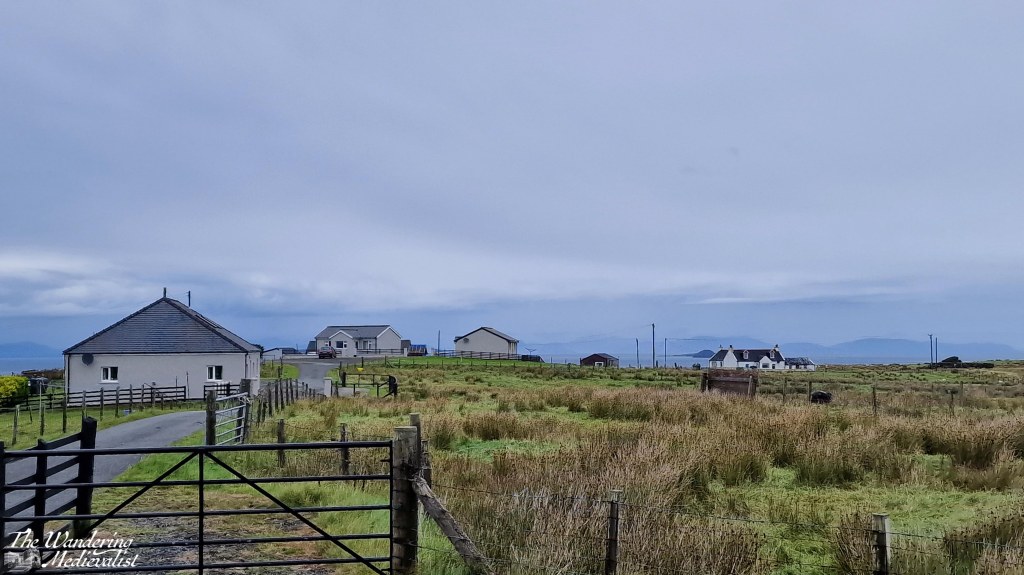
Hunglader is one of those place names that erases any question that the Norse settled in Skye. It was our home for most of the week, and our final morning dawned bright and blue as we packed up and tidied up the Homer. Before finally leaving the north, we ventured down to the local beach, passing on the way some picturesque old Skye-style houses with white walls and thatched roofs.
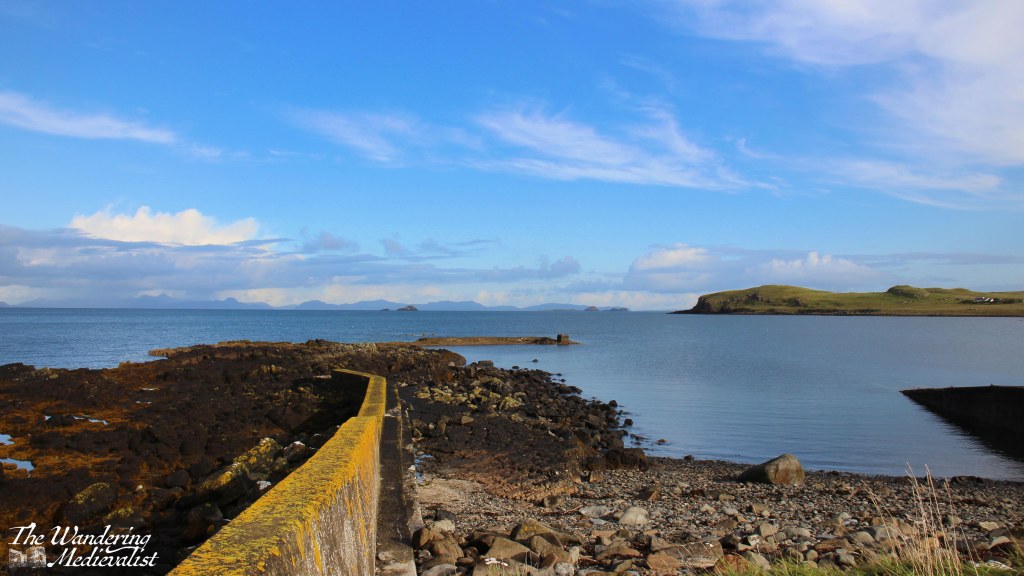
The beach area offered a decent-sized parking area where two couples in a camper van were just finishing their morning fire. The cliffs towered over the beach and sheltered it somewhat, though the wind was not nearly as strong as we had experienced the day before.
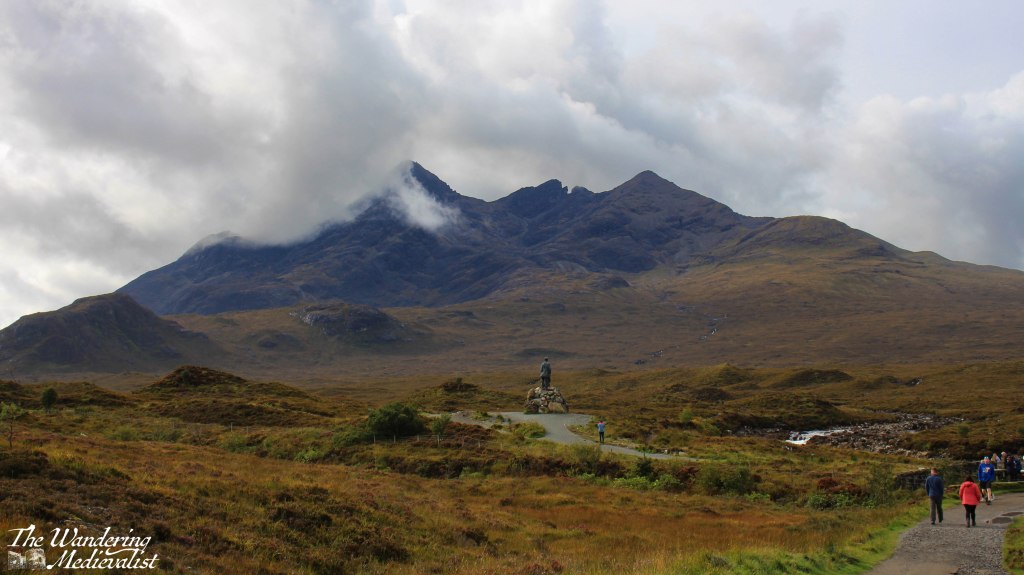
On the way out of town we had one more stop at a ruined church, then we headed south. I was quite keen to make sure we filled up on petrol before leaving Skye, and recalled a number of long queues, so we ended up stopping in Portree and topping up before our final Skye-specific stop, the Sligachan Old Bridge. It was one of several stopping points I had noted on the way north, and it is a gorgeous spot with stunning views up the glen. But it was also midge-infested, so we walked quickly and not as far as I might have hoped.
It is definitely a place to return, with paths heading up towards the Cuillin Mountains. The statue, I should mention, is not some distant historical figure like Bonnie Prince Charlie, but is perhaps more poignantly dedicated to two men who pioneered mountain-climbing on Skye, Norman Collie and John MacKenzie.
Sligachan was our last stop in Skye, and it was a relief to find the wind had stayed calm as we continued over the bridge and back to the mainland. By this view of Loch Duich it was so still that the waters were almost literally glass-like.
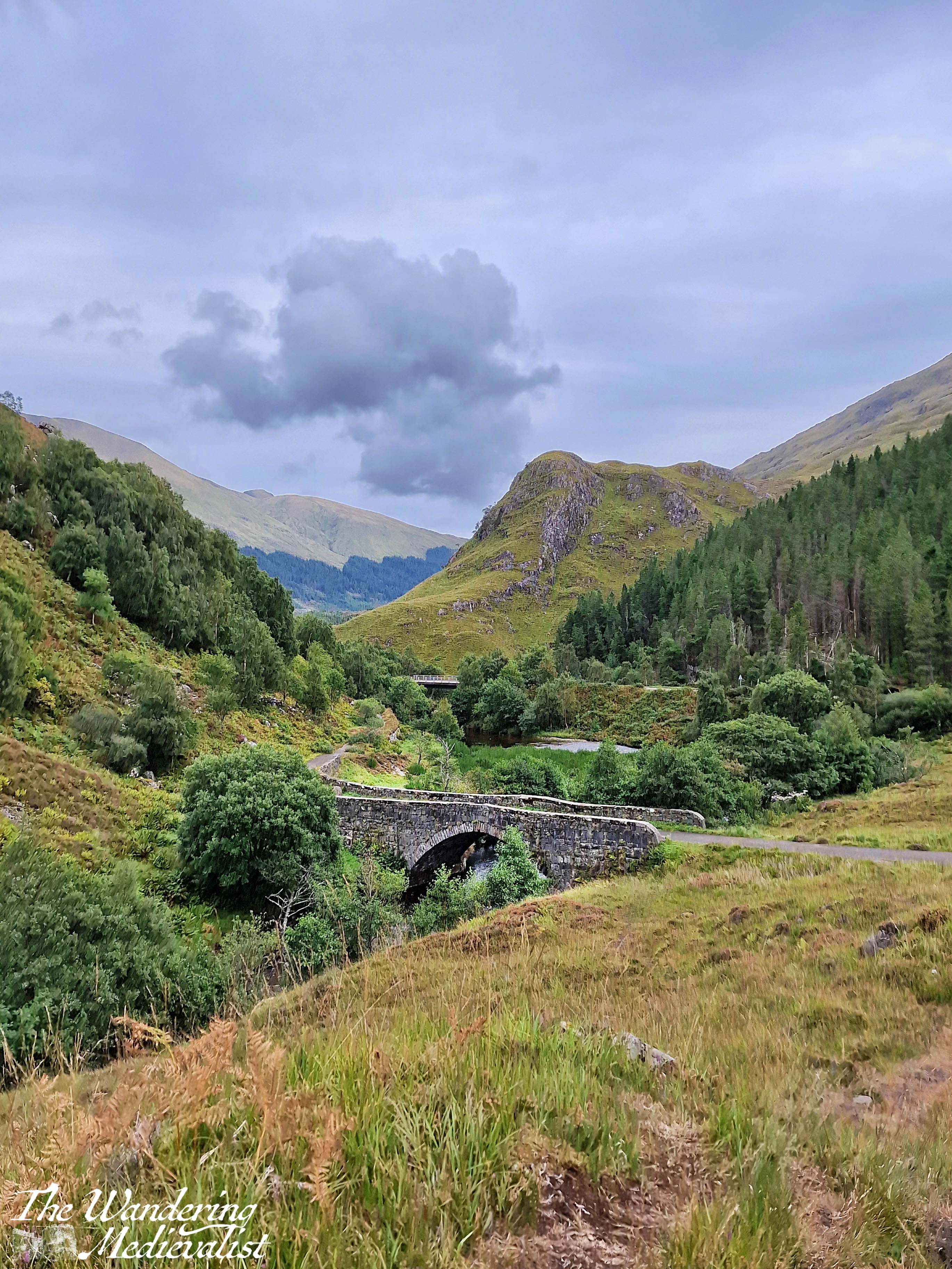
The clouds were drifting in as we pushed south into the mountains, following the road between Loch Duich and Loch Cluanie. I had made a careful note to explore Glen Shiel, where a stone bridge marks the point of a battle in 1719 between the Jacobites and Spanish on one side, and the English and Dutch on the other, evidence of religious and political divides across Europe in the early 18th century. Standing on the modern road, it was possible to track the historic route that armies would have needed to take, and the sharp angle of the hills makes it clear why this might be a treacherous battle spot. While most of the Jacobite commanders escaped, the battle is considered an English victory.
With our many pauses, the day was ticking on, and I think we all had enough of views and pictures and were ready to get to Fort William, still a fair distance away. We considered stopping at the Commando Memorial but there was little appetite amongst the passengers, while I was getting tired of winding roads.
This was taken on the banks of Loch Oich, right before the locks of the Caledonian Canal, and I love how perfect the reflection is. It was our final break to stretch before making the last push.
The hotel we stayed at in Fort William, while clearly designed for coach parties, offered surprisingly good food and local beer – have determined that we must stop at the Glen Spean Brewing Company the next time we are up. We all headed to bed early, contemplative of the end of our time on Skye and what the following day would bring as we drove across Rannoch Moor and home.
I’ve skipped ahead in my story-telling to the third day we spent on Skye – the second was standard Highlands rainy, and we visited Dunvegan Castle before eventually retreating to our cottage for the afternoon. Thursday dawned clear and bright but increasingly windy as the day went on; the car was buffeted about and on one or two excursions it was difficult to walk. We think the gusts were well into hurricane-force, but even with whipping hair biting into my face like knives, I was so excited for our journey.
I had spent most of the afternoon before plotting out the route and places I knew we needed to stop, then entering it all into Google maps so I could know exactly where we were meant to go. There was a question as to whether we might go all the way to Portree and do a loop back, but in the end it was an out-and-back trip, allowing us the opportunity to stop at a few points we missed. Once again, I have chosen a few highlights for this page, but most of my pictures are in the video at the bottom.
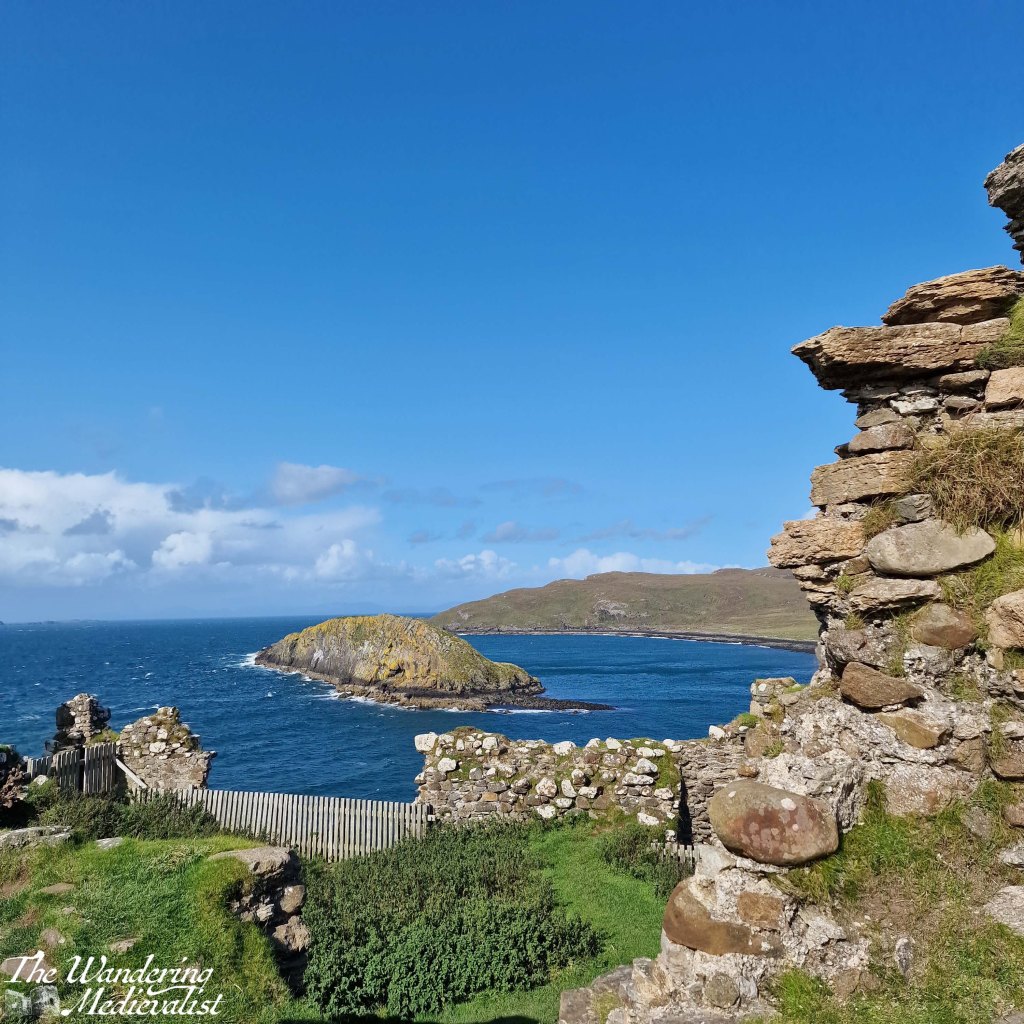
First stop was Duntulm, less than ten minutes north of where we stayed – it is an almost entirely ruined castle on a promontory with gorgeous views back over the hills and coastline.
I was the only one who hopped out of the car on this first stop so I made it quick, eager to see what the rest of the day would hold.
The A855, which is the main road that runs along the north edge of Skye, runs through some breath-taking landscape. Even when one cannot see the ocean, one can enjoy the distant mountains and vistas across green fields dotted with heather, sheep, and outcroppings of rock. Several times I stopped just to enjoy that view, and also to calm my nerves as driver.
Because, while it is the main route along this coast, the A855 is also a single-track road with relatively frequent passing places, but equally frequent blind corners and hills that cause the occasional near-miss with other more confident or less cautious drivers. I would certainly not recommend the route for tourists unused to Highland driving, beauty notwithstanding.
As the road cuts across the top of Skye it leaves the coastline to re-join a few miles later, opening up views across the glistening water to small islands and the distant mainland. We stopped a few times, though as the wind grew stronger, Dad started to doubt whether he wanted to go on much of a hike – one of the plans for the day. Knowing that one of our party would be confined to the car either way meant that cancelling a longer hike made good sense.
One location we knew we could not miss was the Quiraing, and so we turned inland along an even narrower road and made our way towards the line of cliff-like mountains ahead of us. Despite the size of the road it was quite busy, with cars and vans going to and fro. As we approached the parking area, the road started to climb sharply, weaving up the side of the mountain with hairpin turns that reminded me of scenes in To Catch a Thief – though I drove considerably slower than Grace Kelly or Cary Grant. I am not a great one for heights so kept my eyes firmly on the road as I negotiated the turns, breathing again I think only when we reached the top and found a large car park for hikers and visitors.
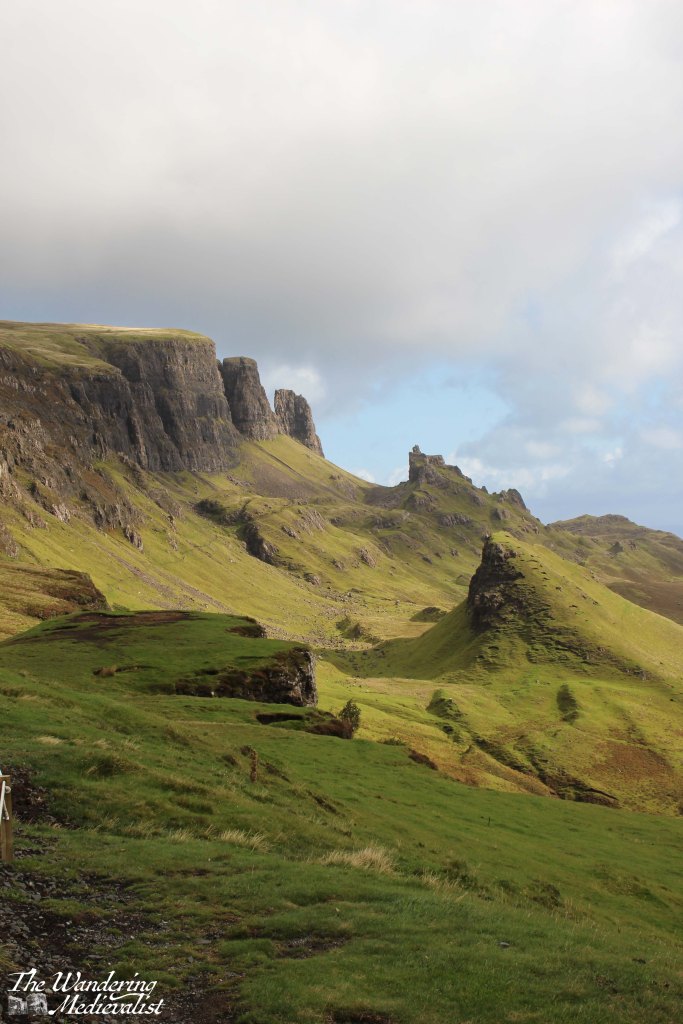
There are a number of path options at this point, including one that is wide and gentle enough that – I think – it is wheelchair accessible. It is certainly easy enough for most to try, and if you ever find yourself here with an elderly or less mobile companion, I would encourage you to encourage them to give it a go, even with wind as strong as it was when we visited – strong enough to take your feet from under you. This sight of the Quiraing, the view across towards the ocean, lochs and hills in between, is one of the most stunning I have ever seen. Top ten in my life, no question. The stunning scenery of the Quiraing is caused in part by a series of landslips, and the sunlight plays dramatically off sharp pinnacles, grassy slopes, and sheer rock faces.
As Dad and I made the short loop, we could see to the right a rain storm coming our way. I knew there was not enough time to reach the car so while Dad made a dash for it anyway, I continued on my way, hoping to reach the next knoll. I tucked my camera inside my sweatshirt and waited to get wet. I have absolutely no regrets.
Yes, I got soaked, and the much better-equipped hikers passing me looked at me questioning my sanity, but I stayed and filmed the storm.
The rain passed in minutes and the sun returned, allowing me to watch the storm as it moved towards the sea. There is no question I need to return here and take the time to do at least some of the hike. We saw quite a few spectacular sights on this day, and on the trip as a whole, but this was definitely the top of the list. Eventually I steeled myself to drive back down the winding road and was delighted to discover that the road south was back to two lanes.
The next stop was Kilt Rock, which was very busy so that everyone was vying for the best photo spot. My companions had been before, so we continued on quickly, to Lealt Falls.
This is where, as we parked the car, we realised just how powerful the wind had become. It must have topped 70 MPH, so strong that it was a challenge to walk and loose hair whipped my face like needles.
The colour of the hills and water were stunning so Dad and I braved a short walk to a viewpoint, though I recall passing two small dogs that I worried would be blown away. The falls themselves are visible from a sturdy viewing gallery that stretches out over the chasm, and in the distance one can see the range of mountains that includes the Old Man of Storr.
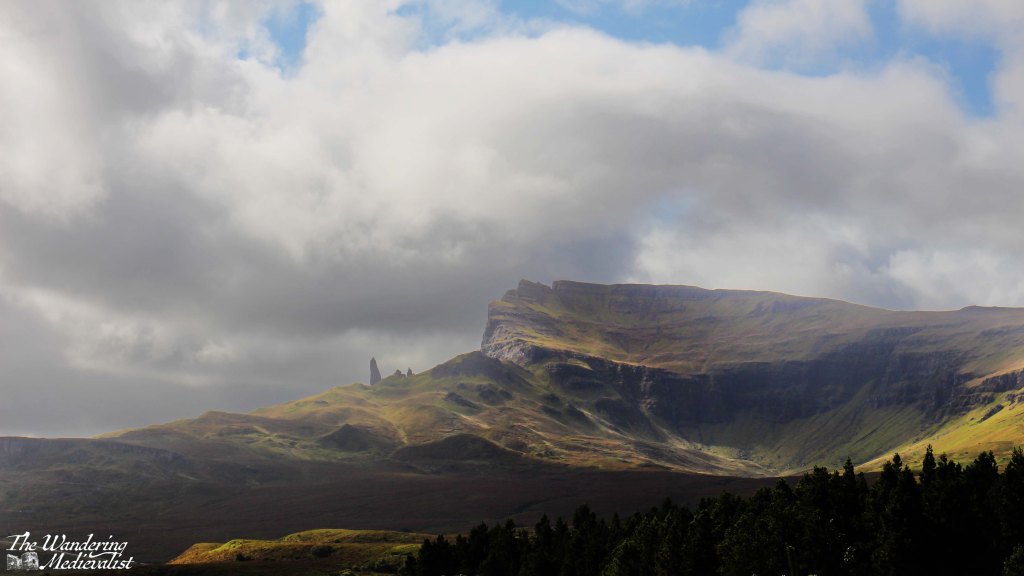
Another famous Skye destination, the Old Man of Storr should not be missed. The picture below is taken from a treacherous parking area called the Rigg Viewpoint – treacherous due to its narrow spots, large busses and larger potholes.
But the view is stunning. From here, we continued on to the actual parking lot for the Old Man, and while my companions waited in the car I scampered up the first half mile or so of the trail, to a point where I could see over Loch Leathan and up to the rock face. Again, this is clearly a spot that must be viewed on foot from the hiking trail, and next trip I will be certain to conserve the time and energy to do so.
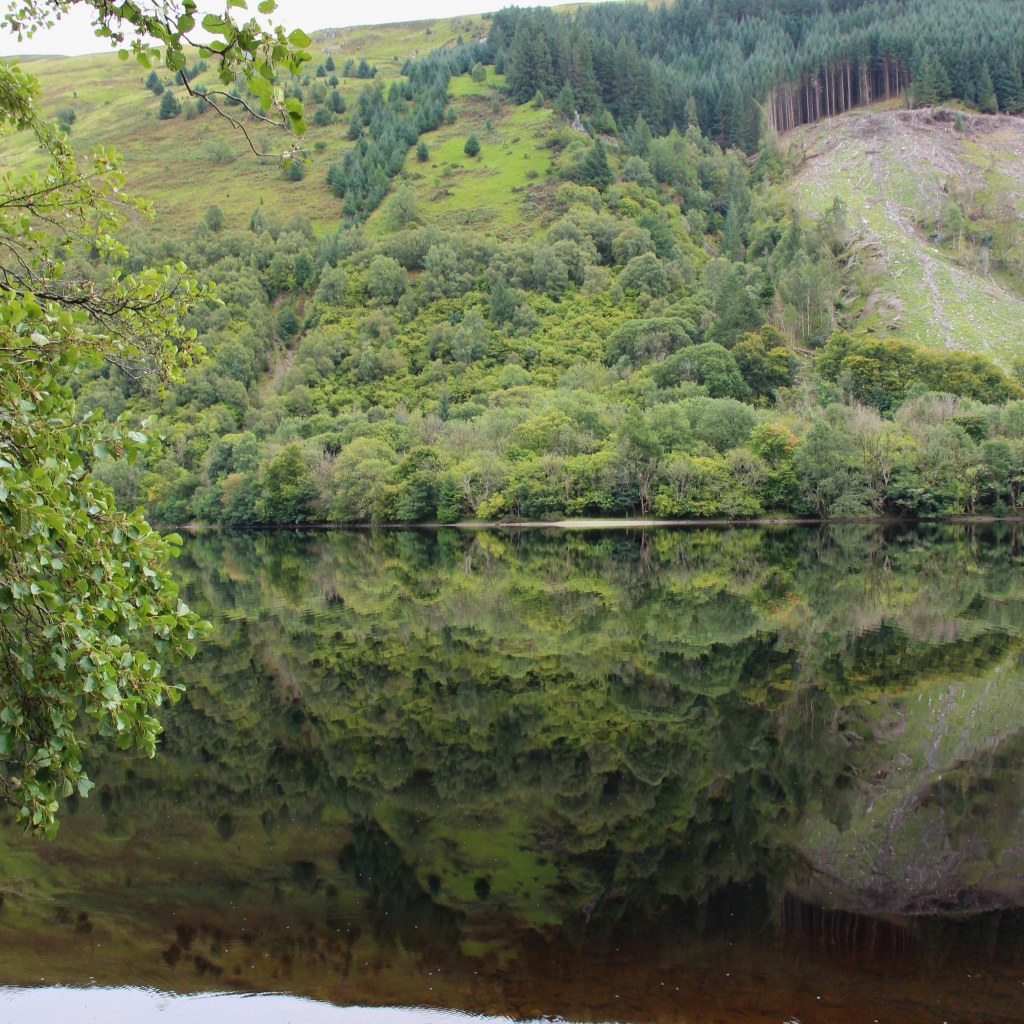
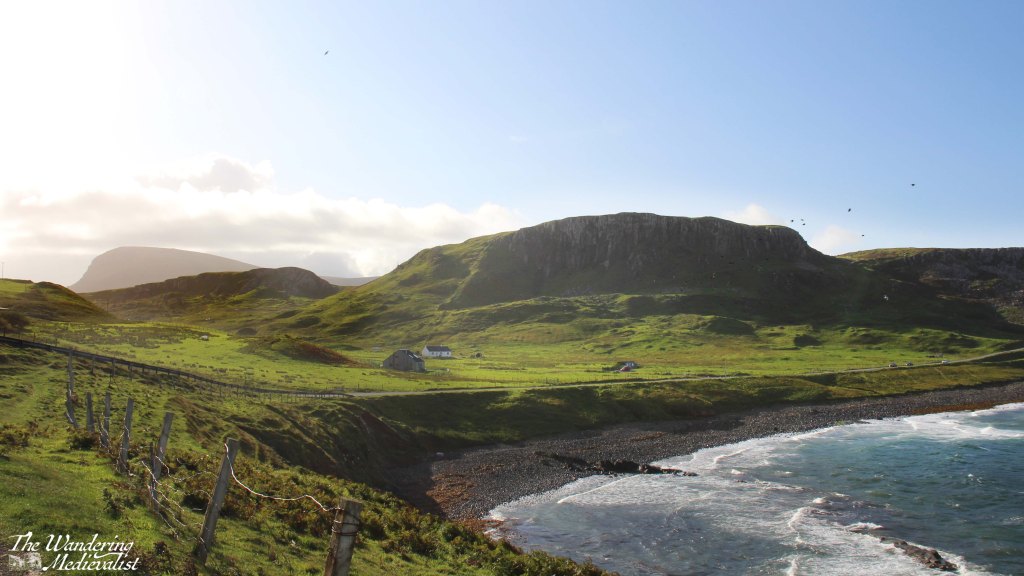
The day was creeping by, however, and so after a brief discussion of our options, we decided to return on the route we had come rather than continuing on to Portree. We did not really need to go that far and the A855 was so beautiful it was worth another look.
We did not stop as often on the return but Duntulm required another look; I parked more securely – again dodging enormous potholes – and Dad and I took the short walk out to the ruins. Here once more the wind was battling us, and at times it was a struggle both to walk and to hold the camera steady.
The castle here had been built in the 14th and 15th centuries, the seat of the Clan MacDonald of Sleat – rivals of the MacLeods who held land further south. Despite its strong defensive position, the site was abandoned in the 1700s and the stone was taken to help build Monkstadt House, several miles south. Monkstadt, incidentally, is now a luxury inn and restaurant that we looked at very briefly before realising it was a bit too luxury for our needs at the time – we resorted to pesto pasta.
Once we had our fill of the castle ruins – or I did, more accurately – we returned to our cottage. It was mid-afternoon and the wind was battering the building and bushes outside, the perfect time to sit in the living room with a cuppa and enjoy the sunshine, a book, and the view. The Homer is so well-built that were it not for the noise, you would never know it was windy; not a single breath of air disturbed us. While we had not had a partiuclarly long day, it was an exhausting and even emotional one and we were all, I think, ready for a rest and time to process and review all we had seen. For me, it was a chance to start planning my return…
The Isle of Skye is a destination that everyone tells you is a must-see. First off, everyone is correct. But for any number of reasons – the distance, time, work – I have never managed to get there, even when most of my family have done so, usually as an add-on to a visit with me.
Finally, earlier this month, I was able to reach the almost mythic isle and was incredibly lucky to experience three out of four days of beautiful weather (one day included hurricane-force winds, but it was clear). Even if we had not had lovely sun for most of our visit, I feel I would be affirming that Skye is, indeed, a place that one really should see, particularly if one has any kind of affection for rugged dramatic mountains and scenery that is quite literally breath-taking.
In fact, I took so many pictures that I have had to turn them into videos, and split my posts into days, so as not to overwhelm – I’ll link it at the bottom of the post. There were a few views that I missed as I was the designated driver on this adventure, but they will remain imprinted on my brain and I did my best to channel what the other half reminds me, ‘Sometimes it’s ok to just enjoy the view and not take a picture.’
Even just the experience of driving over the Skye bridge and following traffic as the road gradually lifts over the mountains was enough to make me long for the time to do it again.
But I get ahead of myself. The first day – really only half on Skye – started with us leaving Fort William at around noon and heading north along the A82 past the Commando Memorial and Loch Lochy towards Inverness. Then at Invergarry, we took a dramatic turn west to follow the A87 towards Kyle of Lochalsh and Skye (and in fact, we would stay on the A87 all the way to Uig). I had scheduled in a number of viewpoints which I thought may be worth pausing to explore – I was acting as tour guide for visiting family – and the first was Loch Garry.
Unfortunately trees had grown up in front of the main viewpoint so high that it was difficult to even see the water, but a bit further along we were rewarded with this vista toward the end of the loch and the mountains beyond.
The road remained high above the lochs for the next few miles and we stopped long enough at the Loch Loyne viewpoint to take a video, then continued on to Loch Cluanie. For some reason this loch had stayed in my mind as I recalled a stop, many years before, at the Cluanie Inn. At the time it had been a much smaller place – it now boasts a bakehouse and fuel pump – but I recall a charming old spot with excellent soup. We did not stop on this trip despite this memory, and instead continued on away from the loch and into the gorgeous mountains.
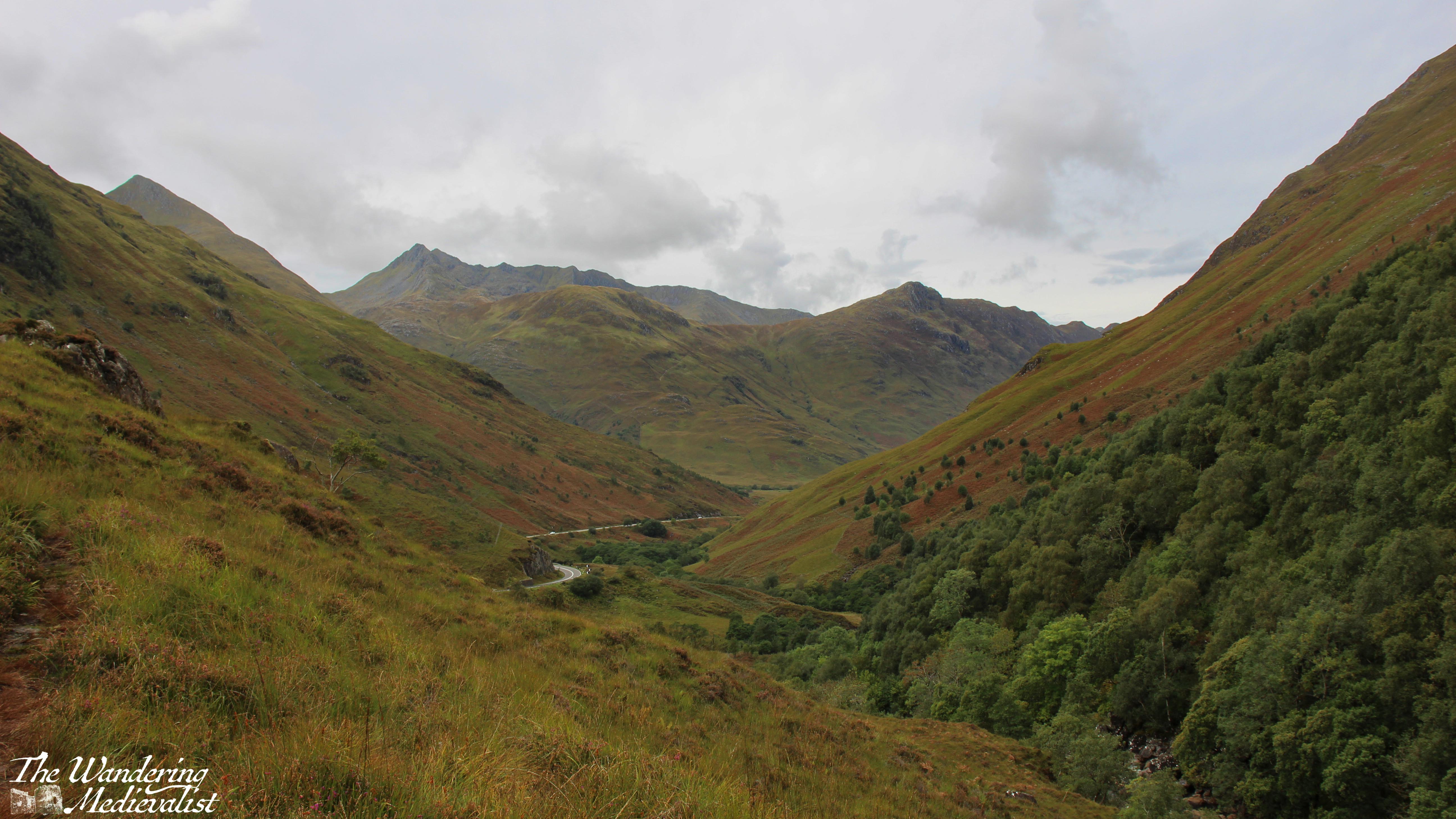
This drive along the A87 is just stunning – the further north you get, the more rugged the mountains and flora get, verging on bleak but falling just short especially in the sun.
We could have stopped in many more places – some I made a note to try on the way back – but the day was passing and I knew we still had a significant amount of ground to cover. So, I pushed on until we reached Loch Duich and the most photographed castle in Scotland, Eilean Donan. We pulled into the massive busy car park and took a few distant pictures, but upon crossing the bridge into Dornie discovered an arguably even better view from the small town hall and public toilets.
Despite a continuation of stunning scenery, I kept my foot down after this stop and pushed on through Kyle of Lochalsh to the famous Skye bridge, an eye-catching steep arch of a bridge that was a touch unsettling at first, or is to one with a wariness of heights.
Once onto Skye the road is in good condition, quickly reaching Broadford, one of the larger towns on Skye were there are some good-sized grocery stores as well as plenty of places to stay – hotels, B&Bs, and self-catered.
Continuing north, the road wove back and forth a few times and began to climb, with stunning mountains and valleys to the left and water to the right. We passed Sligachan with a note to stop on the return, and as the road topped a hill, before us was suddenly visible the distant shape of the Old Man of Storr, unmistakable against the blue.
From here we touched the edge of Portree and continued pushing north, across another stretch of mountains and valleys populated mostly with sheep and a few distant farms. Our penultimate stop for the day came at a well-populated parking place perched on the hill above Uig harbour, dominated by a headland and ferry pier.
From here the road descended quickly into the village, passing several hotels and shops. Our route was further north and so we branched off to the A855 which I knew, from previous research, was also the start of the single-track roads with passing places. Indeed, while the distance from Uig to our cottage was relatively short, it was a solid 20 minutes in the car, requiring relatively regular stops to make room for passing cars and busses. Almost as if in an effort to test drivers, the A855 lifts out of town on a narrow cliff-side road that makes a hair-raising hairpin turn. This turn and the very visible drop off the road made me very happy not to be driving one of the many bulky motorhomes we passed.
After a long day of driving, I was quite ready to reach our destination, and the narrow road was not hugely helpful in alleviating my exhaustion, though the afternoon sun glinting off the water promised a lovely evening. Finally, more than four hours after leaving Fort William, we reached the cottage that was to be our home for the rest of the week. Dad had reserved the place and it was a fully-equipped cottage with two bedrooms, a lovely kitchen that I would happily have traded with my own, comfortable warm living room and perhaps most importantly, 360⁰ views of the sea, mountains, and countryside. After unpacking the car, we had a quick pasta dinner and sat outside with a glass of wine and my trusty camera tripod to watch the sun set. It was a perfect way to end the day.