
It has been an absolutely hectic few weeks at work, and I am so relieved to finally get back to my blog and share a few more medieval sites with you. It’s been a while since I’ve written about an abbey, so here goes!
As I have doubtless mentioned before, I am not a particularly religious person, nor was I particularly interested in ecclesiastical history when I studied the Middle Ages (in fact tended to avoid it as much as possible). However, I must admit to having a curiosity about the architecture of abbeys and cathedrals. The symmetry, the arches, the mathematical nature of the buildings is fascinating and I find myself drawn to them and unable to resist capturing the lines and arches on camera.
Jedburgh (named for its place along the Jed Water, a tributary of the River Teviot) was a location we chose quite at random when planning a special long weekend away, and looking for somewhere different than our normal jaunts north. Our two requirements were not too long of a drive (2 hours max) and nothing too expensive. So, we looked south and discovered a lovely boutique hotel in the ancient border town where the first church had been founded in the 9th century. The town is mentioned frequently in border disputes throughout the Middle Ages and beyond, boasts a beautiful old Mercat Cross and plenty of lovely shops along the old high street.

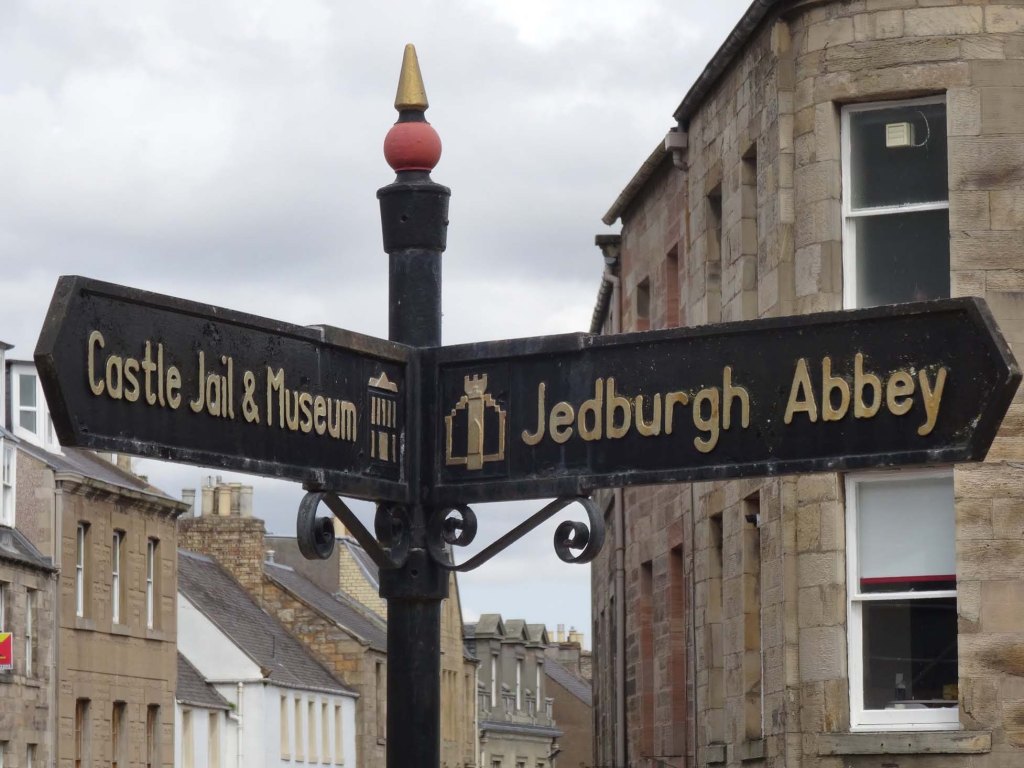
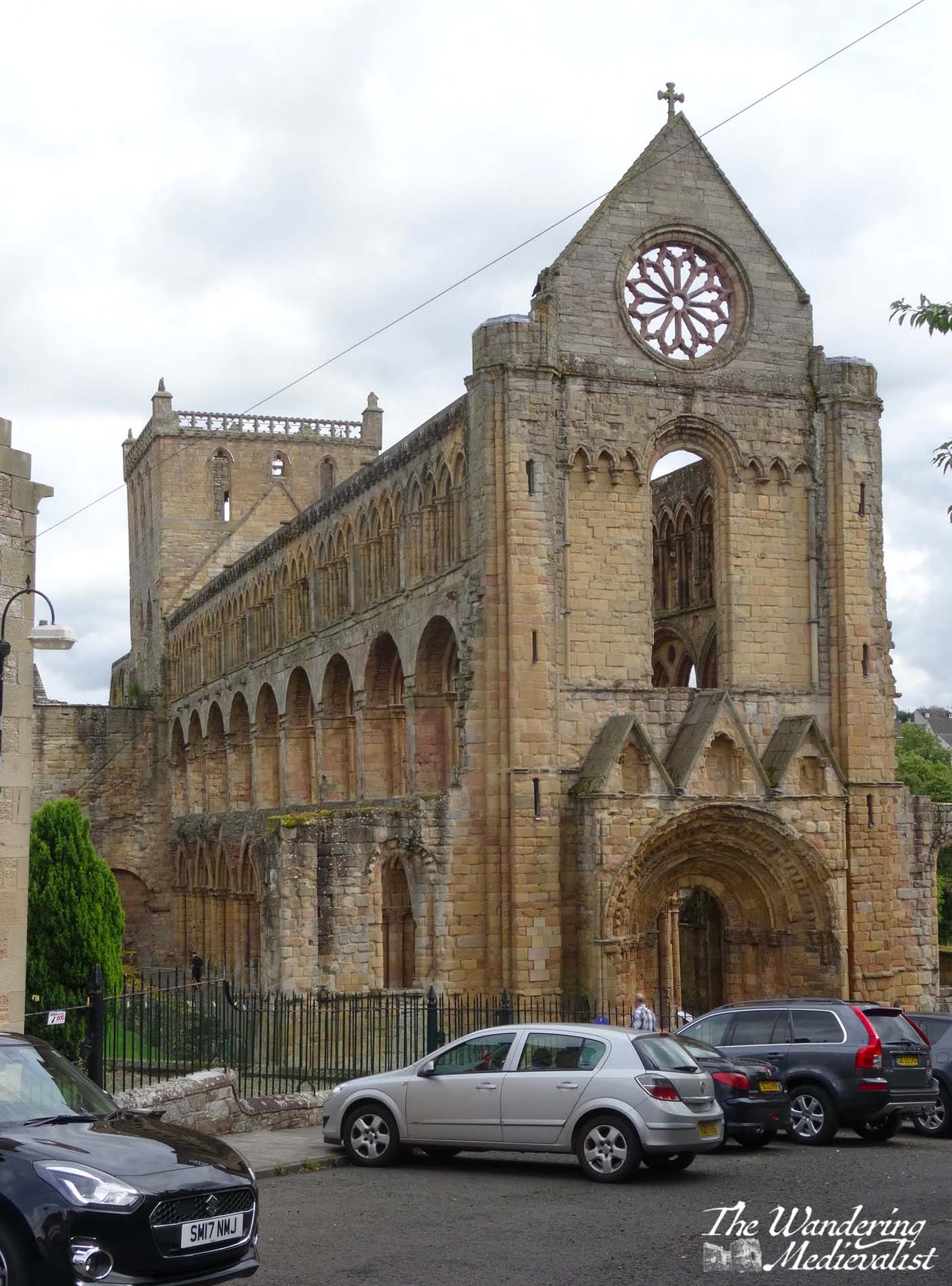
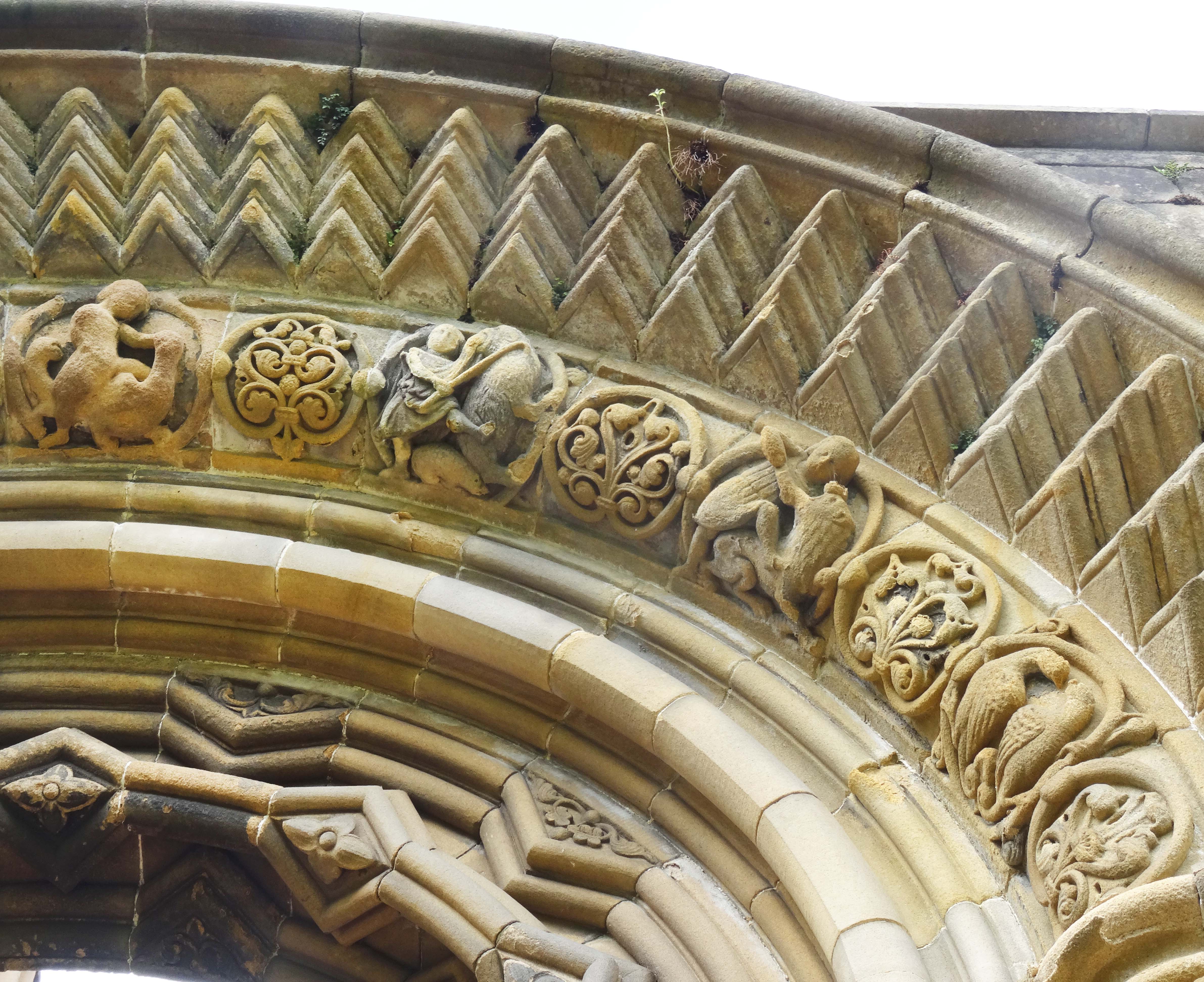
The community of friars at Jedburgh was initially established by Prince and later King David I in the 12th century, with the church gaining full abbey status around 1147. Unlike many of the border abbeys, which sit in secluded glens or fields, Jedburgh Abbey is situated in the centre of the town, and various portions of the structure were added across several hundred years. It was said to contain some of the finest Norman architecture and carving, and even in its ruined state, one can see the beauty of the workmanship that went into the construction. The plaque at the site tells us that the medieval master mason ‘used the church to experiment and to push the boundaries of what was possible both artistically and technically.’


As occurred with many church institutions, the abbey gained control over great parcels of land in the borders, and during the Wars of Independence in 1296 sided with King Edward I. The abbey was subsequently pillaged by the English as punishment after the Battle of Stirling Bridge in 1297, and then re-built and patronised by King Robert I the Bruce.
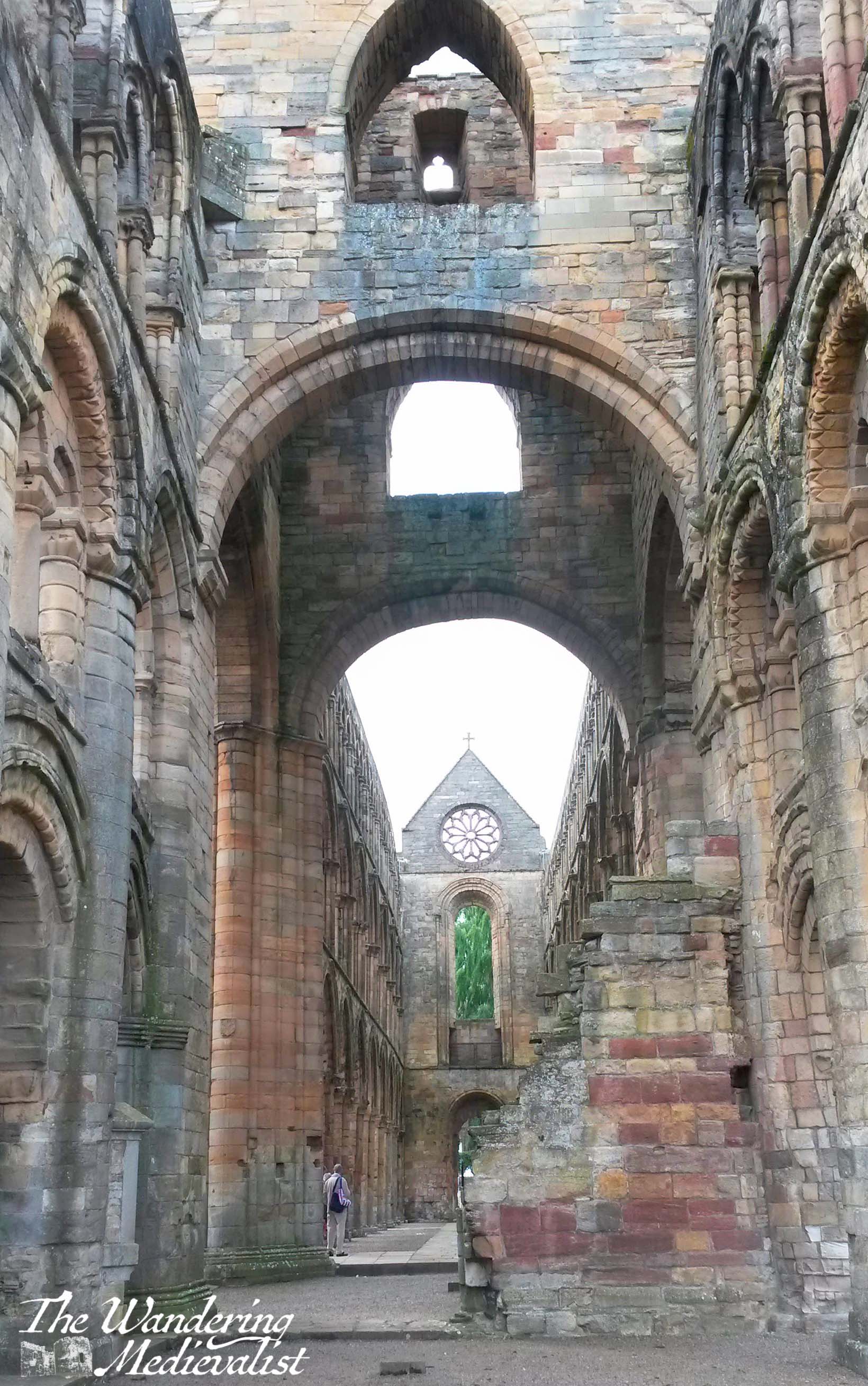
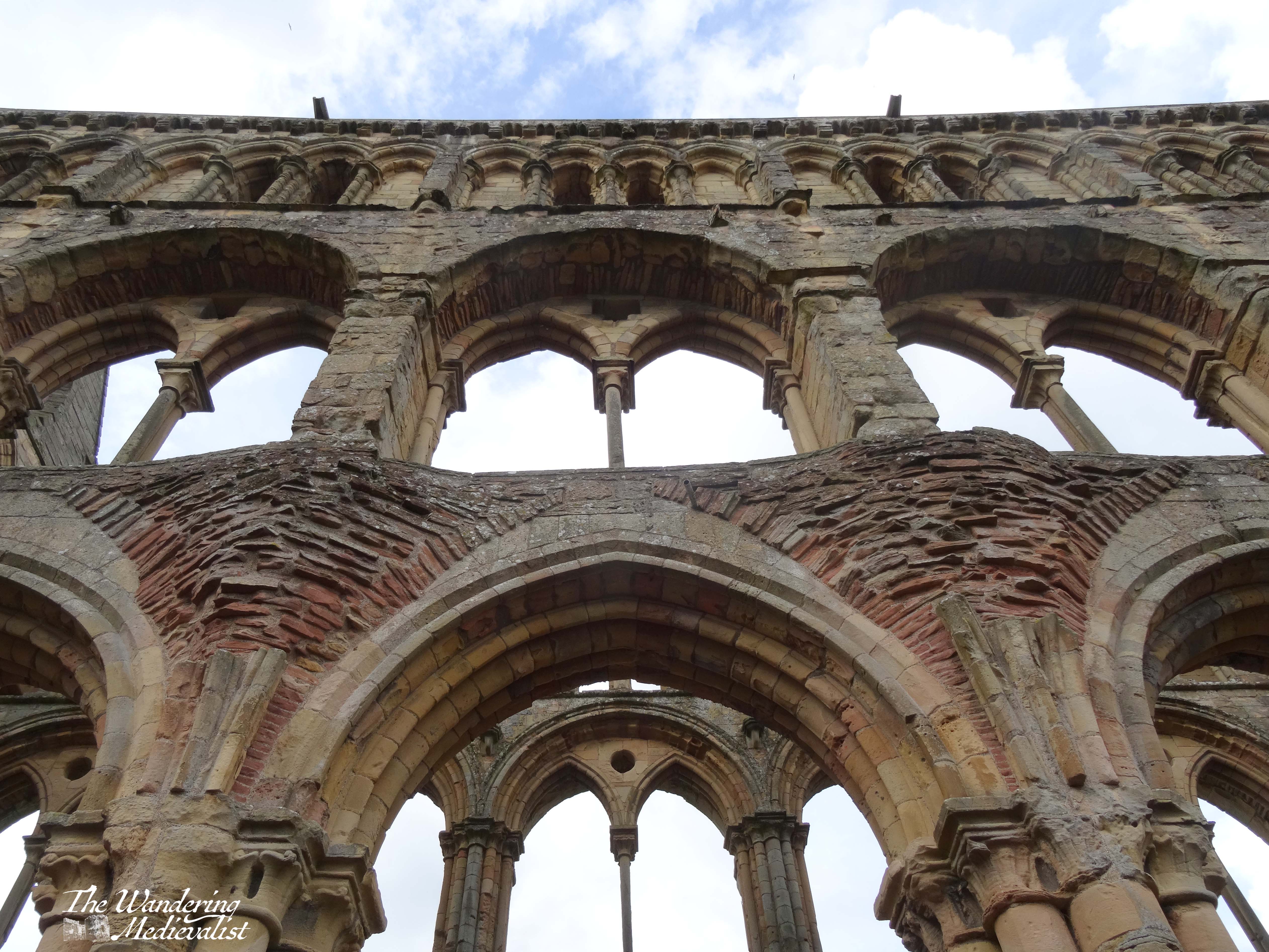
Unfortunately the location in the borders meant that Jedburgh – both the abbey and the town – suffered regularly in wars between the English and Scots, and in 1523 both were burned by the rampaging Earl of Surrey. As with most ecclesiastical institutions in Scotland, Jedburgh’s preeminence ended during the Reformation of the later 16th century.
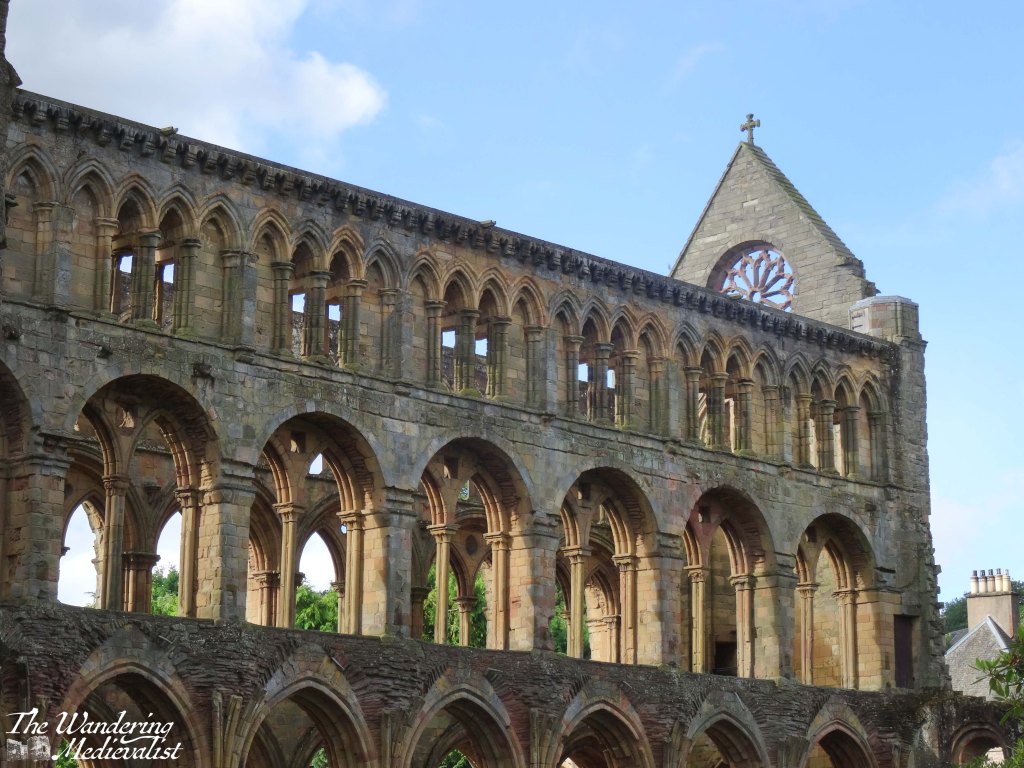
The abbey’s position in the town centre means that it is possible to enjoy views from roughly the level of the first balcony at one end, and to explore at ground level from the opposite end.
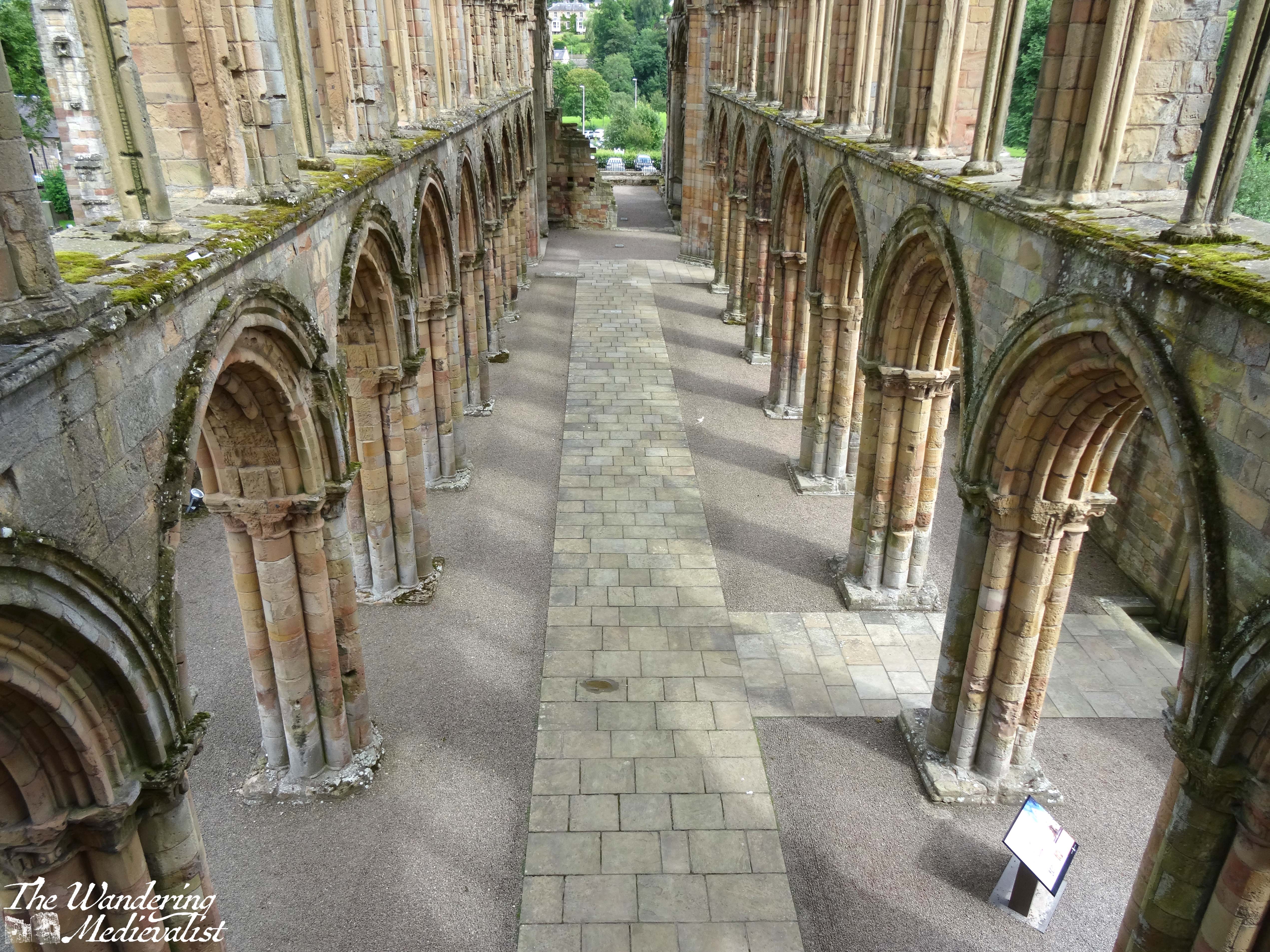
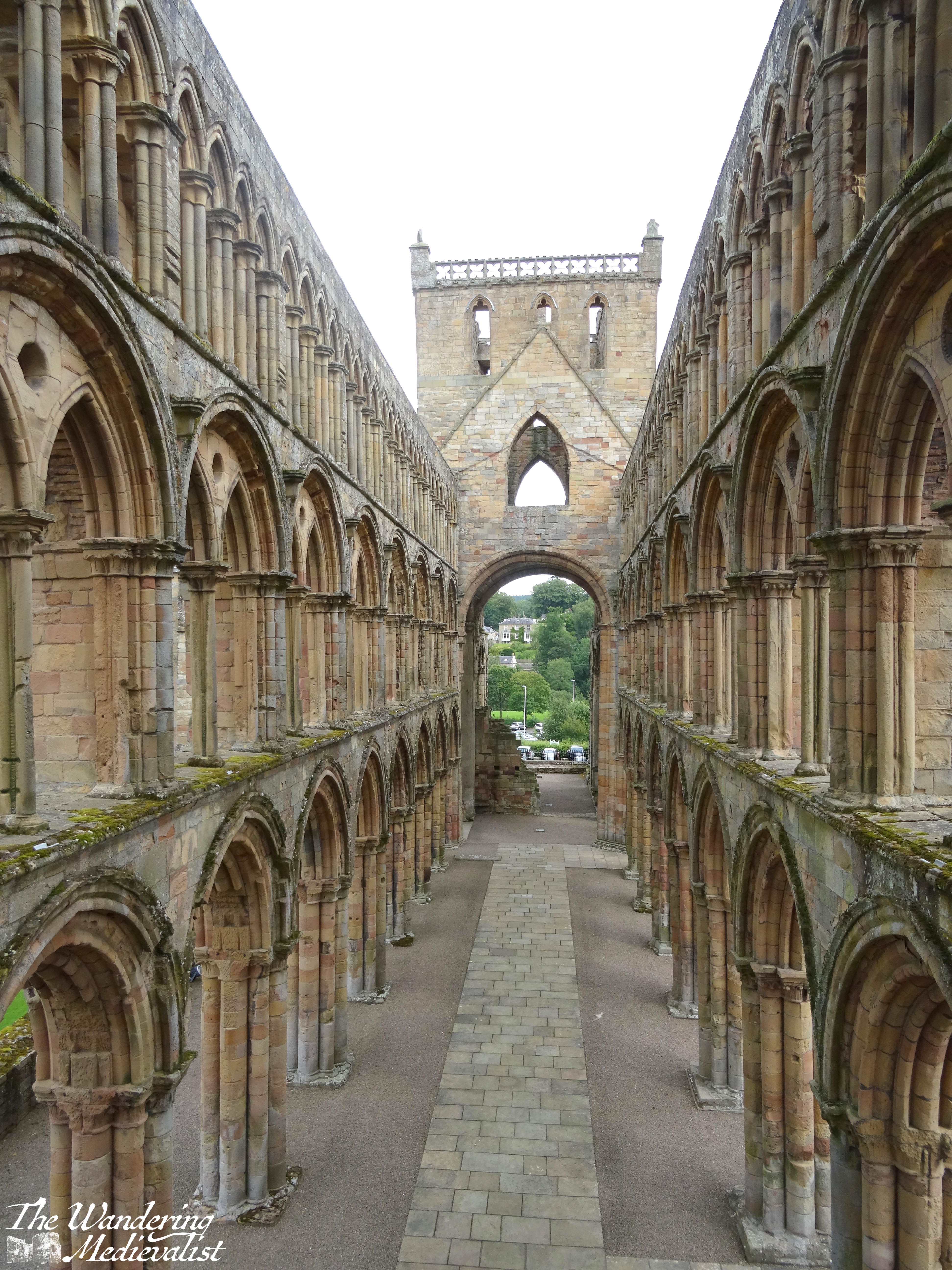
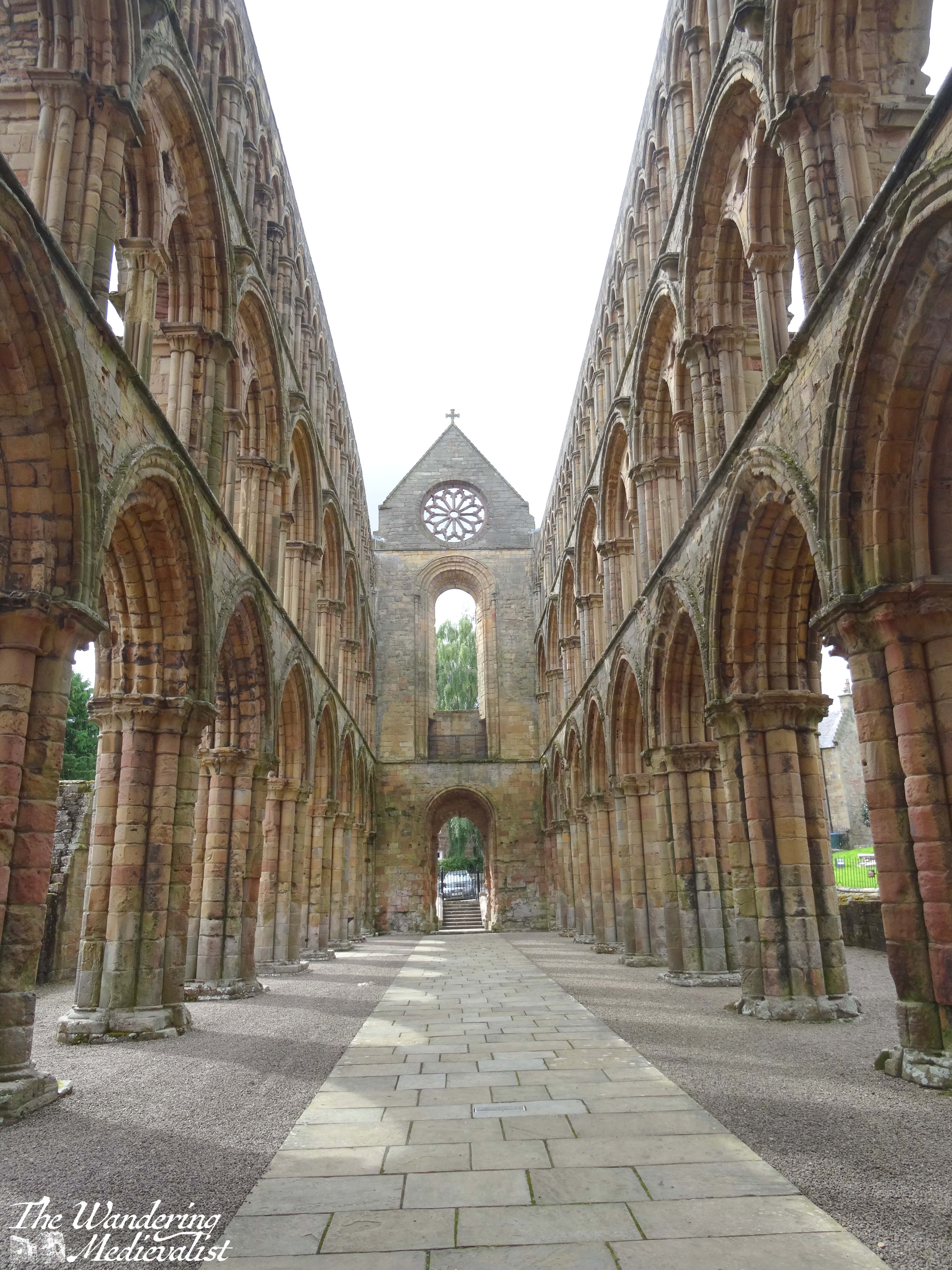
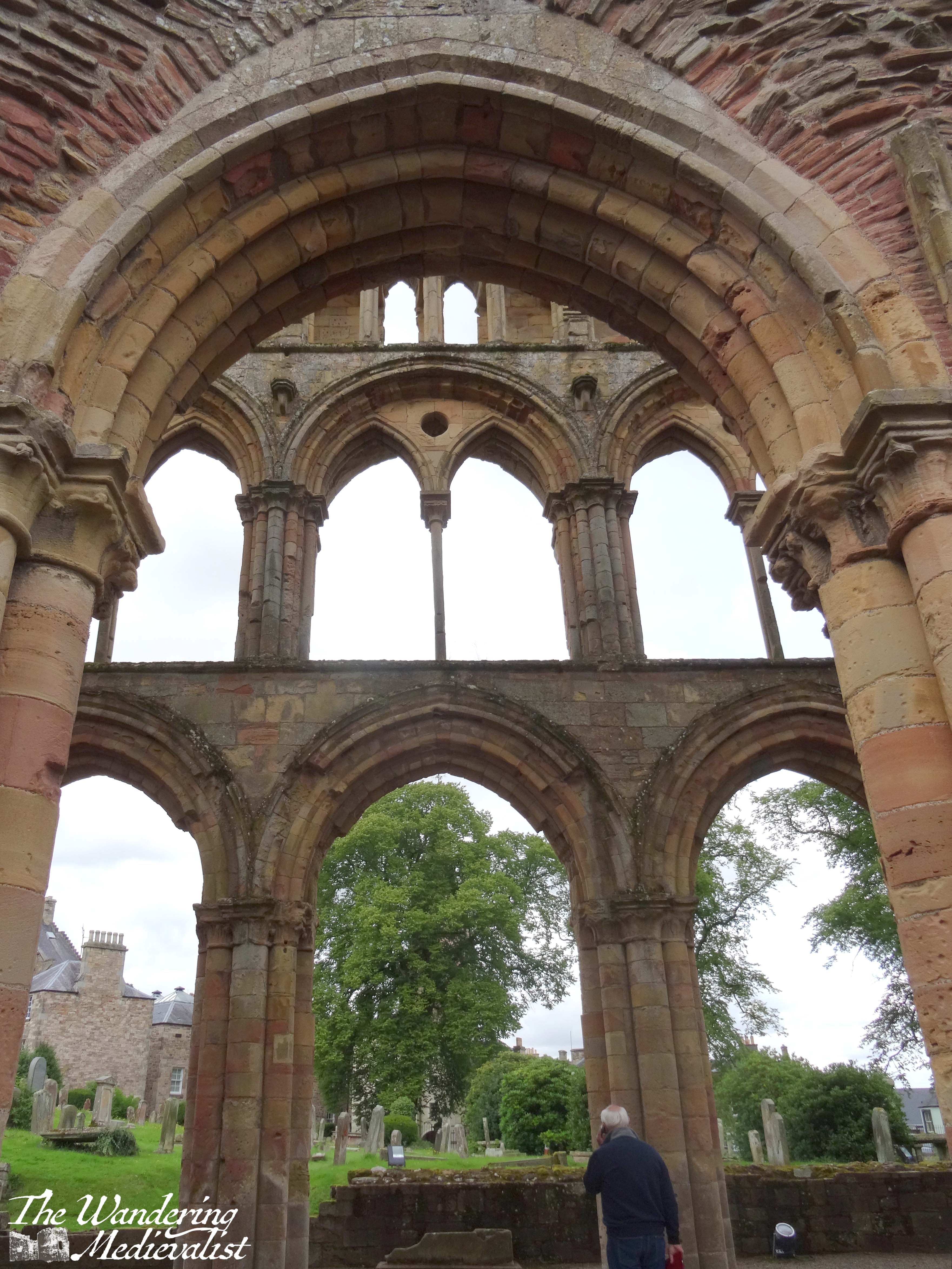
I love this series of views down the main aisle of the church, looking either towards the rose window or the grand processional entrance.
I was intrigued while reading about Jedburgh to discover that it had been founded by David I, who is known to have been a king who brought many ‘English’ innovations to Scotland. He had spent significant time in England in his early years, first in exile after the accession of his uncle, and later he became part of the royal family when his sister Matilda married King Henry I1. David himself was named Earl of Huntingdon by marriage to the heiress, and thereby granted a large parcel of lands scattered throughout England; he brought these with him when he became King of Scotland, complicating the nature of his feudal and personal relationships with Henry and future English rulers.2
David took advantage of the chaos in England during the period of the civil war between Stephen and Matilda to consolidate his own power – foundation and support of religious institutions was an essential part of royal activity during this time period. The architecture of the abbey shows an intriguing mix of traditional Norman round arches with the lighter, pointed arches of later styles. The solid yet ornately-carved columns are reminiscent of Durham Cathedral, while the fine window supports are clearly of newer construction. One cannot help but agree with the writer of the many plaques around the site – it is a monument to medieval construction and architecture, with gorgeous carvings and innovative architecture visible even after 100s of years and multiple attacks. Jedburgh is perhaps less majestic than the more out-of-the-way abbeys like Melrose or Dryburgh, but it is no less beautiful.
- A marriage of ingenious dynastic significance. By marrying Matilda, Henry combined his Norman ‘invader’s bloodline, the new bloodline of the English throne, with the ancient Anglo-Saxon bloodline that Matilda carried from her mother, Queen Margaret (formerly Margaret of Wessex). With one marriage, Henry legitimised his reign and guaranteed that his heirs would carry both English royal bloodlines. The success (or rather lack thereof) of this plan will be discussed at another time. ↩︎
- As the English kings now owed homage to the Kings of France for Normandy, now the Scottish kings owed homage to the English kings for their lands. Always a recipe for trouble when a king owes sovereignty to another king…see the whole 12th and 13th centuries. ↩︎
 The Wandering Medievalist