
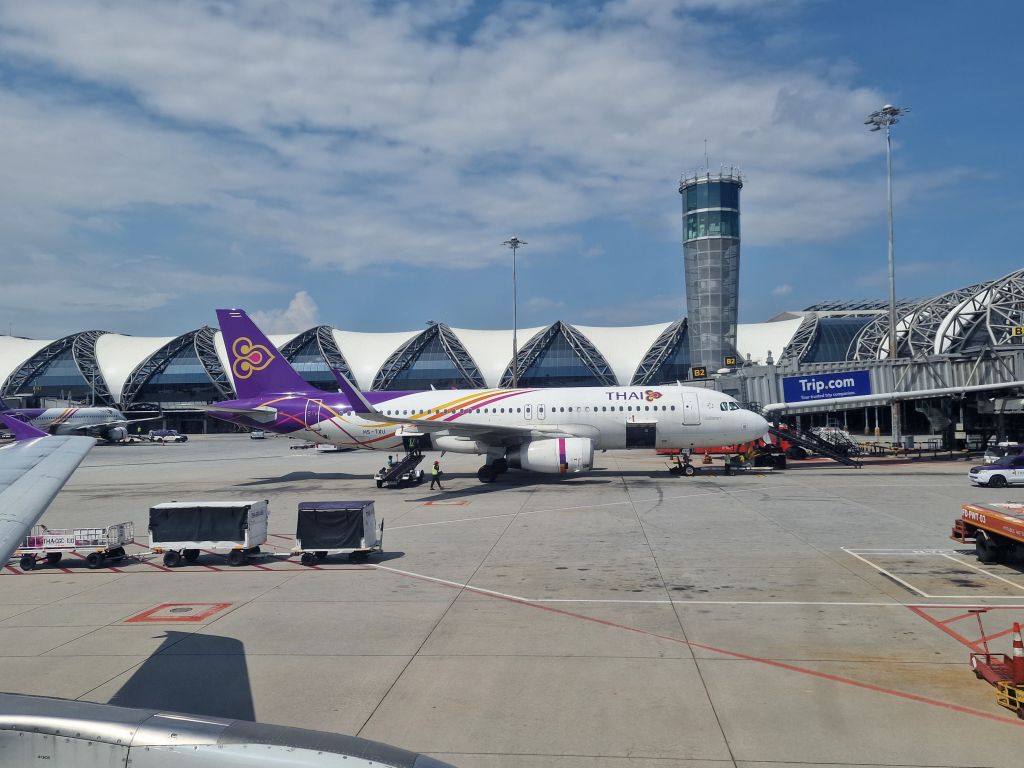
At the end of my Thailand trip, I spent three days in the northern city of Chiang Mai. I had perhaps less idea of what to expect from Chiang Mai than I had of Bangkok, but I was excited to see what it might hold, and the fight was a leisurely 1 hour, leaving at a reasonably mid-morning time of day.
Thai Airways was very pleasant – if the planes were on the older side – with impeccably polite staff and a good snack of a Thai tea-flavoured milk bun, gloriously soft and a touch sweet. I had only discovered the deliciousness that is Thai tea the day before at an event – a new favourite.
I looked out the plane window as they announced we were 15 minutes from landing and realised that the air was much clearer than it had been in Bangkok, and I could see mountains not far off. It reminded me, in some ways, of Puerto Rico; flat land leading to verdant mountains, foliage and similar houses. But then, in the distance, I noticed something rising from the ridge of the mountain. I wasn’t sure what it was – a radio tower perhaps? Then we got closer and closer, and the form of a person was evident – a gold one. Not a radio tower, but a temple, with an enormous statue that stood out against the trees. Nearby, another one. I started to smile.
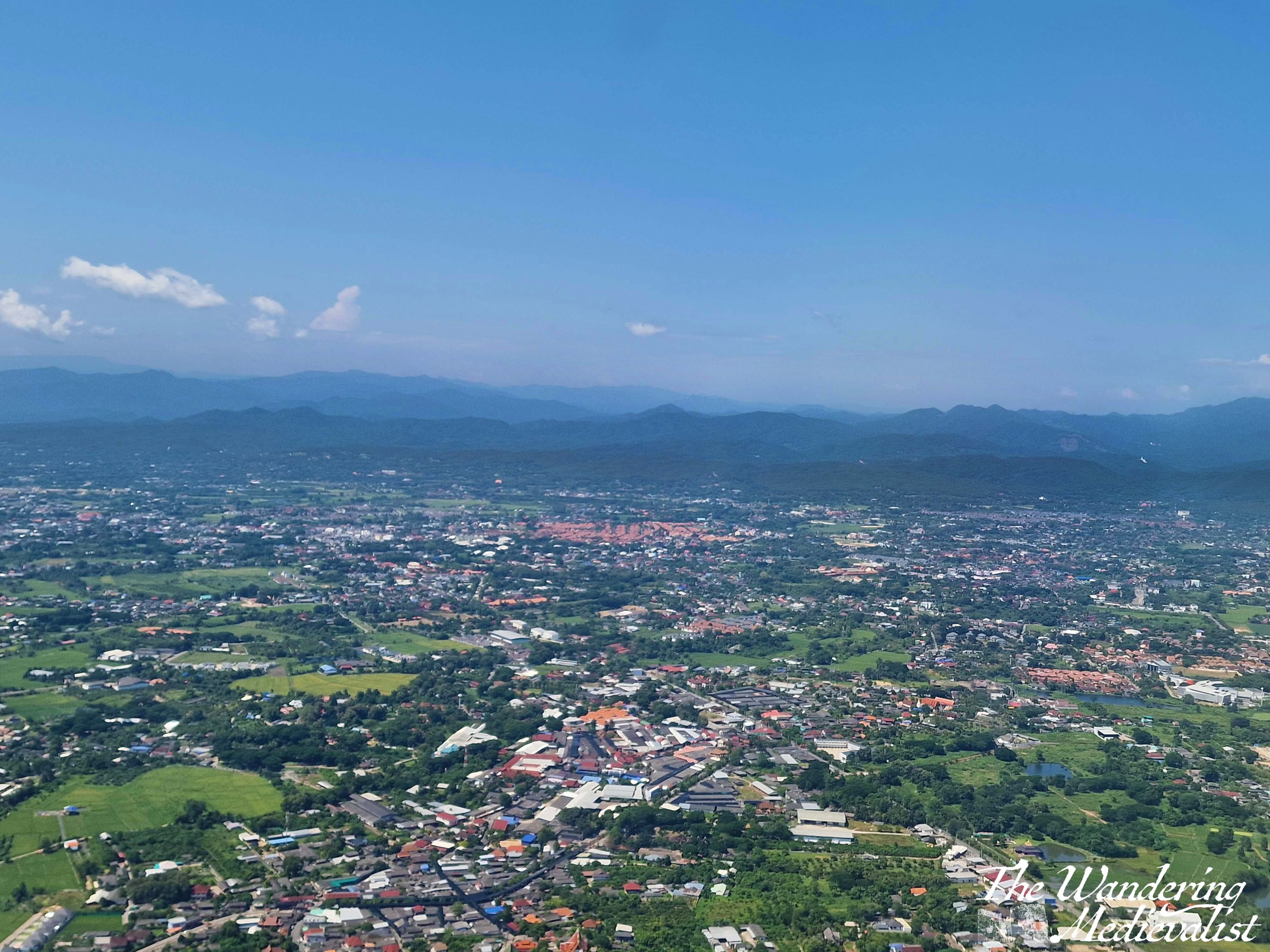

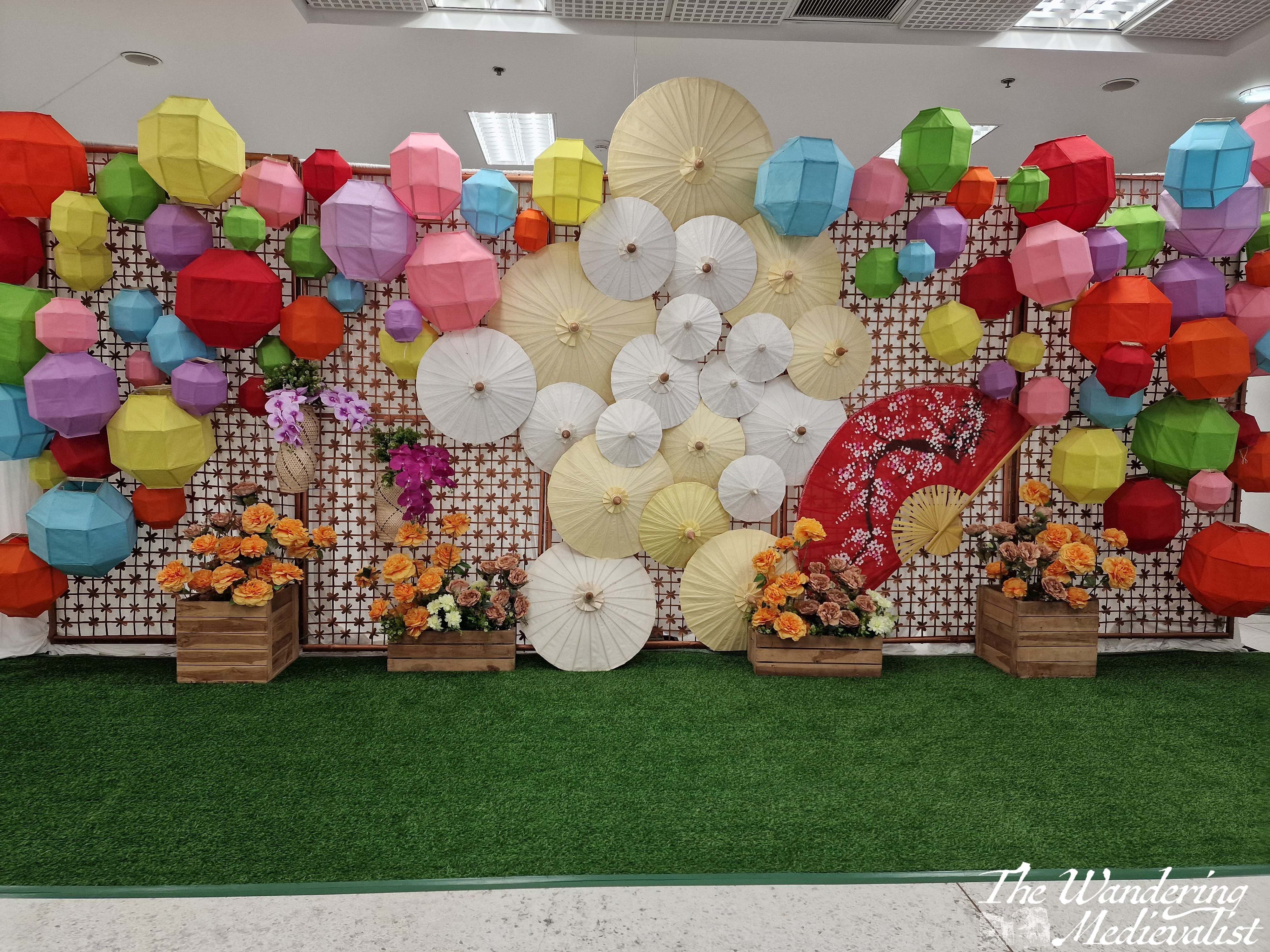
Sure enough, it took me no time at all to fall in love with Chiang Mai. I’m not sure if it was the similarity in size to many cities I love closer to home – the population is 1.2 million, not far off Edinburgh, greater Boston, or Leeds – allowing for a metropolitan feel that is still far less hectic than big cities like Bangkok, London and New York. Or perhaps it was that combined with the sheer beauty of the city, and of its history, so evident on almost any street corner.
The airport is on the small side, the way I remember Edinburgh being twenty-five years ago, and it was easy to arrange a Grab to my hotel. I was considerably more awake for this airport transfer than I had been in Bangkok, and so I happily stared out the window at the city that was both modern in its bundles of wires, concrete structures, and many cars, but also historic in its moat, temples, and detailed adornment to shrines and the simplest light posts and garden walls.

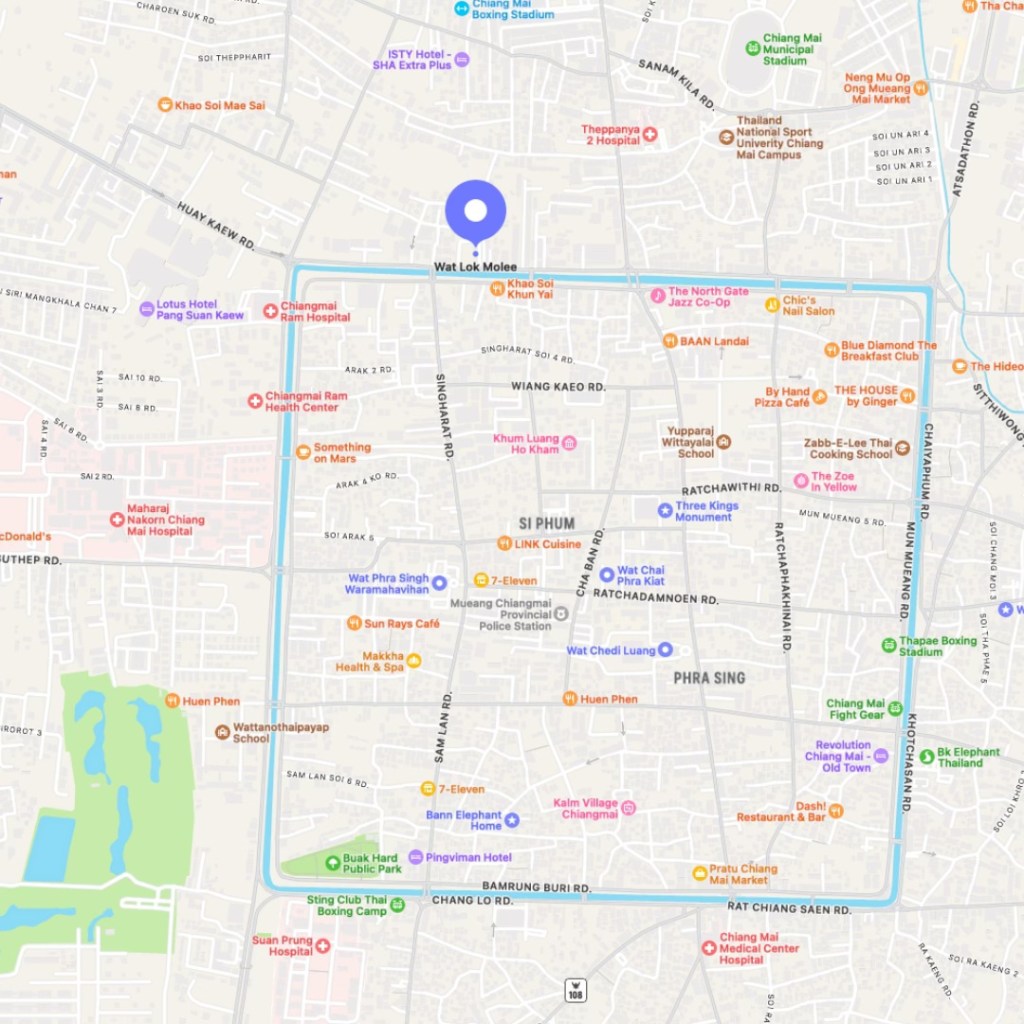
Chiang Mai, as I learned, is the second-largest city in Thailand, though the portion I visited felt considerably smaller – I clearly missed quite a bit. It was founded in 1296, and fortified with a town wall – some of which still exists – as well as the almost square moat. I confess myself to being quite ignorant of Thai history, but learned that this area of northern Thailand was part of the Lan Na Kingdom for what in Euro-centric terms is considered the Middle Ages and early modern period. Chiang Mai became capital of Lan Na under its first king, Mangrai (c. 1238 – 1311).

My hotel, which was absolutely beautiful, was in the Nimman area, a bit north and west of the moat, immediately across from several large shopping centres. The hotel rooftop, which I discovered on my first night, provided a view over the city in every direction and towards the mountains.
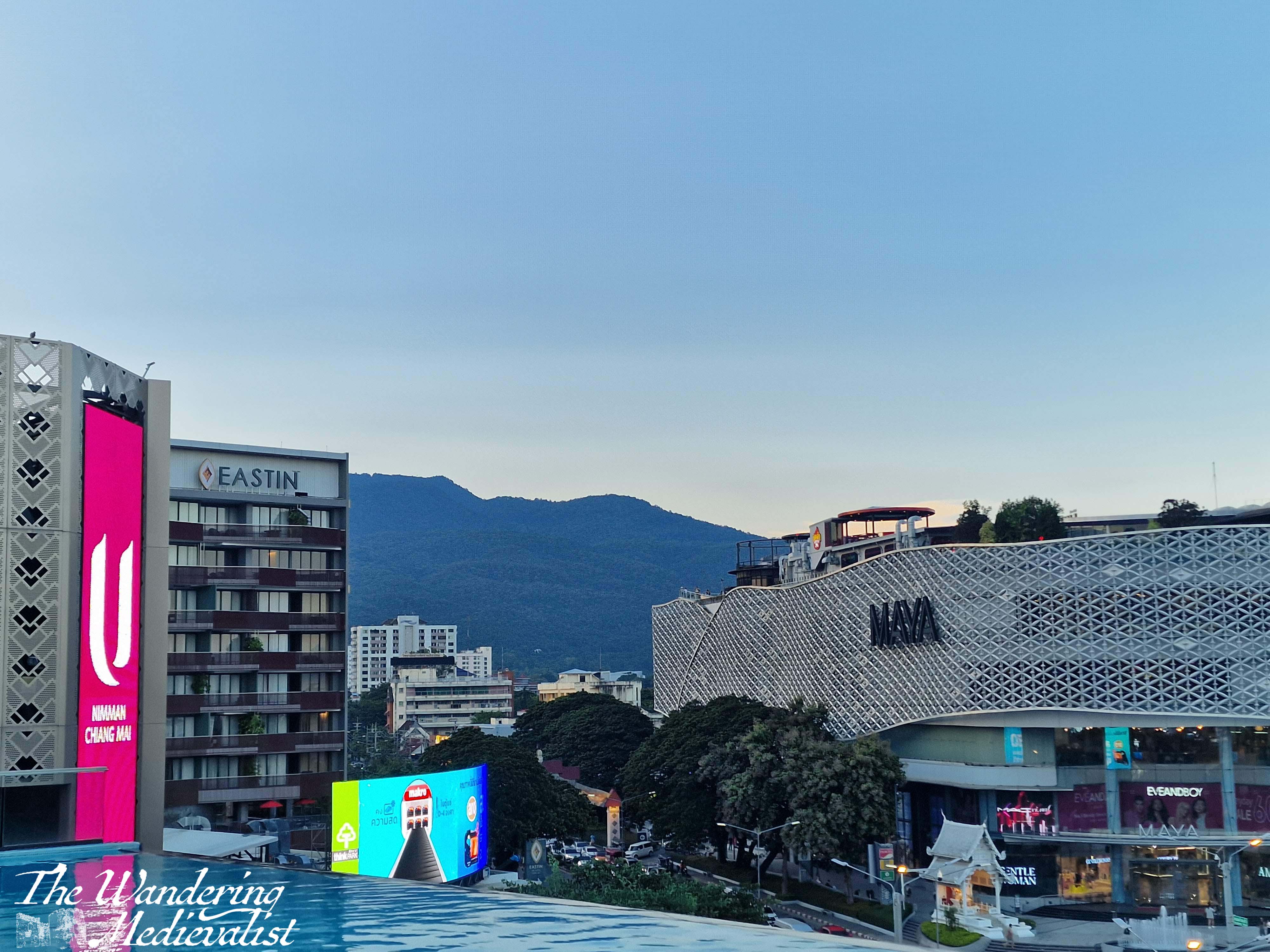
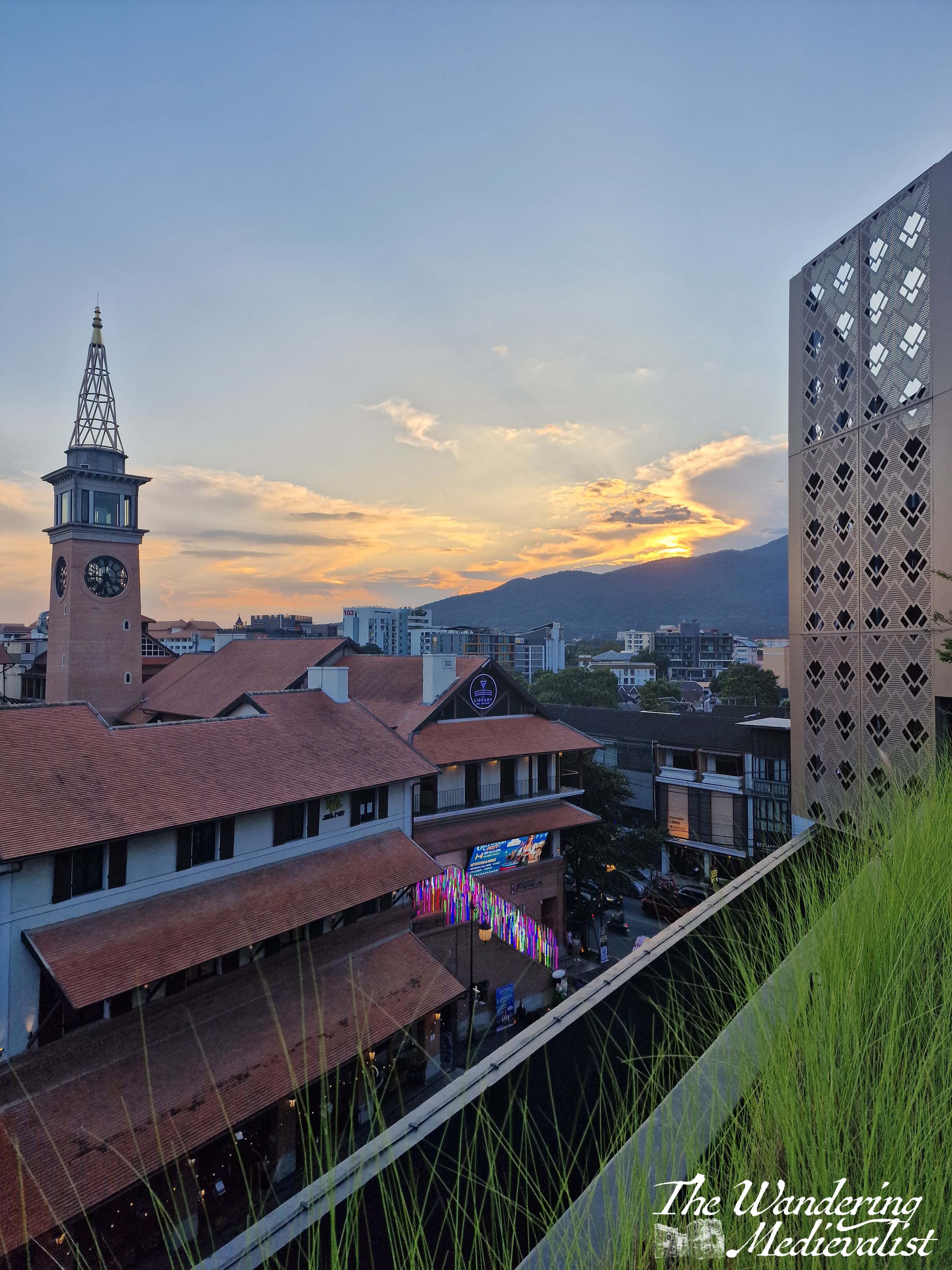
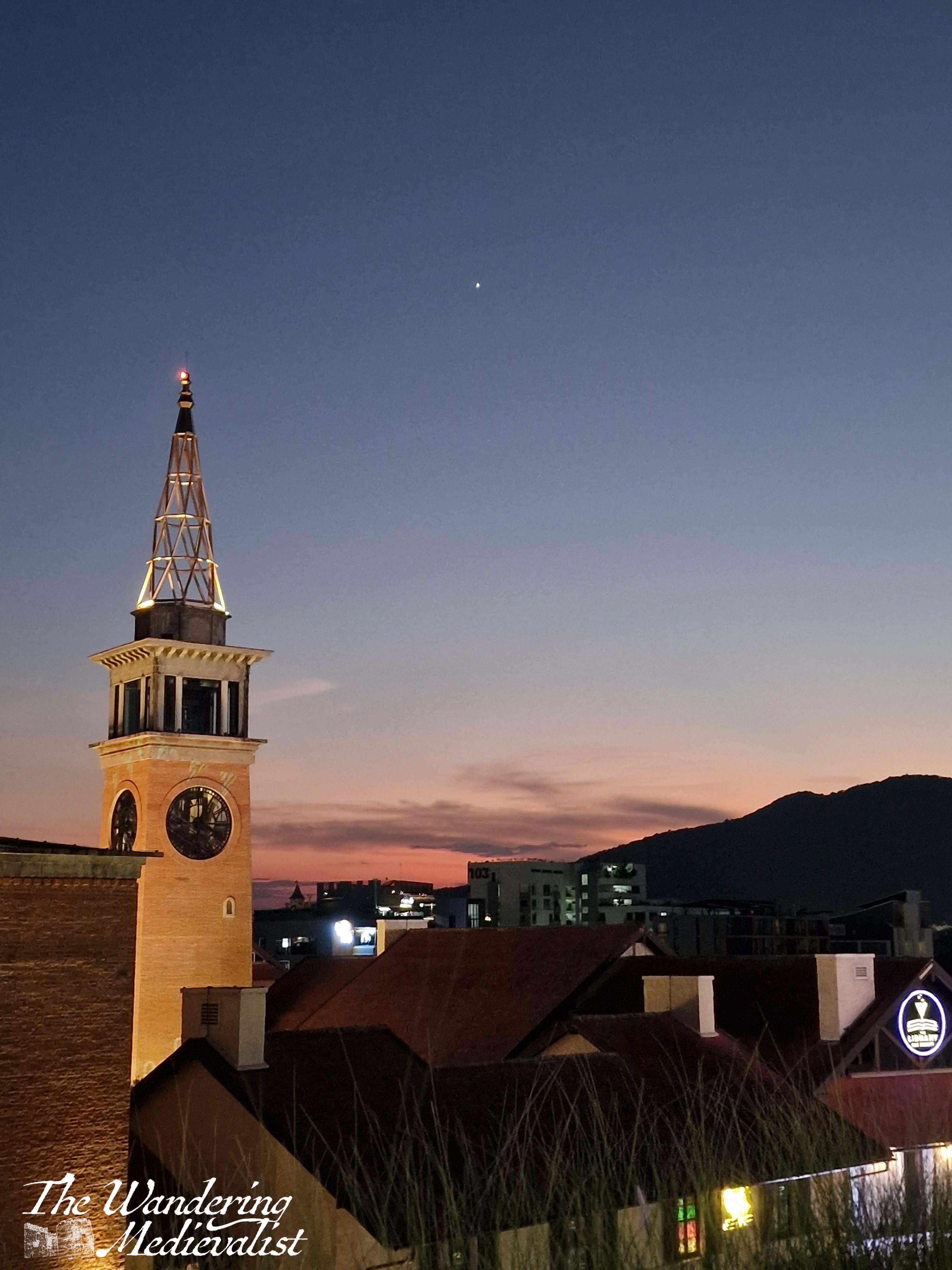
The evening was still warm but a gentle breeze kept the temperature very comfortable, and the hotel staff were happy to bring me a gin and tonic. It was the perfect way to end my day, as you will see.

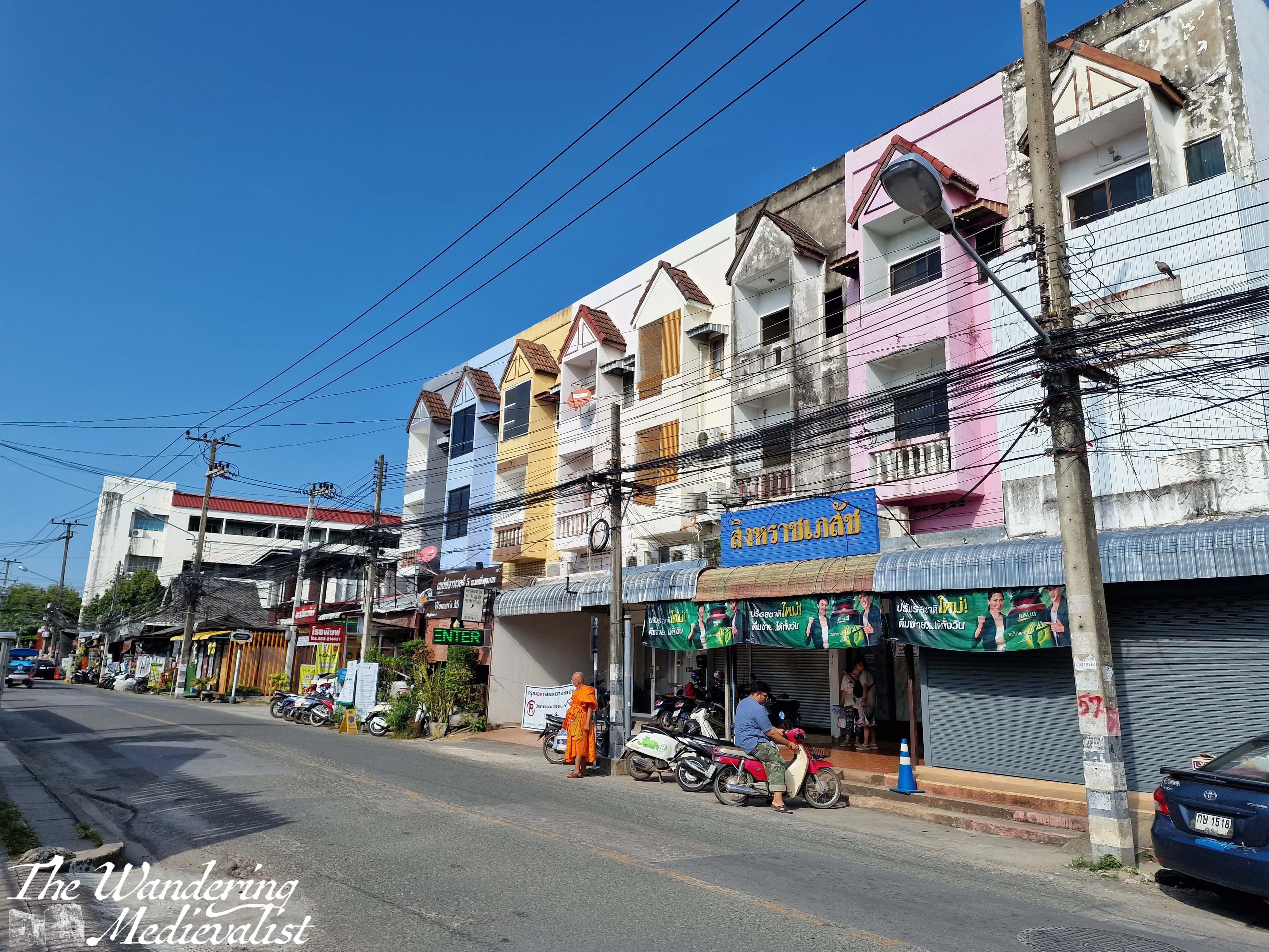
On my first day in Chiang Mai, my work meetings finished in time to allow me to explore. I started off in the centre of the square old city and walked up one of the main roads towards the bridge I had determined to cross. The walk passed by a series of temples from which I could hear chanting, as well as numerous shops. The ubiquitous Thai mopeds were everywhere, and while the heat was intense, it was just comfortable enough to allow for a gentle walk. This would not be possible, I later discovered, in the more modern parts of city where the sidewalk frequently disappeared completely.
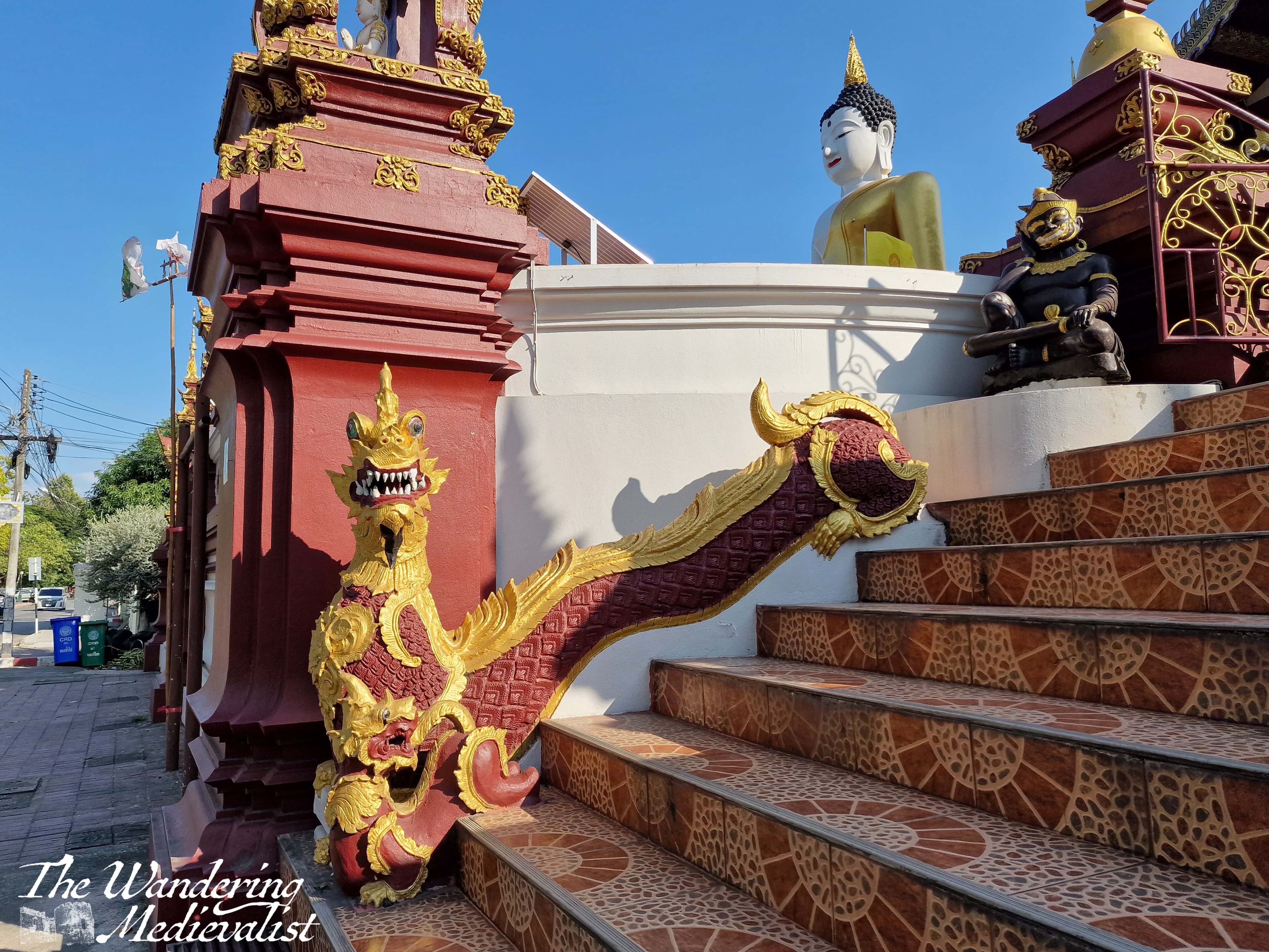
Upon reaching the city moat, I decided first to turn right and walk a short distance along to a footbridge rather than cross the car bridge. In no time at all, I came across my first proper temple – Wat Rajamontean. I did not go inside, as I could hear an active service of some kind. As you can see below, there was a set of steps leading up from the street and framed with dragons and figures of all kinds. Just along the road was Wat Khan Khama, and this excellent set of gilded horse statues.


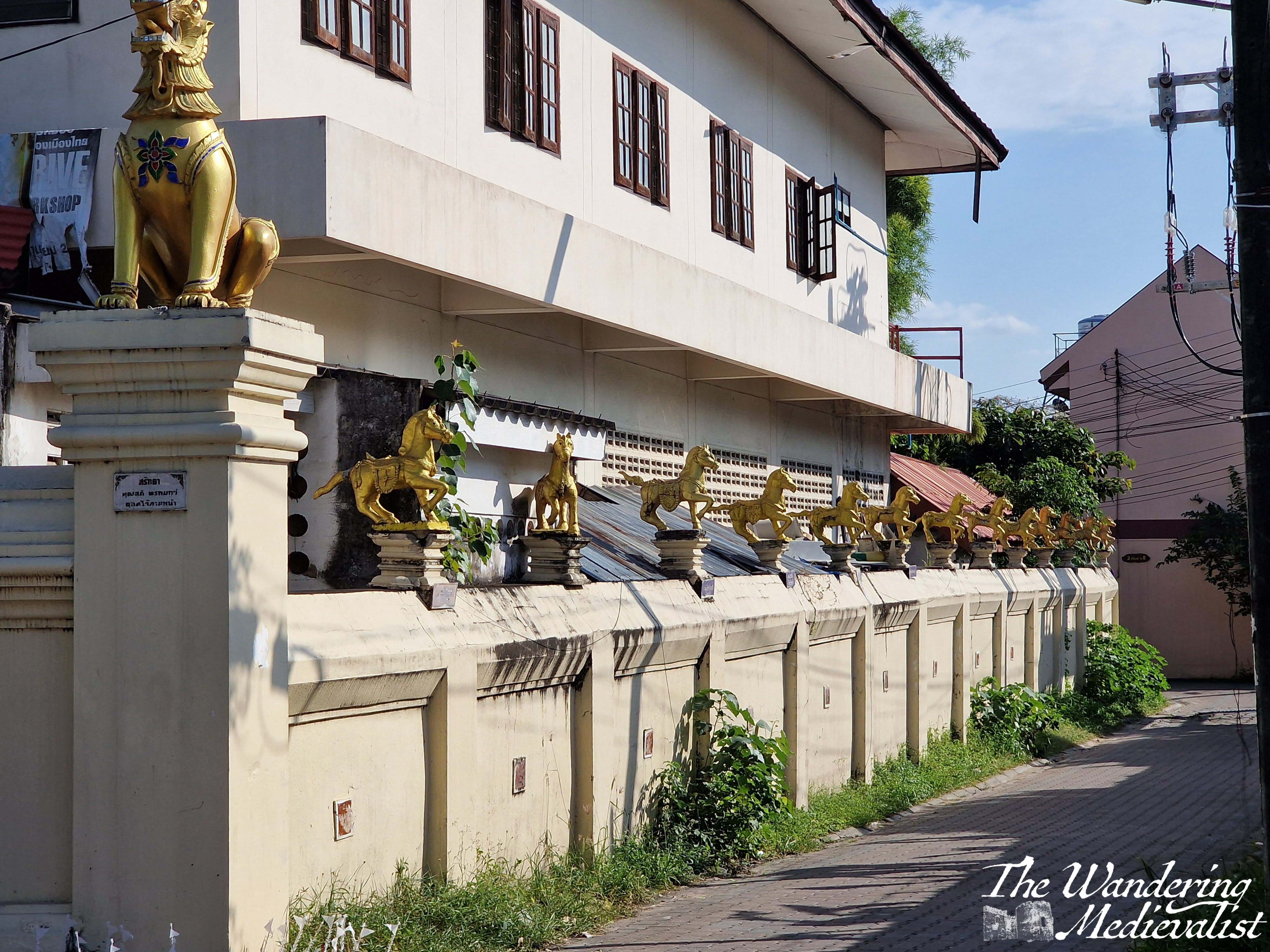
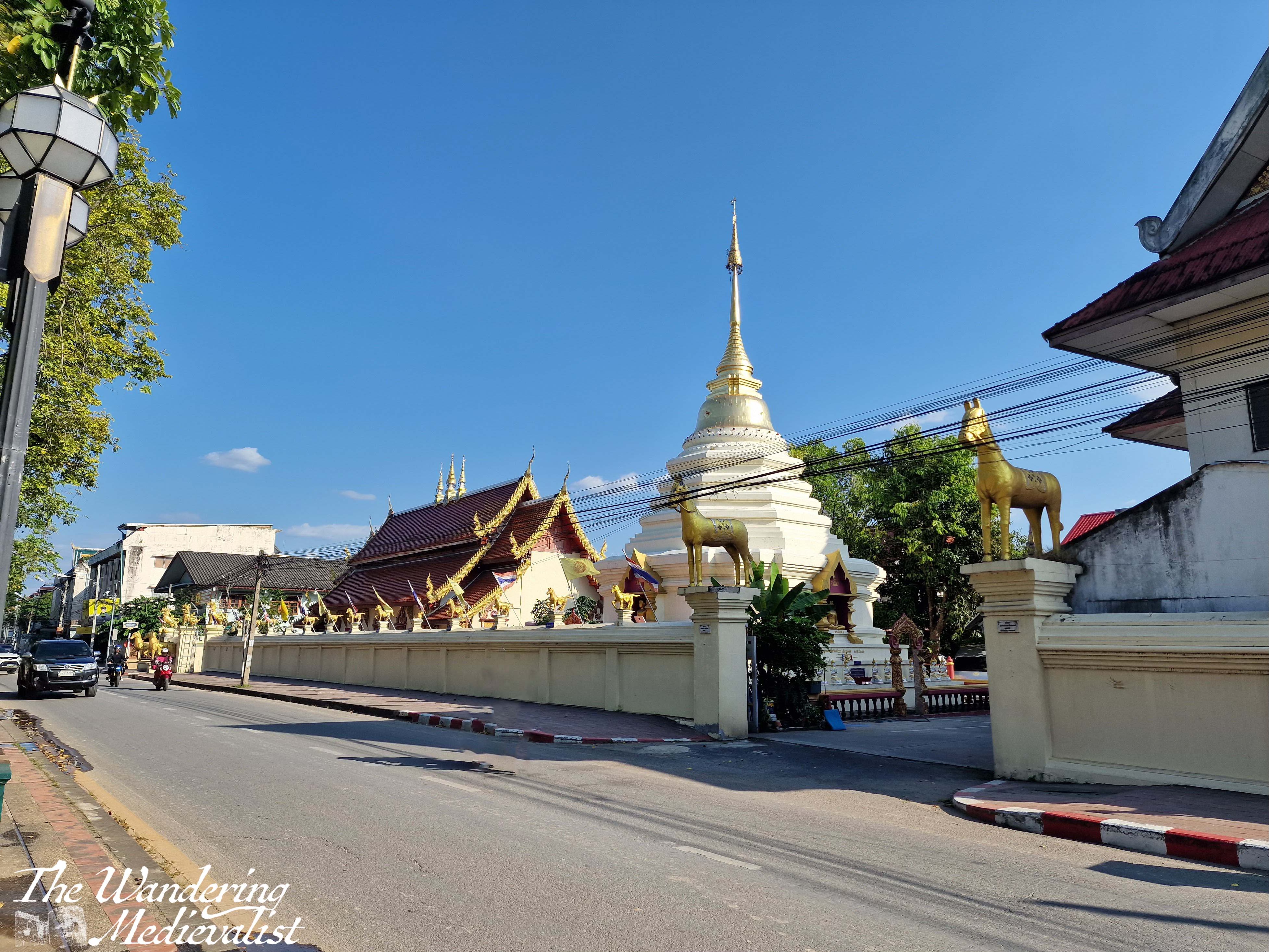
It was frustrating for me as a historian, not to be able to learn more about the temples as I visited/passed them, but the informational plaques were of course in Thai. I have since done a bit of research which indicates that this region was a hub for keeping horses, hence the row of sculptures above. It also appears that ‘Rajamontean’ denotes ‘royal monastery’ and that the Wat contains an impressive library.

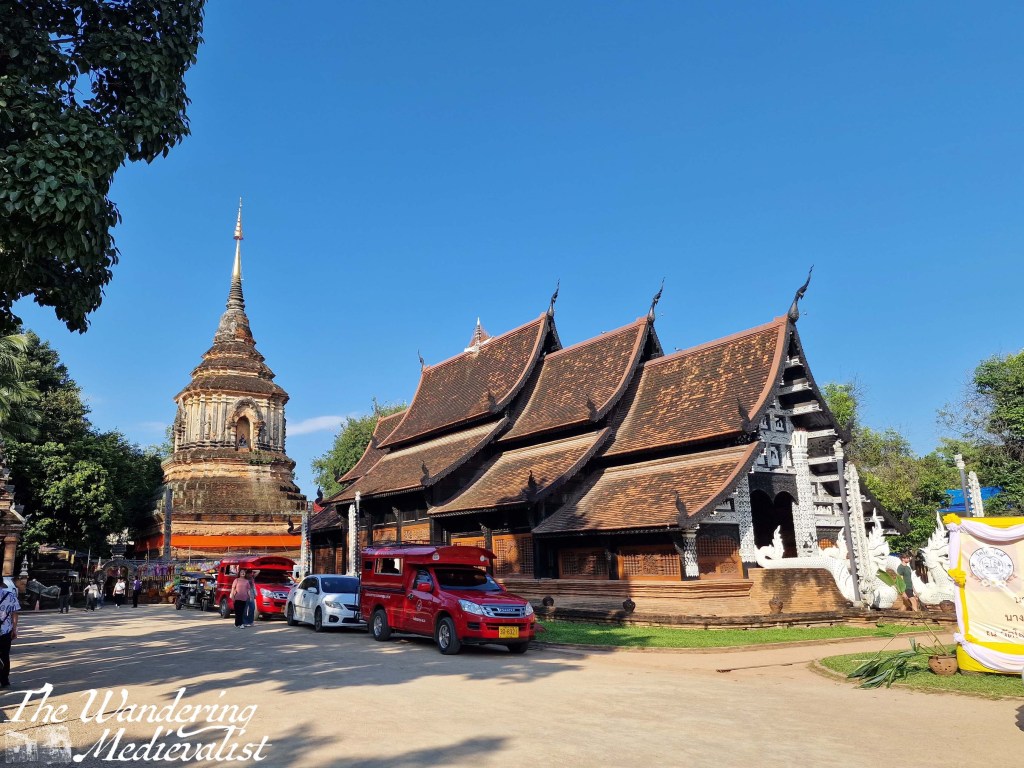
My primary goal for this walk was Wat Lok Moli. While it is not known exactly when the temple was built (the foundation in fact a great mystery), it was mentioned in charters by the mid-14th century. The two structures, the chedi (the taller pointed structure) and the vihara (assembly hall, in the foreground) were both commissioned in the first half of the sixteenth century, and the ashes of some of the royal dynasty were placed here.
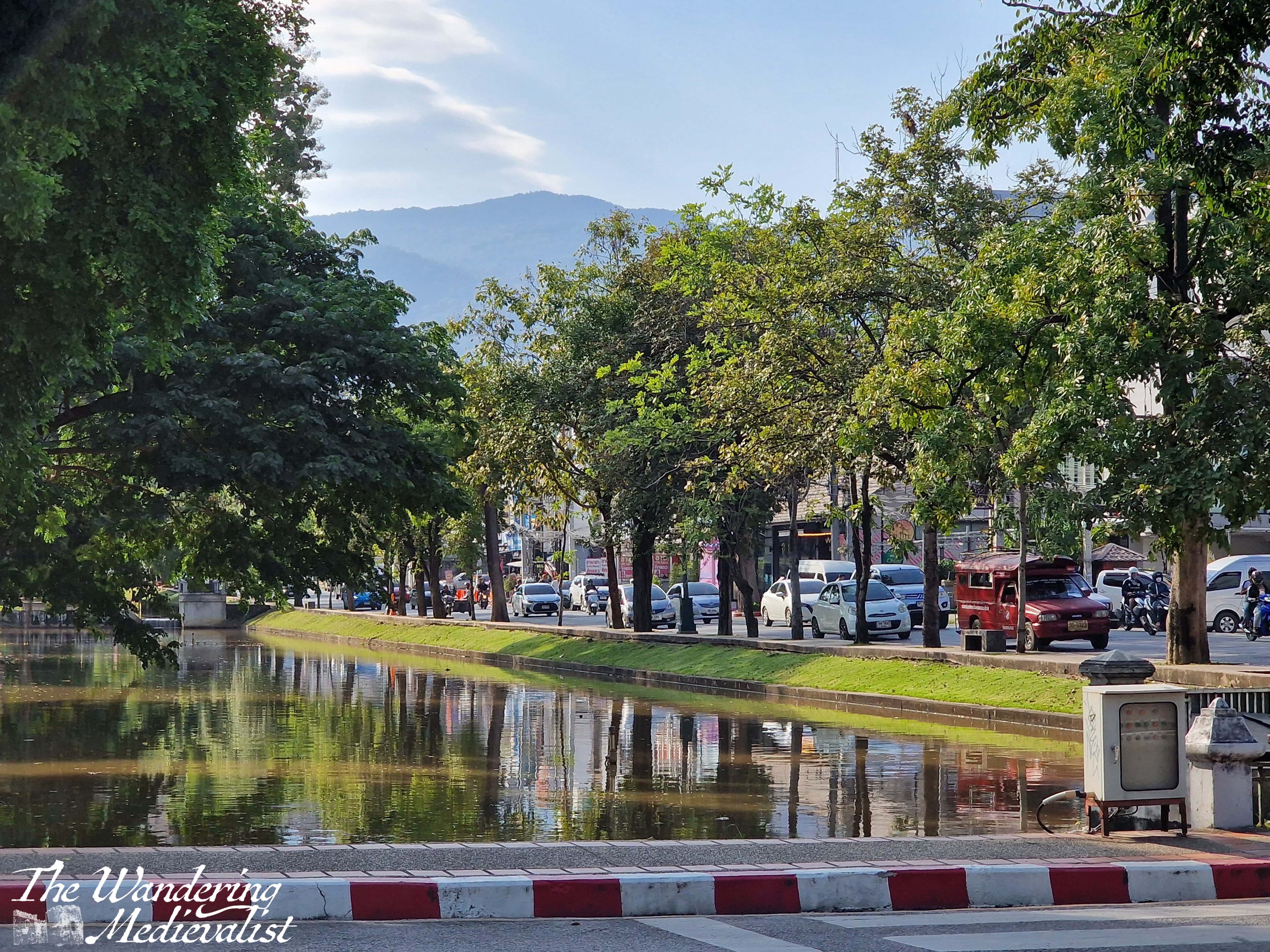
To access it, I had to cross the city moat, with the ideal spot being this beautiful footbridge. Not just beautiful though it was also treacherous, with several holes – covered in chicken wire – looking down at the water. I would not have crossed had not seen someone else on it a moment before, thought I did pass an older Thai man as I reached the far side, who grinned toothlessly at me and warned me to be careful.


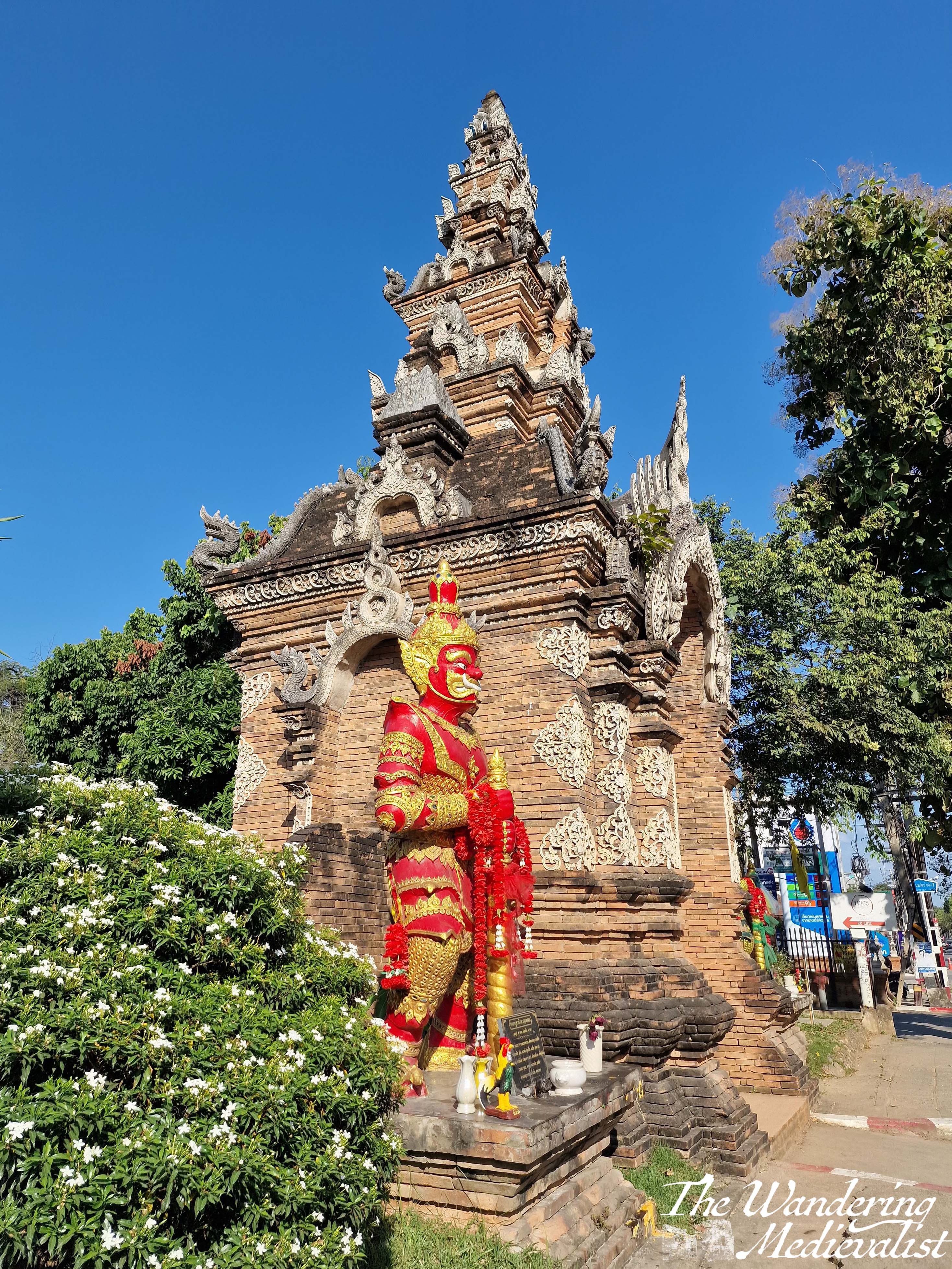
On the far side of the moat was a busy street but I managed to find a pedestrian crossing – not the easiest task – and scampered across with a few other tourists. A brick wall marks the enclosure, and the entrance to the Wat is through a splendid arch, guarded by a red statue.
Through the arch, one was confronted immediately with the splendour of two massive elephant statues, and the intricately carved face of the temple, flanked by white dragons.
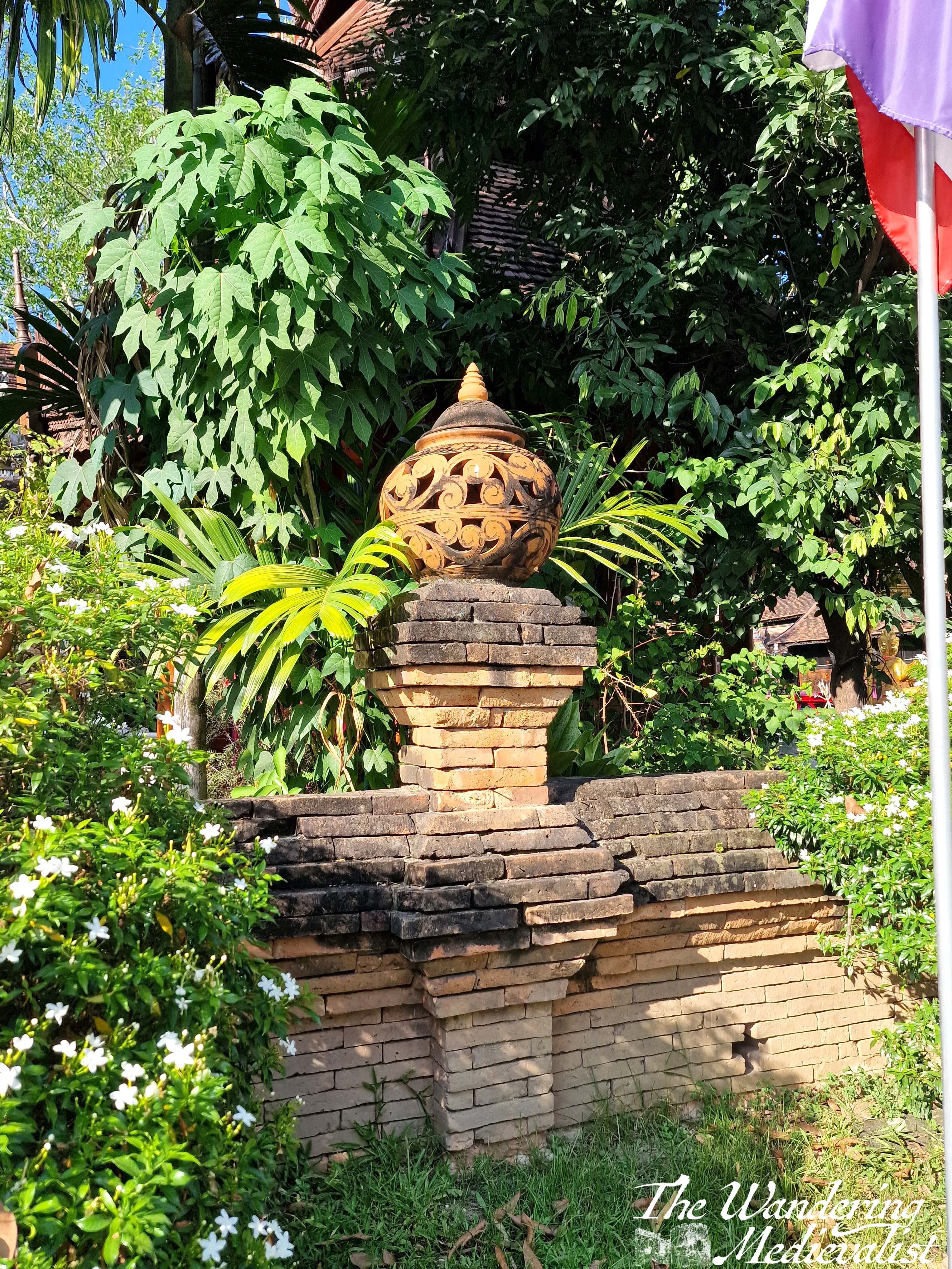
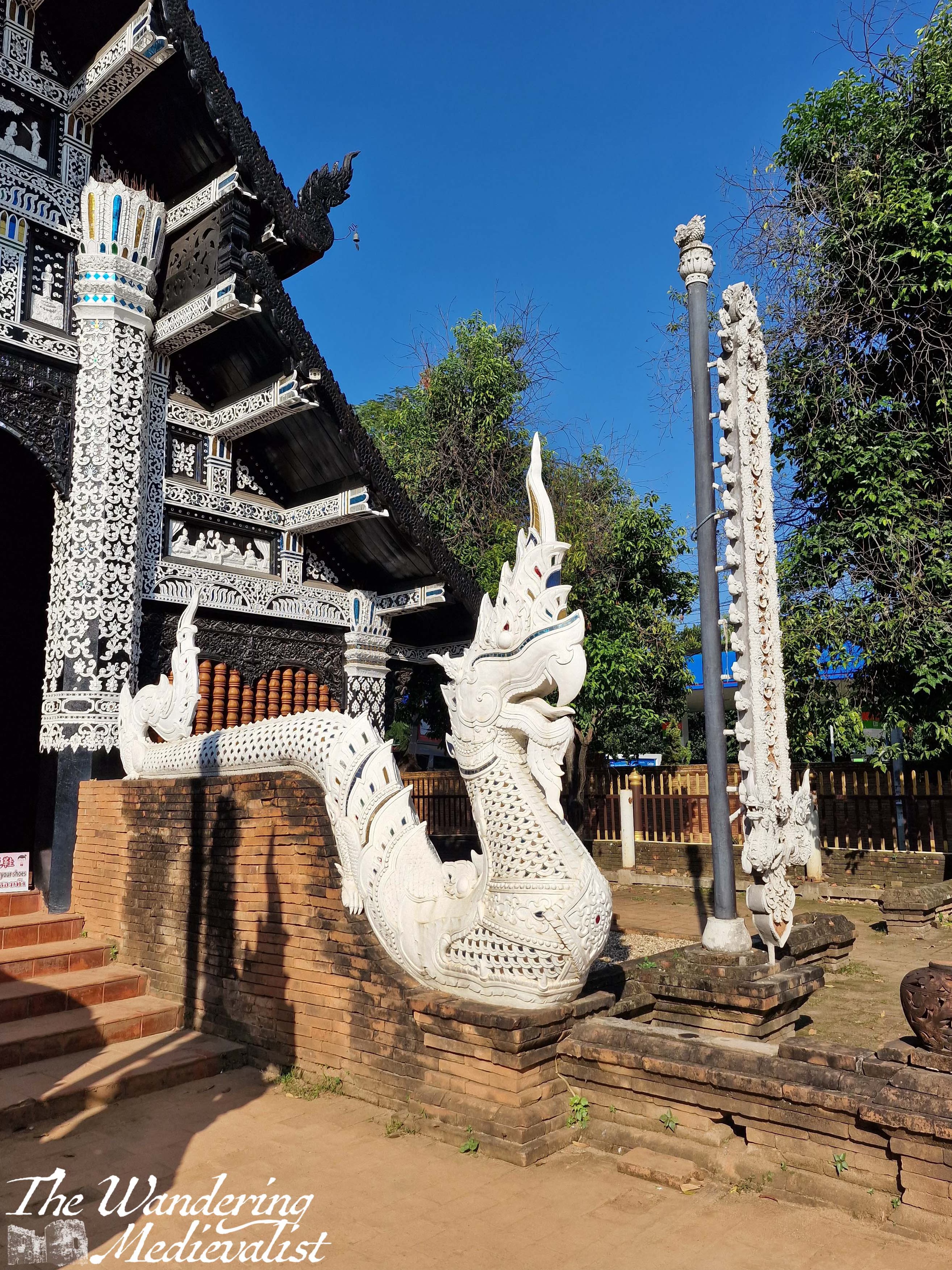
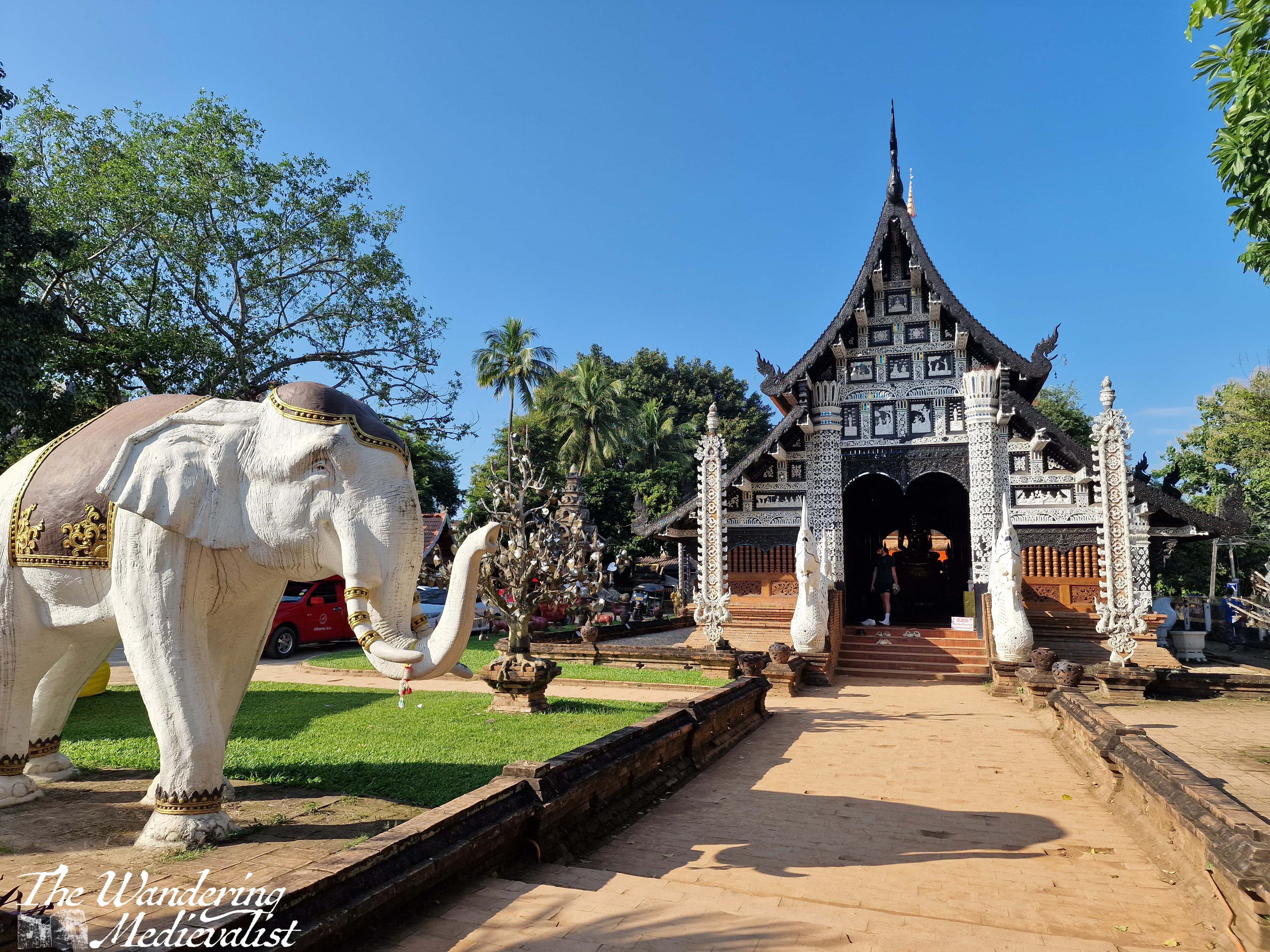
I did take off my shoes and make my way into the temple, but as there were some monks speaking to followers, I felt awkward staying and did not want to take a picture within the temple – the same reticence I feel taking pictures of active churches, though I usually get past that…
Around the back of the temple was more carving, each panel a story of history or religious tale – I assume.

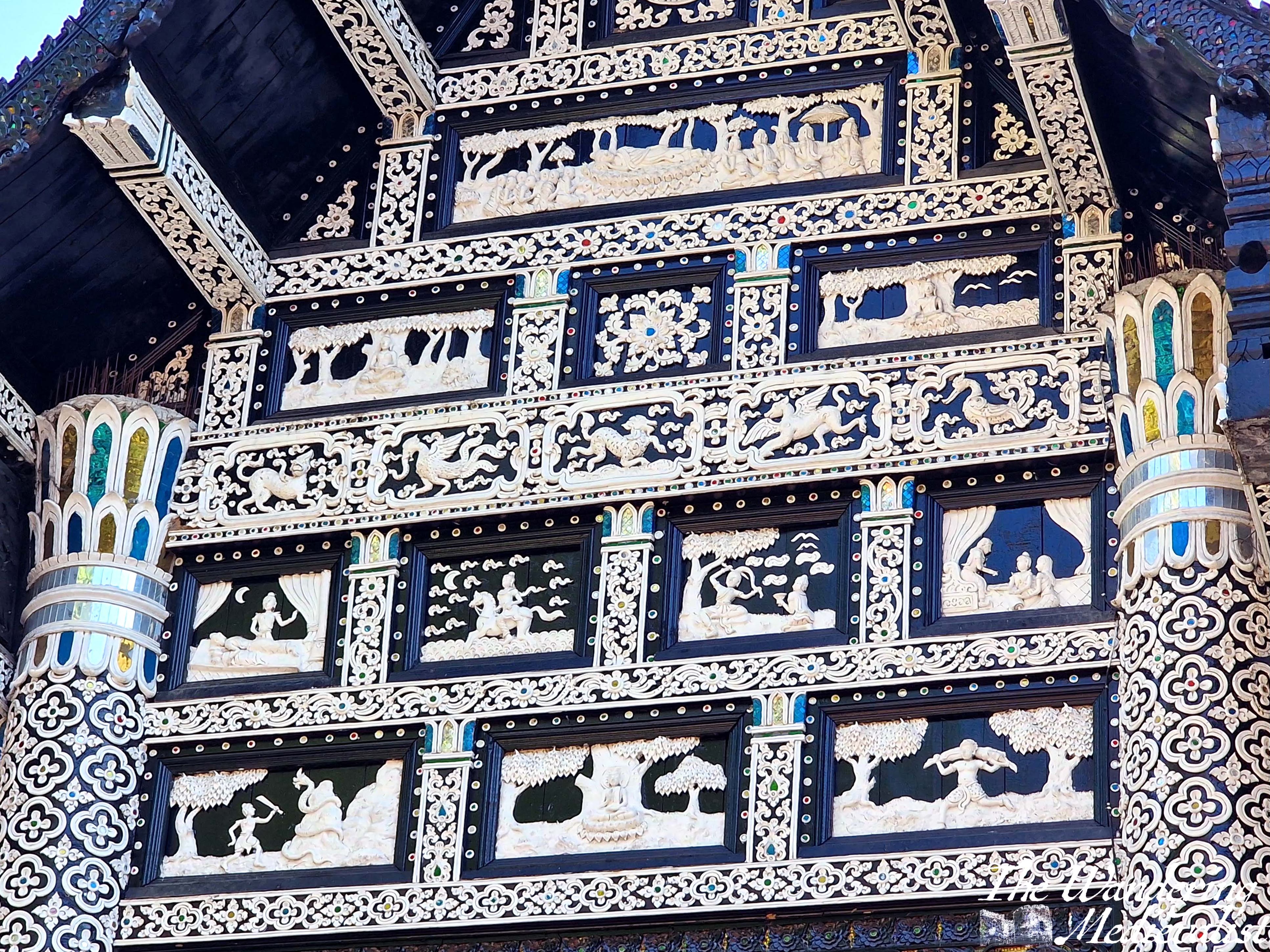
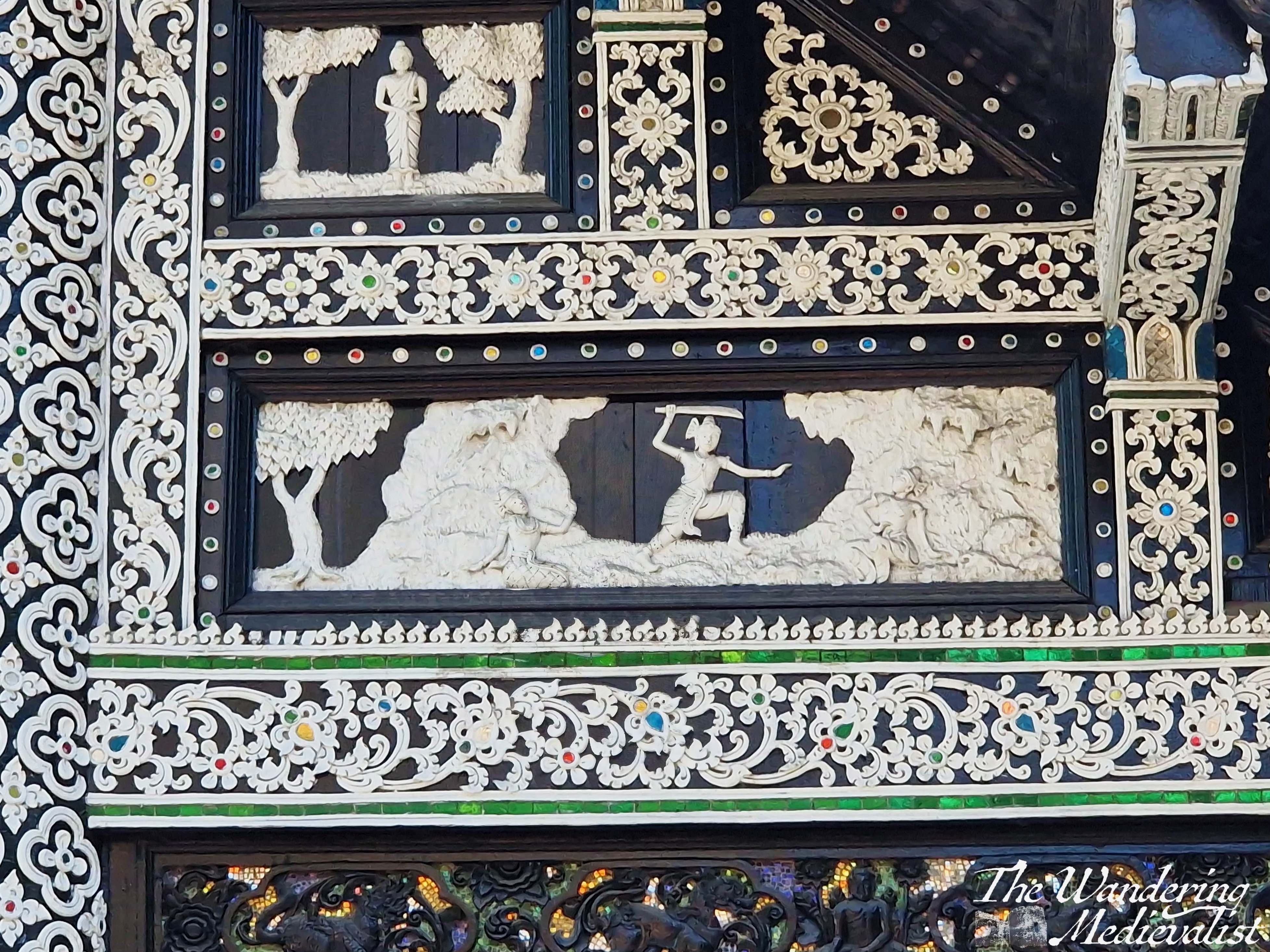
From here I moved back towards the chedi – commissioned in 1527 – in front of which was a display of beautiful coloured lanterns.
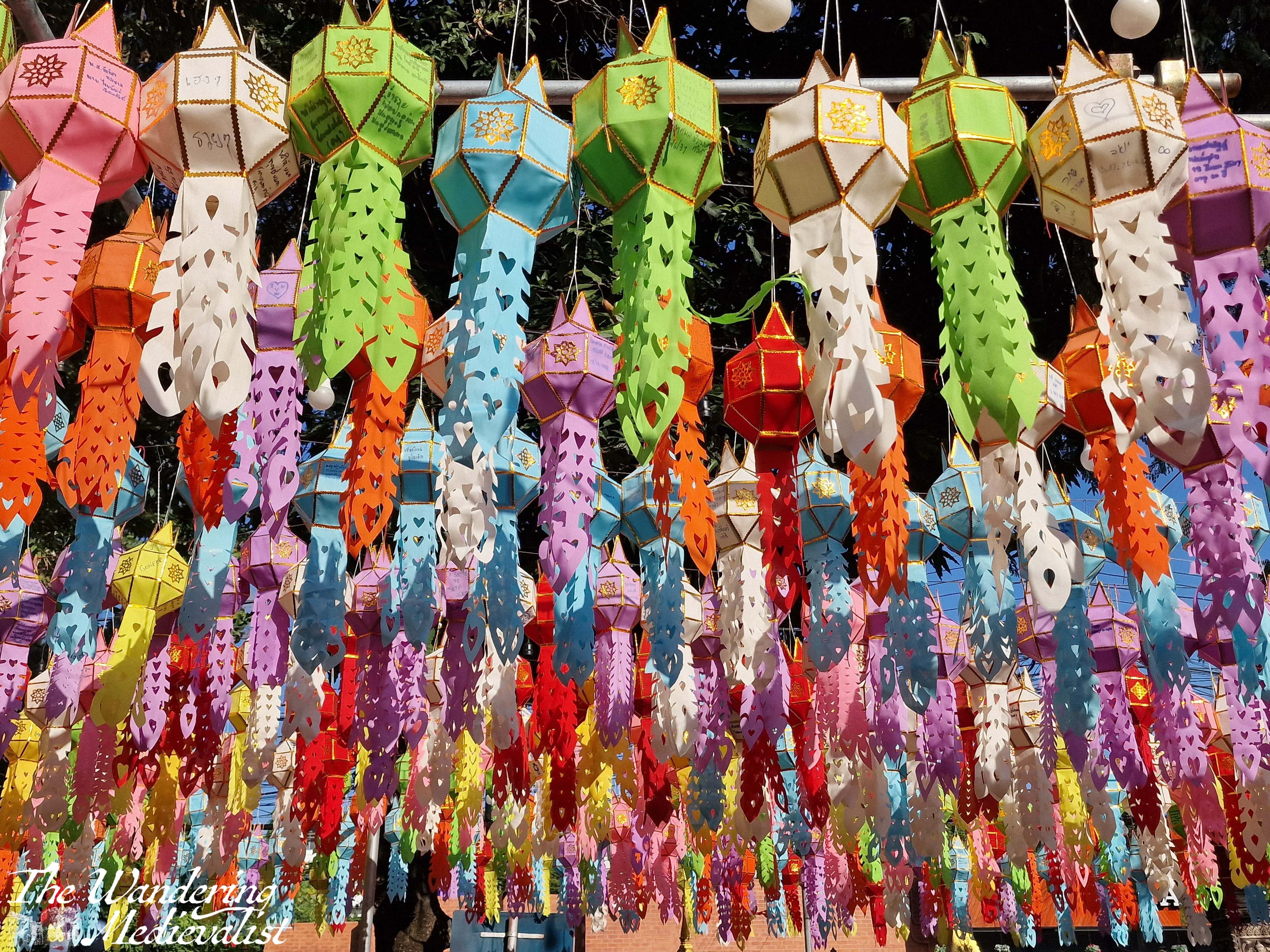
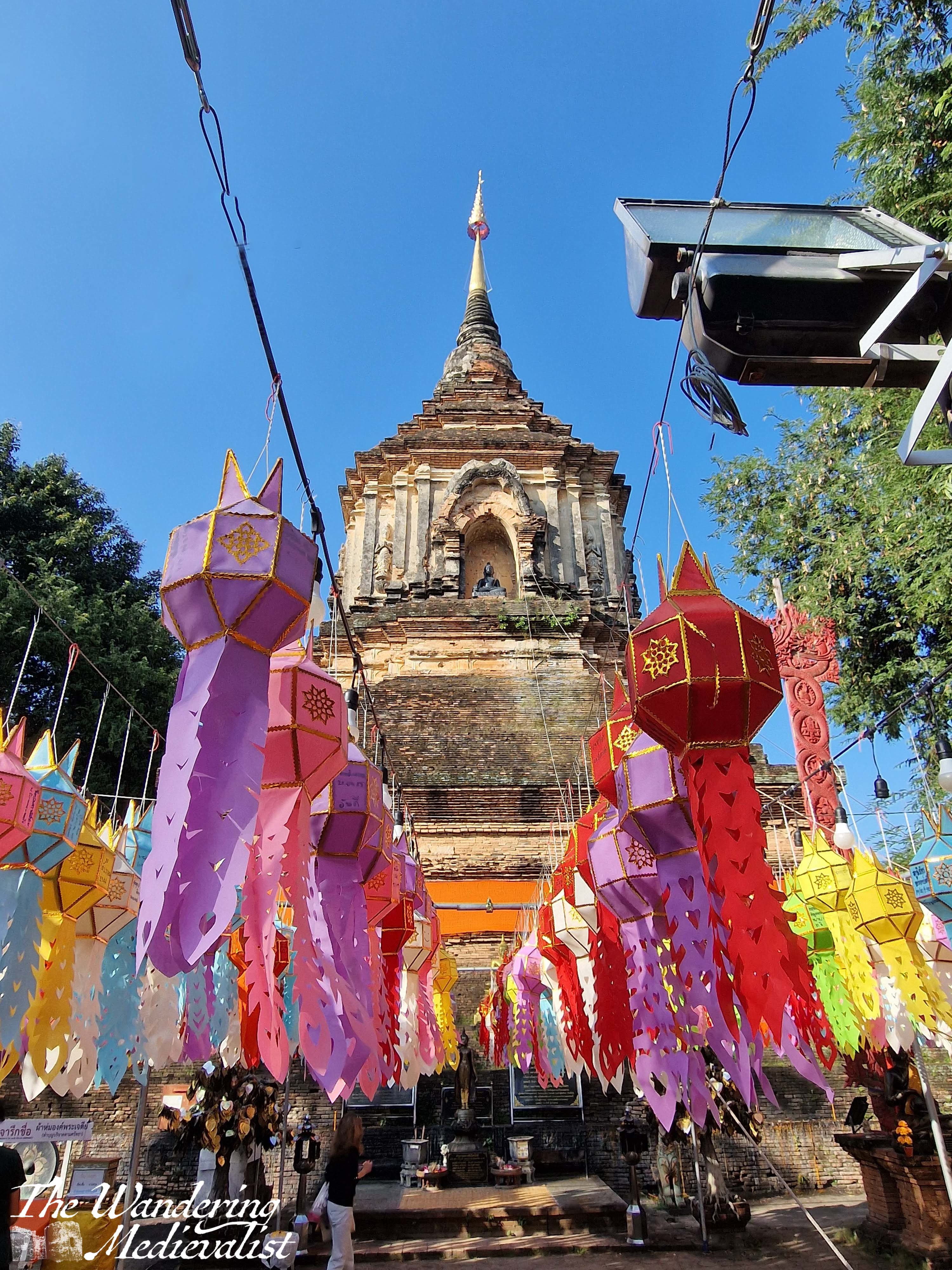
I walked around the whole Chedi and found that there were different statues on each side, plus some more shrines. If there is one thing that struck me about this temple it really was its intricacy and detail; the carving was exquisite, and each part of the complex had its own story. There were countless smaller shrines, carvings and statues to see, as well as the more open compound itself. Though it was busy with tourists, everyone was more or less quiet and respectful of the active religious site.
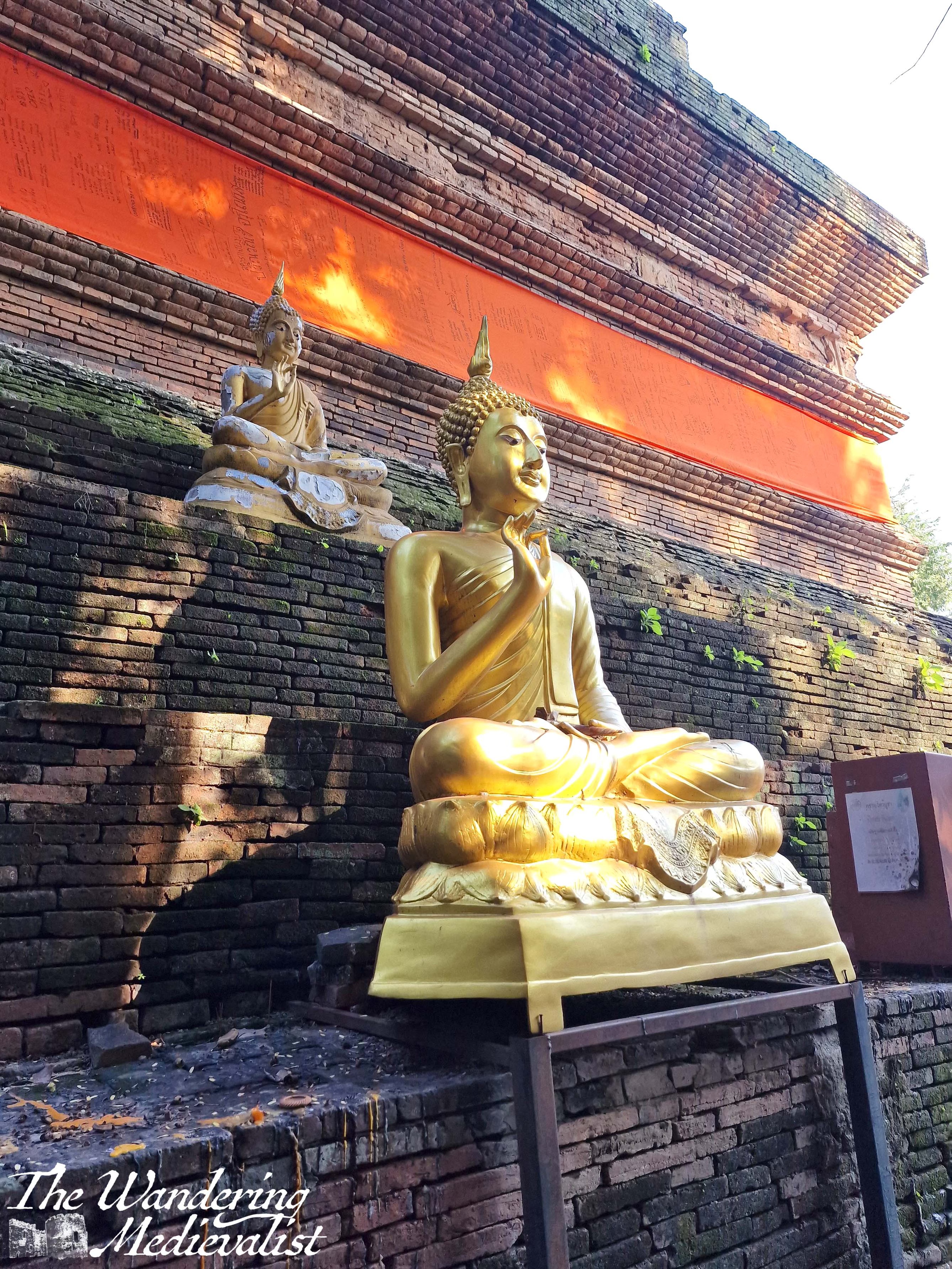


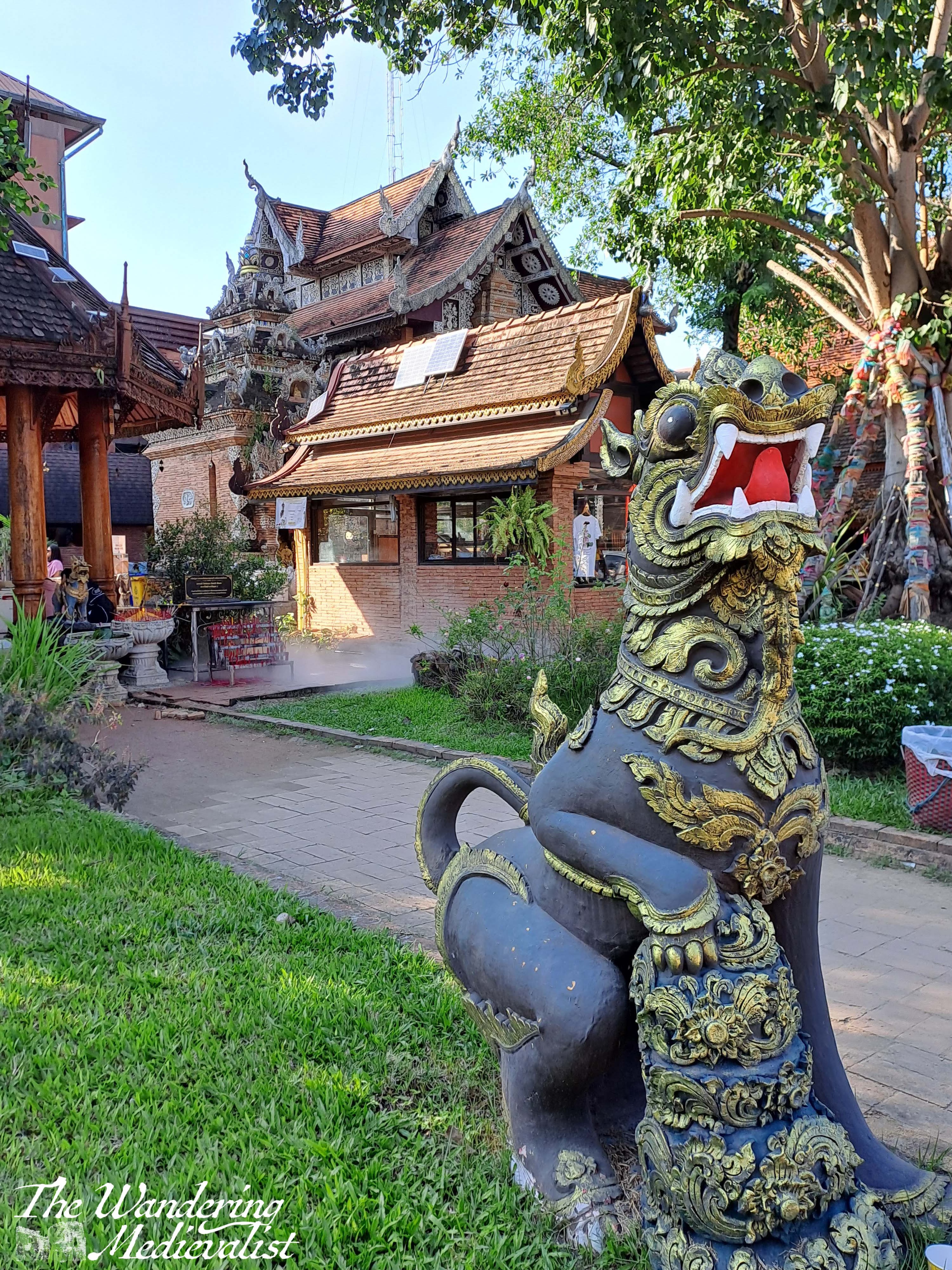
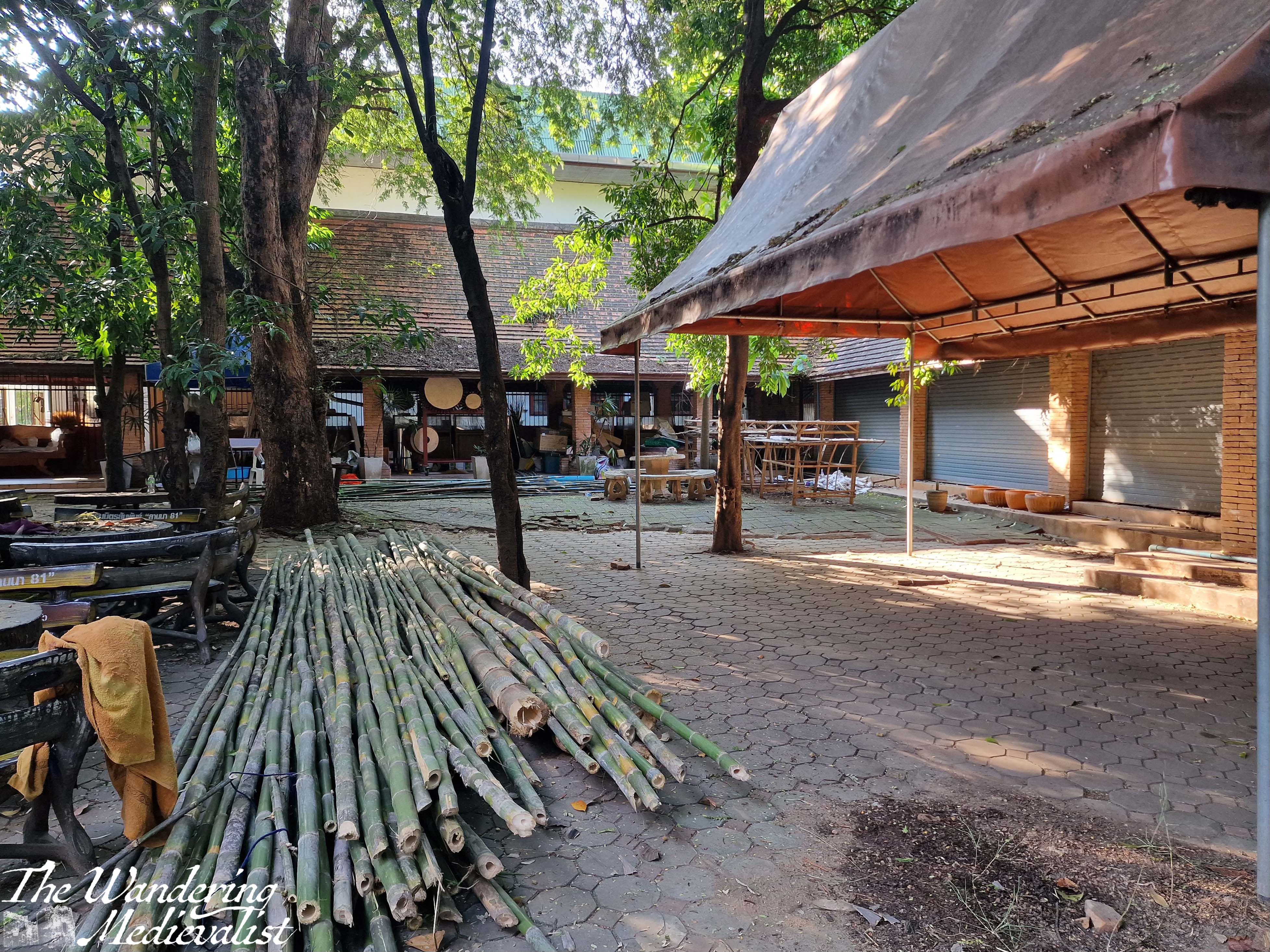
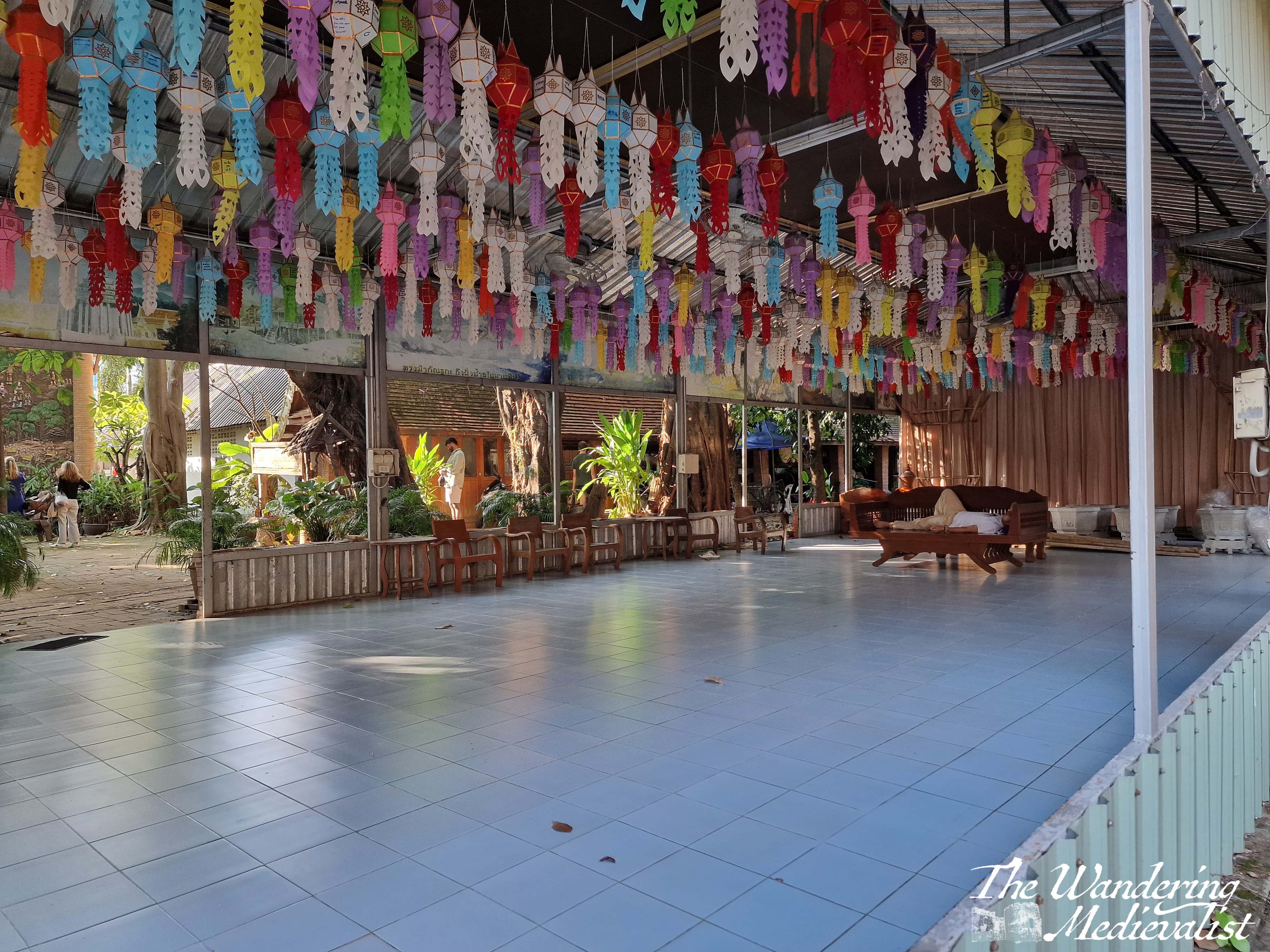
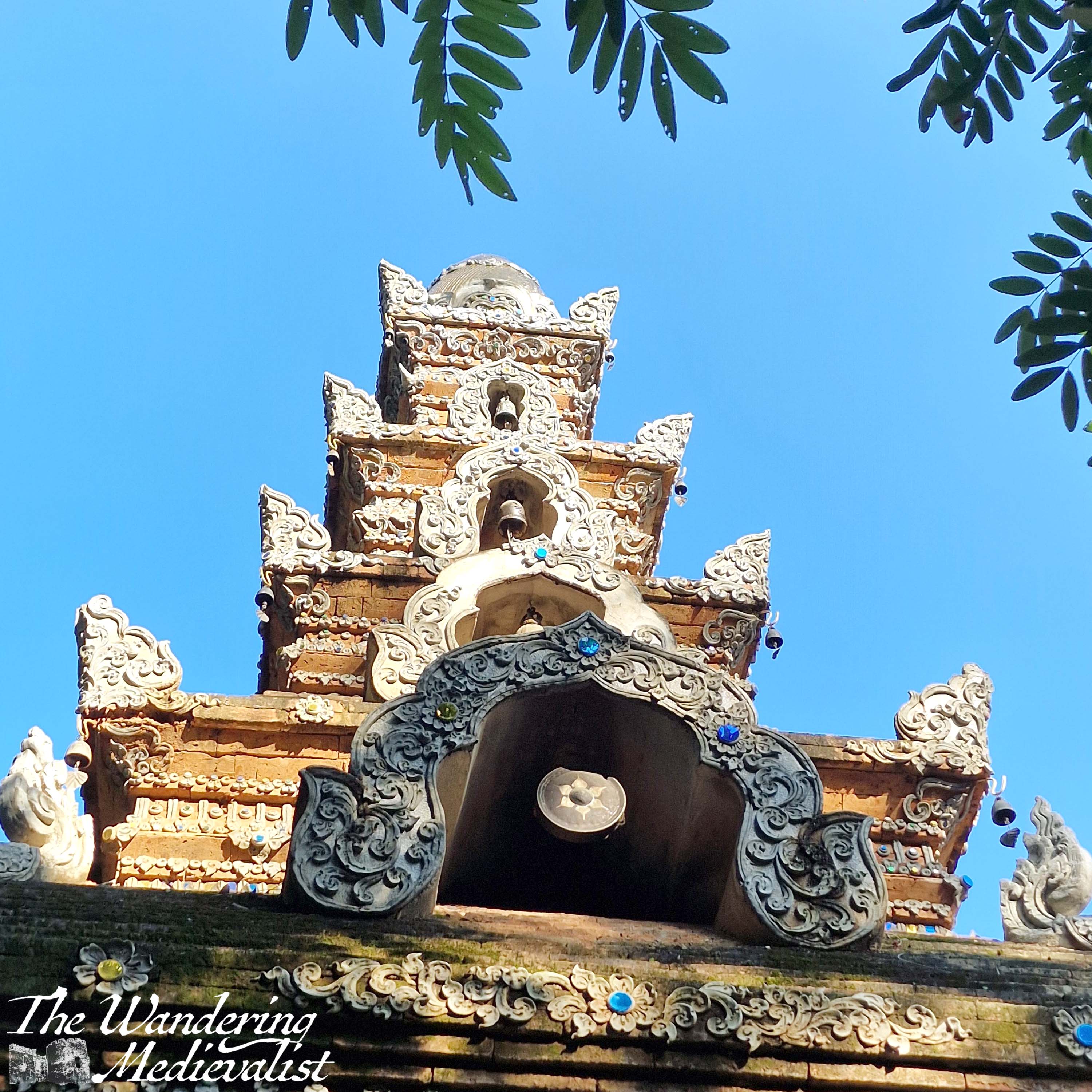

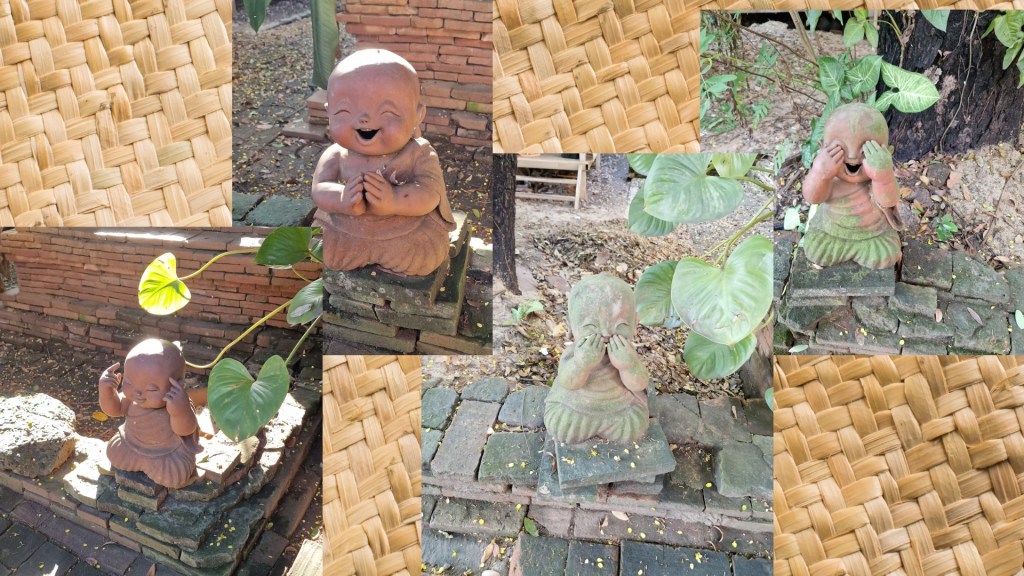

The temperature and my excitement meant that by this point, my phone was actually starting to overheat; it was time to put it in my bag, away from my body heat, and head back to the hotel. I had the route planned out, but learned before long that my idea of ‘I’ll just walk up that road’ was not as simple in Chiang Mai.
To start with, I crossed back to the moat side of the road, where there was a path along the water. Growing tree routes had forced some of the tiles to buckle upwards, meaning the walk took some attention, but the trees meant shade, which I craved. I recall thinking that in a European city there would be a fence along the water, but not here, and around the corner, the street level rose enough that there was a drop of perhaps a foot or two from the path to the moat.
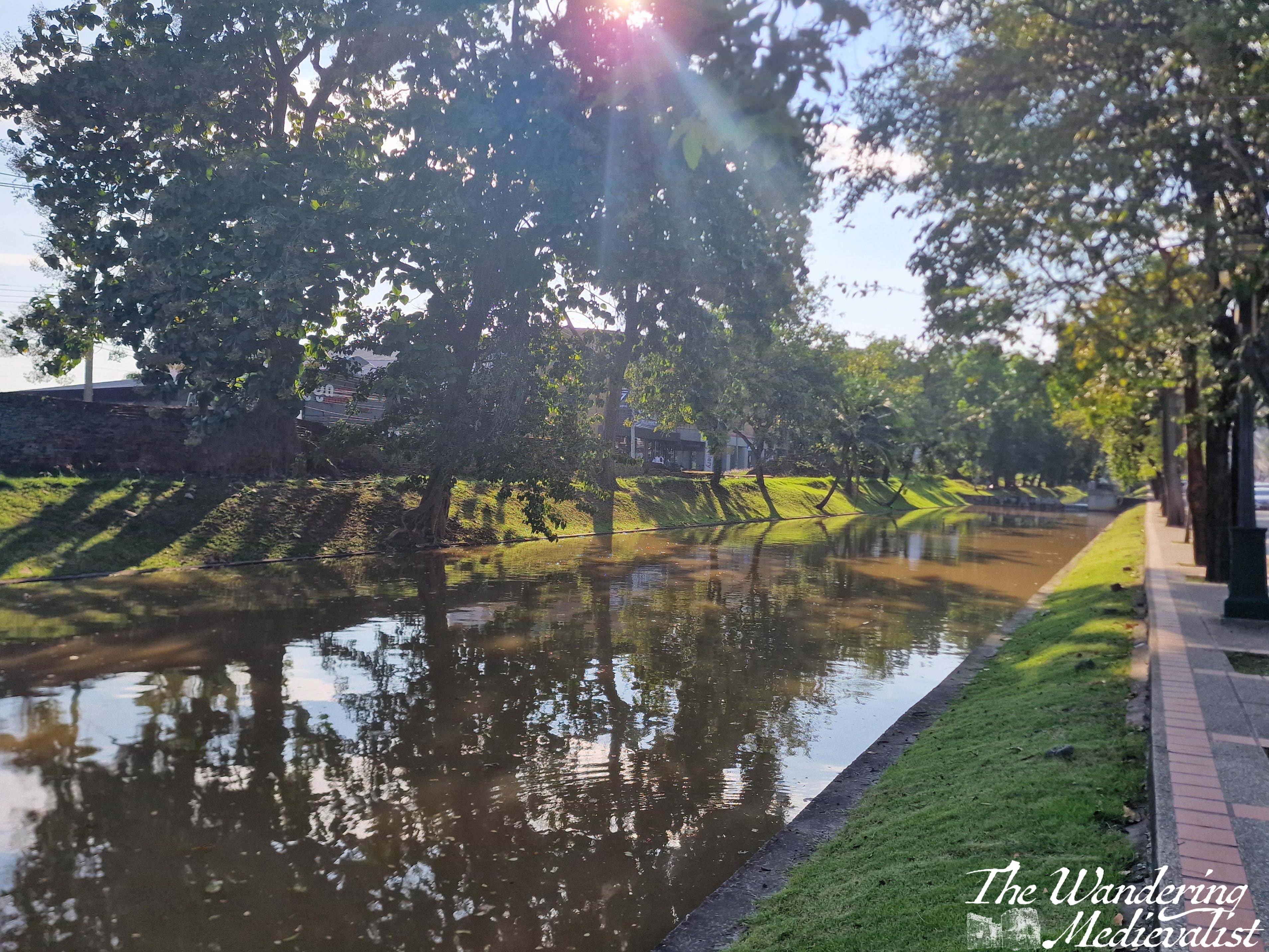

The corner, which I reached after 5-10 minutes of trying to resist taking pictures of the moat, is called Hua Lin corner. It is the location of a former aqueduct, bringing water from the Huai Kaeo brook over the moat and into the city. Today, there is a small garden and some seats where one can rest briefly, and look across the water at the remains of the city wall and bastion.
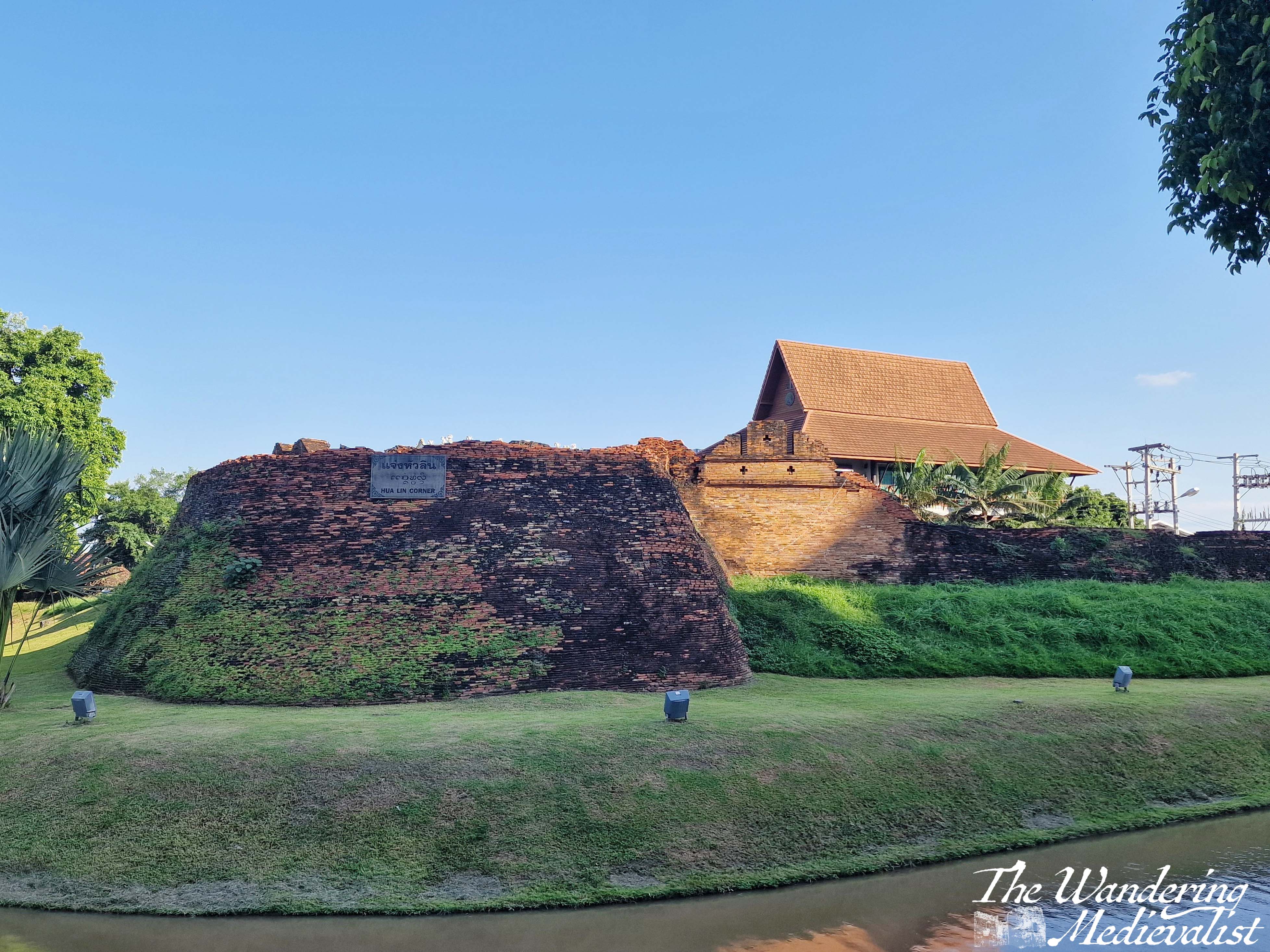
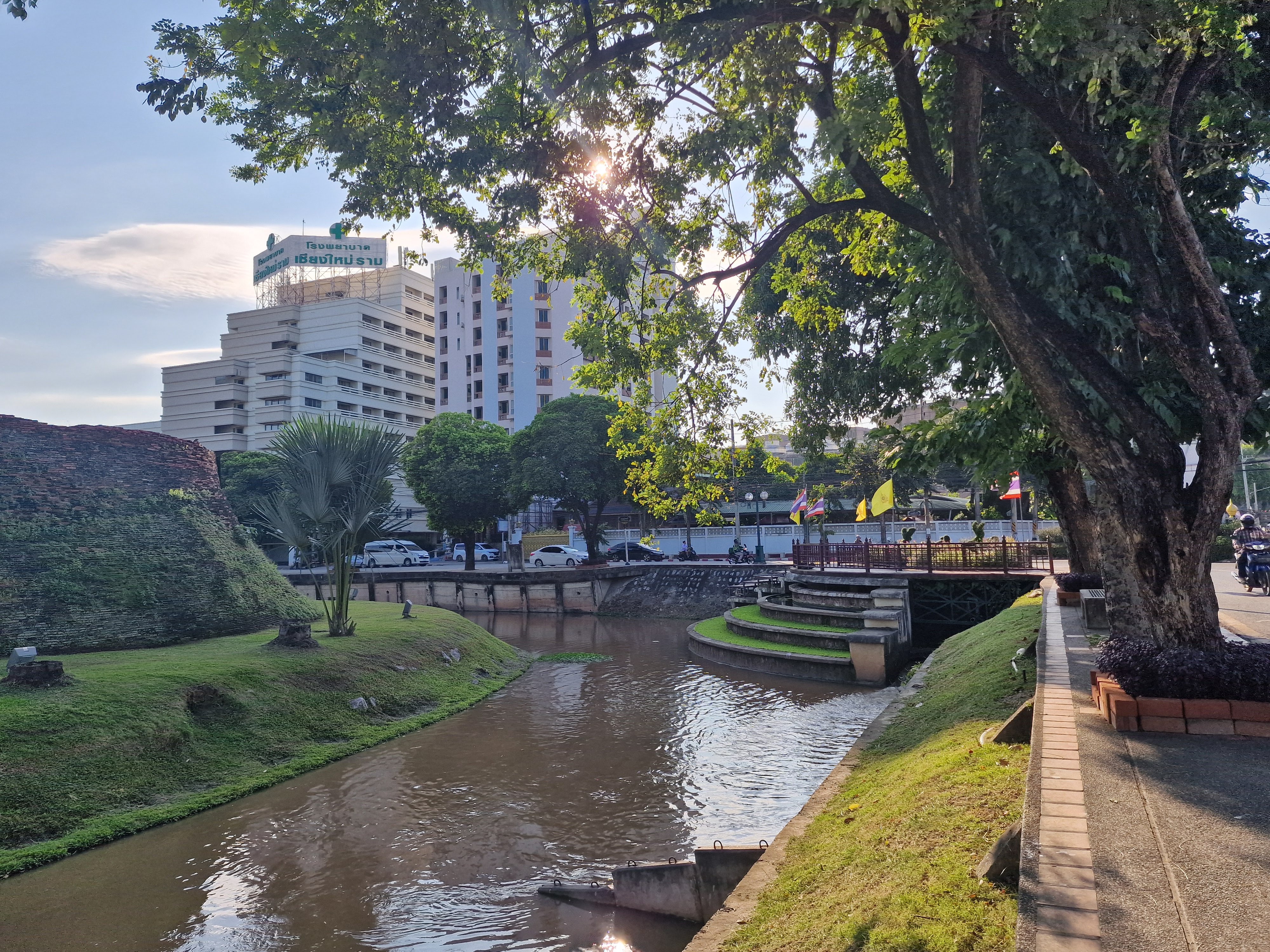
I had planned, at this corner, to cross the road and head north-west towards my hotel. Unfortunately, there was no pedestrian crossing and the traffic was coming far too quickly to try a Bostonian mad dash. I should mention that the driving in Thailand is nothing short of terrifying – the cars and mopeds are right at the edge of the road, so when you are a pedestrian they come within inches, or closer, of clipping you. The ring road that runs around the moat is several lanes in either direction, with cars speeding confidently along. So, I turned left along the moat and figured I would find a place before too long to cross. I was incorrect.
It was the better part of ten minutes that I walked along, enjoying the water lillies that were omnipresent in this part of the moat, and getting warmer as I went – and thirstier. I had water with me but it was almost hot enough to make tea after my hour or so walking around, and I was watching Google maps trying to work out a different route back to my hotel than I had planned. The further I walked – in the wrong direction – the longer I would spend in the sun and heat, in a city where most people clearly did not walk. So I did the next most sensible thing.

I gave up.
There was eventually a pedestrian crossing which allowed me to get across to the far side of the road, and I turned back the way I had come, only to discover that the sidewalk vanished. There was absolutely no safety in walking along the road, but there was a haven where I could wait in the cool, drink some iced tea, and call for a Grab – Starbucks!
I am not proud of reverting to an American stereotype, but it certainly worked. Half an hour later, I was back in my hotel enjoying a shower and two bottles of nice chilled water.

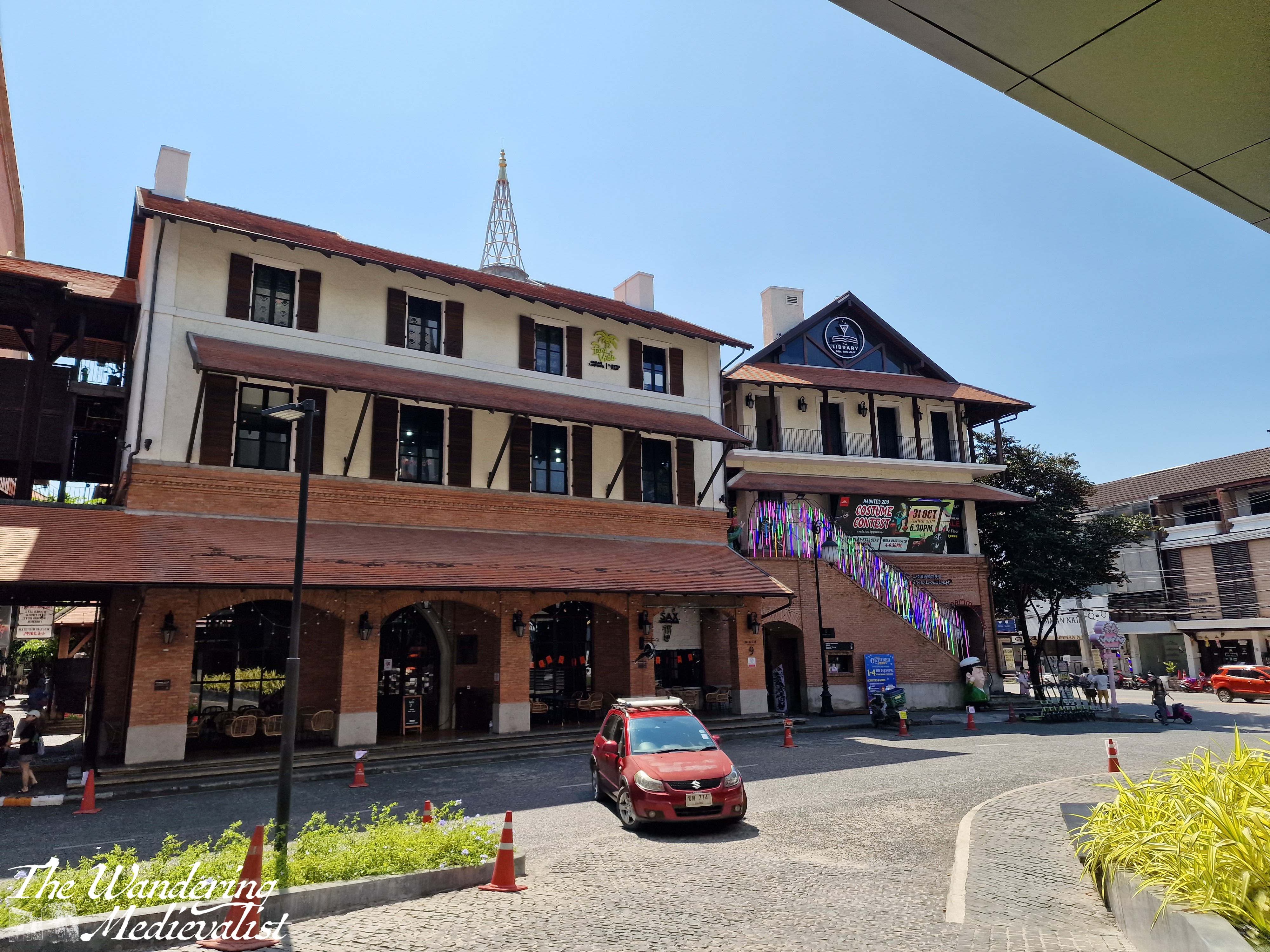
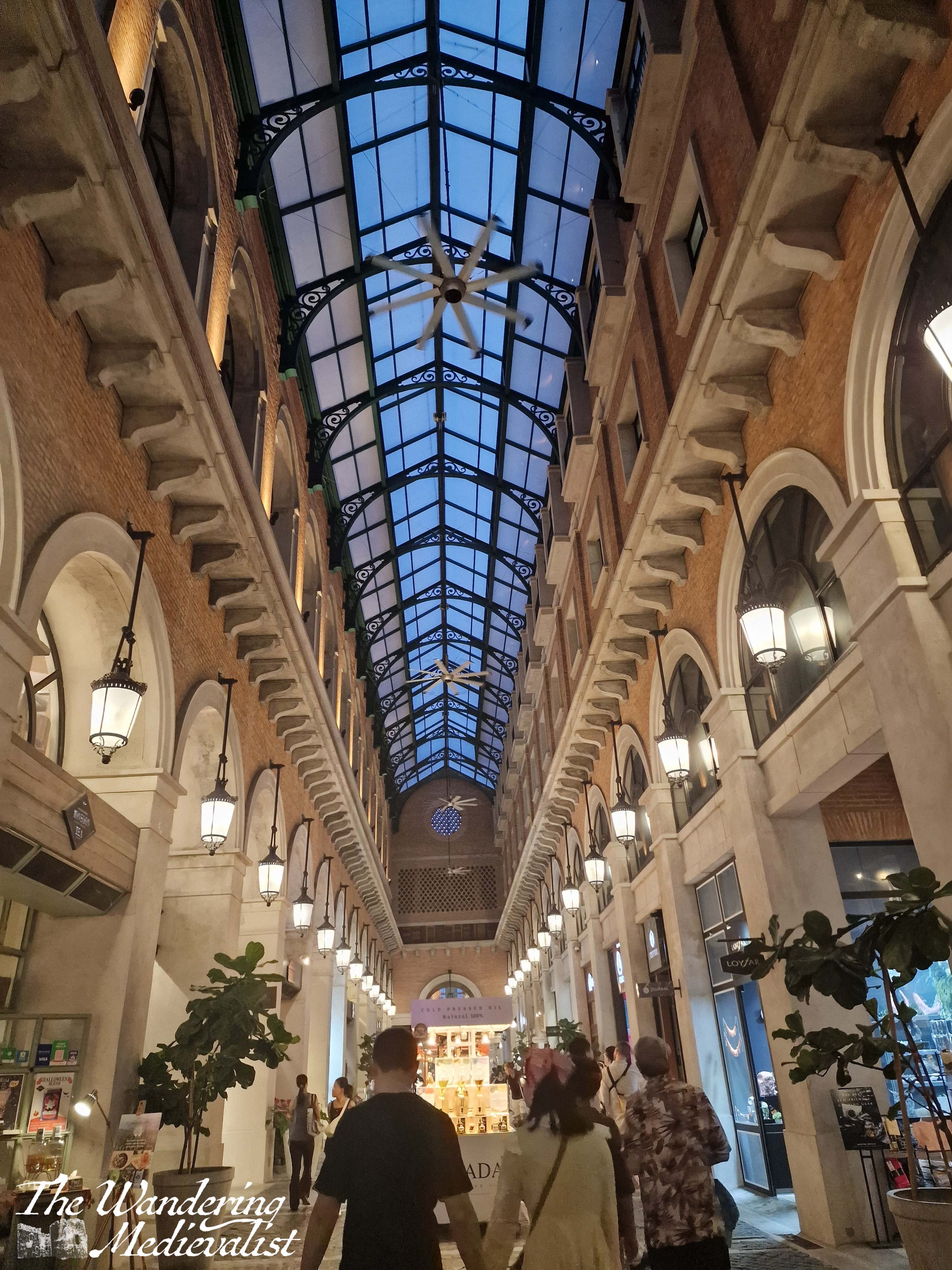
My final exploration of Chiang Mai was investigating One Nimman, the shopping centre across from the hotel. It reminded me slightly of Quincy Market in Boston in terms of architecture, and the shops were perfectly touristy, just what I needed to round out my Thailand gifts for home. The central square was a large open air street food market, while around the edges of the complex were a series of craft stalls. Clearly a high-end market area, One Nimman also offered plenty of health-related shops where wellness was a priority – massage, facials, and much more.
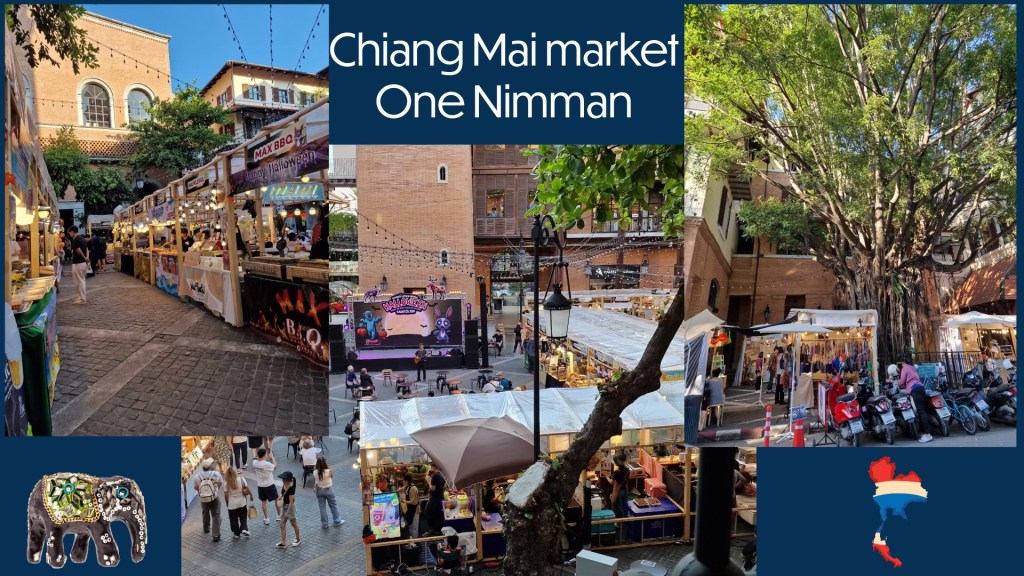
It was a fleeting time in Chiang Mai, but I have determined I will go back – with my proper camera and a plan to visit the mountain temples and the elephant sanctuary. So much still to see! The people were very friendly and while there are certainly western tourists present, there were plenty of more local visitors as well, providing a really pleasant atmosphere. I feel like I have only scratched the surface of what there is to see here. But, it was the end of a long month of travel and I was ready to head back home, flying Chiang Mai to Bangkok to Doha to the UK.

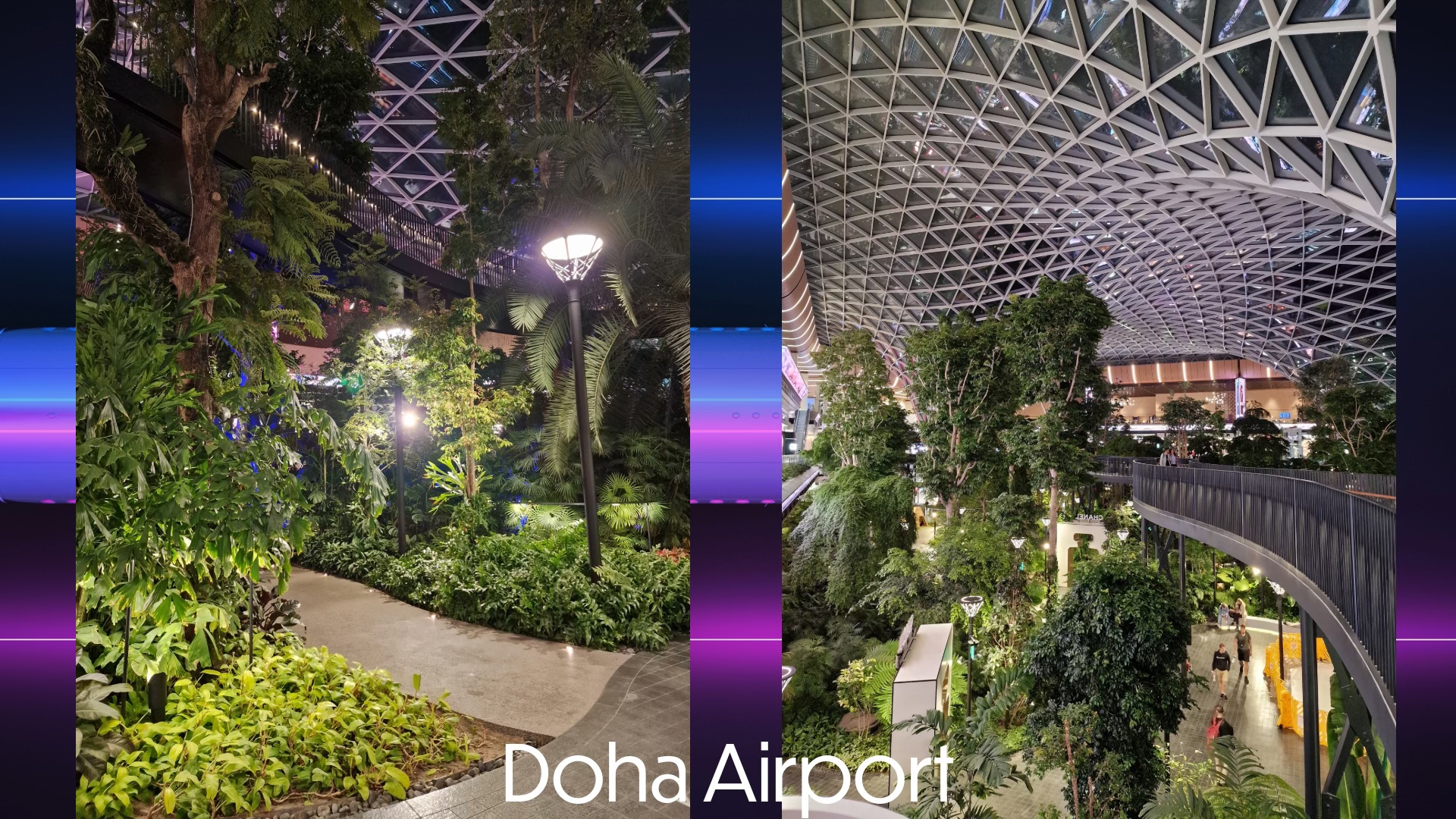
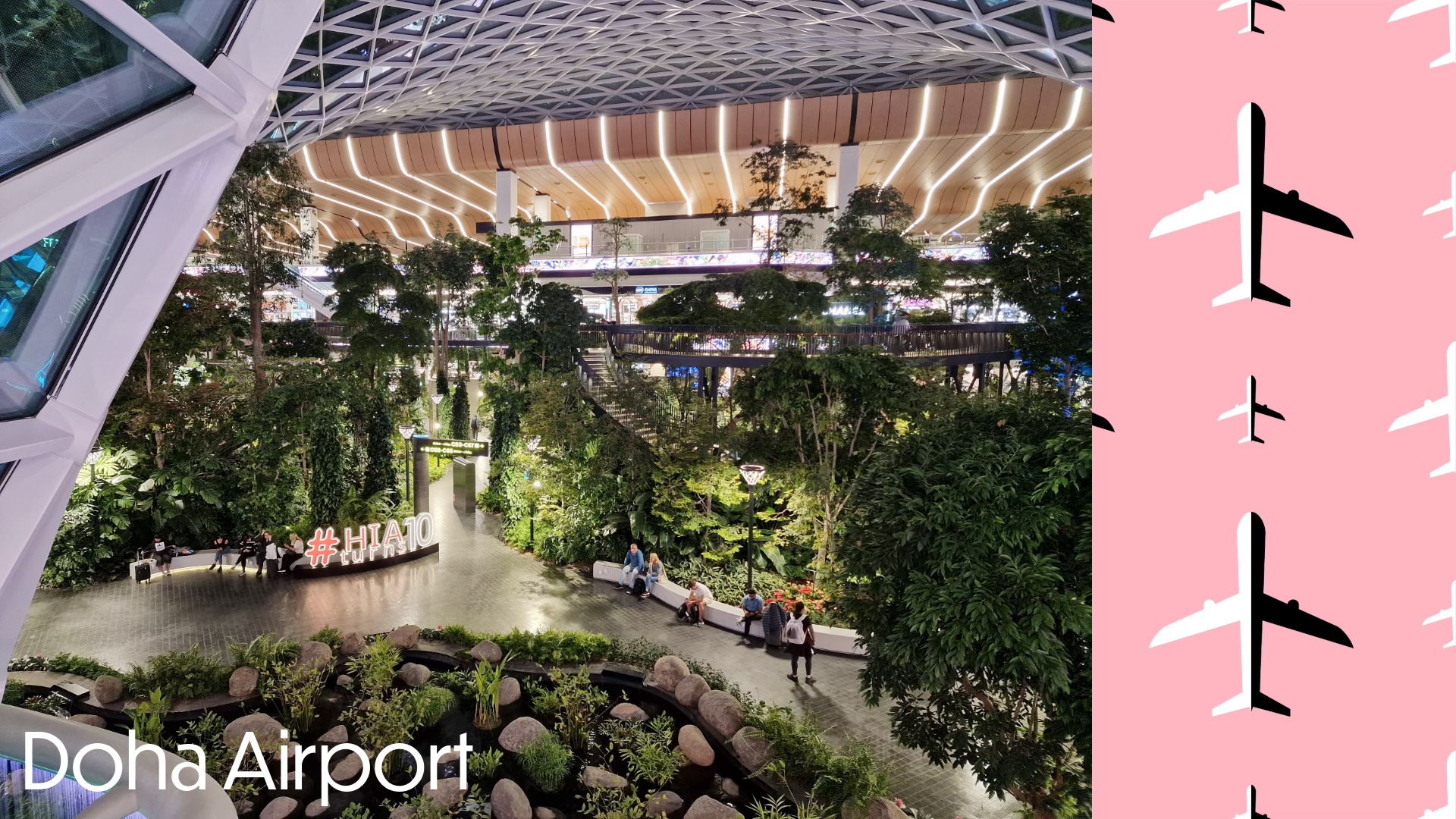
It was the middle of the night when I passed through Doha, but I was happy to have a travelling companion who I had met in Bangkok, worked in the same field, and had the same flights booked home. Together we were determined to see the famed indoor tropical garden of Hamad International Airport, Orchard. So we walked for what felt like hours but was about 20 minutes, and were delighted to find ourselves entirely un-disappointed. Orchard is not particularly large but it is markedly cooler than anywhere else, with the foliage providing a fresh feel to the air, and a palpable sense of relaxation. Particularly in the middle of the night, it was so relaxing to stroll along the paths and find a place to sit and relax. If anyone is passing through and have the time, I would absolutely recommend making the detour to see this indoor wonder.

Words cannot express how fortunate I feel to have been able to take this trip, and experience a part of the world I had never seen before. It has opened up my travel horizons much further, and I hope that the next time I return it is either not for work, or I can take more time to enjoy it. And that I am a bit less asleep…
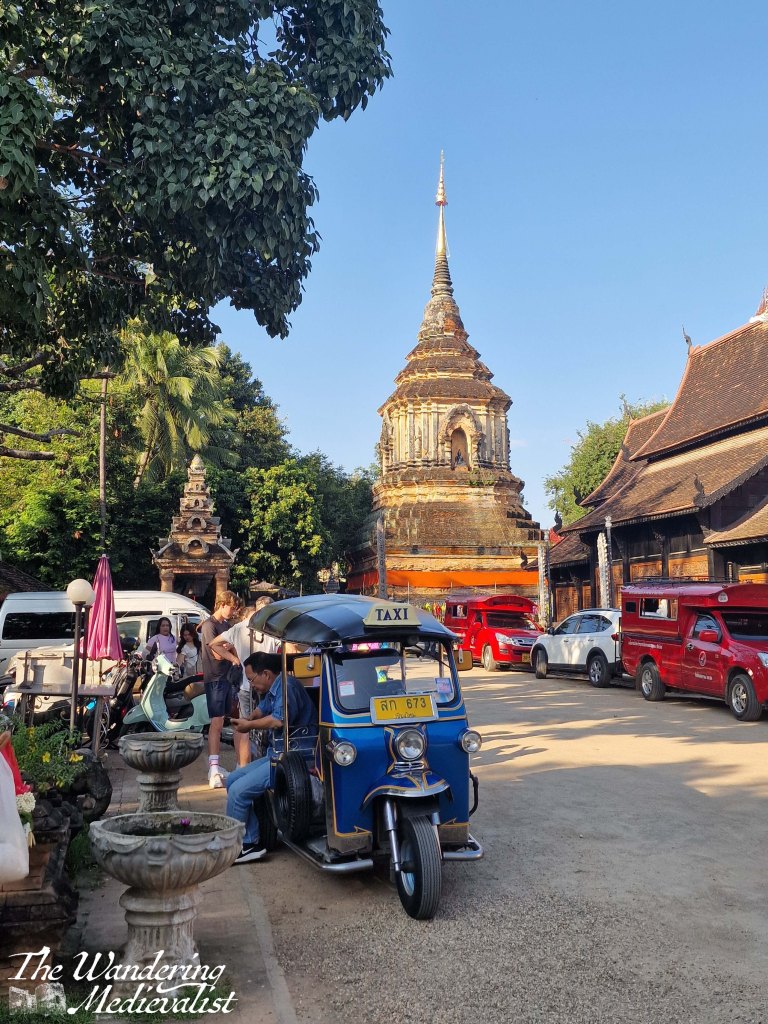
Finally, I leave you with my favourite picture from Thailand, a combination of modern and medieval that I just love:
 The Wandering Medievalist