Work has taken me back to southern California this month, and after a week of travel starting in Pasadena, heading out to Riverside and then finally down to Santa Ana, I was able to settle into one place for the rest of my time here. And so lucky I am, that the place is Orange County!
On Valentine’s Day – not because it was, but because it was a lovely day and my most likely day of rest during this trip – I decided to explore a new part of the coast. Recent rainfall meant that I could not hike in the hills as I hoped and so I did some investigation and eventually decide upon a parking spot along the coast, ten or so minutes from Laguna Beach, which I had so enjoyed visiting last year.
Fortunately the drive was only about 20 minutes, and so I got going relatively early in the day and was happy to find that there were plenty of spots available. The parking is run by the state, and so was even more pricey than my visit to Laguna Beach – $15, though this was for a day pass. The pay system is a very simple QR code scan and pay – much better than the cash boxes I’ve seen elsewhere (*cough* New England).
And, after all, this is Orange County.
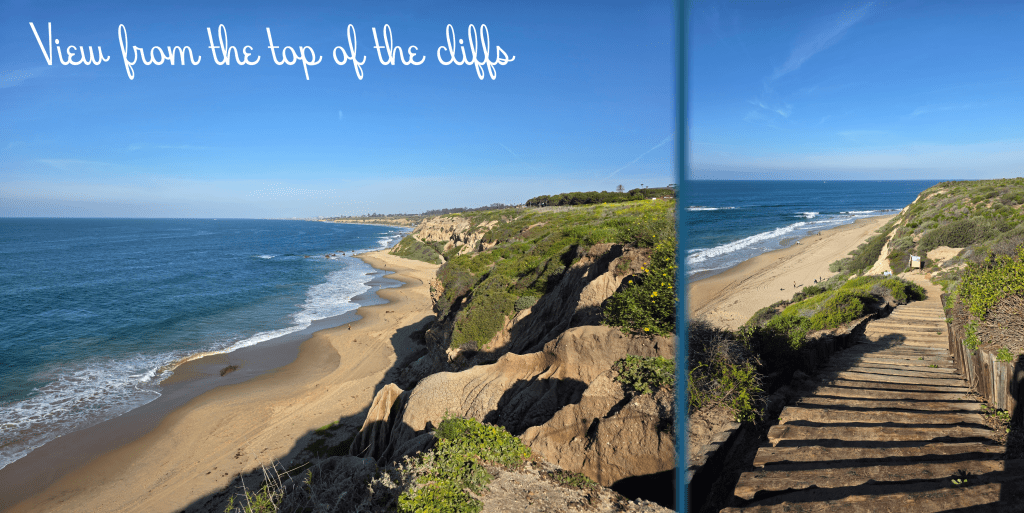
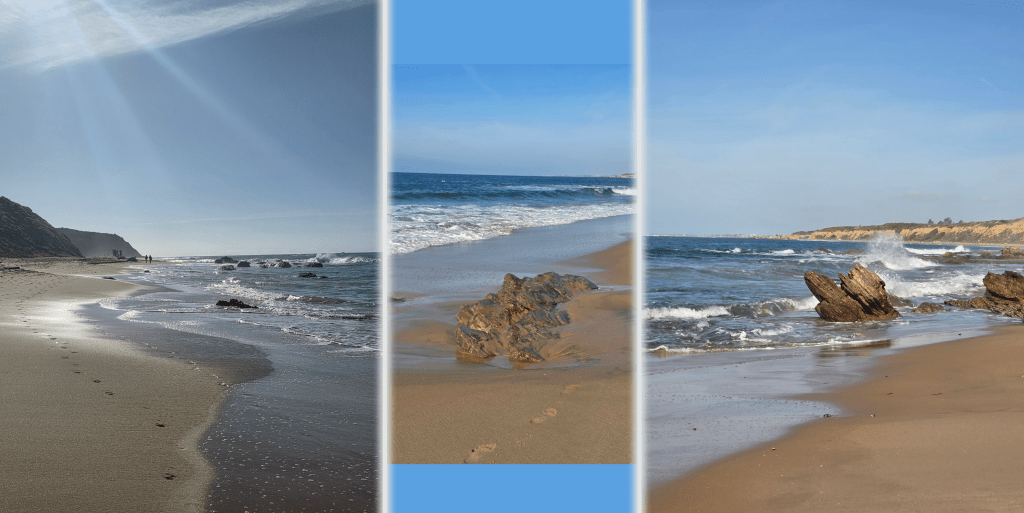
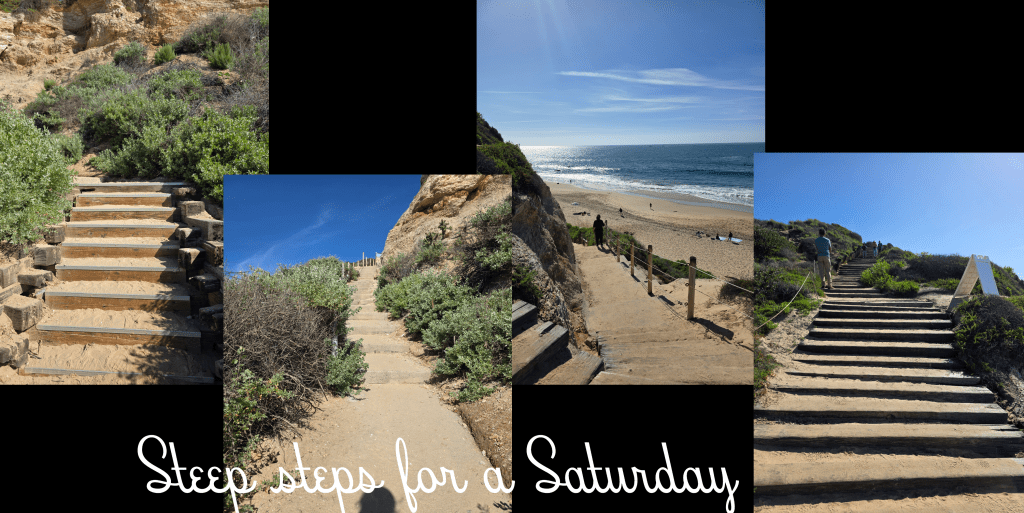
My first dilemma, after payment, was which way to go. My breath had been stolen while I drove by the day before by the stunning Abalone Point, but I was really curious to explore the area that was called ‘Historic’ Crystal Cove, which popped up top of my Google for short walks in Orange County. So, after a touch of meandering, I found myself at the top of the cliffs with a long flight of steps before me, leading down to the beach. The view behind me was hazy as it looked directly into the sun, but ahead of me was the stunning blue water and sky I had come to expect from this area.
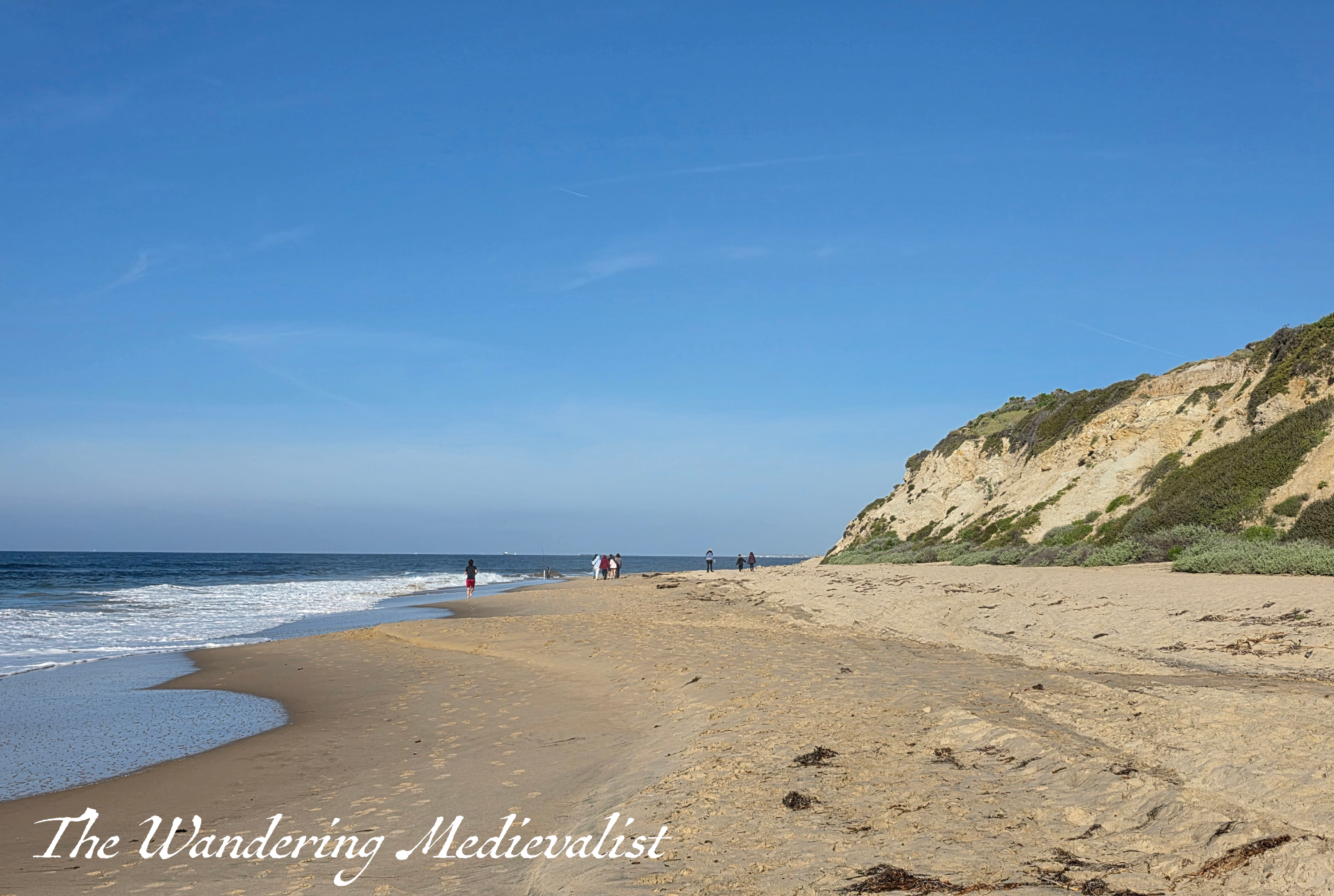
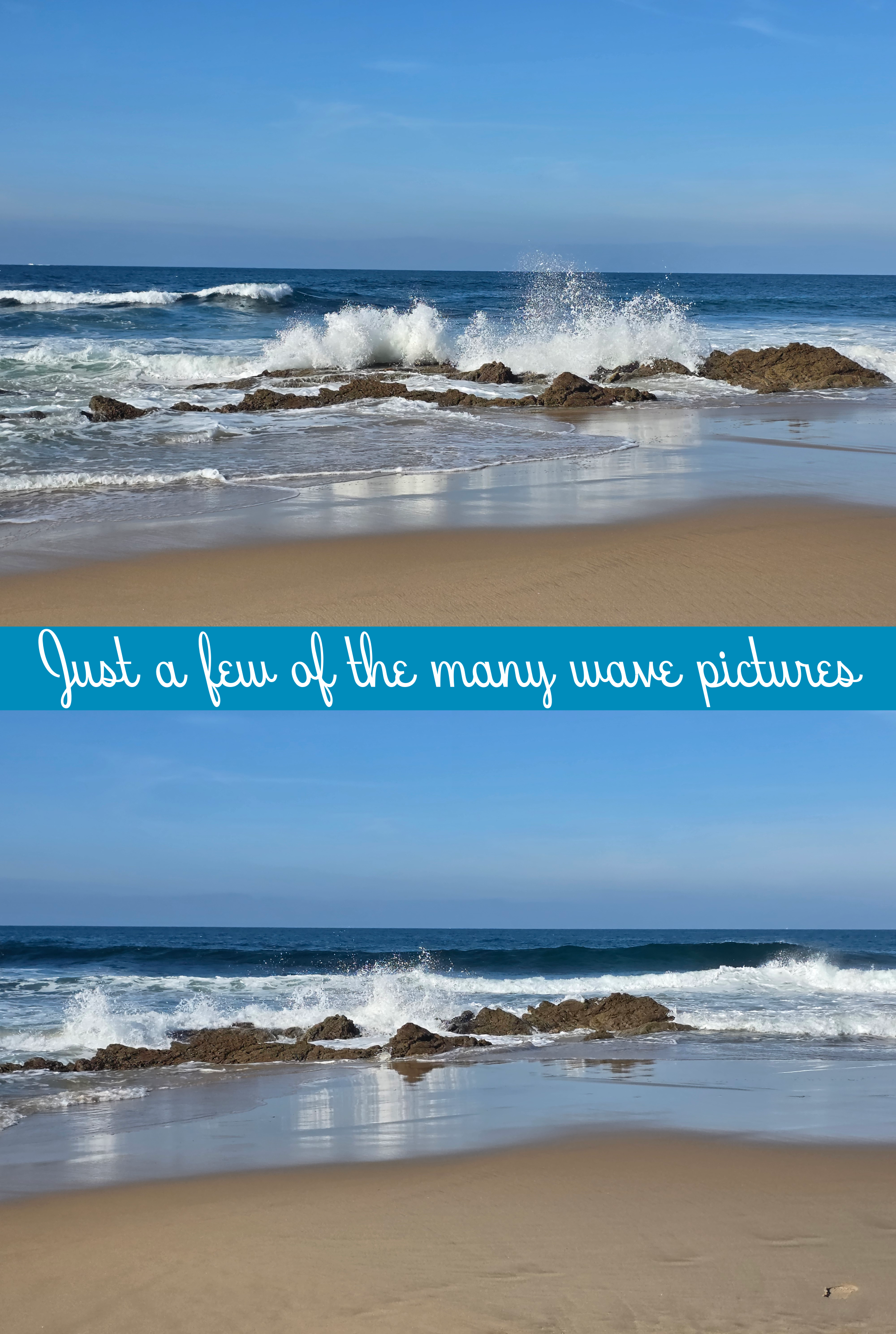
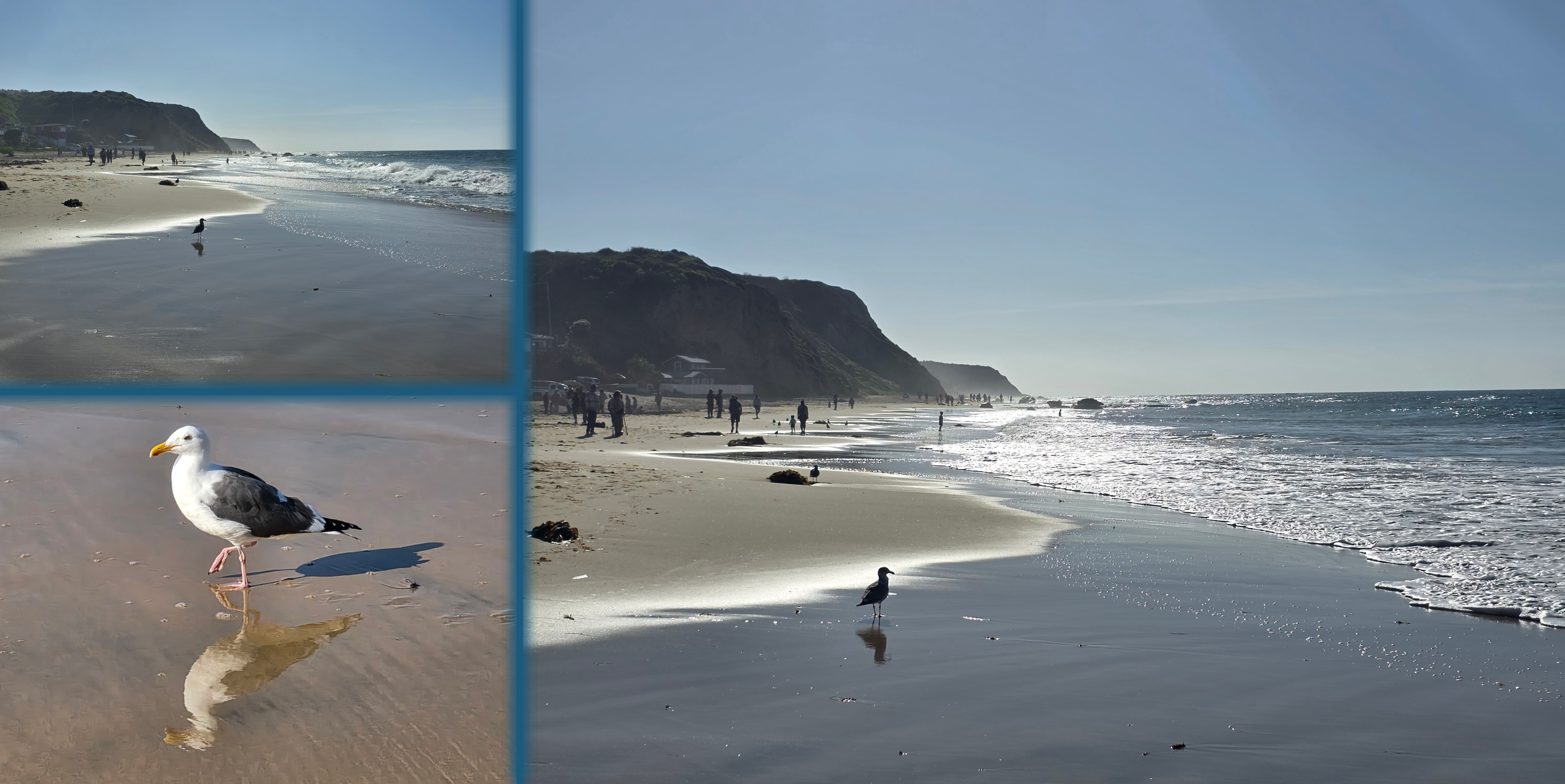
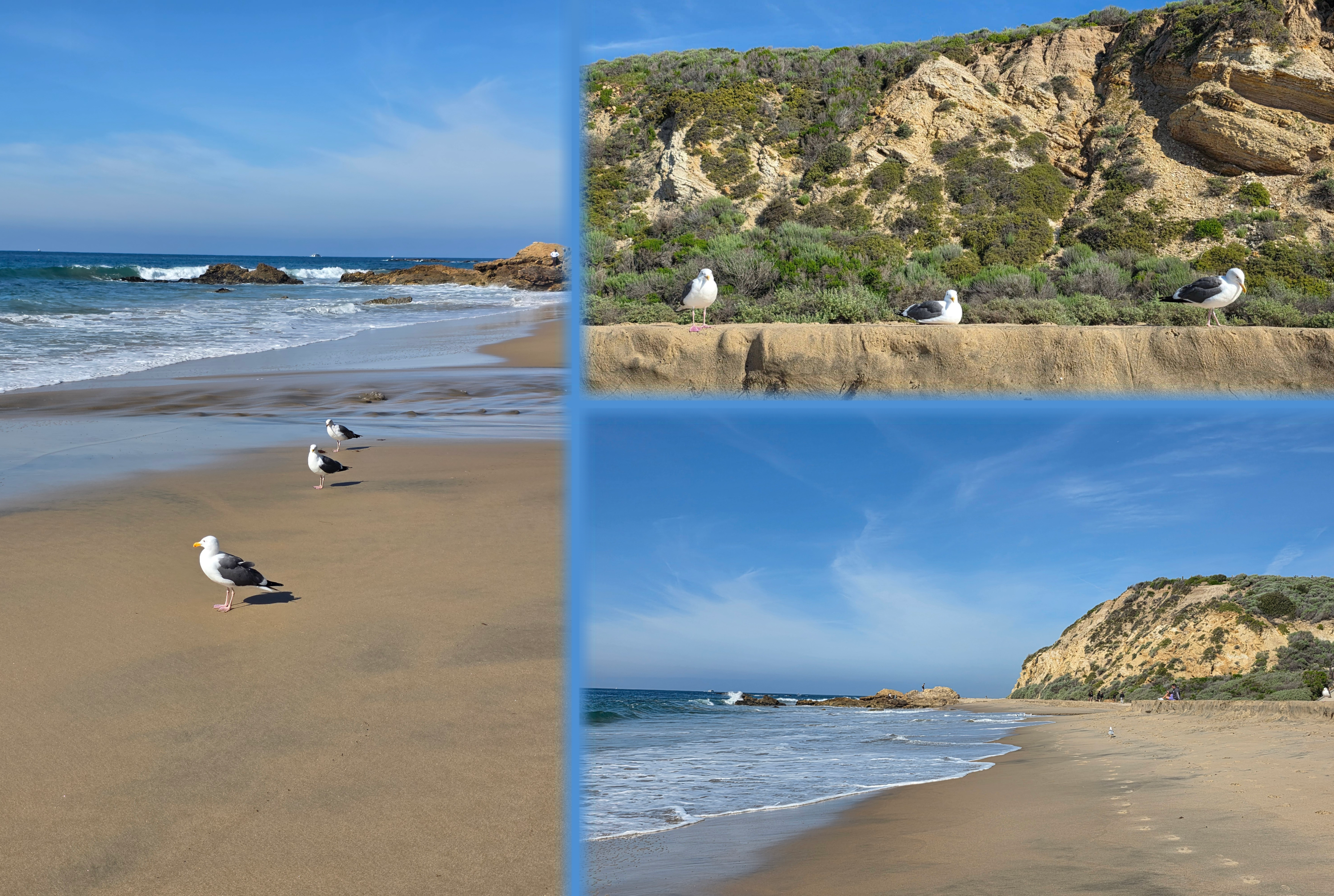
I imagine that we were at about mid-tide, perhaps on the high side, but there was plenty of firm wet sand to walk on, and the waves were constant but not too threatening. As always, I struggled against the urge to just sit and record the crashing surf, the stunning colours and shapes, the dramatic splash when a bigger wave hit the rocks.
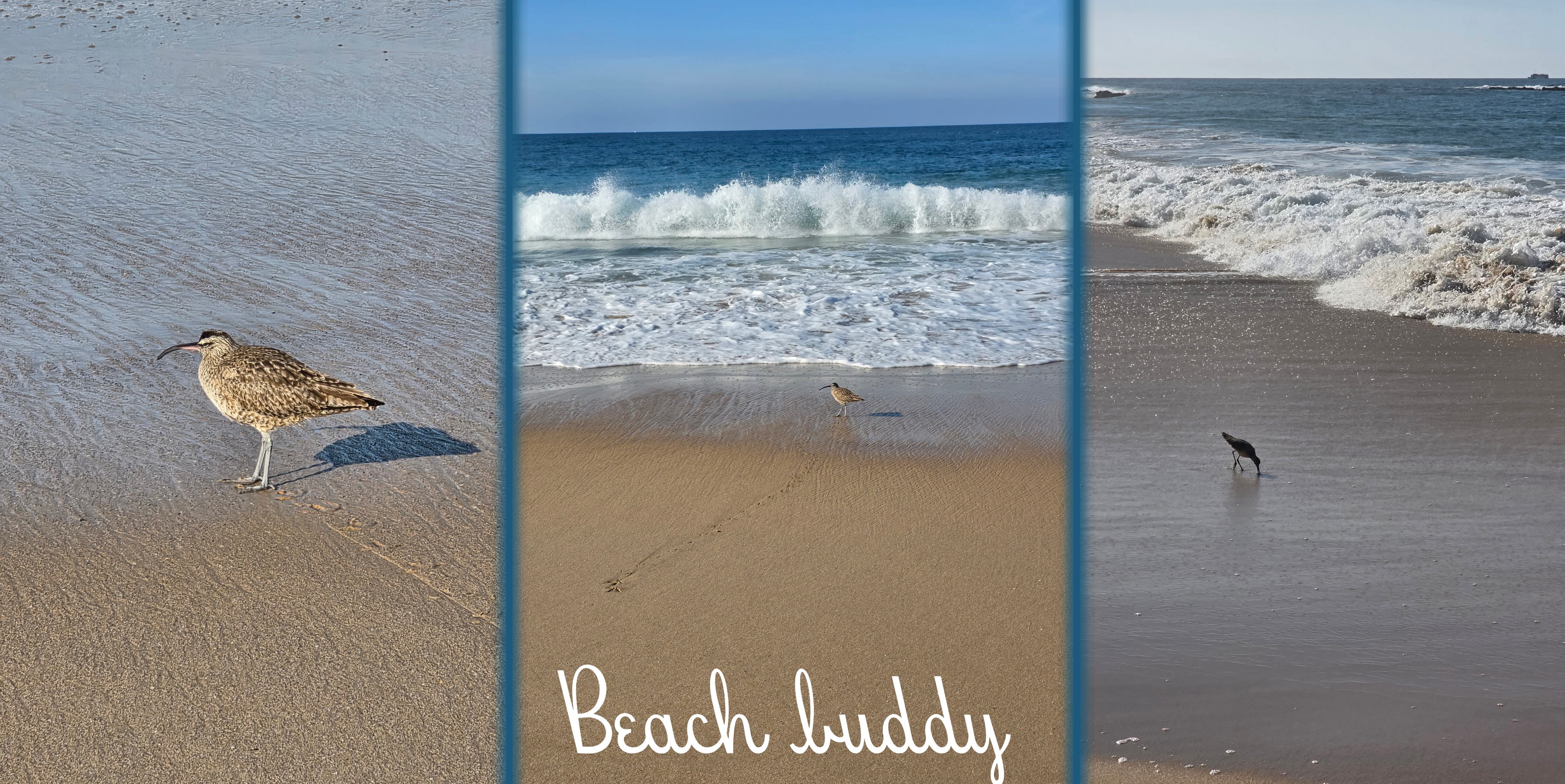
I did pause briefly when I met a few very brave sea birds, who were so unbothered by me that I could get quite close.
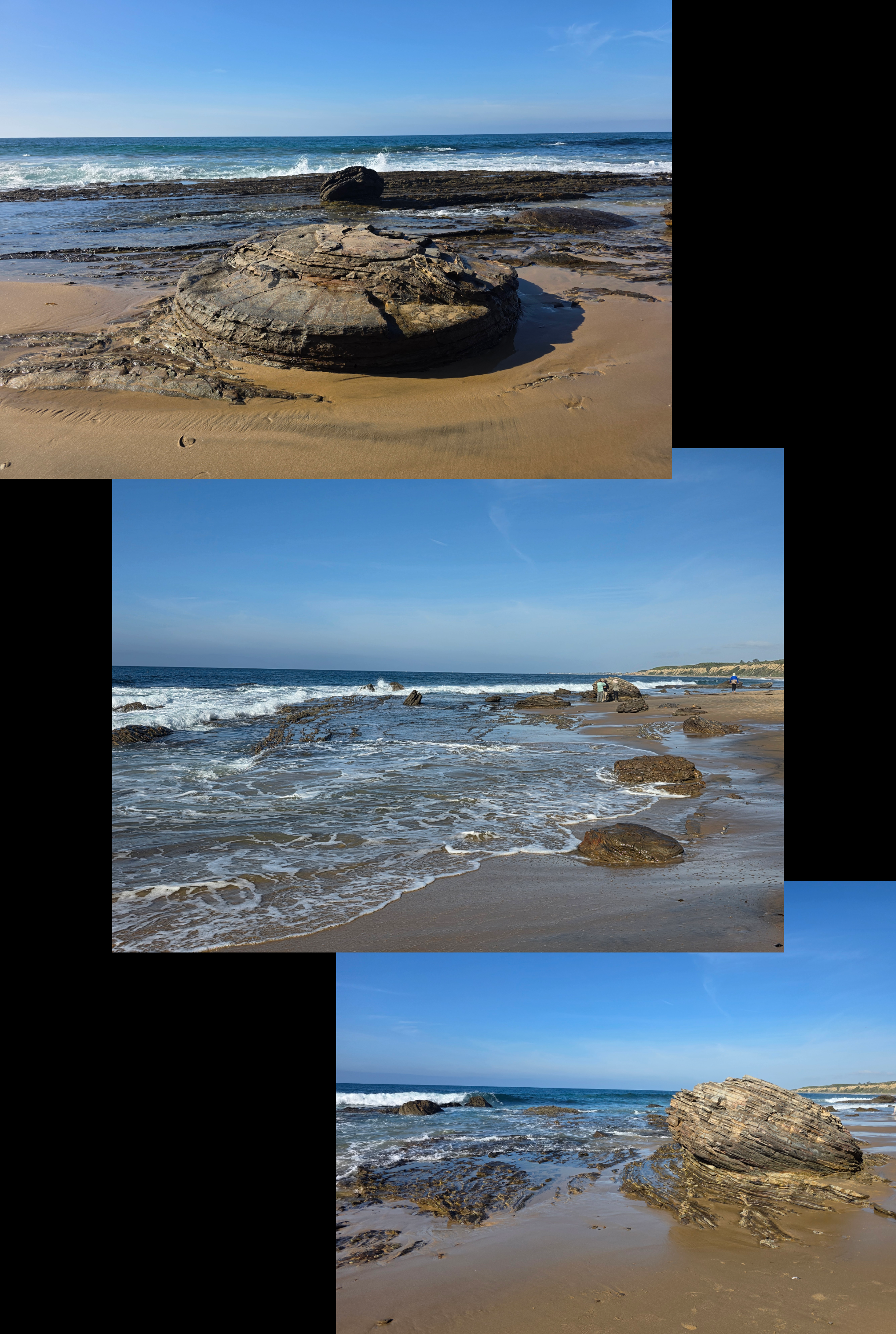
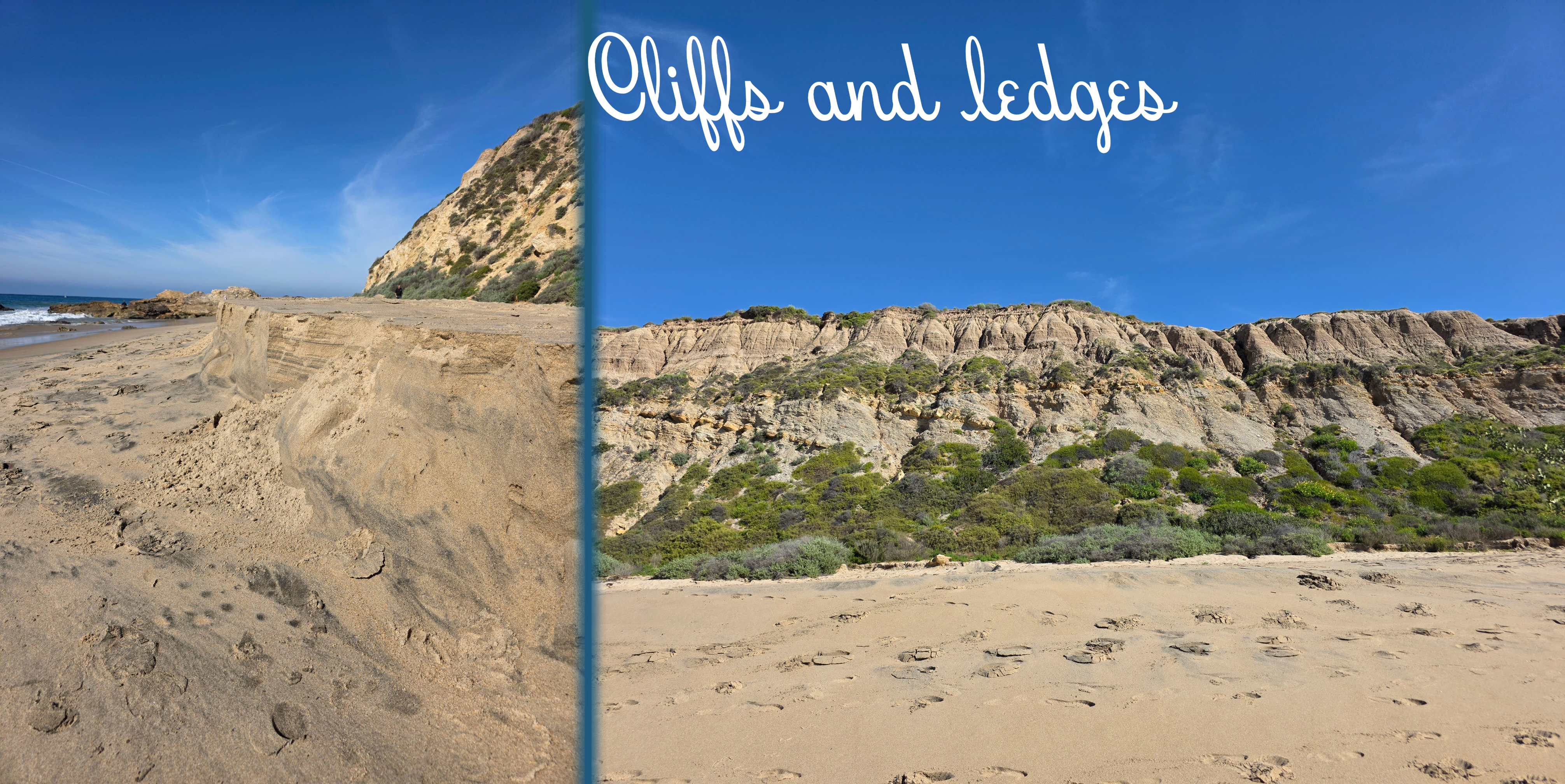
Like in parts of Fife, the sandy beach was broken in places by impressive rock formations, slicing upwards.
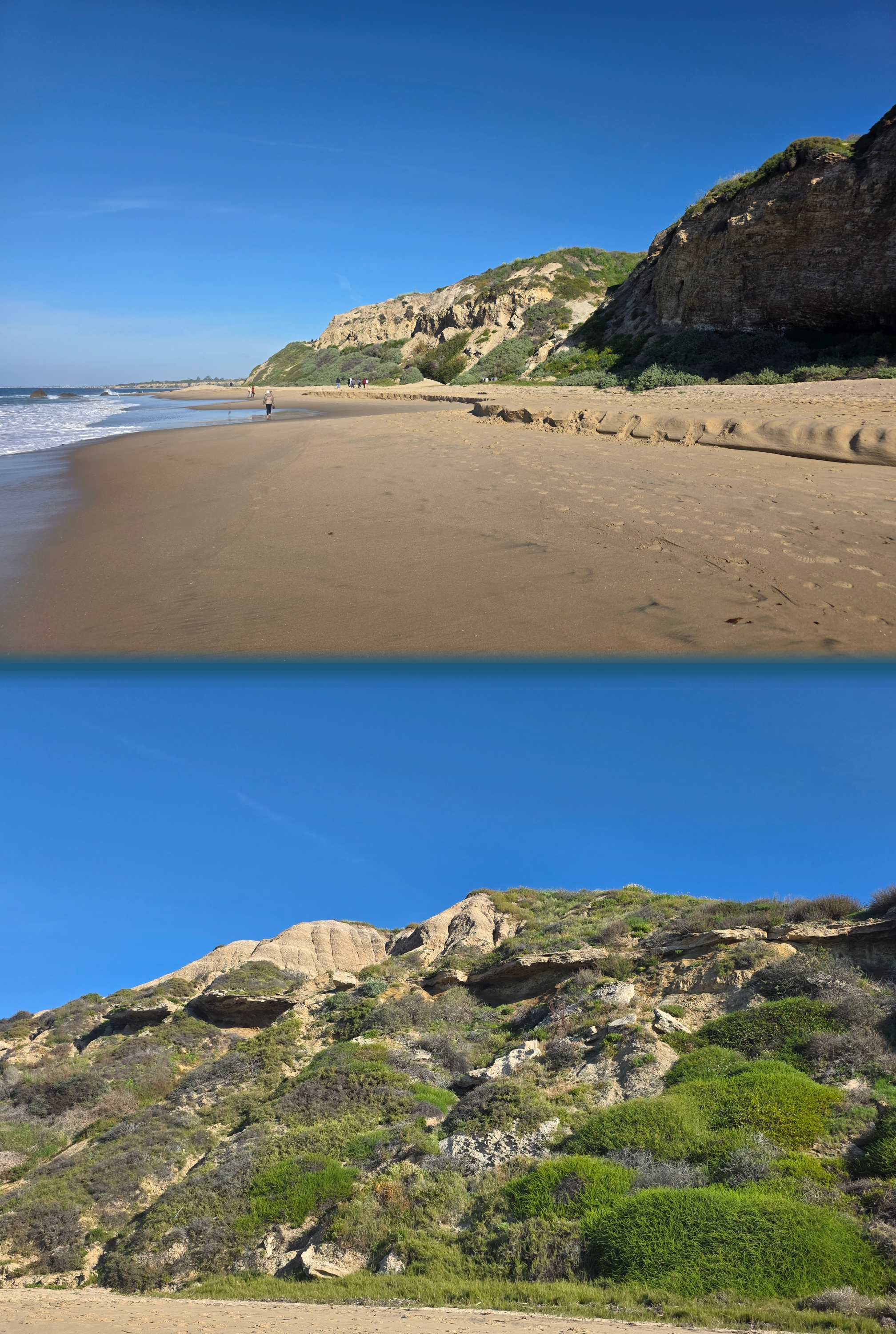
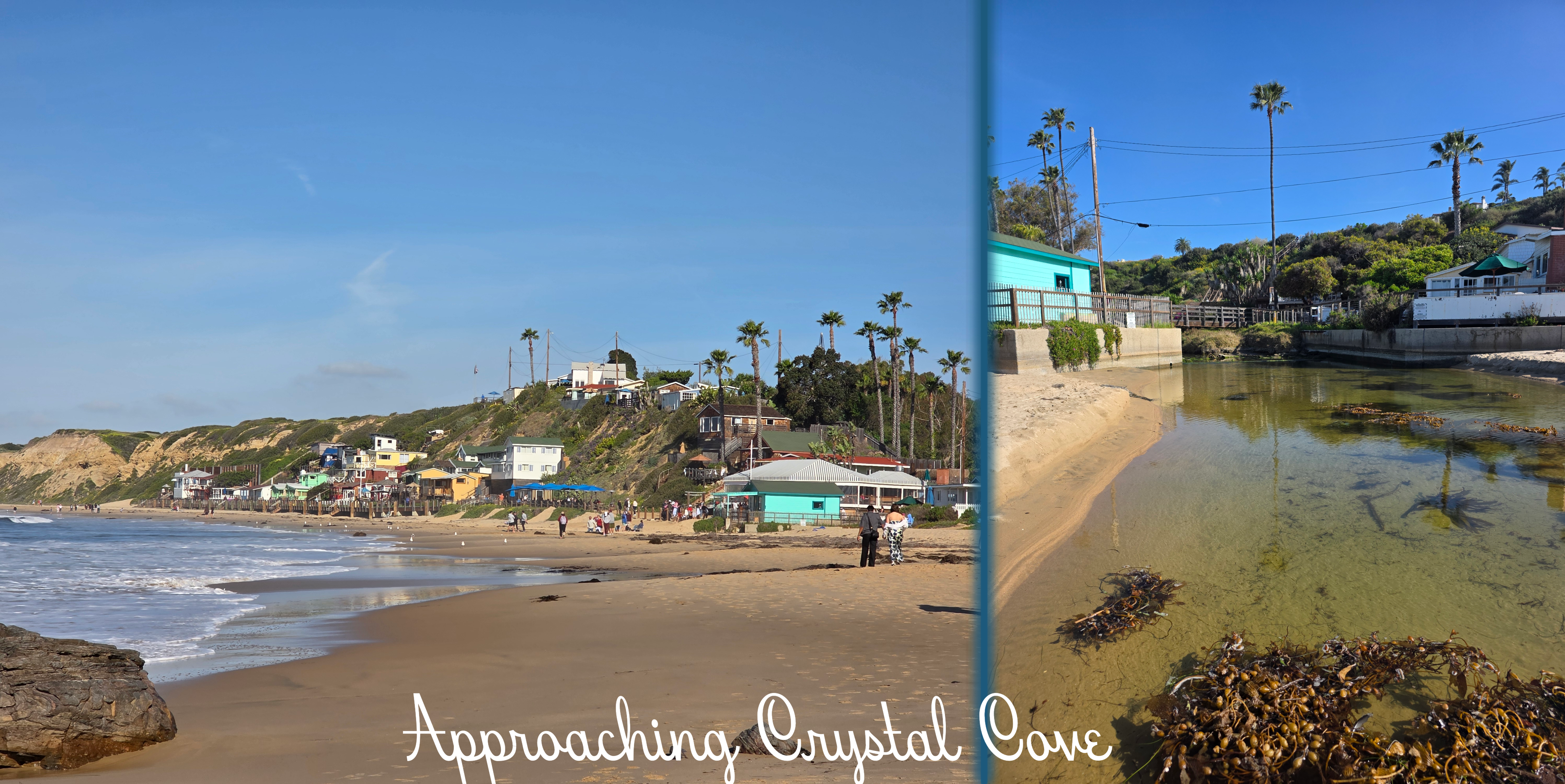
The towering cliffs above the beach were dotted with green but also showed layers of rock and sand – a geologist’s dream, I am sure. As I approached the Crystal Cove area, there was a larger formation of rocks where a few fishermen had parked themselves, accompanied by always-bold gulls. The sun had finally risen far enough that a picture back the way I had come was a touch clearer.
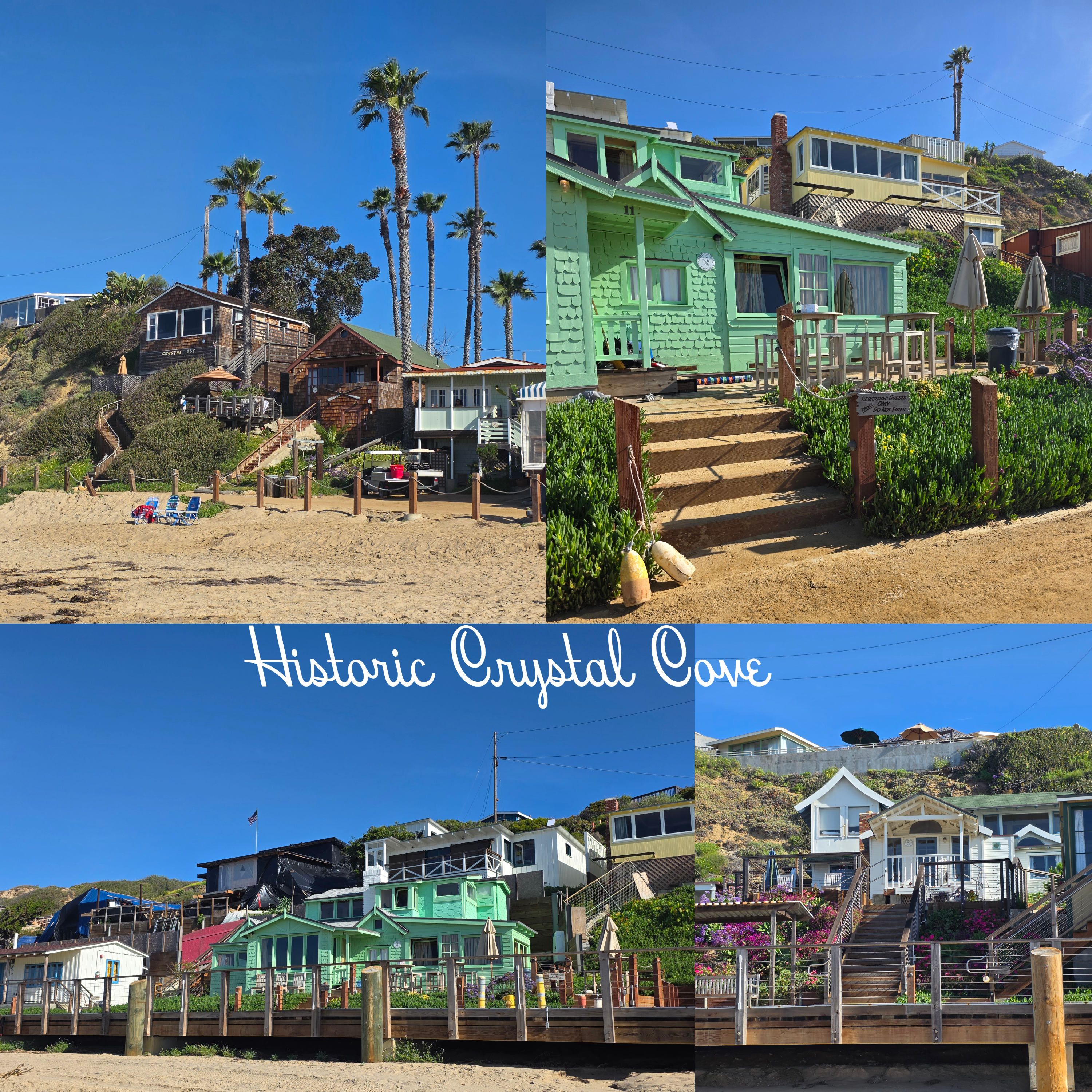
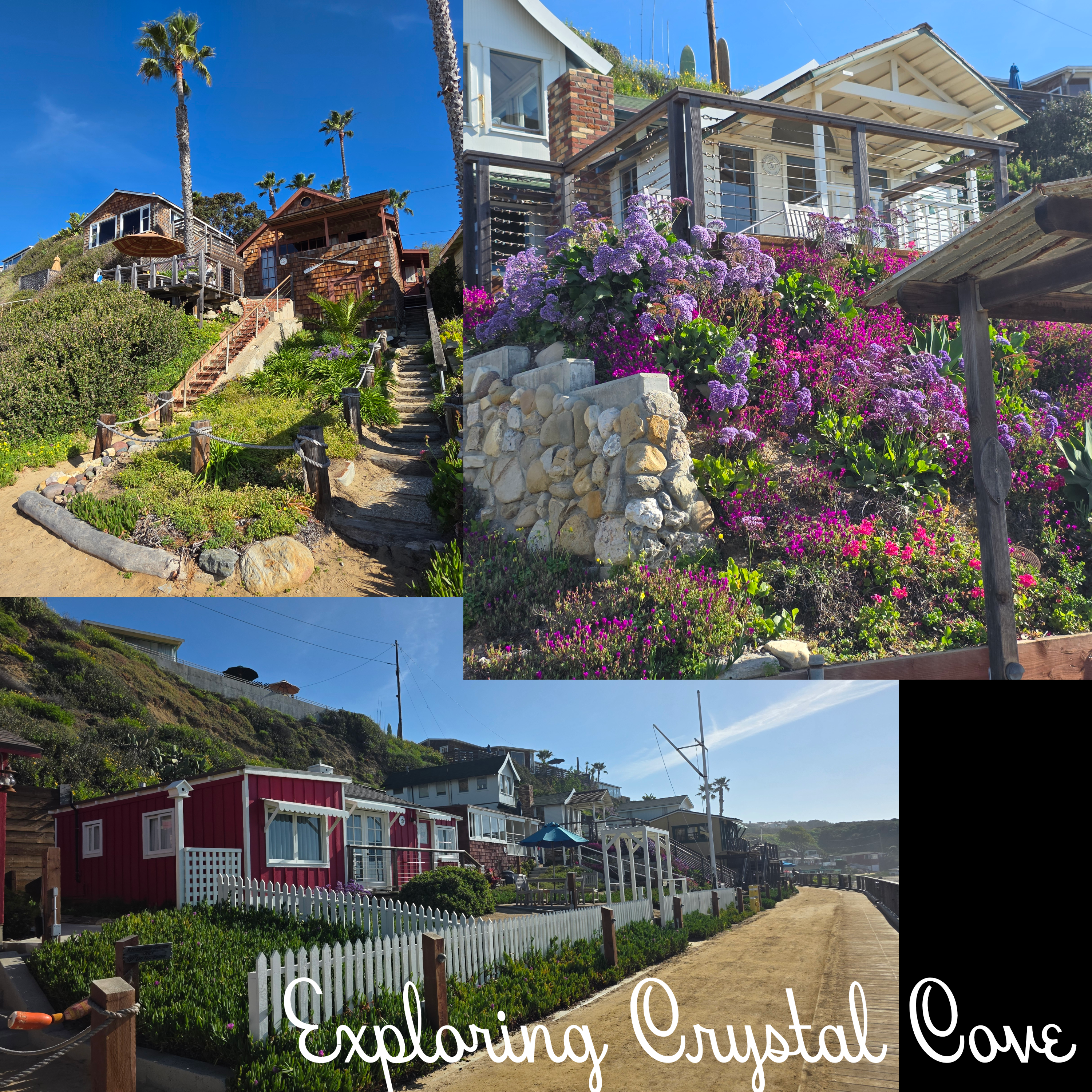
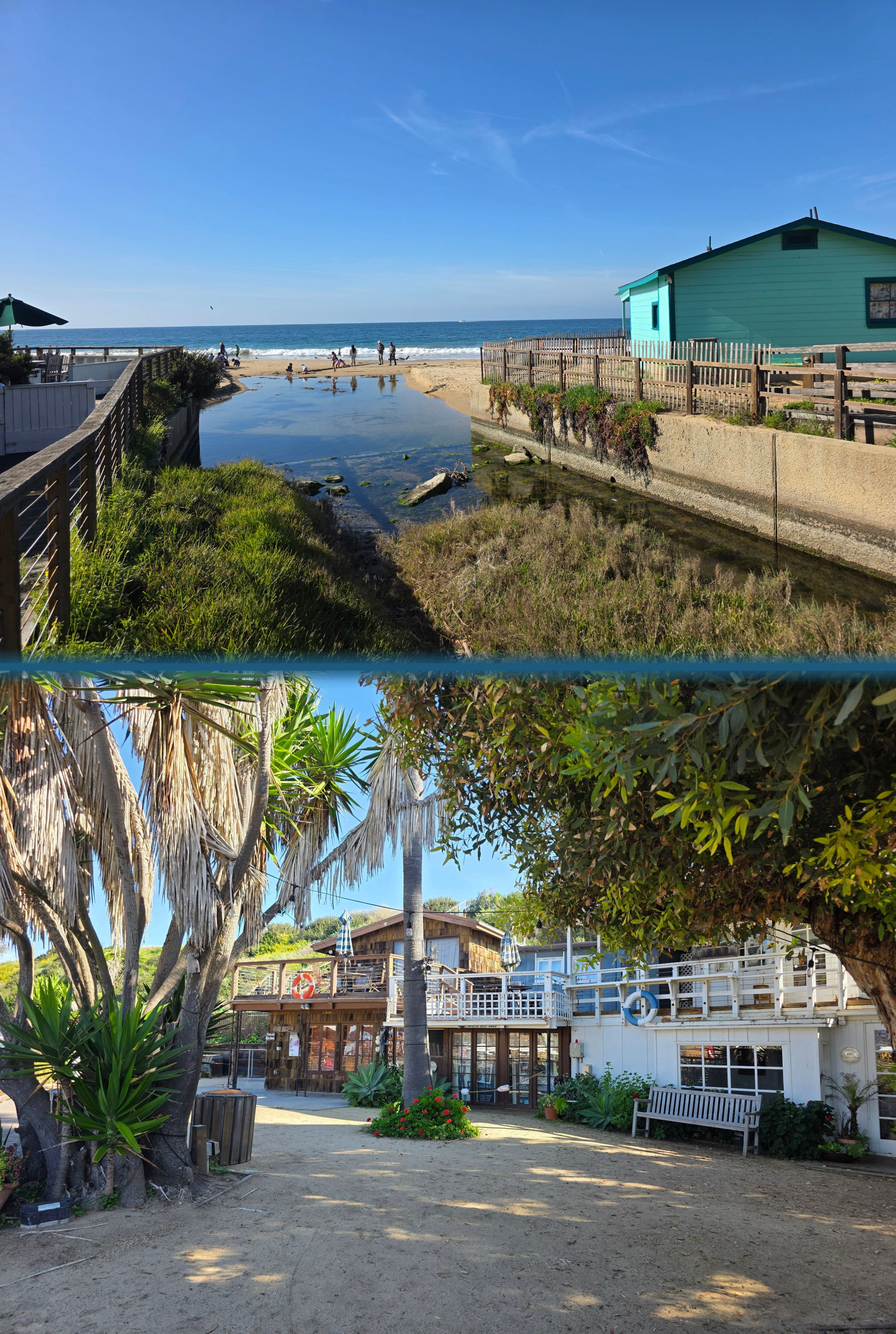
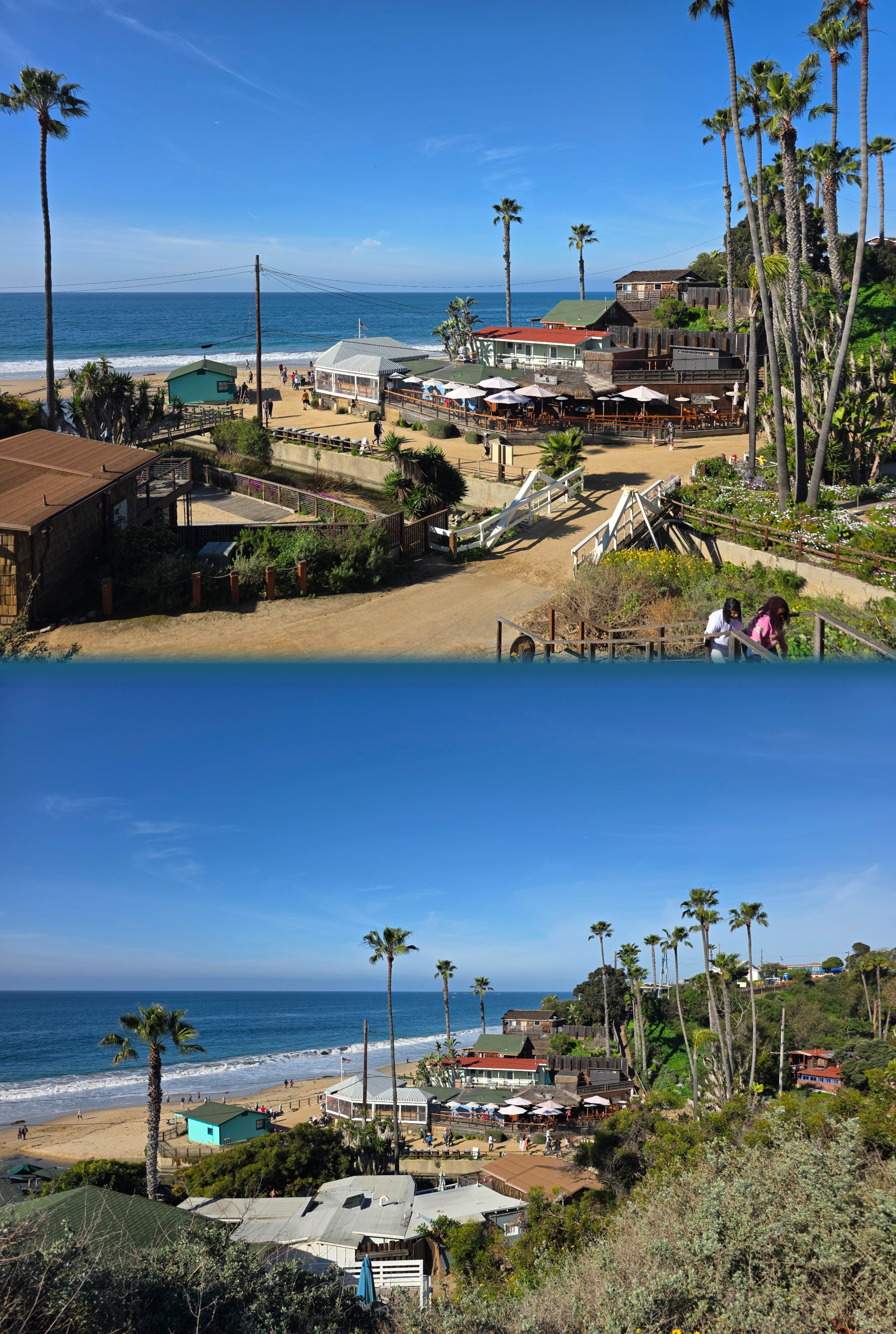
I did not really know what to expect of Crystal Cove, and as I approached it reminded me both of a Caribbean pirate’s lair and a coastal village on Cape Cod. The more I explored, the more the houses reminded me of lakeside ‘cottages’ built on Lake Sunapee in New Hampshire: thin wood, no insulation, designed as a shelter in warm and comfortable weather. Upon reading more, I learned that the Crystal Cove Historic District is a federally listed gathering of 46 vintage coastal cottages built in the 1930s and 40s. One of the last remaining examples of early 20th century coastal development, it has been preserved and the cottages transformed into rental properties. They are nestled around Los Trancos Creek, which is what made me think of the pirate hideout – aren’t there always creeks emptying into the ocean in a lair?
There is a boardwalk in front of the line of houses, so I walked all the way to the end and then back again, enjoying the haphazard, ramshackle nature of some of the cottages. Most were neat, simple constructions with plenty of window and balcony space, but one or two looked like a child had constructed them out of blocks – dormers, gables, windows, extra rooms tacked on in random places. These were, of course, my favourite (in particular the mint green one visible in the collage below).
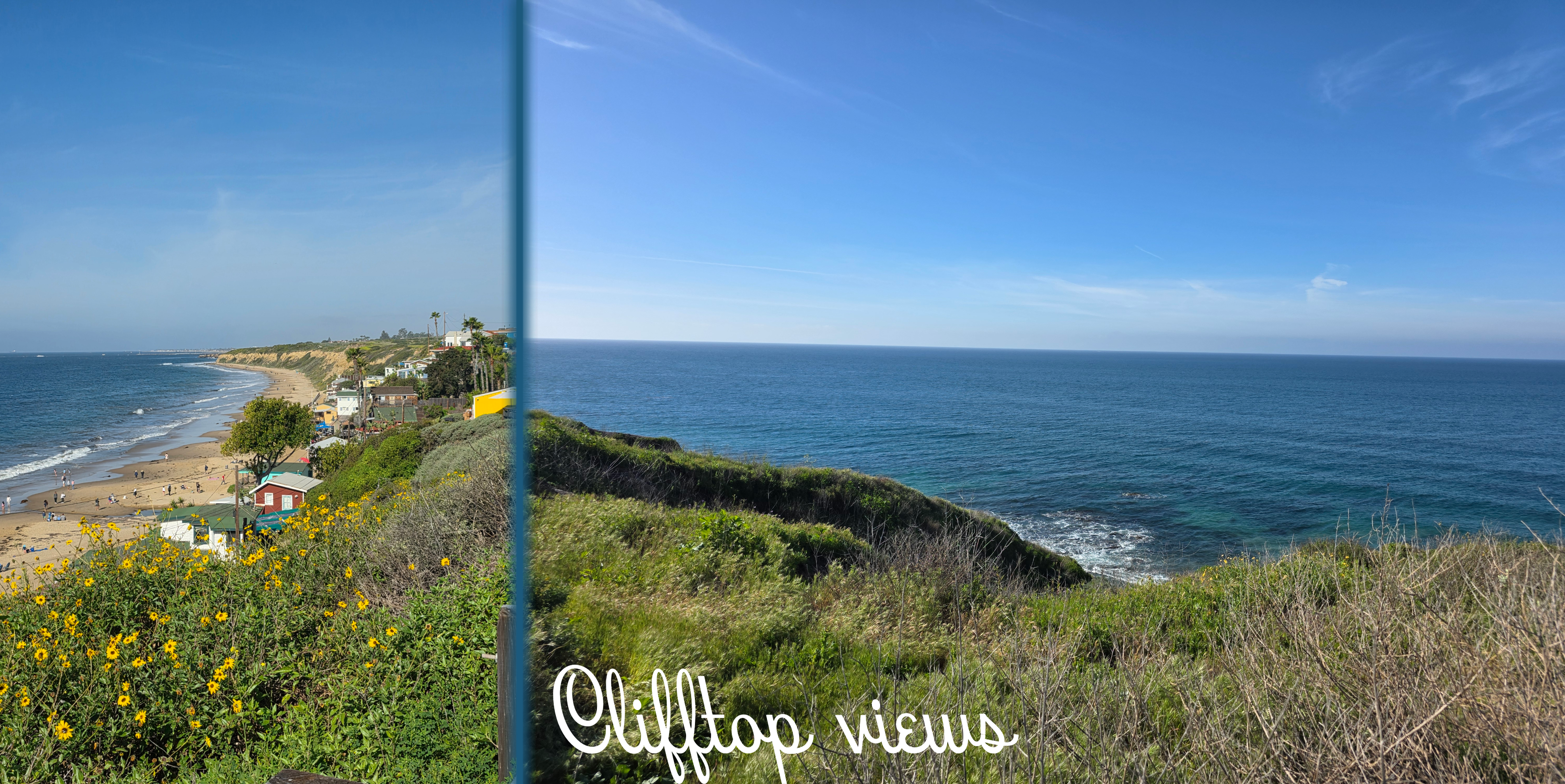
I walked past the Beachcomber restaurant, which seemed to be very busy, and found a clean public restroom just over the pedestrian bridge. From here, my route took me up a flight of steps back to the top of the cliff, where I could look down over the cove and out to sea.
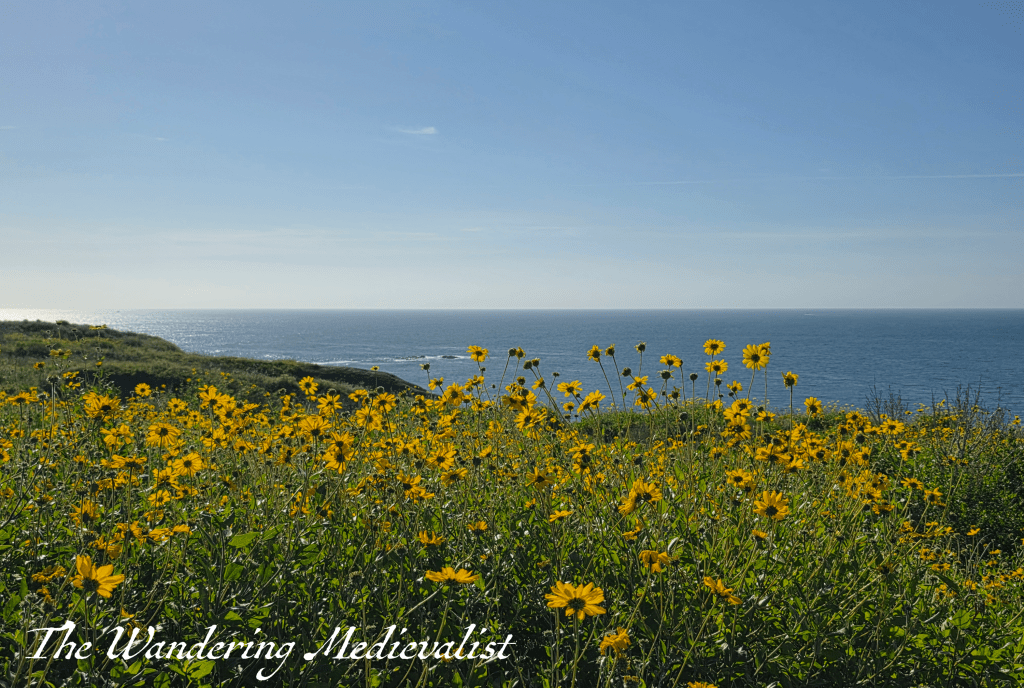
As I moved away from the cluster of houses and past the very busy Shake Shack (this is when I recalled that it was Valentine’s Day, as they had all sorts of offers on), I realised that the cliff-top walk was not entirely dissimilar to parts of the Fife Coastal Path. The trail was paved and well-used by joggers and walkers, and the scrub-like flora dropped abruptly away to a view of the open sea.
really, this could almost be Fife
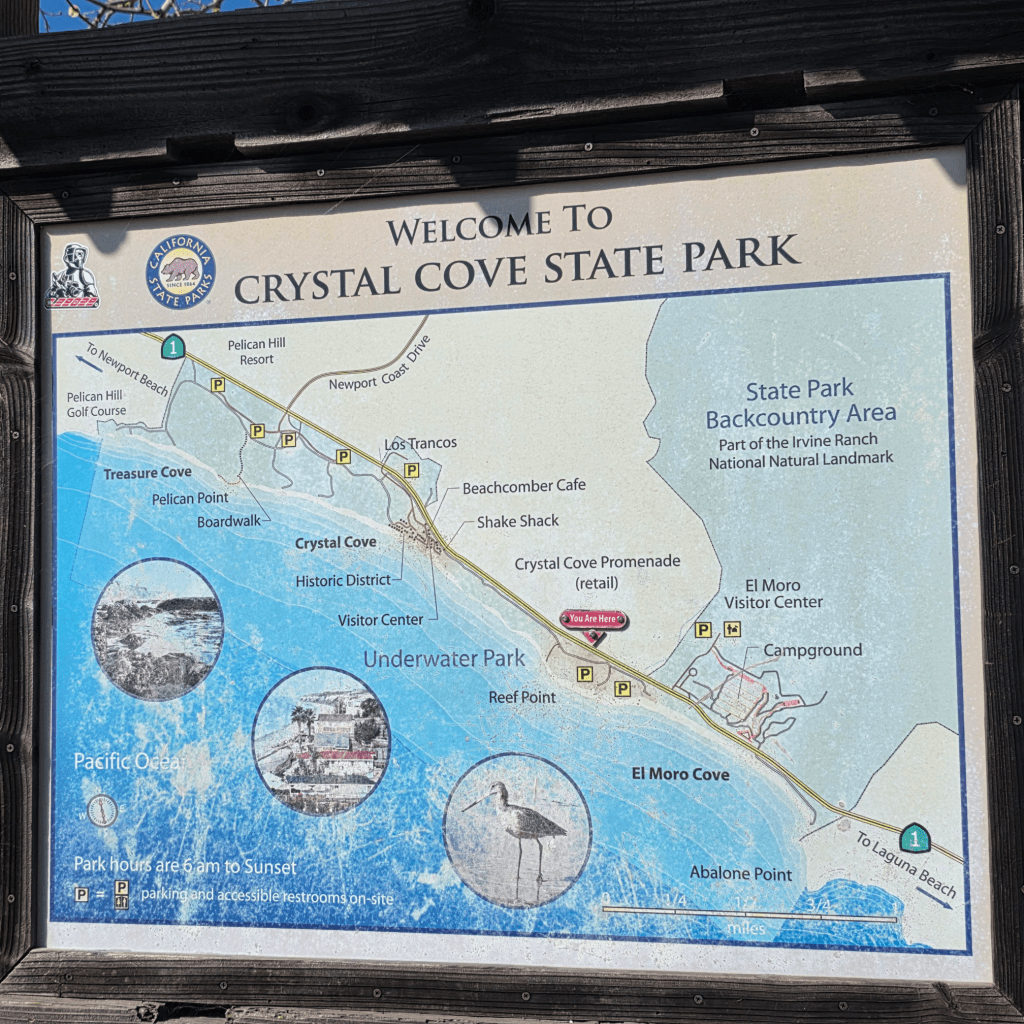
In time I reached the edge of the parking lot, but I really wanted to explore the other direction so I pushed on, passing the useful map you can see at the start of this post. There was also another clean restroom and a spot to fill up your water bottle.
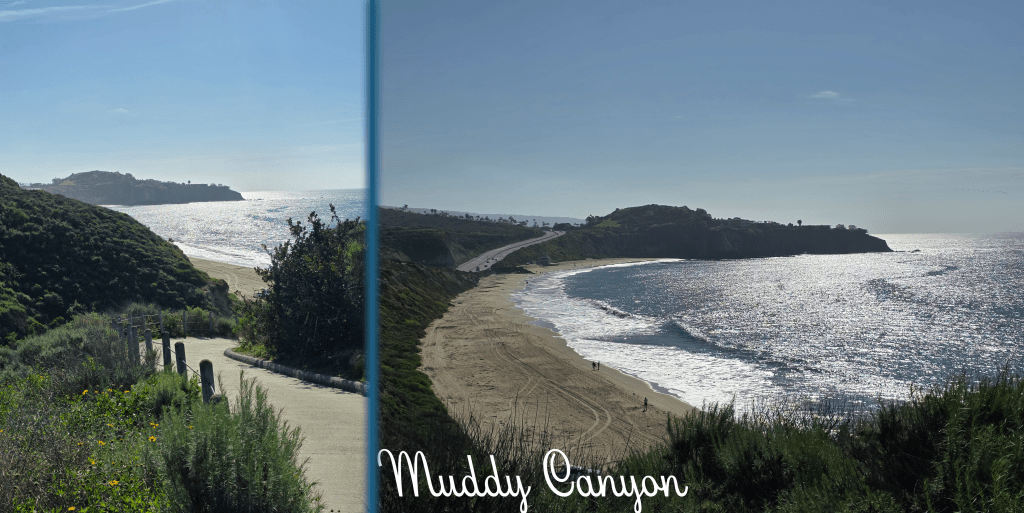
Beyond this hut was another car park, but finally at the end I reached a branch in the path. One direction led to a viewpoint over Muddy Canyon, where there were several benches to enjoy the view.
The other direction led to this winding downward ramp – quite steep and a bit slippery with sand. This portion of the path hugs the edge of the canyon, which has been sliced into the cliff by a creek down below. I began to question whether this was a good idea – I really did not want to climb back up the ramp. But, when I reached the bottom, I was greeted by a beautiful fresh breeze, a touch cool and the type that refreshes and rejuvenates. Perhaps it is my childhood by the sea, but I find few things smell better than this type of breeze, pinching your nostrils with a touch of salt.
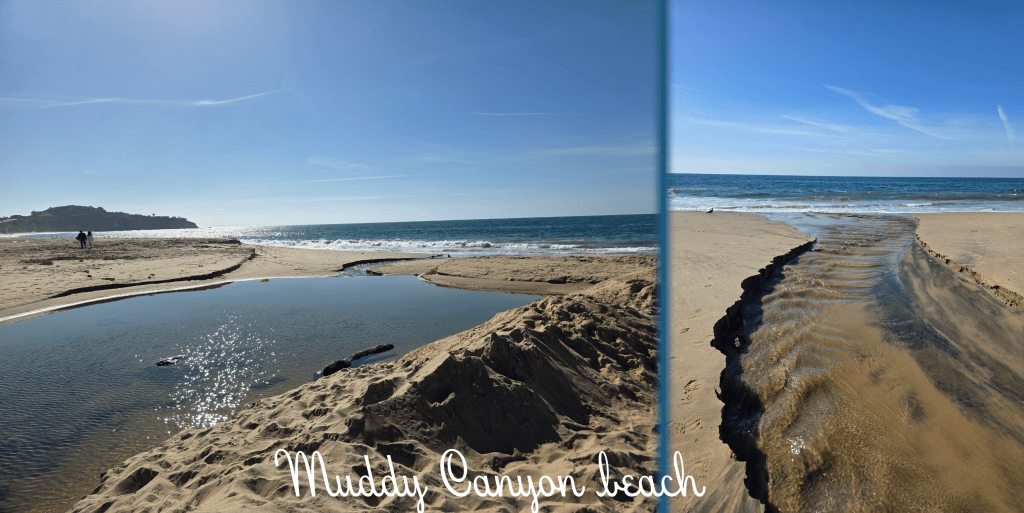
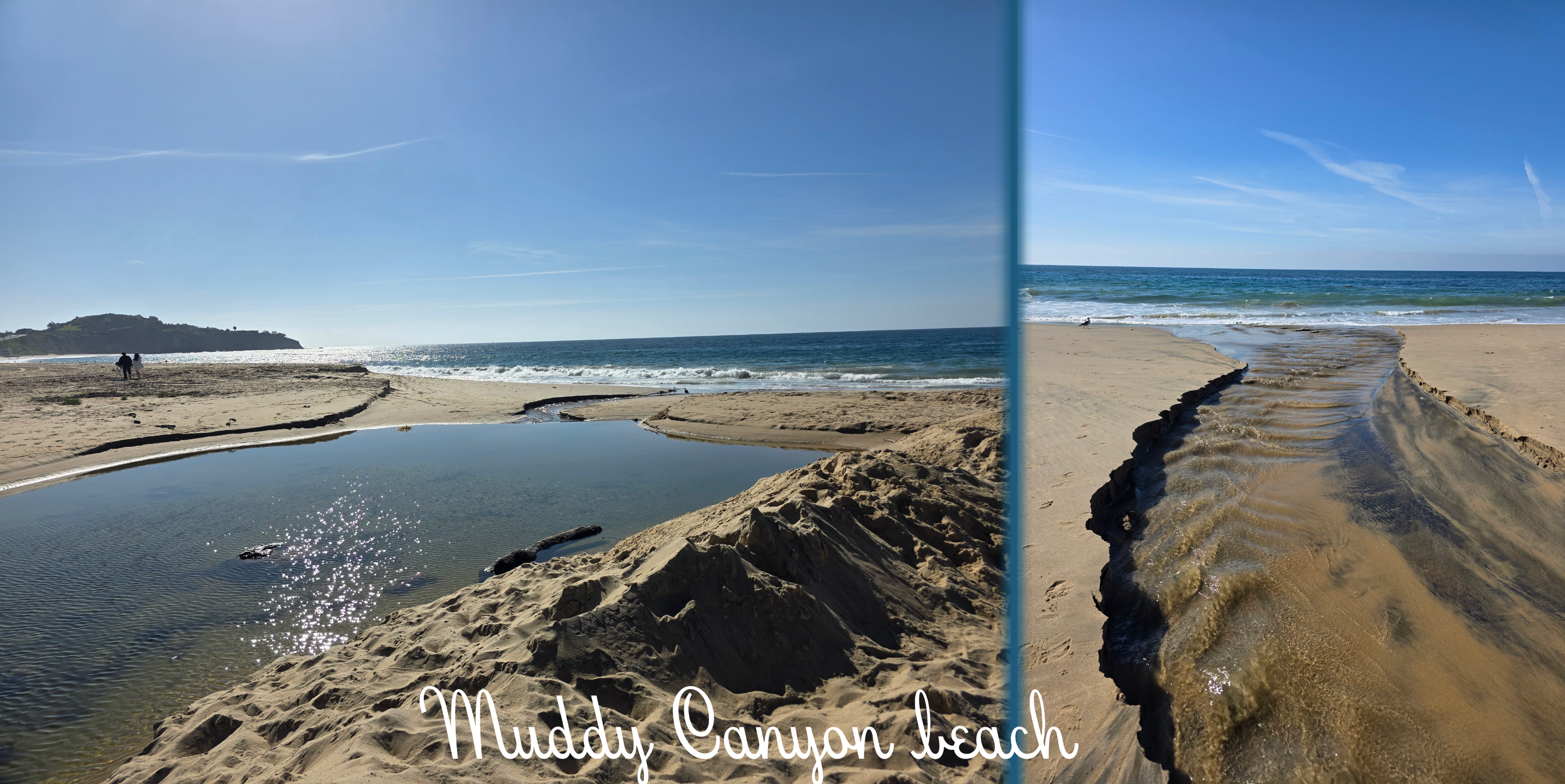
Immediately to my left was a pond where the creek backed up a bit before emptying into the ocean. Fortunately, the outflow was narrow enough at one spot to leap over, and I managed to do so without falling or injuring myself. The seagulls were watching closely.
On the far side of the creek, the beach stretches out towards a headland, which is the edge of the town of Laguna Beach (I think). This part of the coast was quieter, so I walked along for a while, enjoying the dramatic cliffs and the wind. I considered a few times how far I wanted to walk, and realised in the end that I was setting myself up for a good long hike if I kept going. So, I turned around and leapt over the creek again. It then occurred to me that I did not need to go back up the ramp – my car was quite a bit further along and there was a set of steps between it and me. So, I stayed down on the beach for a bit longer before finding myself at the bottom of the stairs I had descended at the start of my walk.
They were a touch more daunting looking up than down. That said, they were mostly quite shallow so not too strenuous, and they switched back a few times, allowing for a pause and quick look at the view while I caught my breath.
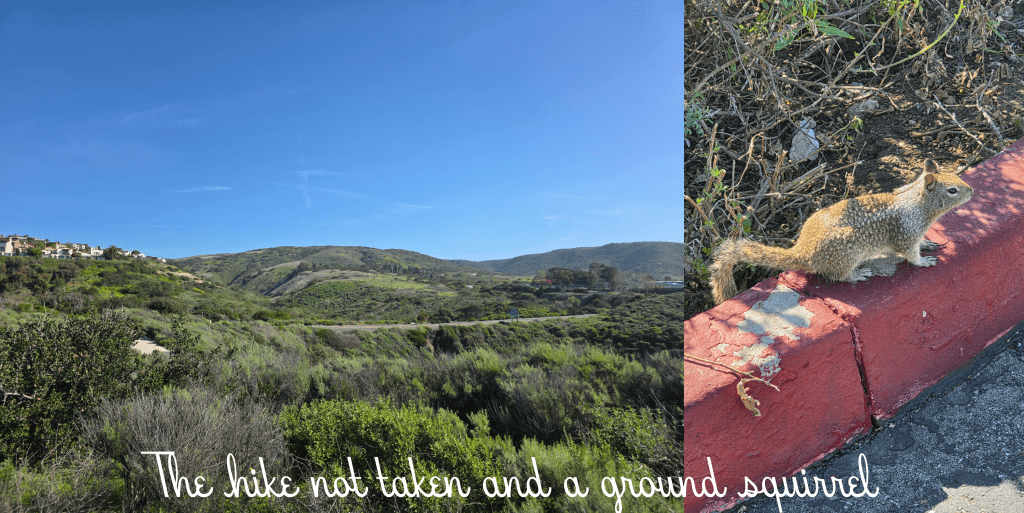
Once back at the top-of-cliff level, I found it to be a relatively short walk back to the car – about five minutes. Along the way I was able to capture a picture of hills I might have been hiking in, as well as this wee ground squirrel who posed very kindly for me. Or possibly froze in fear. Either way, he stayed still for quite some time. While I was heading home, increasing numbers of other people were appearing, particularly couples clearly visiting the beach for a Valentine’s Day picnic. I certainly saw more red mylar balloons that one might expect on a coastal walk, and girls slightly awkwardly clutching bouquets while they headed toward the sand.
In all my hike ended up being about 4 miles with two relatively steep climbs to get the blood pumping a bit. As seems to be the case with much of this area, the beach was stunning and I enjoyed exploring another new spot. The weather has tracked me from Scotland now, as this was the last bright sunny day, and rain has closed in on LA. It looks like I am not likely to get a chance to try another walk on this trip. Perhaps next time!
One last side note about adventuring in this part of Orange County: if you get a chance, stop in at a Pavilions supermarket. The fruit is phenomenal, the packaged salads and breads are delicious and in all it probably comes in around the same cost as a Whole Foods. A really pleasant shopping experience. I am a big fan.
As I have alluded to in my past few posts, January weather has been consistently rubbish. This Saturday really wasn’t much different, except that the rain was more a gentle mist than a downpour. I knew I wasn’t up for a long walk, and I had plenty to do on my last weekend before my next work trip, so this stretch of the coastal path – some of which I have done before but ran into a serious detour – seemed a good idea.
I was also excited to do a proper inaugural hike in my new boots, so I was all ready with my hiking socks and some new insoles that keep my ankles from rolling in. I wrapped up with several layers, and boarded the bus to Leuchars, where I got off at the Olde Hotel. While I can’t say that I was quite as enthused as I have been some mornings – it is hard to be energetic when it’s chilly and damp – I was looking forward to making a tiny bit of progress on my goal. But then I noticed, as I walked along Main Street, that my left foot – the larger one, according to the man who measured them at L.L. Bean – began to rub, quite quickly and painfully. So, I ducked into a bus shelter and found the one Compeed left from my summer walking kit, and plastered it on. I only made it a few more hundred feet before I realised I was in trouble – despite the cushioned plaster, the rubbing was getting worse, and I began to fear that I would have to give up. Also, I was walking unevenly to favour that foot, and I knew that would cause pain in the long run.
Frustration was an understatement – how could these amazing new boots have turned on me?! How could I miss the one opportunity to check off a few more miles? Then it dawned on me – the insole. It was pushing my foot up just enough that it hit a part of the boot it shouldn’t. Despite mud and rain, I managed to get my boot off – again – and pull the insole out. Immediately, the boot felt better and my stubbornness determined that I would manage the walk even with a bit of discomfort. And so I headed on, along the muddy playing fields that abut the castle grounds. My good mood was quickly restored upon meeting a roly-poly black cocker spaniel who ambled up to me and deposited itself on my feet. After a few good ear scratches and a smile, he toddled off again to meet his master. As always, an encounter with a dog improved everything.
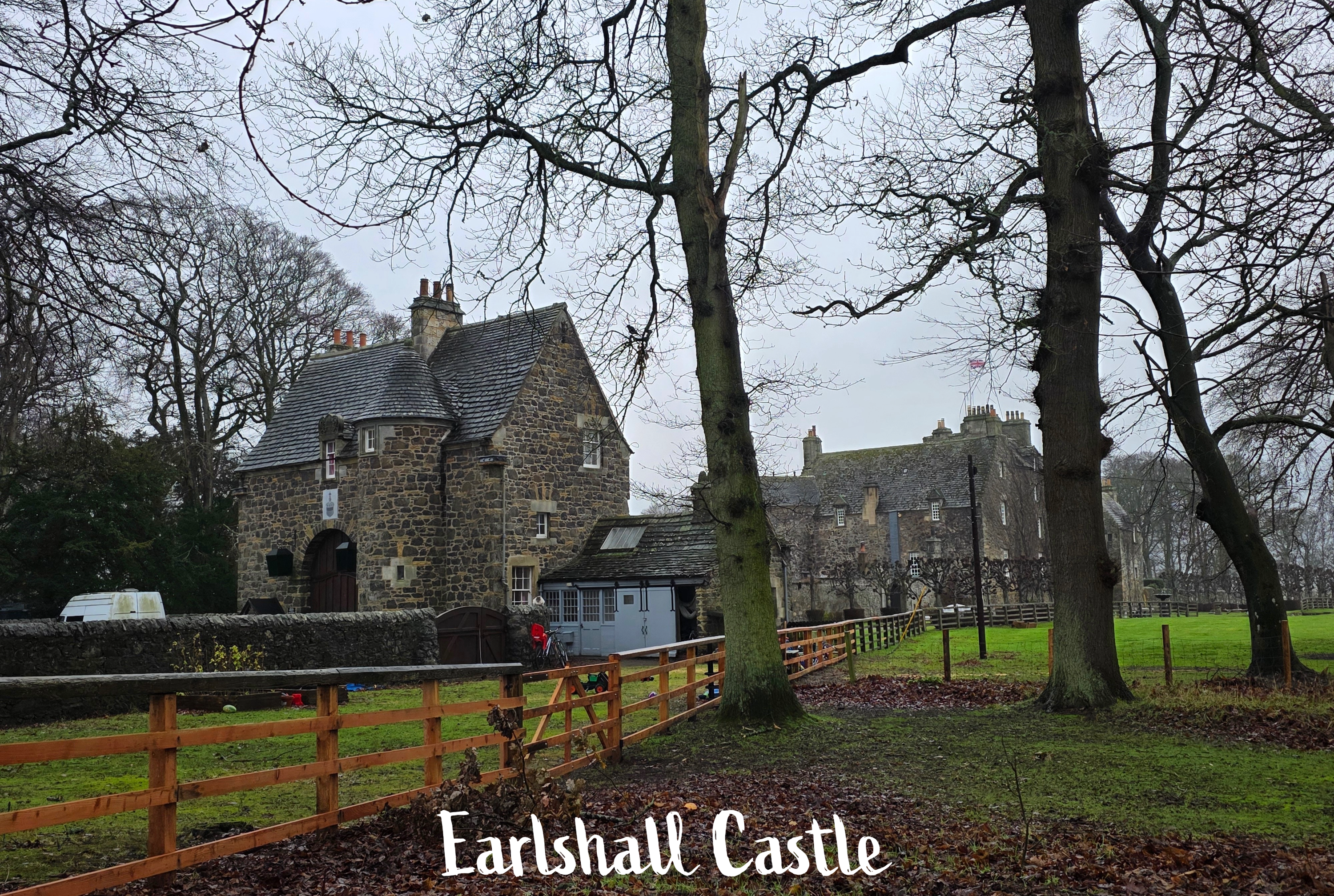
Finally, after a bit more drama than I expected, I reached the castle grounds and started my official walk recording. I cannot recall now if I mentioned much about the castle itself last time I did this walk; it is a relatively ‘new’ castle as Scottish castles go, built in 1546 by a Sir William Bruce, a survivor of the devastating Battle of Flodden. This battle is infamous for the death of King James IV of Scotland, who is the last monarch in Great Britain to die in battle (surpassing Richard III by about 30 years). More a mansion than a castle, Earlshall was built in the ‘courtyard’ style, and is still in good shape. It is also, apparently, for sale; if only I had £8 million to spare.
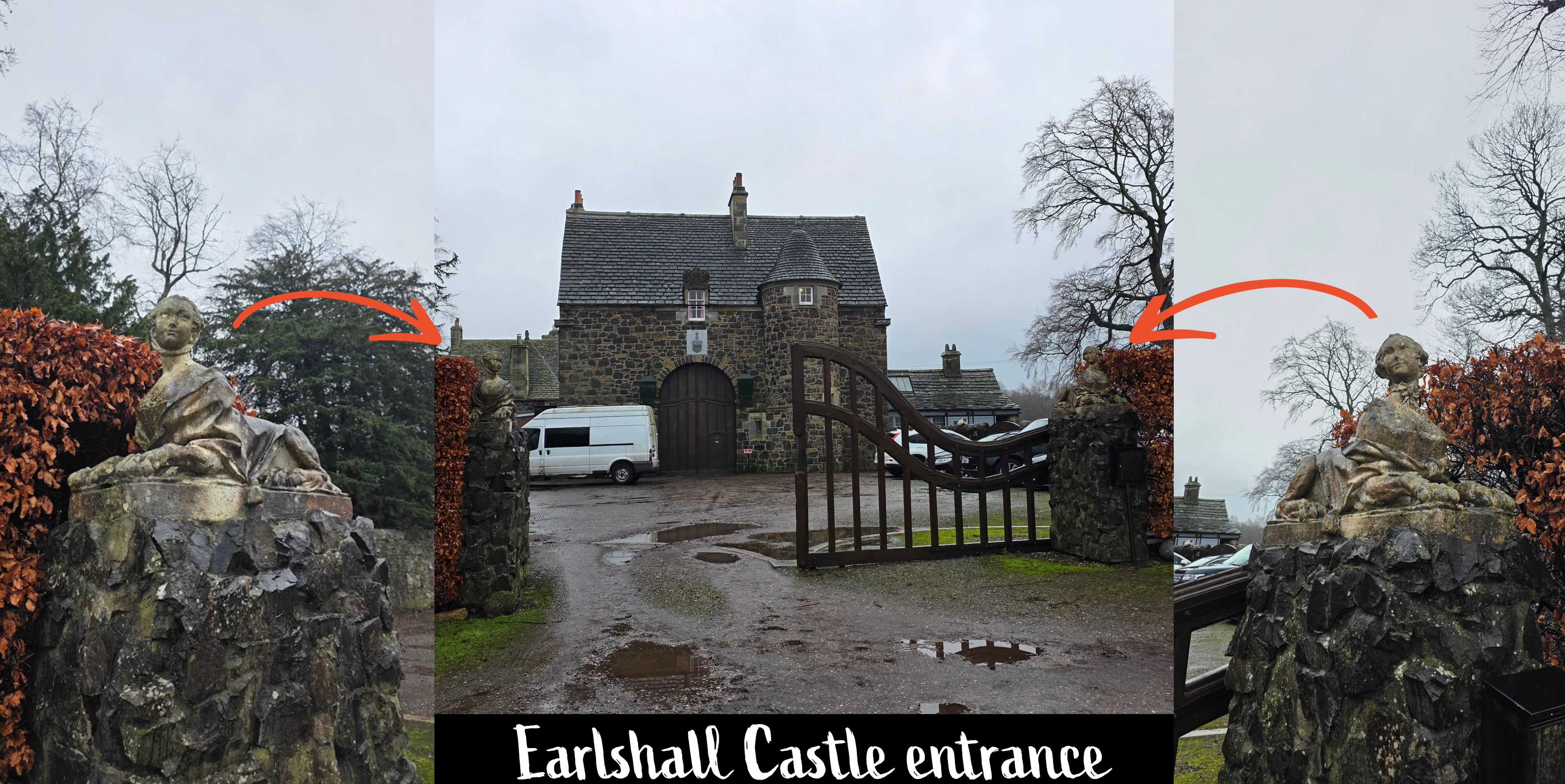
The gated entrance is graced on both sides by carvings of a lord and lady; I stopped for a moment for the below pictures before continuing on my way.
The path at this point leads along a single track road with the estate wall on one side and open fields on the other. One concern on days like this is that with a hood up, it can be difficult to hear approaching vehicles, so it can be a touch treacherous on a narrow stretch like this. Fortunately, I did not encounter a single car.
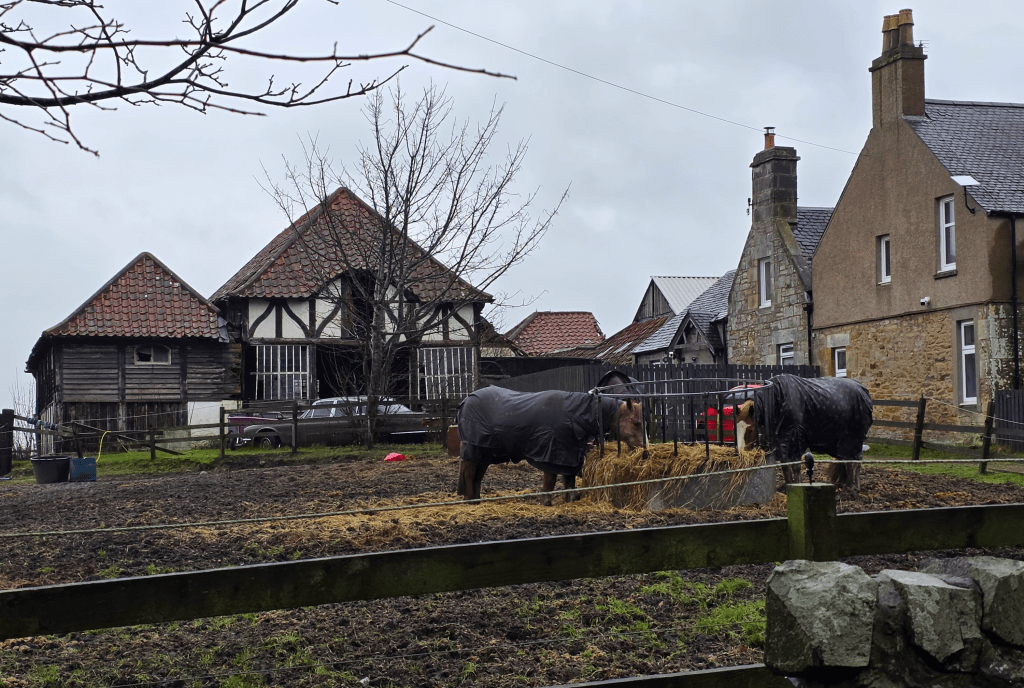
Ahead on the left as I approached the edge of the army base is a beautiful old Tudor-style barn which I would love to know more about, but can’t seem to find any information about.
Just beyond the barn, the first sign of the actual Coastal Path route leads through a gate and along a track that runs between the base fence on one side and the farm on the other. The fields beyond are the home of several horses and I think a pony or two. In this short section without trees, the weather issue for the day quickly became not the rain but the wind, whipping across the open land of the army base. Once safely inside the treeline it calmed a bit, but I could hear it in the treetops, and they were dancing about a touch violently whenever I looked up.
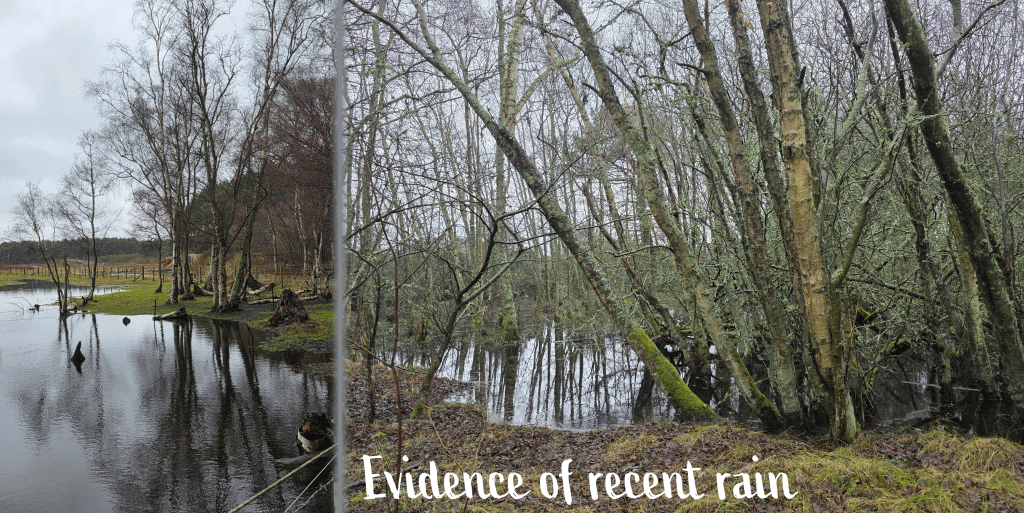
The excessive rain of the last few weeks was evident along the path, with large puddles in the fields and under the trees, areas that might normally be a bit boggy but now are flooded.
Fortunately the trail was in relatively good shape, not too muddy – at least at this point. As I emerged from the trees, I was hit immediately from one side by the wind, but surprisingly it was less bitter than I expected. I was quickly reaching the point of no return, after which going back would be more work that pushing on, and despite the discomfort of my boot, I was determined not to give up – after all, it didn’t seem to be getting any worse (or so I thought). I could tell that my body wasn’t really into the walk – it was complaining more than I expected and I’m not sure if it was the wind or the cold, but the endorphin rush never really hit. It had very evidently been a while since I’d done exercise like this, with the shorter walks I did over Christmas not really measuring up.
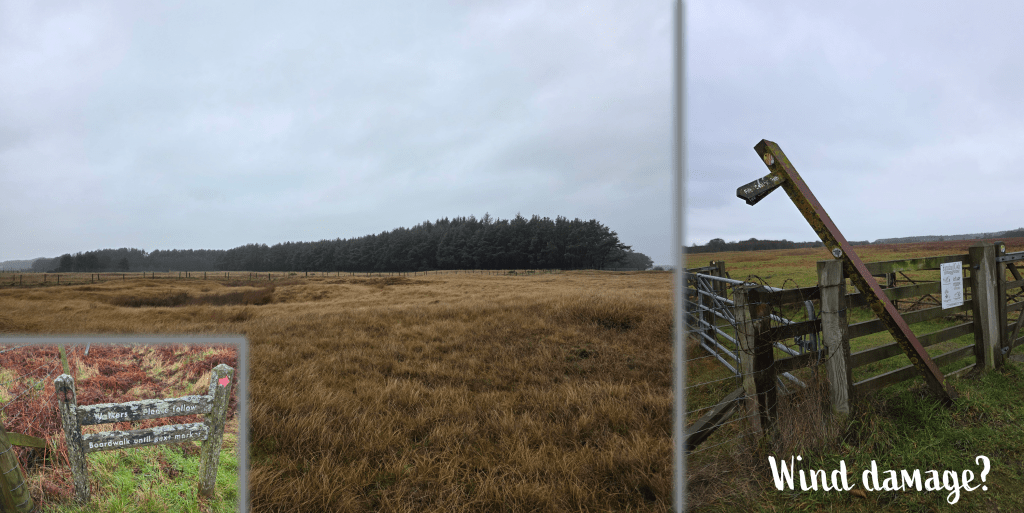
Just under a mile after leaving the castle, I reached the gate where, on my last attempt, I had been forced to take a detour. Fortunately, this time I knew I would be able to take the standard path, as I had seen the update on Facebook that the boardwalk was fully repaired. The sign directing walkers had suffered a bit of wind damage, but the path was clear nonetheless. I passed through two sets of gates and struck out across the field between two fences; the trail rises and falls over hillocks and grass clumps, much more uneven than the farm track.
After a short straight bit that leads at an odd angle away from the farm track, there is a sharp right through another gate. Here you find a warning to walkers to stay on the boardwalk, the first section of which stretches out ahead of you. The wind is much stronger here in the open, and I while I was never cool, I was pleased to have a windbreaker. Sure enough, the boards are very new and well-kept with stripes of raised rough bits that prevent them from becoming slippery, and they pass over some very boggy areas that would be completely impassable at most times of year.
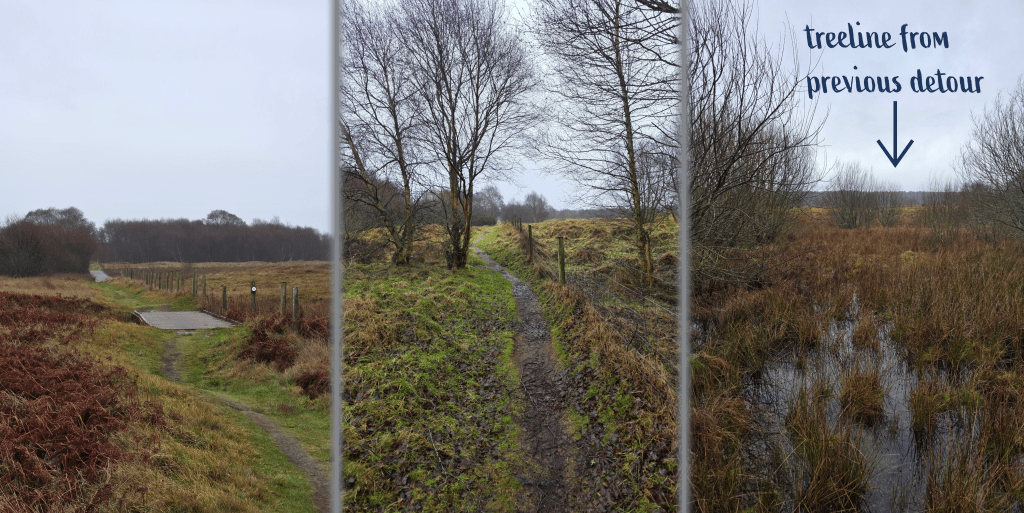
The path alternates on boardwalk sections and uneven muddy ground, following the edge of a fence and meandering through stands of trees. The direct path made me appreciate just how long the detour was that I took last year – the tree line of the forest I walked through is a good half mile or so away.
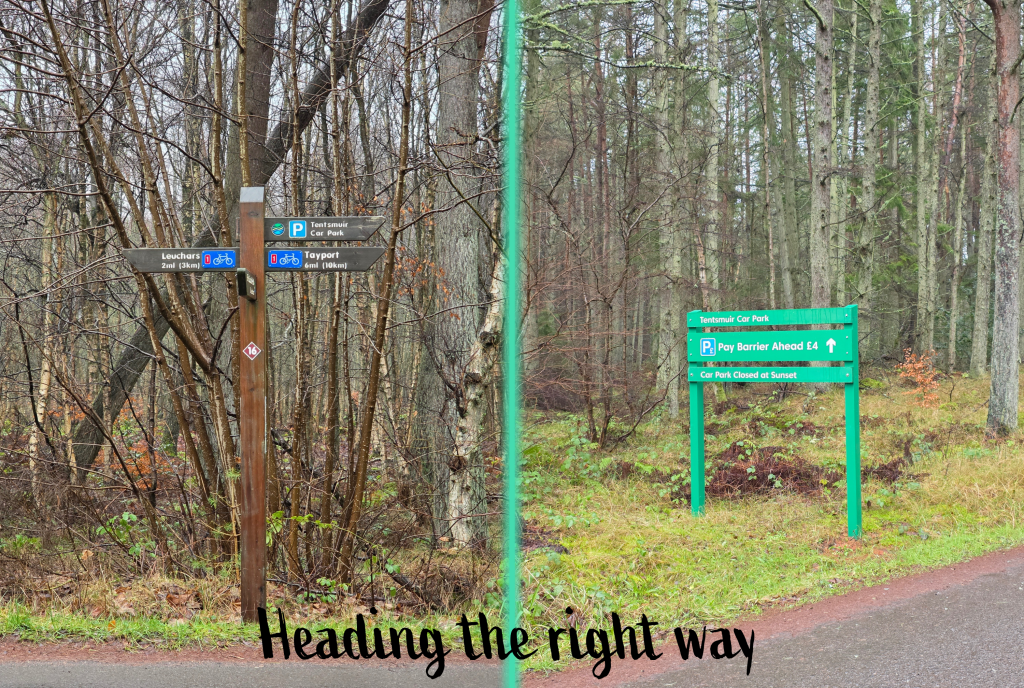
I have to say despite the weather, this is a quite pleasant stretch of path, and I had it completely to myself – I had seen a few joggers closer to Leuchars, but did not see another soul until I reached the Tentsmuir road. As I crossed the last stretch of bridge, a sign appeared in the distance, surrounded by a huge gorse bush that was just starting to bloom. Here I swung left, and ahead through the treeline I caught just the slightest hint of open sky that indicated the beach. I could also hear the distant crashing of waves, though this came and went for the next mile or so.
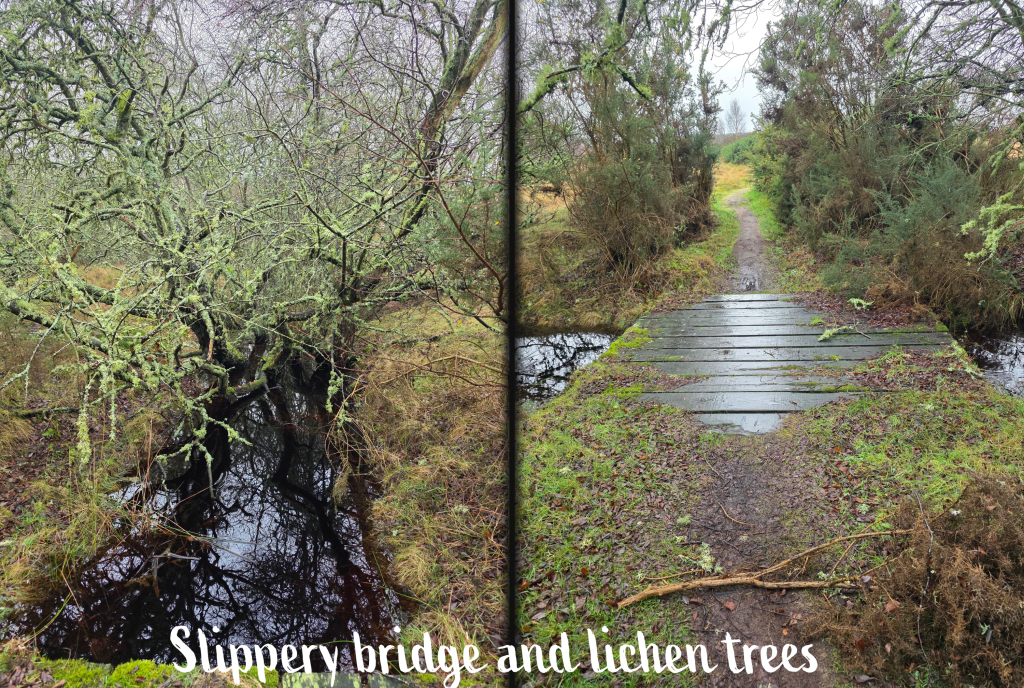
Shortly after this left turn, the quality of the new bridges was made clear when I approached an older wooden bridge, this one slippery and grimy from the weather and moss. Nevertheless, the small burn it crossed was lined with trees absolutely dripping in beautiful lichen, coating the branches in a light seafoam green. Up close, the lichen reminds me of types of coral.
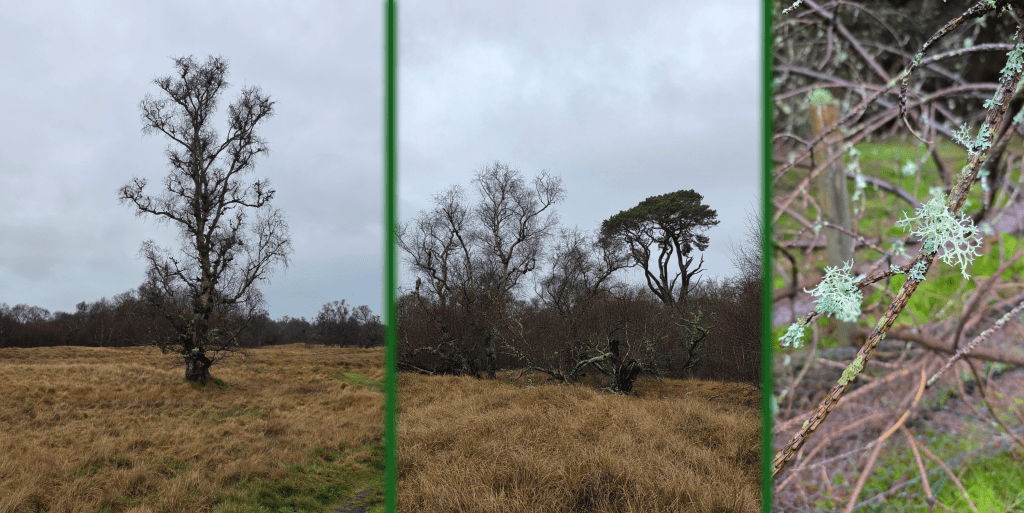
Across the bridge, the path passes into a hilly field, mostly empty but dotted with large, dead trees that created all sorts of creepy patterns reminiscent of a Tim Burton movie. There were a few lone pines with needles still on them which must have very deep strong roots, as so many of the larger trees here were blown down in the wind storms we have had in the last few years. Forest lines this field on both sides, with most trees just ghostly outlines with chunks of lichen on them.
My primary observation of this section of the trail is that it is not particularly coastal. Other than the distant waves – which might not be audible in calmer weather – you do not get any hint of sand or beach at all, and could as easily be in inner Fife or Perthshire as less than a mile from the ocean. This is necessitated by the army base as well as the nature reserve, but I am looking forward to getting back to the seaside views.
Eventually the trail passes out of the field and through another gate – very muddy here for a short while – and onto a forest track with clear vehicle ruts. The forest here is quite pleasant, a mix of pine and birch, and it blocks most of the wind so that it is also very quiet. The rain had completely stopped by and it was a nice stretch of path. That said, it went on quite a bit longer than I expected, and I found myself wishing for one of the first times on the Fife Coastal Path that I had some music to listen to.
Several times on this stretch I thought I could see the end in sight, as the trees seemed to close in over the trail a bit or indicate a change in pattern. However, on at least two examples I was disappointed to discover that I had been a touch premature in my hopes. I was not particularly tired, but the pain in my left foot was growing steadily worse and my right foot was starting to rub slightly as well, so the last 15 minutes or so really seemed to drag – not something I find happens often on this path. I was so relieved to finally see, in the distance, the very man-made shape of a horizontal bar, dividing the path from the road beyond. Here I knew it was just a short distance along the road to the stables, where the other half was to meet me.
Unfortunately, this last short section was the least pleasant, as the road is narrow and the path alongside it even narrower and, on occasion, not present. It was muddy, started raining again, and the cars were regular enough that I was not confident venturing onto the tarmac at all; I even found myself switching sides of the road a few times in search of a better patch to walk on. But I did not have far to go.
Overall, then, not my favourite part of the Fife Coastal Path, though it had some pleasant sections and would probably have been even more pleasant without the enormous blister I was causing on my heel. (as I discovered when I reached home, it really was impressive, covering most of the back of my foot – oops).
I am still in love with my hiking boots though, particularly since the blisters were really my own fault for having put in new insoles and not tested them. Overall, they did a fantastic job and were very sturdy, keeping my ankles from rolling even on quite uneven ground. They dealt well with the mud and puddles, and my feet were bone dry
I’m not sure when I’ll get back out onto the path as work is taking over life for the month of February (and early March), but fingers crossed I’ll get out in March before the next round of travel.
Somehow, it is mid-January. It feels like we just got back from our Christmas trip to New England, and I’m deep into planning my next trip to the US, in just about three weeks. At this time of year time can pass quickly, and we have been adjusting to the time change, getting back to work, and dealing with some truly January Scottish weather – cold, wet, windy, dark. Not great for hiking, but great for duvet days and planning.
So rather than tear myself apart over my inability to get back onto my hike, I thought it might be time for some reflection.
Firstly, I am excited to share a preview of my new hiking boots, a birthday gift from my father. I’m delighted to have found exactly what I need at L.L. Bean (I never doubted), assisted by a delightfully chatty salesman who measured my feet and demanded to know all about my plans before allowing me to make a purchase. I’ve already done an inaugural walk in them (not far, just my normal morning jaunt) and they already feel amazing – nice and light, sturdy, no rolling ankles or rubbing.
But I’m getting carried away. It has been a year since I walked my first section of the Fife Coastal Path and determined that it would be my goal – partly to have a goal, and partly to assist with getting fitter.
In order to write this post, I have had a read through all of the posts I’ve written, and have started to plan this coming year’s activity. There are a few definite spanners in the works, potentially, in that I do not know how much time I will actually be able to spend in Fife over the next few months. But even if I only manage another ten miles before summer, never doubt that it is in my mind, and I still intend to finish this damn trail. Eventually.
So, what did I learn in reading my posts?
I’ve definitely become a bit more thoughtful as the posts go on, giving more background on what I am passing. I’ve done my best to describe the trail but not get into too much detail, which I did early on, rather providing pictures of what you might expect to see. I’ve been incredibly lucky with weather for the most part. I’ve challenged myself physically a few times and usually been delighted to discover that I can push harder than I thought and not been in too much pain. Towards the end of the summer I was the fittest I have been in years and it felt fantastic – I hope I can get back there. Certainly summer in Scotland with long light and enticing late evening sunsets is a better time to force yourself out of doors than January, but I’ll still give it a go.
I’ve worn through a pair of hiking boots, though they may not have been as good quality as I hoped. And, I’ve put together a pretty comprehensive pack of materials that I bring on each trip, including: a map, sunscreen, bug spray (not yet needed), chapstick, water, a snack, my camera, tissues, and a power bank for if/when my phone starts to die. Layers as appropriate as well, of course. I’ve even got a designated hiking backpack, so I don’t have to think too hard about what to get together.
I’m also getting good at reading the signs as to where the path will go even when the markers aren’t the clearest – or there at all. That said, I have also once or twice forgotten to check the tides before setting out – so far I’ve gotten away with it, but I could pay eventually, and of course came close on my recent walk from the Fairmont to St Andrews.
Above all, I’ve discovered parts of Fife that I’d never known were there, and been able to really enjoy the towns and countryside of the East Neuk in particular, in a way I would not have done just by touring by car or bus.
Another thing I’ve learned – I can only do what I can do. There is plenty going on in life which means that sometimes, I just can’t get away for most of a Saturday to make a dent in the miles. I travel for work, meaning I see exciting places but am often jet-lagged and sometimes unwell, and I spend a lot of time not at home.
So I have had to allow myself, on occasion, to put life before the walking. And that’s ok. As ok as it is to put walking ahead of other things, especially as I use it as self-care. I set this goal for myself, not others – I am the only judge of how and when it is fulfilled. So I haven’t quite made it halfway, but I’ve lost more than 20lbs (over 2 stone to you Brits – and in all fairness not just through walking but also in cutting most added sugar from my diet) and I’m fitter and happier, having completed these mini-goals:
Despite the occasional setback, I’ve never given up on a walk once started; I’ve taken some great pictures, produced more content for my blog, and I’ve enjoyed every minute (well, almost).
Favourite walk
So which walk was my favourite? This is a tough one, as I really enjoyed the section from Aberdour to Kinghorn. I liked being out of the East Neuk for a change of scenery, the views were excellent and I proved to myself that I could do a longer walk and not be exhausted. I also really loved the Tayport to Newport stretch, as it brought back many fond memories of living there.
That said, I think I have to select my absolute favourite as the walk from Crail to Cambo Estate, rounding the ‘corner’ of Fife, crossing some beautiful beaches and experiencing lots of different types of coastline. It was a challenge physically but I managed, and several of my favourite pictures of the FCP journey were taken on this walk:
Favourite picture
This was also a tough decision, as I absolutely love the long, jagged lines of the Fife coastline, like those caught from the above-mentioned Crail to Cambo walk:
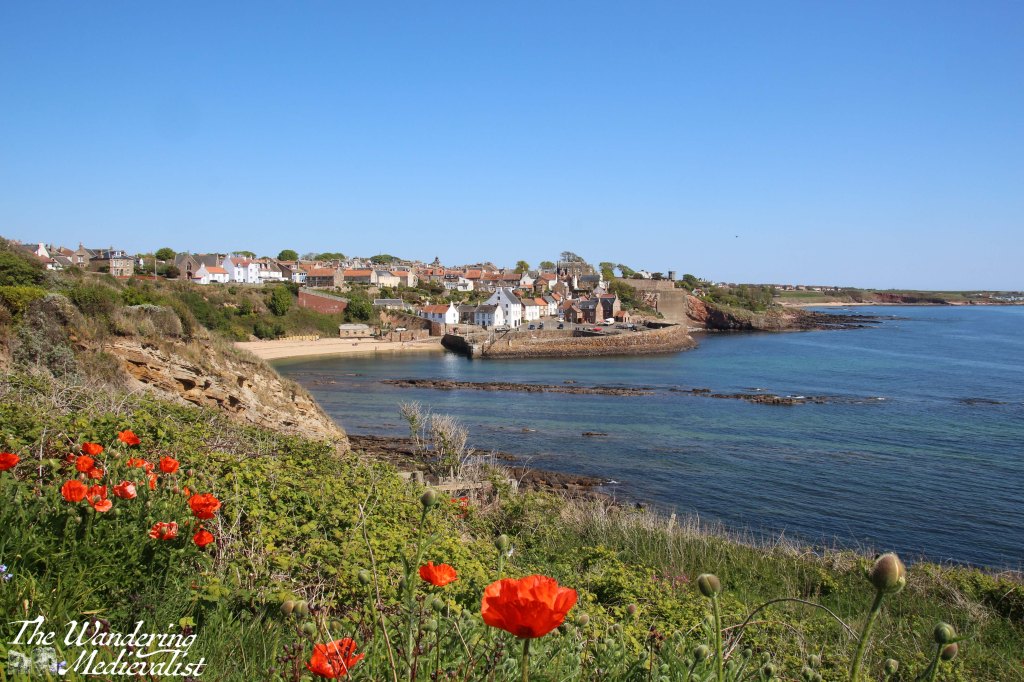
But for the red poppies and the stunning view of Crail, I think this is my favourite of all the pictures I have taken, while on this route:
Crail itself is perhaps even more like my hometown than St Andrews, stunning and quaint and historic, and it presents a beautiful view when approached from the south-west while on the Fife Coastal Path. I was fortunate to have chosen this section while the poppies were still blooming, and on one of those gorgeous sunny days we had this summer with endless blue sky. Just perfect.
A close runner-up though is the view back over Wormit on a rainy day, in a very different part of Fife, with the Tay in the distance and the Rail Bridge stretching out towards Dundee. I do love bridges.
It never ceases to amaze me how varied the coastline can be, how surprising, and how the trail can show me viewpoints I have never seen before, even in places I know so well as St Andrews.
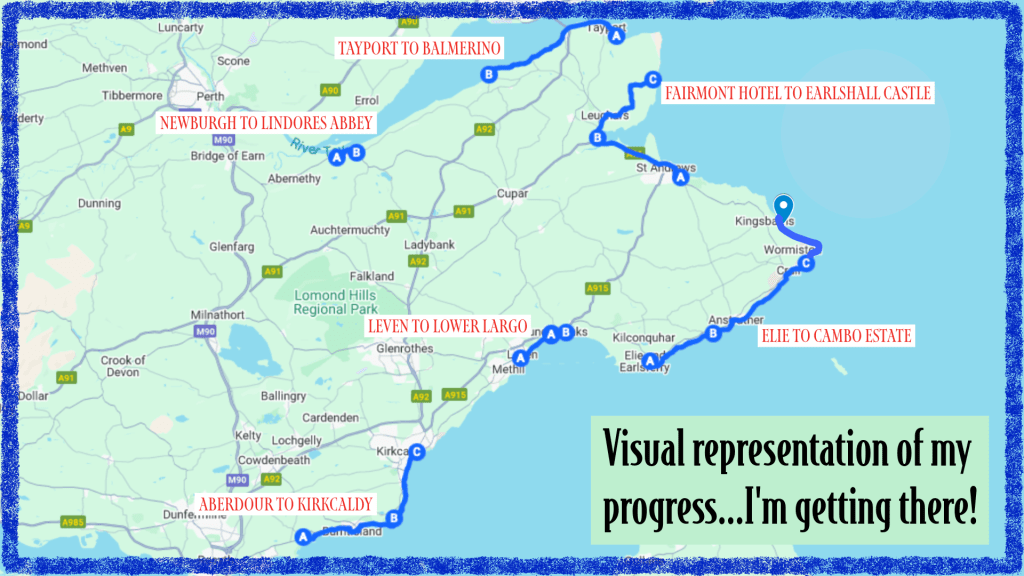
I’ve made it just less than half way, and in case you can’t picture it, here is a visual of the walks I have already done:
So, what next?
I have a lot of work travel planned for this semester and I’ve finished most of the sections of the trail that are relatively easy to reach. So, from now on, most of my walks will require considerably more planning and effort to complete. The far end of the walk, from Kincardine to Inverkeithing, is a solid 90 minutes away by car or longer on public transport, meaning a full day is likely needed to get these sections done. That said, the most challenging part may be Balmerino to Newburgh, which if done in one go is 13 miles. So more likely, I will need to split it in two, and I will need someone else with a second car to help. I’ve had plenty of offers from kind friends, so hopefully this summer the coordination will be possible. (I do, of course, have it planned out. This is me, after all).
So I’m not sure if I’ll manage the rest of the path by the end of July, or if I’ll need to extend by a few more months, but one way or another, I intend to keep walking, keep photographing, and keep writing about my experience.
The business of the season has meant that it has taken me a bit more time than I hoped to pull together all of the pictures I took on my last international adventure, but I have finally managed it! The trip, as the title of this post makes clear, was to Mexico – a new country for me, and one I did not really know what to expect in visiting. Fortunately, I was taking part in a tour of schools that was mostly organised by someone else, and I was able to enjoy my few days in Mexico City with relatively little stress. (Ciudad de México, or CDMX as the city is also known)
The weather was beautiful and a touch cooler than I expected, particularly in the morning. In fact, many Mexicans were wearing coats and scarves while I was still out in my short-sleeved shirt. The food was excellent and while the city was slightly overwhelming in its size, it was full of charm and history. I did plenty of Googling and blog-reading in the week before my trip, and so I set off armed with some tips for safe travel as well as a list of places to visit if I had the time.
After two long flights stopping over in Newark, I arrived in Mexico City at about 8pm (for those of you doing the math, that is 2am UK time). I had read that Uber was not permitted to pick up passengers in the airport, and so it was strongly recommended that visitors use one of the – as it turned out – many ‘authorized taxi’ companies inside the terminal. I was looking out for a pink one in particular, but must have walked past it and, in my exhaustion, ended up outside the terminal where I was immediately harangued by drivers asking if I needed a taxi. Finally I returned inside and found a kiosk where I could pay for my taxi to the hotel. I should note that I studied Spanish in high school to quite a high level, but that was more than 20 years ago and my skill has…rusted a bit since then. I’ve been using Duolingo to re-familiarise myself with the language as best I can; I can read relatively well and usually speak a bit, but when I am spoken back to, it is usually far too fast. Nevertheless I muddled on and found in general that the Mexicans were very happy for me to give it a go, then often spoke back in English or were willing to slow down a bit for me to work it all out.
I arrived at my hotel after a rather chaotic drive, not in part because I had arrived on 1 November, a day of massive celebrations in Mexico City. Though as I was to learn, driving there is always a bit chaotic. I hardly had time to notice my room before having a quick shower and falling into bed.
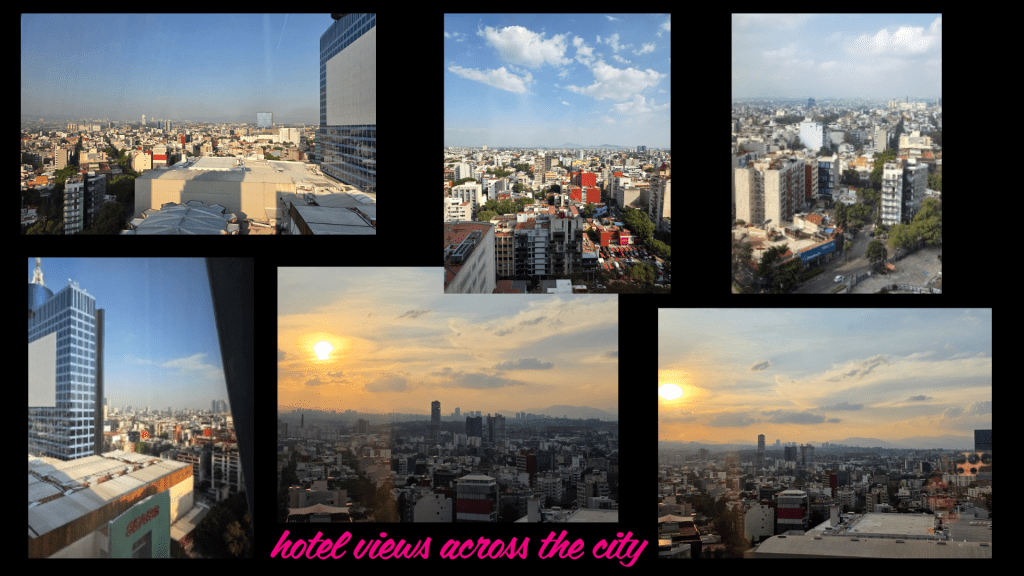
It was early the next morning when I awoke that I was able to really enjoy the fantastic view over the city – my hotel was in a modern area, World Trade Center, but I could see through the hazy air to the distant mountains. Mexico City sits in a kind of bowl almost one mile above sea level, surrounded by a ring of peaks.
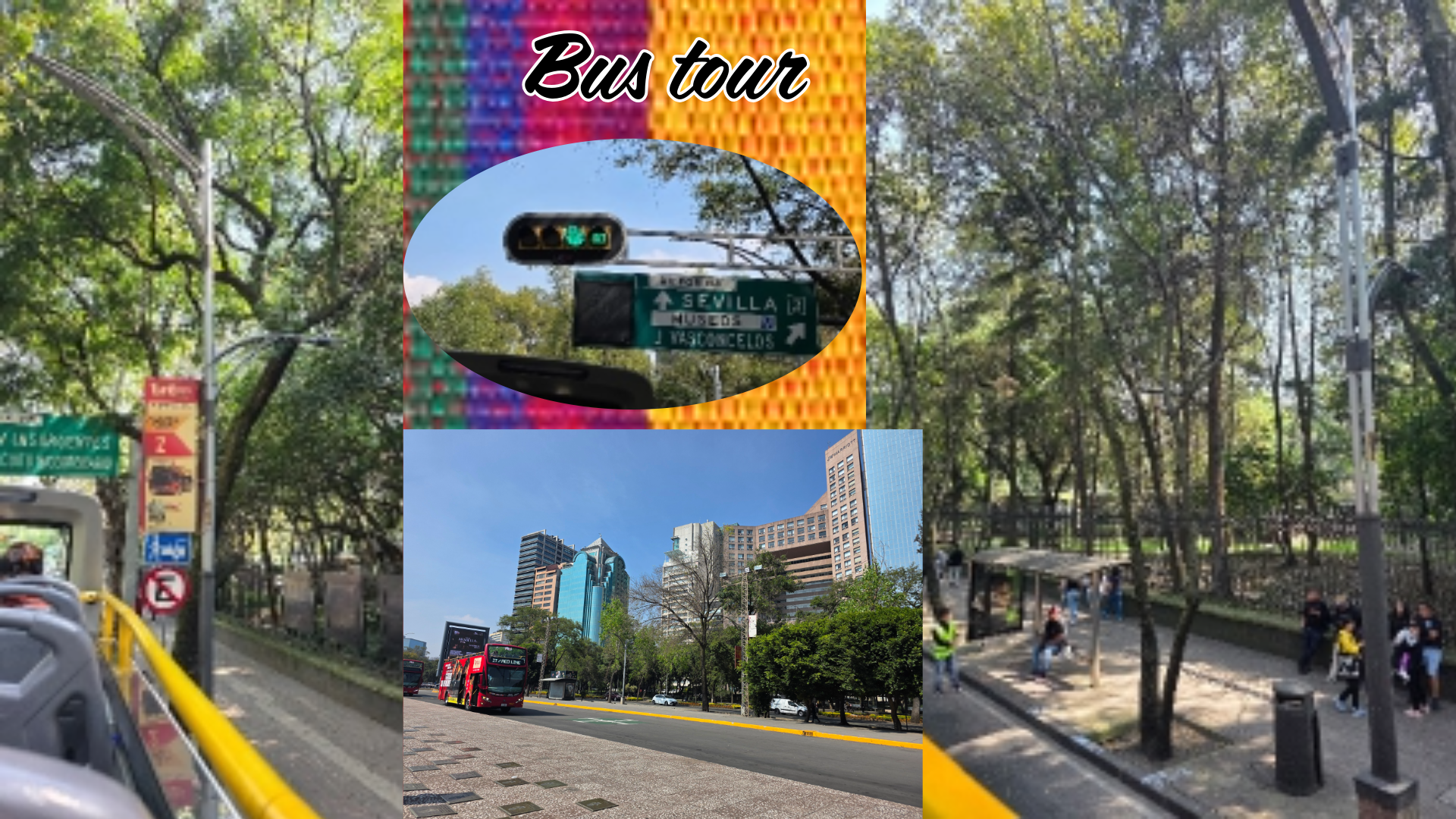
After a lovely breakfast and leisurely morning confirming my schedule for the week, I set off on my first adventure: an open-top bus tour around the city center. I am a big fan of bus tours, especially if you can sit upstairs and enjoy the feeling of winding through a city and seeing everything with very little effort. They can be a great way to orient yourself and learn a bit about what you are seeing. (side note, I had brought my own headphones for the trip which turned out to be the right choice, as none were provided)
My bus tour required an Uber trip up to the Auditorio Nacional, and I had learned that there was an English dub to the tour dialogue. The tour cost was reasonable, and the bus was clean and not too busy so that I was able to change sides a few times as we drove through the city – most likely slower than normal due to it being both a Sunday and a holiday. I opted for the Historic City Centre route, and while I gave up on the recording about halfway through, I got to see a lot of the city and learned a few choice tidbits. One recommendation – while you can purchase your ticket easily online, there were vendors that came onto the bus selling souvenirs who only accepted cash, so it might be worth having a few hundred pesos at the ready.
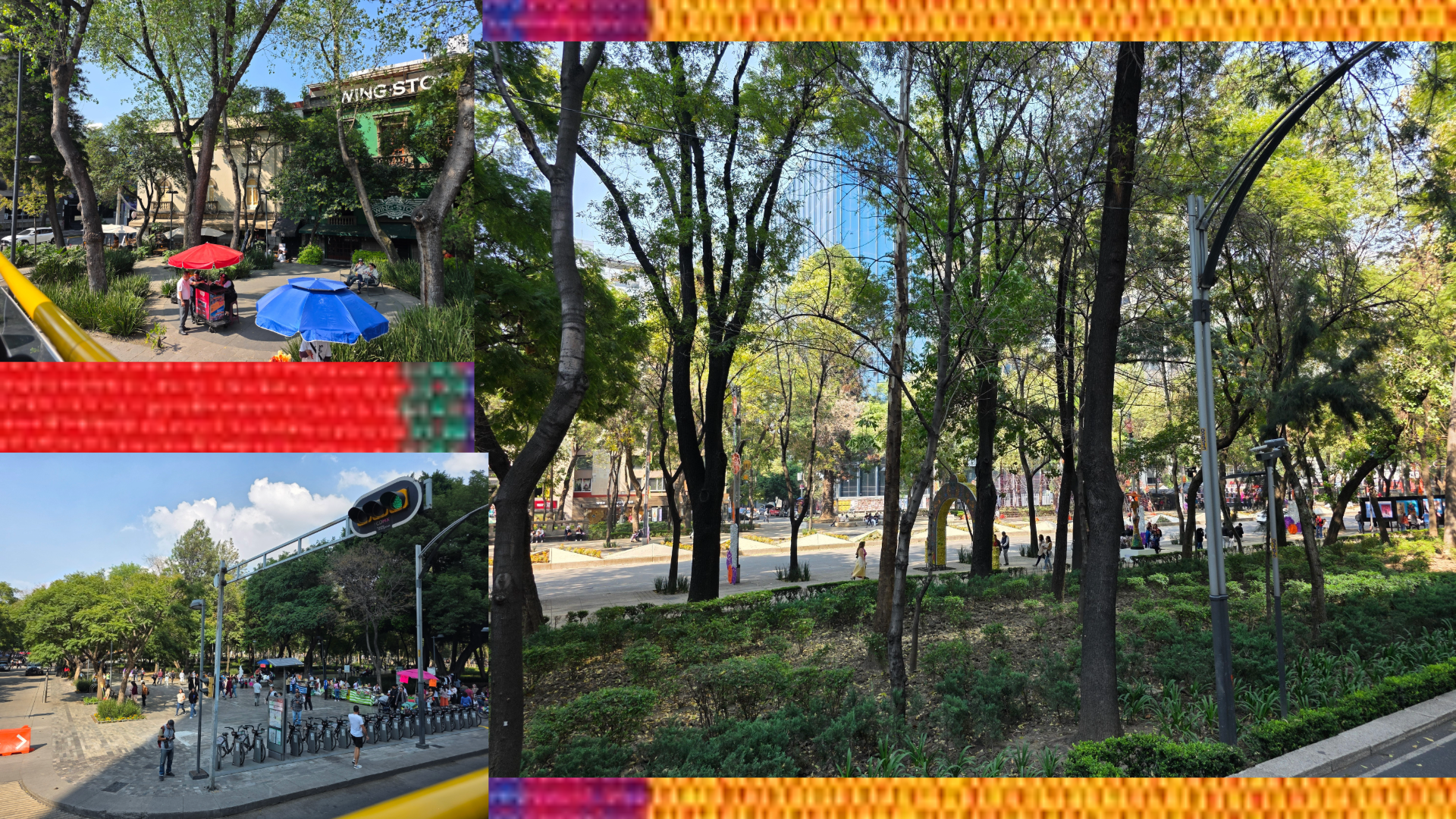
Mexico City has a metro bus system that is almost like a tram in that the busses have their own lanes and traffic signals. The parts of the city I saw were also filled with green spaces – parks, tree-lined street divisions, and much more.
Bus tour sights
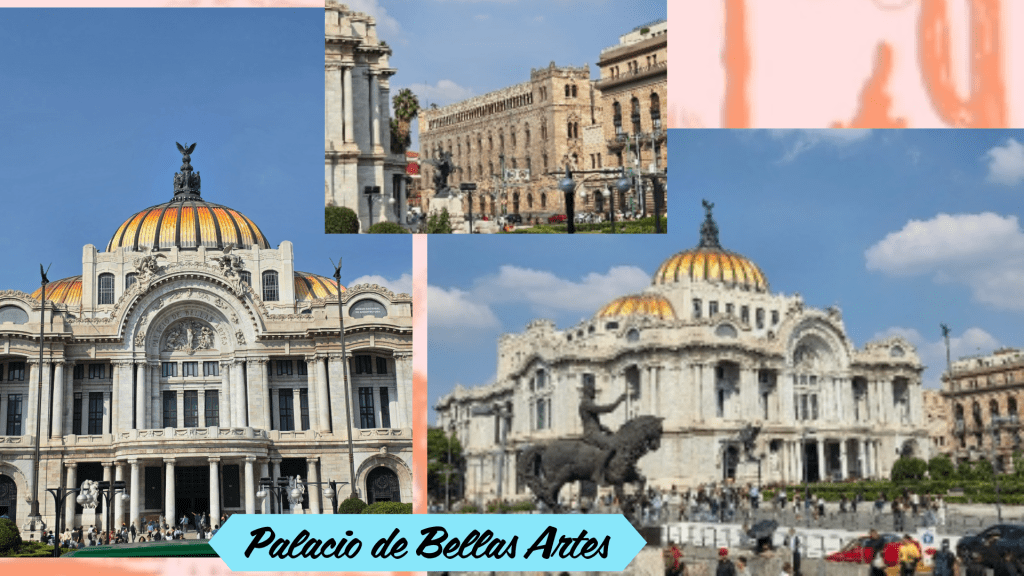
Palacio de Bellas Artes – Palace of Fine Arts, a stunning building at the edge of Mexico City’s historic centre, declared an artistic monument by UNESCO in 1987. Home to murals and other art by some of Mexico’s most important artists.
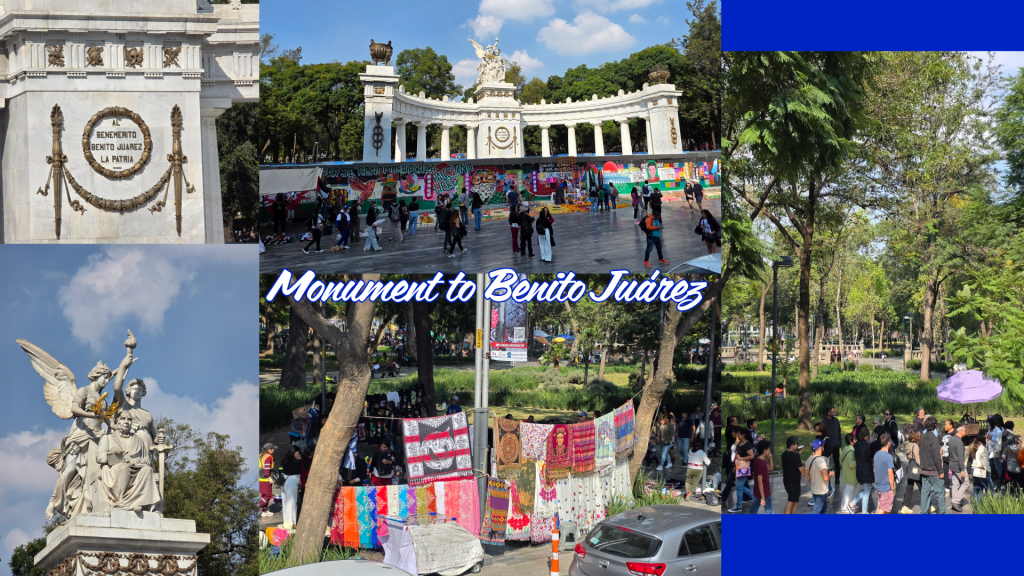
Benito Juárez Hemicycle – commemorating the Mexican stateman who was the first Indigenous president of Mexico, and who became a symbol of nationalism and resistance to foreign intervention.
El Angel de la Independencia and the Plaza Madrid. The Fountain of Cibeles (mother of Jupiter) in the plaza is a direct copy of the one in Madrid and symbolizes Spanish-Mexican brotherhood. The Angel was built in 1910 to commemorate the beginning of Mexico’s War of Independence.
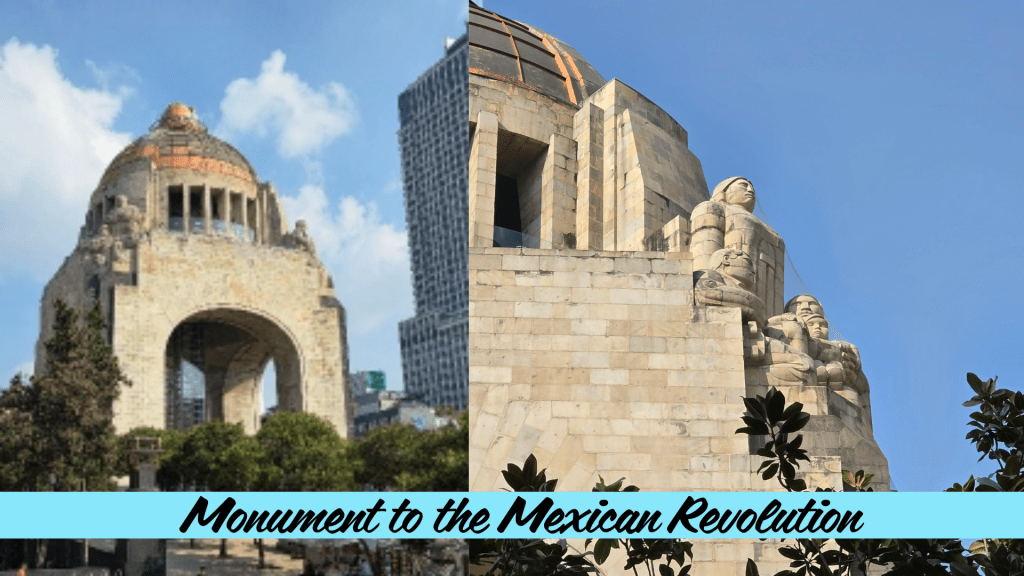
Monumento de la Revolución, in the Plaza de la República, the tallest memorial arch in the world. I was particularly struck by the carvings of people on each corner.
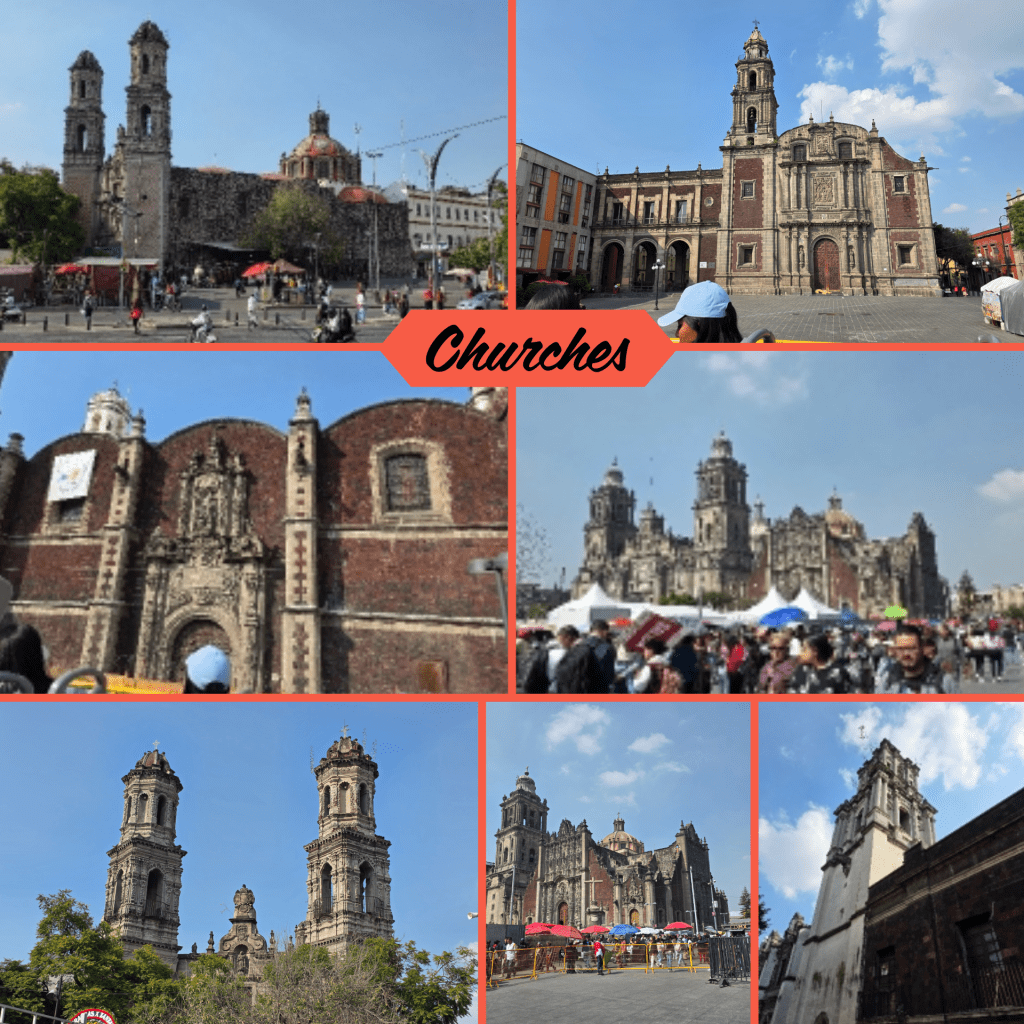
We passed numerous churches on the bus tour, and I do not have the names for all of them, but they were a beautiful combination of European influence and Mexican flavour. Mexico is still a majority Roman Catholic country, and like the European cities before it, has countless options for worship.
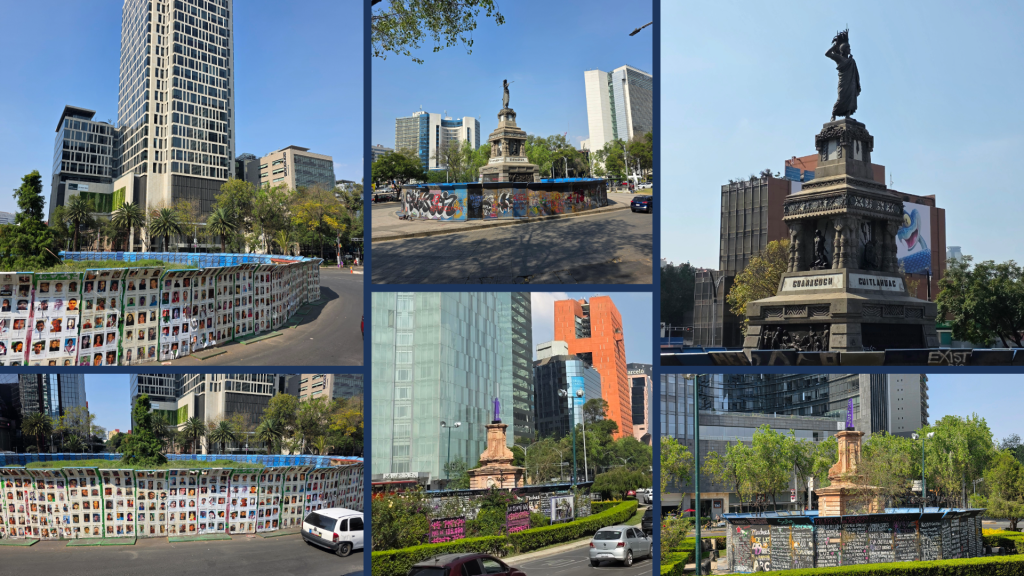
Also striking were the many city intersections and rotaries with dramatic statement pieces in the centre. Below is the the Monument to Cuauhtémoc, the last Mexica ruler of Tenochtitlan, the ancient city at the heart of where Mexico City now stands.
One monument that really stuck with me is the Glorieta de las mujeres que luchan (Roundabout of the Women who Fight), a purple statue of a woman with her fist raised, and the with the word ‘Justicia‘ carved into the cross-support. On the panels at the base are inscribed numerous names (of those who have fought injustice, female and male) and messages of strength and support. It took me a bit of digging to find out more about the display, and discovered it is now a center for many feminist cultural events and activities. It was incredibly moving to see such a strong monument to women supporting one another, to women’s rights. At a roundabout close by, Glorieta de las y los Desaparecidos, families of missing people have covered walls in pictures and search cards, to honour and remember the lost.
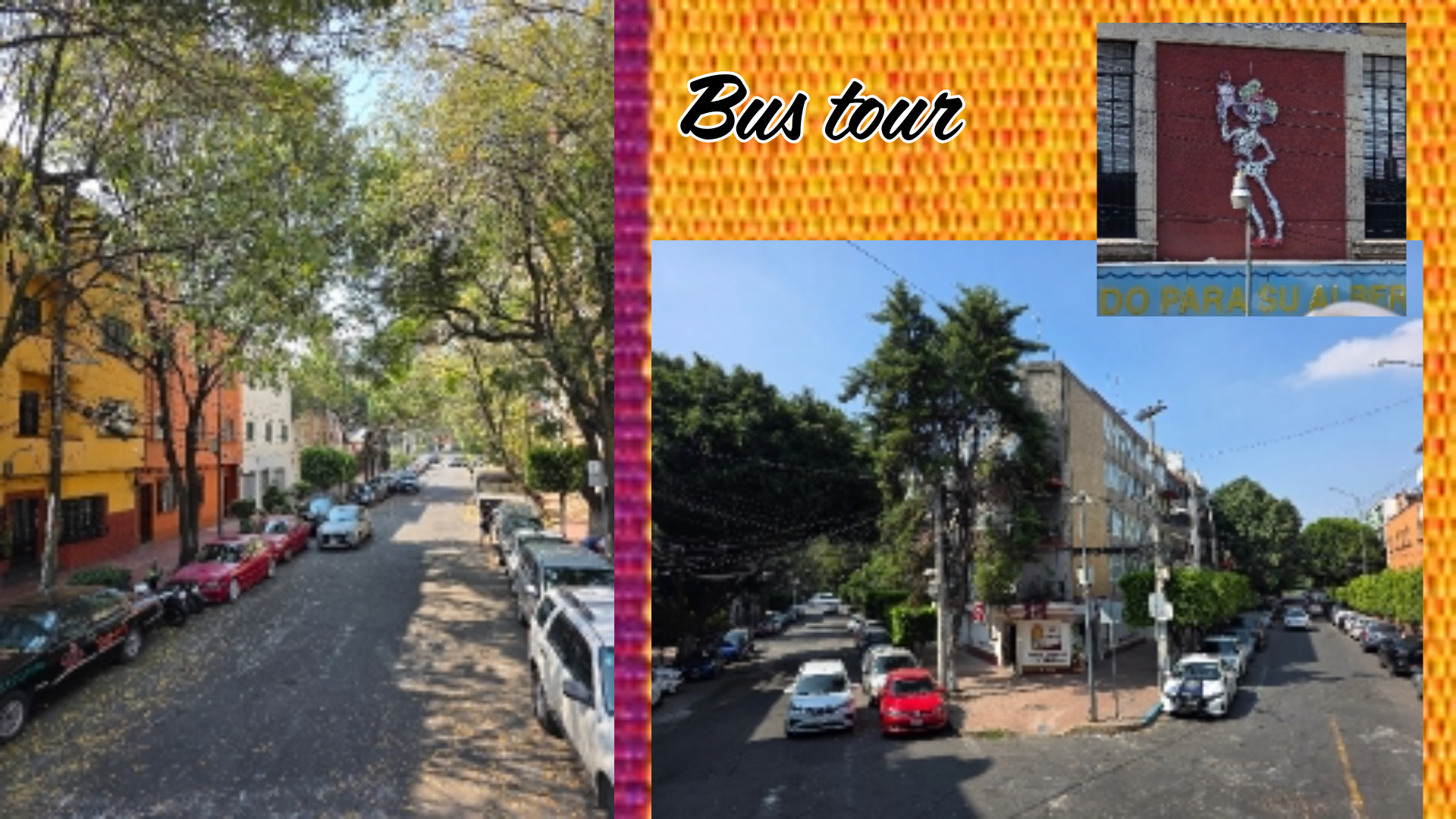
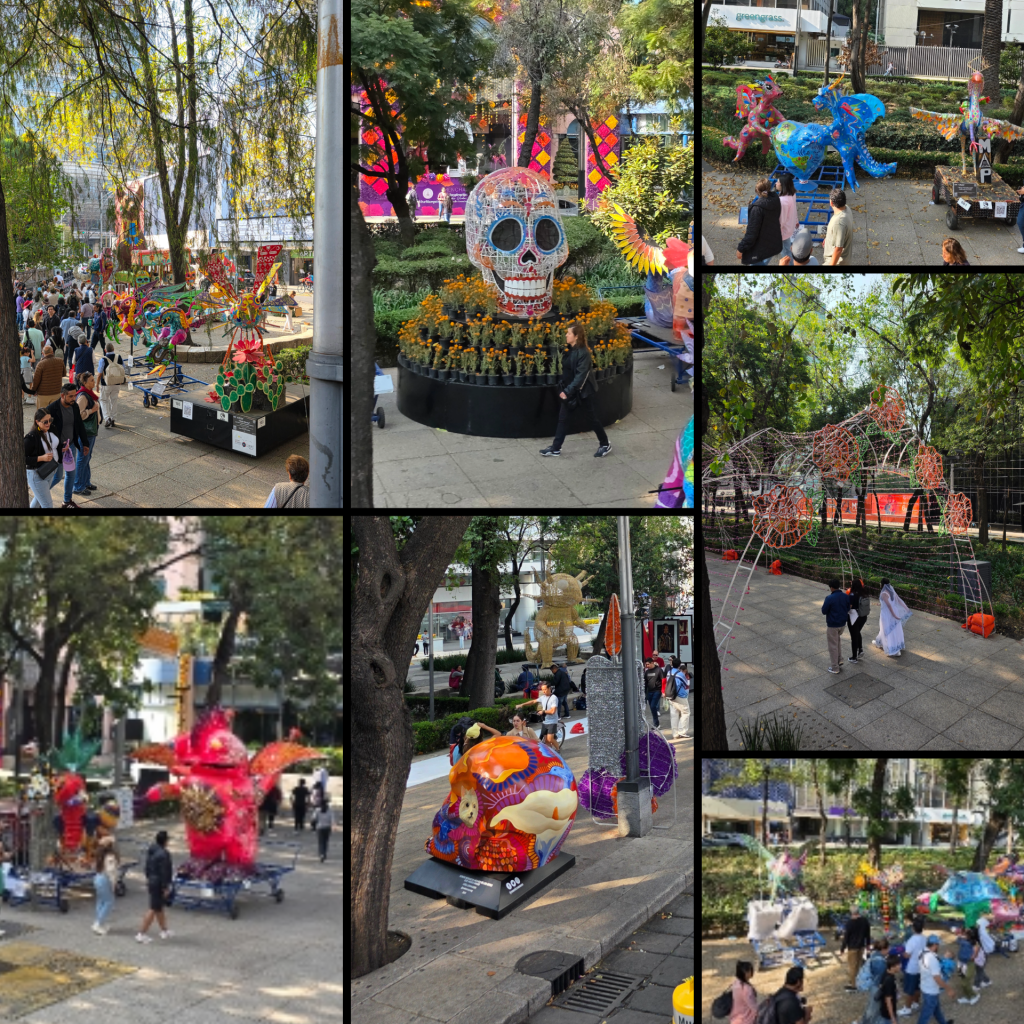
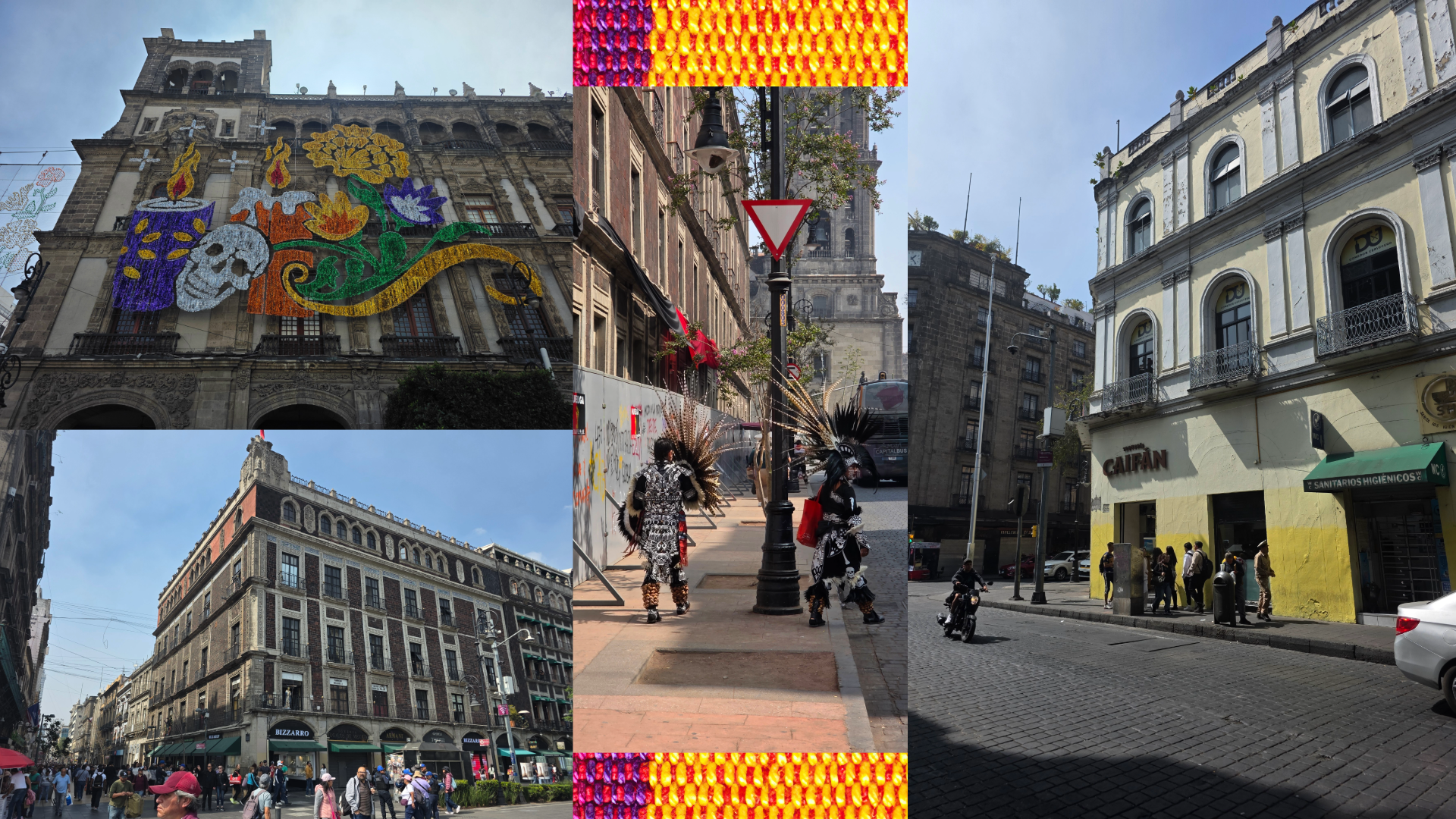
As the bus wound through the city, I was delighted to see display after display of brightly-coloured street art, most for the recent Día de los Muertos holiday, which gives Mexico its famous skull art.
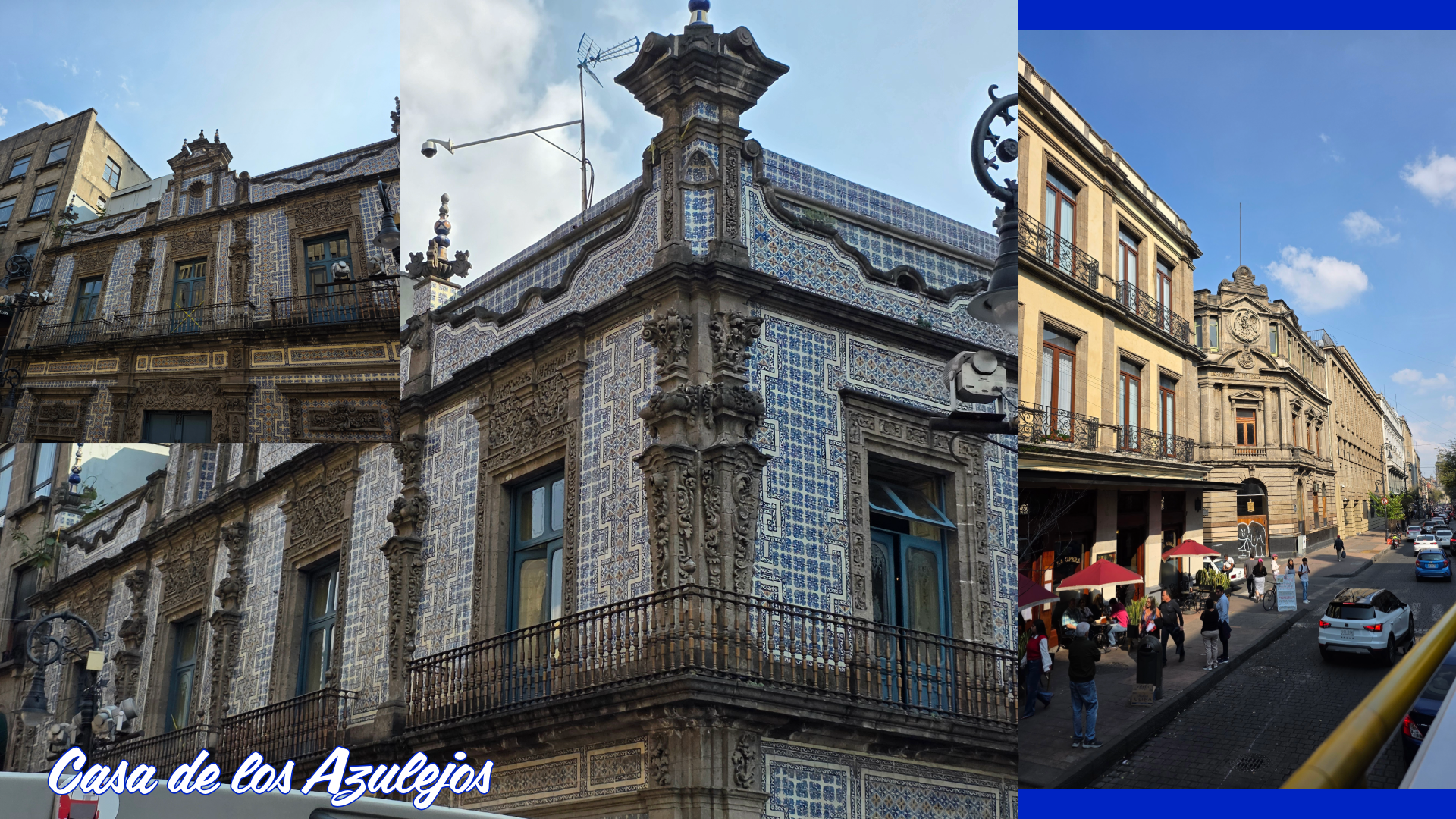
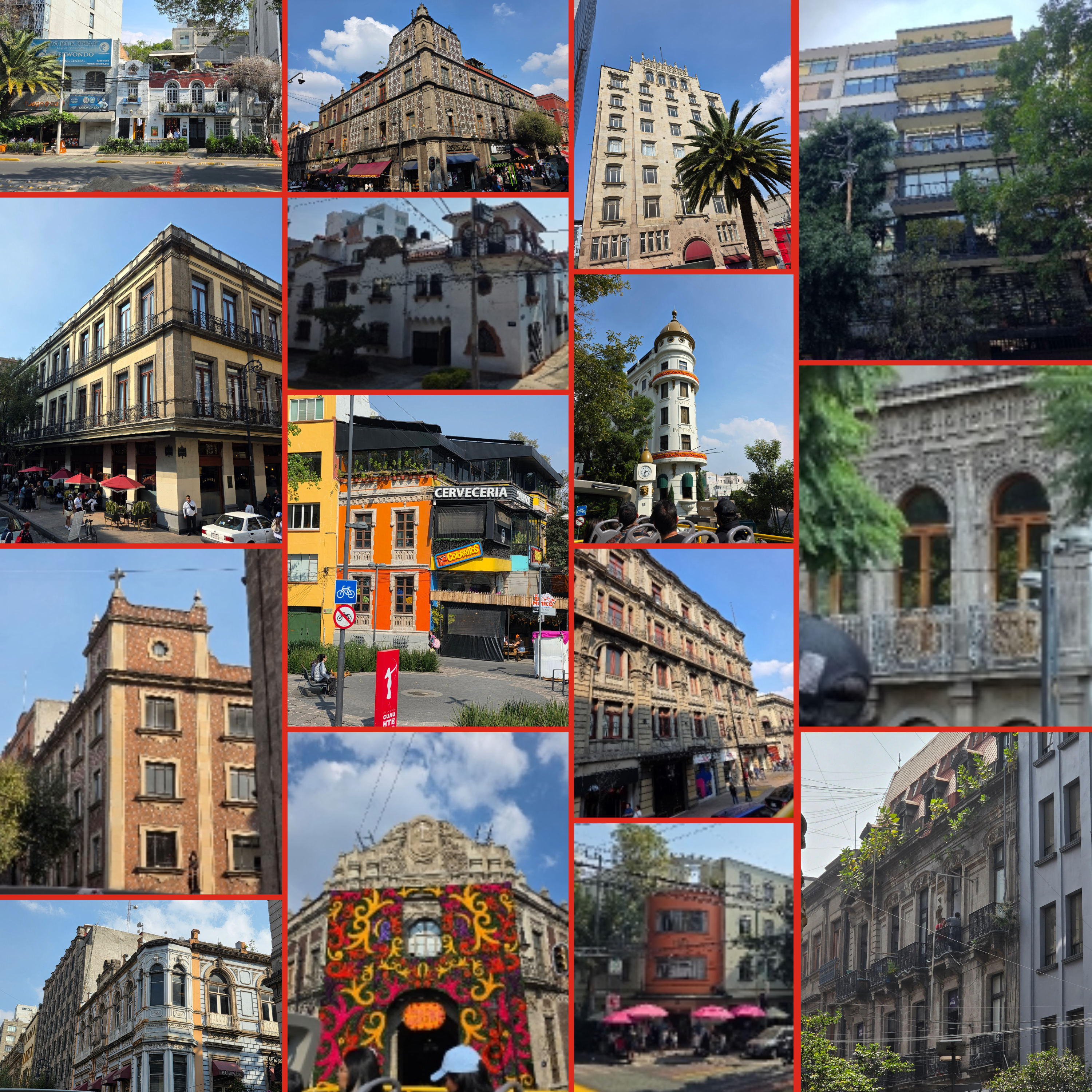
The architecture was also fascinating, both from the bus and as we walked through the historic centre later in the week. I’ve decided it was easier just to pull all the pictures into a collage:
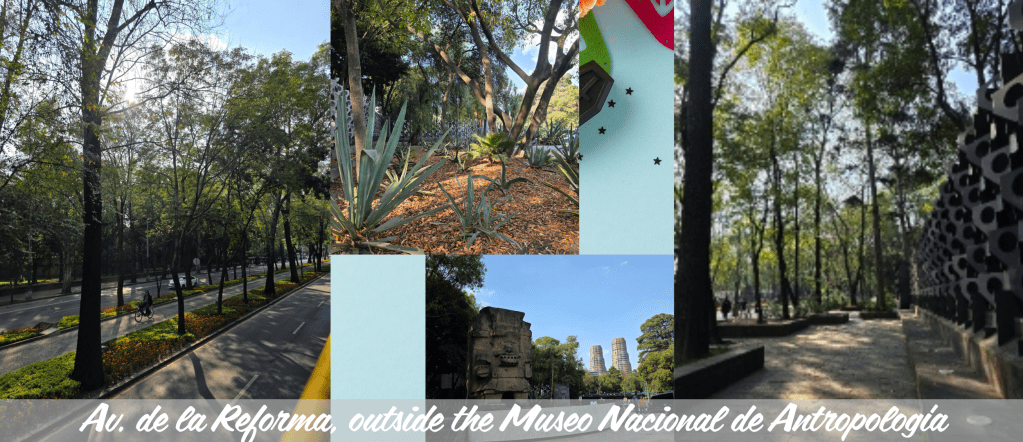
The bus tour was a great way to get a feel for the city and not be stuck at street level, but it was a long route and I was happy to jump off one stop before the Auditorio Nacional. I was just outside of the Museo Nacional de Antropología, which I would have loved to explore but was ready to return to my hotel for a bit. So, I enjoyed a relatively gentle and shaded walk along Ave. Plaza de la Reforma. It was a glorious sunny afternoon, the temperature was pleasant – probably about 75℉ – and there were people out everywhere, some dressed for the holiday with masks or painted faces.
This section of the road is divided and I realised quickly that I would not be able to pick up an Uber, so I did in the end return to the Auditorio to find that there was a portion of road specifically for taxi pick-ups and drop-offs – a sign with a very obvious taxi letting a person out of the car. Upon my return to the hotel I spent a quiet hour catching up on emails while looking out over the city.
For the next few days I had work events, including a 22-hour trip up to the nearby city of Querétaro, where there were international schools to visit. Slightly frustratingly, my suitcase was the only one of eight (all checked at the same time) not to make it onto the flight. Fortunately, the hotel we stayed at was a Japanese chain with excellent toiletries and facilities. I did not get to see much of the city, but some research indicates it would be fun to spend time in should I have the opportunity.
Exploring Mexico City – part 2
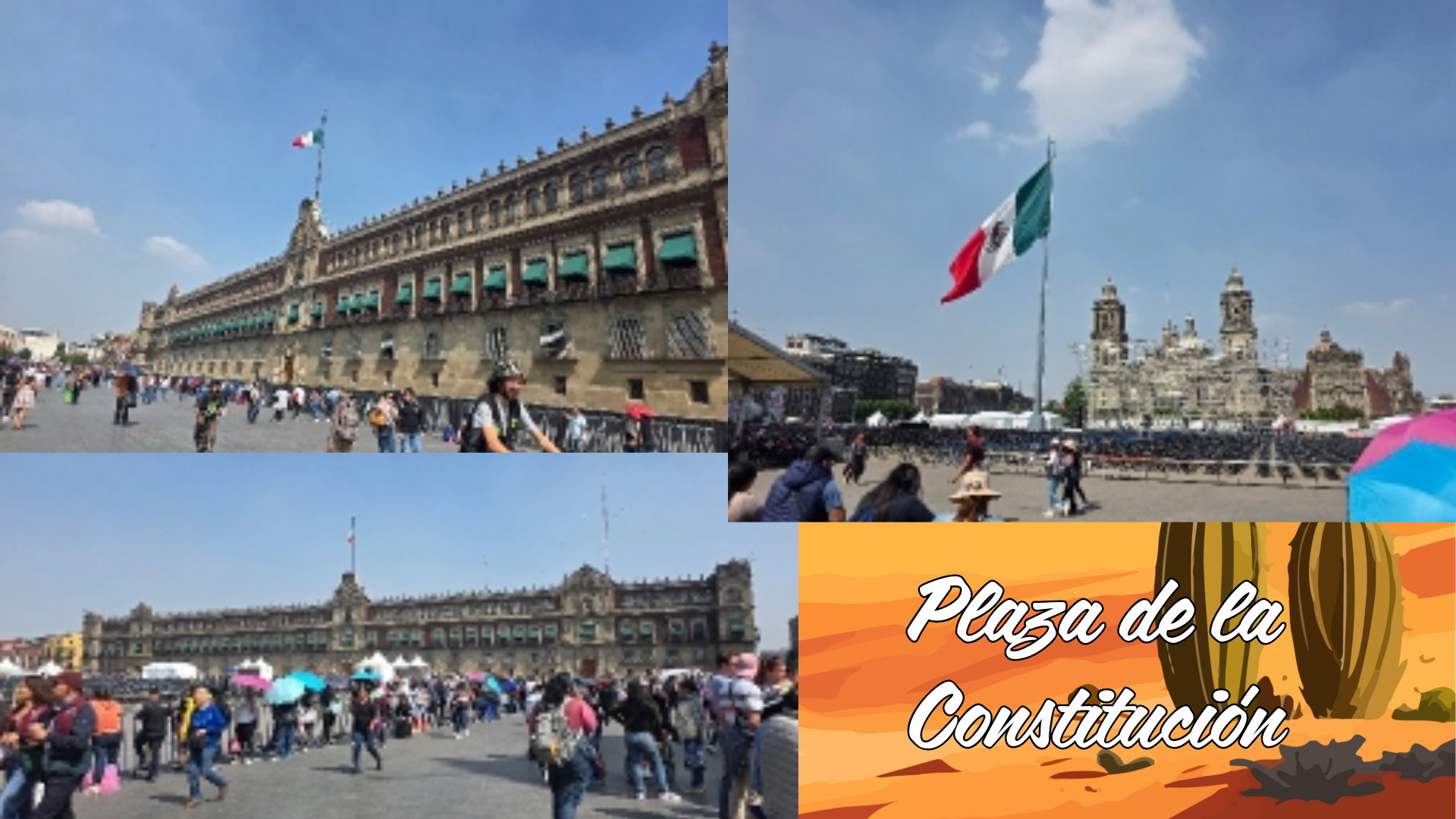
The day after our return to Mexico City, a few others who were in the same hotel joined me in an adventure up to the Plaza de la Constitución and the cathedral. We took an Uber and stopped first for lunch at a local restaurant where my Spanish was just enough to get us a table and pay for our meal with almost all the cash I had left. The food was excellent, though we did have to do a little surreptitious Googling to make sure we knew what we were ordering. After lunch we wandered up to the plaza, which is the second-largest square in the world after Tiananmen Square in Beijing. I knew it had set a record but standing at the edge of the plaza it is really impressive, with the cathedral on one side and stunning monumental buildings on all others, including the Palacio Nacional – the seat of the executive government. On the day we visited the square was largely fenced off for a major event taking place later in the day, with thousands of chairs set up facing a stage.
So, we started at one corner of the Catedral Metropolitano and took a long slow walk around theedges of the square, including one detour off along a shopping street. Some of the buildings were still decorated for the holiday, and even on a Wednesday afternoon, there were people everywhere – locals, tourists, families, teenagers, groups and people wandering on their own.
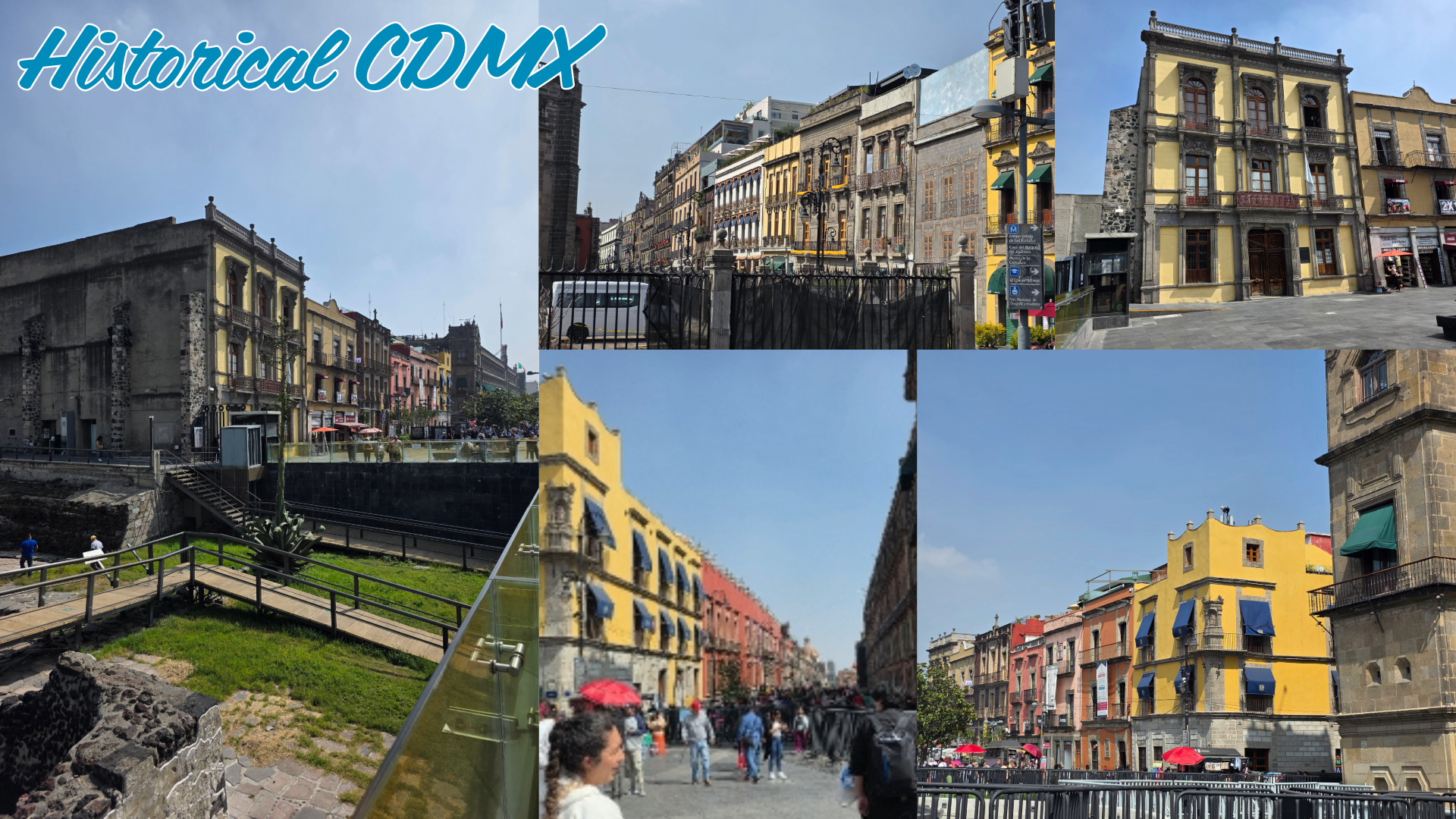
As we walked up the far side, along the front of the Palacio – and the historic centre – I realised that ahead of us was the spot in Mexico City I had most wanted to see: the Templo Mayor. This site was the main temple of the Mexica people in their capital of Tenochtitlan, and dates from the mid-fifteenth century. One of my lectures to the summer school students is about the impact of disease on the native populations of the Americas, and so I had done a great deal of reading about Tenochtitlan and its history. It was fascinating and incredibly exciting to see this evidence in person.
We hoped to go into the museum but they were not willing to let us in with bags and water bottles; fortunately there is a large terrace looking over the site which includes models both of the temples and the city as it would have looked pre-conquest.
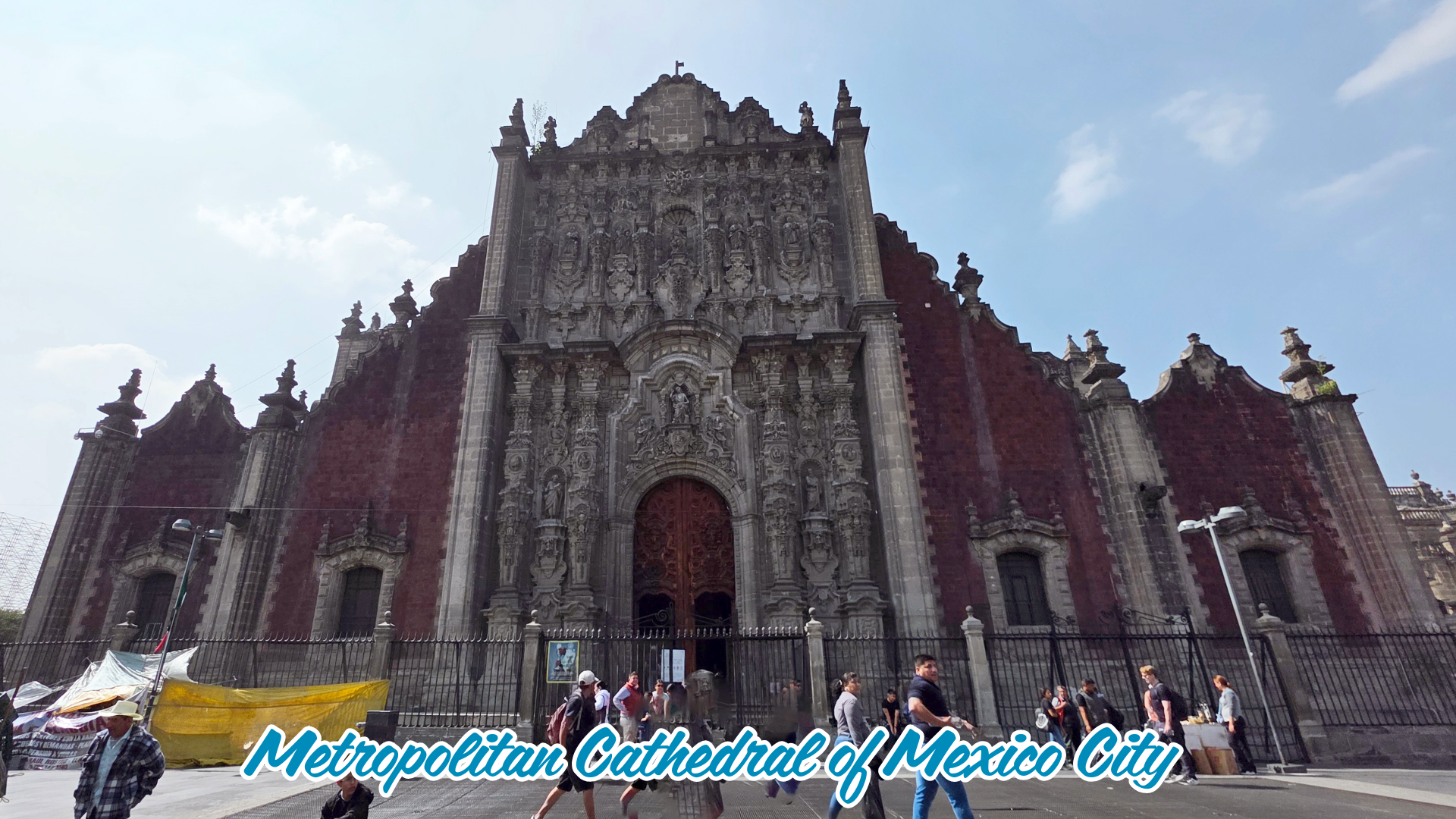
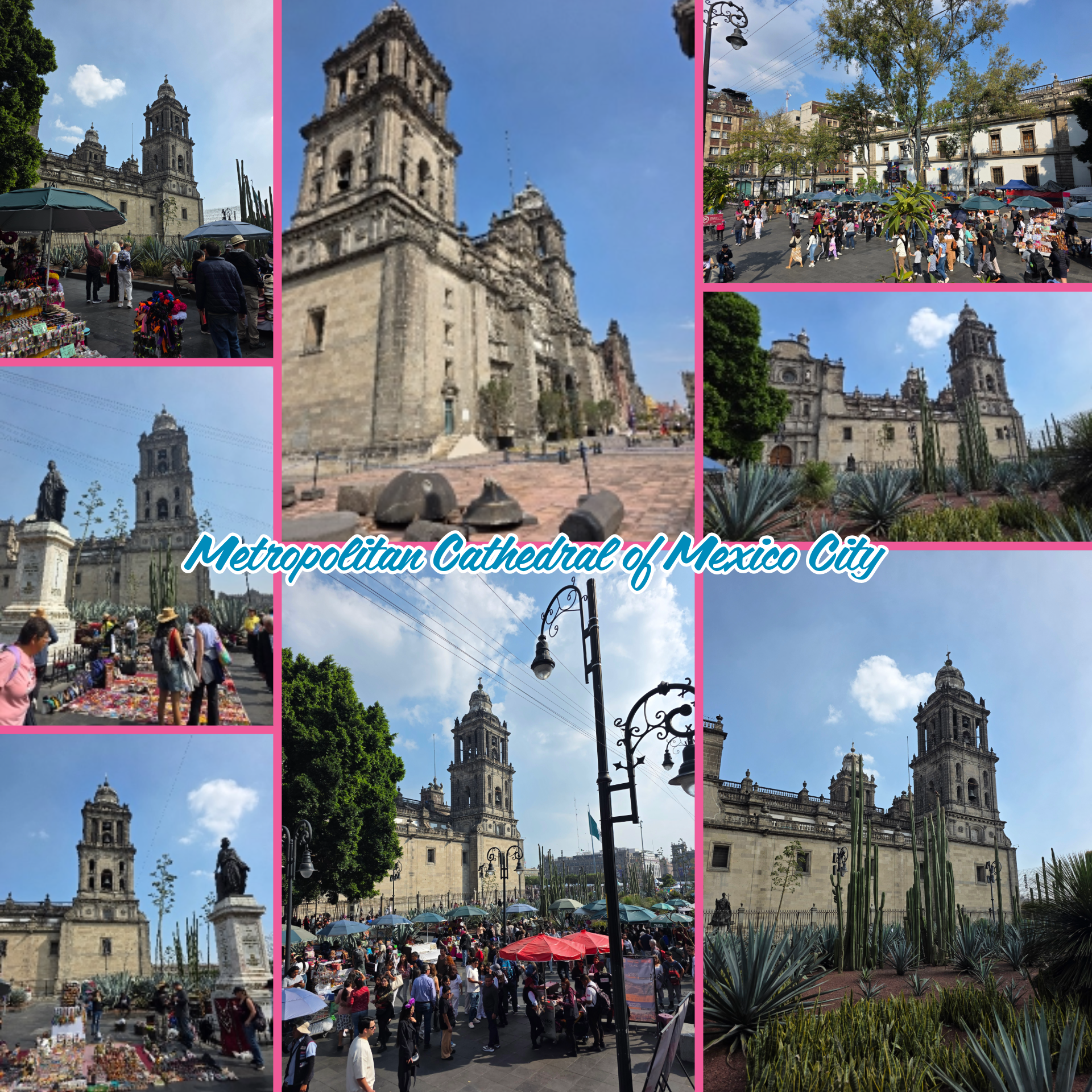
Immediately opposite the temple, around which buildings of several generations have been constructed, is the massive Catedral Metropolitano, built over the former Aztec sacred precinct. The sections range in age of construction from 1573 to 1813, around the original church build after the Spanish conquest of the city. Each face of the cathedral is slightly different, and it felt like we could be looking at three or four separate buildings, depending on which side we viewed it from. We were starting to run out of time – several of us had work calls to get back to – so could not venture inside, but I hope I might manage on a subsequent trip.
The journey back to our hotel took considerably longer than expected, and was my longest Uber journey in the city – more than an hour to go 3.5 miles. I think next time we would probably just walk! But then, that is Mexico traffic, and something one has to be prepared for in most major cities around the world.
Later that evening, a colleague and I walked about a block or two away from our hotel to find El Bajío, one of an excellent chain offering authentic Mexican cuisine. I had a traditional slow-cooked barbeque lamb which was phenomenal, especially with fresh pico de gallo. The accompanying grilled cactus was not to my taste. The margarita, which they made at the table on a small cart similar to a pastry or carvery cart, was second to none, and I was given a list of over 100 tequilas to choose.
I thought here it might be fun to show off some of the excellent food I had while in Mexico including a loaded baked potato with guacamole, a Mexican pastry from a jaw-dropping local bakery, pork tacos, a chicken burrito with dark bean sauce, and a berry-tequila cocktail to celebrate the (eventual) return of my luggage.
There is no question you can eat very well in Mexico – breakfast each day was excellent with many different types of bread (including a mouth-watering plaintain bread), eggs with peppers, fried potatoes, and piles of fresh fruit including the best pineapple I have ever had. I did miss the occasional salad, however – something best to be avoided, along with anything washed in local water.
We had two more days of intense work, then after what felt like a very short week, I was packing again to head home. On my last morning in the hotel, I enjoyed a beautiful sunrise with the distant mountains outlined in orange and yellow.
I had reserved an Uber for my return to the airport – this direction was permitted – and despite flying during the government shutdown, found my connection through Newark quite straight-forward. I am lucky enough to have paid for TSA Pre-check as well as Global Entry, so was able to miss many of the longest queues. The last trip of the semester is always the one you’re ready to get done with so that you can breathe a bit and enjoy your time at home. This trip was no exception, though I really enjoyed my time in Mexico and look forward to taking a bit longer when I (hopefully) return to visit the nearby ruins of Teotihuacan and get inside some of the monuments.
As we took off, we had views of the city – showing its size and hazy air – as well as the nearby hills and the mountains that stuck out in darker green against inhabited valleys.
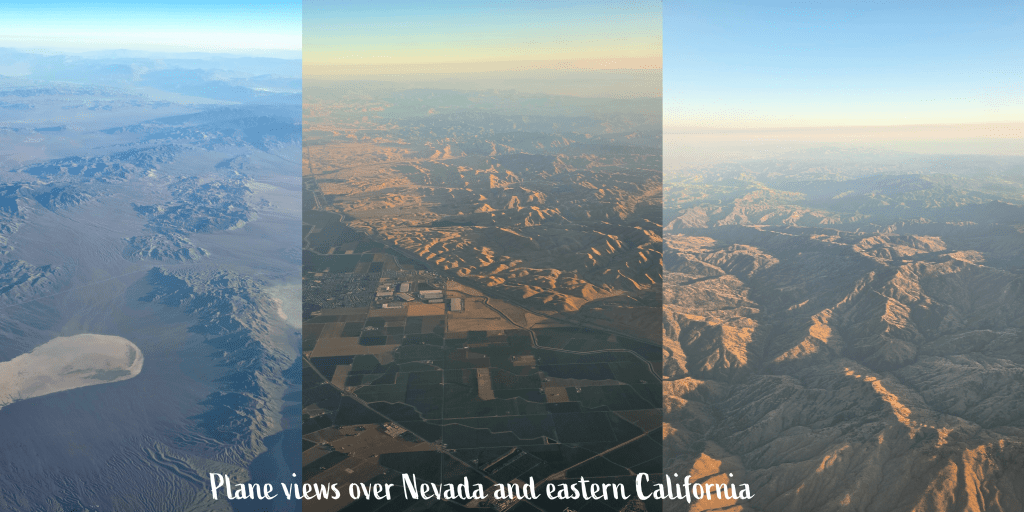
The US and then subsequently Scotland welcomed me with equally impressive plane views – quickly becoming a favourite and making me reluctant to give up my always-requested window seat.
So, before I close, a few top tips for those planning a trip to Mexico either for work or fun:
Make sure you use ‘authorised’ taxis in the airport; you tell the kiosk where you are going and they quote you a price. They then take payment, and bring you to a car; no money changes hands with the driver unless you wish to tip.
I reserved an Uber several times and it was excellent. Ubers in Mexico City are frequent and easy to use. But give yourself LOTS of time, and expect to be stuck in traffic.
It seems inevitable that walking around in the heat and sun would require a water bottle, but my reusable bottle was what caused issues getting into the Templo Mayor and possibly would have been an issue for the Cathedral. Staff were also searching all bags, and not happy about backpacks. So, be aware if you are planning to go inside a monument, you may need to give up your water bottle and may be subject to a search.
You can probably get around the city easily without ever taking any cash out, but I’d recommend having a few hundred pesos with you to buy souvenirs, tip (if you wish) and perhaps just to be on the safe side. I managed to use any leftovers I had in the airport before leaving, and I got some really cute souvenirs by the cathedral that were cash only (there are 100s of small stalls around).
In terms of safety, I never felt unsafe in the least, though I was mostly in the touristy areas with lots of people around, and I was careful to have my phone, hotel key, etc. in a cross-body bag that clearly identifies you as a tourist but is also safe from easy snatching. I didn’t carry or use a lot of cash, and the one time I went out in the evening on my own, I was in a busy and well-lit area.
Like any city, CDMX has neighbourhoods that are best avoided, and others that are very popular. I think that as long as you use your common sense and aware of your surroundings, there is no reason not to enjoy a fantastic week there, or probably more!
It’s been a while since I posted about something purely medieval, and so today seemed a good opportunity to do so, talking about one of my favourite English towns.
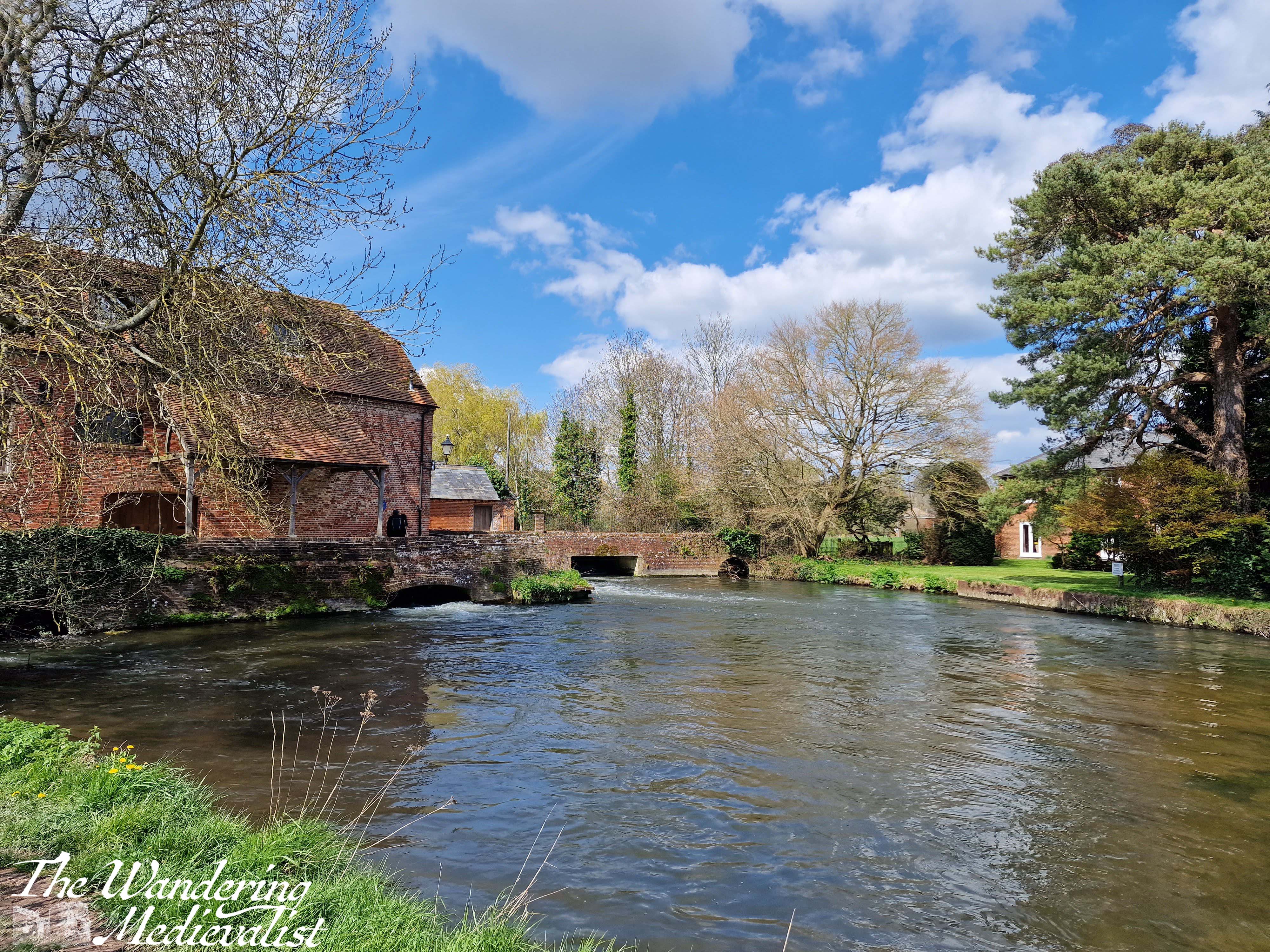
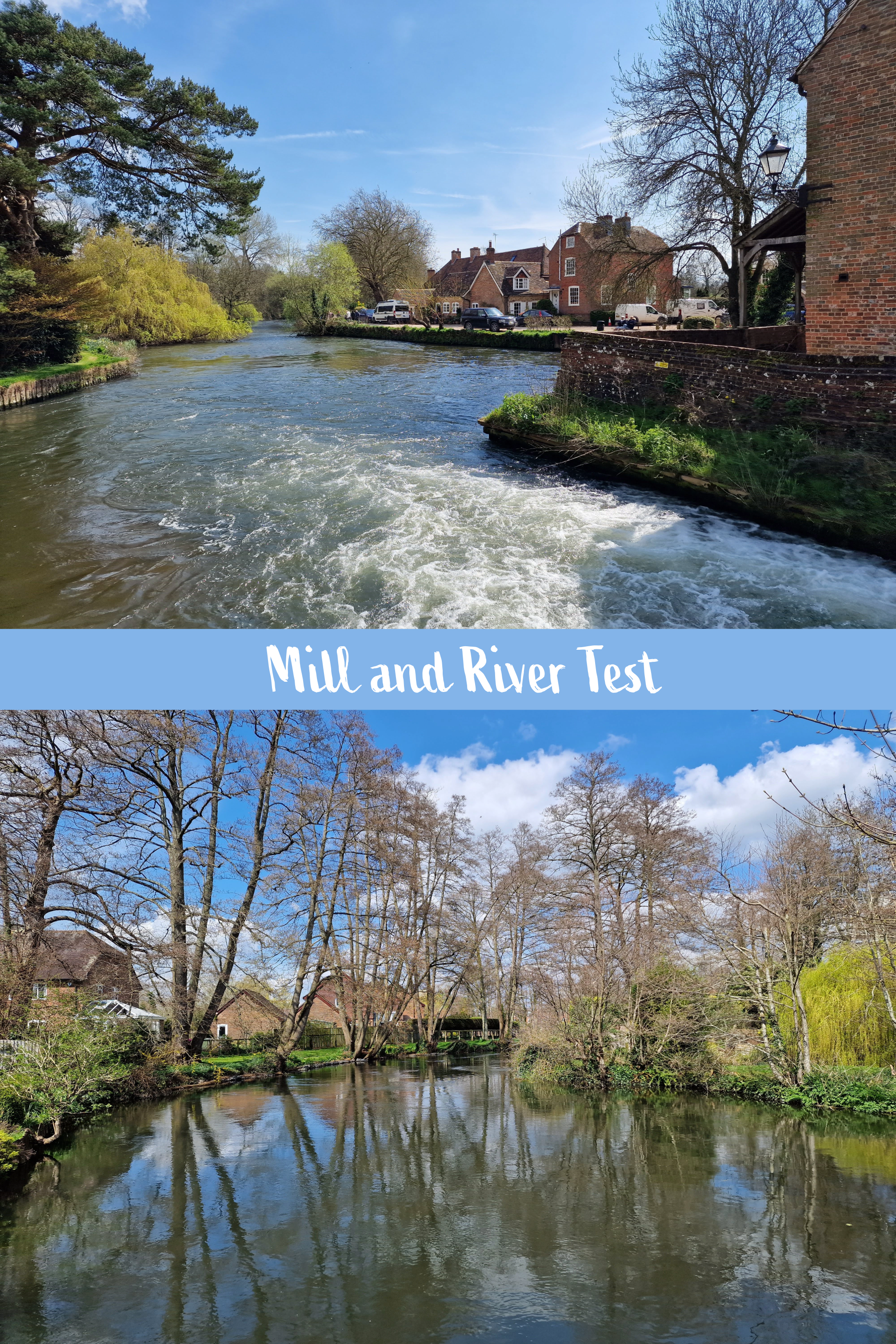
Romsey is a charming, well-to-do town about 7 miles from Southampton Airport, in the south of England. The town centre offers a mix of lovely shops, restaurants and pubs on winding streets and lined with Tudor-style frontages. The River Test flows through the community and some stunning parks, and past a picturesque old mill. The history in the town is more than evident; founded as far back as the 8th century, Romsey was a medieval market town that grew around the founding of the first church by King Edward the Elder in 907 CE.
Our connection to Romsey comes through some close friends who settled there some time ago, and who we try to visit at least once a year. The abbey is a required detour on our walks through the town, and I recall one relaxing morning in particular sitting under the trees with a cinnamon bun and coffee, enjoying the view.
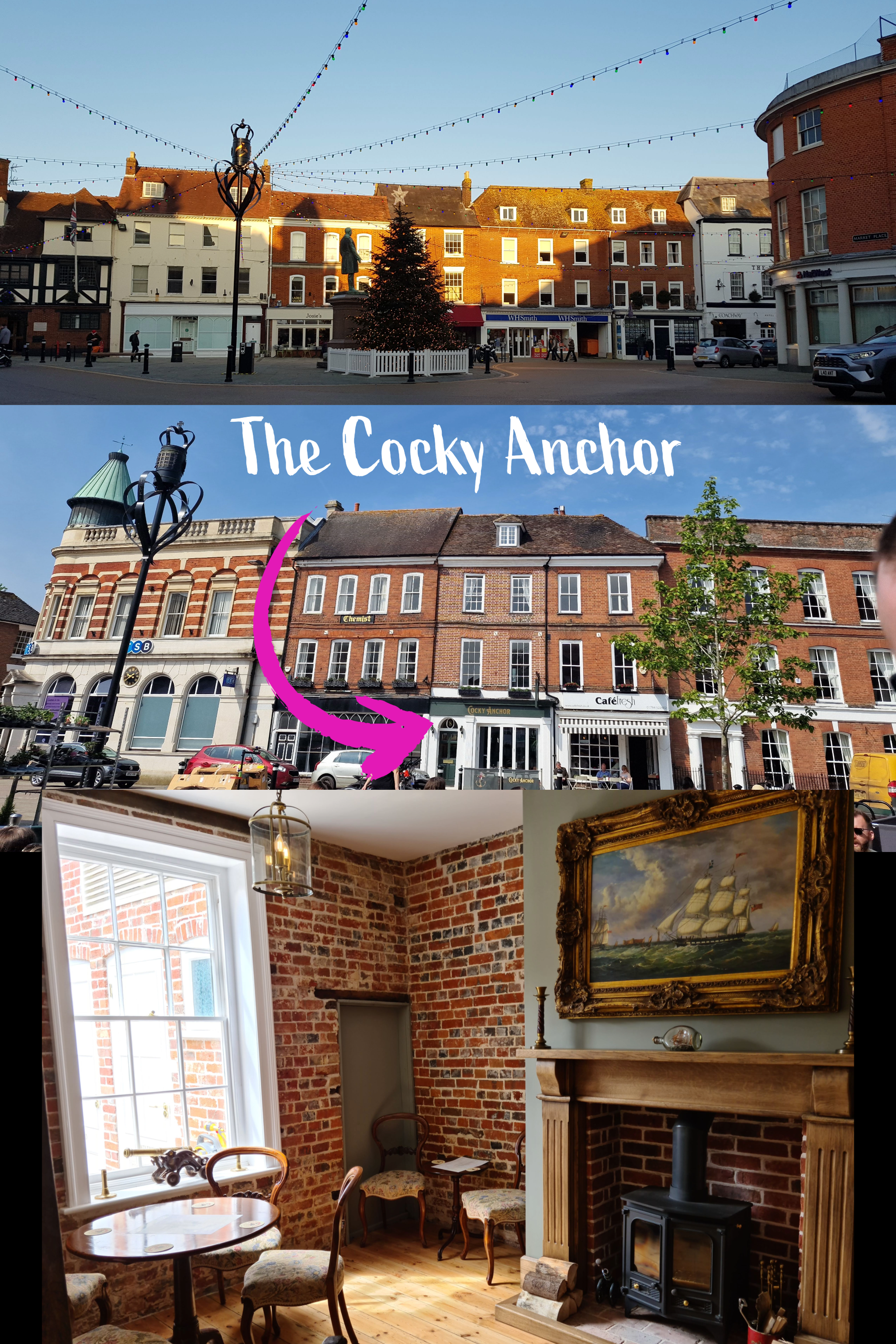
I also have fond memories of visiting the nearby pub the Cocky Anchor in summer 2021 – my first holiday after the end of lockdown – where the back beer garden offered great views of the abbey church.
The pub is just off the nearby market square, from which you have easy access to the abbey, along Church Street and down Church place.
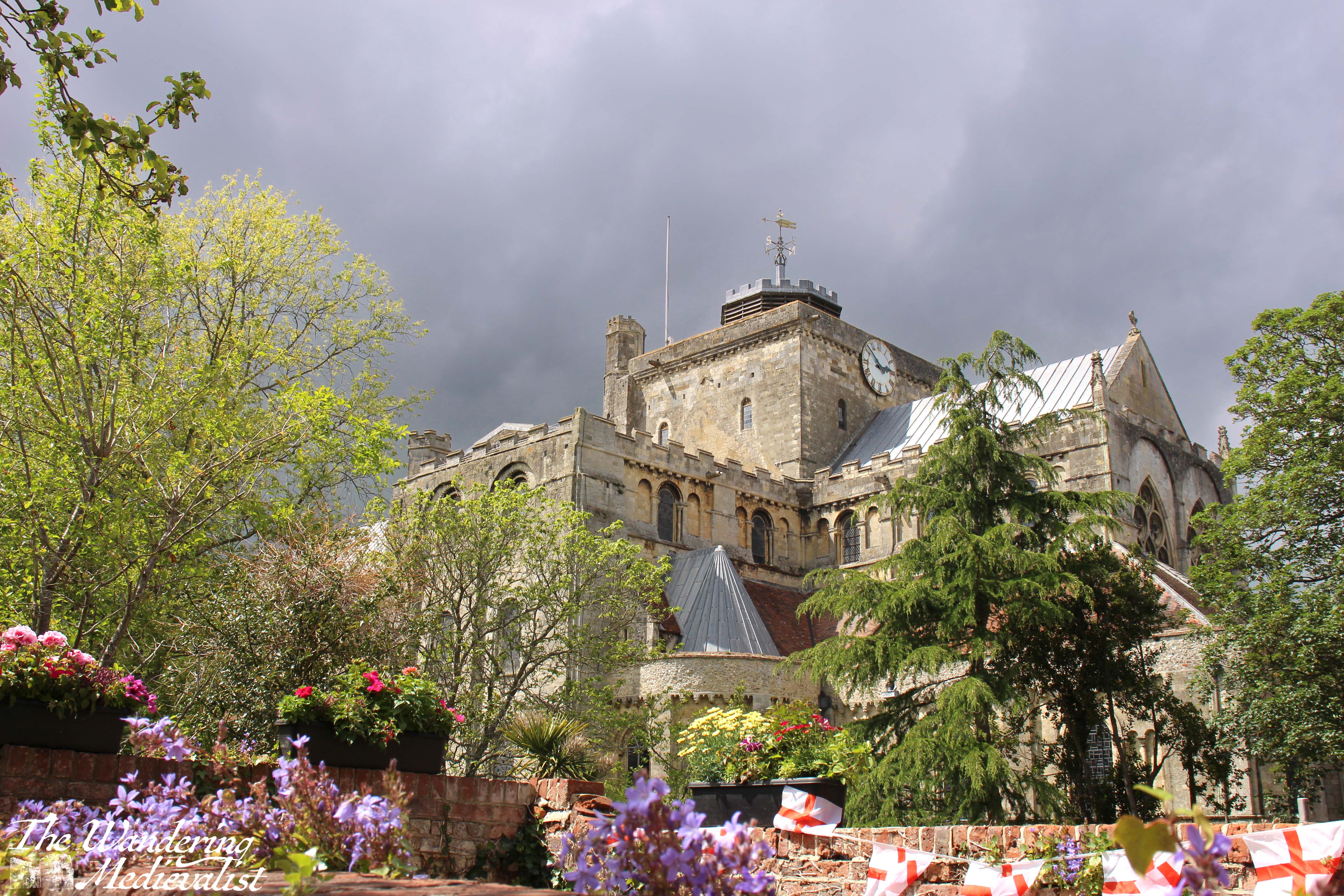
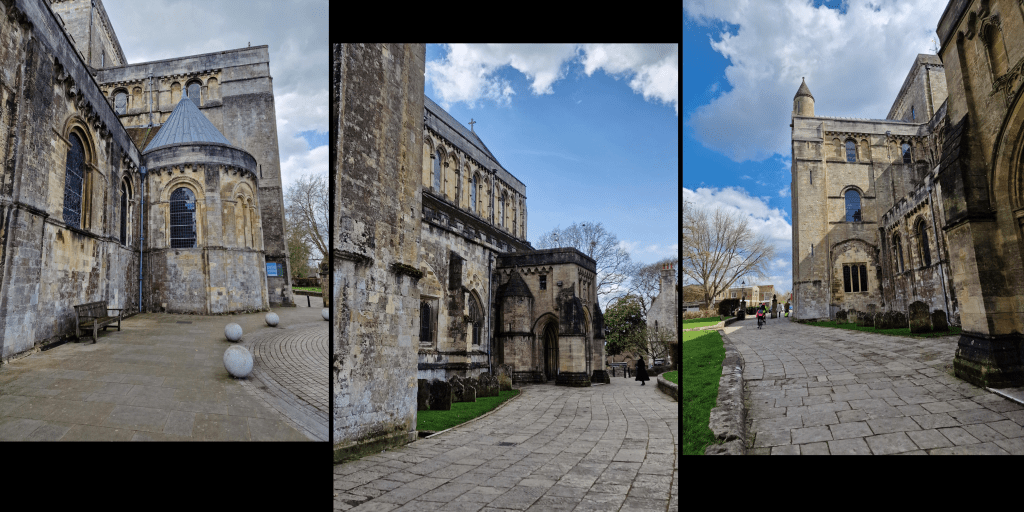
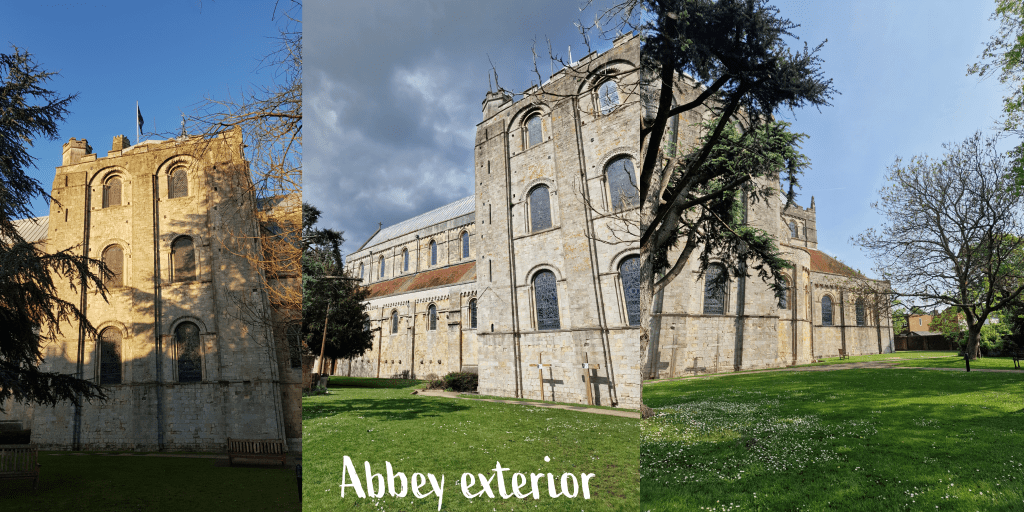
A visit to the abbey does not take particularly long, as you can walk around the outside in less than 5 minutes, unless like me you enjoy a much slower wander to take in the view. We always start off heading down Church Place, where the first view you see is this one, the east end of the church.
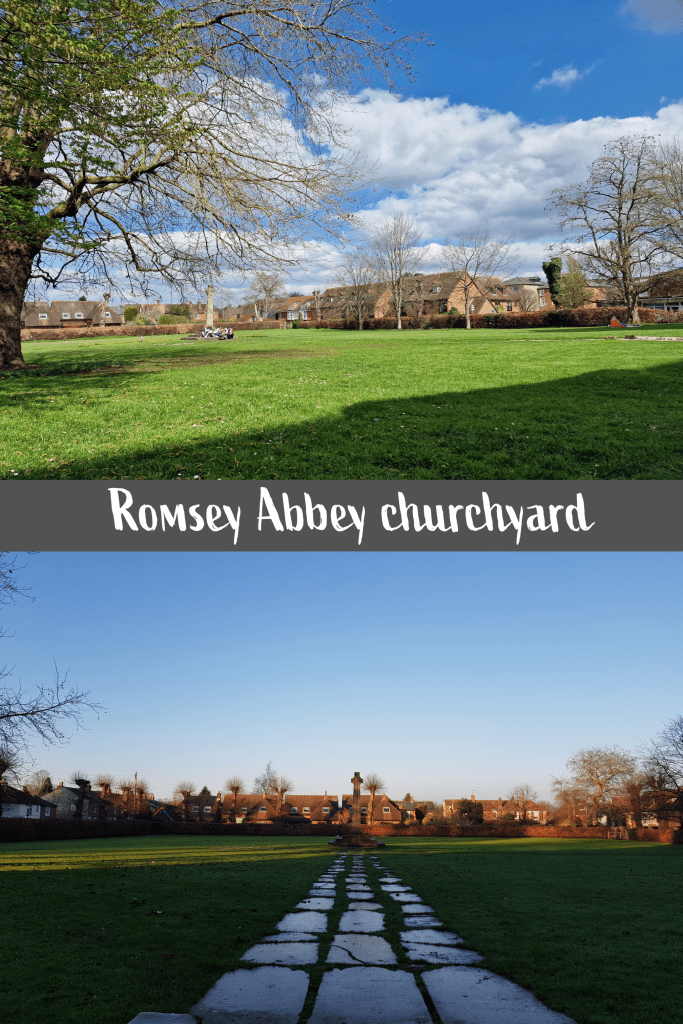
To the right of the path is the churchyard, which was the burial ground attached to the abbey. There are several memorials including a large cross and a Waterloo memorial, though the majority of the monuments were removed when the yard was cleared and levelled in the 1940s. The reasons for this appears to be safety-related, as the area had become very uneven and dangerous to traverse, and many of the stones were re-purposed to create a path.
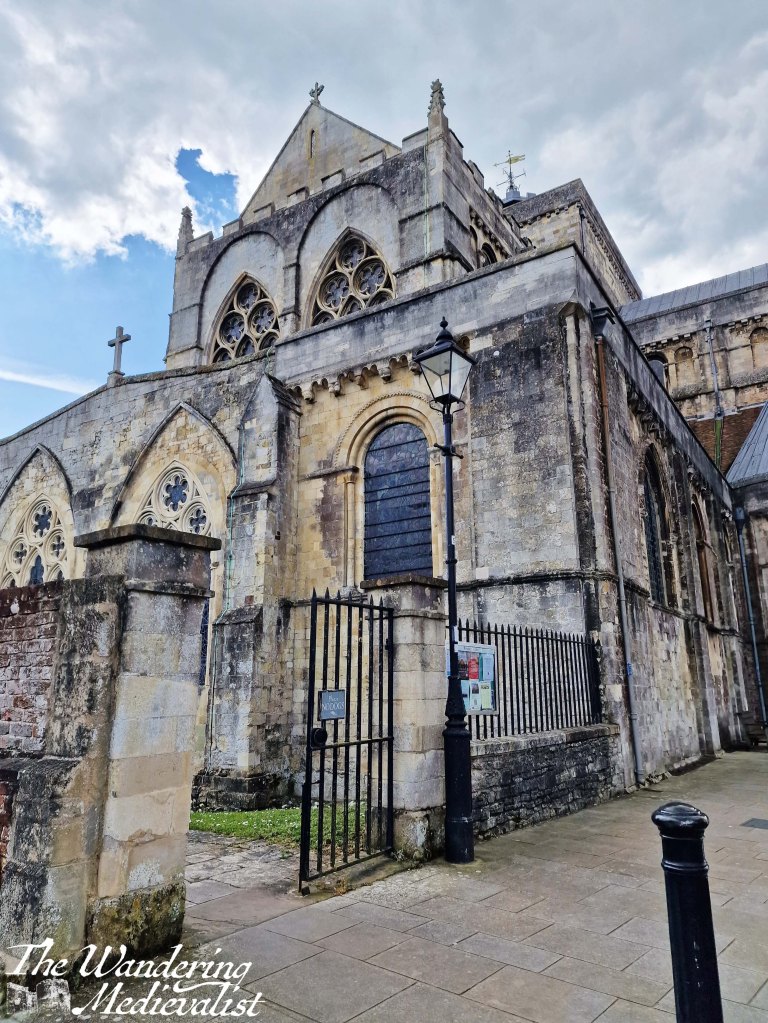
North side of the abbey church
Ahead at the edge of the churchyard is Folly House, the former vicarage, now a beautiful residence. From here you could go in either direction down Church Lane or a street creatively called ‘the Abbey’ to enjoy more of the stunning houses and gardens of Romsey’s town centre.
Folly House, former vicarage
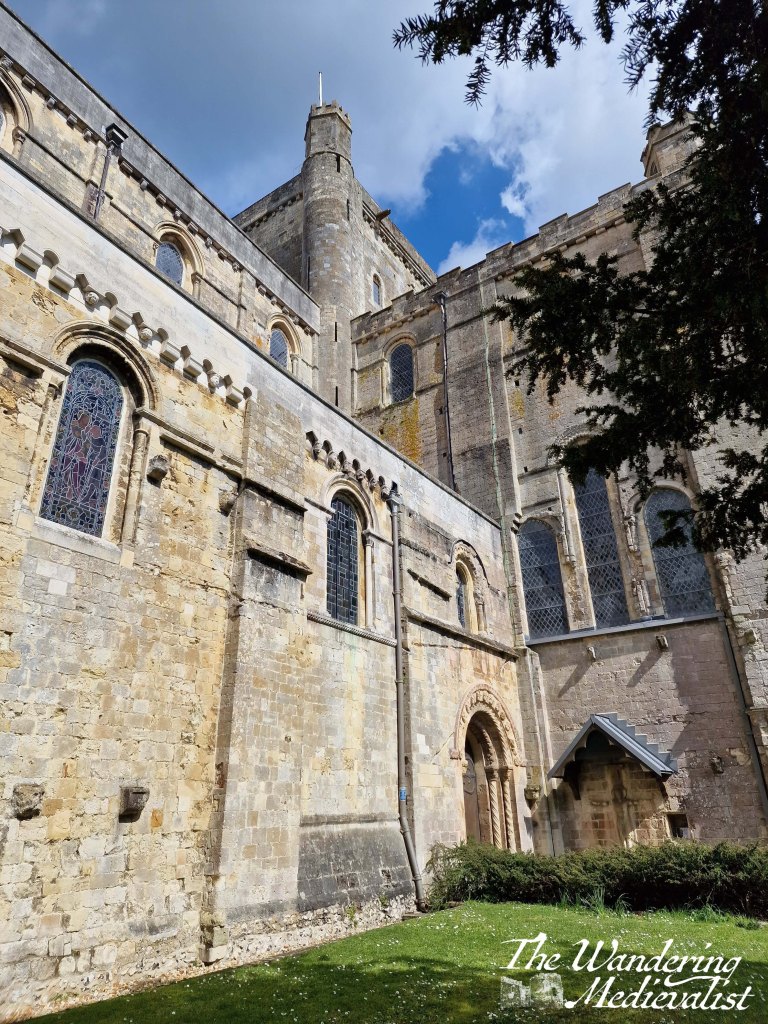
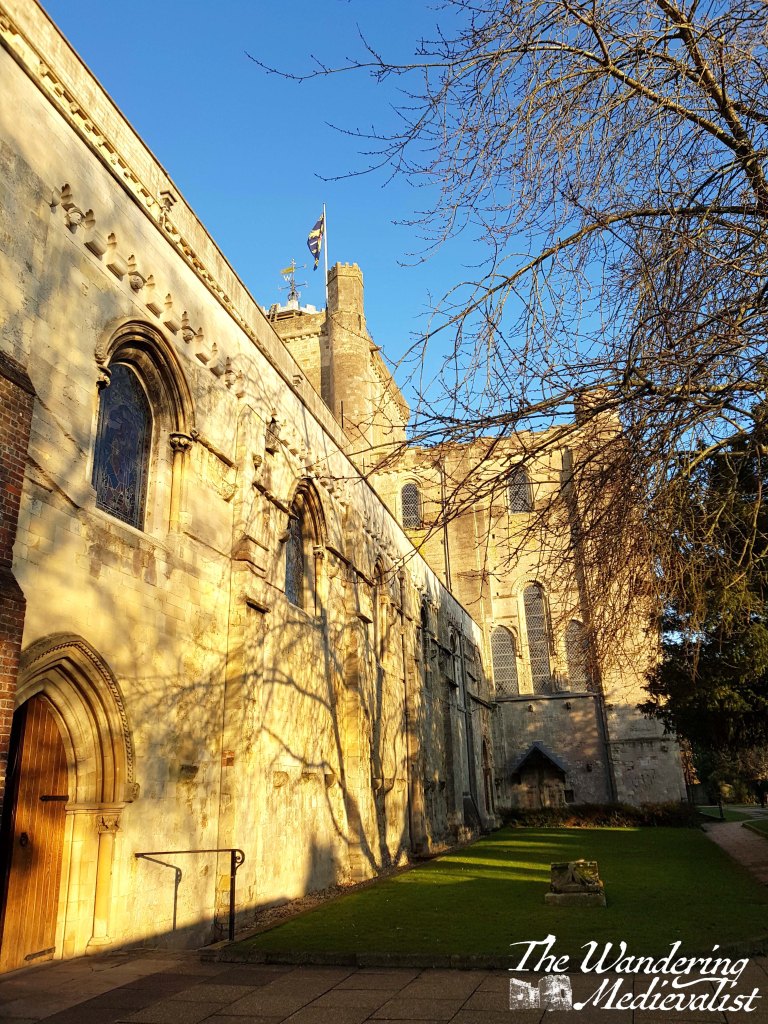
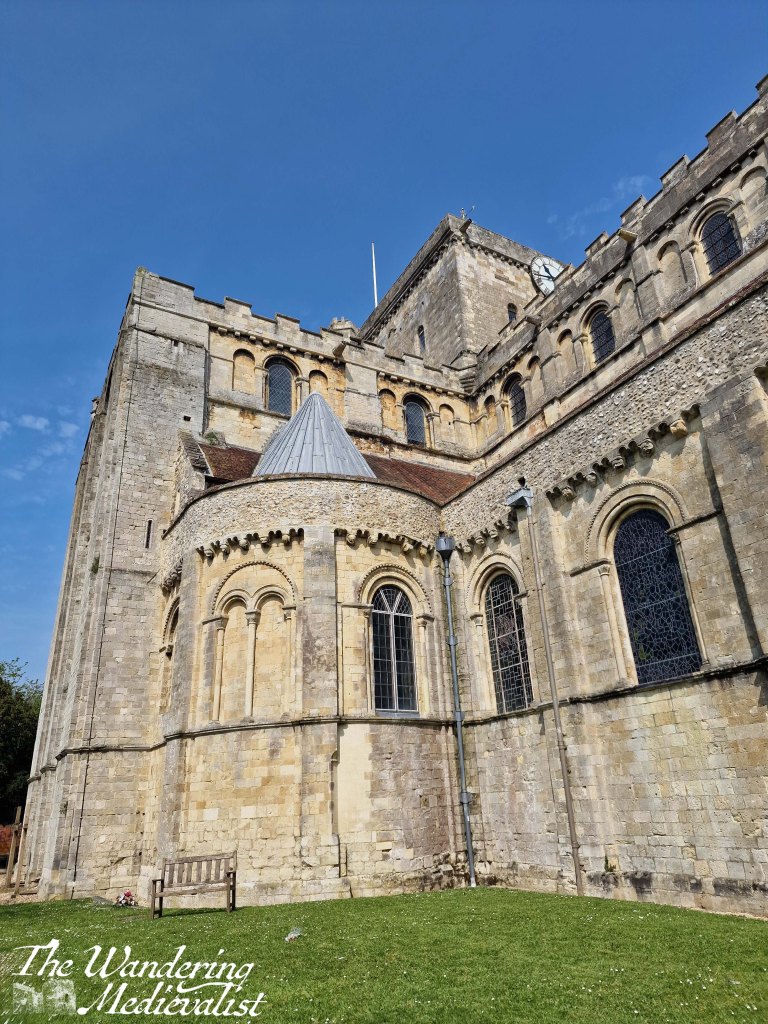
Continuing counter-clockwise around the church takes you to one of my favourite views, looking along the outside wall and up to the central tower – in all fairness, this diagonal view looking from the base of a church up to the tower is my favourite view of any ecclesiastical building. We come this way almost every time we visit Romsey, yet I find it impossible not to get another version, in different light of course…
On this south side of the church is a small park with shady trees, where we enjoyed the breakfast mentioned above.
This seems a good time to go into a bit more detail about the history of the abbey. As mentioned above, it was founded in 907 and Elflaeda, the daughter of the king, was put in charge of the community, beginning a long line of royal abbesses and nuns. In 967, the abbey was re-founded in the Benedictine order by King Edgar, also known as Edgar the Peacemaker or Peaceable. The first stone nunnery and church were built around the turn of the millennium, and the abbey flourished as a place of education and safety particularly for noble and royal daughters.
The abbey was sacked in 1003 by the Danes, likely in retaliation for the St Brice’s Day Massacre. This massacre had taken place on 13 November 1002, when King Æthelred (often referred to as the Unready) had ordered the killing of all the Danes living in England at the time. The chronicles of the time indicate that it was retaliation for an assassination attempt, though it may also have been retaliation for the years of raids by Danish forces.
Following the sacking of the abbey, in the 1120s work began on the current building. This was during the reign of King Henry I and work continued under the supervision of Henry of Blois. Blois was the brother of Henry I’s successor, Stephen, whose daughter Marie was elected abbess in 1155.
Marie’s story is one of those tragic female tales of the Middle Ages that make one realise that royal women had it just as hard – if not sometimes harder – than others.
Her father King Stephen died in 1154 and then her last living brother, William, passed in 1159. On his death, she became suo jure Countess of Boulogne (essentially, countess in her own right, meaning the title was hers by birth and not marriage). Despite her position as abbess, Marie was abducted by the son of the Count of Flanders and forced into marriage. Eventually, after giving birth to several daughters, she found her marriage annulled and was permitted to return to the cloister for the last years of her life – though not to Romsey. I wish this was an unusual tale to find in the Middle Ages, but it goes without saying that it was a difficult time to be a woman, at any level of society.
Back to the abbey. The last three arches of the church, designed in an early English style, were added in the 1230s, by which time over 100 nuns were part of the community. The abbey would continue to prosper until the decimation of the population by the Black Death in the late 1340s; 80% of the nuns are reported to have died, including the Abbess, and from this point on the number of nuns remained much smaller – less than 30. Nevertheless, the abbey remained an important part of local life, functioning as a center of prayer and charity.
Unlike some less fortunate establishments, the abbey survived the dissolution of the monasteries under Henry VIII due to the petition of four Guardians, who purchased the abbey for £100. The nuns were dispersed, but the community continued to worship in the surviving buildings.
It is still a working church to this day, with Sunday services.
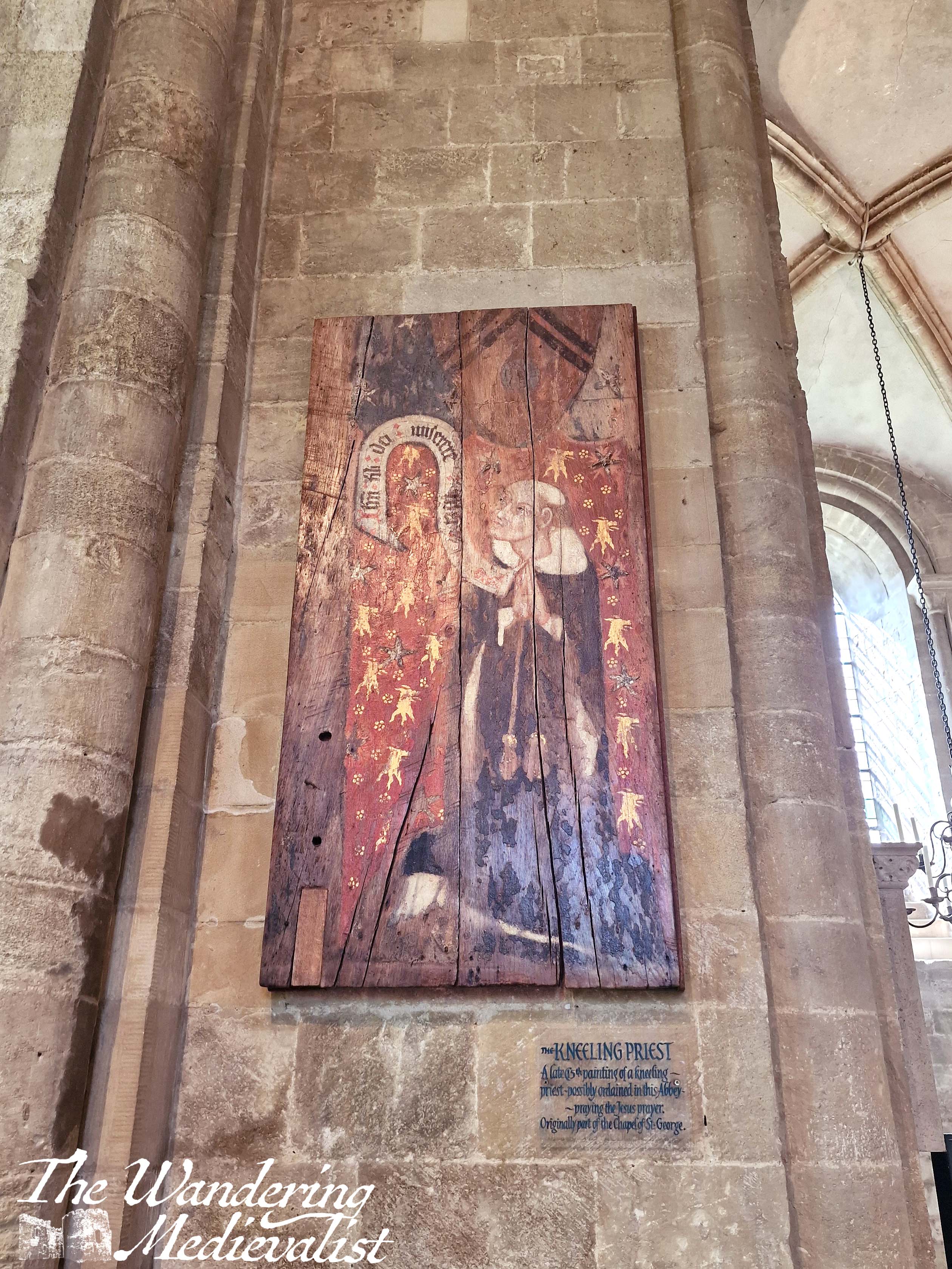
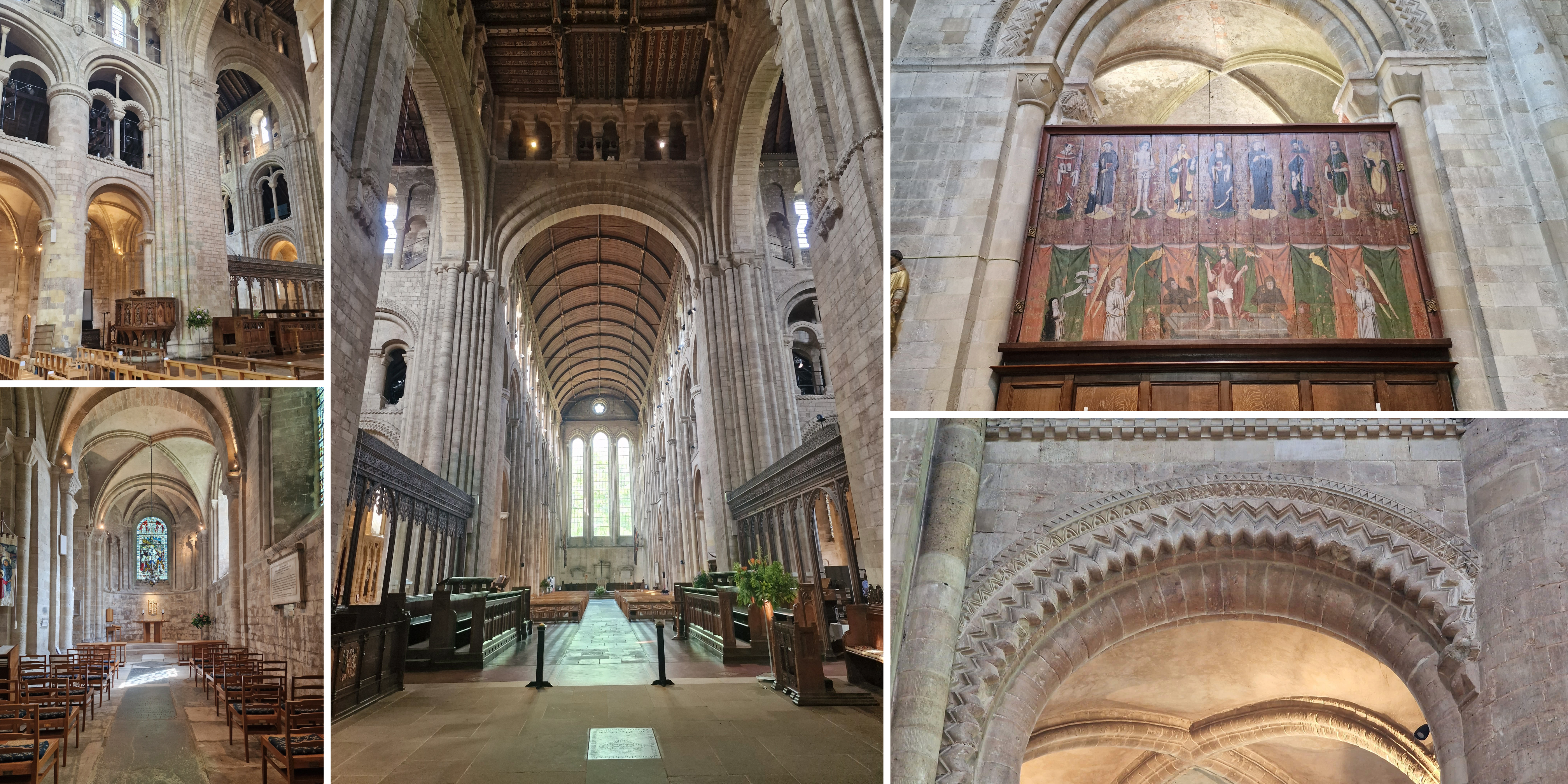
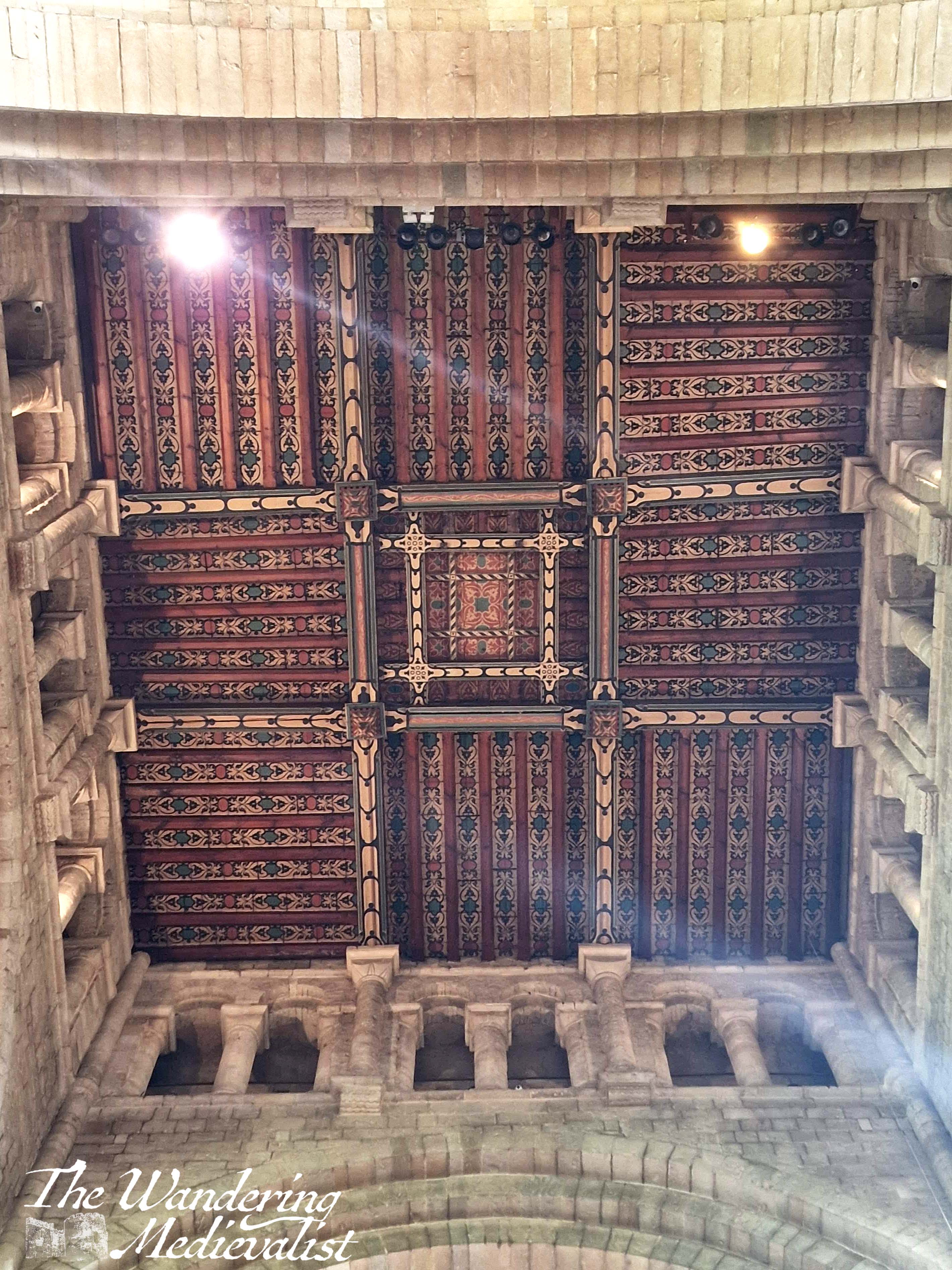
On our last visit, we were finally able to get inside of the church, which has several fine examples of medieval art as well as Norman carving that echoes that seen in Durham Cathedral.
Visiting an abbey like that at Romsey is a unique opportunity to experience an ecclesiastic community that has existed for hundreds of years, both changing and evolving with the times as well as maintaining its medieval roots. The protection Romsey enjoyed after the creation of the Church of England means that it allows the full immersive experience that you cannot get at ruined abbeys like those at Jedburgh, Dryburgh, and so many more that did not survive the dissolution of monasteries in the sixteenth century. It’s also just a beautiful building, set in a lovely English town that provides the best of what the countryside has to offer. I highly recommend a journey!
Finally after a long break, I determined last week that I would return to my Fife Coastal Path endeavour. The last month or so of travel has meant that my efforts to maintain fitness levels dragged a bit, and so I selected a portion of the walk that was not too long but still tested me a bit: starting at the Fairmont Hotel and walking through St Andrews to the Old Course Hotel, where I started my walk to Guardbridge many months ago. The first two miles are traditional Fife Coastal Path: rising and falling along the edge of the coastline with dramatic stretches of rocky shore and beaches. Then, the last mile and a bit is in St Andrews, along East Sands, up the Scores, and past the famous Old Course. This is a really pleasant walk, but the out of town section does require some stamina and sturdy shoes.
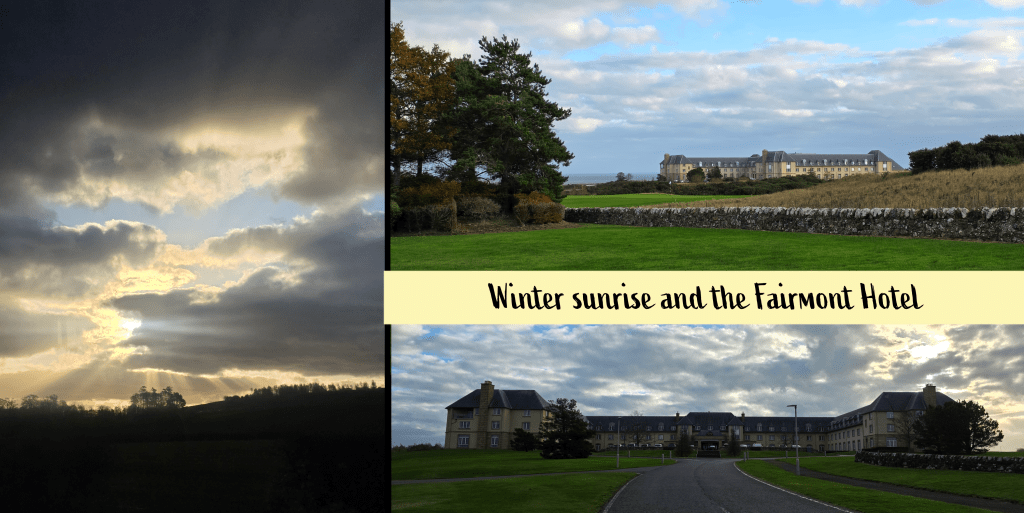
As would be expected in November, the morning was cool (8℃/46℉) with a cold wind and mostly cloudy with patches of blue sky. I wore my raincoat mostly as a windbreaker but also to guarantee against any stray rain showers – fortunately only needed for the wind. The bus trip was a short one – about 10 minutes – on the trusty 95 from St Andrews, and the stop is right on the road outside the entrance to the Fairmont estate. Fortunately there is a well-kept path running from the bus stop and along the access road up to the hotel. It is a gentle decline, allowing for a view over the North Sea as well as up to the hotel building, across the golf course.
I wasn’t 100% confident as to the route to actually get to the Coastal Path, but I knew that the walk from the hotel into town was done by guests, and so I figured it must be possible. There was no question that I was not there for the golf, as most others were – my attire was a bit different from the slick sporting outfits.
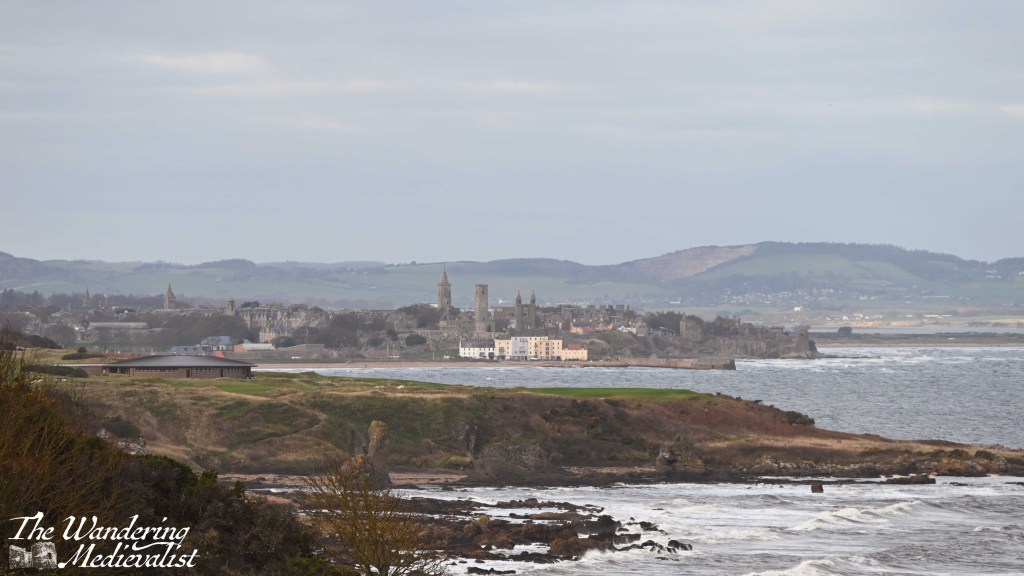
It took me about fifteen minutes from the road to wind towards the hotel the past, and down to the clubhouse for the Torrance. The views across the courses are beautiful even on an overcast day, and the outline of St Andrews is very clear; I really must come back here in the sun! This is clear evidence as to why the Fairmont used to be called the St Andrews Bay Hotel.
Distant St Andrews – with a powerful zoom lens
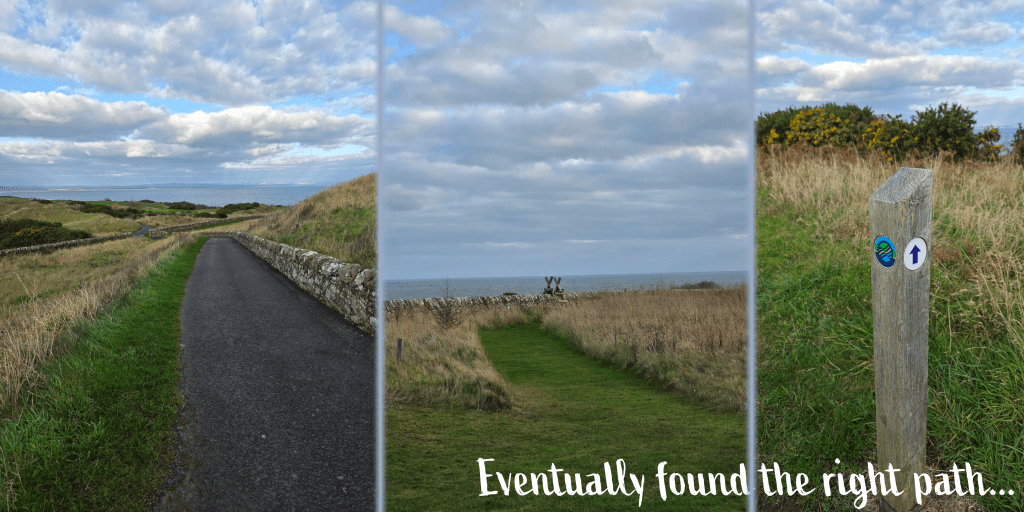
To get my bearings, I chose to walk down below the clubhouse and past the delivery parking, where I realised that I needed to backtrack slightly to an access road onto the course. From there, I turned right through a break in a stone wall and it was an easy walk to the second wall, dividing the course from the Coastal Path. I used a wooden ladder to scale the wall, though I think there was a break a bit further up for anyone less inclined to climb.
Finally at the starting point, I set my Fitbit to record and started on my way, enjoying immediately the return to a cliffside muddy track, along a stone wall, with waves crashing below. There were a few occasions where my eyes filled with water due to the wind, and I did have to wear my hideous winter hat, but I was warm enough once I got moving.
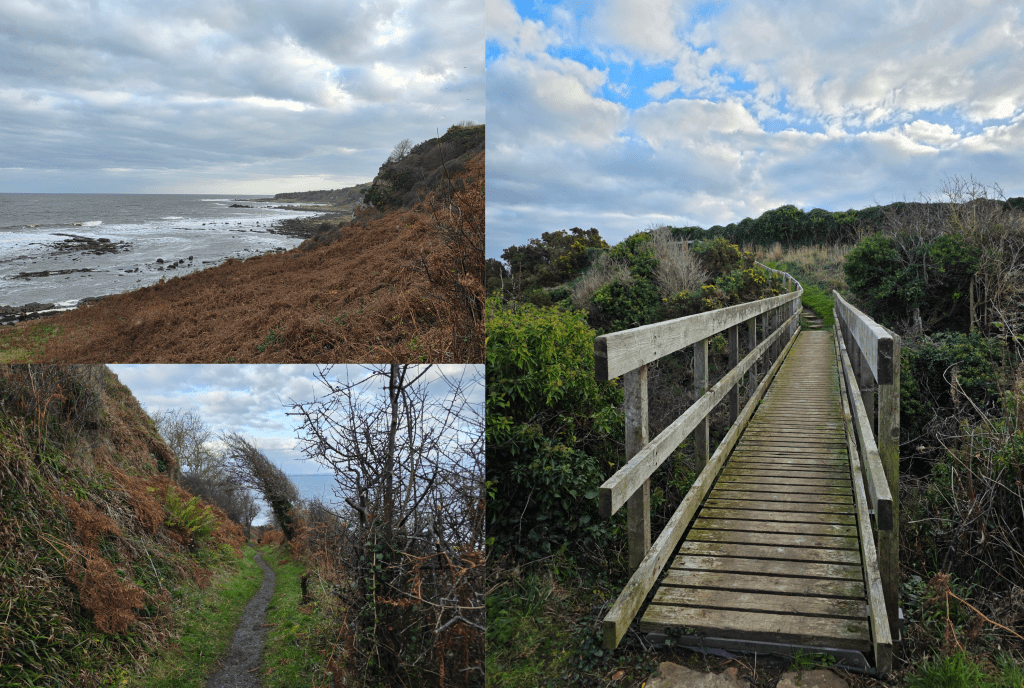
From here, the path eventually goes down some stone steps and across a bridge over a burn, after which it curves to the right and descends quite sharply towards the beach level. While my boots were not as comfortable as they once were, I was glad to have them here where the recent rain has made the small rivulets into rushing burns and even the grassy areas into mud.
The coastal views are great here in both directions, though the wind is definitely a force to be reckoned with – as ever in Scotland, layers are key. I spend a great deal of time at work explaining that it seldom gets as cold in Scotland as it does in parts of the US, but the wind is biting so it can feel much colder than it is. This was one of those days.
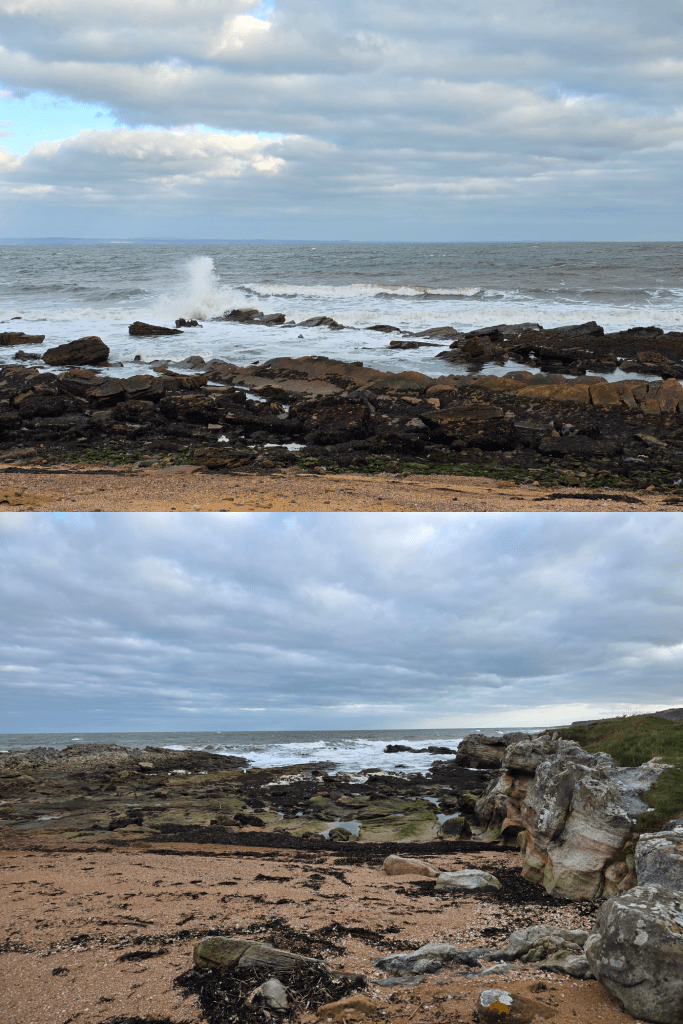
As the path descends it essentially passes through a hedgerow, and you can see the cliffs above you, mostly covered with plants though there are the occasional dramatic rocky outcroppings and circling birds. On the beach level, you can enjoy crashing waves, and ahead is the shape of the Rock and Spindle.
It was about here that I passed a couple who were clearly familiar with the path, and who observed that I had about 45 minutes until high tide, with a gentle warning in their tone.
Yes, I had once again forgotten to check the tide, though to be honest it was because I did not think it was an issue on this section. My error, clearly, and while I assured the couple that I would be fine, I decided that it was time to hustle a bit. So rather than pausing and taking many wave pictures (as I was tempted to do), I crossed the rocky beach and identified relatively quickly where my potential problem lay.
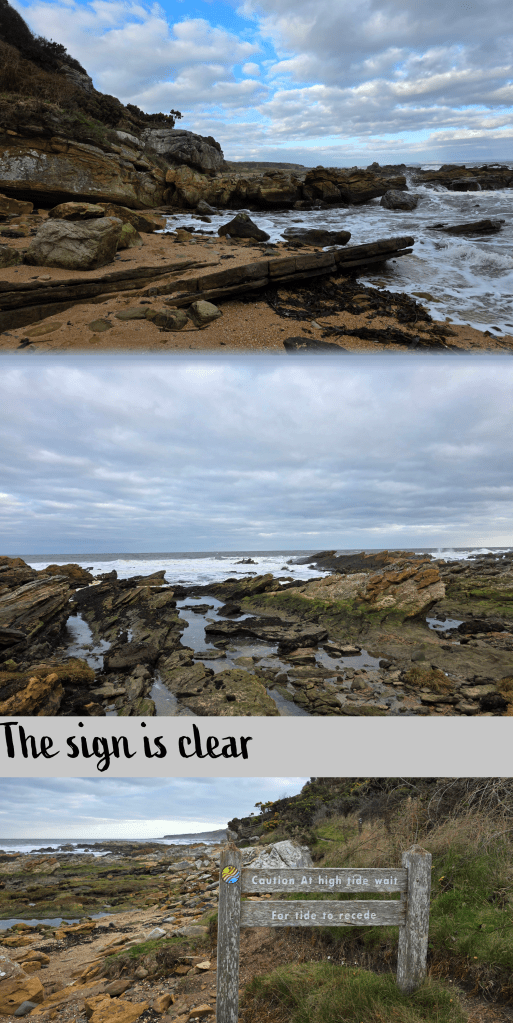
Specifically, it lay right about here, where the waves stretched inland along a rocky edge, threatening to very quickly cut me off from the path ahead. Like many of these small beaches, this cove was backed by a rock cliff and, as the sign clearly told me, if the tide was too high I would have no choice but to wait – there was no high tide route.
So, onwards I scrambled, and found myself looking at a rock face about 4 feet high with one foothold that was a bit higher than I thought my right leg might go. There is no picture, as I realised I did not have time to waste. So it wasn’t graceful or smooth, but I managed to get up the rocks and keep my feet dry – just barely. I probably had another 5 minutes before I would have had to stop. Good timing, then.
Beyond this pinch point, the rocky shore continued for another few minutes before I was able to rejoin the smoother path, and pass the sign in the photo above. I swear next time I will check more carefully.
Side note, I can see why Geology and Earth Science classes from the University would come out here for outings – there is a huge range of fascinating rock formations even for someone who knows nothing about them, and excellent examples of the ocean carving through stone over time.
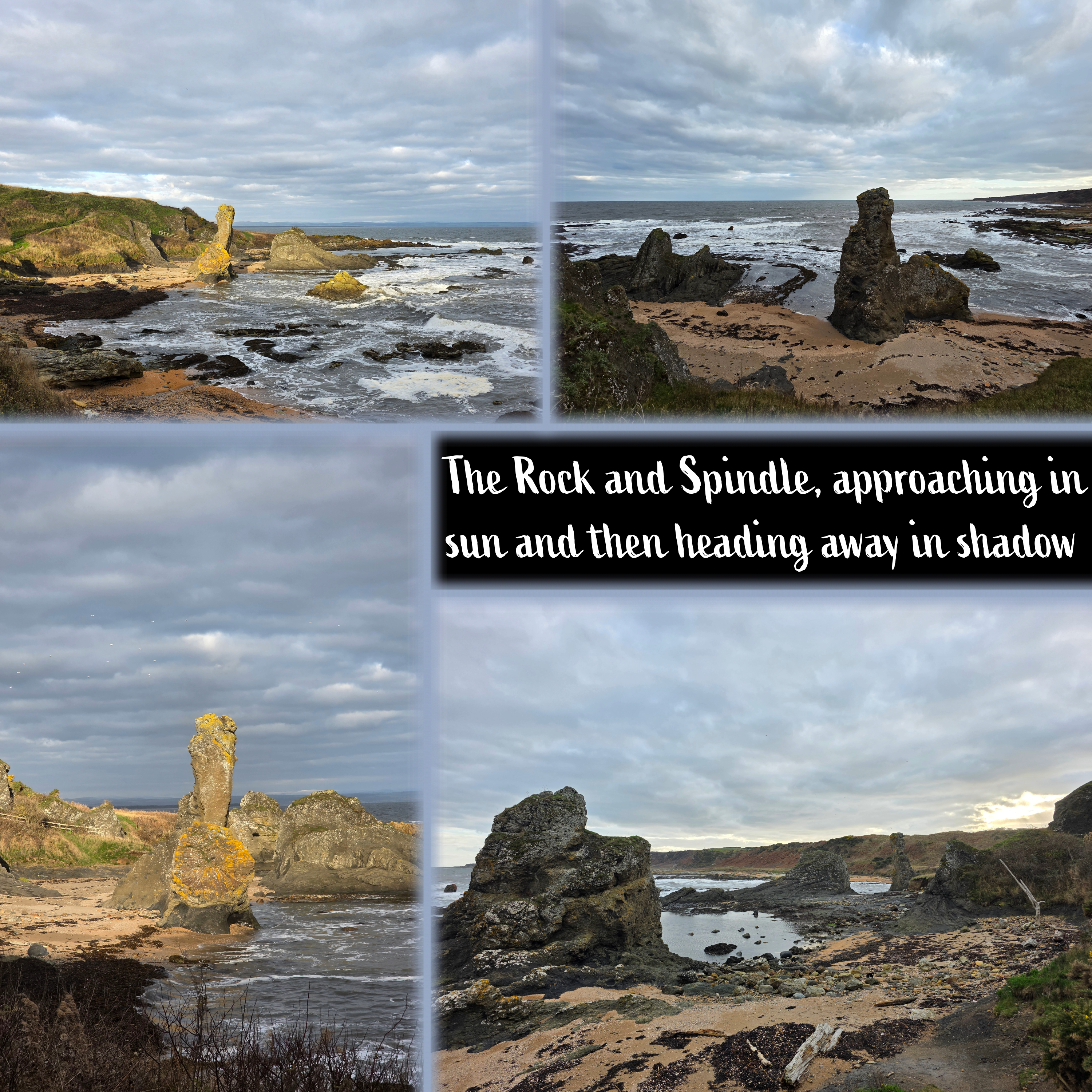
Ahead, in particular, is the Rock and Spindle, a famous formation that has been widely studied and photographed. According to some brief reading I did, the three stacks are made primarily of solidified volcanic ash, the remains of an ancient submarine volcano.
As I approached I was feeling uncertain that the sun would be helpful and actually break through the clouds, then as the path curved around to follow the shoreline, spectacularly the sun prevailed and provided some excellent contrast for my pictures.
A few words of caution if you are approaching from the direction I did – don’t get too caught up looking at the view, as the path here is crossed several times by burns. The rocks and grass are slippery and often wet, so it would be all too easy to fall.
There is also, I should note, a route above the rock formation which offers great views across the golf course and of the Castle Course clubhouse; Dad and I took this path when we walked out here many years ago (and of course I cannot find those pictures for reference). Alternatively, walkers can get down to the beach here to get closer to the rocks, but I was ready to make some progress and so passed through a wonky gate and continued on my way.
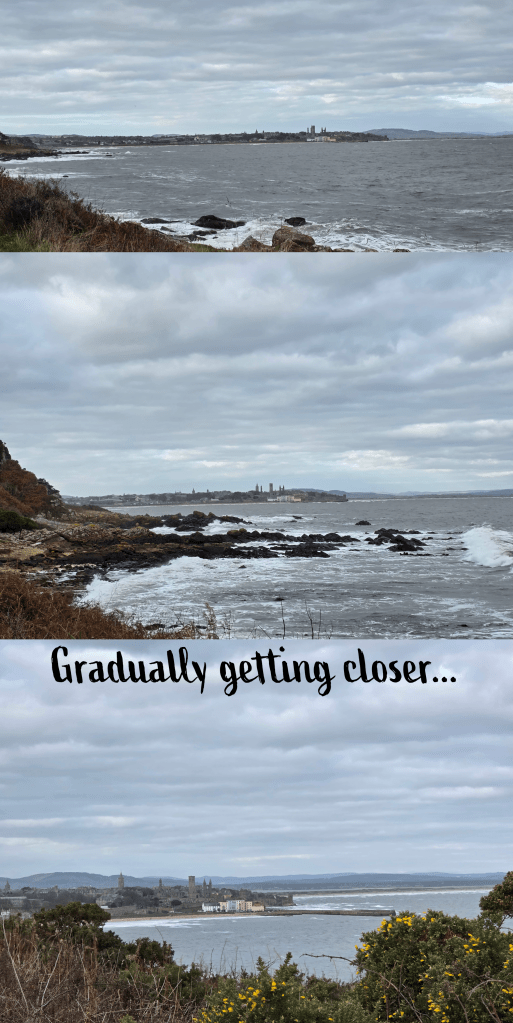
The path here becomes the more standard grassy path, and as I approached St Andrews I started to doubt whether the predicted sunshine would overcome what seemed to be pretty steady clouds. The overcast sky did not prevent me from taking plenty of different views of the town as I approached, of course – here are a few. Do I have sunny versions of these? Almost certainly. But there is something about this view of town that is impossible to resist.
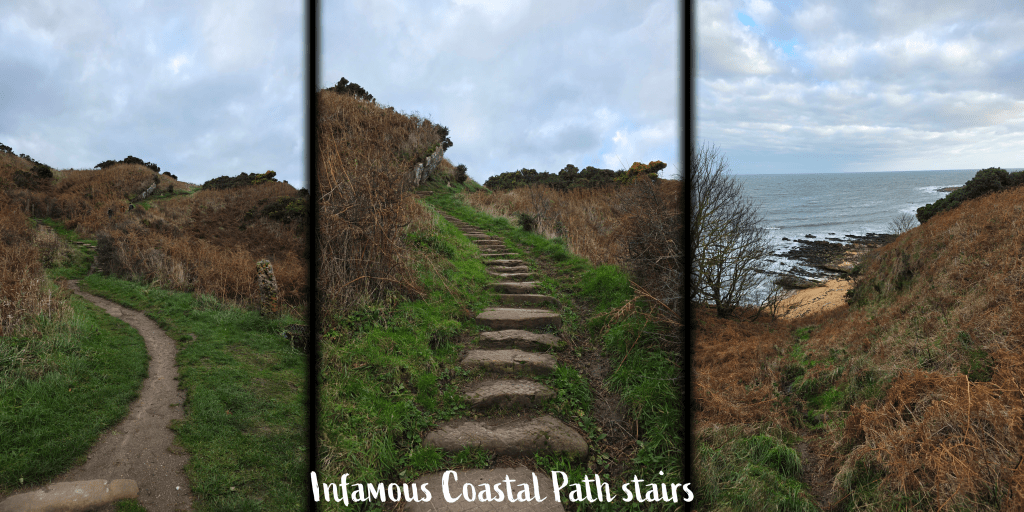
After ambling along at a good pace, enjoying being at the water level and the crashing waves, I realised that the cove I was in was quickly reaching its end, and there ahead of me was one of the Fife Coastal Path’s infamous – in my mind – stone staircases. The steps themselves are generally flat-ish rocks that have been layered into the hillside, and often wind back and forth as they climb steadily upwards. This is one of the longer sets that I have come across, and it definitely tested my endurance, which has declined since the summer. The view is of course excellent particularly if you have to stop and catch your breath.
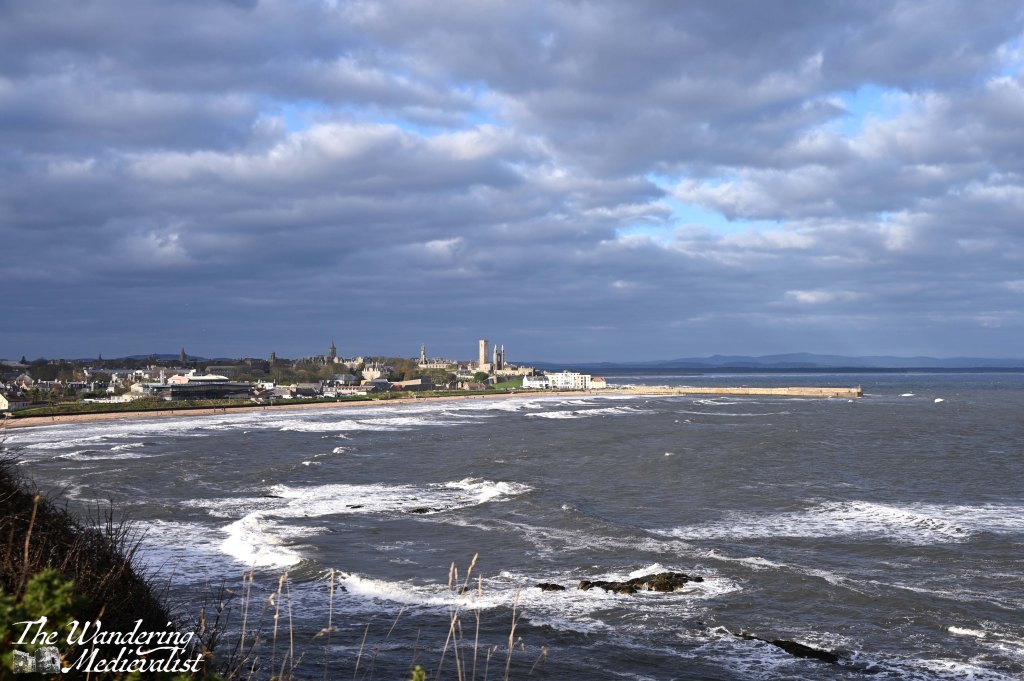
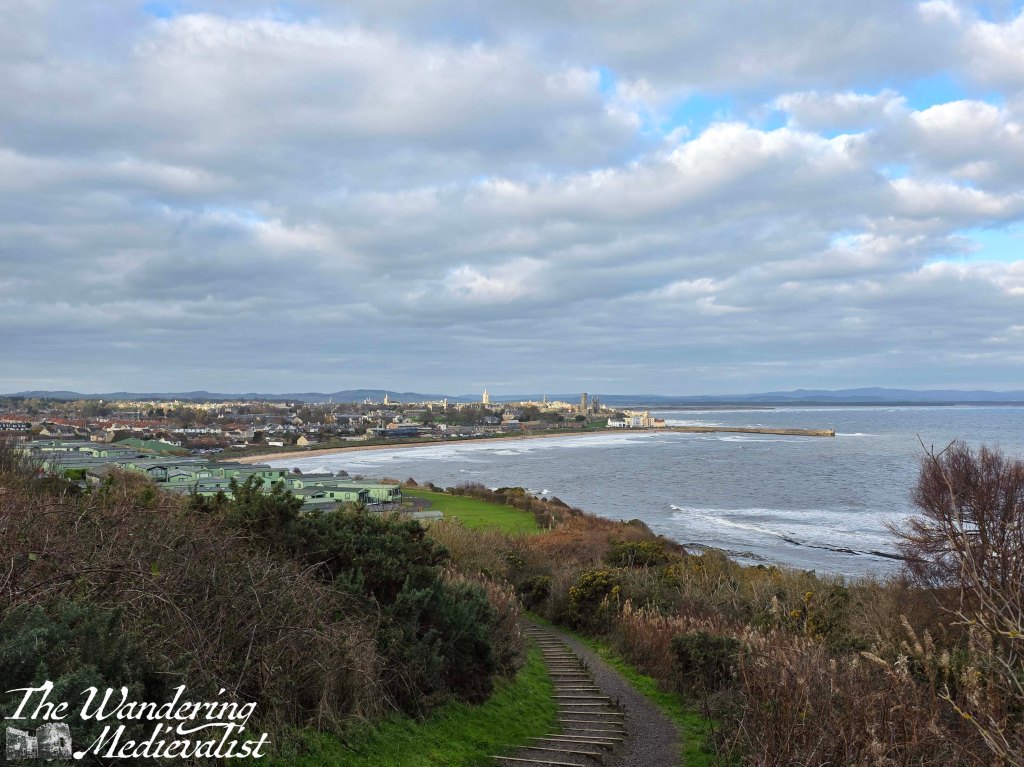
Once you make it to the top, however, the path is relatively level for some time, with only gentle ups and downs. The crest of the next hill provides a spectacular view over the bay and town – it is THE view, the one photographers will climb up here to capture. Even without sun, it is impressive. That said, as I made my way along the clifftop, the sun did make an appearance, highlighting the lighter stone of the cathedral ruins and harbour, bright against the turbulent waters of the bay.
The path here is wider and more regularly-used, with joggers and weekend walkers more common. It is easy to get distracted by the view on one side, while on the other the golf course rolls into the distance until it comes to an end at a line of tall pine trees. This marks the boundary between the Castle Course and St Andrews Holiday park, a large caravan site at the edge of town. Passing through a metal gate, you will notice a narrow path heading up to the road, so in theory you could begin a walk here as well, or do a loop up from town and back along the coast.
St Andrews and the bay
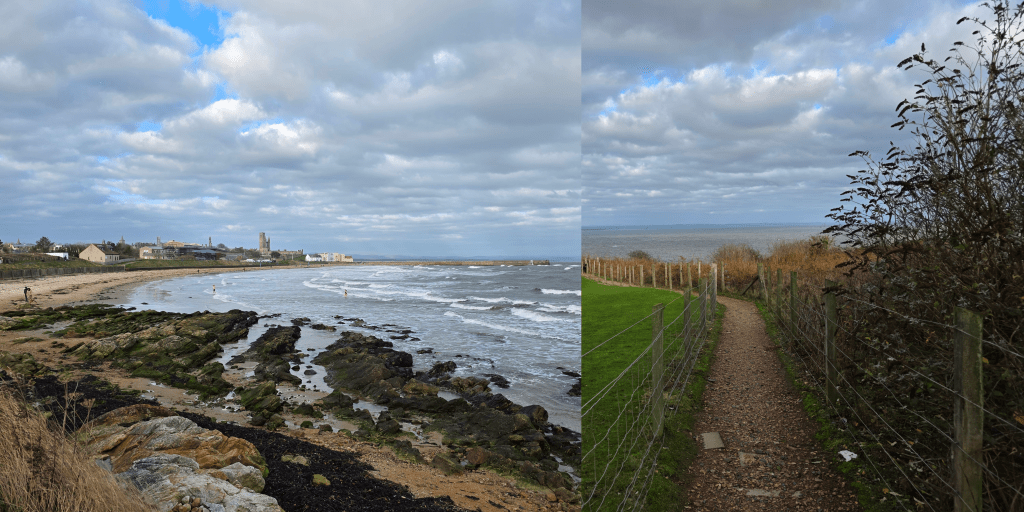
The view is just incredible, as gradually you move closer and closer to East Sands. Then in no time at all you are descending once more, along the edge of the caravan estate on a relatively steep set of stairs. There is a viewpoint off to the right, and then the path continues towards the beach.
One last gentle hill leads down off of the Coastal Path proper and onto the walk along East Sands, the wide open beach of St Andrews edged by the cliff on one end and the pier on the other.
just because…
Those of us who have lived in St Andrews for any length of time will tell you that the weather there is different, golden in a way that cannot be matched anywhere in Scotland. It might be a blizzard in Cupar, raining in Guardbridge, but it is sunny in St Andrews. Not always, of course, but more often than not the town enjoys its own pocket of good weather, and this day was no exception.
As I passed this slightly tattered Saltire at the end of the beach, the sun fought its way through the last of the clouds, and the day opened up into beautiful sunshine. Was it sunny at the Fairmont? Who was to say.
East Sands is always busy with walkers, dogs, swimmers, surfers, and sailors depending on the weather, and today was no different. Even in the cold weather and even colder water there were people out in wetsuits. And, some brave souls just in bathing suits, though I learned later that they were dashing up the beach to the newly-built sauna. This is the beach where students take part in the famous May Dip, and is a spectacular place for sunrise, as well as to catch the Northern Lights if you are lucky. The East Sands walk takes you past the University nursery, the East Sands Leisure Centre (town pool), the Scottish Oceans Institute and the famous Toastie Shack, perfect for a beach snack.
The edge of East Sands marks the start of the portion of the Coastal Path that I know like the back of my hand, have walked 100s of times over the years and love. But oddly, I was not confident as to the actual route of the path. My map told me to turn left at the Toastie shack, but the signs told me to continue strait.
As the straight-ahead route was arguably prettier, leading along the beach and over the harbour gate, I chose to follow the signs. Here, the path goes through the play park and along the edge of the beach, allowing for a great vista across the water and up to the Fairmont.
On the other side is a wide grassy bank that leads over to where the Kinness Burn enters the harbour. I wandered over to take a quick picture, but it is worth warning that this stretch of grass is full of holes, dips and – annoyingly – the occasional dog dropping, so best to keep looking down. Soon the path curves around to the left and down a short hill towards the harbour. Cross at the harbour gates and then swing right either in front of or behind the line of buildings. Officially, the path goes behind, but I don’t think it matters greatly. This is one of the most photographed parts of St Andrews, with the colourful buildings and the old harbour, and the entrance to the famous St Andrews pier.
If you have the time, I recommend a detour out to the end of the pier, as the view back is phenomenal. The pier had been closed for some time due to damage sustained during a storm in November 2023 – it is great to see it back open and so many people enjoying the walk. As often happens on a sunny day after a few of rain, the town was busy with students, visitors and locals all out enjoying the day.
Side note, I have several times on these walks had the weather improve as the day goes on, and wonder if I shouldn’t wait until later in the day to get going. But instead, I just keep heading out as early on a Saturday as I can manage. Maybe that will change as the winter closes in, but probably not.
Whether you detour out the pier or not, you have two choices for climbing back up to cliff-top level; the first is a set of stairs, and the second is a hill so steep that cyclists are required to walk their bikes up or down. I opted for the hill, and either way you arrive at a great viewpoint over the town. There are the ruins here of St Mary on the Rock – a church outline – and several cannon aimed out to sea. The highlight is of course the view of the cathedral wall and remaining towers straight ahead.
The path is wide, with a stone wall along the edge of the cliff, though if you look down you will see familiar rocky coastline and birds nesting or bobbing in the water. Ahead there are two options, and neither is marked though I think the obvious choice is to hug the coastline and take the right-hand fork. The left leads you along the cathedral wall and towards North Street.
The fork I recommend is also the one that takes walkers along one of my most favourite stretches of path in St Andrews, and possibly all of Scotland: up a gentle hill between the cathedral and the castle, one of the best viewpoints in the area. You can see into the cathedral grounds, down to the pier, out to sea, and of course along the coast to the castle and distant West Sands. It is a place that is almost meditative for me – I have walked it more times than I would hope to count, even now seldom stopping to take pictures and only enjoying the view. A scattering of sea roses makes it the perfect spot in summer, and there are two benches ideally placed to rest and enjoy. Definitely take a few moments to do so, if you can.
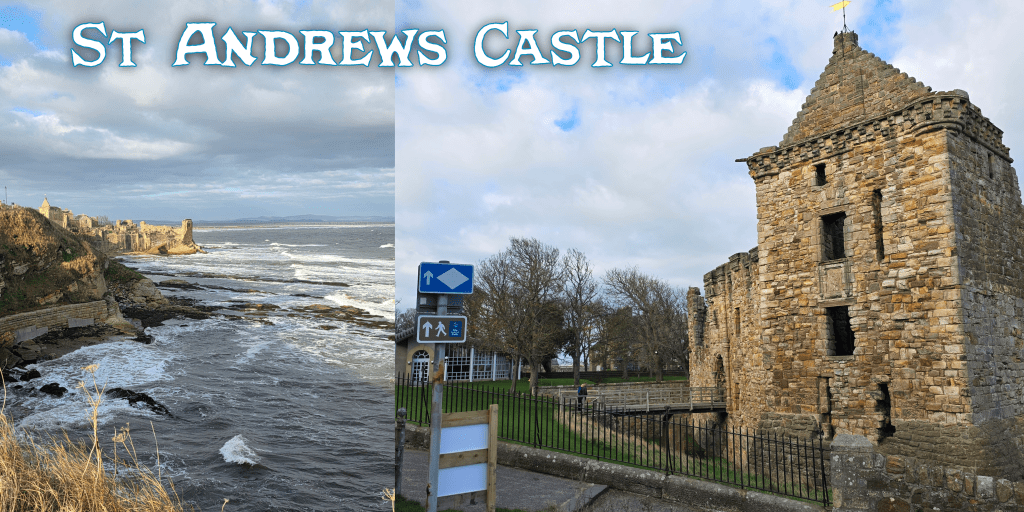
St Andrews Castle is of course directly ahead, its outline something I imagine I could draw with my eyes closed. I cannot pass without a picture, so on this occasion I included the Coastal Path sign – in one of them.
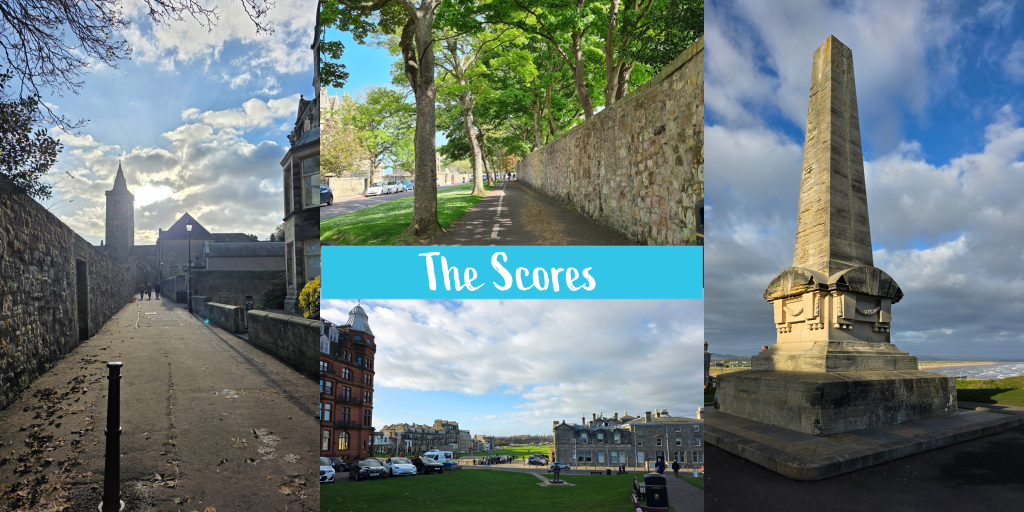
Once past the castle, the route continues along the Scores, one of the most beautiful streets in St Andrews and one of the most expensive in Scotland. The University owns a good portion of the buildings and you will pass, amongst others: the Schools of English, Economics, Philosophy, Classics, International Relations and History, the University Museum, St Salvator’s Hall and the back of St Salvator’s Quad, the Principal’s House, and the Admissions office. The buildings in between which are privately owned are large, some very old and some very new, all with phenomenal views. The Scores is lined at varying points by stone walls, and you can choose to walk on either side, though I always feel that the left going away from the castle is ever so slightly nicer. It is wider, and you do have to look out that you do not wander into the cycle lane.
About half way along on the left, Butts Wynd cuts up towards North Street, offering a stunning view of St Salvator’s Chapel.
It may be tempting to nip up to the quad and take a few pictures, so by all means do so here if this is your one trip through St Andrews. For golf enthusiasts, the best is yet to come.
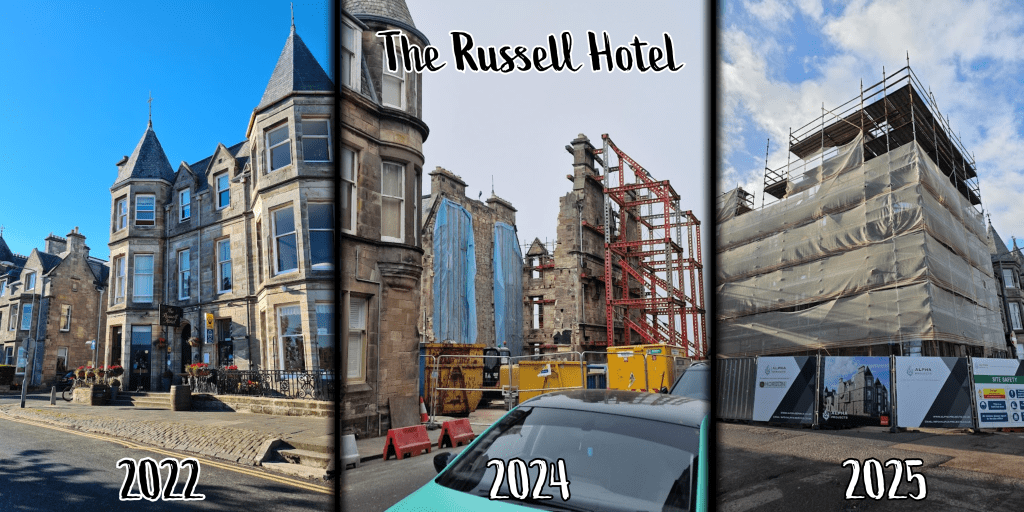
Continuing along the Scores, you will pass the Catholic Church, and ahead on the corner of Murray Park is what used to be the Russell Hotel, which was one of our favourite spots in town for excellent Scottish food. The couple who owned it eventually retired and the majority of the structure was torn down, so that all that remained was the listed frontispiece. As of writing, it is enshrouded in scaffolding and being rebuilt into what I understand will be flats.
At this point I recommend crossing the street and continuing roughly straight ahead. Along the cliff you will find a tall wrought iron fence with warning signs as to the sheer drop on the other side – this is due at least in part to the unfortunate tendency for students to wish to climb the fence, which has devastatingly led to fatal injury in the past.
Avoid the temptation to turn right down the steps toward the Aquarium, and while there is no clear signage continue straight towards the towering Martyrs’ Monument, which was put in place to commemorate those killed during the Reformation. Beyond the Monument is the Royal and Ancient Golf Club of St Andrews and the famous Old Course. To the left, the buildings of the Scores including what used to be the Scores Hotel but is now Seton House, and the towering red Hamilton Grand, that incredible framing building to all pictures of the 18th hole. When I was a student it was still student housing, though has in intervening years been re-build into luxury condos.
Continue down the hill and cross the road, continuing up Golf Place towards North Street – do not head toward the beach, though there are public toilets in that direction should they be needed.
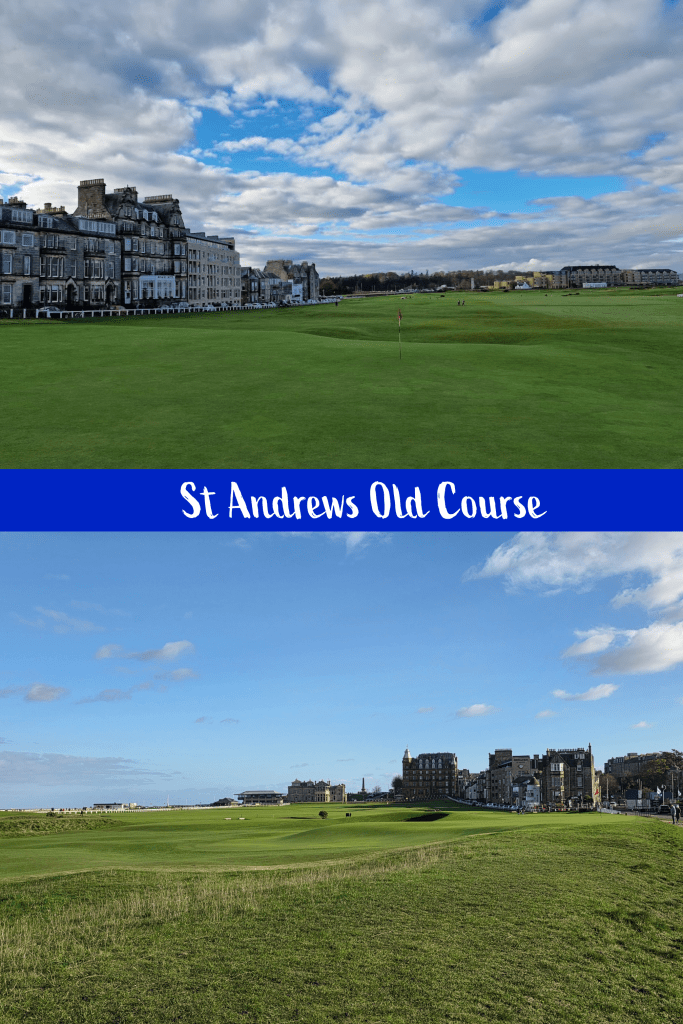
Continue to follow the golf course by turning right along the Links, which is a narrow road that runs between the Old Course and the buildings that include the famous Auchterlonies Golf Shop, the Rusacks Hotel, and the New Golf Club. There are regular signs reminding you of this, but golf is being played year-round, so pay attention for stray shots!
As you walk along the course, you will get some great views towards the Swilcan Bridge – where all golf competition winners have their pictures taken, as do many tourists.
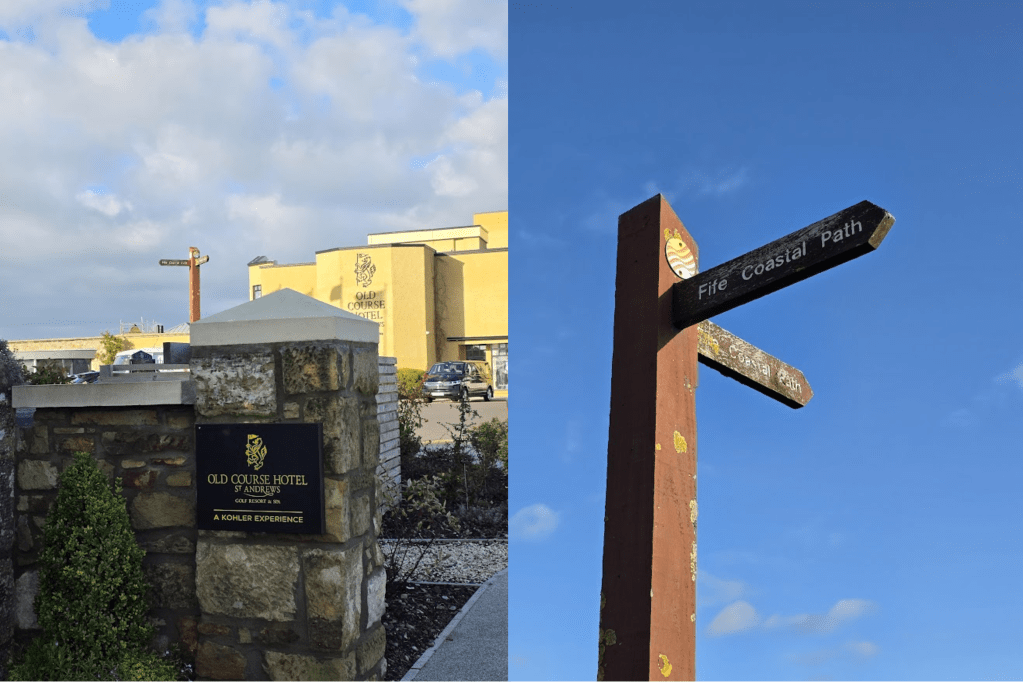
Follow the white fence when it curves around the end of the buildings and keep moving towards the hotel, straight ahead through the car park. In only a few minutes, you arrive at the entrance to the hotel grounds, where there is a clear sign to mark the end of this section.
Overall, a comfortable walk with a few spots to challenge you and a few spots to just enjoy the view. The section through St Andrews is beautiful, but I still think I prefer the out in the wild paths such as the one from Crail to Cambo – for hiking, in any case.
A small calamity of this walk was the realisation that my walking boots, purchased in the spring, just aren’t cutting it anymore. They have worn down and are encouraging my ankles to roll in even more than they do naturally, so I am on the lookout for a replacement. Good thing Christmas is coming, as I hope I can request a new pair! Any recommendations on brand would be welcome.
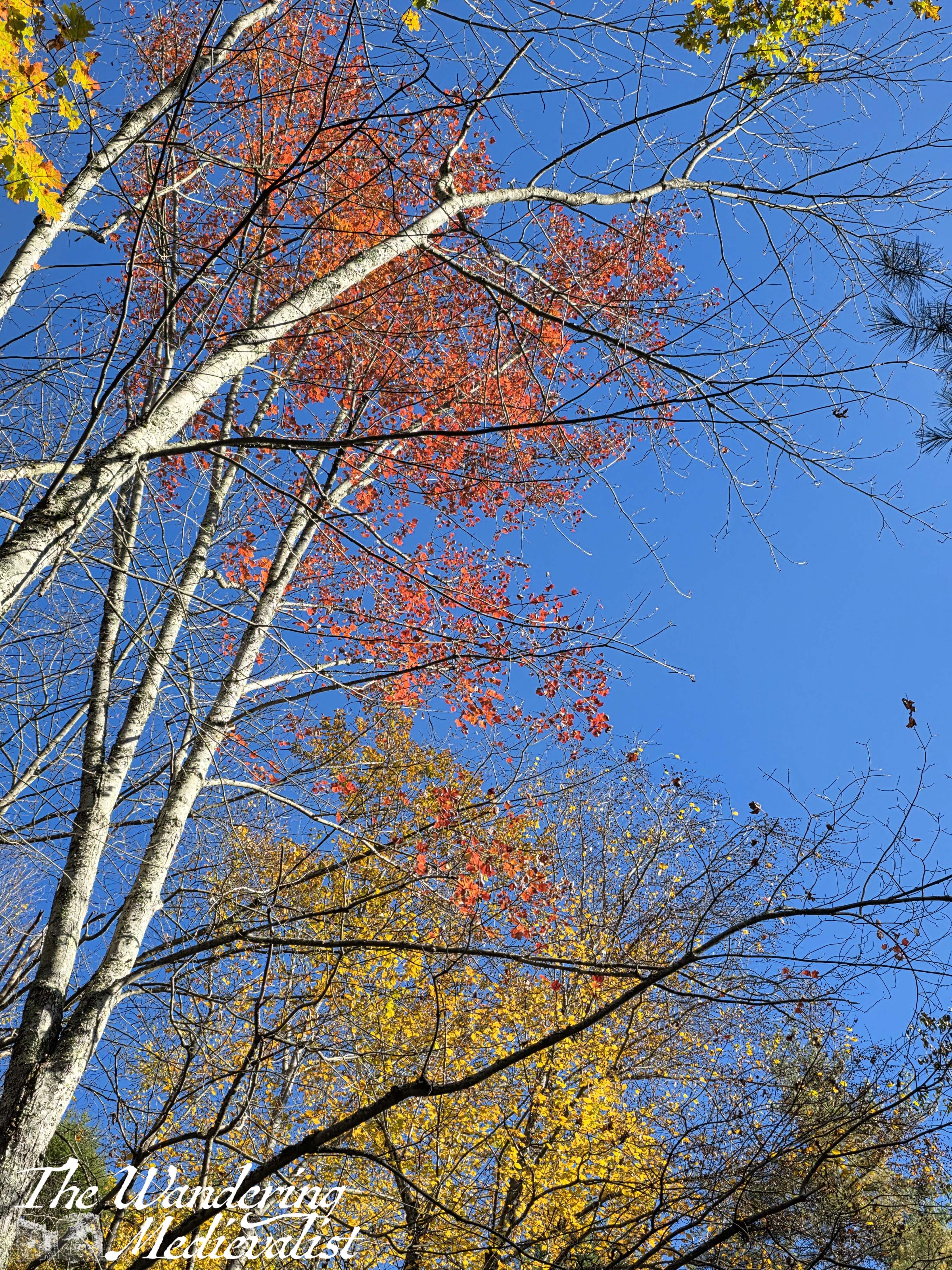
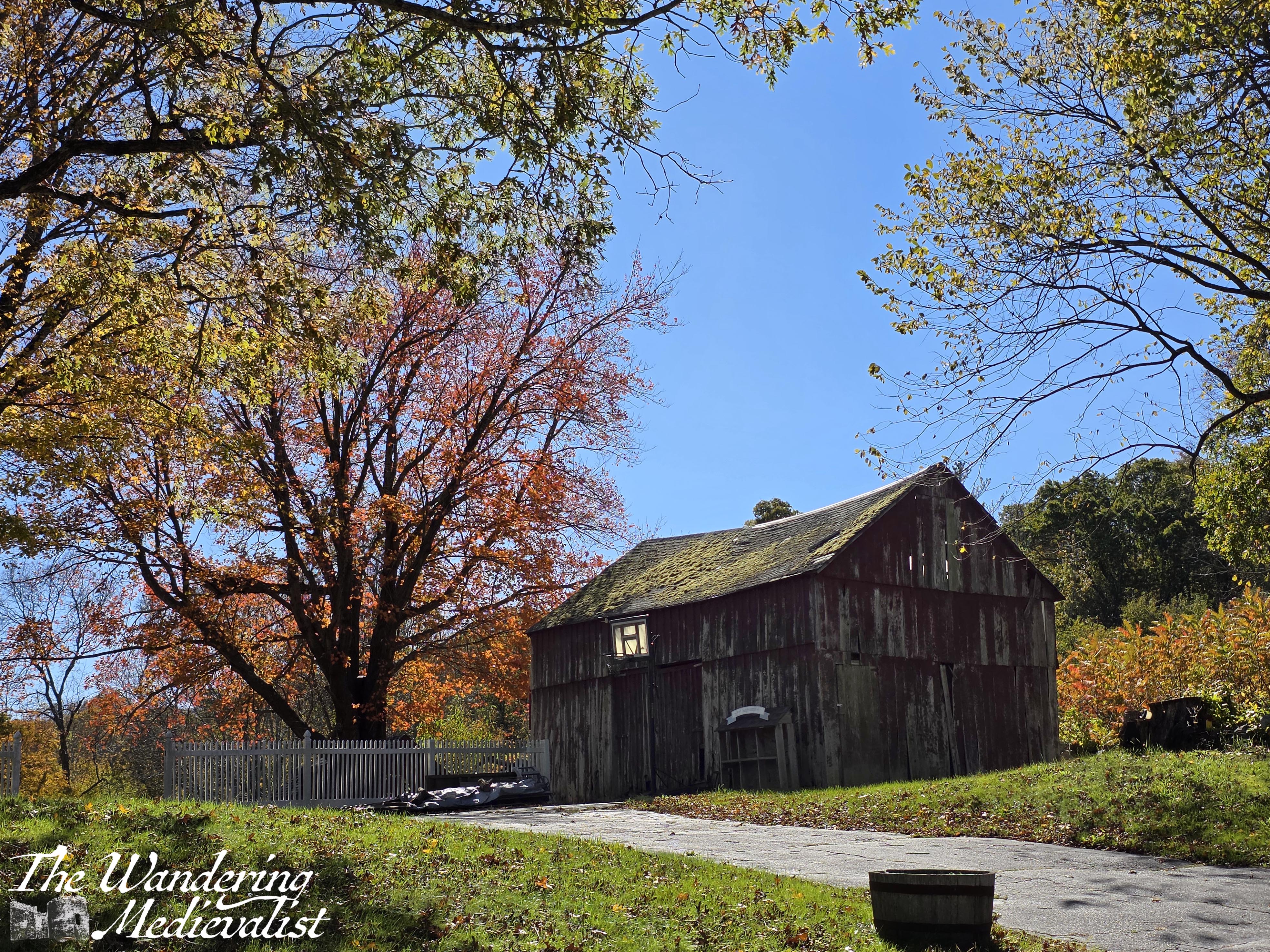
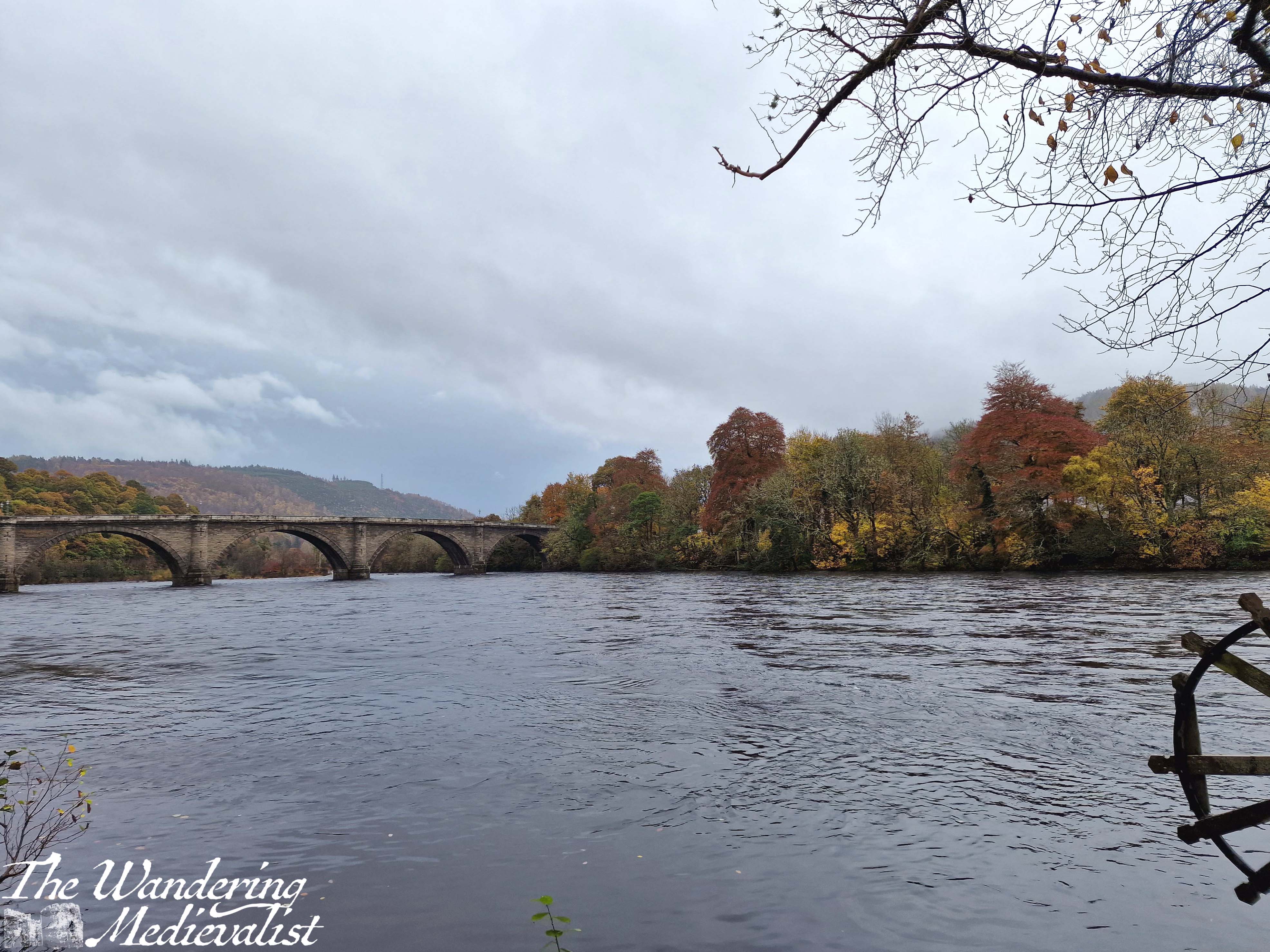
Autumn and winter compete as my favourite seasons of the year, both for photography and life in general. There are few things that make me happier than a snowstorm and snow scape (see my post about Marblehead in snow). That said, the colours of autumn are just stunning, be they orange, red, gold, or anything in between. This year in particular, I had two trips that reminded me of the spectacular nature of autumn on both sides of the Atlantic; and I am lucky enough to call both regions home – or very close to it.
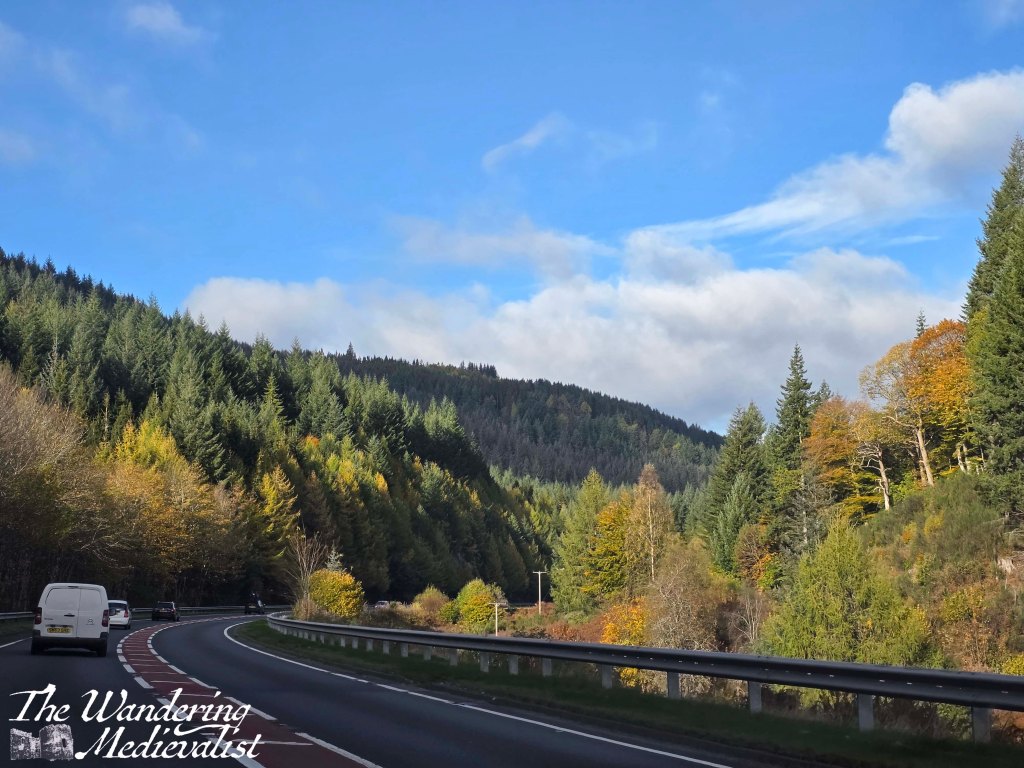
As I have written about before, Pitlochry is a special place for us, and one to which we return regularly. Our first weekend away in November many years ago allowed us to catch the very end of the autumn colour, but this year we chose to take a day trip on my weekend at home, and we caught some gorgeous golds and yellows (despite the often overcast weather). My favourite point on the drive, which I have mentioned before, is just as you turn a corner on the A9, and on this trip we could see just the start of the colour.
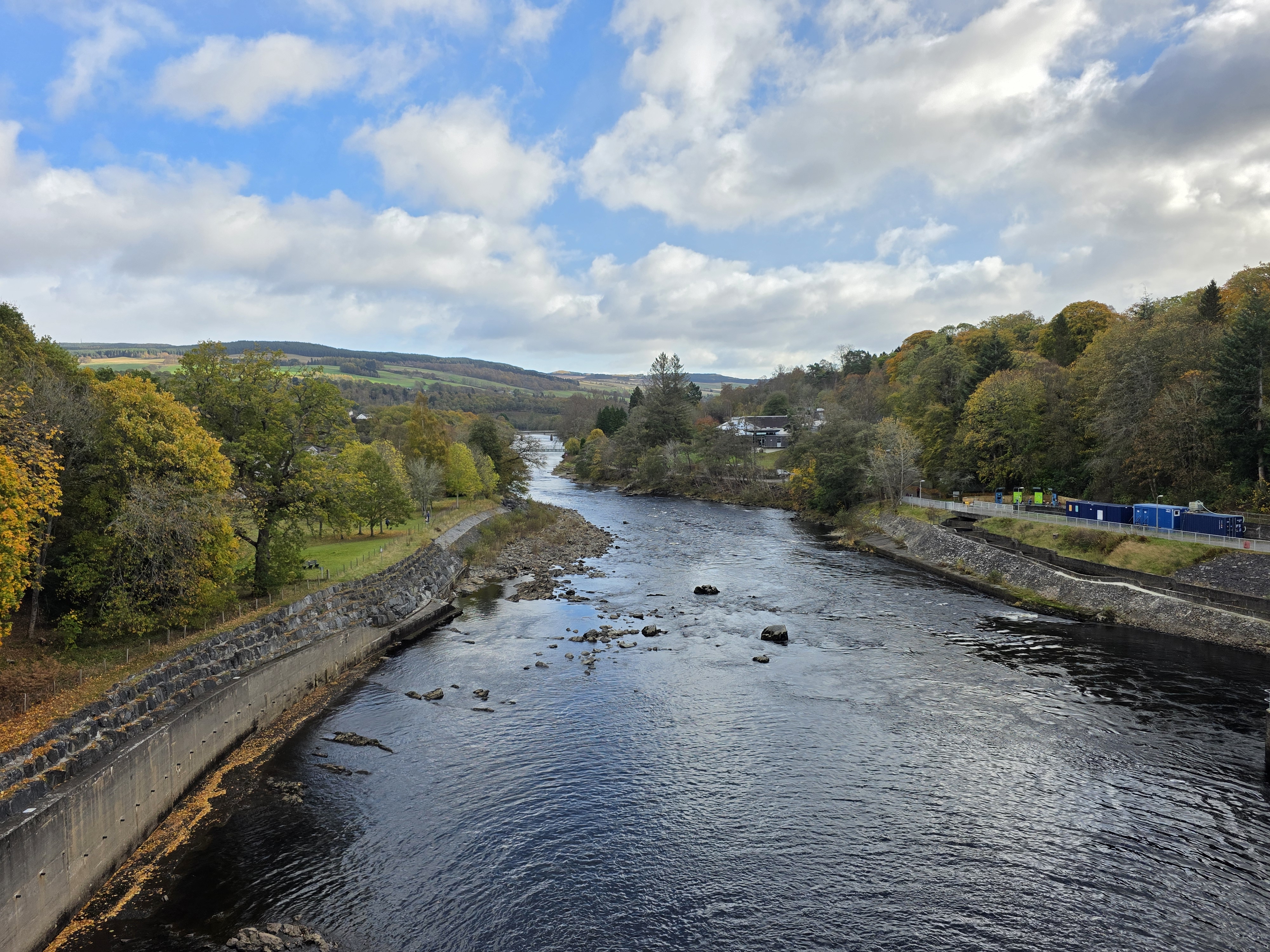
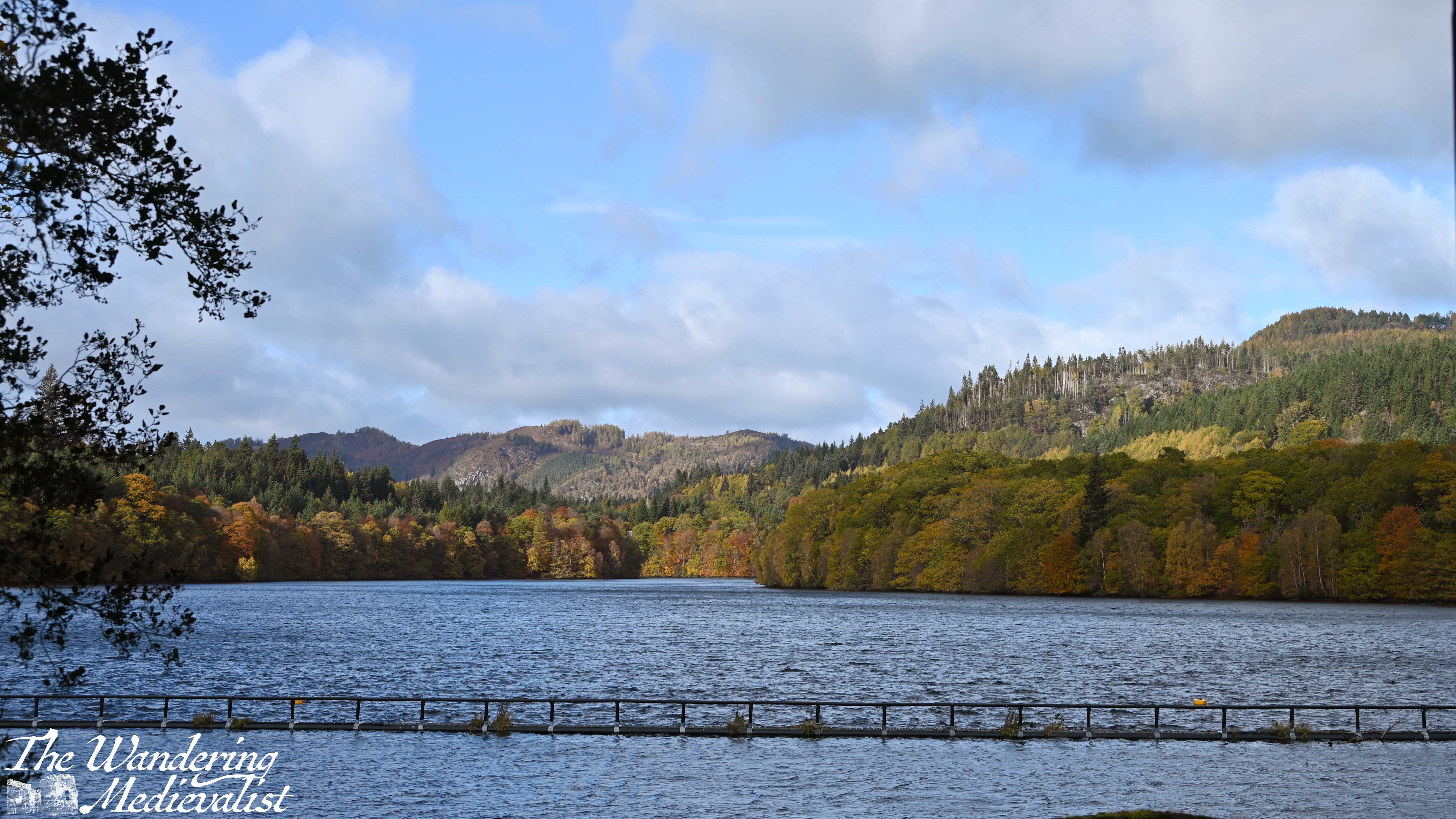
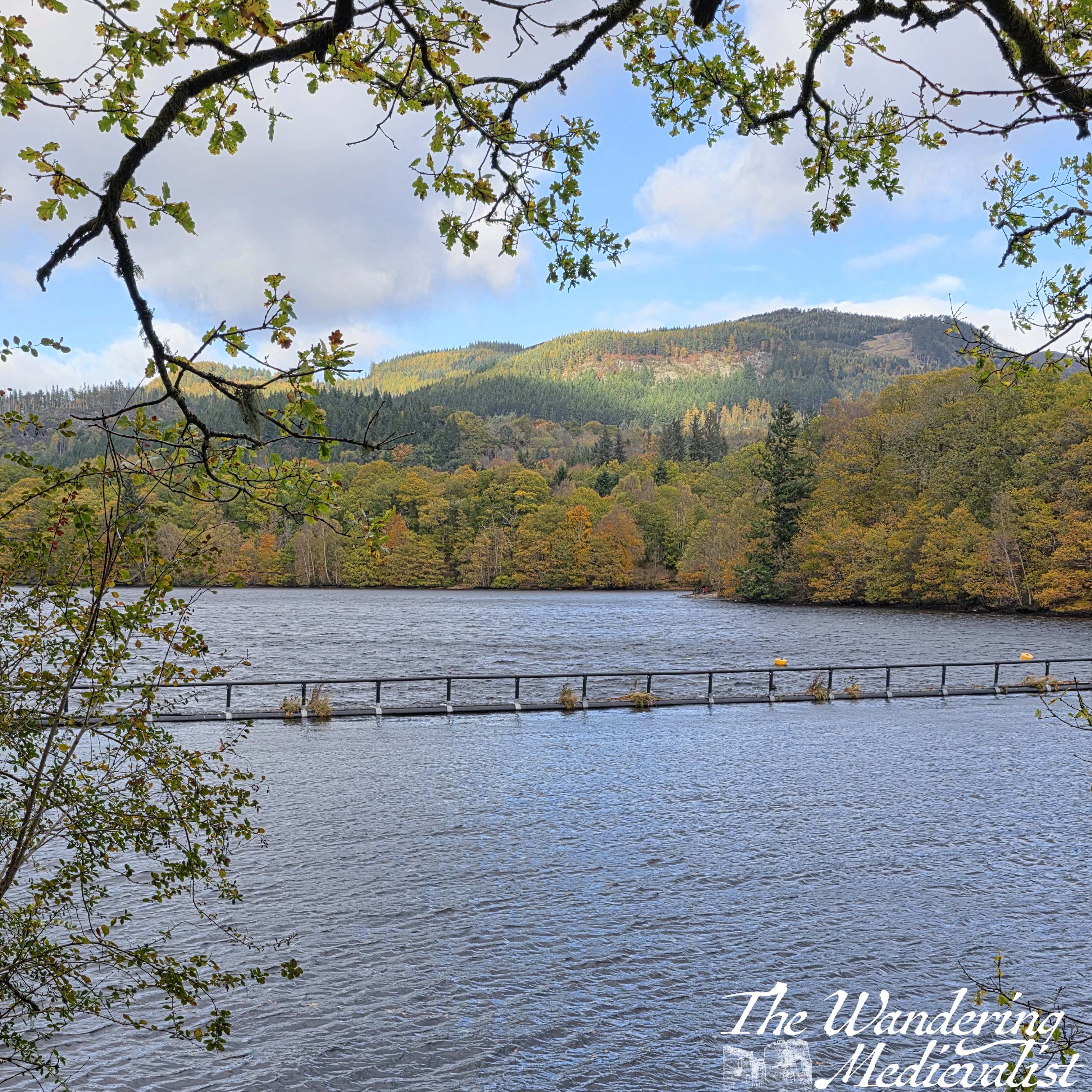
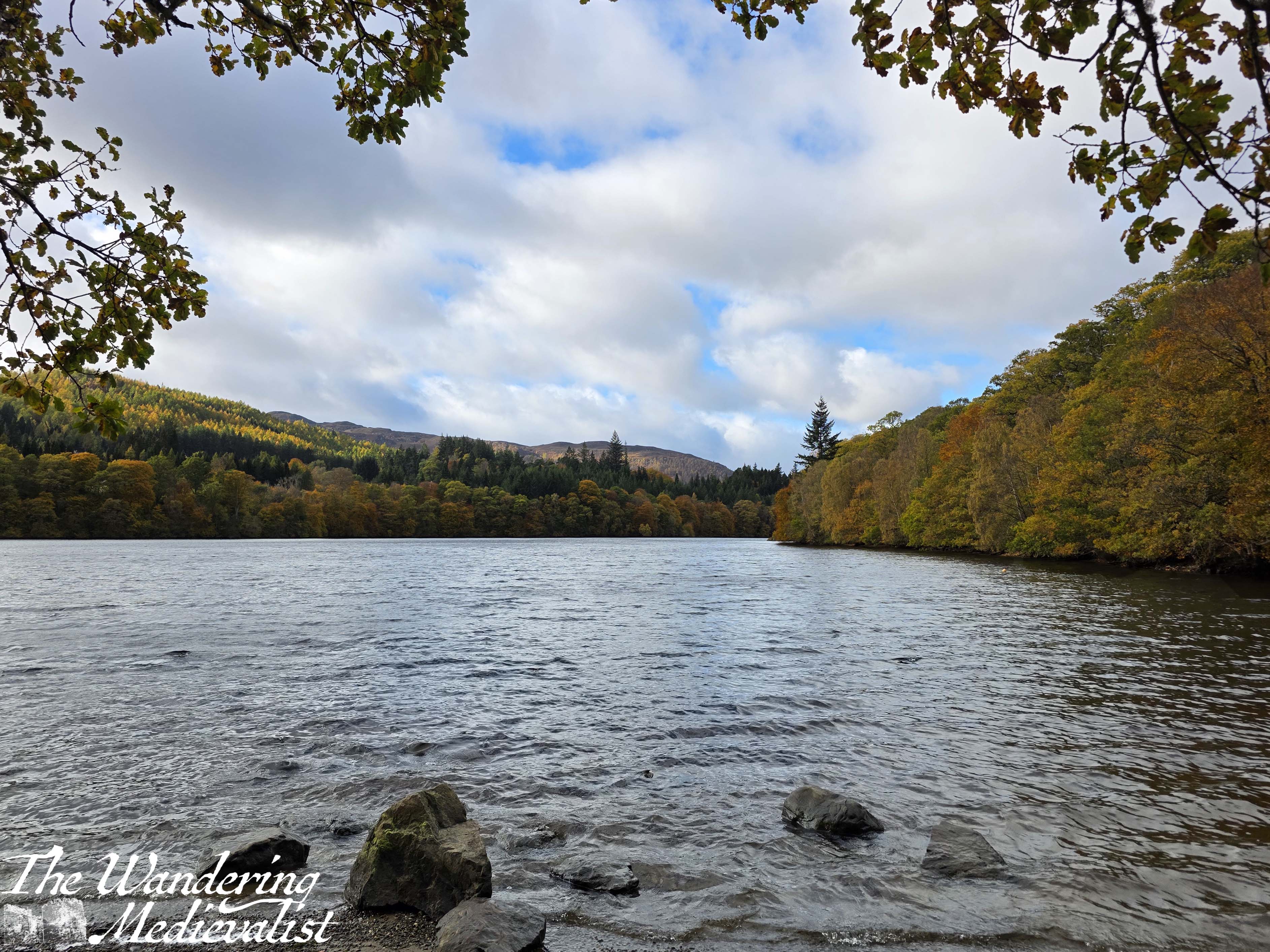
In Pitlochry, we parked at the edge of town and meandered our way through the crowds (yes, even a small town in Perthshire has crowds), then down to Loch Faskally and the famous Pitlochry dam, where there is a fish ladder and excellent views in both directions. We crossed the dam and walked a short way around the loch, where we could look back on the trees still in sunshine.
The standard walking loop in Pitlochry goes across the dam and then down the far side of the river, past the Festival Theatre. This theatre reminds me very much of the North Shore Music Theatre which I visited frequently while growing up, for its eclectic shows and unique nature. I have never actually attended a show here, but some day soon…
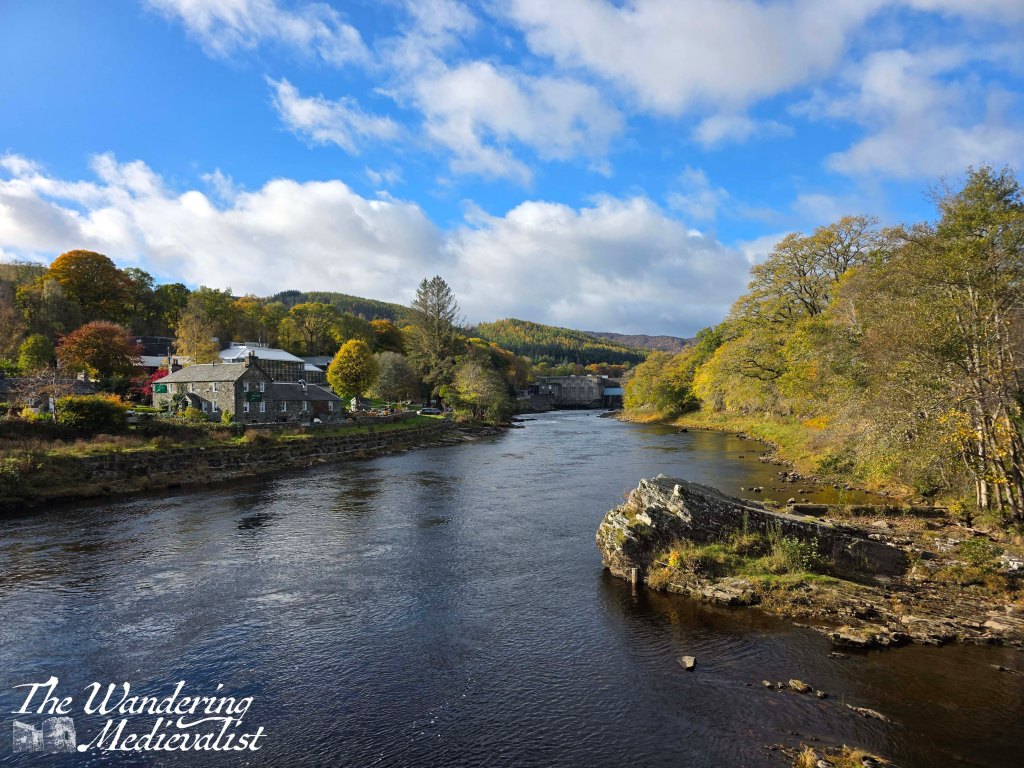
Not far beyond the theatre, the street passes by some stone cottages on one side and an inn on the other, then walkers must pay close attention not to miss the narrow entrance to the turn-off across the pedestrian suspension bridge. From this bridge, the view looking back towards the dam and the river is fantastic.
Once across the bridge, walkers can continue up through the town or take a sharp left to follow the riverbank back towards the dam and its visitor centre. We chose this route as there were several families ahead of us moving at the pace of the accompanying toddlers, and we wished to go back up to the overlook of the loch, below. Side note, the visitor center is relatively new (opened less than 10 years ago), and offers a great café, small gift shop, and clean restrooms.
The sun on this day just would not cooperate and show off the yellows and oranges the way I wanted, but I think you can get a hint of what we saw.
After a quick lunch in Pitlochry, we headed back to the car to drive up to Killiecrankie, which is only a few miles north.
The walk here is famous for stunning colour, but apparently everyone else had heard that too – there was not a place to park, and so we drove a bit further north to Blair Atholl. Immediately upon crossing the bridge into the town, there is a small car park where we stopped and found a walk along the riverbank.
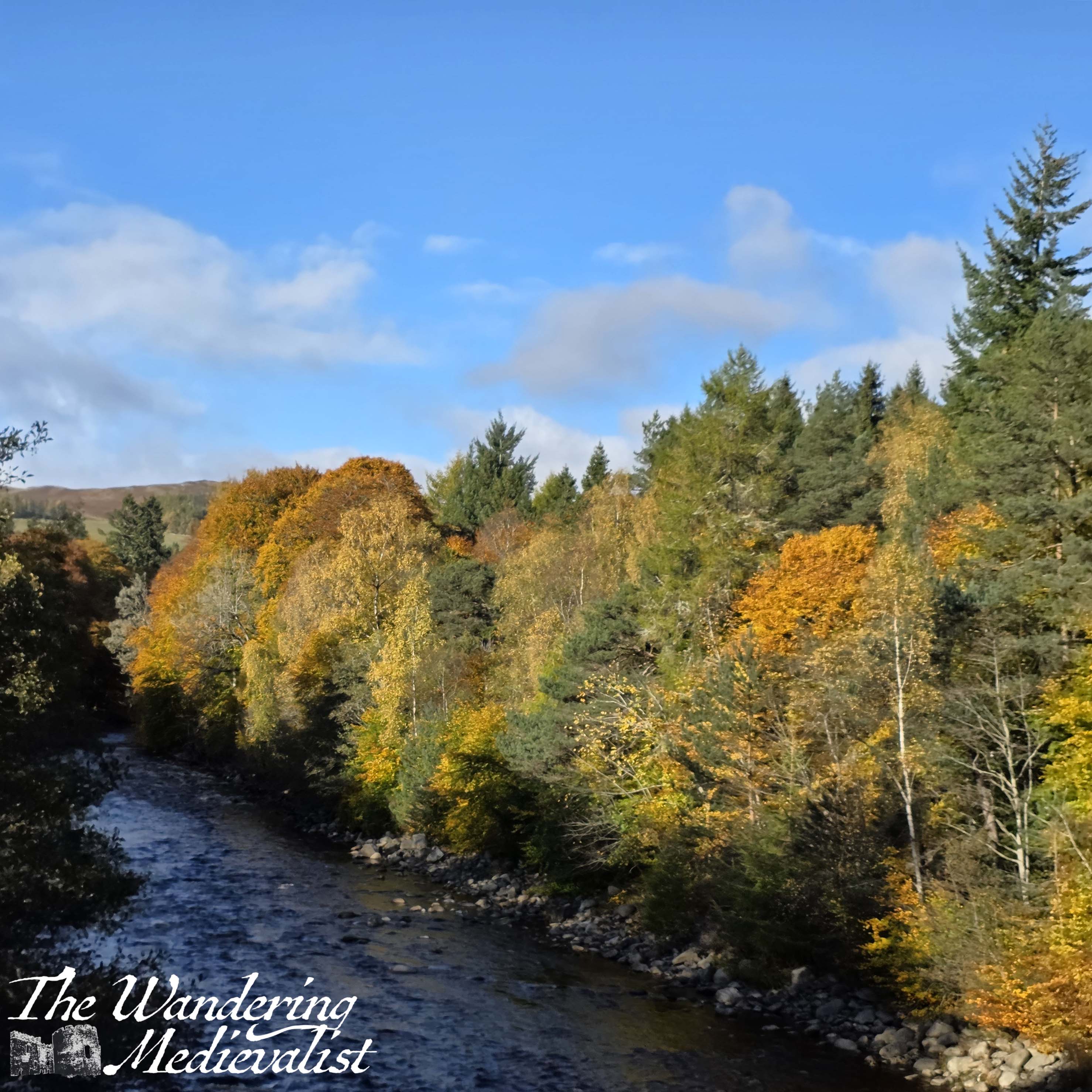
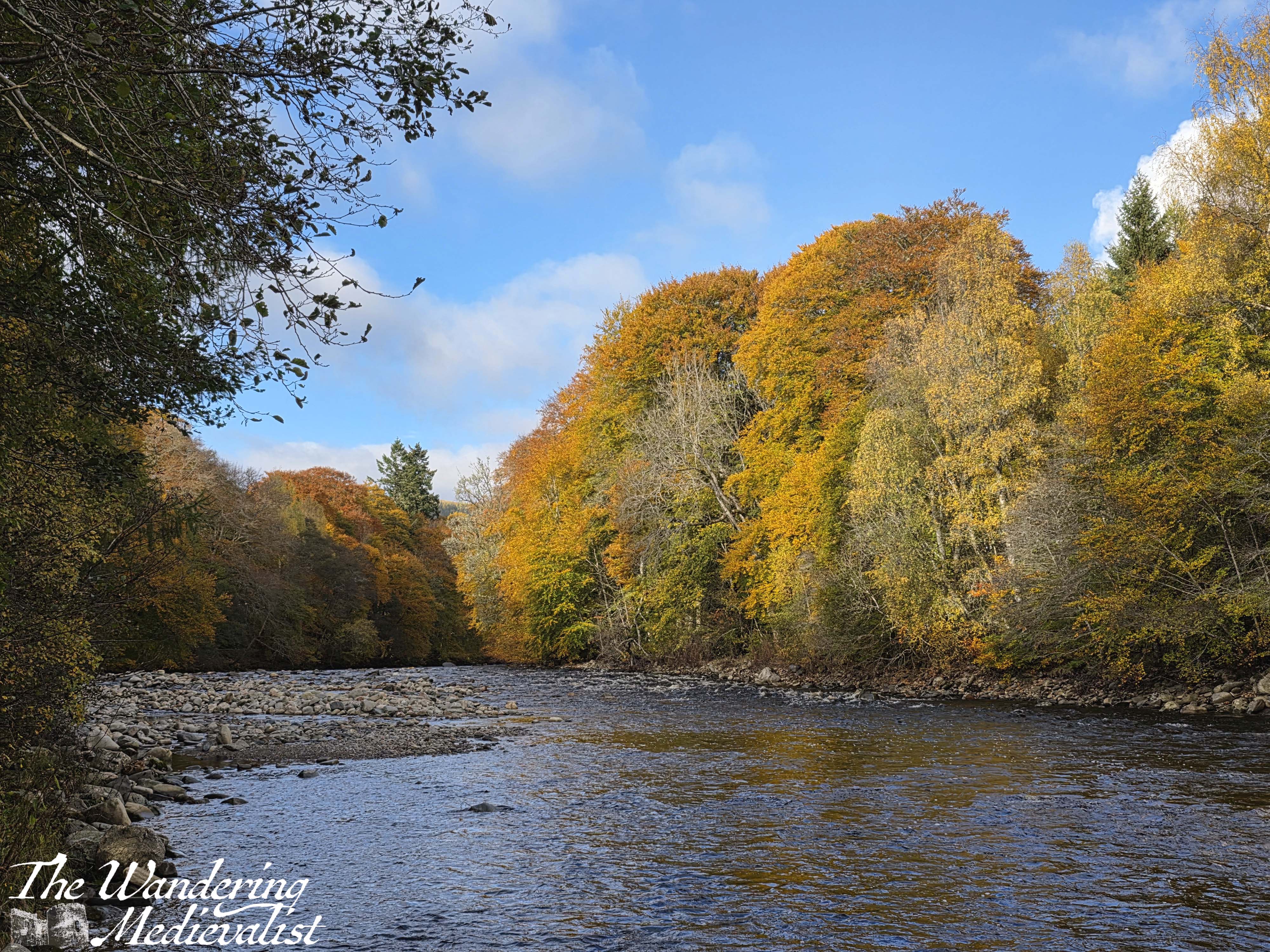
Finally, here the sun came out in honest and I was able to capture a bit more of what we saw in person, brightness that really isn’t as visible in the above, overcast pictures.
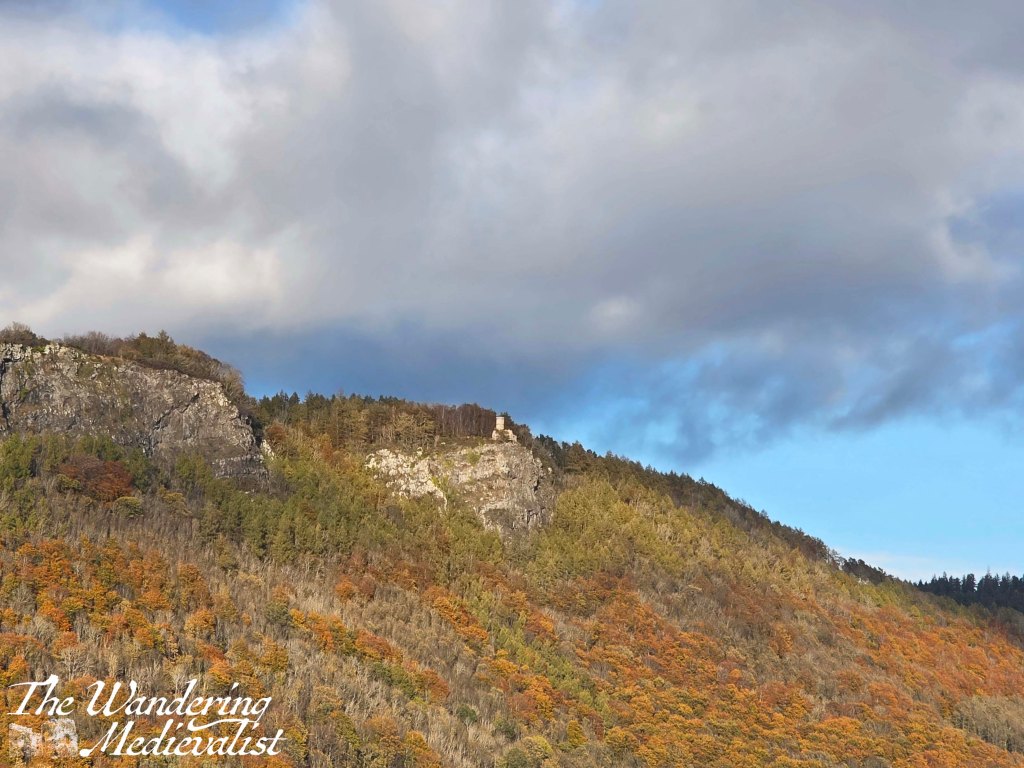
We thought very briefly about going all the way to House of Bruar, but decided it would likely be even busier than Pitlochry, so not appealing. The drive home boasted one more impressive view, looking up at Kinnoull Hill near Perth, from the A9. There was a hint of what once had been (or may be on a less dry autumn).
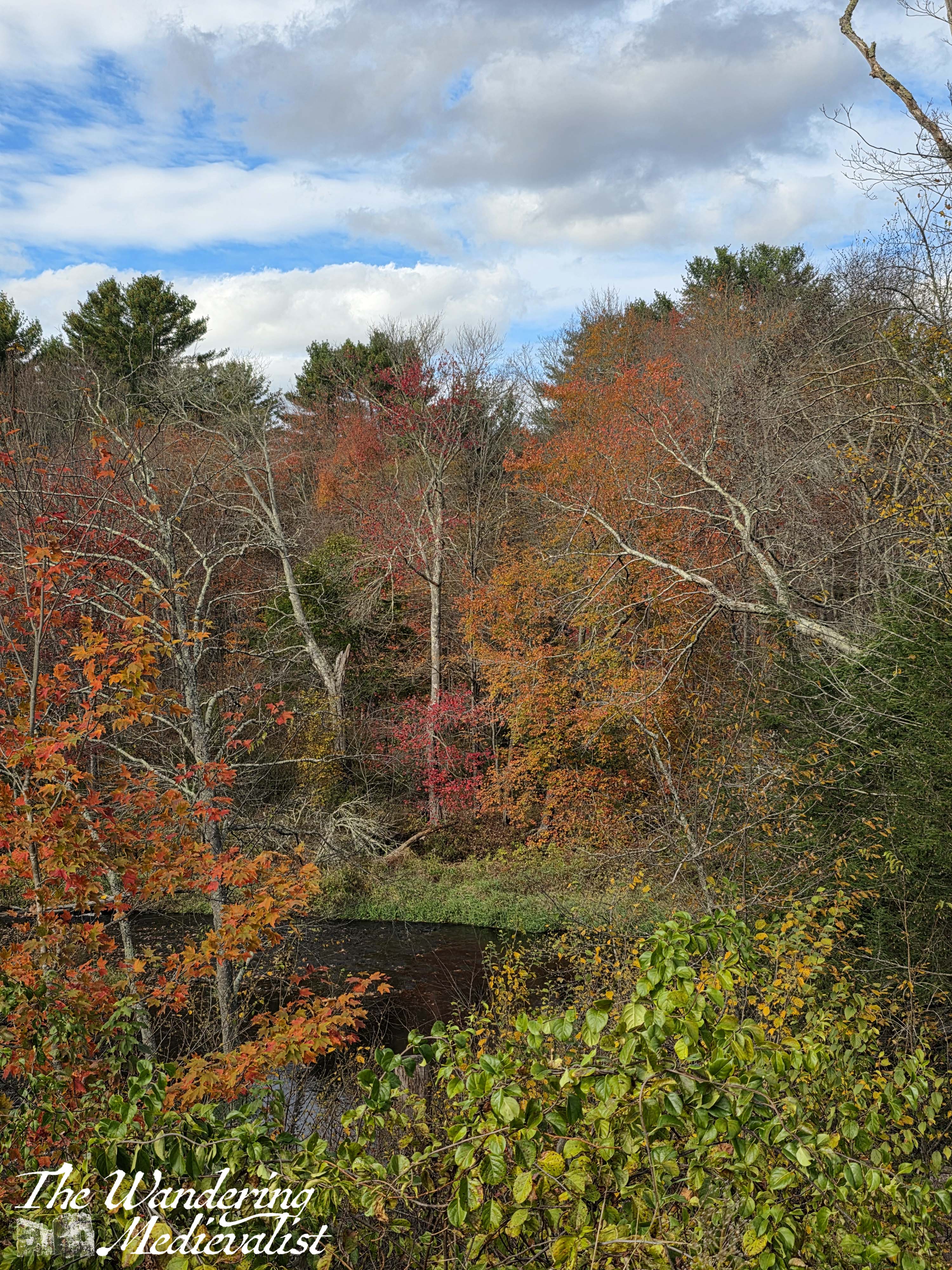
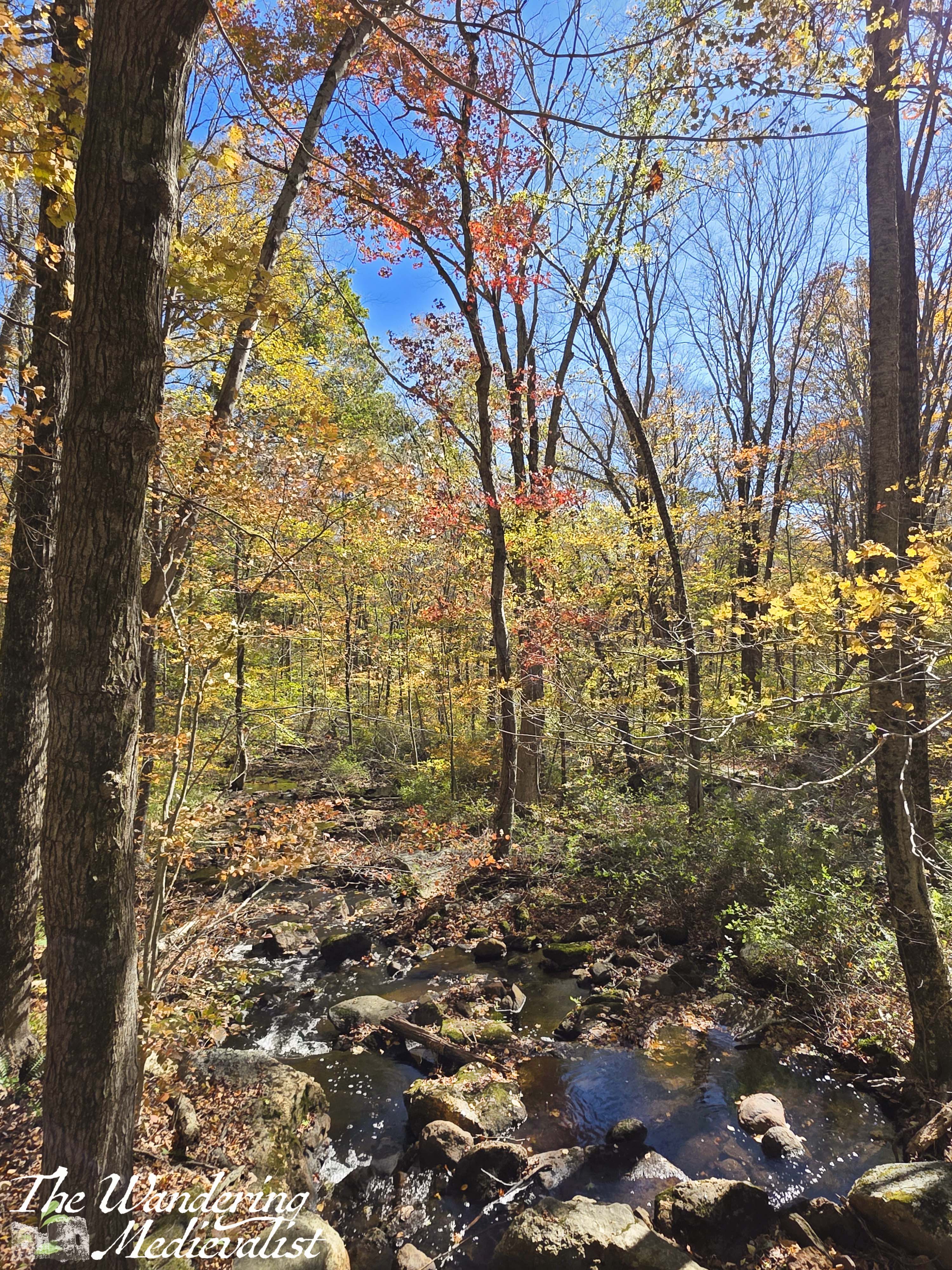
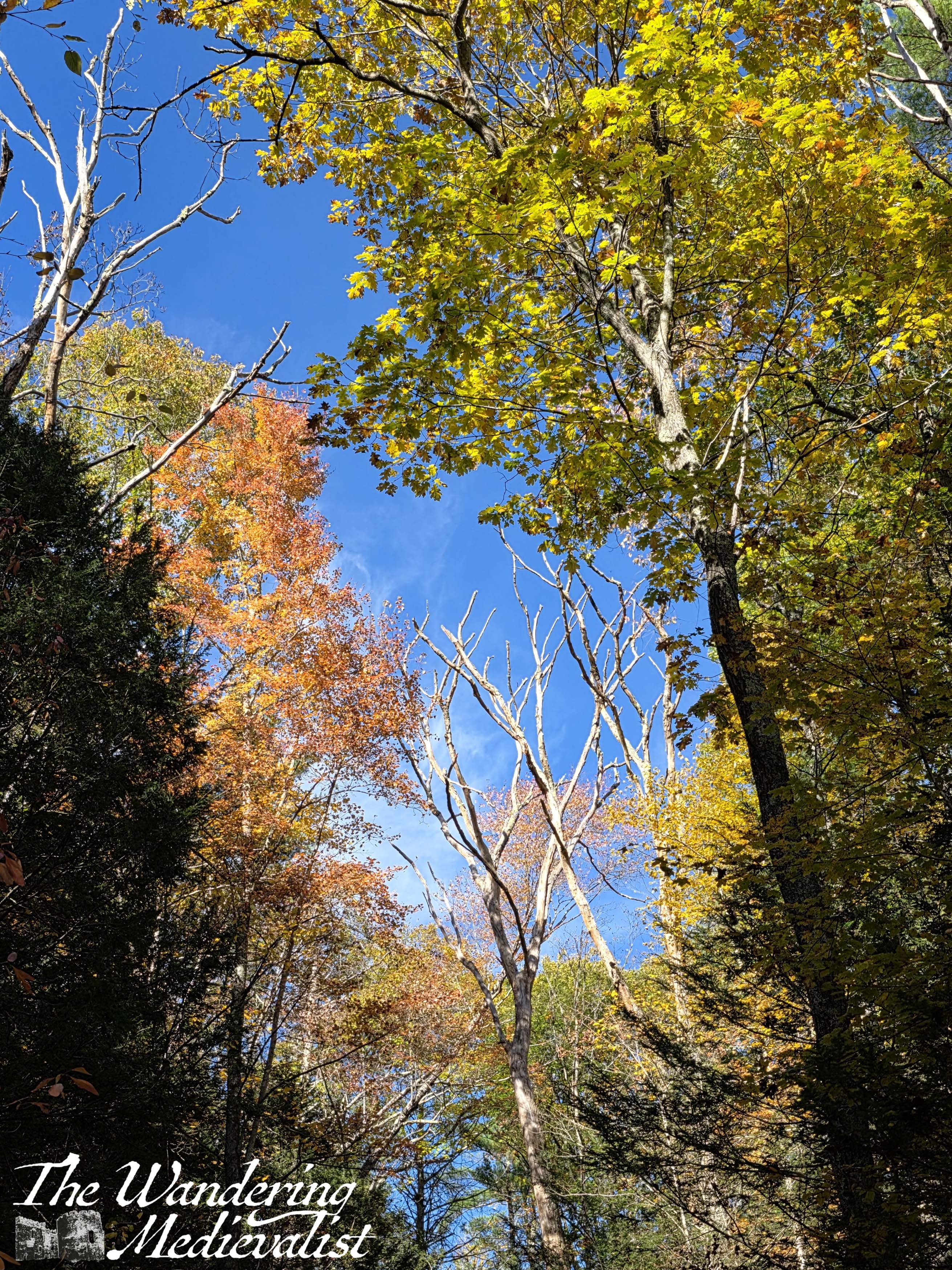
The rumour on TV was that this year had been so dry, that all of the famous New England colour would be muted. It may be that further north this was the case, but on my drive from Boston to Greenwich, CT and back again, I saw some of the most amazing colour I can remember in many years. Now, granted, this was only my second autumn visit to New England in 20 years, but I found myself in awe over the beauty and vivacity of the leaves. There was one colour, which I do not seem to have managed to capture, that was an almost fluorescent pink-orange that you would not be blamed for thinking could not appear in nature – I was desperate to capture this colour, but it seemed only to exist on the side of the highway, where I could not stop. Nonetheless, I managed a few lovely views and took some short breaks while driving to stretch out my back and enjoy the scenery.
My first stop was at a rest area heading south, about halfway between Sturbridge, Massachusetts and Hartford, Connecticut. I did not expect it, but the small information cabin included a back porch looking over the river below, lined by some stunning maples.
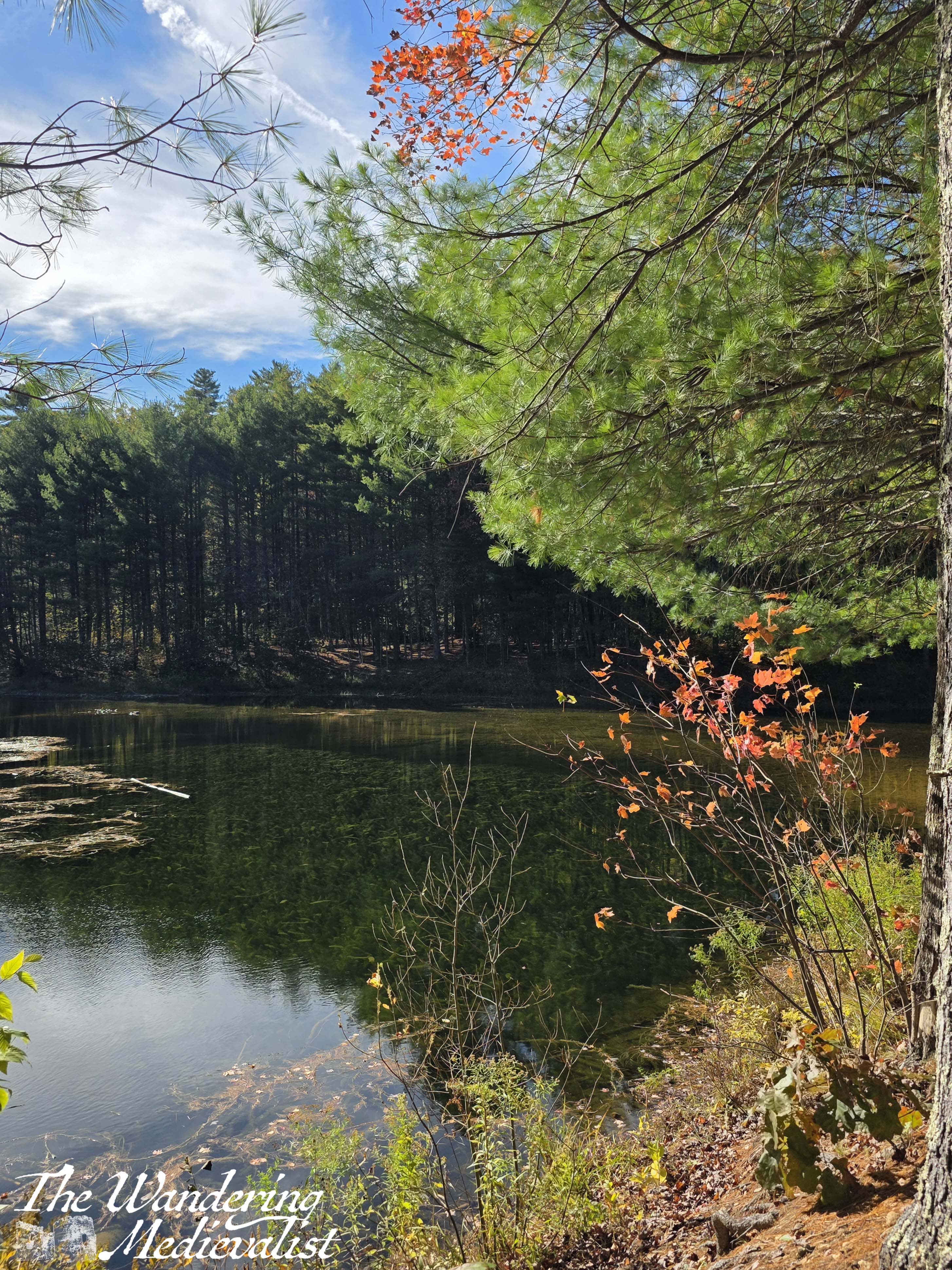
The next morning I found myself favoured by traffic and so 40 minutes early for an appointment, making it possible for me to take a short detour down a tree-lined road to a pond. The reflection of the trees on the calm water was stunning, and there was a small brook meandering past the road.
My final day in Connecticut was dominated by the long drive from New Canaan to Marblehead, through downtown Boston as going through Salem is not an option in October (as I was reminded frequently). This was looking to be around 4 hours, so I planned to stop twice along the way – my back was starting to show the wear and tear of a busy few weeks in the car.
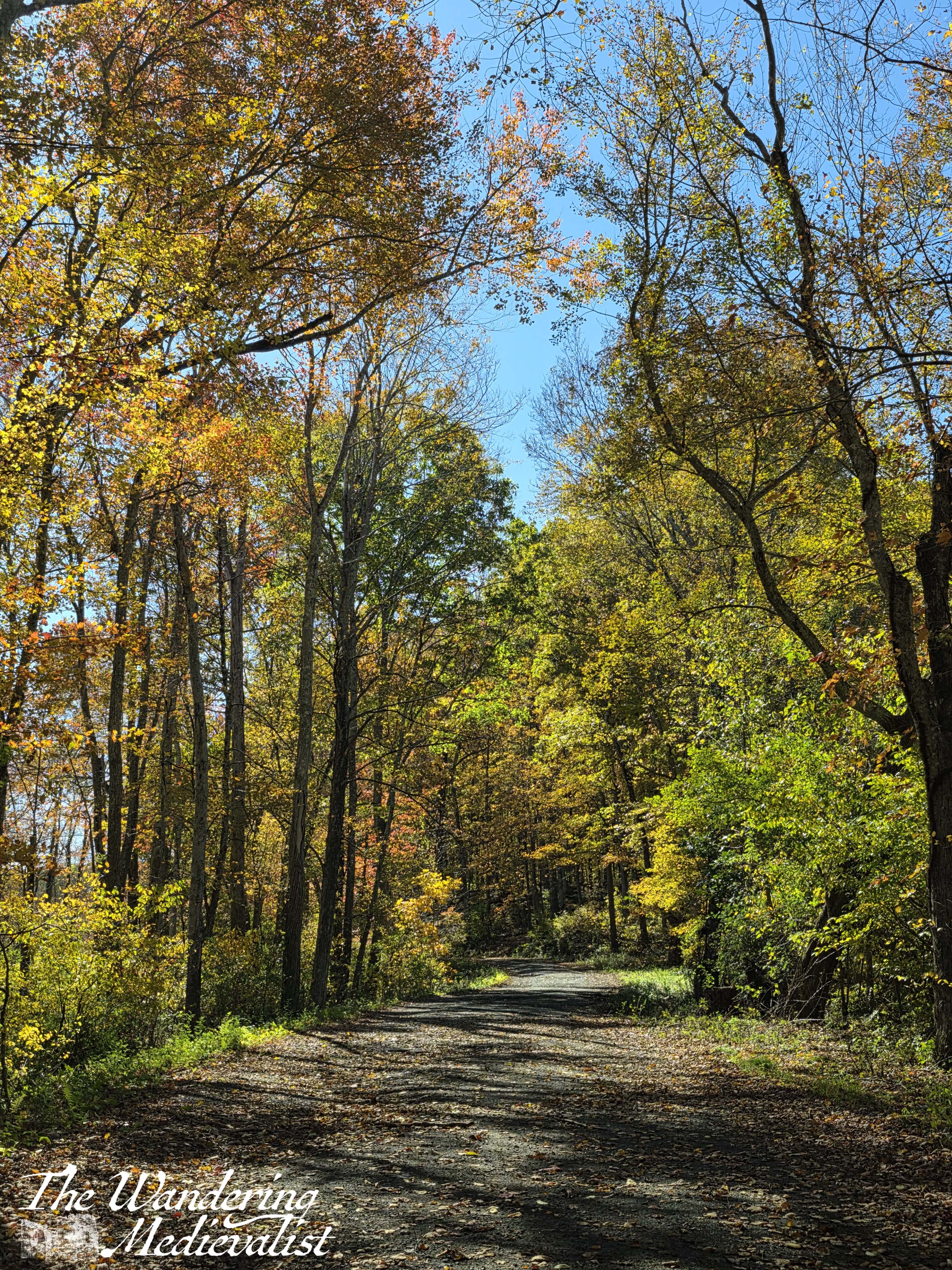
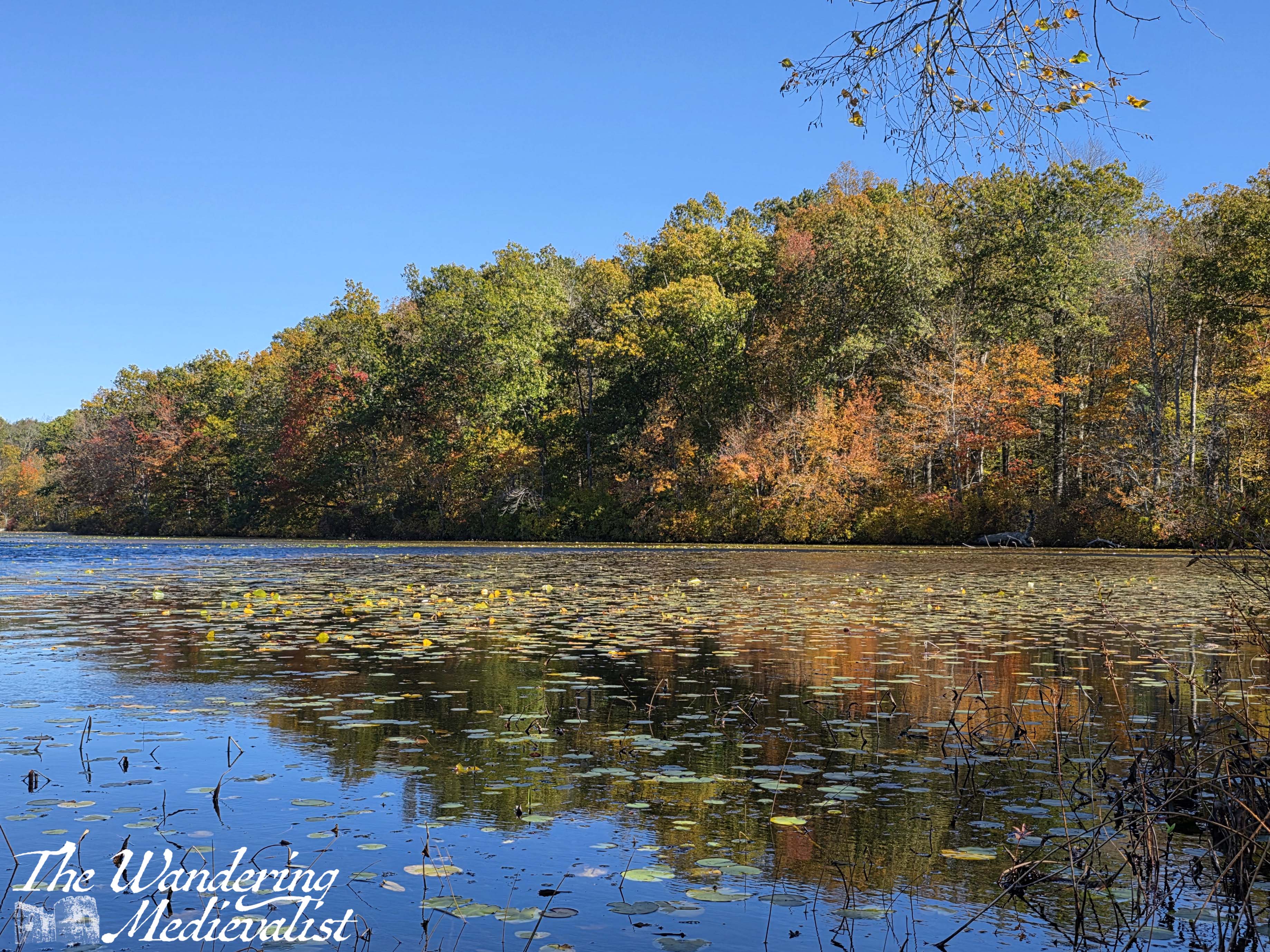
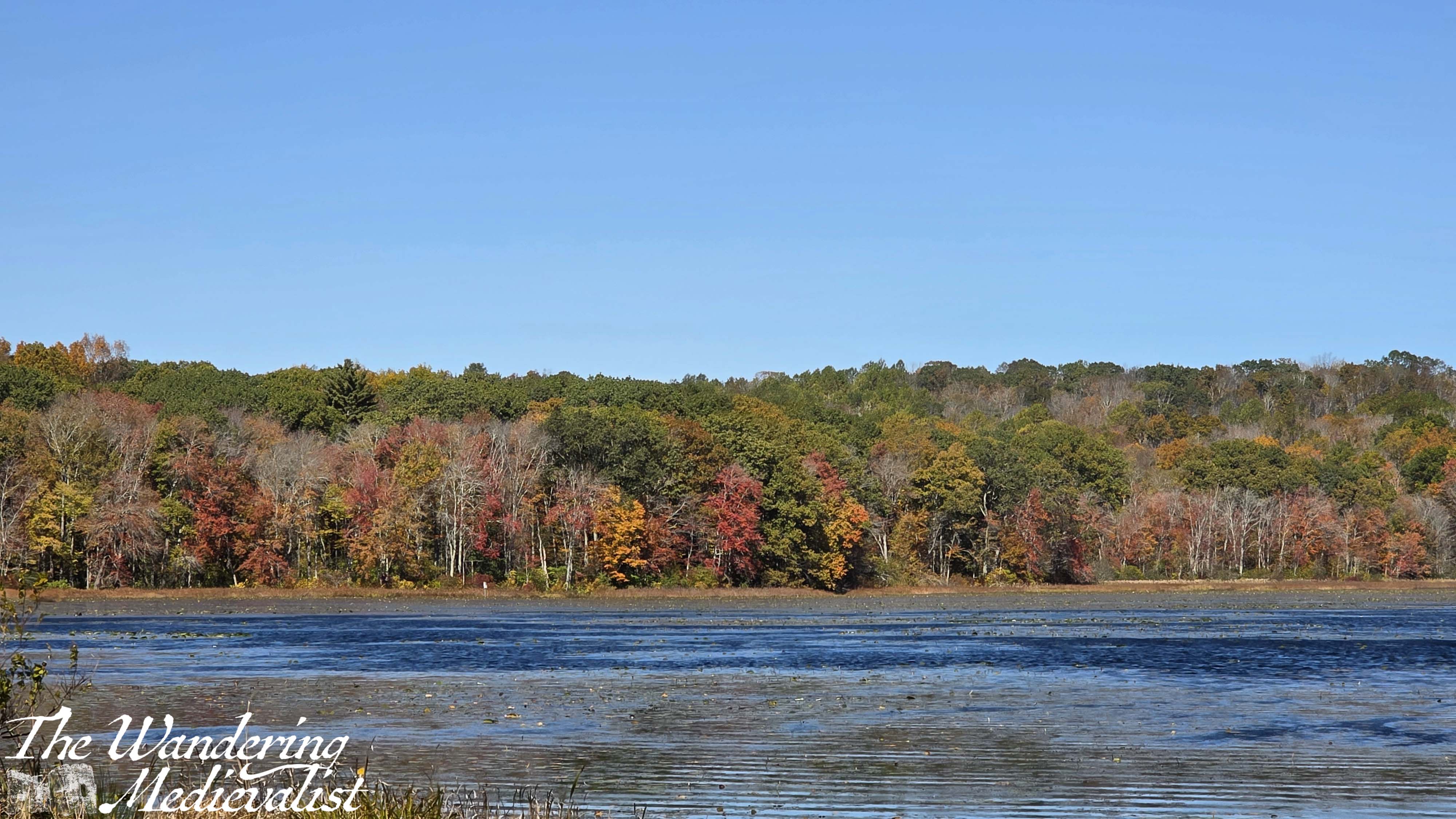
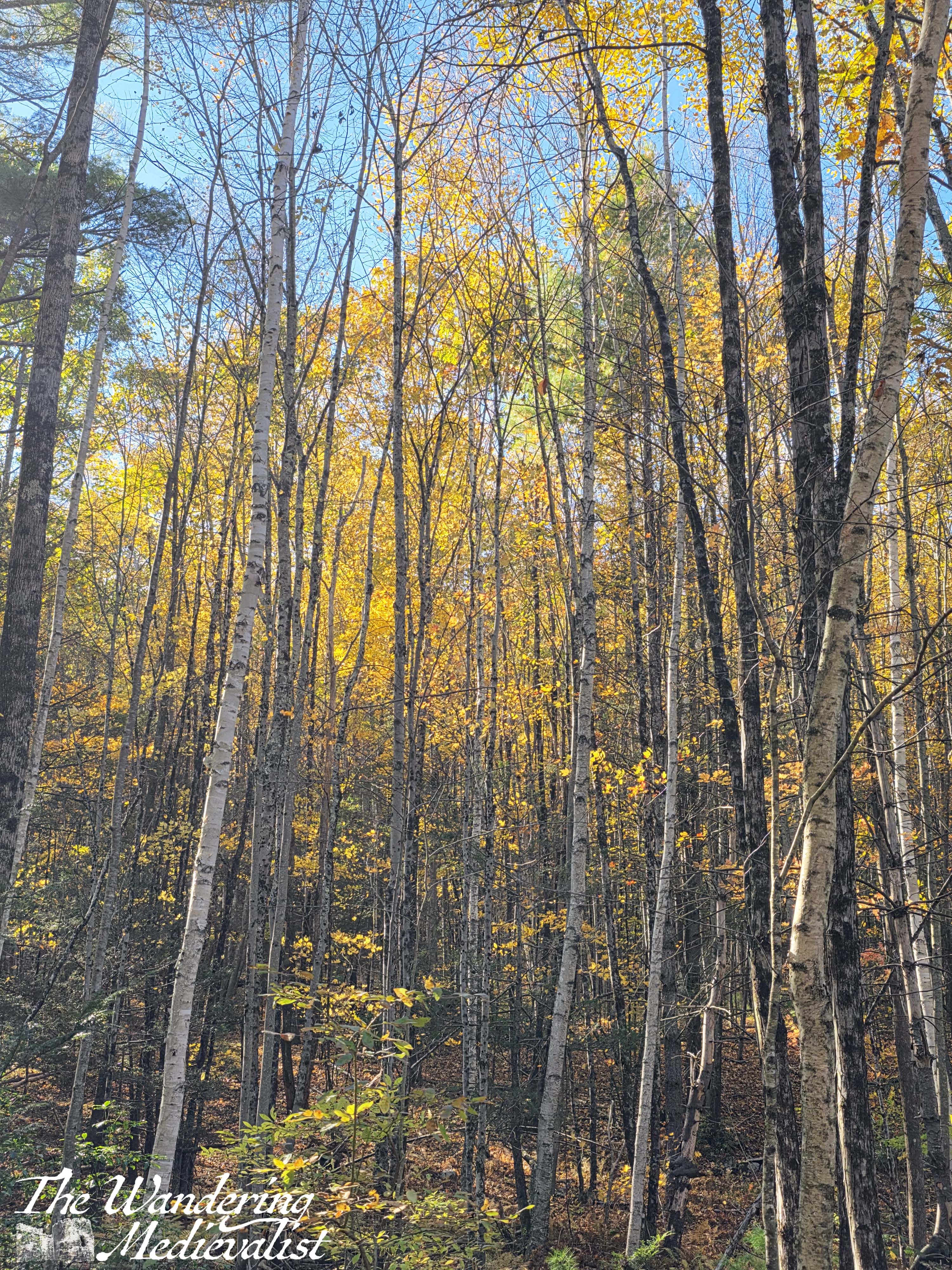
My second and final stop was just outside Sturbridge, Massachusetts, where there was a short mile-long walk around a pond – the perfect opportunity to stretch legs/back, and take a walk in the woods. Sure enough, while once again I was stymied in finding many bright colours, I found the golden hues everywhere, and it was a beautiful afternoon.
The light shining through the yellow trees against white birch bark reminded me of a scene in House of Flying Daggers, a film known for its imagery perhaps more than its story.
I am forever grateful to myself for taking this interlude, as what should have been two more hours in the car turned into three as I hit the Friday afternoon traffic through Boston. That was a long drive.
I am forever grateful, though, for a job that allows me to experience this kind of journey at a time of year when I could not visit for so long. I hope that I may be back next year.
Finally, while this visit to Dunkeld did not take place this year, I have been wanting to post these pictures for some time and was looking for the right time. Several years ago, as I recovered from my second bout of Covid, the other half suggested a day trip as I was no longer testing positive and had been confined to the house for two weeks. Dunkeld is a beautiful village in Perthshire – one of many – even closer than Pitlochry, boasting a medieval cathedral and some lovely homes.
On the day in question, we arrived just after lunch and walked through the village to the cathedral, then down to the river where you can walk along the bank back towards the main bridge.
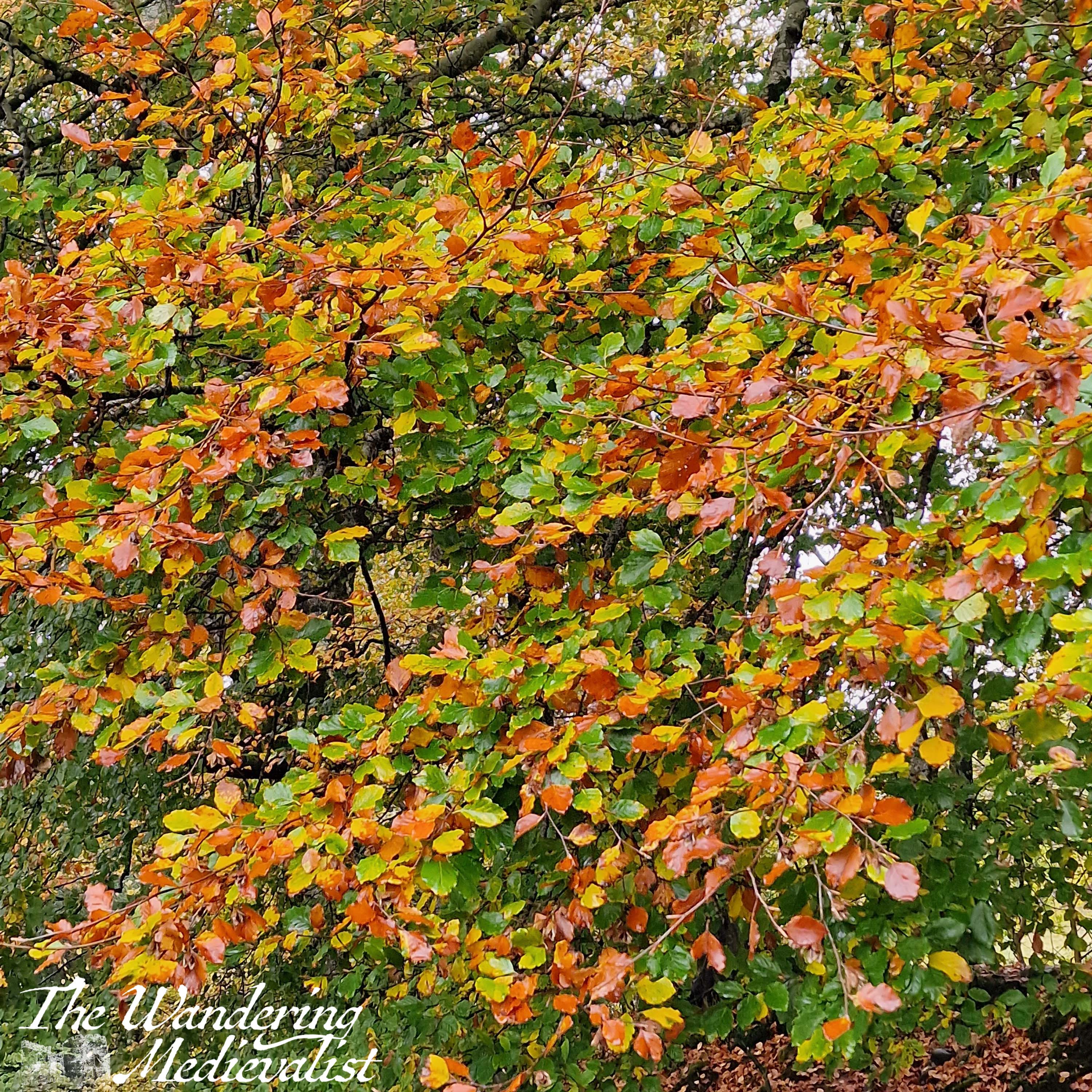
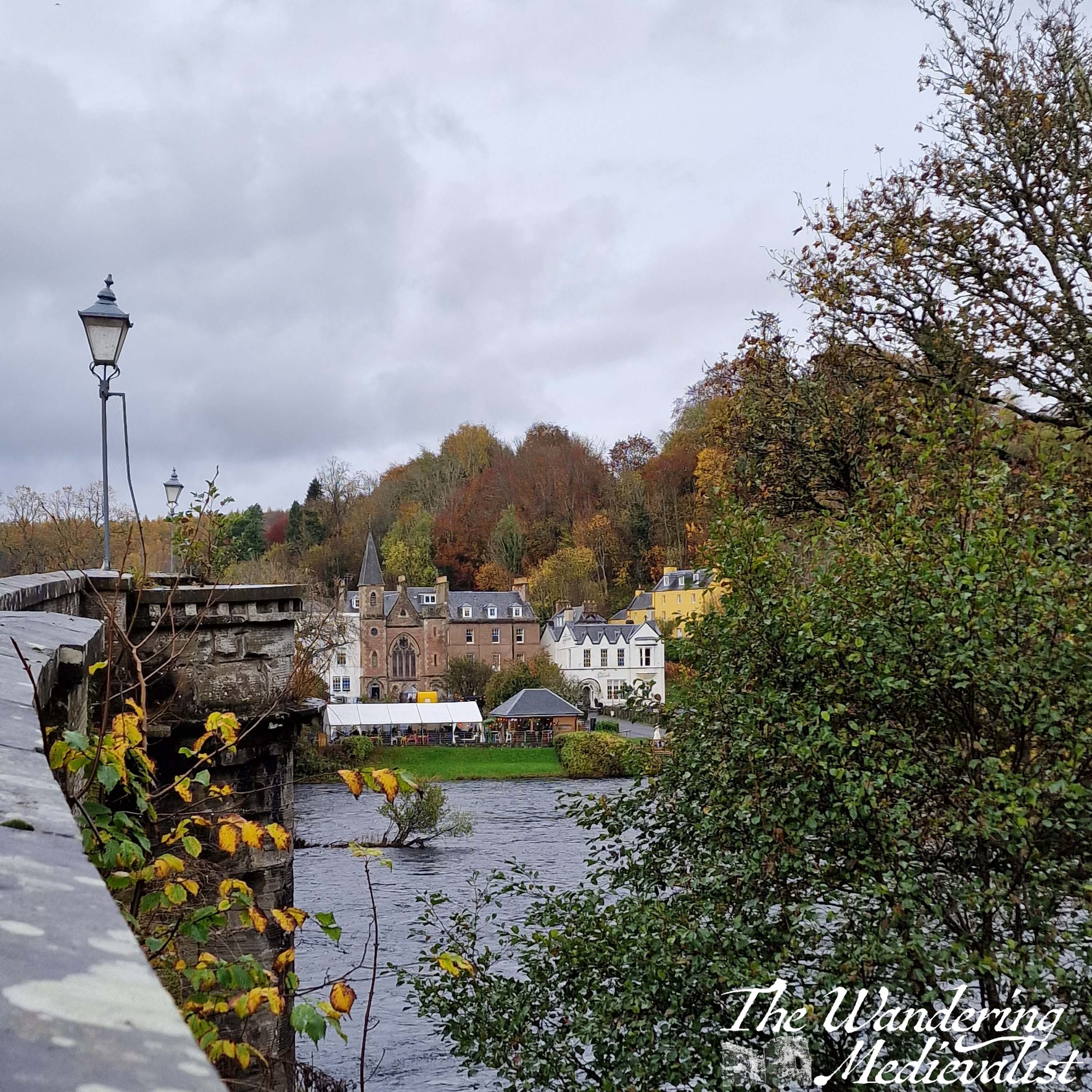
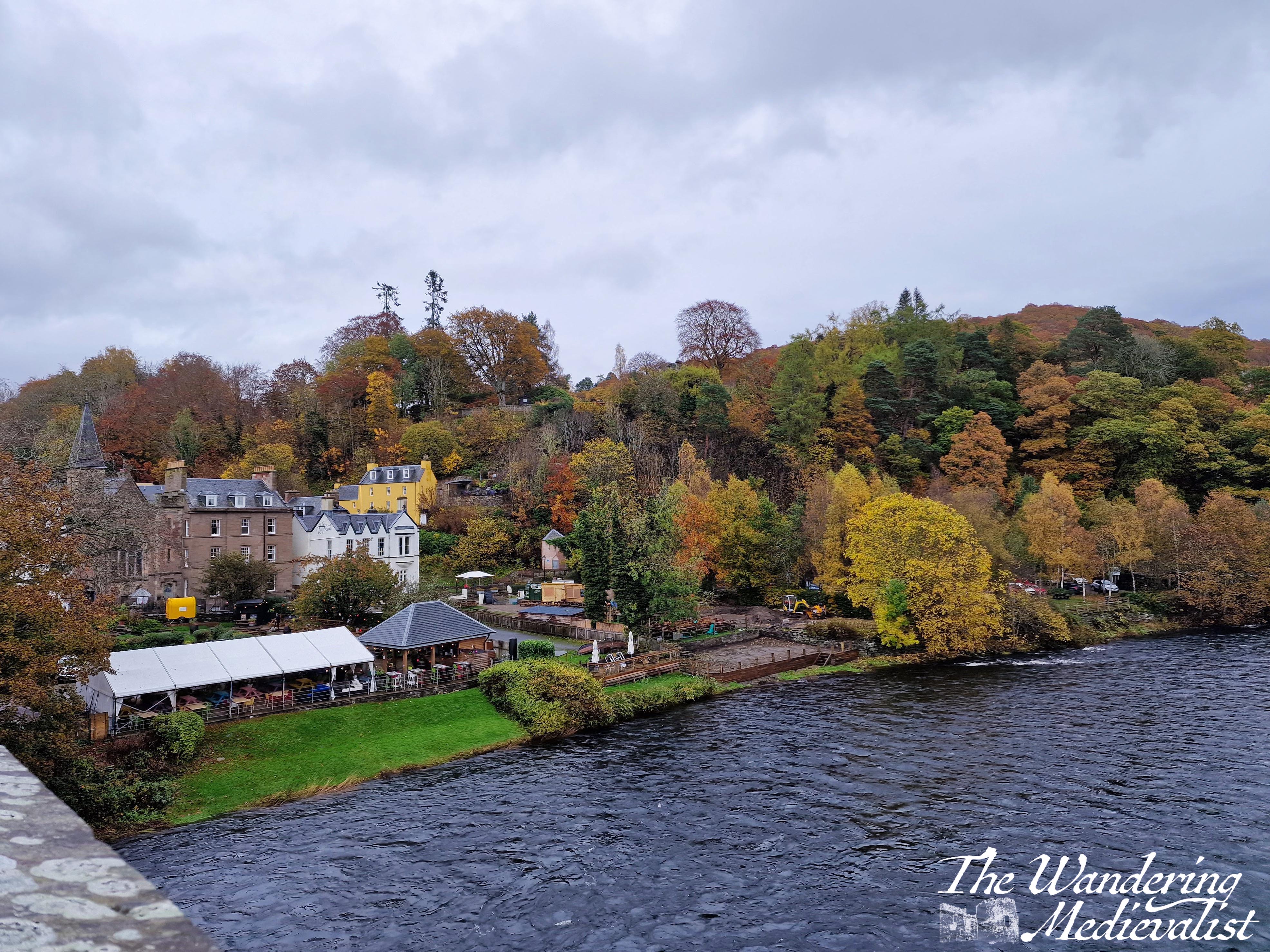
While it was later in the season, there was still a touch of yellow and gold, particularly in what I think are beech trees. As we approached the bridge, the sun was glinting off the river between the mostly-empty branches of the trees, and I took about 10 pictures of the leaves. These are the better ones.
The day was growing clearer, and so we climbed up to the bridge and across, to take in the view from both sides. In one direction is the village, spread along the riverbank and the hills.
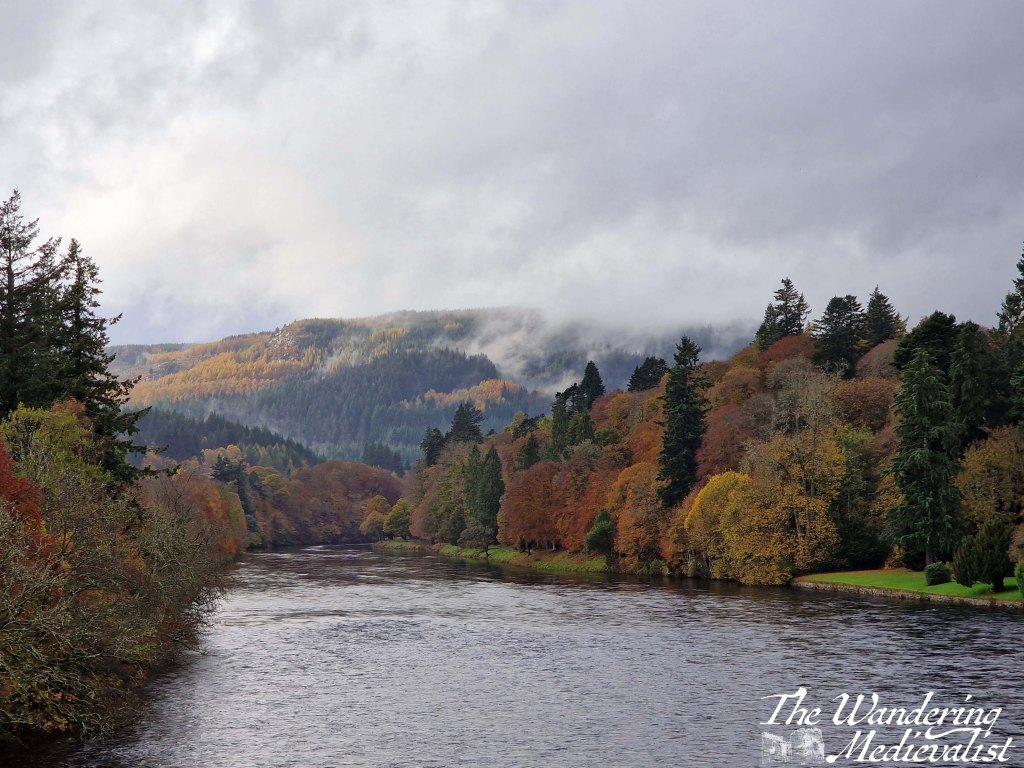
In the other direction is the river and – just visible through the trees – the tower of the cathedral. Covid exhaustion meant that I was not really up for a long walk, and so we headed back towards the car via a coffee shop on the main street.
On the day we visited, there was a perfect Scottish mist hanging on the treetops, though the hints of red and orange are still visible between the green pines.
This is one of my favourite pictures of Dunkeld, and the grassy area you can just see on the left side is where the cathedral grounds meet the river.
There is nothing particularly thought-inducing about this post, but I wanted to share my appreciation for autumn in both of the places I have lived. New England colour is world-famous, and deservedly so, but Scotland – along with many other countries – produces its own autumnal glory. It may not be as dramatic, but it is beautiful.
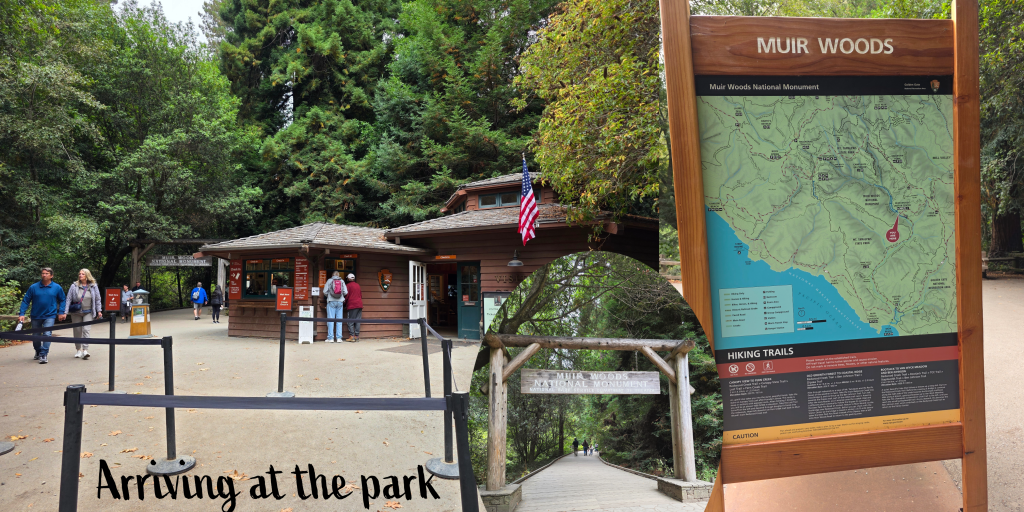
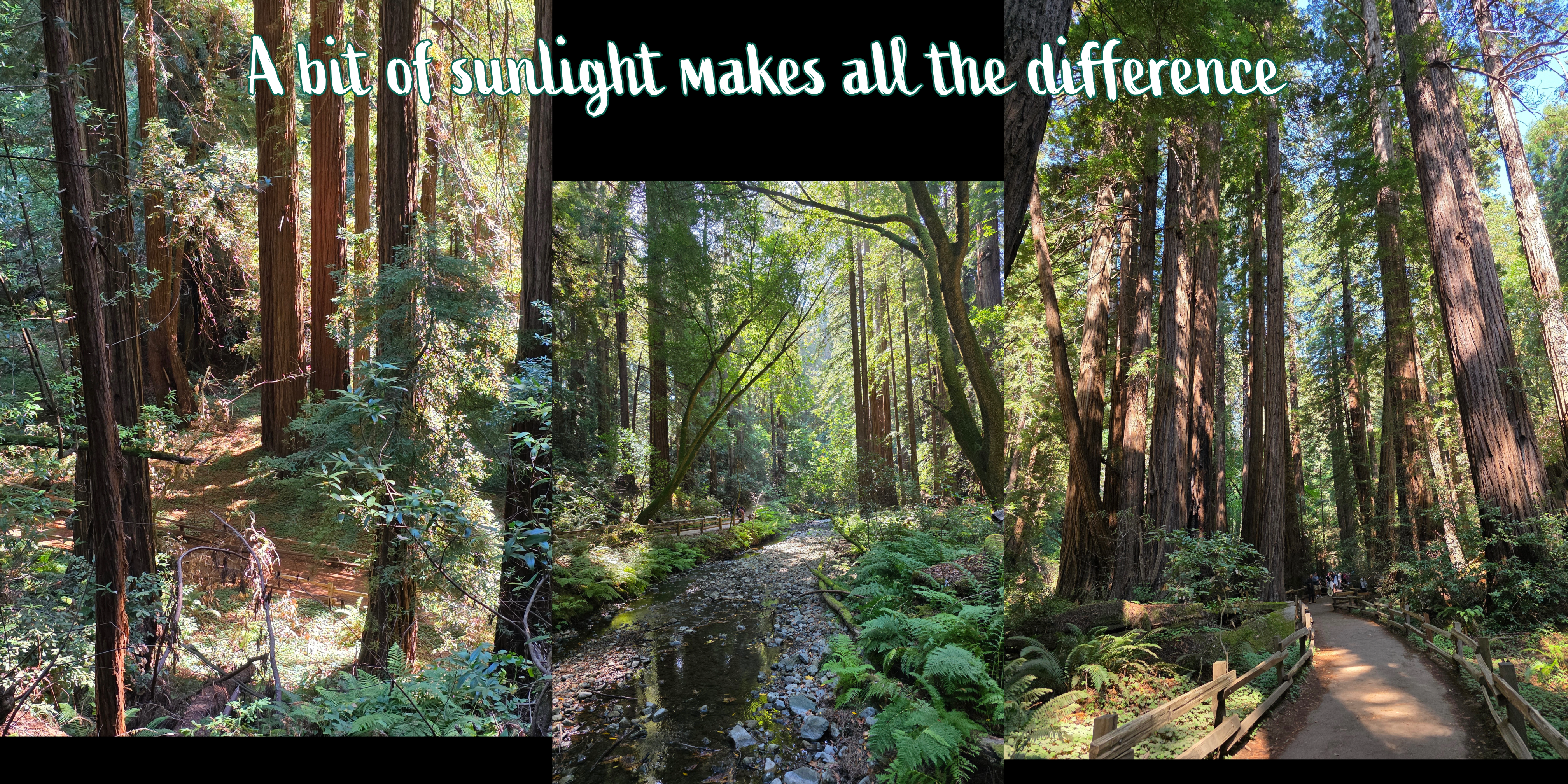
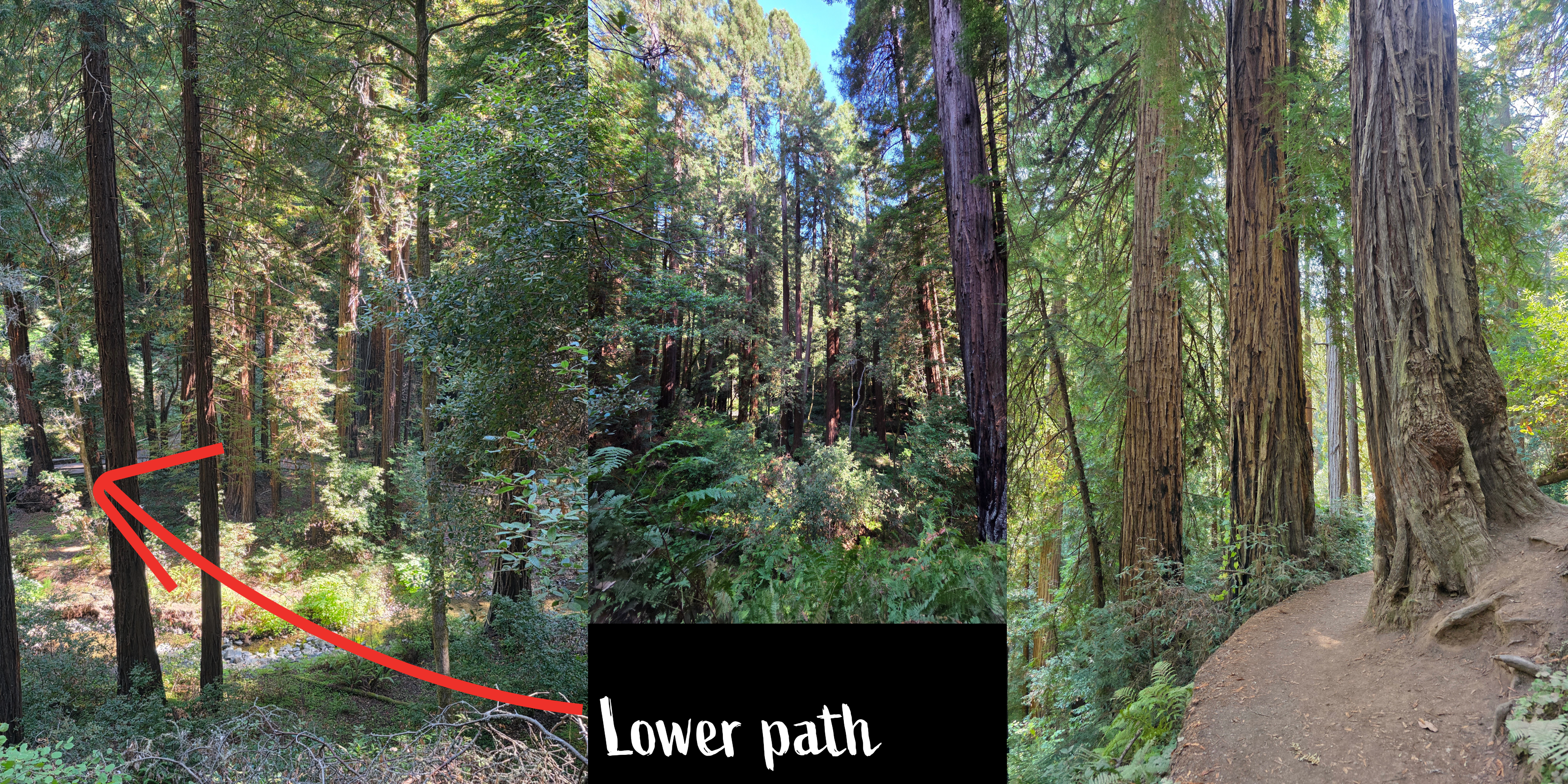
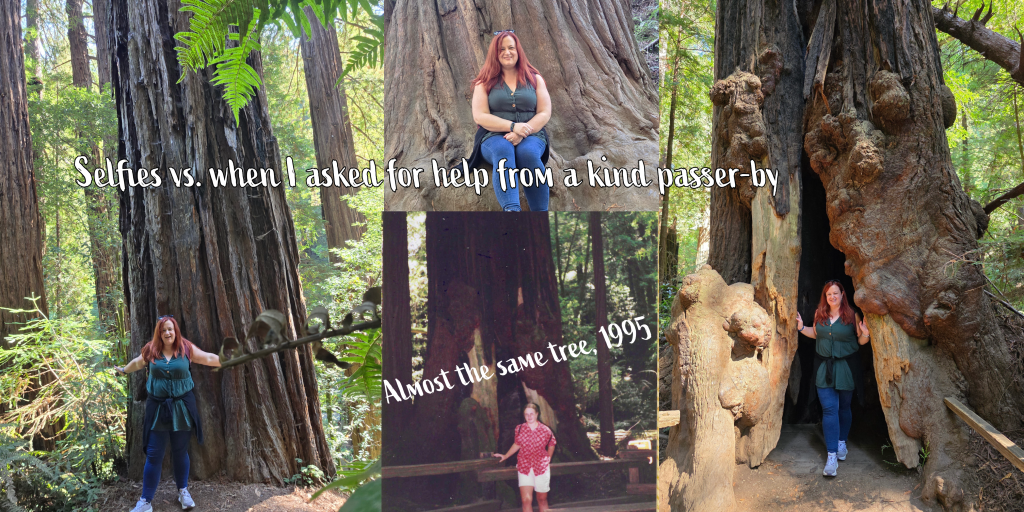
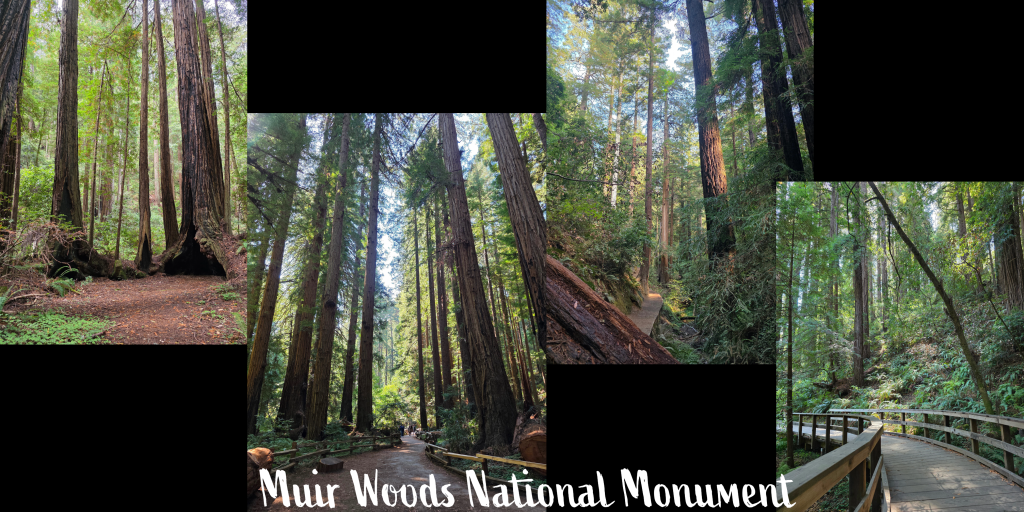
As anyone who read my September Stories post may be aware, I was lucky enough recently to visit the San Francisco Bay area for work. I had one day off while I was there, and I was determined to visit Muir Woods, which I recalled as the absolute stand-out of a family trip to San Francisco in 1995 – so yeah, it’s been a while.
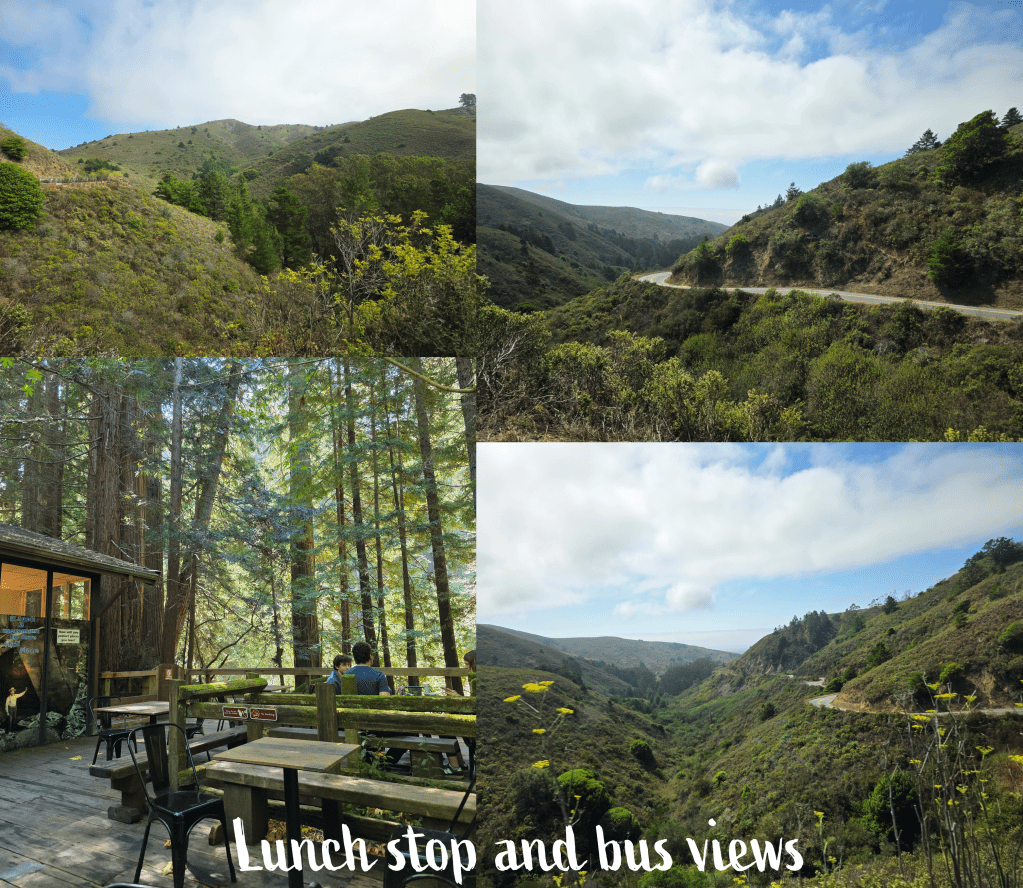
What I was not excited about was the drive – winding narrow roads, steep drop-offs, and lots of traffic. So, I did some investigating and discovered that the there was a shuttle that picks up travellers at Larkspur Landing Ferry Terminal, north of the city (and quite close to the infamous San Quentin prison!). There is plenty of parking, and it was a relatively easy drive on a Saturday morning. I did have to book my tickets both to and from the park in advance, but they provided recommendations on timing, and parking at the park is bookable in advance, too (it is in fact required that you do so).
This option is highly recommended – the coach is very comfortable and was quiet when I arrived. I was told that it was off-season so I could board an earlier bus than I had booked (I am never not early, unless I am really late), and while the nearby restrooms were actually port-a-potties, they were surprisingly clean.
As we started off, I enjoyed just staring out the window and watching the communities pass by as we wound up into the mountains – very quickly I was more than a little relieved not to have to manage the curves. I can do these in Scotland, in my own car, but this was a bit different. Plus it meant I could actually enjoy the drive, and the views. I am always impressed, in California, how housing is constructed absolutely everywhere, no matter how steep the hill. The neighbourhoods we wound through on our way to Muir Woods included some truly spectacular homes with large yards around them, and I saw more than a few enviable tree houses.
After about 30 minutes, we arrived at the park, and I realised that though the shuttle was quiet, the park was not. I know that it was not high season yet there was definitely a good number of people on the paths, and this was one of the reasons I eventually deviated from my original plan to stick to the three bridges. But I get ahead of myself (so unlike me).
The weather as we piled out of the coach was cloudy, with the all-pervasive Bay Area fog sitting at the tree-tops, casting the highest branches with a grey tinge. The coach ticket included entrance to the park, where I received a map of the trails – I took a short moment to peruse before heading through the main gateway.
I had decided, due to the weather, that I would not do the ‘long’ loop, just walk out to Bridge 3 before coming back; the Medium loop goes up one side of the river and down the other, which is what the majority of visitors seemed to be doing, and there are several bridges that you can cross-cross on your way. I intended to take a side-trip up through Cathedral Grove, but then return on the yellow trail.
Trails of Muir Woods, scanned from the leaflet I received upon arrival
I started off by crossing Bridge 1 but soon found myself walking against the main traffic, with almost everyone else coming back towards the entrance. So, at Bridge 2 I crossed back over to join the more socially accepted direction (not something I would normally bother about, but some of the wooden paths were narrow and I was tired of getting annoyed looks).
It is a beautiful walking route, with some fallen trees that show the decades and centuries of rings, glimpses of the river, and a forest floor carpeted in mosses, saplings, and clover.
It took me less time than I had imagined to reach Bridge 3, and enter Cathedral Grove, which the sign stated was set aside as:
A quiet refuge to protect its natural soundscape in an incredibly noisy world. The soundscape is vital to animals for hunting and foraging, courtship and mating, nurturing young, and avoiding predators. By walking quietly, we experience the natural sounds of a living, ancient forest.
I have to admit to finding the other visitors a little less considerate of the soundscape than I would have liked, but it is almost to be expected when visitors were so many. The experience of walking through Cathedral Grove, silent or not, was extraordinary. At every turn I found myself wanting to capture a new view, even if it was often difficult to avoid other visitors. In the video at the end of this post I made an effort not to record other people, which meant many of the clips are shorter than I would have liked.
Within Cathedral Grove is a plaque memorialising the 1945 delegation from around the world that met in San Francisco to establish the United Nations. They visited Muir Woods on 19 May of that year to honour the memory of President Franklin Roosevelt, who had recently passed away. President Roosevelt was a strong supporter of national parks, good forestry practices and the sustainable development of natural resources, as tools to maintain lasting peace around the world, particularly after the destruction wrought by World War II.
Moving out of Cathedral Grove as I approached Bridge 4, it seemed a natural choice not to turn back but to extend my walk by heading up the Hillside trail. The sun was beginning to come out, burning through the fog and filtering down through the branches to create bright patches of green. The Hillside path, which started off with a steep rise away from the river, eventually turned to run parallel the lower path, weaving in and out of the hills with a few gentle ups and downs.
Beyond the first few hundred feet of incline it was not a particularly difficult trail, and was absolutely beautiful. It also allowed me the opporunity to be, on occasion, alone with the trees – a special kind of peace and quiet.
This was absolutely the best way to enjoy the forest, and after in time descending back to the river level, I took a short detour back up through Cathedral grove – to catch it in the sunlight. Finally, I returned to the ‘far’ side of the river to make sure I got the famous Muir Woods picture, inside a redwood. I had tried a few selfies along the way though none worked particularly well, and I finally gave in to request help from a very kind couple, for whom I reciprocated a picture.
There are a few spots along the Hillside trail and other walking paths where you can get a picture inside a redwood, but this was the one that was least busy – at some there were queues of groups waiting for pictures. It was also very close to the Bicentennial tree, which – as it is likely impossible to read the sign – was commemorated in 1976 as having begun its life 200 years before. ‘As this redwood tree began its life, across the continent, a revolution occurred which transformed 13 colonies into the United States of America’.
A tree as old as the country, a tribute to the success of both, really. And quite phenomenally tall…check out the video below to see it in all its glory.
I had walked speedily enough that I reached the café and gift shop a bit ahead of the lunch rush, and was so happy to find a massive turkey sandwich and iced tea to enjoy. As there was no phone service in the park (I think I got a bar or two at the café but nothing useful), I read my book while I ate, then indulged myself in a long – and costly – browse through the gift shop. I particularly enjoyed a set of carved wooden figures of bears and trees, several of which came home with me as gifts. Also some beautiful artistic postcards of the park which I could not bring myself to actually send. The shop here is expectedly over-priced, but for a trip like this I really did not care and was willing to go a bit overboard – who knew if or when I might return?
By the time I had finished lunch and my browsing I decided it was time to head back towards the shuttle, and I was lucky enough to wait only about 10 minutes for the next one. Again, I also managed to get on an earlier shuttle than I had scheduled and so arrived back at my car by about 1pm. It was a glorious sunny day and I hoped to be able to get a view of the Golden Gate Bridge on my drive south, but the car parks were so busy that I had to give up.
As I drove back to my hotel, I could not help but feel envious of the more ‘local’ people who were visiting Muir Woods, clearly there not as tourists but for exercise – there were joggers, more intense distance hikers, fitness groups, and walkers. While there are apparently even more impressive redwood forests furhter up the coast, I was so happy to be able to visit Muir Woods again, putting new memories to those echoed by an old magnet on my mum’s fridge from the 1995 trip. Yes, I could have spent the day exploring the city, but for me, the woods were the right choice. They usually are.
Hence my new laptop sticker:
As a side note, I was sorry to see, upon checking the website while writing this post, that Muir Woods has been closed as of 21 October 2025 due to the lapse in funding caused by the government shutdown. It is a sad thought that people might be missing their once-in-a-lifetime opportunity to explore this beautiful National Monument.
For anyone who works in education, September is an unavoidably busy month, and this September was no exception. I hope you will accept this post as a solid explanation of why it has been the only one in some time – the weeks have gotten away from me. Not in the least because as now has become standard for me, September is travelling-for-work month. I was fortunate enough to see some truly spectacular sights in my just over two weeks away, from the Golden Gate Bridge to the redwoods of Muir Woods and the streets of a new city or two. I also managed some fantastic ‘out of the plane window’ views, and even a glimpse of the northern lights, all topped off by a beautiful early-morning return to Edinburgh flying across Fife, with the sun rising in the east. So, here is a glimpse into my busy and exciting month of September.
The Northern Lights – a glimpse of magic while still in Scotland
I am fortunate to have friends and an other half more than willing to go out at 9.30pm to stand on the dark beach of West Sands and look for stars, the rising moon or, in this case, the Aurora Borealis. The alert app I use had been red a few times this summer, but usually only in the middle of the night or while the sky was still light (not, of course, mutually exclusive in Scotland in summer), so I was excited when there were rumours of two good nights in early September. My fellow night sky aficionados and I headed out as the last light in the sky was fading, and we were lucky enough to catch a bit of green and purple through our lenses – not visible to the naked eye, but still fantastic, with colours not normally seen in the night sky. This made for an excellent start to the month, and an excellent opportunity to play with night settings on my new camera.
I try, before disappearing for a few weeks, to connect with friends I may not see much, and we enjoyed a lovely end of summer evening at the local pub, with a pint or two down by the river. It was truly the end of summer, for while I left Scotland with temperatures still hovering at no-jacket levels, by the time I returned autumn had well and truly landed. Edinburgh was 4℃ when I arrived (around 40℉).
A quick jaunt to England
Before departing for the US, I first had a quick overnight trip down to Manchester to attend a training session. I will spare you the absurdities of UK train travel, which works well a good portion of the time but when it goes wrong goes spectacularly wrong. Suffice it to say, it was helpful to have knowledge of the trains and very little luggage as my original train was cancelled and I was forced to very quickly change plans. I arrived about 3 hours later than planned, but the next day’s return journey went very smoothly. Train journeys in the UK – particularly long ones – are a wonderful opportunity to get a good feel for the countryside and I have been known to just stare out the window for the whole trip between Durham and Edinburgh.
Manchester required a different route than I was used to, passing through – amongst other places – Lancaster, a northern city I have always wanted to explore. We were held up for a short time just at the edge of the city, at sunset, allowing me to capture these lovely views.
I had hoped to add a few tidbits here about Manchester as well, but I really did not spend enough time there to get a feel; I arrived late, spent all day in the conference centre, and left after a short walk. I was delighted to discover a Dunkin Donuts near to Piccadilly, but did not have the time to pop in. Definitely a city I would like to have more time to explore.
Across the pond…and beyond
Two days after my training journey to Manchester, I woke up well before dawn (3.30am if you must know, who says travel is all glitz and glamor?) to get the airport bus. I tend to request window seats on flights, as they can be more helpful if you want to try to sleep (something I am still quite rubbish at). A happy coincidence is that you also occasionally get the most fantastic views. The second leg of my flight was from Atlanta to San Francisco, and as we got to about one hour out of SFO, I took a peek out the window. For anyone who has not had a chance to fly over the western US, I’d highly recommend aiming for a window seat if you can, as I was greeted by the spectacular sights of stark desert and treeless ridges of mountains. The setting sun cast an orange light over the hills at the far edge of San Francisco Bay, and it was one of the more amazing flights I’ve had in some time.
The following day, I met a friend for lunch at the New England Lobster Market, which did seem a touch absurd but also perfect as we had met in high school. I took a short detour walk along the coastline near my hotel, with views over the bay and the airport which is situated, similarly to Boston, essentially in the water.
Jet lag heading west is, in my opinion, easier than heading east and I was up early to visit my first school in a neighbourhood where the omnipresent San Francisco mist was just lifting as the sun rose.
The following morning, I woke up to a bit of a surprise: I had parked my car under a tree at the hotel thinking that it might keep some sun off. It did, but it also encouraged the invasion by a colony of ants. I opened the car door to find them all over the rubber lining, on the dashboard, in the cup holders, and – though I didn’t realise it right away – in the boot/trunk where I had stashed my materials for the day.
Cursing the less-than-clean interior of my newly collected car, I wiped everything down with some grapefruit-scented face wipes I had once picked up in an airport; they were just astringent enough to do the job well, though for the rest of the week I would find rogue ants scrambling across the dashboard.
Having dealt with this infestation I headed off for a school on the north side of the city, requiring a drive through the Presidio park – one of the better drives of my life, winding through stands of pine and cypress trees and beautiful homes, finally emerging to a large parking area alongside the Main Parade Lawn. Have arrived a bit early, I decided that I would walk down to the park briefly before my appointment.
The Presidio is a park and formerly – as the name indicates – US Army post that is now part of the Golden Gate National Park. The area where I parked was newly renovated, with pristine grass and pathways, all very clean and with phenomenal views of the Golden Gate Bridge, out into the bay to Alcatraz island, as well as back towards the sloping city centre. Even carrying all of my materials I managed to get a few good pictures, which I then had to re-take after my appointment once the sun had completely emerged from the clouds. It was a breath-taking way to start my week in the Bay Area.
Returning to my hotel that evening, I was looking forward to the second half of the take-away meal I had bought the night before. I had, when leaving that morning, asked reception if housekeeping could look at the fridge in my room as it seemed to be very cold, and I had searched as much as I could for a dial. Having been assured it would be dealt with, I came home and noticed that the fridge door was ajar – a bit extreme I thought, but I figured housekeeping had done it on purpose. Not so much. Instead, I quickly realised that the temperature was as cold as ever and instead one of the cans of seltzer water I was storing had exploded, spreading now-melting shrapnel around the interior of the fridge and my room floor. My dinner was frozen solid, and the remaining cans of seltzer were slush, with one more can so badly deformed that it was clearly not far from also exploding. Excellent. Clean-up and new dinner required.
I spent the rest of the week covering as much of the Bay Area as I could, driving more than 500 miles up and down around the bay, before finally reaching Friday afternoon. This was the day I was changing hotels, and I had been invited to dinner at the home of my friend’s parents – as mentioned above, this was one of my best friends from high school who I had not seen in almost 20 years, but we had always been lucky enough to enjoy one of those friendships that years do not alter. We fell into conversation immediately and spent time reminiscing as well as catching up on what the intervening years had held – or at least scratching the surface.
Prior to meeting her for dinner, I had decided to spend an hour exploring the city a bit. So, upon leaving my car and luggage safely in my new hotel, I ventured onto the BART train – not that different really to Boston’s MBTA though perhaps newer – and stepped out at Embarcadero station. Here, I was only steps away from the Ferry Building Marketplace, and so I headed for the tall clock tower and, once across the busy Embarcadero street, turned left to follow the coast.
I walked along the many piers of San Francisco from Pier 1, past some that were used for cruises, some for day trips, some for fishing, and much more I am sure. As I walked, Coit tower became more and more prominent, before I eventually made my way around to the far side, having essentially done a wide arc.
The further I walked, the busier the sidewalk became, and gradually I reached the tourist centre of Fisherman’s Wharf. I took a short walk out through the arcade-style shops and cafés before cutting through to the most important part of the wharf: the sea lions. It was incredibly busy, but I managed to fight my way to the edge of the railing to get a few pictures of the incredibly loud sea lions, as well as the view back towards the city.
While this is not a place I wanted to spend an enormous amount of time, I felt like I couldn’t miss it, and I am glad I forced myself to brave the crowds. And it was only another ten minutes or so to the real goal of this walk, one of the only places I remembered clearly from my last trip to San Francisco about 30 years ago – Ghirardelli Square.
Sure enough, the sign was very clear from a distance, sitting high up above the red brick industrial buildings so typical of the 19th century. I approached from below, and paused to watch for a minute or two as tourists walked up the rainbow-painted steps to enter the square proper.
I’m not really sure what I expected, but the area was a touch underwhelming, so I made a quick stop at the chocolate shop to pick up some gifts before finding a bus to take me back towards the centre of the city. The whole walk was about 2.5 miles, so I felt like I had earned my dinner.
The following day was my day off, so I arranged to visit Muir Woods, the redwood forest just north of the city, and the other clear memory from the 1990s. I will have to write a separate post about that trip as it was absolutely breath-taking – I definitely recommend making the effort to visit if you are in the area. And, as I learned, you can get a shuttle from the Sausalito area, meaning that you do not have to brave the winding roads yourself.
I tried to get a good picture of the Golden Gate Bridge on my way back, but as it was a beautiful Saturday, all of the parking lots were completely packed. So, I managed only a short stop along Baker Beach to enjoy the coastline. It’s quite stunning here, stark and mostly treeless with hills dropping right into the ocean in a way that reminded me a touch of Scotland.
A wrong turn meant that I was also able to make a quick stop for another view back towards the city, which is stunning in its varying height and skyline. The stop allowed me to turn around, and head (finally) in the right direction after fully confusing my Google maps route.
On Sunday, I attended an event that meant I had one last chance to enjoy the weird and wonderful architecture that San Francisco is known for. (Back when we visited in the 90s, I was planning to be an architect, how times have changed, and I dragged my mother all over the city in search of the areas I wanted to see).
Specifically, I walked up Fulton Street from the University of San Francisco to Alamo Square, which is a lovely park at the peak of a hill with amazing views over the city centre. This was also the location, I knew, of the houses filmed at the start of the credits for Full House, the San Francisco-based TV show I had grown up watching. I could not resist taking a quick look. Fellow Millennials will recognise it, I am sure…
Fog was still sitting over the taller city buildings as I walked through the park, and it struck me as just such a typical San Francisco view. Fulton Street was fascinating, as so many homes have intricate carvings on their fronts and around the windows, and I found myself taking pictures of many of them.
The Bay Area – beyond San Francisco
There is plenty more to the Bay Area than just the city itself, of course, and on one of my last nights, I attended an event in Lafayette, which is closer to Berkeley but inland. As usual I was early, and so I pulled in at a local park, where I took a short walk up a hill. A steep, short walk. The mountains here reminded me more of what I saw in Southern California, though there was far more residential spread here.
Not home time yet!
It had been a busy 10 days or so in the Bay Area with more than 700 miles under my belt, but my trip wasn’t quite over. Instead, I was attending a conference in Columbus, Ohio, a city of which I really had no idea what to expect. It turned out to be a really pleasant mid-west city, clean and central with plenty of good restaurants and bars in close proximity to the convention centre. Parks and the residential neighbourhood where we stayed in an Air B&B were easy to walk to, and I can see why it would be a good spot for a large convention.
We also discovered, close by, the North Market, a large industrial space that has been turned into an indoor food market slightly reminiscent of Quincy Market in Boston. However, it was far less expensive and not as busy, meaning that you could take your time in deciding on pasta, salad, Asian food, and bakery items (plus a lot more I am sure that I didn’t see).
Like in Boston, this market offers seats on the upper level, meaning that you can enjoy your meal while looking down at the patrons and shops, which I really enjoyed. Absolutely worth investigating if you are ever in Columbus! As I said, I really didn’t have any expectation of the city but the residential areas reminded me a touch of parts of South Bend, while downtown could have been almost any small city in the US. Pleasantly every-city, very mid-west and just generally a nice place.
Coming home, but not quite…a long layover in Boston
My trip home from Columbus included a long layover in Boston, which I had intended as an opportunity hopefully to see my mum. For various reasons this did not come to pass, but I enjoyed my flight in on a beautiful clear morning, and because I had more than enough time, I took the elevator to the top of the airport parking structure to take in the view of the city. It was emotionally hard to be so close and not have a chance to explore or visit home, but it still felt good to be in Boston, even briefly. The international terminal was nice and quiet during the day, so I was able to get some work done and enjoy some peace after three days of conference busy-ness.
Coming home, but really this time.
My flight from Boston to Edinburgh was delightfully quiet, or at least it was at the back of the plane where I was sitting – I in fact managed two seats to myself, which were unfortunately just a touch too small to allow me to properly spread out and sleep. I find the night flights hard anyway, as we landed in Edinburgh around the time I would be looking to go to sleep, so could not make myself doze off before. I tried, but no luck – instead I watched a few old movies and was awake to realise, about 30 minutes out, that we were flying towards the rising sun. For the third time, I had a fantastic view from the window seat as the plane approached Edinburgh from the west, passing the city of Stirling (it’s impossible not to recognise that dramatic bend in the river), then Loch Leven (the castle is just a bit too small to see), and finally the coastline of Fife.
It was a very pleasant welcome home!
I’ll leave you with two last images of San Francisco, one the panoramic view taken from the Presidio park, and the other this view of the Waymo taxis that were quite frequent. No, I did not take one, though for a Scotland-based girl, even the multiple Uber Teslas were an adventure of their own.
Overall a very busy month, and a time to explore two parts of the US I had never seen, or not as an adult. I felt I only scratched the very surface of San Fransisco but I know I am likely to be back; it is a quirky, funky city that is like few others. It tumbles over hills that in snow-based climates could not be built on in the same way, and offers a different fascinating view every time you turn a corner or cross a street. I look forward to my next visit!
As for October, it will be another busy month, and I imagine it will be one for the record books in terms of miles driven, but I am excited to see where more new cities will take me. I’ll be sure to keep you updated, when I can find some spare moments…
As I have written about before about my affection for the area around Aberfeldy and Kenmore, and so it will come as no surprise that, during an unexpected long weekend, we decided to book two nights at Moness Resort just above Aberfeldy. We didn’t plan much, but discovered the Dùn Hill walk as an option that looked ideal for our purposes – not too long, and in walking distance from our accommodation. Though the weather was a bit disappointing – overcast for the whole day – it was not actually wet, and so after a full Scottish breakfast (well almost full, I skipped the black pudding, but still a requirement when eating breakfast away from home), we headed out.
For those familiar with Aberfeldy, the Dùn Hill is above the Birks walk, and starts by heading up a farm track between some trees and a field full of sheep. ‘Up’ is a good word to use, as ‘up’ was very much the theme of the walk; while not particularly long – 3 miles round trip – this path is a pretty constant uphill, and at times quite steep. We had not intended on vigorous exercise (as the other half reminded me several times), but we pushed on in any case.
As with many walks we do in Scotland, we were using a page from Walkhighlands to guide us on the way, and while I generally find their route maps to be very useful, the instructions are on occasion a bit vague. Fortunately, there is really only one option for this walk.
The road climbs steadily and winds around to the right in time, offering what appears to be a choice to be made between a higher and lower road. In fact, the low road is a private drive, leading to an impressive large house and outbuildings.
Passing this fork, the trail opens up so that the views over the fields and hills are visible – at least climbing quickly means the vistas are also fast to appear! Unfortunately our view was marred slightly by the weather, meaning that pictures do not tend to show the glory of the area.
Perhaps five minutes beyond the fork, walkers tired of a dirt road and having to look out for the infrequent traffic will be delighted to notice a sign pointing up the hill. This is roughly the half-way point of the walk.
From here, the path becomes a bit more typical for mountain walking – alternately rocky, grassy, and climbing through fields and trees. In relatively little time, the shape of an abandoned white cottage appears, nestled amongst some trees and with a walled yard. Almost covered by the foliage, this house reminded me a touch of something Bob Ross would paint – an abandoned spot in the woods, mostly overgrown (see below). But with a great view over the town.
This was where we got a bit lost, as while our instructions said ‘go through a forest gate’, we could not immediately see the way to the gate. So, we thought perhaps it was a bit further along the meadow, and that is the way we headed.
It was uneven, with deep grass and rough to walk on, no markings or discernible gates in the distance. After a few minutes of trudging along, we realised that there was a dog walker behind us who could only have come through the gate we had seen. Clearly, we had gone the wrong way. While the view from the meadow was pleasant, it was not going to take us where we wanted to go.
So, we retraced our steps and discovered, mostly covered by high weeds, a sign pointing towards the gate. The faintest remnants of a trail was evident, and so we bivouacked towards the gate, passed through and discovered a narrow forest path – clearly the correct way.
The forest path was pleasant, winding through pines and larch (I think?), and the dry summer plaguing Scotland was a touch less evident here. Yes, it has been a very dry summer – Fife is at near drought conditions as is a large portion of the UK. The gorgeous weather I have experienced while hiking the Fife Coastal Path was unfortunately not good for the overall health of the countryside. Rain is very much in need! Despite all stereotypes of Scotland…
This is the kind of hiking trail I love the most – well-kept and easy to follow, winding through forests that smell like the pine I used to play under when I was young. Occasionally there would be a break in the trees where a hillside meadow met the tree line, but we saw no one else and very little sign of civilisation for most of the remainder of the climb.
Then, suddenly, there were signs that up ahead the trees were thinning, and we reached the clearing at the top of the hill – wide open, grassy, with large patches of beautiful purple heather.
While it is not really visible to untrained eyes like ours, this clearing is the remnant of an Iron Age hill fort, the Dùn. Scientific equipment and archaeologists can identify the rings and gaps where entrances may have been, but for us it was just a lovely peaceful clearing where we could sit for a while, have a snack and some water, and enjoy the quiet. Well, quiet except for a sheep in a nearby field that was baa-ing with a gusto.
The views were unfortunately marred by the low cloud that made the distance hazy, but there was enough of a vista to make one imagine how impressive it could be on a clear, sunny day.
And of course, there is a rock cairn marking the top of the hill; I realise how fortunate we were to be hiking at a time when the heather was in bloom, as it really did add some spectacular colour to an otherwise mostly grey and green landscape. I could have sat quite happily for hours watching the bees, enjoying the many different shades of purple from a soft lavender to bright almost fluorescent magenta – I also found myself humming ‘Heather on the Hill’ from Brigadoon, and had it stuck in my head for hours after.
However, despite a hearty breakfast and a few hiking snacks, we hadn’t really provisioned ourselves for a long time away, and so we eventually headed back to the break in the trees and began the meander back down towards Aberfeldy. We have reached that age – as I am sure I have mentioned – where down can be harder than up, and this was definitely the case once we left the forest path and re-joined the road. Small pebbles and stones combined with dust made for a slippery descent, and almost as slow as the climb. But, we did enjoy the views a bit more heading down and I can see how this could be even more lovely with autumn colours.
While not a particularly long walk, like its sister walk at the Birks of Aberfeldy, the Dùn hill is unexpectedly steep and requires a bit more stamina than originally expected. One review of the walk did mention this, though one we did not read until later; as the other half pointed out, it is worth observing how far a walk ascends in height to make sure you are prepared for the climb. We weren’t, but we made up for it with an excellent dinner that evening at a relatively new place in Aberfeldy, the Inti lounge. Fortunately, we had reserved a table as it was packed by 6.30pm – food and drink all fantastic! In particular, the best whisky peppercorn sauce we had ever had (and this from the other half who is serious about his peppercorn sauce) and a delicious play on a traditional cocktail, the Highland Iced Tea, made with whisky and Irn Bru.
I would definitely be up for trying this walk again in better weather, but also forewarned about the climb. There are plenty of walks up mountains and hills in the area that are not quite so steep, and take a longer trail up that allow for a bit of flat along with the up. Nonetheless, this is a lovely peaceful walk in the woods and an equally serene, history-filled clearing at the top – and perfect if you are staying in Aberfeldy and do not want to drive!