
My love of writing and my love of medieval history can both be traced back to one particular book, which I received for Christmas when I was 11 or 12 years old. It was a time in my life when I received many books as gifts – no complaints mind you – and I had packed it along with several others in my carry-on during my annual January plane trip to see my father. I cannot say for certain how long it took me to devour the book, but I was enthralled from the first moment. It was the perfect mix of adventure, romance, and meandering tale, all based on the experiences of a fourteen-year-old girl.
The book was of course, On Fortune’s Wheel, the second in Cynthia Voigt’s loosely connected Kingdoms quadrilogy. I loved that she created her own kingdom to write about, thereby dictating her own rules as to law, tradition, and history, but she did not make them fantastical. In fact, much as George R.R. Martin did in his series, Voigt used ‘real’ history as inspiration, but edited or simplified as she wished – the Wolfers, for example, and the alpine lands of the north versus more temperate cities of the south are all vaguely familiar.
One of my first writing exercises was a re-imagining of the story in a way I liked slightly better and in my own words – a homage that hinted at pure plagiarism – and my fascination with the medieval lifestyle has never gone away, even through years of study and advanced understanding. My best friend in high school had read the books too, and we constantly argued over which was the best, which male character we fancied, and which was superior. Only once the final book was released were we eventually able to agree that the hero in that book was, in fact, the best of all.
As I delve deeper into my love of all things medieval through this blog, it seemed appropriate therefore to revisit these books, and I have to admit as an adult to liking them perhaps even more than I did when I was younger. I will review them here in chronological order, though this does not relate to my preference.
I have been fascinated, as I read, to recall firstly how beautiful her writing is – stunningly crafted prose, with an easy way of making words specific to the story quickly understood. I was also impressed by her brutality, in places – by her unflinching description of how difficult and violent life could be. There is no shying away from the topics of cruel death, starvation, physical and mental abuse, or sexual abuse and exploitation. Much as they likely were considered in the Middle Ages, these topics are just part of the story, not glorified or simplified, just present. It is a brave writing style for young adult books, without the more obvious ‘wrongness’ that one sees in newer series like the Hunger Games. Most purveyors of the worst behaviour, though, do tend to get their comeuppance…though not all.
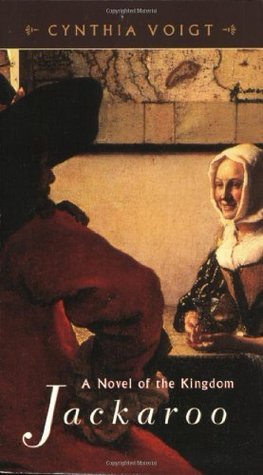
1. Jackaroo
Not originally top of my list, I found in re-reading this series that I enjoyed Jackaroo considerably more than I remembered. The story revolves around the experiences of a young woman, Gwyn, who like so many girls at the age of sixteen feels uncertain and out of place in her life. Gywn is the daughter of an Innkeeper, independently-minded and in regular conflict with her mother. She has no intention of marrying, an hopes instead to run her father’s Inn. As the tale continues we meet her close companion, Burl, and see her explore the legend of the Jackaroo, a Robin Hood-type character who helps the local people who are starving or struggling. Then during a storm, she is isolated in a cabin with a noble’s young son, and their friendship is the basis for much of the freedom she later experiences – as well as the final nail in any coffin of her hopes of living a normal life in the Inn.
Voigt is a master at character and relationship-building, making us both sympathise with Gwyn and wish, for a moment, that she could have the ‘normal’ life her family hopes for her. Instead, it is very quickly obvious that she is meant for more and greater things, and the message of the book is clearly to trust your own instincts. It may not always be an easy path, but it will be the right one. This theme most definitely runs throughout the series.
As for the medieval aspects, it is clearly a difficult world of social inequality, where peasants struggle to eke out a life and lords live in castles far away. Rather that focus on the lords, this story revolves around the farmers and Innkeepers, imagining the trials and tribulations of the lower classes.
My rating:
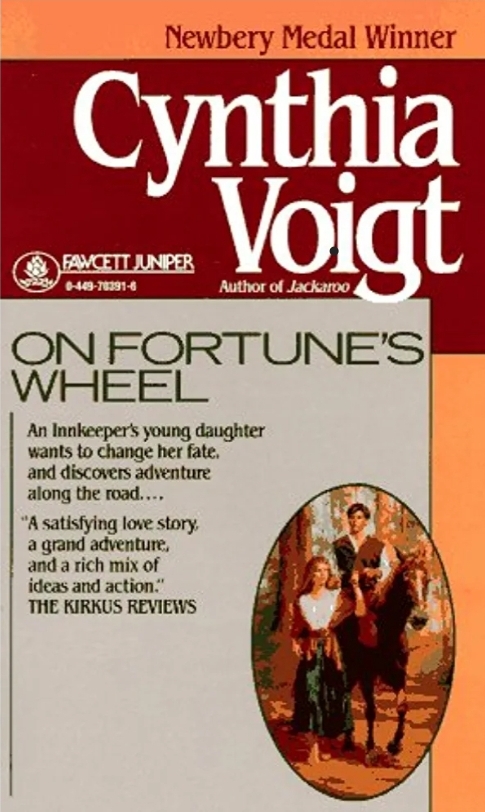
2. On Fortune’s Wheel
This was the first book in the series that I read, and it enthralled me from the start. Birle, the main character, is from the start so clearly acting as many teens do – she is fourteen at the outset – in setting out on a course that may not prove wise, but which she thinks is the best one at the time. She ends up following Orien, a young runaway lord, into the depths of hunger, slavery, and cruelty, but through her own worth, she is able to survive when many others would not. Younger and arguably more impulsive than Gwyn, Birle also loses control of her fortune considerably faster, but her loyalty and kindness to those around her bring her to happiness in the end. This book is, arguably, the happiest of the lot, and focuses more closely on the love story within.
In this book, Voigt ventures away from the relative safety of the Kingdom and into the cities of the south, where society is crueller and more violent. There are walled cities, mines worked by slaves, pirates, and cruel autocrats more reminiscent of a sea-based Mediterranean society. There is also more depth put into the rules of the lords and the primogeniture that named the wrong brother earl and gave him no choice but to flee, and to the sexist view of high-class women as little more than ornaments. As in Jackaroo, there is the implication of corruption in the upper classes, while the working lower classes are, if not always good people, often more pure.
My rating:
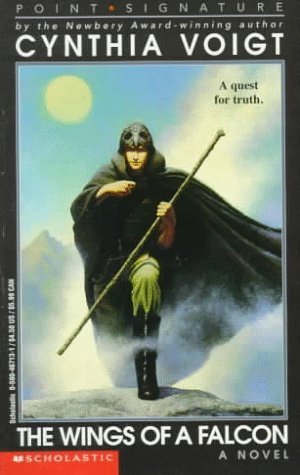
3. The Wings of a Falcon
This book is the one that caused endless arguments between me and my friend. It is the only one of the series in which the main character(s) are male, and in which we follow a male protagonist through a never-ending series of cruelties and trials. For some reason, my friend found the main character – who remains nameless for the first third or so of the book – irresistible, whereas I was more drawn to the hero of On Fortune’s Wheel, or to the main character’s best friend, Griff.
The story starts with a mood reminiscent of Dickens, on an island of orphan boys, ruled by the cruel hand of their overseer, captor and surrogate father. The mental and physical abuse described is powerful and horrifying, and it is a relief when the story moves away. Griff and Oriel – as he soon names himself – maintain an impressively close bond throughout a series of misadventures, though by about half-way through the book the story begins to drag a bit and I do wonder why Griff is so loyal. By the last third of the book, it becomes quite hard to like Oriel, who comes across as selfish and unemotional, while I much preferred the loyal Griff. Much of the tale depends upon Oriel being charismatic, charming, likeable, handsome, and yet I found that hard to see and instead wondered why so many were drawn to him.
Despite my dislike of Oriel’s character, I fully admit that the book is beautifully written, and Voigt ventures out a bit into new territory with the Wolfers and the very real fear they bring to the towns and cities who hear only whispers of their cruel feats. Echoes of Viking raids are clear, and it is fascinating to hear descriptions of the towns and countryside and how they dealt with the threat.
My rating:
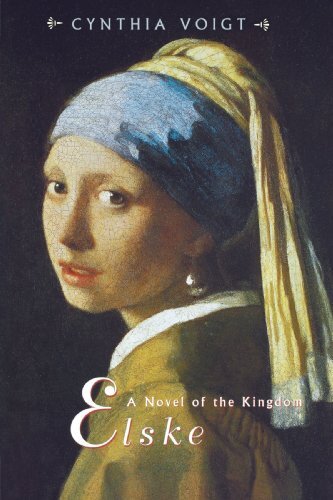
4. Elske
The final book of the series was published five years after The Wings of a Falcon, and by the time it was released in the US I was already living in Scotland, so struggled to get ahold of it for some time. As a result, I have not read it as many times and it does not have the same place in my memory as the others. However, upon re-reading it recently, I was struck again by just how beautiful and visually evocative Voigt’s writing is. The first few chapters are very dark and quite brutal, with sexual assault a relatively casual topic, and violence described in depth through the cruel practices of the Wolfers. However, that cruelty is arguably a vital piece of the main character’s development – her escape from a brutal life is part of why she, like the female protagonists before her, is always just a touch out of place. She does not fit in, she is not ‘normal’, but this is, in the end, to her benefit.
Elske is the eponymous main character, a surprisingly clever young woman who, through careful and secret education, has learned to read and write when most other females cannot. This makes her stand out – as it did Birle in On Fortune’s Wheel – and means that she deviates from the ‘standard’ path for a woman in her world. She is more respected by the men around her, she is more self-reliant and moves to take control of her destiny in a way other women can or do not. Voigt is a master at showing an evolving relationship between two people that start out at odds and slowly come to need one another; in this book, it is Elske’s devotion to a female ruler that mirrors, to some extent, Griff’s devotion to Oriel. Elske is more self-sufficient than Griff, however, and there is a fascinating clash at the end of the book between her love for a male partner and her devotion to her mistress.
One could potentially argue that this book is inching into a more early modern period. The city in which much of the story takes place is clearly Baltic in feel, a play on a city such as Amsterdam or Ghent in which water is present and separates the city into neighbourhoods. Also fascinating is Voigt’s introduction of the mystery of the black powder, how it is described by those who only see its effects, and the mad rush by those in power to gain its mastery. It is a very real echo, one imagines, of how stories of gunpowder first came to Europe.
My rating:
So, is there anything not to like about this series? Of course – there are some tropes that the author enjoys using repeatedly, and some of the cruelty I have mentioned above is jarring. The first few chapters of Elske, in particular, are brutal in their casual addressing of the violence perpetrated on really all females of the Volker people. But while she follows similar character patterns – loyal, quiet, stalwart male companions, mothers or mothering characters that do not understand, stalwart and reliable fathers, flighty females that are the antithesis of the main characters – they are all done differently enough to maintain separate characters. Voigt’s female protagonists, while not identical by any stretch, all have a similar quiet confidence. They are resilient, independent, and often quick-thinking in rough situations, using their instincts to save themselves. All four female protagonists – I’m including Beryl from The Wings of a Falcon here – are learned and able to read, and their positions on the edge of society usually enhance their value. What makes them different, makes them valuable. What a fantastic message for teen girls desperately hoping to fit in and so many unable to do so – what makes you different, makes you valuable, makes you worthy of an epic tale.
 The Wandering Medievalist