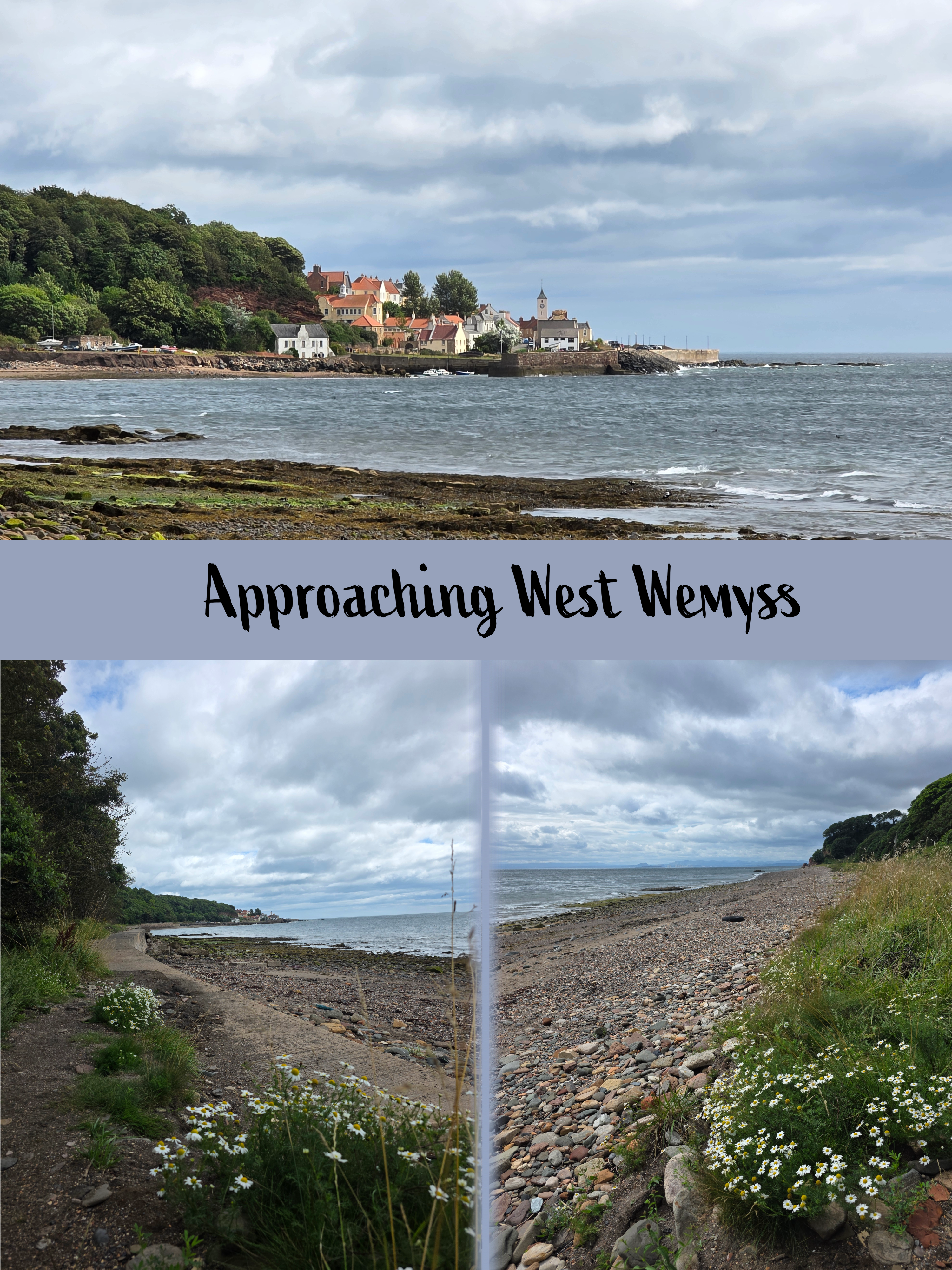
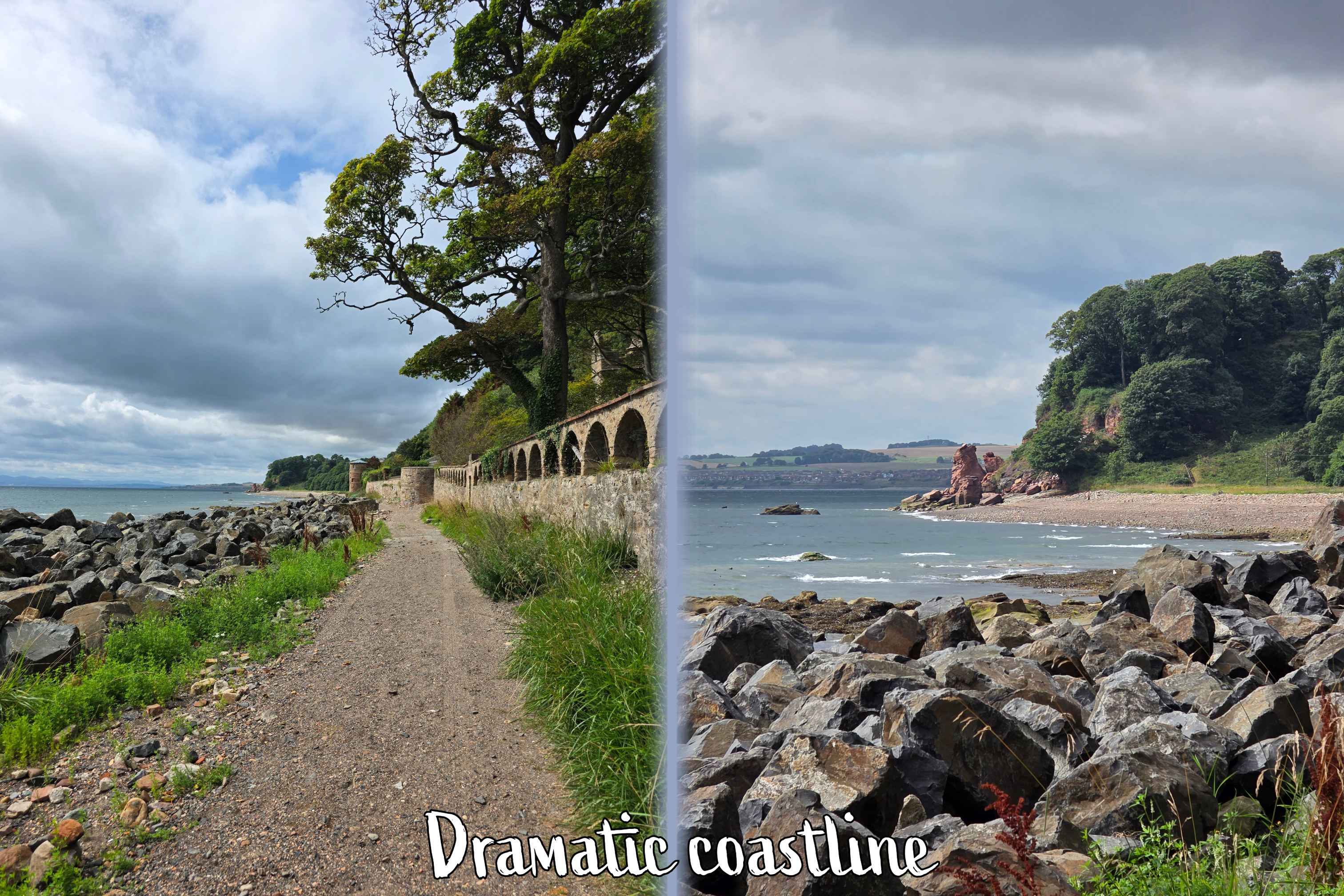
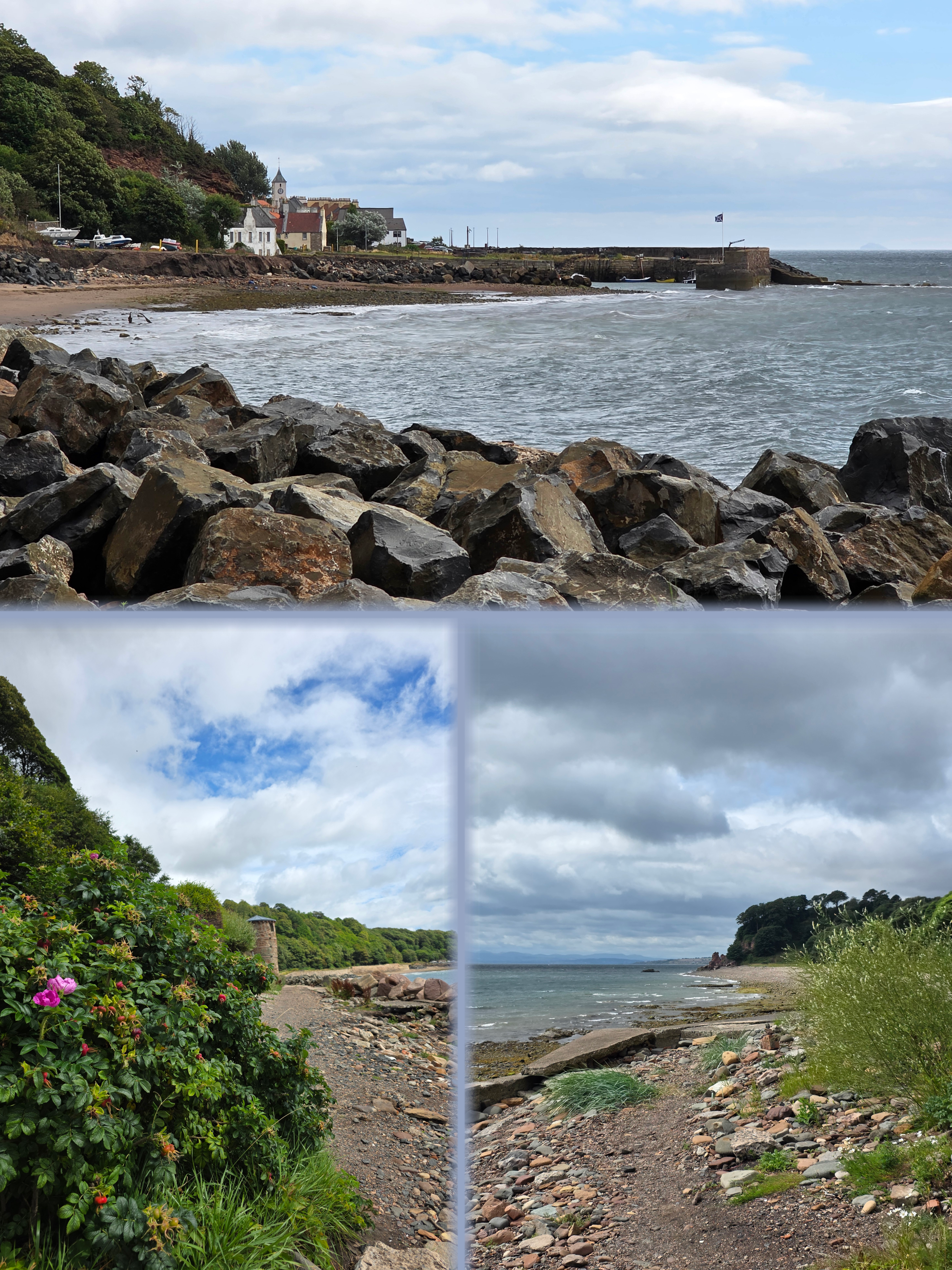
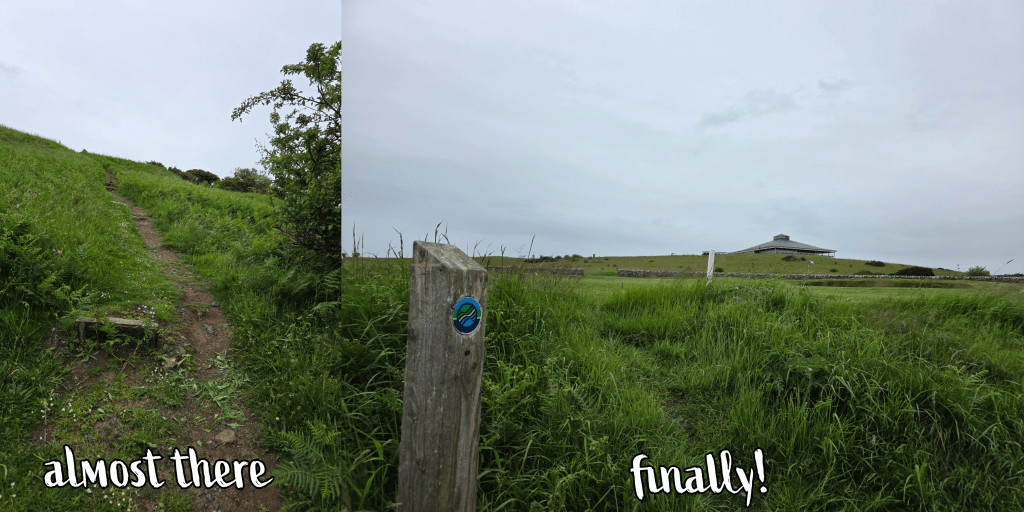
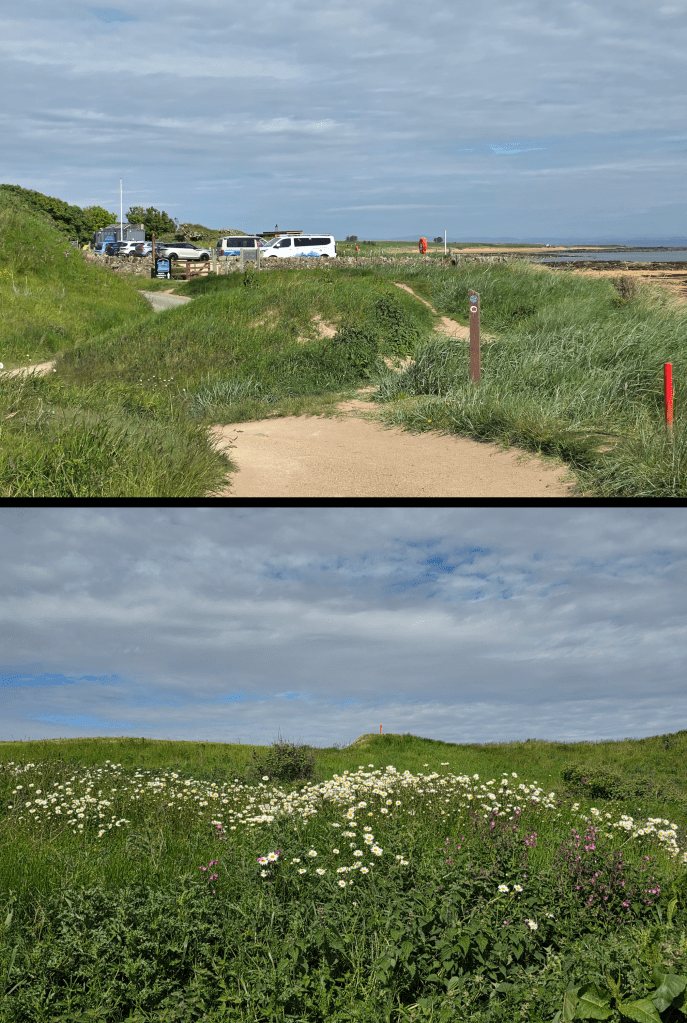
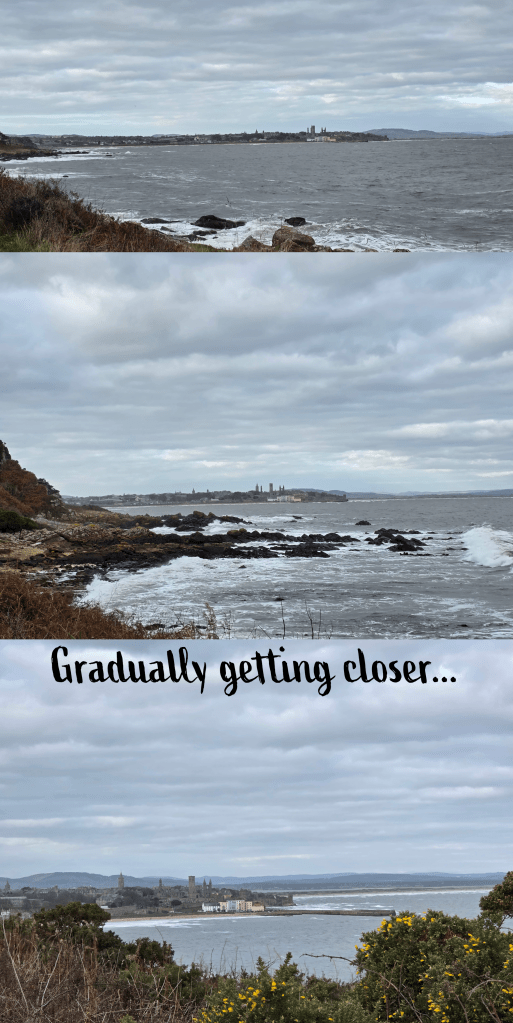
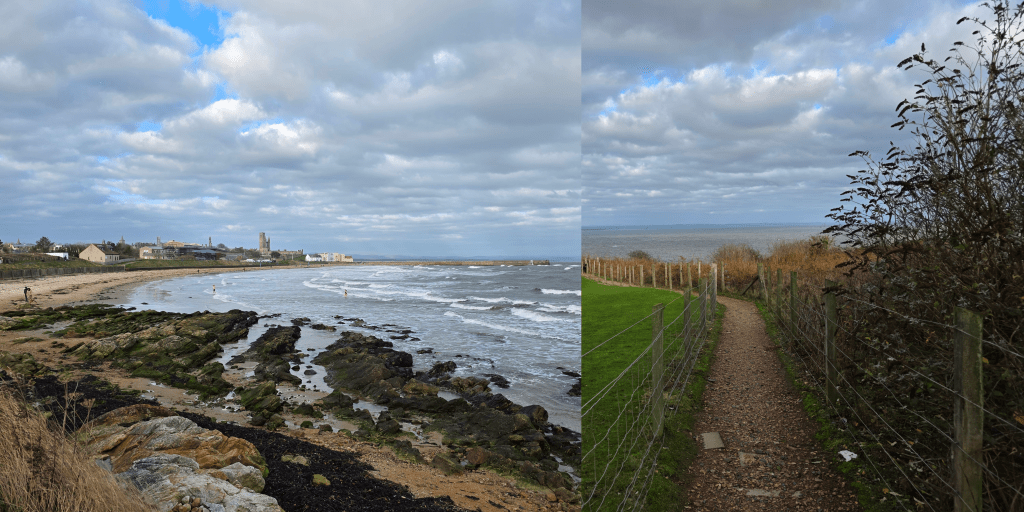
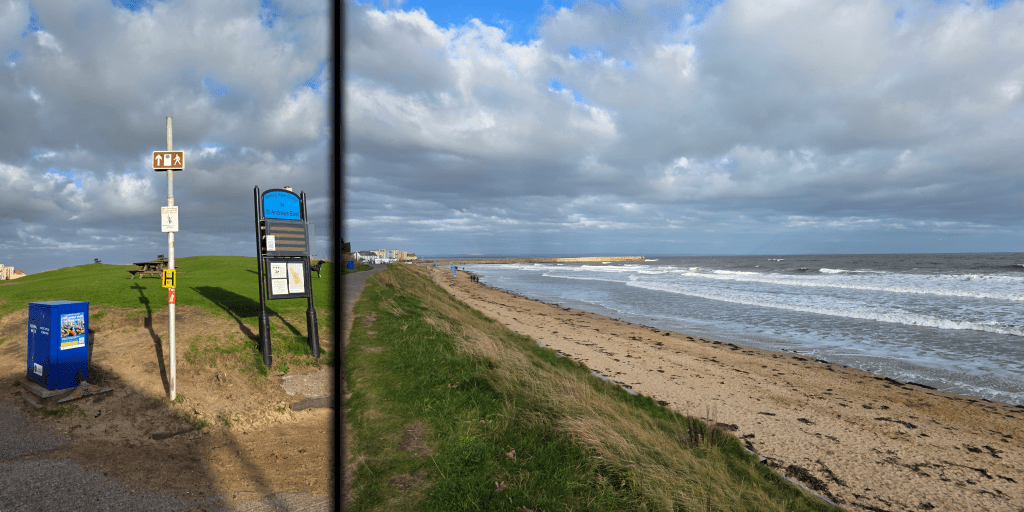
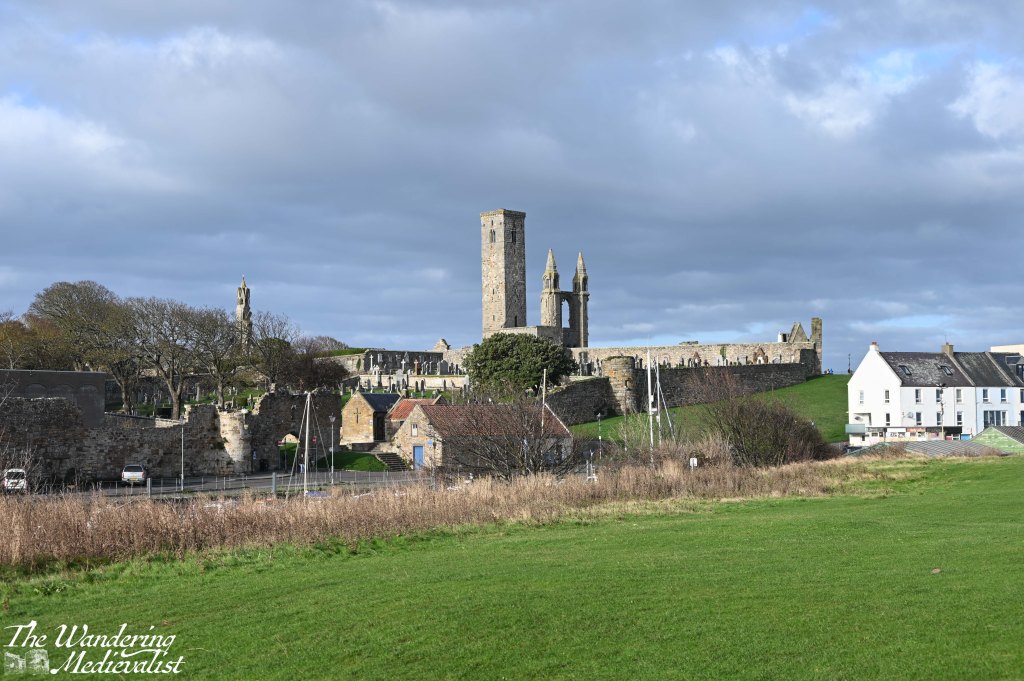
Last Saturday started off overcast, though the clouds were light grey and white, which usually are not hugely threatening. So I headed off to fill in the relatively short gap I had between walks, so that I could say I have finished the whole distance from Ely to Tentsmuir – East Neuk done! I hoped that the cloud would lighten, though as I rode the bus to Boarhills to pick up where I left off last week, the colours shifted to a bit darker…oh well.
A bit of rain was all I expected to see, and that wouldn’t hurt me – I was feeling determined. We had quite a dramatic week of weather, I should mention, with lots of big grey clouds and thunderstorms, so I hoped that the day would be a bit more settled even if not sunny. I tested fate a bit by bringing my sunglasses and not wearing my raincoat.
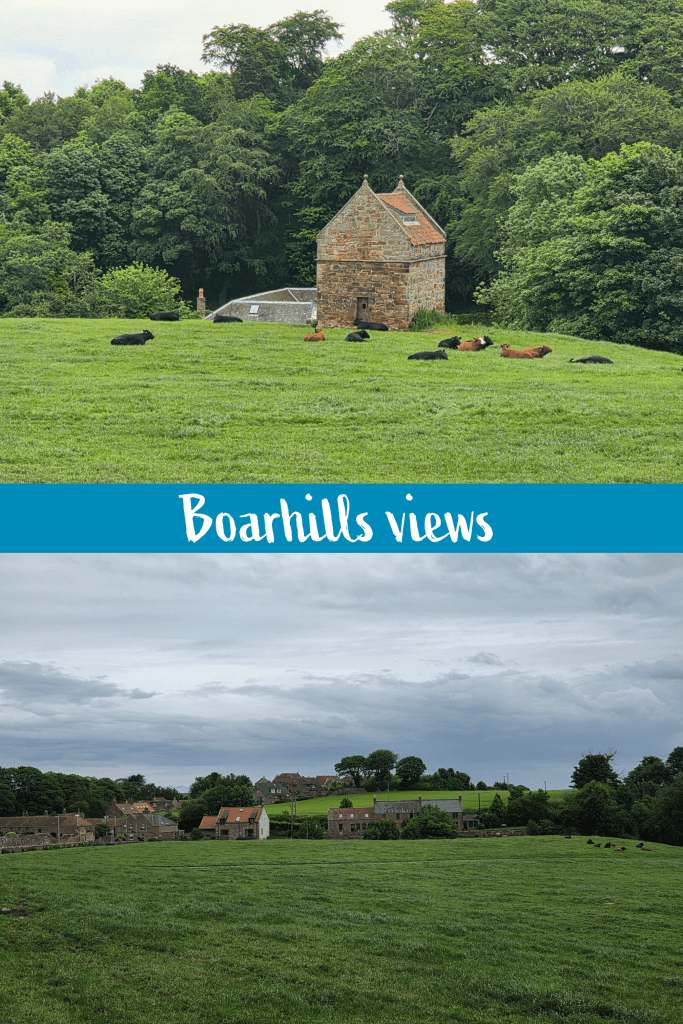
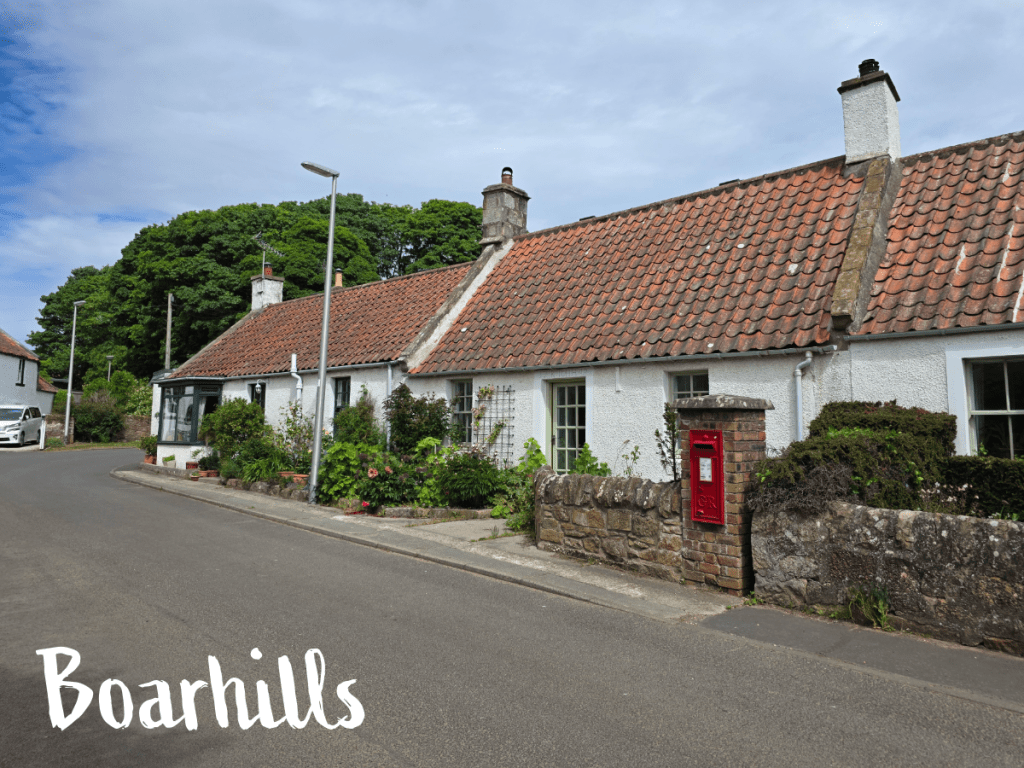
I alighted from the good old 95 bus at the Boarhills stop which is incredibly awkwardly placed, at the end of the entrance road to the village. My views were some lazy cows (not a good sign for weather) and the village filling in the gaps between wide green fields.
From the bus stop, it is a short downhill stroll into the village, and I turned right up the farm access road towards where I had broken off my walk last Saturday.
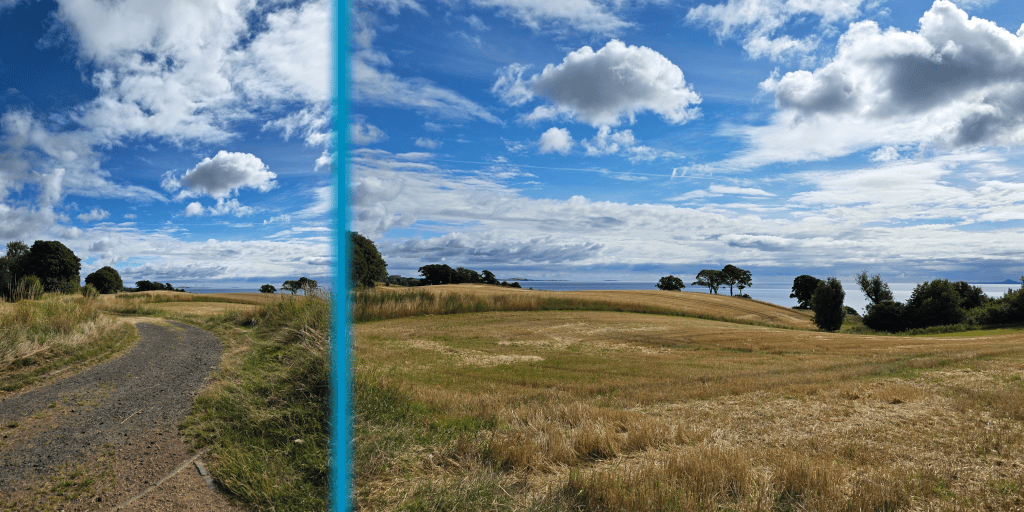
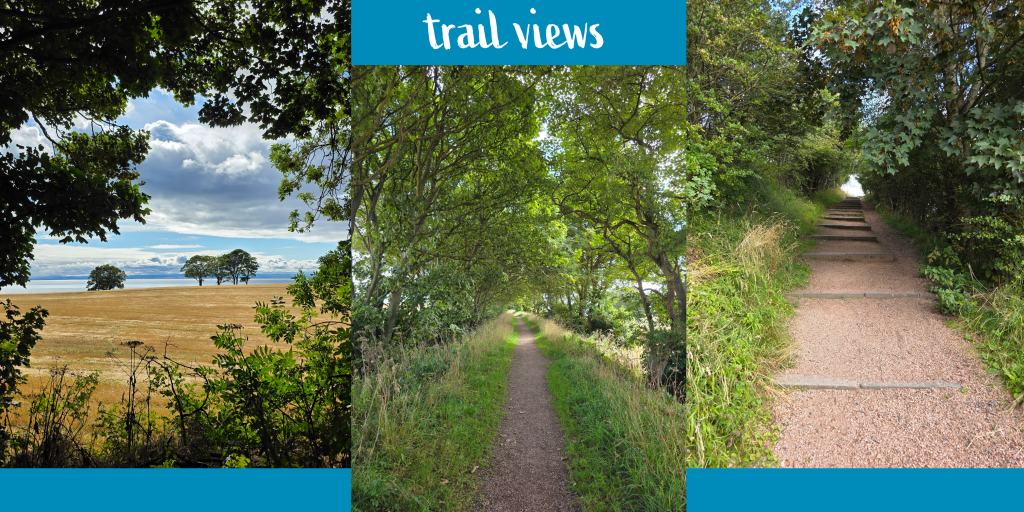
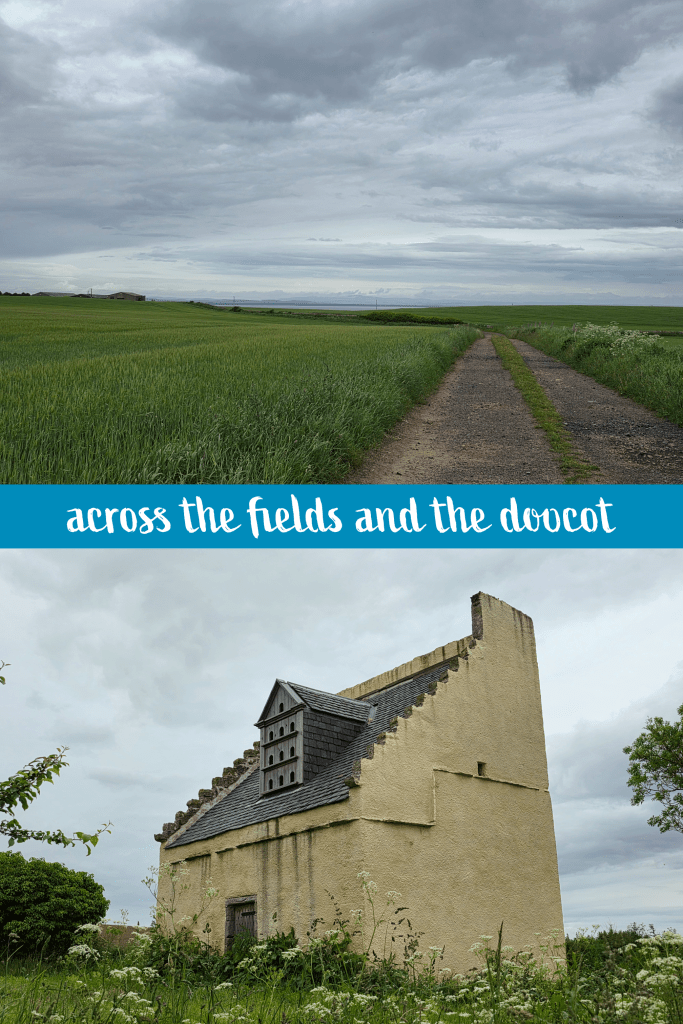
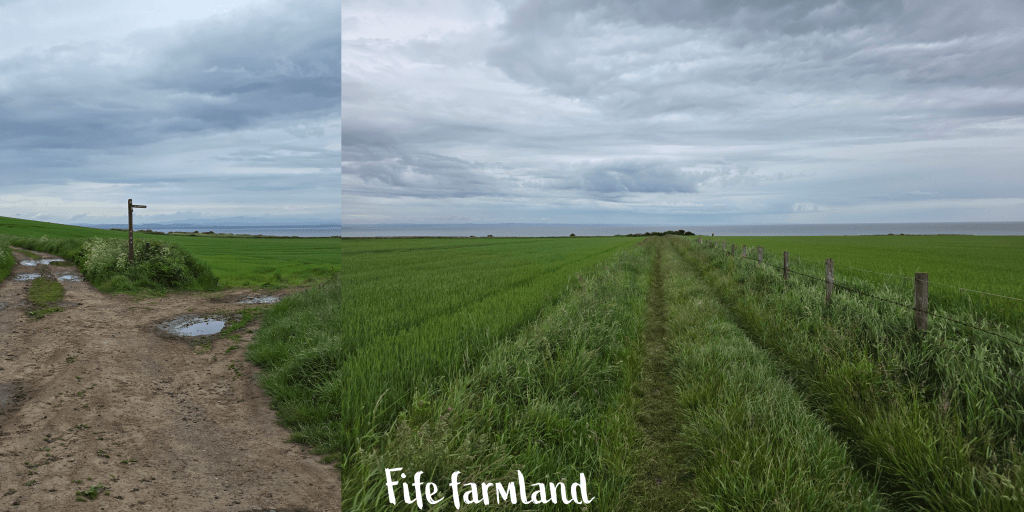
It took me just under ten minutes to make my way back to where the Coastal Path splits from the farm road, though it is almost identical in appearance – a wide farm track with two ruts, accessible by vehicle as well as foot. This path took me across a field with views across the water towards the distant hills behind Dundee. It was a good day for a walk, with a gentle breeze and comfortable temperatures of about 13℃/55℉, and while overcast the air was clear.
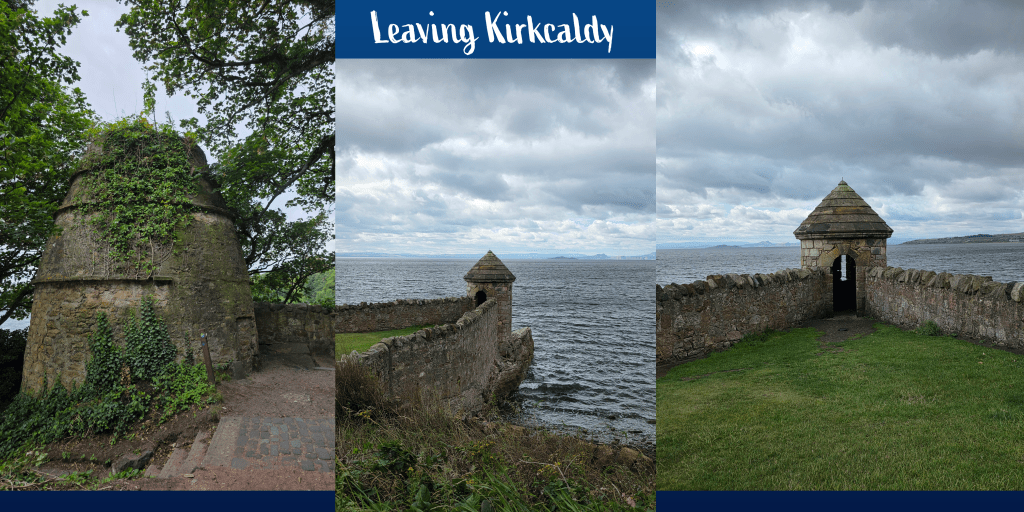
After about 5 minutes on this track there is a short section on the road, and then a quick turn off again to the right, behind the doocot above. This is essentially a detour around some large farm buildings, then the path strikes out again across the fields. A sunnier day may have required more pictures, but overcast skies without dramatic clouds just don’t do much for me, and the wind had picked up, so I moved along a bit faster until I reached another signpost. This directed walkers off to the right, towards the coast, along a grassy trail.
There was a short spot of rain as I crossed this section of field, but oddly I only noticed it from the sound of the drops hitting the grass – it was so light I did not feel it on my face, hair or clothing. It made the faintest dots on my coat before stopping again.
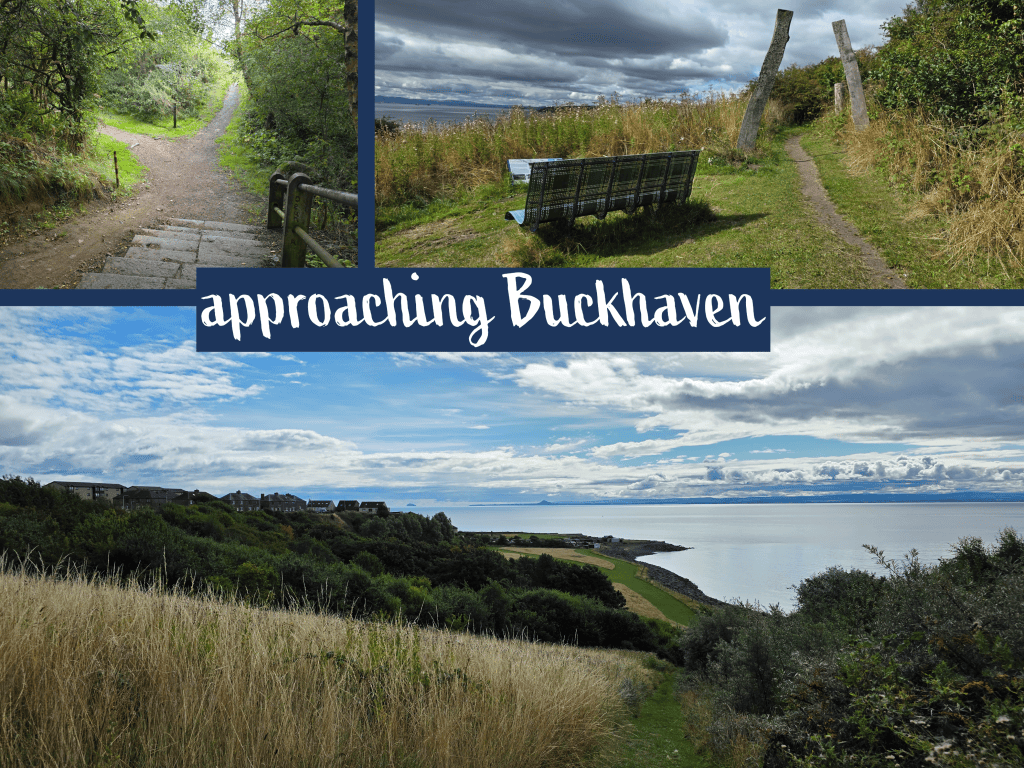
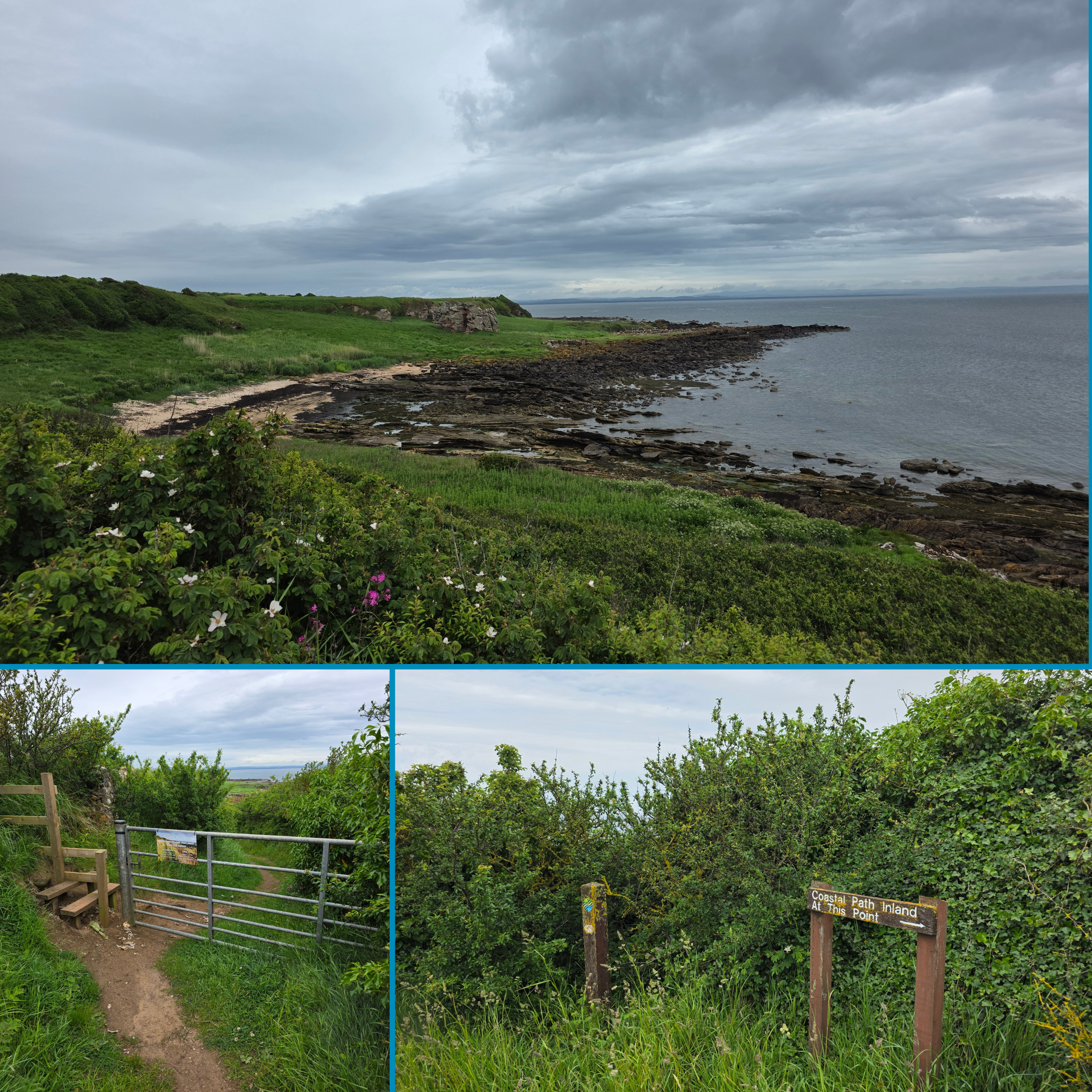
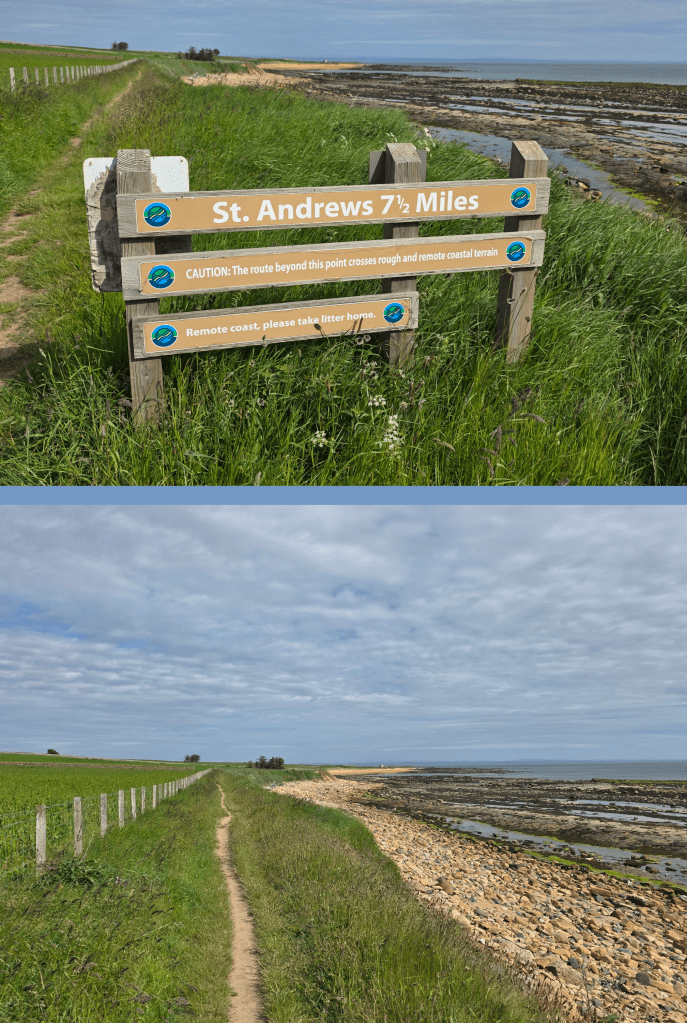
Ahead along the coast is a cluster of bushes, and an obvious left turn towards St Andrews – through a gate and down a hill, the path descends almost to beach level. Here is the first of many views looking north, this one at least assuring me that the tide was low enough not to be an issue. Yes, I had again forgotten to check the times.
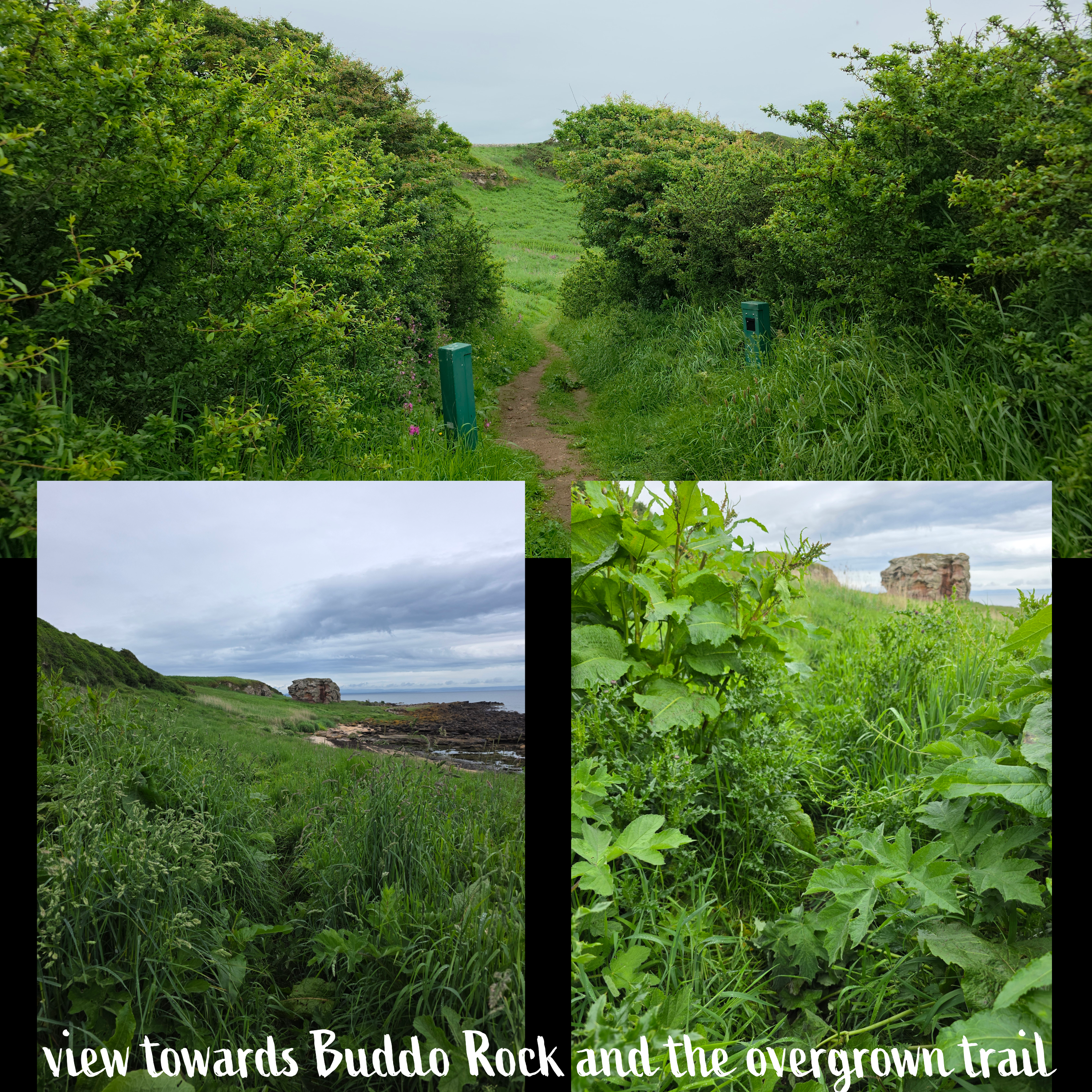
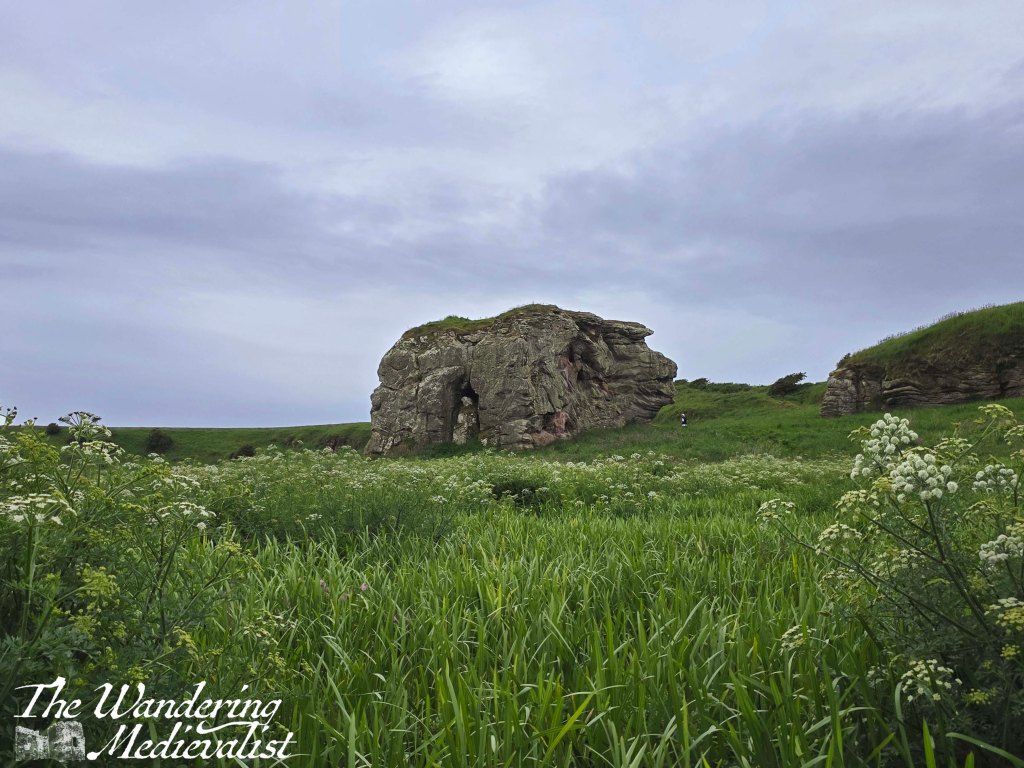
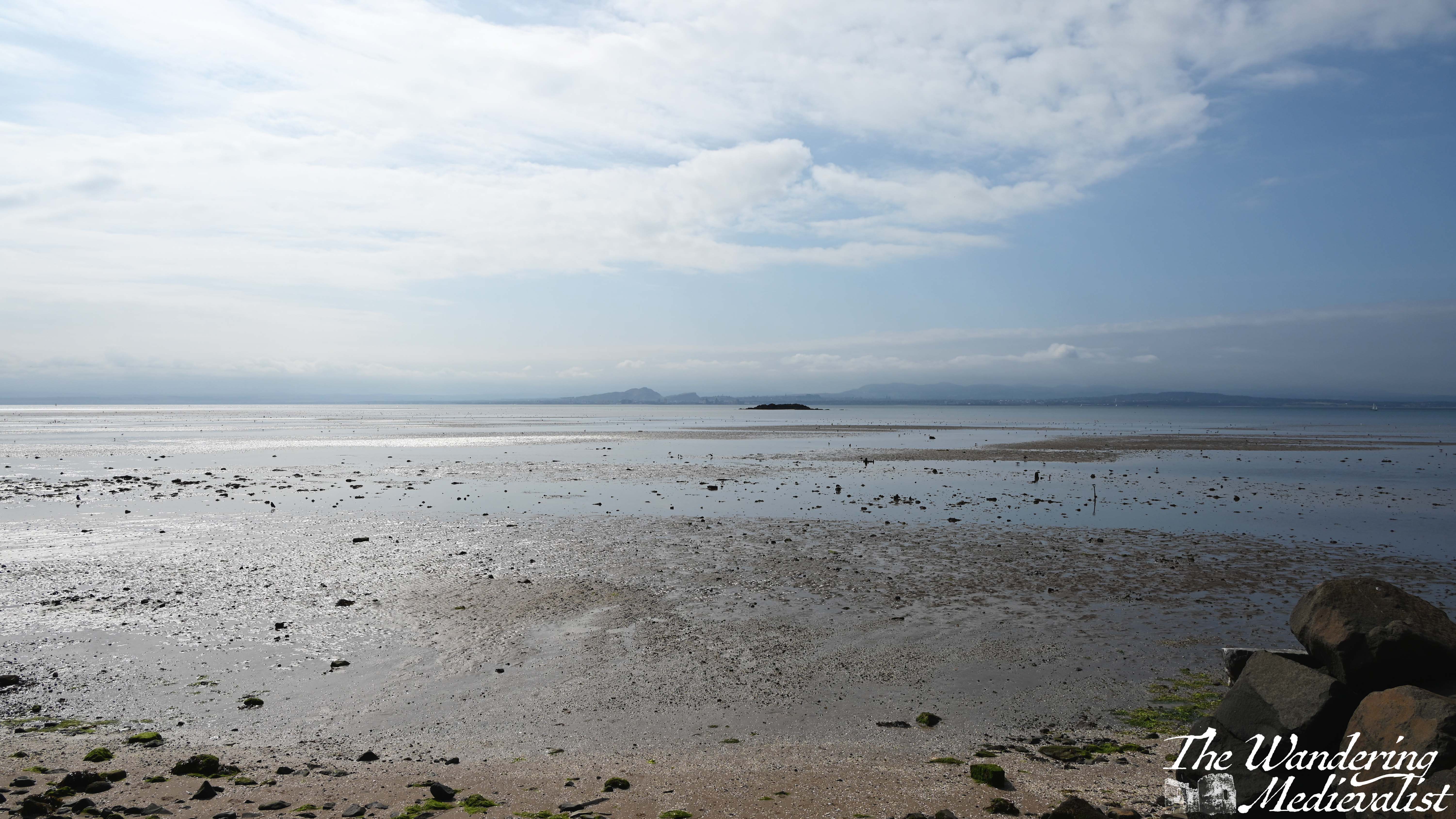
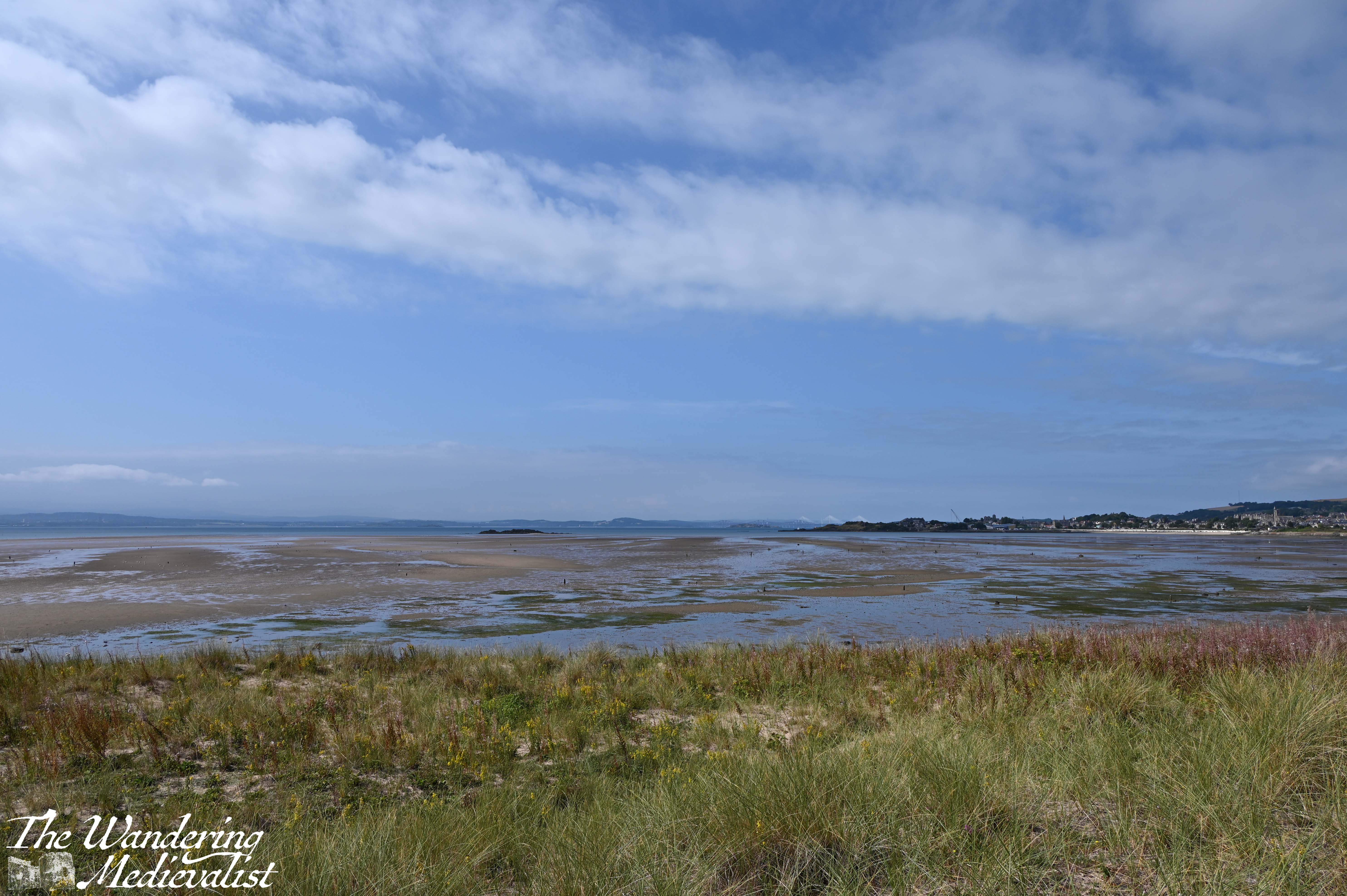
At beach level, you can see ahead towards Buddo Rock, with cliffs on the horizon that are very familiar to anyone who has walked near and around St Andrews. The sun was trying very hard to fight its way through the clouds, but it was not quite strong enough to win.
The path had narrowed here considerably, so that I was walking through almost waist-deep grass and plants, positively soaking my jeans and boots. This part of the route is clearly not well-used and so I gather is not as well maintained. Hiding in the more harmless plants were plenty of prickly thistles, nettles and other less pleasant flora – I should have gone down to the beach and stayed there instead. I was beginning to wonder if I had in fact taken a wrong turn – the path was barely present enough to be followed – when from within the brush emerged a familiar Coastal Path post. I was not lost, but I was even wetter from knees down than if it had been pouring rain.
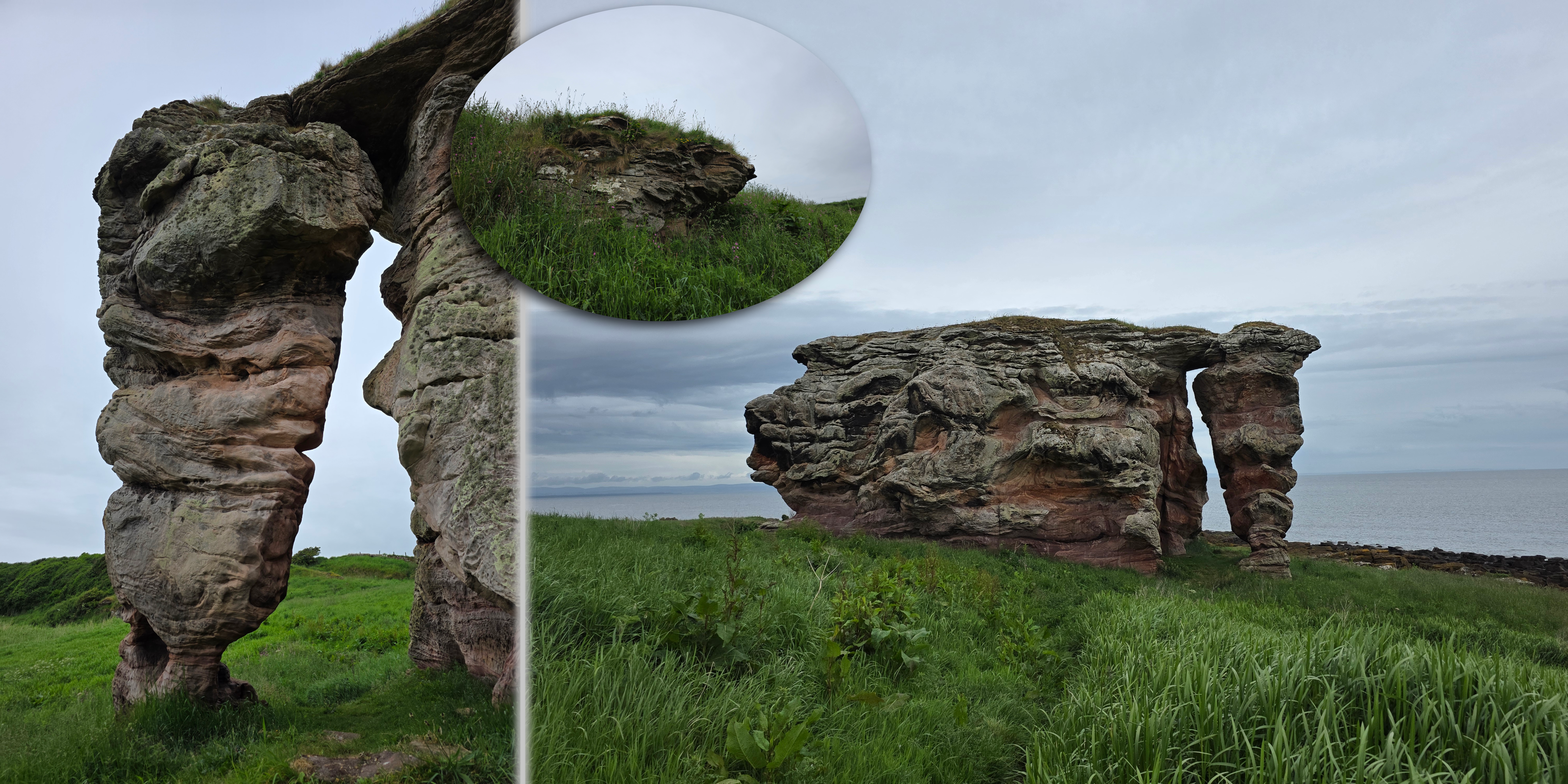
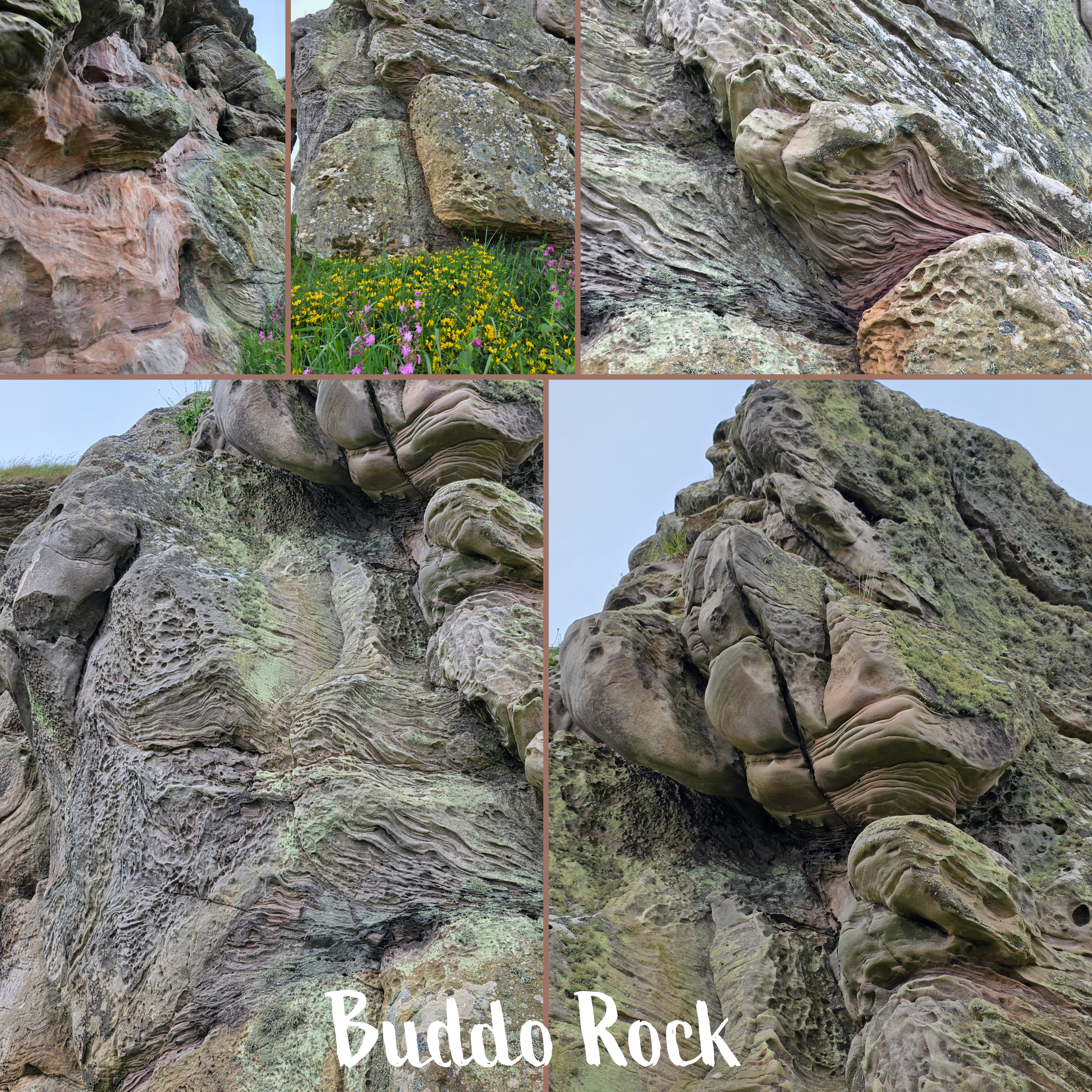
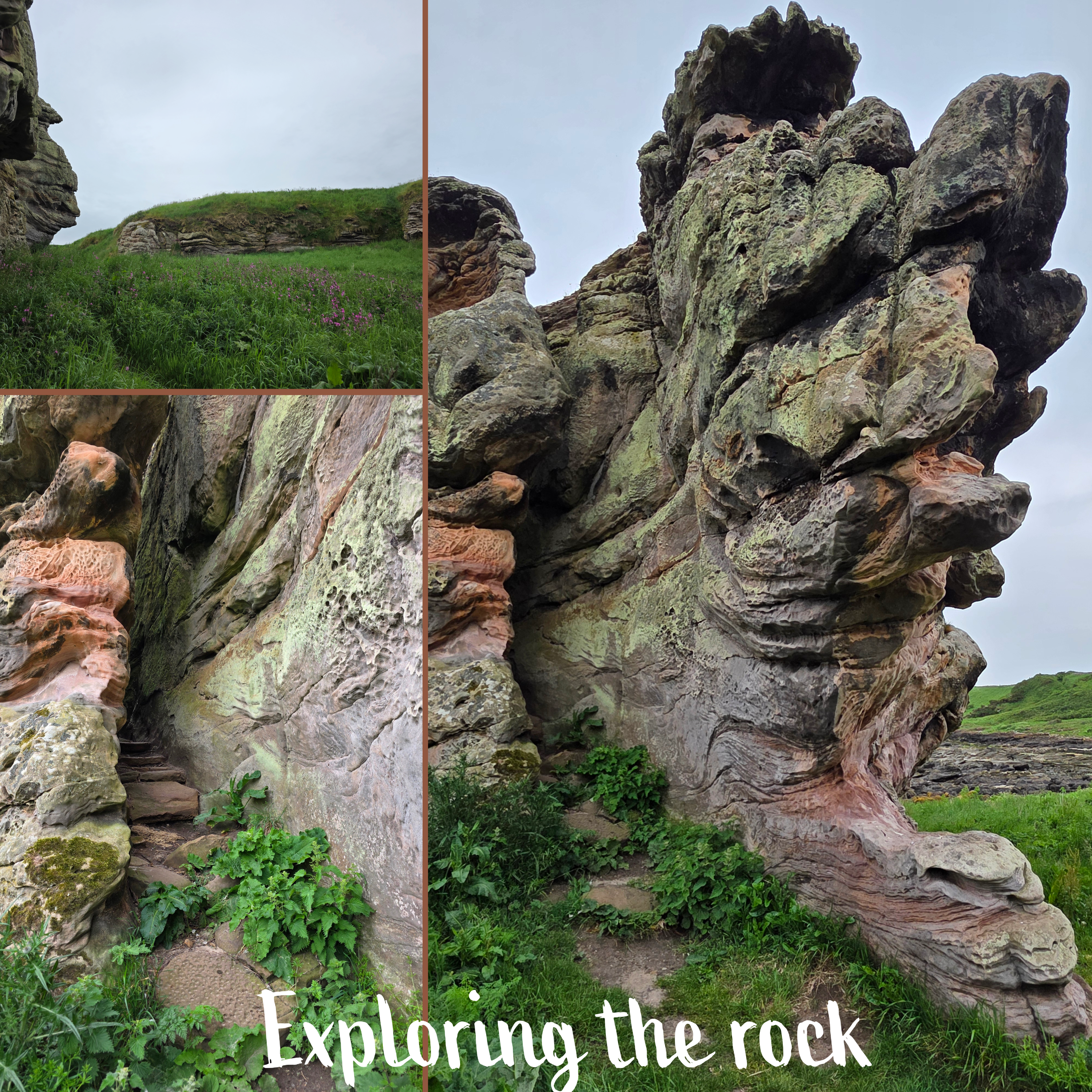
Eventually after what felt like miles of bivouacking (was only about ten minutes really), I reached Buddo Rock, which was really quite cool. The cliffs nearby show evidence of once having been connected, and the rock itself is a fascinating piece of geology, the sandstone surface folded and swirling like cloth or liquid.
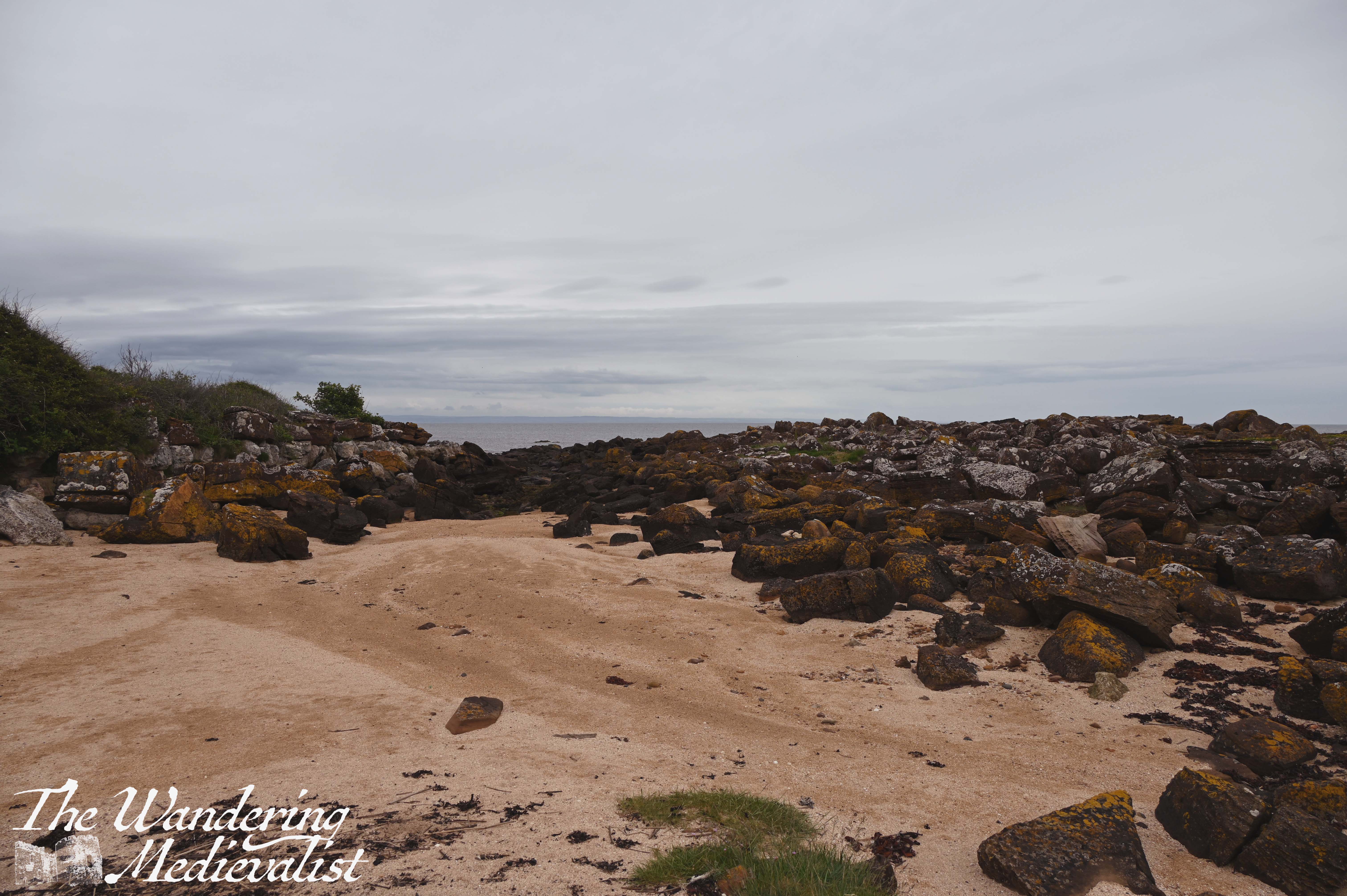
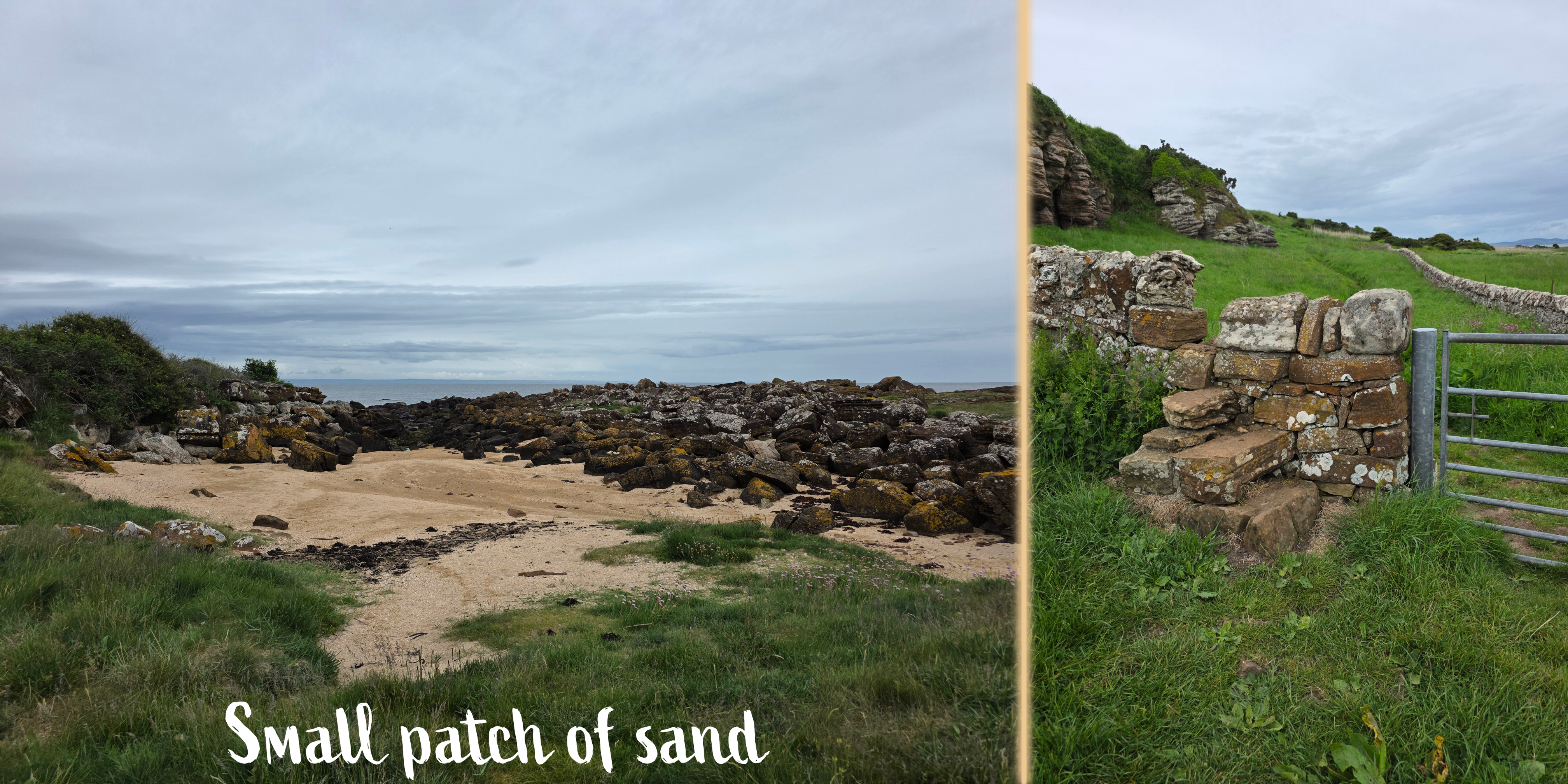
I spent a few minutes wandering around the outside, getting pictures from all angles, and then backed away a little to a small stretch of rock and sand nearby. This would be an amazing spot on a day with more sun.
The cliff line is really interesting along here, with chunk of stone sticking out from the grass, and a couple indentations that could be the start of caves. It is easy to understand how there are several sets of caves along this coastline.
But, I could not stay here and be fascinated by the rock forever, and so I headed on, over a gate and into a more cared-for portion of the path.
Once past the gate, the trail begins to climb gently, with the cliffs on one side and a stone wall on the other. I knew that at some point I would need to climb back to golf course level, and I suspected at the time that it might be a more gentle climb. I was quite wrong.
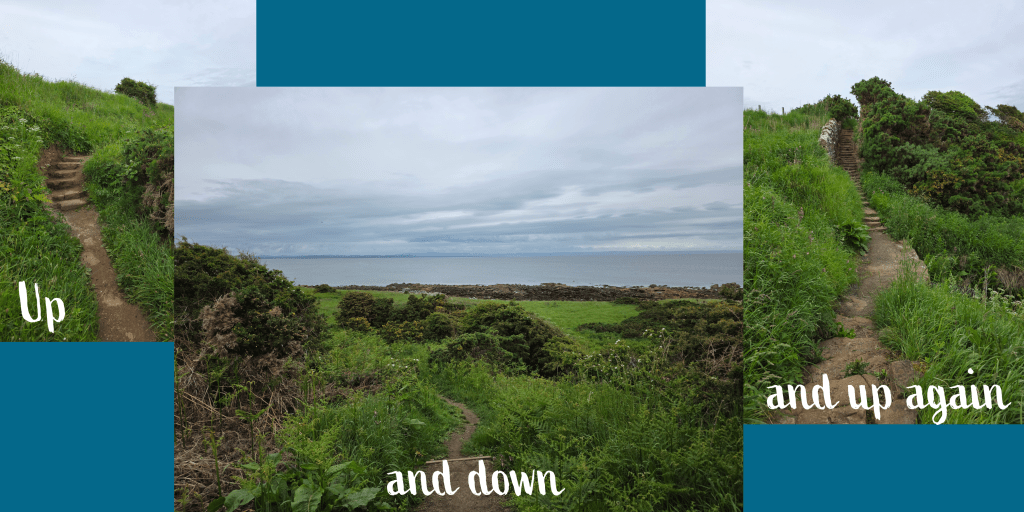
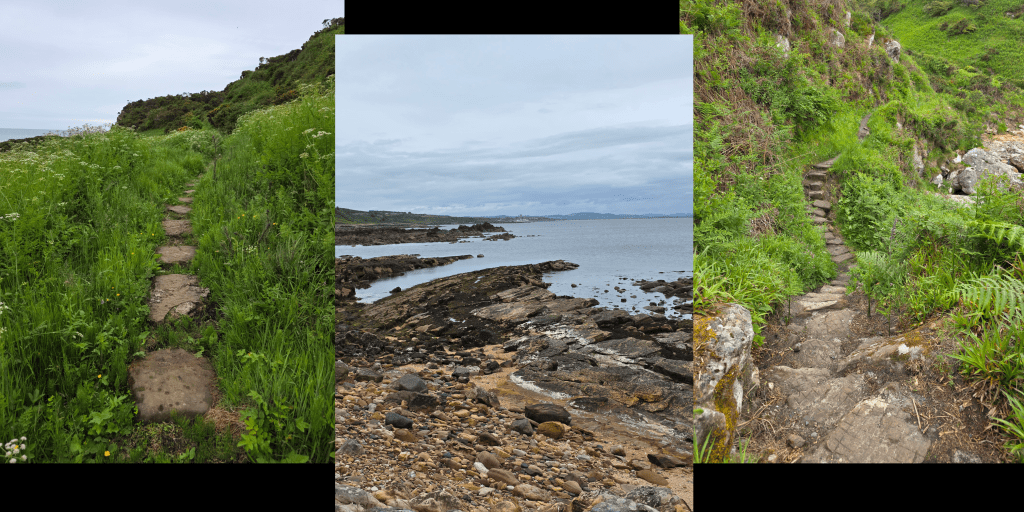
In very little time, that supposition that the climb would be easy was dashed by a series of steady ups and downs, some of them with stone steps and others just rough-cut stairs.
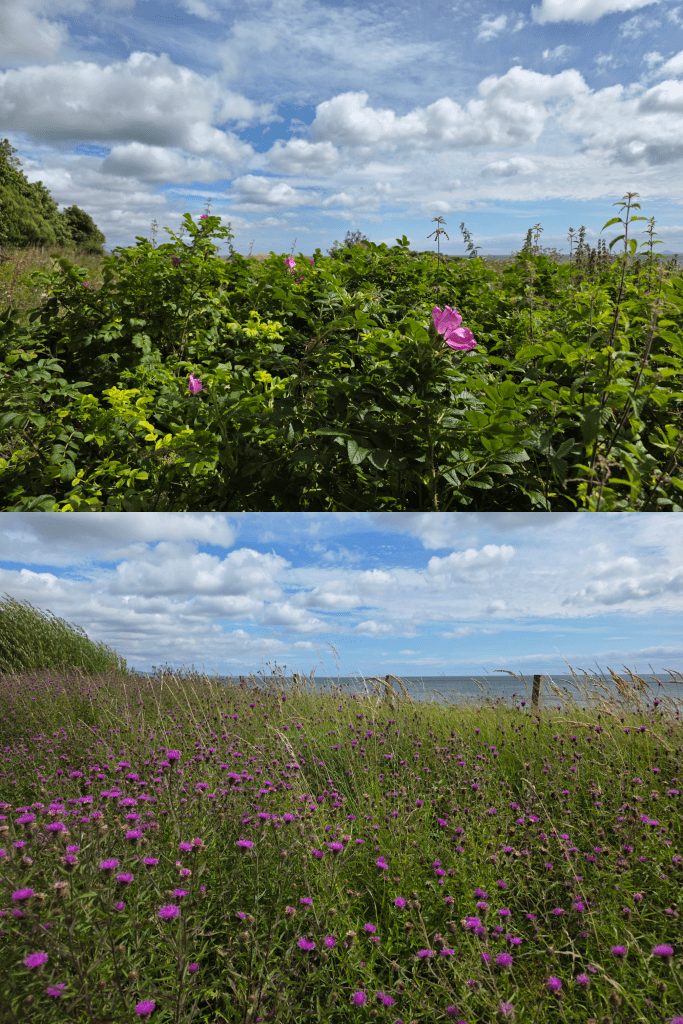
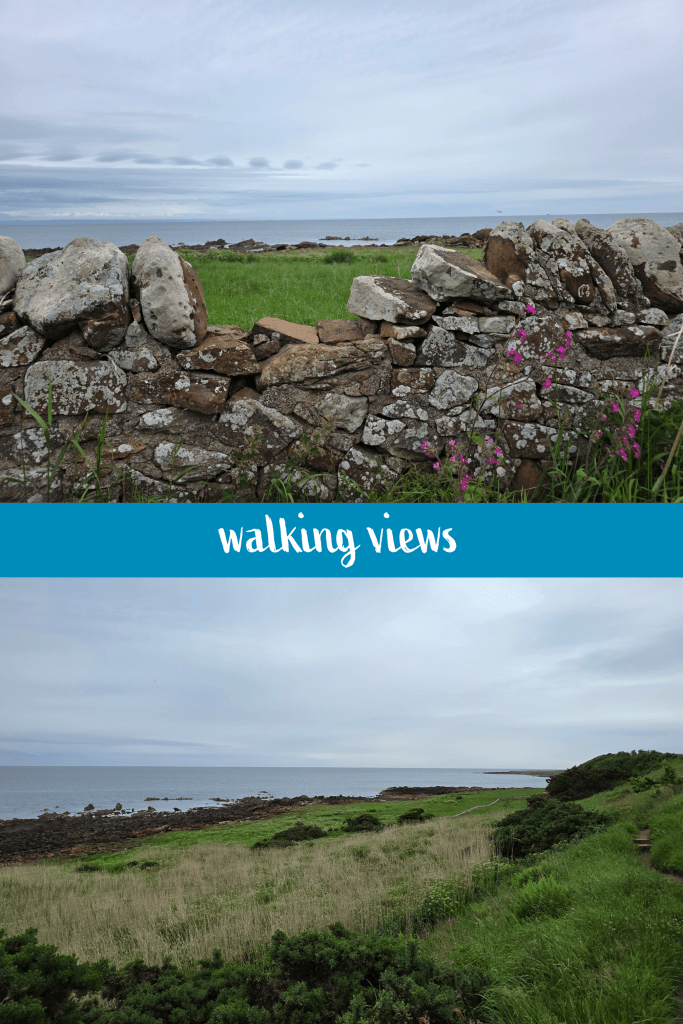
This portion of the route was worth it, though, for several reasons. Firstly, the flowers, which vary between wildflowers, sea roses, foxglove or any number of other blossoms – lovely pinks, yellows, purples, and whites.
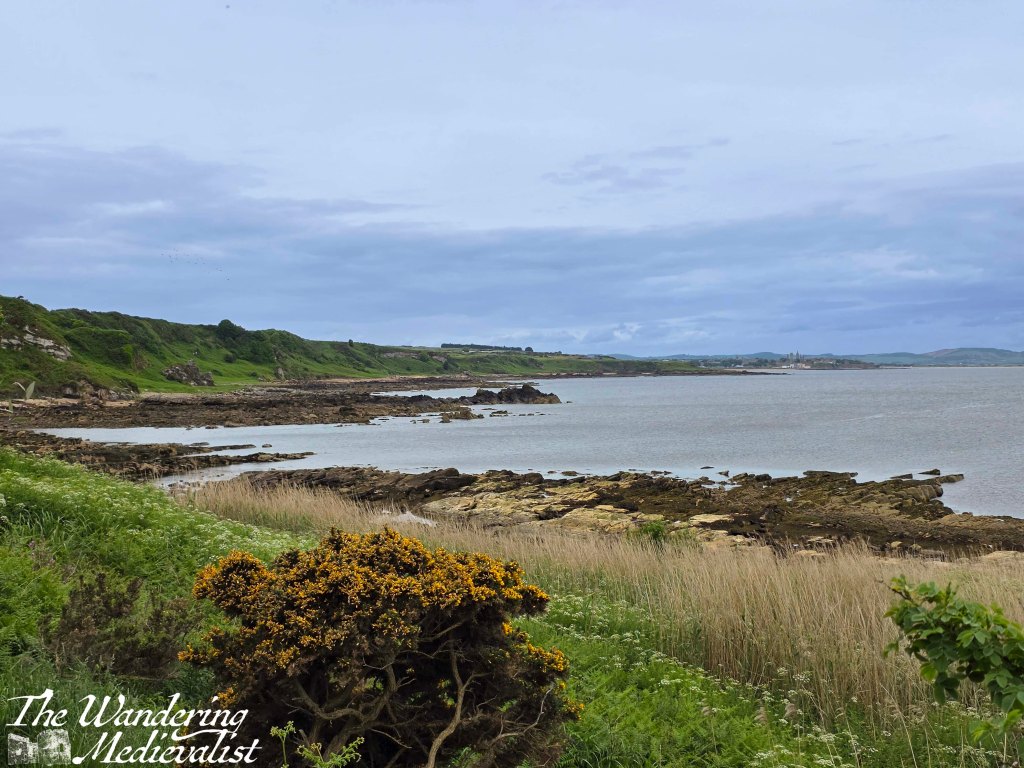
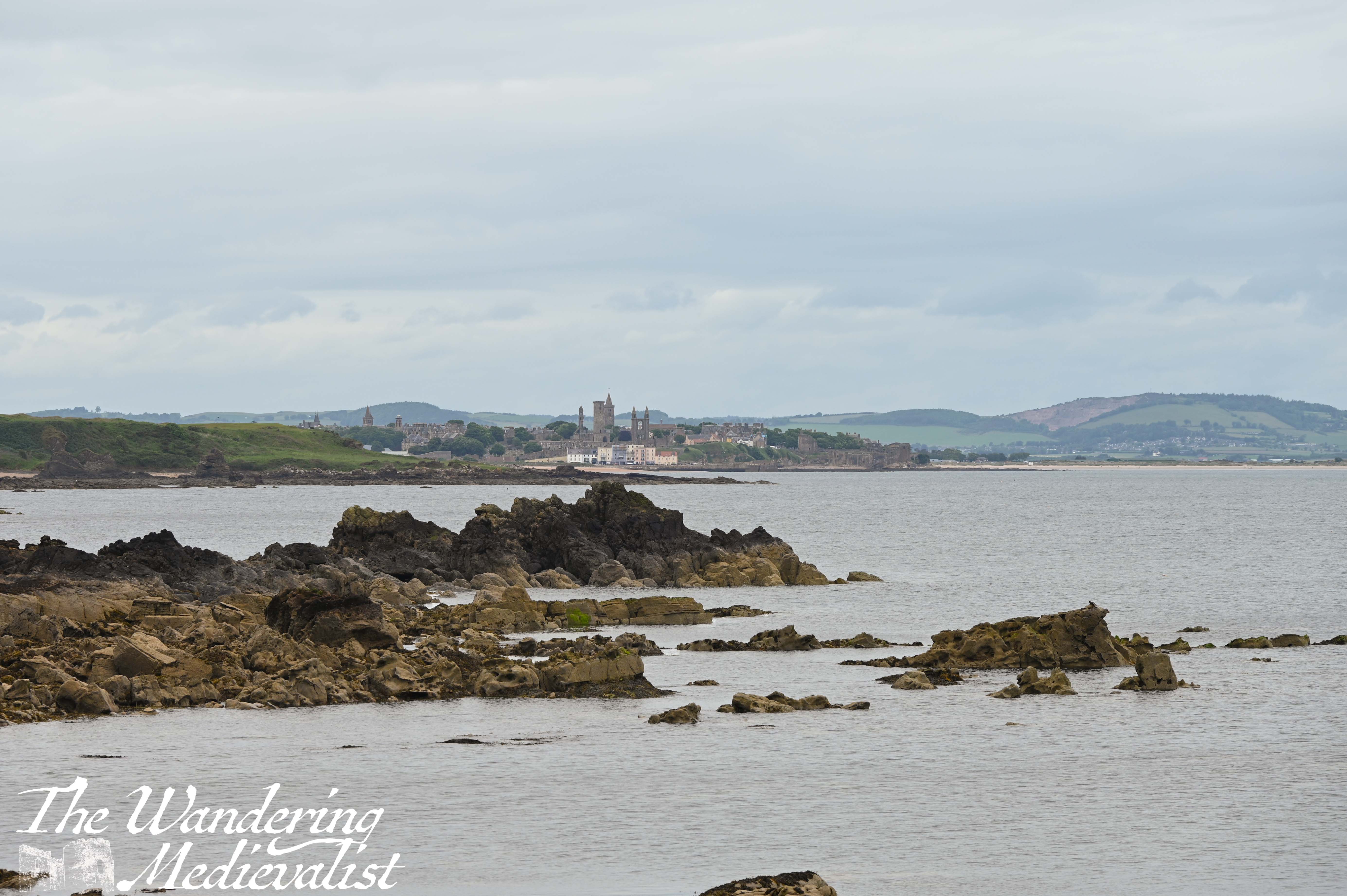
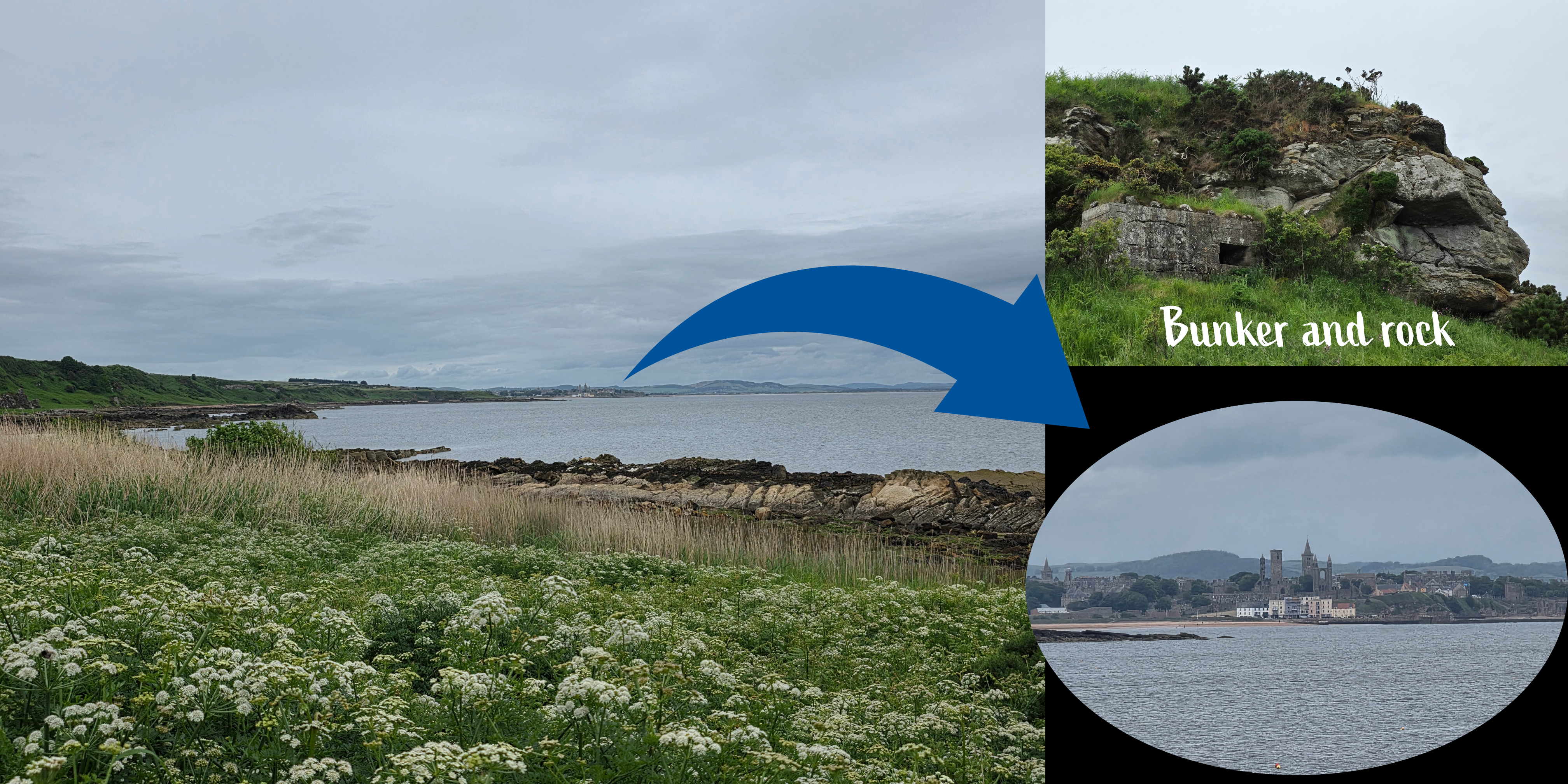
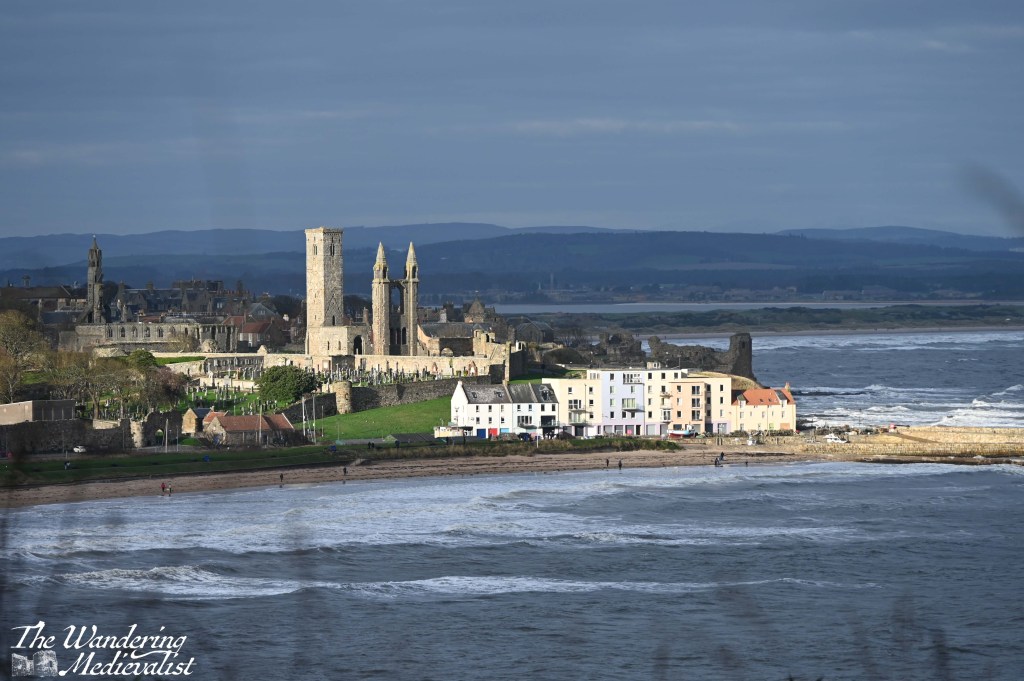
Secondly, for the view along the coast which was a completely new one I had never appreciated before – this far around the coast, I was looking almost straight down St Andrews pier, which was visible with a zoom lens.
The cliffs are also really fun to watch and see what new thing will emerge – there is a World War II bunker just visible for example, as well as countless hidden spots. This would be a phenomenal spot to come back to on a sunny day.
Moving on, there is a section of path made out of stepping stones to take you over a muddy patch. I could not stop marvelling at how amazing the view of St Andrews was from here, and I had to stop myself from re-taking the same picture over and over. The one above with rocks directly in the view was my final effort.
There is quite a lot of moving up and down the edge of the beach and cliff at this point, and many of the ‘steps’ are not in the best state. While the views are excellent, the almost continuous rise and fall makes this a more strenuous portion of the path, though at least my legs were starting to get warmer as they dried out. I was being followed at this point by a group of walkers less than five minutes behind me, which stressed me out slightly; I considered stopping to let them pass, but decided instead to push on. The weather was becoming a bit more threatening, and I had plenty to do once I had finished my walk.
As mentioned, the stairs here have in some places seen better days, and there were some significant drops particularly for those with shorter legs like mine. But, as long as you take it easy and pay attention to where you are putting your feet, it is certainly manageable.
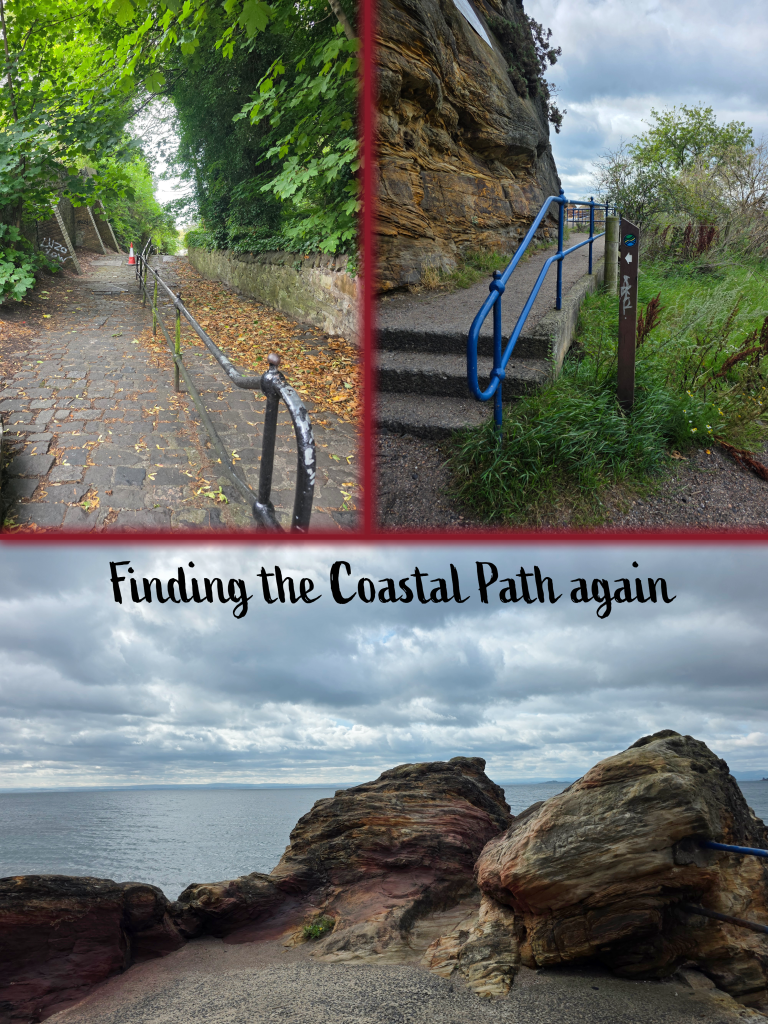
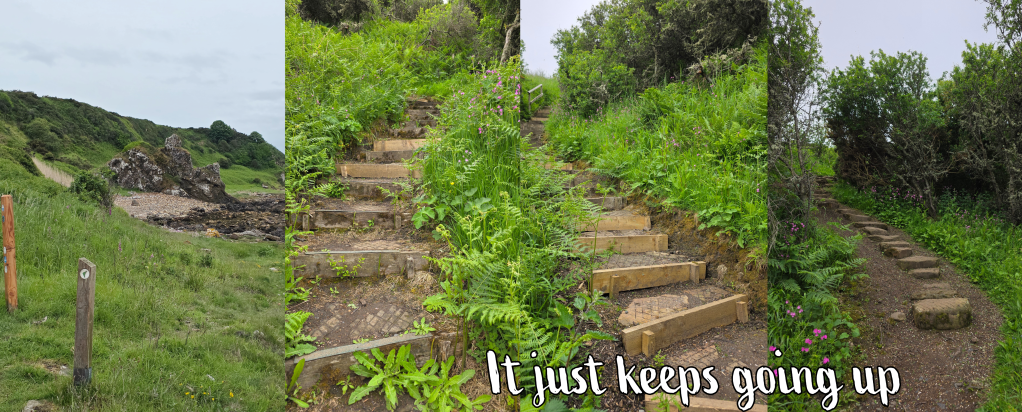
In time, the path levelled out at beach level, with a large rock ahead. Another post directs walkers towards a flight of stairs and I realised that my earlier supposition was completely wrong: I would in fact have to climb from beach level to the golf course in one long winding go. I won’t lie – particularly with the other walkers behind me, this one was a push.
The steps vary from wooden slats to stone chunks, then closer to the top merge into just a hill. Then, just as you are starting to doubt your sanity on how far you have climbed, the sound of golf balls being whacked drifts into your ears, and the shape of the clubhouse appears on the horizon.
The path meets the green and follows it around to the access road, only steps from the spot where I had started my walk several months ago. I had made the foolish decision to remove my jacket at the beach level, but up on the course the wind was much stronger, and I found I had to pull the extra layer out of my pack again. It was also starting to spit with rain, and I still had a way to go, trudging up towards the road; my main priority was not being hit with an errant golf ball.
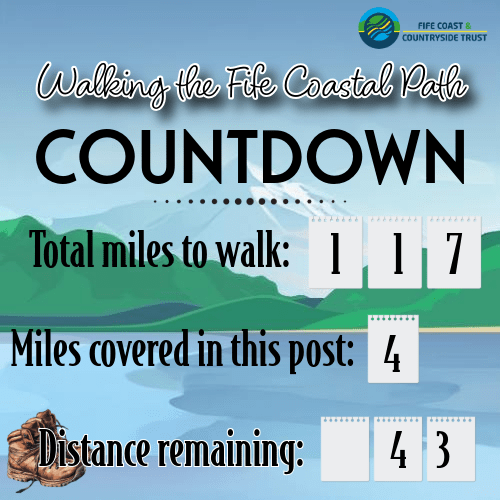
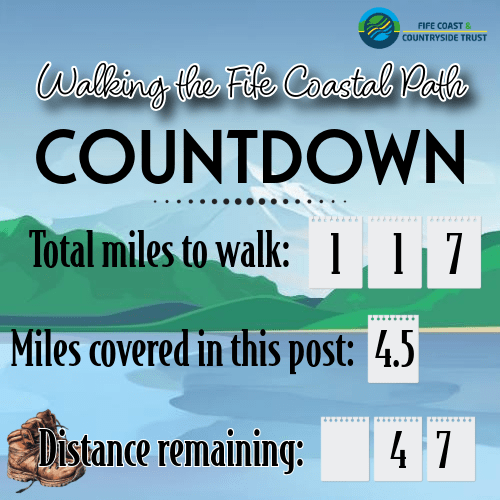
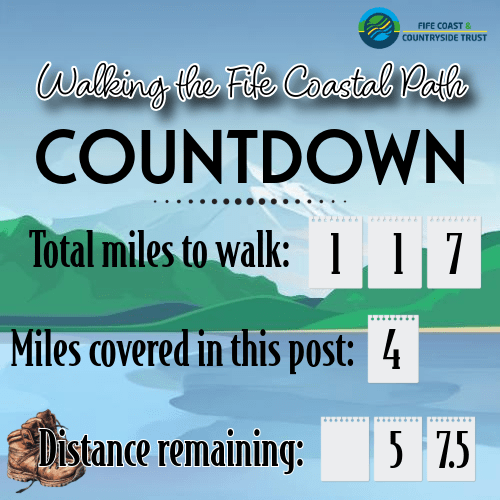
Overall, while this was a shorter walk than the previous week – 2 miles on the path and about 4 overall – it was arguably harder to do with a lot more climbing and descending, and of course the monumental climb at the end. The good news is that I definitely stretched out all of my back muscles that were bothering me.
Also, it didn’t really start to rain until the end.
One unpleasant after-effect though was that when I got home and was enjoying removing my boots, I discovered two ticks on my hand – one had bitten, one was still crawling around. The other half swiftly removed the one that had bitten with tweezers, and I squished the other – I do not think it had actually been there long. Compared to a US tick, it was quite small, but still necessitated a few shudders and an immediate shower. Apparently the weather in Scotland this spring has been perfect for ticks, so if you are out, be careful!
Speaking of weather, we are all being told that there is a Super El Niño coming. What exactly this will mean for Scotland is uncertain – more wet or more dry, either way I intend to continue on my walks. Now that the East Neuk is done, it’s time to focus on the south coast again. More in July when I am back!
Finally at it again! Saturday was supposed to be cloudy in the morning with rain coming in the afternoon, but I was determined to get a few more miles under my belt. I was not feeling hugely confident about my stamina, so found a mid-length section that I could do relatively close to home, though it is one of the last that will be so easy to reach: Cambo Estate to Boarhills. One exciting note about this walk, is that in completing I have officially passed the halfway mark on my journey.🎉 Still a long way to go.
Saturday morning started off breezy but mild (16℃/60℉) with an almost cloudless blue sky and bright sun. I had even remembered to check the tide, which was scheduled to be low at about 7.30am, so perfect for me. The actual Coastal Path section of this walk would be 4 miles, but I knew I had about a mile on each end to get to a road, so I spent the short bus journey reminding myself that I did 6 miles easily in Washington, so this should be fine.
The bus trip was pleasant, warm in the sun and the flowers at this time of year are stunning – peony roses, iris, poppies, rhododendron and so many more bursts of colour particularly as we rode through Kingsbarns.
I alighted bus just outside the gate to the Cambo Estate and enjoyed a pleasant walk along the access road through a wooded landscape full of chirping birds. A few purple rhododendron were hiding in amongst the trees, like on so many old Scottish estates. After about ten minutes I reached the cluster of buildings where there is a shop, café and access to the walled garden, though it was not due to open for another hour. I was a bit uncertain how to get past the buildings, but managed to skirt my way around and headed down through the grounds towards the coast.
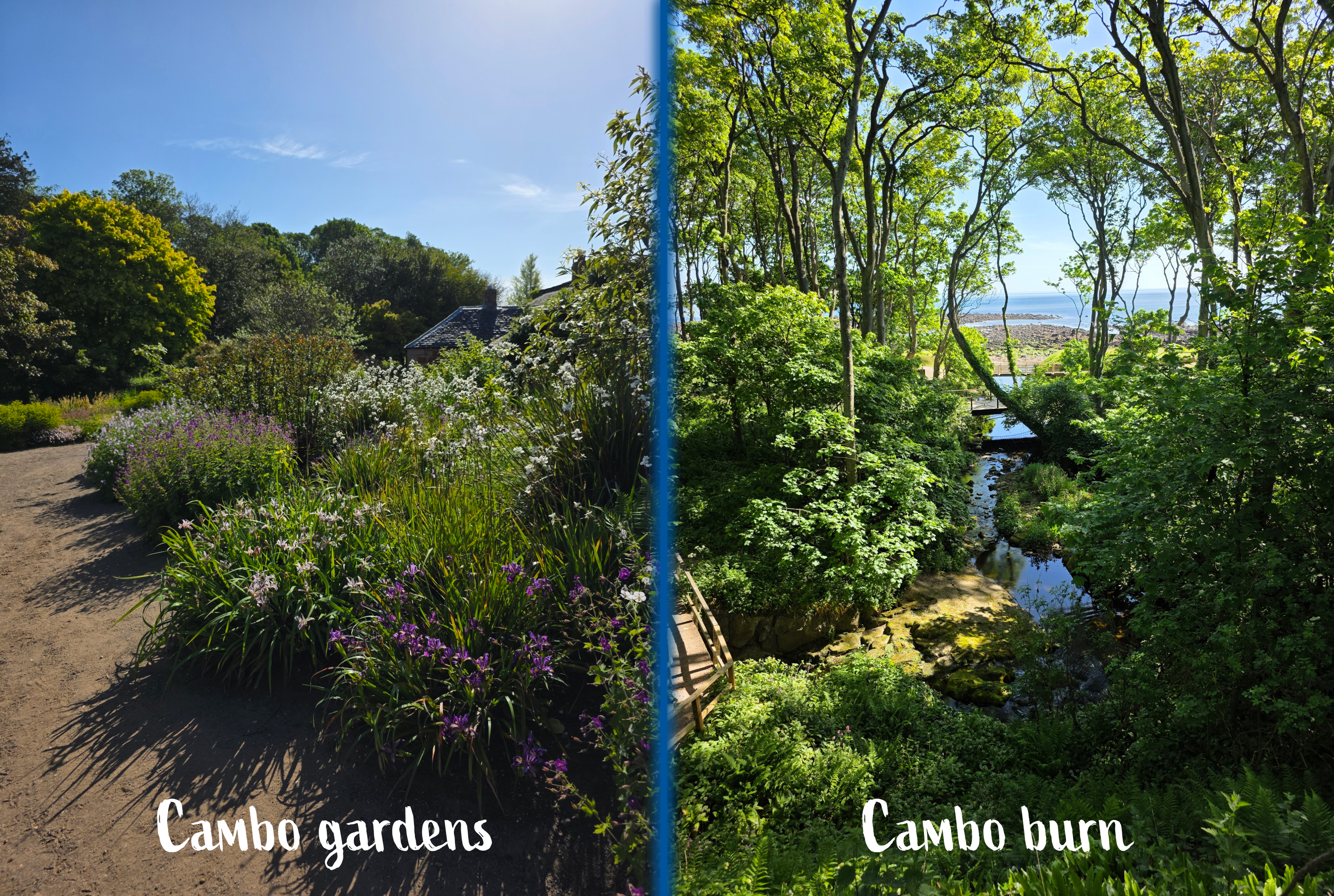
I couldn’t resist capturing a few garden views on the way…
The spot where I had stopped my walk counter last year was the bridge over the creek, and so I picked up the path here, almost exactly 1 mile from where I had left the bus. The path emerges from the trees – quite welcome due to the prevalence of bugs hovering amongst the foliage – and onto the golf course. I was very happy to discover that the public toilets designed for walkers and golfers were open, so stopped for a moment before properly setting off.
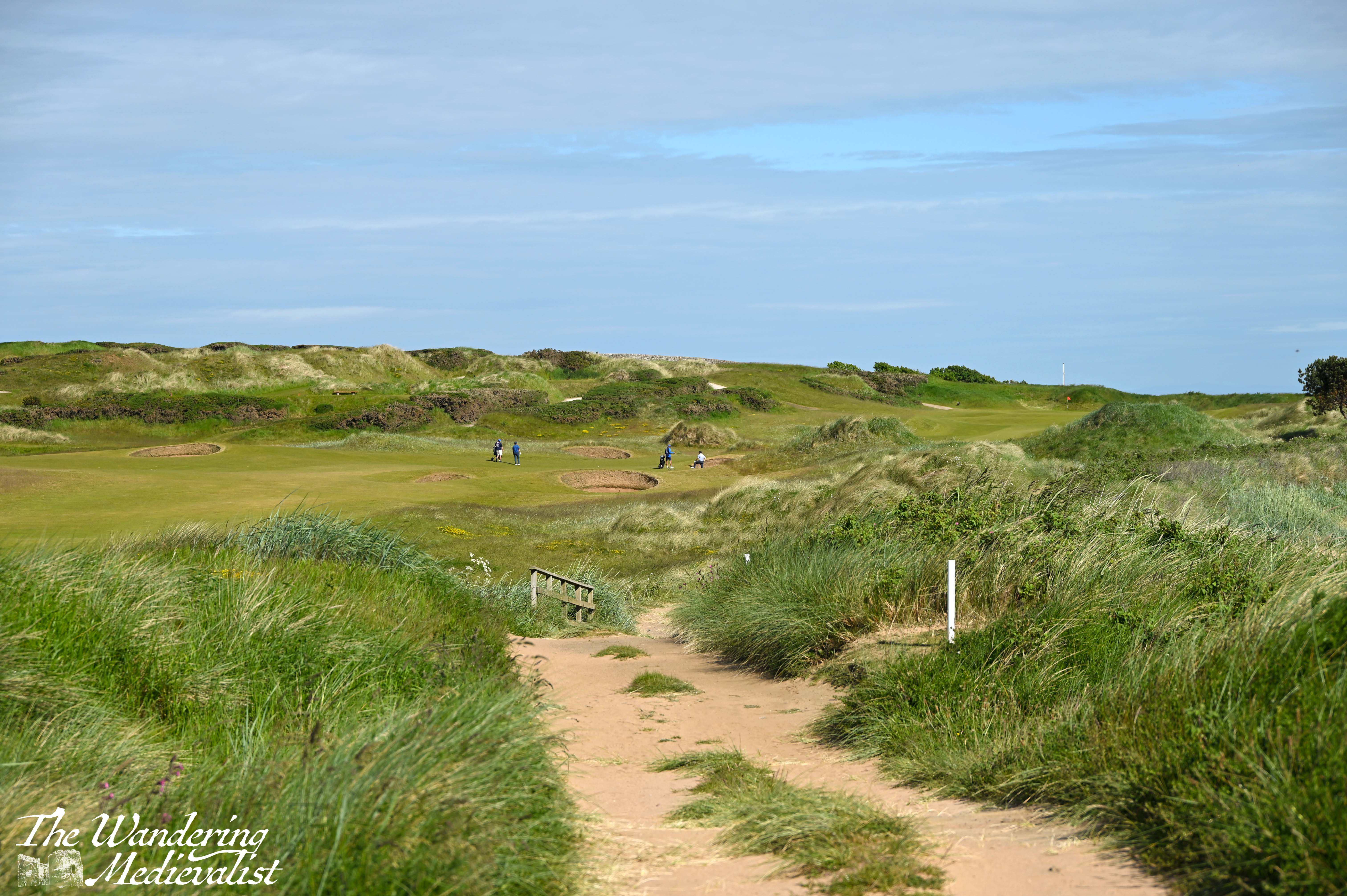
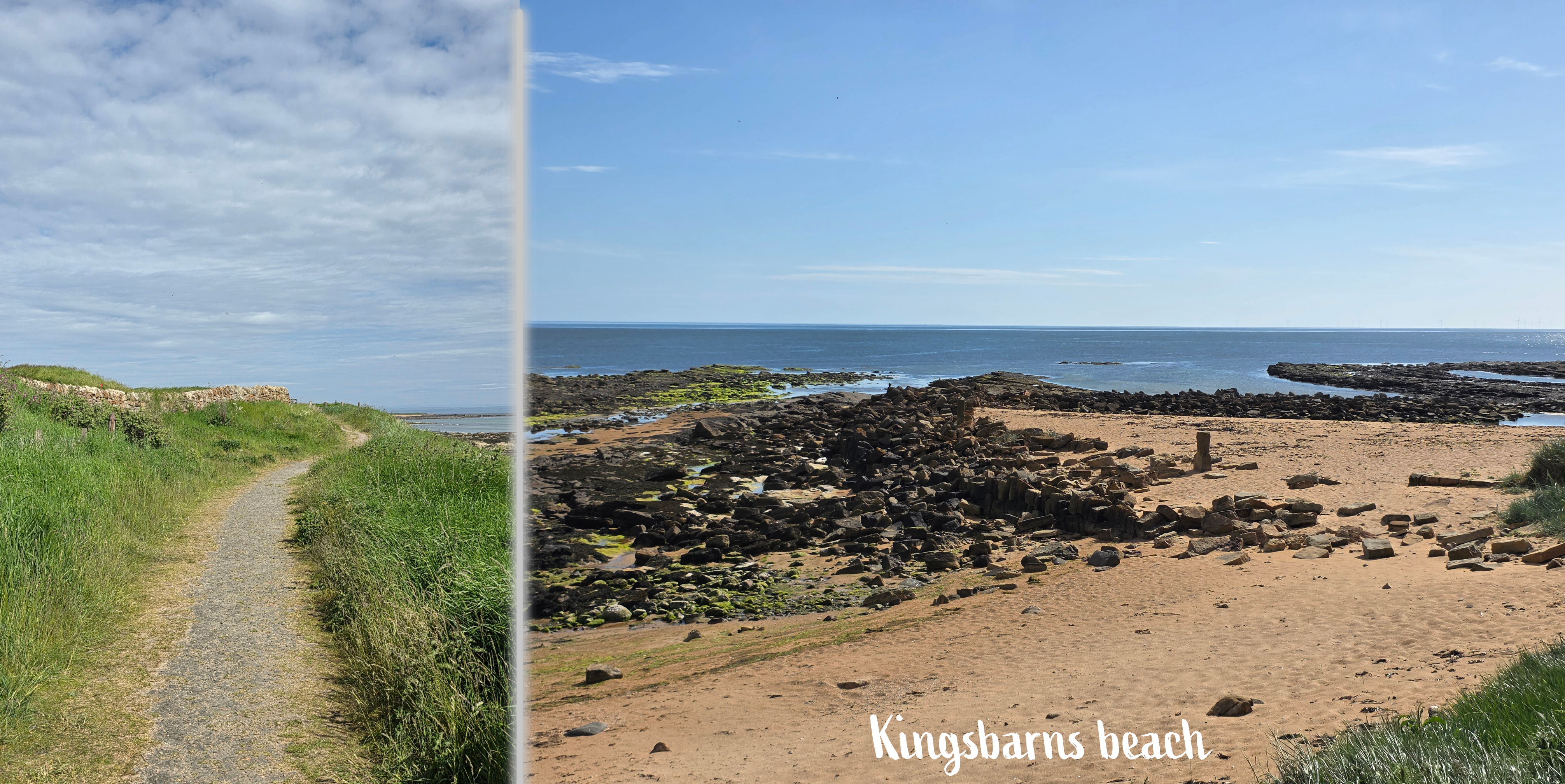
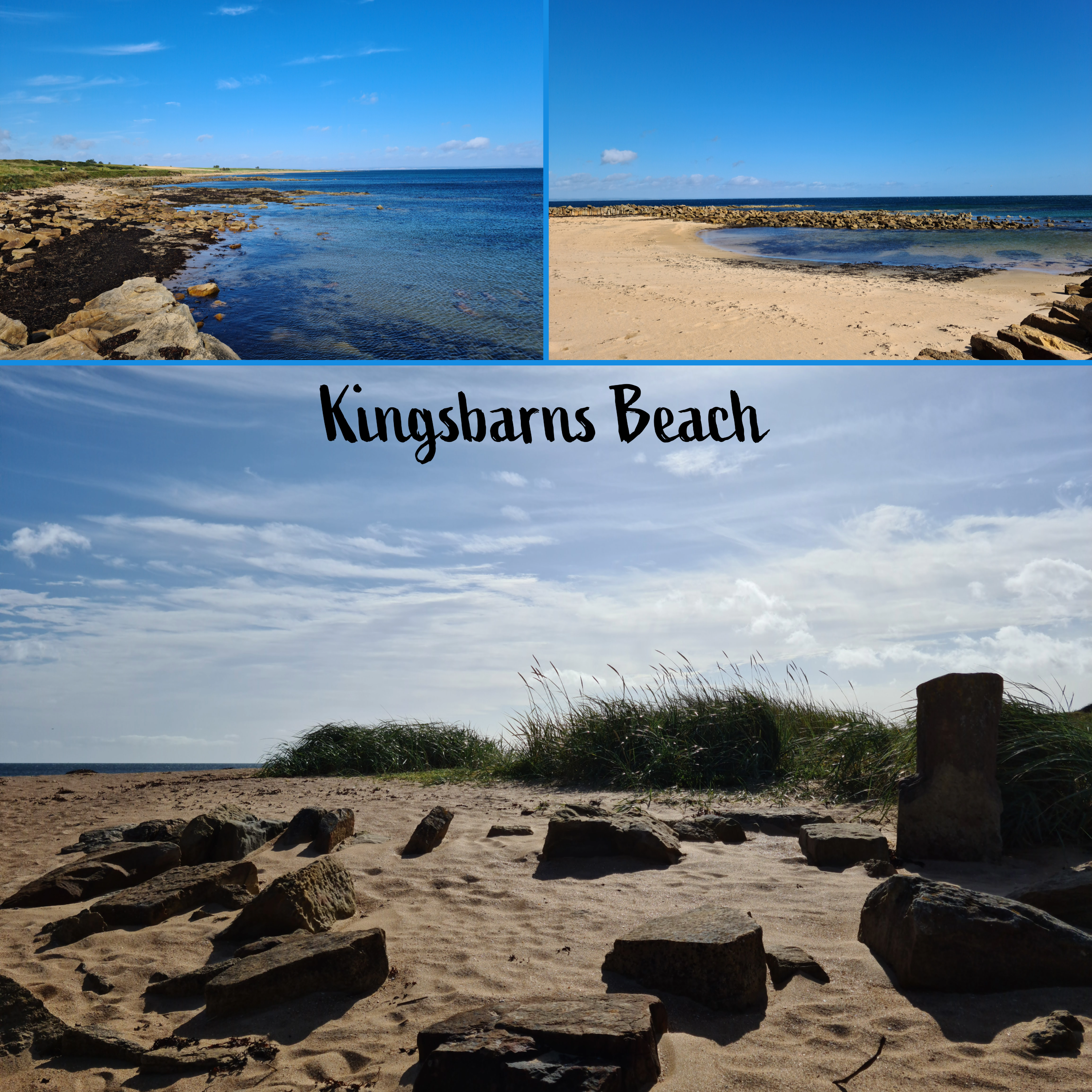
I have done this section of the path several times with friends and it is a really nice walk, parking at Kingsbarns Beach and walking up to the estate and back. It runs along the edge of Kingsbarns Golf Links, offering great views up over the course to the clubhouse. Needless to say, views of the beach are also extraordinary.
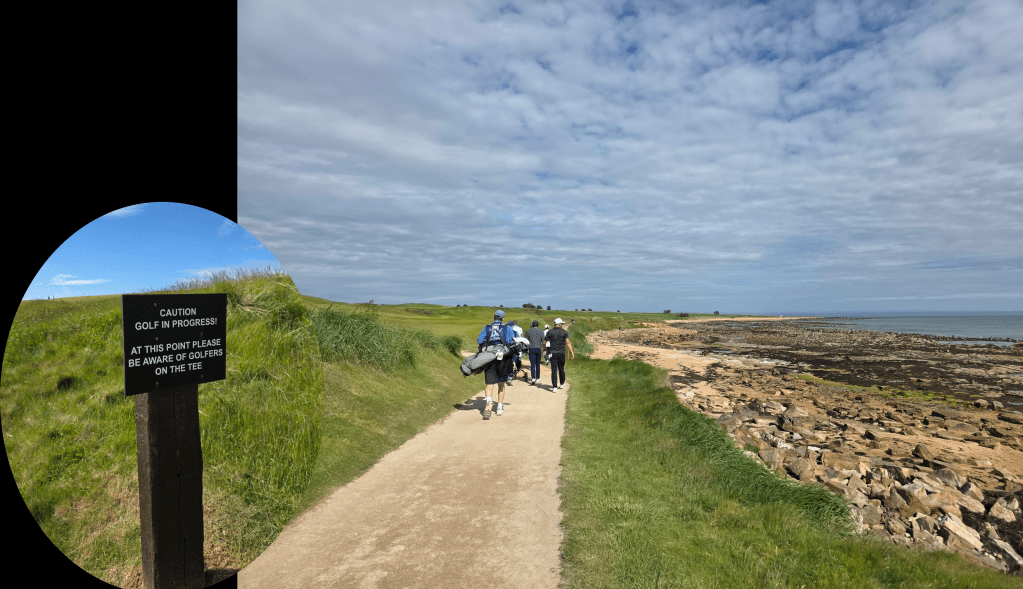
The course was already busy at just before 9am on a Saturday, though the beach was quiet. In fact, one could probably walk on the sand at this point in the hike, if you wished. But, I had a feeling there would be required beach walking further up so I stuck to the trail, which is a wide sandy track, gently rolling as it hugs the line between beach and golf course. I did make the decision not to take too many pictures and instead to focus on getting some ground behind me, so powered on for the just over half a mile to the beach car park. As I have observed previously, walking the Fife Coastal Path is probably the best way to see a large number of golf courses without actually picking up a club!
This car park is often busy and you have to reach it early to get a spot, though it is also available for overnight stays with a good number of camper vans parked along one side. It is a popular local spot with a burger van, sauna, picnic tables, public toilets and a drinking water fountain. While he signs are not really clear, the Coastal Path instinct will take you through the car park and around the burger van.
Just beyond the picnic area is a nice spot to detour down to the beach, where there are some interesting rock formations and nice views – the beach here is quite sandy, between larger stretches of rock on either end of the cove.
The path narrows a bit here but is still easy to follow. It was also very quiet; normally I pass numerous dog walkers, hikers and runners but really only came across 3 or so groups; from the edge of Kingsbarns to Boarhills only 2 people total – not sure why, but I didn’t begrudge the quiet.
For about half a mile beyond the beach, the path follows the edge of the golf course, occasionally even crossing the green so that there are signs asking both golfers and walkers to be courteous of one another.
This stretch is very pleasant, mostly flat and not particularly strenuous. The breeze was gentle, and the view familiar but no less beautiful, with green on one side and the beach on the other.
At the edge of the golf course there is a sign warning walkers about the distance to St Andrews, as well as the treacherous nature of the trail in places. Almost immediately the path narrows considerably to the point where groups would need to walk single file, but it is still mostly flat. In little time, there is a large post directing walkers down to the beach until there is another sign (which I never actually saw, though I did work out when the path re-started).
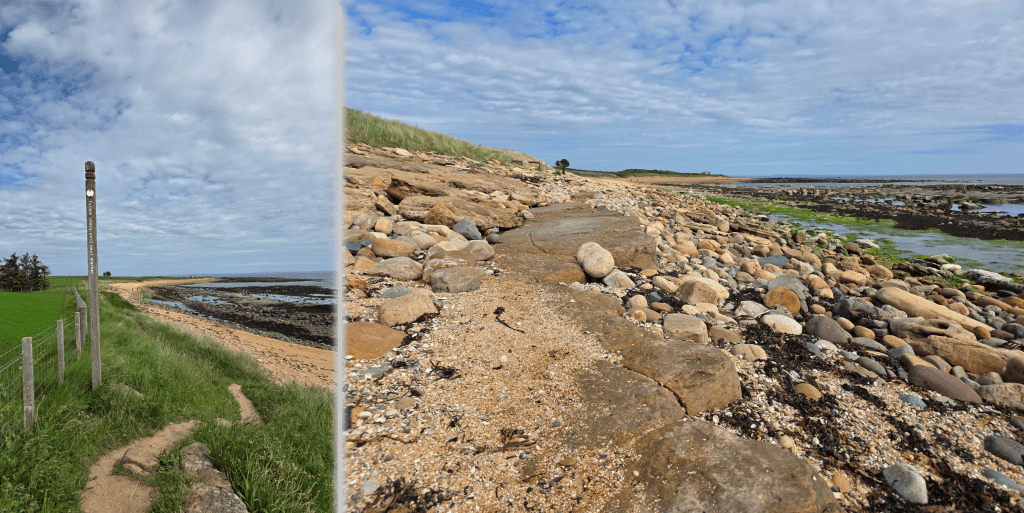
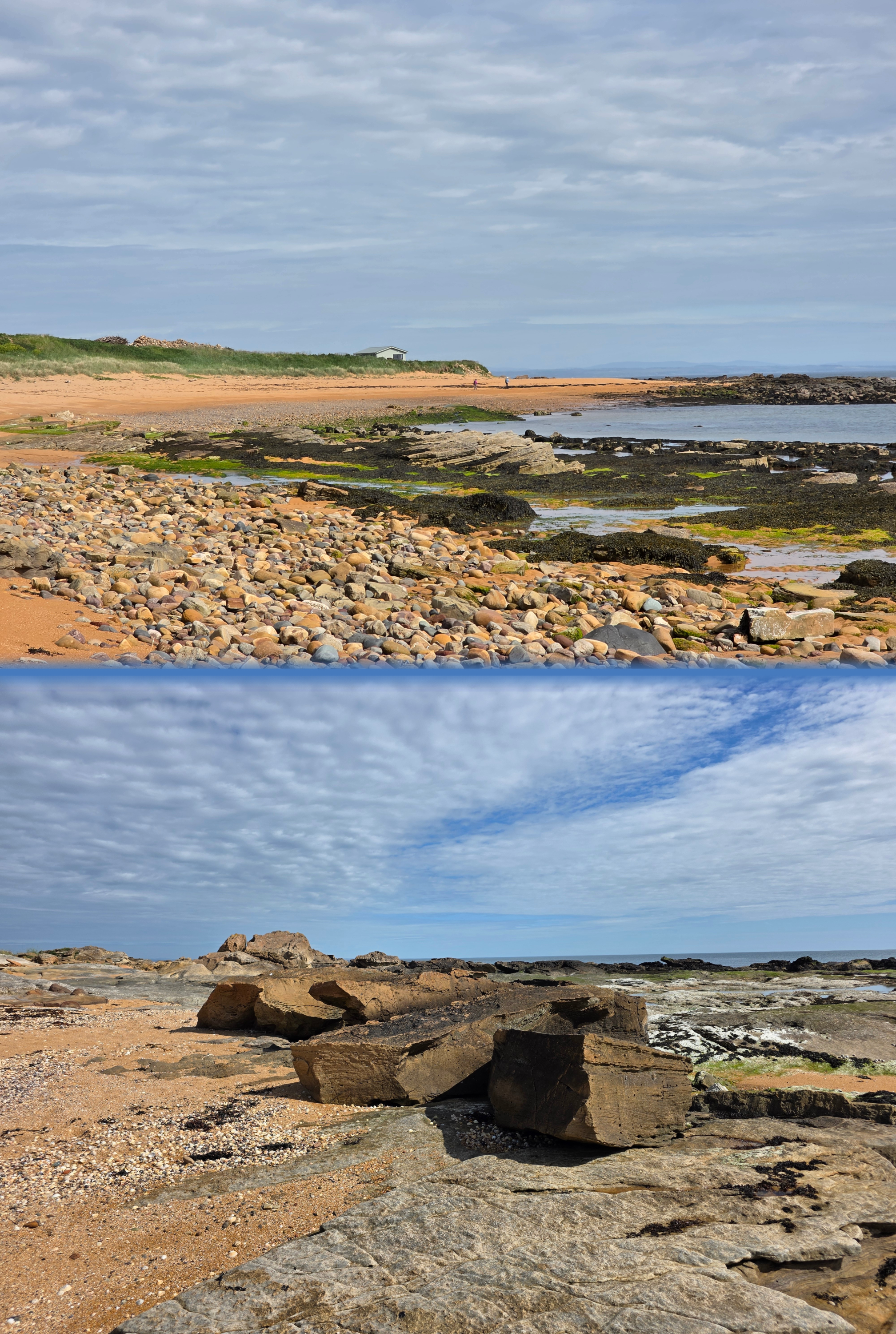
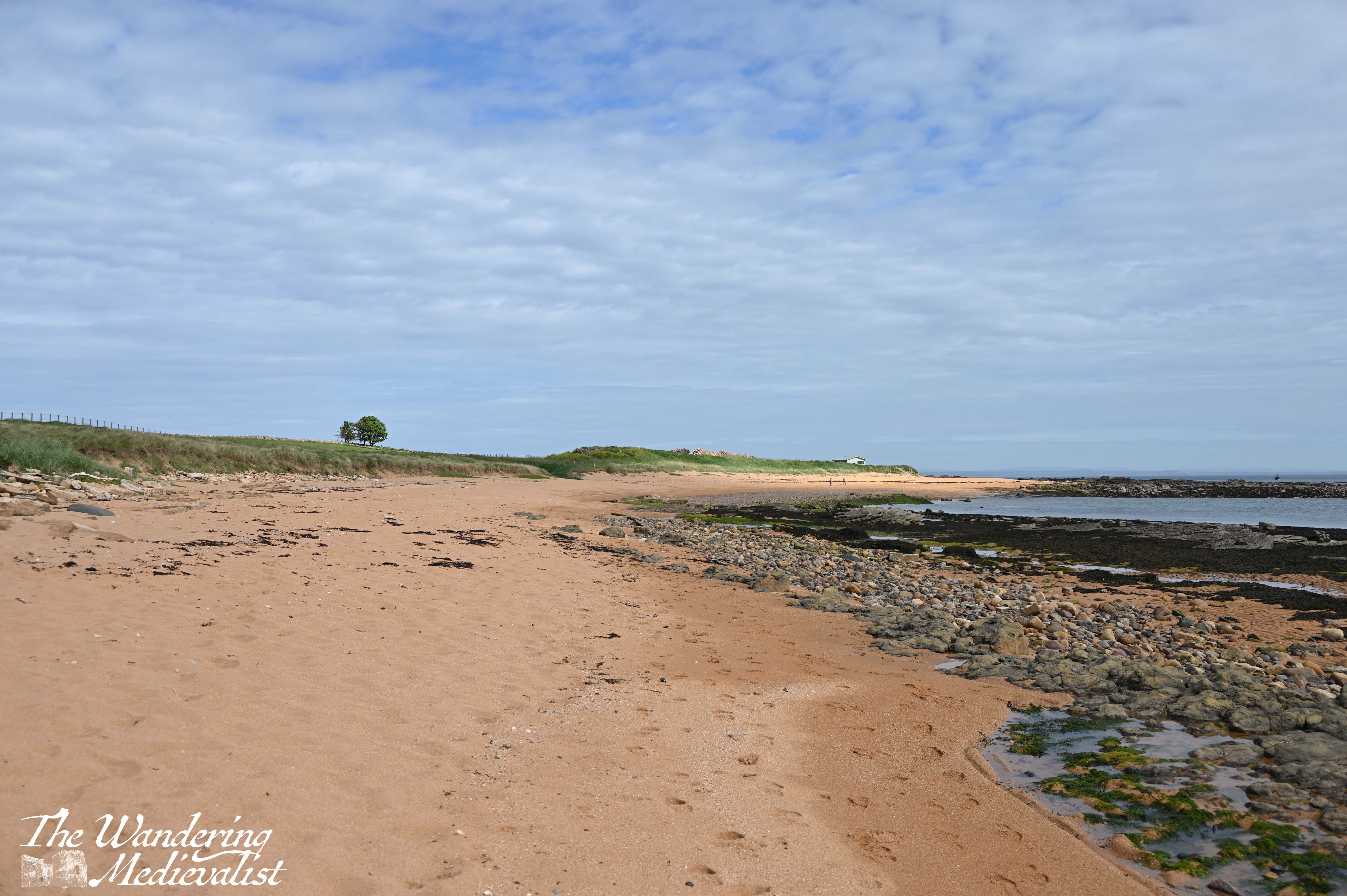
I think you could probably just manage on the beach even at high tide, and while it is alternately sandy, I was able to find a shelf of rock to walk along for a while, and prevent my boots sinking into the soft sand. Ahead on the horizon was a house that I was using as a marker for when I should think about looking for the second sign, to return to the grass. When not sandy, the beach becomes treacherously rocky with those medium-sized rocks that are perfect for turning your ankle if you are not careful.
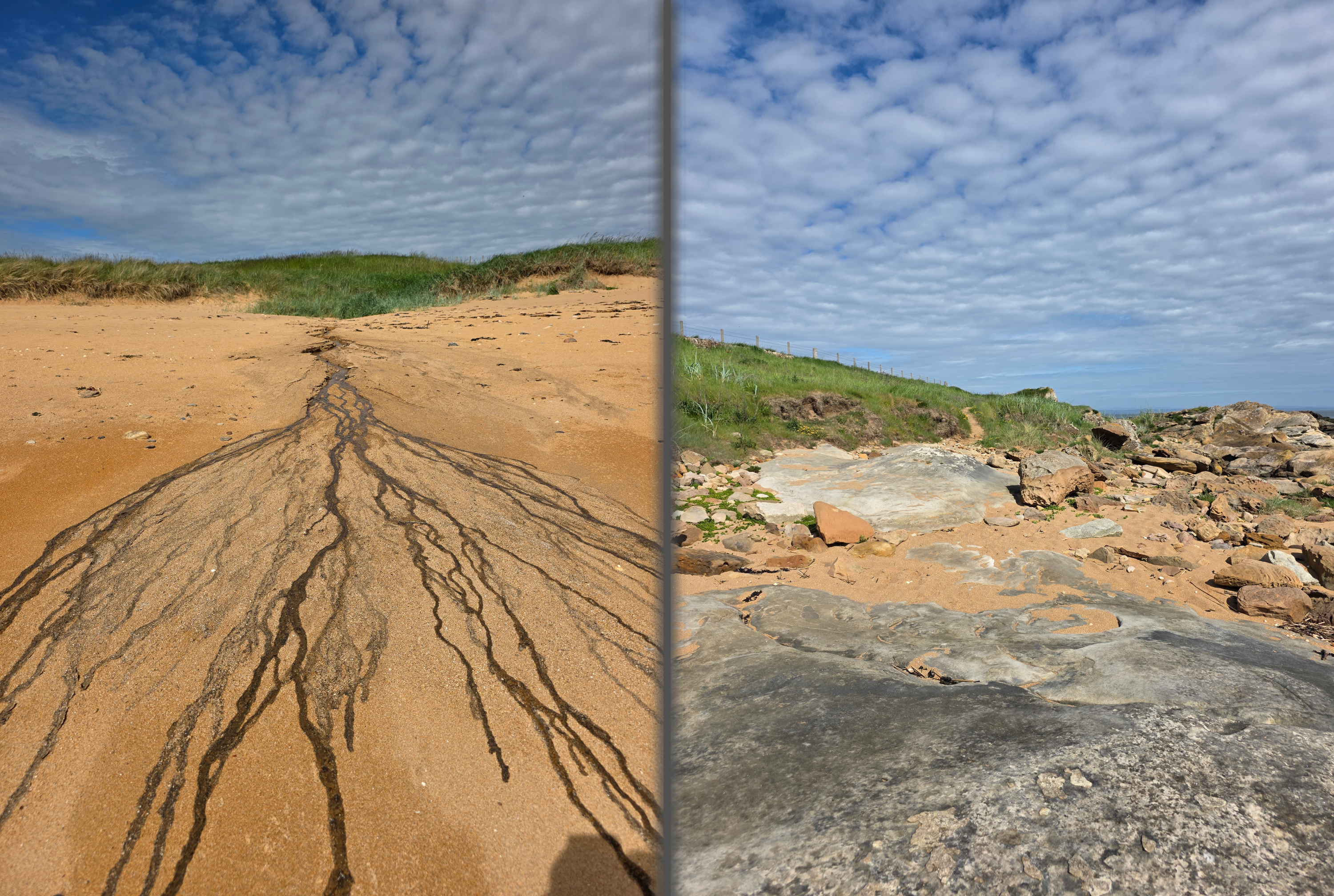
While you cannot necessarily see the cows from the beach, their scent leaves no doubt that they are just out of sight in the fields above. The runoff from one of the fields created this fascinating mini river delta on the beach, though it smelled awful. The hungry hiker in me also was sure I saw some dark fudge brownies in a pile of rocks…wishful thinking!
In time, the coastline juts outward – where the building is – and at that point you can look back all the way to Crail. Somehow distances on this coast never look as far as they are, and I remember that walk well as one of the best sections of the path.
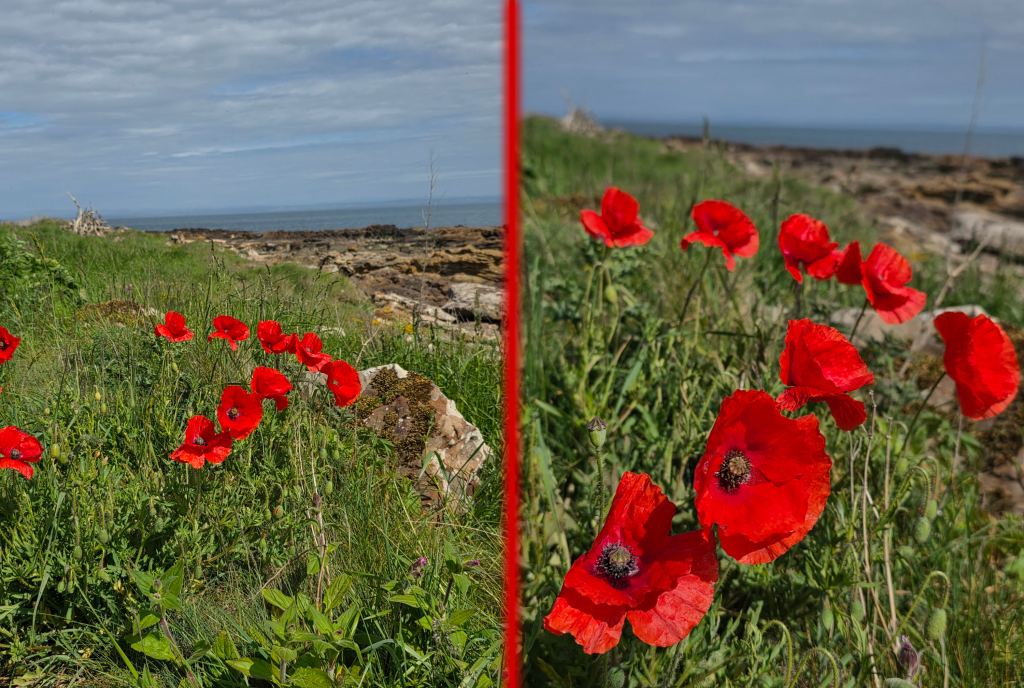
Just when I was starting to get tired of plodding though sand, a slab of rock firmed up beneath my feet and lo and behold, the path re-appeared up ahead. It is still narrow here and a bit less even, edged with grass and wildflowers. I stopped for a moment to capture these gorgeous red poppies that stood out dramatically against the background.
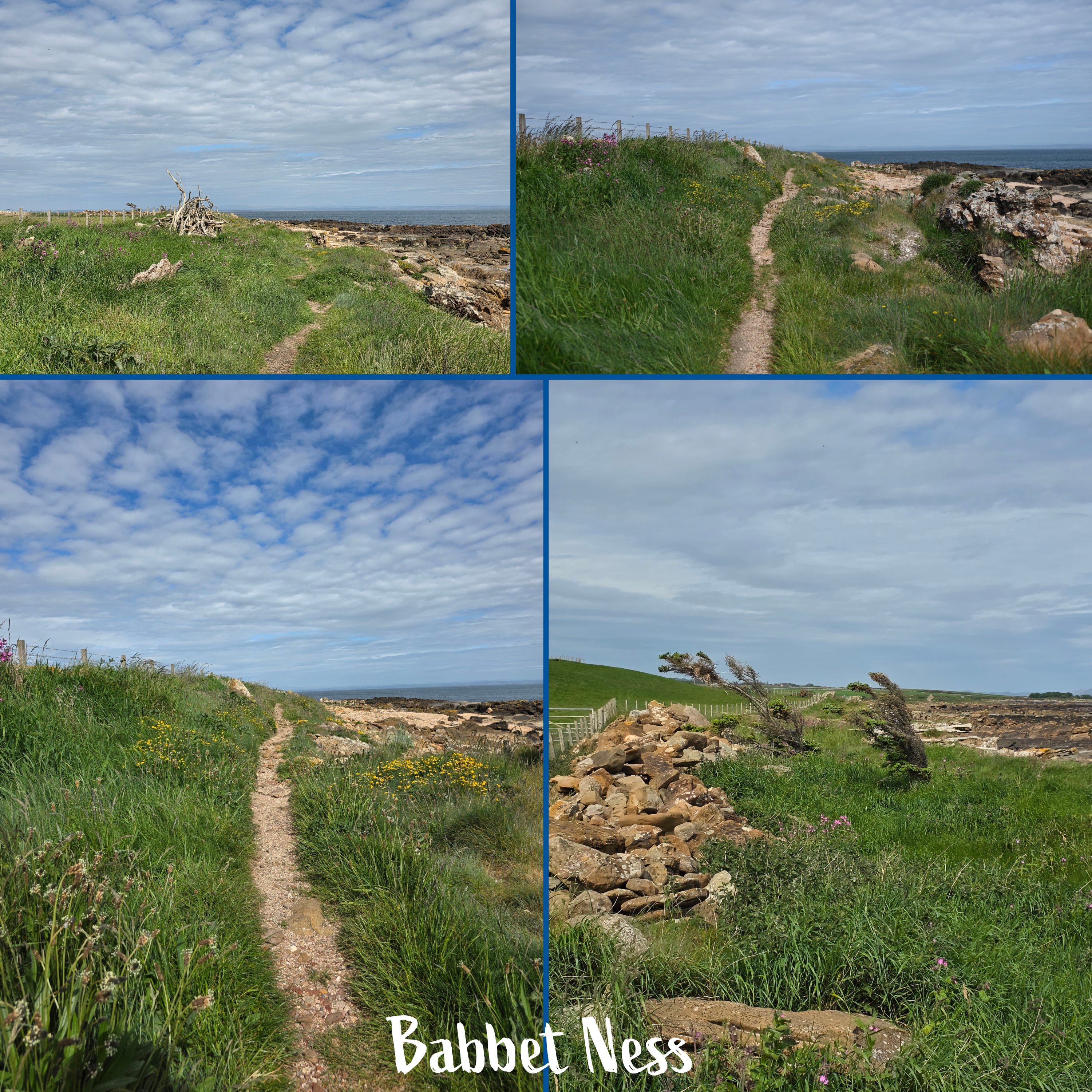
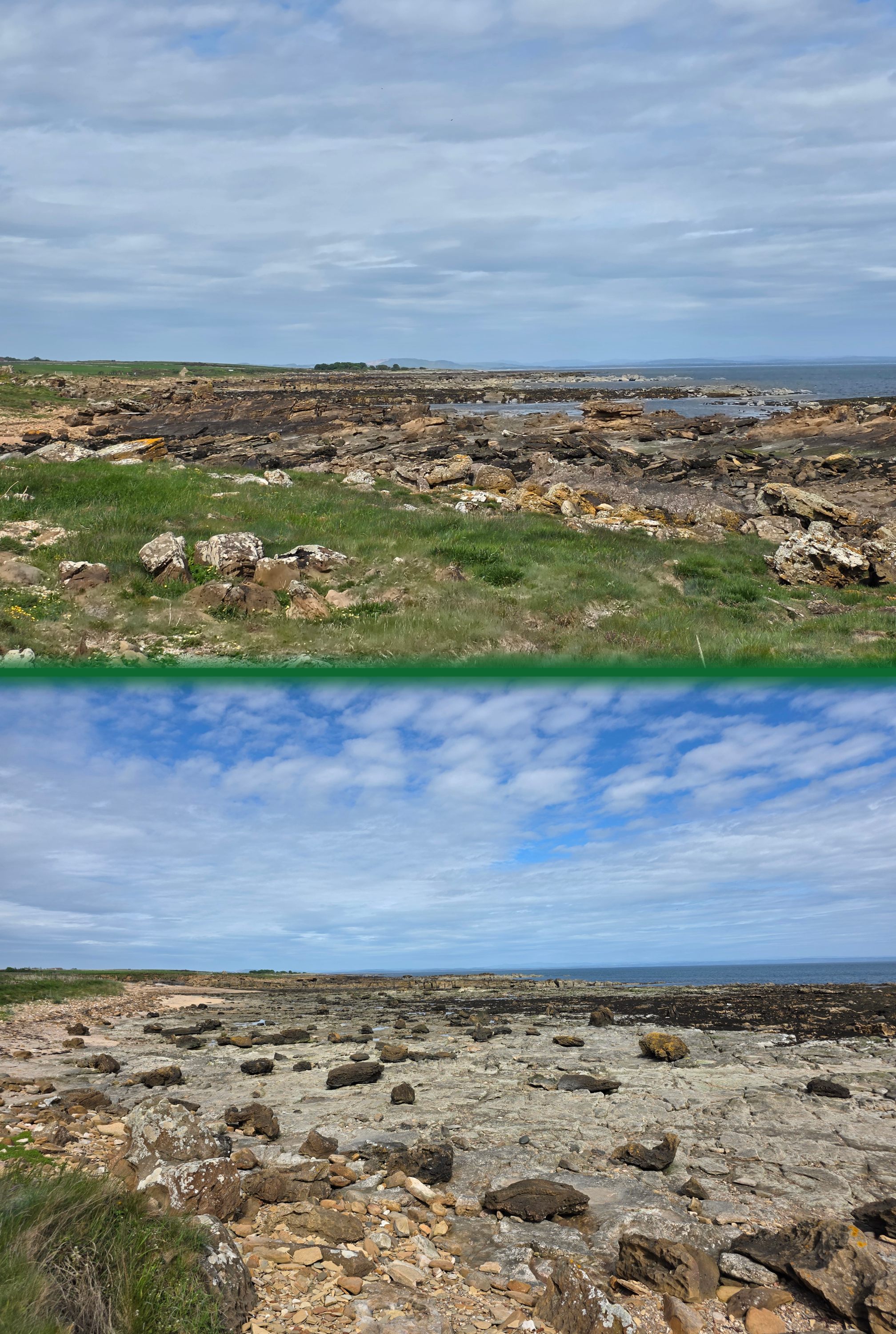
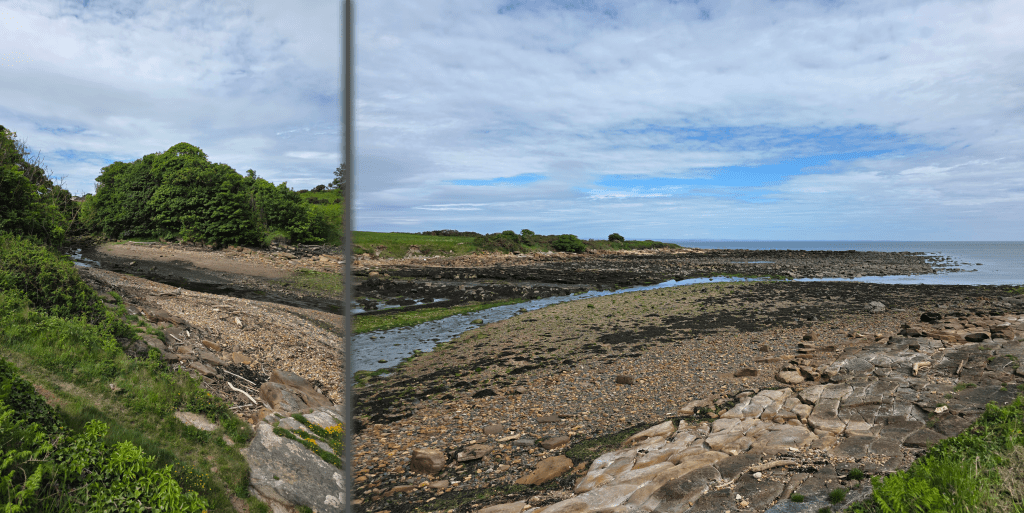
A jumble of logs marks Babbet Ness, a headland that comprises another sort of ‘corner’, where the coastline turns at an almost right angle due west for a short distance inland, until it meets Boarhills. There are two small trees – really more shrubs – that demonstrate just how strong the wind here can be, and very little other vegetation beyond grass and low brush. Beyond is yet another gorgeous stretch of Fife coastline, the long shelves of rock broken up by small sandy coves, distant trees and grassy fields that stretch from the coast up toward the main road, just over the knoll. Ahead, in the far distance, I could just make out the lump that is Balmullo Law.
For a short time, the path runs very close to a new barbed wire fence that looks lethal, so be careful if you are busy looking at the view. The path is also quite uneven here, narrow with plenty of places for a foot to slip or turn if you are not paying attention to your feet. Sprays of small yellow and purple flowers break up the grass, and the sky was still blue though the large stretches of clouds were rolling in from the west. Fortunately, while they blocked the sun a bit, they did not seem threatening.
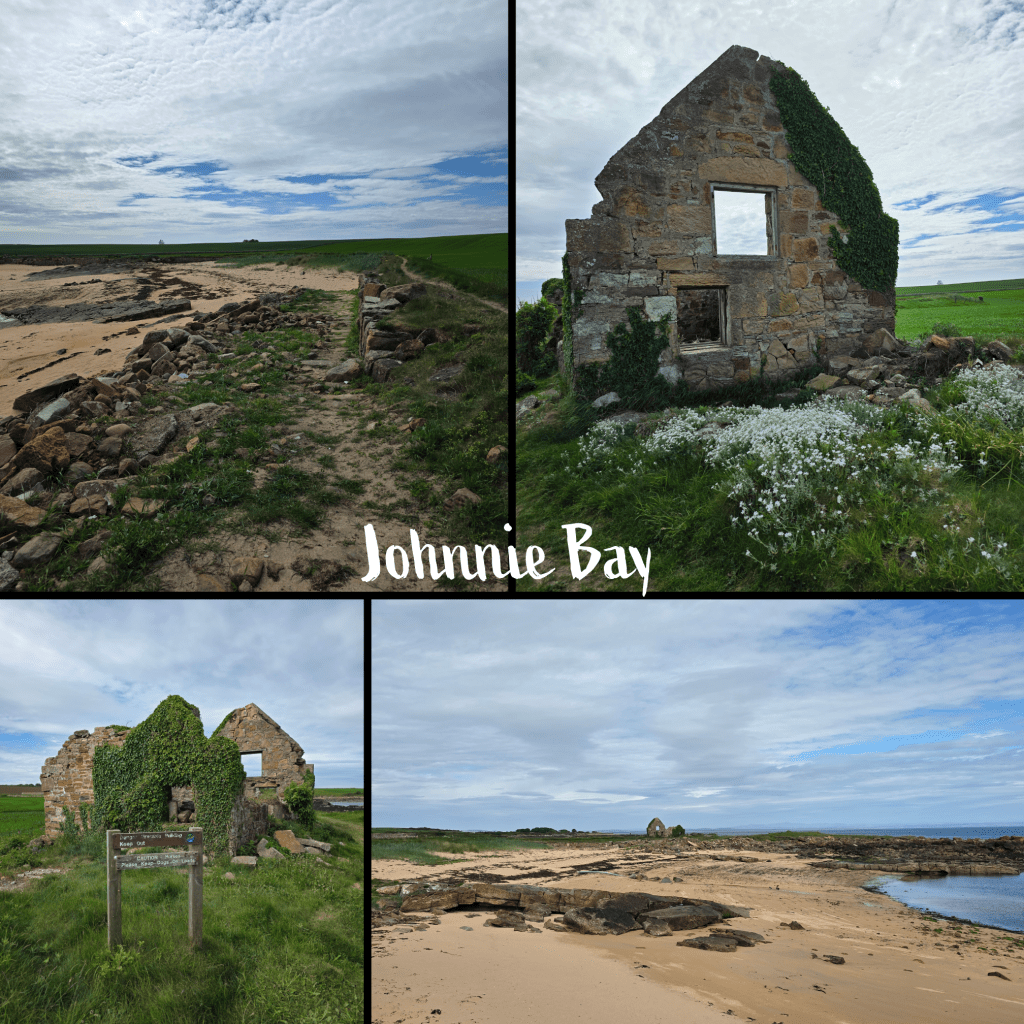
Beyond Babbet Ness, I could see the distant unmistakable shape of an abandoned building, a croft or house of some kind. This turned out to be at a spot known as Johnnie Bay, a sandy inlet with what must have been a boat ramp leading from the ruined building down to the water. It’s a charming spot, though there are strict signs on both sides to keep out of the structure as it is not safe.
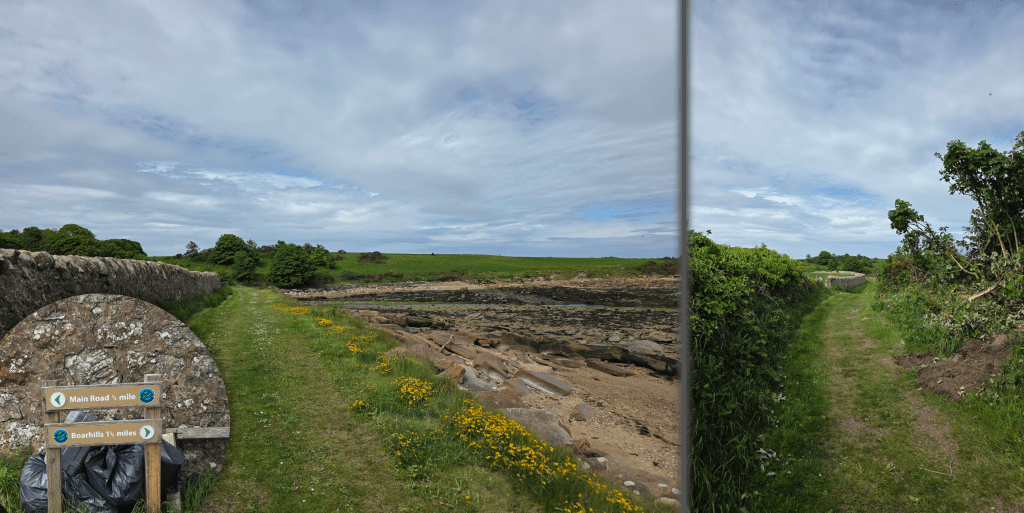
By this point in the walk – as you can doubtless see in the pictures – the sun was behind a cloud more often than not, and I was able to take off my sunglasses, which I prefer. Not far beyond the house I could see a sign and a stone wall, from which I was distracted temporarily by what I was relatively certain was a gunshot – a rifle of some kind. It could have been something else, as rifle shots are not common, but it stayed in my mind as I approached the signpost.
This spot allows you to make a choice, directing you up a farm track to the main road only .5 miles away, or to Boarhills, 1.5 miles away. I knew from looking at the map that the spot where the farm track emerged was a tricky one: on a blind corner, and potentially nowhere for the other half to pick me up. Fortunately, a happy cocker spaniel trotted towards me from the other direction, and so I paused to give it a good ear rub before pushing on towards Boarhills. The path here follows the edge of an estate wall, and is a wider track that is easy to follow.
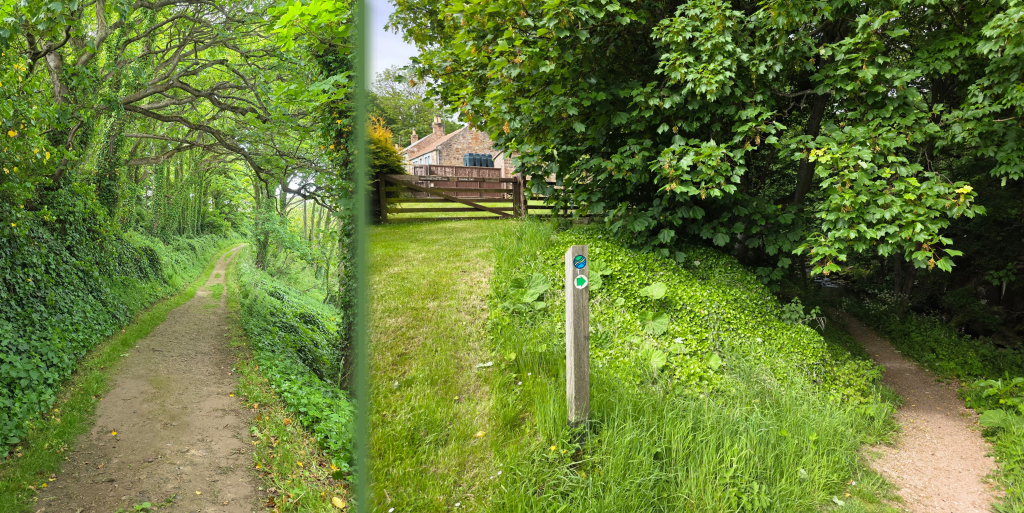
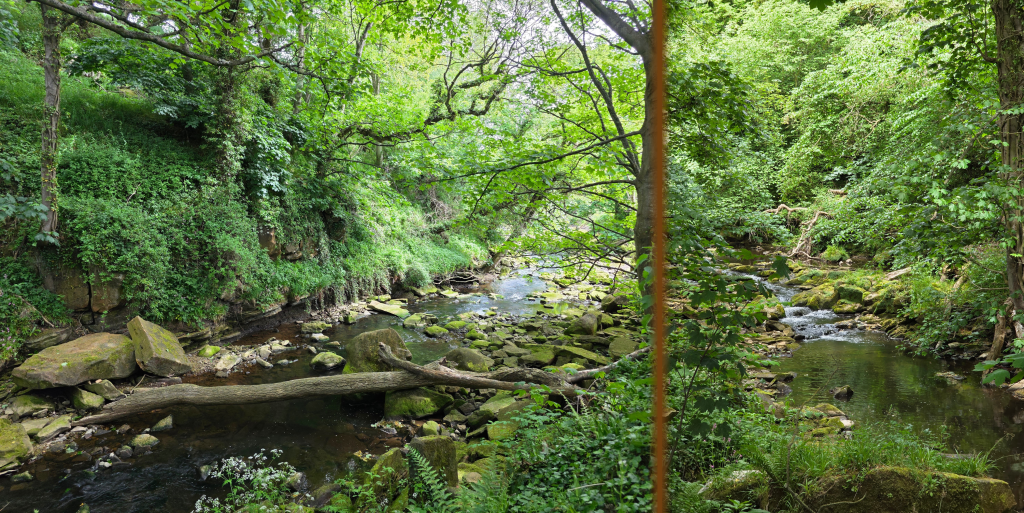
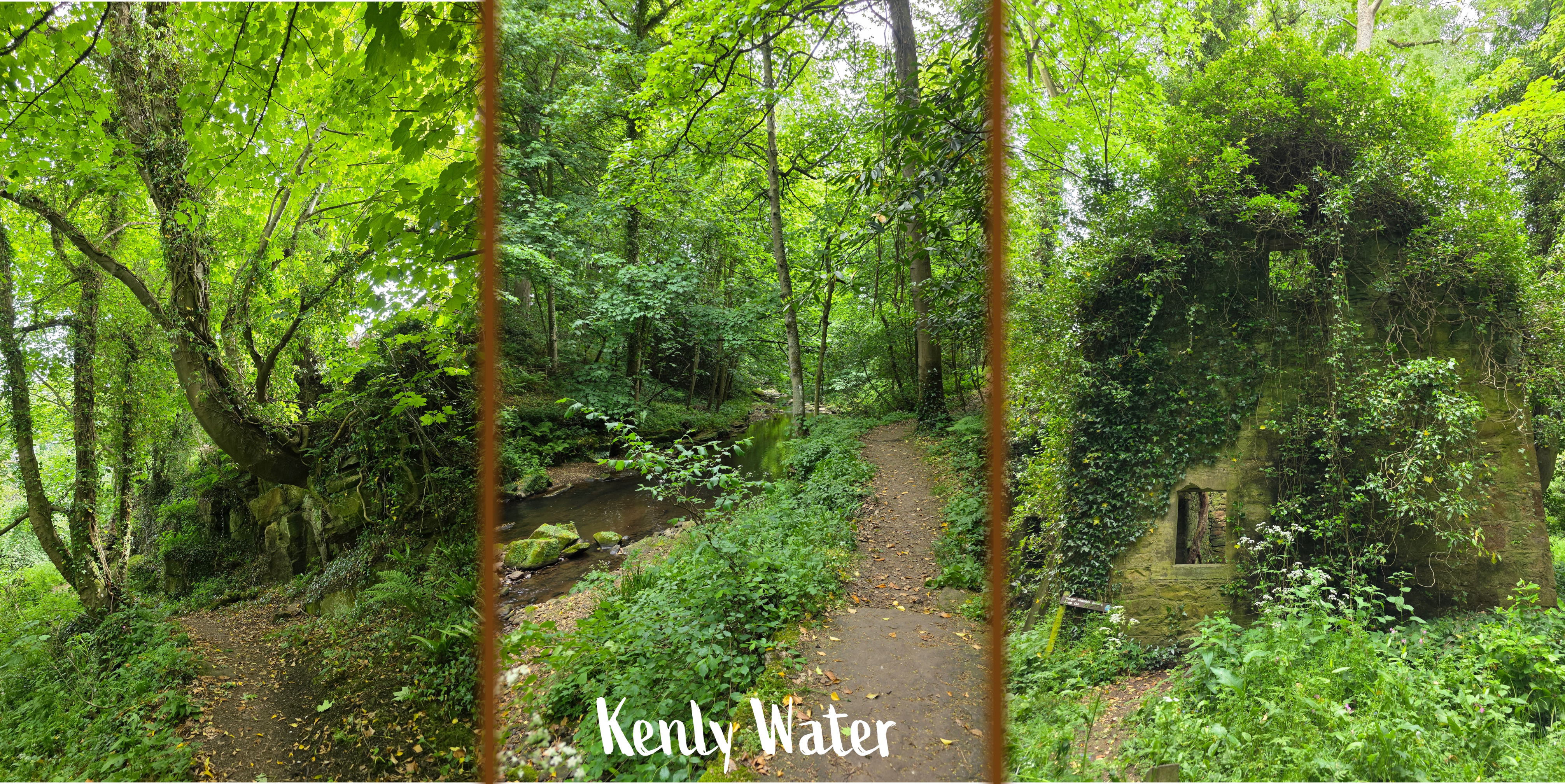
In a short distance of only a few minutes’ walking, the path begins to turn inland, where Kenly Water flows out of the farmland to meet the sea. Ahead is the edge of the tree line which surrounds the burn, and there is a hint of roofs and fences indicating homes. The walk through the trees is very pleasant, a lush green tunnel with ivy-covered trunks and the water trickling along beside.
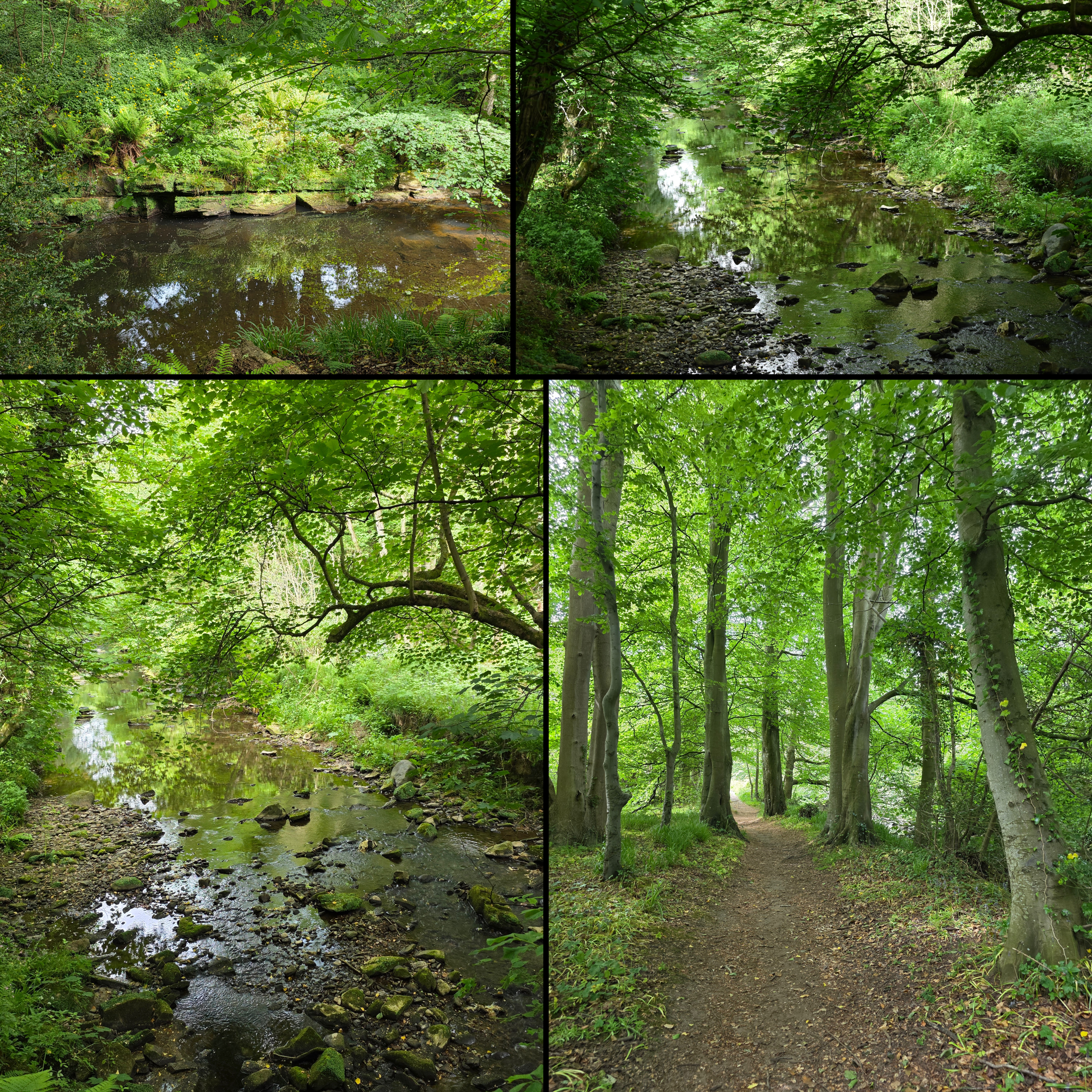
Soon, the trail splits with a farm track to the left and the coastal path marker directing walkers down a smaller trail to the right, descending again into the den. It reminded me very much of Dunino Den, though this makes sense as they are only miles apart; in Scotland, a den is a narrow valley or ravine, usually wooded, with a river or burn running through. They tend to be extremely beautiful and peaceful, and this one was no different. The path winds closer to and then away from the water, sometimes a bit higher on the bank and sometimes lower down, and on Saturday morning was serene, the only noises being the ducks, the birds, the water rushing, and my footsteps.
The burn – Kenly Water – varies between tumbling over rocks and pieces of log and pooling in deeper areas where it slows for a time and allows for reflection. And ducks.
At several points, a joining rivulet requires a stone bridge to cross, in particular just before the path meets another half-ruined house. This one is covered in ivy, like something out of a fairy tale, though there are again strict signs warning against entry.
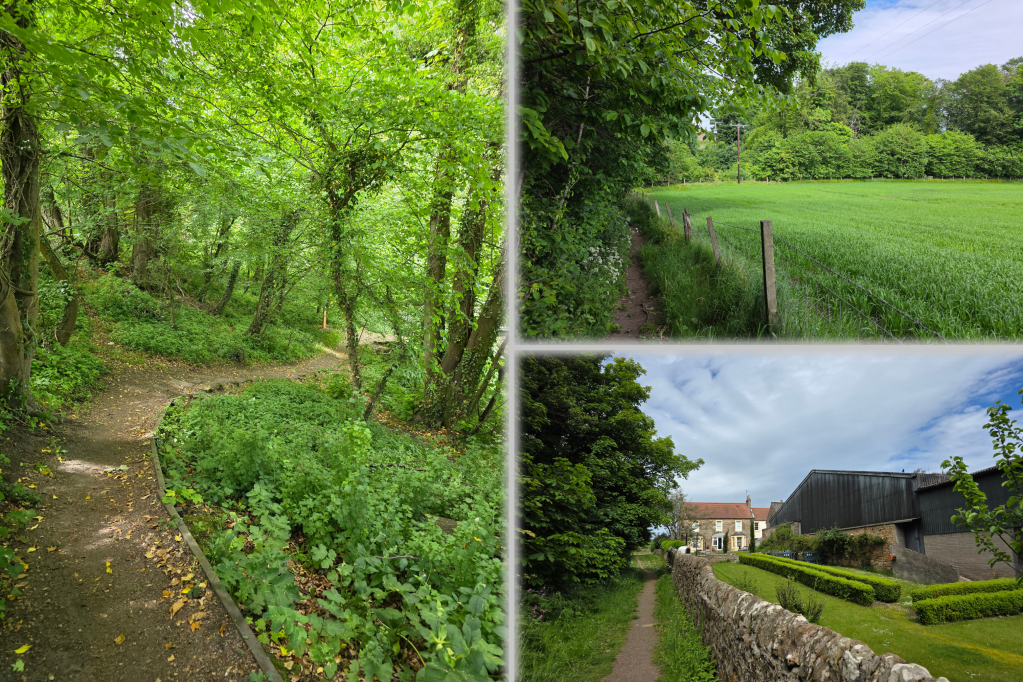
About a mile on, there is a jog away from the burn and up beside a field – it was a touch buggy, as standard in spring, but offered another view down towards the woods. Soon after this, the path turns into the trees again and passes over a metal bridge that is most definitely a single file affair.
Beyond the bridge is a well-kept old farm with rambling roses growing along the barn, and an old stone farmhouse that seemed to be basking in the morning sun, which had by this time emerged again from cloud.
Just after passing the farmhouse, the path joins a private road that is very narrow and quiet, but not completely unused – it is the access road for the farm, and a post van came zooming along it quite quickly. That said, it is unlikely to be busy as it is marked no access to unauthorised vehicles.
From here the path follows this road, winding up away from the farm and climbing a hill between two fields. The view here was excellent, looking back at the main road through this part of Fife and towards the village. But, I was definitely hitting the end of my endurance, and sometimes knowing the end is close makes it harder.
I finished my walk at a rather random spot, where the private road turns towards the village and the coastal path continues. I have every intention of picking it up here again this weekend, as the next portion of the walk is relatively short and should be easier to manage. From this point to the ‘main’ road through Boarhills was just under half a mile, and there I was collected by the other half as I had just missed a bus.
The access to the coastal path was the biggest challenge for this section, as both ends required at least a mile of extra walking that was not ‘official’. But, like the section from Crail to Cambo, it is a beautiful stretch of coastline with golf course, beach, wooded den and more. I am so happy to be back on track and wish I were not disappearing for most of June!
But I am sure I will have other adventures to share about that trip, in due course.
As I have alluded to in my past few posts, January weather has been consistently rubbish. This Saturday really wasn’t much different, except that the rain was more a gentle mist than a downpour. I knew I wasn’t up for a long walk, and I had plenty to do on my last weekend before my next work trip, so this stretch of the coastal path – some of which I have done before but ran into a serious detour – seemed a good idea.
I was also excited to do a proper inaugural hike in my new boots, so I was all ready with my hiking socks and some new insoles that keep my ankles from rolling in. I wrapped up with several layers, and boarded the bus to Leuchars, where I got off at the Olde Hotel. While I can’t say that I was quite as enthused as I have been some mornings – it is hard to be energetic when it’s chilly and damp – I was looking forward to making a tiny bit of progress on my goal. But then I noticed, as I walked along Main Street, that my left foot – the larger one, according to the man who measured them at L.L. Bean – began to rub, quite quickly and painfully. So, I ducked into a bus shelter and found the one Compeed left from my summer walking kit, and plastered it on. I only made it a few more hundred feet before I realised I was in trouble – despite the cushioned plaster, the rubbing was getting worse, and I began to fear that I would have to give up. Also, I was walking unevenly to favour that foot, and I knew that would cause pain in the long run.
Frustration was an understatement – how could these amazing new boots have turned on me?! How could I miss the one opportunity to check off a few more miles? Then it dawned on me – the insole. It was pushing my foot up just enough that it hit a part of the boot it shouldn’t. Despite mud and rain, I managed to get my boot off – again – and pull the insole out. Immediately, the boot felt better and my stubbornness determined that I would manage the walk even with a bit of discomfort. And so I headed on, along the muddy playing fields that abut the castle grounds. My good mood was quickly restored upon meeting a roly-poly black cocker spaniel who ambled up to me and deposited itself on my feet. After a few good ear scratches and a smile, he toddled off again to meet his master. As always, an encounter with a dog improved everything.
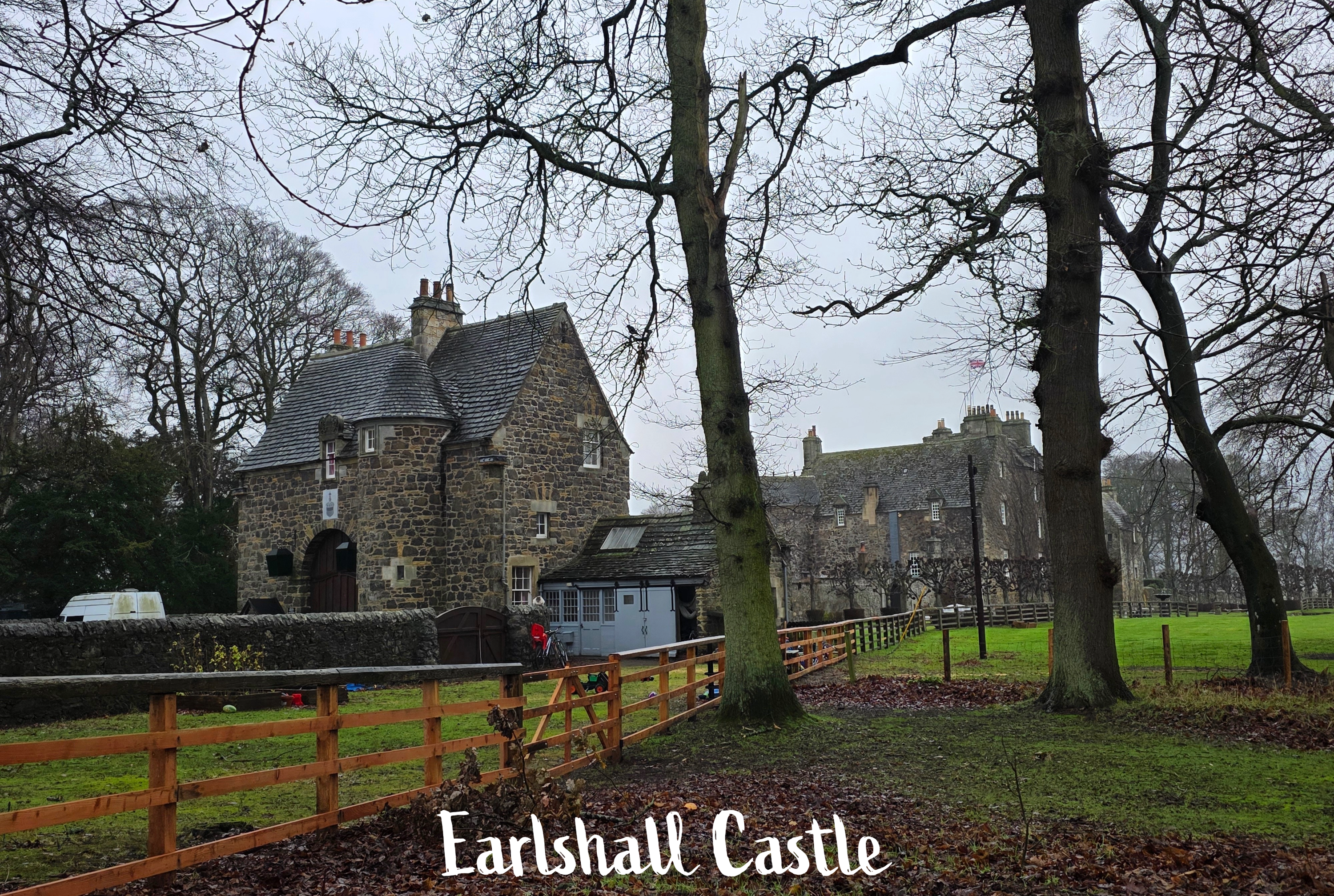
Finally, after a bit more drama than I expected, I reached the castle grounds and started my official walk recording. I cannot recall now if I mentioned much about the castle itself last time I did this walk; it is a relatively ‘new’ castle as Scottish castles go, built in 1546 by a Sir William Bruce, a survivor of the devastating Battle of Flodden. This battle is infamous for the death of King James IV of Scotland, who is the last monarch in Great Britain to die in battle (surpassing Richard III by about 30 years). More a mansion than a castle, Earlshall was built in the ‘courtyard’ style, and is still in good shape. It is also, apparently, for sale; if only I had £8 million to spare.
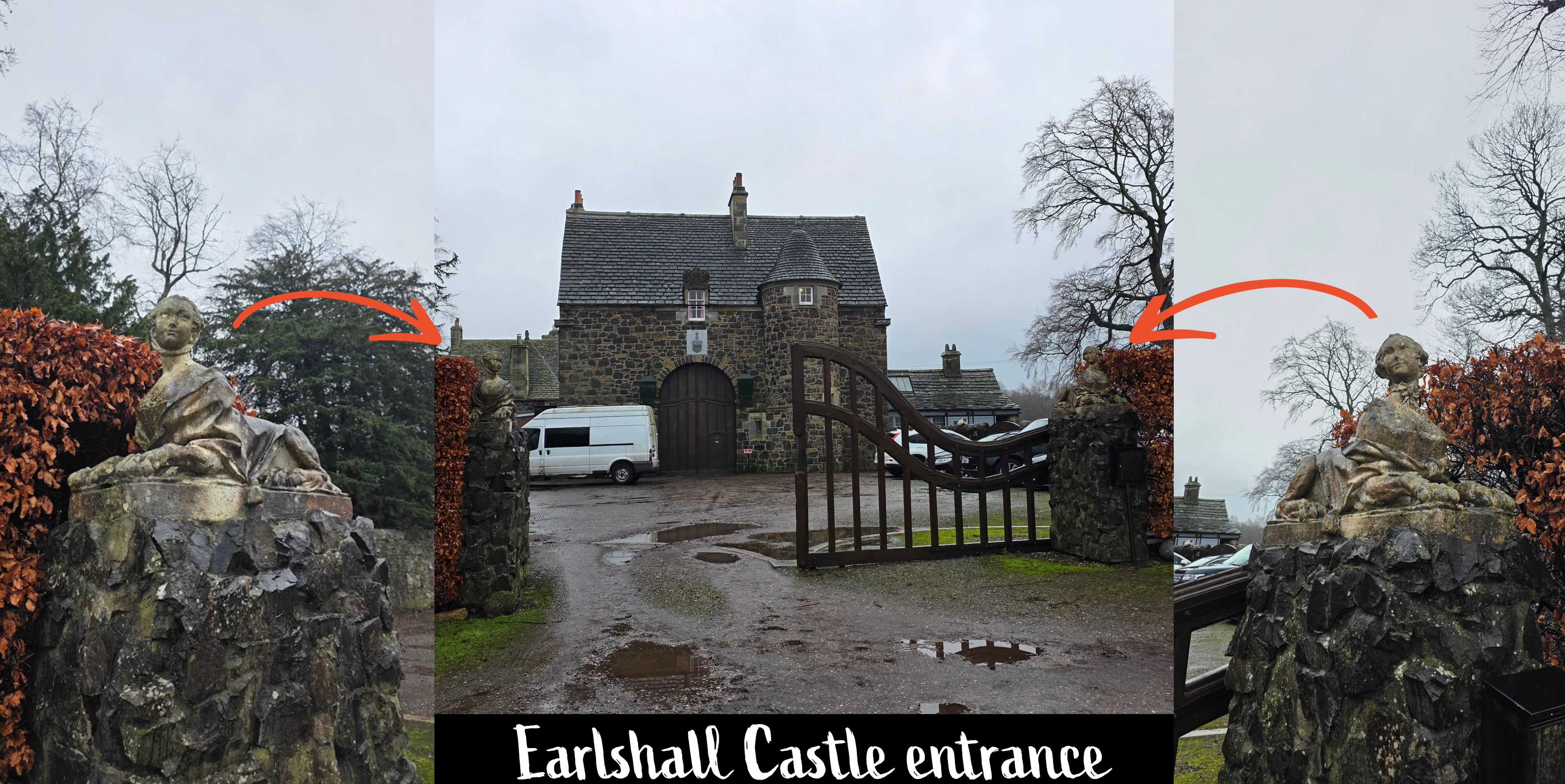
The gated entrance is graced on both sides by carvings of a lord and lady; I stopped for a moment for the below pictures before continuing on my way.
The path at this point leads along a single track road with the estate wall on one side and open fields on the other. One concern on days like this is that with a hood up, it can be difficult to hear approaching vehicles, so it can be a touch treacherous on a narrow stretch like this. Fortunately, I did not encounter a single car.
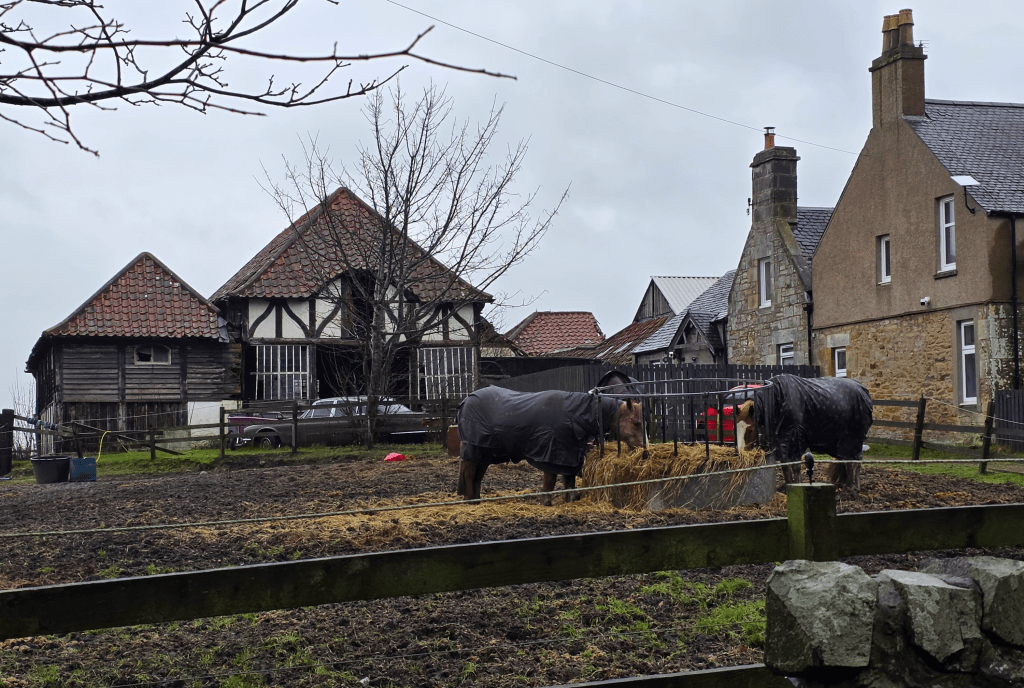
Ahead on the left as I approached the edge of the army base is a beautiful old Tudor-style barn which I would love to know more about, but can’t seem to find any information about.
Just beyond the barn, the first sign of the actual Coastal Path route leads through a gate and along a track that runs between the base fence on one side and the farm on the other. The fields beyond are the home of several horses and I think a pony or two. In this short section without trees, the weather issue for the day quickly became not the rain but the wind, whipping across the open land of the army base. Once safely inside the treeline it calmed a bit, but I could hear it in the treetops, and they were dancing about a touch violently whenever I looked up.
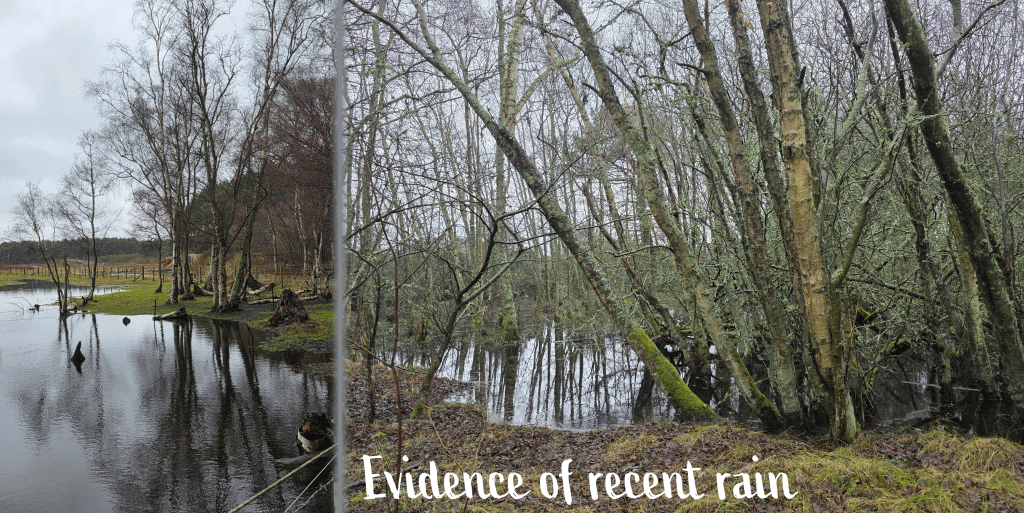
The excessive rain of the last few weeks was evident along the path, with large puddles in the fields and under the trees, areas that might normally be a bit boggy but now are flooded.
Fortunately the trail was in relatively good shape, not too muddy – at least at this point. As I emerged from the trees, I was hit immediately from one side by the wind, but surprisingly it was less bitter than I expected. I was quickly reaching the point of no return, after which going back would be more work that pushing on, and despite the discomfort of my boot, I was determined not to give up – after all, it didn’t seem to be getting any worse (or so I thought). I could tell that my body wasn’t really into the walk – it was complaining more than I expected and I’m not sure if it was the wind or the cold, but the endorphin rush never really hit. It had very evidently been a while since I’d done exercise like this, with the shorter walks I did over Christmas not really measuring up.
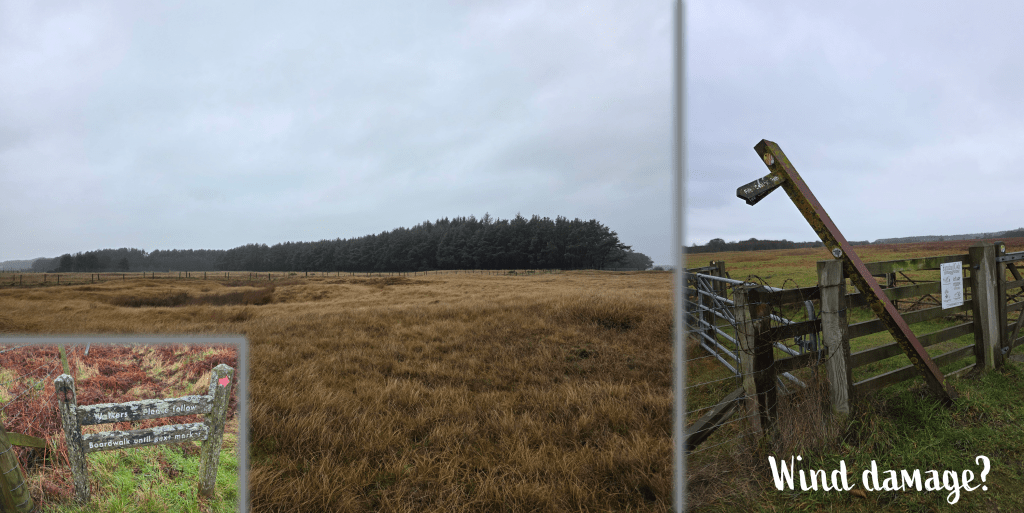
Just under a mile after leaving the castle, I reached the gate where, on my last attempt, I had been forced to take a detour. Fortunately, this time I knew I would be able to take the standard path, as I had seen the update on Facebook that the boardwalk was fully repaired. The sign directing walkers had suffered a bit of wind damage, but the path was clear nonetheless. I passed through two sets of gates and struck out across the field between two fences; the trail rises and falls over hillocks and grass clumps, much more uneven than the farm track.
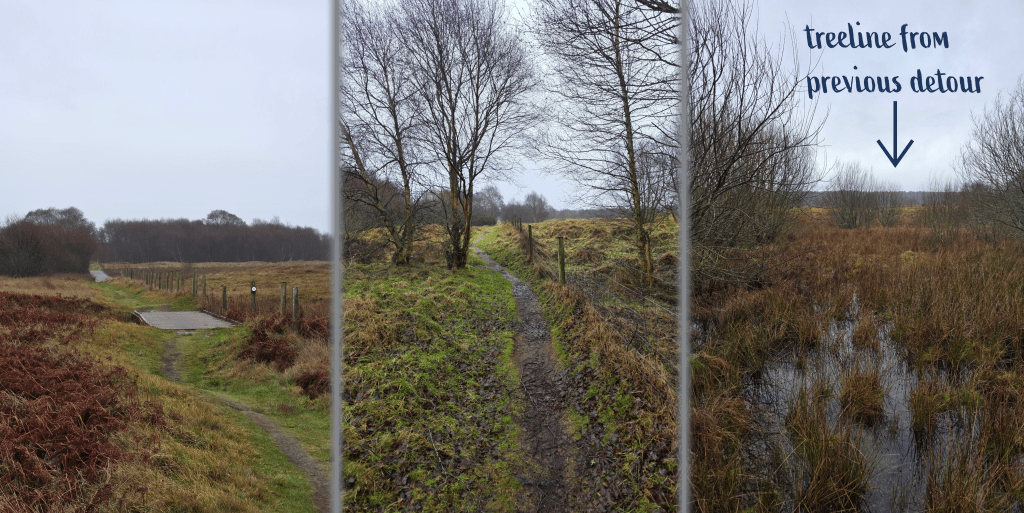
After a short straight bit that leads at an odd angle away from the farm track, there is a sharp right through another gate. Here you find a warning to walkers to stay on the boardwalk, the first section of which stretches out ahead of you. The wind is much stronger here in the open, and I while I was never cool, I was pleased to have a windbreaker. Sure enough, the boards are very new and well-kept with stripes of raised rough bits that prevent them from becoming slippery, and they pass over some very boggy areas that would be completely impassable at most times of year.
The path alternates on boardwalk sections and uneven muddy ground, following the edge of a fence and meandering through stands of trees. The direct path made me appreciate just how long the detour was that I took last year – the tree line of the forest I walked through is a good half mile or so away.
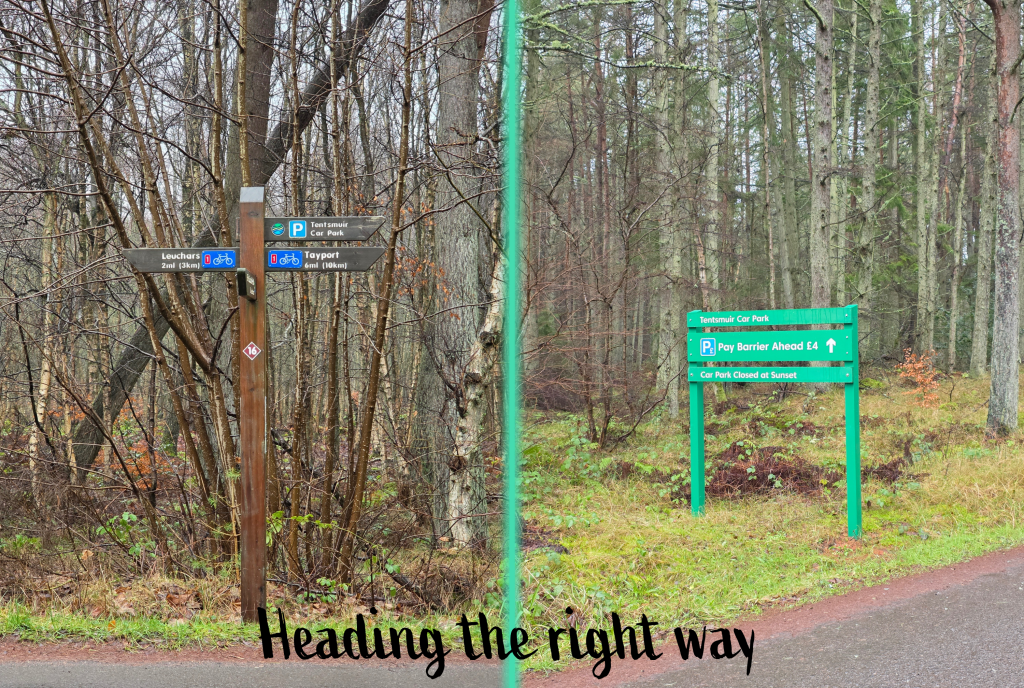
I have to say despite the weather, this is a quite pleasant stretch of path, and I had it completely to myself – I had seen a few joggers closer to Leuchars, but did not see another soul until I reached the Tentsmuir road. As I crossed the last stretch of bridge, a sign appeared in the distance, surrounded by a huge gorse bush that was just starting to bloom. Here I swung left, and ahead through the treeline I caught just the slightest hint of open sky that indicated the beach. I could also hear the distant crashing of waves, though this came and went for the next mile or so.
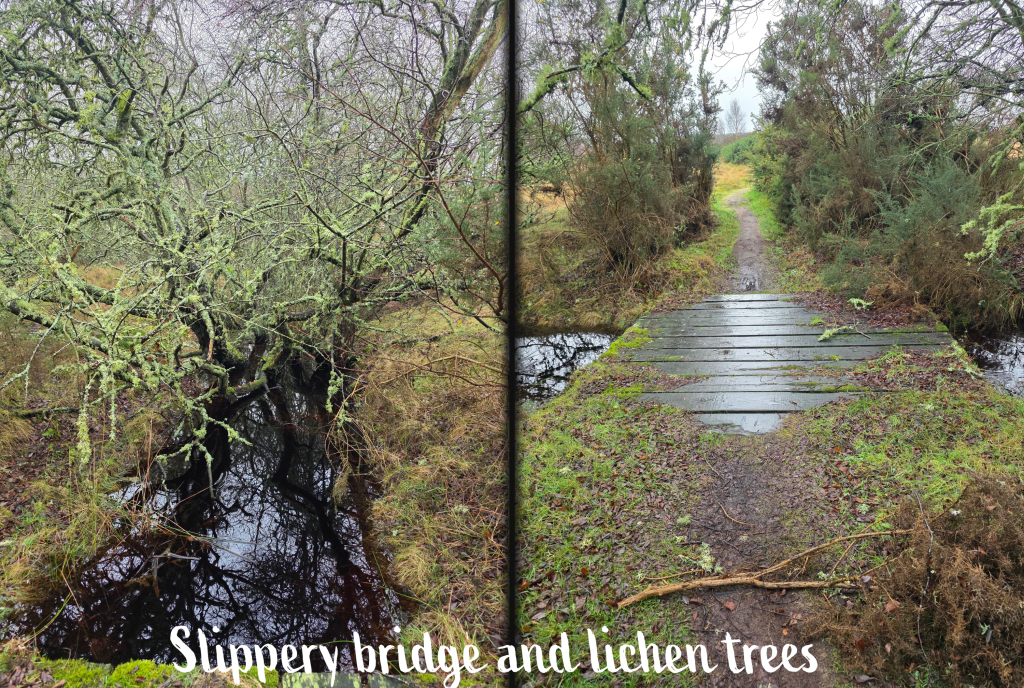
Shortly after this left turn, the quality of the new bridges was made clear when I approached an older wooden bridge, this one slippery and grimy from the weather and moss. Nevertheless, the small burn it crossed was lined with trees absolutely dripping in beautiful lichen, coating the branches in a light seafoam green. Up close, the lichen reminds me of types of coral.
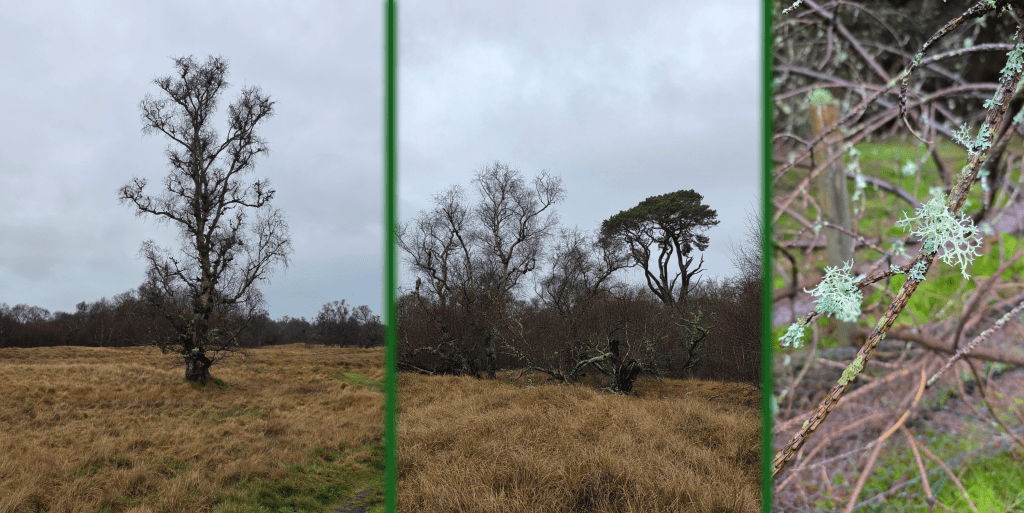
Across the bridge, the path passes into a hilly field, mostly empty but dotted with large, dead trees that created all sorts of creepy patterns reminiscent of a Tim Burton movie. There were a few lone pines with needles still on them which must have very deep strong roots, as so many of the larger trees here were blown down in the wind storms we have had in the last few years. Forest lines this field on both sides, with most trees just ghostly outlines with chunks of lichen on them.
My primary observation of this section of the trail is that it is not particularly coastal. Other than the distant waves – which might not be audible in calmer weather – you do not get any hint of sand or beach at all, and could as easily be in inner Fife or Perthshire as less than a mile from the ocean. This is necessitated by the army base as well as the nature reserve, but I am looking forward to getting back to the seaside views.
Eventually the trail passes out of the field and through another gate – very muddy here for a short while – and onto a forest track with clear vehicle ruts. The forest here is quite pleasant, a mix of pine and birch, and it blocks most of the wind so that it is also very quiet. The rain had completely stopped by and it was a nice stretch of path. That said, it went on quite a bit longer than I expected, and I found myself wishing for one of the first times on the Fife Coastal Path that I had some music to listen to.
Several times on this stretch I thought I could see the end in sight, as the trees seemed to close in over the trail a bit or indicate a change in pattern. However, on at least two examples I was disappointed to discover that I had been a touch premature in my hopes. I was not particularly tired, but the pain in my left foot was growing steadily worse and my right foot was starting to rub slightly as well, so the last 15 minutes or so really seemed to drag – not something I find happens often on this path. I was so relieved to finally see, in the distance, the very man-made shape of a horizontal bar, dividing the path from the road beyond. Here I knew it was just a short distance along the road to the stables, where the other half was to meet me.
Unfortunately, this last short section was the least pleasant, as the road is narrow and the path alongside it even narrower and, on occasion, not present. It was muddy, started raining again, and the cars were regular enough that I was not confident venturing onto the tarmac at all; I even found myself switching sides of the road a few times in search of a better patch to walk on. But I did not have far to go.
Overall, then, not my favourite part of the Fife Coastal Path, though it had some pleasant sections and would probably have been even more pleasant without the enormous blister I was causing on my heel. (as I discovered when I reached home, it really was impressive, covering most of the back of my foot – oops).
I am still in love with my hiking boots though, particularly since the blisters were really my own fault for having put in new insoles and not tested them. Overall, they did a fantastic job and were very sturdy, keeping my ankles from rolling even on quite uneven ground. They dealt well with the mud and puddles, and my feet were bone dry
I’m not sure when I’ll get back out onto the path as work is taking over life for the month of February (and early March), but fingers crossed I’ll get out in March before the next round of travel.
Somehow, it is mid-January. It feels like we just got back from our Christmas trip to New England, and I’m deep into planning my next trip to the US, in just about three weeks. At this time of year time can pass quickly, and we have been adjusting to the time change, getting back to work, and dealing with some truly January Scottish weather – cold, wet, windy, dark. Not great for hiking, but great for duvet days and planning.
So rather than tear myself apart over my inability to get back onto my hike, I thought it might be time for some reflection.
Firstly, I am excited to share a preview of my new hiking boots, a birthday gift from my father. I’m delighted to have found exactly what I need at L.L. Bean (I never doubted), assisted by a delightfully chatty salesman who measured my feet and demanded to know all about my plans before allowing me to make a purchase. I’ve already done an inaugural walk in them (not far, just my normal morning jaunt) and they already feel amazing – nice and light, sturdy, no rolling ankles or rubbing.
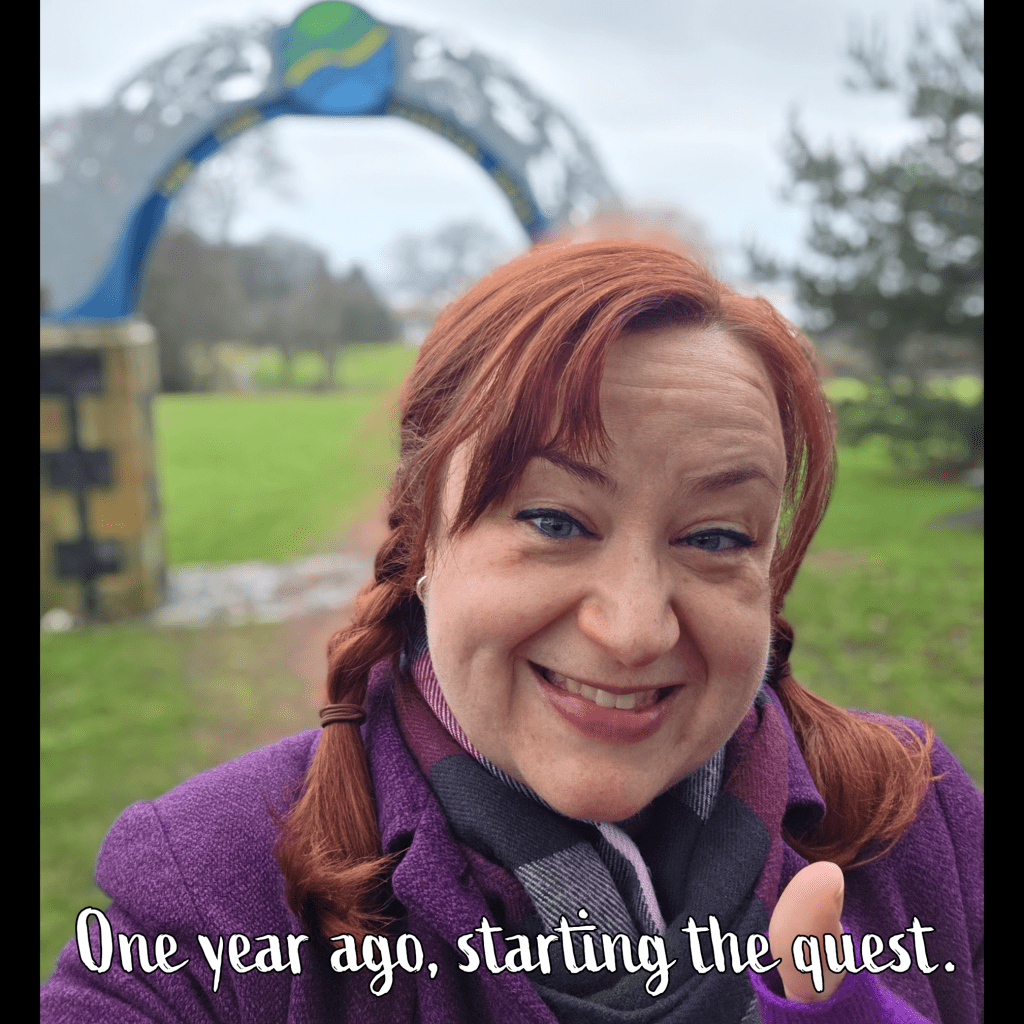
But I’m getting carried away. It has been a year since I walked my first section of the Fife Coastal Path and determined that it would be my goal – partly to have a goal, and partly to assist with getting fitter.
In order to write this post, I have had a read through all of the posts I’ve written, and have started to plan this coming year’s activity. There are a few definite spanners in the works, potentially, in that I do not know how much time I will actually be able to spend in Fife over the next few months. But even if I only manage another ten miles before summer, never doubt that it is in my mind, and I still intend to finish this damn trail. Eventually.
So, what did I learn in reading my posts?
I’ve definitely become a bit more thoughtful as the posts go on, giving more background on what I am passing. I’ve done my best to describe the trail but not get into too much detail, which I did early on, rather providing pictures of what you might expect to see. I’ve been incredibly lucky with weather for the most part. I’ve challenged myself physically a few times and usually been delighted to discover that I can push harder than I thought and not been in too much pain. Towards the end of the summer I was the fittest I have been in years and it felt fantastic – I hope I can get back there. Certainly summer in Scotland with long light and enticing late evening sunsets is a better time to force yourself out of doors than January, but I’ll still give it a go.
I’ve worn through a pair of hiking boots, though they may not have been as good quality as I hoped. And, I’ve put together a pretty comprehensive pack of materials that I bring on each trip, including: a map, sunscreen, bug spray (not yet needed), chapstick, water, a snack, my camera, tissues, and a power bank for if/when my phone starts to die. Layers as appropriate as well, of course. I’ve even got a designated hiking backpack, so I don’t have to think too hard about what to get together.
I’m also getting good at reading the signs as to where the path will go even when the markers aren’t the clearest – or there at all. That said, I have also once or twice forgotten to check the tides before setting out – so far I’ve gotten away with it, but I could pay eventually, and of course came close on my recent walk from the Fairmont to St Andrews.
Above all, I’ve discovered parts of Fife that I’d never known were there, and been able to really enjoy the towns and countryside of the East Neuk in particular, in a way I would not have done just by touring by car or bus.
Another thing I’ve learned – I can only do what I can do. There is plenty going on in life which means that sometimes, I just can’t get away for most of a Saturday to make a dent in the miles. I travel for work, meaning I see exciting places but am often jet-lagged and sometimes unwell, and I spend a lot of time not at home.
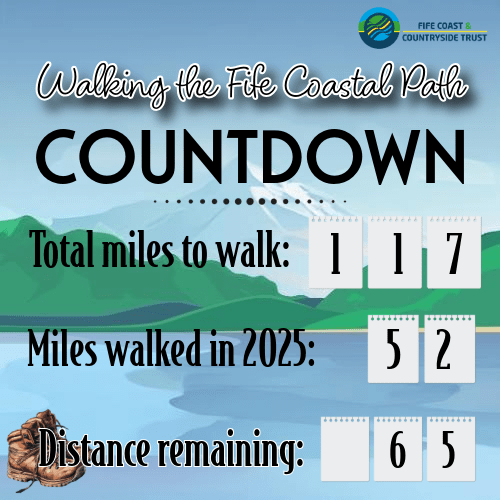
So I have had to allow myself, on occasion, to put life before the walking. And that’s ok. As ok as it is to put walking ahead of other things, especially as I use it as self-care. I set this goal for myself, not others – I am the only judge of how and when it is fulfilled. So I haven’t quite made it halfway, but I’ve lost more than 20lbs (over 2 stone to you Brits – and in all fairness not just through walking but also in cutting most added sugar from my diet) and I’m fitter and happier, having completed these mini-goals:
Despite the occasional setback, I’ve never given up on a walk once started; I’ve taken some great pictures, produced more content for my blog, and I’ve enjoyed every minute (well, almost).
Favourite walk
So which walk was my favourite? This is a tough one, as I really enjoyed the section from Aberdour to Kinghorn. I liked being out of the East Neuk for a change of scenery, the views were excellent and I proved to myself that I could do a longer walk and not be exhausted. I also really loved the Tayport to Newport stretch, as it brought back many fond memories of living there.
That said, I think I have to select my absolute favourite as the walk from Crail to Cambo Estate, rounding the ‘corner’ of Fife, crossing some beautiful beaches and experiencing lots of different types of coastline. It was a challenge physically but I managed, and several of my favourite pictures of the FCP journey were taken on this walk:
Favourite picture
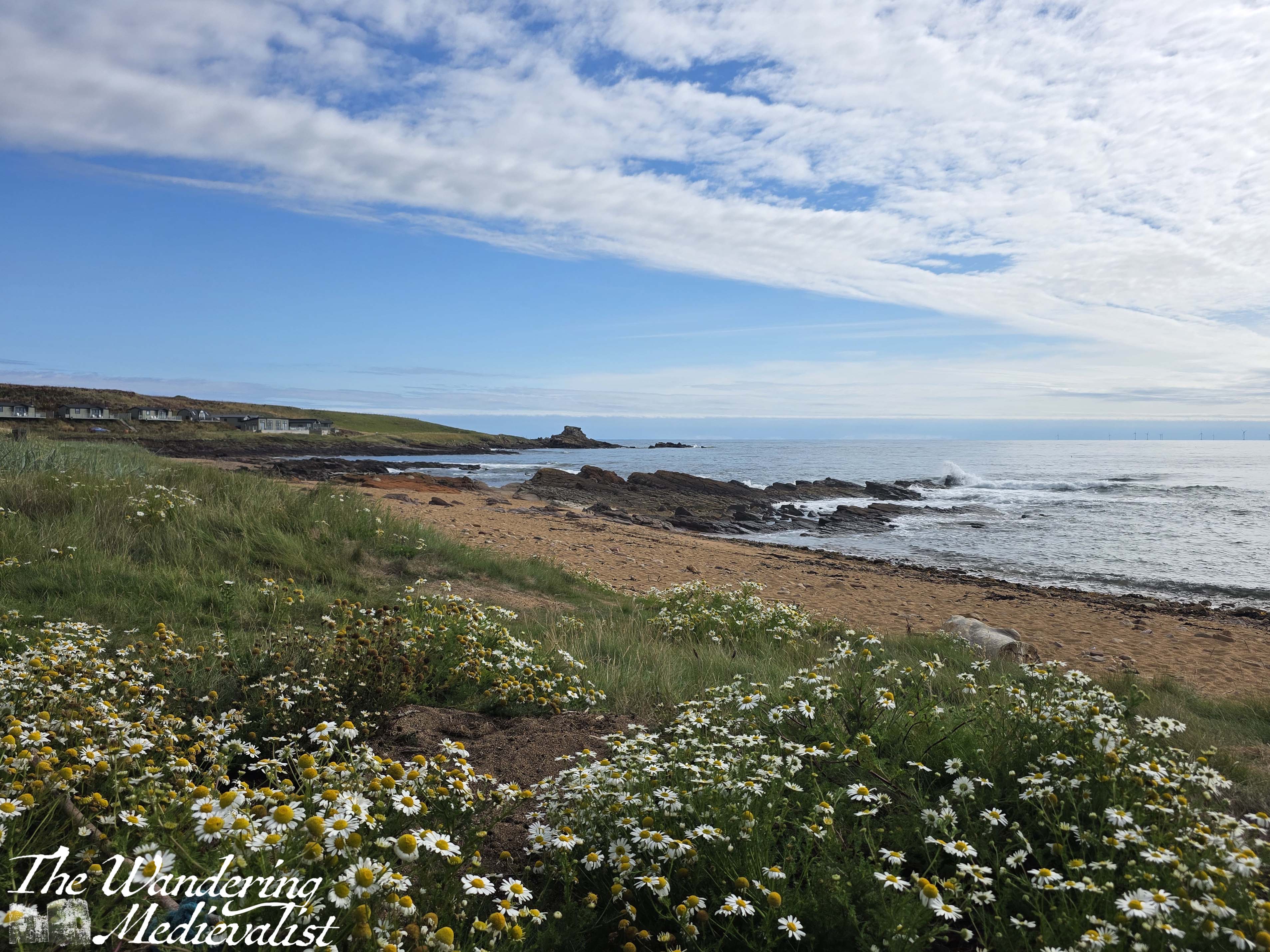
This was also a tough decision, as I absolutely love the long, jagged lines of the Fife coastline, like those caught from the above-mentioned Crail to Cambo walk:
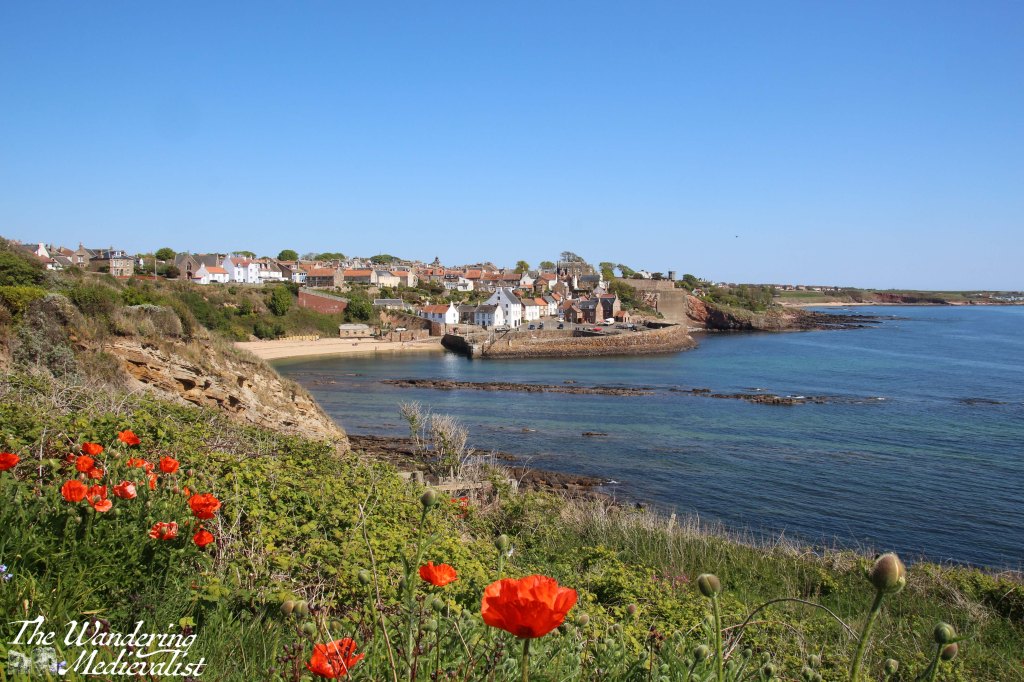
But for the red poppies and the stunning view of Crail, I think this is my favourite of all the pictures I have taken, while on this route:
Crail itself is perhaps even more like my hometown than St Andrews, stunning and quaint and historic, and it presents a beautiful view when approached from the south-west while on the Fife Coastal Path. I was fortunate to have chosen this section while the poppies were still blooming, and on one of those gorgeous sunny days we had this summer with endless blue sky. Just perfect.
A close runner-up though is the view back over Wormit on a rainy day, in a very different part of Fife, with the Tay in the distance and the Rail Bridge stretching out towards Dundee. I do love bridges.
It never ceases to amaze me how varied the coastline can be, how surprising, and how the trail can show me viewpoints I have never seen before, even in places I know so well as St Andrews.
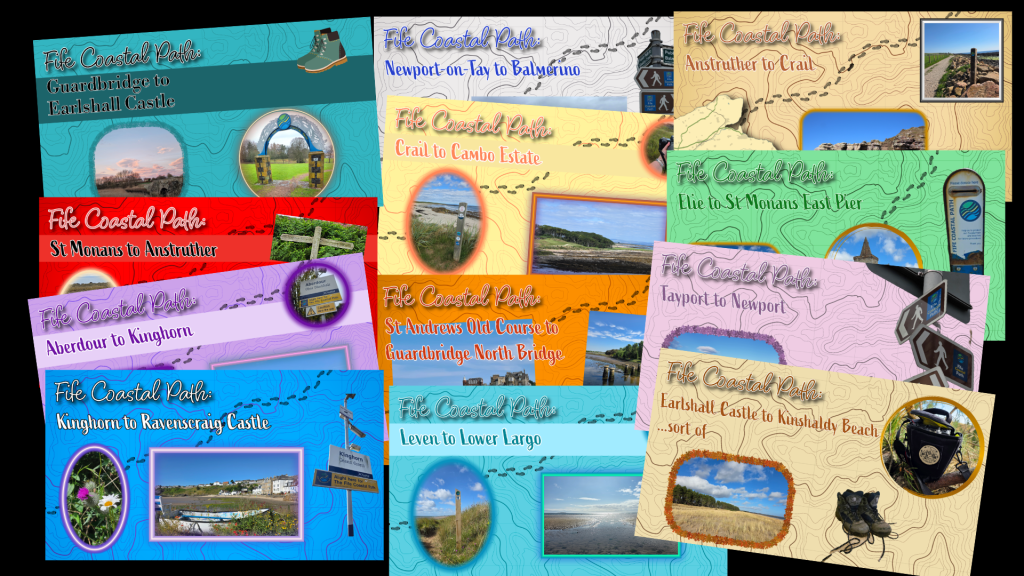
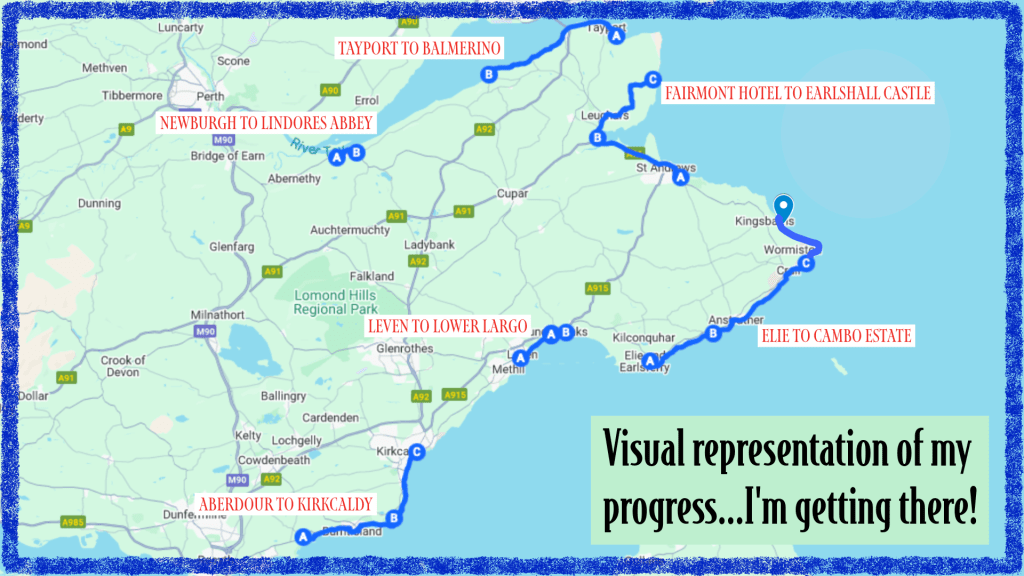
I’ve made it just less than half way, and in case you can’t picture it, here is a visual of the walks I have already done:
So, what next?
I have a lot of work travel planned for this semester and I’ve finished most of the sections of the trail that are relatively easy to reach. So, from now on, most of my walks will require considerably more planning and effort to complete. The far end of the walk, from Kincardine to Inverkeithing, is a solid 90 minutes away by car or longer on public transport, meaning a full day is likely needed to get these sections done. That said, the most challenging part may be Balmerino to Newburgh, which if done in one go is 13 miles. So more likely, I will need to split it in two, and I will need someone else with a second car to help. I’ve had plenty of offers from kind friends, so hopefully this summer the coordination will be possible. (I do, of course, have it planned out. This is me, after all).
So I’m not sure if I’ll manage the rest of the path by the end of July, or if I’ll need to extend by a few more months, but one way or another, I intend to keep walking, keep photographing, and keep writing about my experience.
Finally after a long break, I determined last week that I would return to my Fife Coastal Path endeavour. The last month or so of travel has meant that my efforts to maintain fitness levels dragged a bit, and so I selected a portion of the walk that was not too long but still tested me a bit: starting at the Fairmont Hotel and walking through St Andrews to the Old Course Hotel, where I started my walk to Guardbridge many months ago. The first two miles are traditional Fife Coastal Path: rising and falling along the edge of the coastline with dramatic stretches of rocky shore and beaches. Then, the last mile and a bit is in St Andrews, along East Sands, up the Scores, and past the famous Old Course. This is a really pleasant walk, but the out of town section does require some stamina and sturdy shoes.
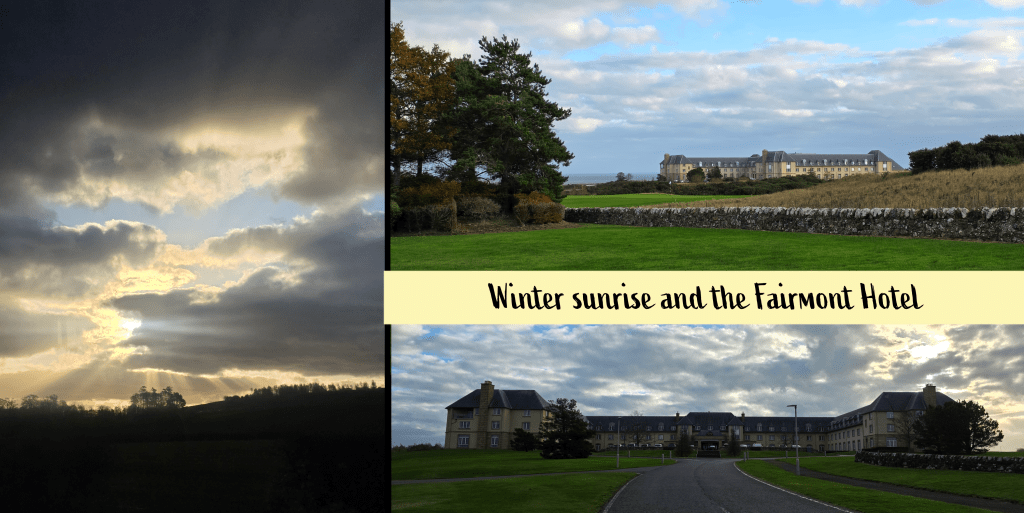
As would be expected in November, the morning was cool (8℃/46℉) with a cold wind and mostly cloudy with patches of blue sky. I wore my raincoat mostly as a windbreaker but also to guarantee against any stray rain showers – fortunately only needed for the wind. The bus trip was a short one – about 10 minutes – on the trusty 95 from St Andrews, and the stop is right on the road outside the entrance to the Fairmont estate. Fortunately there is a well-kept path running from the bus stop and along the access road up to the hotel. It is a gentle decline, allowing for a view over the North Sea as well as up to the hotel building, across the golf course.
I wasn’t 100% confident as to the route to actually get to the Coastal Path, but I knew that the walk from the hotel into town was done by guests, and so I figured it must be possible. There was no question that I was not there for the golf, as most others were – my attire was a bit different from the slick sporting outfits.
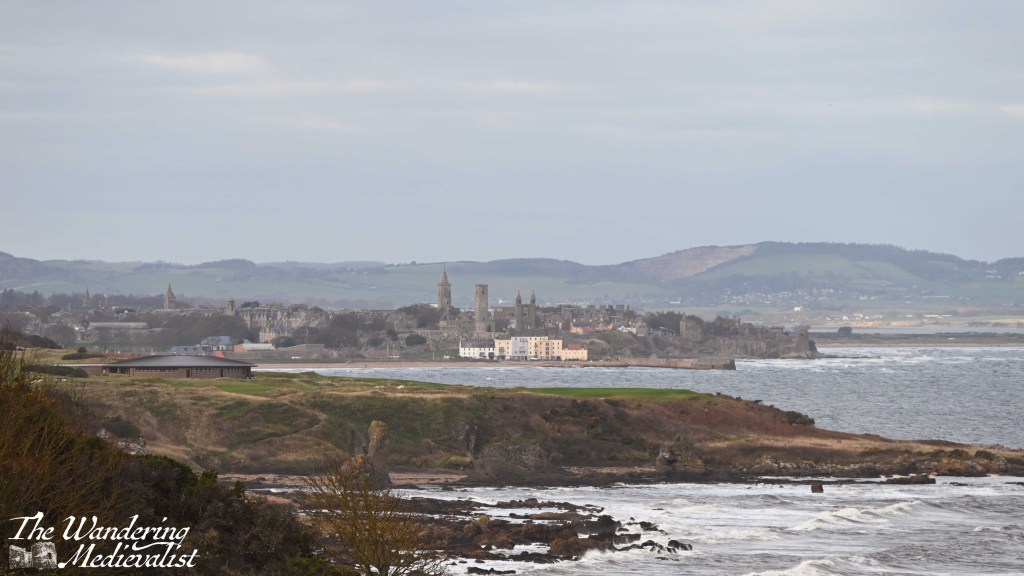
It took me about fifteen minutes from the road to wind towards the hotel the past, and down to the clubhouse for the Torrance. The views across the courses are beautiful even on an overcast day, and the outline of St Andrews is very clear; I really must come back here in the sun! This is clear evidence as to why the Fairmont used to be called the St Andrews Bay Hotel.
Distant St Andrews – with a powerful zoom lens
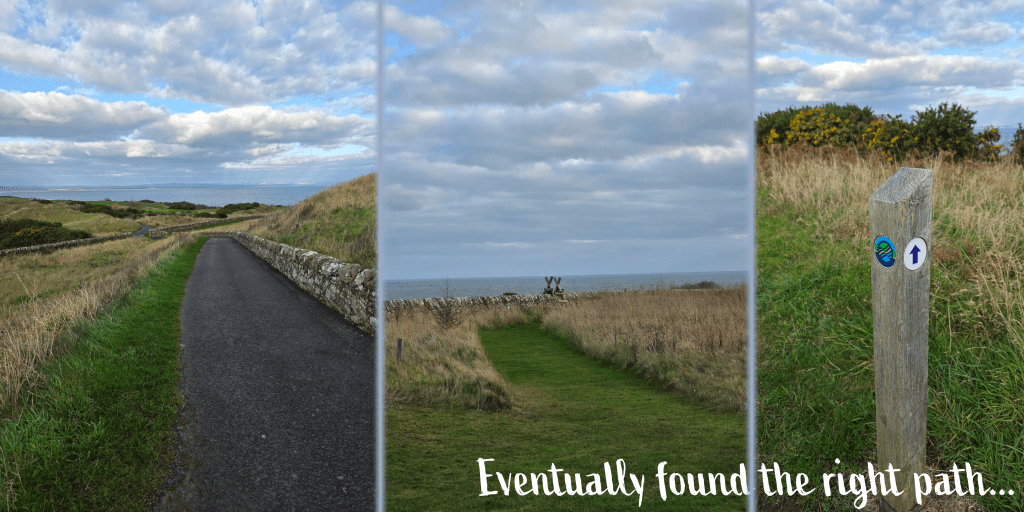
To get my bearings, I chose to walk down below the clubhouse and past the delivery parking, where I realised that I needed to backtrack slightly to an access road onto the course. From there, I turned right through a break in a stone wall and it was an easy walk to the second wall, dividing the course from the Coastal Path. I used a wooden ladder to scale the wall, though I think there was a break a bit further up for anyone less inclined to climb.
Finally at the starting point, I set my Fitbit to record and started on my way, enjoying immediately the return to a cliffside muddy track, along a stone wall, with waves crashing below. There were a few occasions where my eyes filled with water due to the wind, and I did have to wear my hideous winter hat, but I was warm enough once I got moving.
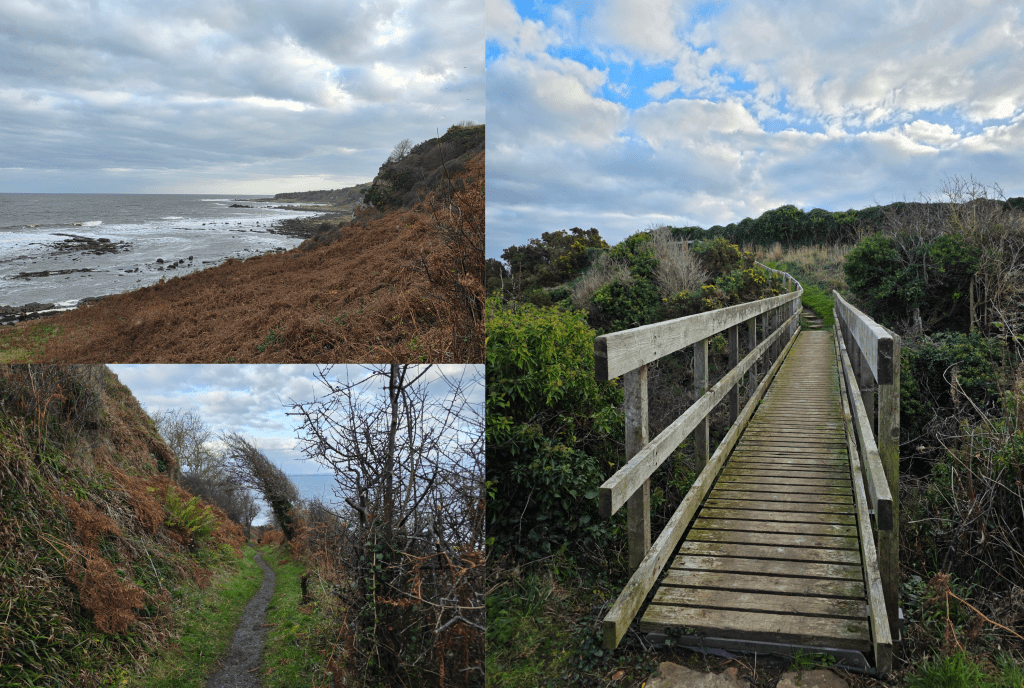
From here, the path eventually goes down some stone steps and across a bridge over a burn, after which it curves to the right and descends quite sharply towards the beach level. While my boots were not as comfortable as they once were, I was glad to have them here where the recent rain has made the small rivulets into rushing burns and even the grassy areas into mud.
The coastal views are great here in both directions, though the wind is definitely a force to be reckoned with – as ever in Scotland, layers are key. I spend a great deal of time at work explaining that it seldom gets as cold in Scotland as it does in parts of the US, but the wind is biting so it can feel much colder than it is. This was one of those days.
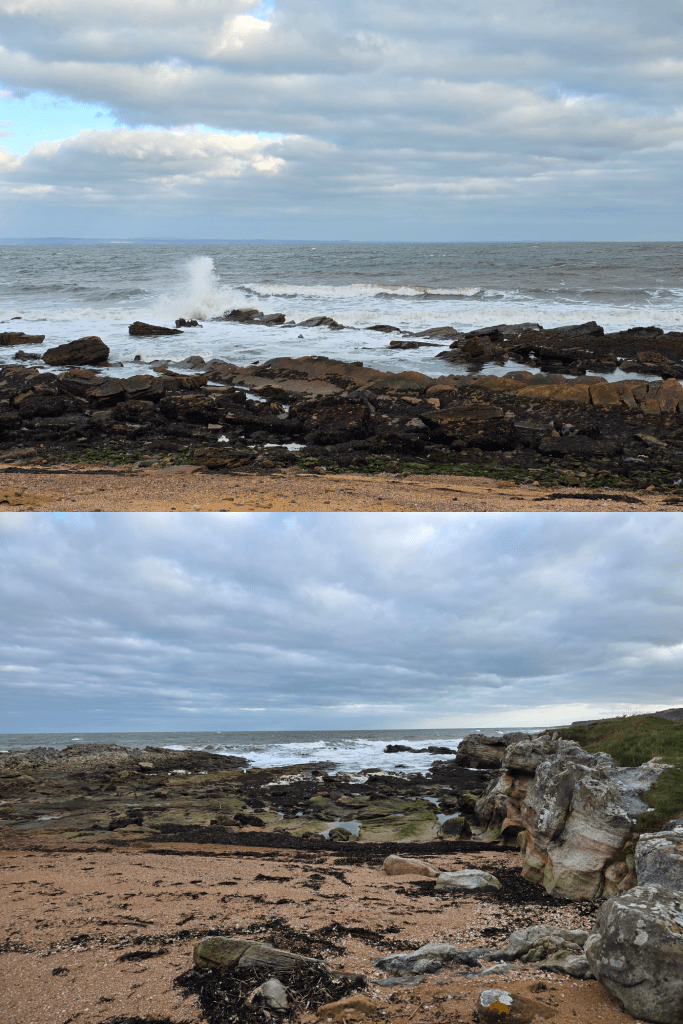
As the path descends it essentially passes through a hedgerow, and you can see the cliffs above you, mostly covered with plants though there are the occasional dramatic rocky outcroppings and circling birds. On the beach level, you can enjoy crashing waves, and ahead is the shape of the Rock and Spindle.
It was about here that I passed a couple who were clearly familiar with the path, and who observed that I had about 45 minutes until high tide, with a gentle warning in their tone.
Yes, I had once again forgotten to check the tide, though to be honest it was because I did not think it was an issue on this section. My error, clearly, and while I assured the couple that I would be fine, I decided that it was time to hustle a bit. So rather than pausing and taking many wave pictures (as I was tempted to do), I crossed the rocky beach and identified relatively quickly where my potential problem lay.
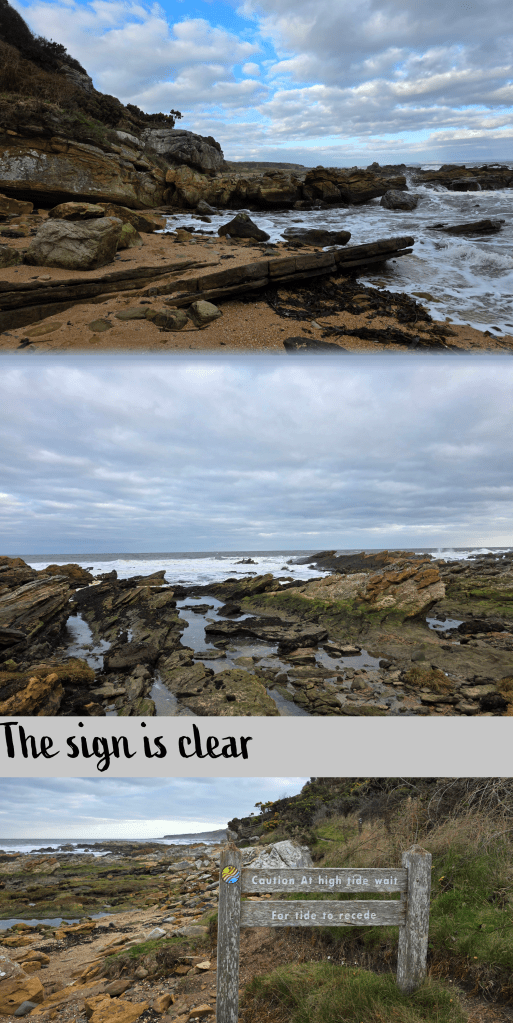
Specifically, it lay right about here, where the waves stretched inland along a rocky edge, threatening to very quickly cut me off from the path ahead. Like many of these small beaches, this cove was backed by a rock cliff and, as the sign clearly told me, if the tide was too high I would have no choice but to wait – there was no high tide route.
So, onwards I scrambled, and found myself looking at a rock face about 4 feet high with one foothold that was a bit higher than I thought my right leg might go. There is no picture, as I realised I did not have time to waste. So it wasn’t graceful or smooth, but I managed to get up the rocks and keep my feet dry – just barely. I probably had another 5 minutes before I would have had to stop. Good timing, then.
Beyond this pinch point, the rocky shore continued for another few minutes before I was able to rejoin the smoother path, and pass the sign in the photo above. I swear next time I will check more carefully.
Side note, I can see why Geology and Earth Science classes from the University would come out here for outings – there is a huge range of fascinating rock formations even for someone who knows nothing about them, and excellent examples of the ocean carving through stone over time.
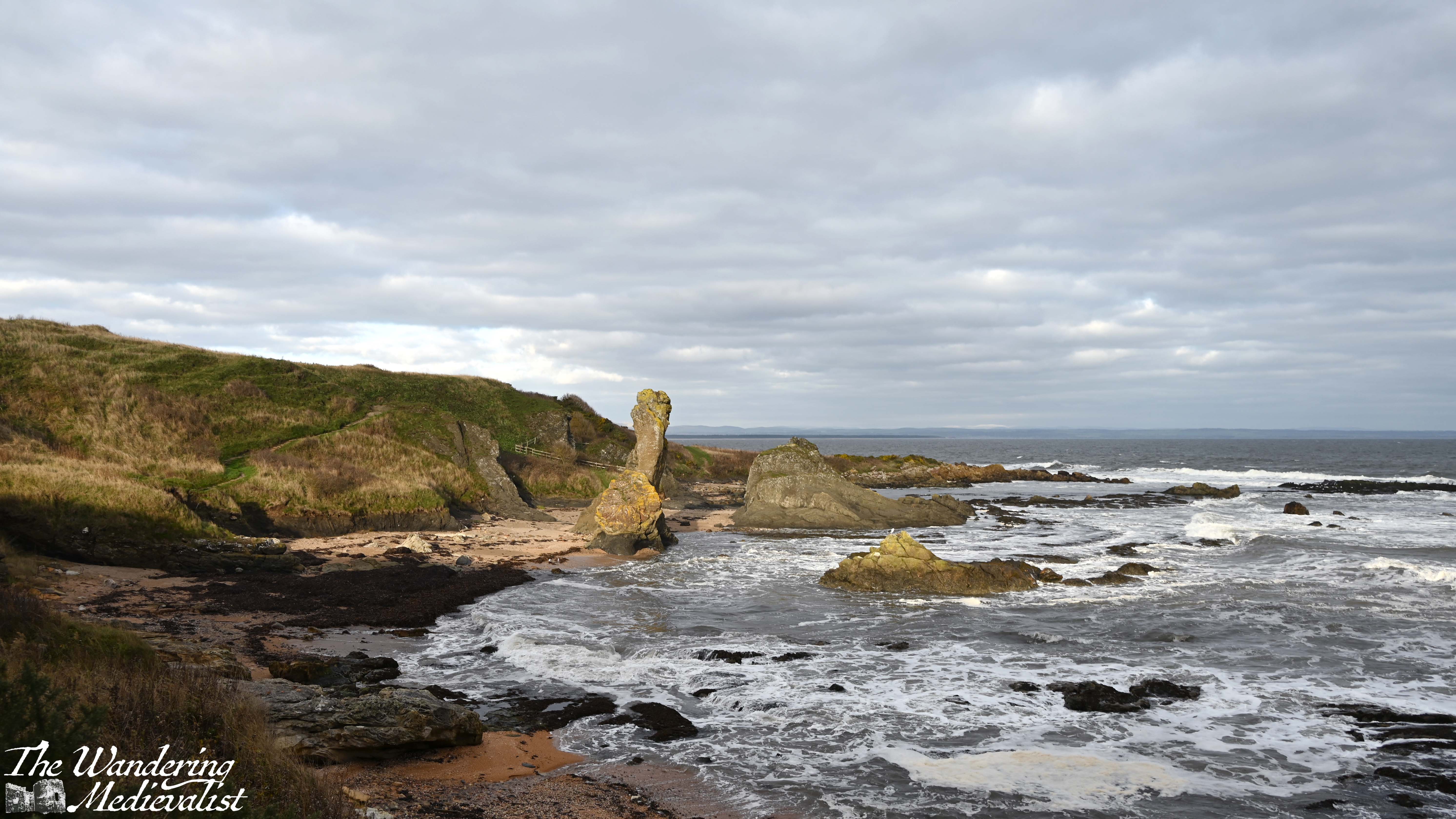
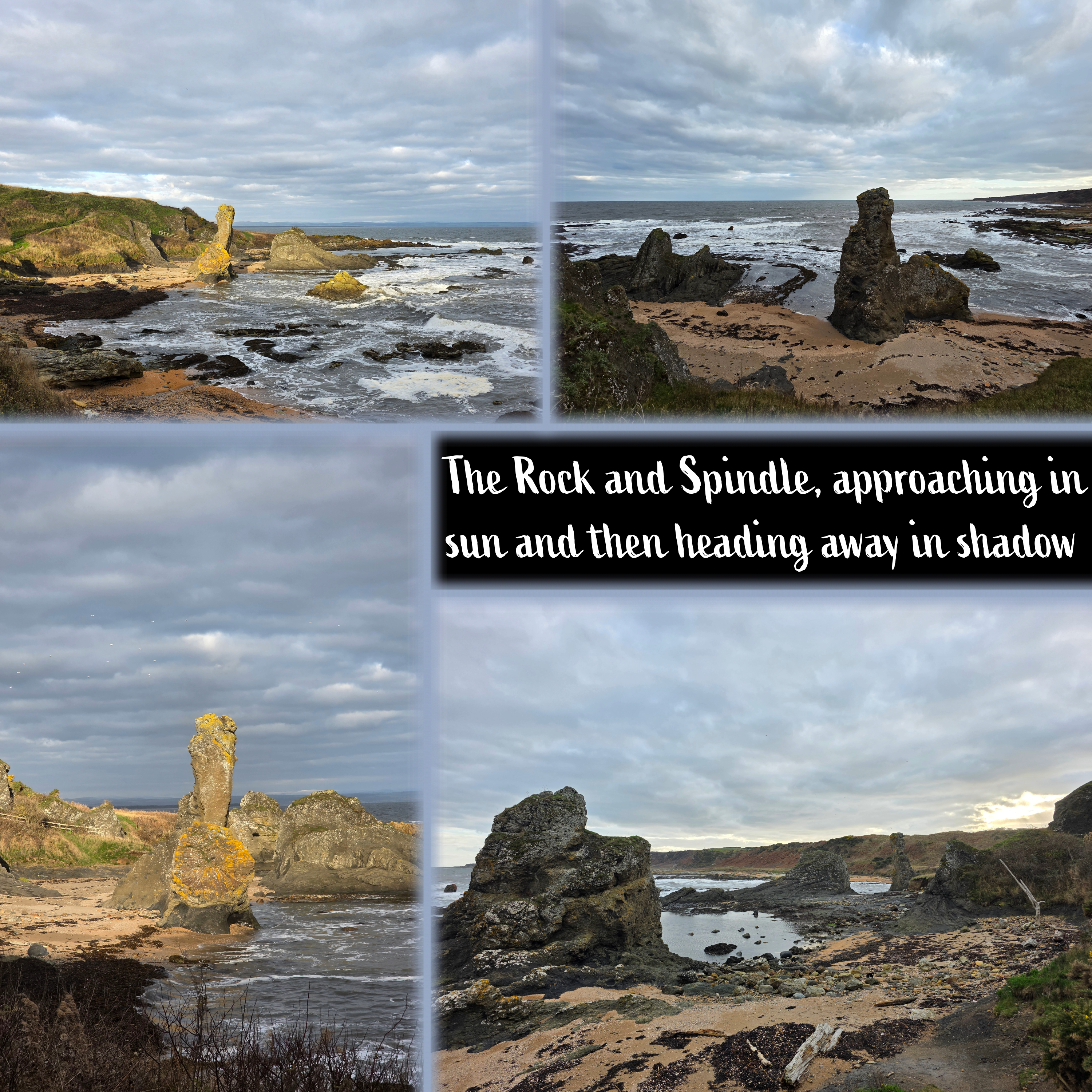
Ahead, in particular, is the Rock and Spindle, a famous formation that has been widely studied and photographed. According to some brief reading I did, the three stacks are made primarily of solidified volcanic ash, the remains of an ancient submarine volcano.
As I approached I was feeling uncertain that the sun would be helpful and actually break through the clouds, then as the path curved around to follow the shoreline, spectacularly the sun prevailed and provided some excellent contrast for my pictures.
A few words of caution if you are approaching from the direction I did – don’t get too caught up looking at the view, as the path here is crossed several times by burns. The rocks and grass are slippery and often wet, so it would be all too easy to fall.
There is also, I should note, a route above the rock formation which offers great views across the golf course and of the Castle Course clubhouse; Dad and I took this path when we walked out here many years ago (and of course I cannot find those pictures for reference). Alternatively, walkers can get down to the beach here to get closer to the rocks, but I was ready to make some progress and so passed through a wonky gate and continued on my way.
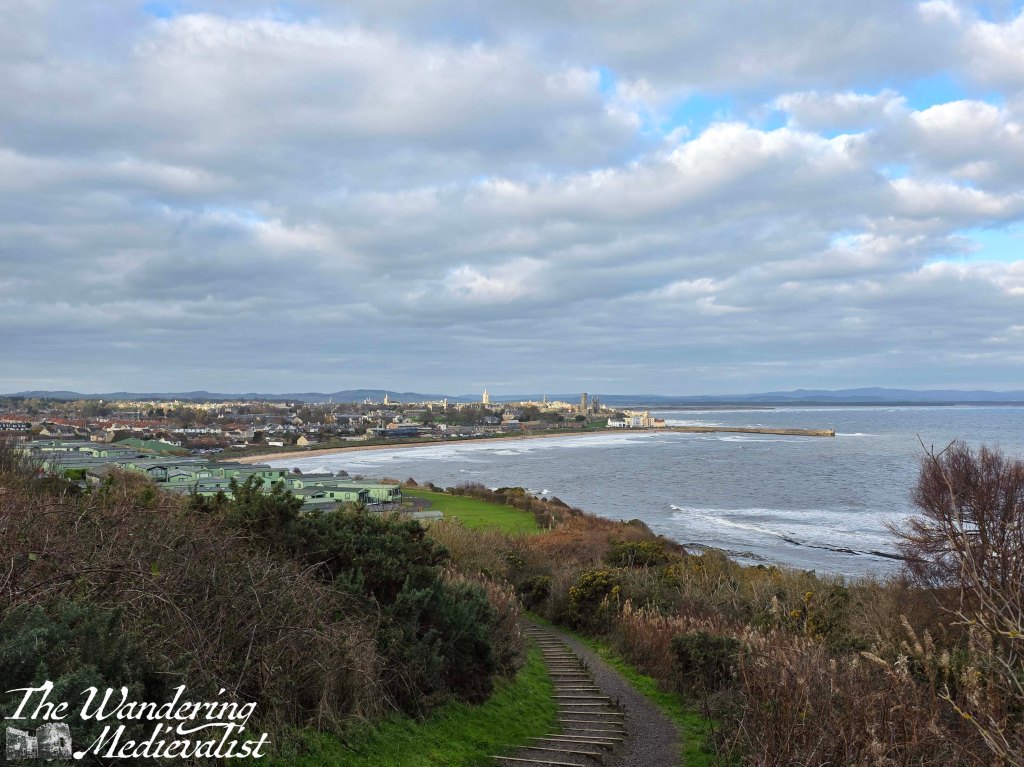
The path here becomes the more standard grassy path, and as I approached St Andrews I started to doubt whether the predicted sunshine would overcome what seemed to be pretty steady clouds. The overcast sky did not prevent me from taking plenty of different views of the town as I approached, of course – here are a few. Do I have sunny versions of these? Almost certainly. But there is something about this view of town that is impossible to resist.
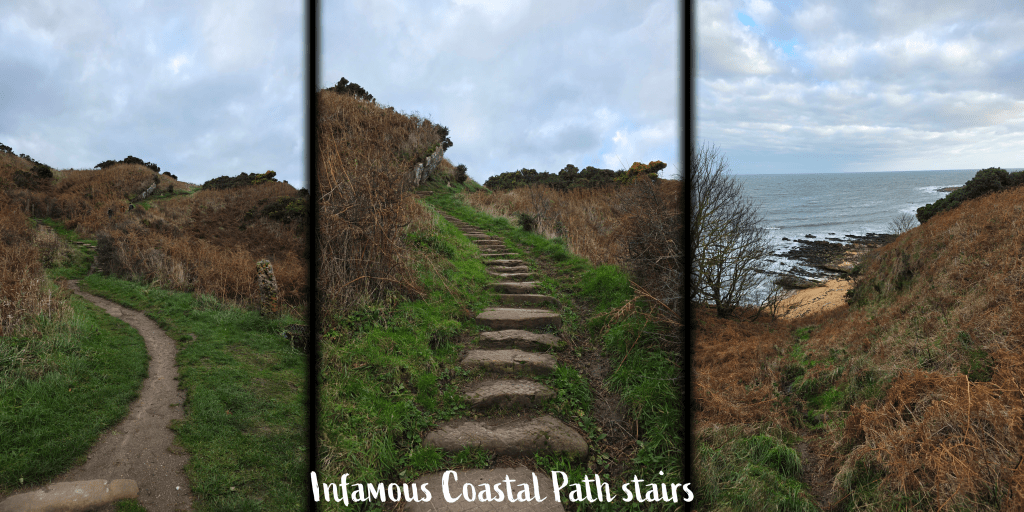
After ambling along at a good pace, enjoying being at the water level and the crashing waves, I realised that the cove I was in was quickly reaching its end, and there ahead of me was one of the Fife Coastal Path’s infamous – in my mind – stone staircases. The steps themselves are generally flat-ish rocks that have been layered into the hillside, and often wind back and forth as they climb steadily upwards. This is one of the longer sets that I have come across, and it definitely tested my endurance, which has declined since the summer. The view is of course excellent particularly if you have to stop and catch your breath.
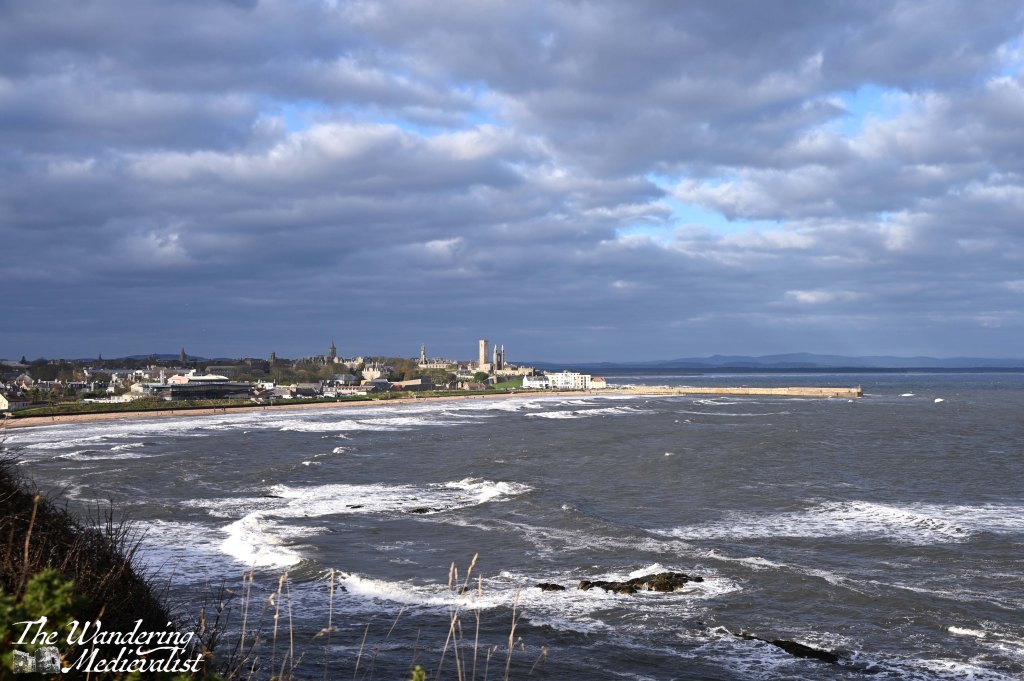
Once you make it to the top, however, the path is relatively level for some time, with only gentle ups and downs. The crest of the next hill provides a spectacular view over the bay and town – it is THE view, the one photographers will climb up here to capture. Even without sun, it is impressive. That said, as I made my way along the clifftop, the sun did make an appearance, highlighting the lighter stone of the cathedral ruins and harbour, bright against the turbulent waters of the bay.
The path here is wider and more regularly-used, with joggers and weekend walkers more common. It is easy to get distracted by the view on one side, while on the other the golf course rolls into the distance until it comes to an end at a line of tall pine trees. This marks the boundary between the Castle Course and St Andrews Holiday park, a large caravan site at the edge of town. Passing through a metal gate, you will notice a narrow path heading up to the road, so in theory you could begin a walk here as well, or do a loop up from town and back along the coast.
St Andrews and the bay
The view is just incredible, as gradually you move closer and closer to East Sands. Then in no time at all you are descending once more, along the edge of the caravan estate on a relatively steep set of stairs. There is a viewpoint off to the right, and then the path continues towards the beach.
One last gentle hill leads down off of the Coastal Path proper and onto the walk along East Sands, the wide open beach of St Andrews edged by the cliff on one end and the pier on the other.
just because…
Those of us who have lived in St Andrews for any length of time will tell you that the weather there is different, golden in a way that cannot be matched anywhere in Scotland. It might be a blizzard in Cupar, raining in Guardbridge, but it is sunny in St Andrews. Not always, of course, but more often than not the town enjoys its own pocket of good weather, and this day was no exception.
As I passed this slightly tattered Saltire at the end of the beach, the sun fought its way through the last of the clouds, and the day opened up into beautiful sunshine. Was it sunny at the Fairmont? Who was to say.
East Sands is always busy with walkers, dogs, swimmers, surfers, and sailors depending on the weather, and today was no different. Even in the cold weather and even colder water there were people out in wetsuits. And, some brave souls just in bathing suits, though I learned later that they were dashing up the beach to the newly-built sauna. This is the beach where students take part in the famous May Dip, and is a spectacular place for sunrise, as well as to catch the Northern Lights if you are lucky. The East Sands walk takes you past the University nursery, the East Sands Leisure Centre (town pool), the Scottish Oceans Institute and the famous Toastie Shack, perfect for a beach snack.
The edge of East Sands marks the start of the portion of the Coastal Path that I know like the back of my hand, have walked 100s of times over the years and love. But oddly, I was not confident as to the actual route of the path. My map told me to turn left at the Toastie shack, but the signs told me to continue strait.
As the straight-ahead route was arguably prettier, leading along the beach and over the harbour gate, I chose to follow the signs. Here, the path goes through the play park and along the edge of the beach, allowing for a great vista across the water and up to the Fairmont.
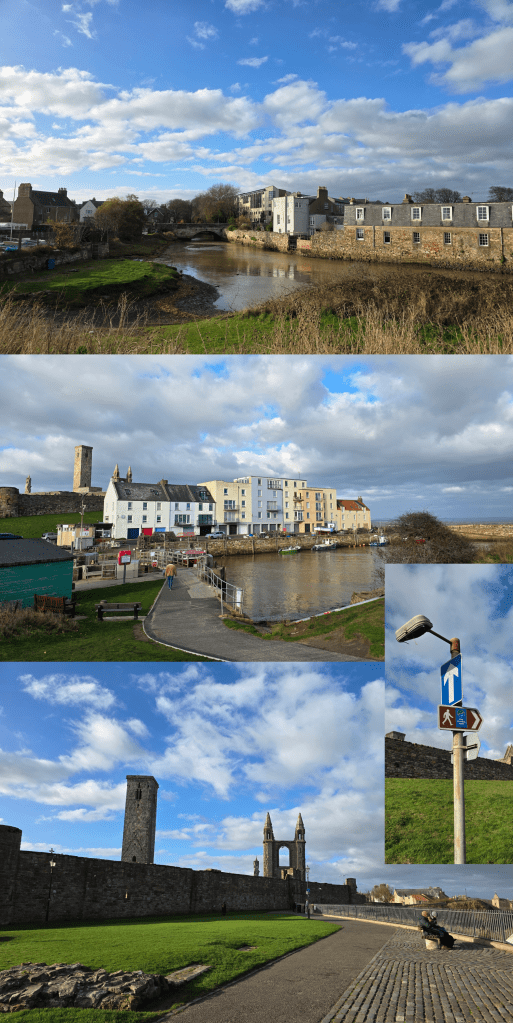
On the other side is a wide grassy bank that leads over to where the Kinness Burn enters the harbour. I wandered over to take a quick picture, but it is worth warning that this stretch of grass is full of holes, dips and – annoyingly – the occasional dog dropping, so best to keep looking down. Soon the path curves around to the left and down a short hill towards the harbour. Cross at the harbour gates and then swing right either in front of or behind the line of buildings. Officially, the path goes behind, but I don’t think it matters greatly. This is one of the most photographed parts of St Andrews, with the colourful buildings and the old harbour, and the entrance to the famous St Andrews pier.
If you have the time, I recommend a detour out to the end of the pier, as the view back is phenomenal. The pier had been closed for some time due to damage sustained during a storm in November 2023 – it is great to see it back open and so many people enjoying the walk. As often happens on a sunny day after a few of rain, the town was busy with students, visitors and locals all out enjoying the day.
Side note, I have several times on these walks had the weather improve as the day goes on, and wonder if I shouldn’t wait until later in the day to get going. But instead, I just keep heading out as early on a Saturday as I can manage. Maybe that will change as the winter closes in, but probably not.
Whether you detour out the pier or not, you have two choices for climbing back up to cliff-top level; the first is a set of stairs, and the second is a hill so steep that cyclists are required to walk their bikes up or down. I opted for the hill, and either way you arrive at a great viewpoint over the town. There are the ruins here of St Mary on the Rock – a church outline – and several cannon aimed out to sea. The highlight is of course the view of the cathedral wall and remaining towers straight ahead.
The path is wide, with a stone wall along the edge of the cliff, though if you look down you will see familiar rocky coastline and birds nesting or bobbing in the water. Ahead there are two options, and neither is marked though I think the obvious choice is to hug the coastline and take the right-hand fork. The left leads you along the cathedral wall and towards North Street.
The fork I recommend is also the one that takes walkers along one of my most favourite stretches of path in St Andrews, and possibly all of Scotland: up a gentle hill between the cathedral and the castle, one of the best viewpoints in the area. You can see into the cathedral grounds, down to the pier, out to sea, and of course along the coast to the castle and distant West Sands. It is a place that is almost meditative for me – I have walked it more times than I would hope to count, even now seldom stopping to take pictures and only enjoying the view. A scattering of sea roses makes it the perfect spot in summer, and there are two benches ideally placed to rest and enjoy. Definitely take a few moments to do so, if you can.
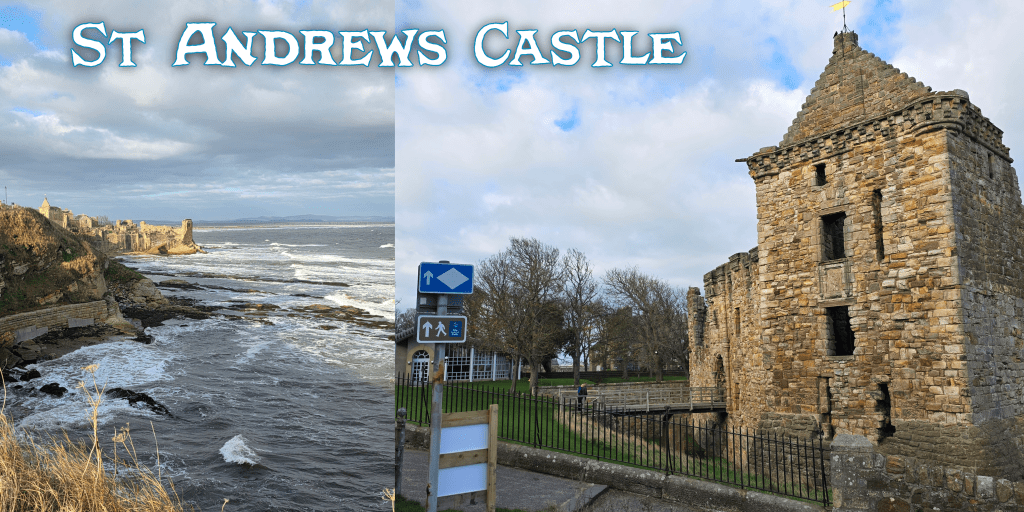
St Andrews Castle is of course directly ahead, its outline something I imagine I could draw with my eyes closed. I cannot pass without a picture, so on this occasion I included the Coastal Path sign – in one of them.
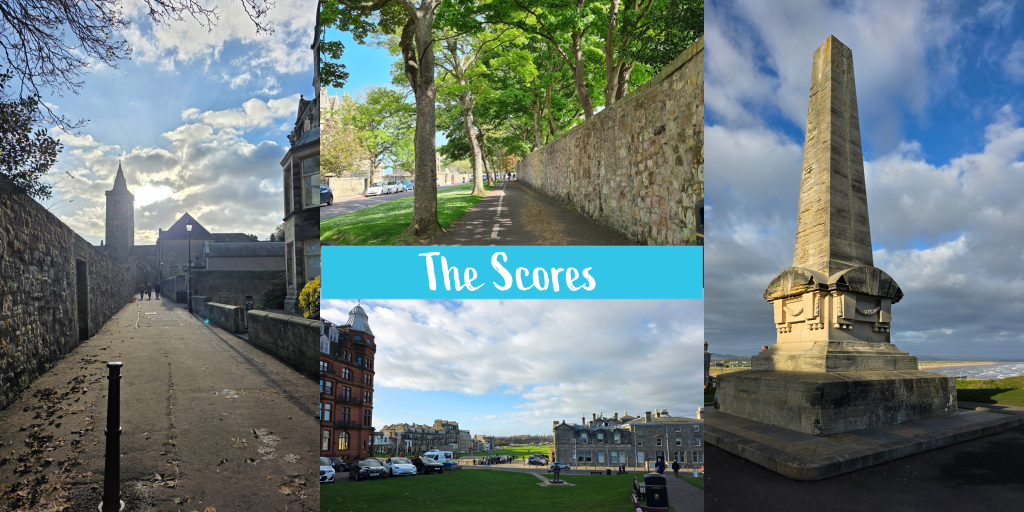
Once past the castle, the route continues along the Scores, one of the most beautiful streets in St Andrews and one of the most expensive in Scotland. The University owns a good portion of the buildings and you will pass, amongst others: the Schools of English, Economics, Philosophy, Classics, International Relations and History, the University Museum, St Salvator’s Hall and the back of St Salvator’s Quad, the Principal’s House, and the Admissions office. The buildings in between which are privately owned are large, some very old and some very new, all with phenomenal views. The Scores is lined at varying points by stone walls, and you can choose to walk on either side, though I always feel that the left going away from the castle is ever so slightly nicer. It is wider, and you do have to look out that you do not wander into the cycle lane.
About half way along on the left, Butts Wynd cuts up towards North Street, offering a stunning view of St Salvator’s Chapel.
It may be tempting to nip up to the quad and take a few pictures, so by all means do so here if this is your one trip through St Andrews. For golf enthusiasts, the best is yet to come.
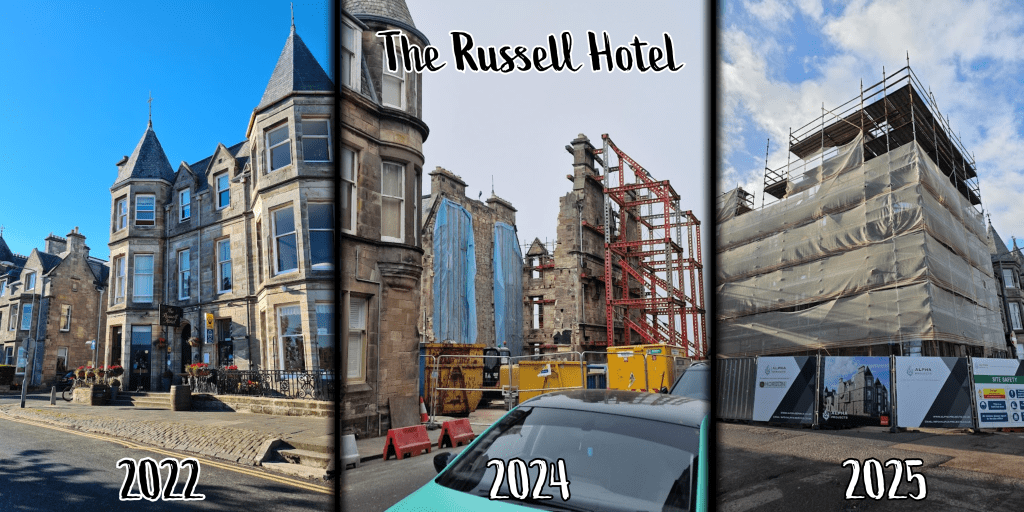
Continuing along the Scores, you will pass the Catholic Church, and ahead on the corner of Murray Park is what used to be the Russell Hotel, which was one of our favourite spots in town for excellent Scottish food. The couple who owned it eventually retired and the majority of the structure was torn down, so that all that remained was the listed frontispiece. As of writing, it is enshrouded in scaffolding and being rebuilt into what I understand will be flats.
At this point I recommend crossing the street and continuing roughly straight ahead. Along the cliff you will find a tall wrought iron fence with warning signs as to the sheer drop on the other side – this is due at least in part to the unfortunate tendency for students to wish to climb the fence, which has devastatingly led to fatal injury in the past.
Avoid the temptation to turn right down the steps toward the Aquarium, and while there is no clear signage continue straight towards the towering Martyrs’ Monument, which was put in place to commemorate those killed during the Reformation. Beyond the Monument is the Royal and Ancient Golf Club of St Andrews and the famous Old Course. To the left, the buildings of the Scores including what used to be the Scores Hotel but is now Seton House, and the towering red Hamilton Grand, that incredible framing building to all pictures of the 18th hole. When I was a student it was still student housing, though has in intervening years been re-build into luxury condos.
Continue down the hill and cross the road, continuing up Golf Place towards North Street – do not head toward the beach, though there are public toilets in that direction should they be needed.
Continue to follow the golf course by turning right along the Links, which is a narrow road that runs between the Old Course and the buildings that include the famous Auchterlonies Golf Shop, the Rusacks Hotel, and the New Golf Club. There are regular signs reminding you of this, but golf is being played year-round, so pay attention for stray shots!
As you walk along the course, you will get some great views towards the Swilcan Bridge – where all golf competition winners have their pictures taken, as do many tourists.
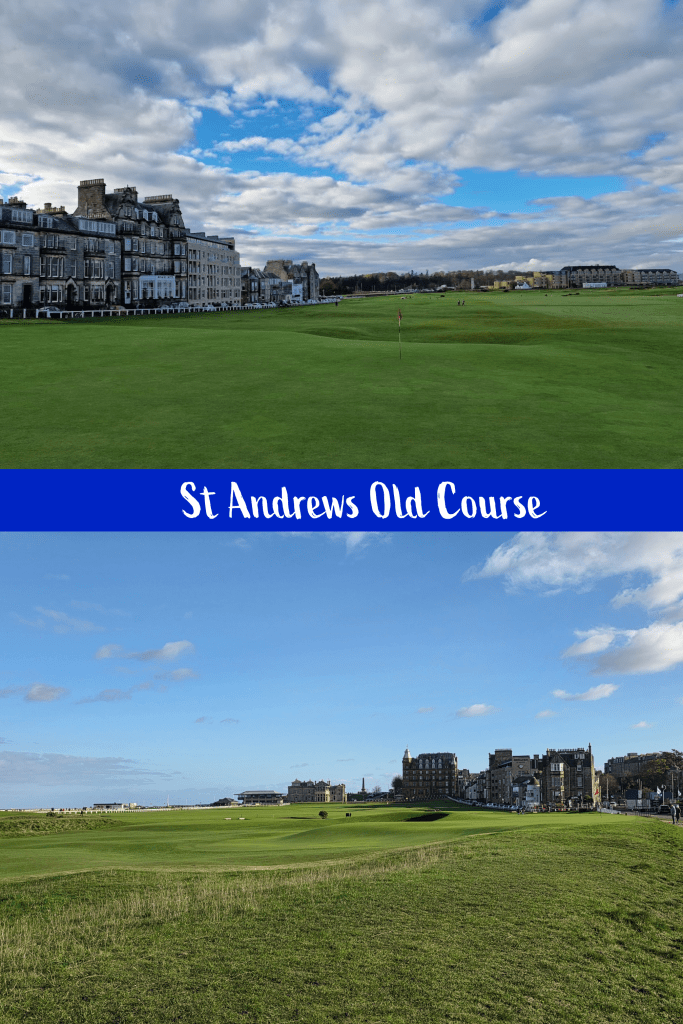
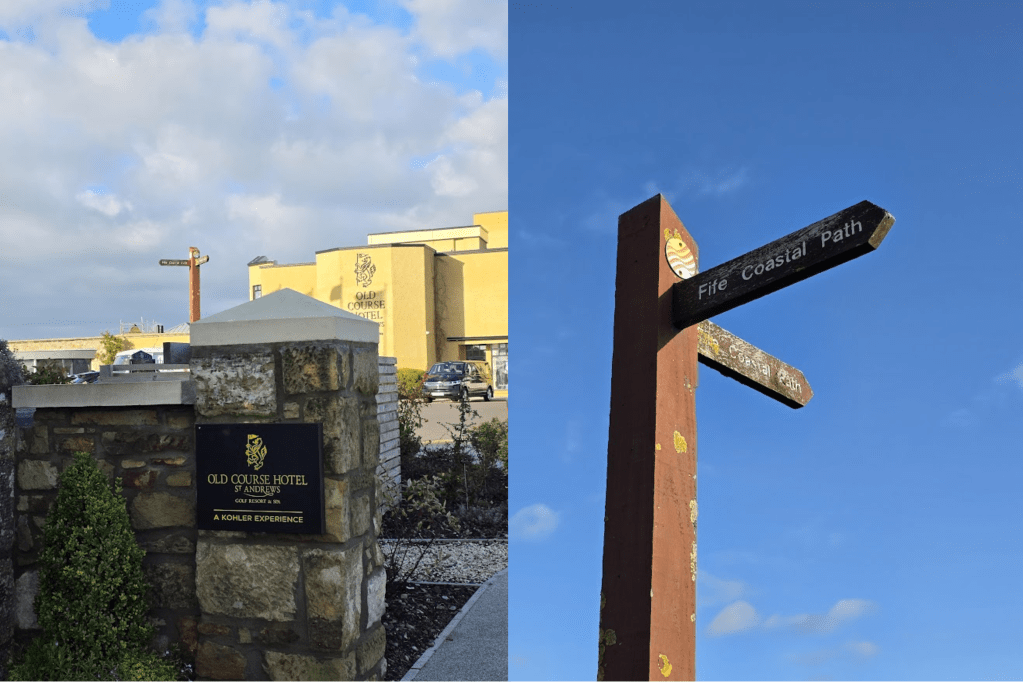
Follow the white fence when it curves around the end of the buildings and keep moving towards the hotel, straight ahead through the car park. In only a few minutes, you arrive at the entrance to the hotel grounds, where there is a clear sign to mark the end of this section.
Overall, a comfortable walk with a few spots to challenge you and a few spots to just enjoy the view. The section through St Andrews is beautiful, but I still think I prefer the out in the wild paths such as the one from Crail to Cambo – for hiking, in any case.
A small calamity of this walk was the realisation that my walking boots, purchased in the spring, just aren’t cutting it anymore. They have worn down and are encouraging my ankles to roll in even more than they do naturally, so I am on the lookout for a replacement. Good thing Christmas is coming, as I hope I can request a new pair! Any recommendations on brand would be welcome.
Whew, this was a long one. I knew it would be, and I was excited to give it a go, but I think I mis-calculated the mileage. Nonetheless, I managed, and it was a good challenge for me as well as a nice stretch of the coast.
The morning started with some overcast and the hopeful promise of blue sky by the middle of the day.
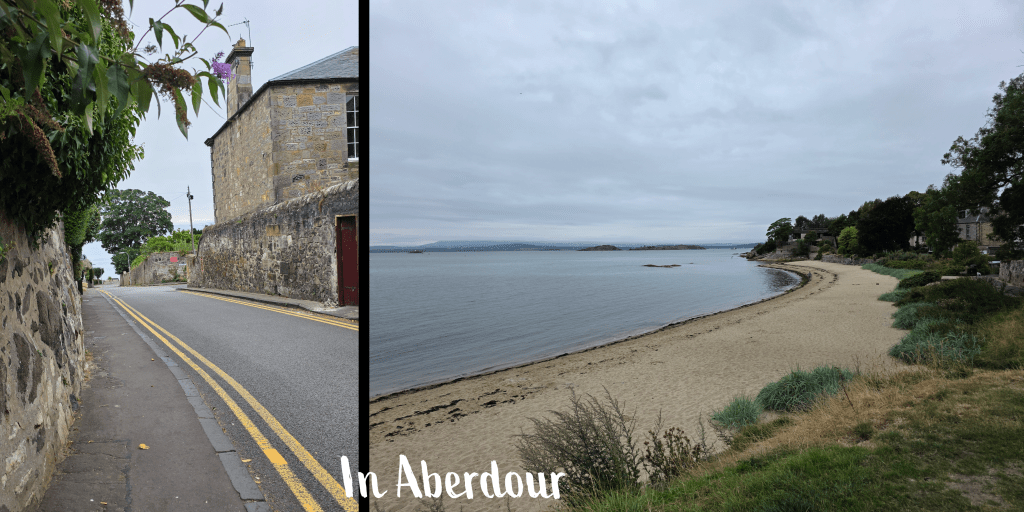
My starting point was Aberdour, famous for its castle which I have visited in the past, but chose not to stop on this occasion due to the clouds. It is definitely on the list for a re-visit soon.
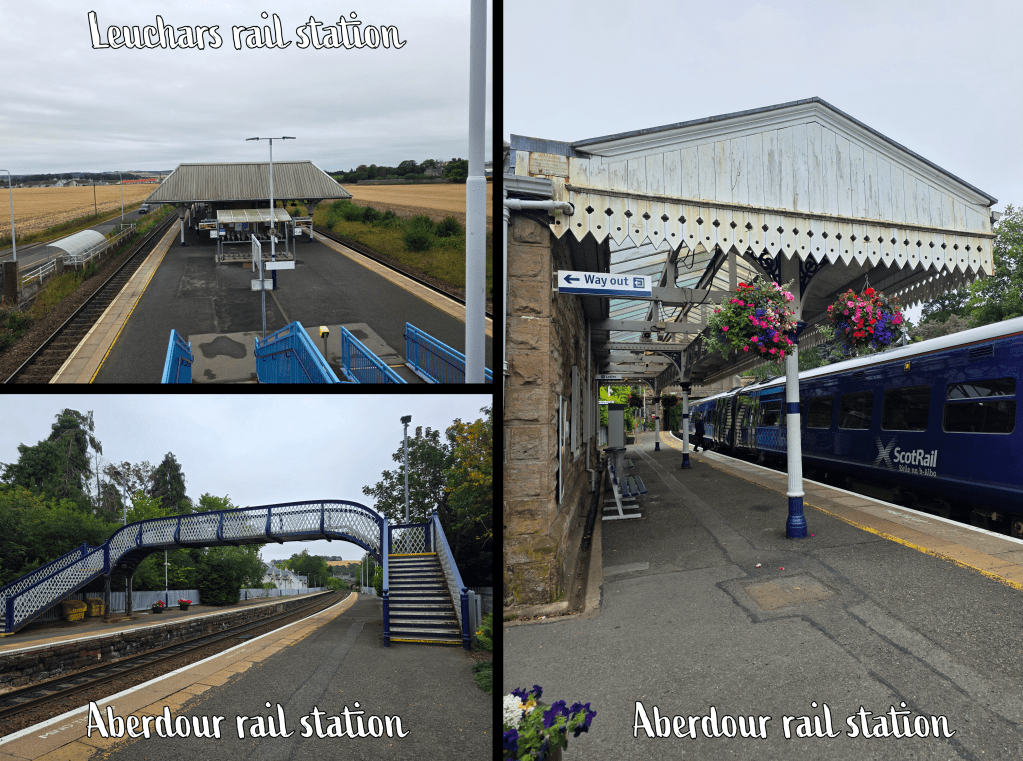
Aberdour is best reached by train, from the north requiring a short stop in Kirkcaldy on the way; I boarded in Leuchars and it was an easy, quiet trip. The station in Aberdour is beautiful – Victorian, with decorative metal scroll work and beds of flowers in and around the building.
From the station I headed through the car park to the main road, where there was a short half block before a turn down Shore Road. I counted the start of my walk from this intersection, where I officially re-joined the path.
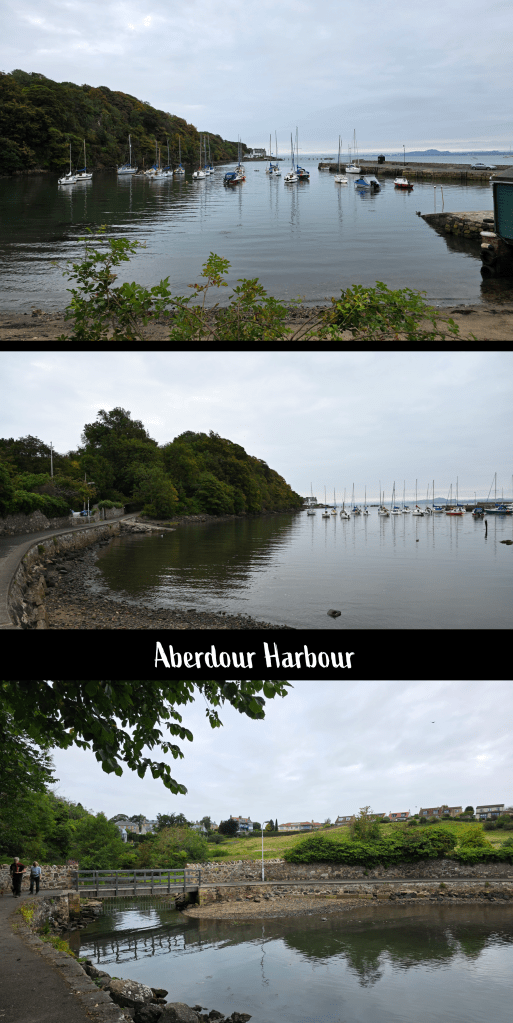
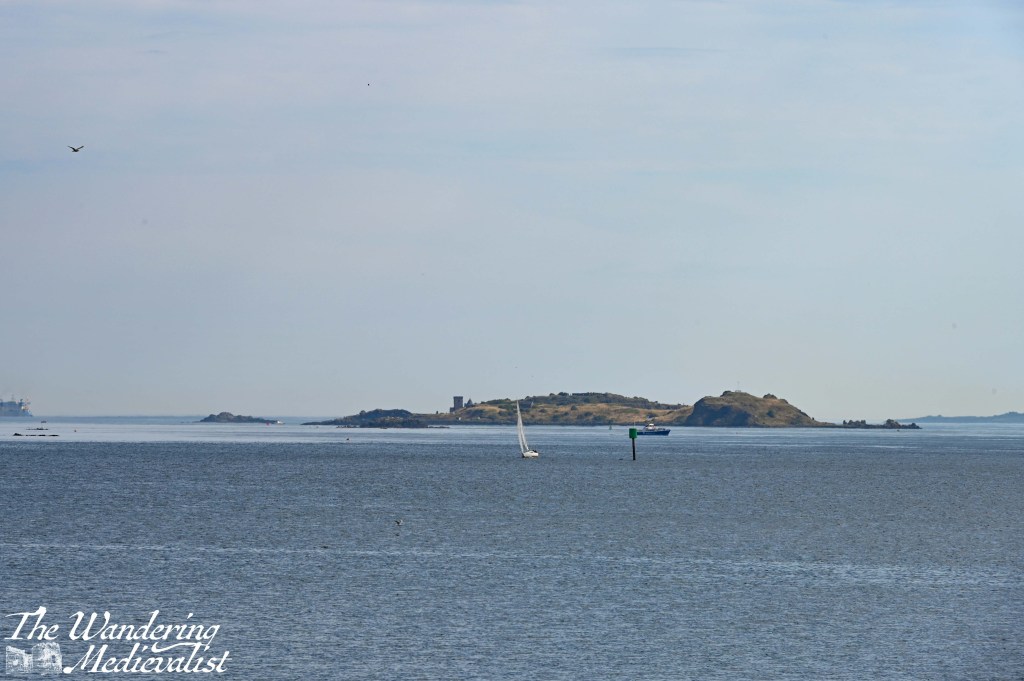
Shore Road runs down towards the water, passing some shops, a park, and large well-appointed houses with rocky gardens. In little time, it is clear you are descending a hill, and at the waterfront where there is a seating area and a beach off the the right. To the left is the harbour, and ahead of you in the Firth of Forth is just visible the outline of Inchcolm Abbey. Once the sun came out, I was able to get a good shot of the island.
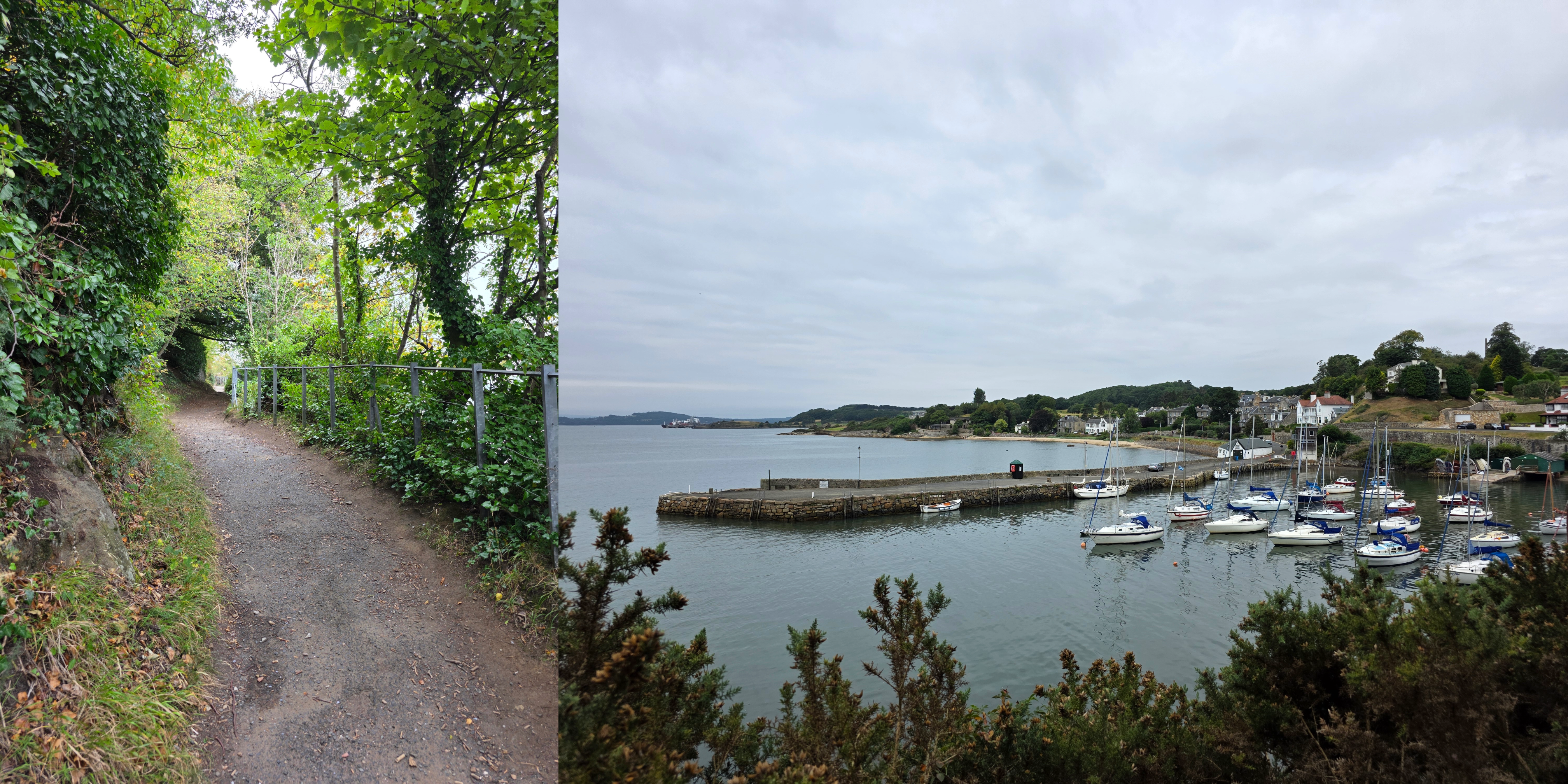
From here, the path leads towards the harbour, and just as the road turns into wharf, there is a sign directing walkers to the left. The harbour is small but with plenty of sailing vessels – less fishing, more pleasure boating here it seems – and sheltered by a headland. As the path loops around the harbour it crosses a burn that has cut through two sloping fields. I knew that at the top of the hill was the castle, but it hidden from view.
Beyond the harbour, the path climbs a bit as it continues around the coast, with occasional breaks in the trees for views back towards the village or out to Inchcolm.
It was an odd weather day, not sunny but nonetheless quite warm and a bit sticky. My cardigan, needed for the train and early part of my trip, did not last long.
After perhaps five minutes, some houses appear through the trees, but be aware that the Coastal Path does not follow the road here, instead taking a sharp left up some stone steps.
As the trail winds through the trees there are a few small footpaths leading off into the distance, but if you maintain your course relatively straight, you will eventually reach a hilltop meadow.
It was just about at my arrival at the hilltop that the sun began to win its battle with the clouds, peeking through a few gaps, though clouds over Edinburgh and south still looked threatening. I was also delighted to discover what seemed to be a set of small standing stones, and a gate that led to the top of the cliffs that overlook Aberdour. The edge is sharp and not fenced at all, so there are plenty of warning signs – it is a dramatic spot looking over the water, along the coast, and to the distant Forth bridges. I learned later that this is Hawkcraig Point, once home to a Royal Naval Submarine research base, though there is very little remaining except for a lighthouse.
Once I had taken my fill of the view, I headed down the hill towards the narrow road which must have been constructed to reach the point. At the time it was being used by some very keen fishermen.
The road passes through a large parking area designated for caravans (unlike many car parks), which was incredibly busy. More than a few dogs were sitting outside in front of their temporary homes, watching me closely as I passed, and occasionally looking up at the regular outgoing planes from Edinburgh airport – clearly we were on the flight path that day.
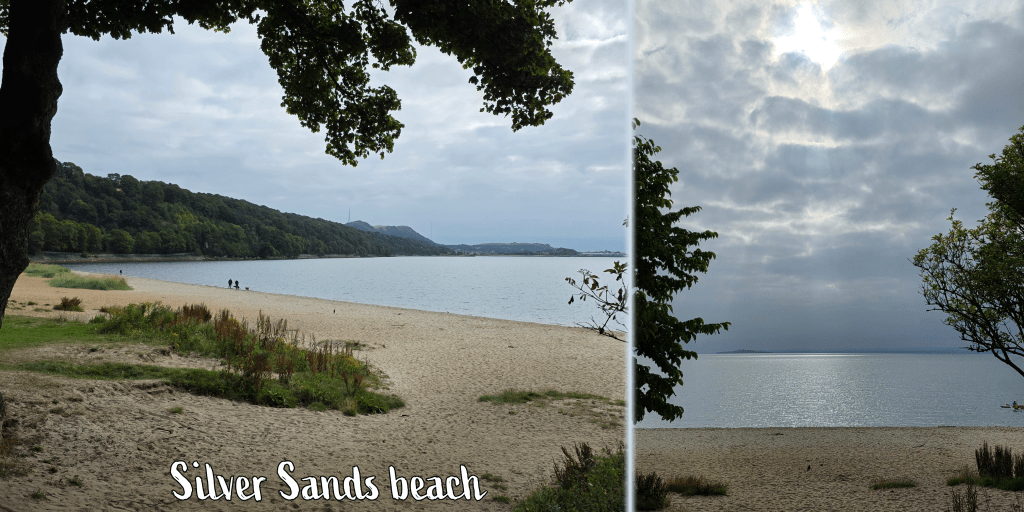
Soon I reached Silver Sands beach, which was already growing busy. Like many beach areas in Fife, it is well-kept with a good car park, some playground equipment, and a cafe that had not quite opened yet, much to my disappointment. I could have done with another coffee.
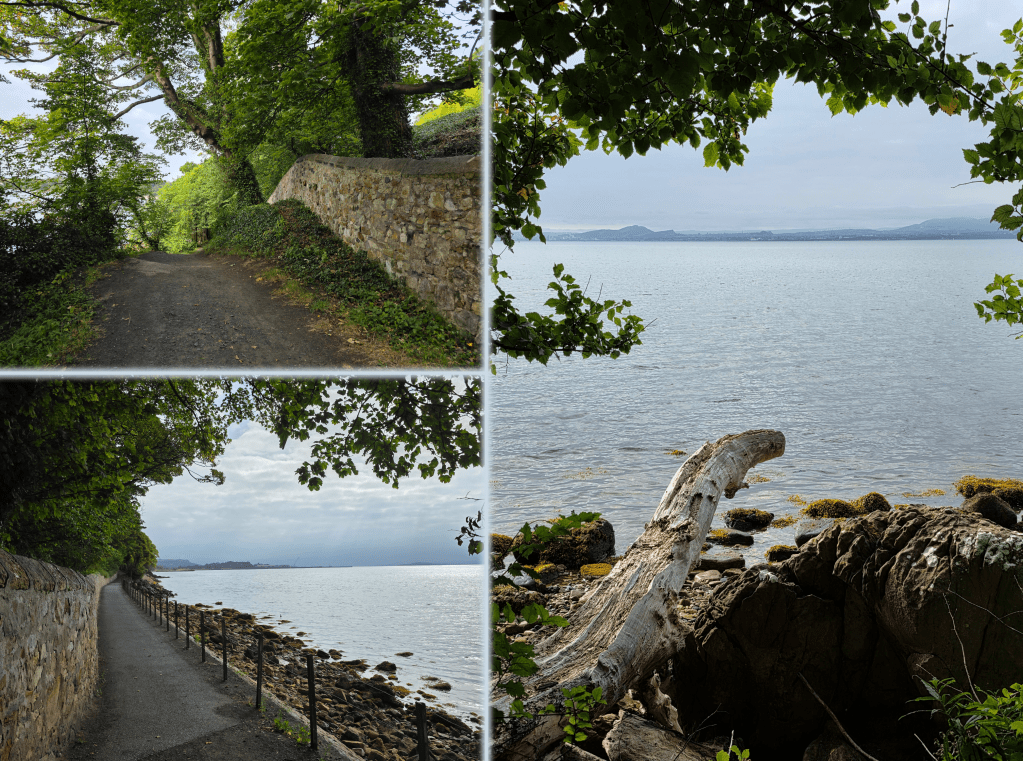
At the far end of the beach, the path disappears into the woodland with a well-kept trail that is either paved or packed dirt and close to the edge of the water. Below you is a rocky shoreline with sea birds, and I paused for a short while to watch a pair of cormorants (or that’s what they looked like anyway) doing some breakfast fishing.
Inchcolm Abbey in the Firth of Forth
In a short time, the left-hand side of the trail becomes a long stone wall, an old estate wall, which follows the path as it rises and falls over some gentle hills. This was a popular stretch with runners, as it was mostly paved, and required a bit less attention to your feet.
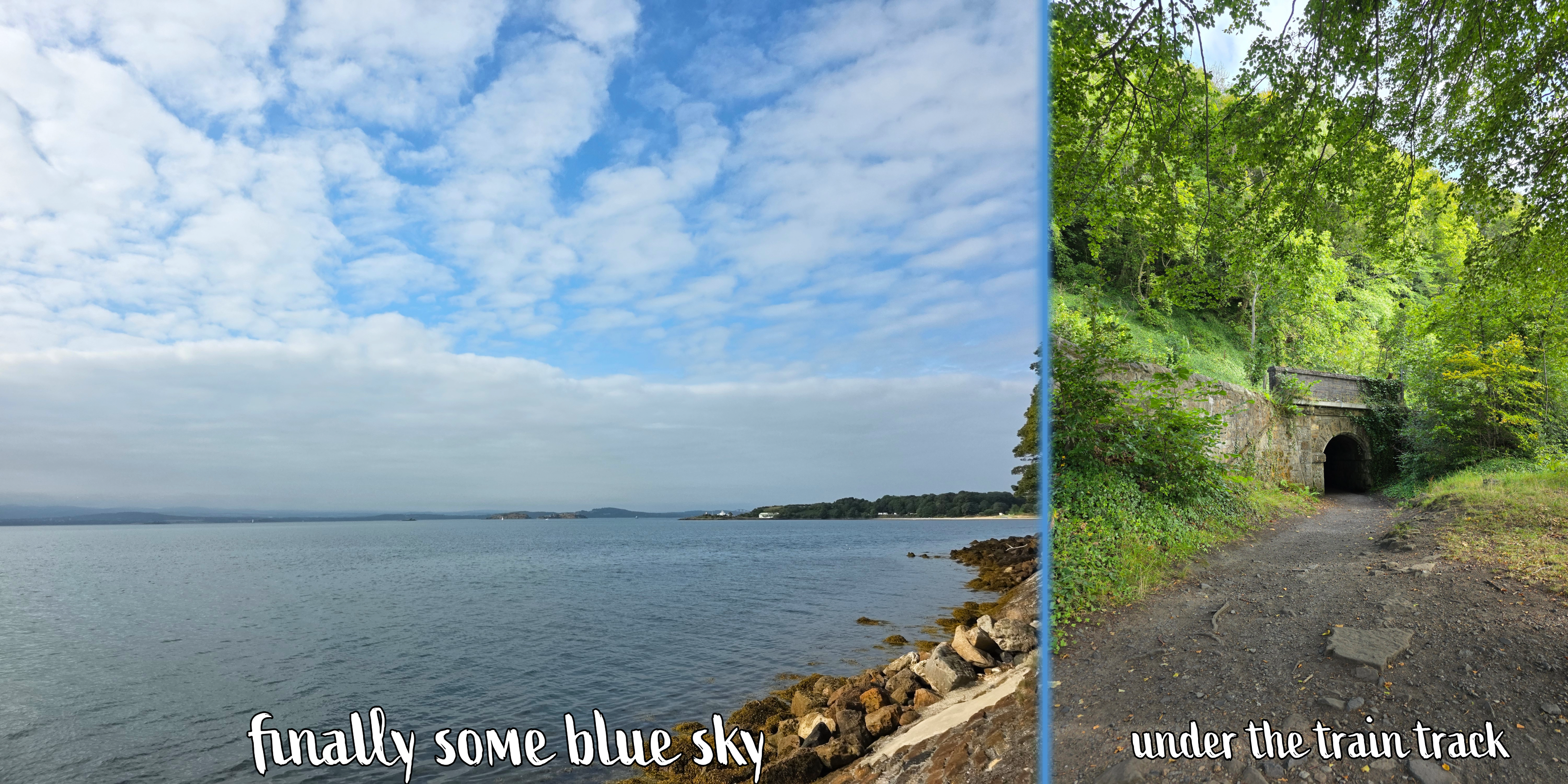
About half-way between Aberdour and Burntisland, the route passes under the rail line through a stone tunnel. This is a busy stretch of track with quite regular traffic, and it is a section I have always loved when on the train as the views across the Forth are superb.
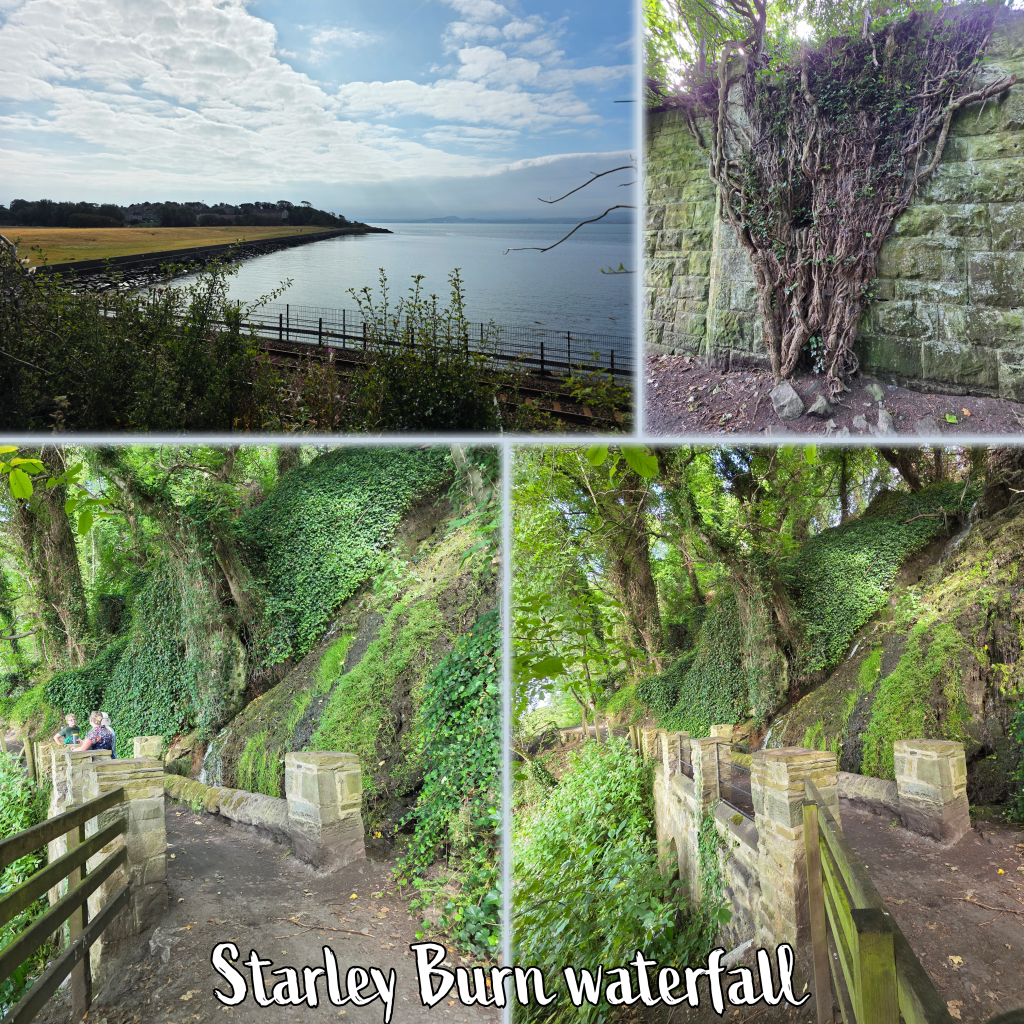
Just outside of the edge of Burntisland, the path crosses Starley Burn over a lovely pedestrian bridge. There is a waterfall above which falls about 12 – 15 feet, and the lime-rich water causes a thick coating on the rocks. It’s a nice peaceful spot in a glen, good for a short break should you need one.
Soon after crossing the burn, the path jogs left inland a bit, and narrows between the train on one side, and a stone wall on the other, with fields up to the left. By this time the day had warmed up nicely, with no wind and only a breath of breeze, so the section here was quite warm, away from the water.
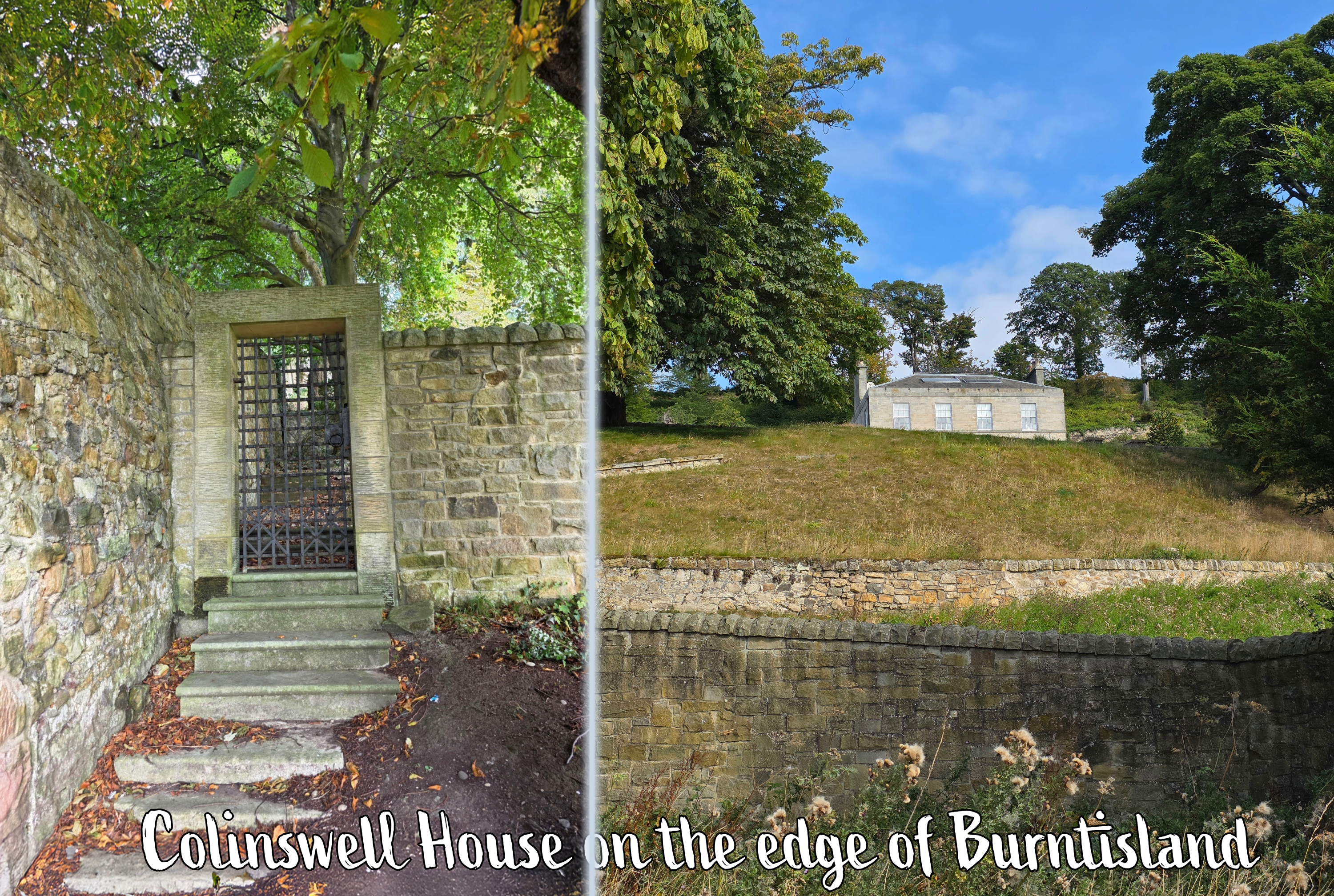
Approaching the edge of Burntisland, the route passes a lovely old estate which reminded me of something out of a Jane Austen movie, including a metal gate in the estate wall – Colinswell House, I learned upon searching. Shortly beyond is Burntisland proper, and the path leads along the edge of a very nice neighbourhood of relatively new homes.
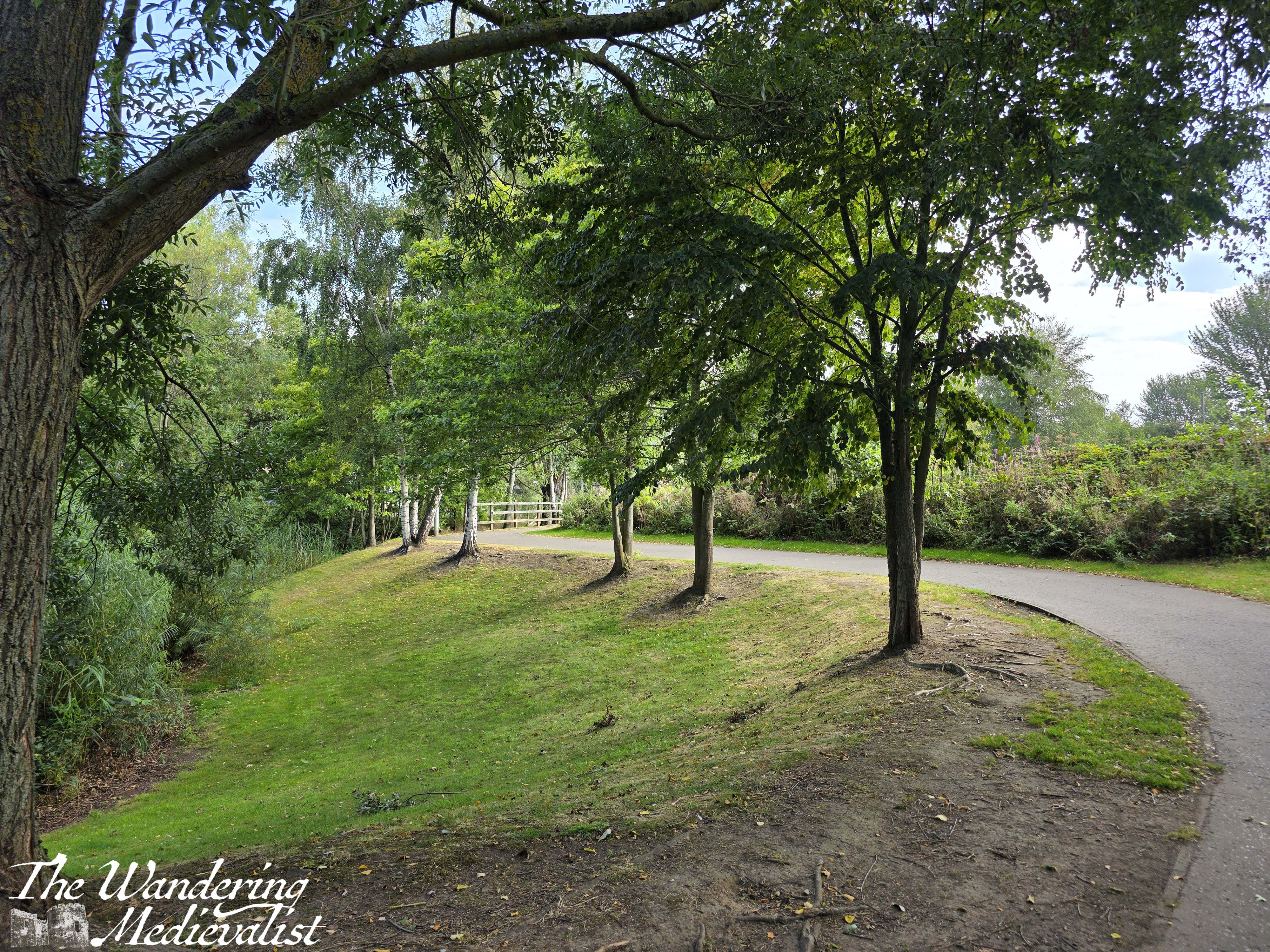
There is an option to pass under the track but don’t be tempted, as the route continues straight before beginning to wind through a nice park. It was well-kept with cut grass, oak and silver birch trees, and a small burn down below between the park and the residential area.
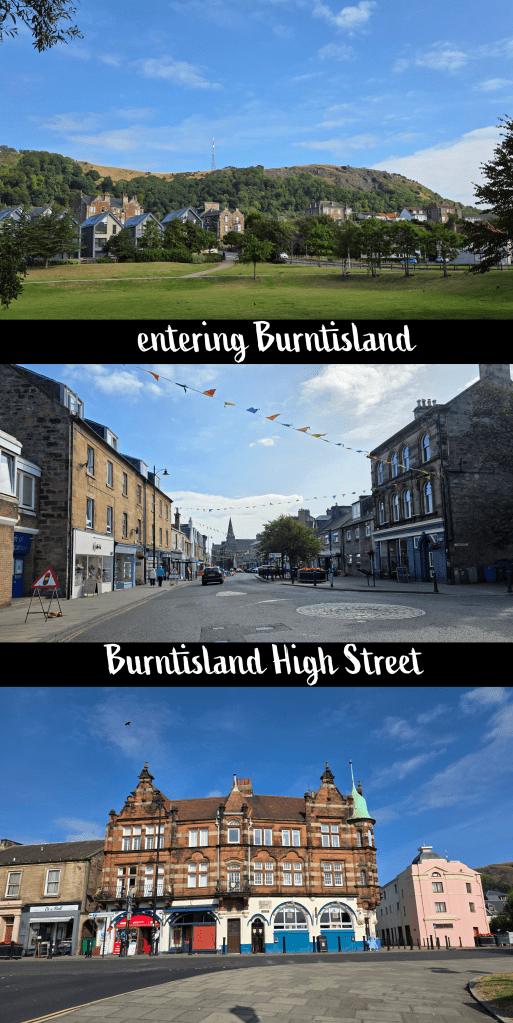
About a half-mile beyond the edge of the town, the route passes into an open park with a view of houses and the hill behind. At the edge of the park turn right up the hill on Kirkton Road. Descending the other side takes you past a few apartment blocks, though these disappear quickly when at the bottom you turn left on to the High Street (not East Broomfield Road, which you reach first). Follow the High Street, which is lined with shops and pubs, quite pleasantly not too many chains but instead local places that seemed quite popular – particularly the butcher and the bakery.
Just before the High Street runs into the Links there is a Co-op food store, a great place to grab a drink or snack if you need it. Across the road at the edge of the Links is also a public toilet – not the fanciest toilet in the world, but it was the first one I had passed that was open. Beyond, I could see the large trucks and brightly-coloured tents and rides of the Burntisland Fair, which takes place over the summer. I caught a few glimpses as I followed the edge of the grass up Links Place and then turned left along Lammerlaws Rd. There is an odd mix here of quite old pubs and buildings that show the age of the town, and much newer additions as well as the bright colours of the fair.
Lammerlaws Road becomes a bridge over the train track, and some walkers taller than I may be able to see over the wall – I tried with my phone but had no luck. Continue straight until you reach the water’s edge, where you can see the busy beach and promenade to the left.
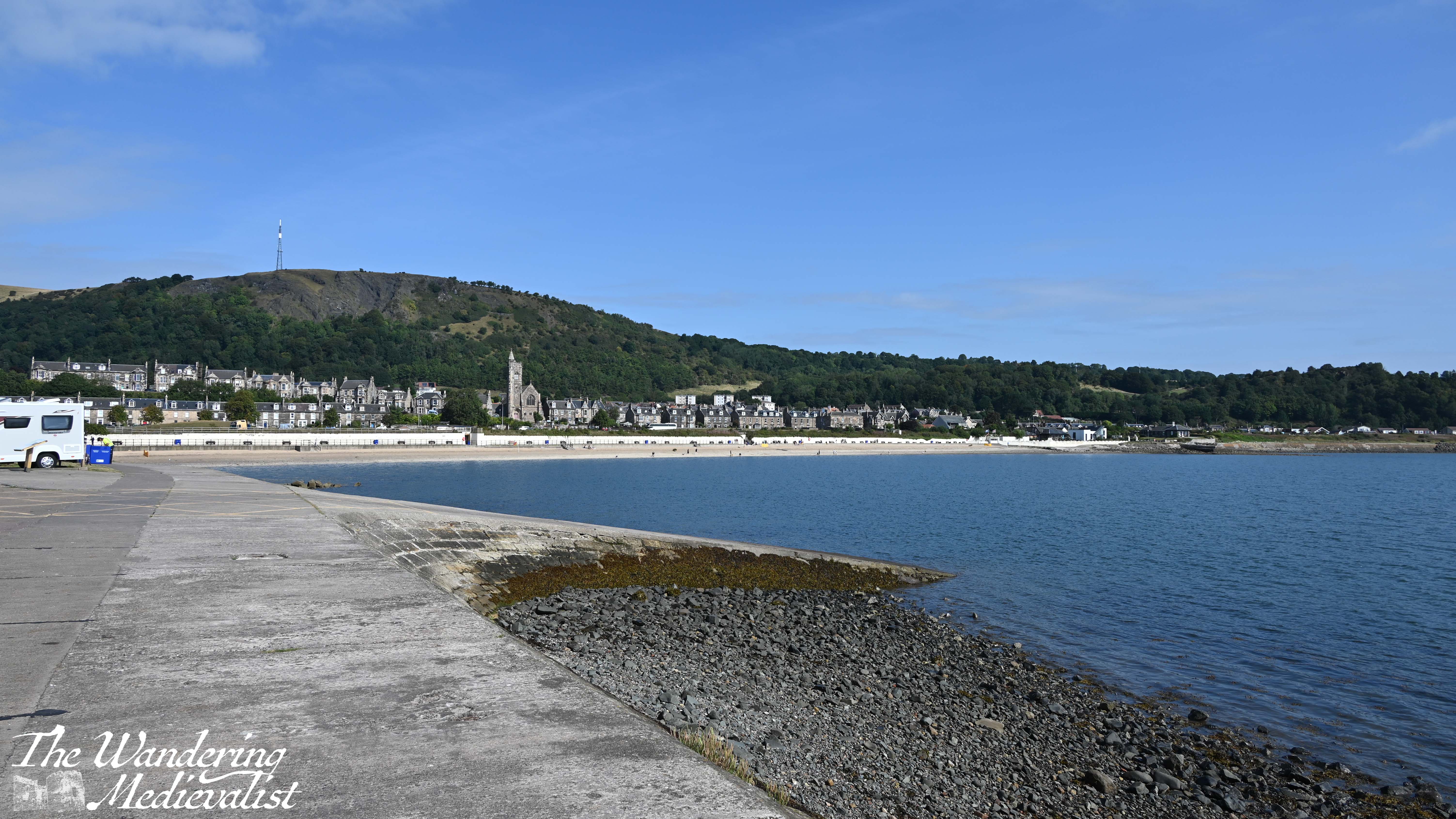
Burntisland promenade is narrower but no less busy than some others, with plenty of families and dog-walkers enjoying the sunny day on what was one of the last weekends before school. The beach was popular and there were life guards on duty, with large flags indicating where it was safe to swim. Just beyond their hut, the Coastal Path splits into two options: the high tide and low tide routes. It was about mid-tide, but upon looking at the low tide option, I decided I was not feeling up to proper long-term rock scrambling. So, I followed the road to the left, through another tunnel, and turned right along the A921.
This was a pleasant stretch of road lined with bungalows and cottages with well-kept gardens, and eventually runs past the town cemetery. Opposite the far end of the cemetery wall, there is another tunnel under the rails, and I chose this as my moment to re-join the beach. It was a steep slope down to the rocks, but beyond was lovely and sandy, with a relatively straightforward route that is solid and easy to walk on.
the low tide route
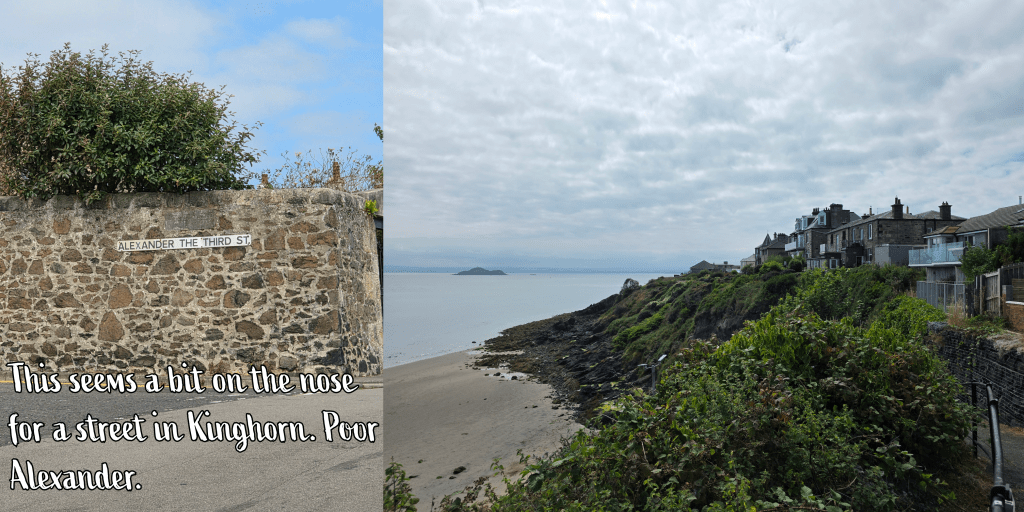
If I had stayed on the road a tad longer I would have passed the Alexander III memorial which would have been nice to see, but I did not realize it would be inaccessible from the beach.
The beach here is incredibly wide at low tide, with flats stretching far out into the Firth that I can only imagine are muddy and a touch treacherous. On a clearer day, the views across to Edinburgh and Leith would be excellent, and even on a hazy day they were impressive.
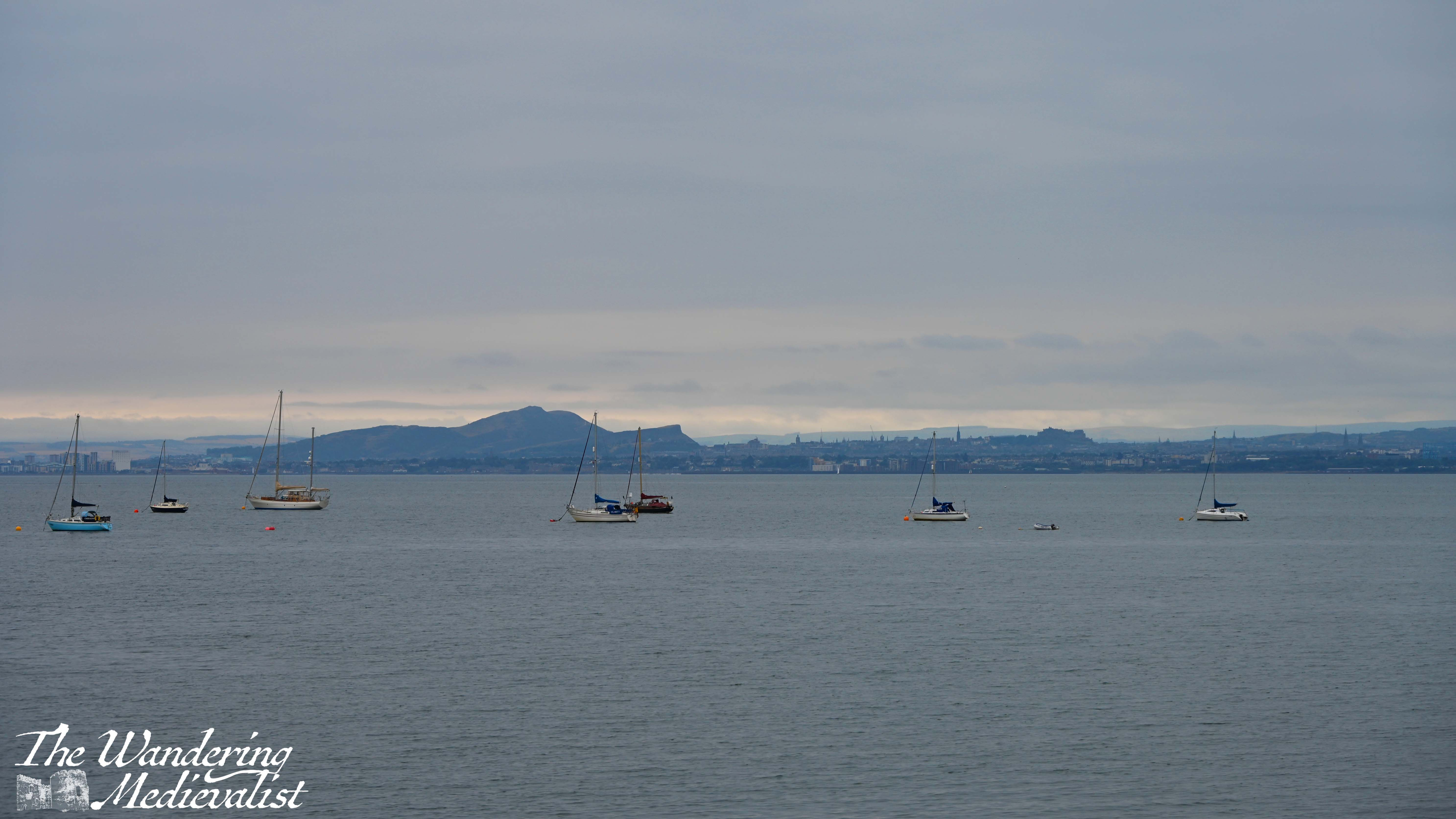
Another half mile or so beyond where I re-joined the beach, the dunes bulge out towards the beach, and the option is either to follow the sand or cut up to the grass. I opted for this, following the at times quite faint path through long grass, ferns, and various other flora. I’m not sure this was the most sensible option, but being slightly higher than the beach allowed some views back towards the three bridges – just peeking out over the headland – and a better feel for what you usually see from the train.
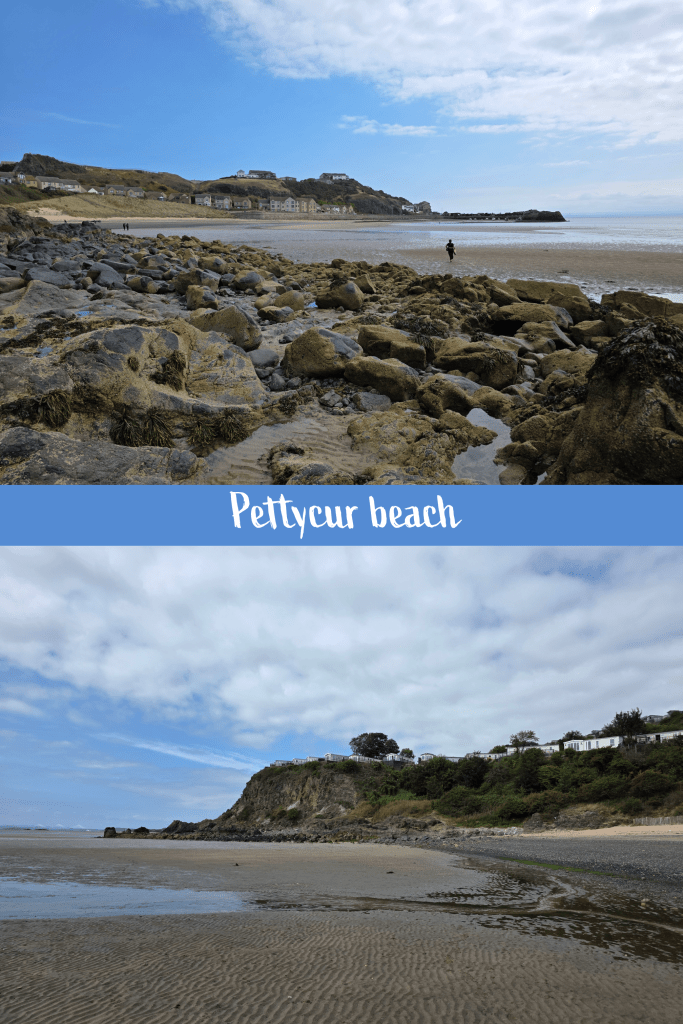
There was some near-bivouacking for a while, but eventually the trail re-joined the beach, with the road high above. As I approached Pettycur I could see a caravan park on the hill, and a steep flight of stairs leading up from the beach. This definitely was not what I wanted to see after a solid 5 miles or more of walking, and so I found a perfect rock ledge on which to take a proper break and enjoy my packed lunch. Which was, incidentally, inclusive of the all-American favourite, peanut butter and jelly (raspberry jelly, which in my opinion is the best).
God’s food, I will hear no objections.
It was salty, a touch sweet, and absolutely perfect.
This is one of my favourite pictures from this walk. Peaceful beach.
As I enjoyed my flash-back to the USA, I pulled out my up-to-date map of the coastal path to determine whether I had to climb the hill or not. After deciding that I could just as easily follow the beach, I made myself sit for 10 minutes enjoying the view before packing up again.
The route I chose definitely included a touch of rock-climbing as a tidal pool cut off the sandy option; fortunately, the rocks were not slippery but heavily encrusted with barnacles, which were great for grip. They would be torture should you fall, but I managed to avoid both a slip and wet feet. This was the case even once I had crossed the rocks and negotiated my way across the sand, which was rippled and wet but not enough to reach over my boot treads.
At this point I was in Pettycur bay, which included a small harbour where the boats were all beached due to low tide. I climbed the stairs at the edge of the harbour to re-join the road, which would have been the high tide option I think. My break and snack hadn’t really done much to reinvigorate me, and I found myself slowing down as I headed up the long slow hill of Pettycur Road that runs from the beach up to the top of the cliffs. The houses here reminded me quite a bit of parts of Marblehead – lovely, large modern places built on stilts or into the edge of the cliff, open to the Firth of Forth and ocean beyond. For those familiar, it was a touch like part of Marblehead Neck, right at the far end from the causeway, though these houses were smaller.
I had pretty much determined that when I reached the top of the hill, I was going to need another rest – I had been reluctant to look at the map to work out how close I was to Kinghorn. What rather gave it away was when I noticed road names that were Alexander III Street, and then David I Street – there is also a Canmore St and Queen Margaret St, showing the strong historical tie of the area to the Medieval Scottish crown. Suddenly, I realised, I was essentially in Kinghorn.
The sign for the Coastal Path turns right down a close, with the sea ahead, and at the end a set of benches. The view is, like so many others, spectacular – the ocean stretches out ahead, with the clifftop homes to your right and the town of Kinghorn with its train viaduct to the left. I paused for a few minutes to savour the triumph, though in doing so I missed that hour’s train. So, I took a gradual walk down towards the water before finding the spot at the bottom of the hill where I had marked the start of my journey from Kinghorn to Kirkcaldy.
I may have missed a few of the historical sites along the way that I hoped to see, but this walk really tested the limits of my fitness and I got to see parts of Fife I had only ever passed through.
It was a good final walk for the summer, I felt, leaving me in a strong place for when I come back from travels long enough to pick things up again. I’m looking forward to trying to stay fit while travelling – hotel gyms are uninspiring – but it’s a good goal to have, and I was really pleased when this hike didn’t completely destroy me. Was I a bit stiff that night? Yes. But it faded by morning.
After my plans for a walk last weekend were rained out (torrential rain, not pleasant Scottish mist), I was determined to get back on track this weekend. It has however been a long and stressful week at work, so I chose a slightly shorter route again rather than pushing myself for the five miles I was planning. After spending the last few weeks arranging my autumn travel, I am becoming concerned that the goal to get this walk done by end of January might be a touch ambitious, but I can only try and get as much done as possible. And it doesn’t mean I’m going to not finish at all, just that it might take a bit longer. Eagle-eyed readers checking my Fife Coastal Path challenge page may note that I have extended the challenge by 6 months. A new goal, and one I intend to keep!
It’s been a warm few weeks, but this morning I discovered a lovely cool air wafting through the bathroom window, and the sky was overcast but not threatening, so it seemed a good morning to make a bit of progress. So, I hopped on a bus to St Monans, where the primary bus stop is on the main road. It is a relatively short – though steep – walk down Station Road to the waterfront.
I finished my walk at the East Pier, and so it is here that I set my timer again, before heading up away from the harbour along Forth Street and then making a quick right onto Rose Street. Rose Street is lined with beautiful old houses and cottages so omnipresent in the East Neuk, and ends at a small car park from which the Coastal Path continues.
Immediately ahead, less than a ten minute walk, St Monans windmill dominates the horizon. A remnant of the 18th-century Scottish salt trade, the windmill pumped sea water into salt pans, which were boiled using the plentiful local coal supply – Fife was a major coal producer from the 1800s until the 1980s.
As you walk past the windmill, the remnants of the salt works are evident in indentations in the grass as well as the foundation ruins of a workhouse. I of course took a quick detour up to the windmill itself to see the view in both directions. Below the windmill is one of many coastal bathing pools though this one was empty in the brisk breeze.
As I kept moving, I was warm enough to manage with just a t-shirt, but wind-breaker would not have gone amiss. This section of the walk was already busy again – more so than further towards Kincardine – with dog walkers and even a few foreign tourists. Passing the windmill, one can already see Pittenweem in the distance, as well as across the Firth of Forth to the Bass Rock.
Not long before the houses of Pittenweem appear, the path splits with one route leading up the hill and the other along to the swimming pool, where there was a brave soul doing laps in what could only have been chilly water. Due to very evident coastal erosion, this portion of the path is quite new, heading up the hill towards West Brae, where there is a small snack shop and a mini golf.
The coastal path heads down again after this brief rise and around the corner to a great view of the town. The sun was trying to come out as I reached this point, desperately fighting against the clouds, which made for some very dramatic colours, as you can see above.
The route enters Pittenweem on the path between the coast-facing houses and the rocky shore; clearly an area built well before the advent of cars, when it would have been more likely to take a boat to your doorstep. Shortly the path opens up to a road and a car park, at the end of which is a beautiful statue that is the Pittenweem Fishermen’s Memorial – the figures of an anxious mother and child looking out over the sea for their returning loved ones. It could as easily be in my home town as here, though Pittenweem is still far busier as a fishing port. In fact, it is the busiest port in the East Neuk with an active fish market.
I took a short detour – again – out the harbour wall where you get a real feel for how active the place still is. There are some beautiful old buildings at the water’s edge, which I took a bit of time to appreciate before heading on my way.
Beyond the harbour, the path heads up a hill along Abbey Wall Road, which is lined with houses. I love the way the stone wall rises from the rock, as if they were one.
Then suddenly, at the top of the hill, the view opens up and is a gorgeous vista over the ocean and coast in both directions.
From here to the edge of Pittenweem, the path hugs the top of the cliff, with neighbourhoods disappearing up roads to the left, and the path a hazy line through Glebe Park, some grassy patches and behind walled gardens.
It’s the time of year for flowers!
As with most East Neuk villages, the edge of Pittenweem is very dramatic, with a line of houses right up against a wide field. Less than a quarter of a mile beyond, the path takes a turn down the coast with some relatively steep rock steps that could easily be slippery if they were damp.
Descending the rocky steps, one finds the first signs for Anstruther Golf Course, and the alert that walkers should be courteous of players and listen for any signs that an errant ball might be coming their way. Wildflowers line the narrow trail until suddenly they stop, with well-manicured grass immediately ahead.
Generally, the Coastal Path is best followed by keeping close to the edge of the grass, where it meets the rocky shore. There are some great views back along the dramatic shale coastline, back to Pittenweem.
In little time, the edge of the golf course moves inland, with the path sticking close to the shore. It isn’t particularly well marked, but as long as you stay on the edge of the line where the shore meets the beach, you are in good shape, and there is an obvious trail. There are also some relatively gentle ups and downs – in fact this whole section has a few more ups and downs than many on the East Neuk – between grass tufts, a few boulders, and some more wild flowers and gorse.
You will pass this beautiful white beach made entirely of shells, which some have used to write out messages on the rocks as they go by. It looked to me like the kind of beach nicer to look at than walk on – sharp shells are not the greatest material to explore.
Around the corner from this beach, Anstruther opens up ahead of you, and it is possible to get a real feel for the size of the town. While not enormous – the population is about 3,500 – it is the largest town in the East Neuk with a seafront that stretches for more than a mile, including its busy harbour and beaches.
Above you on the left is the Anstruther war memorial, designed as a medieval-looking tower with crenellations on top, and over to the right on a rock is a lone saltire flag, quite dramatic against the sea.
There is a playpark here which was busier with dog walkers than children on the day I passed, then the path circles around between Anstruther beach and the first hole of the golf course.
Beyond the beach, you pass the golf club itself, which must have a stunning view over the ocean and Anstruther harbour. The coastal path continues straight here into the residential neighbourhood and is well-marked, taking walkers up Crichton Street. If you take a short detour at this point though, you reach this lovely wee cottage and view over the sea – I can’t resist a stone cottage!
At the top of Crichton Street, turn right onto the A917, which is the main route along this part of the East Neuk, running from St Andrews down towards Elie. Though it is narrow, this portion of the road is quite busy with cars and busses and trucks, sometimes going a touch faster than would be wise.
One of the first notable buildings is the Dreel Tavern, which sits at an angle away from the road. Dating from the 18th century at the latest, the Tavern currently serves meals and drinks, both inside and in the large beer garden to the rear. Also to the rear is the Dreel Burn, along which you can walk in both directions, though it shortly winds around the churchyard and across the beach to join the ocean. There is a great deal of work being done at the moment to restore the water quality of the burn.
Beyond the tavern on the opposite side of the road, there is a lovely stretch of well-restored older homes in bright colours, and on the corner a house that has been meticulously decorated with shells.
From here, you have two routes. One is the official Coastal Path route, which carries on along the High Street, crossing the burn, and then following the road into the centre of town. Keep to the right, passing in front of the Bank Hotel, and then turn right to meet Shore Street. There are bus shelters on either side of the road, but be careful when choosing a side. Busses to St Andrews, for example, leave from both sides depending on the route, so make sure you check the time tables! While several routes pass this way, frustratingly they tend to arrive around the same time, so you may be left without transport for a while. Fortunately, there are plenty of shops and cafes in which to pick up snacks. And of course the famous Anstruther Fish Bar.
There is another option however, and this is not to turn left along the High Street, but instead to continue straight down the Esplanade, to where there is a car park. If you choose this route, do take a short moment to detour back to the Dreel Halls, which is the tall yellow building you cannot miss. Formerly a church, the upper part was built to house the Town Hall in the 1790s, while the downstairs was used for a school.
Once you have taken a short wander through the extensive graveyard, return to the Esplanade and head for the car park you can see ahead. The homes here are mostly 18th-century or so, and some are beautifully decorated.
The view from the car park is excellent in all directions.
But what is most intriguing – and possibly only accessible at mid- to low tide – is a notch cut in the wall, and a steep flight of stairs leading down to the beach. At the bottom is a set of concrete stepping stones that allows you to cross the water of the Dreel Burn.
The beach ahead is soft and sandy, and can be a bit of a struggle if you are wearing heavy boots. The view of Anstruther in the gathering clouds was stunning, though, and I was pleased to have opted for this route.
As I headed for the bus shelter, these dark clouds became more and more ominous, and I was lucky I think not to be soaked. Fortunately, the breeze of the day continued in my favour, pushing the clouds past, and an almost blue sky returned as I waited for the bus.
Next weekend, I’m aiming to wrap up the East Neuk with the Crail to Cambo route. We’ll see how I do!
Scotland (and indeed the whole UK) was blessed last week with a stretch of sunny, hot weather that encouraged everyone to get outside. And then back inside, quickly, to get sun screen and water bottles. In England the temperatures hit the 30s (about 90°F), and in Scotland the high 20s which qualifies as a genuine heat wave.
I was eager to get back to my Coastal Path goal after several weeks of travel and then post-travel illness (I blame Charles de Gaulle airport, where I was re-routed after a flight delay), and this sunny spell was the perfect incentive to get out there. So, I chose a slightly shorter route than I had been doing in May, only 4 miles rather than 5, for while I’d kept up my walking during my travels, the cold/cough combo on my return meant I’d had two weeks for my stamina to unravel.
It was time, I decided, to tackle some of the south coast of Fife beyond the East Neuk, and so I planned the train trip to Kinghorn, where the rail station is almost immediately on the Coastal Path. Since the opening of the Leven Rail line, the trains from Edinburgh to Dundee no longer stop at these smaller stations, and so I was required to change trains in Kirkcaldy. Fortunately, the Leven train was only 5 minutes behind, so I was only slightly delayed; if coming from the Edinburgh direction, it would be easy to get on the direct Leven train.
The day was sunny and bright when I alighted in Kinghorn, which is a station I have always wanted to stop at due to the beautiful view from the train at this point. This section of the track is why I always encourage visitors to sit on the right-hand side of the train coming north.
I paused to take a few pictures and hoped to use the facilities in the small station, but found them out of order. So, I headed down the steep hill towards the coastline and beach.
Kinghorn may not boast quite the same stunning nature as some of the East Neuk villages, but the beach is beautiful and there are regular views across the Firth of Forth towards Edinburgh. It was a clear day so that I could see the outline of Arthur’s seat and the coastal town of Leith clearly, while a gentle breeze kept the temperature comfortable and the bugs at bay.
The path starts off along the coast then loops back up under the train track and through a fantastic pirate-themed play park.
Beyond the park, the route passes once again under the rails, then turns left along the back side of a caravan park. This portion of the trail is quite narrow, stuck between the fence for the park and the fence for the train line, so keep a look out here for other walkers/runners and cyclists. I should say, I did not pass many people at the Kinghorn end of the trail, but as I approached Kirkcaldy there were more and more people using the path for a Saturday morning jog or stroll with the dog.
I mentioned above the rail track, and it’s worth pointing out that this is a relatively busy line, so don’t be alarmed by a sudden, speedy train interrupting your peaceful walk. And peaceful it is, gently rising and falling along with the coast, a similar feel to other sections of the walk with the rocky beach on one side and a grassy slope on the other, dotted with bushes, wild flowers and the occasional tree.
The ocean was incredibly still on the morning I walked, with only one or two fishing boats out; the gentle breeze I enjoyed was definitely not enough for sailing. It was difficult not to pause regularly to enjoy the view back to Edinburgh , and if my camera battery had not died 10 minutes in (my own fault for not checking it), there would be many more I am sure. Fortunately, my phone takes good pictures so I made up for the lack as best I could.
Gradually the path goes around a curve in the coast, and rises temporarily away from the beach on a sharp switch-back style path. The view from the top is even better, though it does not last long, with the trail gently descending over several stair cases. One advantage I noted of this portion of the path was that there was a fair amount of shade, relieving the heat of the sun for a short while. This is definitely not the case closer to Kirkcaldy.
Just over a mile out from Kinghorn, there is a steep climb up to the top of a hill, to a viewpoint at the top. This is one of the last really good views back towards Edinburgh and along the rail line, while ahead you can start to see the buildings of Kirkcaldy.
The path descends again towards the beach level, and around a corner the houses at the very edge of Kirkcaldy come into view, along with the ruined Seafield Tower.
Upon a bit of searching, I discovered later that this tower is all that remains of a late medieval (sixteenth-century) castle. It was sold to the Bishop of Glasgow in 1631 and after passing through several families was allowed to deteriorate to the state it is in today.
While the day was still clear and sunny, in the distance I could see that further north and east in Fife, the experience was not the same – instead, a thick haar (Scottish fog) was layered over the coastline from Elie around to Tayport.
From where I stood, I could just see Largo Law rising above the clouds.
And here I’ll take a break for a short opinion poll – let me know your answer in the comments!
Would you rather be able to see the end of your walk, even if it is several miles away, or would you rather have no idea how much longer you have to go?
As I walked towards Kirkcaldy, I could see in the distance the faint outline of Ravenscraig Castle, and the much more prominent high-rises of the Ravenscraig flats, which I knew were my goal but still seemed a long way away. Fortunately, I was distracted by how lovely the beach and coast are. It was approaching low tide so there was an expanse of sand, interspersed with rocky outcroppings. The old sea wall is still present though large portions have been washed away, creating dramatic gaps through which to see the view. Above me on the top of the hill to the left were increasingly well-appointed houses, many with large balconies overlooking the ocean.
Once past the old sea wall, the path continues along the beach which is now completely sandy, and was already starting to become busier with poeple eager to enjoy the sun.
I found the coastal path to be less well sign-posted here, and eventually had to look up the proper route on my phone, as I walked along the grass at the edge of the beach, past the car park for Seafield beach. There is a large Morrisons here, and officially the coastal path leads up to the left and around the store and car park. This is a good spot to stop for a snack or cold drink, if you need it. There is also, I am relatively certain, a route that takes you between Morrisons and the beach – or you can walk on the beach of course – but I was doing my best to follow the ‘official’ trail that loops around and then follows the main road past a Lidl supermarket.
There is no need to cross the road – stay on the Morrisons side and follow the sidewalk (or pavement, for the Brits) around the edge of the car park – this is now the A921.
In short time, the road crosses a small burn – Tiel Burn – and here there are public restrooms should you need them. At this point, the path is not well-marked at all, but I determined that it made sense to swing to the right and follow the seawall at the edge of the beach, onto Kirkcaldy Esplanade.
I admit to being really impressed with how well-kept the esplanade is, especially as it was first built just over 100 years ago. Stretching for just about a mile, it is wide pedestrian route with a relatively new seawall separating it from the sandy beach. There are periodic breaks in the wall for paths down to the beach, and very recent additions to the pavement in the form of games to entertain children. There was a world map, several hopscotch outlines, suggestions of places to run, hop and skip, and much more, all brightly painted in clear colours.
Beside the pedestrian area is the busy A921, and across the road a series of shops, parking areas, and some apartment blocks. As I walked along the coast, I began to notice wisps of mist blurring the view – while not a full-on haar, there were gentle clouds rising from the sand and hovering in the still air. While it did not come together into a total blockage of the sun, the mist was gathering more heavily, and as I reached the end of the esplanade, the sea wall at the far end of the beach was hard to see.
At the end of the esplanade is the Heart of Kirkcaldy, a famous art installation that is popular with selfie-takers, and here I started again seeing signs for the Coastal Path. Rather than following the coastline around to the right, the path crosses at the stoplight and heads straight along the A921. Here there is an odd mix of much older buildings on one side of the street – 17th and 18th century – and very new apartment blocks on the other, as all of Williamson’s Quay is much more modern accommodation.
About five minutes later, there are two onward alternatives, marked by a pedestrian crossing. One is to continue straight up the hill ahead, along the road. The other is to take a right and then almost immediate left past the Carr’s Flour plant, and along the coast. I have to admit to getting this bit wrong, as the Coastal Path signs seemed to point directly into the factory grounds, and were a touch vague. So, I deviated from the path and went straight up the hill which is quite steep and a good long climb, especially after walking for about 4 miles.
My goal for the end of this walk was Ravenscraig Castle, a mostly-ruined edifice at the edge of Ravenscraig park. I did just see it from the road, but realised as I planned my route to it that I had firstly lost the Fife Coastal Path but perhaps more importantly, was about to miss the only bus I could get in that hour. So, I took a quick picture from across the burial ground then legged it across the street to the bus shelter, where a kind woman assured me that the bus had not yet come.
On the rather long and winding bus trip back to St Andrews, I was able to see just how all-pervasive the hair had become in Fife, with heavy clouds of mist reaching over the land from the coast and settling into valleys.
Observations on this section of the path are that the first section, which reminded me of many others with rocky beach and grassy slope, was a much shorter part of the 4 miles than I realised; instead, at least half of the walk ran through Kirkcaldy, both the along the beach and then the Esplanade. It’s a less nature-focussed walk, but the views are impressive and it was a good way to get back into my habit of waking on a Saturday and getting moving.
So, I shall soon have to repeat this section of the walk and actually visit Ravenscraig Castle, then make my way along the coast towards East Wemyss – who knows, perhaps next weekend?
In case you are concerned that my last few posts have indicated a Scotland far sunnier than you have been led to believe is possible, please allow this post to alleviate that concern. The beautiful weather we enjoyed for most of May has passed into days a bit more standard, with clouds and drizzle driven along by strong wind, allowing for sunny patches amongst the grey.
This route from Newport to Balmerino enters the realm of walks that are a bit harder to access. Busses to Newport are less frequent, and as far as I have been able to work out, there is no regular public transport to Balmerino. There is also considerably more ‘out in the countryside’ to this walk than some of the others, with the trail taking you through fields and a forested area. But as usual, I am getting ahead of myself.
After a long and winding route on the 77A bus from St Andrews, I alighted in Newport, only a few hundred yards from where I had marked the end of my walk from Tayport. To keep myself honest, I back-tracked slightly to that spot, and set my Fitbit walk timer to go from there.
Heading away from Newport town centre takes you south-west, and at the end of the high street the road splits with outgoing traffic taking the higher route and incoming traffic the lower – the coastal path takes the right fork, hugging the edge of the Tay. On one side of the road is a stone wall above the rocky beach, on the other side a series of apartment blocks, a coffee shop and a pub.
You can already tell from these pictures that the day was much less pleasant, overcast though quite mild. Only a gentle breeze – or sometimes less than gentle – kept it from being muggy. Boat Road is a great spot to look over towards Dundee, and try to identify various neighbourhoods and buildings.
At the end of this stretch there is a marine warehouse and wharf, and immediately beyond a restaurant building. Here the path starts moving up to join the high road, with a retaining wall rising up on the far side of the road.
At the top of the hill the path continues through the edge of Newport, the houses a fascinating combination of old, stately and quite modern. There are stretches of row cottages similar to what you might see in Tayport, and overall one gets the feeling that there was definitely money here, as the wealthy Dundonians built homes across the river.
There are some really quirky houses here, including this yellow faux castle, and a house with a garden absolutely packed with statues and carvings. Lanterns, fountains, cupids, birds, animals – all of it nestled into the verdant garden. I particularly like the houses where one has to go down a flight of stairs and along the garden path to get to the front door. Here and there are wide driveways winding away from the street toward old estates.
About 3/4 of a mile from the starting point, the walk crosses the line from Newport into Wormit. This is about when it began misting heavily – not quite raining – though it lasted only a few minutes.
The edge of Wormit is a bit more modern in construction though it isn’t long before the houses return to the traditional Victorian style. There are glimpses through the bushes and gardens of the water, just enough to remind you that you are still on the coast, and you find yourself closer and closer to the rail bridge with each viewpoint.
I have to admit to finding this portion of the walk a bit less invigorating. It may just be that it was one town that was very similar to the next, though the gardens were lovely. Wormit is long and narrow, and the road passes the Primary School, where a class was out playing football, as well as the parish church and plenty of lovely cottages. The poppies were passing by – just – and the rhododendron blooming, with some early roses out though most were still only showing promise of what they would become.
Eventually, almost two miles from where I started, I found that the path branches off from the main road, heading down a hill and towards the shoreline. Here are some excellent views of the rail bridge, and a line of lovely little cottages so typical of the late 19th century.
What I imagine is the older, brick portion of the bridge stretches out over the road to meet the newer section, and in time the path goes right under the bridge, with glimpses of the water and structure through the foliage.
Once under the bridge, the coast side opens up again briefly, and the coastal path continues through the neighbourhoods, varying between newer constructions and older homes. As the path descends, it suddenly becomes apparent that you are reaching the edge of town, with hills covered in fields rising ahead.
Very suddenly, the town ends at Wormit Bay, a relatively un-sheltered beach primarily of rock. There are parking spots for camper vans and mobile homes, a few benches, and would likely be a lovely spot on a nicer day.
At the far end of the bay are three stone slabs, a memorial to the Tay Rail Bridge disaster of 1879. On 28 December of that year, during a violent windstorm, the first Tay Rail Bridge collapsed just as a passenger train from Burntisland to Dundee was crossing. There were no survivors, and the pylons from the first bridge are still visible below the new bridge.
Just beyond the memorial, the path goes past a Coastal Path marker and carved stone seal, then climbs relatively swiftly away from the beach. Here it becomes a proper hiking trail, narrower and rocky, a nice change from the village road. I could hear a primary school class exploring the beach below with buckets and spades, and flashes of brightly-coloured raincoats and excited shouting indicated they were having a great time.
Unlike the East Neuk trails, this portion of the path is clearly less used, and while it is well-marked, I did not pass a single person from Wormit onwards (though I was also walking on a weekday, rather than weekend).
Shortly after leaving Wormit Bay, the trail goes through a metal gate, and there are warning signs for cows – while I did not see any immediately I could certainly smell and hear them, as well as sheep and the occasional rabbit, so any dogs on this trail should definitely be kept on a lead. Cow pats are plentiful even if cows aren’t, and I found myself watching my feet a bit more as I hiked up and out of the tree line.
This portion of the trail is one I have determined I must try again on a nicer day, as the views over the river were lovely. The tide was incredibly low, with large stretches of sand bank visible, reminding me that the Tay has silted up since the Middle Ages. Closer to Balmerino, I could just see a wrecked ship through the trees, and more stretches of sand.
The most spectacular view, though, was when I paused for a moment at the top of a ridge to catch my breath, and looked back over Wormit. Even in the dull grey and framed with faded yellow gorse, the village and rail bridge were clear, and showed how quickly the town disappeared into the hills.
I took many versions of this picture, and I hope that on a sunnier day I can do even better. Eventually I did have to hide my camera from the spitting rain, but the exertion of climbing the hill meant I did not mind a bit of dampness. I could see different weather ahead and even a patch of sunshine on the far bank, though it did not last and the blue skies I was glimpsing never quite reached me.
I was also a bit disappointed not to come across any coos, despite the signs. Evidence was everywhere and the trail here is quite uneven, so I definitely had to keep an eye on my feet to avoid turning an ankle or slipping into the grass. There is no question that this is proper countryside, as all evidence of other people fades, and the path rises and falls through several fields and another gate or two.
A burn cutting through the fields must have over millennia carved into the hillside, creating a tree-filled valley that the path dips down into. The way was barred by a fallen tree – more evidence that this part of the walk is not quite as popular – but I was able to make my way over the branches and then climb up out the other side on a set of stairs.
While perhaps not as well tended, I can assure walkers that this portion of the walk is well-defined, with regular way markers that were often a bit less obvious in town. That said, there are very few places where you can go anywhere but along the path. From here on it is single-file only (if you are walking in a group), with grass and nettles grown up on both sides of the trail. The fields on the left disappear into trees after some time, and it was incredibly quiet.
Side note, I was asked recently if I listen to podcasts or music while I walk, and actually, I tend not to. Firstly, because I have never really gotten into podcasts though I am regularly told that I should. Secondly, and really more importantly, because I like to listen to the peace and quiet. The sounds of the trees, the wind, the water.
That said, this stretch of trail went on for quite a bit longer than I had thought, (it’s about .75 miles) or perhaps I was just more tired, as it took me longer than I expected. On both sides of the trail is a sharp barbed wire fence – deterring walkers from wandering I suppose, or from going too close to the steep cliffs.
I felt myself starting to flag a bit, especially when a break in the fence and job up to the left meant entering an enormous open area that looked newly ploughed by the several tractors abandoned nearby. Roots and bits of tree indicated that it might have once have been fully overgrown, but all that was left was soft dirt and vehicle tracks. I found this terrain quite difficult to traverse, with my boots sinking into the soil and caught on the roots.
I was starting to wonder if I would ever reach Balmerino, when I crested one last rise and realised that houses were visible above me on the hillside. Finally.
A steep flight of stairs leads the path down to the level of the coastline and beach, and while I was getting tired I knew this was a good thing, and that the Coastal Path at Balmerino was level with the beach front. Sure enough, a narrow path and signs indicated the way between the seawall and several white houses. These homes are clearly old, their style indicating perhaps several hundred years, but they are all well-kept, freshly painted and maintained.
While the coastline itself has turned south slightly and so is more protected than in Newport and Tayport, there is still a strong wind here, smelling of seaweed and salt. It felt excellent after so much traipsing through fields, and I enjoyed walking slowly along the beachfront, which reminds me a bit of the beaches of Marblehead – rocky and not hugely welcoming.
Finally, I ended my walk at another set of wooden seal statues, on a small grassy promontory. I have not yet worked out how I will get back to Balmerino to continue the walk, as there really is not anywhere to park, but that can be a problem for later in the year.
Balmerino itself is a small village, with one narrow road leading up the hill from the coastal path, with most of the homes from the 18th or 19th century.
It is a relatively short climb up to the ruined Medieval abbey, which is where I had agreed to meet the other half. Fortunately, I had just enough time to wander through the ruins before sitting down to peel off my boots. I had first visited the abbey several years ago, on one of my first ever solo adventures, and it was very little changed: haunting, I think, is the best term.
Weather notwithstanding, I enjoyed this stretch of the coastal path though it is perhaps less stunning than further south. It is certainly a good mix of town and countryside, and I hope to do parts of it in sunshine on another date. Recommendations are definitely sturdy boots – probably not even sneakers – and some bug spray, plus layers! Though none of that is really new advice.
Unfortunately travel means I will not be able to complete any more walks until the end of June, but I’ll do my best to keep my fitness up!
I have to admit to rather dreading this section of the Coastal Path. I have walked it before, and compared to some of the East Neuk stretches, it is busy, noisy, and not as stunning. However, it is required and so I chose to walk it before it got too late into the summer and harvest season. The last time I walked this route, it was August and there were 1 million harvest flies, several tractors stirring up dust, and enough pollen to defeat any anti-histamine.
There are plenty of good points about this section, though: it is fully accessible by public transport, relatively flat, paved, and moderately busy (can be a plus or a minus depending on how you see it).
I started this part of my journey by getting off the bus at the Old Course Hotel bus stop, just opposite the Gateway Building. From here you follow the path directly behind the bus stop and very quickly come upon a car park, and your first signs for the Coastal Path.
Golf enthusiasts will want to take a short detour here to go closer to the course, which here is the 17th Green of the famous St Andrews Old Course. Views looking back to the Royal and Ancient Golf Club, the 18th Green and the Hamilton Grand are stunning. You can tell that one of these pictures was taken several years ago when we had more rain than we have had this spring….
The official route of the coastal path leads here along Station Road to the left. The first buildings passed are the spa and the impressive Old Course Hotel, where most celebrities and famous golfers stay when they visit St Andrews (unless they rent a house of course). The menus are impressive and restaurants are beautiful, and they offer high tea with some of the best views in town, looking over the golf courses and beach.
Beyond the hotel is the driving range, and across the road are a series of sports fields, which on the morning I walked were busy with Saturday football (soccer) games. This stretch of road is always lined with parked vehicles, both parents going to games and the luxury coaches of the golf tour operators. At the far end, the path crosses the road to the driving range, and continues off along to the right.
I took a quick detour to get a picture by the town sign before heading back to the path. The signs here are evidence of just how busy this stretch of path is – cyclists, often in groups, take advantage of the pavement while walkers and runners are regular users. I deviated from my normal no-earphones walking pattern, but I was careful to always look around before moving from one side of the path to the other.
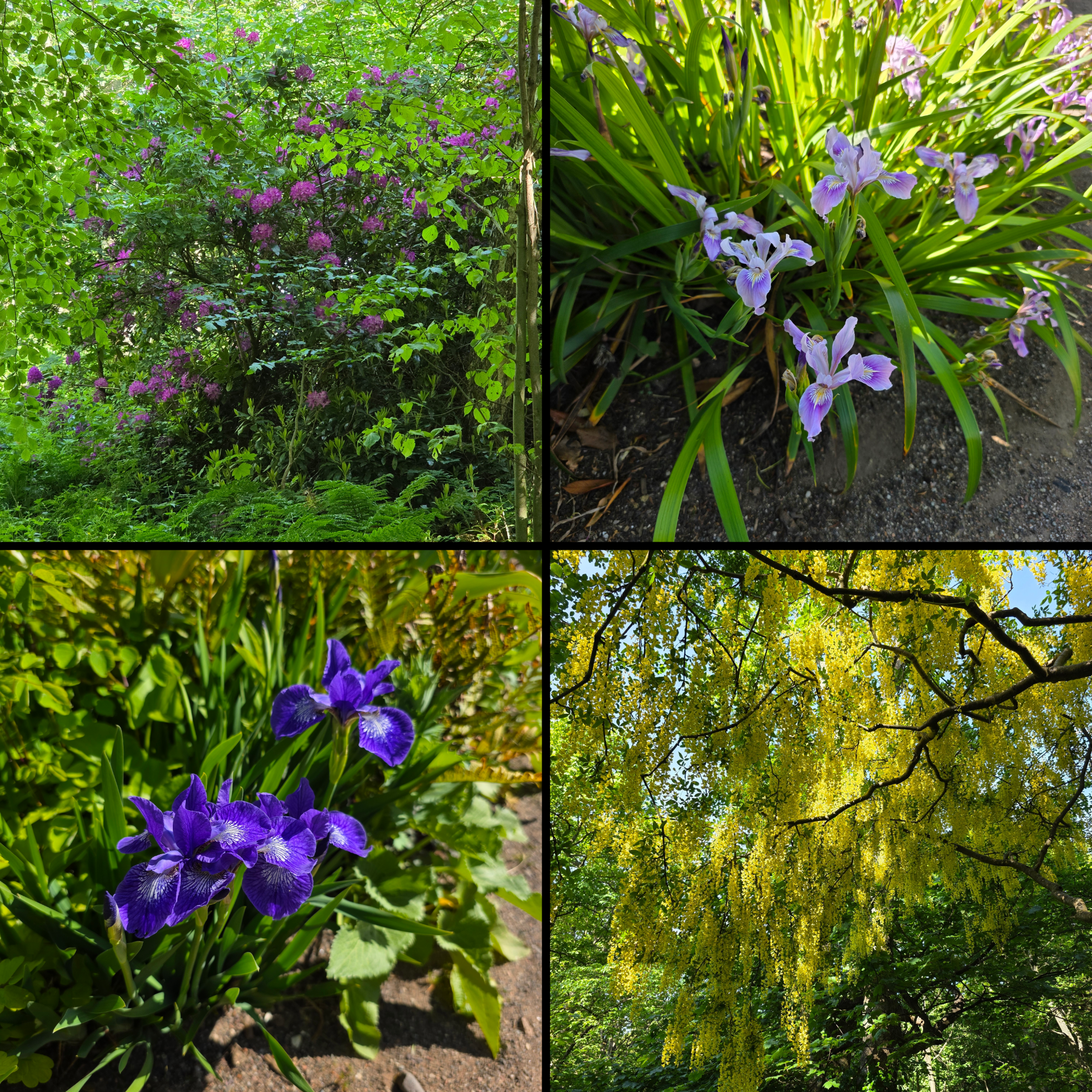
The first mile of this walk is quite pleasant, with trees for shade dotted along and the potential for lovely flowers – some roses, lots of yellow gorse and white flowering bushes. There are several breaks in the foliage for vehicle access, and the first one is very close to Balgove Larder, an upmarket farm shop that sells local produce, bread, cheese, meat, beer and liquor, and much more. It has a great café and a steak barn that is hugely popular.
Along the right-hand side of the path is a large hedgerow, separating the coastal path from the Balgove and Strathtyrum Golf Courses. Periodic breaks in the hedgerow offer good glimpses of the fairways.
Then, about a mile and a quarter outside of town, the golf course abruptly stops, and the right-hand side of the path opens up to wide fields, those I am so eager to avoid later in the year. A hedge on the left continues to separate the coastal path from the busy A91. A short while longer – I confess I forgot to mark how much further, but probably 5-10 minutes walking – and the hedgerow disappears, replaced by only a stone wall separating walkers from the road.
While you can turn to look back at the town at several points along this path, I confess this is the part I like the least. It is very noisy with constant traffic, and there is not a huge amount to see. At the point where you can feel the path rising slightly and curving around to the right, it is a good time to look back at the steeples of St Andrews, just visible over the tree line. When driving, this is an iconic view of town, and one that even now makes me feel, just a touch, as though I am coming home.
Then, about three miles from St Andrews, the stone wall separating the pavement from the road ends, and the Coastal Path becomes essentially what in the US we would refer to as a sidewalk, running along the road. The traffic on this road should be explained briefly in that this is the primary route into St Andrews from the north (Dundee), as well as traffic coming from further west in Fife, Edinburgh, Glasgow, etc. Busses run along this road to Leuchars station every ten minutes, plus large coaches going to the bigger cities, tourist coaches, and plenty of commuter traffic. When something stops traffic on this road, it takes very little time to build up for miles in all directions, bringing movement even in St Andrews town centre to a halt.
This is also where the view across the fields becomes a bit more interesting, as you can see to Tentsmuir forest and get a good feel for just how big Leuchars Air Base is. Just past the turn-off for Kincaple, you can also start to get a good view straight ahead, with the distant Guardbridge mill buildings just visible, and the lump of Balmullo Law against the horizon. The Law stands out from any other hill by the obvious scar of the Balmullo quarry, a stark brown against the sky.
The path is quite narrow at a few points here, and you have to hope you don’t meet any cyclists, but as the road curves again towards Guardbridge, fields open up to the right along the estuary, along with a few groupings of houses. The hedgerow to the right has a few gaps to allow views across to the mill buildings, now run by Eden Mill, a local distillery.
As you approach the village limits, the hedge also vanishes and the path to widens a bit. You will note a beautifully-kept white guest house surrounded by fields in which horses frolic away (and also the occasional bold rabbit).
You know you are getting close when you pass Fast’n’Fresh across the road, a sandwich and refreshment spot that would be a good place for a break should you need one. A caveat though in that there is no pedestrian crossing, so you do have to make a bit of a run for it. You’ll also see the road up to Strathkinness here, and shortly after, the Guardbridge town marker.
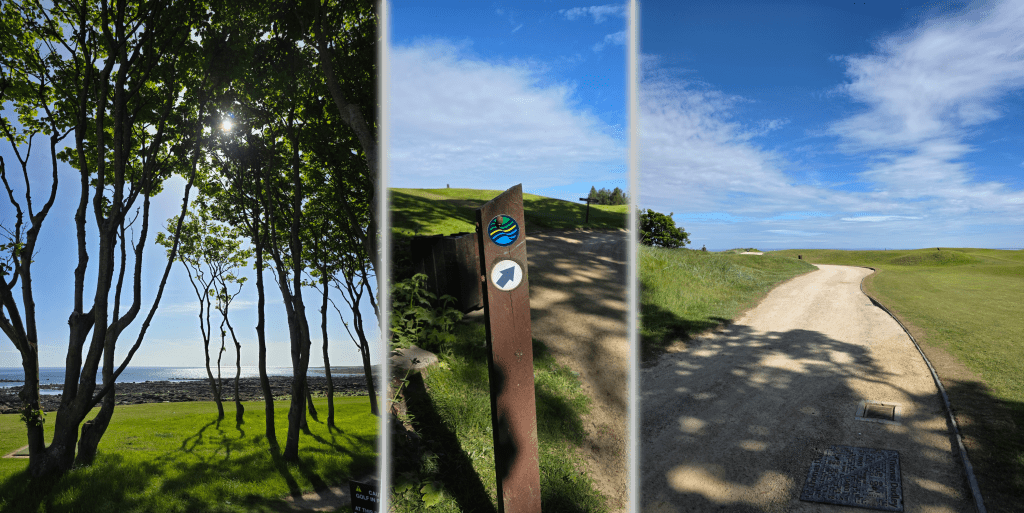
At the crest of the hill at the edge of town, the Coastal Path breaks off from the main pavement and branches right, onto Old St Andrews road. There are some large rubbish and recycling skips here, a few tables, and signs for the Guardbridge Inn.
This is the edge of the residential part of Guardbridge, with houses appearing on both sides both quite new and clearly of an older era. At one point, you can look directly down the road, across the bridge, and up Cupar Road on the other side of town. It is worth observing at this point that this route follows what was once a train line into St Andrews. There is a small local element looking to reinstate the line – which closed in 1969 – but much of the route is now golf course and fields, also residential.
Both this bridge, the pylons in the Estuary, and the north bridge at the end of this walk are evidence of the former train line, and the required alternative bridges for road traffic. The bridge that pedestrians now cross on the Coastal Path is either or was once where there was a medieval bridge, build in the 1400s by Bishop Wardlaw of St Andrews.
At the bottom of the hill, just before the bridge, is the Guardbridge Inn, a fantastic place for dinner or just a few pints with friends. They offer tables out front as well as in a grassy area along the estuary at the back; this was one of the first places we enjoyed a drink after the pandemic lockdown, when we could all sit outside and enjoy the sun and social distancing. The chef is excellent and the building itself is lovely, though I am not sure of its age.
By all means, schedule a stop here if you can! Or, at the small coffee shop and antique store below, which I admit I have never frequented but about which I have heard good things.
Continuing on from the Inn, the coastal path crosses the old bridge, which I have always preferred at high tide, and which you can get an excellent feel of from the Inn, and from the far side of the bridge.
The bridges both end at the main Guardbridge roundabout – another popular spot to hold up traffic – which unfortunately you must cross at this point, heading for a break in houses on the far side of the road.
In theory at this point there are two paths through Guardbridge, one along the main road which allows you to get refreshment at Dan’s Goods (a small convenience store), detour through the park and even the University’s Eden Campus. But, the official Coastal Path takes a route behind the main residential section, with back gardens to the right and a hill leading up to the left. Once you cross at the roundabout, follow the signs between the houses, and then cross the small parking area to another gap between gardens. Here the path is again beneath the trees – a relief after a sunny stretch – following the former rail line; it is quite well-marked. On that hill stretching up to the left is the Seggie estate, which was a farm but is now a large housing estate that has been built over the past few years, adding several hundred homes to the village. For a longer walk, you could go up Cupar Road and walk through the estate, where there is a walking path through some tall trees allowing a view over the university campus and the estuary beyond.
About five minutes along the path, the houses disappear and there is a wide open space where a condemned rail storage building was torn down. It has been vacant for some time, and there is great supposition as to what might be constructed there.
On the other side of the road from here until the end of this stretch is the Eden Campus, which was built by the University of St Andrews in the late 2010s and opened for staff use at the end of the pandemic. When I first arrived in St Andrews many years ago, the buildings still housed Curtis Fine Paper. They were originally built in the 1870s as the Guardbridge Paper Company. The town grew up around the mill, which employed more than 600 people in the 1950s. Many of the original elements of the mill remain today including what were wide doors for horse-drawn wagons to enter, and the Guardbridge clock that overhangs – almost – the road. The University was careful to maintain as much of the original feel of the mill as they could when they built Eden Campus, which is a wide open-plan area with an industrial feel to it. They have won several awards for their success.
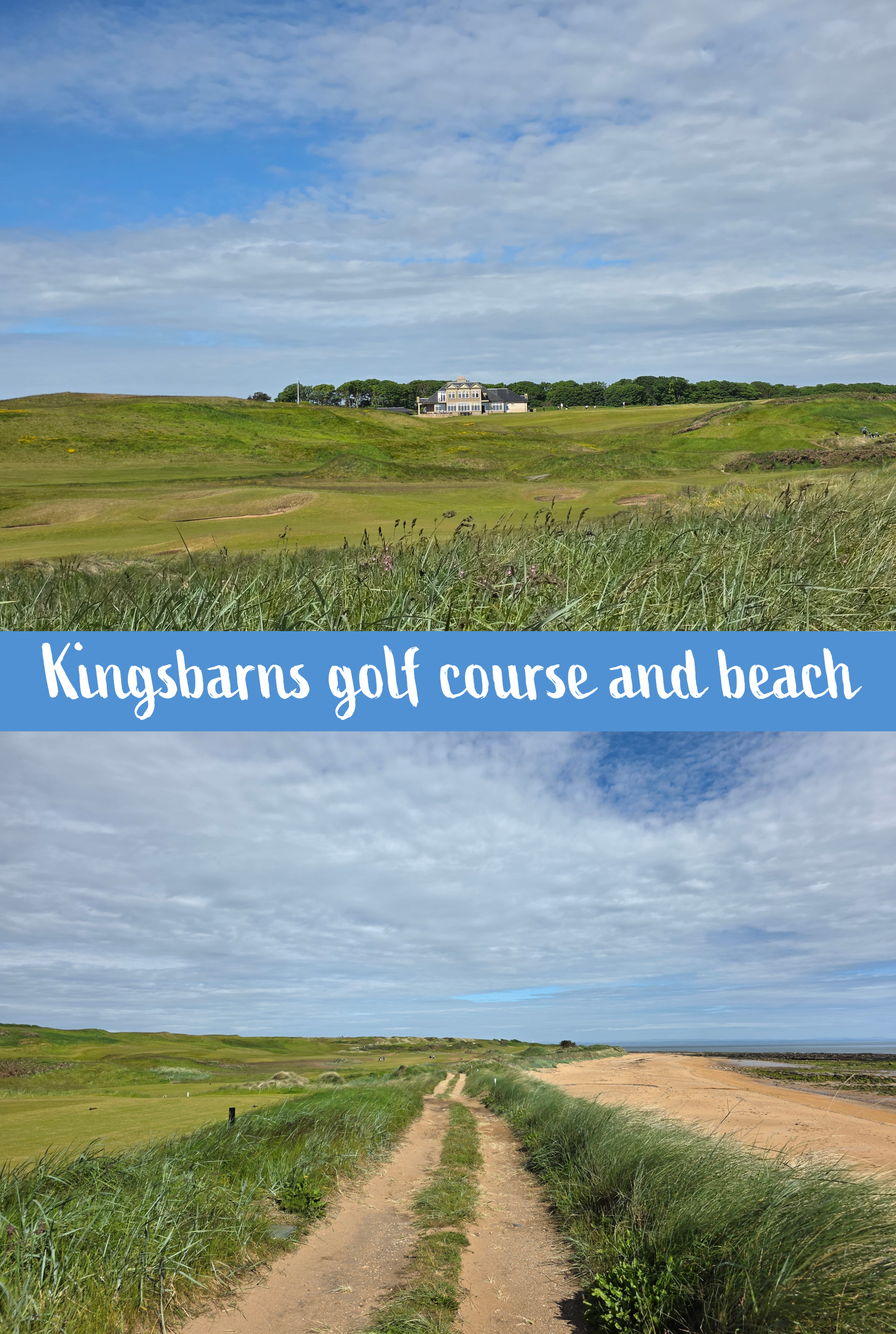
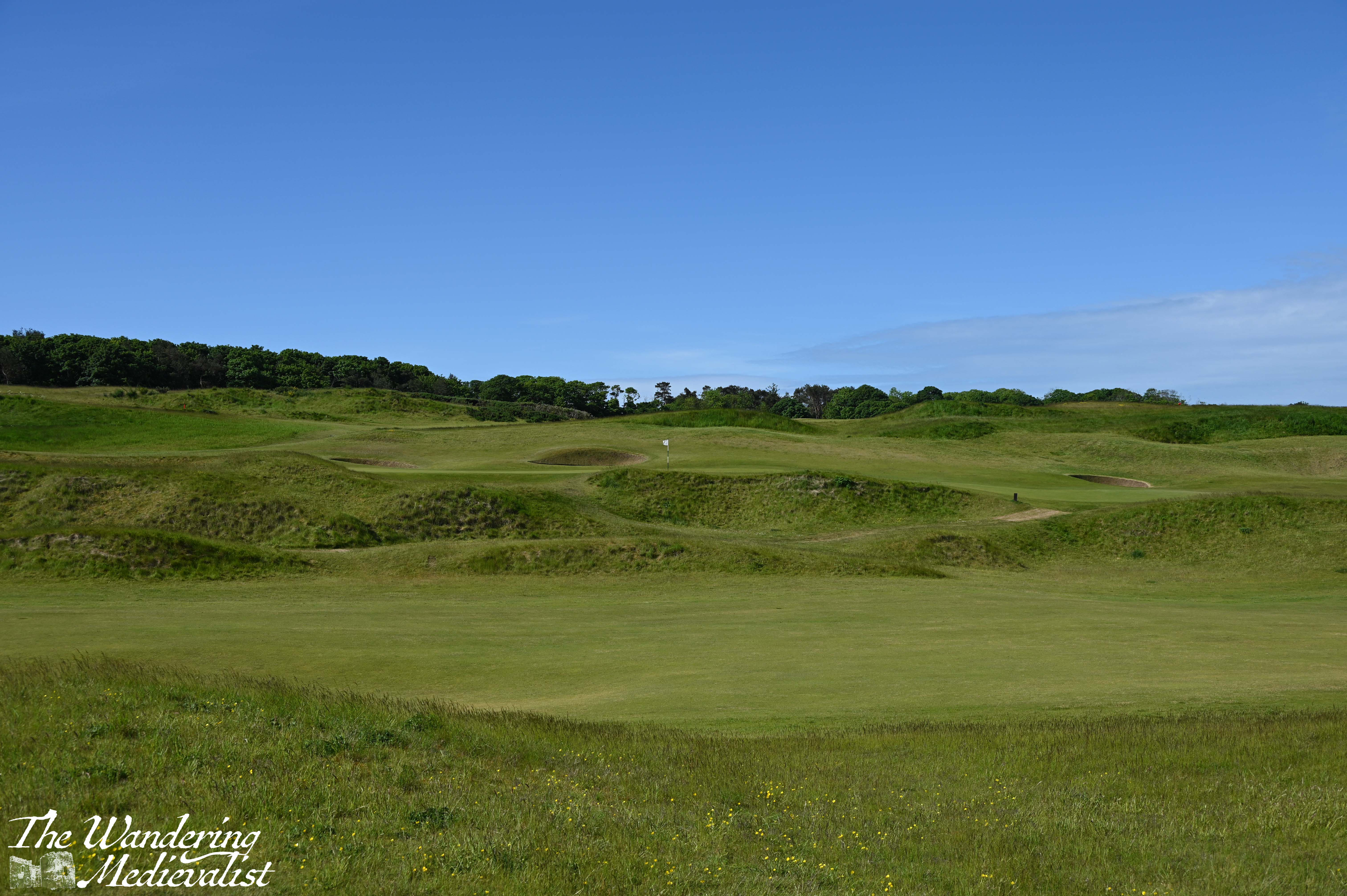
Seggie Drive joins the main road just across from the University, and from here on the path is raised slightly away from the road, which is considerably safer. Again, though the speed limit is 30 MPH here, traffic is often moving quickly around an almost blind corner.
The end of this section of the walk is where I started a few months ago, at the north bridge in Guardbridge, the far end of town. As you can see there are some lovely spots that you pass on this walk, though it is also far less rustic than further south. It was the first walk where I really noticed a difference in my stamina, which I hope can continue! But I’m off on travels again soon, so we shall see.