
While in the US last month, I took advantage of a Sunday off to visit the Holocaust Memorial Museum in Washington DC, a bucket list destination for me almost since it opened in 1993.
I began writing about the experience on the Metro trip back to the hotel, and it will I am sure take me some time to process it all – I knew that it would be emotional and moving, and it was certainly both of those things. I also knew that I wanted to go by myself, so I could move through the exhibits at my own speed, as I wished to, and be entirely independent in my experience, my reaction. I wanted to be completely selfish in the experience, did not want my natural people-pleasing to alter my visit to someone else’s wishes, and I had a feeling that I would want firstly not to do anything else ‘touristy’ on that day, and secondly to have time, in quiet, to think. Fortunately, I had both.
My study of the Holocaust
I was exposed to the study of the Holocaust quite early in my education, partly due to my mother’s own passion for World War II study (particularly the French resistance) but also through school. In class – I think 6th grade – we read Number the Stars by Lowis Lowry, a book about the escape of a family of Jews from Copenhagen – it touched on the dangers but without too much detail. Probably earlier than I should have, I read Elie Wiesel’s Night and Day, both quite graphic in their description of the atrocities, and of course the Diary of Anne Frank, then watched the 1959 movie by the same name. Mum was inspired to take me to a play version of the book, which I am relatively certain starred Natalie Portman – a bit of research indicates this is likely to be so as she played the role for some time including at the Colonial Theater in Boston.
But my real interest in this period of history came in 7th and 8th grade, when we studied, ‘Facing History and Ourselves’, curriculum meant to help us understand the Holocaust and why it had happened. It was a very honest course, and we were fortunate enough to meet a survivor, Sonia Schreiber Weitz, hear her speak in-person and read her book. We watched videos of many other survivors at a time when there was a real push to record these testimonials before the passage of time meant we started to lose them. Other reading that sticks with me to this day is the short novel Friedrich, by Hans Peter Richter, during which a nameless narrator describes the experience of his close friend, a young Jewish boy, during the rise of the Nazis in Germany. The almost matter-of-fact way in which the rights of Friedrich are worn away is heart-breaking. These are all books I have held on to, as well as some text books on Facing History and America during the war, and the graphic novels Maus and Maus II, by Art Spiegelman, in which he explores his father’s experiences as a survivor and how to deal with those experiences decades later.
The years during which I was studying Facing History happened to coincide with the release of Schindler’s List, which I watched probably a bit too young, but which put visuals to the writing of Wiesel and other survivors. I recall vividly being curled into the corner of the couch, as if I were trying to get away from the screen while at the same time mesmerised. It remains a movie that I feel all students should watch, but in a safe environment where they can talk about the experience.
Most recently, I found myself on a long plane trip watching the (relatively) new film, Nuremburg (2025), which of course focusses more on the trials after the war. But, there is a vitally important part of the history that the movie addresses: in its exploration of the relationship between Hermann Göring and the psychiatrist who interviewed him, it reminds us of the humanity behind the men who perpetrated this evil. For all their flaws and sins, they were human, and in Göring’s case, they were charismatic and at times even sympathetic. And this is a part of the difficulty. Russell Crowe’s Göring is likeable, charming, at times pitiable. He was a real man, not some dark villain – the Nazis were people, not evil demons, even as they perpetrated demonic crimes.
Where am I going with all of this? I guess I feel that it is important for you to be aware of my history with this history, and to give a bit of background for understanding the knowledge and experience with which I approached the museum. I was not necessarily coming to learn many new facts, but as a necessary part of my experience of learning about the Holocaust. It was another piece of the puzzle.
My visit
I planned my day carefully, as discussed above, as I wanted to be able to be quiet after the visit, to think, not to have to immediately talk about what I had seen. The solo aspect was vital.
I approached the museum on foot from the Smithsonian Metro stop – a pleasant walk even in the drizzling rain along Independence Avenue. The omnipresence of the Washington Monument is very evident here, and the Museum itself is a majestic yet understated building, compared to many of the very decorative and dramatic government buildings nearby.
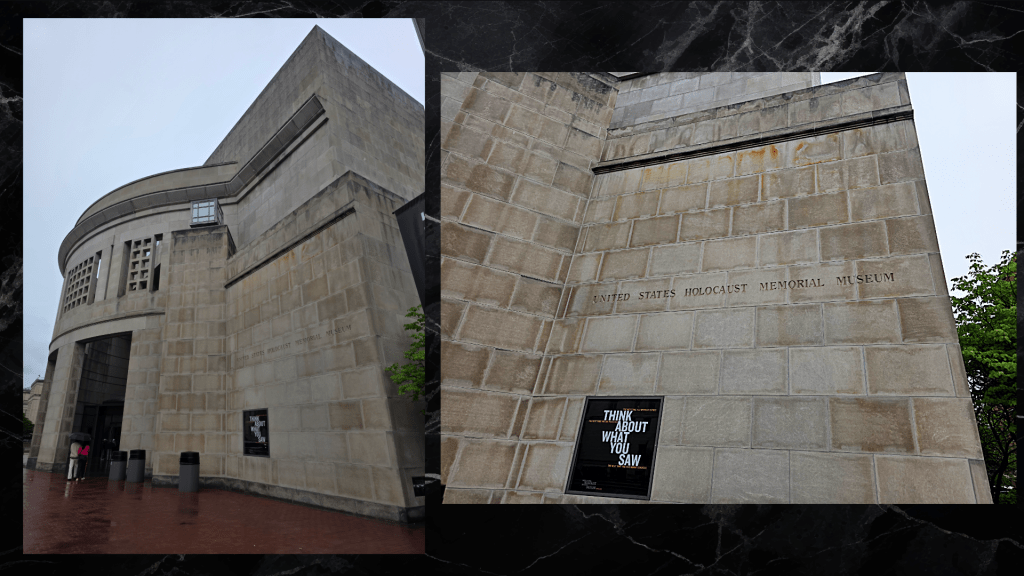
I was surprised, perhaps foolishly, by the need to go through security both at Arlington Cemetery and here, but clearly that just shows how long it has been since I visited a major site – security was needed in Mexico City and is also required to enter sites in London. I later learned that a guard had lost his life here, protecting the museum and its exhibitions. I forget so easily the continued antisemitism, particularly now. I am fortunate enough to be able to forget it, living where I do, and the sentiment of antisemitism it is something I absolutely do not understand – the town where I grew up has a large Jewish population, and many of my friends were Jewish or half-Jewish. I got to experience Passover Seders, Hannukah celebrations, and Bar and Bat Mitzvahs as a regular part of life. This upbringing sheltered me to how prevalent antisemitism still is – it never occurred to me as a child, and I understand now what a privilege that is. I also realise now, as an adult, that the absence of antisemitism I experienced may well also have been a benefit of childhood. The experience of the parents of my friends may well have been very different.
I entered the museum ready to experience whatever it had for me. I learned that the permanent exhibit was free to visit, and I was directed towards a line where everyone selected an identity booklet out of a pile of hundreds; each told the story of one person who was persecuted.
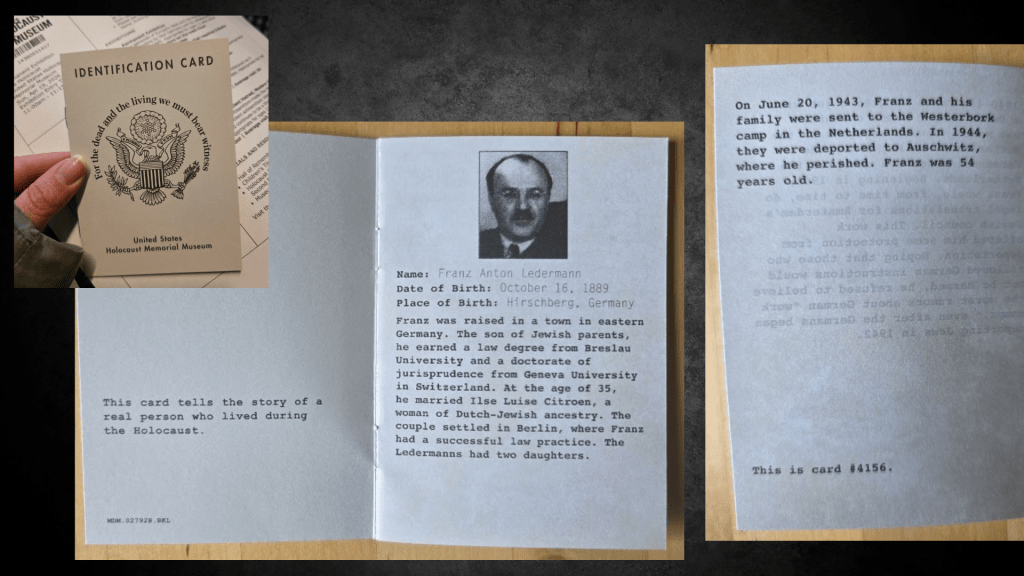
The queue of visitors was then invited into an elevator to take us up to the top of the building – the elevator was just a touch too tight to be comfortable, the first of many experiential design aspects of the museum. As we rose, a video played of recordings from those who had liberated the camps. This was the start of the journey, and the end, to some extent.
Immediately outside of the elevator was this sign:
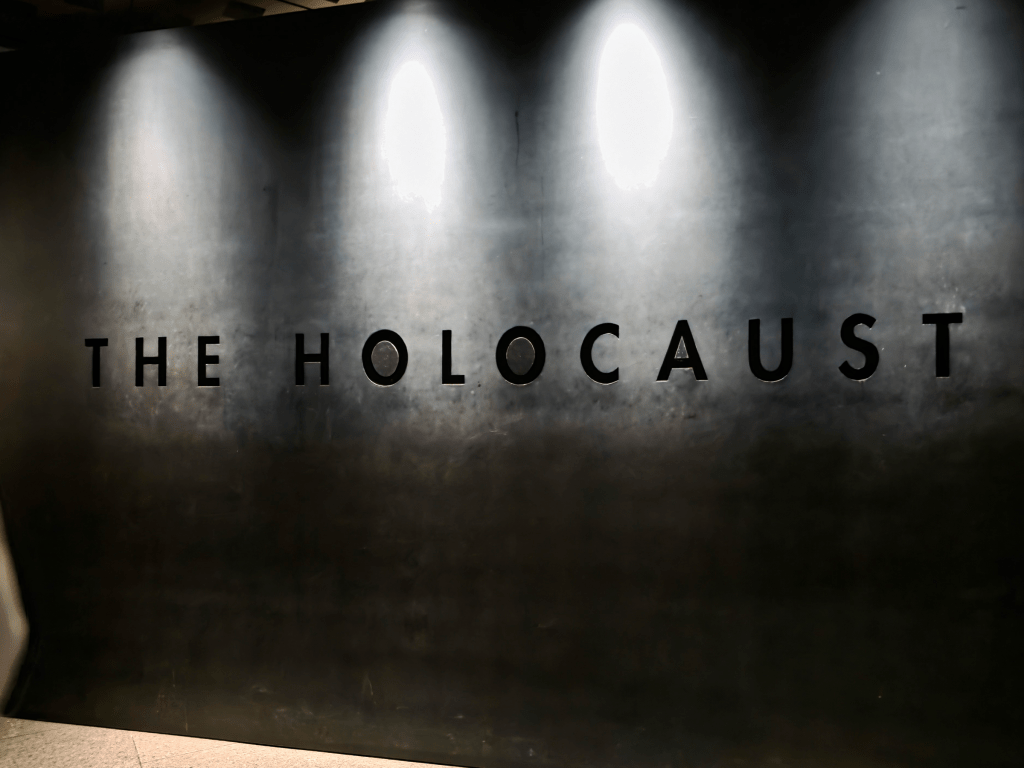
I paused here for a moment to let those in the elevator with me get ahead, and then moved forward to read the first introductory panel, describing Europe before the Holocaust and the sentence that stood out most clearly – within 12 years of 1933, two out of three European Jews would be dead.
Jews had lived in Europe for almost two thousand years, though not without significant isolation and persecution – something I learned a great deal about while studying the Middle Ages and the plague, after which Jewish communities were an easy scapegoat.
The panel went on to state:
‘By the 1880s….Though Western Jews had gained equal rights under the law, religious antisemitism reappeared, with political and racial overtones. In eastern Europe, Jews faced poverty, antisemitism, and, periodically, outbreaks of mass violence known as progroms. Yet Jewish traditions and culture remained full of vitality, and Jewish religious life was rich and fervently observed. Jewish artists, writers, scholars and scientists thrived and contributed greatly to their fields of endeavour.’
Beyond this panel and for the a good portion of this floor, there were massive bottlenecks of visitors, either moving slowly or standing in front of exhibits, making it very difficult to experience it as one might hope. The day was incredibly busy with school groups, families, and many more.
This permanent exhibit starts with the history, as it should – Germany in the 1930s, the rise of Hitler after World War I, the increasing antisemitism that always bubbled beneath the surface of Europe. I did not stay long in this section as it was so busy that it was difficult to read some of the exhibit. I also knew a great deal of it, though there were some elements that were newer to me.
One was the panel about the Évian Conference, held in July 1938, which I do not recall learning about previously. At this conference delegates from 32 countries met to discuss the refuge crisis caused by the rise of the Nazis. As the cartoon here indicates, the conference had hoped to find a solution to the thousands of Jews fleeing Germany.
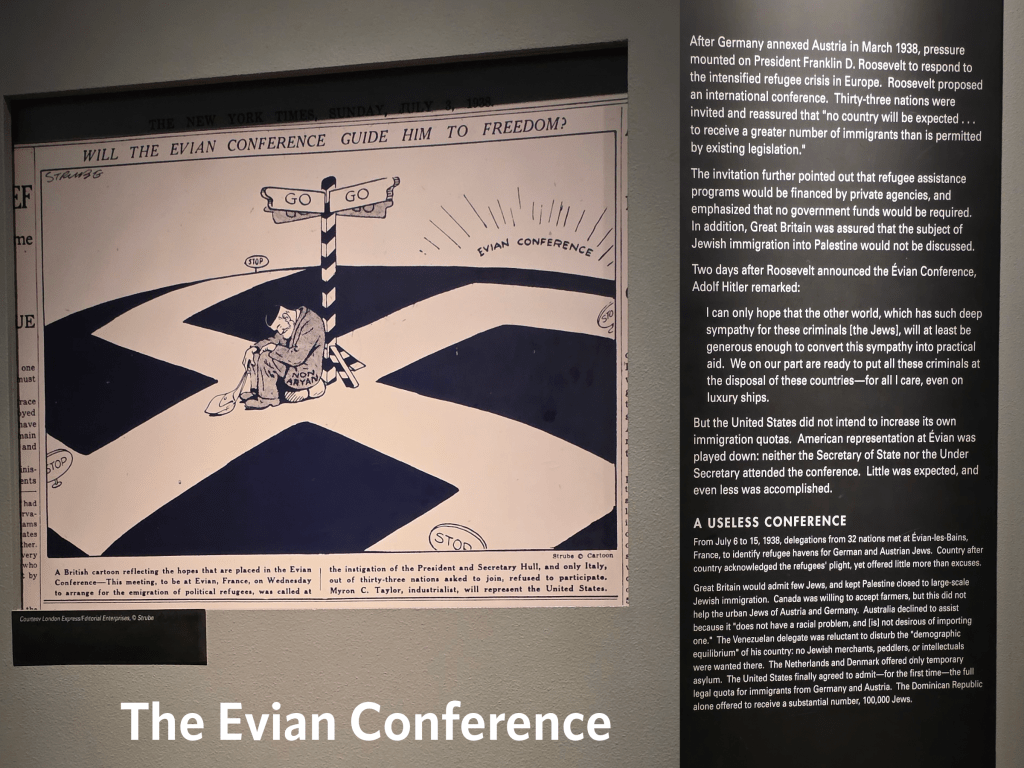
But, as you can doubtless guess, while there was sympathy for the Jewish plight, but no country was willing to increase the number of refugees that it would accept. Only months later, Nazi Germany perpetrated the state-sponsored episode of vandalism, arson and terror that became known as Kristallnacht, or Night of Broken Glass. More than 1,400 synagogues were burned, 26,000 men were imprisoned, and thousands of homes and business were vandalised.
The museum took careful time to feature elements of Jewish life in Europe prior to the 1930s, and one of the most moving is a tall tower full of photographs that were taken between 1890 and 1941 in a small town in what is now Lithuania. Jews had lived in the area for almost 900 years, and the pictures show a wide variety of life in the village, most of it incredibly similar to a non-Jewish village.
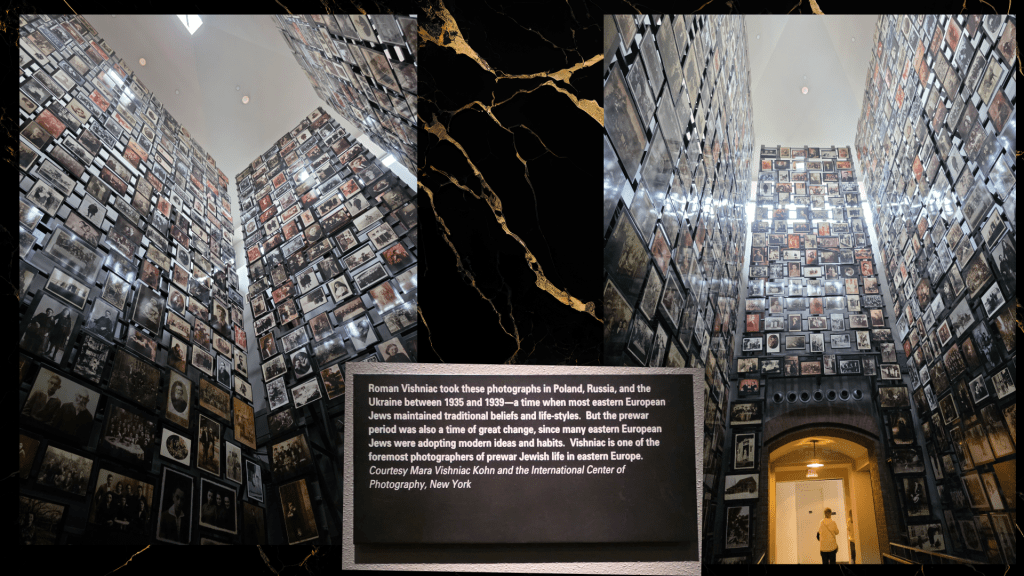
The narrow tower of course meant that visitors could not see all the pictures individually, but the sense of community and history was palpable. It also reminded me, in style, of the Holocaust memorial in Boston, which is six tall glass towers that one can walk through.
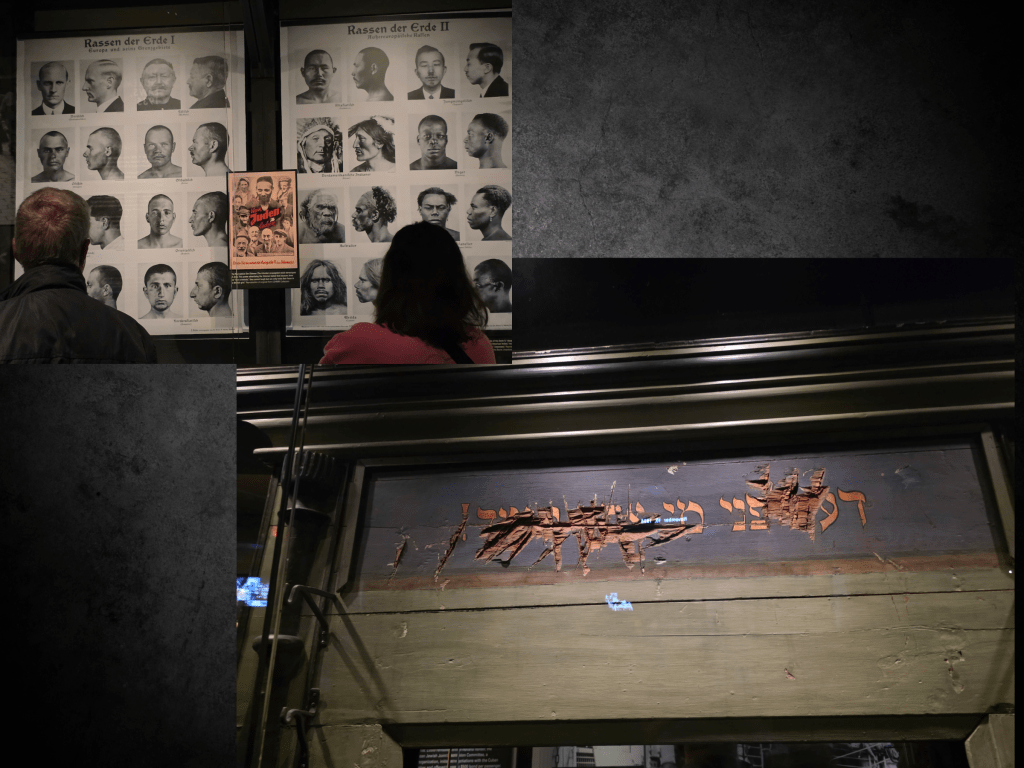
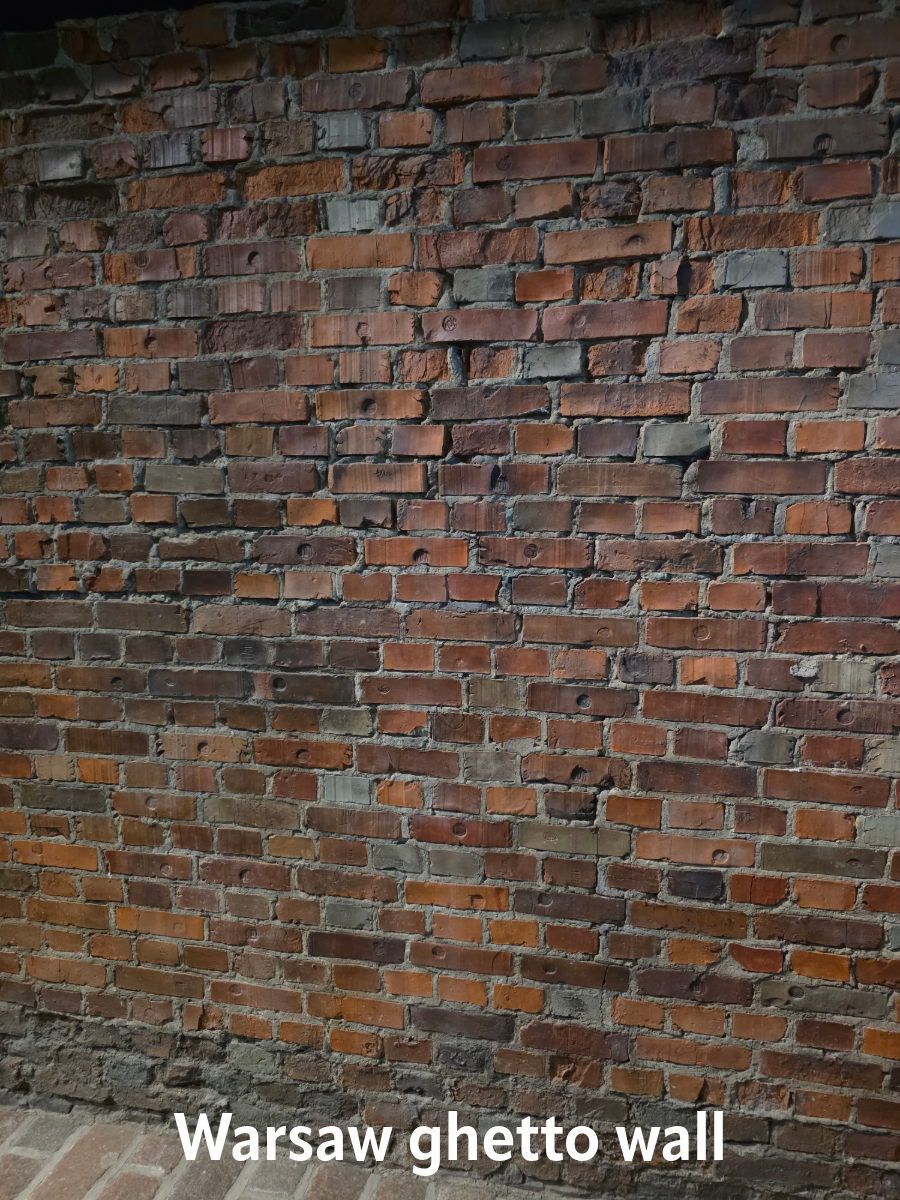
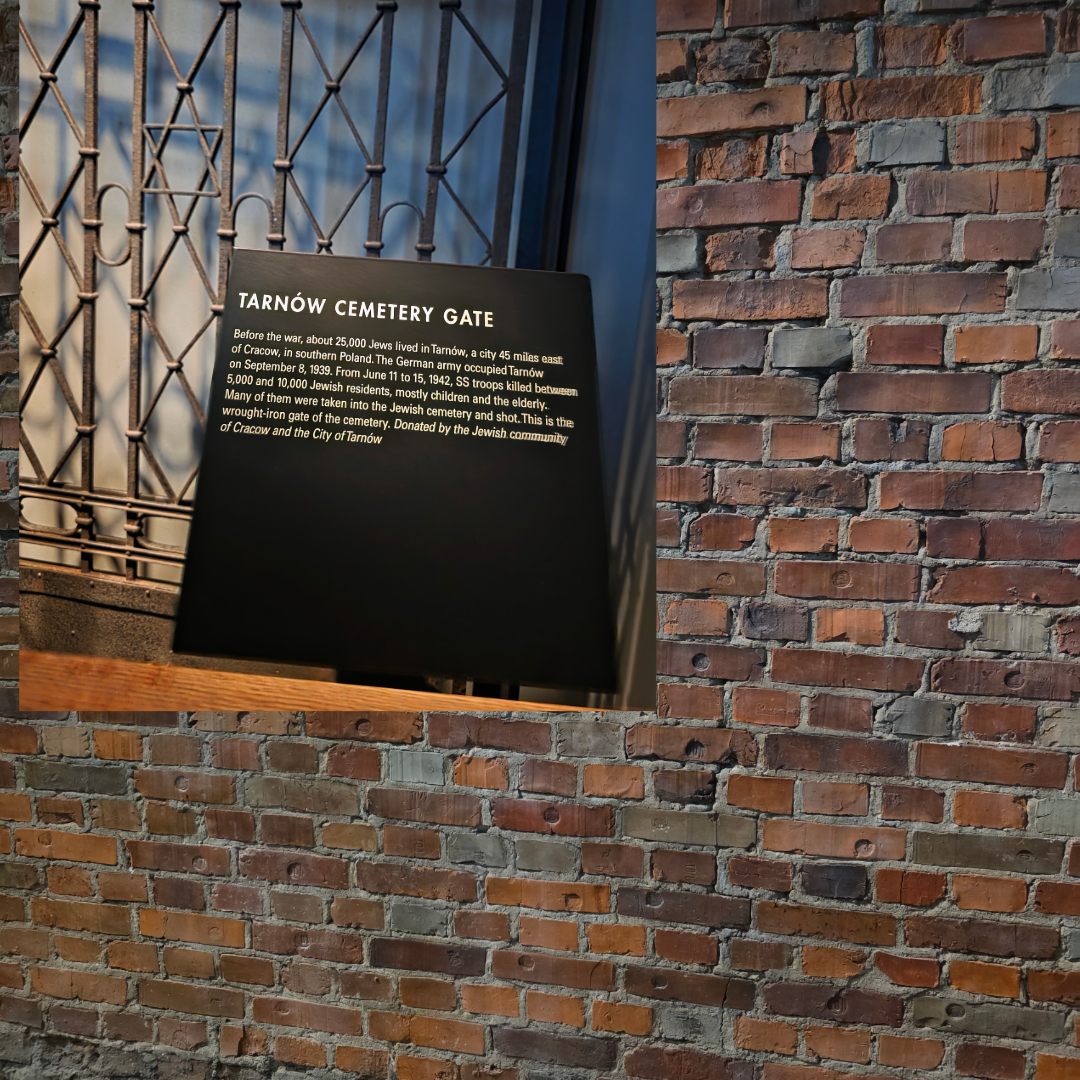
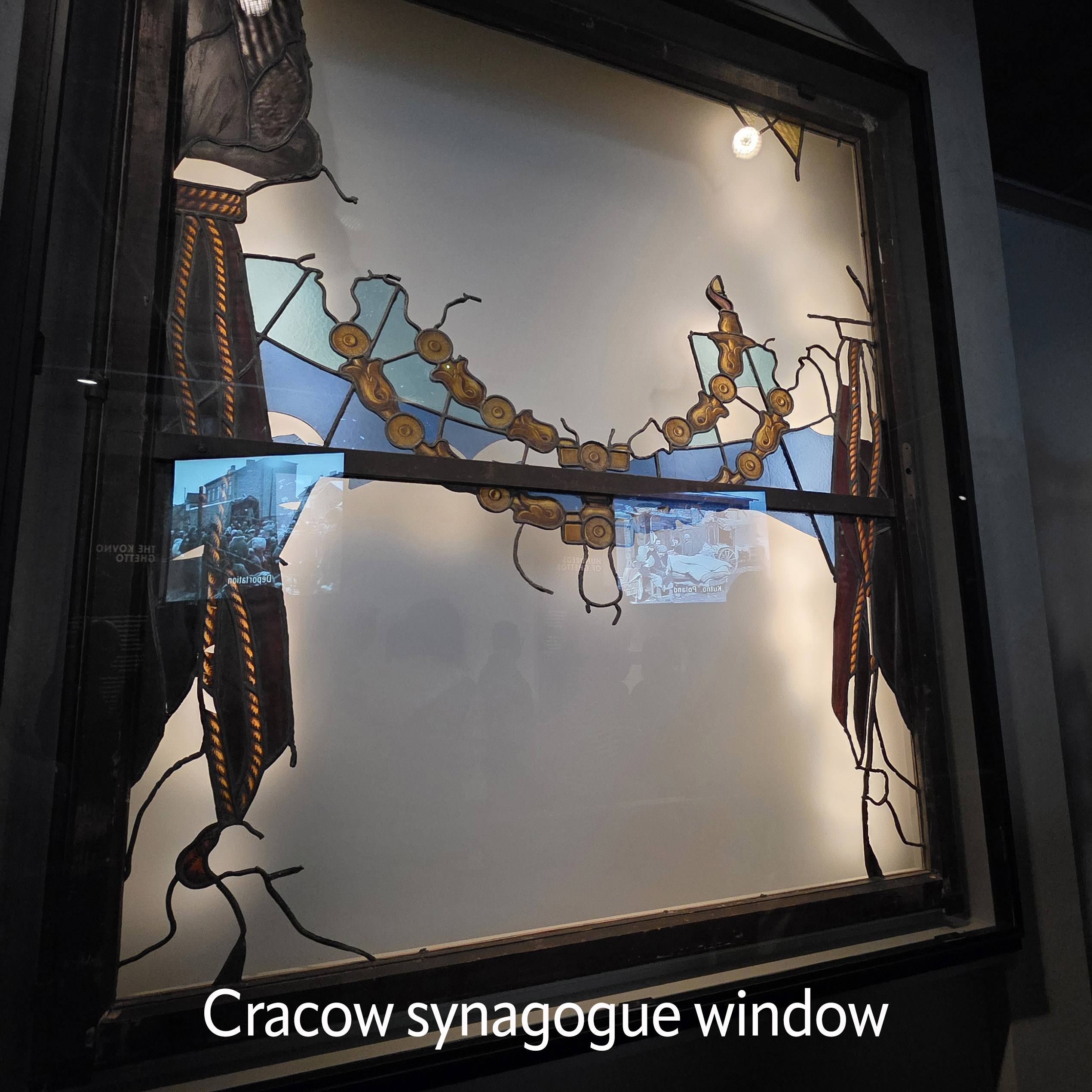
There were poignant and beautiful artifacts of Jewish life both before and as the ghetto system came into effect, including a mostly-ruined but still beautifully detailed synagogue window from Cracow, a cemetery gate from Tarnów in southern Poland, and a recreated portion of the Warsaw ghetto wall – a solid brick expanse that would have been topped with barbed wire.
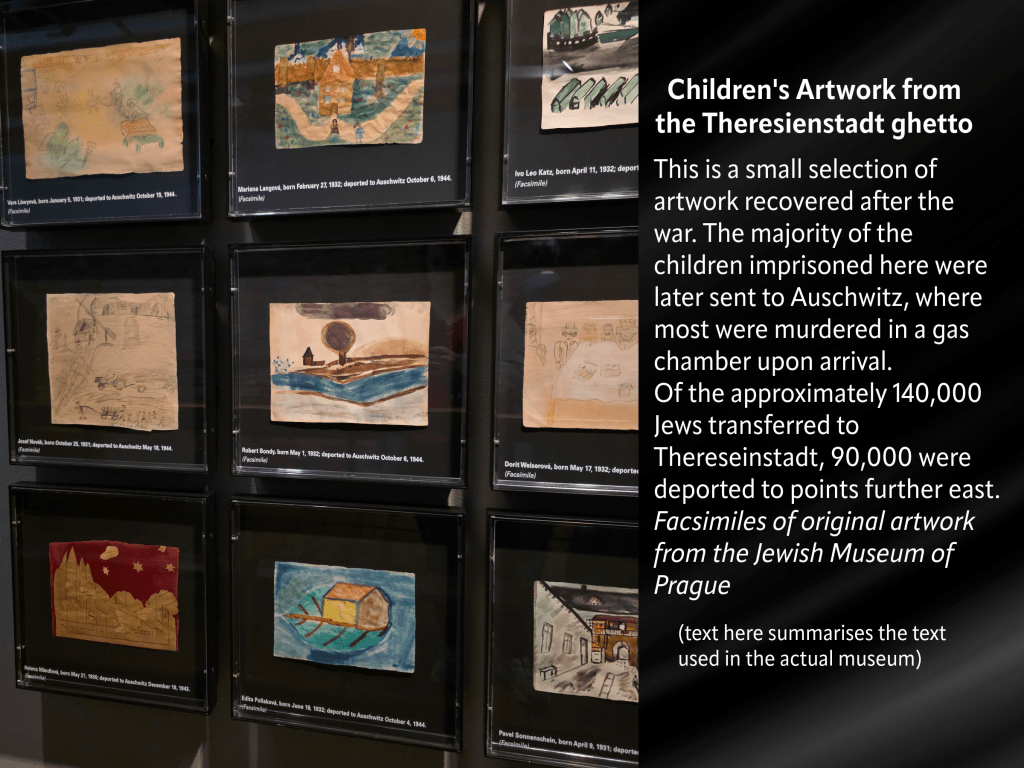
A portion of the exhibit that has stuck with me vividly and made me pause for some time in my wandering was the one below – artwork from children who were living inside a ghetto in what is now Czechia. It reflects both upon their life within and before the ghetto and the variation of bright colours to stark grey, black and white was painfully poignant. It was the first – and not the last – time I could feel tears prickling at my eyes. I know only a small amount about how art can be used in therapy sessions to evaluate a child’s state of mind, yet these pictures do not need a degree to assess.
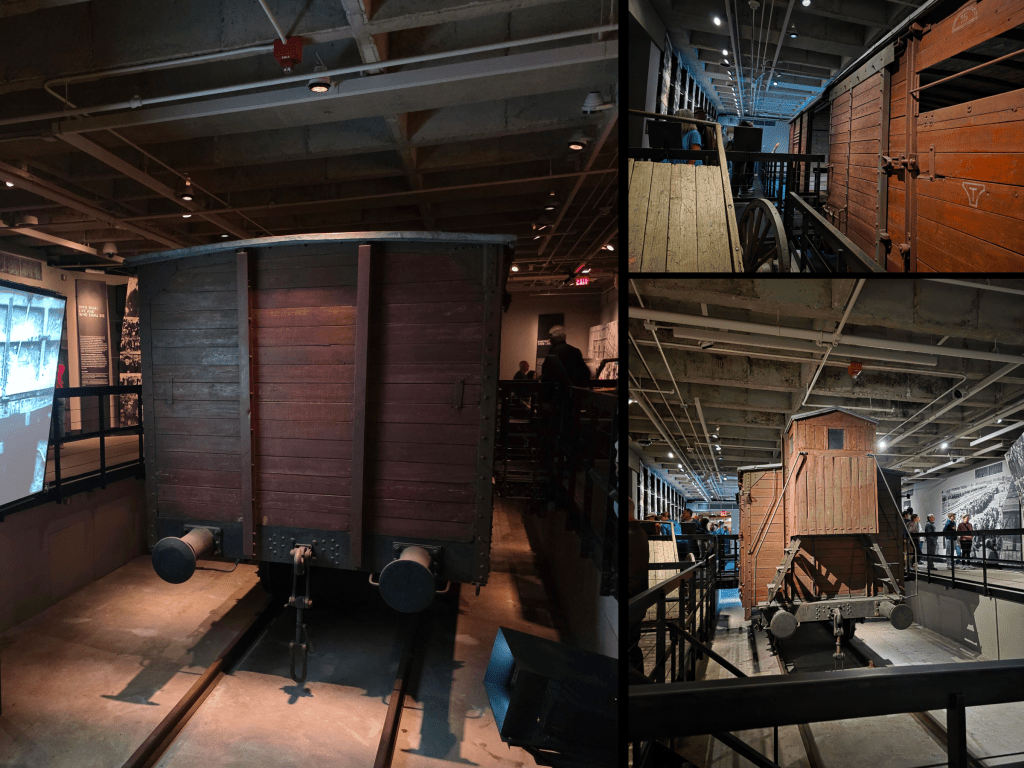
As the museum moves visitors through time, from ghettos to the camps, the focus becomes the ‘Final Solution’: the effort by the Nazis to wipe the Jewish people and culture from the face of the earth.
Several rooms of the exhibit are focussed on the relics of the murders that are most horrifying – the gold removed from mouths, the suitcases and personal artefacts confiscated. I knew, from the testimony of many who had visited the museum, that there would be a pile of shoes, taken from those who were murdered.
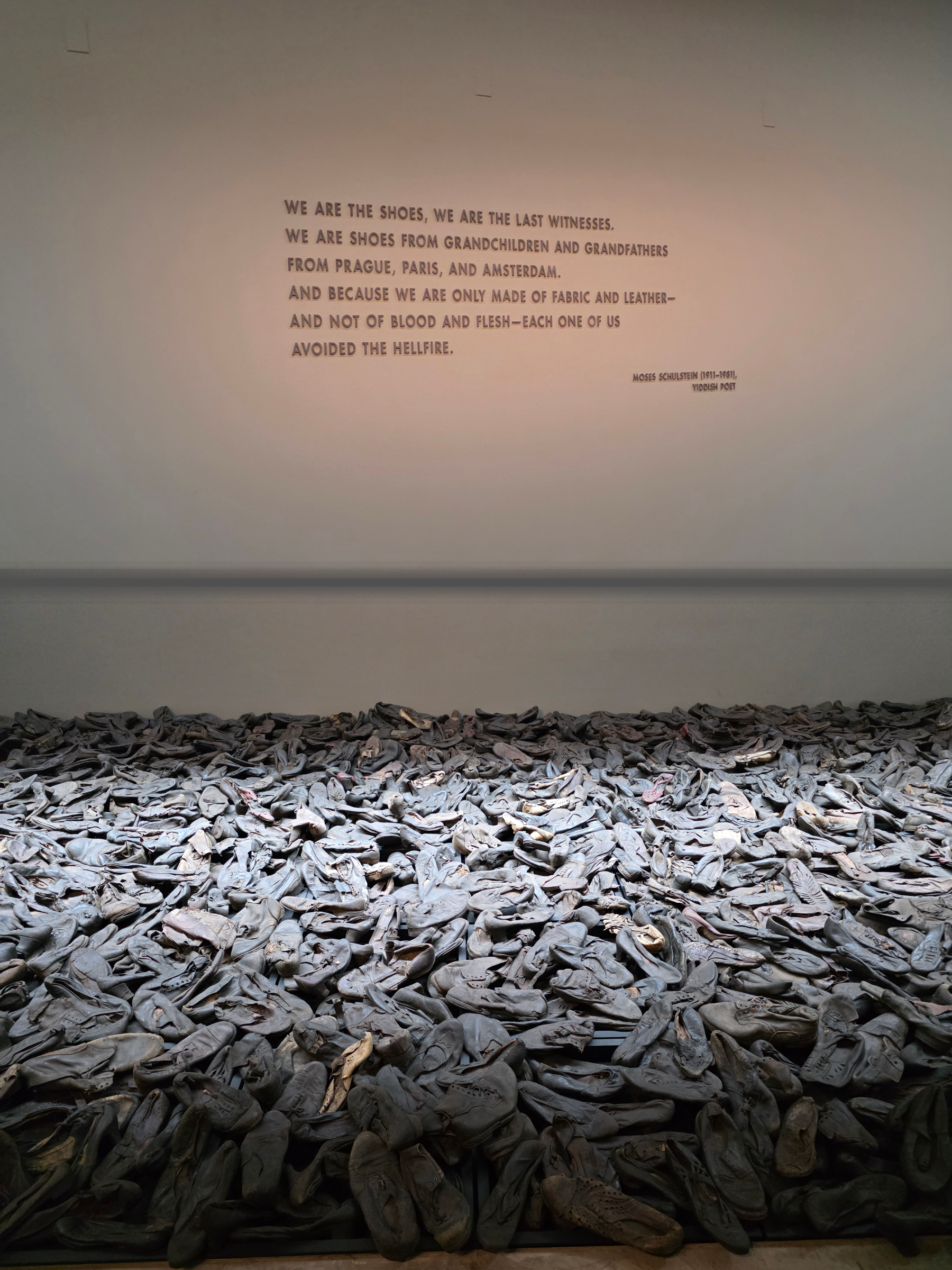
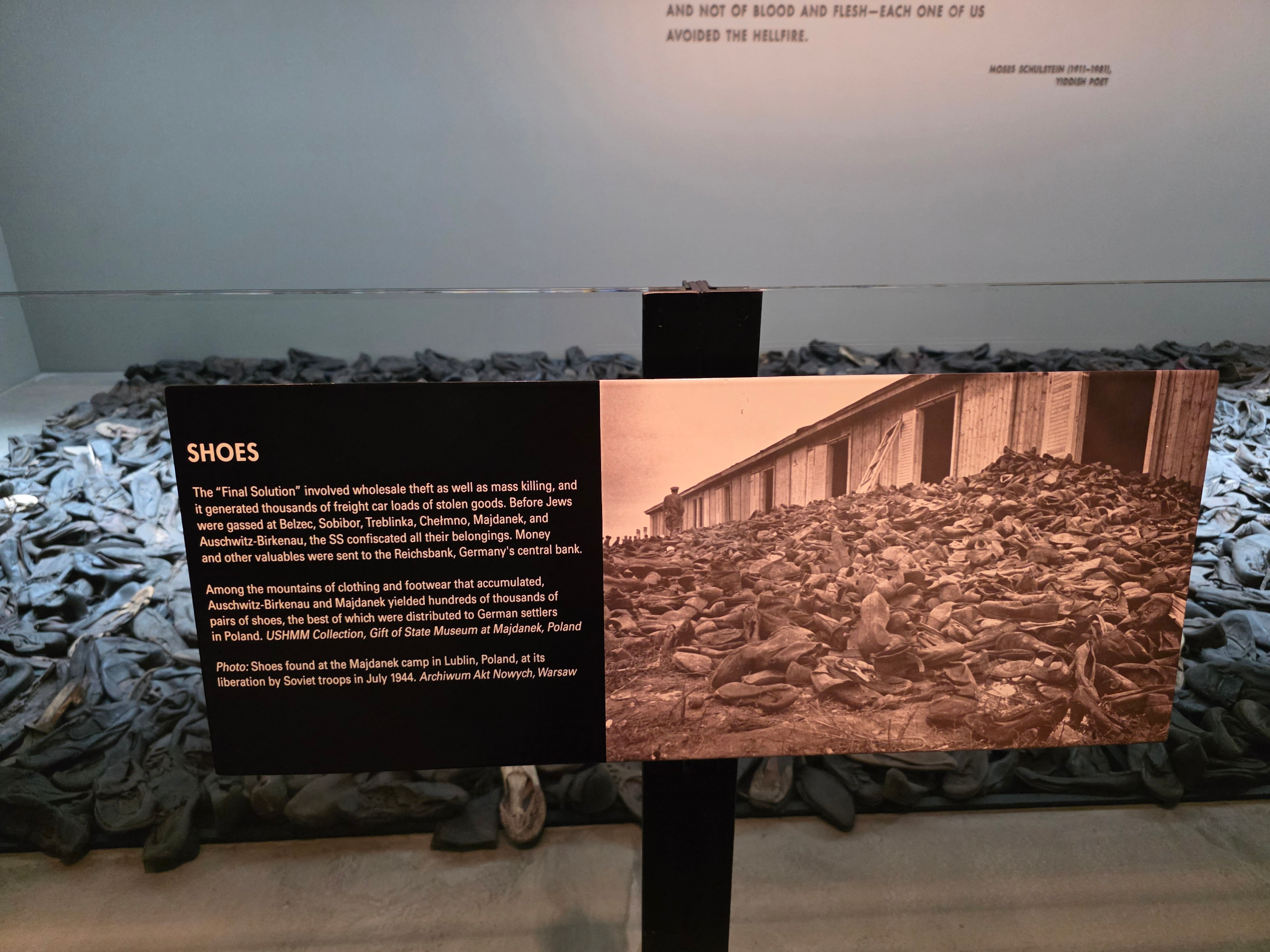
Perhaps because I had prepared myself for these shoes, I found a different element more shocking – piles of hair. This was so terrifyingly human, especially when the images of prisoners having their hair shaved is such a regular and heart-wrenching component of Holocaust stories. The hair was used for any number of industrial purposes, and as I read the list I began to feel physically sick.
Further along was a wall of pictures with prisoners showing their tattooed forearms, and large displays of the piles of items the Nazis had stolen.
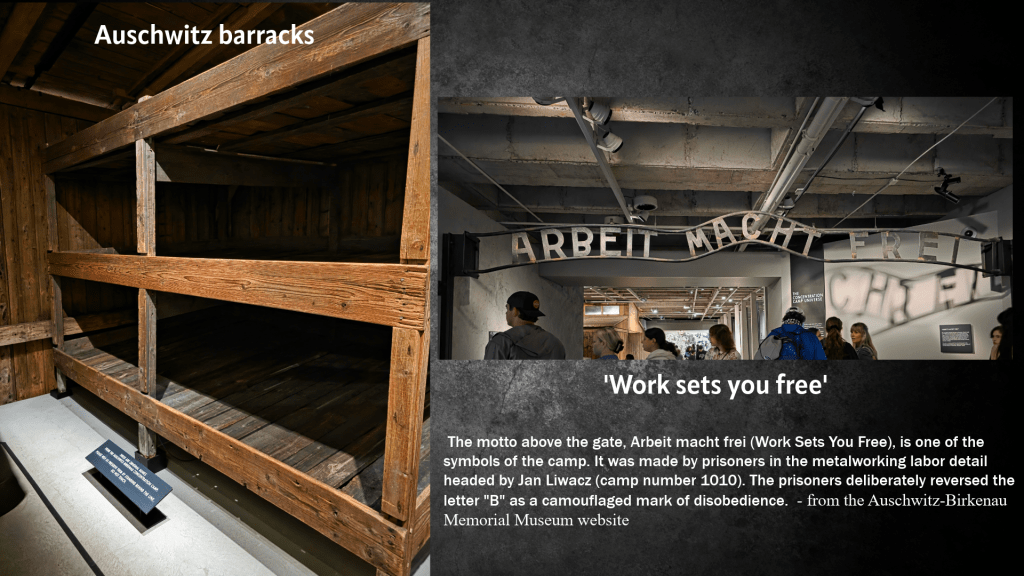
One of the more remarkable items was the section on Auschwitz, probably the most well-known of concentration camps – they have an actual bunk from a worker’s barracks, as well as a replica of the room itself that you can walk through and learn more about what life was like. To continue through the exhibit, you must walk under the famous motto displayed over the camp entrance. If it does not send chills down your spine, I don’t know what would.
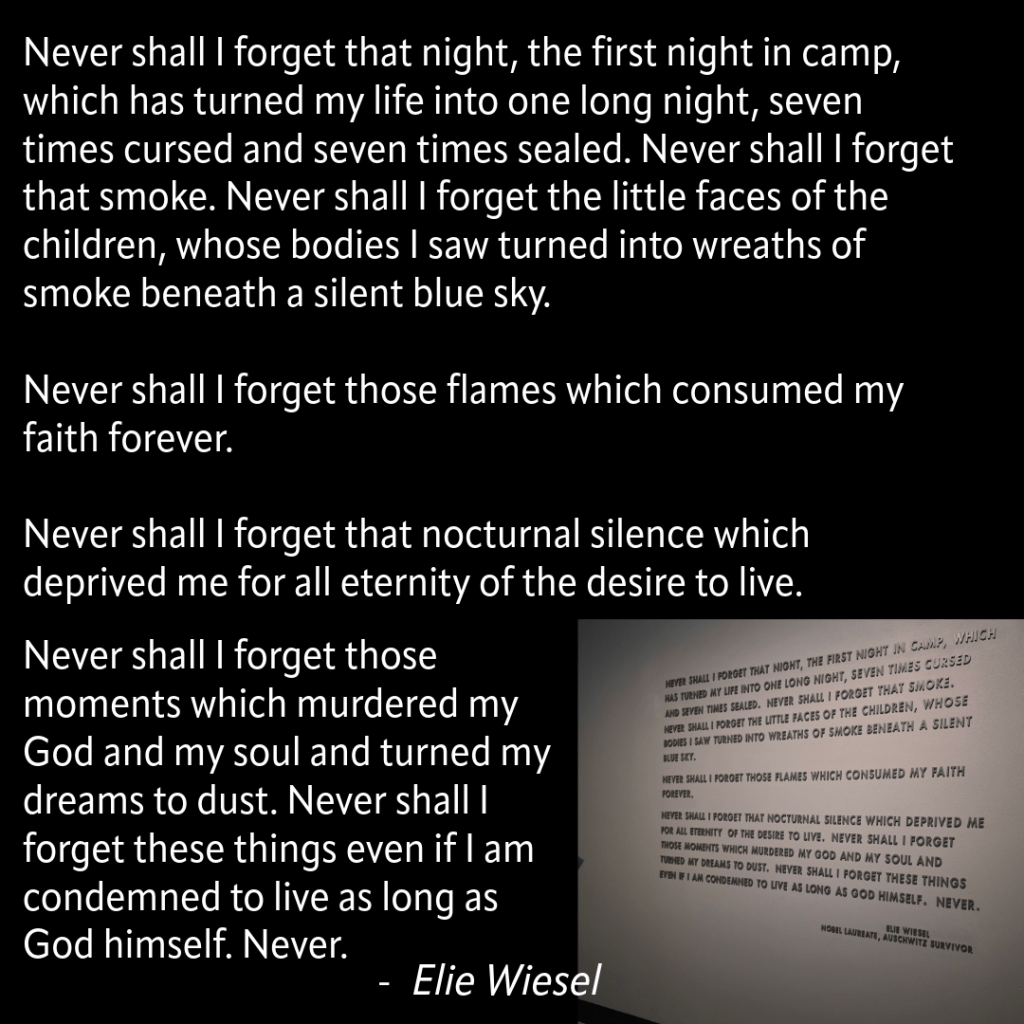
On one wall, separate from other pictures and displays, is a quotation from Elie Wiesel.
This is a design used frequently in the museum, displaying important quotes on their own, so that there is no way a visitor could miss them.
The final floor of the permanent exhibit is, despite the previous pictures and elements, arguably one of the most difficult to experience. The focus is the end of the war, liberation of the camps, as well as recognition of all those who tried to help Jewish friends, family and total strangers escape from occupied territories. There is a enormous wall which lists heroes of the resistance who saved Jewish lives, divided roughly by country, and it was fascinating to see the countries with the longest lists of names – Poland and the Netherlands stood out particularly. There was a picture of Oskar Schindler of course, and some other more high-profile names, as well as stories of everyday people – a touching and comforting example of people helping one another, some hope in a myriad of despair.
The most emotional portion of the museum for me, anyway, was the careful display of the videos both of survivors telling their stories years later and of the liberation of the camps. Many of the videos are placed out of immediate view, around a corner or behind a screen so only seen from above, as they are so graphic that museum curators did not want young children to see them, or anyone who did not expressly choose to do so. I am not sure if I had not realised just how many testimonials there are of these liberations, but this is some of the most difficult footage I have ever seen, perhaps even more so than depictions of the camps under the Nazis. The inhumanity of the treatment and condition of the people there combined with the visible, slowly dawning hope just destroyed me. By the time I reached the section of the museum with videos of survivors telling their stories, I was openly crying, but I was far from the only one. Even writing about it brings tears back to my eyes.
What did the Americans know?
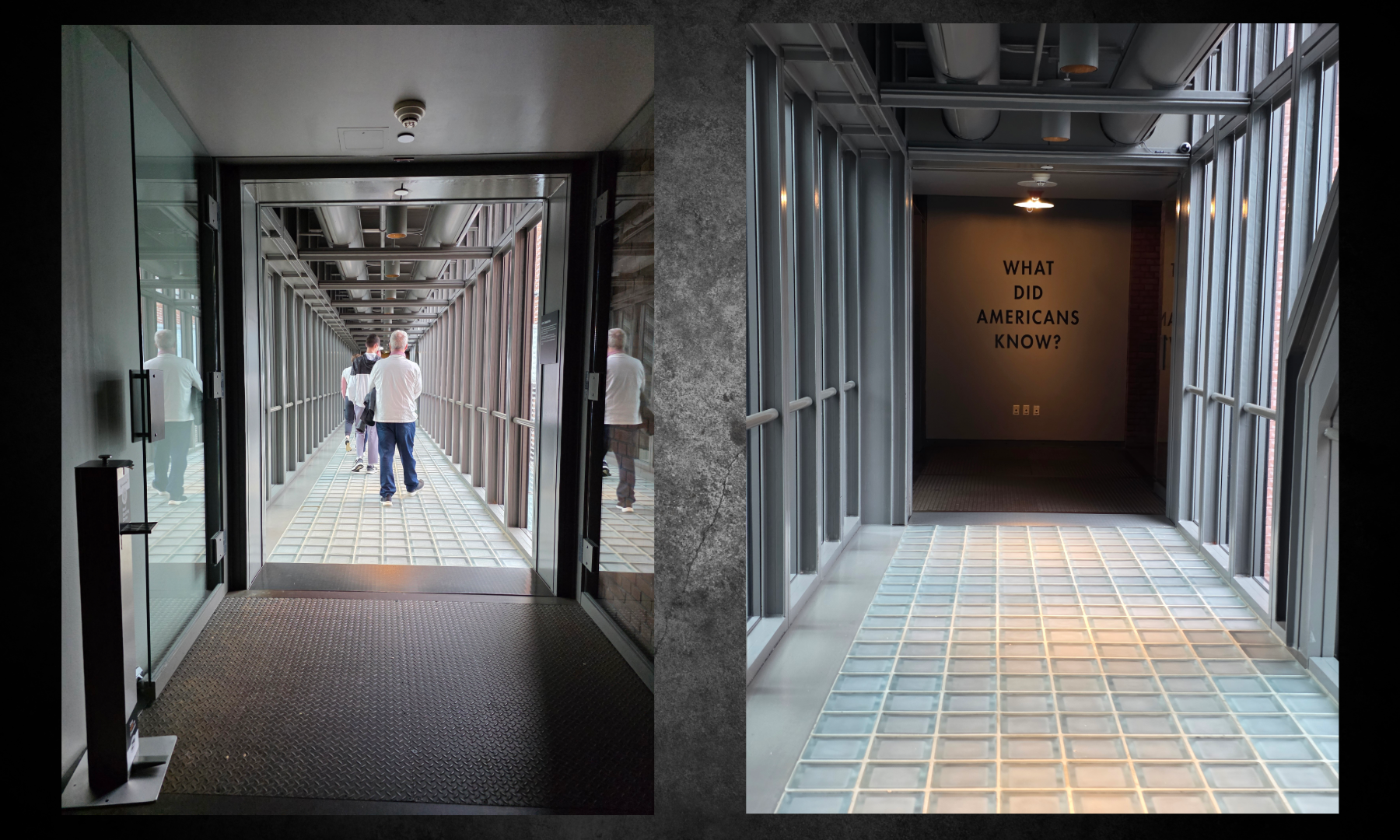
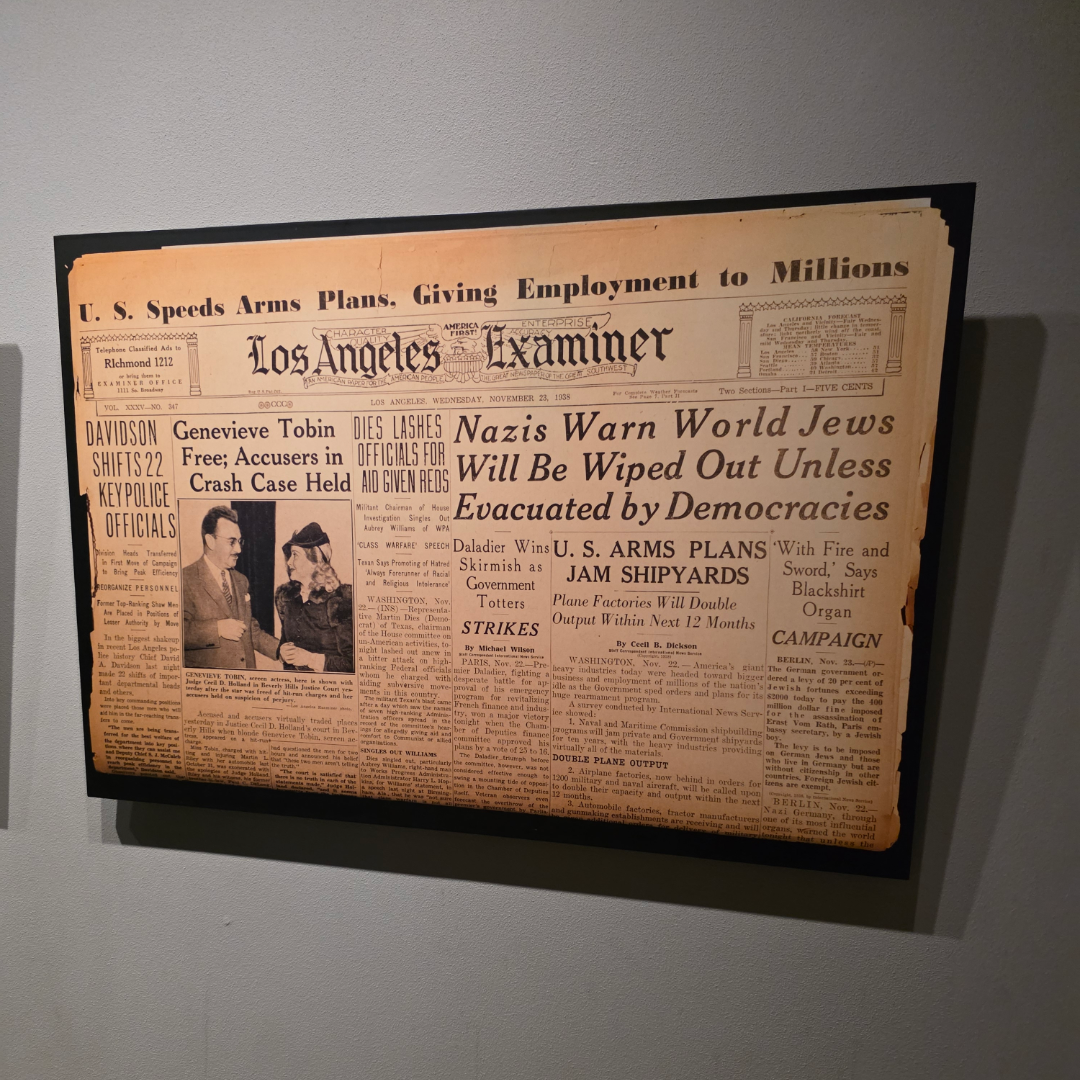
Another part of the museum which resonated strongly with me was the discussion and evidence of what both the US government and the US people knew about the Holocaust, and specifically the death camps. When I was studying US History in High School, I had written a research paper specifically on this topic, spending hours scrolling through microfiche of newspaper articles to find evidence that both parties – government and people – had evidence of the atrocities being committed. I titled my paper, ‘The Acquiescence of the US Government on the Murder of the Jews’, and it would have fit right in both to the permanent exhibit and also the temporary exhibit that I visited briefly, ‘Americans and the Holocaust’.
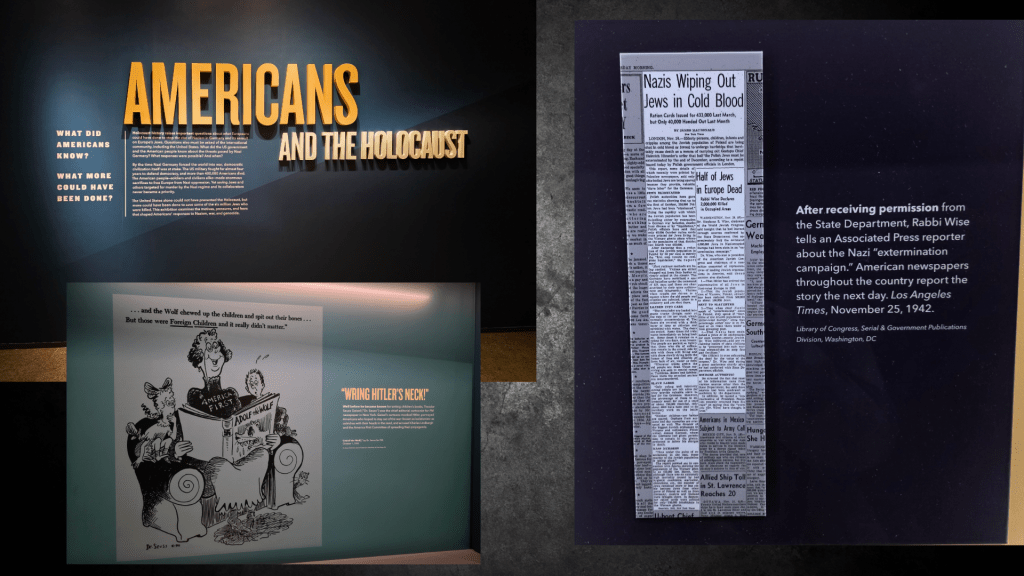
This evidence started during the main, permanent exhibit, examining in particular why it was that Auschwitz was not bombed when it was known exactly what was taking place there. The reason stated by the Assistant Secretary of War in 1944 was that an operation to bomb the camps would divert air support from combat operations, and yet allied bombing of an oil and rubber factory only miles from Auschwitz-Birkenau was carried out. The argument became that a swift end to the war was the most effective relief for Nazi victims, and that all efforts should be directed towards military victory rather than rescue. In Spring and Summer 1944, more than 430,000 Jews were deported from Hungary to the camp, and on some days as many as 10,000 people were murdered.
The reason why more was not done is of course a complex combination of racism, antisemitism, political divide and much more – further, it was not just the US who ignored the plight of the camps, but the UK as well. But it is an important question to ponder, and consider in modern times.
The last panel of the exhibit is a famous quote from Martin Niemöller, a Lutheran minister.
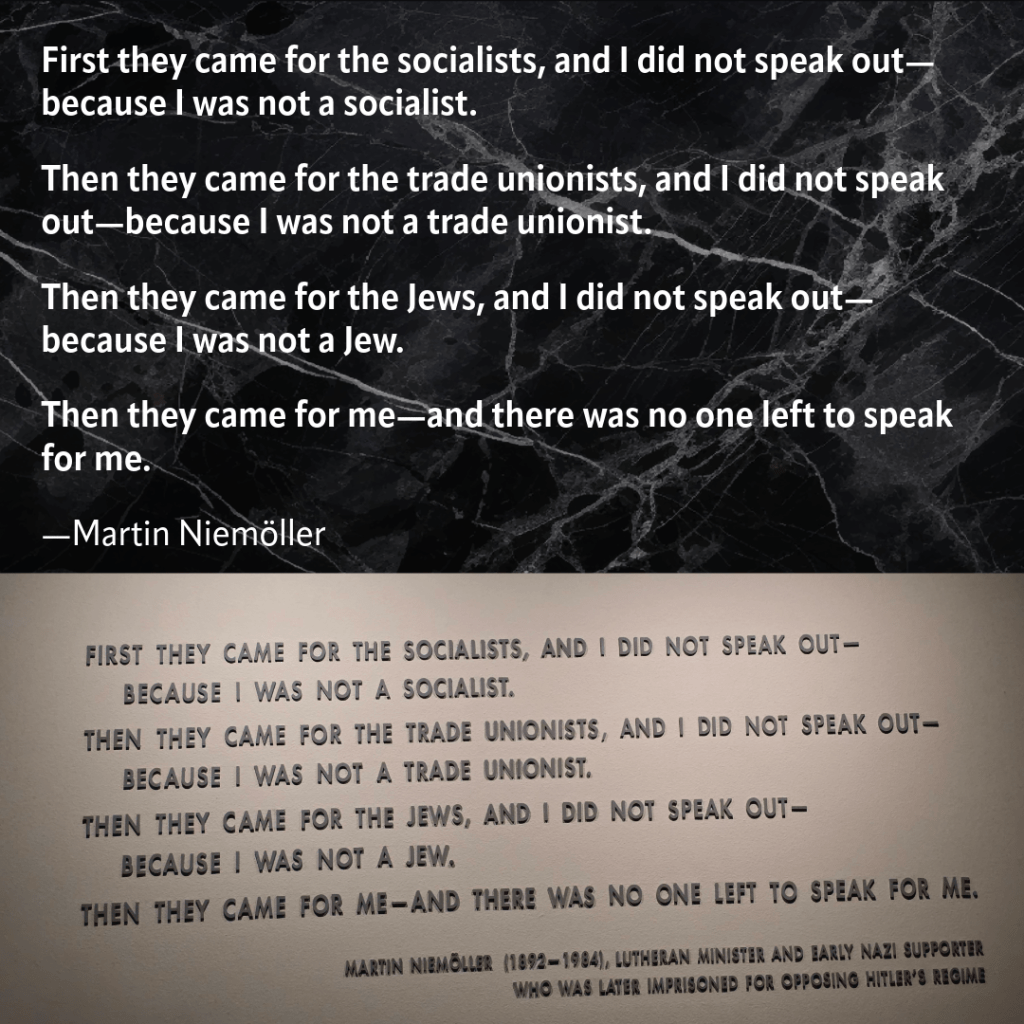
A timeless indictment of passivity, indifference, and that most dangerous of sentiments, ‘it has nothing to do with me.’
To encourage continued meditation and contemplation, the end of the exhibit leads visitors directly to the Hall of Remembrance. Here we are invited to consider the lives lost, in walls that are inscribed with the names of the concentration and death camps. Visitors may light candles, and an eternal flame burns in the centre of the space.
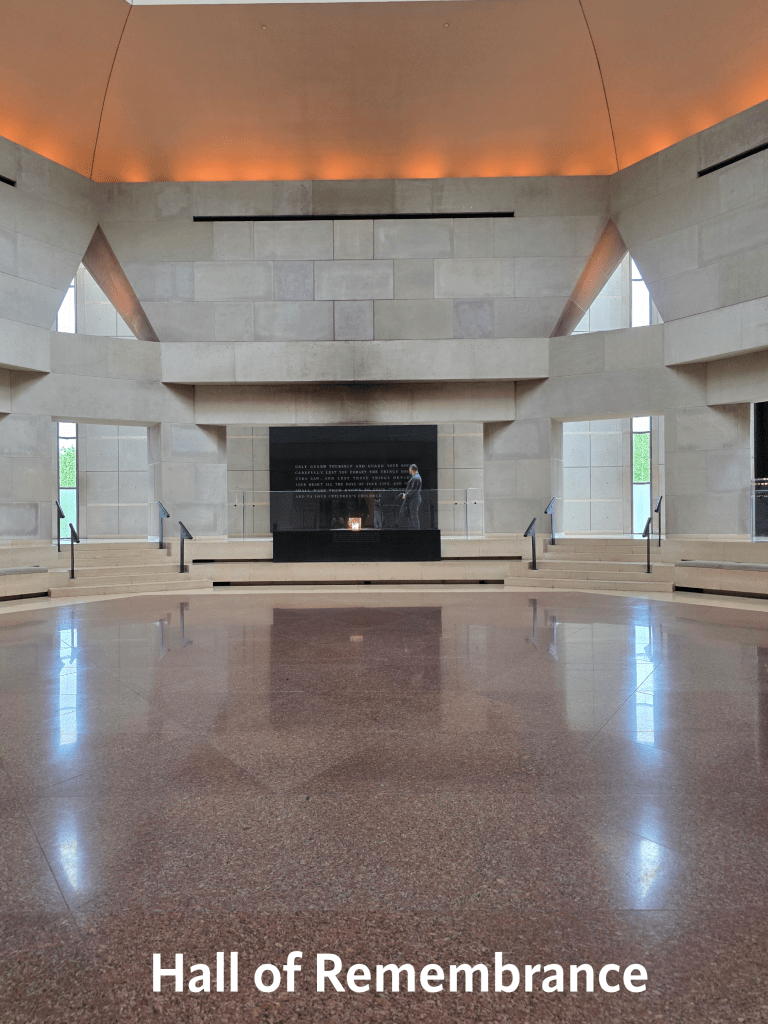
The inscription before the flame reads:
Only guard yourself and guard your soul carefully, lest you forget the things your eyes saw, and lest these things depart your heart all the days of your life. And you shall make them known to your children, and to your children’s children.
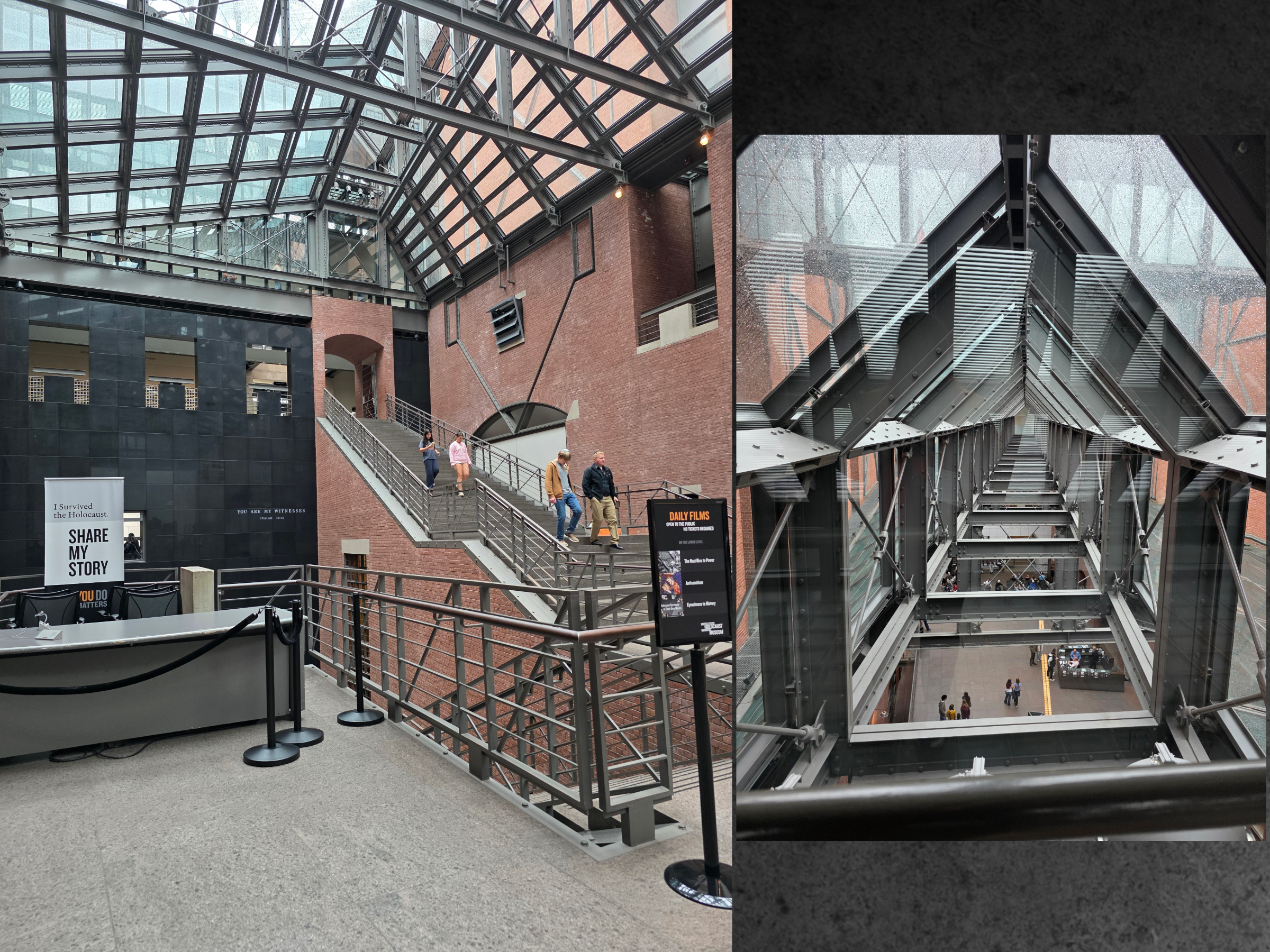
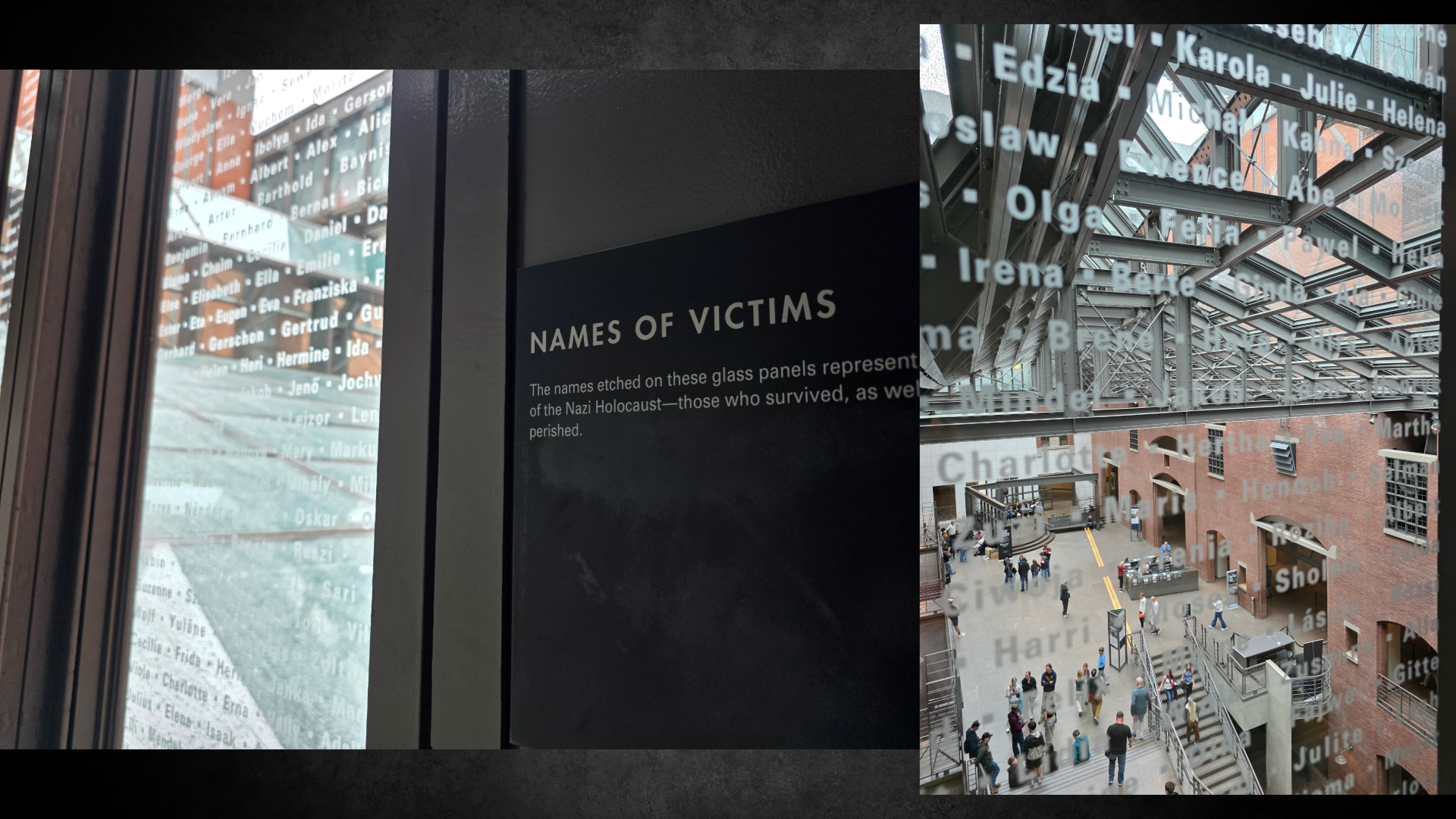
I haven’t really taken much time to remark on it but I think it is important to observe the careful architecture of the museum – the strong industrial feel, with high walls of red brick, angular glass hallways, metal chutes and slabs, almost as if we were walking through a factory from the 1940s. The exhibits are dark, sombre, leaving plenty of space for one to step aside, to pause for a moment and process what they have seen; the very structure of the museum is part of the experience.
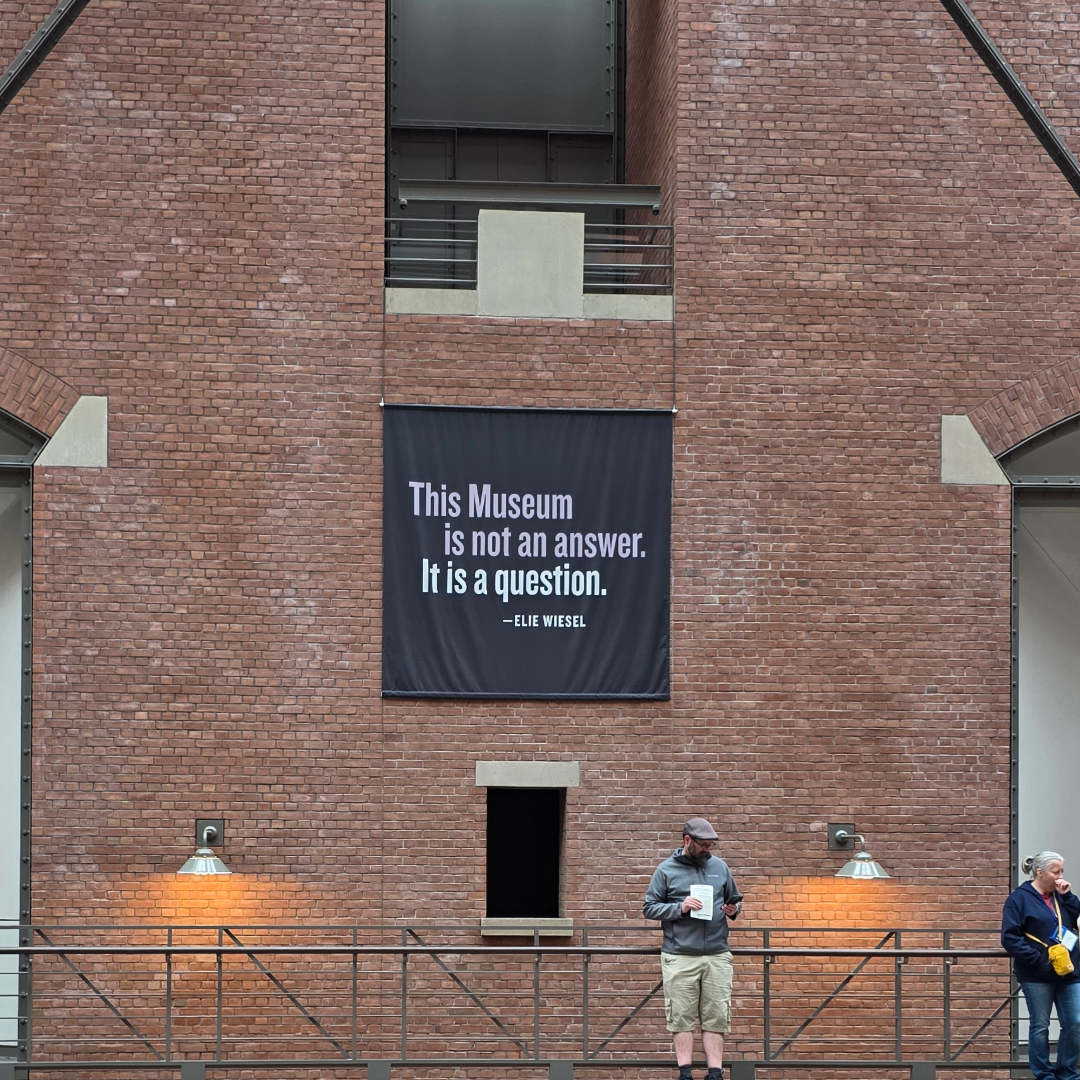
The purpose of my writing this post was not to share every item or piece of information I learned or saw in the museum. Rather, it was to share my experience, my reflections, and to explore my own queries that arose from visiting the place that is, as Elie Wiesel said, not an answer but a question.
My question
So what, then, is my question? I considered this for some time, and my conclusion is:
How?
Not how could this happen – that answer has unfortunately been made more than clear.
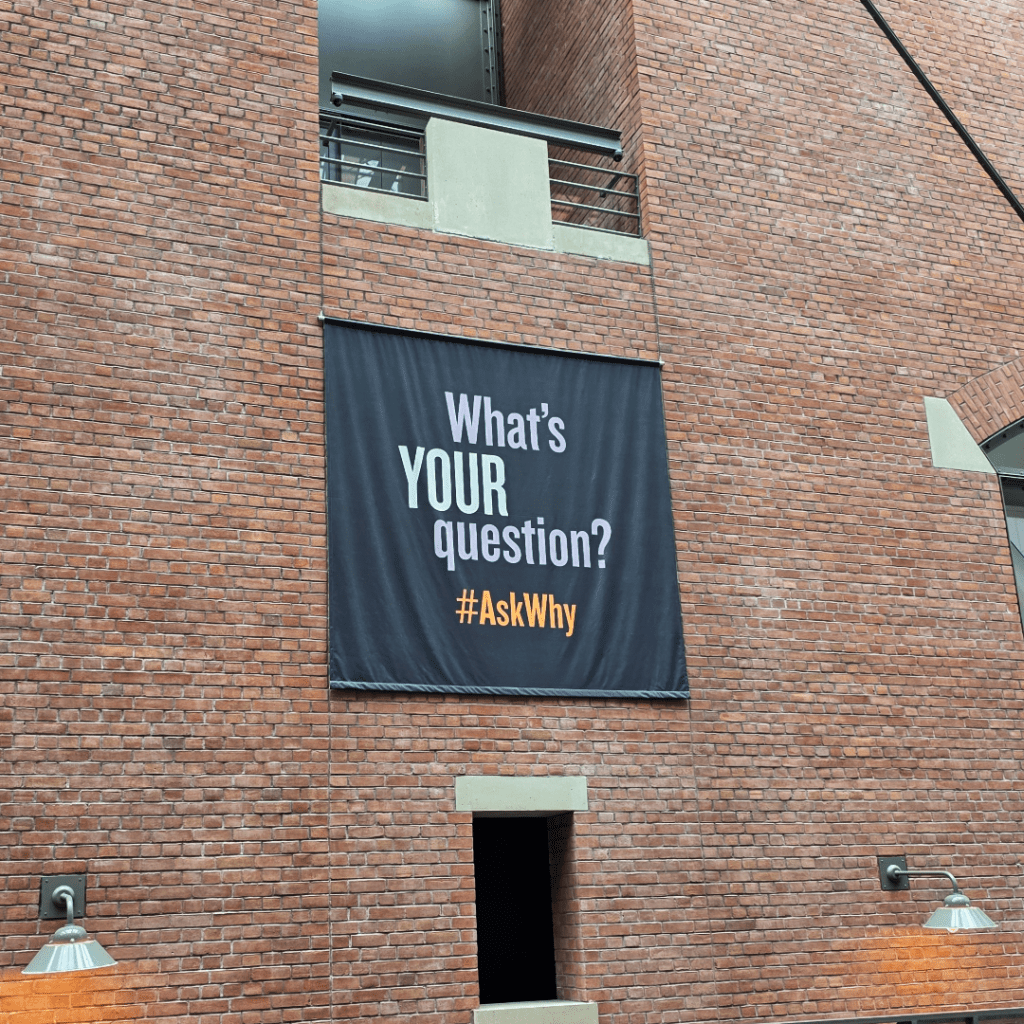
But how could anyone dispute this evidence – video, photograph, testimonial and artefact alike. How could anyone see the raw emotion in the faces of the victims, liberators and survivors and not believe it. How could someone see this testimony and not be shaken, moved, horrified, sickened.
And how do we make sure that every person, every school child learns about this time, sees this and understands the pure human tragedy. How do we make them want never to see this happen, never tolerate hate, cruelty, inhumanity towards one another, and indifference.
Everyone should experience feeling this sadness, and this outrage. It is the only thing that will point us in the direction of preventing another Holocaust.
A final note:
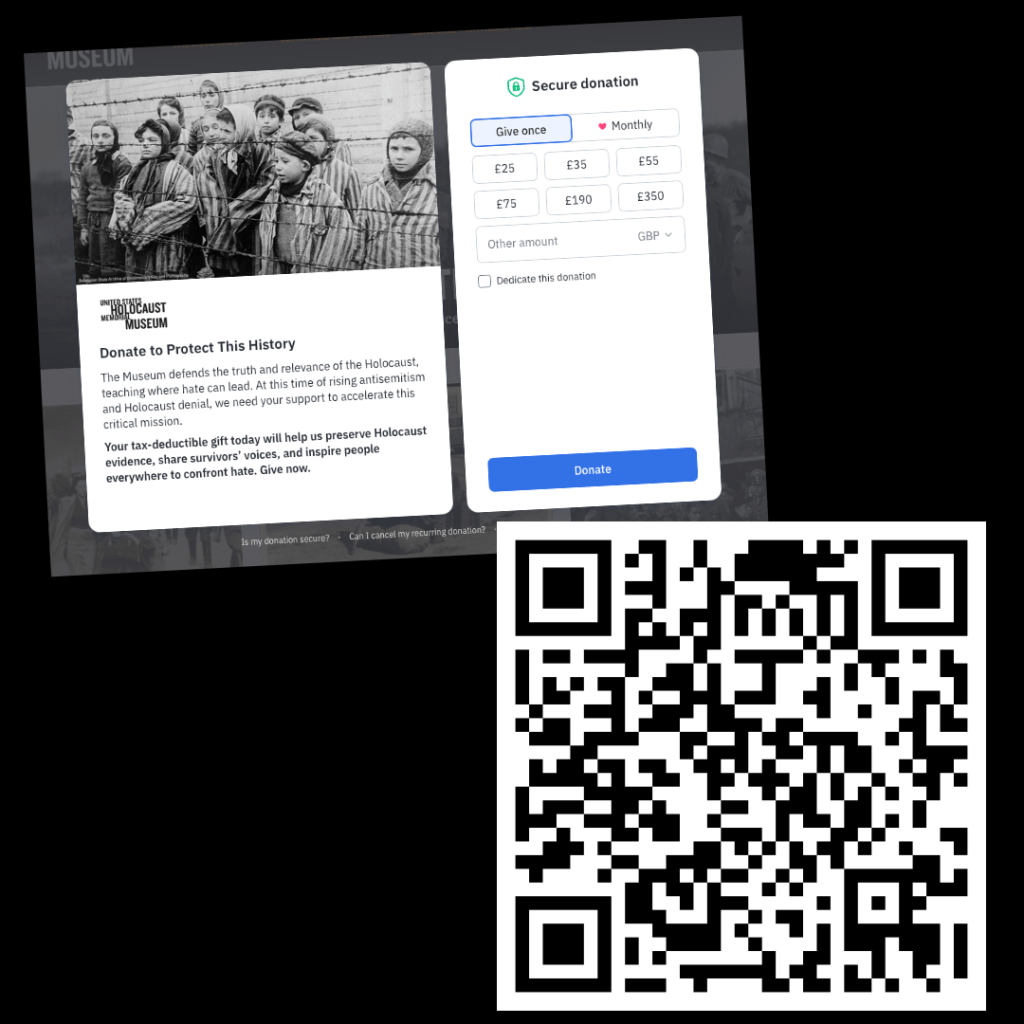
Tickets to enter the museum are free (though can be booked in advance). There are many places as you leave the exhibits to donate to the continued work of preserving this knowledge. Even if you cannot donate at the time, or cannot visit the museum in person, you can donate online very easily.
There are also several excellent shops at the museum where you can pick up books about the Holocaust and memorials of your visit.
The Museum website, the Holocaust Encyclopaedia, also includes phenomenal resources for teachers and students.

