The last month has been an absolute whirlwind of travel, work, sneezing (due to allergies or a cold I am still not certain), trying to adjust to whatever time zone I am in, and resting up to be ready and raring to go in June. I’m still working on that last one…life and work get in the way.
Last weekend though, we finally managed to check one big task off the list: to get a car, which we had been without since our old one failed its MOT in February – for those in the US, this is the annual check-up for road readiness here in the UK. The car chosen by the other half was located in England – as most good options are – and so he promised that if I came with him, we could make a weekend of it and see a castle on the way back.
I am never too tired to see a castle (though I came close). It was the first one I had visited in some time and I was very excited – there were plenty of options nearby, northern England being rife with castles, and after a bit of researching I selected Brougham Castle. It seemed both well-placed not too far from the motorway, and in a good state of repair (all relative of course). I was not disappointed.
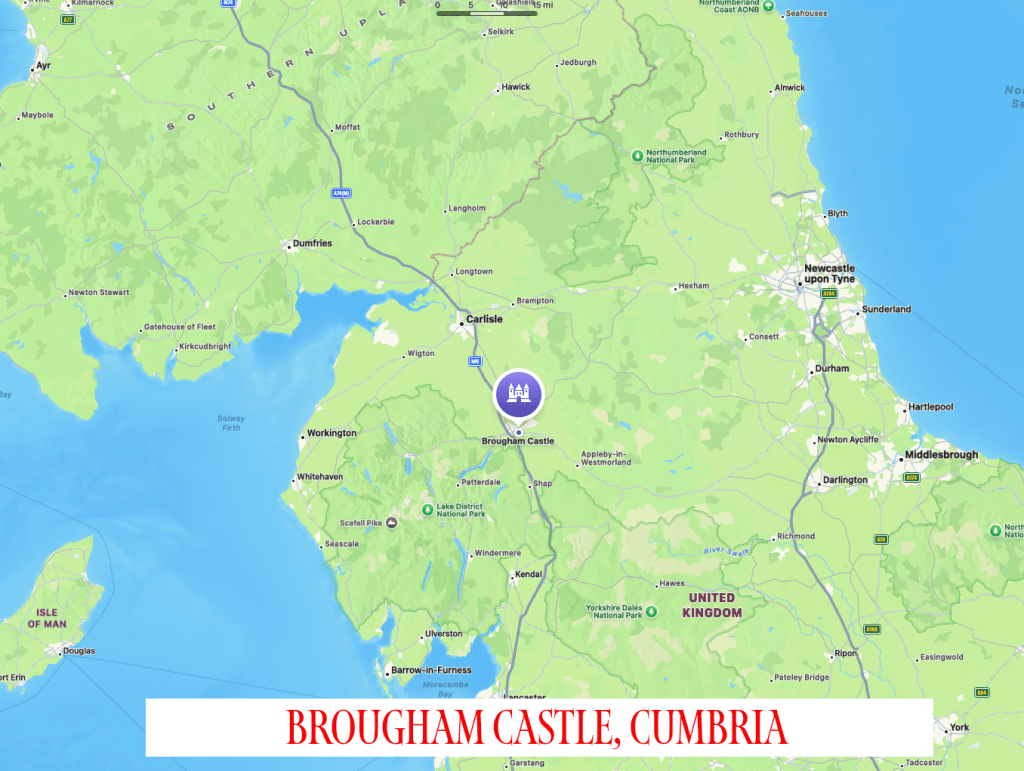
Brougham is in Cumbria, about half an hour south of the Scottish border and on the edge of the Lake District. It is just outside the town of Penrith, and so easily accessible from the M6 (the main road that runs south to north, the UK’s answer to route 95 in the US)
History of Brougham Castle
Brougham (pronounced ‘Broom’, for the record) was constructed at the north end of an enclosure of the Roman fort of Brocavum, or ‘heathery place’. A community grew up to support the fort, and it remained in use until the end of the Roman period. The castle, built on the ruins, used materials from the fort; in one of the stairwells, you can clearly identify a tombstone with Latin carvings. The site itself was first acquired in or around 1214 by Robert de Vieuxpont, Lord of Westmorland, one of the last remaining trusted supporters of the often-maligned King John (not objecting to the maligning of John, for the record). Identified as a good spot for a fortification, the aim was to assist with the defence of the north against the Scots, and other northern barons less friendly to the ruling monarch.
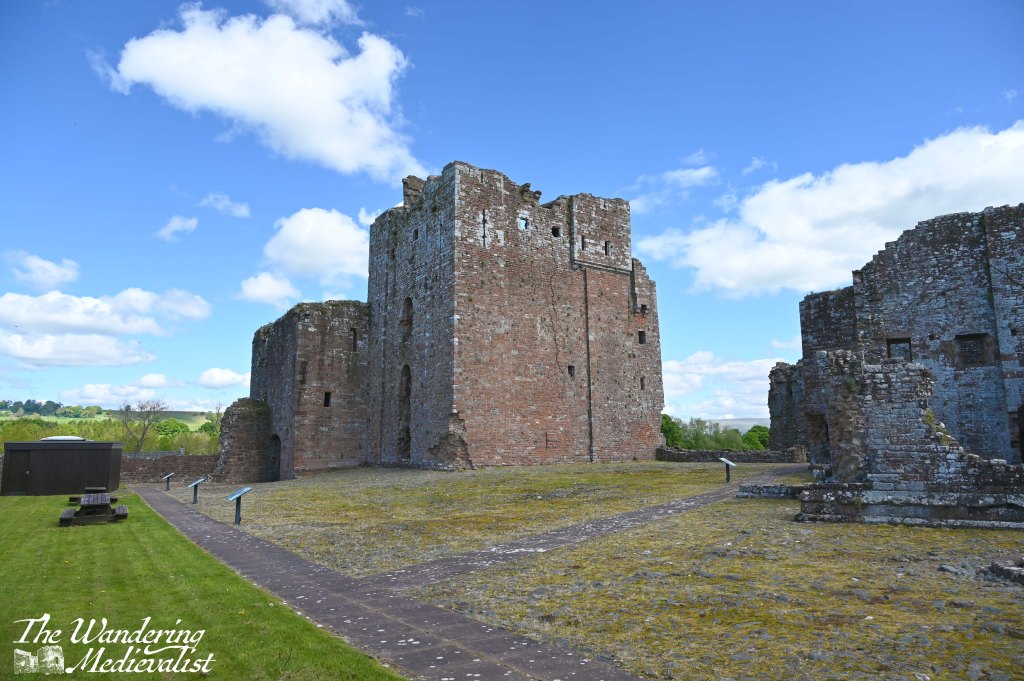
Under Vieuxpont, the castle consisted of the main keep and some service buildings, surrounded by a timber wall that was replaced with stone in around 1300. This view is of the keep and gatehouse, from within the courtyard.
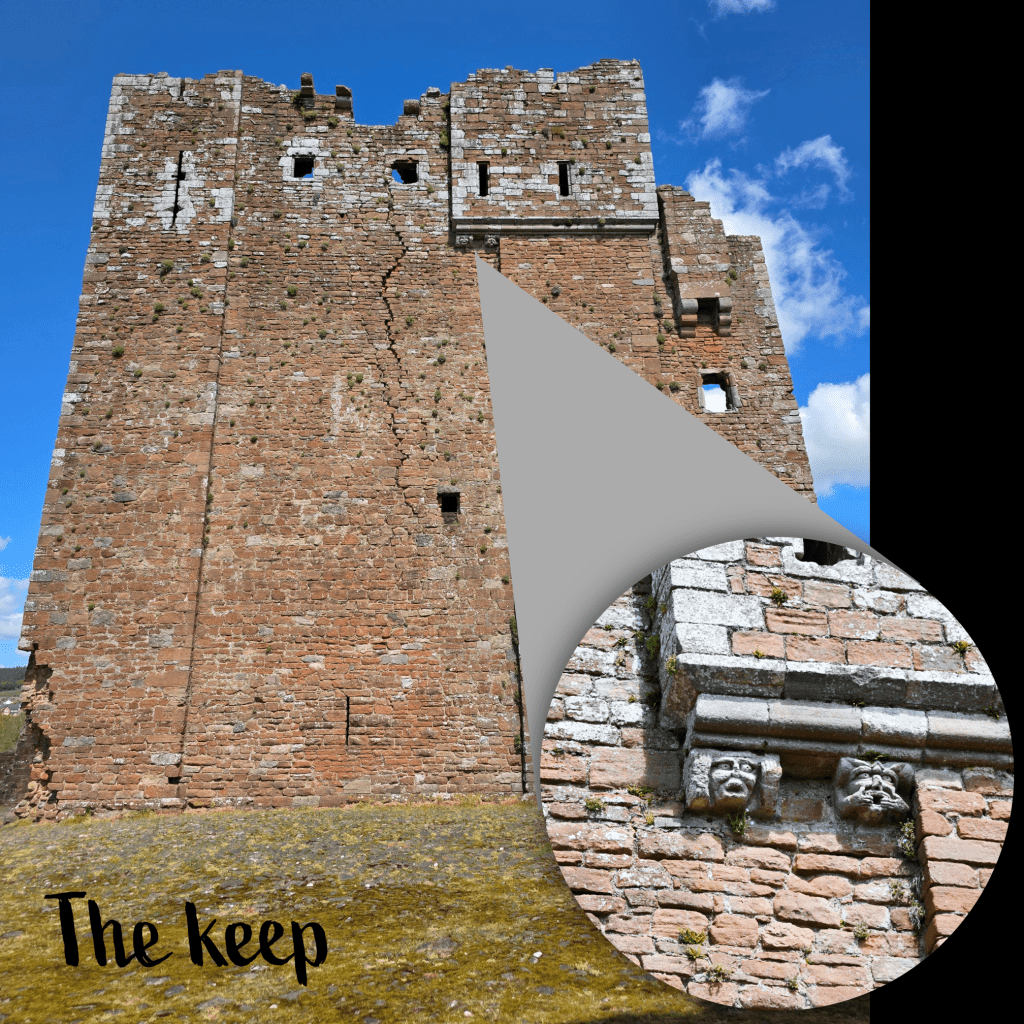
The top story of the keep, obvious in its slightly different style, was constructed towards the end of the 1290s, at least partly in response to the Scottish Wars of Independence and impending danger. The decorated corbels, which I managed to capture on my camera, helped to support the third floor oratory.
By this time, the castle was in the hands of the Clifford family, who would expand over the years, adding the new hall, chapel, and buildings along the south curtain wall. The structure was damaged significantly by the Scots in 1388, and played a role in the Wars of the Roses, with the Lancastrian Cliffords using it as a stronghold in the north against the Yorkist Neville family.
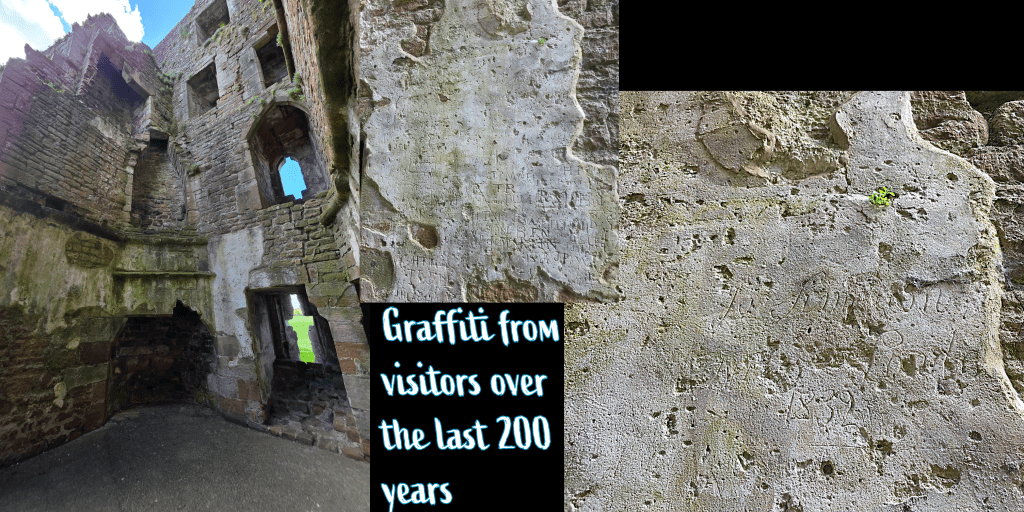
As the years passed the castle gradually deteriorated, with some family choosing to restore its use for a short period, but like many castles it deteriorated and was considered too expensive to be maintained. Cattle were living in the gatehouse in the 1850s, and visitors complained that the castle was inaccessible and partly ruined. Interestingly, graffiti from those tourists of the 19th century – and those since – survives in carvings in the plaster of one tower.
In 1928, the castle came into the guardianship of the Ministry of Works, a precursor to English Heritage.
Our visit
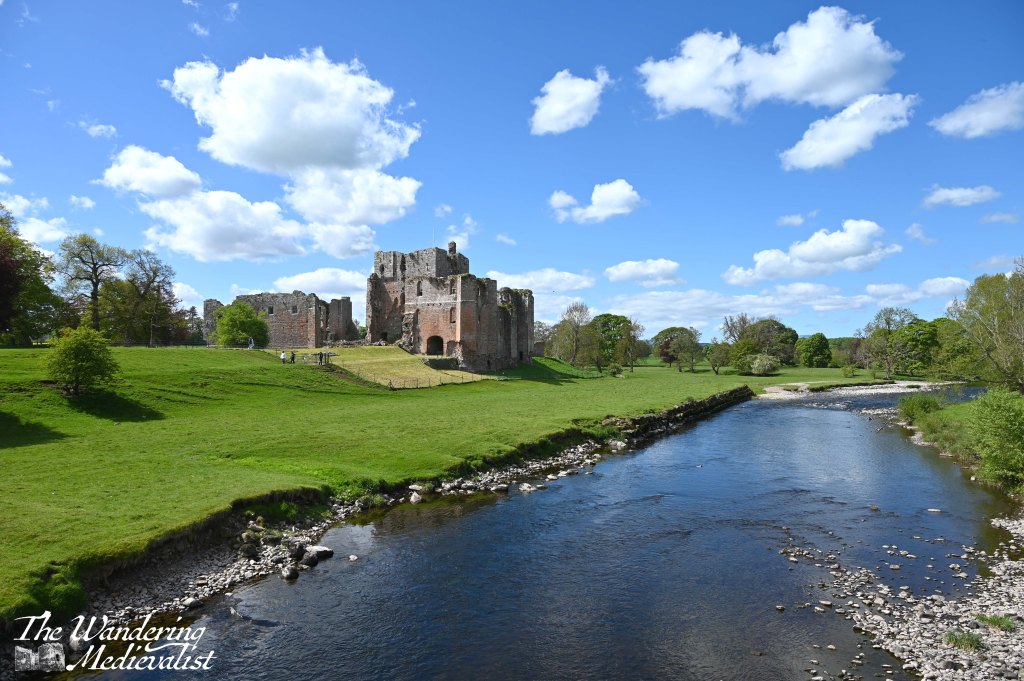
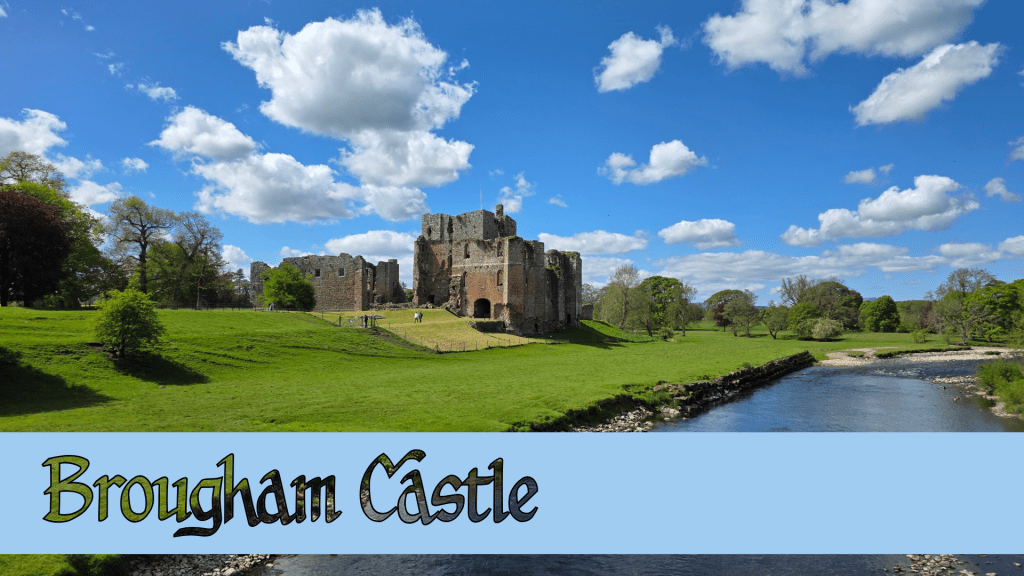
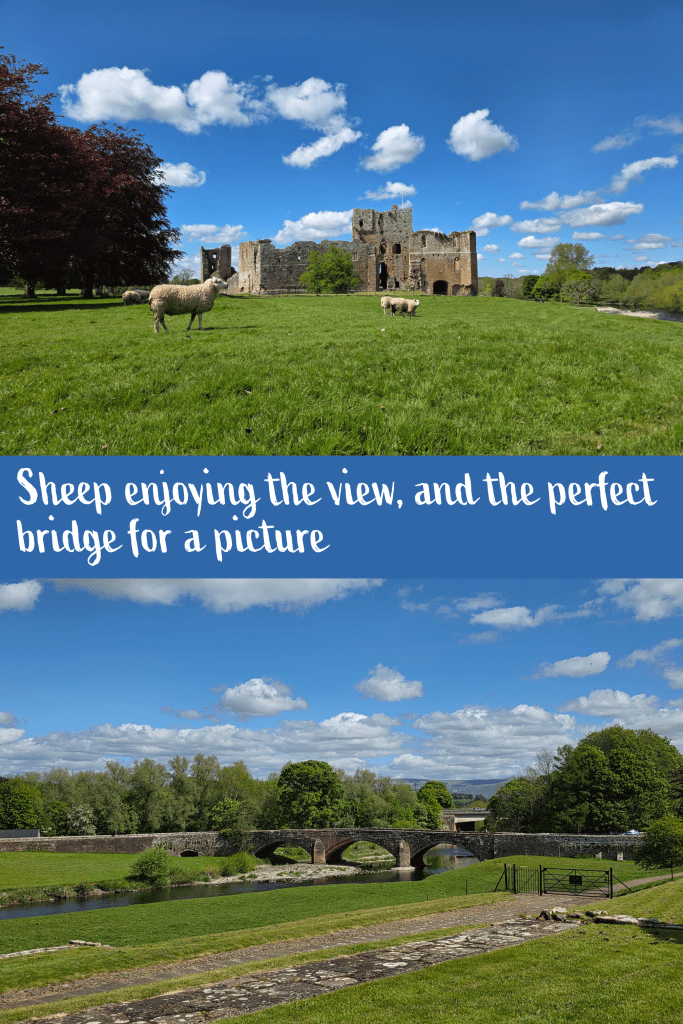
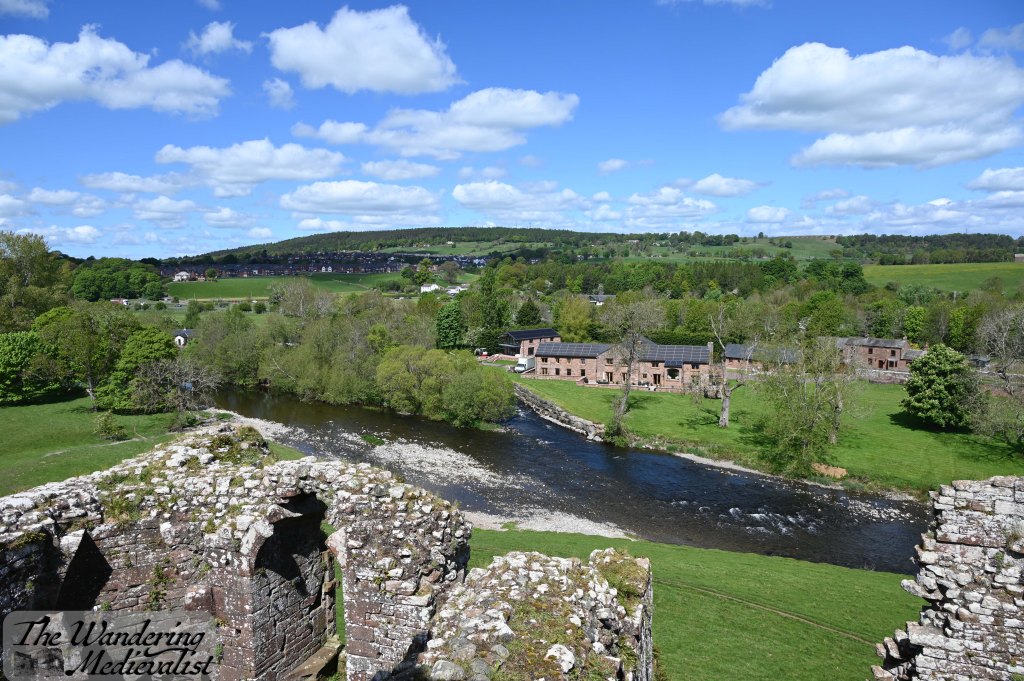
We arrived at Brougham after a short drive up the M6 and discovered that parking is rather haphazard, along a farm access road near the main entrance. I might imagine that at busier times of year, it could be difficult to find a spot. Fortunately, we found a good location out of the way, and while the other half got himself a drink, I scampered up to the bridge across the River Eamont, a spectacular spot for a view (see the post cover, as well as the picture at the very end).
My first photos taken, we continued into the house that acted as the shop for the castle; there were some nice touristy items, a clean bathroom, and a few snacks including ice cream for sale. The kind woman behind the desk trusted me when I said I was a member of Historic Scotland – though I could not find my card – and provided us entry to the castle for free, as I gather English Heritage honours that membership. It makes sense, but was also nice to experience. Between the house and the castle, a field of sheep grazed quite unbothered by the visitors.
We were one of perhaps three or four groups of visitors, and we took a few moments to read the display about the history of the castle, both Roman and Medieval. I was too excited to read much though, and instead pushed forward along to the main entrance, through the gatehouse, which is made of three connected elements, easier to see from inside than out.
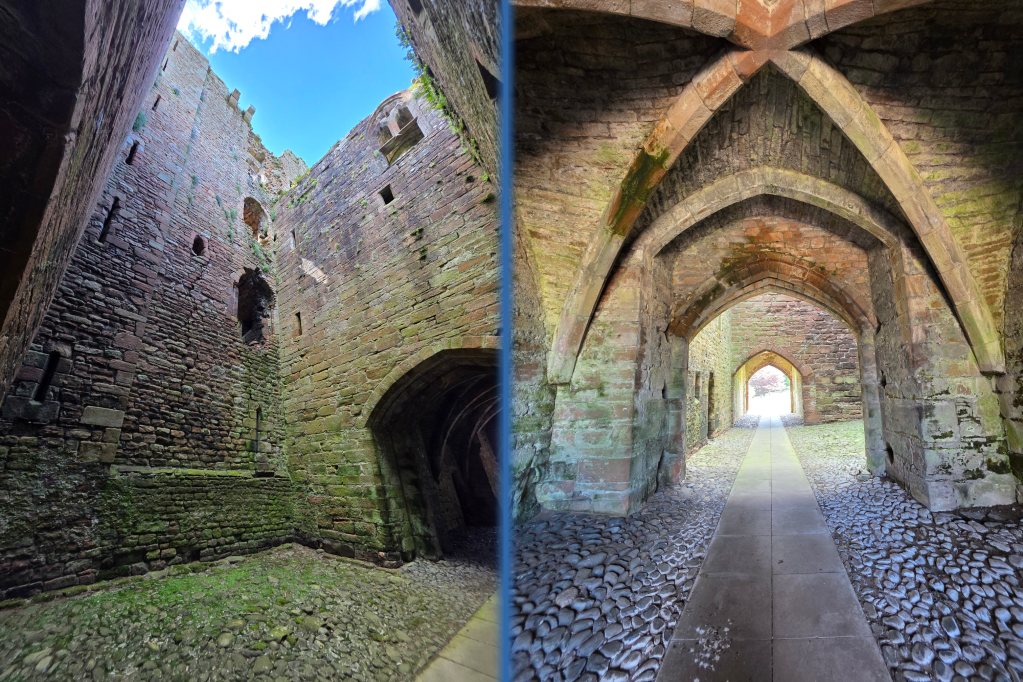
Passing through the gatehouses, one enters the courtyard, where there are remnants of outbuildings along one side, a distant tower in the far corner, and a jumble of additional constructions along the south and east walls. We started at the far tower, the Tower of League, which was built around 1300 to project beyond the walls and assist in defence, allowing for fighters within to look back along the curtain wall. This tower is where the above plaster inscriptions could be found.
Moving around the castle walls counter-clockwise, we came to the ruins of a sequence of rooms used by most residents of the castle, in particular the garrison. There is a lodging block, a dining area, and a chapel, evident on a higher floor from its carvings. I love looking up the walls of a castle and trying to identify where floors would have been, and trying to work out what was a window, perhaps a door, a floor support, or a fireplace.
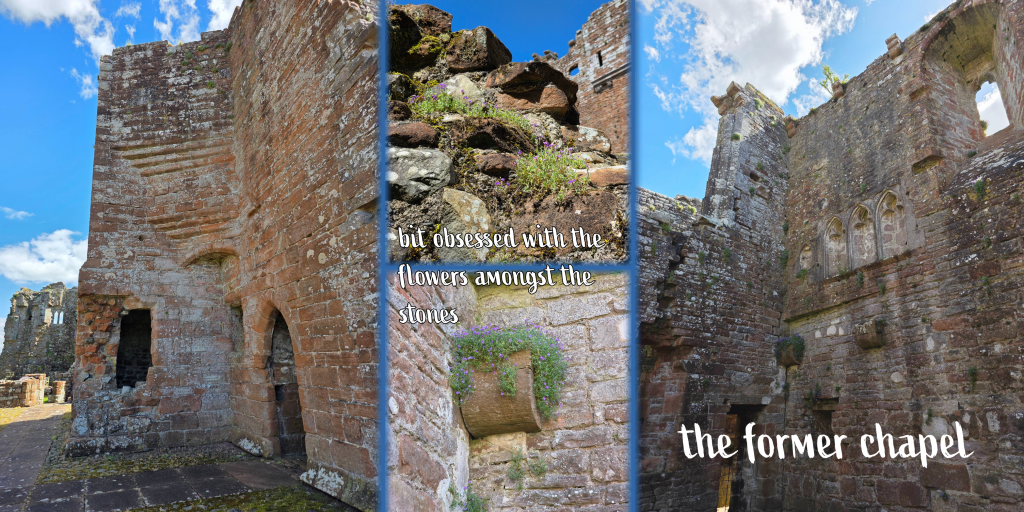
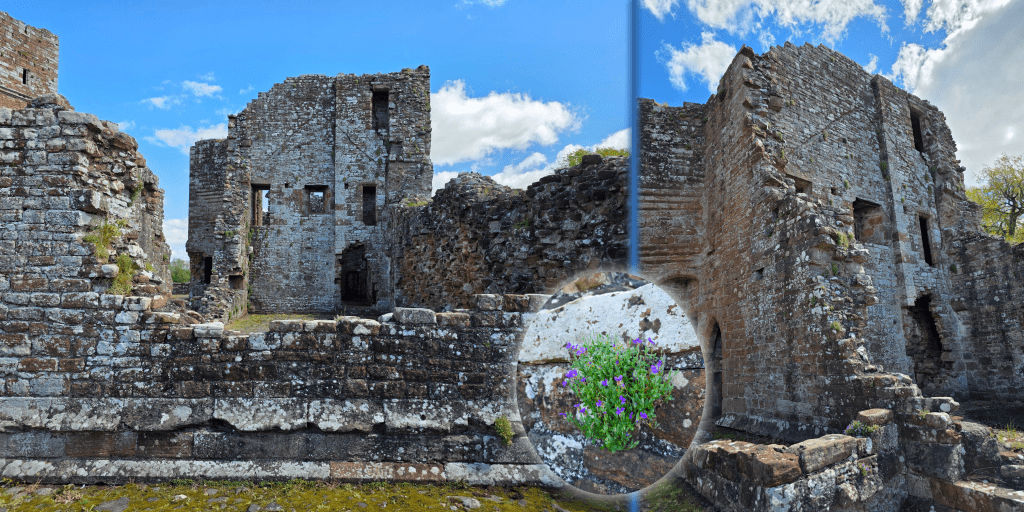
All of the buildings here were overrun by small purple flowers, growing between the stones or on outcroppings – I found myself slightly obsessed by these flowers, and captured them many times.
Along the south wall was also a doorway out – whether an intended entrance or not I was not certain, but it could possibly have been a postern gate of some kind – which led to the grassy ditch that surrounds the castle, and provided a great view back towards the walls.
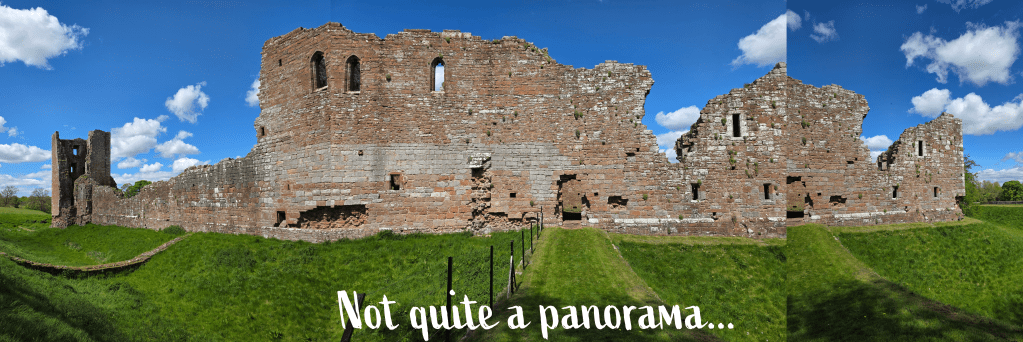
After exploring the various rooms and ruins, there was one more important part of the visit in which to partake – climbing the keep to see the view.
We had been warned several times that it was a difficult climb, steep and narrow, and indeed the staircase did not provide space for more than one person to climb or descend. But, the stairs were not as worn as I have seen, there was a sturdy railing and plenty of places along the way to duck out of the stairs into a short hall or alcove, allowing others to pass.
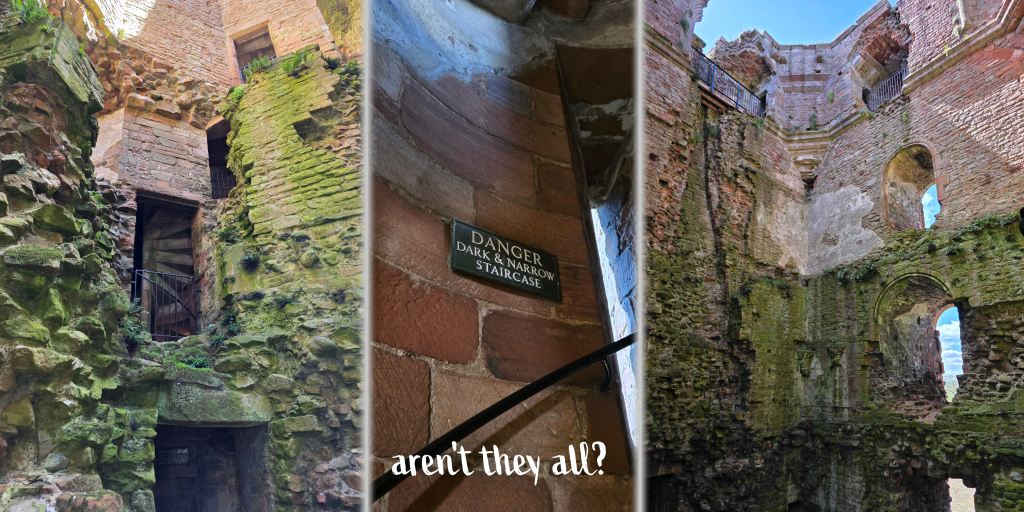
In short, I’ve climbed worse. St Rule’s Tower in St Andrews being one.
And the view was spectacular, whether you looked inside or outside of the castle. Inside, you could look up and down the keep and identify where all the different floors were, the higher ones boasting more carving and showing the newer construction. The top floor of the castle has been made safe enough that you can walk most of the way around the walls, sometimes inside the stone passages and sometimes on bridges secured into the stonework.
There were several places both as I climbed and as we explored the top level where I could peer out through a window or arrow loop – excellent on a sunny day. One of the views here is actually the passage I took out of the castle to see the walls, as mentioned above. I loved being able to see the countryside through these unusual shapes.
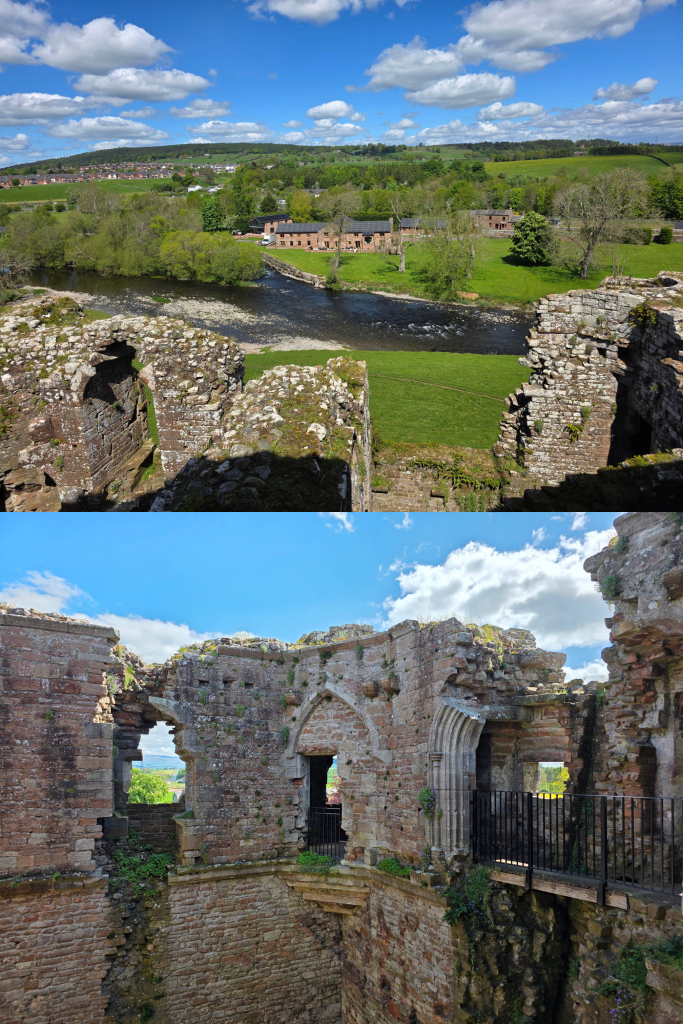
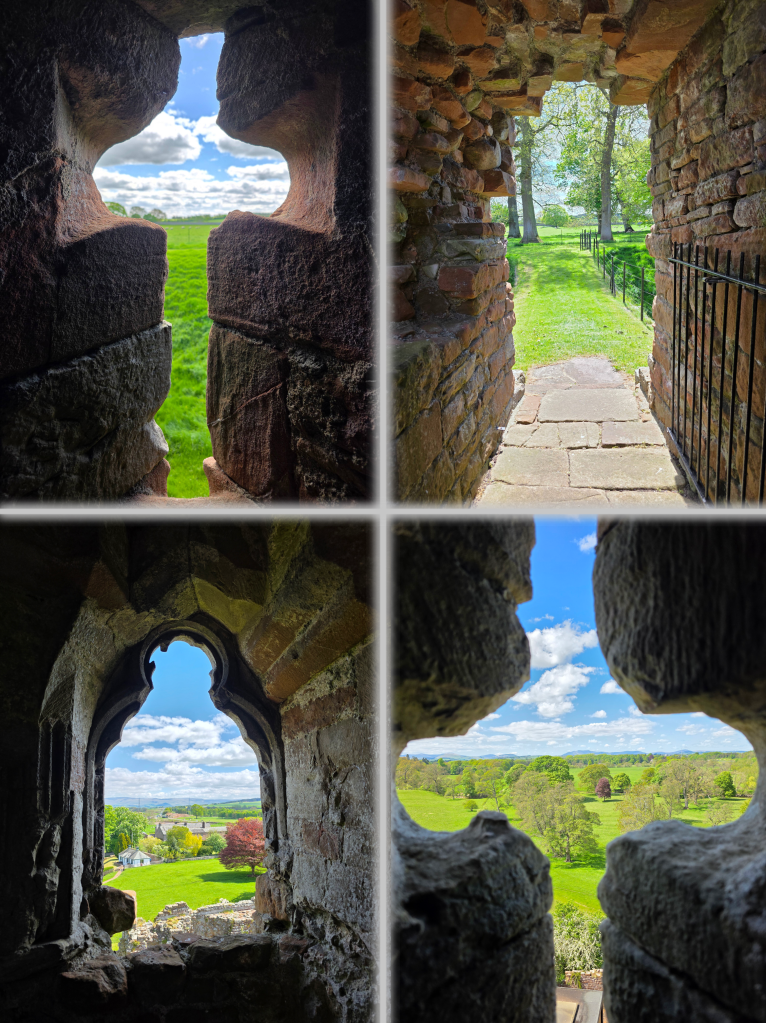
The strategic location of the castle is perhaps most clearly emphasized by this view from the top floor.
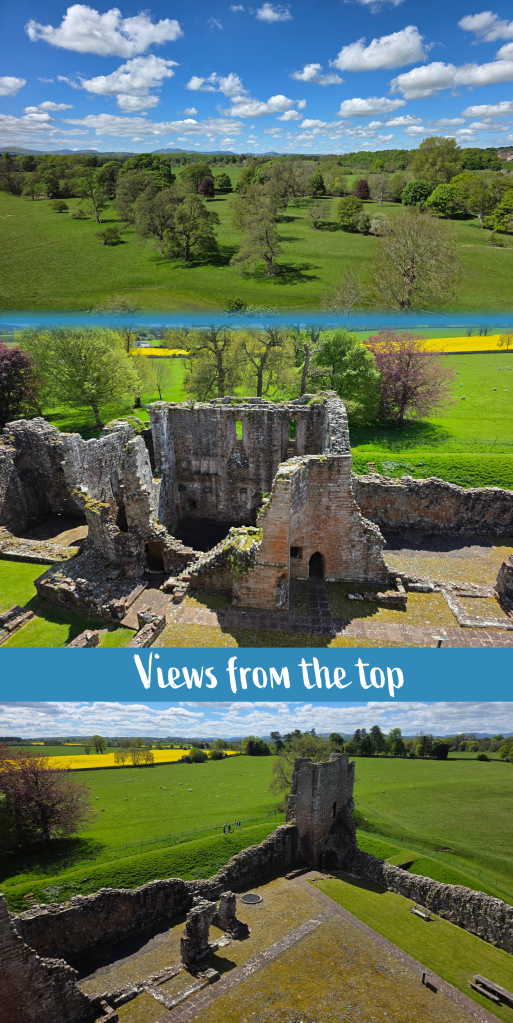
Fields stretch in each direction, some with sheep and crops, and visibility goes on for miles. The outlines of the castle buildings themselves are even more clear from above, and you get a real sense of the power of the structure, and how self-sustaining it would be. In the other direction, you look down at the river and the bridge, with a 360° view of anyone approaching the castle. We stood up here for some time, enjoying the sun and the gorgeous vista, exploring the passages and nooks and crannies of the structure.
Finally though, we did need to return to our car and get going on the drive home – we hoped no more than 4 hours. The day was beginning to change, with more clouds blocking the sun than when we first arrived, a pattern that would continue as we drove north. My final few shots were these, looking at the east wall of the castle and then looking back at the gatehouse as we walked away.
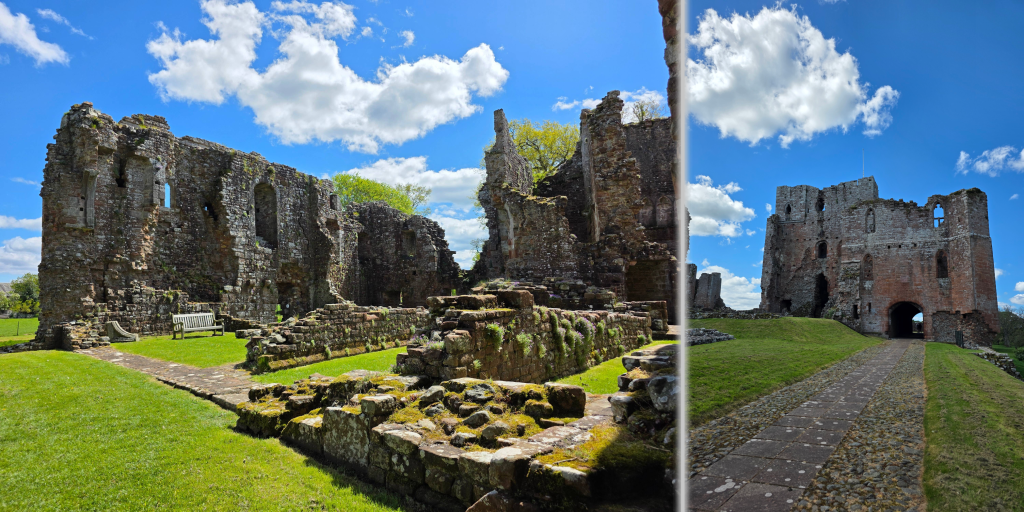
I feel the other half would not forgive me for not admitting that I trod in sheep droppings as I walked, so busy was I with the view – but fortunately they wiped off before we returned to the car.
For castle lovers, Brougham is an excellent day out. The history is extensive, with evidence of the building taking place across the centuries of the high Middle Ages, and clear examples of evolving styles. The castle was defensive, domestic, and was an imposing presence in the landscape – a symbol of power for those who lived there. The castle boasts carvings and decorations galore, a relatively intact keep that can be climbed, and plenty of nooks and crannies to explore both for adults and children. The surrounding countryside is lovely, with a small wooded park nearby and fields of sheep and oilseed stretching towards the south.
I highly recommend a visit if you are in the area, or even if you are just driving up the M6 and need a short detour – it is less than 10 minutes from the highway. And…look at this view!