
I am so very lucky that my job requires me to travel, and has taken me to countries and cities I would never normally have experienced – this autumn was no exception. As you may have read in my recent post about my return to San Francisco, you can find exciting new things to explore in places you have already been, but even more exciting is somewhere brand new. For me, the state of Georgia was that new place. Now, of course I had flown through Atlanta before – I imagine most people who travel in the US have – but I had never been outside the airport, and this visit included a week in Atlanta, drive across the state, and three days in Savannah. Quite an adventure, and with corresponding number of photos that took me some time to sort through. So strap in – this is a long one.
I admit I had less excitement about Atlanta; it wasn’t that I did not want to explore, but I knew that I did not have much time off to get a good feel for the place. Savannah on the other hand had been a fascination since I had seen Midnight in the Garden of Good and Evil in the 1990s, and then more recently read the book. Lucky for me, there was a genuine work reason to check it out, and my day off just happened to fall there!
Atlanta
But I get ahead of myself.
My travel agent friend is always my first port of call when I have ‘new city in the US’ questions and she recommended that I look for a hotel in Buckhead, which is a few miles north of Atlanta proper. She was absolutely right – I was able to find a lovely hotel with excellent breakfast, good coffee, and plenty nearby in the way of grocery stores and restaurants. Parking was expensive, but traffic wasn’t too bad in compared to some other cities.
This was not the case, I should say, upon my arrival at Atlanta airport and collection of my rental car. That drive through Atlanta city centre in a car I did not know well was less than fun.
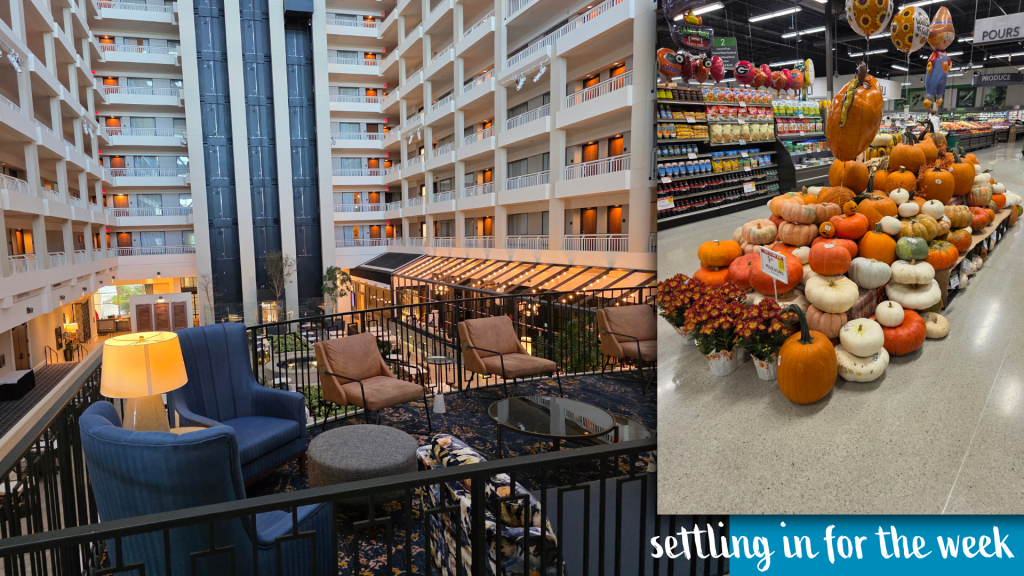
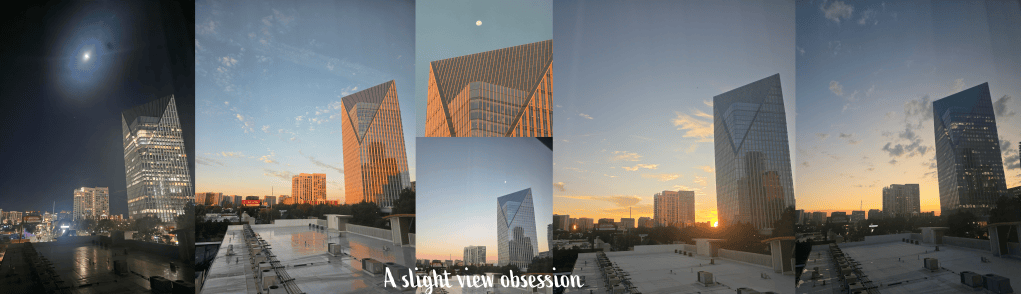
But by the following morning, I was rested and ready to explore the nearby neighbourhoods, starting off of course with some excellent work visits. I did become a touch obsessed with the view out of my hotel window, which changed drastically throughout the day so that I found myself capturing it whenever I could.
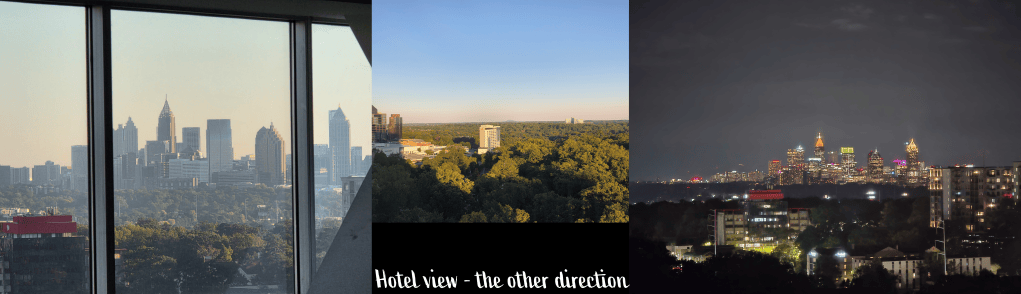
Later in the week, I wondered if I might be able to see the Atlanta skyline from the hotel and sure enough, after a bit of exploring and climbing to the top floor, I managed to capture this: (and of course went back later at night)
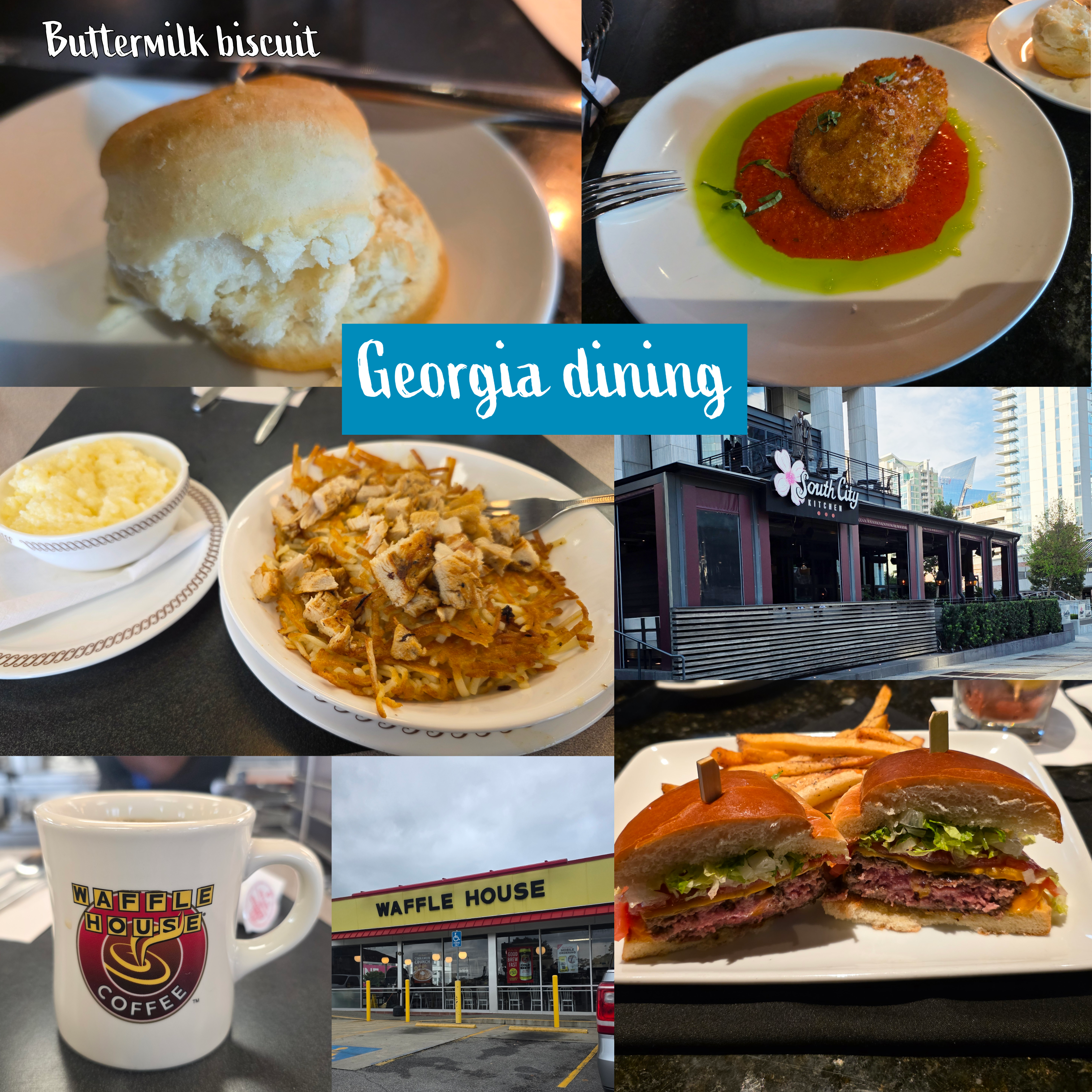
Close to the hotel was the fantastic Southern City Kitchen, to which I ventured one night in search of a proper southern feast. While as a single diner I was required to sit at the bar, I was far from disappointed. Fried green tomatoes and a chicken dish flavoured with mustard were to die for, but the best part of the meal by far were the light-as-air buttermilk biscuits. They were so good I even took one home for later. See the end of this post for pictures.
I did do more than just eat, though proper Southern buttermilk biscuits are a major weakness of mine. I was also able to manage a few short walks between visits, with various degrees of success at finding an interesting view.
Along the Chattachoochee River
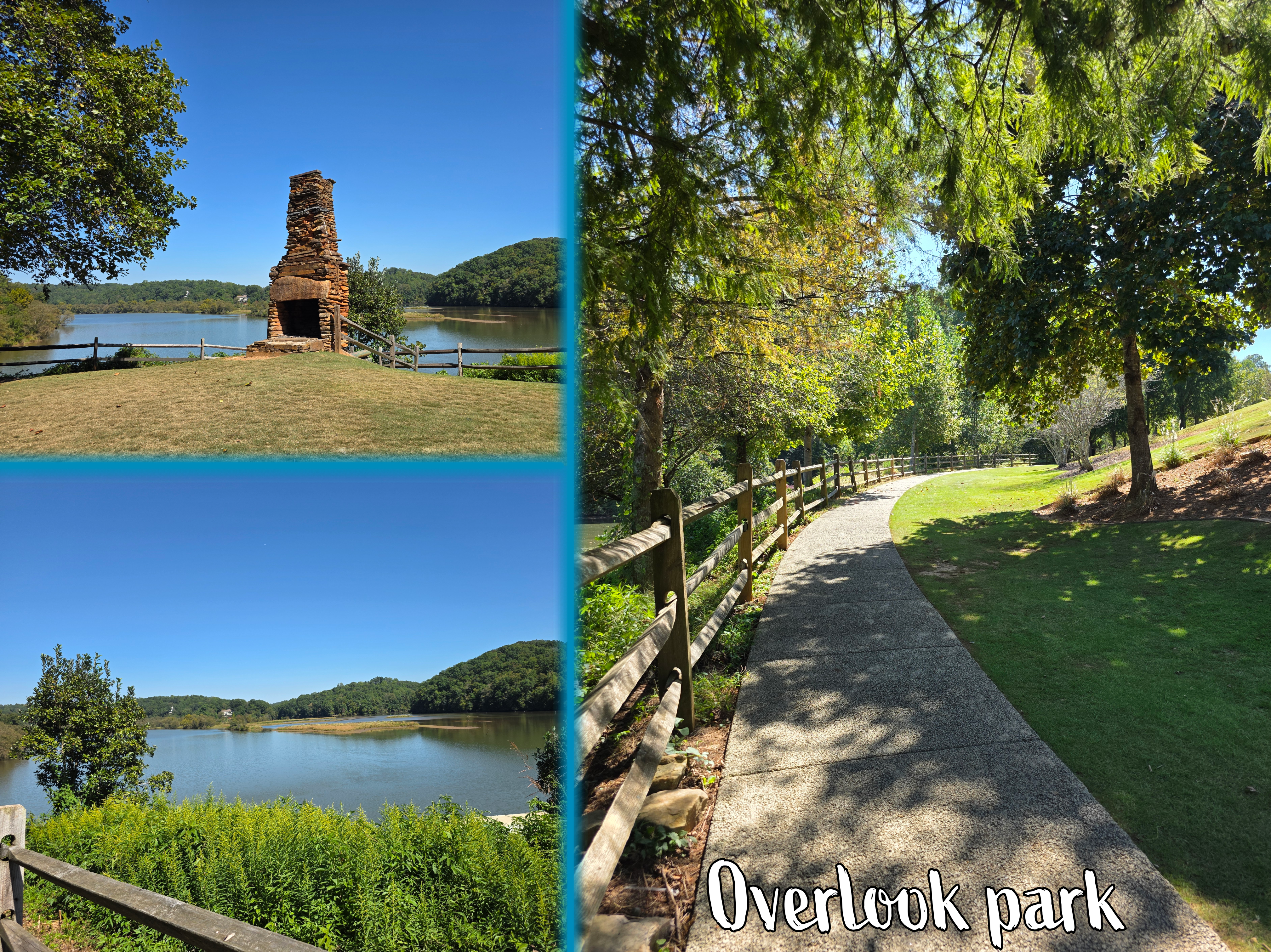
My first stop was Morgan Falls Overlook Park, which I hoped might provide a view of said falls but did not – it may have done through a longer walk in the woods for which I did not have time. I was able to take a short loop that included views over the Chattahoochee River.
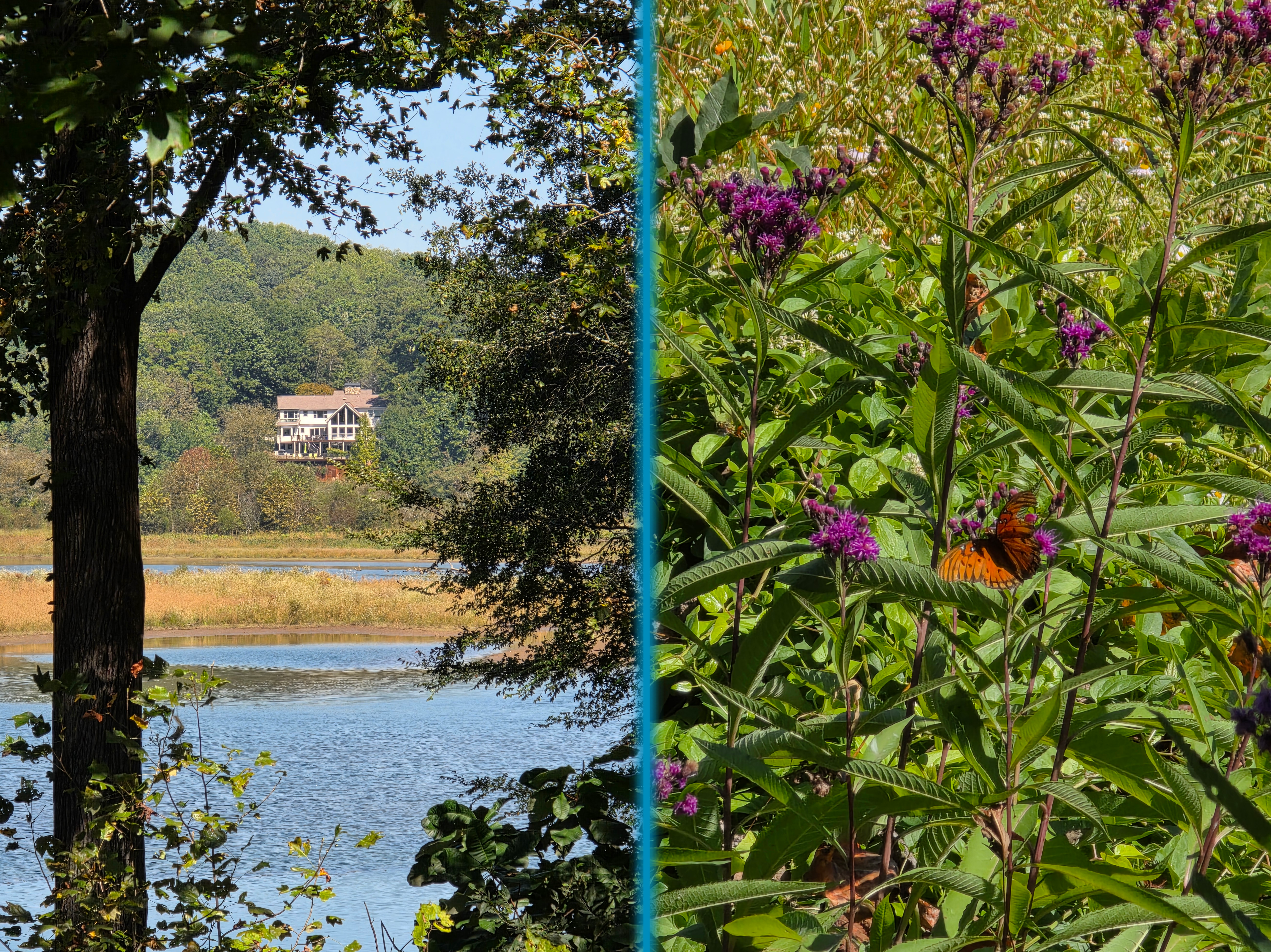
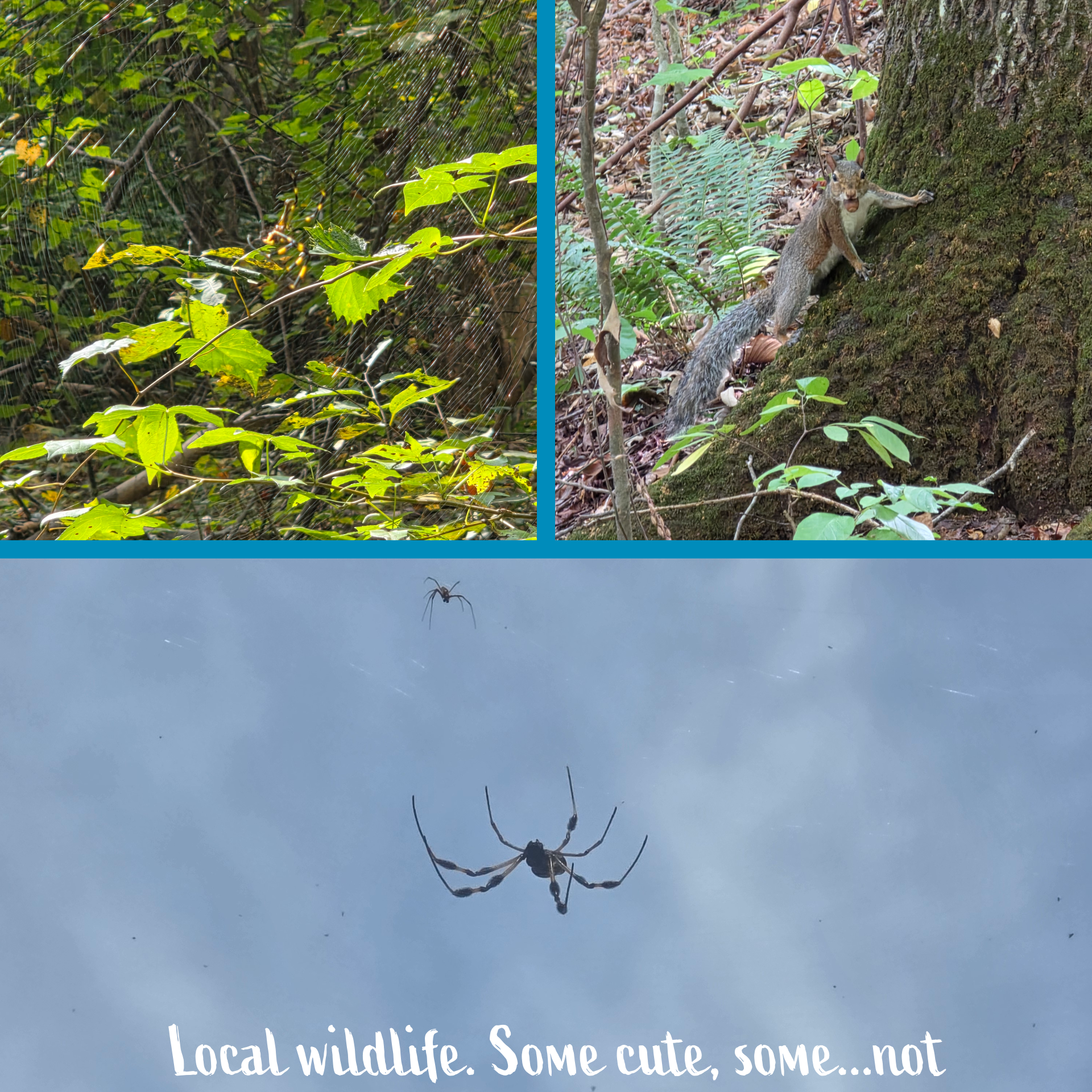
It was quite a warm day, and while there were butterflies fluttering about, there were also massive webs just off the trail amongst the trees, giving me my first glimpse of Georgia spiders. I hoped to return at some point to a different park nearby so that I might actually see the falls, but never managed.
My second stop along the Chattachoochee River was the following day, perhaps 5 or 10 miles further north. I had identified what appeared to be a parking area near the river, but when I turned off the main road I found myself quickly on an unpaved track. It was in better shape than many, so I cruised carefully along, avoiding potholes, and managed to park. The river was a very short walk away, and the view was indeed stunning, in particular the greens and browns of the water.
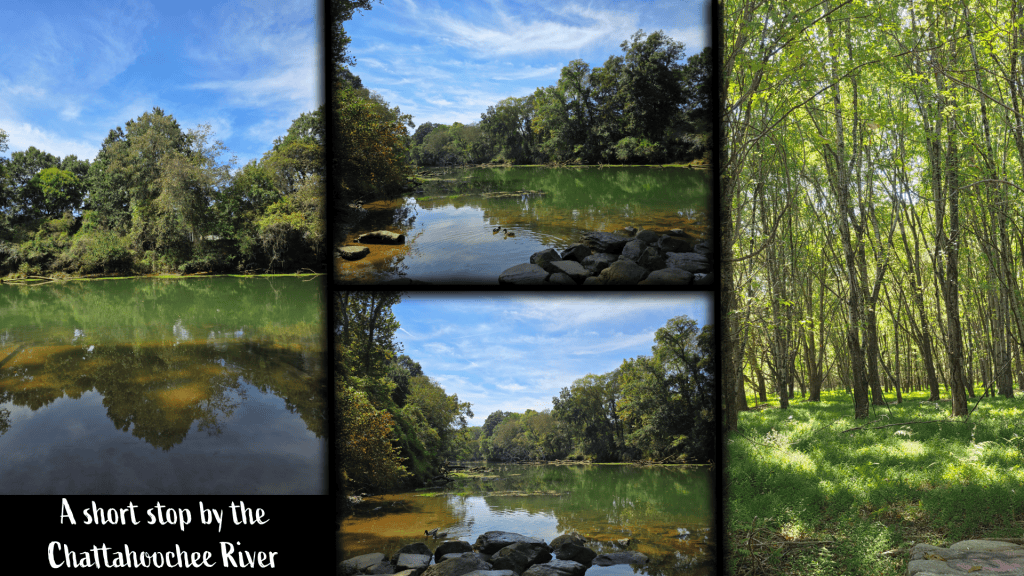
While I had not yet come across any ominous signs, the car park was almost entirely empty and there was not a person in sight. Strange movements among the trees that I could not identify encouraged me to get back in my car and head on out pretty quickly. The colours were gorgeous though.
Sope Creek Park
Later in the week, one of my visits ended early and I managed to discover this park not far away, fortunately including some good walking trails. I had come prepared with sneakers though not with a hair tie, my downfall – while the heat of Georgia was not new to me (it feels like most places I go for work are hot), the humidity was. I had only walked for about 20 minutes before my hair was sticking to me unpleasantly, and became a frizzy unmanageable mess. But I learned my lesson.
Anyway back to the trail, which included well-marked intersections (I took a picture of the map to avoid getting lost) and several loops of different lengths. I opted for a shorter one, leading through the woods towards the ruins of an old paper mill.
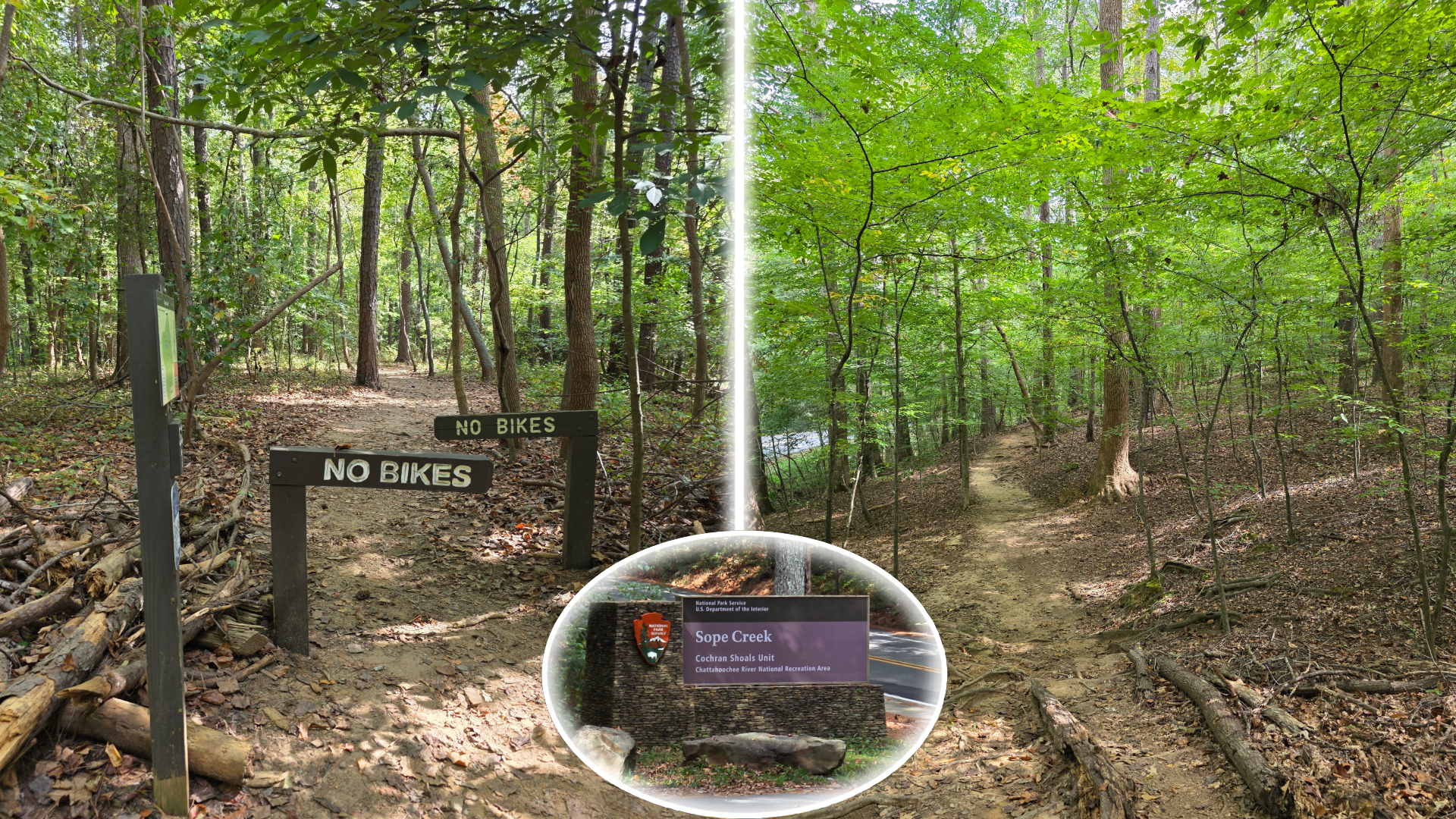
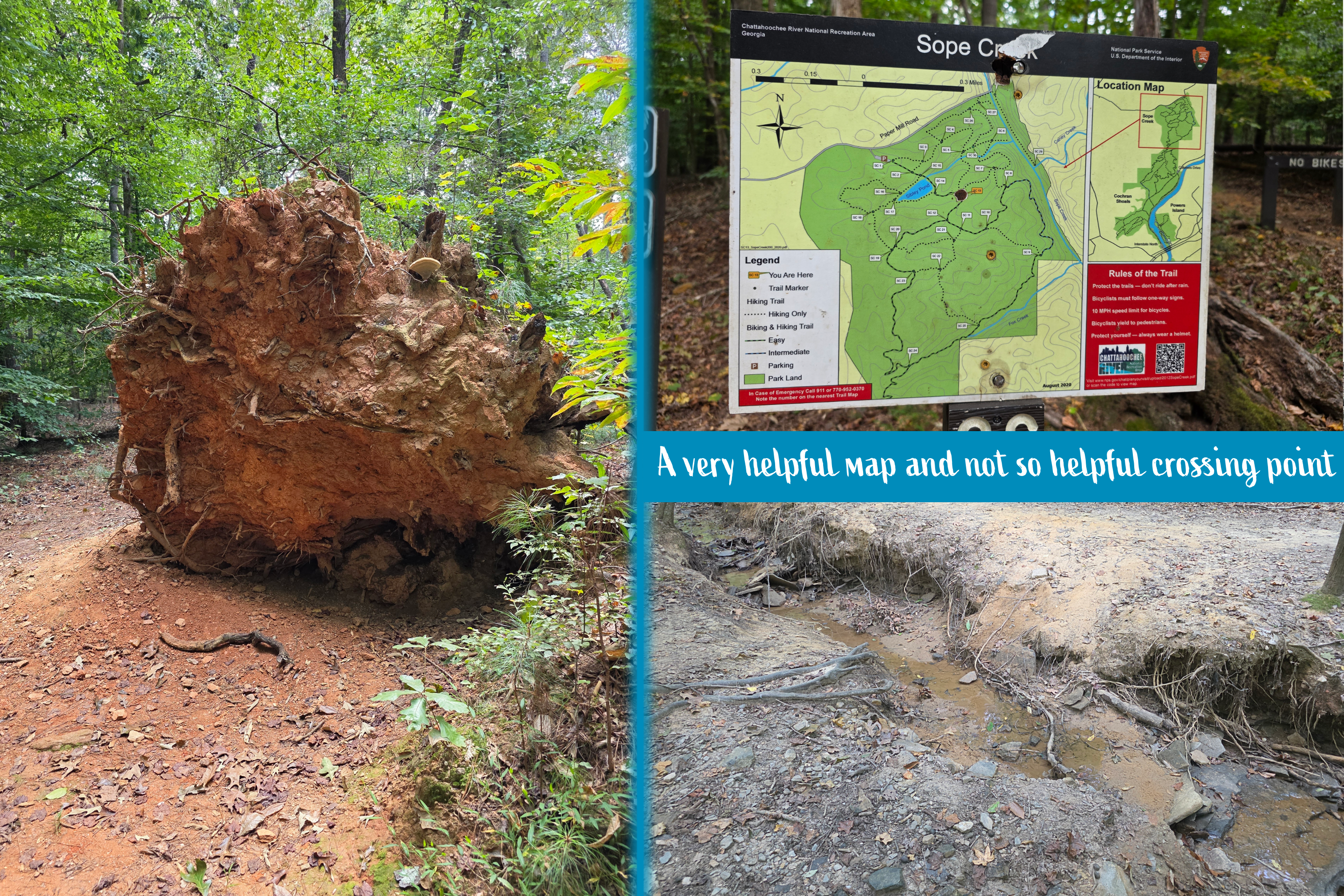
The trails were reminiscent of those I am accustomed to in New England or Scotland, well-kept and for the most part easy to traverse. I did have one unfortunate crossing of a small creek bed – completely dry – that had caved in, as you can see in the picture above. It was just too far to jump reliably, so I awkwardly climbed into and out of the gully. For the most part, though, it was a very pleasant trail down to the ruins and gentle river. The Marietta Paper Mills had been incorporated here in 1859, but were burned during the Civil War in 1864. Re-built, they operated until 1902. Now, the ruins present an almost castle-like picture in the woods, and the river is flat and open, easy to traverse over large shelves of rock.
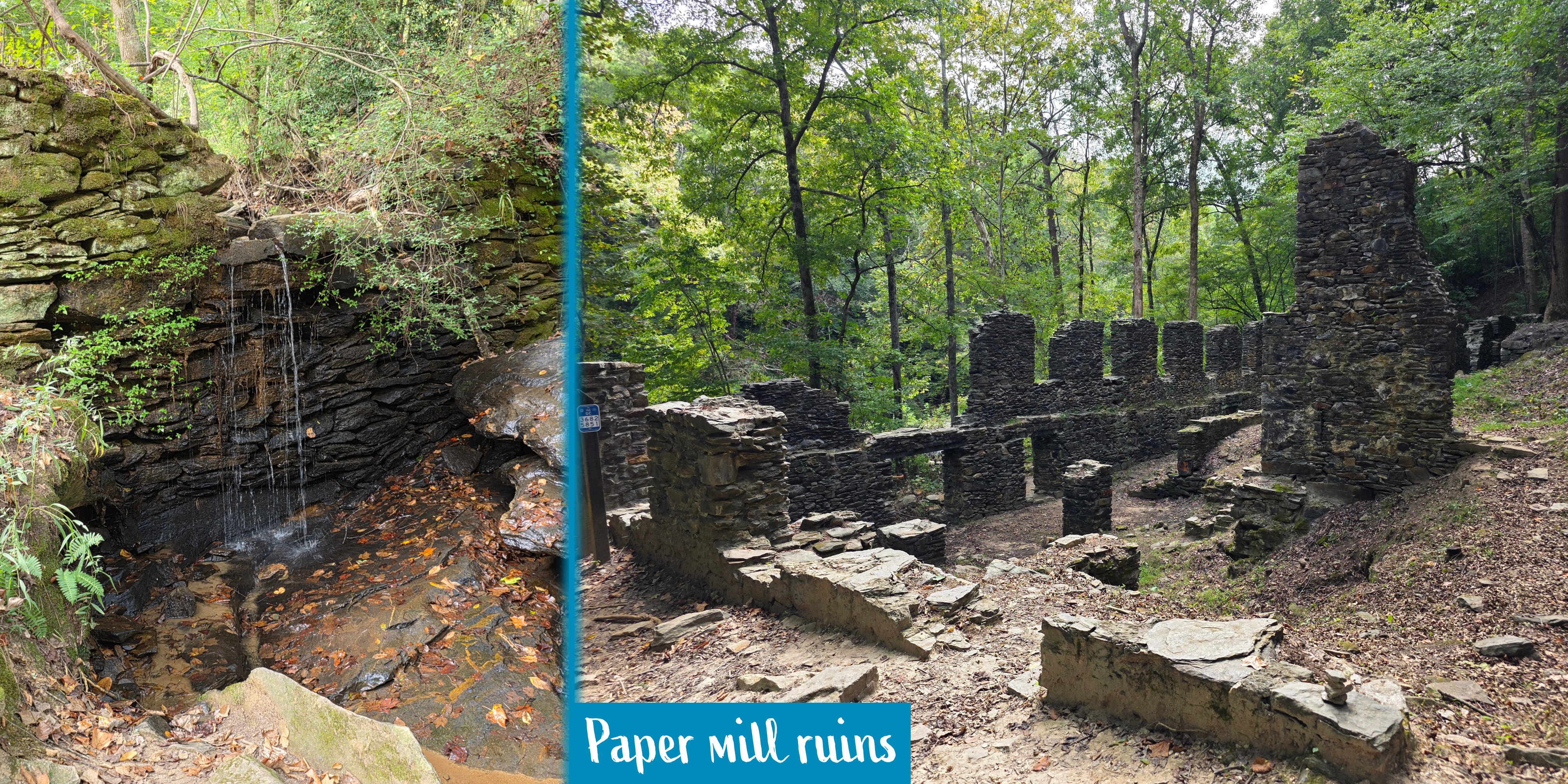
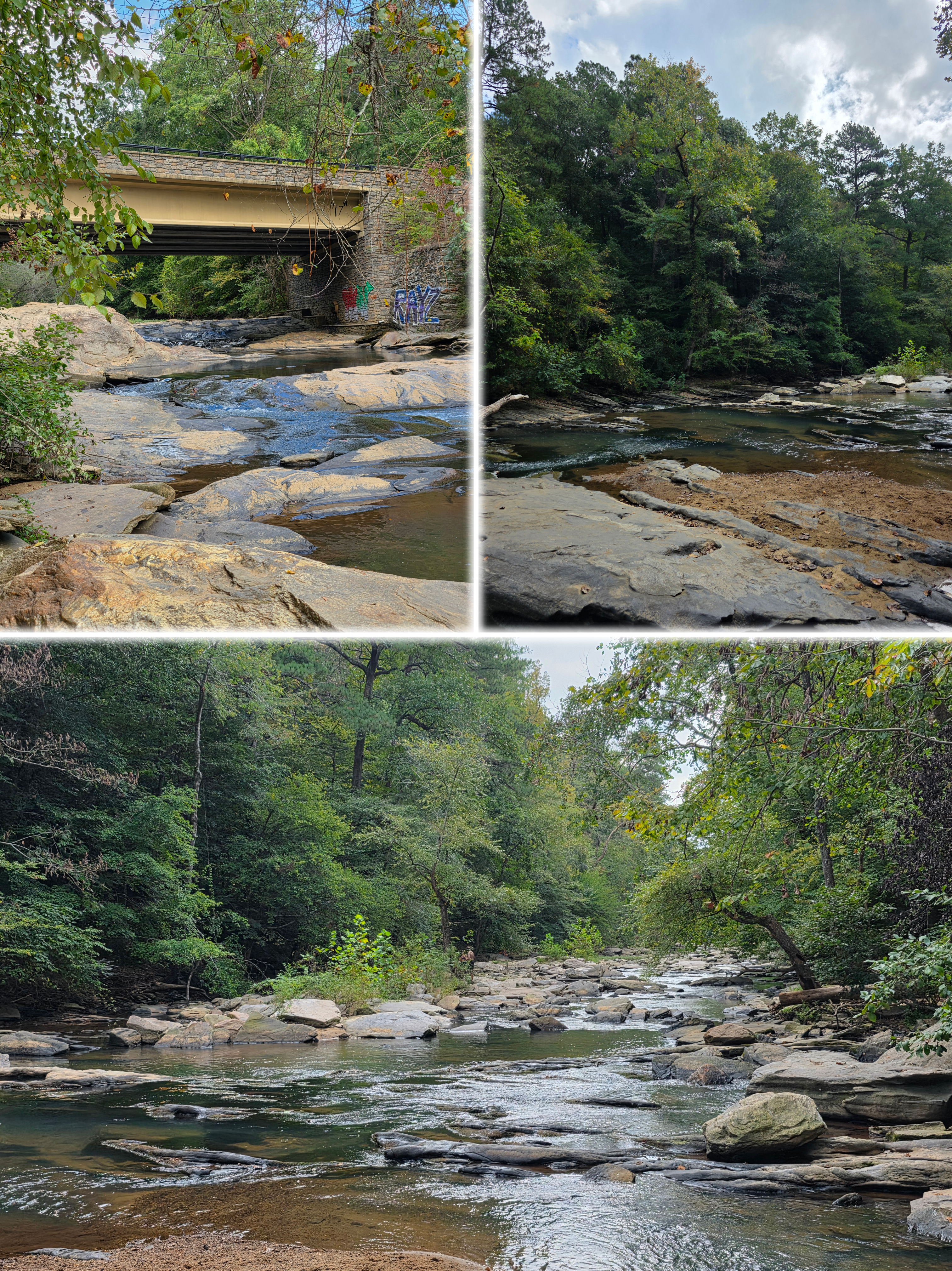
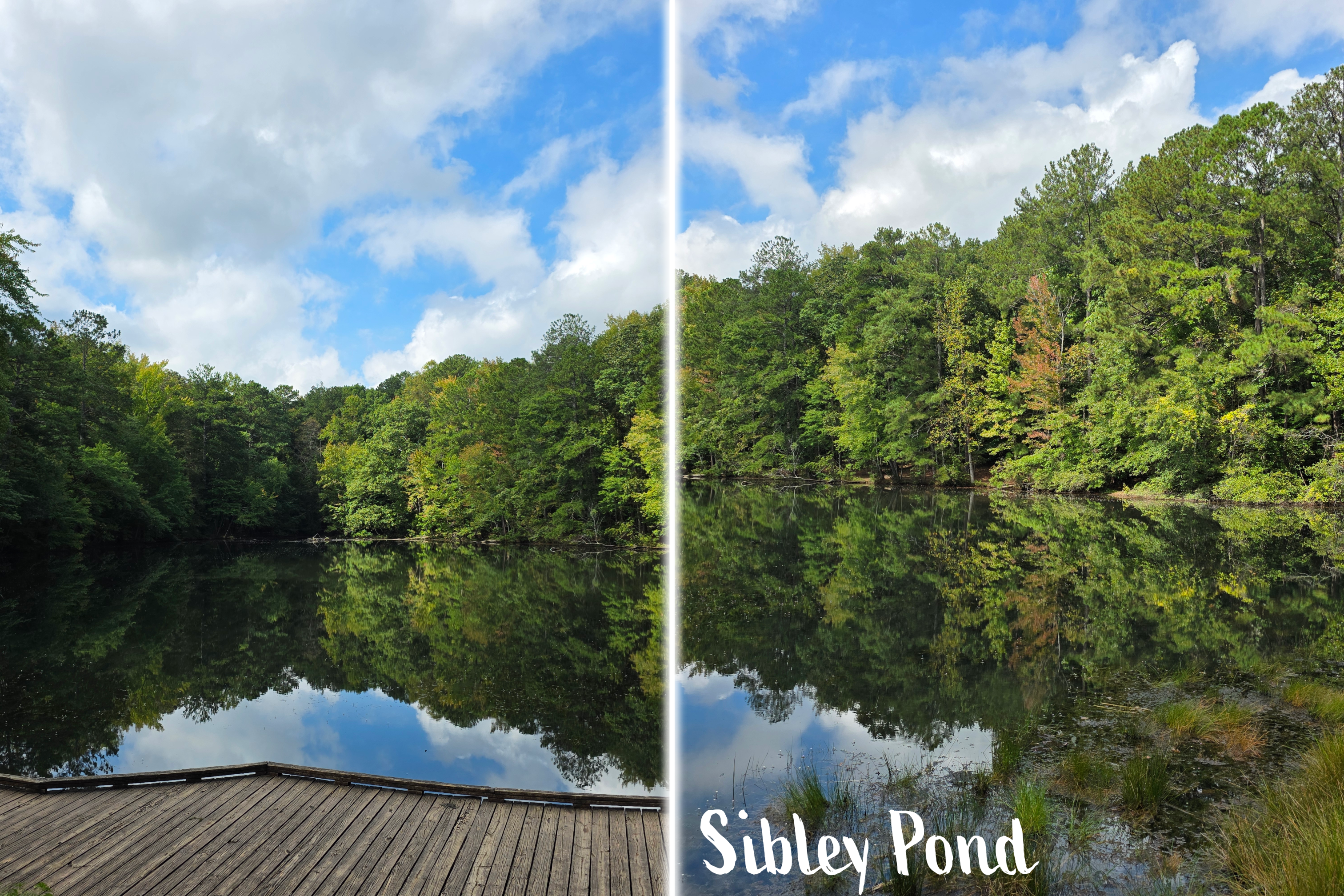
After exploring the mill, I continued on a slightly longer loop to Sibley Pond, a man-made pond about 100 years old. The closer I got to the pond, the more aware I became, once again, of the enormous spiders housed in the trees along the trail. The pond was beautiful but the New England and Scotland girl in me cannot handle large arachnids, and I quickly headed back to the car. The squirrels at least were mostly friendly.
Peachtree Highlands
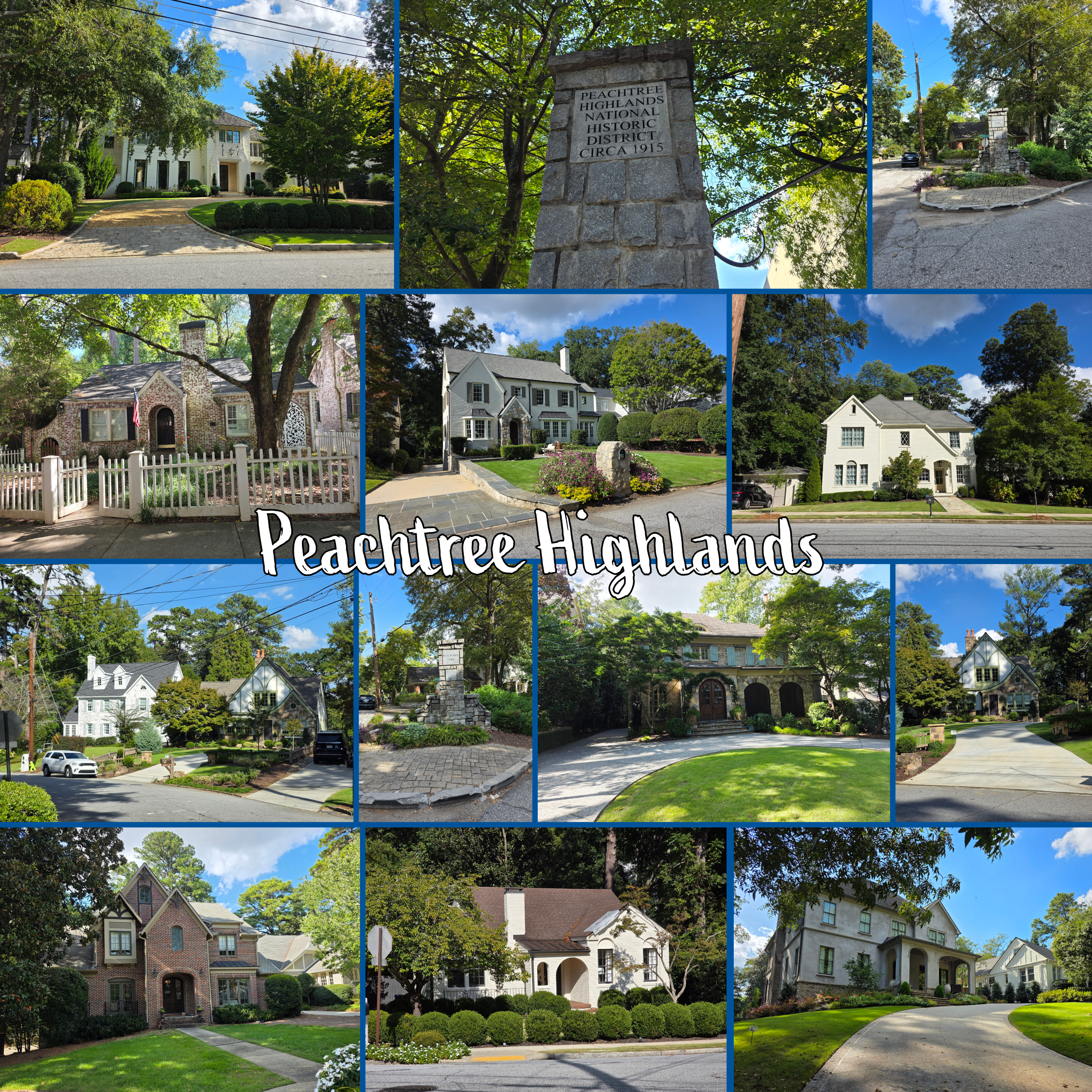
On one of my busier days, I returned to my hotel having spent several hours in the car and very aware of the need to get a bit of exercise. Studying Google maps earlier in the week had shown that almost immediately behind the hotel was a significant residential area, the Peachtree Highlands National Historic District, dating from 1915.
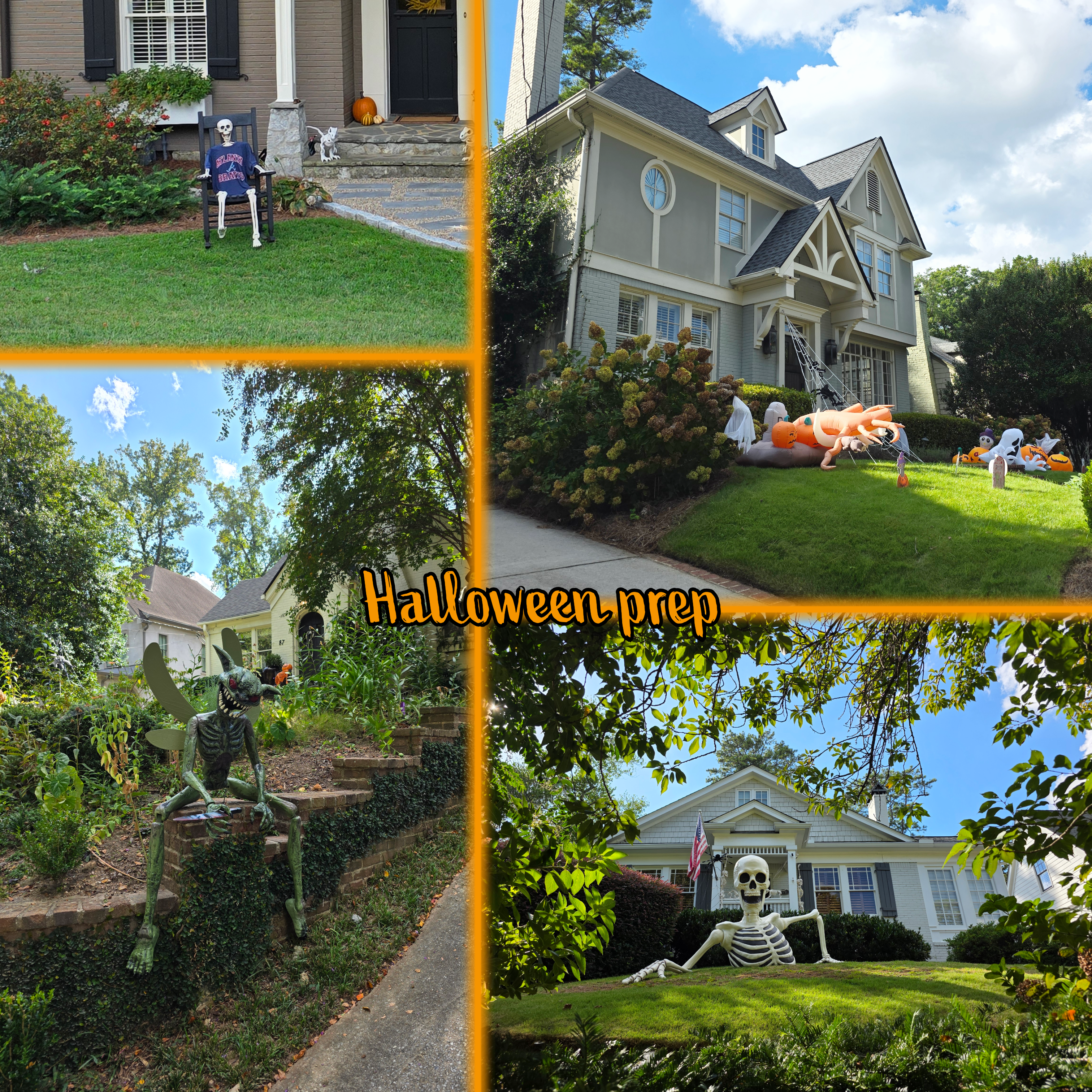
So, off I went, planning on a good 20 minutes or so of looping through the streets. My reading of the terrain sent me out of the hotel and through a gap on the stone wall, with pillars on either side. To my delight, once through the gate I was far from alone, with a number of dog-walkers, joggers and strollers out and about, and I was able to have a pleasant wander. 1915 still seems relatively ‘new’ to me, but I really enjoyed the variety of architecture, some of which reminded me of South Bend, Indiana; some of the newer parts of Boston and Salem; and some all of its own design. To a one the houses were attractive, well-kept with immaculate gardens and lawns, and more than a few were decorated for Halloween.
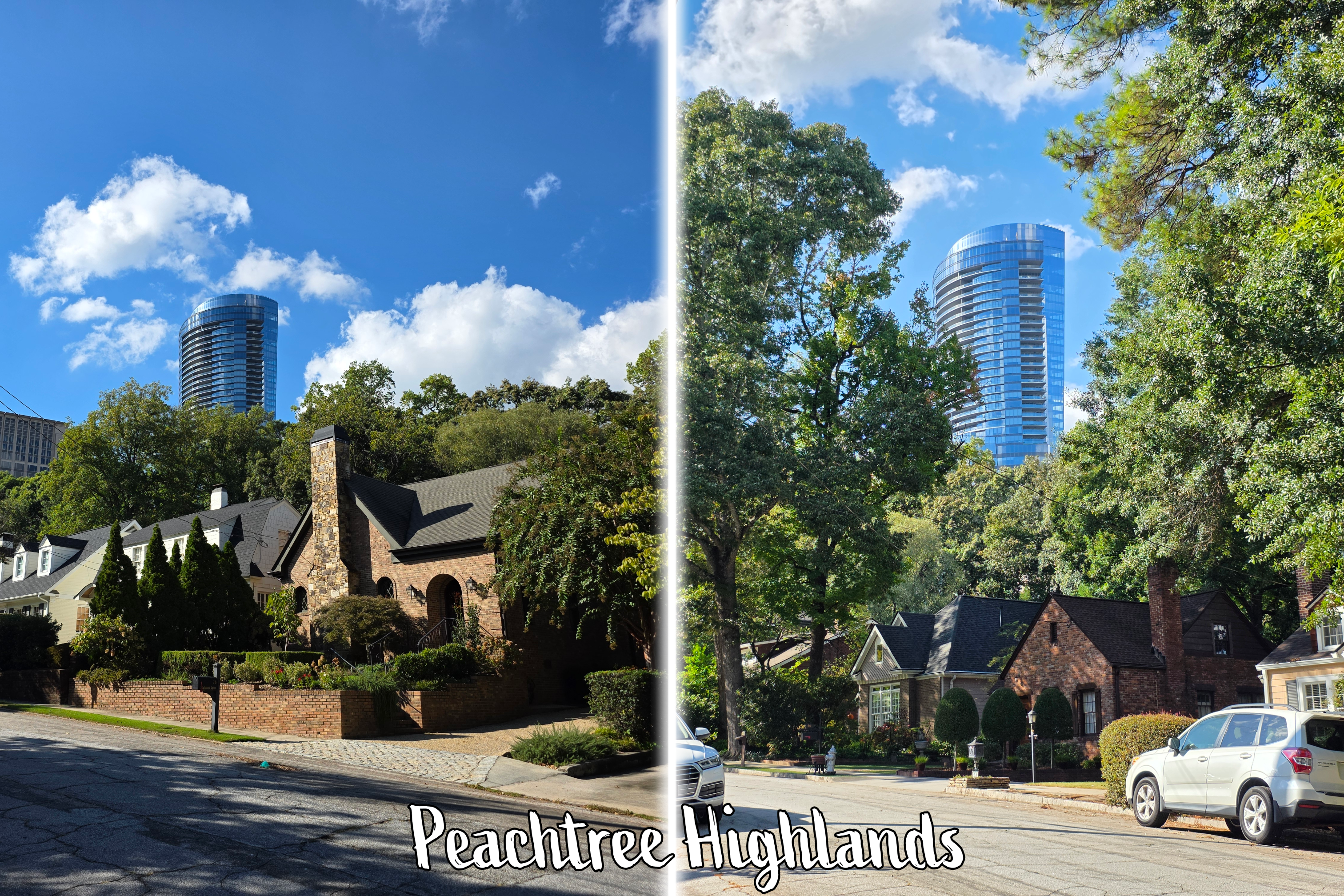
The biggest surprise was not how pleasant the architecture was – I had done enough driving around Atlanta by this point to have experienced some truly impressive mansions and homes – but how close it was to the comparatively city-center area of Buckhead. As you can see, the sky-scraping offices and hotels are literally a wall away from the residential neighbourhood.
Ocmulgee Mounds National Historic Park
On Saturday of my time in Georgia, I planned to drive from Atlanta to Savannah, a journey of about 250 miles or roughly 4 hours. As I had all day, I chose to break the trip just past Macon, where I had discovered Ocmulgee Mounds park, not quite half way, but close. The day – in Atlanta anyway – was clear and I was ready for a break by the time I had passed Macon. I had been warned, I should mention, by a teacher at a school that after Macon, there really wasn’t much left between there and Savannah. They had never really re-built, she said, after Sherman. Yes, she was referring to Sherman’s March to the Sea in 1864, almost 160 years ago. I was to discover, however, that she was mostly correct.
The excitement of a pre-historic site in the Americas was enough for me to pursue this walk, and I was prepared with hair pulled away from my neck and casual clothes that I did not mind getting a bit sweaty – gross, but inevitable.
This series of mounds and earth houses was constructed more than 500 years before the arrival of Columbus by the Mississippians, who built a thriving culture throughout the American south-east. Archaeological investigations from the 1930s discovered evidence that these lands were inhabited as early as 9600 BCE by Ice Age nomadic hunters – absolutely fascinating! The evidence came from the discovery of a Clovis point in 1935, the first one found east of the Mississippi River, and evidence of early occupation of the eastern US.
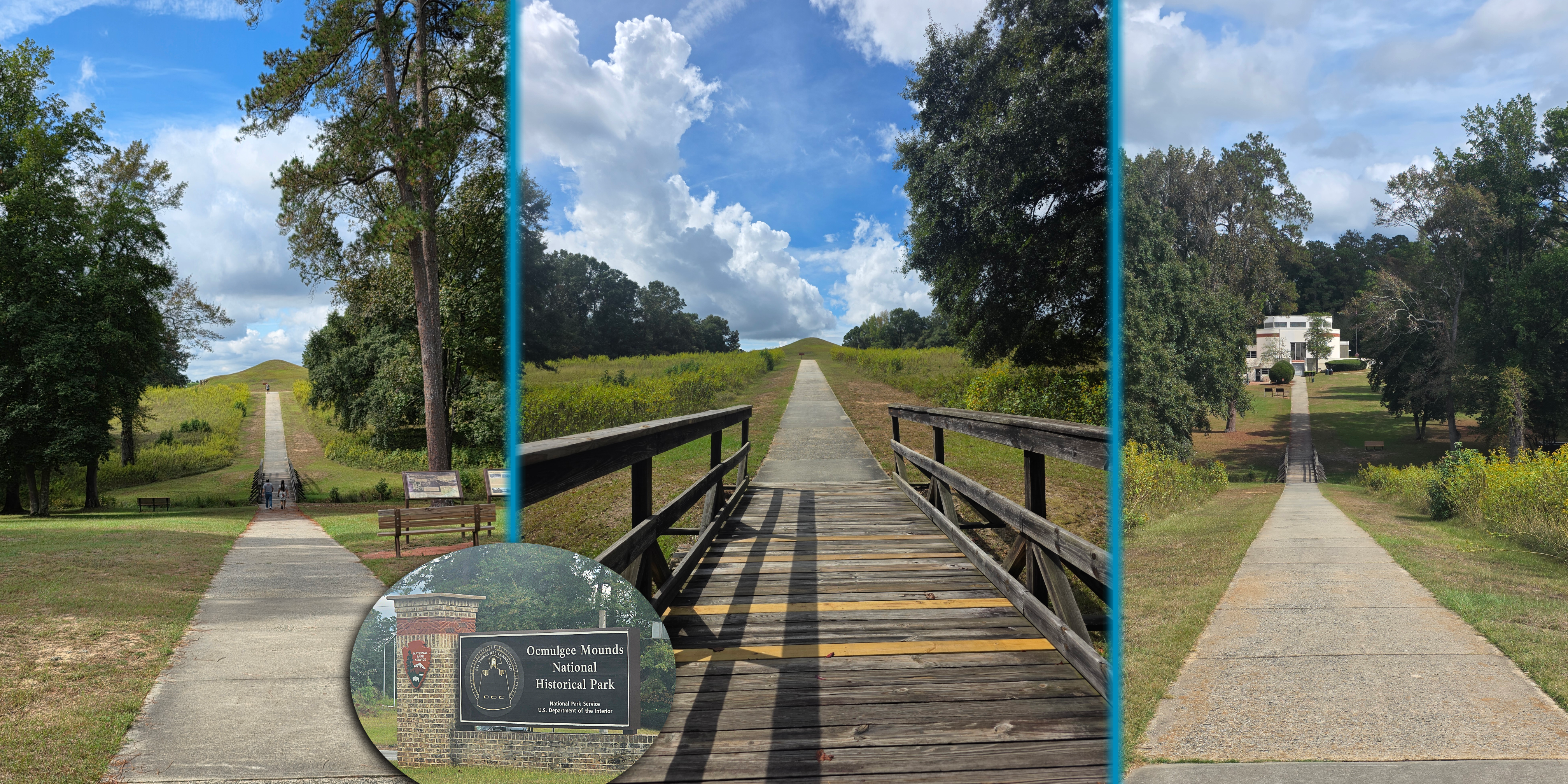
After checking in at the visitor centre, I was excited to wander out down the long path towards the first mound, which is the Earth Lodge – America’s oldest Ceremonial Lodge, with fragments of roof carbon dated to 1015.
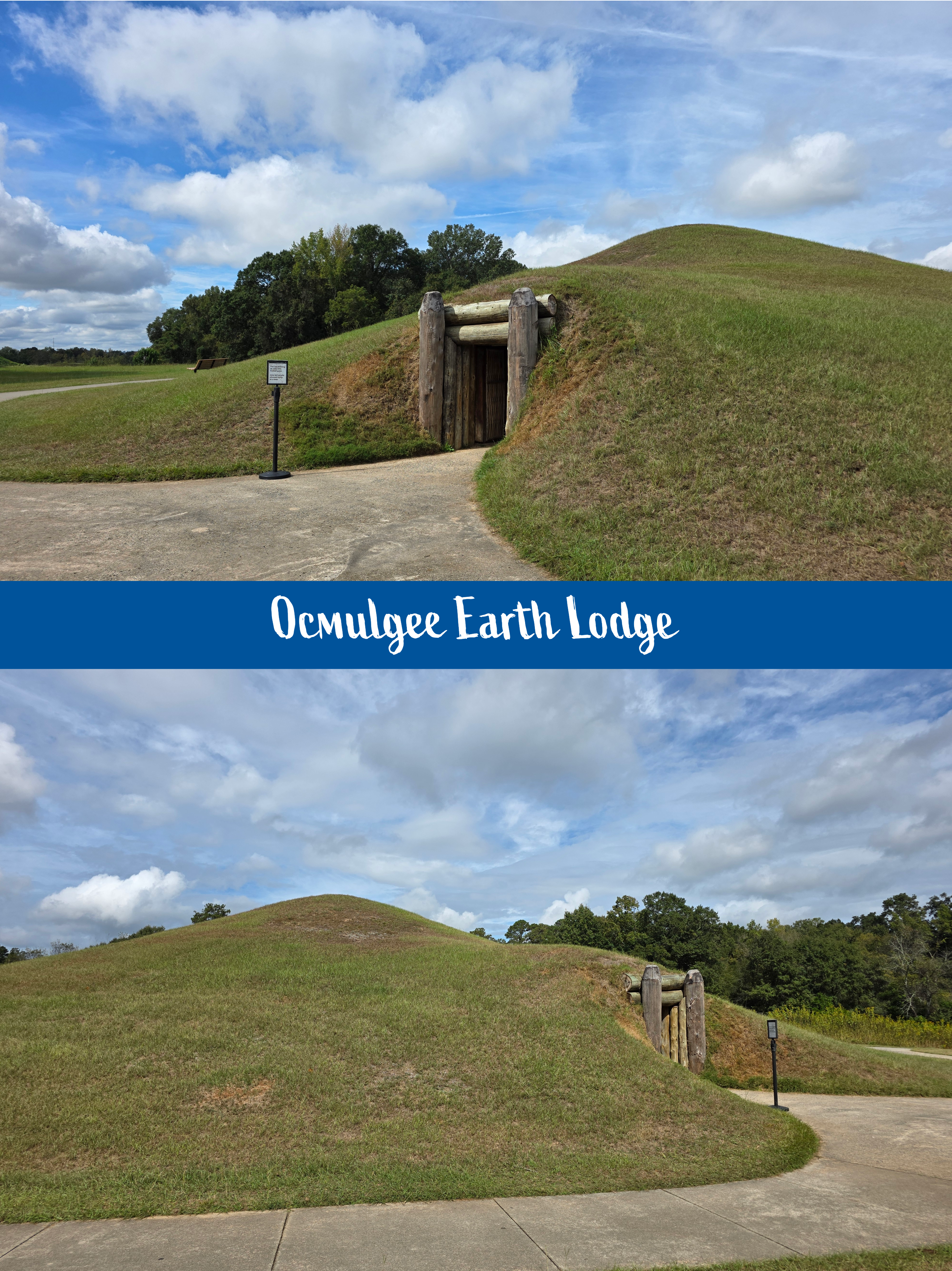
The lodge was discovered in 1934 and reconstructed to be open to the public three years later. The park was quiet enough that I was able to enter on my own, and one of the first things I noted was just how much cooler the interior was – outside was approaching 95℉. It also reminded me, unsurprisingly, of similar round structures I had entered at Native American sites near Boston, and also at the Crannog Centre in Scotland.
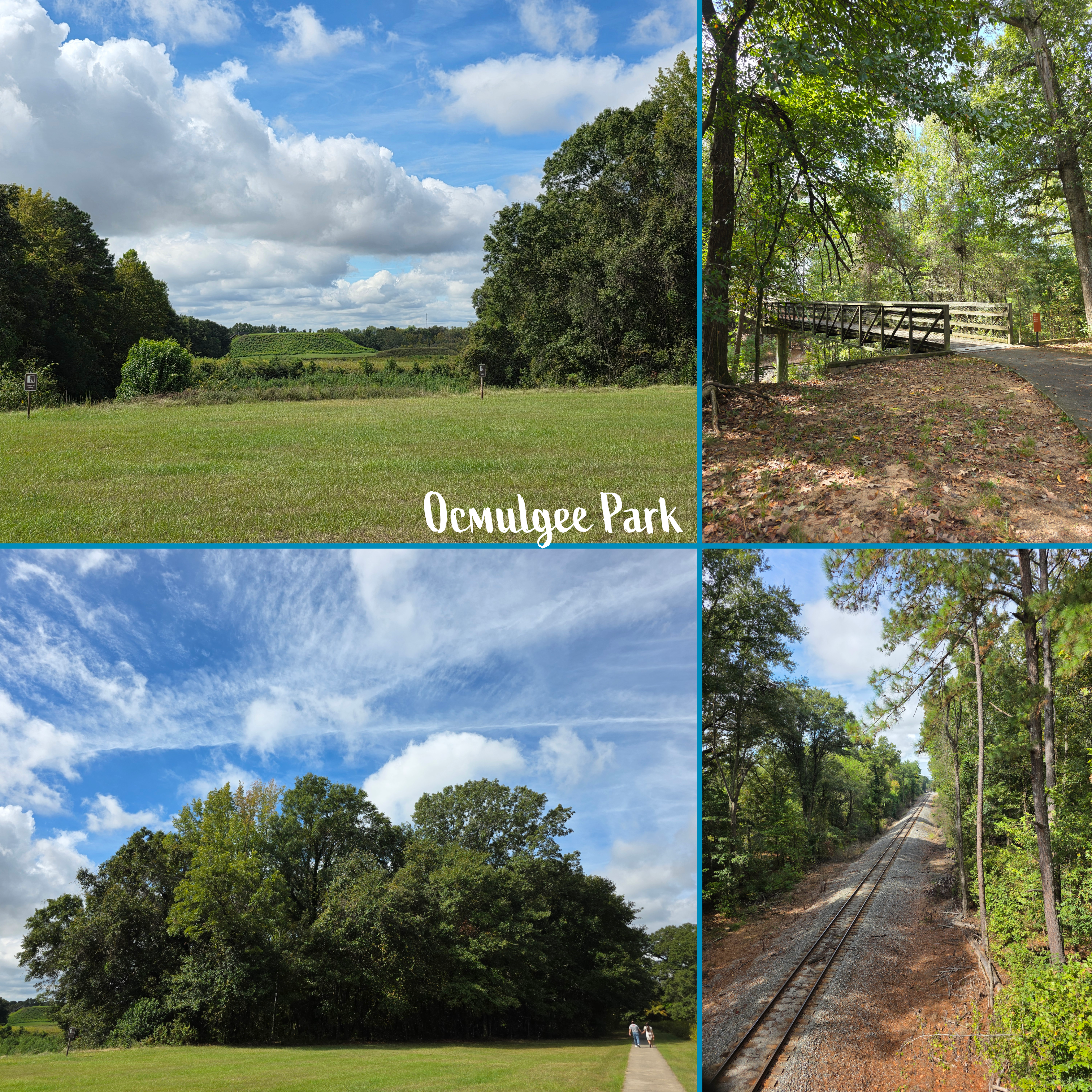
Beyond the Earth Lodge lay several other mounds, a short walk through the woods and over the train tracks.
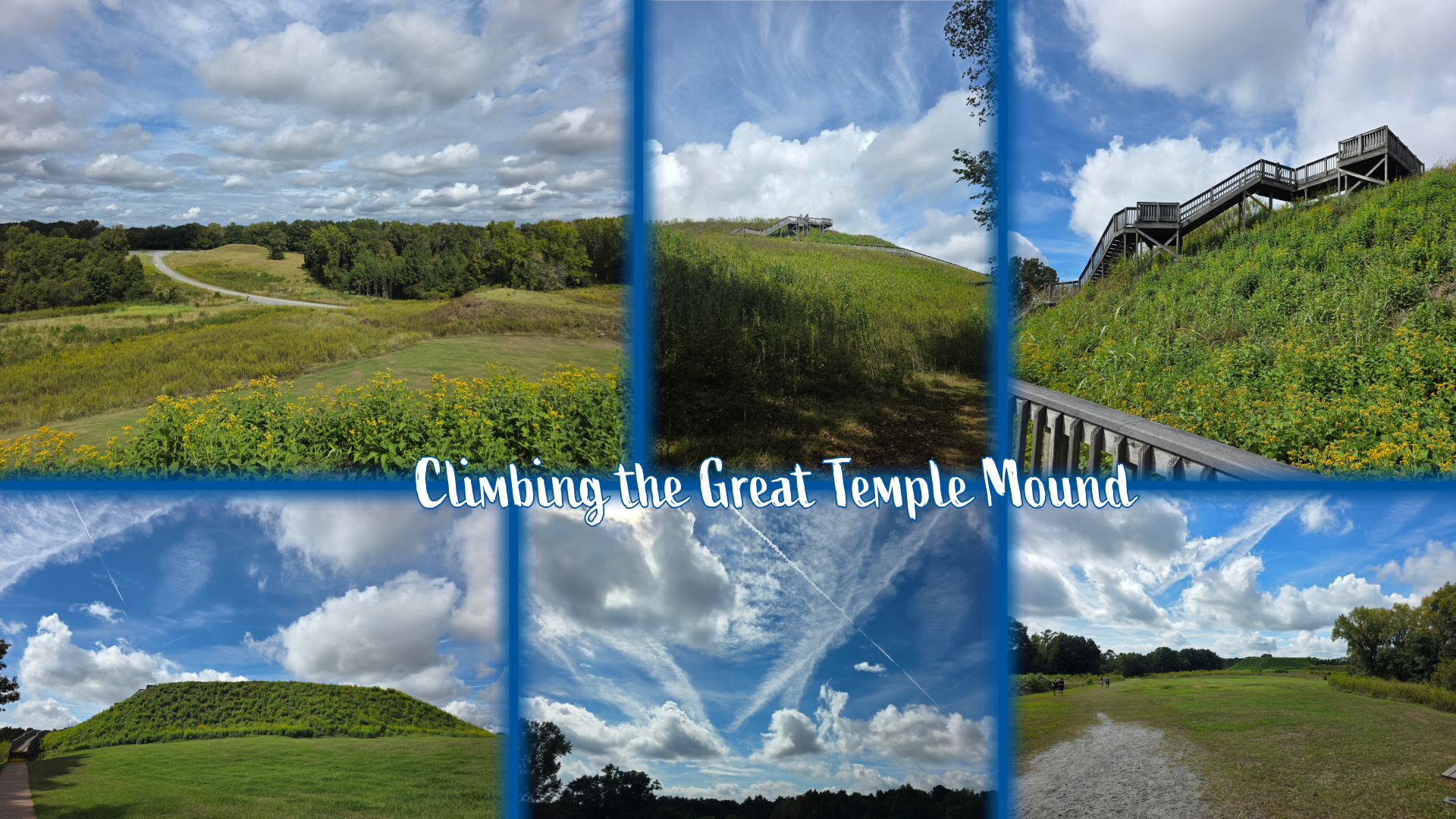
The greatest of these mounds was the Great Temple Mound, a flat-topped hill requiring winding wooden steps to climb the 55 feet to its summit. It is likely that the village chief lived atop the mound, and may also have been used for religious ceremonies.
I had been promised an amazing view from the top, and while the sky was stunning, I found very little to really see other than forest stretching out in all directions and evidence of a (modern) town in the distance. Nonetheless, it was thrilling to be climbing a pre-Columbian structure when so much evidence of this era has been lost. I cannot wait to share the visit with my summer school students!
Nearby the mounds was a large pond (or small lake?) that I decided would be a good place to explore. The path did not seem to go completely around, and I found that one trail was closed off. The route quickly became a boardwalk lifted above the swampy edge, with trees growing right out of the water and white egrets in the distance. There was also, however, the sign in yellow that you see below. While I did not imagine a daytime walk with plenty of people nearby would be particularly high-risk, it certainly encouraged a quicker turn-around than I might have done.
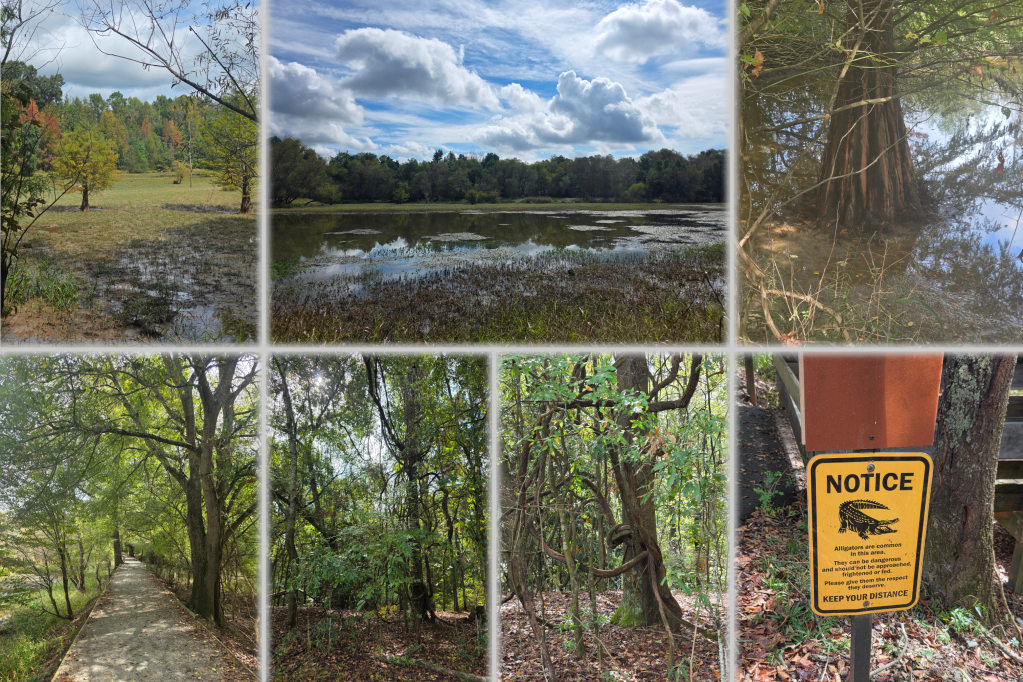
By the time I had finished my walk I was thirsty and ready for a rest in the air conditioning of the visitor centre before getting back on the road. I of course picked up a few bits and pieces in the gift shop before heading on.
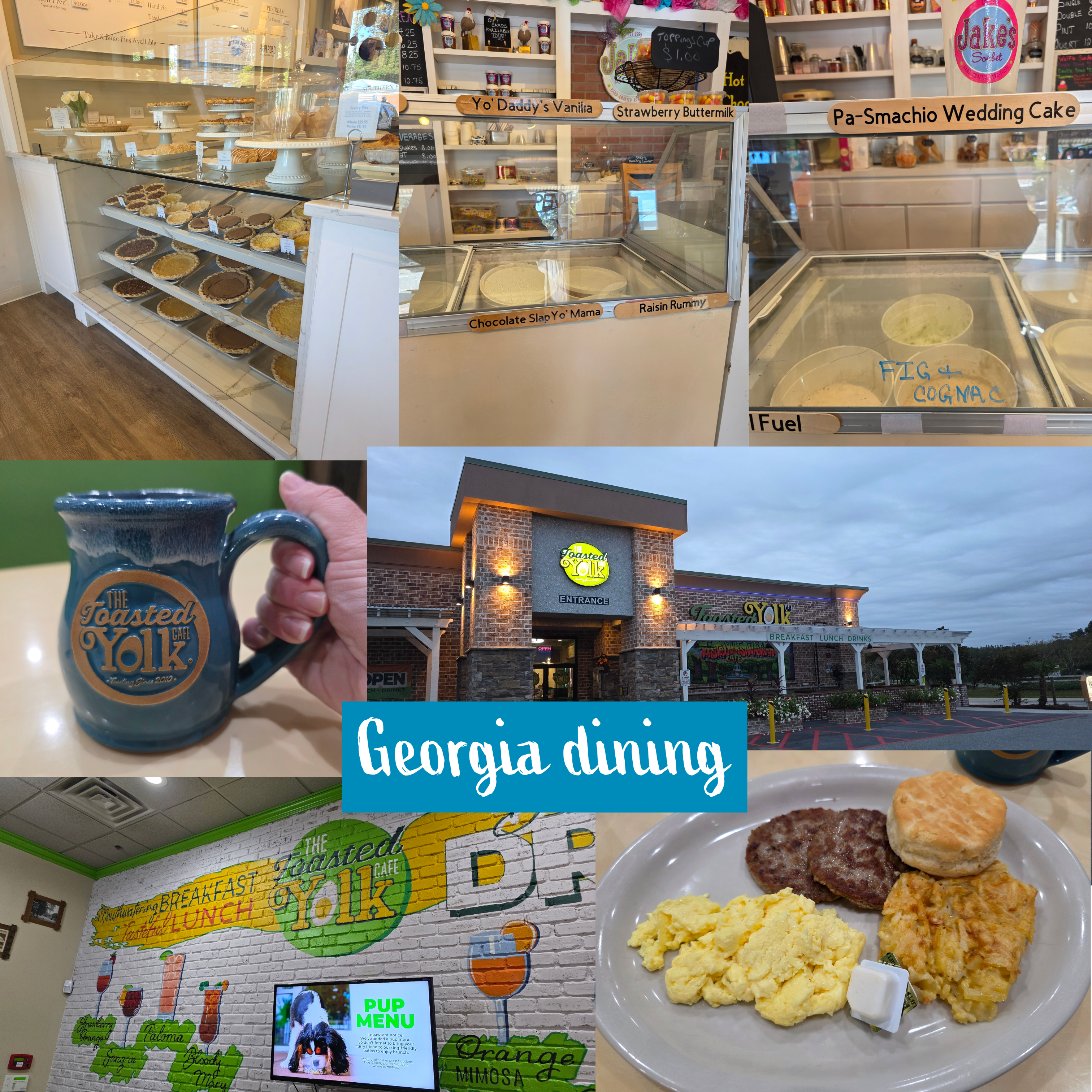
I had researched somewhere that I might try for lunch, and upon my friend’s recommendation planned to try a Waffle House, a chain I had seen frequently in Atlanta. While the drive was as empty of sights as the teacher had suggested, there were a few small towns with gas stations, hotels and places to grab a bite – including a Waffle House. I was plenty hungry by the time I got there – another hour down the road – and enjoyed a purely carby delight of hash browns with chicken and I think cheese, and some grits. Not a fruit or vegetable in sight. While the breakfast I had in Savannah the next day topped it by far, it filled me up for the remainder of my drive (see pictures at the end). One of my favourite things about the US – I don’t know why – are the heavy, thick coffee mugs you find at diners and the like, usually with free refills. Just so purely American.
About 40 minutes out of Savannah, the weather changed, and I was hit with that kind of intense rain storm I have only ever seen in Florida. The windshield wipers could not come close to clearing the view, the road lines were almost completely obscured, and a mist of rain hovered up to two feet off the road. Everyone slowed down and lights went on, and I have to admit to talking out loud to myself at several points to stay calm. Frustratingly, there was no where to pull off, and so I just powered on, gripping the steering wheel like a mad woman until finally the rain let up, a few miles from Savannah. Not a drive I would like to repeat, at least not the last hour. But, I made it, and settled into my hotel by a truly lovely receptionist who remembered me for the rest of my stay.
Savannah
Despite having been in the country for a week, I still wasn’t able to sleep past about 6.30am, so I ventured out early the next morning to try out the breakfast place I had noted the night before. Absurdly, despite it being just on the far side of the highway, I drove, as there was no safe pedestrian crossing. The Toasted Yolk was everything I hoped it would be – heavy mugs (one of which I purchased on a whim and managed to bring safely back to Scotland) with endless coffee and a fantastic big breakfast to keep me going. It was my day off, and I had a plan.
It may not be everyone’s first choice but I have found that booking a bus tour of any new city can be a great way to learn some history, see the sights, and stay cool and safe. Mostly, it inspires me to work out where I want to return and explore on foot. I had discovered online a company called Old Savannah Tours; there was also a standard hop-on, hop-off trolley tour, but the first was a touch less expensive. Both were a bit more pricey than I might have hoped, but it was definitely worth it.
I wasn’t sure if parking nearby was possible (it was), so I booked myself an Uber from my hotel and arrived a bit earlier than I needed to, meaning that I was able to nab a spot at the front of the queue when boarding. I was faced with the age-old question: which side to sit on? In the end I chose left and should probably have picked right, but really how is one to know?
Our driver was positively fantastic – a large man named Tiny, he was full of fantastic historical facts about the city and had a dry, wry sense of humour that I greatly enjoyed. Some of the tidbits I picked up were that Georgia was created as a buffer between the Spanish in Florida and the wealthy, successful English colonies in South and North Carolina. He also referred to SCAD (Savannah College of Art and Design) as the ‘mafia’ of the city, in that they owned a great deal of property and were a diving force behind much of what went on. The similarity to St Andrews was not lost on me.
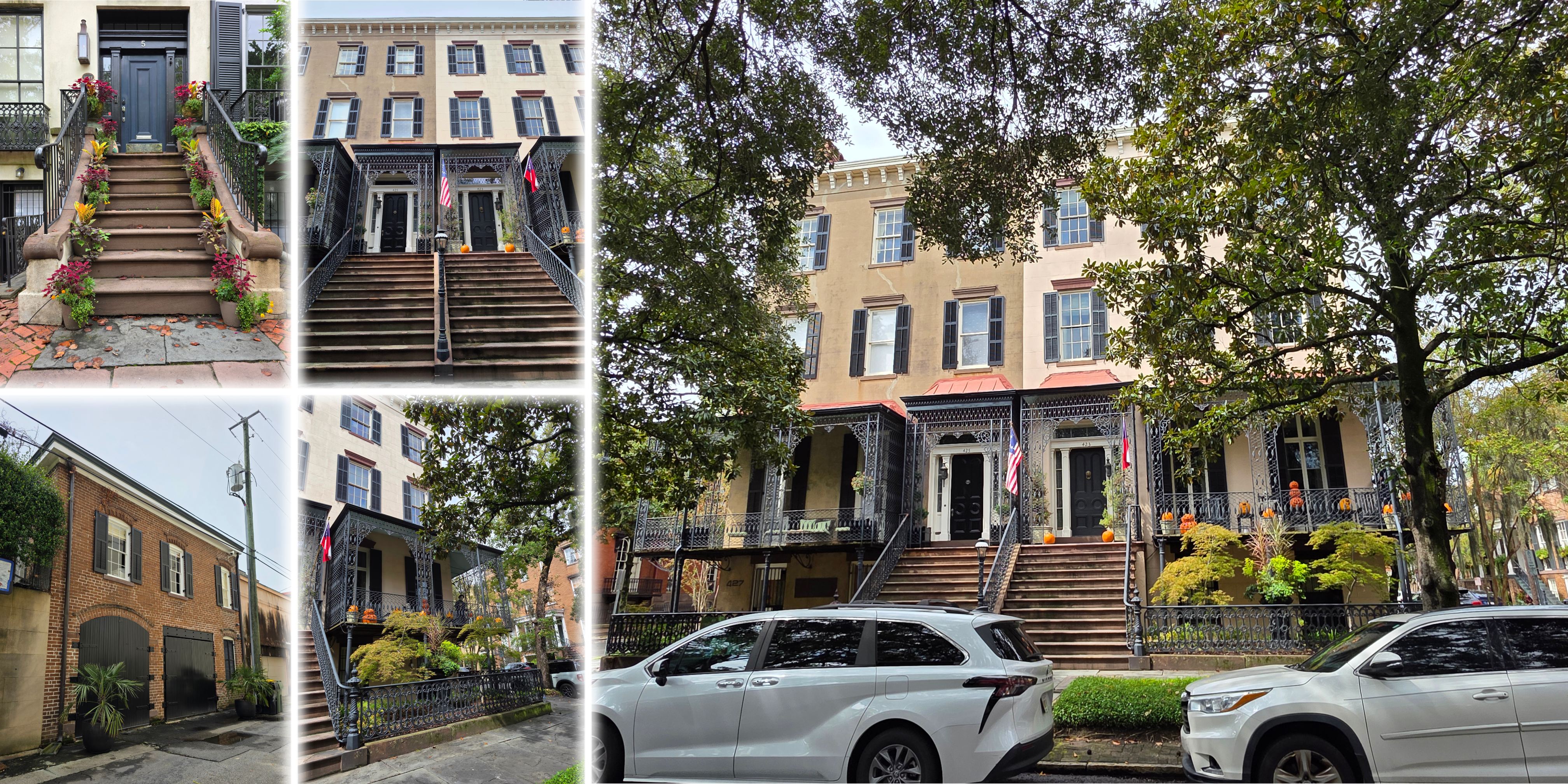
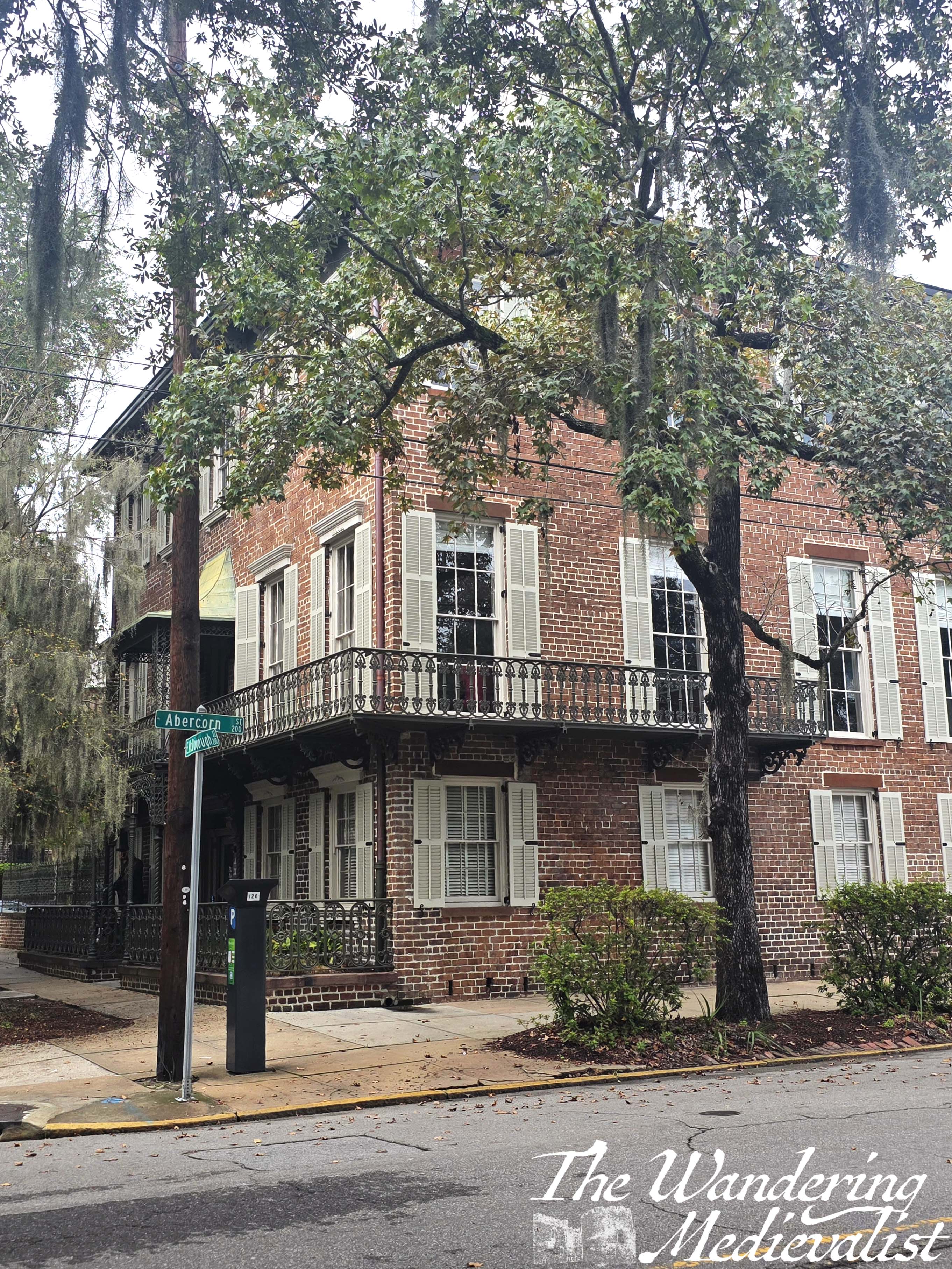
Intricate ironwork, like that you can see here, was a status symbol and so many houses added extra railings and outdoor decoration that may not necessarily have been needed. It was prevalent throughout the city, and frequently fascinating in its design.
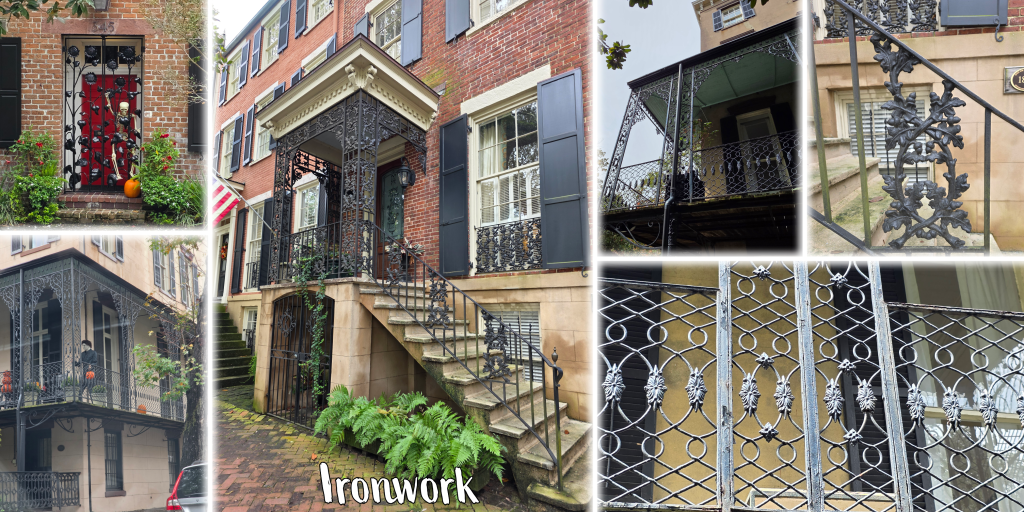
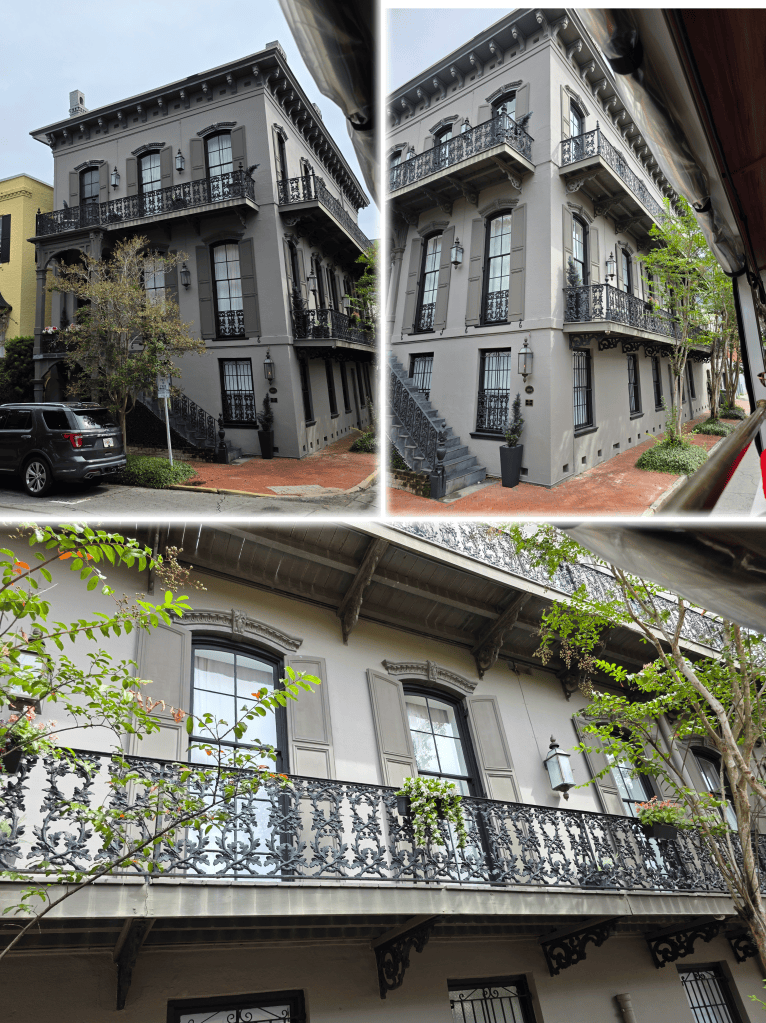
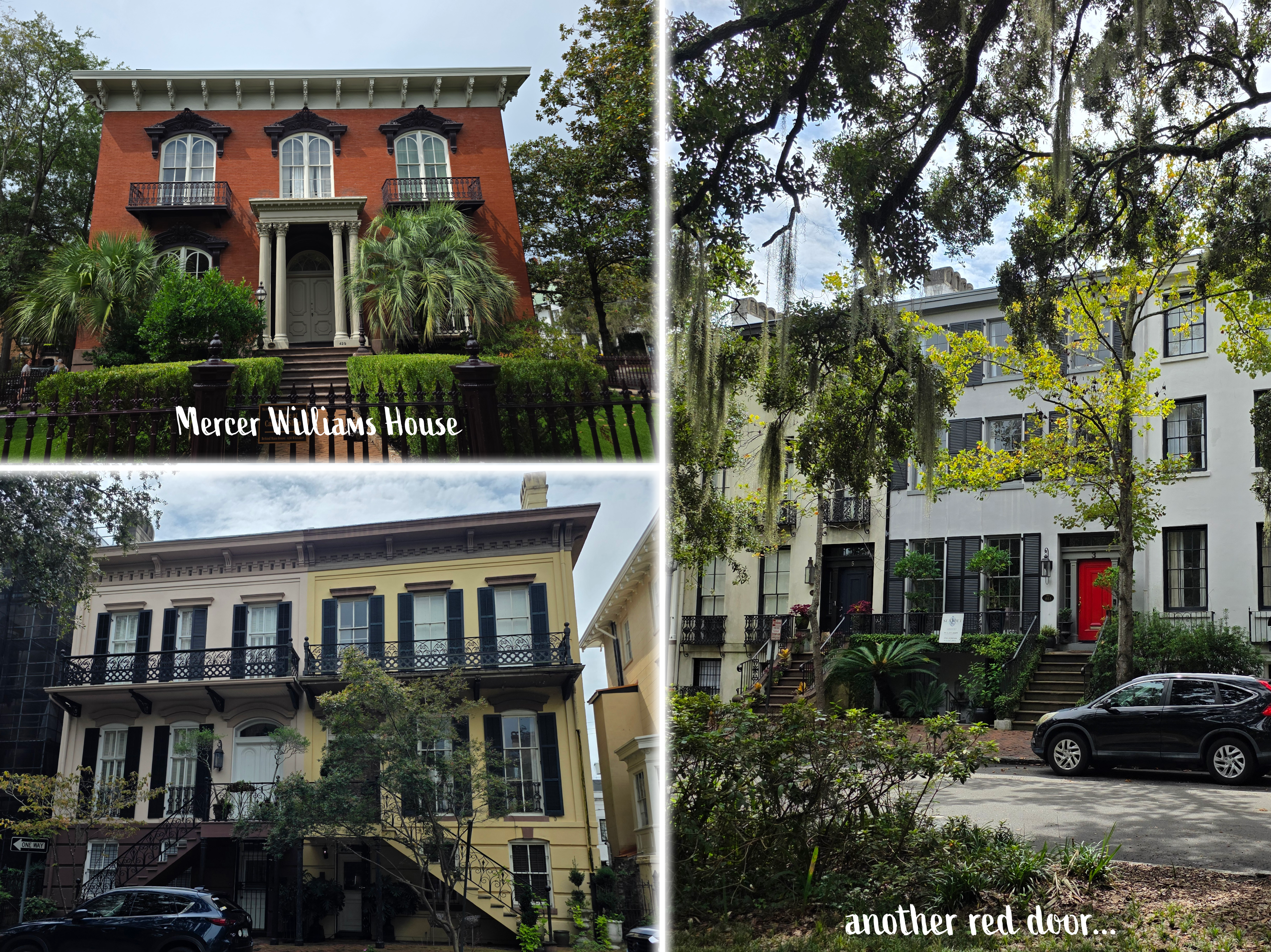
Red doors, which I noted several times, were signs that a house was part of the Underground Railroad, a vital pipeline to help slaves escape north. Jones Street is one of the most beautiful and desired addresses in Savannah (I confirmed this later). And there was much more.
Tiny was full of stories and I wish I had captured more of them.
One that stood out most clearly in my mind was that of the Jewish population of Savannah, which is focussed around the stunning building of Mickve Israel, located on Monterey Square.
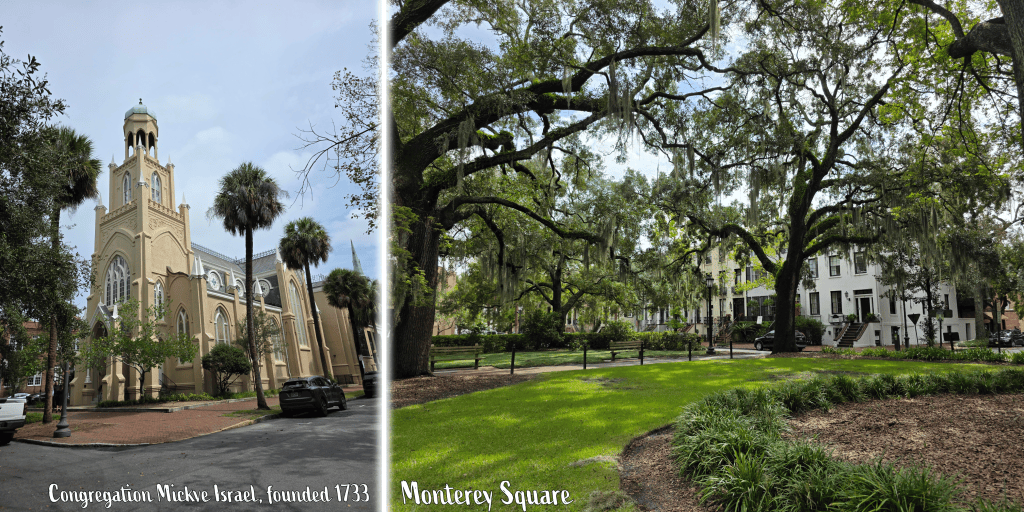
Savannah has in fact been a haven for those of Jewish faith almost since its origin. Five months after the founding of the city in 1733, 41 Jews arrived from London and were allowed to join the community due to the presence in their group of a doctor, who could treat the city’s raging Yellow Fever epidemic. James Oglethorpe, the city’s founder, defied the city trustees and allowed the group to stay.
It is worth pausing here for a brief look at the history of Savannah – I am a historian after all. The city was founded by a group of English colonists who landed on the coast in February 1733, and were welcomed by the local Native Americans, the Yamacraw. A friendship was established between Oglethorpe and Tomochici, the chief of the Yamacraw, and meant that peace persisted between the populations throughout the fledgling years of the city, and advantage many English colonies did not have. The city was founded on a belief of religious tolerance, and a detailed plan developed by Oglethorpe of six interconnected city wards built around central squares.
The lots on the east and west of squares were to be for public buildings, the north and south for colonists’ homes. Today, this careful grid pattern and set of beautifully-landscaped squares are at least part of what makes Savannah so unique, compared to many more northern cities and towns that were often built around a central common space with streets more haphazardly laid out. I’m looking at you, Boston.
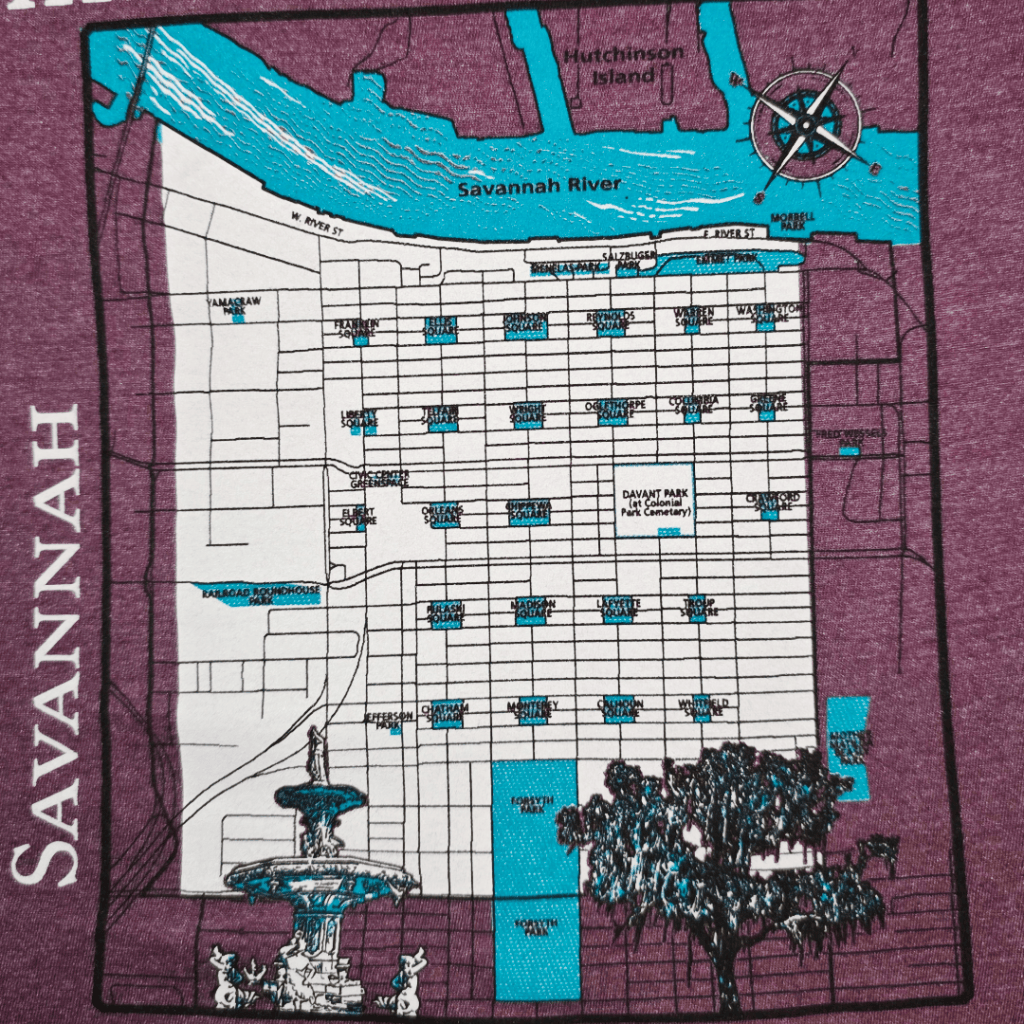
There is also the famous story that Savannah was spared during the destruction of the Civil War due to its beauty. In fact, I learned that the city leaders agreed to allow General Sherman and his troops into the city and entertained him well, and so it was spared.
The squares and the trees were the two things that stood out most to me, as well as the stunning colonial – and newer – architecture that was both so similar to what I had seen in northern colonial cities (like Alexandria VA or Salem MA) but also absolutely southern.
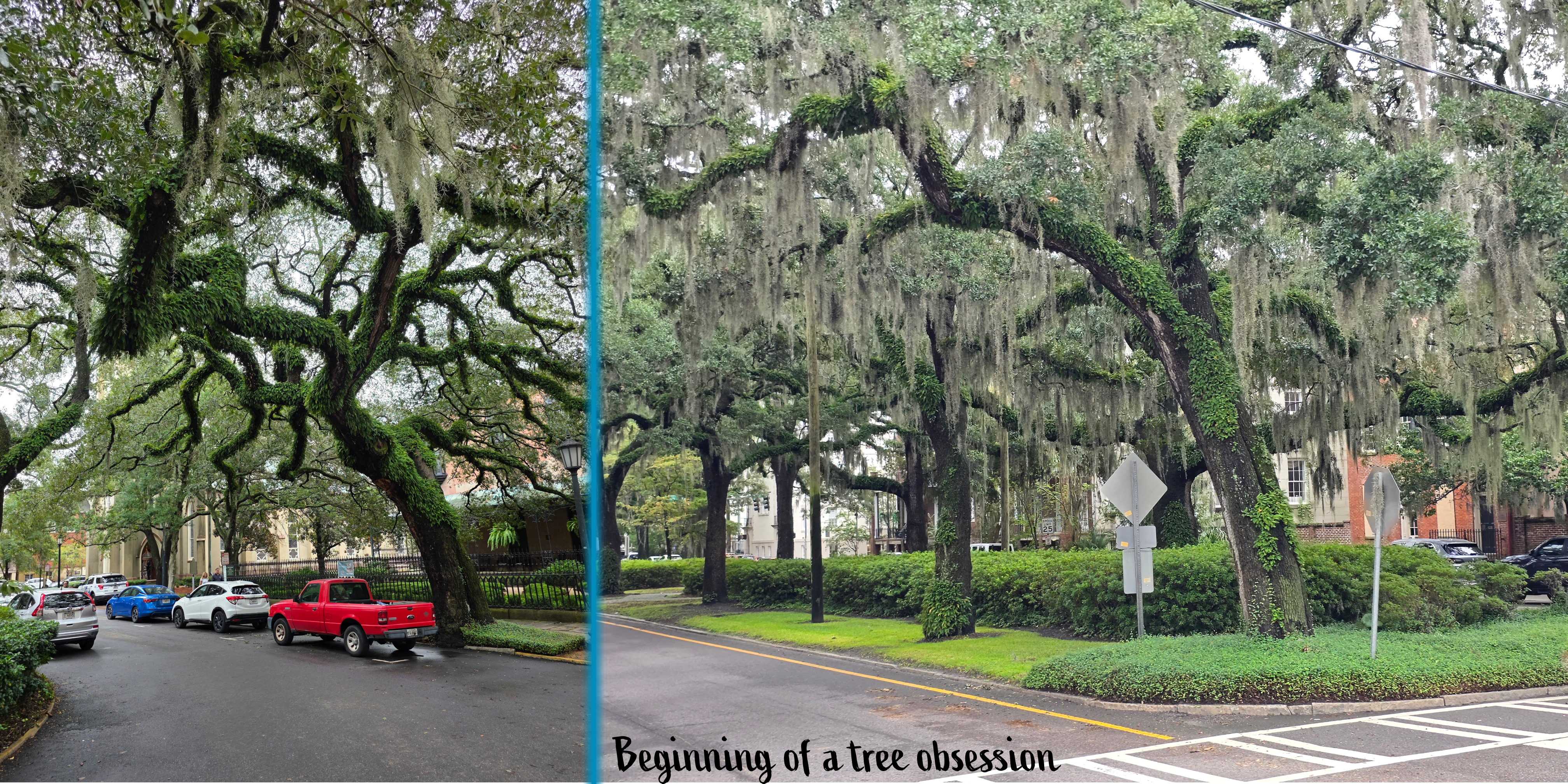
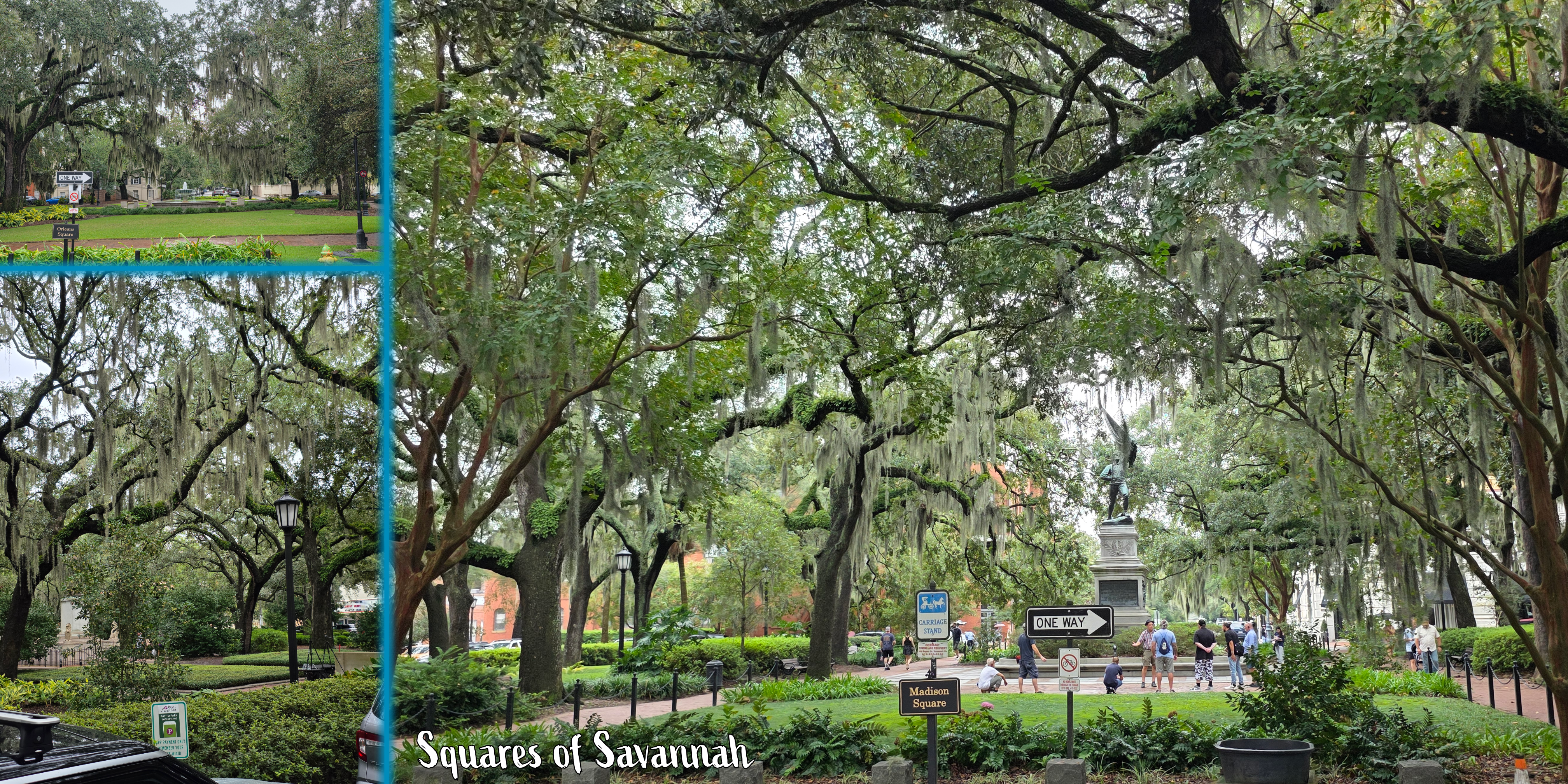
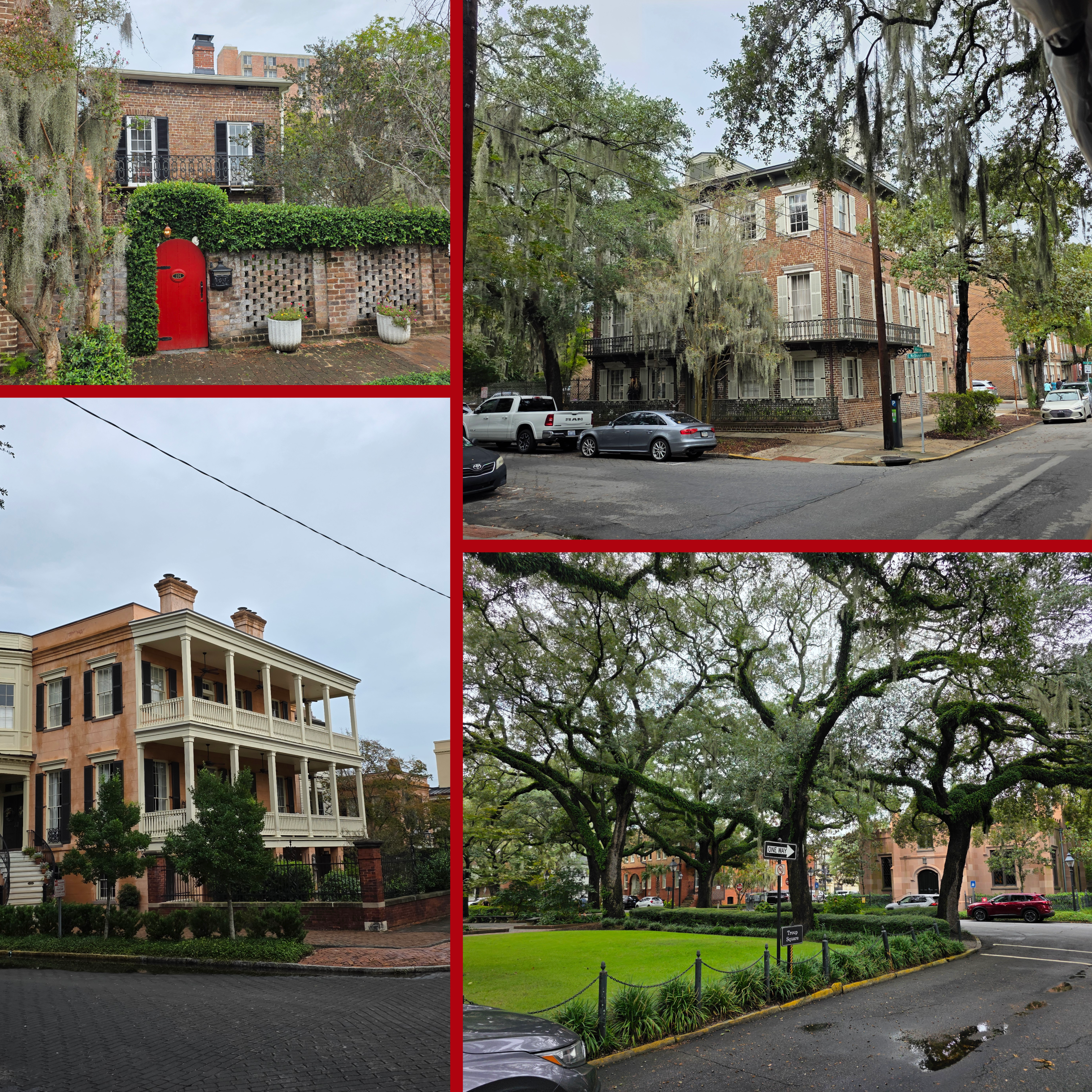
The trolley tour took a long winding route around the city, passing some squares several times and giving me a good feel for where I wanted to return on my wanderings. Towards the end of the ride, Tiny looped down towards the waterfront, which to this day remains one of the most active ports in the US (thus is much more evident when flying out and able to see the acres of shipping containers). This was also evident during a taxi trip back to the airport when we were held up at a train crossing for almost 10 minutes. ‘The trains down here are long!’ the driver told me. Evidently Uber was not aware, as I got an alert observing that the vehicle had been stopped for a long time and asking about my safety.
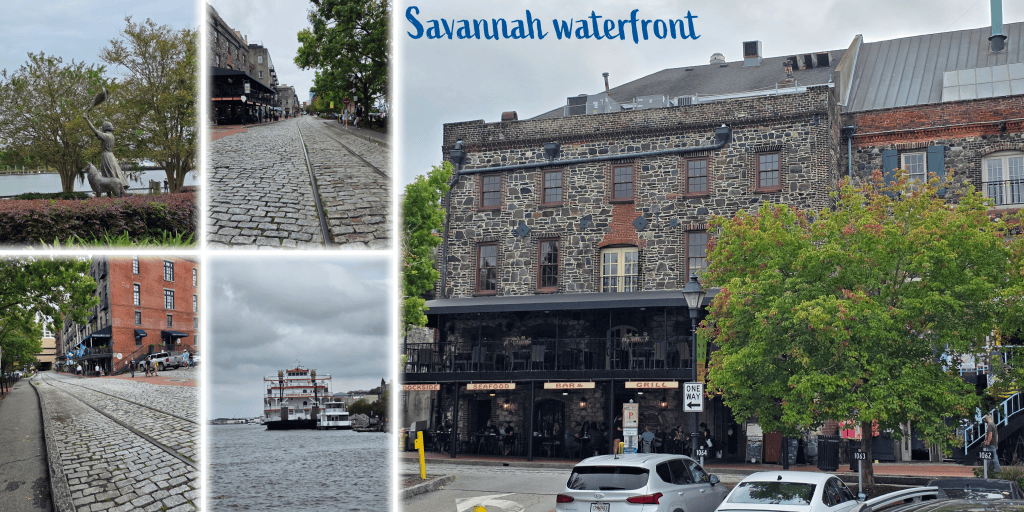
The statue in this grouping is a memorial to a local woman who, in the late 19th and early 20th centuries, took it upon herself to welcome ships into the port, known as the Waving Girl. The large colonial structures and trolley tracks remind visitors that Savannah’s status as a vital port goes back several hundred years.
The tour also drove around Forsyth Park, a 30-acre park in the heart of the city where there are walking paths, tennis and basketball courts, a Civil War monument to the Confederate dead, and a stunning fountain reminiscent of Paris in design if not size.
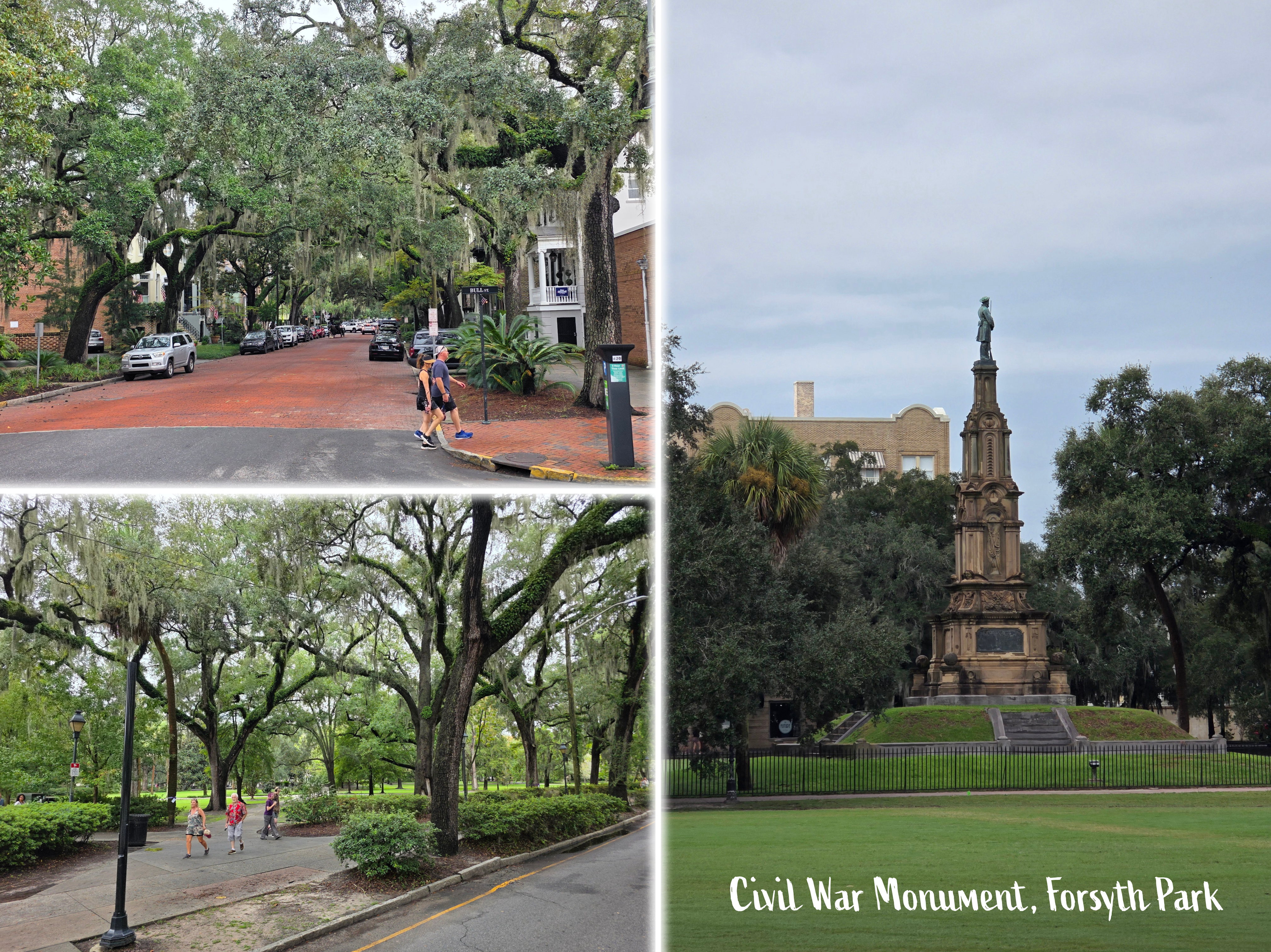
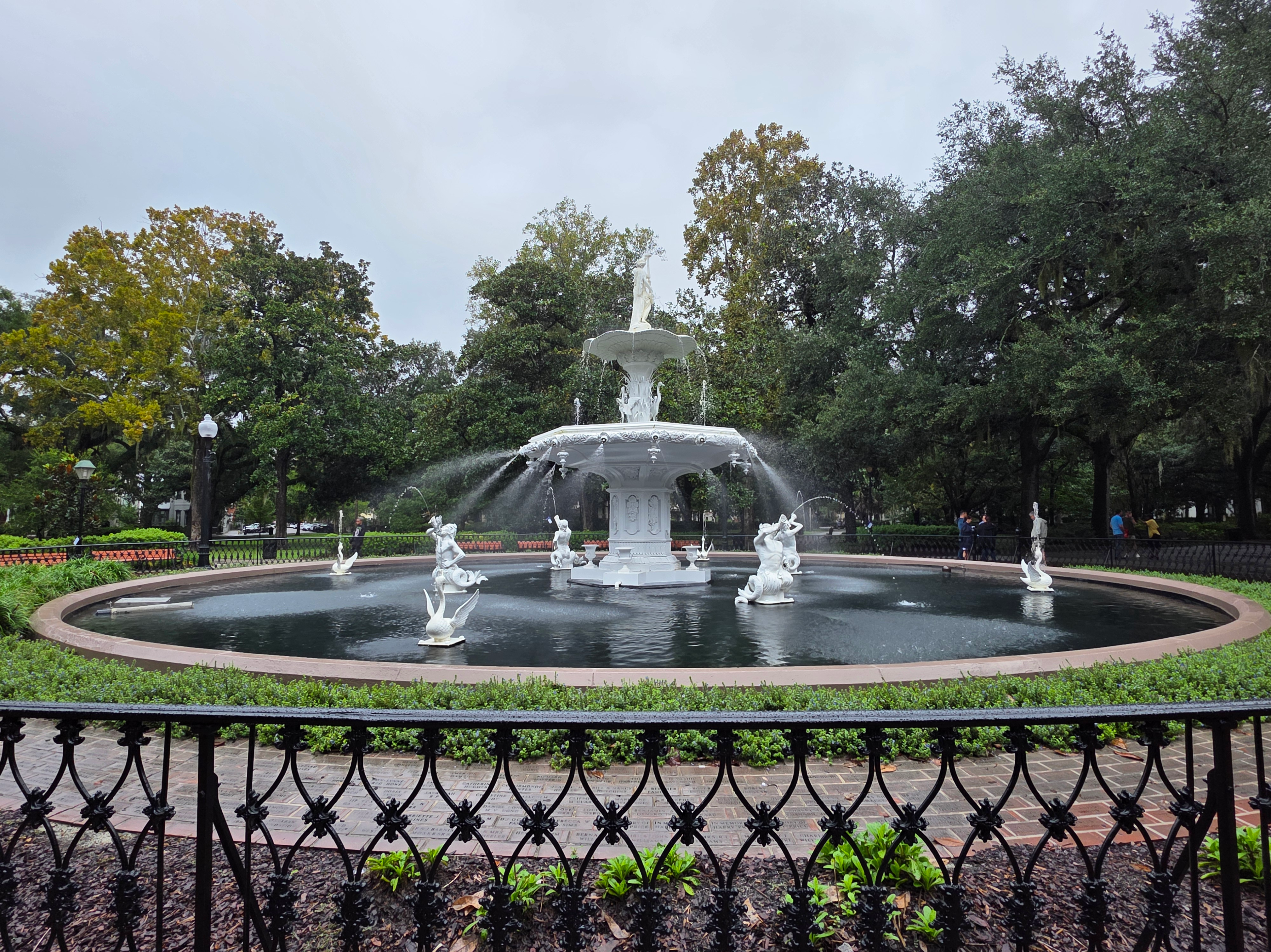
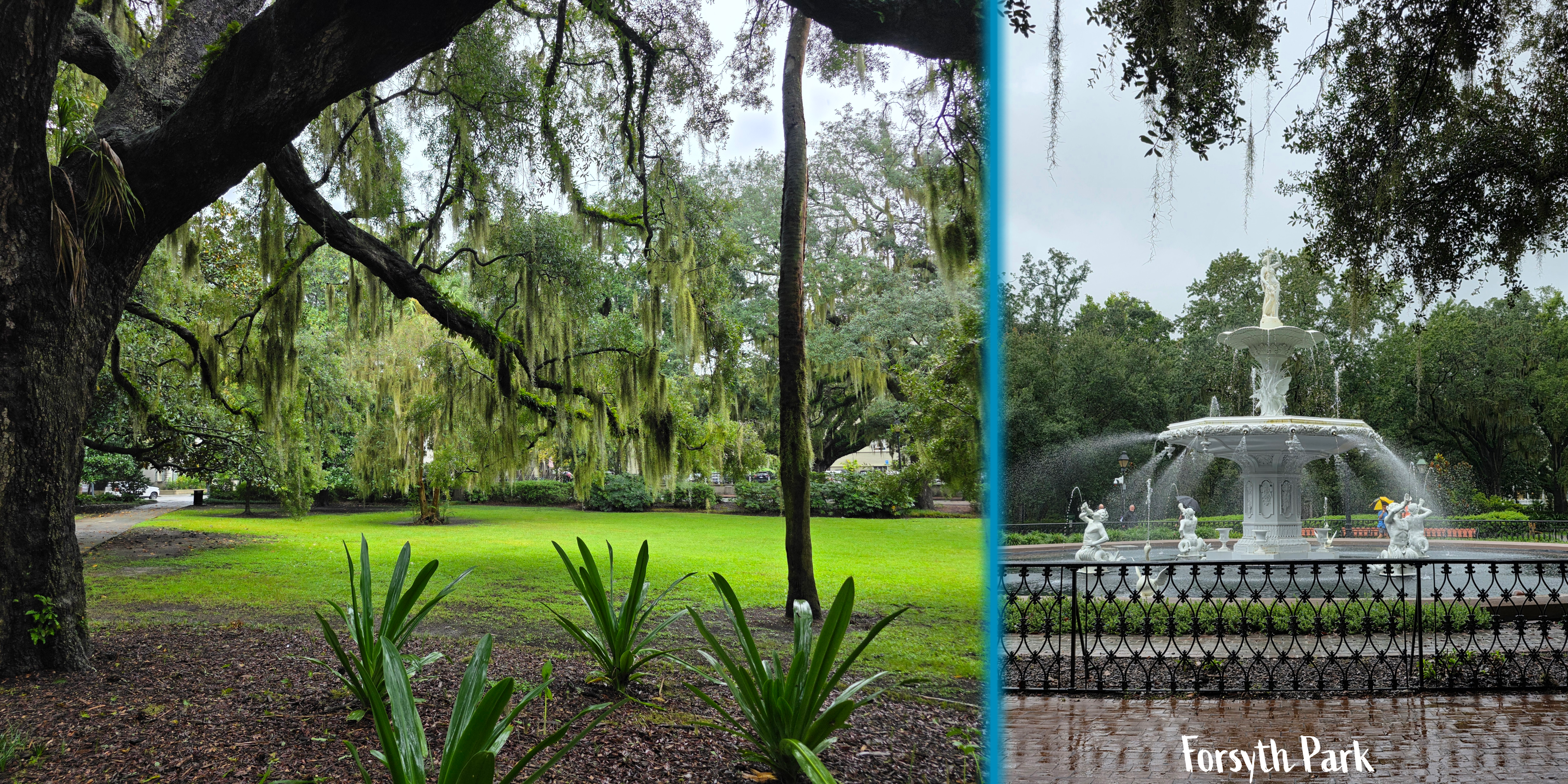
By the time the tour was over, I was more than ready to stretch my legs and find as many of the points as I could – being me, I had been making notes of those I particularly wished to re-visit. The weather improved slowly as the day went on, from overcast and grey to a hint of blue in the sky, though never once in my three days did I see a clear sky, and on the Monday it poured almost all day.
Savannah is one of those cities that I think looked larger on a map than it was once I started walking, and I was pleasantly surprised by how quickly I reached the central historic area. My route took me first past the Independent Presbyterian Church, which was first organised in 1755 on land granted specifically to those who followed the Church of Scotland. The current church was built later, but certainly echoes other Presbyterian churches with which I am familiar.
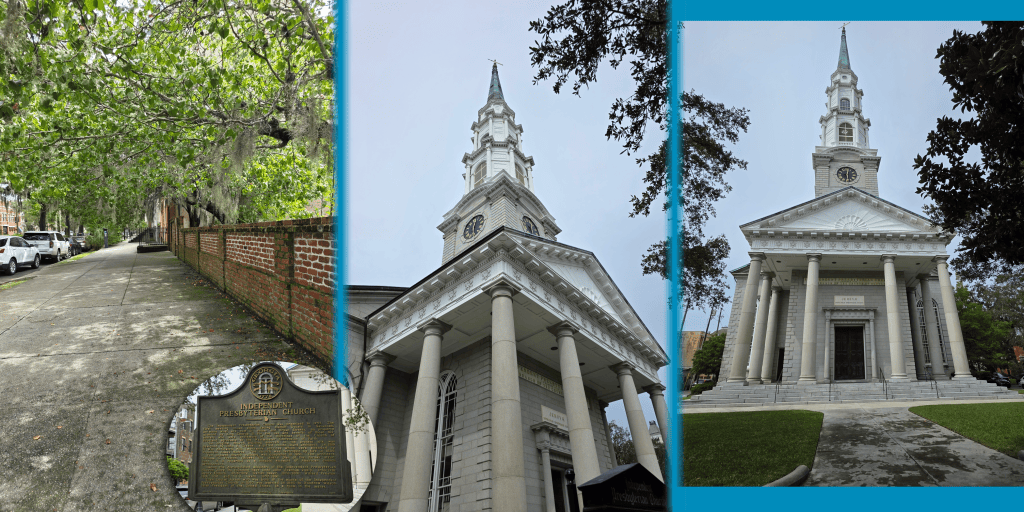
Beyond the church, I turned up Bull Street, which was my first goal. Almost immediately, I entered Chippewa Square, one of the more beautiful of the many beautiful squares, named in honour of the American soldiers killed during the Battle of Chippewa during the War of 1812. Amongst other claims to fame, it is filming location of the opening scene of the movie Forrest Gump (with the feather).
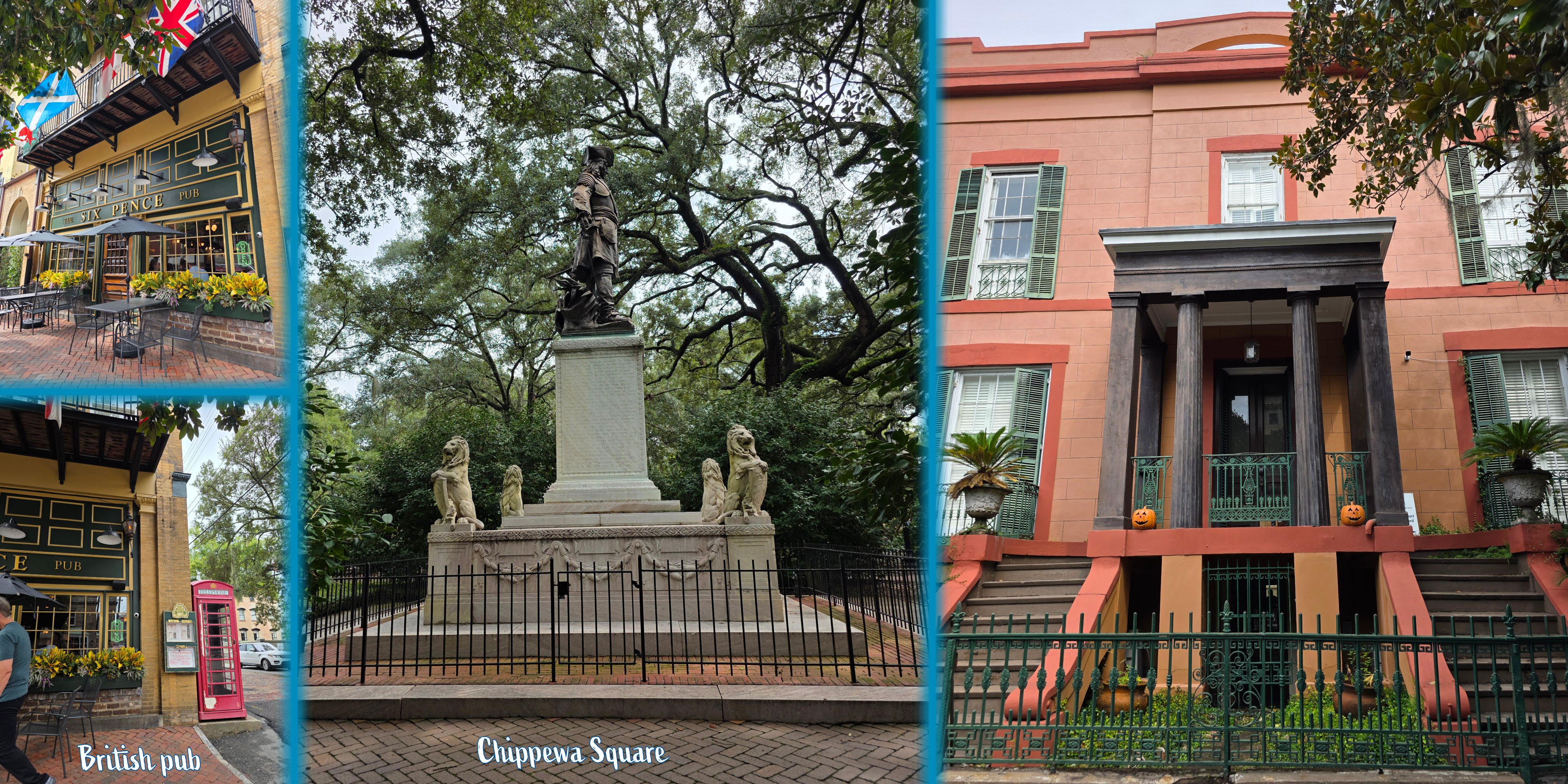
Continuing up Bull Street, I found myself passing the ‘only British pub in Savannah’, complete with a red phone box and flags from around the UK. This was definitely a selfie stop, but not one to actually go in, though the day was getting on and I knew I would need some lunch at some point despite my enormous carby breakfast.
The next square was Madison Square, around which are built some beautiful colonial homes as well as the Green-Meldrim House, which is fronted by a lovely boxwood garden. This house was made famous as being Sherman’s headquarters while he was in Savannah, and in the square is a plaque naming the house as the location of the meeting at which Sherman declared Special Field Orders No.15, which redistributed confiscated coastal lands to newly freed Black families. There is also a plaque recalling Sherman’s March to the Sea, 250 miles from Atlanta to Savannah during which Sherman’s men destroyed anything that might be used for waging war – a chevauchée of sorts, if you are familiar with that medieval term – though also freeing enslaved peoples.
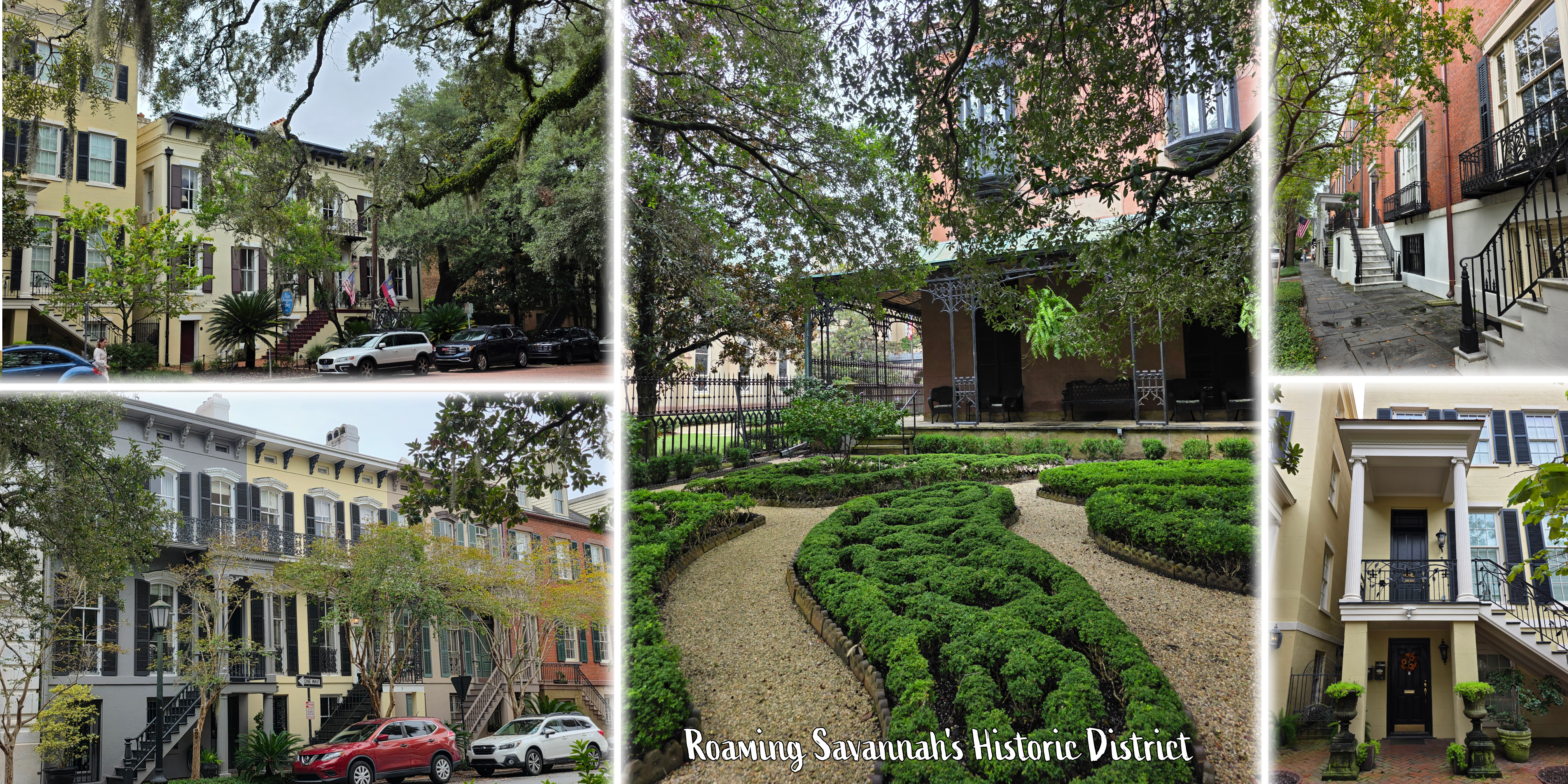
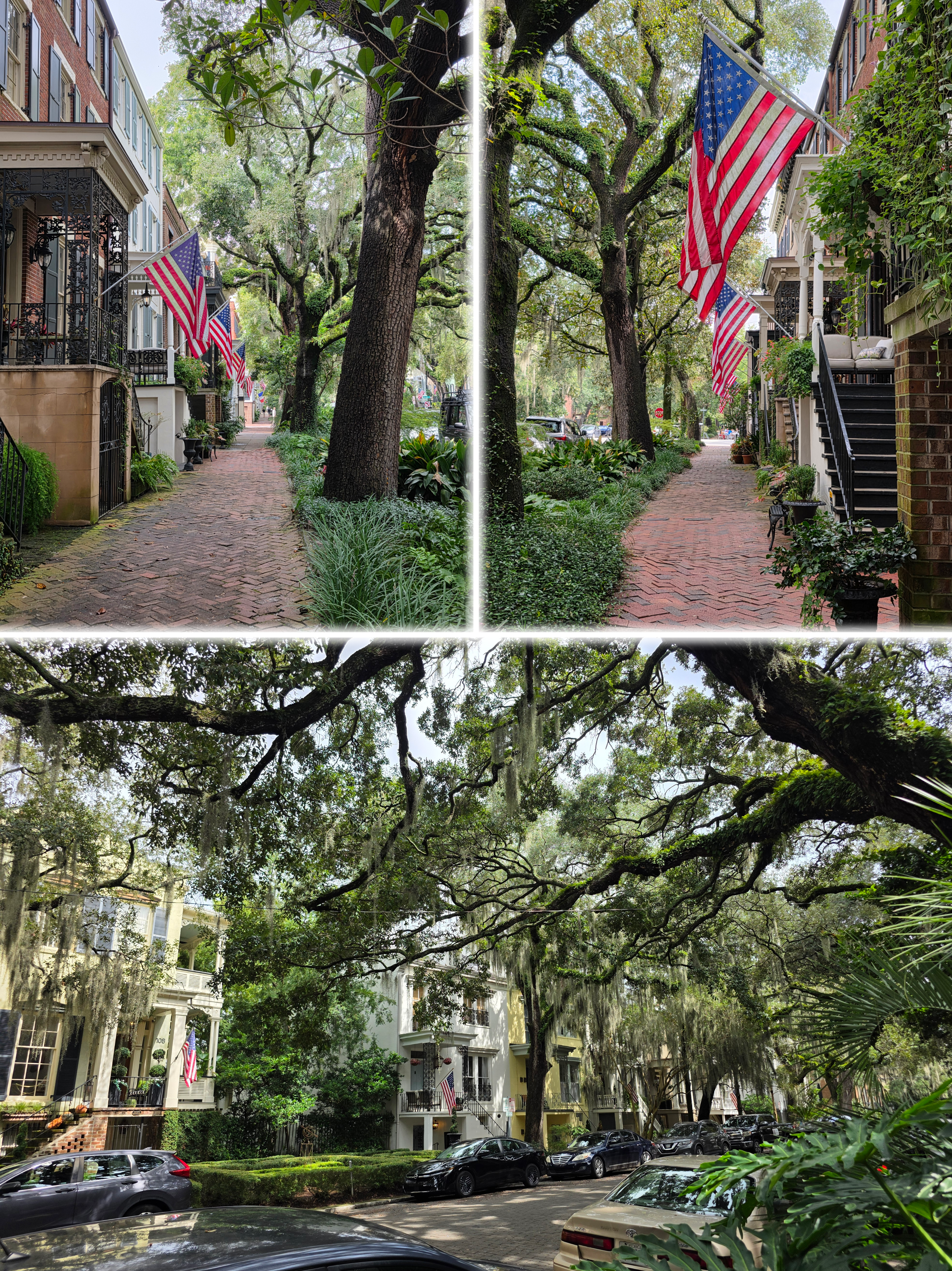
Soon after I passed Jones Street, the aforementioned most beautiful street in Savannah. While I didn’t want to deviate too far, I did walk about half a block down and can fully agree it is stunning, reminiscent in feel – bear with me here – of Chestnut Street in Salem. Many stately houses, well-kept, and lined with trees, just very different from those in New England.
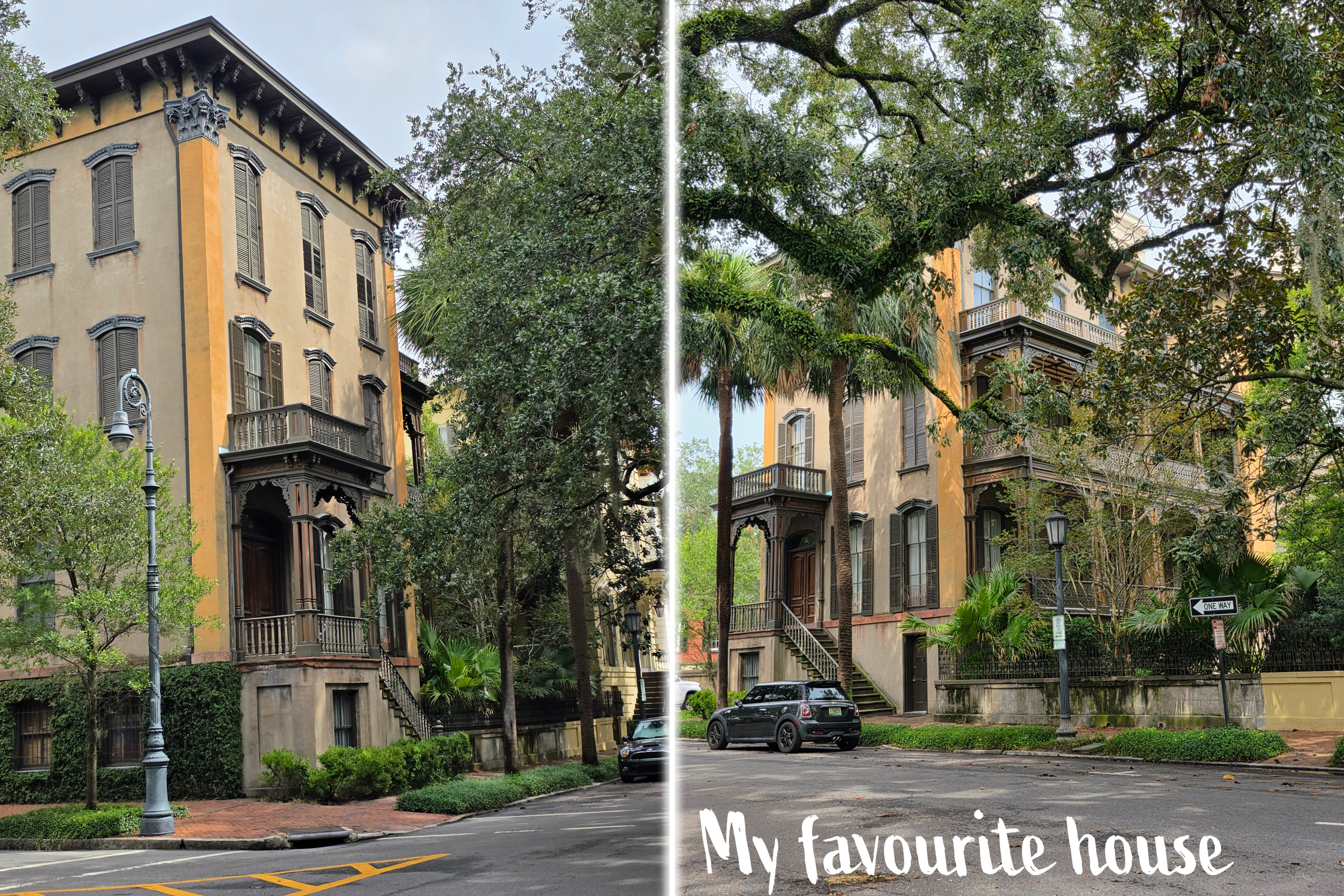
My goal for my planned loop was Monterey Square, due to the convergence of famous spots nearby. Firstly, it is the site of Mickve Israel, as mentioned above. Secondly, it is the location of the Mercer Williams house, made famous by Midnight in the Garden of Good and Evil. Thirdly, I found a house that I decided is my favourite due to its lovely garden (not photographable and only seen through bushes) complete with fountain and long porches. And finally, it is just a really lovely area.
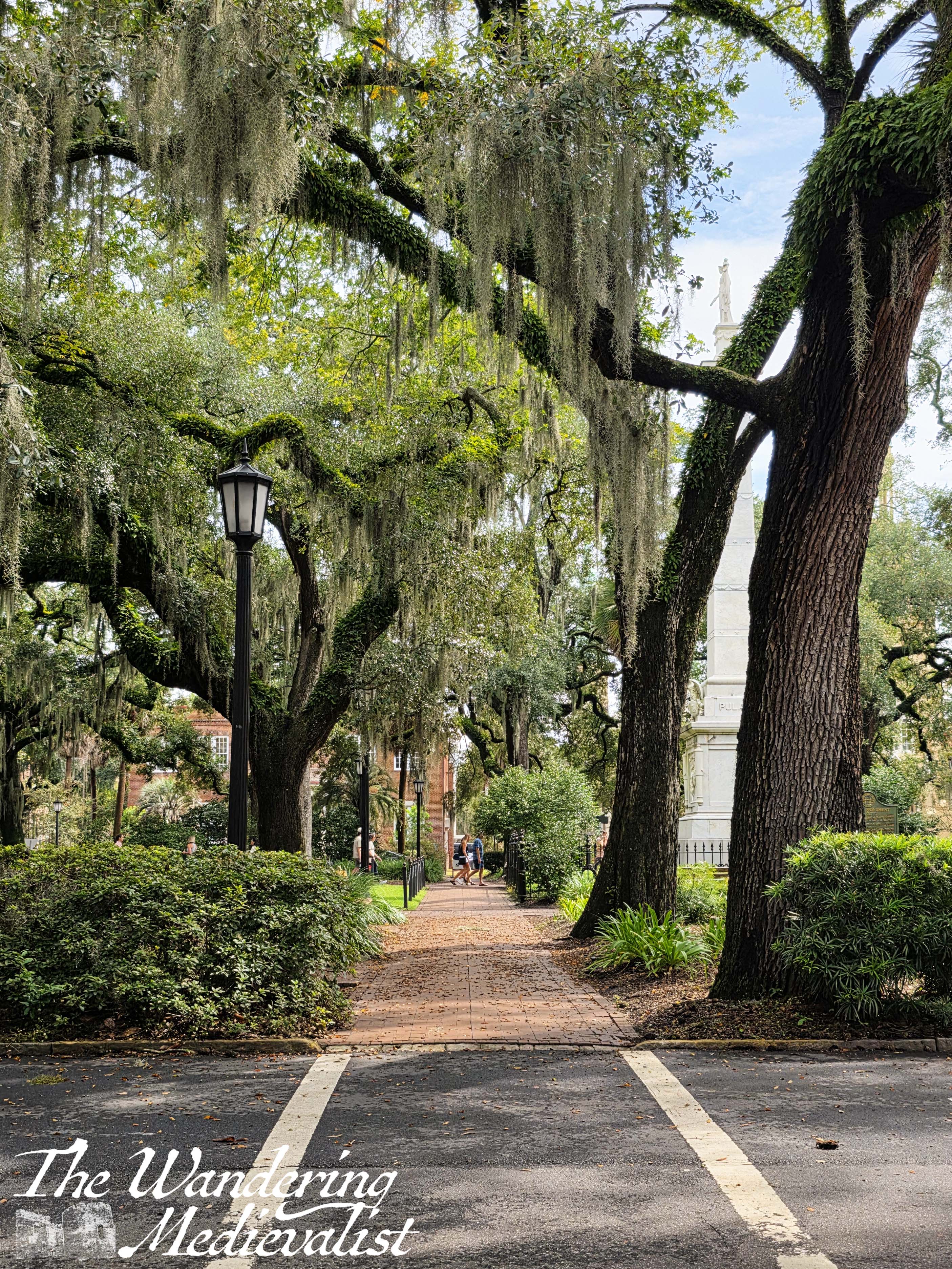
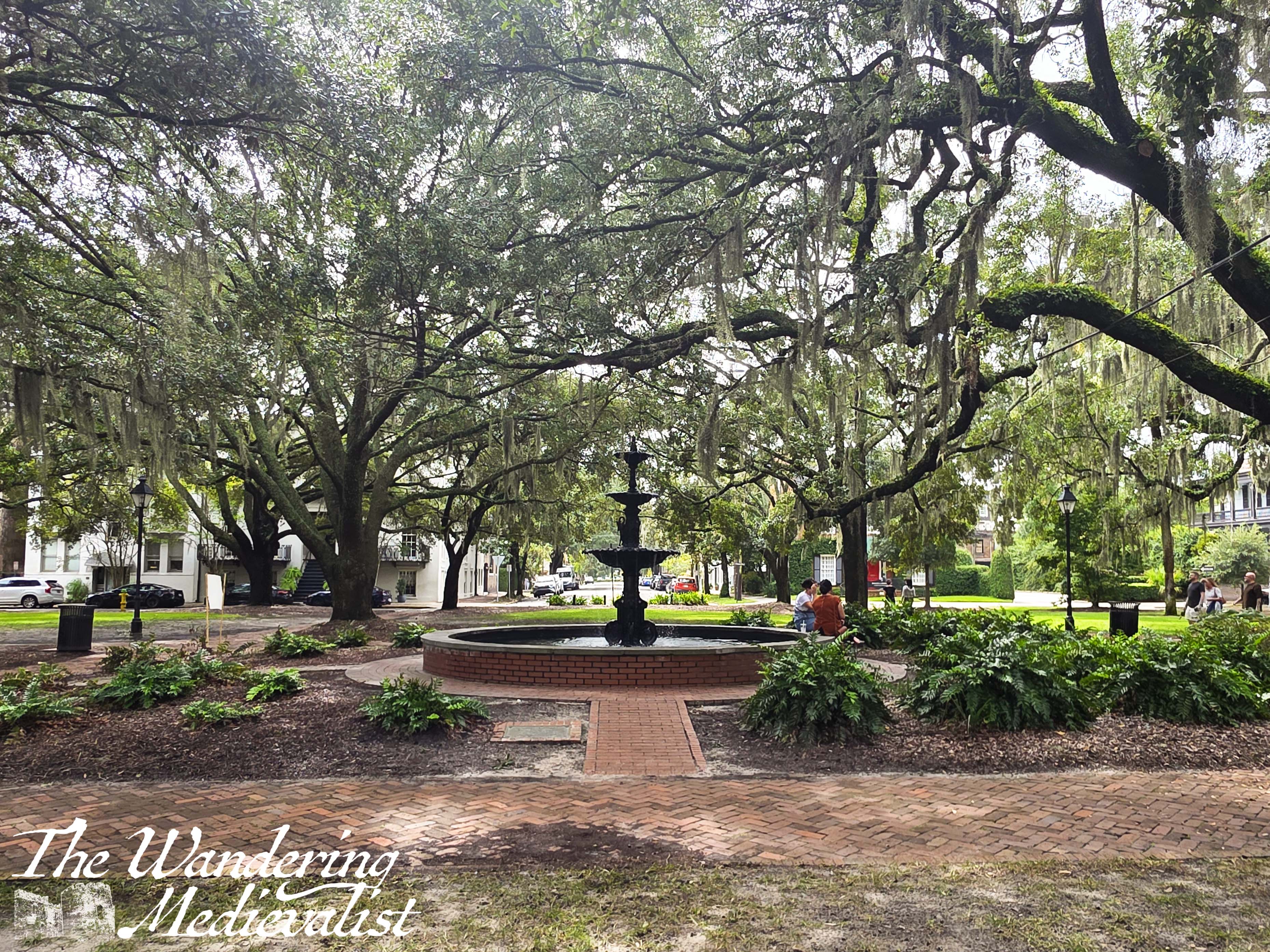
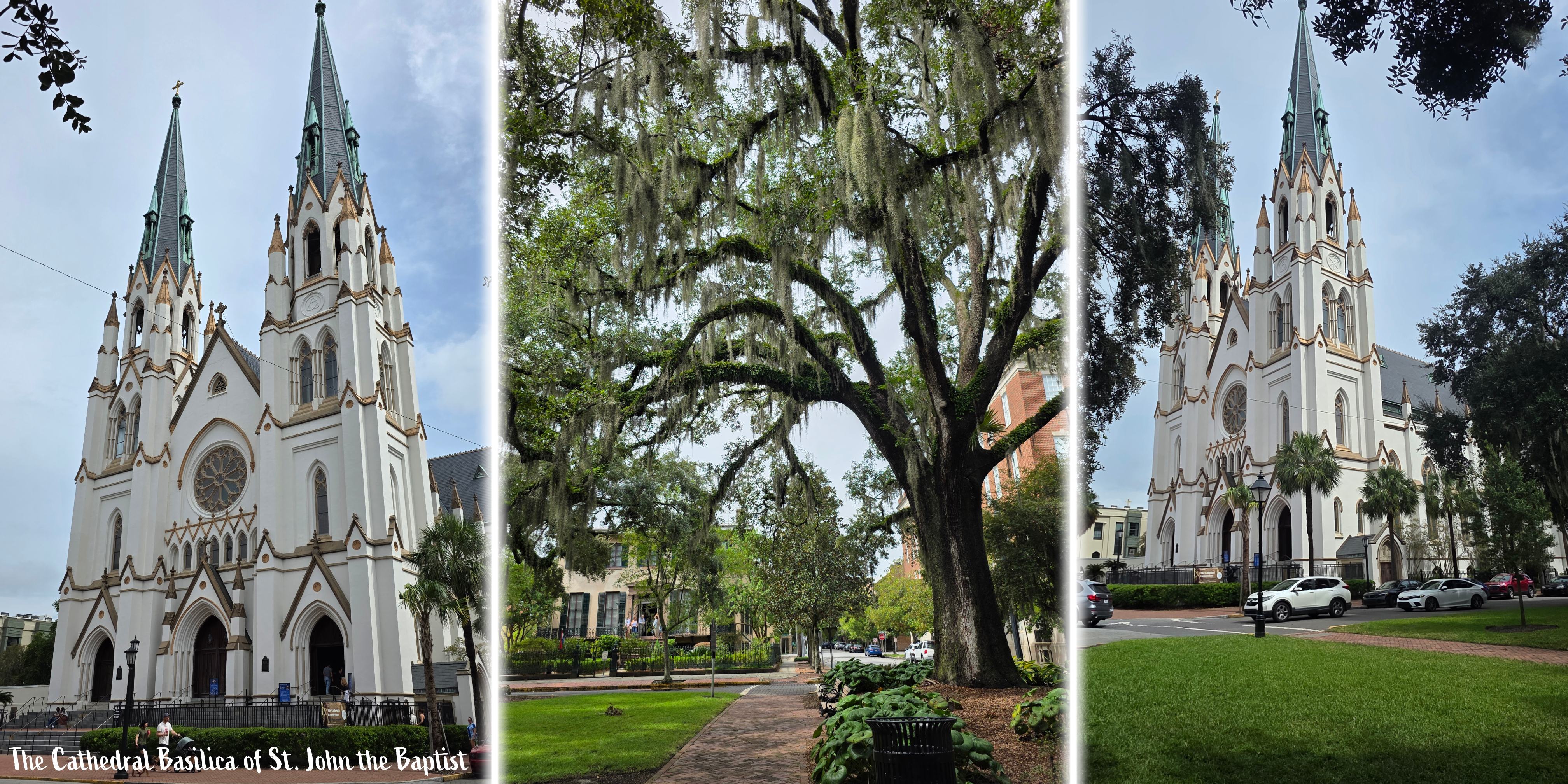
Once I’d had my fill, I headed back north again, taking a right turn along Jones Street until I reached Lafayette Square, named of course for the French hero of the American Revolution. The fountain commemorates the 250th founding of the Georgia colony, and is adjacent to the Roman Catholic Cathedral Basilica of St John the Baptist. The bells for the church were ringing out clearly as it was Sunday, and quite stirring.
I had just about decided that it was time to find lunch when I passed Colonial Park Cemetery, first established in 1750 with its final burials in the 1930s. I could not call myself a fan of cemeteries and not check it out, and so I took a short detour through the grounds. Perhaps most unique in my eyes were the brick tombs, most with a white marble engraving and plants growing from their roofs – quite a different style from what I was accustomed to.
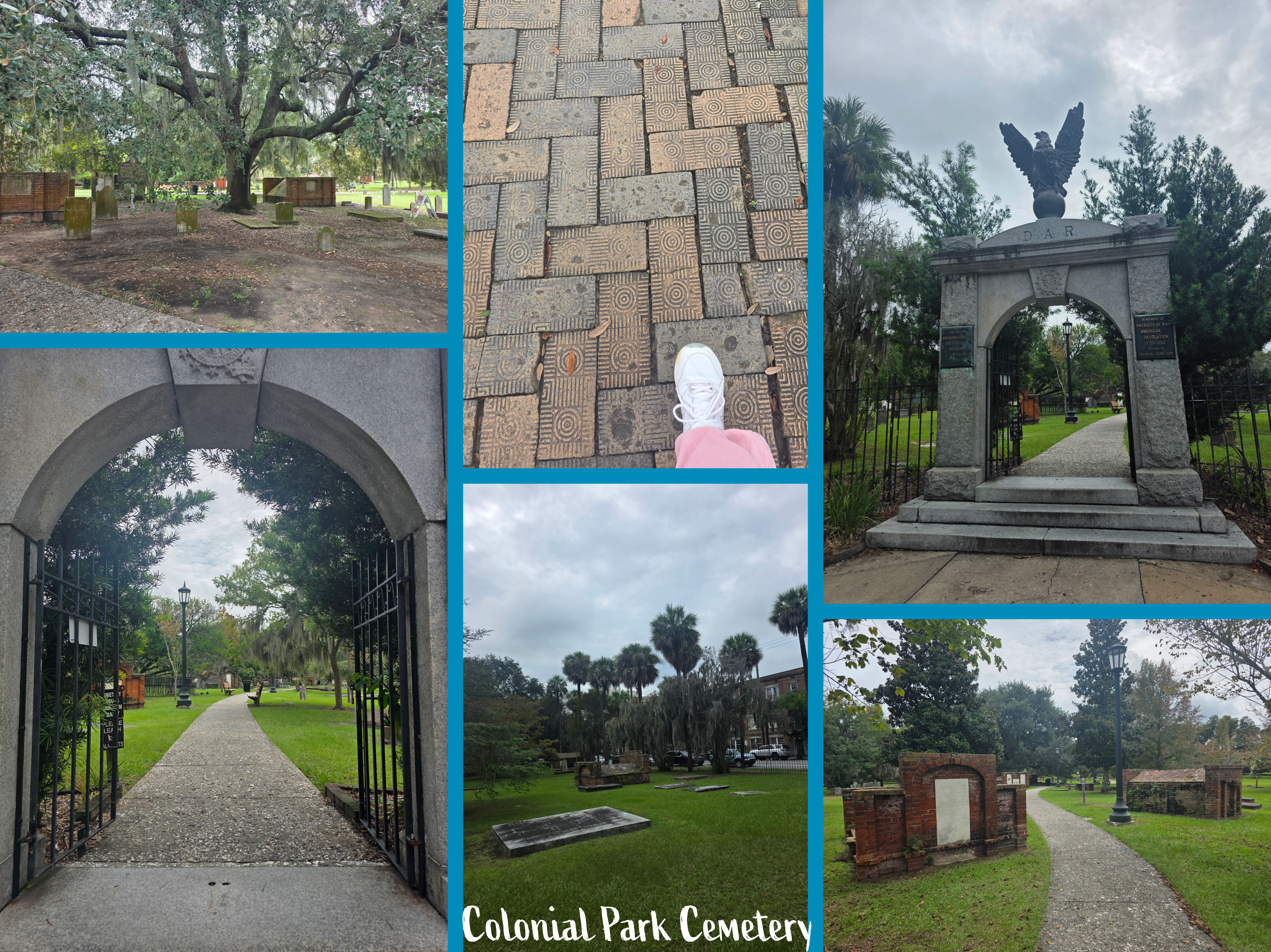
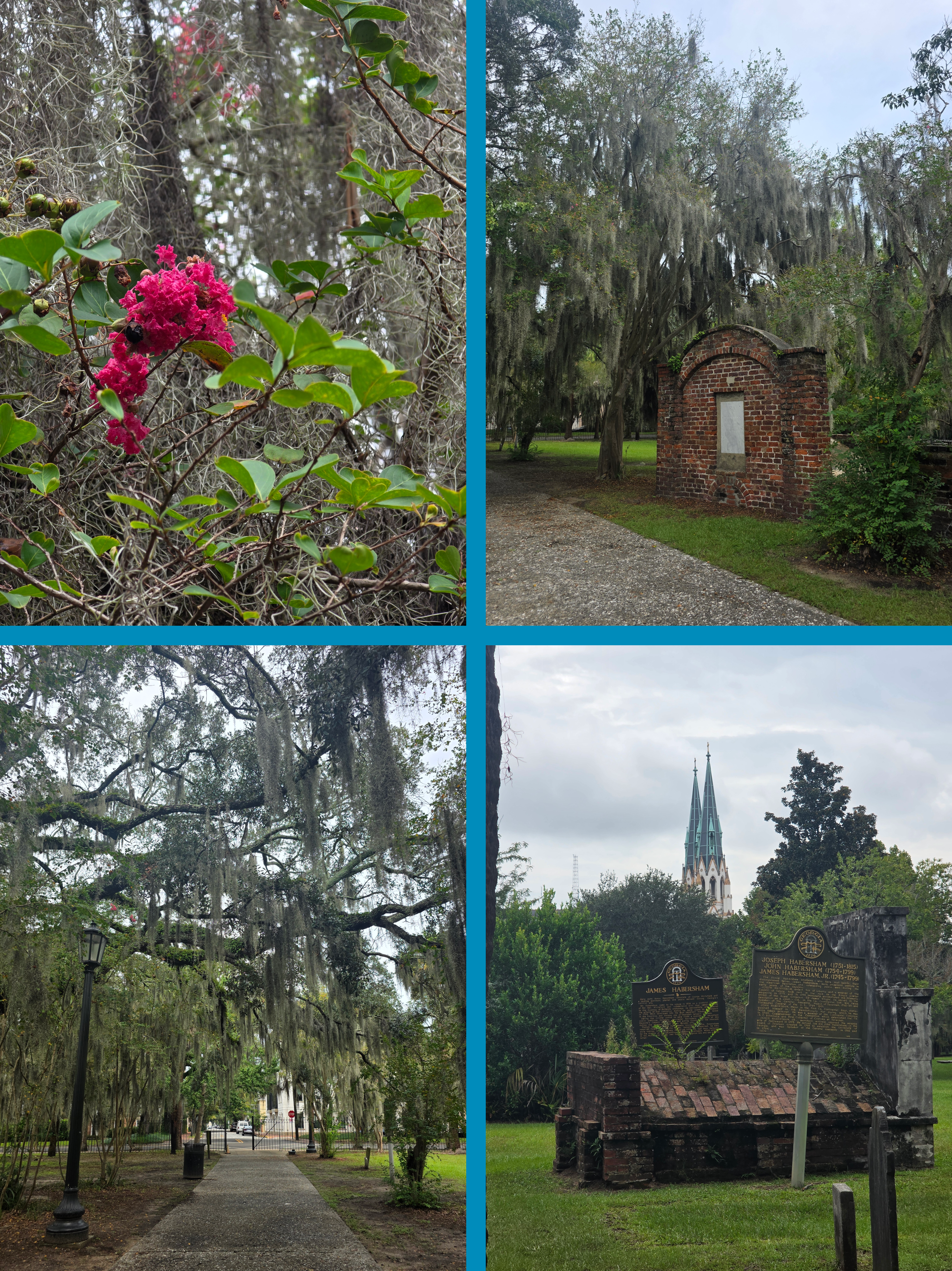
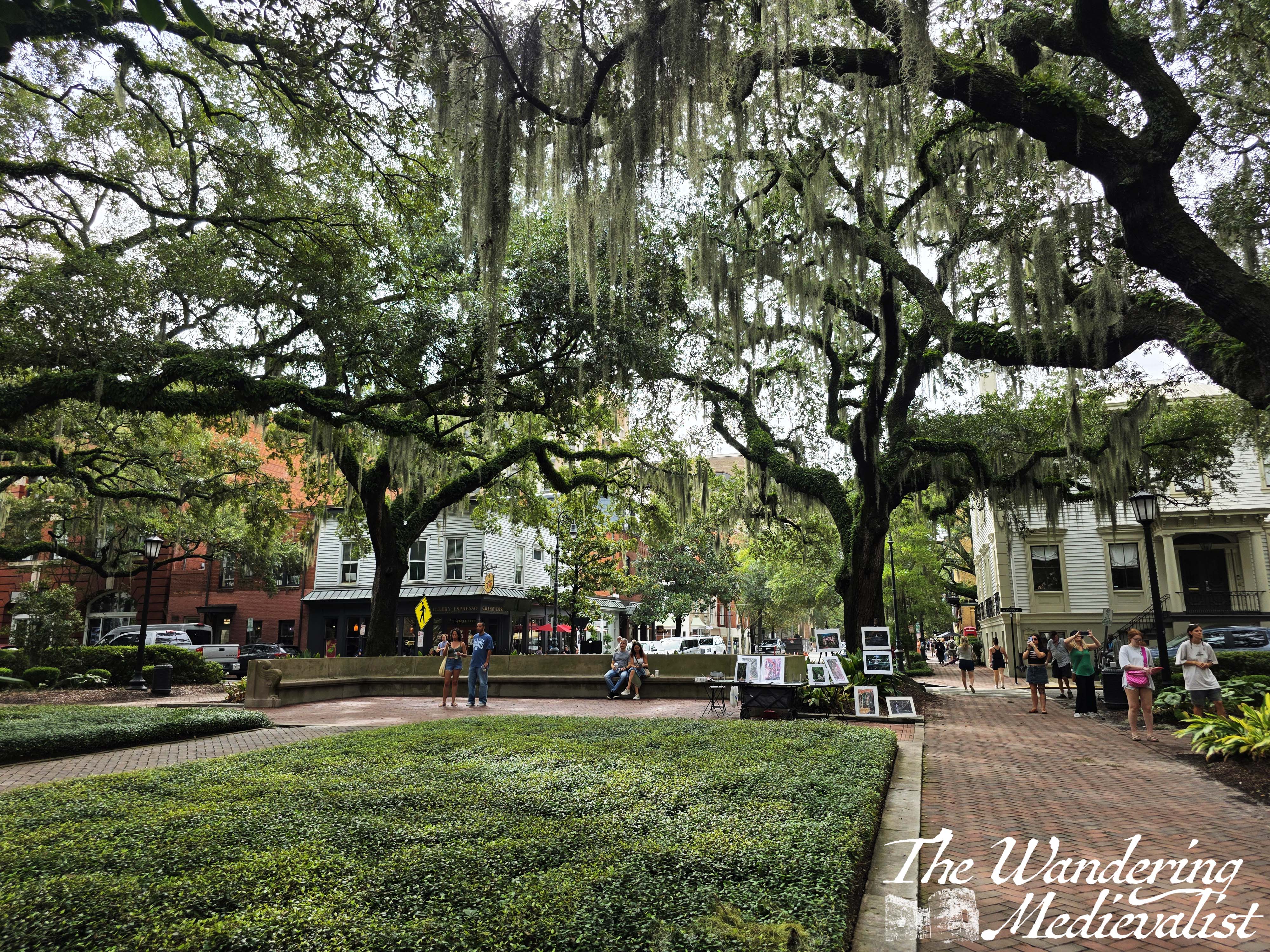
The cemetery also gave me the opportunity to get up close and personal with my new favourite thing – Spanish moss, which as I had been informed by Tiny, is neither Spanish nor moss. Rather, it is a plant belonging to the bromeliad family that has no roots and hangs in threads from trees, absorbing water and dust from the air. It is not parasitic, though Tiny scared us by saying that it was the home of many tiny mites that would burrow into your skin if you touched it. A quick web search assured me this was only if it fell to the ground first.
Most likely due to its novelty, I fell absolutely in love with the graceful, beautiful and somehow almost sorrowful drapings, and the trees on which it grew. If you think you have seen many pictures of trees in this post, well there are more to come, and these were only about half of what I took.
Imagine if it had been sunny?!
After a stroll through the cemetery, I was really starting to feel my blood sugar crashing, so I powered on, declining to take more pictures until I reached Broughton Street, which I recall Tiny telling us had more eateries than anywhere else in the city. A restaurant had been recommended by a friend of my aunt, so I enjoyed an excellent lunch including local shrimp before continuing on my adventure. I did manage to find a few souvenir shops to grab a t-shirt and keychain (my required souvenir from each place I travel) and picked up a treat for later at the Maple Street Biscuit Company. I had not realised it, but the biscuits came with a home-made blueberry compote that was just…perfect.
From Broughton Street I cut down towards the waterfront, but my legs and feet were telling me it was time to head home. The heat in Savannah is paired with a brutal level of humidity, and while there was more I could see, I was exhausted.
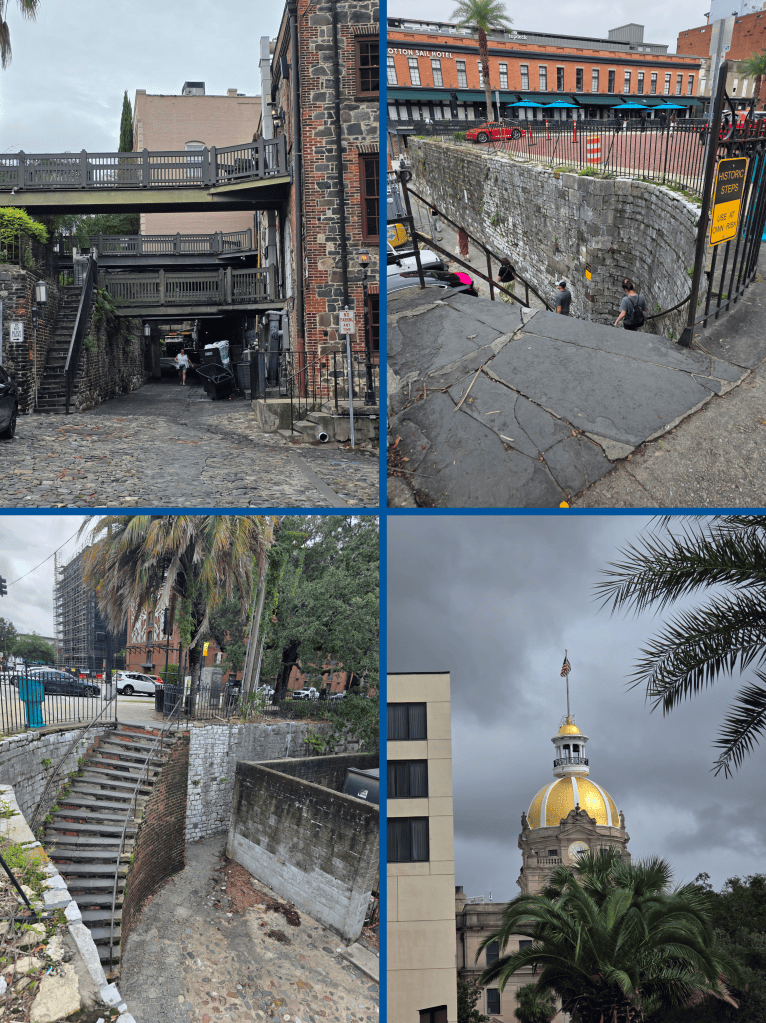
In making my way up to street level, from the waterfront, I climbed these steep, shallow steps and was amused to see a warning sign that they were ‘historic steps’ and not easy to traverse. Even more to my amusement, I heard a British accented-tourist pass by saying, ‘These are just like Cockburn Street in Edinburgh’. Definitely echoes of Craig’s Close anyway.
Reaching the top, I discovered a bench upon which I could wait for an Uber.
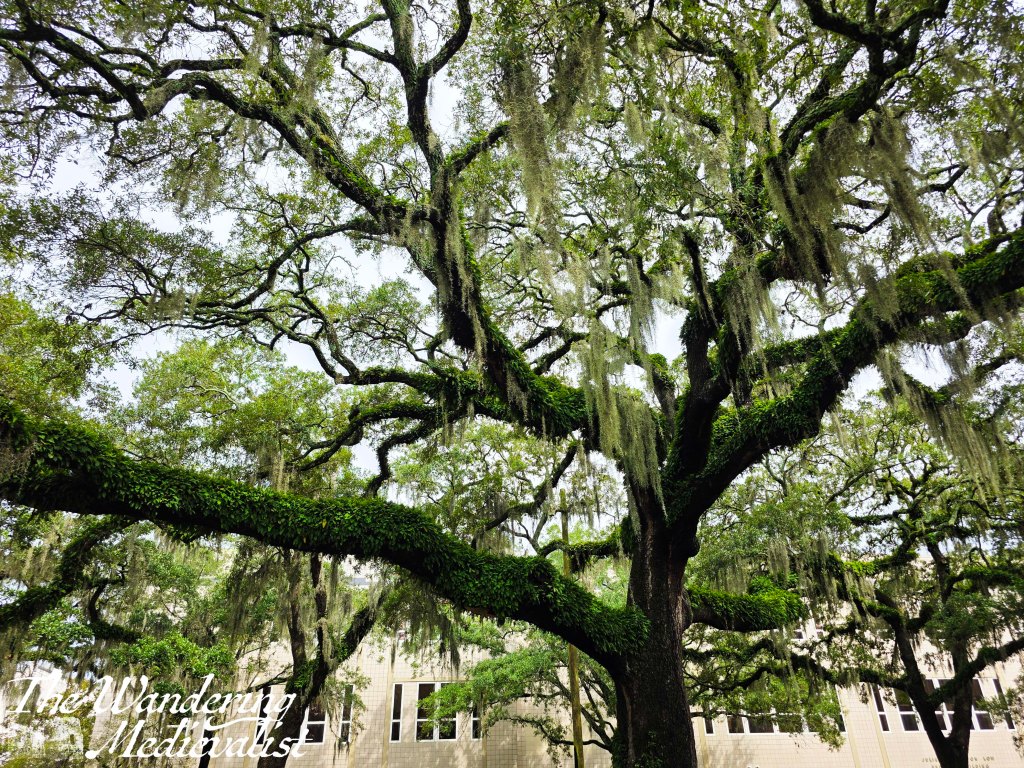
But my Savannah adventure was not quite over. Monday was pouring rain for much of the day, though it let up as I wrapped up my visit to SCAD, and I was allowed some almost fair weather to investigate the Candler Oak. This tree, at the edge of Forsyth Park, was first rooted in the 1700s, and is one of the oldest living landmarks in the area. During the Civil War, stockades were built beneath it for Union officers being held as POWs, and in 2004 it was named to the National Register of Historic Trees (a register I admit I did not know existed). I fell absolutely in love with it, if one can be in love with a tree, and spent a good twenty minutes trying to work out how to accurately capture its sprawling branches, dripping Spanish moss and resurrection ferns, which grow on its bark.
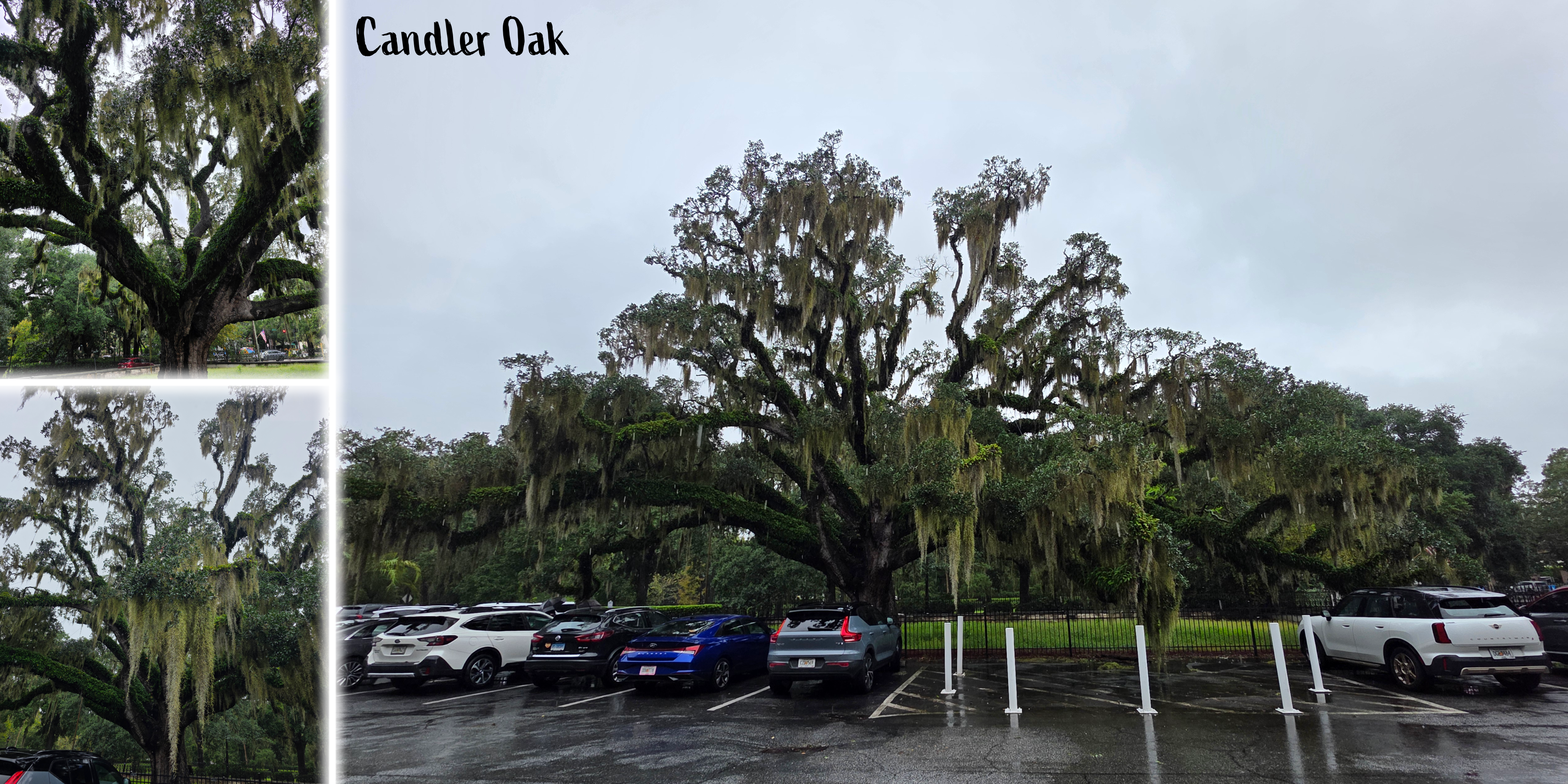
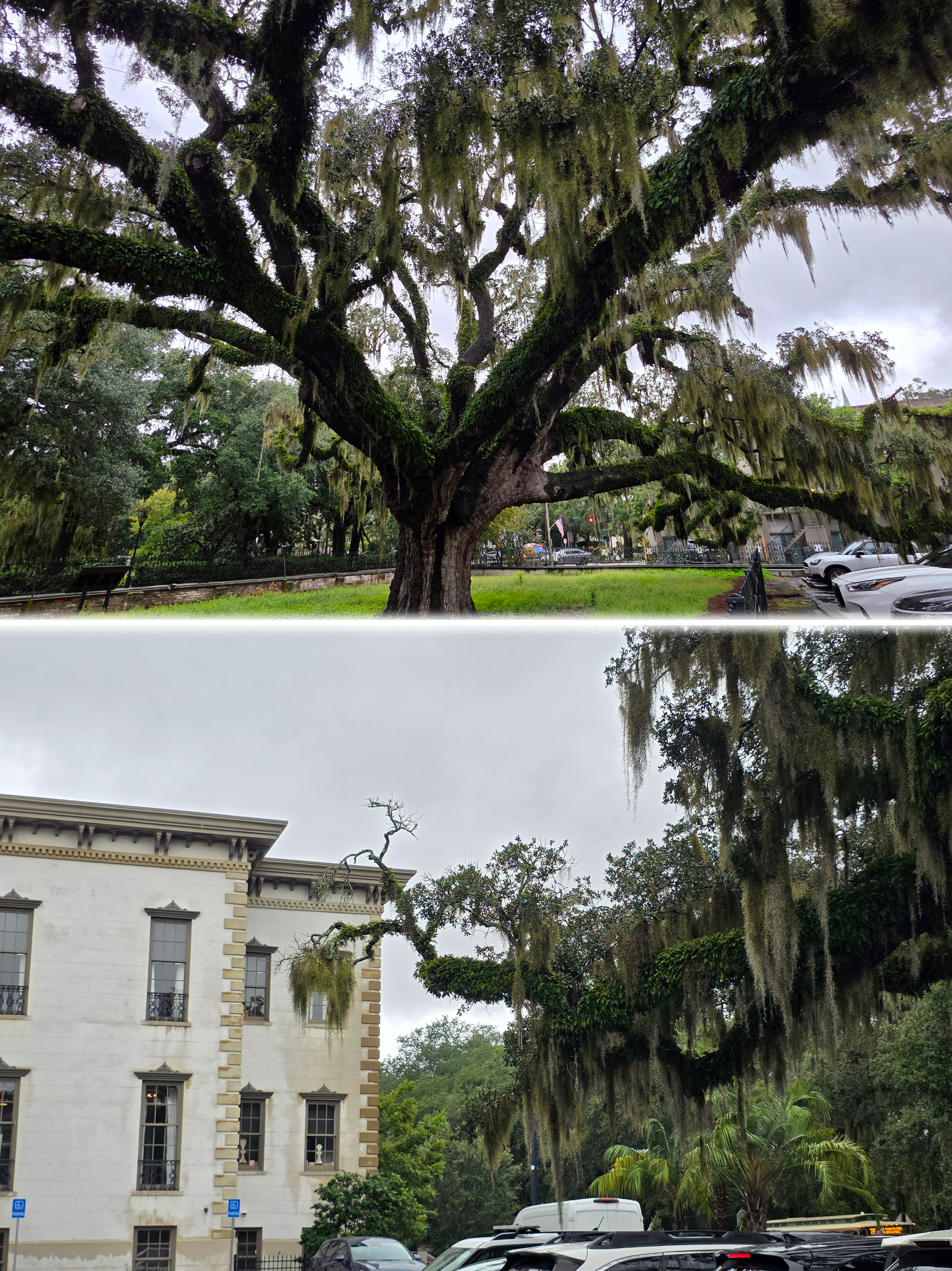
Again, imagine if I had been here in the sun!? Or with my proper camera…
Bonaventure Cemetery
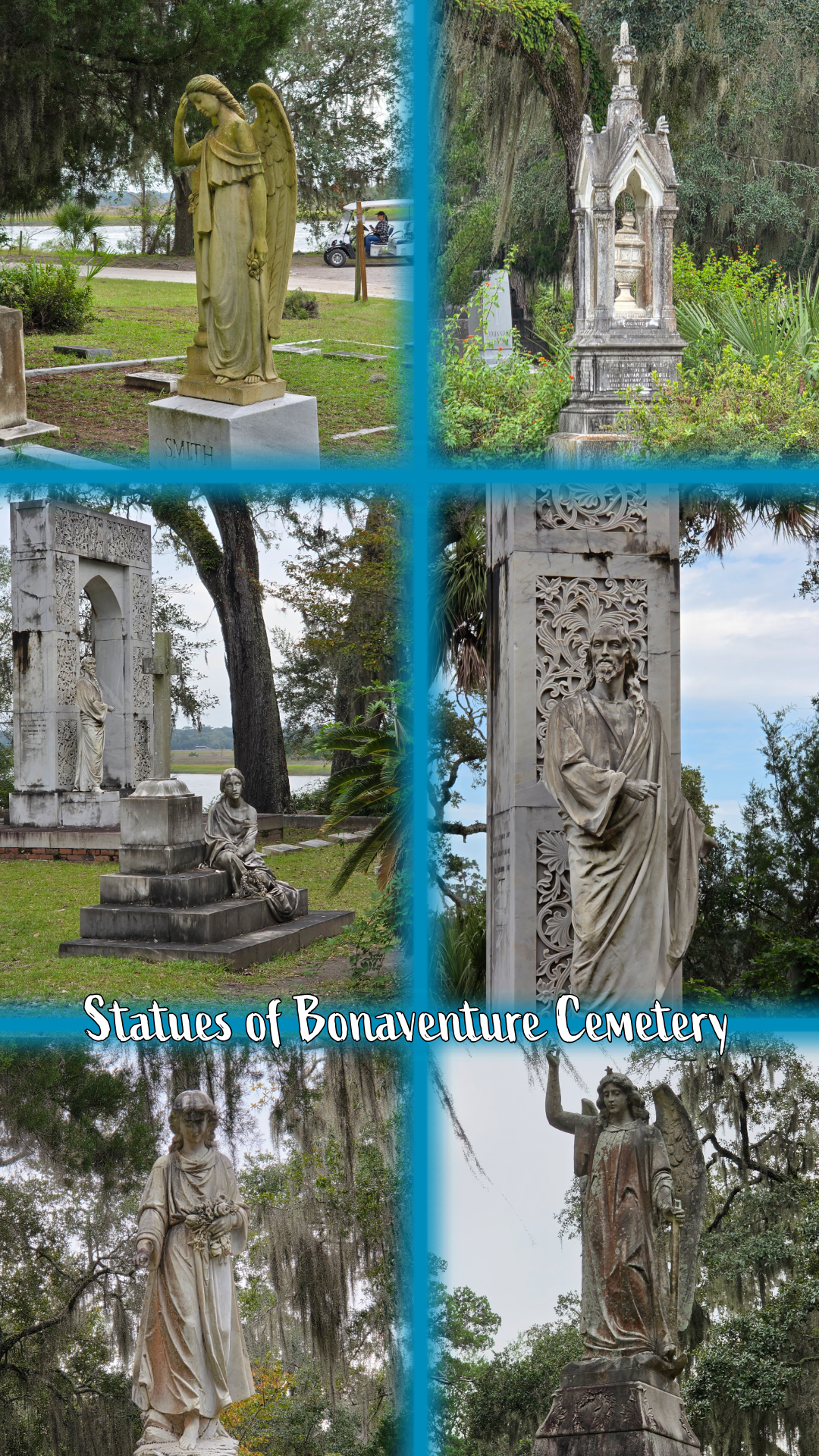
Tuesday was a long day which included checking out of my hotel in preparation for a flight to Minneapolis in the evening, and then visiting several schools. The first was in Savannah proper, and the second out on Wilmington Island, about 20 minutes from the city. As I had a bit of time, I stopped off at Bonaventure Cemetery, one of the only really famous spots in Savannah that I had not yet seen (museums aside). Featured in John Berendt’s book, it is an enormous cemetery of almost 160 acres, located on land originally part of Bonaventure Plantation. I managed to drive in and through the cemetery but did not have time for one of the several walking and golf buggy tours. So, I contented myself with a short walking loop and lots of pictures of trees and statues. I still had to visit two schools, and did not want to be too hot and sweaty.
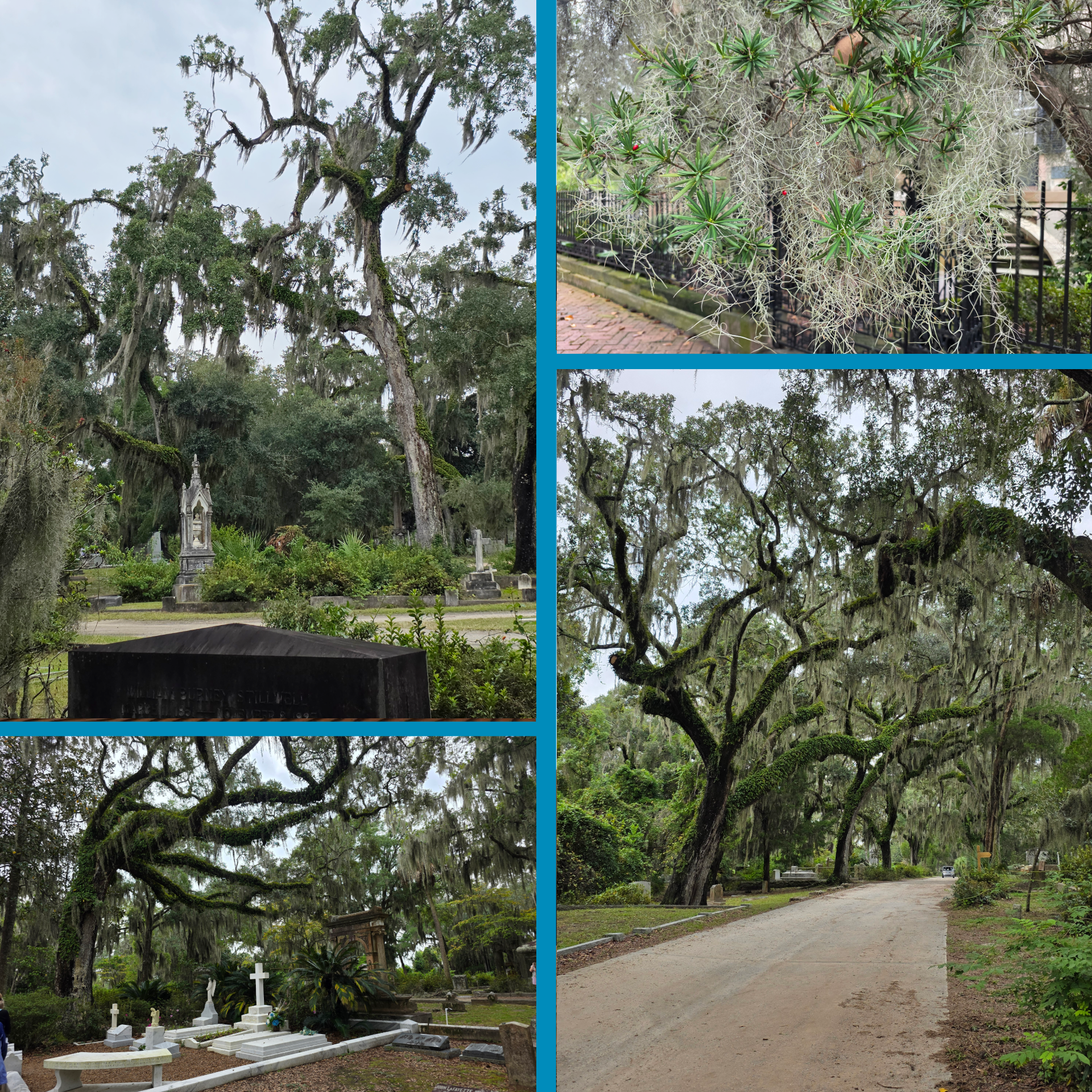
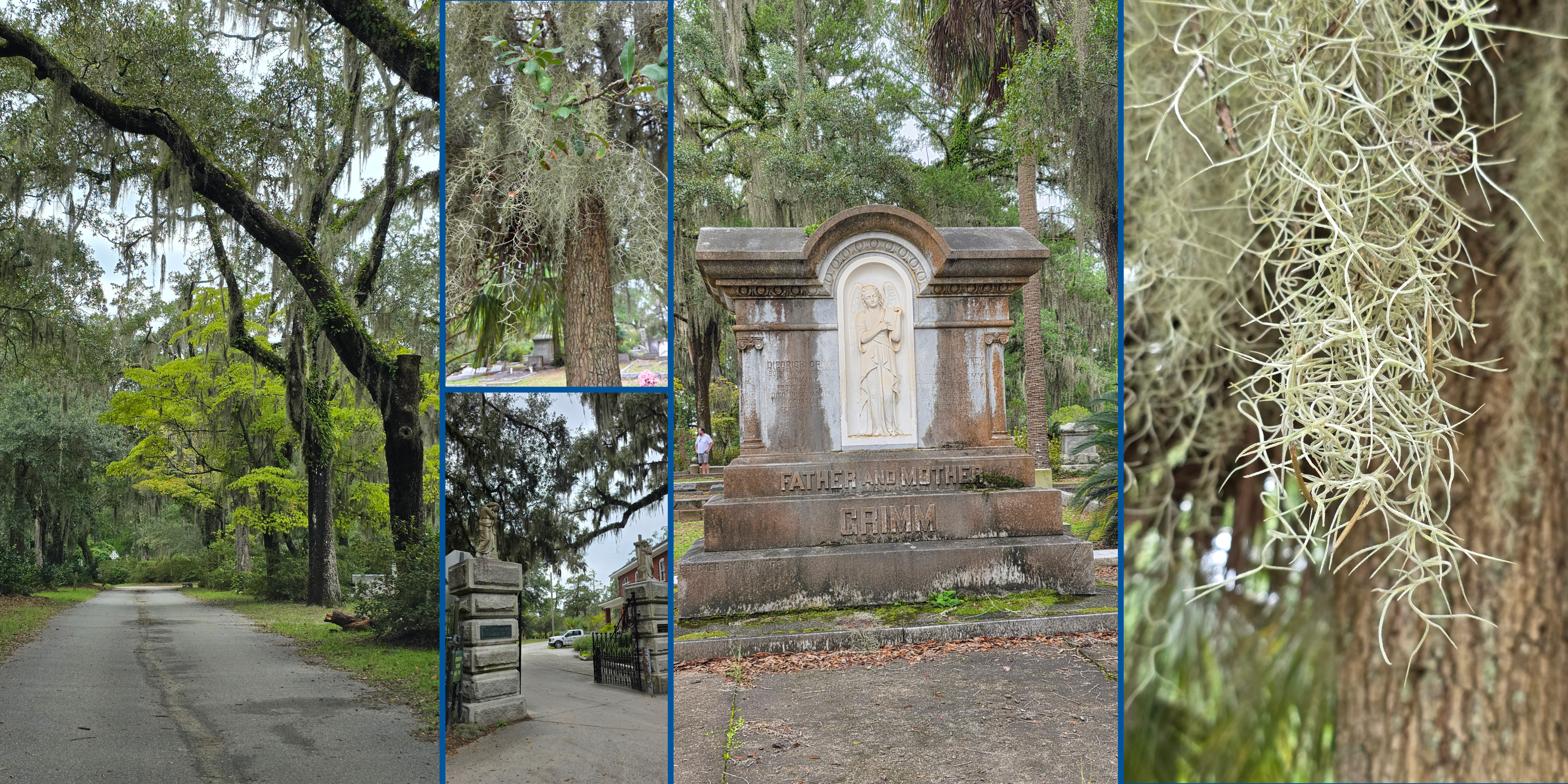
Orleans Square
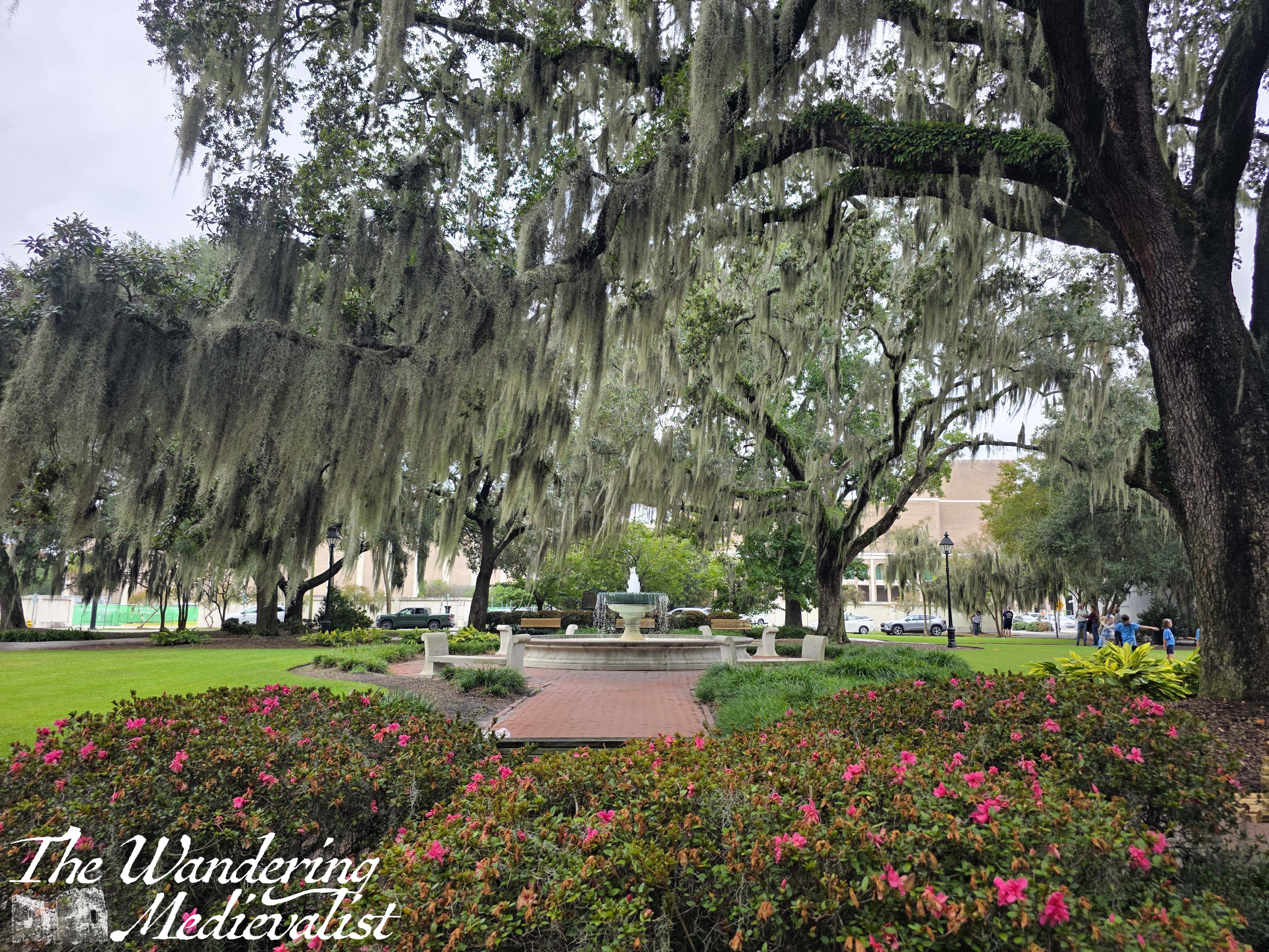
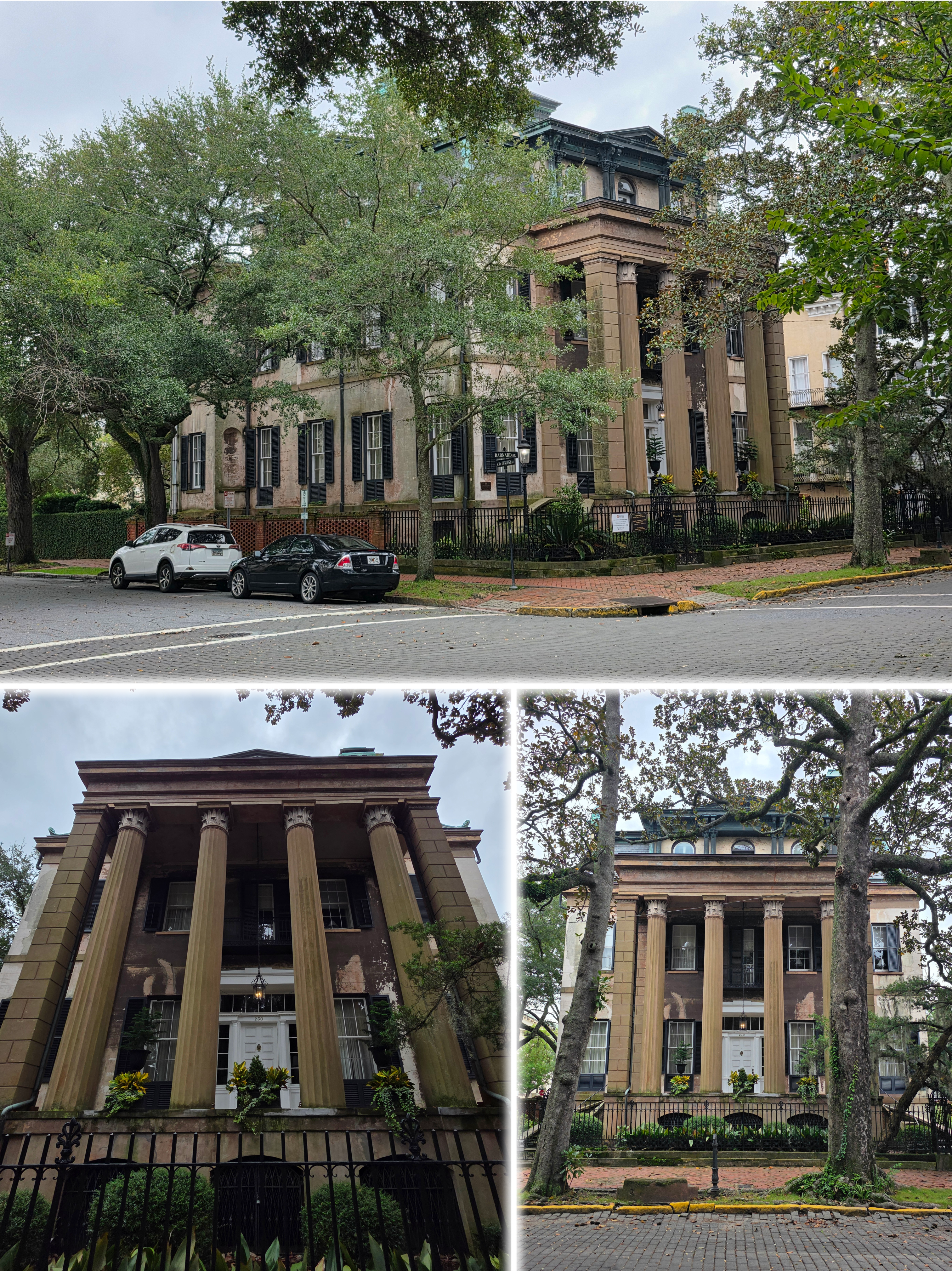
I made quite good time heading back to the airport, and so decided I wanted to make one last stop which was only slightly out of my way. This was Orleans Square, the fountain in which honours the early German immigrants to Savannah. A slight breeze set the Spanish moss to drifting sideways and some pink flowers finally added a bit of colour to a photo. The house is a 1842 Greek Revival mansion, known as the Harper Fowlkes House. Quite an impressive monument.
Wrapping Up
Needless to say, there is plenty about Savannah – and Atlanta – that I did not see. I was not there for tourism, of course. I have also left out a great deal of history, and there were too many amazing, named houses in Savannah to tell you the history of all of them.
While the twisting trees and Spanish moss will stay in my memory forever, one of the most enduring things I took away from my 10 days were the people I met. They were, without exception, kind, friendly and so excited to hear about where I was from and why I was there.
Side note, I can never really decide in these situations whether I should admit that I am American living in Scotland or if I should say, truthfully, that I live in Scotland and see what their reaction is to my accent. Some will look at me a bit funny at which point I will admit I grew up in Boston but some will just take my very slight Scottish accent and word choice as explanation.
One of my favourite interactions was when I stopped for a coffee at a small shop near Atlanta Airport called Yay Beignet, which turned out to be a fantastic little shop with some of the most creative and unique food selections I’ve ever seen. While I waited for my beignets (rude not to order some surely?) I chatted to the owner, who loved the community and the hot weather as it was what he was used to in his home country. If it had not been early morning I would have tried some of their ice cream which had fascinating flavours like Fig and Cognac, Pa-Smashio Wedding Cake, Strawberry Buttermilk and Chocolate Slap Yo’Mama. I can’t believe I forgot to take a picture of the outside, and yes the beignets were excellent. I ate them later in the day by which point they had made my car smell like heaven on earth. The food, particularly when I made an effort to find something outside the chains, was dangerously good.
I’m relatively confident that I will be back to Georgia at some point and I look forward to seeing more of Atlanta.
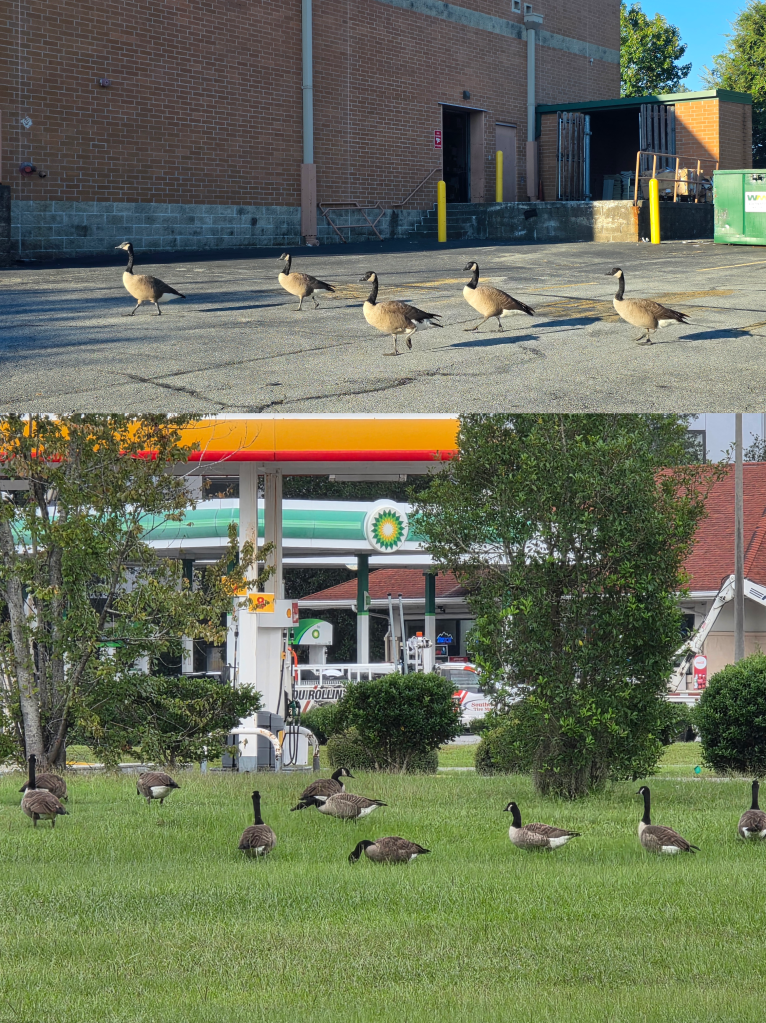
One mystery I have not solved is why there were large flocks of geese wandering around relatively well-populated areas, like near the airport or in a CVS car park. Once or twice, I even had to slam on the brakes as I or the car ahead avoided hitting groups of them in the road.
These may stick with me, too. But not as much as the people, the heat, the humidity, and melt-in-your-mouth buttermilk biscuits.



2 responses to “TWM goes down to Georgia: ten days in the Empire State of the South”
Loved reading this and the photos too! Safe travels.
LikeLiked by 1 person
Thanks so much Fahd!
LikeLike